1884 Liberty Nickel Coin Value: How Much Is It Worth?
The 1884 Liberty Nickel is a Philadelphia-only issue struck in copper-nickel with the With CENTS reverse design. A guide estimate from USA Coin Book places the business strike at about $25 in G4 and around $376 in MS63, while a proof example sits near $344 in PR63.
These are retail guide snapshots, not guaranteed sale prices, and individual coins vary with condition and eye appeal.
Fast Way to Identify Your 1884 Liberty Nickel
Want a quick read on your 1884 Liberty Nickel? Upload clear photos of the front and back, and our identifier can offer a preliminary identification of the version and approximate condition.
Good lighting and a steady shot of both faces go a long way toward a useful result.
1884 Liberty Nickel Value
Upload both sides of your 1884 Liberty Nickel.
Front Obverse
Upload photo
Back Reverse
Upload photo
Which 1884 Liberty Nickel Versions Are Worth Money?
- Business strikes in MS63 or above carry a guide value around $376, well above the $25 level of a G4 coin, making condition the biggest value driver.
- Proof strikes graded PR63 anchor near $344 in the USA Coin Book guide; original surfaces without heavy hairlines matter most.
- Repunched date varieties, where remnants of an earlier punch position appear near the date digits, are a recognized collectible category for this year.
- Lamination or split-planchet errors have been reported on 1884 nickels and can add collector interest when clearly visible and authenticated.
Step 1: Identify Your 1884 Liberty Nickel Mint Mark and Version
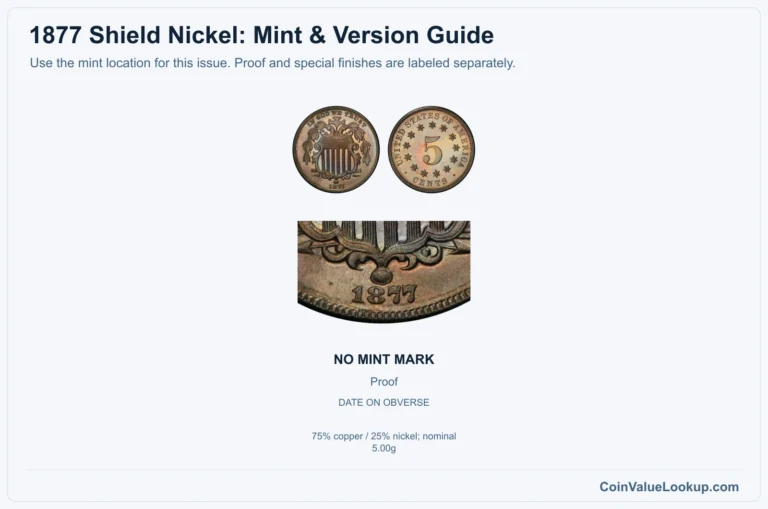
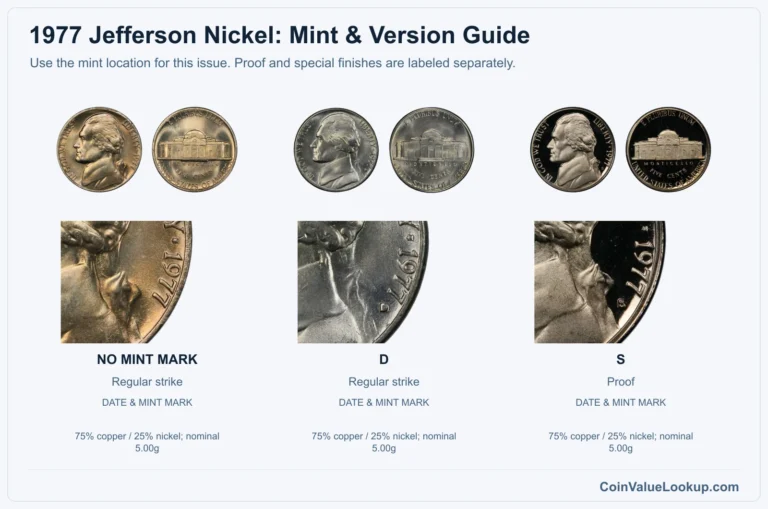
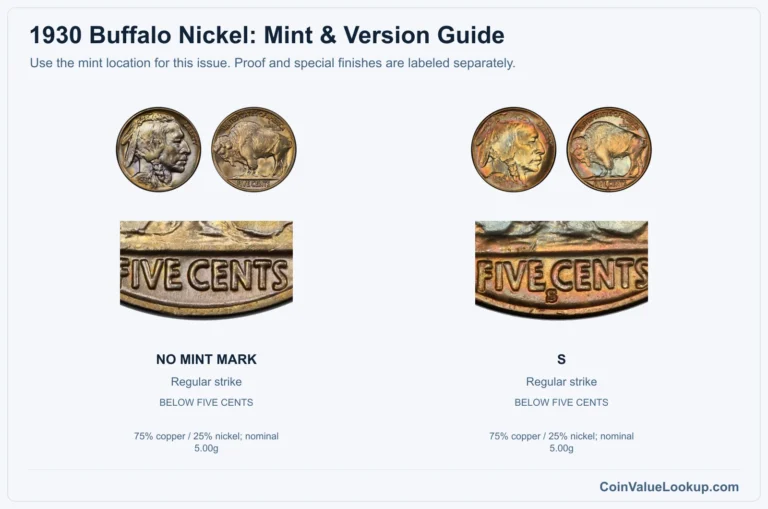
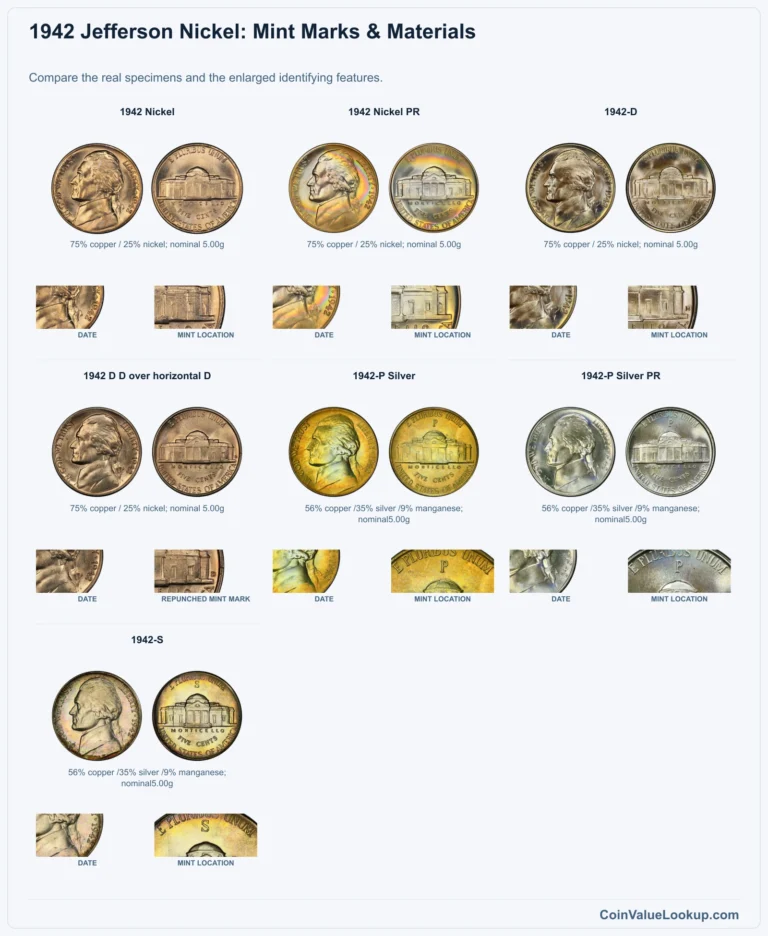
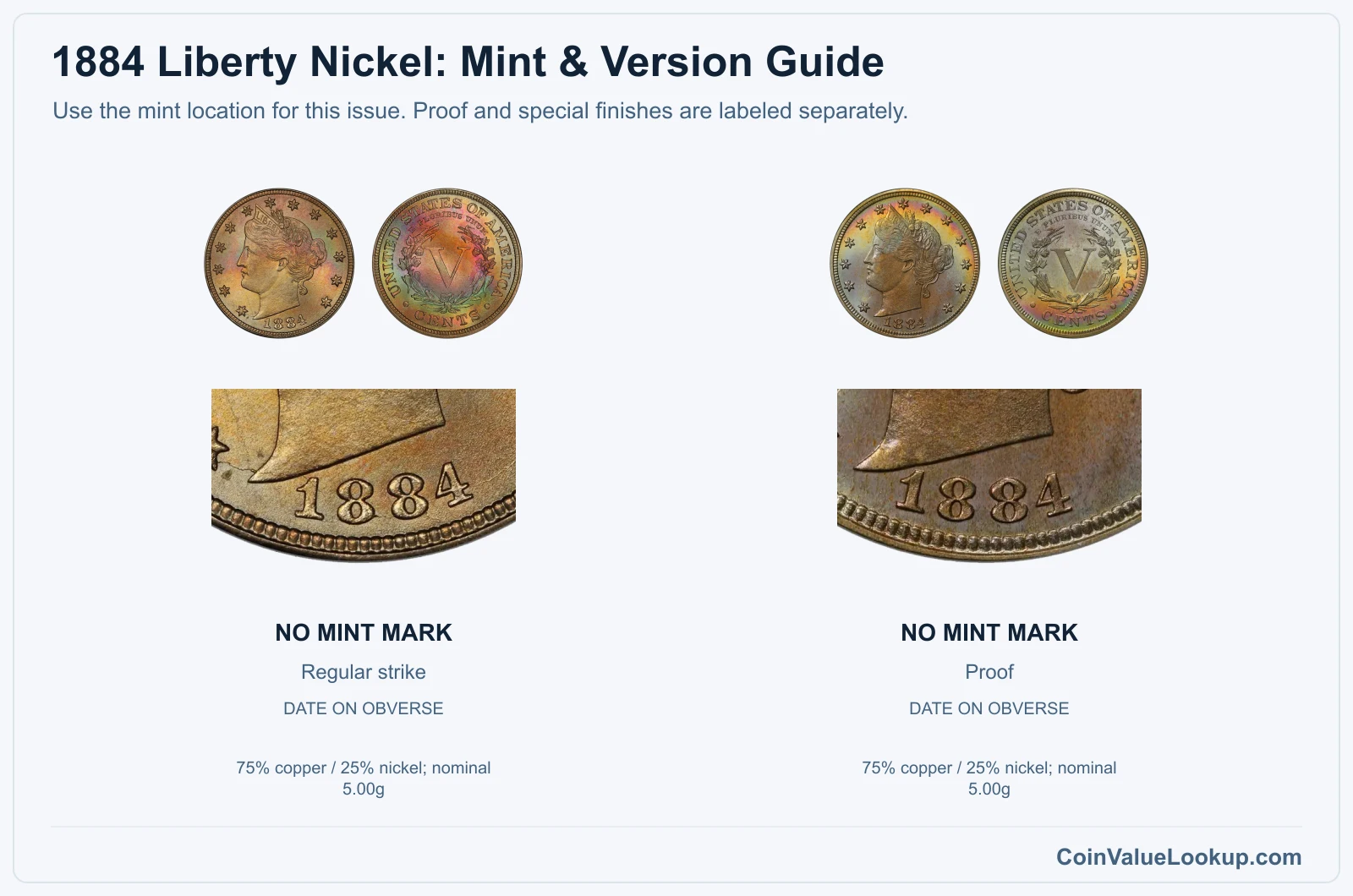
Every 1884 Liberty Nickel was struck at Philadelphia. There is no mintmark to hunt for, and no branch-mint versions exist for this date.
The coin is 75% copper and 25% nickel, weighs about 5 grams, measures 21.2 mm across, and has a plain edge.
All 1884 nickels carry the With CENTS reverse, so you will see the word CENTS at the bottom of the wreath. The earlier No CENTS design applied only to 1883.
One thing that trips people up: some business strikes can look extremely shiny and mirror-like, almost prooflike. That reflective surface alone does not make a coin a proof.
Proof is a specific manufacturing method involving specially prepared dies and planchets, and establishing proof status requires careful comparison of the fields, rims, and overall strike character against known proof examples.
Step 2: Check Your 1884 Liberty Nickel Grade
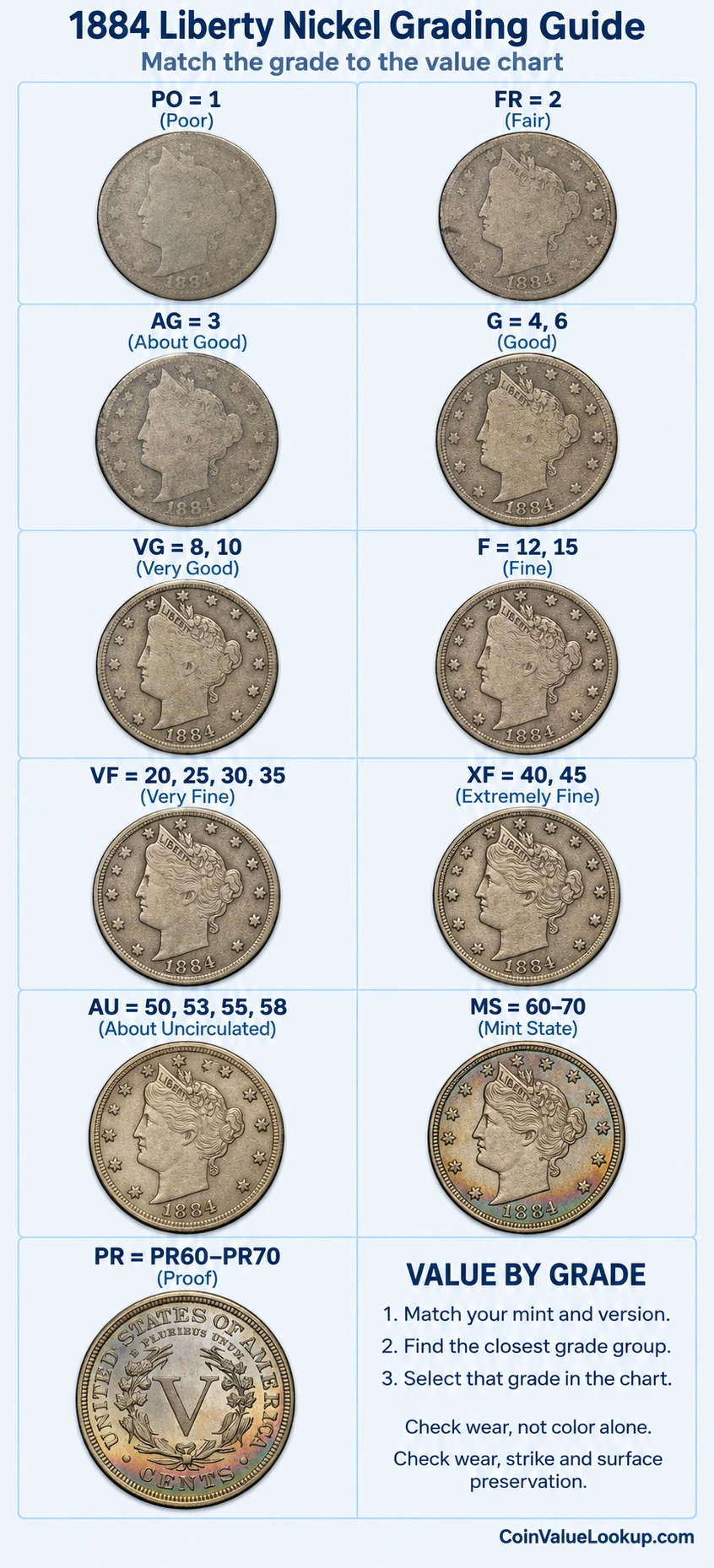
Start with the word LIBERTY on the coronet. On a well-worn coin those letters disappear from right to left, with Y and T going first.
If all letters are sharp but the coin still looks tired, check the high points of the hair curls above the ear and the cheek below the eye.
On the reverse, the ear of corn and the inner wreath leaves take wear early. But be careful: weak detail in these spots can also come from a soft strike at the mint, not from circulation.
Look at the fields and overall luster before concluding the coin is worn.
For mint-state pieces, judge luster quality, the number and severity of contact marks, and strike sharpness together. Compare your coin against the reference image to calibrate your eye.
If you suspect you have a proof, examine the fields for a deeply mirrored surface and inspect the rims for squared-off edges. Hairlines from old cleanings are common on proofs and will affect the grade.
A proof is a manufacturing category, not a grade higher than Mint State.
Step 3: Check 1884 Liberty Nickel Value by Mint and Version
1884 Liberty Nickel — No Mint Mark — With CENTS Circulation
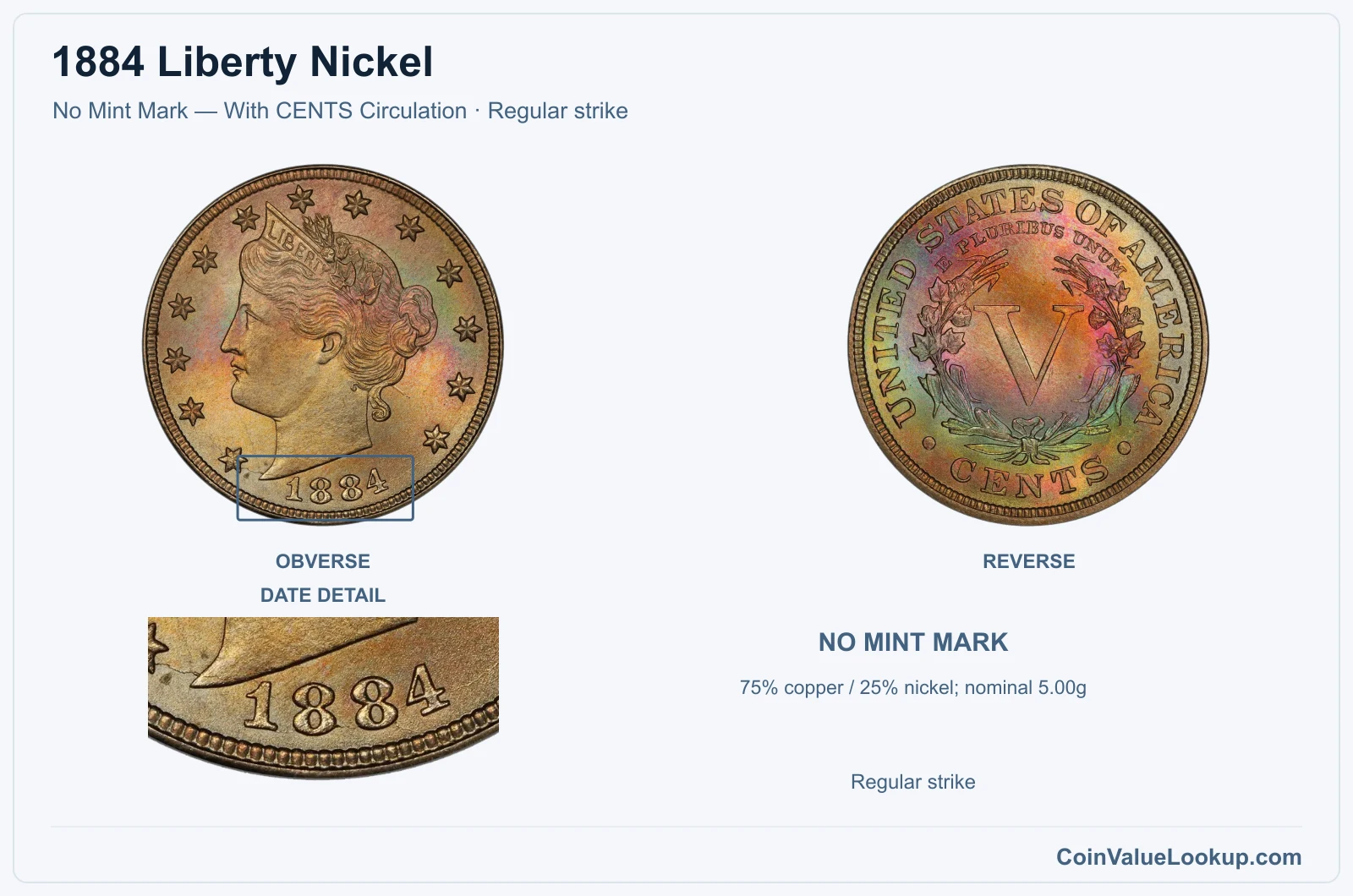
The standard 1884 Liberty Nickel business strike was produced at Philadelphia with no mintmark. It uses the With CENTS reverse that became standard partway through 1883.
USA Coin Book's guide estimate runs from about $25 in G4 to roughly $376 in MS63.
Don't let a flashy surface fool you. Some business strikes come off the dies looking almost mirror-like, but prooflike appearance on a business strike is not the same as a proof.
If you are trying to figure out whether your coin is a regular strike or a proof, field texture, rim sharpness, and overall die characteristics matter more than shine.
Range Grade
Price Auction Records Appraisal PO PO 1
—
Coin Identifier FR FR 2
—
Coin Identifier AG AG 3
—
Coin Identifier G G 4
—
Coin Identifier
G 6
—
Coin Identifier VG VG 8
—
Coin Identifier
VG 10
Coin Identifier F F 12
—
Coin Identifier
F 15
—
Coin Identifier VF VF 20
—
Coin Identifier
VF 25
—
Coin Identifier
VF 30
—
Coin Identifier
VF 35
Coin Identifier XF XF 40
Coin Identifier
XF 45
Coin Identifier AU AU 50
Coin Identifier
AU 53
Coin Identifier
AU 55
Coin Identifier
AU 58
Coin Identifier MS MS 60
Coin Identifier
MS 61
Coin Identifier
MS 62
Coin Identifier
MS 63
Coin Identifier
MS 64
Coin Identifier
MS 65
Coin Identifier
MS 66
Coin Identifier
MS 67
Coin Identifier
MS 68
—
—
—
MS 69
—
—
—
MS 70
—
—
—
1884 Liberty Nickel — No Mint Mark — With CENTS Proof
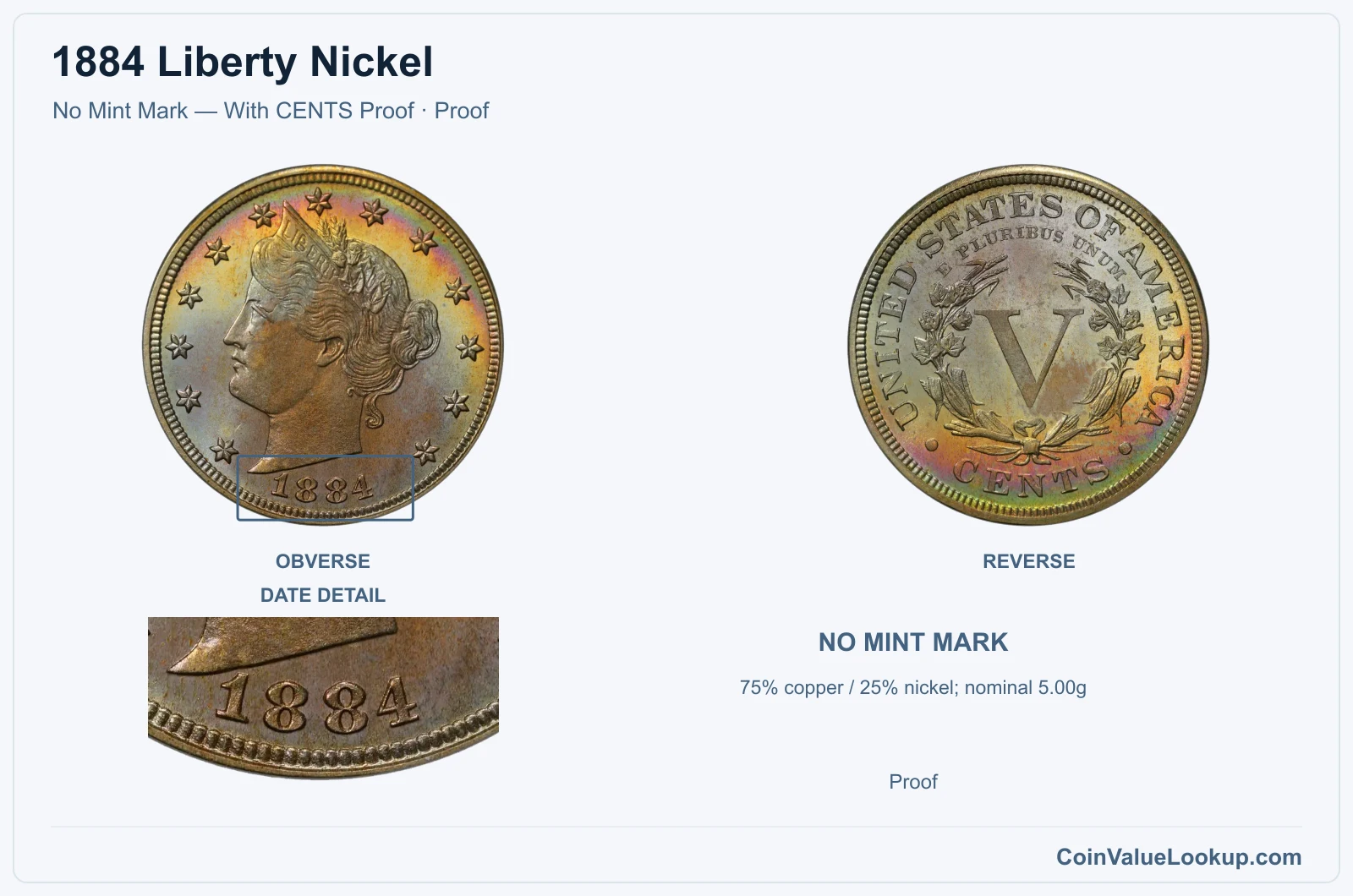
Philadelphia also struck proof Liberty Nickels in 1884 for collectors, using the same With CENTS reverse design. The USA Coin Book guide places a PR63 example at about $344.
To identify a proof, look for deeply mirrored fields, sharply squared rims, and a full, crisp strike across every design element. Hairlines from past wiping are the most common condition issue on proofs and will push the grade down.
Cameo or deep-cameo designations, where the devices appear frosty against mirror fields, are additional classifications some grading services apply.
Coin Value Lookup is a handy starting point if you want to compare this date against other Liberty Nickel years or check values across different series. Bookmark it for your next pocket find.
Range Grade
Price Auction Records Appraisal PR PR 1
—
Coin Identifier
PR 2
—
Coin Identifier
PR 3
—
Coin Identifier
PR 4
—
Coin Identifier
PR 6
—
Coin Identifier
PR 8
—
Coin Identifier
PR 10
—
Coin Identifier
PR 12
—
Coin Identifier
PR 15
—
Coin Identifier
PR 20
—
Coin Identifier
PR 25
—
Coin Identifier
PR 30
—
Coin Identifier
PR 35
—
Coin Identifier
PR 40
—
Coin Identifier
PR 55
Coin Identifier
PR 58
Coin Identifier
PR 60
Coin Identifier
PR 61
Coin Identifier
PR 62
Coin Identifier
PR 63
Coin Identifier
PR 64
Coin Identifier
PR 65
Coin Identifier
PR 66
Coin Identifier
PR 67
Coin Identifier
PR 68
—
—
—
PR 69
—
—
—
PR 70
—
—
—
1884 Liberty Nickel Error List
1. 1884 Liberty Nickel — Repunched Date
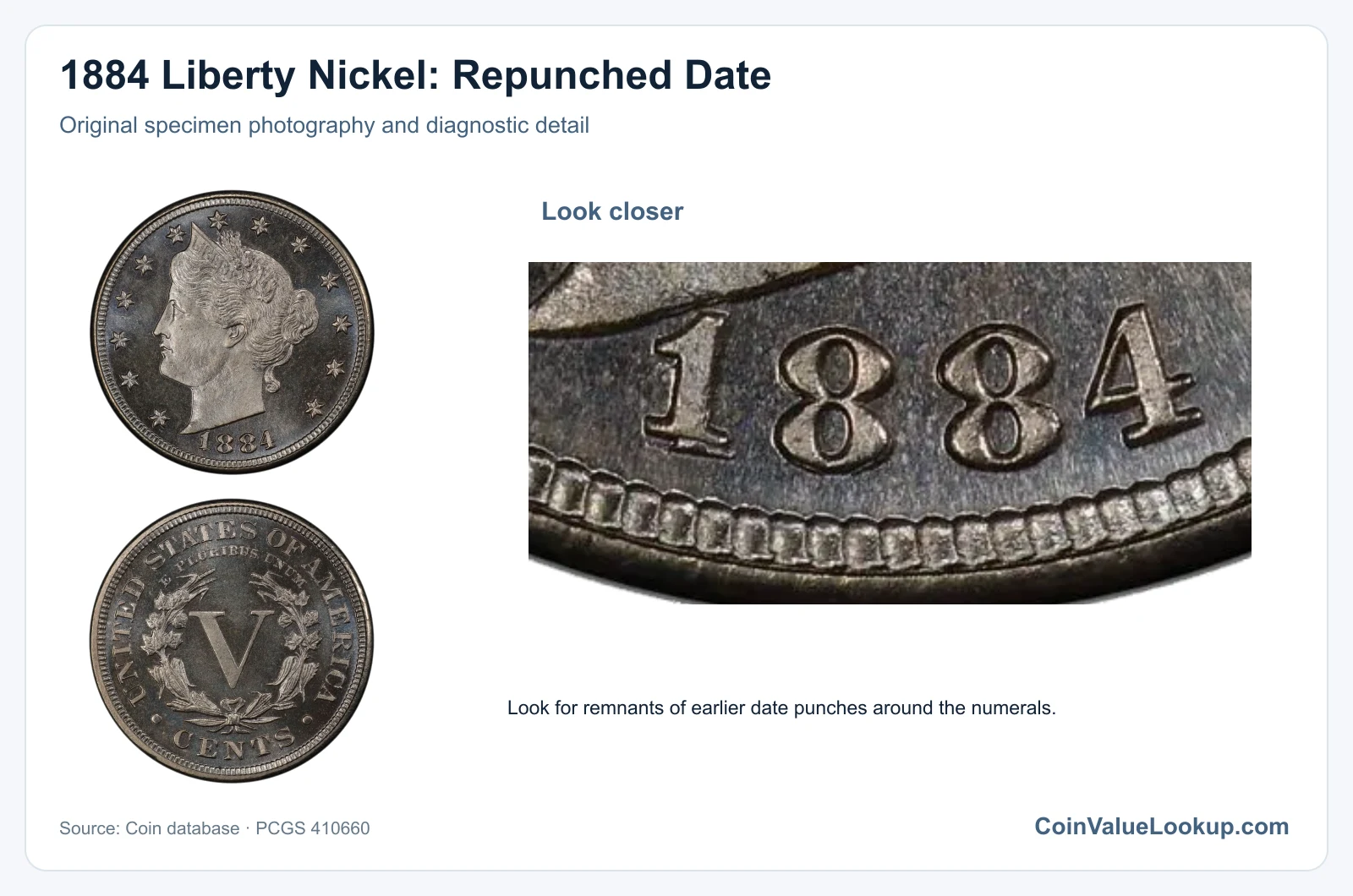
A repunched date on an 1884 Liberty Nickel shows traces of an earlier position of one or more date numerals alongside the final placement. Look closely at the bases and tops of the 1, 8, and 4 digits under magnification for slight doubling or shadowing that shifts in a consistent direction.
This is a die variety, not a striking error: it happened when the date punch was applied to the working die more than once in slightly different positions. It is different from machine doubling, which produces flat, shelf-like distortion on a struck coin rather than a crisp secondary image.
Damaged dates from contact or corrosion can mimic the look, so compare your coin to known examples. The value of a repunched date depends on how visible the remnant is, overall coin condition, and collector demand for that specific variety.
2. 1884 Liberty Nickel — Lamination / Split Planchet
Lamination errors on an 1884 Liberty Nickel appear as peeling or flaking metal, a retained flap, or a visible separation within the copper-nickel alloy. These result from impurities or gas pockets trapped in the planchet before striking.
When photographing a suspected lamination, capture the edge of the coin alongside the affected face so the layer separation is clear. A good photo set makes all the difference for identification.
Be aware that post-mint scraping, environmental corrosion, or deliberate cutting can look similar to a genuine lamination. The key distinction is that a true lamination follows the contour of the coin's surface and usually has a smooth underside where the layers separated naturally.
Condition, the size and visibility of the flaw, and independent authentication all affect any premium this type of error might carry.