1897 Liberty Nickel Coin Value: How Much Is It Worth?
The 1897 Liberty Nickel is a Philadelphia-only issue that most collectors can still find affordably. A well-worn example in G4 condition runs about $4.96 according to a USA Coin Book guide estimate, while an MS63 business strike climbs to around $194.
Proofs exist too, with a PR63 anchor near $344. Both finishes and a couple of known error types give this date more to explore than you might expect.
Fast Way to Identify Your 1897 Liberty Nickel
Want a quick read on your 1897 Liberty Nickel? Upload clear photos of the front and back, and our identifier can offer a preliminary take on which version you may have.
Good lighting and a steady hand help — try to capture the date, the word CENTS on the reverse, and any rim detail. This is not a substitute for professional authentication, but it is a solid starting point.
1897 Liberty Nickel Value
Upload both sides of your 1897 Liberty Nickel.
Front Obverse
Upload photo
Back Reverse
Upload photo
Which 1897 Liberty Nickel Versions Are Worth Money?
- Business strikes in MS63 or higher show strong premiums over circulated examples — the guide lists MS63 at about $194 versus under $5 in G4.
- Proofs in PR63 carry a guide estimate near $344; original surfaces without hairlines or cleaning are key.
- Repunched-date varieties, where traces of an earlier date punch appear beside the final numerals, can add collector interest depending on visibility and condition.
- Off-center strikes with a visible date are a recognized error type for this date and draw specialized attention.
Step 1: Identify Your 1897 Liberty Nickel Mint Mark and Version
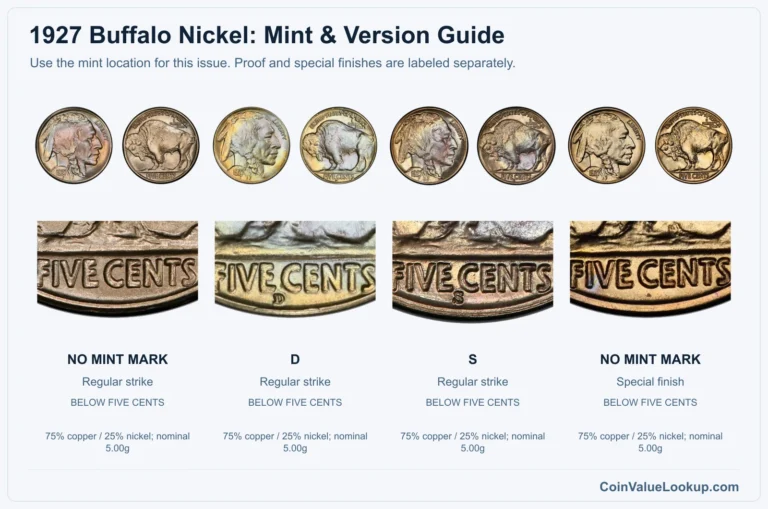
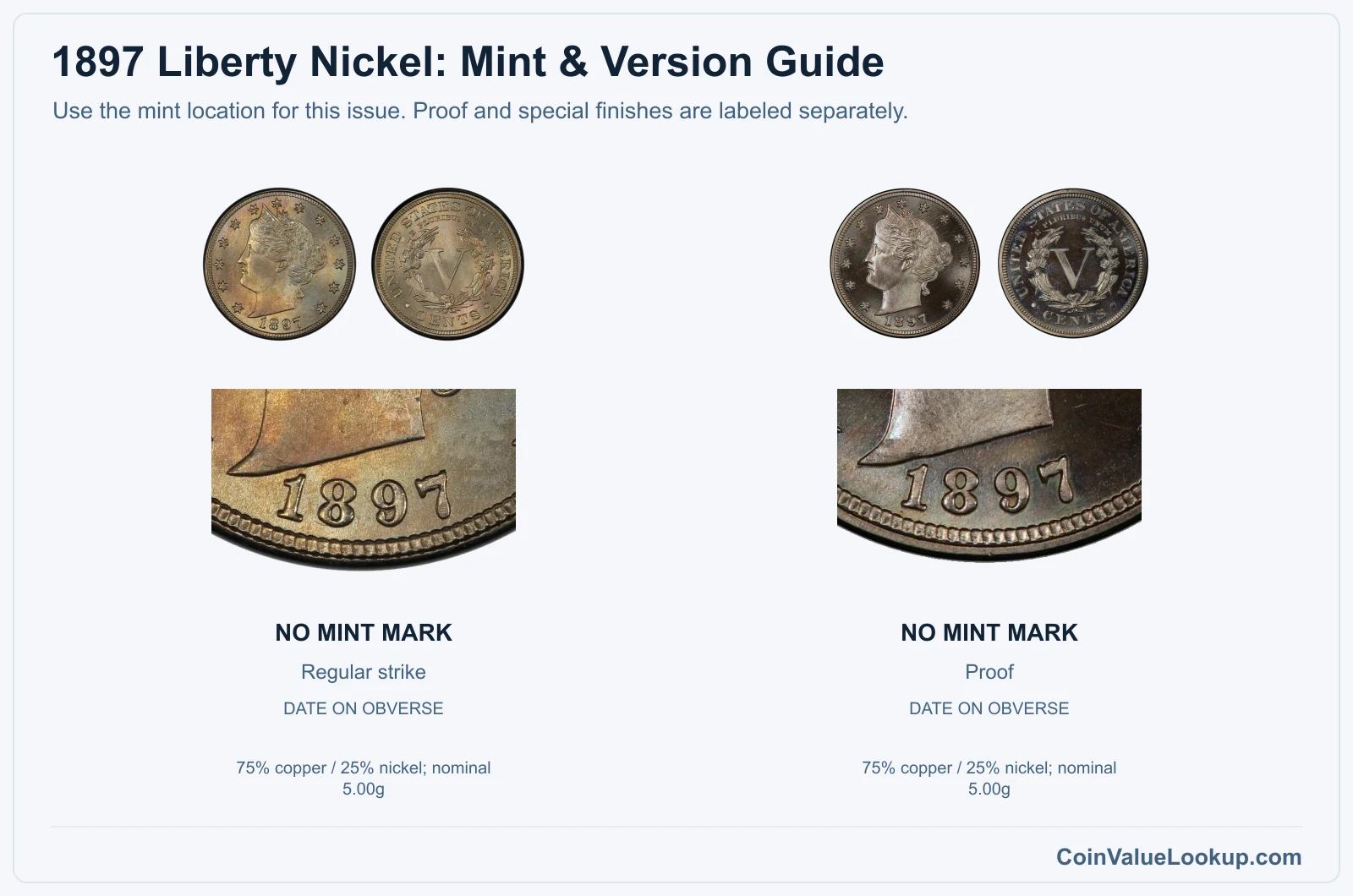
Every 1897 Liberty Nickel was struck at Philadelphia. There is no mintmark to hunt for — no D, no S.
The coin is 75% copper and 25% nickel, weighs about 5 grams, and measures 21.2 mm with a plain edge. No silver version exists for this year.
The design type is "With CENTS," meaning the Roman numeral V on the reverse is accompanied by the word CENTS at the bottom of the wreath. This is the standard reverse used from 1883 onward after the infamous "No CENTS" first-year variety invited gold-plating scams.
Two finishes were produced: regular business strikes for circulation and mirror-field proofs for collectors. The proof is a manufacturing method, not a higher grade than Mint State.
If you are unsure which you have, compare the fields carefully — proof surfaces show a distinctive reflective quality that circulation strikes lack, even in high grades.
Step 2: Check Your 1897 Liberty Nickel Grade
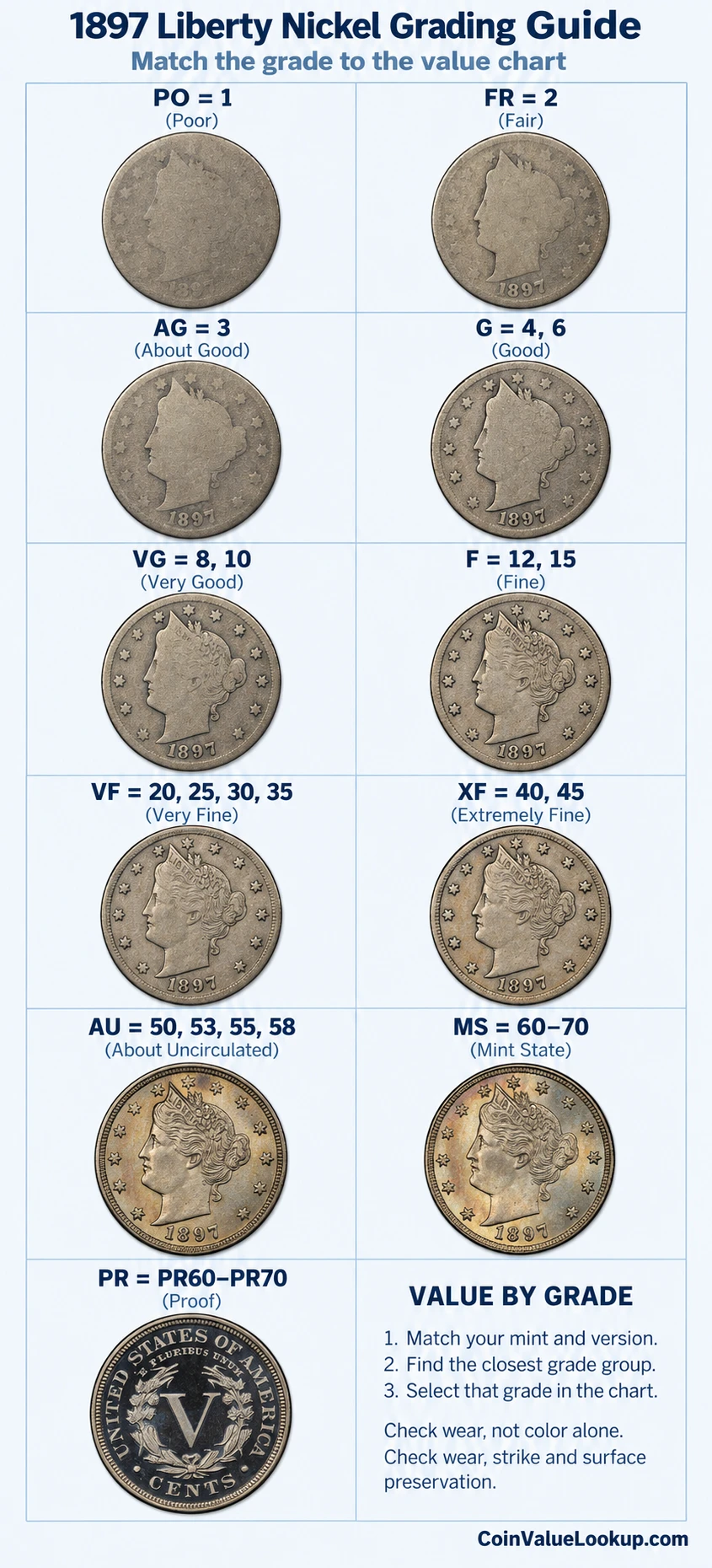
Start with the word LIBERTY on the coronet across the head. On a well-worn coin those letters blur and merge; on a mid-grade piece they are complete but soft.
A sharp, fully separated LIBERTY with no flatness points toward a higher circulated grade or better.
Next check the high hair curls above the forehead and the cheek below the eye. These are the first spots to lose detail.
On the reverse, the corn ears inside the wreath and the surrounding leaves wear down progressively.
Do not confuse a weak strike with actual wear. Some 1897 nickels left the press with soft detail in the hair or corn — the fields and luster tell the real story.
A coin with full luster but mushy hair curls may be weakly struck, not circulated. Compare your coin with the grading image to see the difference at each level.
For proofs, look at the mirrored fields under angled light. Hairlines from old cleanings reduce the grade even when no wear exists.
Rim sharpness and original surface tone also matter.
Step 3: Check 1897 Liberty Nickel Value by Mint and Version
1897 Liberty Nickel — No Mint Mark — With CENTS Circulation
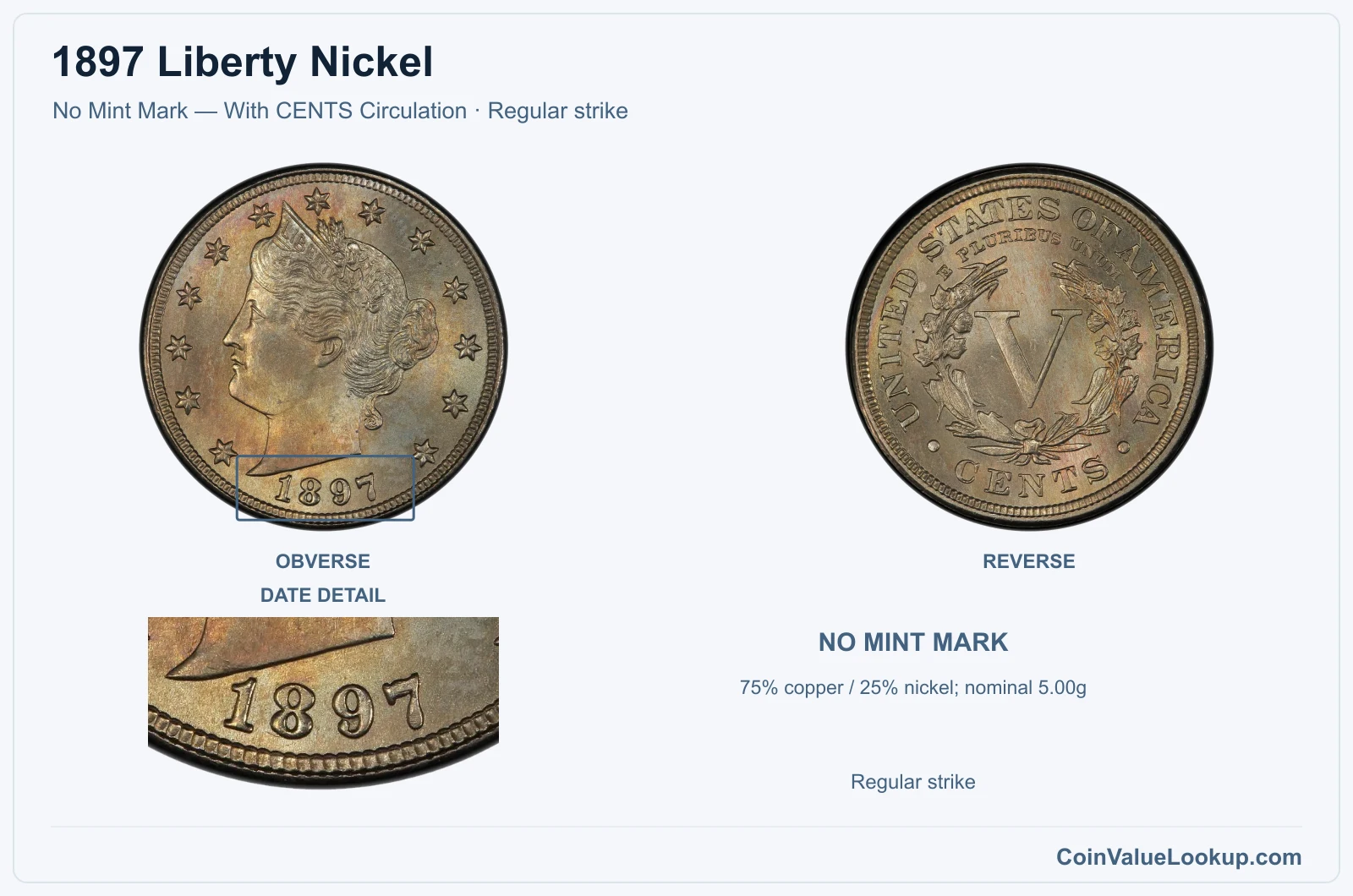
This is the standard 1897 Liberty Nickel struck for circulation at Philadelphia. No mintmark appears on the coin.
It is composed of 75% copper and 25% nickel, and the reverse carries the words FIVE CENTS beneath the wreath.
A USA Coin Book guide estimate places a G4 example at roughly $4.96 and an MS63 around $194. That is a big jump, which tells you surviving mint-state pieces with clean surfaces and good luster are far less common than pocket-worn survivors.
Most examples you encounter at flea markets or in inherited collections will fall somewhere in the lower circulated grades.
If you are building a Liberty Nickel set, this is not a key date, but a nice original uncirculated example still commands real money. Look for full LIBERTY, sharp hair detail, and minimal contact marks on the cheek.
Range Grade
Price Auction Records Appraisal PO PO 1
—
Coin Identifier FR FR 2
—
Coin Identifier AG AG 3
—
Coin Identifier G G 4
—
Coin Identifier
G 6
—
Coin Identifier VG VG 8
—
Coin Identifier
VG 10
—
Coin Identifier F F 12
—
Coin Identifier
F 15
—
Coin Identifier VF VF 20
—
Coin Identifier
VF 25
—
Coin Identifier
VF 30
—
Coin Identifier
VF 35
—
Coin Identifier XF XF 40
Coin Identifier
XF 45
—
Coin Identifier AU AU 50
—
Coin Identifier
AU 53
—
Coin Identifier
AU 55
Coin Identifier
AU 58
Coin Identifier MS MS 60
Coin Identifier
MS 61
Coin Identifier
MS 62
Coin Identifier
MS 63
Coin Identifier
MS 64
Coin Identifier
MS 65
Coin Identifier
MS 66
Coin Identifier
MS 67
Coin Identifier
MS 68
—
—
—
MS 69
—
—
—
MS 70
—
—
—
1897 Liberty Nickel — No Mint Mark — With CENTS Proof
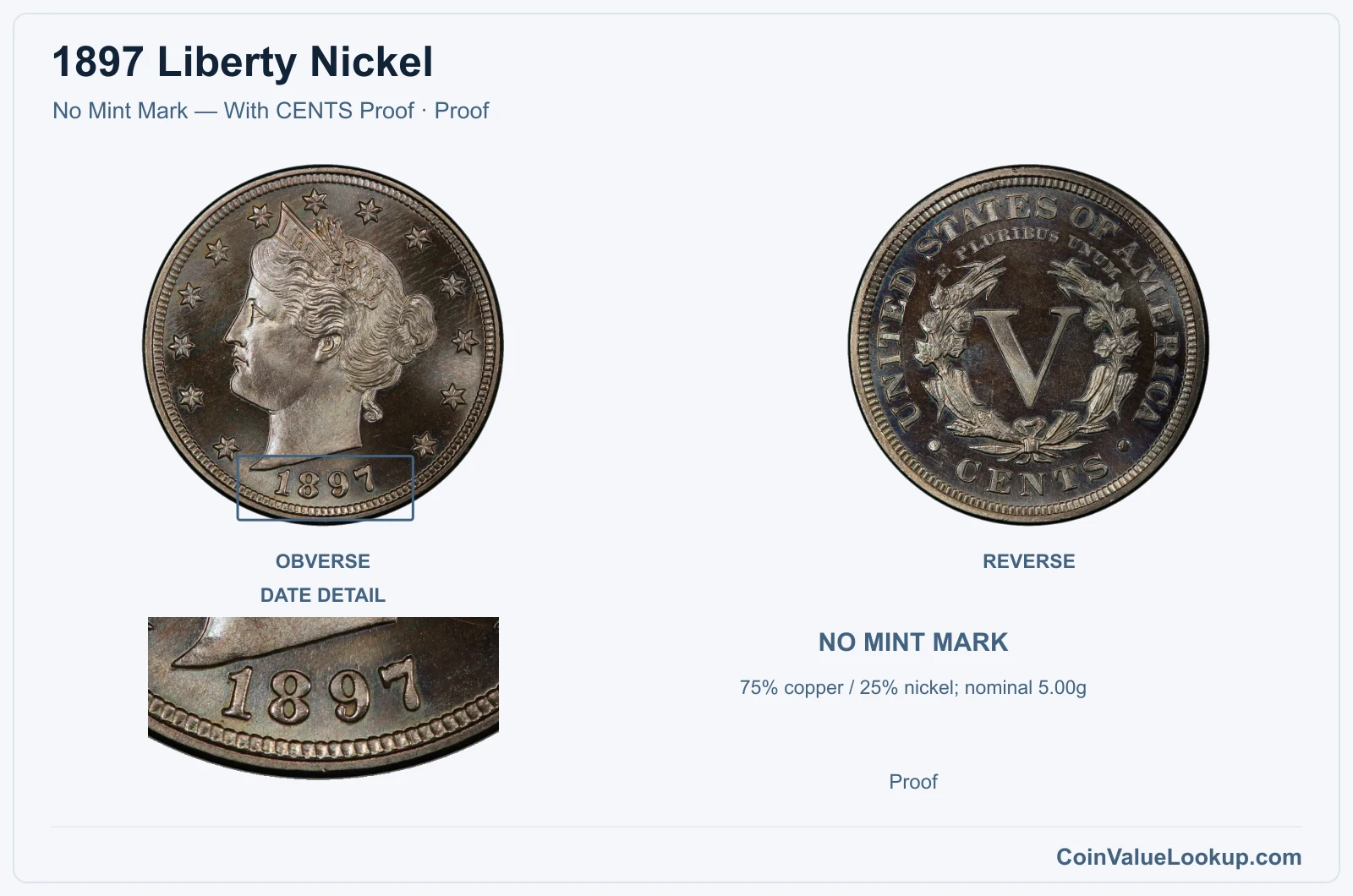
Philadelphia also produced proof 1897 Liberty Nickels for collectors. These were struck with polished dies on prepared planchets, yielding mirror-like fields and sharp rims that business strikes simply do not have.
The PR63 guide estimate from USA Coin Book sits at about $344. Condition of the proof surfaces matters enormously — hairlines from improper storage or cleaning drag the grade and value down quickly.
Toning can be attractive or distracting depending on evenness.
Coin Value Lookup is a handy place to look up guides for other dates and denominations in the Liberty Nickel series, so you can compare how this proof stacks up across the run.
When evaluating a proof, examine the fields under a single-point light source tilted at an angle. Genuine proof mirrors reflect sharply; a business strike, no matter how lustrous, shows a different texture.
The rim on a proof is typically knife-sharp and squared off compared to the rounded rims on circulation coins.
Range Grade
Price Auction Records Appraisal PR PR 1
—
Coin Identifier
PR 2
—
Coin Identifier
PR 3
—
Coin Identifier
PR 4
—
Coin Identifier
PR 6
—
Coin Identifier
PR 8
—
Coin Identifier
PR 10
—
Coin Identifier
PR 12
—
Coin Identifier
PR 15
—
Coin Identifier
PR 20
—
Coin Identifier
PR 25
—
Coin Identifier
PR 30
—
Coin Identifier
PR 35
—
Coin Identifier
PR 40
—
Coin Identifier
PR 45
—
Coin Identifier
PR 50
—
Coin Identifier
PR 53
—
Coin Identifier
PR 55
—
Coin Identifier
PR 58
—
Coin Identifier
PR 60
—
Coin Identifier
PR 61
Coin Identifier
PR 62
Coin Identifier
PR 63
Coin Identifier
PR 64
Coin Identifier
PR 65
Coin Identifier
PR 66
Coin Identifier
PR 67
Coin Identifier
PR 68
Coin Identifier
PR 69
—
—
—
PR 70
—
—
—
1897 Liberty Nickel Error List
1. 1897 Liberty Nickel — Repunched Date
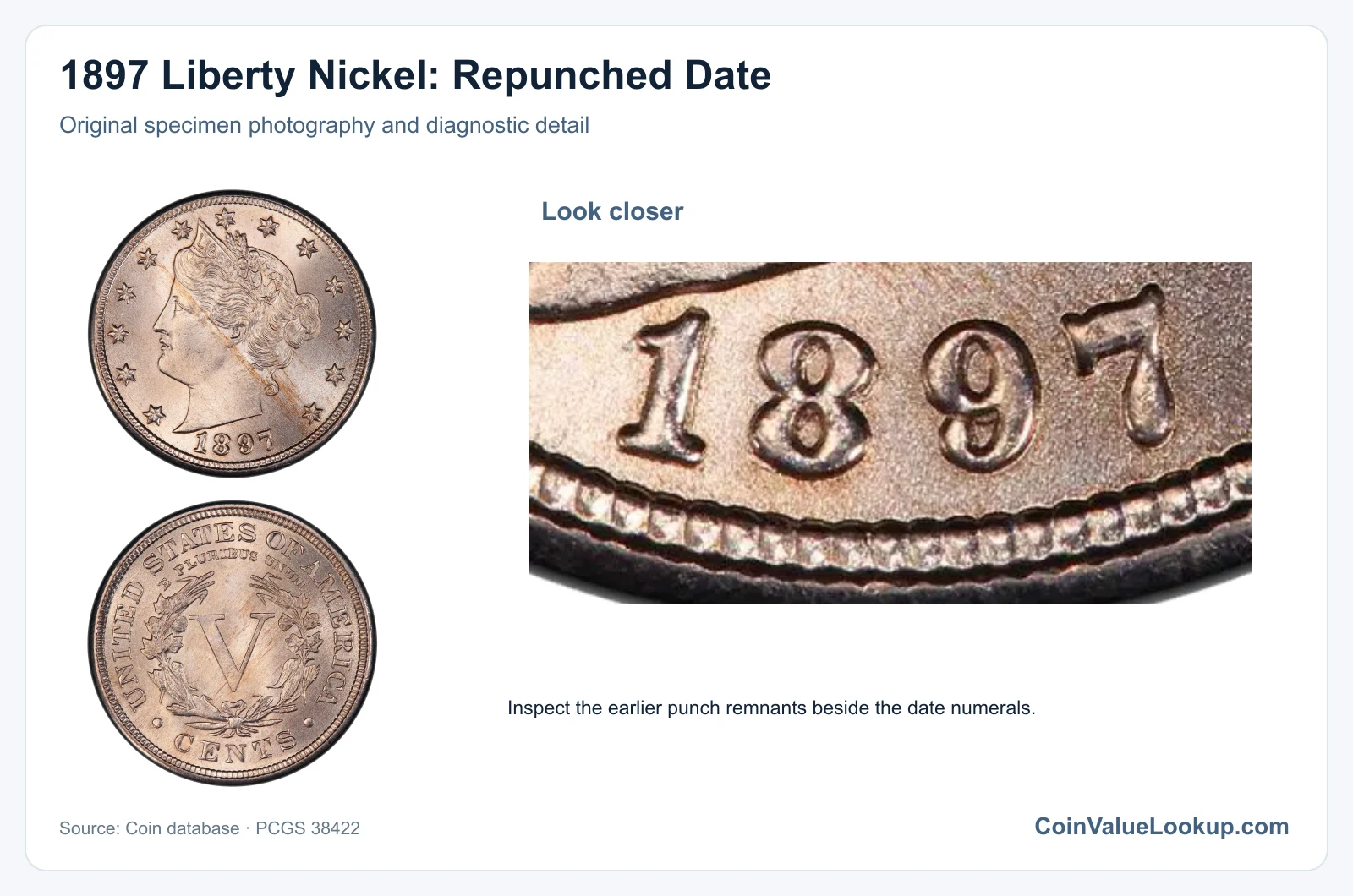
A repunched date on an 1897 Liberty Nickel shows traces of an earlier impression of one or more date numerals slightly offset from the final position. This happened when the date punch was applied more than once to the working die and the strikes did not perfectly overlap.
To spot it, use a loupe of at least 5x and examine each digit — especially the 1, 8, and 7. You may see a ghost outline, a thickened serif, or a secondary curve peeking out from behind the final numeral.
The remnant is part of the die, so it will be consistent across every coin struck from that die.
Do not confuse this with machine doubling, which produces flat, shelf-like distortion, or with post-mint damage that pushes metal around a single digit. A true repunched date has a distinctly doubled punch impression.
Value depends on the visibility of the repunching and the coin's overall condition; no specific price range is adopted here, so individual assessment by an experienced grader is the safest approach.
2. 1897 Liberty Nickel — Off-Center Strike
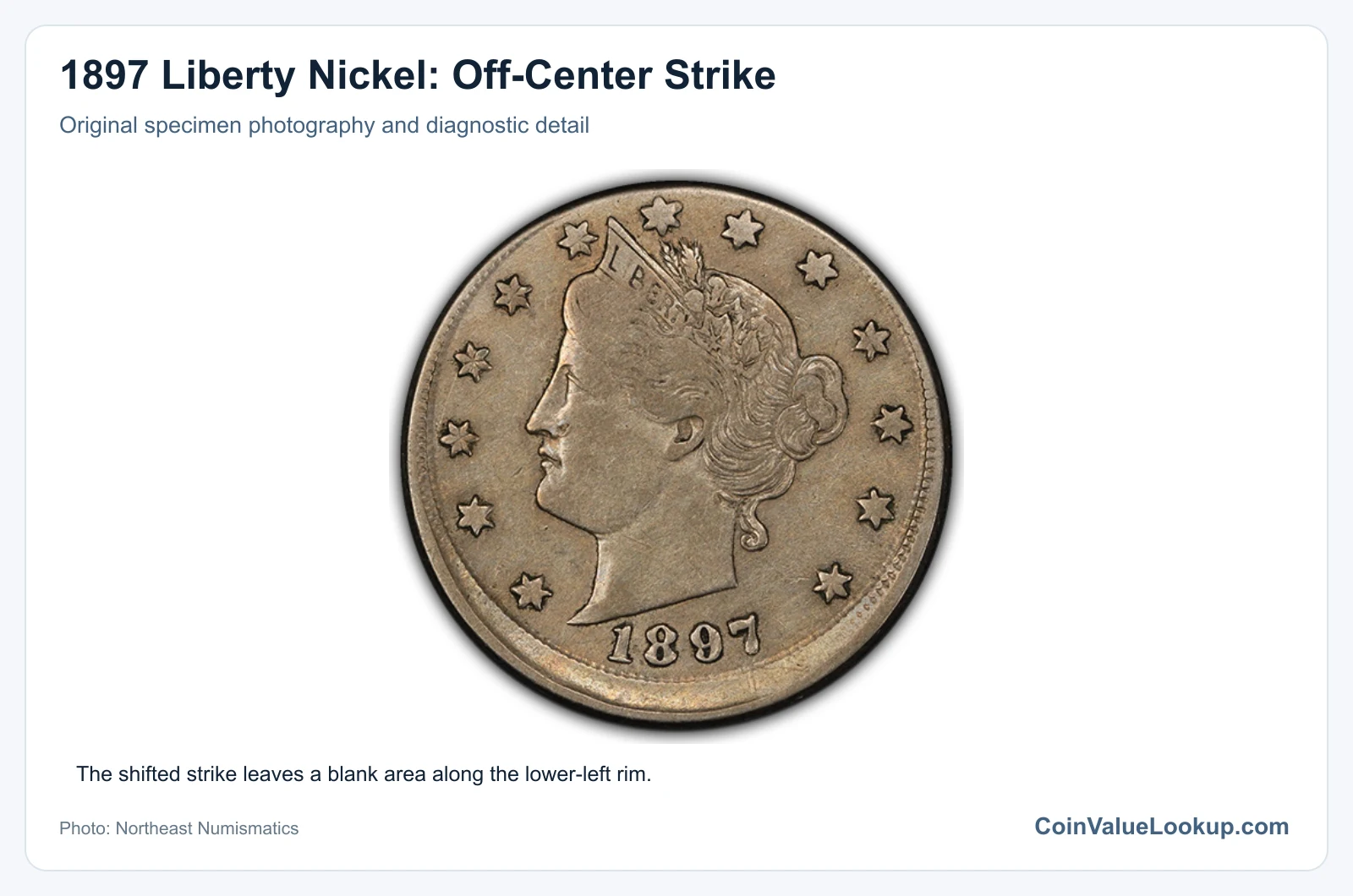
An off-center strike occurs when the planchet is not seated properly between the dies at the moment of striking. The result is a design that is shifted to one side, leaving a blank crescent of unstruck metal on the opposite edge.
For the 1897 Liberty Nickel, this error type has been reported in catalogs. A dramatic example — say 40% off center — is visually obvious, but smaller shifts of 5–10% can be subtle and require careful comparison with a normally centered coin.
The key detail collectors want is a fully visible date. An off-center coin missing the date loses most of its appeal.
Also watch out for lookalikes: a clipped planchet has a curved or straight missing edge but the design is centered, and post-mint flattening from damage can mimic displacement without the telltale unstruck crescent. Condition, the degree of misalignment, and date visibility all influence value, so professional evaluation is recommended rather than relying on a single comparison.