1866 Shield Nickel Coin Value: How Much Is It Worth?
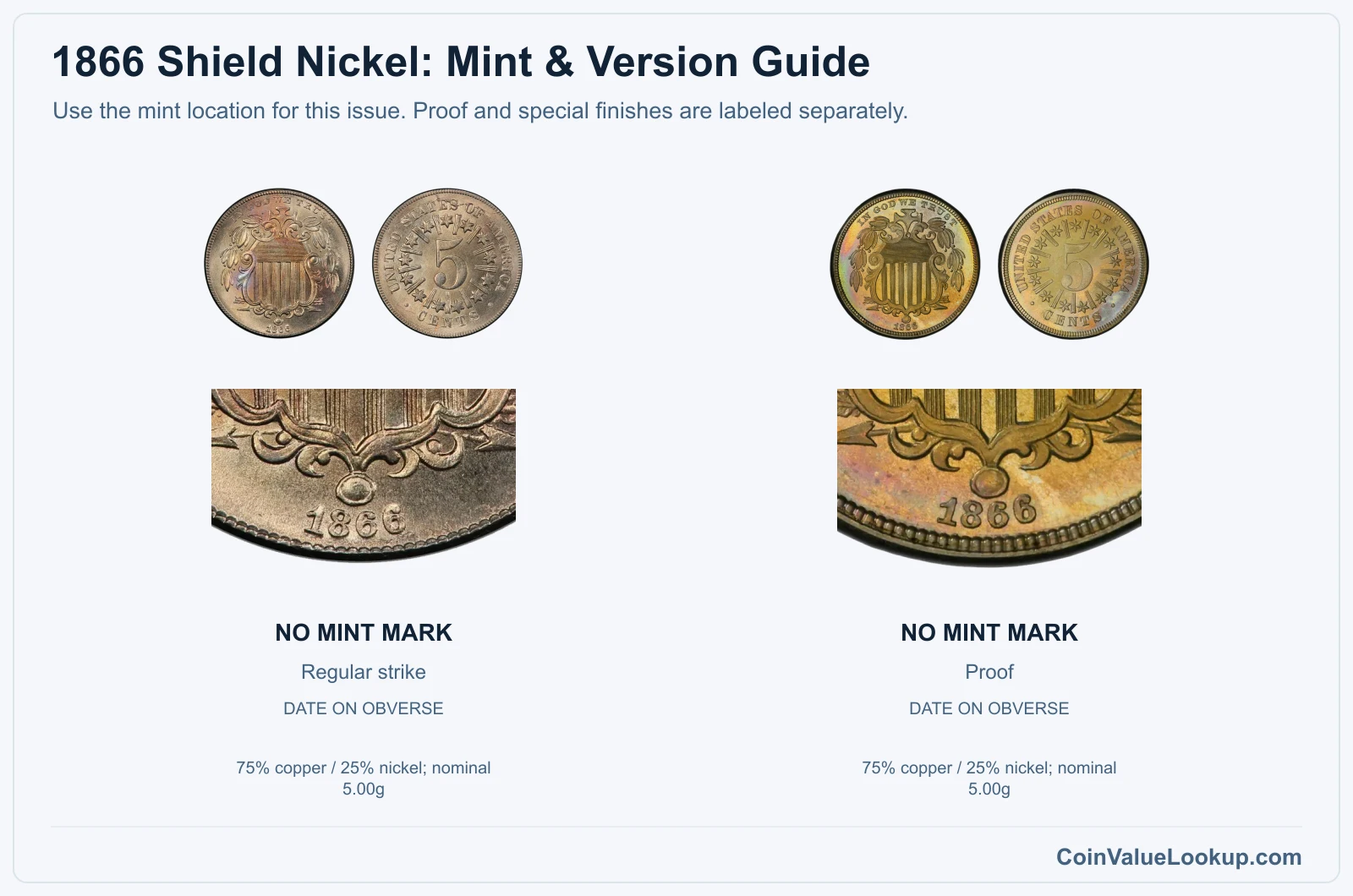
The 1866 Shield nickel is the first year of the series, and every regular-issue example carries rays between the reverse stars. A USA Coin Book retail guide places circulated examples around $43 in G4 and uncirculated coins near $612 in MS63.
Proof strikes and certain mint errors command separate premiums worth understanding before you sell or set one aside.
Fast Way to Identify Your 1866 Shield Nickel
Upload clear photos of both the front and back of your 1866 Shield nickel for a preliminary identification. This helps sort the business strike from the proof finish and flag any obvious variety features.
Good lighting at a slight angle brings out the shield detail and ray pattern that matter most for narrowing down what you have.
1866 Shield Nickel Value
Upload both sides of your 1866 Shield Nickel.
Front Obverse
Upload photo
Back Reverse
Upload photo
Which 1866 Shield Nickel Versions Are Worth Money?
- The 1866 With Rays business strike is the only regular-issue branch; guide values range from about $43 in G4 to $612 in MS63, making original Mint State examples the ones to watch.
- Proof examples with confirmed mirror fields carry a separate premium, with a guide estimate near $2,111 in PR63.
- Certain mint errors such as doubled die obverse, repunched date, or double strikes can add value depending on visibility and condition.
Step 1: Identify Your 1866 Shield Nickel Mint Mark and Version
Every 1866 Shield nickel was struck at the Philadelphia Mint. There is no mintmark, and the absence of a letter is completely normal for this issue.
The obverse shows a prominent shield with a cross, surrounded by stars and the date. Flip it over and you will see a large numeral 5 ringed by stars with rays radiating between them.
The coin is copper-nickel (75% copper, 25% nickel), weighs about 5 grams, measures 20.5 mm across, and has a plain edge. There is no silver version.
The rays between the reverse stars are the hallmark of the 1866 design; they were removed partway through 1867. So if your coin says 1866 and has rays, that is exactly what it should look like.
The main branching decision is whether your coin is a regular business strike or a proof. Proofs have mirror-like fields, sharp rims, and a distinct overall look compared to coins made for circulation.
After determining the strike type, evaluate condition. Never clean the coin, as that destroys originality and lowers its value.
Step 2: Check Your 1866 Shield Nickel Grade
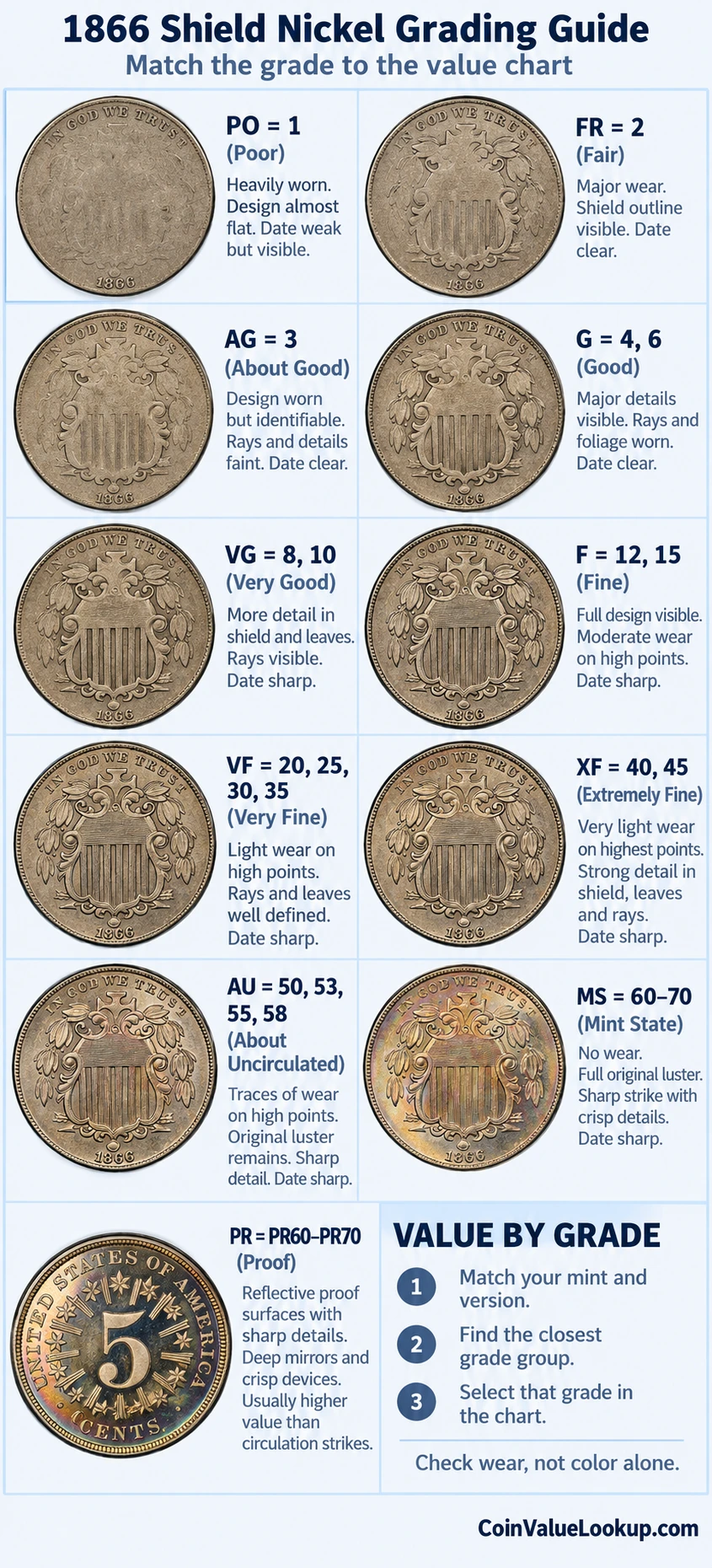
Start with the shield on the obverse. The horizontal and vertical lines within the shield are the first details to soften with wear.
In lower grades the cross and inner lines blur together. By About Good, only the outline of the shield remains.
On the reverse, check the rays and star points. Light wear rounds the star tips first, then the rays begin to flatten.
A well-worn coin may show only faint outlines of the rays.
Here is the tricky part: these coins were sometimes weakly struck at the mint. A coin with soft shield lines is not necessarily worn.
Compare both sides. If luster is intact and the reverse rays are sharp but the shield looks mushy, you are probably looking at a strike issue, not circulation damage.
Use the comparison image to judge your coin against known grade benchmarks. Set aside any coin that has been cleaned, corroded, or damaged.
Those problems place it outside the standard guide values regardless of how much design detail remains.
Step 3: Check 1866 Shield Nickel Value by Mint and Version
1866 Shield Nickel — No Mint Mark — With Rays
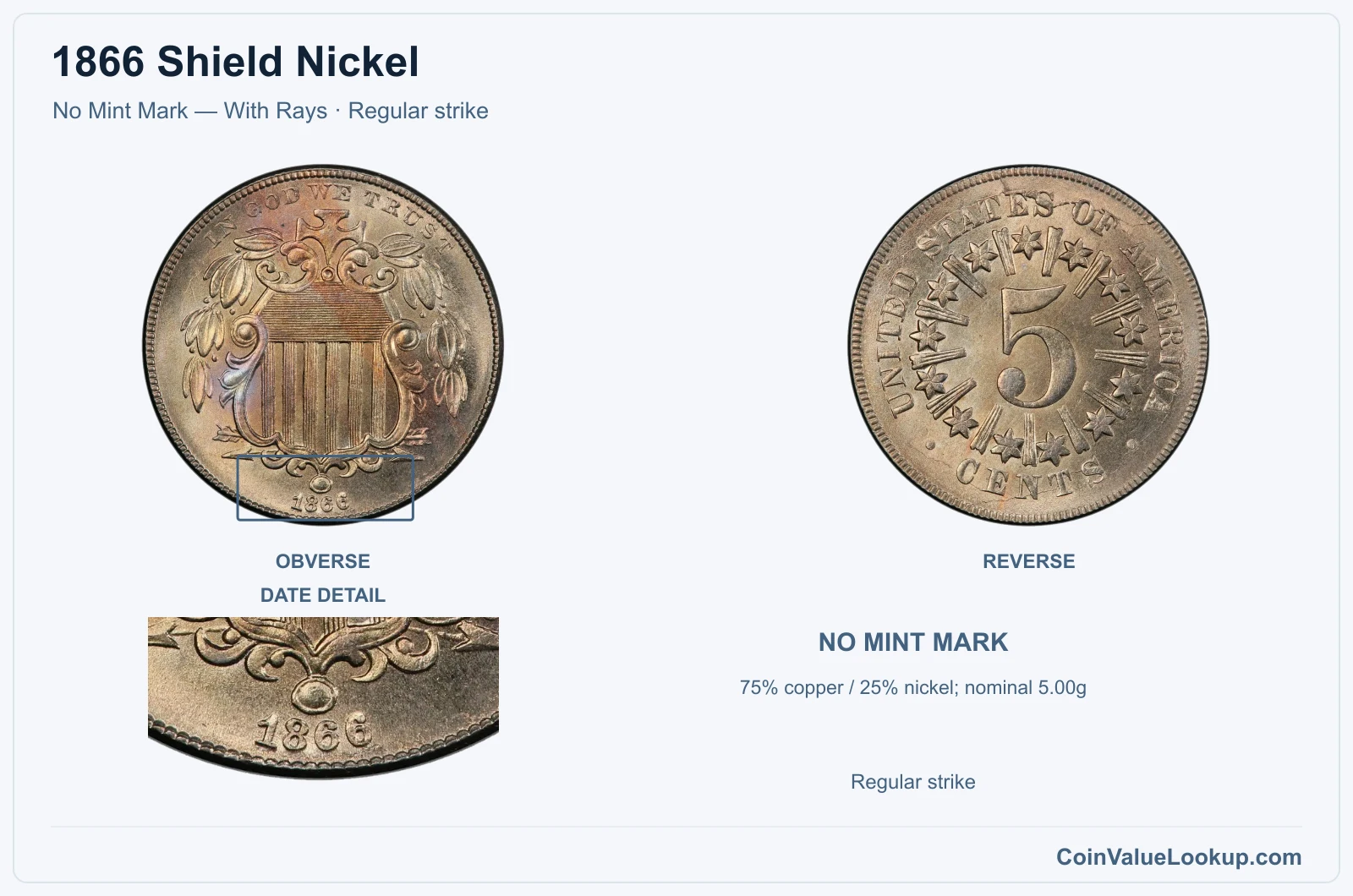
This is the standard 1866 Shield nickel struck for circulation at Philadelphia. It carries no mintmark, which is normal.
The reverse displays prominent rays between the stars, the defining feature of the first Shield nickel design.
The coin is 75% copper and 25% nickel, with a nominal weight of 5 grams. USA Coin Book retail estimates place it around $43 in G4 and approximately $612 in MS63.
Problem-free coins with original surfaces will track closer to those figures, while cleaned or damaged pieces fall well below.
Coin Value Lookup is a good place to look up guides for this and other Shield nickel dates if you are working through an inherited collection or a dealer's junk box.
Range Grade
Price Auction Records Appraisal PO PO 1
—
Coin Identifier FR FR 2
—
Coin Identifier AG AG 3
—
Coin Identifier G G 4
Coin Identifier
G 6
Coin Identifier VG VG 8
Coin Identifier
VG 10
Coin Identifier F F 12
Coin Identifier
F 15
Coin Identifier VF VF 20
Coin Identifier
VF 25
Coin Identifier
VF 30
Coin Identifier
VF 35
Coin Identifier XF XF 40
Coin Identifier
XF 45
Coin Identifier AU AU 50
Coin Identifier
AU 53
Coin Identifier
AU 55
Coin Identifier
AU 58
Coin Identifier MS MS 60
Coin Identifier
MS 61
Coin Identifier
MS 62
Coin Identifier
MS 63
Coin Identifier
MS 64
Coin Identifier
MS 65
Coin Identifier
MS 66
Coin Identifier
MS 67
Coin Identifier
MS 68
—
—
—
MS 69
—
—
—
MS 70
—
—
—
1866 Shield Nickel — No Mint Mark — With Rays Proof
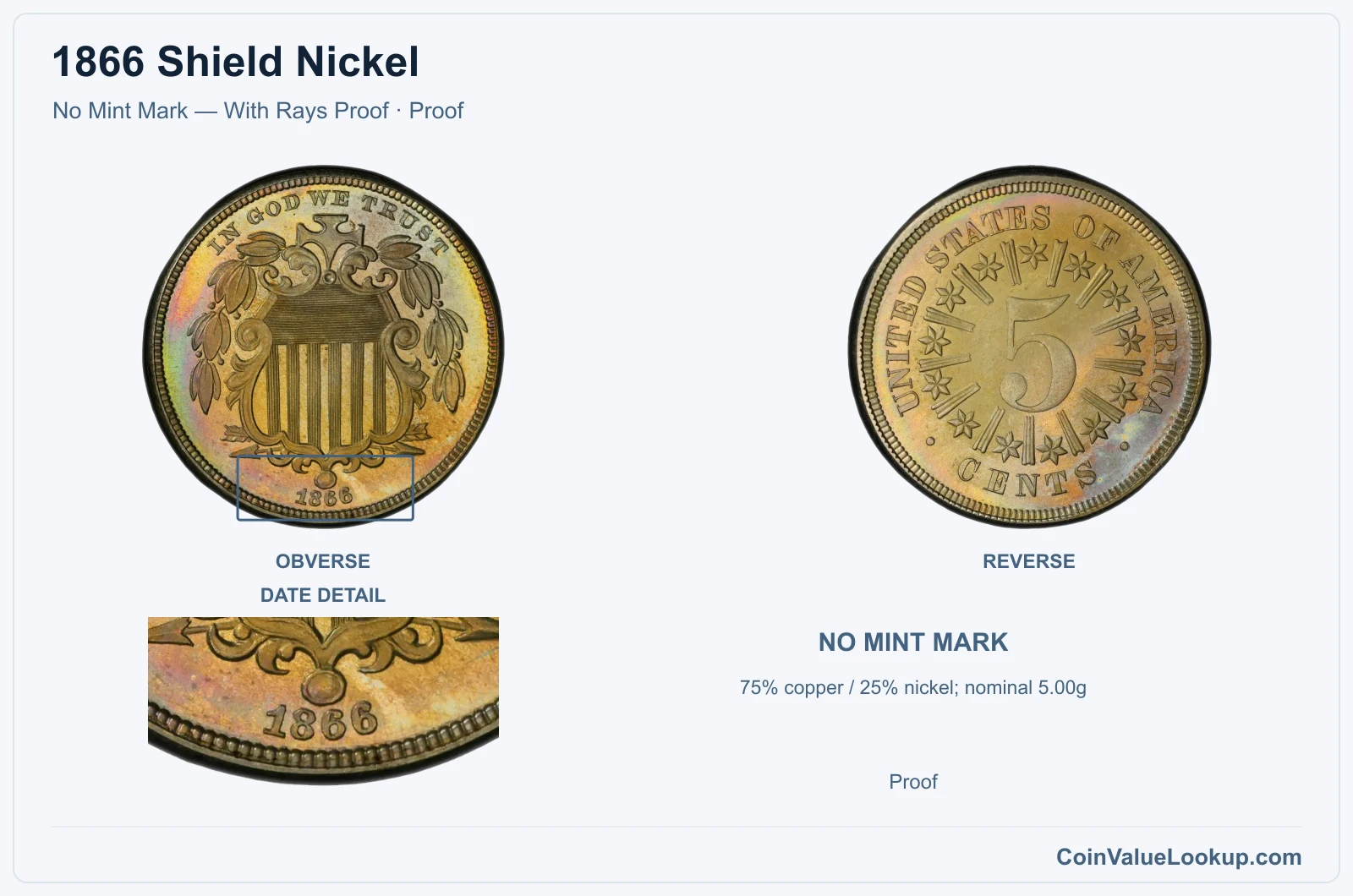
The 1866 With Rays proof was struck at Philadelphia using polished dies and specially prepared planchets. The result is a coin with mirror-like fields, crisp rims, and fully detailed rays that look distinctly different from even a high-grade business strike.
Authentication matters here. Genuine proofs show squared-off rims and reflective surfaces across both faces, not just one bright side from polishing.
A USA Coin Book retail guide places the PR63 estimate at about $2,111. Because proofs were made in limited numbers for collectors, a confirmed example in any grade deserves careful evaluation by a professional grading service before you assign a value.
Range Grade
Price Auction Records Appraisal PR PR 1
—
Coin Identifier
PR 2
—
Coin Identifier
PR 3
—
Coin Identifier
PR 4
—
Coin Identifier
PR 6
—
Coin Identifier
PR 8
—
Coin Identifier
PR 10
—
Coin Identifier
PR 12
—
Coin Identifier
PR 15
—
Coin Identifier
PR 20
—
Coin Identifier
PR 25
—
Coin Identifier
PR 30
—
Coin Identifier
PR 35
—
Coin Identifier
PR 40
—
Coin Identifier
PR 45
—
Coin Identifier
PR 50
—
Coin Identifier
PR 53
—
Coin Identifier
PR 55
—
Coin Identifier
PR 58
—
Coin Identifier
PR 60
—
Coin Identifier
PR 61
Coin Identifier
PR 62
Coin Identifier
PR 63
Coin Identifier
PR 64
Coin Identifier
PR 65
Coin Identifier
PR 66
Coin Identifier
PR 67
Coin Identifier
PR 68
—
—
—
PR 69
—
—
—
PR 70
—
—
—
1866 Shield Nickel Error List
1. 1866 Shield Nickel — Doubled Die Obverse
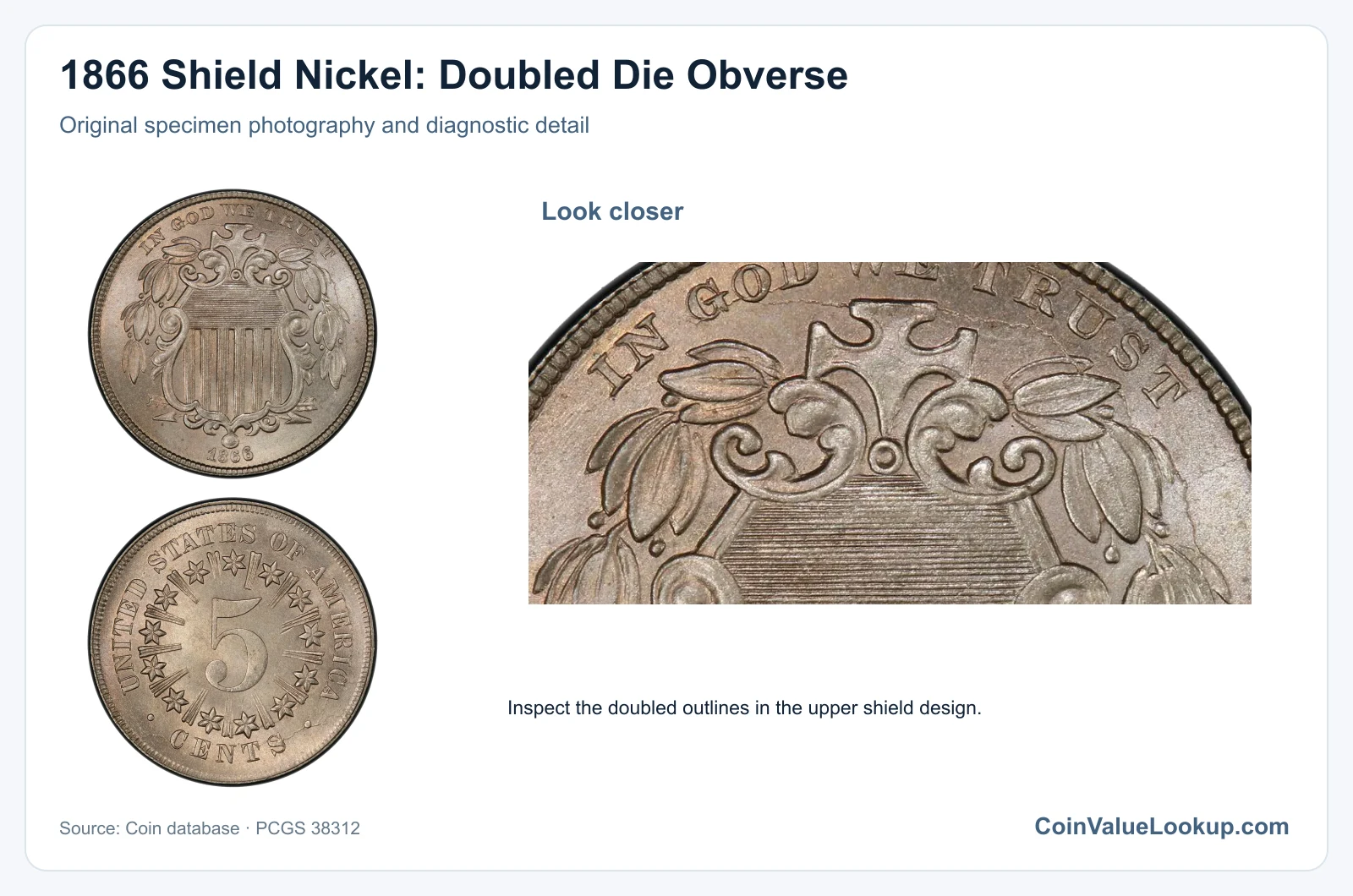
A doubled die obverse on the 1866 Shield nickel shows consistent separation or notching on the obverse lettering or design elements. This is not a random wobble; the doubling repeats in the same direction across multiple features because it originated in the die-making process.
To check, examine the obverse letters and date numerals under good magnification and even lighting. You are looking for a secondary image that follows the contour of each element rather than a flat shelf of displaced metal.
Machine doubling, which is far more common, tends to produce a flat, shelflike distortion without the raised definition of a true doubled die.
Condition and the strength of the doubling both influence value. No standard price range is established here, so individual assessment is needed.
2. 1866 Shield Nickel — Repunched Date
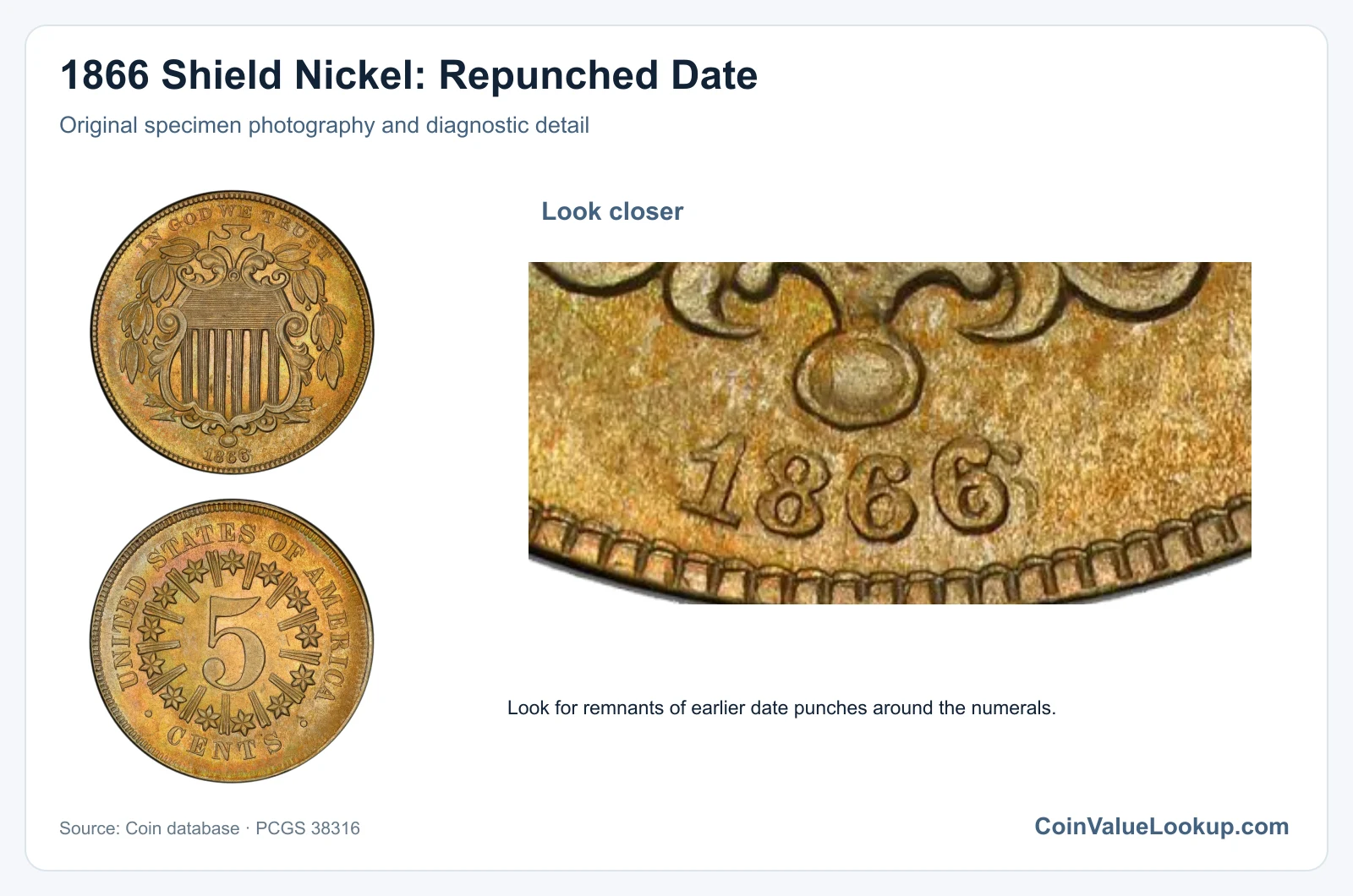
A repunched date on the 1866 nickel occurs when the date punch was applied more than once in slightly different positions. The result is remnants of an earlier impression visible alongside the final numerals, often as extra serifs or partial outlines of a digit.
Look closely at each numeral in the date with magnification. You may see a ghost of a digit offset from where the final number sits.
This is different from a doubled die, which affects the entire obverse design rather than just the date area.
Do not confuse a damaged or corroded date with a repunched date. Damage is random and irregular; a repunch shows a recognizable numeral shape in a displaced position.
Value depends on visibility and the coin's overall condition.
3. 1866 Shield Nickel — Die Crack / Die Chip
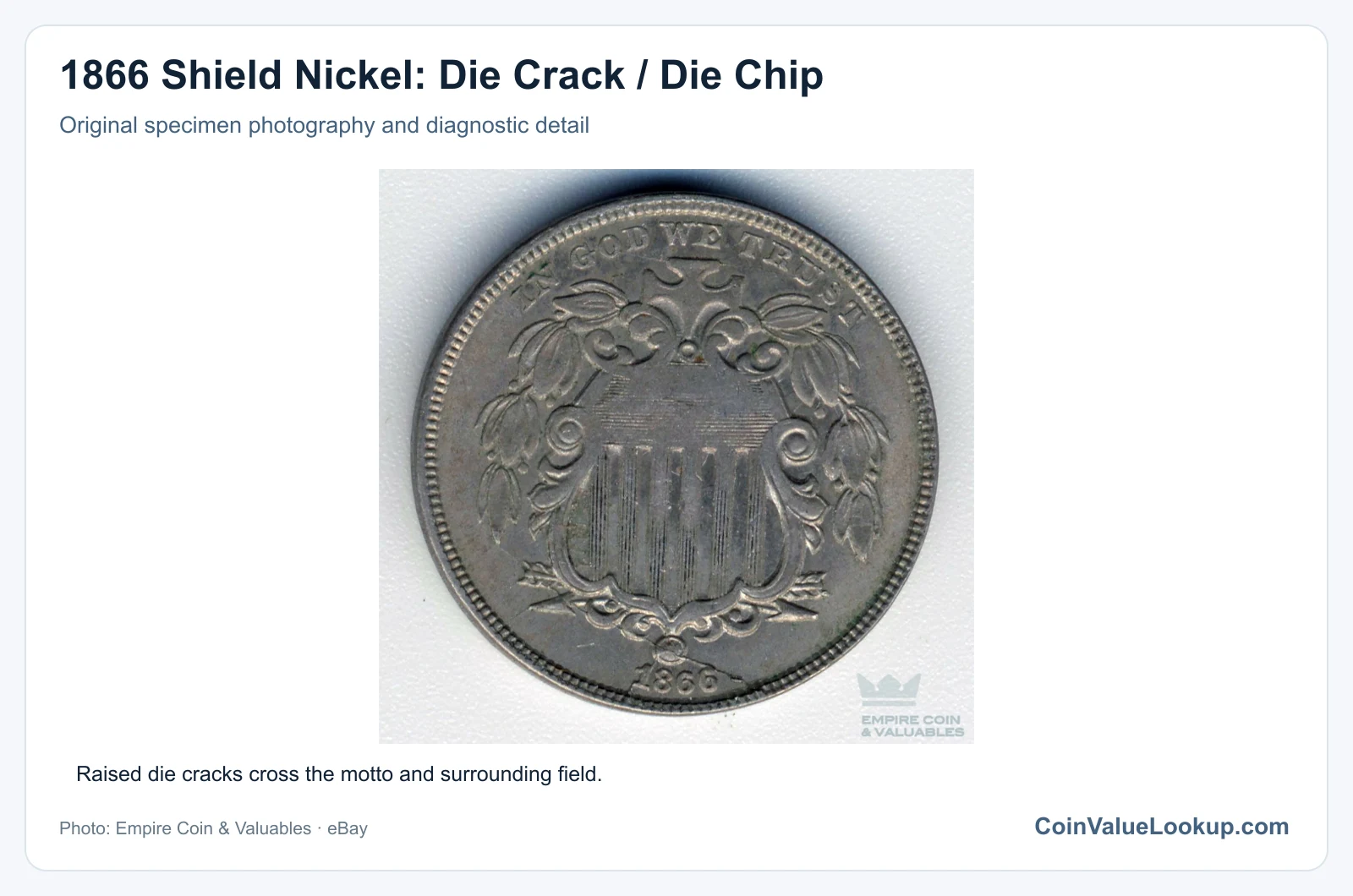
Die cracks appear as thin raised lines on the coin's surface, caused by fractures in the steel die. Die chips are small raised blobs where a tiny piece of the die broke away, leaving a void that fills with metal during striking.
On an 1866 Shield nickel, check both faces for these raised features. A die crack typically runs in a fairly straight or gently curved path across the design.
A die chip looks like a small bump, often near letters or within the shield lines.
Do not mistake incuse scratches, corrosion tracks, or bits of foreign material for die cracks. Scratches are recessed into the surface; die cracks are raised above it.
An interior chip that does not reach the rim is a different animal from a rim-connected break. Value depends on size, location, and the coin's condition.
4. 1866 Shield Nickel — Die Break / Cud
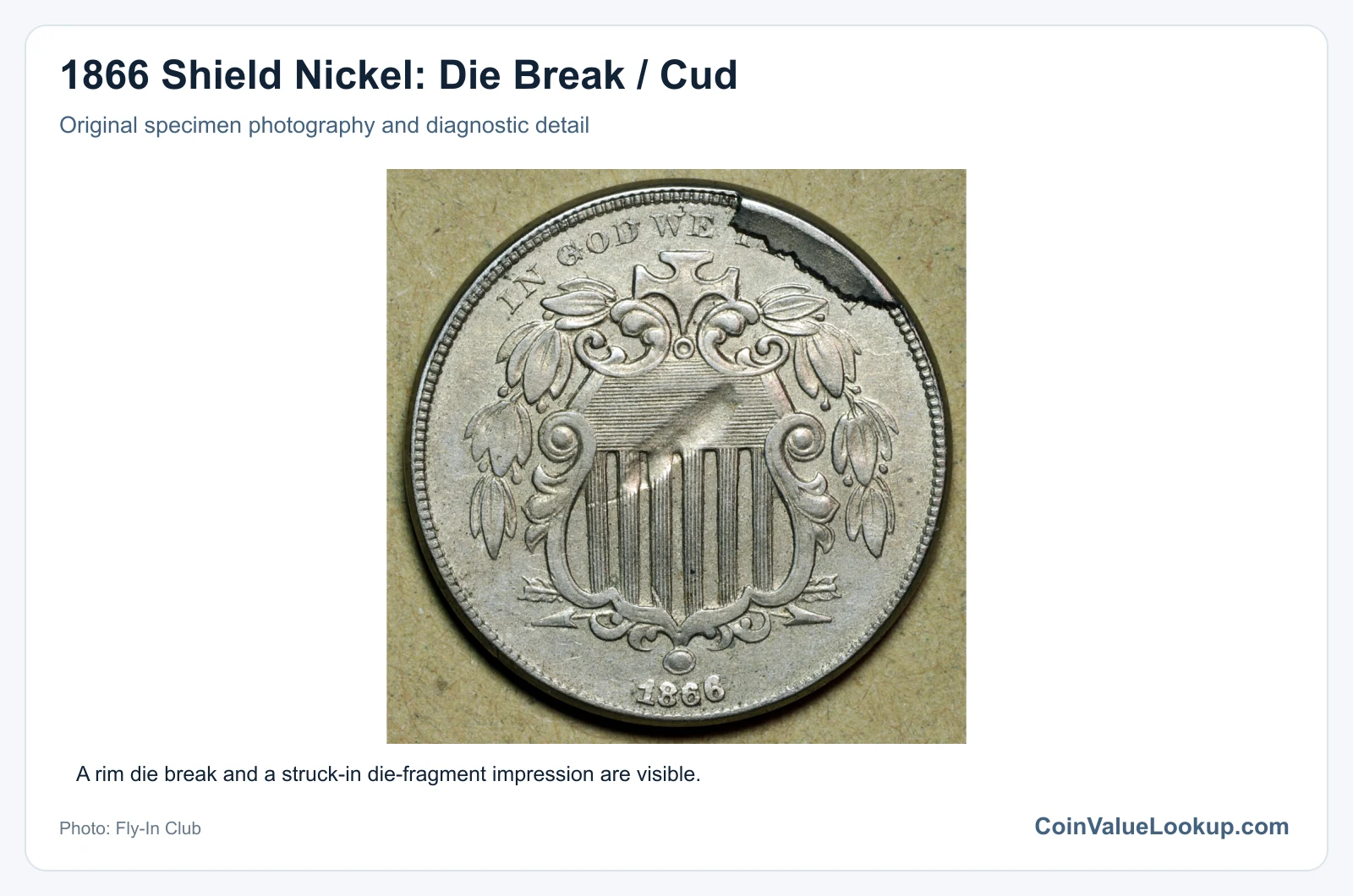
A cud is a raised, featureless lump of metal at the rim caused by a piece of the die breaking away entirely. Because the broken section of the die is missing, the corresponding area on the coin fills with metal but receives no design impression.
On the 1866 Shield nickel, a cud will appear as a blob connected to the rim, sometimes obliterating part of a star, letter, or date digit. The boundary between the normal design and the cud area should be visible as a distinct line.
Rim dents or corrosion can mimic a cud at first glance. A genuine cud is raised and smooth, occupying a logical section of the die's edge.
Corrosion is rough and random. An interior die chip that does not touch the rim is not a cud.
Value varies with size, location, and condition.
5. 1866 Shield Nickel — Clashed Dies
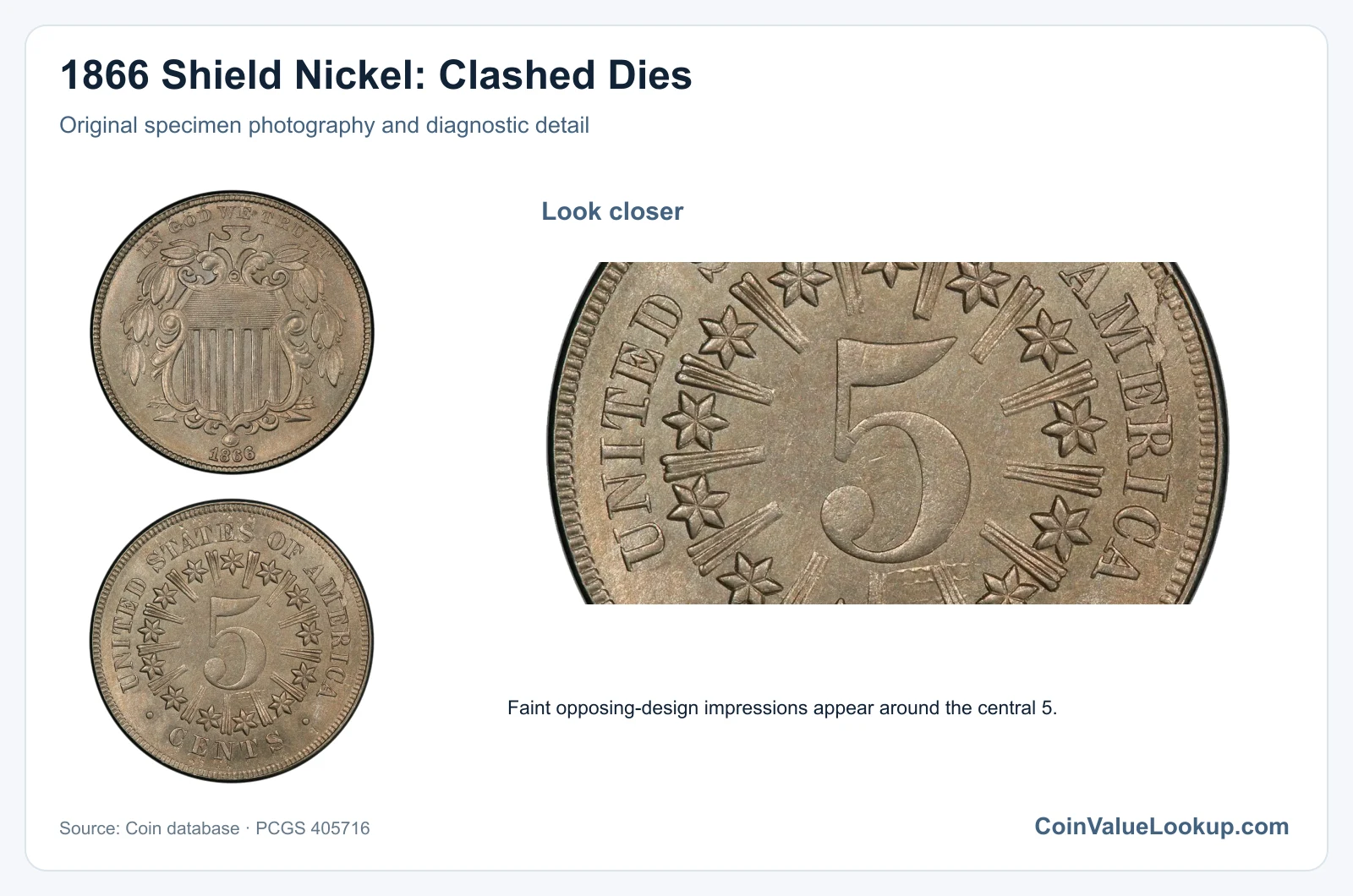
Clashed dies happen when the obverse and reverse dies strike each other without a planchet between them. The impact transfers traces of each die's design onto the other, and those ghost impressions then appear on subsequently struck coins.
On an 1866 Shield nickel, look for faint outlines of the reverse numeral or stars showing up in the obverse fields, or shield elements appearing among the reverse rays. The transferred image will be aligned with where the opposite die would normally sit.
Do not confuse random scratches, contact marks, or raised lines from other causes with a die clash. A genuine clash shows recognizable design elements from the opposite face in a predictable position.
Value depends on how dramatic the clash impression is and the coin's overall grade.
6. 1866 Shield Nickel — Rotated Dies
US coins are normally struck in medal alignment: hold the obverse upright, flip the coin top to bottom, and the reverse should also appear upright. A rotated die error means the reverse is turned at an angle from this standard orientation.
To test your 1866 Shield nickel, hold the obverse so the date is at the bottom, then rotate the coin along its vertical axis. If the reverse 5 and stars are tilted noticeably from their normal upright position, you may have a rotation error.
Make sure you are not simply turning the coin sideways or looking at a rotated photograph. The rotation must be visible when the coin is physically flipped in hand.
Greater degrees of rotation tend to attract more collector interest. Value depends on the amount of rotation and the coin's condition.
7. 1866 Shield Nickel — Misplaced Date
A misplaced date error on the 1866 Shield nickel shows a fragment of a date numeral in the wrong location, typically near the denticles below the normal date position. Specialist sources describe a curve consistent with the numeral 6 appearing between the final digits of the date.
To spot this, examine the area around and below the date under magnification. You are looking for a partial numeral that matches the style of the date digits but sits where no number belongs.
It is leftover from an initial date punch that landed in the wrong spot before the final impression corrected the placement.
Ordinary denticle shapes or minor surface damage can look similar at a glance. A true misplaced date fragment follows the curve or line of a recognizable numeral.
Value varies with clarity and the coin's condition.
8. 1866 Shield Nickel — Double Strike with an Off-Center Second Strike
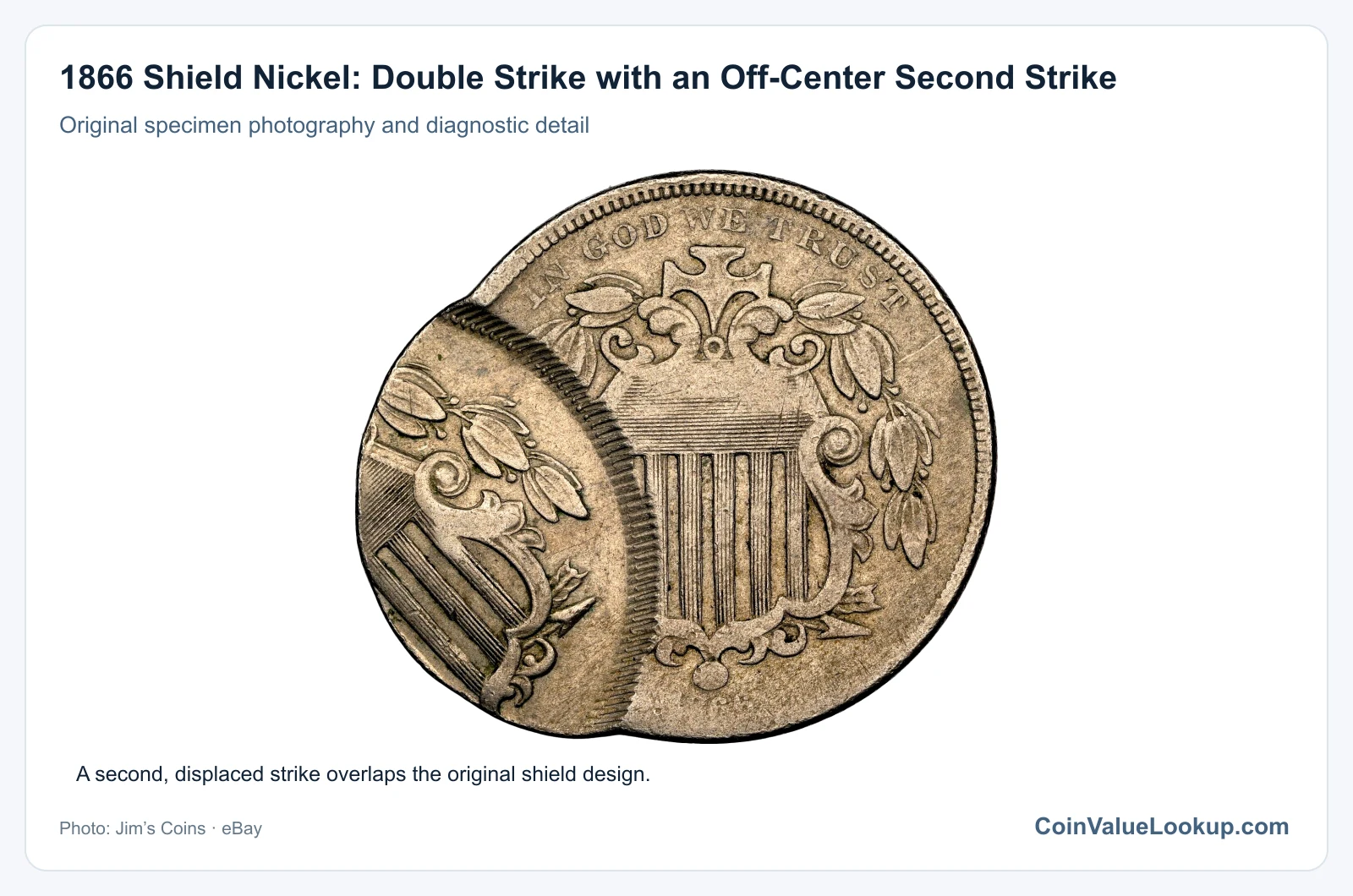
A double strike with an off-center second impression is one of the more dramatic errors you can find on an 1866 Shield nickel. The coin received two separate blows from the dies, with the second strike landing in a displaced or rotated position relative to the first.
The result is two distinct sets of design elements visible on the same coin. You should be able to see, for example, two separate shield impressions or two sets of reverse stars that do not overlap cleanly.
The relationship between the two strikes, how far apart and at what angle, defines the variety.
This is different from a doubled die, where the doubling originates in the die itself and produces subtle separation rather than a fully shifted second image. It is also different from post-mint damage like vice marks.
Condition, the degree of displacement, and whether the date remains readable all affect the coin's value.