1896 Barber Quarter Coin Value: How Much Is It Worth?
The 1896 Barber Quarter is a 90% silver coin that can range from about $24.00 for a worn Philadelphia issue to $26,309.00 for a high-grade San Francisco piece, according to USA Coin Book guide estimates. That is not one price for every coin.
Your specific value depends on which mint struck it, whether it is a business strike or proof, and its condition.
Fast Way to Identify Your 1896 Barber Quarter
The quickest way to start figuring out what you have is to snap clear photos of both sides of your 1896 quarter and upload them here. Our identifier can offer a preliminary take on your coin's mint, version and general condition.
It is not a substitute for professional certification, but it gives you a solid starting point.
1896 Barber Quarter Value
Upload both sides of your 1896 Barber Quarter.
Front Obverse
Upload photo
Back Reverse
Upload photo
Which 1896 Barber Quarter Versions Are Worth Money?
- 1896-S: Guide estimate reaches $26,309.00 in MS63 — the scarcest regular-issue mint for this date, and worth identifying carefully.
- 1896-O: Guide estimate of $2,431.00 at MS63; even in G4 condition it lists at $90.00, well above the Philadelphia issue.
- 1896 Proof (PR): Guide estimate of $799.00 at PR63 — a collector finish struck at Philadelphia, distinct from business strikes.
- Always confirm the mintmark and condition first; cleaning, damage and bright polished surfaces do not make a coin rare.
Step 1: Identify Your 1896 Barber Quarter Mint Mark and Version
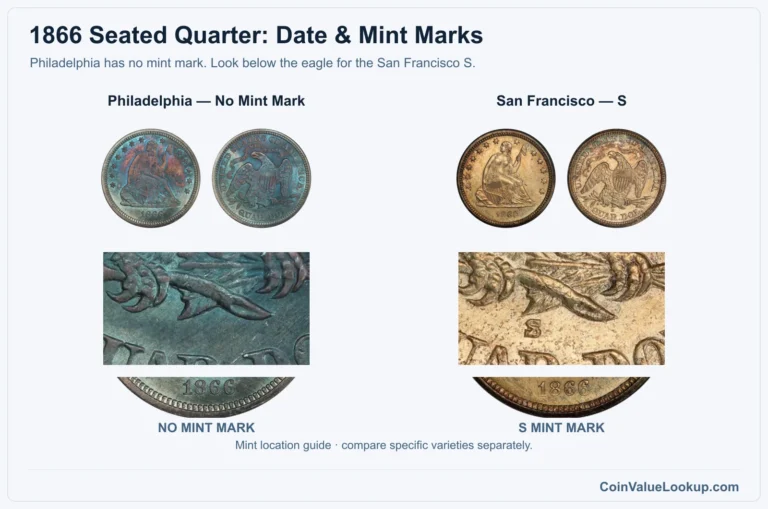
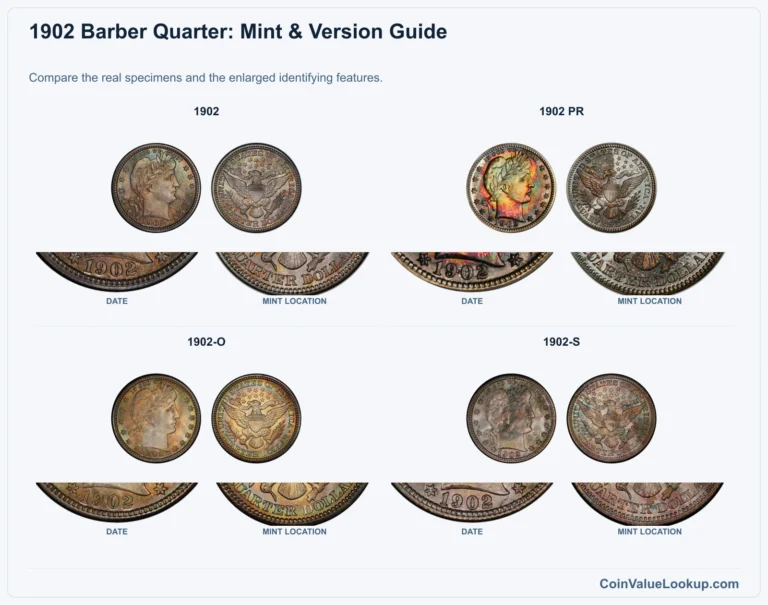
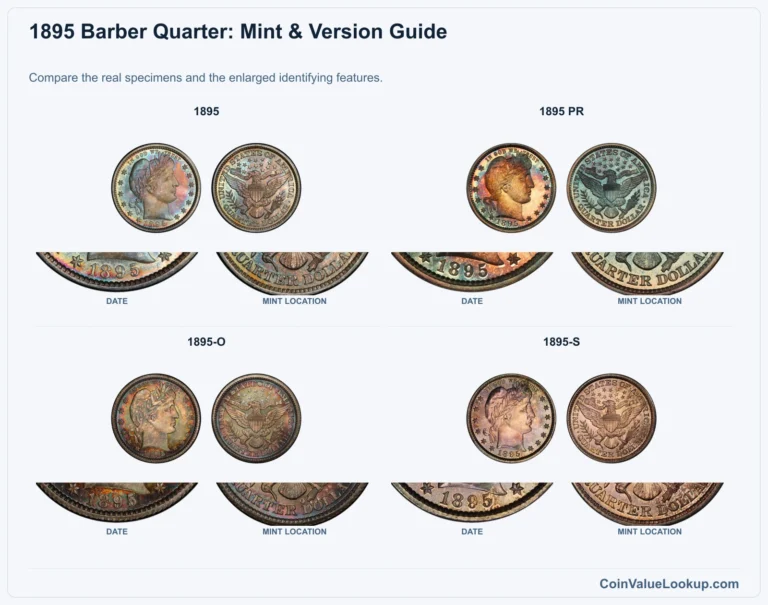
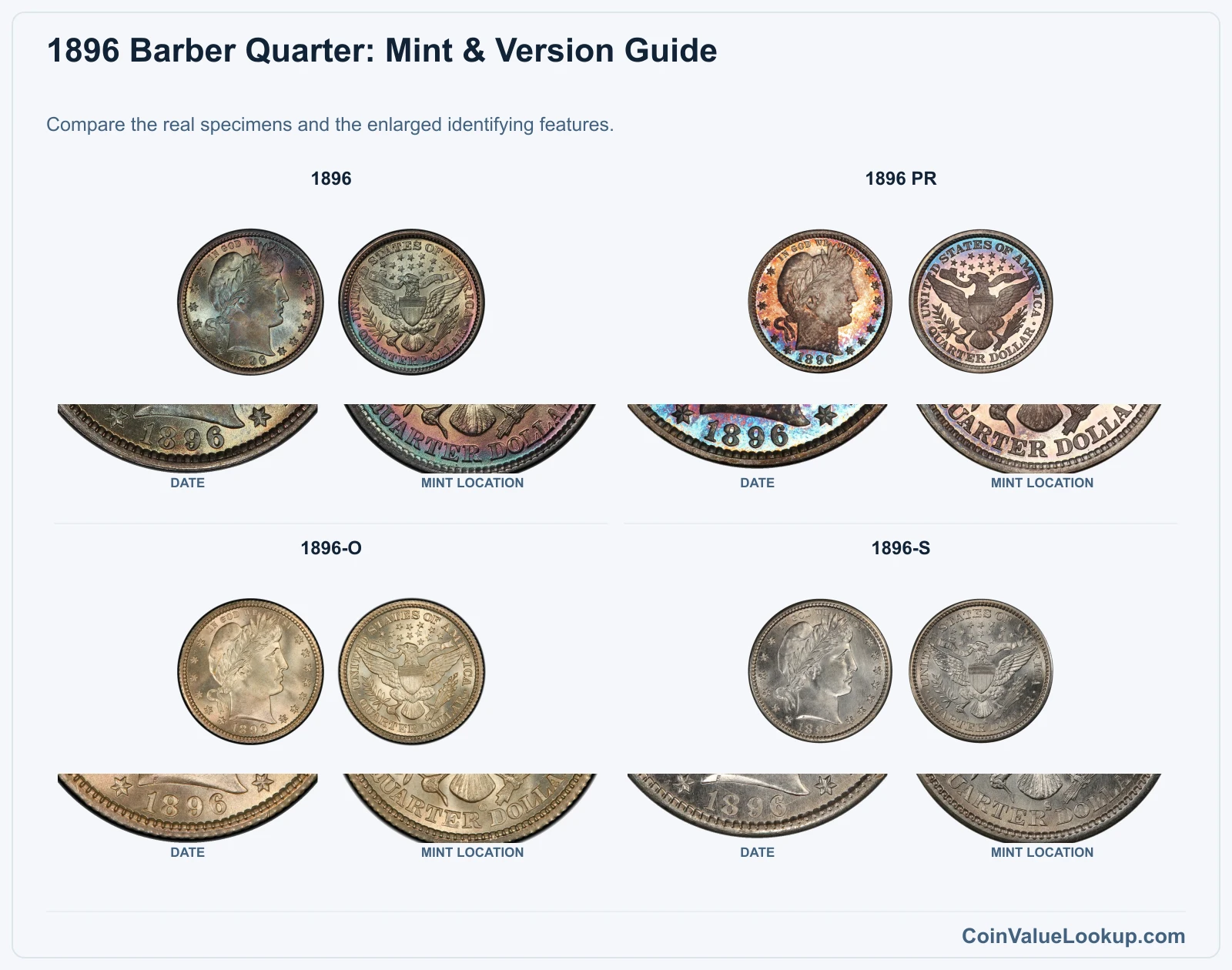
Flip the coin to the reverse and look below the eagle's tail feathers, just above the words QUARTER DOLLAR. A small O means New Orleans.
An S means San Francisco. No letter at all means Philadelphia.
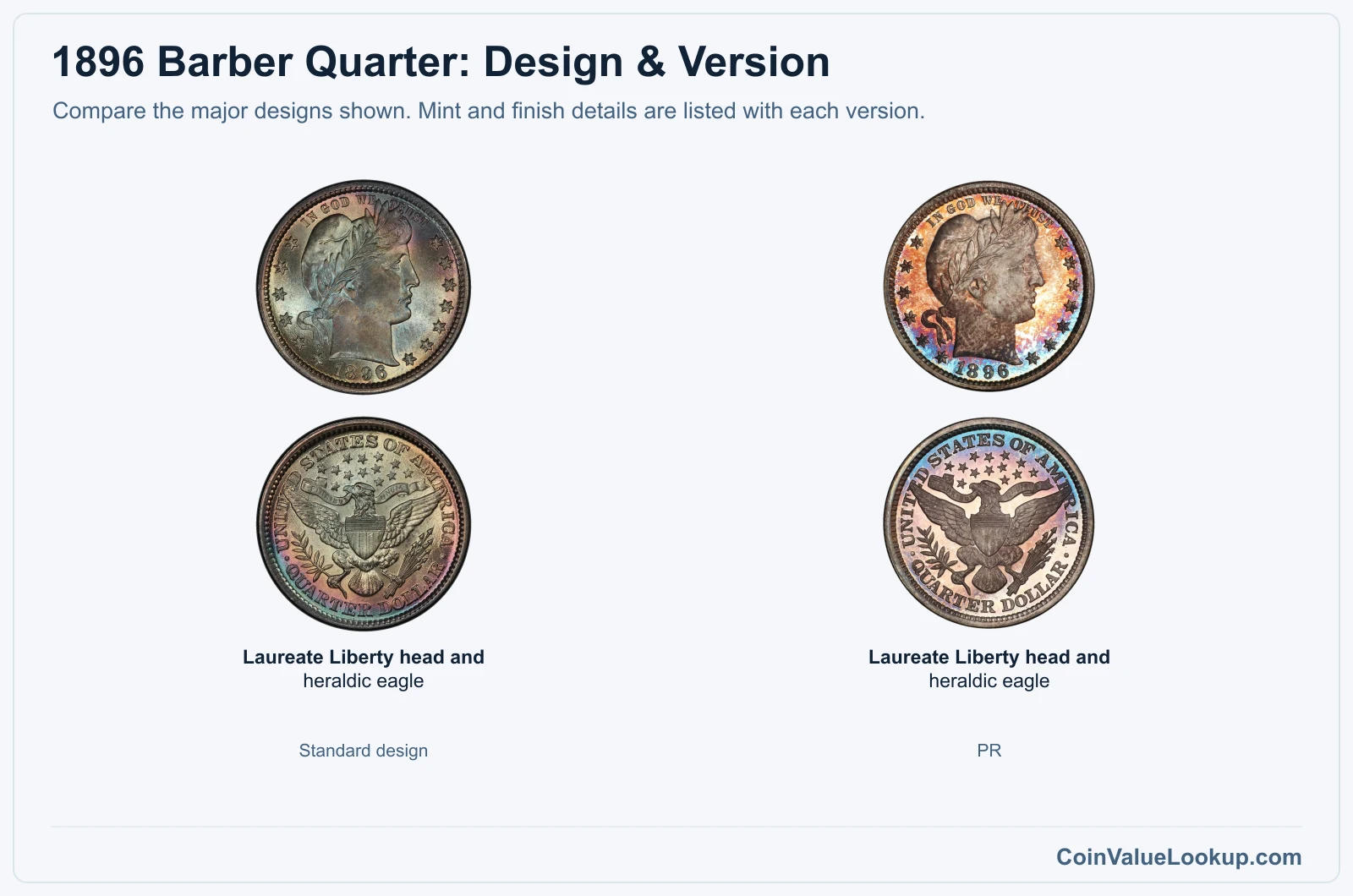
All four branches share the same Laureate Liberty head obverse and heraldic eagle reverse, struck in 90% silver and 10% copper at 6.25 grams.
Philadelphia also produced proof versions in 1896. A proof is a manufacturing method, not a grade — these coins were struck on specially prepared planchets with polished dies.
They have mirror-like fields and sharper rims than regular business strikes, and a shiny circulated coin is not automatically a proof.
So your four possible branches are: 1896 (Philadelphia business strike), 1896 PR (Philadelphia proof), 1896-O (New Orleans), and 1896-S (San Francisco). Nail down mint and finish before you start comparing prices.
Step 2: Check Your 1896 Barber Quarter Grade
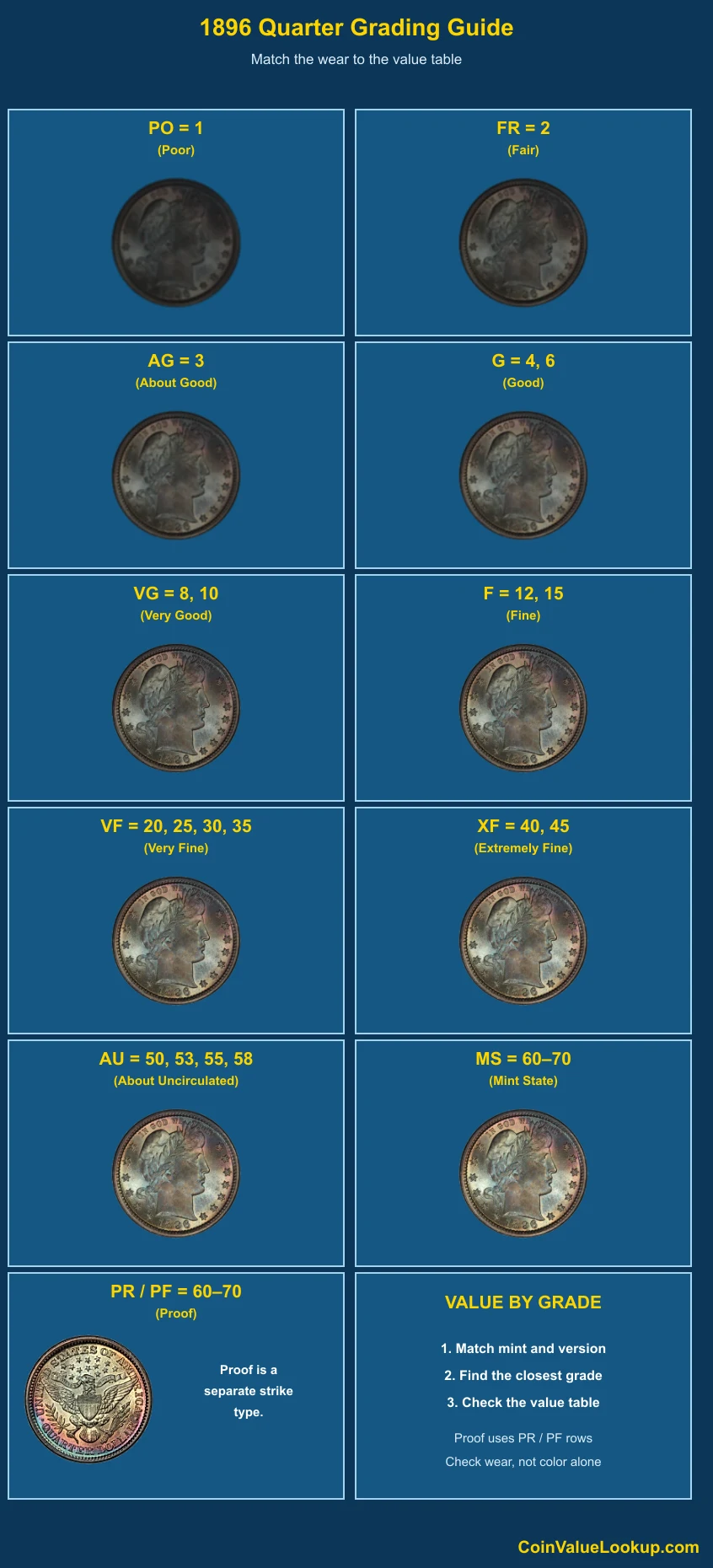
Start with Liberty's hair above the forehead and along the cheek. On a well-worn coin, these areas blend together and the wreath leaves flatten.
The word LIBERTY on the headband is a classic checkpoint, but do not rely on it alone — a weak strike can soften those letters even on an unworn coin.
On the reverse, check the eagle's breast feathers, wing tips and tail. These high points wear first.
A coin with full separation in the feathers and original cartwheel luster across both sides is in a different league from one where the breast is smooth.
Use the comparison image to match your coin's overall wear pattern. Luster matters as much as detail.
A coin can show complete design elements yet have dull, cleaned surfaces — that is not the same as mint state. Likewise, a genuinely uncirculated piece with a soft strike may lack sharpness in spots; do not confuse strike weakness with wear.
Step 3: Check 1896 Barber Quarter Value by Mint and Version
1896 Barber Quarter
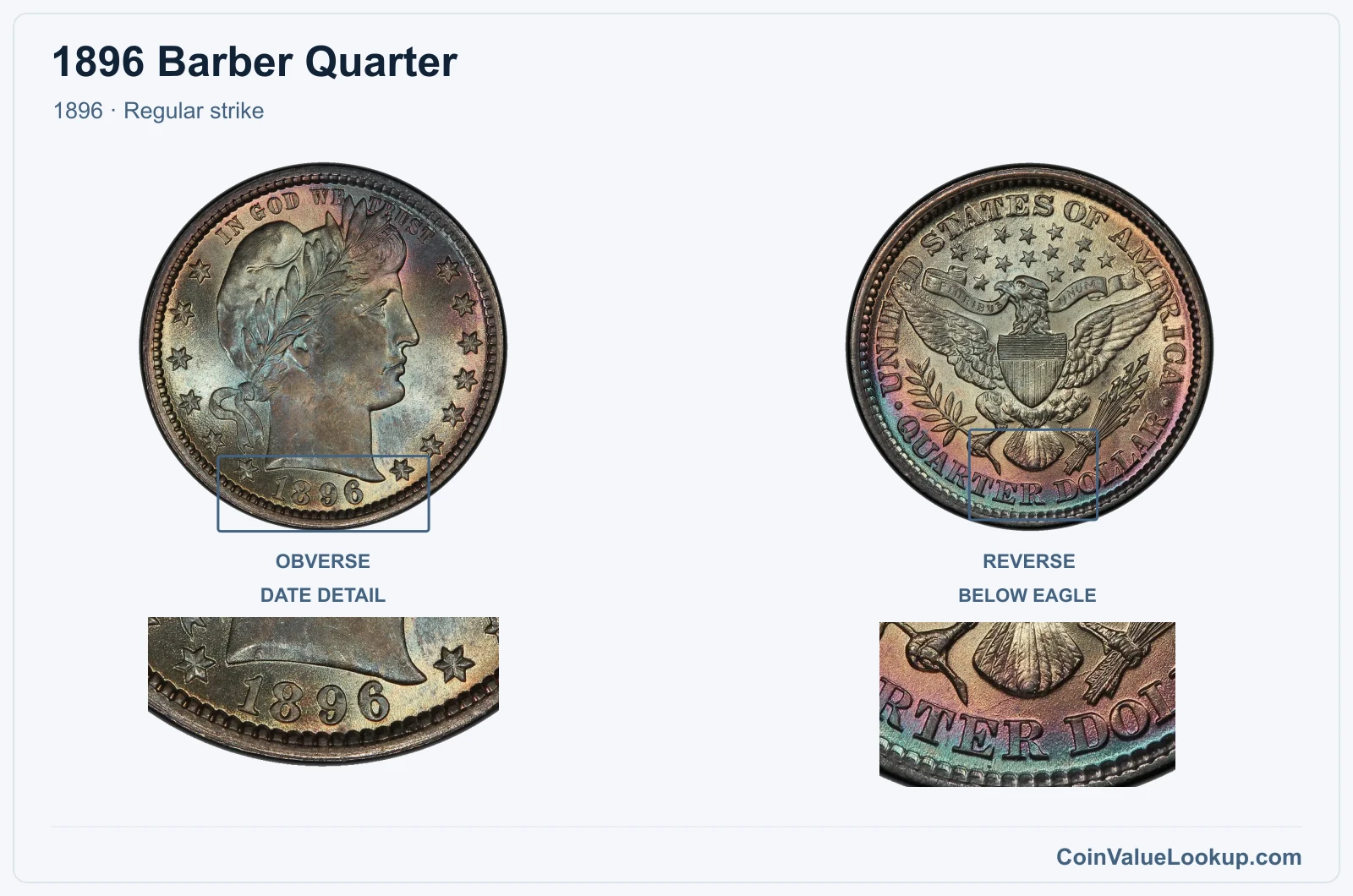
The 1896 Philadelphia business strike carries no mintmark. In well-worn G4 condition, USA Coin Book lists it at about $24.00.
Step up to uncirculated MS60 and the guide estimate jumps to $322.00, with MS63 at $416.00.
This is the most available version of the date. Original surfaces matter here — a cleaned or damaged coin will trade below these guide figures regardless of how much detail remains.
Look for even gray or golden toning and no scratches under magnification.
Range Grade
Price Auction Records Appraisal PO PO 1
—
Coin Identifier FR FR 2
—
Coin Identifier AG AG 3
—
Coin Identifier G G 4
—
Coin Identifier
G 6
—
Coin Identifier VG VG 8
—
Coin Identifier
VG 10
—
Coin Identifier F F 12
—
Coin Identifier
F 15
—
Coin Identifier VF VF 20
—
Coin Identifier
VF 25
—
Coin Identifier
VF 30
Coin Identifier
VF 35
Coin Identifier XF XF 40
—
Coin Identifier
XF 45
Coin Identifier AU AU 50
Coin Identifier
AU 53
Coin Identifier
AU 55
Coin Identifier
AU 58
Coin Identifier MS MS 60
—
Coin Identifier
MS 61
Coin Identifier
MS 62
Coin Identifier
MS 63
Coin Identifier
MS 64
Coin Identifier
MS 65
Coin Identifier
MS 66
Coin Identifier
MS 67
Coin Identifier
MS 68
—
—
—
MS 69
—
—
—
MS 70
—
—
—
1896 Barber Quarter — PR
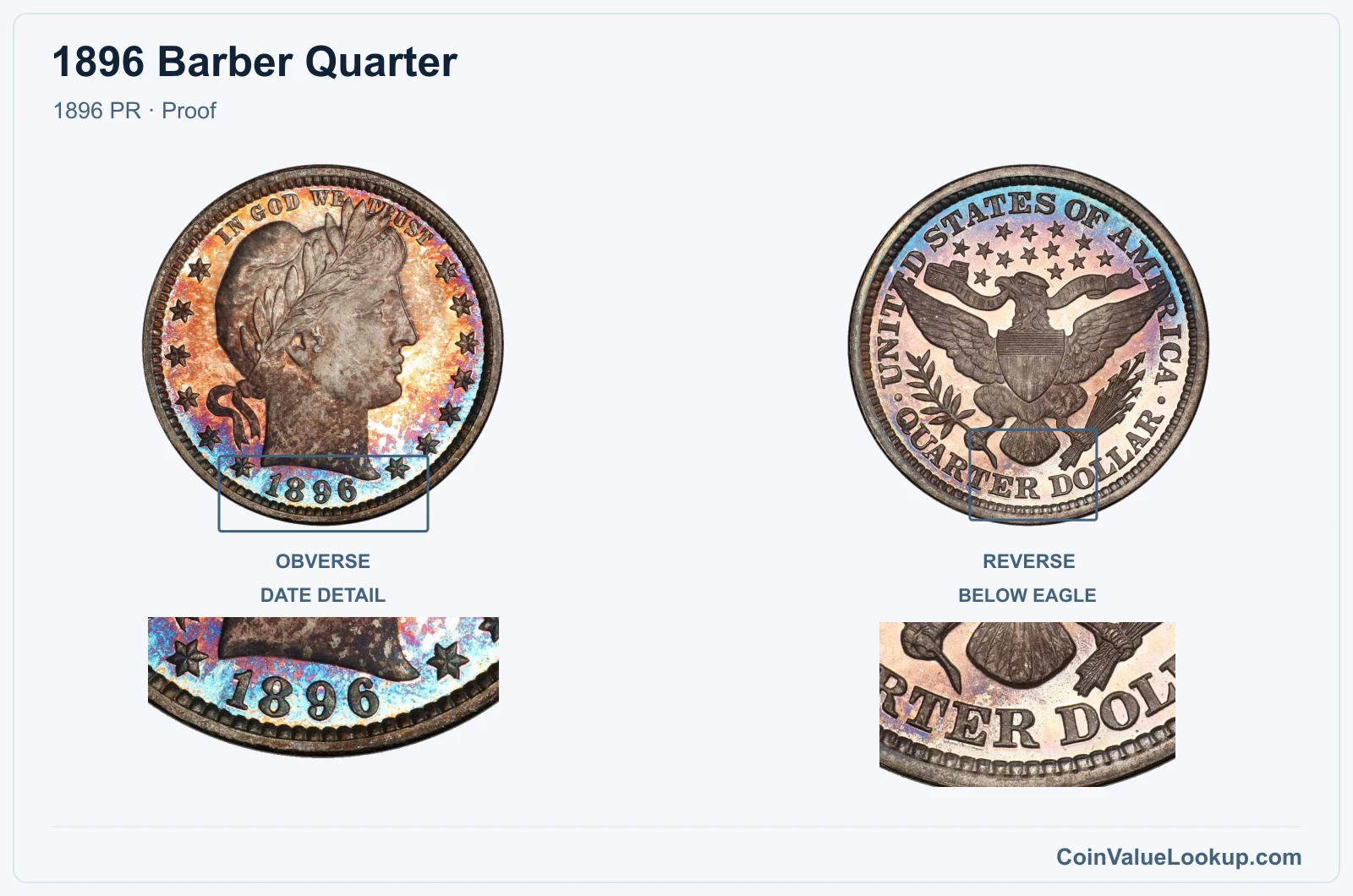
The 1896 Proof was struck at Philadelphia using polished dies and specially prepared planchets. There is no mintmark, same as the business strike, so identification rests on the coin's surface character: mirror fields, squared-off rims and sharper overall detail.
USA Coin Book estimates PR63 at $799.00. Surface haze and hairlines from handling are the main enemies here.
A proof that has been wiped or improperly stored will show fine lines across those mirror fields, and that drags the collector value down significantly. Do not confuse a shiny, lightly circulated business strike for a proof — the differences are in the manufacturing, not just the shine.
Range Grade
Price Auction Records Appraisal PR PR 1
—
Coin Identifier
PR 2
—
Coin Identifier
PR 3
—
Coin Identifier
PR 4
—
Coin Identifier
PR 6
—
Coin Identifier
PR 8
—
Coin Identifier
PR 10
—
Coin Identifier
PR 12
—
Coin Identifier
PR 15
—
Coin Identifier
PR 20
—
Coin Identifier
PR 25
—
Coin Identifier
PR 30
—
Coin Identifier
PR 35
—
Coin Identifier
PR 40
—
Coin Identifier
PR 45
—
Coin Identifier
PR 50
—
Coin Identifier
PR 53
—
Coin Identifier
PR 55
Coin Identifier
PR 58
Coin Identifier
PR 60
Coin Identifier
PR 61
Coin Identifier
PR 62
Coin Identifier
PR 63
Coin Identifier
PR 64
Coin Identifier
PR 65
Coin Identifier
PR 66
Coin Identifier
PR 67
Coin Identifier
PR 68
Coin Identifier
PR 69
—
—
—
PR 70
—
—
—
1896 Barber Quarter — O
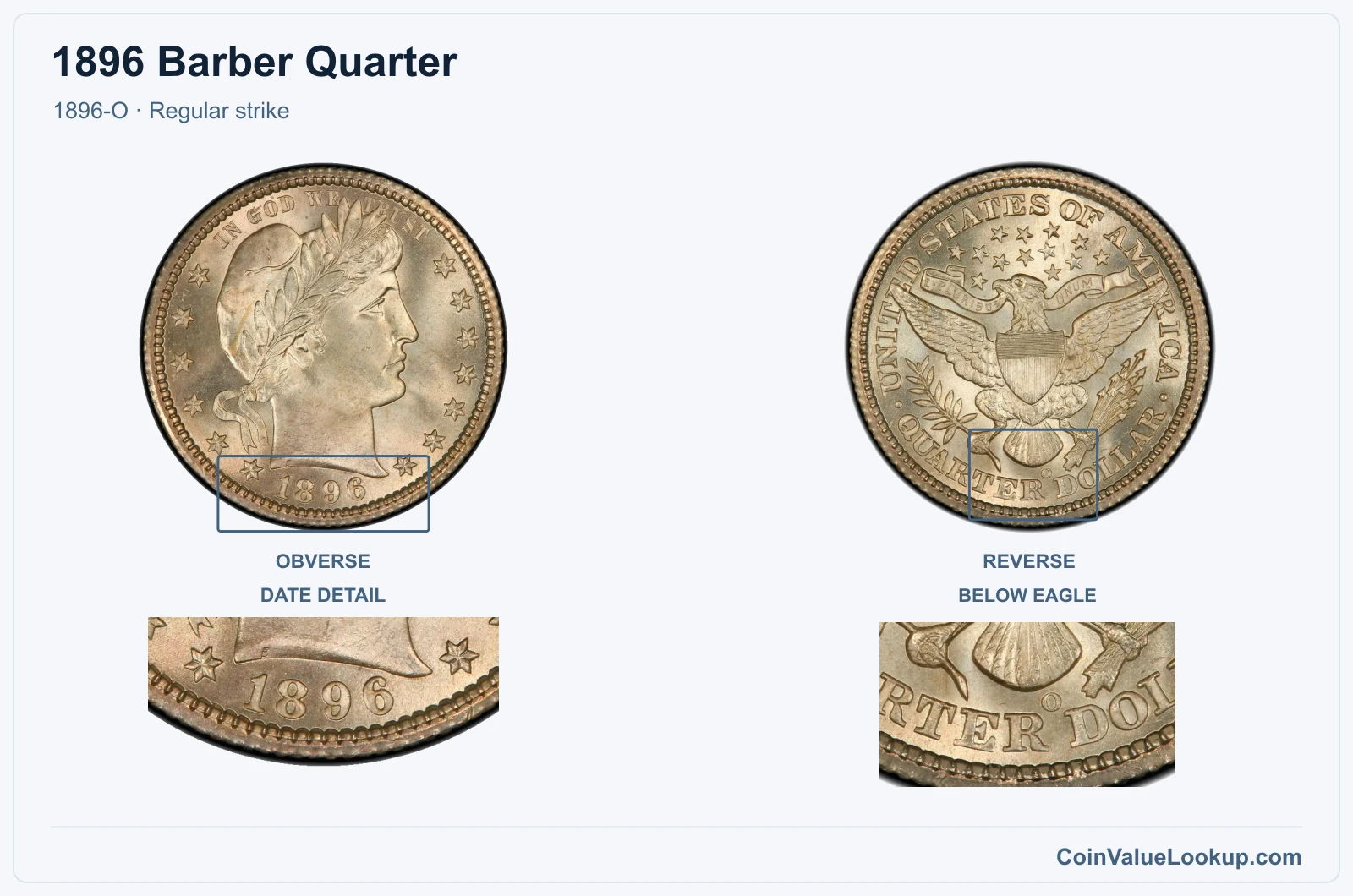
The 1896-O was struck in New Orleans and carries a small O mintmark on the reverse below the eagle's tail. In G4 the USA Coin Book guide estimate is $90.00 — nearly four times the Philadelphia coin in the same grade.
At MS60 the estimate climbs to $1,454.00, and MS63 reaches $2,431.00. Original surfaces and strike quality control the comparison at every level.
Cleaning or environmental damage can cut that value sharply, so look carefully at the fields under good light before assuming you have a high-grade example.
Coin Value Lookup is a good place to start when you want to look up other dates and mints in the Barber Quarter series or check values across different denominations.
Range Grade
Price Auction Records Appraisal PO PO 1
—
Coin Identifier FR FR 2
—
Coin Identifier AG AG 3
—
Coin Identifier G G 4
Coin Identifier
G 6
Coin Identifier VG VG 8
Coin Identifier
VG 10
Coin Identifier F F 12
Coin Identifier
F 15
Coin Identifier VF VF 20
Coin Identifier
VF 25
Coin Identifier
VF 30
Coin Identifier
VF 35
Coin Identifier XF XF 40
Coin Identifier
XF 45
Coin Identifier AU AU 50
Coin Identifier
AU 53
Coin Identifier
AU 55
Coin Identifier
AU 58
Coin Identifier MS MS 60
—
Coin Identifier
MS 61
Coin Identifier
MS 62
Coin Identifier
MS 63
Coin Identifier
MS 64
Coin Identifier
MS 65
Coin Identifier
MS 66
Coin Identifier
MS 67
Coin Identifier
MS 68
—
—
—
MS 69
—
—
—
MS 70
—
—
—
1896 Barber Quarter — S
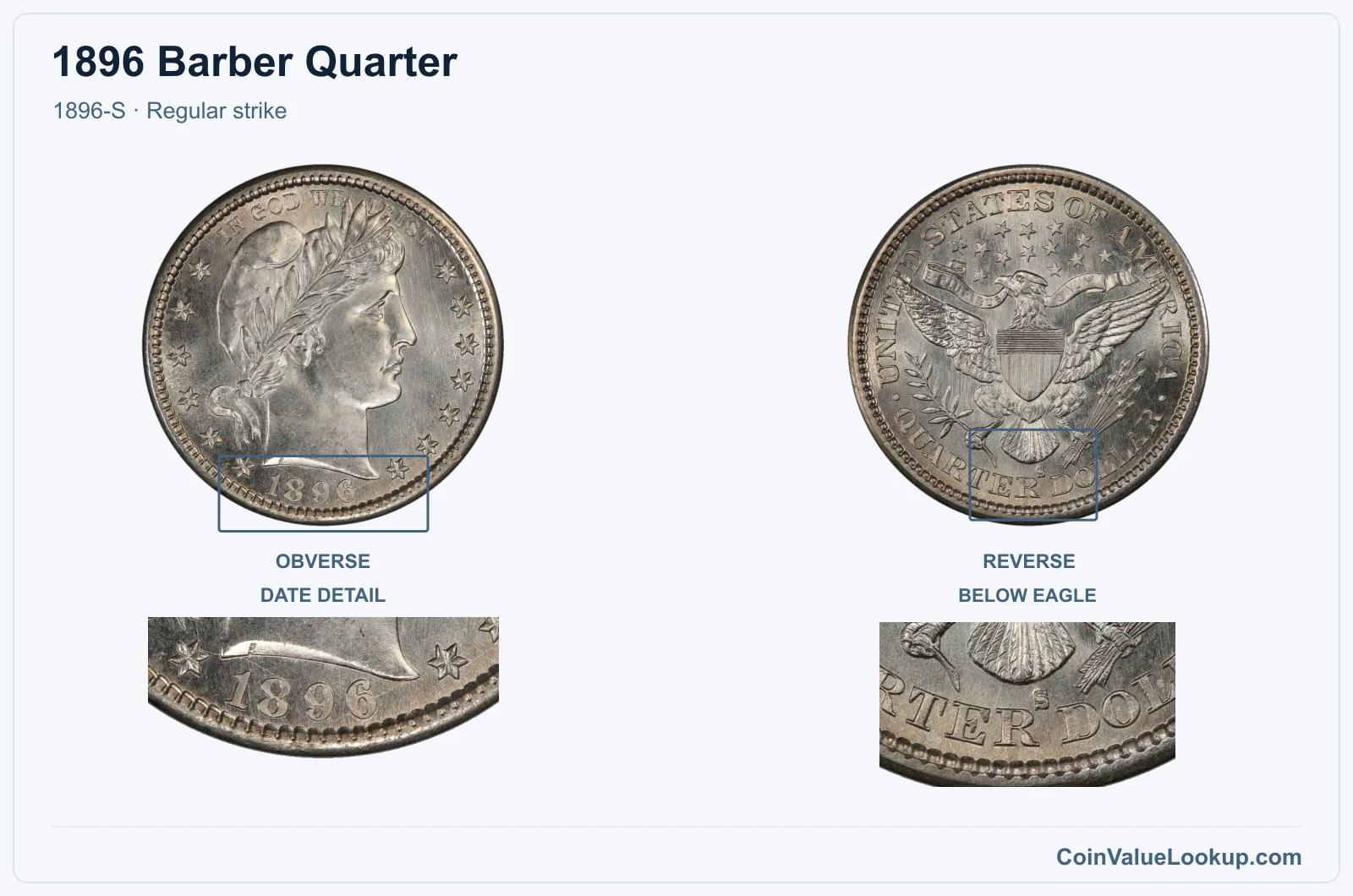
The 1896-S is the prize of this date. Struck in San Francisco, it carries an S mintmark on the reverse.
Even a heavily worn G4 example lists at $834.00 in the USA Coin Book guide — more than most other 1896 quarters in uncirculated condition.
At MS60 the guide estimate rockets to $17,449.00, and MS63 sits at $26,309.00. These numbers reflect genuine scarcity in higher grades.
Very few survived without heavy wear or cleaning.
Because the value is so high, authentication and professional grading are especially important. A fake S mintmark added to a common Philadelphia coin is one of the oldest tricks in the hobby.
Confirm the mintmark looks correct relative to the eagle's tail feathers — it should be cleanly punched and consistent with the surrounding metal surface.
Range Grade
Price Auction Records Appraisal PO PO 1
—
Coin Identifier FR FR 2
Coin Identifier AG AG 3
Coin Identifier G G 4
Coin Identifier
G 6
Coin Identifier VG VG 8
Coin Identifier
VG 10
Coin Identifier F F 12
Coin Identifier
F 15
Coin Identifier VF VF 20
Coin Identifier
VF 25
Coin Identifier
VF 30
Coin Identifier
VF 35
Coin Identifier XF XF 40
Coin Identifier
XF 45
Coin Identifier AU AU 50
Coin Identifier
AU 53
Coin Identifier
AU 55
Coin Identifier
AU 58
Coin Identifier MS MS 60
—
Coin Identifier
MS 61
—
Coin Identifier
MS 62
Coin Identifier
MS 63
Coin Identifier
MS 64
Coin Identifier
MS 65
Coin Identifier
MS 66
Coin Identifier
MS 67
Coin Identifier
MS 68
—
—
—
MS 69
—
—
—
MS 70
—
—
—
1896 Barber Quarter Error List
1. 1896 Barber Quarter — Off-Center Strike
An off-center strike happens when the planchet is not seated properly in the collar before the dies come together. The result is a design that is shifted to one side, leaving a blank crescent of unstruck metal on the opposite edge.
On a 1896 Barber Quarter, the degree of displacement and whether the date remains fully visible are the two biggest factors affecting desirability.
Do not confuse an off-center strike with a misaligned die, which shifts one side slightly but still fills the planchet, or with post-mint damage like a coin that was flattened unevenly after it left the press. A genuine off-center error will show consistent blank metal along one arc.
The value depends on the percentage off-center, overall condition and the visibility of the date, so no single price applies.
2. 1896 Barber Quarter — Clipped Planchet
A clipped planchet error occurs when the blank is punched incorrectly from the metal strip, leaving a missing portion along the edge. On a 1896 Barber Quarter, this can appear as a curved bite (the most common type), a straight edge or a ragged irregular absence.
Genuine clips typically show a characteristic weakness in the design directly opposite the missing area, because the metal did not flow fully during striking.
Watch out for lookalikes. A coin with a filed notch, a deliberate edge cut or corrosion damage along the rim is not a mint error.
Compare the edge texture carefully — a true clip will have a smooth or slightly tapered transition, not a rough gouge. The value of a clipped planchet depends on the size and shape of the clip, the coin's overall condition and which mint produced it; no single adopted price covers every scenario.