1827 Capped Bust Quarter Coin Value: How Much Is It Worth?
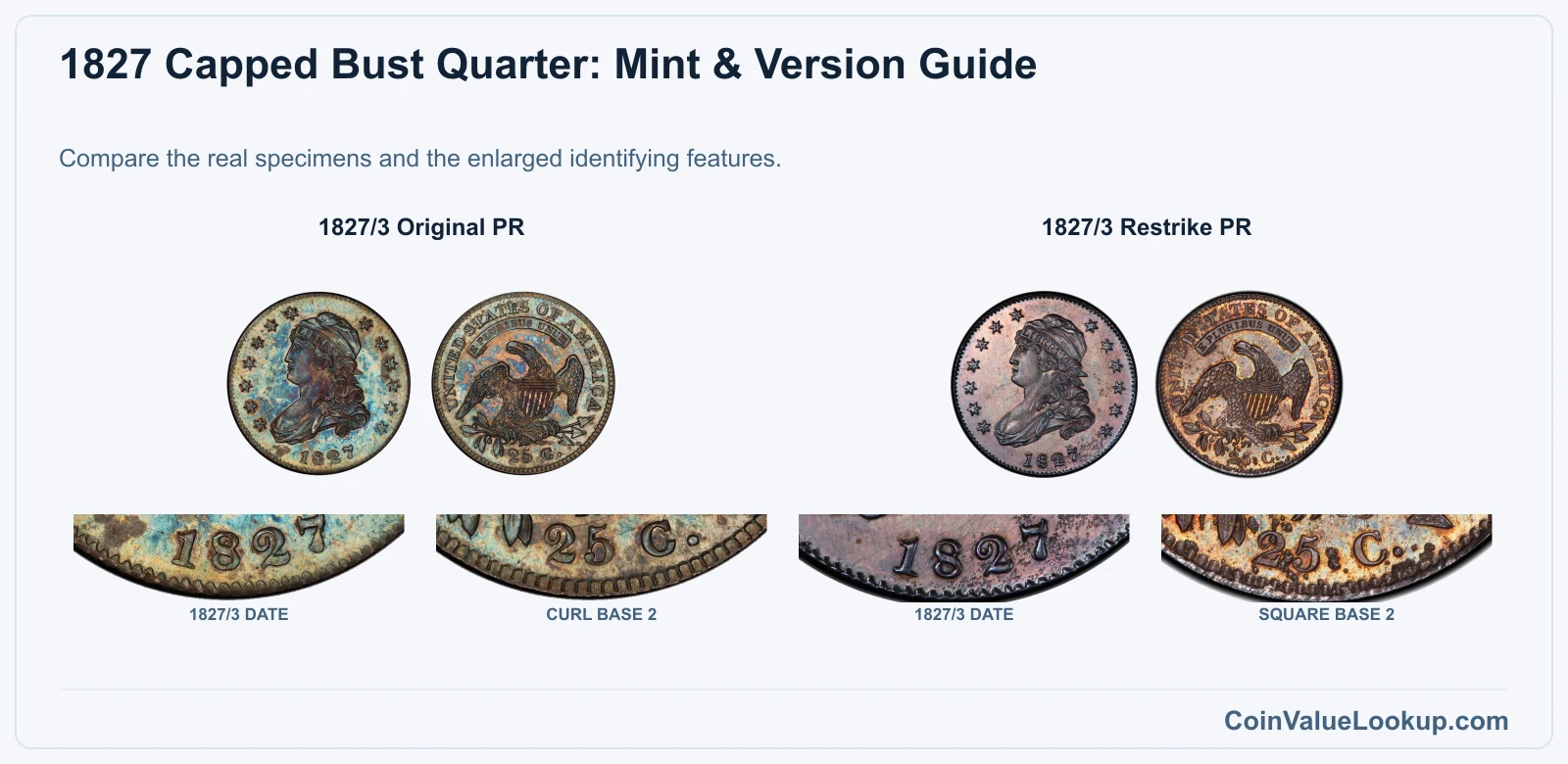
The 1827 Capped Bust Quarter is one of the most unusual issues in the entire early quarter series. No regular-strike business coins are confirmed for this date — every known example is a proof, and all carry an overdated 1827/3 date.
That makes this a coin where identity and authenticity drive the conversation far more than simple grading. Values depend entirely on whether your piece is an authenticated original or a later restrike, and on its specific condition and surface quality.
Fast Way to Identify Your 1827 Capped Bust Quarter
If you think you have an 1827 quarter, snap clear photos of both the front and back and upload them here for a preliminary identification. This is a date where the details matter enormously — the shape of a single numeral on the reverse can separate two very different coins.
Sharp, well-lit images help distinguish proof surfaces from a merely shiny old quarter.
1827 Capped Bust Quarter Value
Upload both sides of your 1827 Capped Bust Quarter.
Front Obverse
Upload photo
Back Reverse
Upload photo
Which 1827 Capped Bust Quarter Versions Are Worth Money?
- The 1827/3 Original proof is distinguished by a curl-base 2 on the reverse denomination — confirm this detail under magnification.
- The 1827/3 Restrike proof has a flat-base 2 on the reverse and was manufactured later than the originals, making it a separate collectible branch.
- Both versions require professional authentication; condition, surface quality, and confirmed identity determine individual value.
Step 1: Identify Your 1827 Capped Bust Quarter Mint Mark and Version
Every confirmed 1827 quarter was struck at Philadelphia with no mintmark. The coin is a silver-copper alloy, approximately 89.24% silver.
It uses the large-diameter Capped Bust design with a heraldic eagle reverse.
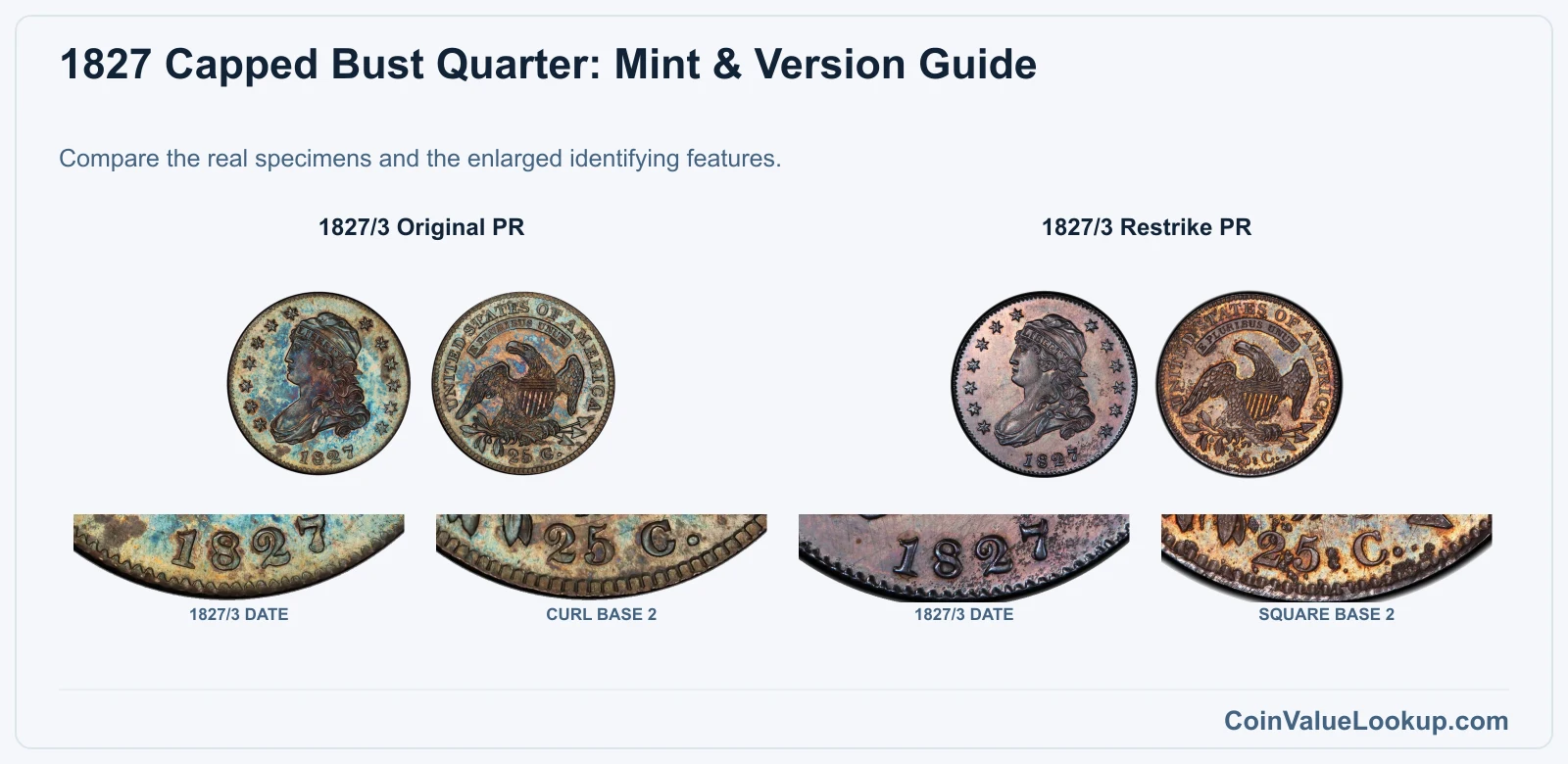
All known pieces show an overdated 1827/3 date — look closely at the 7 in the date for traces of an underlying 3. Two distinct versions exist: the Original and the Restrike.
The critical difference is on the reverse denomination: originals display a curl-base 2 in "25 C.," while restrikes show a flat-base 2. Both versions are proofs.
Do not assume a bright, well-preserved quarter from this era is automatically one of these rare proofs. Proof manufacture leaves specific characteristics — squared rims, mirrored fields, sharp detail from heavy die pressure — that differ from a cleaned or lightly circulated regular-strike coin of a neighboring date.
Authentication by a recognized grading service is essential before drawing any conclusions about this date.
Step 2: Check Your 1827 Capped Bust Quarter Grade
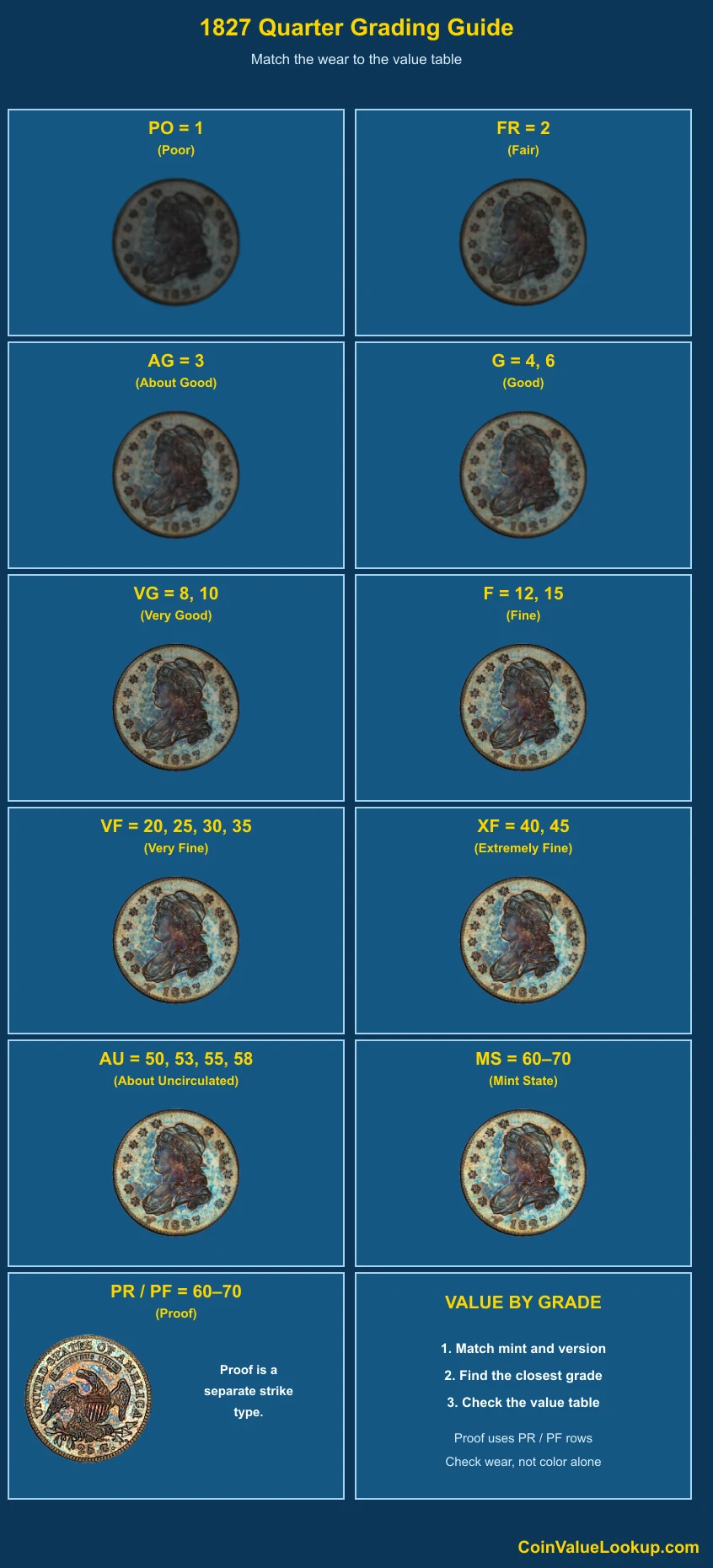
On the Capped Bust Quarter, check the hair curls above Liberty's ear first. That area and the cap folds lose definition before anything else.
On the reverse, the eagle's breast feathers and wing tips are the high points that show friction earliest.
Since all confirmed 1827 quarters are proofs, your focus shifts from circulation wear to surface quality. Hairlines from cleaning, haze from improper storage, and contact marks all matter.
A proof can still show handling damage even if it was never spent.
Compare your coin to the reference image and separate what you see into two categories: was the detail ever there from the strike, or has it been worn away? A weakly struck area looks soft but uniform, while a worn area has flattened, shiny high points next to protected recesses that still show original texture.
On a proof, the fields should be mirror-like when tilted under a light.
Don't confuse a bright surface with a high grade. Cleaning can make a coin look flashy while actually reducing its collector appeal.
Step 3: Check 1827 Capped Bust Quarter Value by Mint and Version
1827 Capped Bust Quarter — /3 Original PR
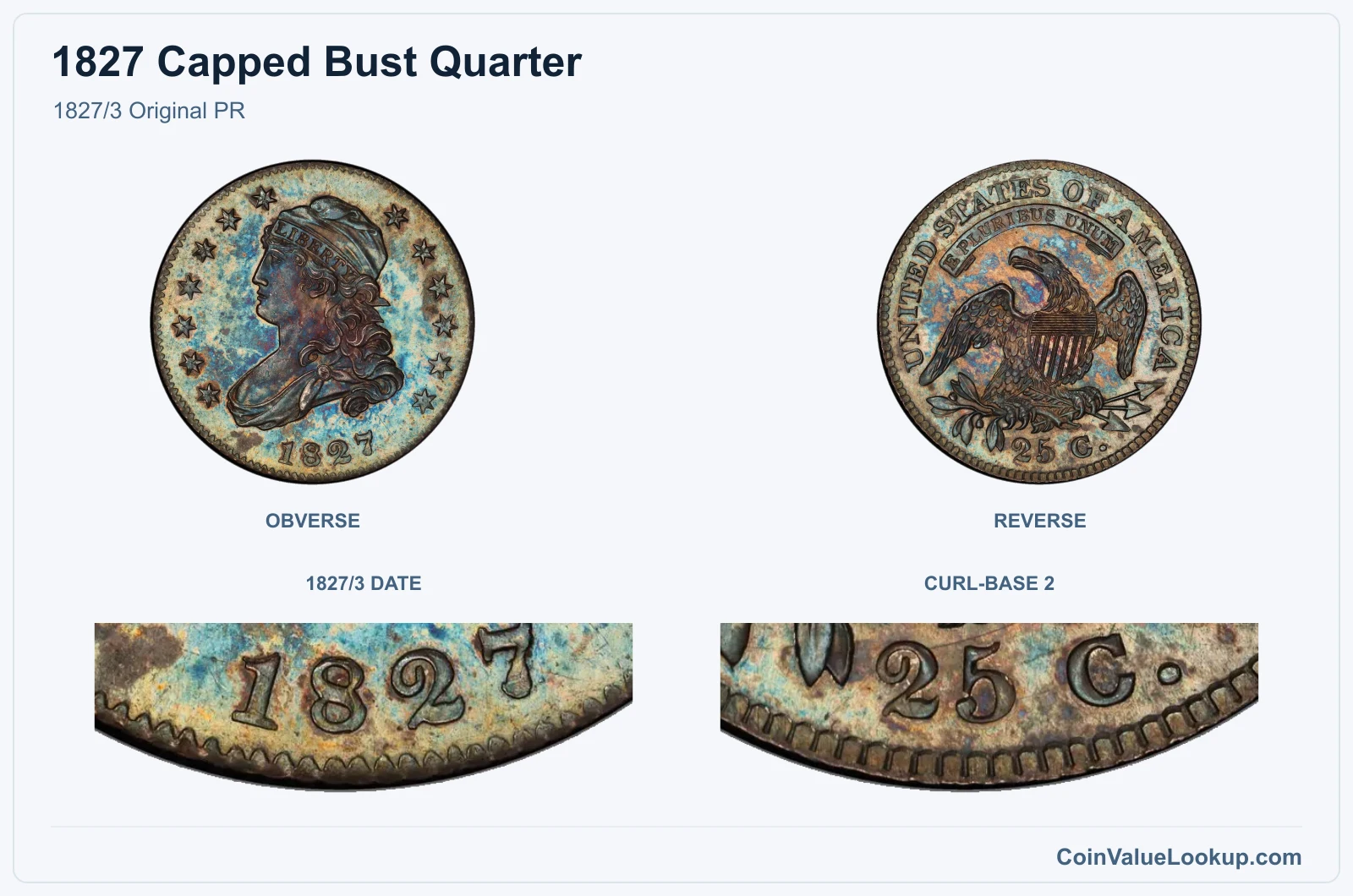
The 1827/3 Original is the earlier of the two proof issues. It carries the overdated 1827/3 date on the obverse and, crucially, a curl-base 2 in the "25 C." denomination on the reverse.
That reverse numeral style is your primary identification point.
All known originals show a die crack on the reverse, which is actually a confirming diagnostic rather than damage. Proof surfaces should display mirrored fields with sharply struck devices.
Hairlines, haze, and rim contact all affect desirability.
No supported price range exists for this version because so few are known and each transaction depends on the individual coin's authenticated identity, surface preservation, and pedigree. If you believe you hold one, professional certification is the necessary first step before any value discussion.
Range Grade
Price Auction Records Appraisal PR PR 1
—
Coin Identifier
PR 2
—
Coin Identifier
PR 3
—
Coin Identifier
PR 4
—
Coin Identifier
PR 6
—
Coin Identifier
PR 8
—
Coin Identifier
PR 10
—
Coin Identifier
PR 12
—
Coin Identifier
PR 15
—
Coin Identifier
PR 20
—
Coin Identifier
PR 60
—
—
—
PR 61
—
—
—
PR 62
—
Coin Identifier
PR 63
Coin Identifier
PR 64
Coin Identifier
PR 65
Coin Identifier
PR 66
—
—
—
PR 67
—
—
—
PR 68
—
—
—
PR 69
—
—
—
PR 70
—
—
—
1827 Capped Bust Quarter — /3 Restrike PR
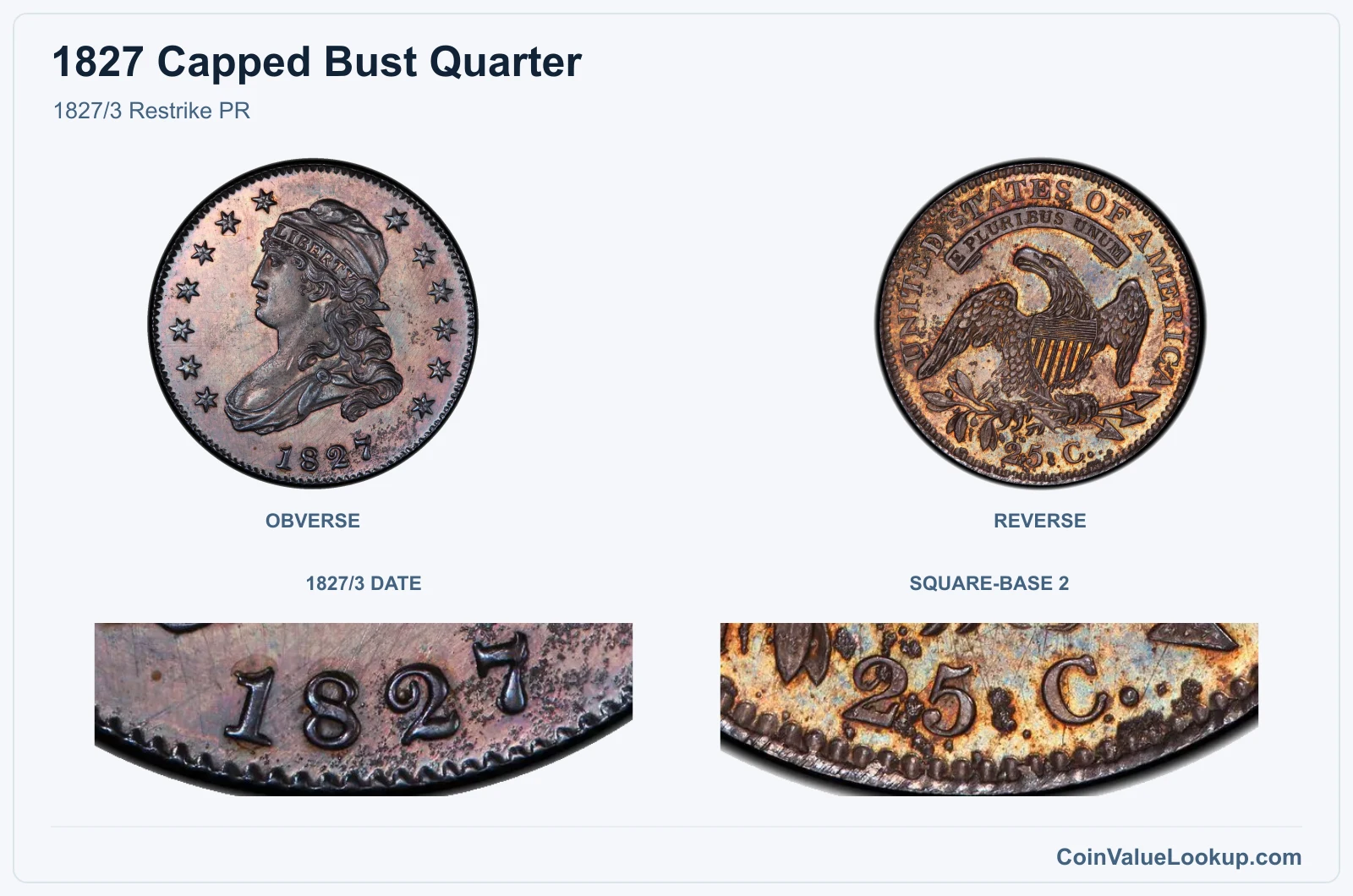
The 1827/3 Restrike shares the same overdated 1827/3 obverse as the Original but was struck at a later time using different reverse die pairings. The telltale sign is a flat-base 2 in the "25 C." on the reverse, compared to the curl-base 2 found on originals.
Because restrikes were produced after the date on the coin, they occupy a distinct place in the collecting hierarchy. They are still rare and still proofs, but collectors differentiate them from originals.
Coin Value Lookup can help you look up guides for Capped Bust Quarters and other early U.S. series when you need a starting point for research.
As with the Original, no supported numeric price range is available here. Each coin's value hinges on authenticated identity and condition, so third-party grading service confirmation is the essential starting step.
Range Grade
Price Auction Records Appraisal PR PR 1
—
Coin Identifier
PR 2
—
Coin Identifier
PR 3
—
Coin Identifier
PR 4
—
Coin Identifier
PR 6
—
Coin Identifier
PR 8
—
Coin Identifier
PR 10
—
Coin Identifier
PR 12
—
Coin Identifier
PR 15
—
Coin Identifier
PR 20
—
Coin Identifier
PR 25
—
Coin Identifier
PR 30
—
Coin Identifier
PR 35
—
Coin Identifier
PR 40
—
Coin Identifier
PR 45
—
Coin Identifier
PR 50
—
Coin Identifier
PR 53
—
Coin Identifier
PR 55
—
Coin Identifier
PR 58
—
Coin Identifier
PR 60
—
Coin Identifier
PR 61
—
Coin Identifier
PR 62
Coin Identifier
PR 63
Coin Identifier
PR 64
Coin Identifier
PR 65
Coin Identifier
PR 66
Coin Identifier
PR 67
—
—
—
PR 68
—
—
—
PR 69
—
—
—
PR 70
—
—
—
1827 Capped Bust Quarter Error List
1. 1827 Capped Bust Quarter — Overdate
The overdate on the 1827 Capped Bust Quarter is not just an error — it defines the issue. Every confirmed example shows remnants of a 3 beneath the final 7 in the date.
Under magnification, you can see curved elements of the earlier digit where the new punch did not fully obliterate the old one.
This is a die variety created when the Mint re-engraved an existing 1823-dated die with a new 7 punch. Look at the base and top of the 7 for traces of the underlying numeral's curves.
Don't confuse a damaged or corroded date with an overdate. Post-mint scratches or corrosion can create shadows that mimic underlying digits.
A genuine overdate shows consistent, raised remnants that follow the original digit's contour because they were part of the die itself. No specific price premium applies separately from the coin's identity since the overdate is inherent to all known 1827 quarters — it is part of what the coin is, not an add-on.
2. 1827 Capped Bust Quarter — Off-Center Strike
An off-center strike on an 1827 Capped Bust Quarter would show a displaced design with an unstruck crescent along one edge. The coin blank was not seated properly between the dies when struck, shifting the entire image to one side.
One reported characteristic of early reeded-edge quarters struck off center is that they tend to have plain edges, because the mis-seated planchet did not engage the collar that imparts the reeding. That plain edge is itself a diagnostic.
Be careful not to confuse an off-center strike with a clipped planchet, which removes a curved bite from the blank before striking, or with post-mint damage like a flattened rim from being hit. A genuine off-center piece will show the full design displaced uniformly in one direction with the missing area completely unstruck.
No numeric price data is available for this error on the 1827 quarter. Value would depend on the percentage off center, whether the date remains visible, and overall condition.
3. 1827 Capped Bust Quarter — Die Crack / Die Chip
All known examples of the original 1827 quarter share a die crack on the reverse, making it a diagnostic feature of that specific die pairing rather than a random defect. A die crack appears as a thin, raised line on the coin's surface — it is raised because the crack in the steel die creates a recessed channel that fills with metal during striking.
Distinguish a die crack from a die chip. A crack is linear, often connecting two points on the design or running to the rim.
A chip is a small, raised blob where a piece of the die surface broke away. A crack that reaches the rim and displaces metal outward is called a cud — a more dramatic form.
Do not mistake incuse scratches, corrosion lines, or debris stuck to the surface for die cracks. Scratches are recessed into the coin, not raised above it.
Tilt the coin under a light and feel the direction of the relief.
No separate price premium is documented for the reverse die crack on this date since it is present across the known originals.