1852 Liberty Seated Quarter Coin Value: How Much Is It Worth?
An 1852 Liberty Seated quarter can be worth anywhere from around $163 in well-worn G4 condition to over $42,000 for a high-grade New Orleans strike. Those are guide estimates, not guaranteed offers, and they swing dramatically depending on mint, condition and originality.
Match yours carefully before assuming a value — the difference between a Philadelphia and an O-mint coin is enormous in this year.
Fast Way to Identify Your 1852 Liberty Seated Quarter
Upload clear photos of both sides of your 1852 quarter and our identifier will give you a preliminary read on the mint, version and general condition. This is not authentication or exact grading, but it narrows the field quickly.
A sharp, well-lit image of the date area and the reverse below the eagle helps the most.
1852 Liberty Seated Quarter Value
Upload both sides of your 1852 Liberty Seated Quarter.
Front Obverse
Upload photo
Back Reverse
Upload photo
Which 1852 Liberty Seated Quarter Versions Are Worth Money?
- The 1852-O (New Orleans) business strike is the scarcer mint, with guide estimates from $447 in G4 up to $42,845 in MS63 — far above the Philadelphia issue at the same grades.
- Philadelphia business strikes in original, problem-free condition above VF20 are solid coins, with guide values reaching $2,637 at MS63.
- The 1852 Philadelphia proof is a recognized rarity with no adopted guide price; authenticated examples require individual assessment.
- A repunched-date variety exists on Philadelphia business and proof strikes, adding collector interest when confirmed by diagnostics.
- Rotated reverse examples paired with the repunched-date die are documented at significant rotation angles and would need specialist evaluation.
Step 1: Identify Your 1852 Liberty Seated Quarter Mint Mark and Version
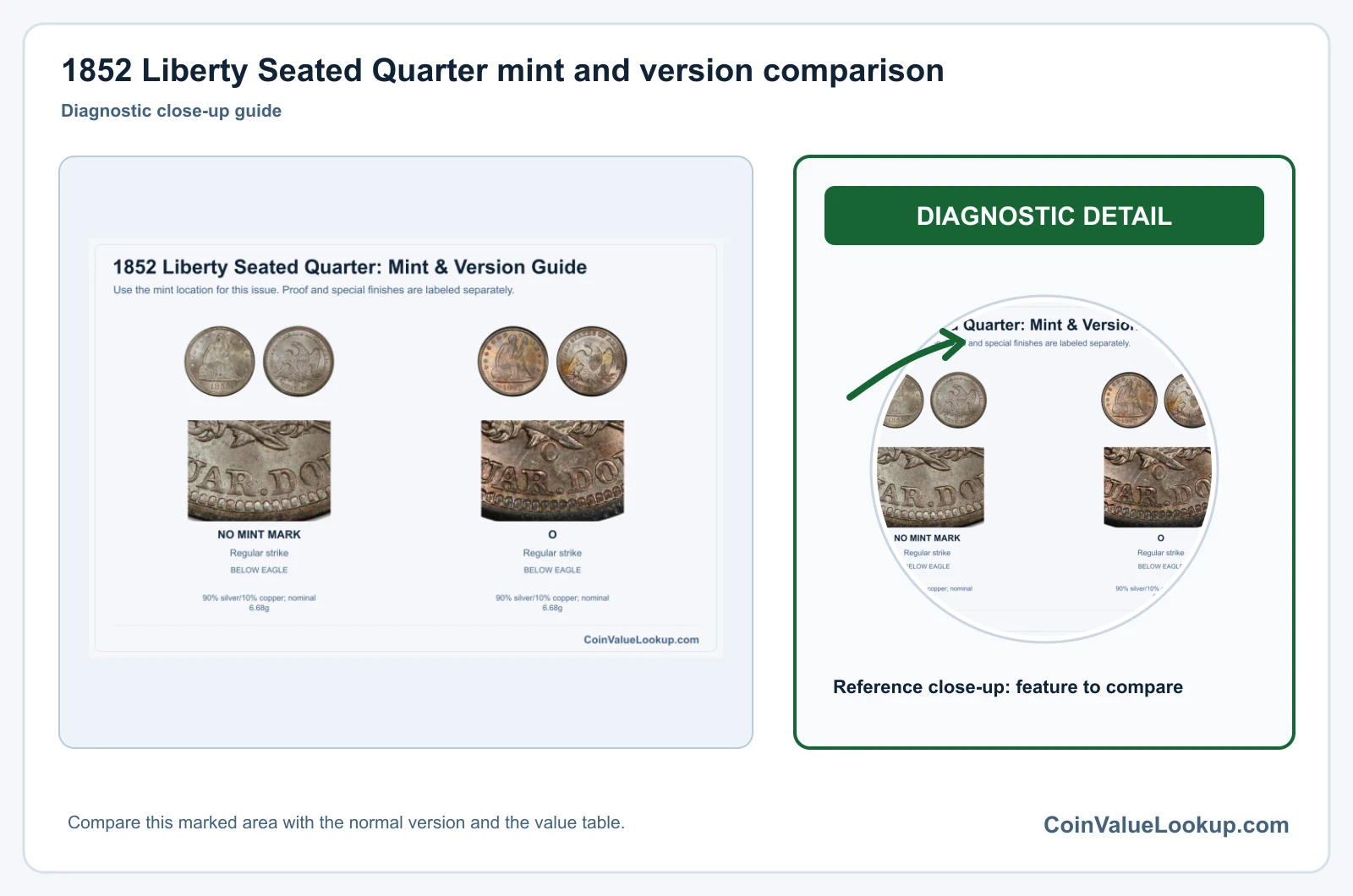
All 1852 Seated Liberty quarters share the same basic design: Liberty seated on the obverse, an eagle without motto on the reverse. The series predates the weight reduction of 1853, so genuine examples should weigh about 6.68 grams in 90% silver, 10% copper, at roughly 24.3 mm diameter.
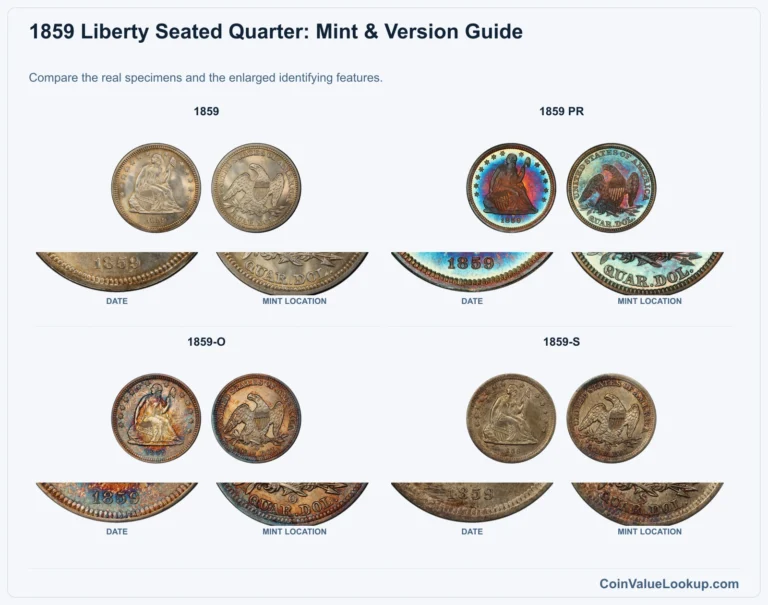
Mintmark location is on the reverse, below the eagle. No mintmark means Philadelphia.
An "O" means New Orleans. San Francisco did not strike quarters until 1855, so any 1852 with an S mintmark would be suspect.
Philadelphia produced both business strikes and rare proofs in 1852. A repunched date variety (where the digits of 52 show extra remnants from a second impression during die preparation) exists on both business and proof strikes.
The presence of that repunched date alone does not prove a coin is a proof — finish and surface character are separate questions.
Original, undamaged surfaces matter far more than brightness. A coin that has been cleaned or polished will lose value regardless of the date or mint.
Step 2: Check Your 1852 Liberty Seated Quarter Grade
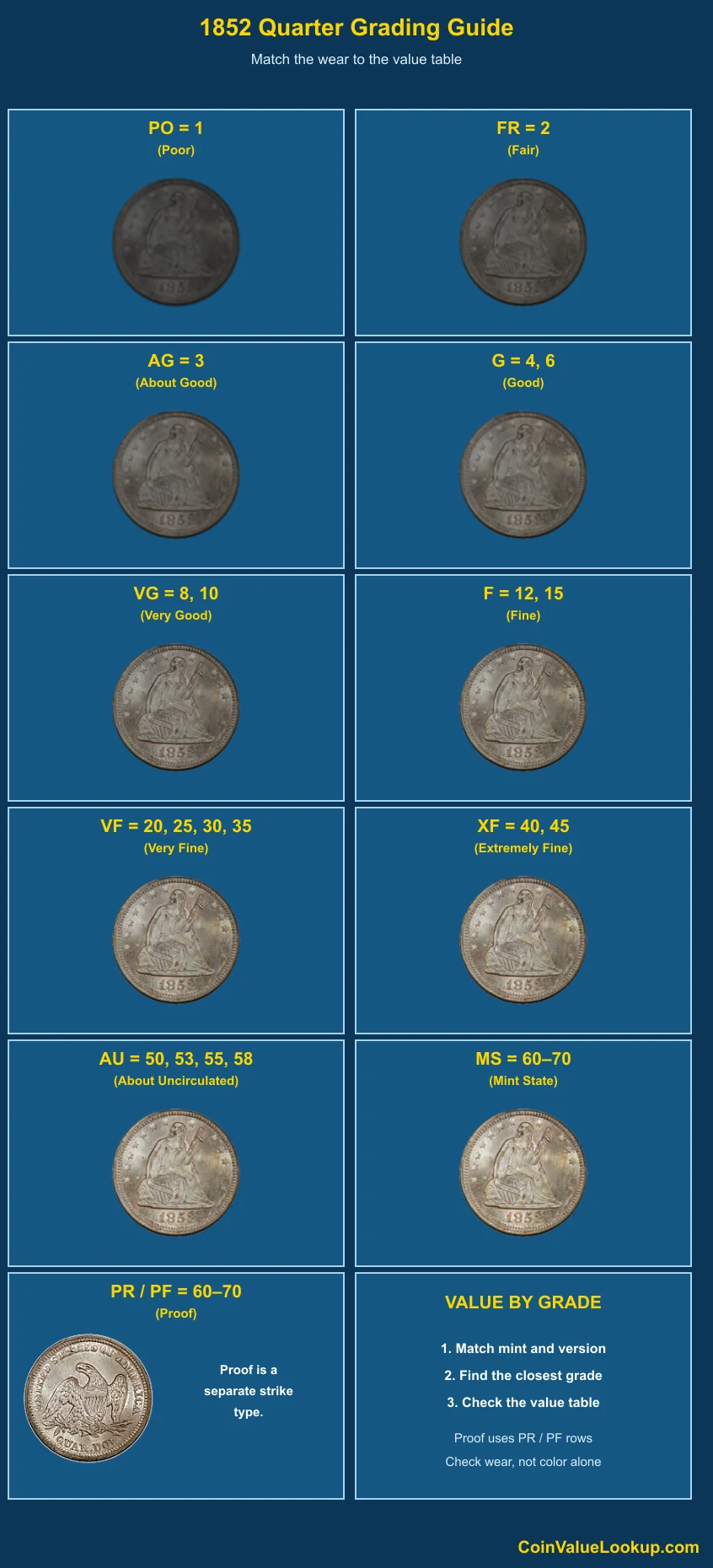
Start with the obverse. Check Liberty's head, the line of her breast, the knee and the lettering on the shield.
These are the first spots to lose detail as a coin circulates.
On the reverse, look at the eagle's breast feathers, wing tips and claws. Rounded, soft features indicate wear.
But a soft head or mushy stars can also be a strike issue — not every flat area means the coin saw heavy use.
Luster is a clue, not a verdict. A coin with full cartwheel luster across both sides is likely uncirculated, but reflective surfaces from polishing are not the same thing.
Hairlines under magnification usually point to past cleaning.
Rim dings, corrosion and scratches all reduce value. For proof or special-strike attribution, comparison against a known genuine specimen is essential — reflectivity alone is not enough.
Use the comparison image to benchmark your coin's wear against known grade points.
Step 3: Check 1852 Liberty Seated Quarter Value by Mint and Version
1852 Liberty Seated Quarter — Business Strike
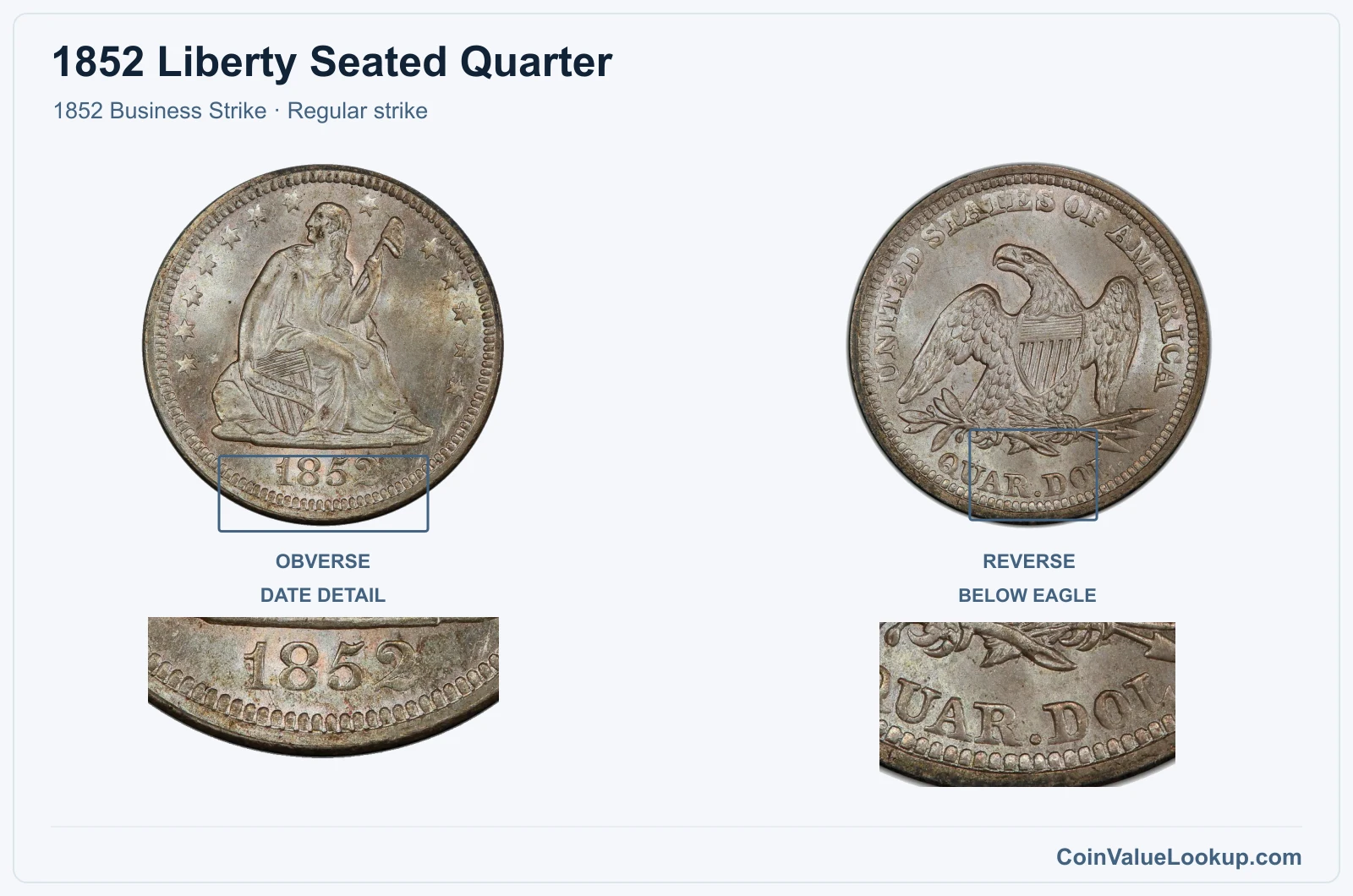
The 1852 Philadelphia business strike has no mintmark and uses the pre-1853 heavy standard at about 6.68 grams. It is the more available of the two regular issues this year.
USA Coin Book guide estimates place it near $163 in G4 (a well-worn but identifiable coin), around $447 in VF20 (moderate wear with major details clear), and roughly $2,637 in MS63 (uncirculated with minor contact marks). These are retail guide figures, not guaranteed sale prices.
A repunched-date variety is known on Philadelphia business strikes. That variety is covered separately below.
| Range | Grade | Price | Auction Records | Appraisal |
|---|---|---|---|---|
| PO | PO 1 | — | Coin Identifier | |
| FR | FR 2 | — | Coin Identifier | |
| AG | AG 3 | — | Coin Identifier | |
| G | G 4 | — | Coin Identifier | |
| G 6 | — | Coin Identifier | ||
| VG | VG 8 | Coin Identifier | ||
| VG 10 | Coin Identifier | |||
| F | F 12 | Coin Identifier | ||
| F 15 | — | Coin Identifier | ||
| VF | VF 20 | Coin Identifier | ||
| VF 25 | Coin Identifier | |||
| VF 30 | Coin Identifier | |||
| VF 35 | Coin Identifier | |||
| XF | XF 40 | Coin Identifier | ||
| XF 45 | Coin Identifier | |||
| AU | AU 50 | Coin Identifier | ||
| AU 53 | Coin Identifier | |||
| AU 55 | Coin Identifier | |||
| AU 58 | Coin Identifier | |||
| MS | MS 60 | — | Coin Identifier | |
| MS 61 | Coin Identifier | |||
| MS 62 | Coin Identifier | |||
| MS 63 | Coin Identifier | |||
| MS 64 | Coin Identifier | |||
| MS 65 | Coin Identifier | |||
| MS 66 | Coin Identifier | |||
| MS 67 | — | — | — | |
| MS 68 | — | — | — | |
| MS 69 | — | — | — | |
| MS 70 | — | — | — |
1852 Liberty Seated Quarter — O Business Strike
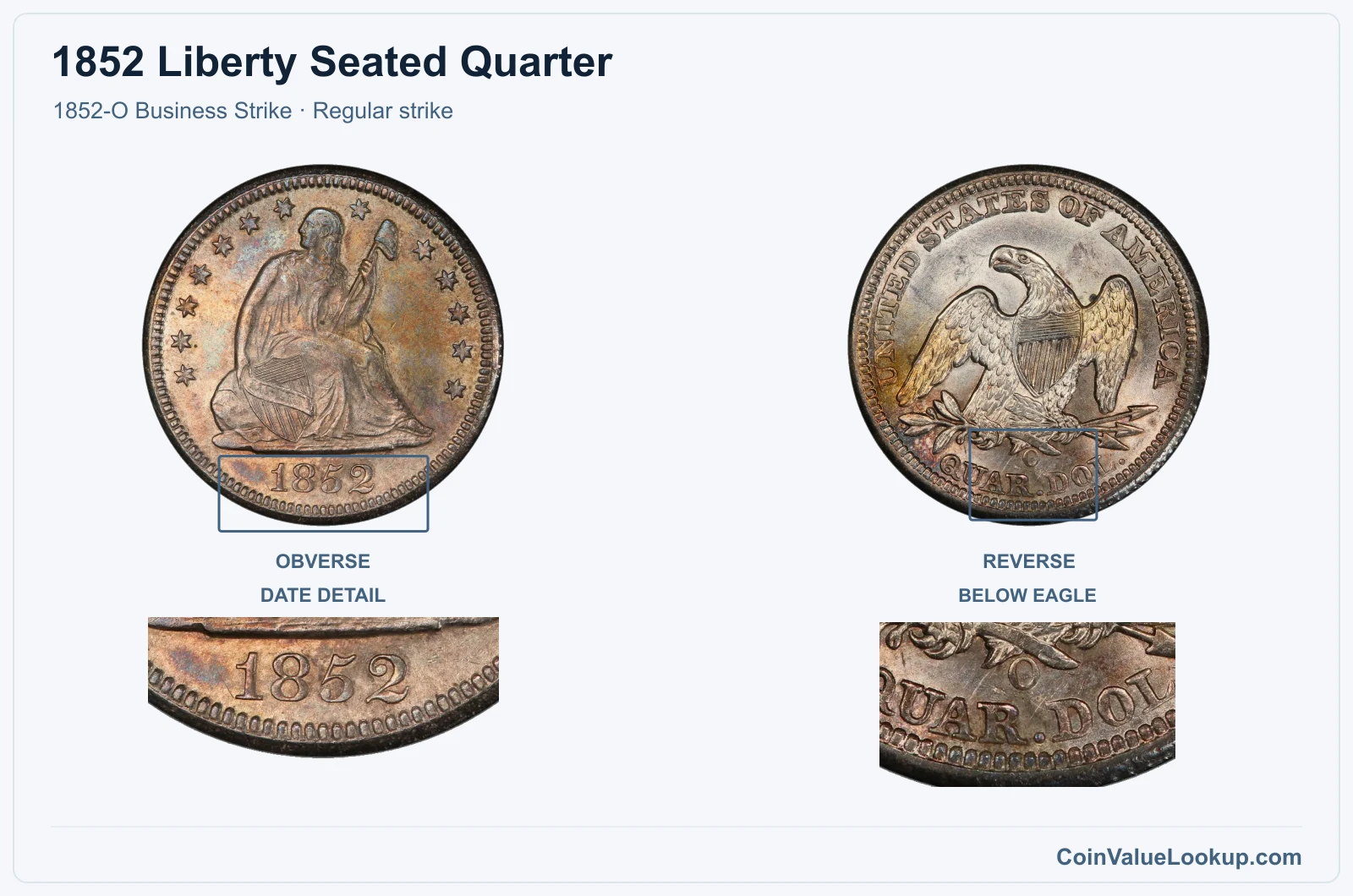
The 1852-O carries an "O" mintmark on the reverse below the eagle. New Orleans output was smaller, and survival rates in higher grades are much lower — which is why the price curve gets steep.
Guide estimates start around $447 in G4, jump to approximately $1,887 in VF20, and reach a striking $42,845 at MS63 according to USA Coin Book. That MS63 figure reflects genuine scarcity at that level, not a typo.
If you have one, condition is everything. Cleaning, rim damage or heavy scratches will cut the premium severely.
Original surfaces with honest wear are far more desirable than a shiny, cleaned coin.
| Range | Grade | Price | Auction Records | Appraisal |
|---|---|---|---|---|
| PO | PO 1 | — | Coin Identifier | |
| FR | FR 2 | — | Coin Identifier | |
| AG | AG 3 | Coin Identifier | ||
| G | G 4 | Coin Identifier | ||
| G 6 | Coin Identifier | |||
| VG | VG 8 | Coin Identifier | ||
| VG 10 | Coin Identifier | |||
| F | F 12 | Coin Identifier | ||
| F 15 | Coin Identifier | |||
| VF | VF 20 | Coin Identifier | ||
| VF 25 | Coin Identifier | |||
| VF 30 | Coin Identifier | |||
| VF 35 | Coin Identifier | |||
| XF | XF 40 | Coin Identifier | ||
| XF 45 | Coin Identifier | |||
| AU | AU 50 | Coin Identifier | ||
| AU 53 | Coin Identifier | |||
| AU 55 | Coin Identifier | |||
| AU 58 | Coin Identifier | |||
| MS | MS 60 | — | Coin Identifier | |
| MS 61 | Coin Identifier | |||
| MS 62 | Coin Identifier | |||
| MS 63 | Coin Identifier | |||
| MS 64 | — | — | — | |
| MS 65 | — | — | — | |
| MS 66 | — | — | — | |
| MS 67 | — | — | — | |
| MS 68 | — | — | — | |
| MS 69 | — | — | — | |
| MS 70 | — | — | — |
1852 Liberty Seated Quarter — Philadelphia Proof
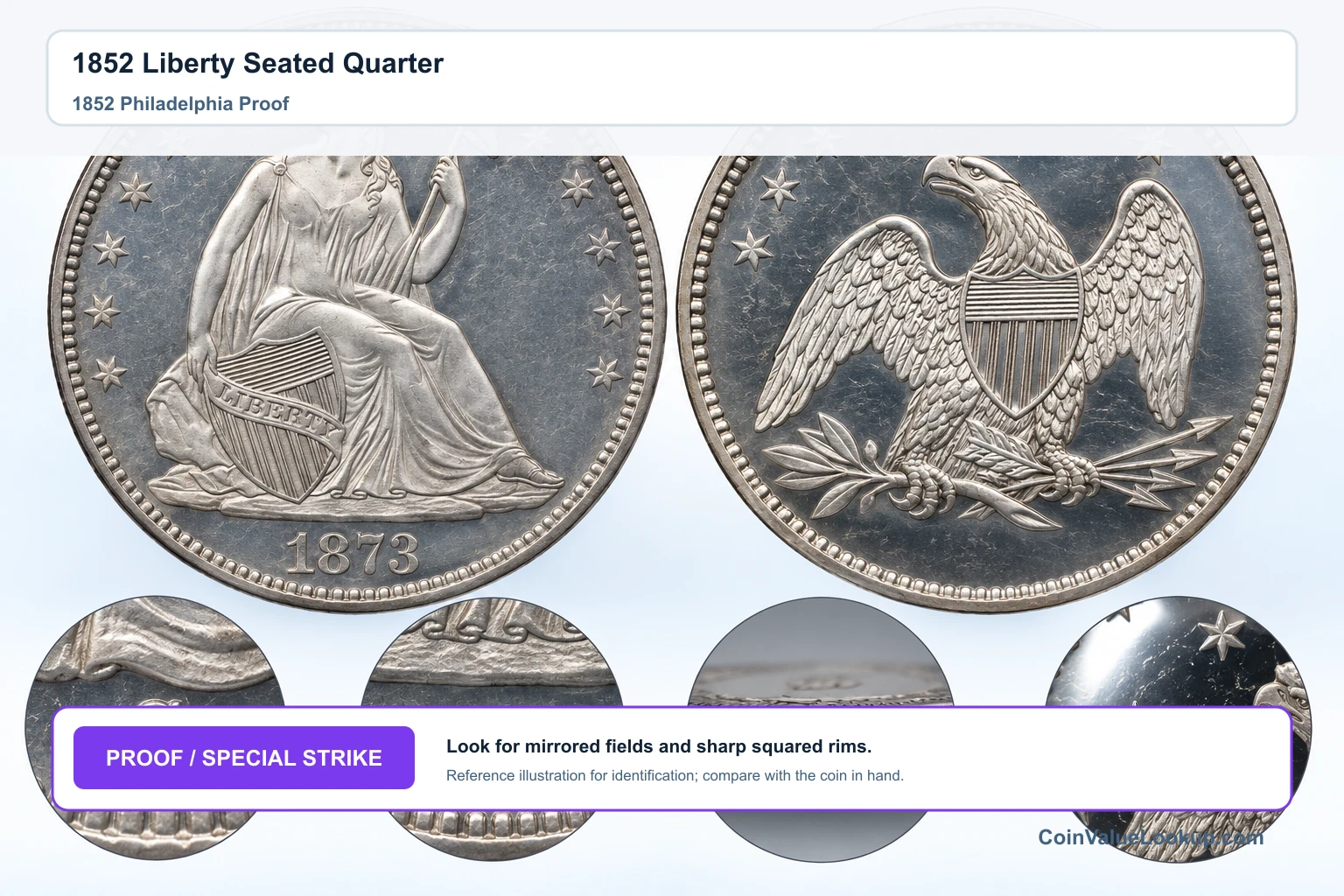
Philadelphia proofs from 1852 are recognized by PCGS but omitted from the supplied pricing database, which means no guide estimate is adopted here. These are rare coins.
The same repunched-date obverse die appears on both proof and business strikes. That shared die means the repunching alone cannot determine whether your coin is a proof — surface finish, edge character and overall quality are the distinguishing factors.
Coin Value Lookup is a good starting point when you need to look up guides for other years and mints in the Seated Liberty quarter series. Any 1852 proof candidate should be evaluated individually by a professional grading service rather than priced from a generic table.
1852 Liberty Seated Quarter Proof Value by Grade
Reliable grade-by-grade prices are not currently available. The confirmed Proof catalogue entry has no usable grade-by-grade values in the current price feed. The regular-strike table does not price this rare Proof.
1852 Liberty Seated Quarter — Repunched52 Business Strike
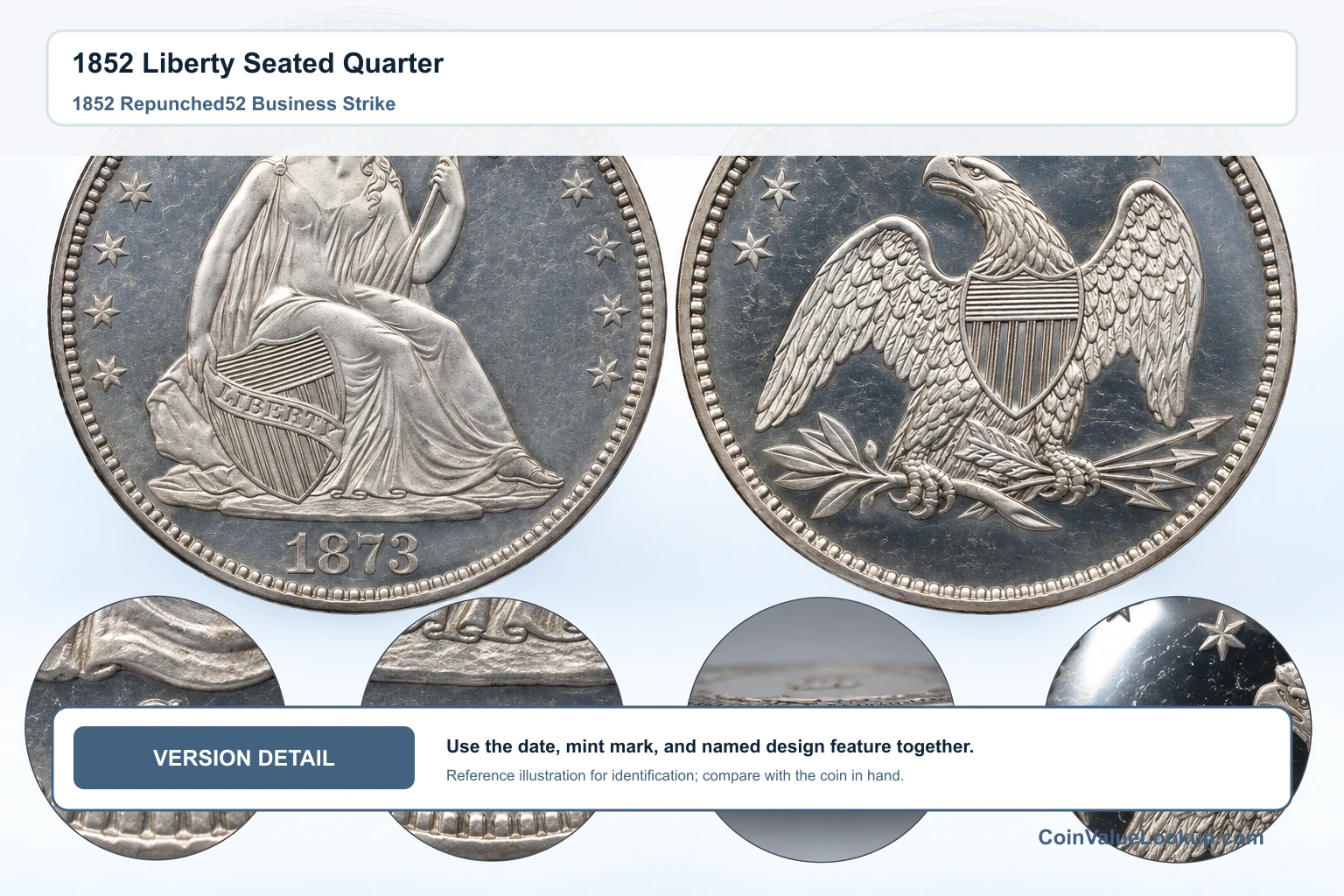
The repunched-date variety on 1852 Philadelphia business strikes shows extra remnants of the digits 52 where the date was impressed into the die a second time during preparation. One diagnostic: the right side of the 1 aligns near shield lines 6 and 7 on this particular obverse, distinguishing it from an alternative die where the alignment falls closer to line 5.
No adopted guide price exists for this variety as a separate line item. Value depends on the strength and visibility of the repunching, overall grade, and whether a grading service has attributed it.
Mechanical doubling — a flat, shelf-like distortion from strike bounce — can mimic repunching to the untrained eye, so careful comparison under magnification matters.
Range Grade
Price Auction Records Appraisal PO PO 1
—
Coin Identifier FR FR 2
—
Coin Identifier AG AG 3
—
Coin Identifier G G 4
—
Coin Identifier
G 6
—
Coin Identifier VG VG 8
Coin Identifier
VG 10
Coin Identifier F F 12
Coin Identifier
F 15
—
Coin Identifier VF VF 20
Coin Identifier
VF 25
Coin Identifier
VF 30
Coin Identifier
VF 35
Coin Identifier XF XF 40
Coin Identifier
XF 45
Coin Identifier AU AU 50
Coin Identifier
AU 53
Coin Identifier
AU 55
Coin Identifier
AU 58
Coin Identifier MS MS 60
—
Coin Identifier
MS 61
Coin Identifier
MS 62
Coin Identifier
MS 63
Coin Identifier
MS 64
Coin Identifier
MS 65
Coin Identifier
MS 66
Coin Identifier
MS 67
—
—
—
MS 68
—
—
—
MS 69
—
—
—
MS 70
—
—
—
1852 Liberty Seated Quarter Error List
1. 1852 Liberty Seated Quarter — Repunched Date
The repunched date on 1852 Philadelphia quarters results from the date digits being punched into the working die more than once during manufacture. Look for extra remnants of the 52 near the primary digits — traces of a second impression that did not perfectly overlap the first.
A useful diagnostic is the position of the right side of the 1 relative to the shield lines on the obverse. On the repunched-date die, it aligns near lines 6 and 7, while an alternative obverse positions it closer to line 5.
This same obverse die was used for both business and proof strikes, so the repunching alone does not establish that a coin is a proof.
Mechanical doubling — caused during the striking process rather than die preparation — can look similar but typically produces flat, shelf-like distortions rather than the rounded secondary digit impressions of a genuine repunched date. No separate price premium is adopted here; value depends on authenticated attribution, visibility of the doubling and overall coin condition.
2. 1852 Liberty Seated Quarter — Rotated Reverse
A rotated reverse occurs when the reverse die is not properly aligned to the obverse die during installation. To check: hold the obverse upright, then flip the coin top-to-bottom along a vertical axis.
A normally oriented coin will show the reverse right-side up. Any departure from that alignment is a rotation.
On 1852 Philadelphia quarters paired with the repunched-date obverse, study specimens have been documented with approximately 45-degree and 90-degree rotations — significant departures that are immediately obvious.
The main lookalike is simply a coin photographed at an angle in a flip or holder. Always test rotation by physically flipping the coin in a consistent, controlled manner rather than judging from photos alone.
Photograph both sides in a fixed orientation for documentation.
No price data is adopted for these rotations. Any example would need individual assessment based on the degree of rotation, overall grade and professional attribution.