1868 Liberty Seated Quarter Coin Value: How Much Is It Worth?
The 1868 Liberty Seated Quarter is a scarce post-Civil War silver coin struck at two mints and also produced as a proof. Guide estimates range from $163.00 to $11,491.00 depending on mint, finish, and condition.
Not every 1868 quarter falls at the high end — your specific coin's value depends on identifying the right version and honestly assessing its grade.
Fast Way to Identify Your 1868 Liberty Seated Quarter
The quickest way to start figuring out what you have is to upload clear photos of both the front and back of your coin. Our identifier can provide a preliminary identification based on those images, helping you narrow down the mint, version, and approximate condition.
That is not a certification or guarantee of grade, but it points you in the right direction.
1868 Liberty Seated Quarter Value
Upload both sides of your 1868 Liberty Seated Quarter.
Front Obverse
Upload photo
Back Reverse
Upload photo
Which 1868 Liberty Seated Quarter Versions Are Worth Money?
- 1868-S: USA Coin Book guide estimates reach $11,491.00 at MS63, making this the version to check for first — the S mintmark sits below the reverse eagle.
- 1868 Philadelphia business strike: Guide estimates reach $4,255.00 at MS63; no mintmark on the reverse identifies this branch.
- 1868 Proof: Estimated at $1,072.00 at PR63; look for mirrored fields and sharp squared rims that distinguish proof manufacture from a polished regular strike.
- Always confirm mint and finish before assuming value — damage, heavy wear, or cleaning do not create a rare version.
Step 1: Identify Your 1868 Liberty Seated Quarter Mint Mark and Version
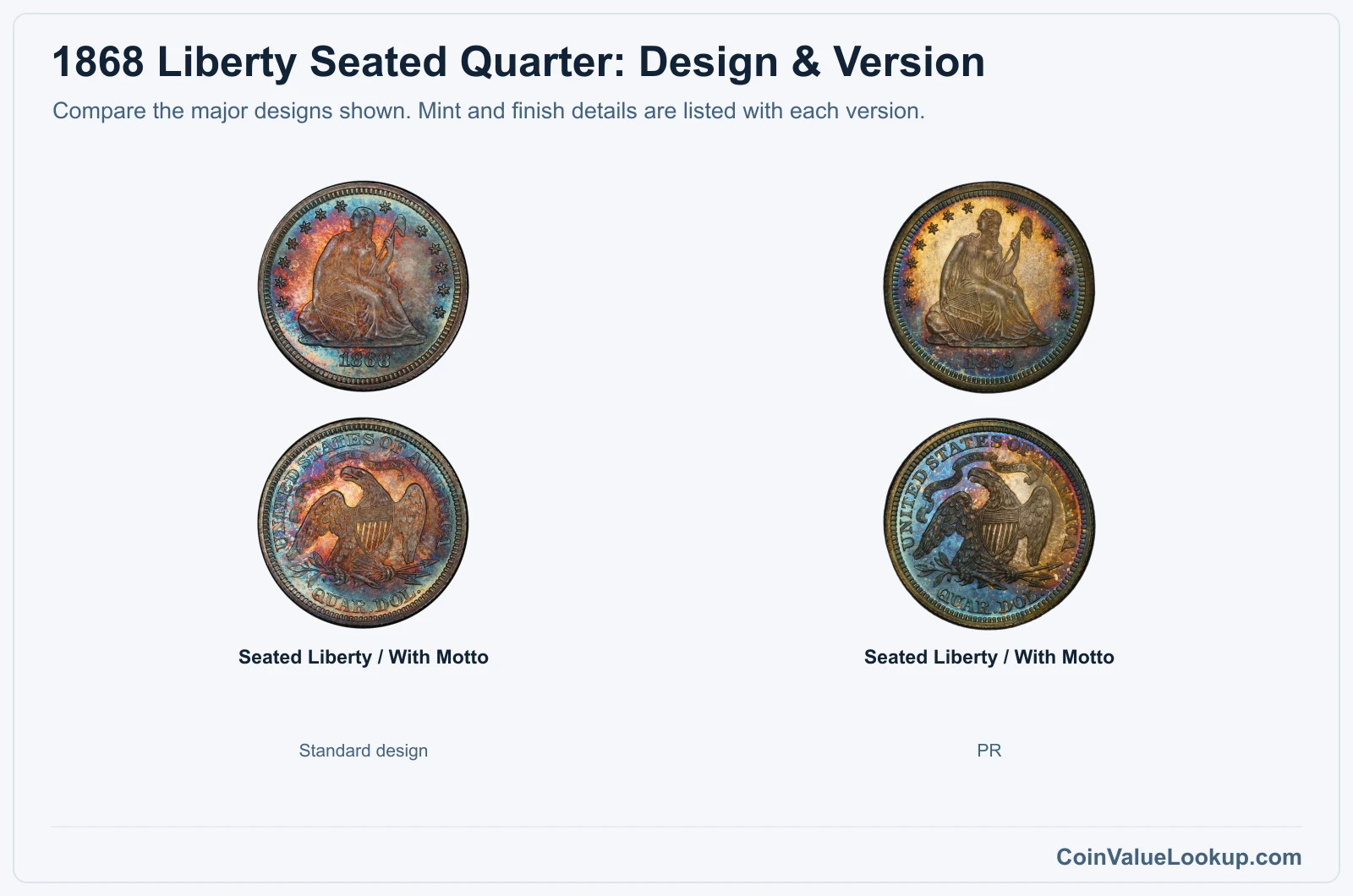
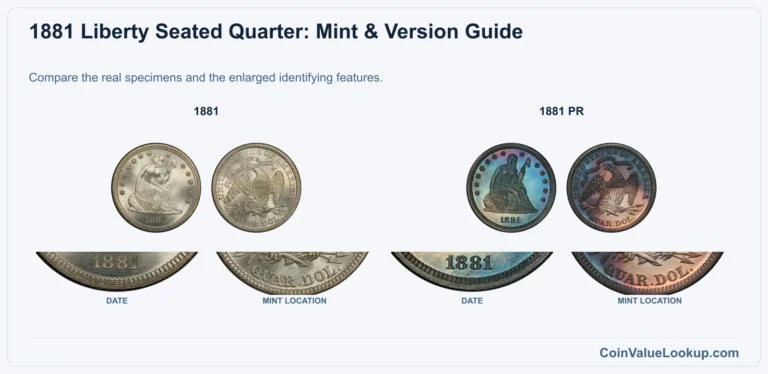
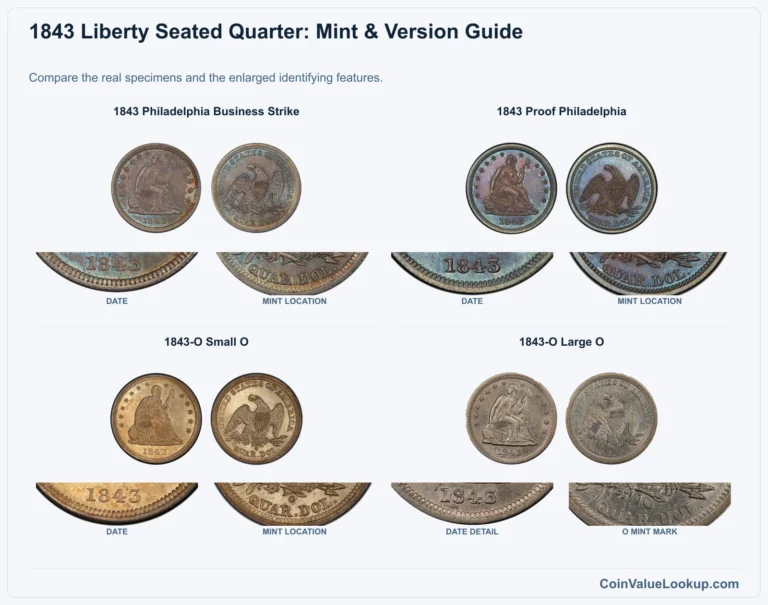
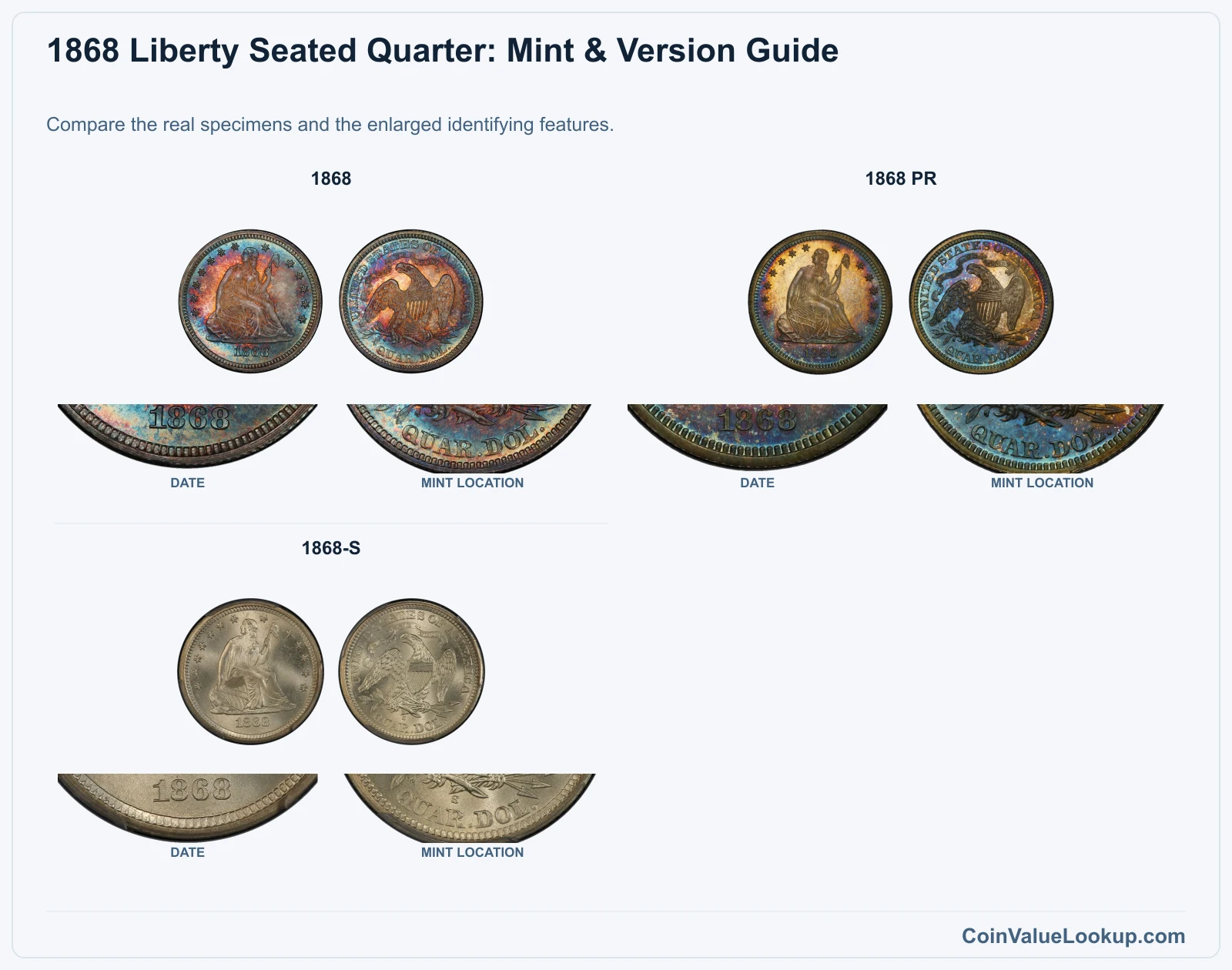
Three distinct branches exist for this year: the 1868 Philadelphia business strike, the 1868 Proof, and the 1868-S from San Francisco. All are 90% silver and 10% copper, weighing 6.22 grams.
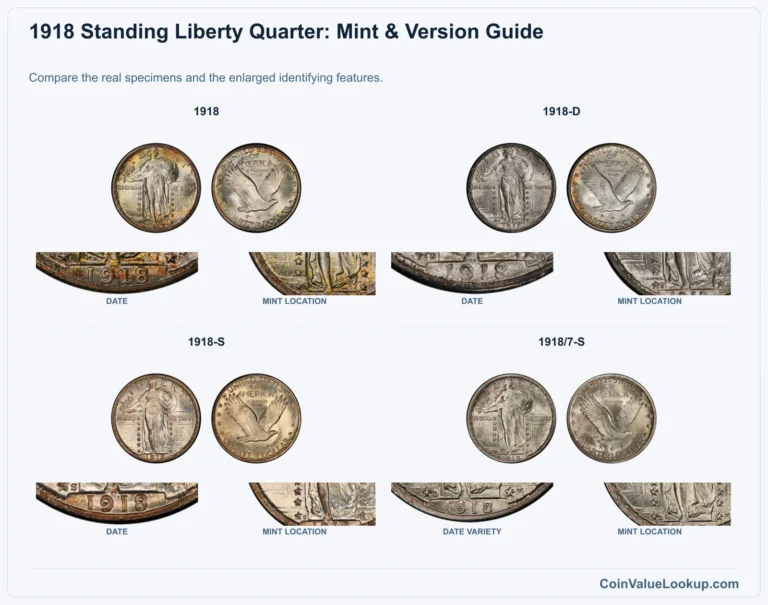
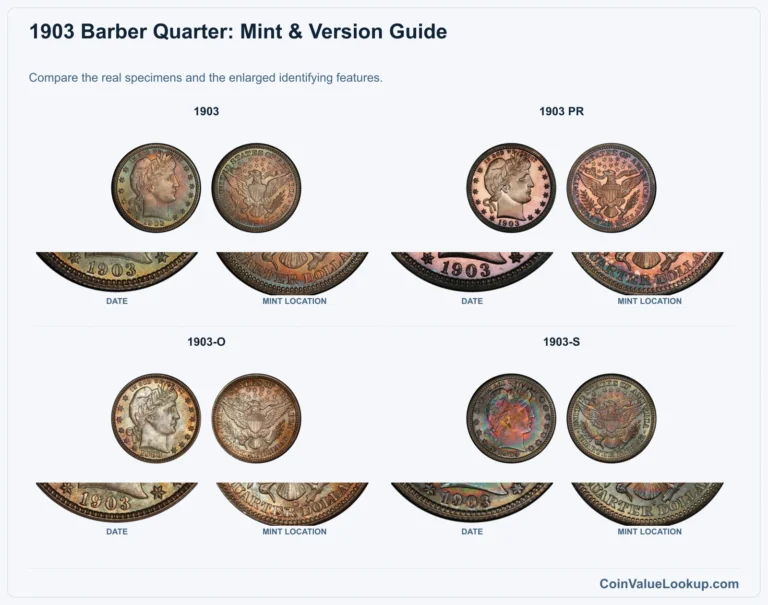
To tell them apart, flip the coin over. Philadelphia coins carry no mintmark.
An "S" mintmark below the eagle on the reverse means San Francisco. No other mintmarks apply to this date.
The obverse shows Liberty seated on a rock holding a pole with a Phrygian cap. The reverse eagle is surrounded by the motto "In God We Trust" on a banner above, which was added to the series starting in 1866.
Proofs are a different animal from business strikes. A proof has squared, mirrored rims and deeply reflective fields — it is a manufacturing method, not just a shiny coin.
A polished or cleaned business strike can fool you if you are not careful, so look for the telltale flat, razor-sharp rim edge that proofs exhibit.
Step 2: Check Your 1868 Liberty Seated Quarter Grade
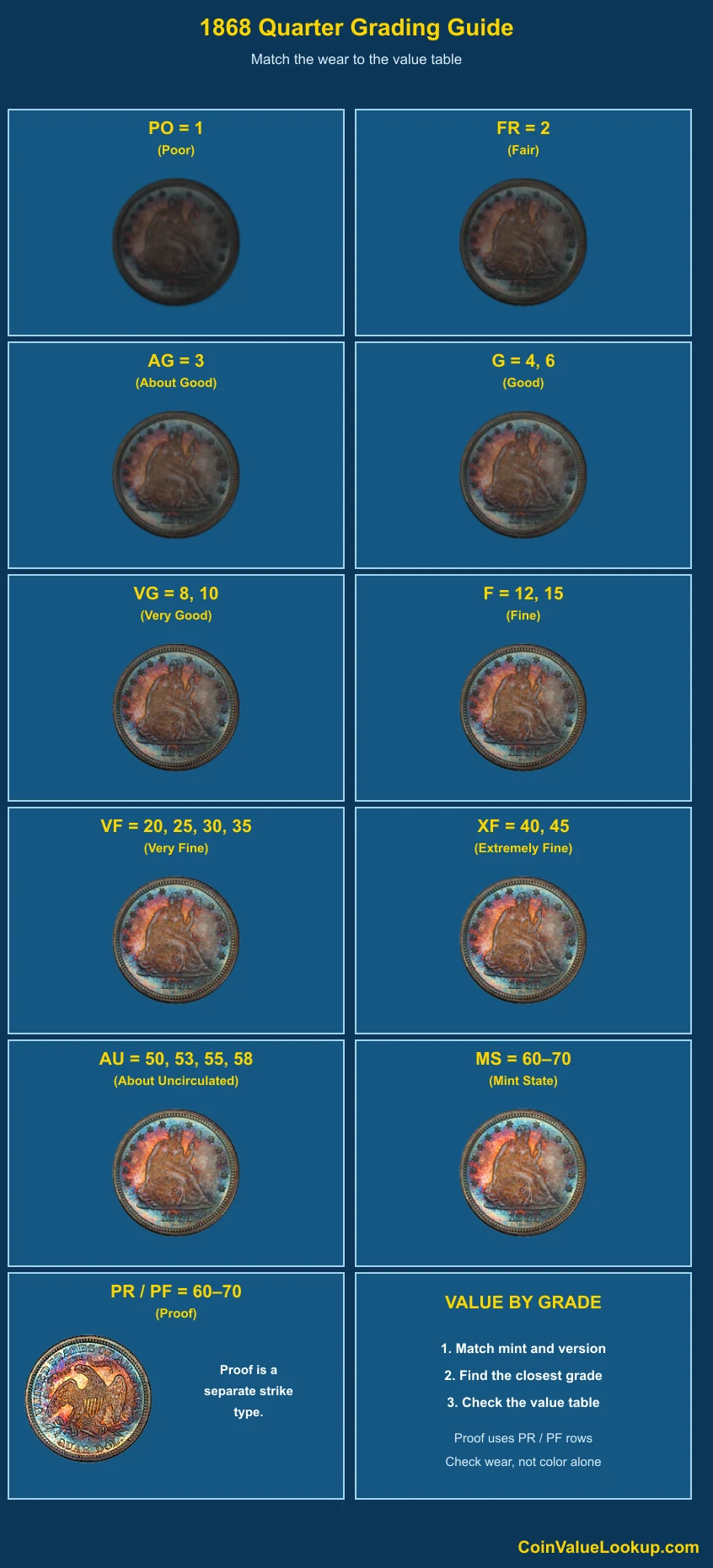
Start with the high points. On the obverse, check Liberty's head, the line of her breast, the knee area, and the horizontal lines on her shield.
These wear first. On the reverse, focus on the eagle's breast feathers and the tips of the upper wing feathers.
A coin in Good (G4) condition will have a flat Liberty with most detail gone but a readable date and legend. At Mint State (MS60), the coin shows no wear but may have bag marks and reduced luster in the fields.
Compare your coin against the reference image. Look at both wear and luster together — they tell different stories.
A weakly struck coin can appear worn even when it is not, because the mint did not push enough metal into the die's recesses. Do not confuse a mushy strike for circulation damage.
Cleaning matters a great deal. An 1868 quarter with a bright, unnaturally white surface has likely been cleaned, which reduces its collector value significantly below guide estimates.
Original toning and undisturbed surfaces are what buyers pay a premium for.
Step 3: Check 1868 Liberty Seated Quarter Value by Mint and Version
1868 Liberty Seated Quarter
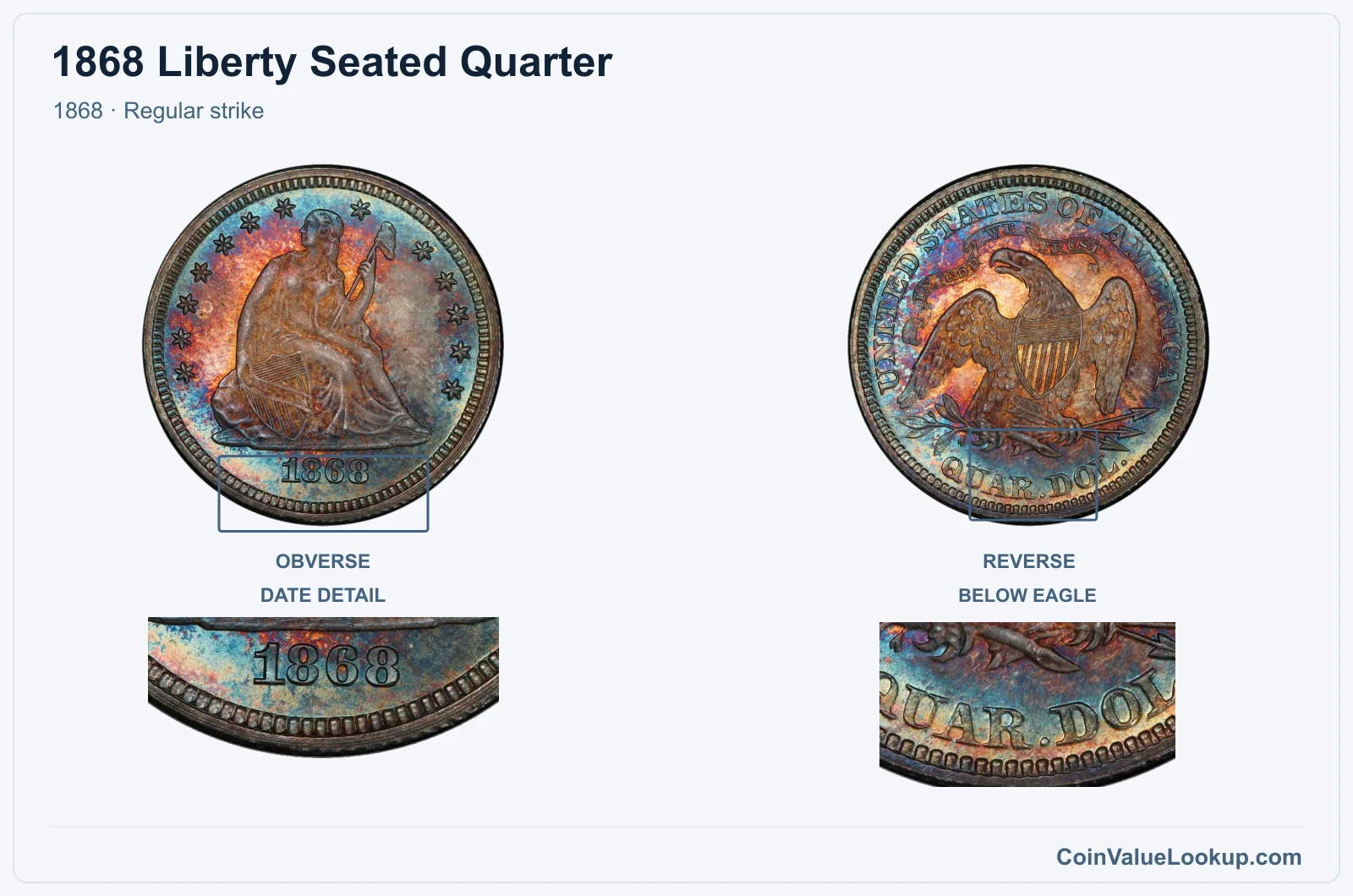
The 1868 Philadelphia quarter has no mintmark on the reverse. It is a business strike with the "With Motto" eagle reverse.
USA Coin Book guide estimates place this version at $234.00 in G4, $2,120.00 in MS60, and $4,255.00 in MS63. Those are retail guide estimates, not guaranteed offers.
Before comparing grades, confirm your coin actually lacks a mintmark and shows normal business-strike surfaces rather than proof characteristics. Original surfaces and honest wear determine where your coin falls on the scale.
Cleaning or post-mint damage can push the value well below these estimates regardless of how little actual wear the coin shows.
Range Grade
Price Auction Records Appraisal PO PO 1
—
Coin Identifier FR FR 2
—
Coin Identifier AG AG 3
Coin Identifier G G 4
Coin Identifier
G 6
—
Coin Identifier VG VG 8
Coin Identifier
VG 10
—
Coin Identifier F F 12
Coin Identifier
F 15
—
Coin Identifier VF VF 20
—
Coin Identifier
VF 25
Coin Identifier
VF 30
Coin Identifier
VF 35
Coin Identifier XF XF 40
Coin Identifier
XF 45
Coin Identifier AU AU 50
Coin Identifier
AU 53
Coin Identifier
AU 55
Coin Identifier
AU 58
Coin Identifier MS MS 60
—
Coin Identifier
MS 61
—
Coin Identifier
MS 62
Coin Identifier
MS 63
Coin Identifier
MS 64
Coin Identifier
MS 65
Coin Identifier
MS 66
Coin Identifier
MS 67
—
Coin Identifier
MS 68
—
—
—
MS 69
—
—
—
MS 70
—
—
—
1868 Liberty Seated Quarter — PR
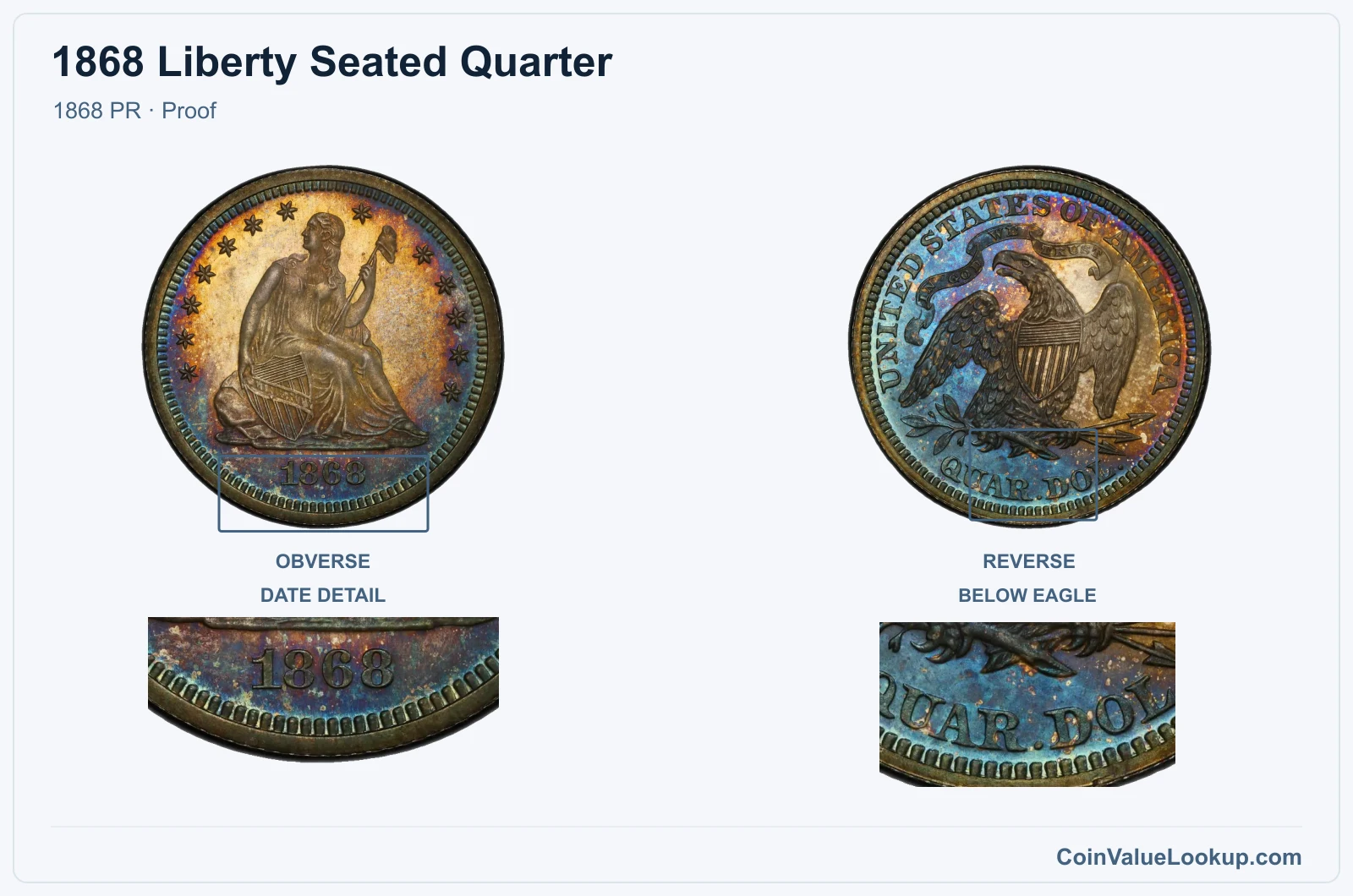
The 1868 Proof quarter was struck at Philadelphia for collectors, so it also carries no mintmark. Do not confuse it with a shiny business strike — proof manufacture produces squared rims, deeply mirrored fields, and exceptionally sharp design details that result from specially prepared dies and planchets.
USA Coin Book estimates this version at $1,072.00 in PR63. That is a guide figure, not a guaranteed offer.
Surface haze, hairlines from improper handling, and any cleaning will affect what a collector is willing to pay. A proof with heavy hairlines across the fields can grade much lower than PR63, so examine the surfaces under good angled light.
Coin Value Lookup is a useful starting point if you want to look up guides for other dates and denominations in this series. It can help you compare your coin's characteristics across different Liberty Seated Quarter years.
Range Grade
Price Auction Records Appraisal PR PR 1
—
Coin Identifier
PR 2
—
Coin Identifier
PR 3
—
Coin Identifier
PR 4
—
Coin Identifier
PR 6
—
Coin Identifier
PR 8
—
Coin Identifier
PR 10
—
Coin Identifier
PR 12
—
Coin Identifier
PR 15
—
Coin Identifier
PR 20
—
Coin Identifier
PR 25
—
Coin Identifier
PR 30
—
Coin Identifier
PR 35
—
Coin Identifier
PR 40
—
Coin Identifier
PR 45
—
Coin Identifier
PR 50
—
Coin Identifier
PR 53
Coin Identifier
PR 55
Coin Identifier
PR 58
—
Coin Identifier
PR 60
Coin Identifier
PR 61
Coin Identifier
PR 62
Coin Identifier
PR 63
Coin Identifier
PR 64
Coin Identifier
PR 65
Coin Identifier
PR 66
Coin Identifier
PR 67
Coin Identifier
PR 68
—
—
—
PR 69
—
—
—
PR 70
—
—
—
1868 Liberty Seated Quarter — S
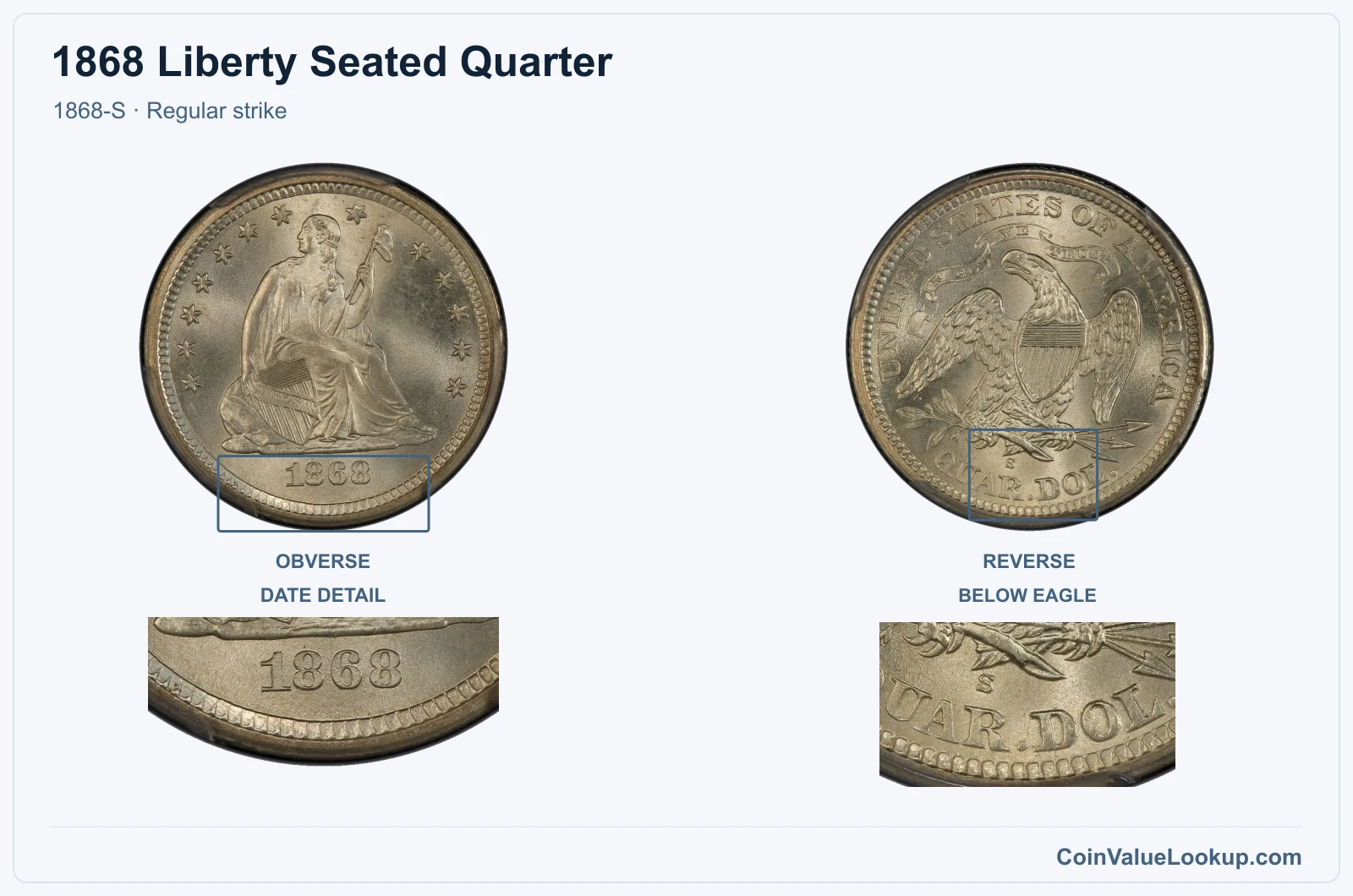
The 1868-S quarter was struck in San Francisco and carries a small "S" mintmark on the reverse below the eagle. This is the version with the highest guide estimates for the year.
USA Coin Book places it at $163.00 in G4, $6,838.00 in MS60, and $11,491.00 in MS63.
That jump from G4 to Mint State is dramatic. Surviving examples in high grade are genuinely scarce, which is why the estimates climb so steeply.
Most 1868-S quarters you encounter will show heavy circulation wear.
As with all branches, these are guide estimates and not guaranteed purchase offers. Match the mint, confirm original surfaces, and assess wear honestly before applying any price.
A cleaned or damaged example trades at a significant discount from these figures, even if the underlying wear level seems low.
Range Grade
Price Auction Records Appraisal PO PO 1
—
Coin Identifier FR FR 2
—
Coin Identifier AG AG 3
Coin Identifier G G 4
Coin Identifier
G 6
Coin Identifier VG VG 8
—
Coin Identifier
VG 10
Coin Identifier F F 12
Coin Identifier
F 15
—
Coin Identifier VF VF 20
Coin Identifier
VF 25
Coin Identifier
VF 30
Coin Identifier
VF 35
Coin Identifier XF XF 40
Coin Identifier
XF 45
Coin Identifier AU AU 50
Coin Identifier
AU 53
Coin Identifier
AU 55
Coin Identifier
AU 58
Coin Identifier MS MS 60
—
Coin Identifier
MS 61
—
Coin Identifier
MS 62
Coin Identifier
MS 63
Coin Identifier
MS 64
Coin Identifier
MS 65
Coin Identifier
MS 66
Coin Identifier
MS 67
—
Coin Identifier
MS 68
—
—
—
MS 69
—
—
—
MS 70
—
—
—
1868 Liberty Seated Quarter Error List
1. 1868 Liberty Seated Quarter — Off-Center Strike
An off-center strike happens when the planchet is not properly seated in the collar before the dies come together. The result is a displaced design with an unstruck crescent of blank metal on one side.
On an 1868 Liberty Seated Quarter, this would leave part of the seated Liberty or the eagle pushed away from center.
The key to value is visibility of the date. An off-center coin with a clear, readable date is far more collectible than one where the date has shifted off the edge entirely.
The percentage of off-center displacement also matters — a dramatic shift draws more attention.
Do not confuse an off-center strike with a clipped planchet, a one-sided die misalignment, or post-mint damage from being flattened or bent. No specific price data is available for this error on the 1868 quarter; condition, percentage of displacement, and date visibility all affect what a buyer would pay.
2. 1868 Liberty Seated Quarter — Die Crack / Die Chip
Die cracks appear as raised lines on the coin's surface, caused by fractures in a worn or damaged die. On an 1868 Liberty Seated Quarter, these can show up anywhere — across the fields, through the lettering, or along the rim.
A die chip produces a small raised blob rather than a line.
When a crack extends to the rim and a chunk of the die breaks away, the result is called a cud — a raised, featureless lump at the edge of the coin. Interior cracks without rim connection are more common and generally less dramatic.
These raised features are the opposite of scratches, which are incuse. Do not mistake corrosion, surface grime, or foreign material stuck to the coin for a die crack.
No adopted price data is available for this error on the 1868 quarter. Value depends on the size, location, and visual impact of the crack, along with the coin's overall condition.
3. 1868 Liberty Seated Quarter — Mismatched Obverse and Reverse Dies
A mule is a coin struck with two dies that were never intended to be paired together. For the 1868 quarter, sources report an 1868 Proof mule quarter dollar — a coin combining incompatible obverse and reverse dies.
This is not a doubled die or a double impression; it is a fundamentally wrong die pairing.
To identify a potential mule, photograph both sides clearly and compare the designs to known 1868 proof quarters. The mismatch should be apparent when you compare the specific design elements against standard references for this date.
Do not confuse a mule with a novelty item made by joining two coins together, or with a plated coin that shows odd surface characteristics. Genuine mules are extremely rare and typically require professional authentication.
No adopted price data is available for this variety, but condition and the specific nature of the die mismatch would heavily influence any valuation.