1890 Liberty Seated Quarter Coin Value: How Much Is It Worth?
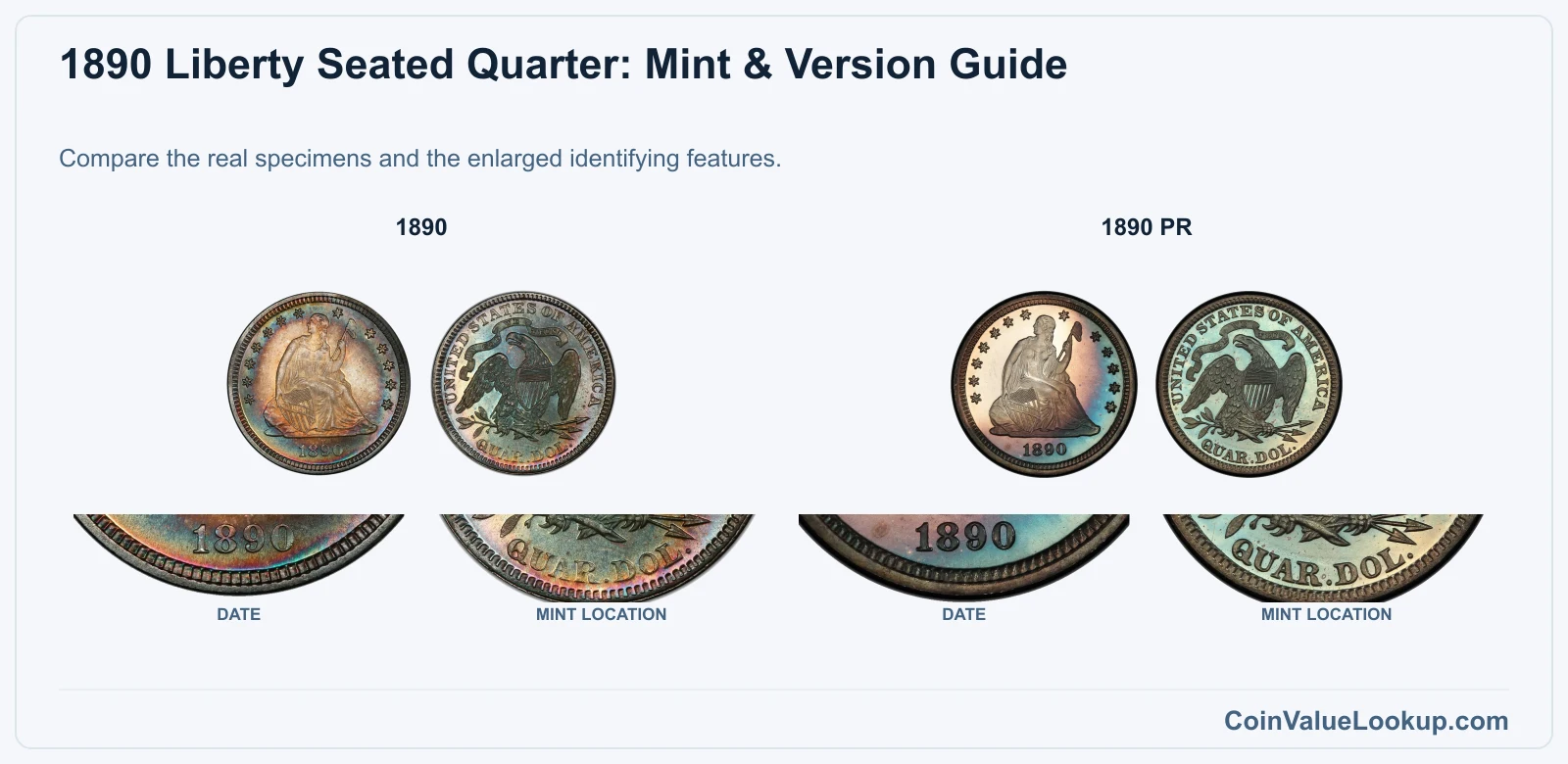
The 1890 Liberty Seated Quarter is a late-date issue in a series that ended just one year later. Struck in 90% silver at the Philadelphia Mint, these coins carry guide estimates ranging from about $126.00 in well-worn condition up to $1,136.00 for uncirculated business strikes, according to USA Coin Book.
A proof version also exists. Your coin's actual position in that range depends on whether it is a regular strike or proof, its condition, and the quality of its original surfaces.
Fast Way to Identify Your 1890 Liberty Seated Quarter
The quickest way to start figuring out what your 1890 quarter is worth is to upload clear photos of both sides. A front-and-back image lets us provide a preliminary identification of your coin's version and approximate condition.
Snap the photos in good light, avoid glare, and try to keep the coin flat and centered in the frame.
1890 Liberty Seated Quarter Value
Upload both sides of your 1890 Liberty Seated Quarter.
Front Obverse
Upload photo
Back Reverse
Upload photo
Which 1890 Liberty Seated Quarter Versions Are Worth Money?
- 1890 business strike: USA Coin Book estimates reach $1,136.00 at MS63, making well-preserved uncirculated examples the top guide value for this date.
- 1890 Proof (PR): Guide estimate of $938.00 at PR63; genuine proofs with minimal hairlines are scarce survivors from a small original mintage.
- Check your coin's finish and mint first; surface damage, cleaning, or heavy wear will place a coin well below these higher-grade benchmarks.
Step 1: Identify Your 1890 Liberty Seated Quarter Mint Mark and Version
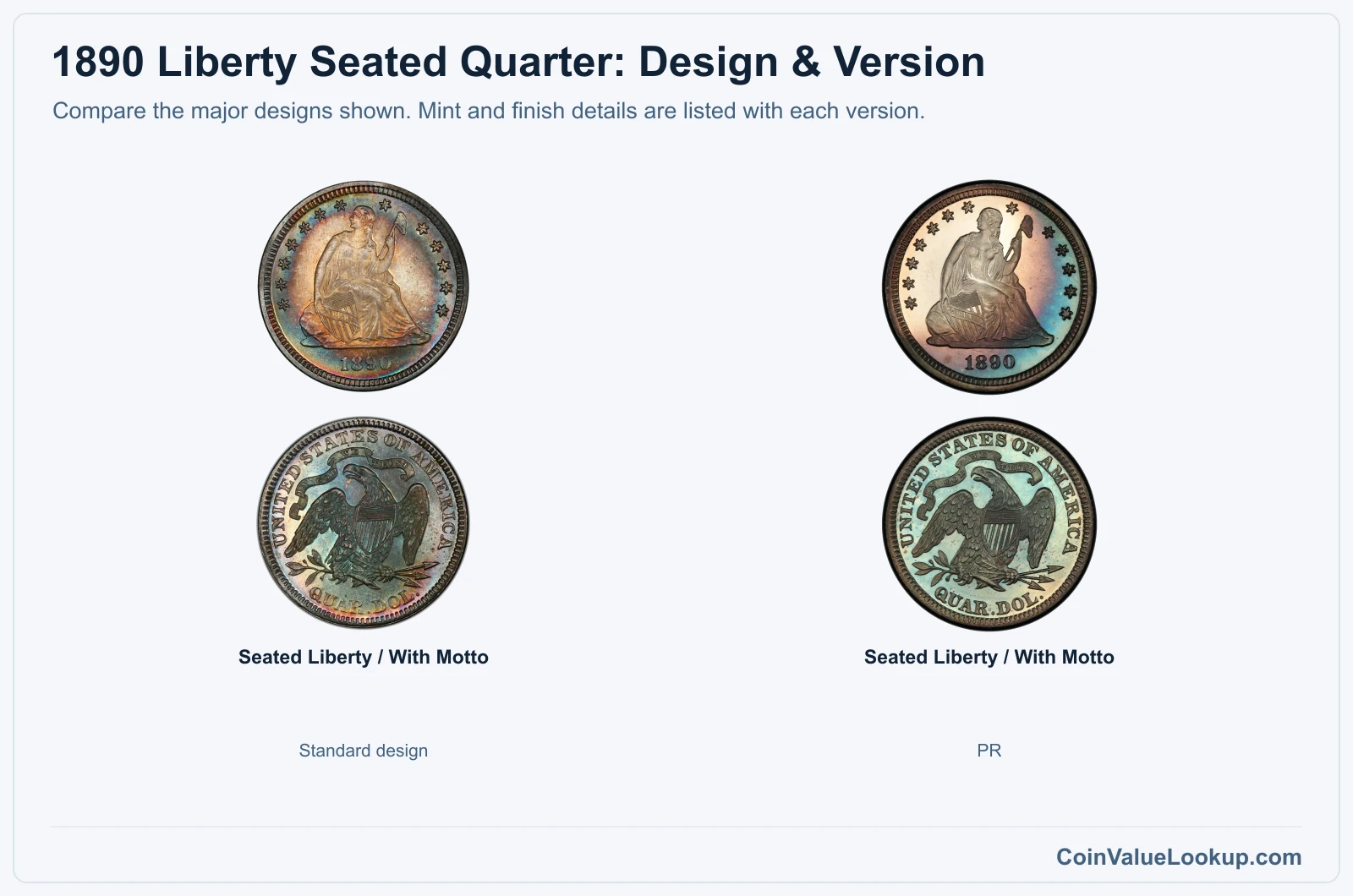
Only one mint produced quarters in 1890: Philadelphia. That means your coin will have no mintmark at all.
If you see an O, S, or CC on the reverse beneath the eagle, you are looking at a different year or denomination.
The design shows a seated figure of Liberty on the obverse, holding a pole with a liberty cap, and a shield at her side. The reverse features an eagle with outspread wings and the motto "In God We Trust" on a banner above.
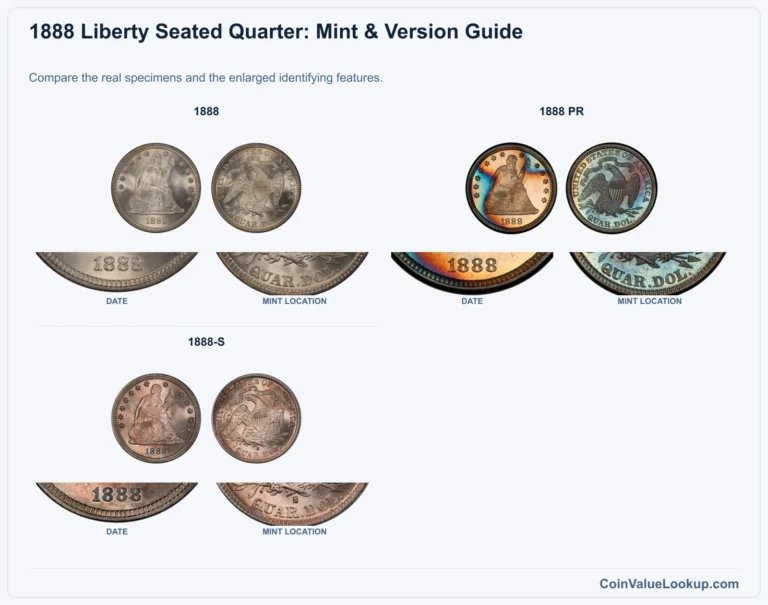
The two collectible branches for this date are the regular business strike (1890) and the proof (1890 PR). Proofs were made for collectors using specially prepared dies and planchets, producing mirror-like fields.
A shiny circulated coin is not a proof. Look for squared, knife-sharp rims and deeply reflective surfaces as starting clues.
The coin is 90% silver and 10% copper, weighing 6.25 grams. If it feels too light or does not respond to a magnet test properly, consider whether you have a contemporary counterfeit or a different denomination entirely.
Step 2: Check Your 1890 Liberty Seated Quarter Grade
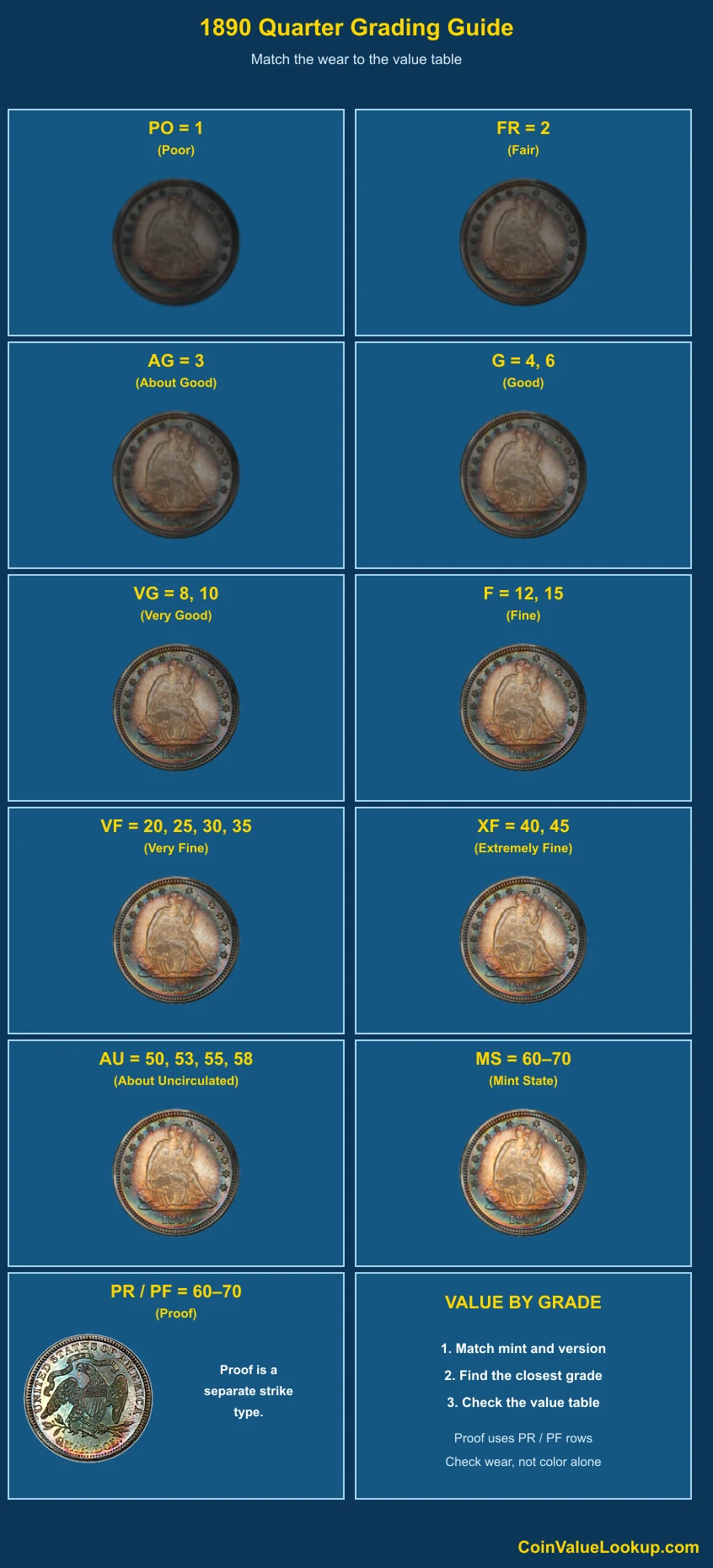
Grading a Liberty Seated Quarter means reading wear on specific high points. On the obverse, check Liberty's head, the area across her breast and knee, and the horizontal lines of the shield.
These are the first spots to lose detail as a coin circulates.
On the reverse, the eagle's breast feathers and the tops of the wings wear down earliest. A coin graded G4 (Good) will have a visible outline of Liberty but most interior detail will be smooth.
An MS60 coin is technically uncirculated but may show bag marks and subdued luster.
MS63 means a coin with attractive luster and only moderate contact marks. Compare your coin against the reference image to judge where it falls.
Be careful with strike quality. Some 1890 quarters left the press with soft detail at the centers even though they never circulated.
A weakly struck coin is not the same as a worn coin, but it is also not as desirable as a sharply struck one. Cleaning is another trap: a coin scrubbed to look bright will actually grade lower than one with honest, original toning.
Step 3: Check 1890 Liberty Seated Quarter Value by Mint and Version
1890 Liberty Seated Quarter
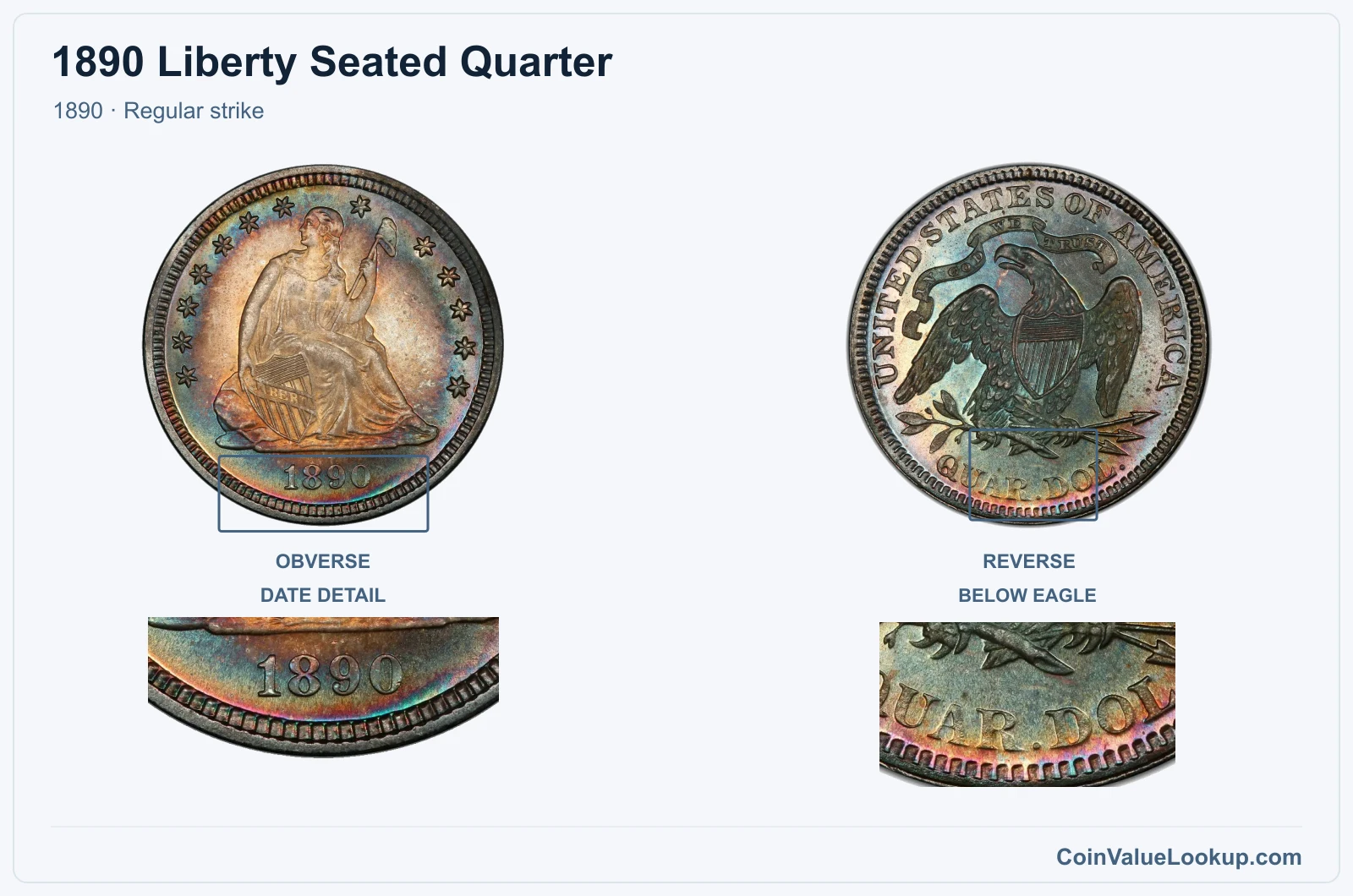
The 1890 business-strike quarter was produced at Philadelphia with no mintmark. It is 90% silver, weighs 6.25 grams, and carries the With Motto eagle reverse used from 1866 onward.
USA Coin Book guide estimates place a G4 example at about $126.00, an MS60 at $614.00, and an MS63 at $1,136.00. These are retail guide figures, not guaranteed sale prices.
Condition is everything here. A coin with original gray or blue toning and no scratches will command a premium over one that has been cleaned or has rim dings.
Before comparing your coin to these prices, confirm you have a Philadelphia issue (no mintmark) and that the surfaces are original, not polished.
Coin Value Lookup is a good place to look up guides for other dates and denominations in this series if you are working through a collection.
Range Grade
Price Auction Records Appraisal PO PO 1
—
Coin Identifier FR FR 2
—
Coin Identifier AG AG 3
—
Coin Identifier G G 4
—
Coin Identifier
G 6
Coin Identifier VG VG 8
—
Coin Identifier
VG 10
Coin Identifier F F 12
Coin Identifier
F 15
Coin Identifier VF VF 20
Coin Identifier
VF 25
—
Coin Identifier
VF 30
Coin Identifier
VF 35
Coin Identifier XF XF 40
Coin Identifier
XF 45
Coin Identifier AU AU 50
Coin Identifier
AU 53
Coin Identifier
AU 55
Coin Identifier
AU 58
Coin Identifier MS MS 60
—
Coin Identifier
MS 61
Coin Identifier
MS 62
Coin Identifier
MS 63
Coin Identifier
MS 64
Coin Identifier
MS 65
Coin Identifier
MS 66
Coin Identifier
MS 67
Coin Identifier
MS 68
Coin Identifier
MS 69
—
—
—
MS 70
—
—
—
1890 Liberty Seated Quarter — PR
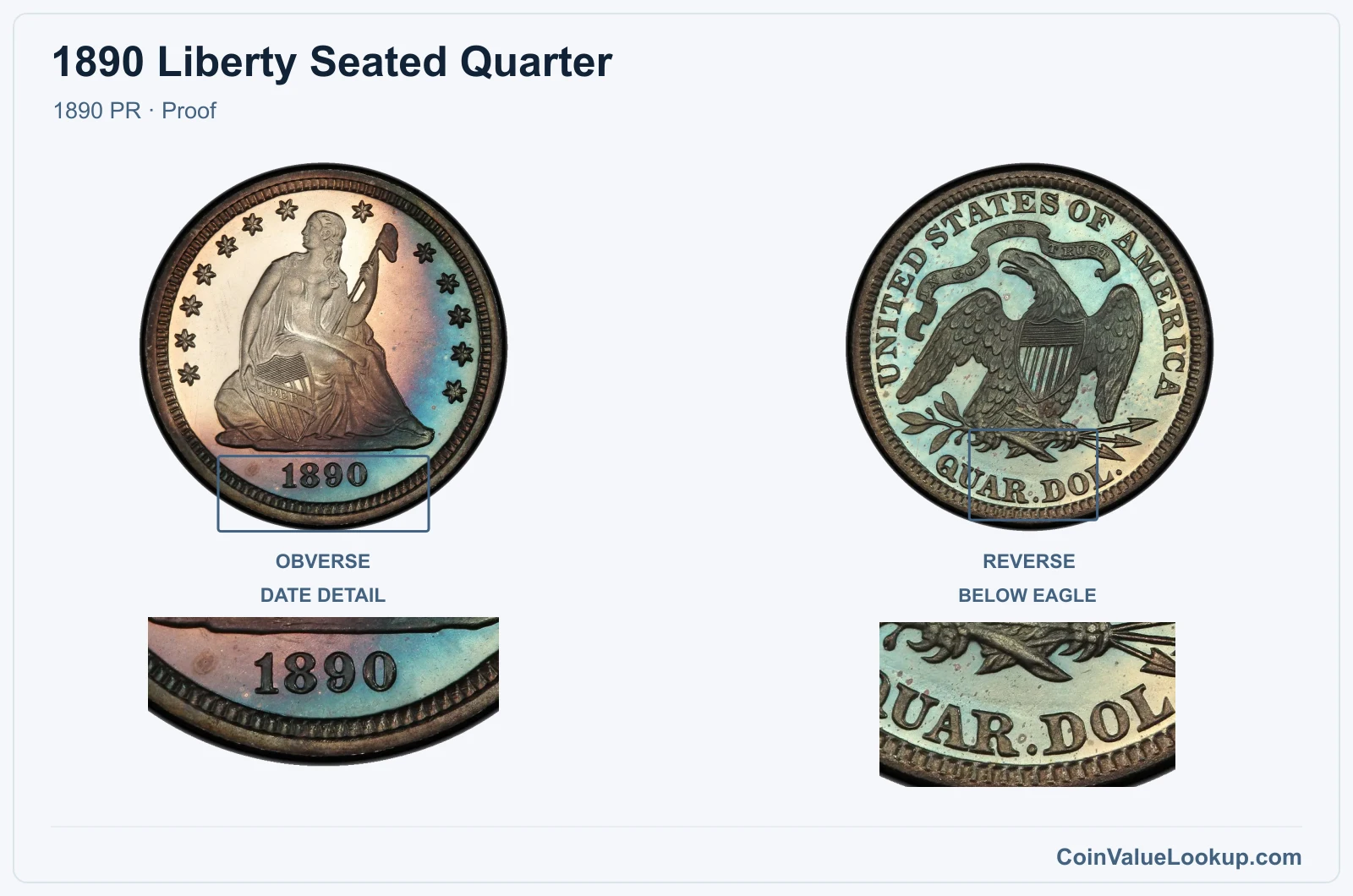
The 1890 Proof quarter was struck at Philadelphia for collectors, using polished dies and carefully prepared planchets. The result is deeply mirrored fields and sharp, squared rims that distinguish it from even the nicest business strike.
USA Coin Book estimates a PR63 example at $938.00.
Proof manufacture is a process, not a grade. A PR63 coin has reflective surfaces but may show light hairlines or minor haze under magnification.
Heavy hairlines, fingerprints, or cloudy toning push the grade lower and the value with it. Do not assume a shiny coin in your collection is a proof; regular strikes can look bright after cleaning, but they lack the characteristic die finish and edge sharpness of a genuine proof.
Range Grade
Price Auction Records Appraisal PR PR 1
—
Coin Identifier
PR 2
—
Coin Identifier
PR 3
—
Coin Identifier
PR 4
—
Coin Identifier
PR 6
—
Coin Identifier
PR 8
—
Coin Identifier
PR 10
—
Coin Identifier
PR 12
—
Coin Identifier
PR 15
—
Coin Identifier
PR 20
—
Coin Identifier
PR 25
—
Coin Identifier
PR 30
—
Coin Identifier
PR 35
—
Coin Identifier
PR 40
—
Coin Identifier
PR 45
—
Coin Identifier
PR 50
—
Coin Identifier
PR 53
—
Coin Identifier
PR 55
—
Coin Identifier
PR 58
—
Coin Identifier
PR 60
—
Coin Identifier
PR 61
Coin Identifier
PR 62
Coin Identifier
PR 63
Coin Identifier
PR 64
Coin Identifier
PR 65
Coin Identifier
PR 66
Coin Identifier
PR 67
Coin Identifier
PR 68
Coin Identifier
PR 69
—
—
—
PR 70
—
—
—
1890 Liberty Seated Quarter Error List
1. 1890 Liberty Seated Quarter — Off-Center Strike
An off-center strike happens when the planchet is not seated properly in the collar at the moment the dies come together. The result is a displaced design with an unstruck crescent of blank metal along one edge.
The size of that crescent tells you how far off center the strike landed, often described as a percentage.
For a 1890 Liberty Seated Quarter, the date needs to remain fully visible for the error to attract strong collector interest. A dramatic off-center piece that loses the date is harder to attribute and less desirable.
No specific price range is adopted here because value depends heavily on the percentage of displacement, whether the date is readable, and the coin's overall condition.
Watch out for lookalikes. A straight-clipped planchet, post-mint damage from a vise or hammer, or a coin that was simply struck through debris can mimic the appearance.
Genuine off-center errors show a consistent shift of the entire design, not localized distortion on one side.