2006 Quarter Coin Value: How Much Is It Worth?
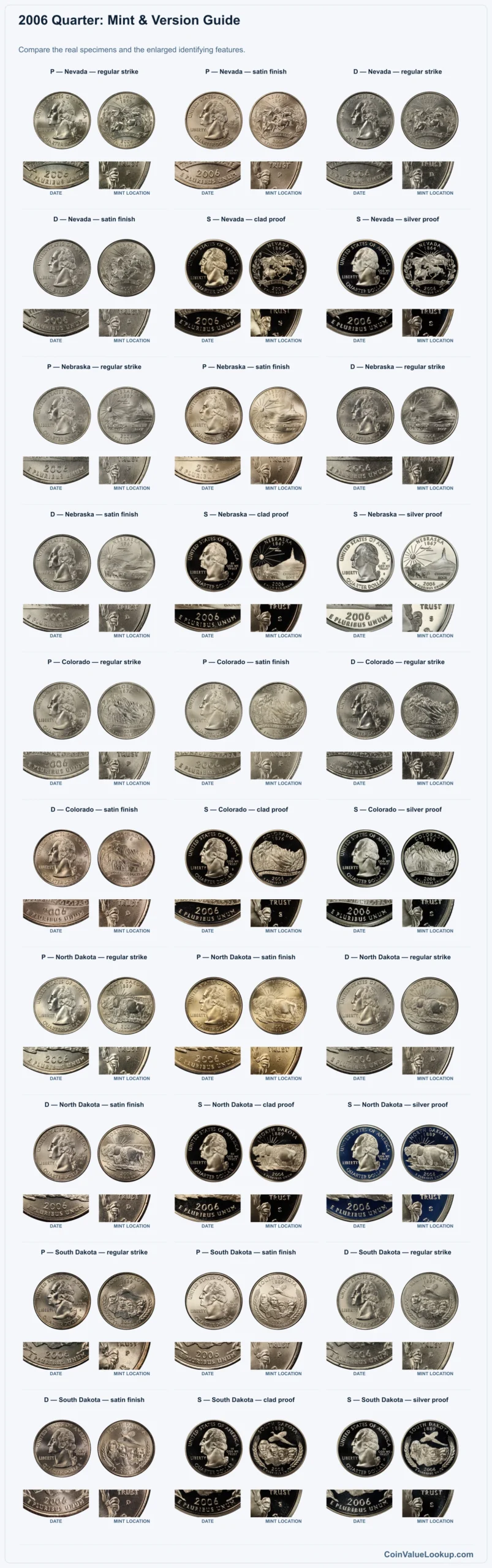
The 2006 quarter comes in five different reverse designs — Nevada, Nebraska, Colorado, North Dakota and South Dakota — each struck at up to three mints in several finishes. Guide estimates for these coins range from about $0.49 to $23.00, depending on which mint, reverse design, finish and grade you are looking at.
That spread is not one price for every coin; your specific combination matters.
Fast Way to Identify Your 2006 Quarter
The quickest way to start figuring out what you have is to upload clear photos of both the front and back of your coin. This gives a preliminary identification of the mint, reverse design and finish so you can compare it against the right version.
Good lighting and a steady hand help — blurry phone shots make mintmarks disappear.
2006 Quarter Value
Upload both sides of your 2006 Quarter.
Front Obverse
Upload photo
Back Reverse
Upload photo
Which 2006 Quarter Versions Are Worth Money?
- The S-mint silver proofs (Nevada, Nebraska, Colorado, North Dakota, South Dakota) carry the highest guide estimates at about $23.00 each in PR65, thanks to their 90% silver content.
- S-mint clad proofs for all five designs are estimated around $5.63 in PR65, well above face value but lower than their silver counterparts.
- Satin-finish versions from P and D mints (found only in uncirculated mint sets) require individual assessment because no standard guide price is adopted for them.
- P and D Nevada regular strikes carry a guide estimate of $6.25 at MS65, higher than several other 2006 state designs at the same grade.
Step 1: Identify Your 2006 Quarter Mint Mark and Version
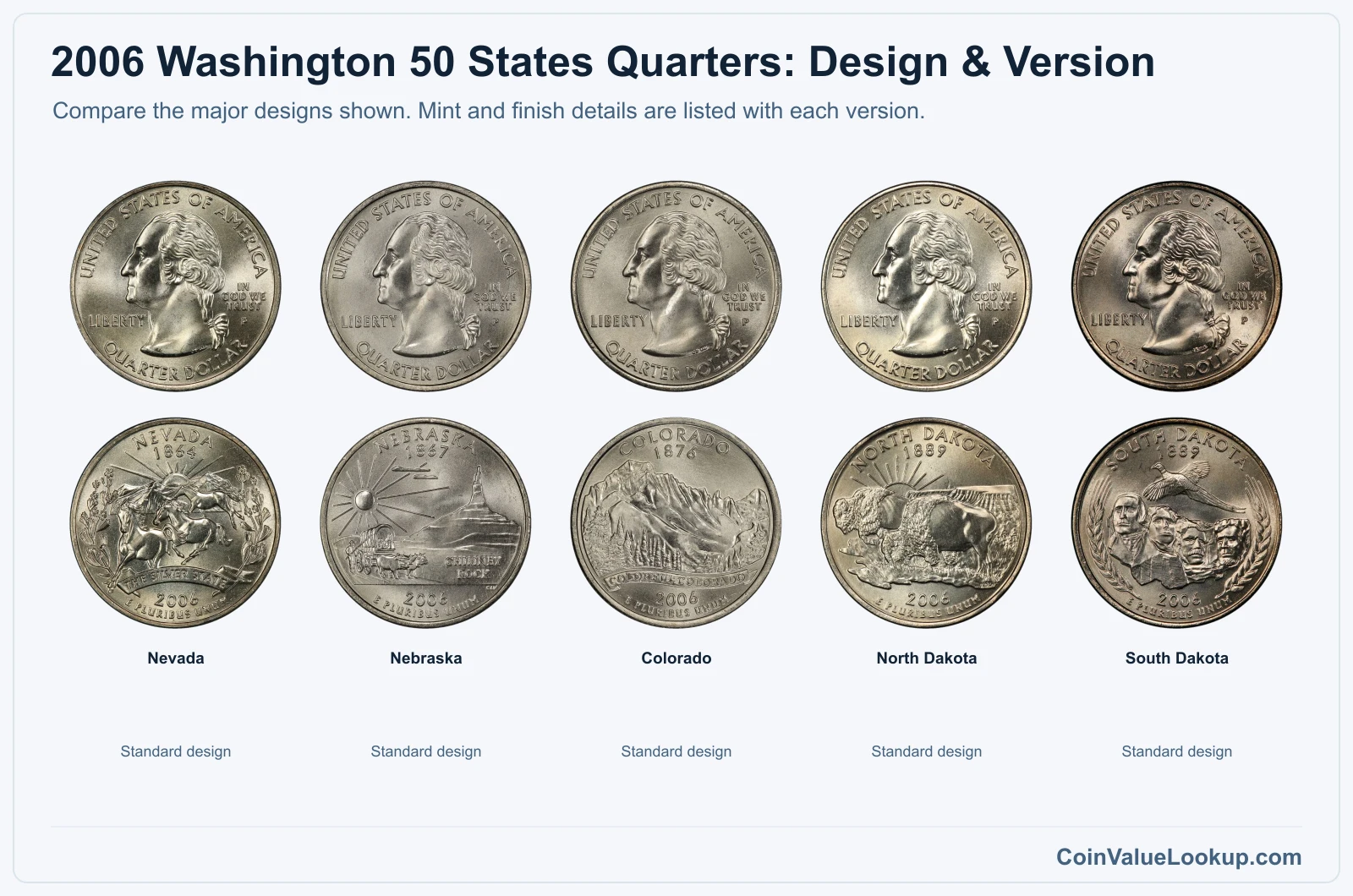
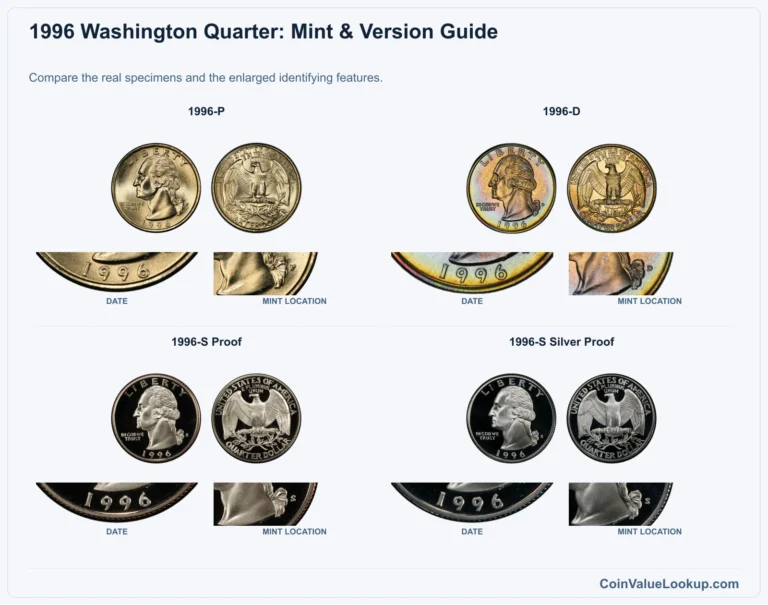
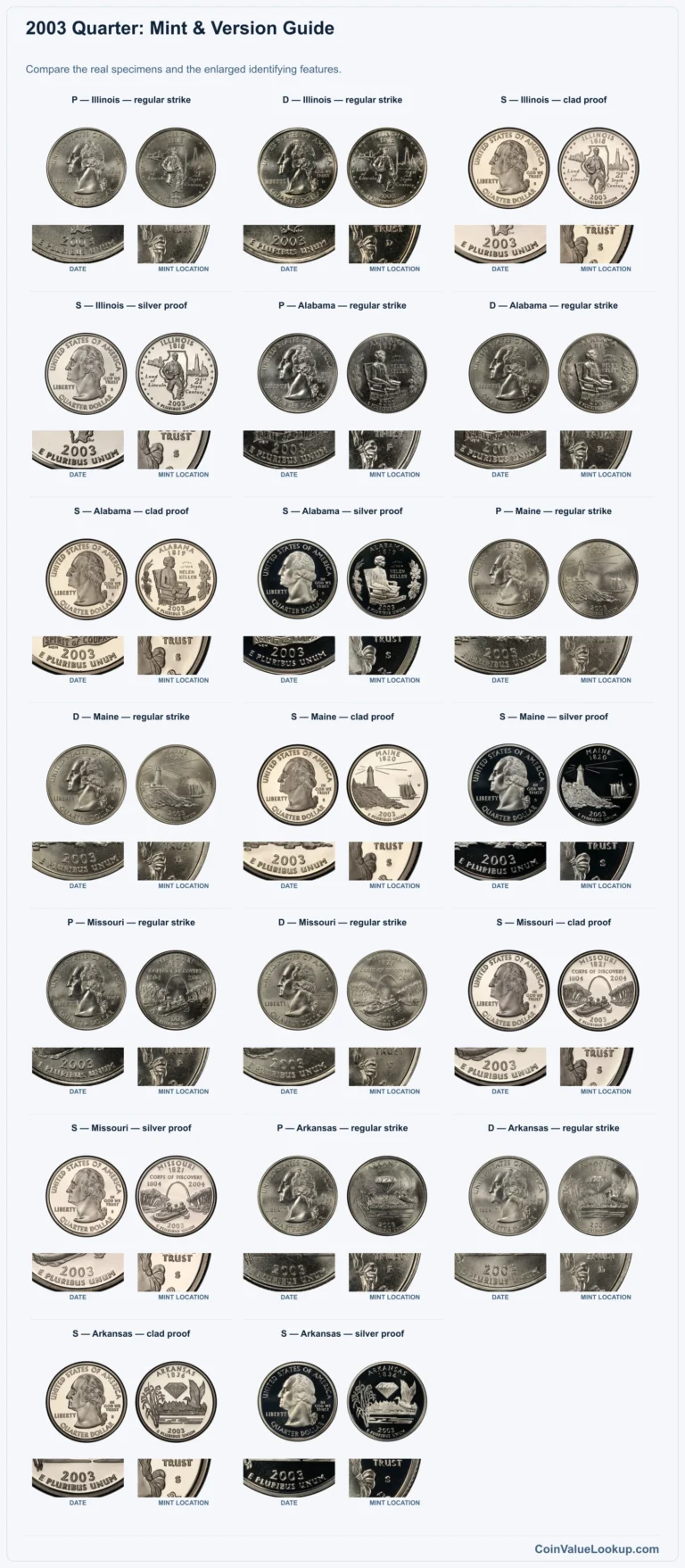
Start on the obverse. Look near Washington's portrait for the mintmark: P for Philadelphia, D for Denver, or S for San Francisco.
Then flip to the reverse and identify which of the five state designs you have — Nevada, Nebraska, Colorado, North Dakota or South Dakota.
The date on the obverse is the minting year, 2006. Any statehood date shown in the reverse design is historical, not the issue date.
Do not confuse the two.
Ordinary business-strike quarters are copper-nickel clad. Silver proofs, struck at San Francisco, are 90% silver and weigh about 6.25 grams versus 5.67 grams for clad coins.
Check the edge — a silver proof shows a uniform silver-gray edge, while a clad coin typically shows a visible copper-colored stripe.
Satin-finish coins came in uncirculated mint sets. They have a distinctive fine-textured surface that is softer than a proof's mirror but more uniform than a business strike.
A worn or cleaned surface is not the same thing. Proof and satin finishes are intentional manufacturing choices, not errors or upgrades beyond Mint State.
Step 2: Check Your 2006 Quarter Grade
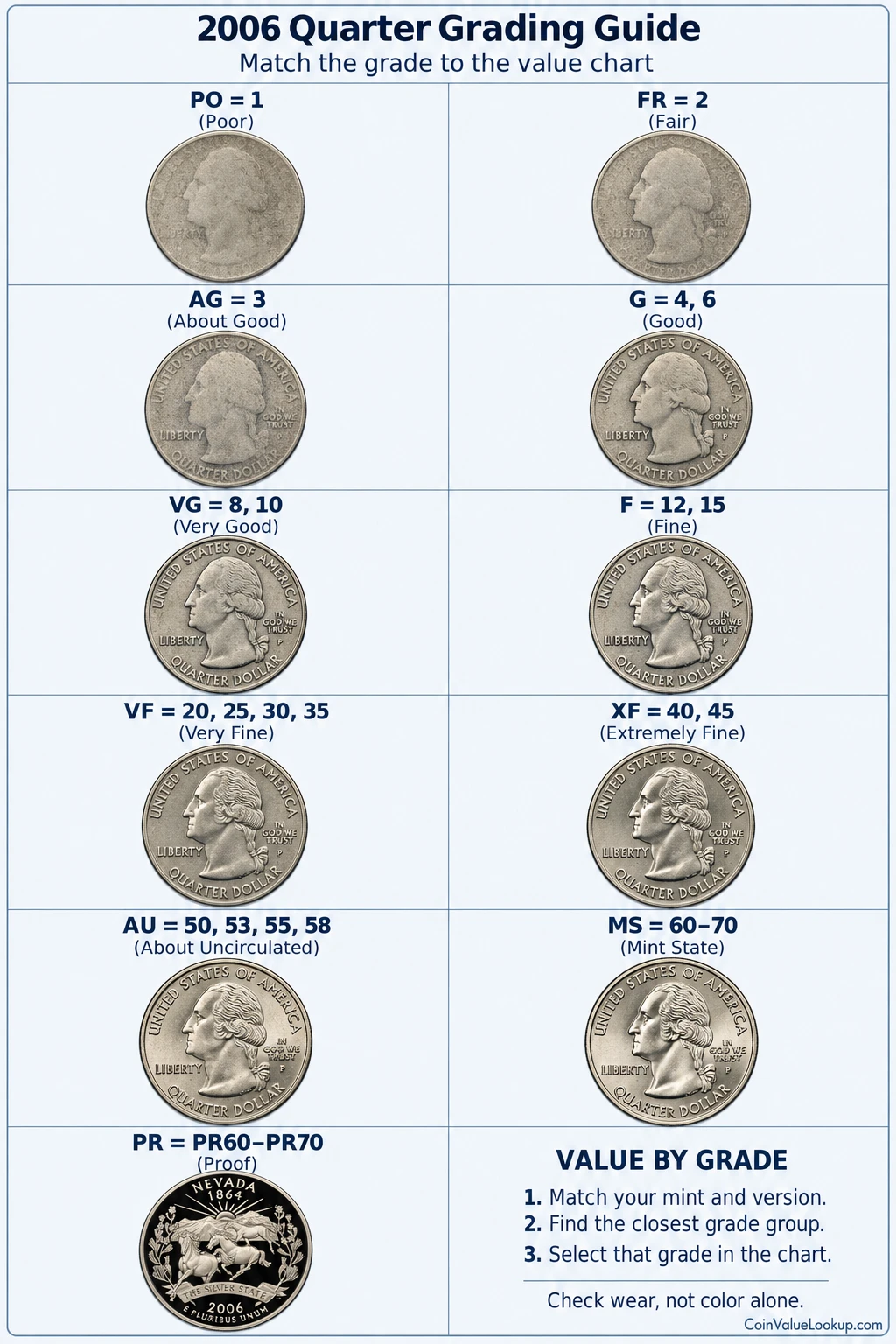
Focus on Washington's cheek and the hair above his ear on the obverse. These are the first areas to show wear, and even light friction will dull the original luster there.
On the reverse, check the highest-relief elements of whichever state design you have. Flat spots from wear look different from weak strikes — wear removes luster, while a weak strike still shows original surface texture.
For proofs, tilt the coin under a single light source. Hairlines in the mirror fields and haze over the frosted devices are the main condition issues.
A proof that has been removed from its case and handled will show these quickly.
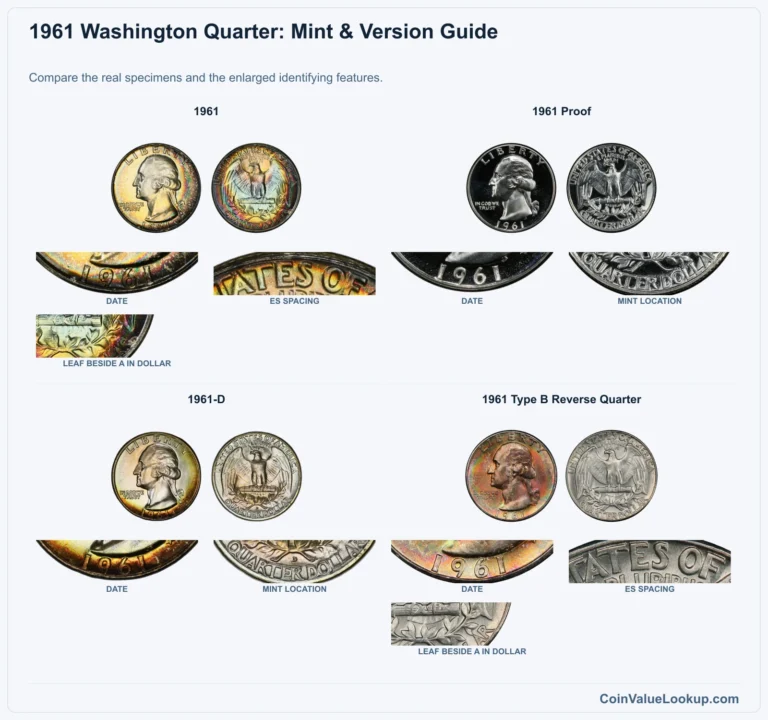
Use the comparison image to match your coin's overall look. A coin with full original luster and no visible contact marks sits at the top of the Mint State scale, while one with obvious rub on the high points falls lower.
Do not assume a shiny coin is high grade — brightness from cleaning actually lowers the grade.
Step 3: Check 2006 Quarter Value by Mint and Version
2006 Quarter — P — Nevada — regular strike
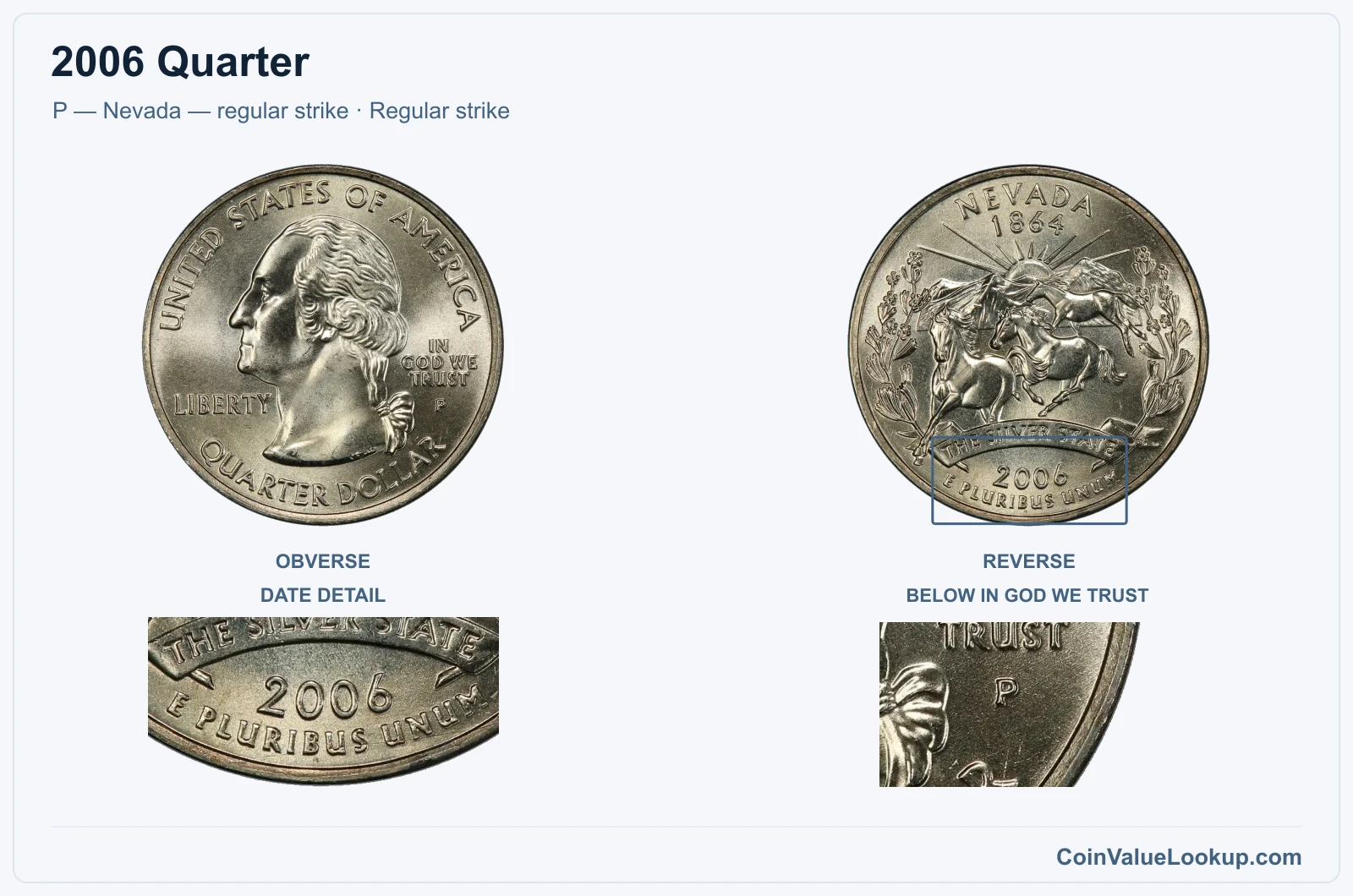
This is the Philadelphia business strike with the Nevada reverse. It is copper-nickel clad, 24.26 mm in diameter, and weighs about 5.67 grams.
Look for the P mintmark near Washington's portrait.
In circulated condition, these trade near face value. A USA Coin Book guide estimate places an MS60 example at about $0.49 and an MS65 at $6.25.
Those are guide estimates, not guaranteed offers. Confirm your exact reverse design before comparing grades.
Range Grade
Price Auction Records Appraisal PO PO 1
—
Coin Identifier FR FR 2
—
Coin Identifier AG AG 3
—
Coin Identifier G G 4
—
Coin Identifier
G 6
—
Coin Identifier VG VG 8
—
Coin Identifier
VG 10
—
Coin Identifier F F 12
—
Coin Identifier
F 15
—
Coin Identifier VF VF 20
—
Coin Identifier
VF 25
—
Coin Identifier
VF 30
—
Coin Identifier
VF 35
—
Coin Identifier XF XF 40
—
Coin Identifier
XF 45
—
Coin Identifier AU AU 50
—
Coin Identifier
AU 53
—
Coin Identifier
AU 55
—
Coin Identifier
AU 58
—
Coin Identifier MS MS 60
—
Coin Identifier
MS 61
—
Coin Identifier
MS 62
—
Coin Identifier
MS 63
—
Coin Identifier
MS 64
—
Coin Identifier
MS 65
—
Coin Identifier
MS 66
—
Coin Identifier
MS 67
Coin Identifier
MS 68
—
—
—
MS 69
—
—
—
MS 70
—
—
—
2006 Quarter — P — Nevada — satin finish
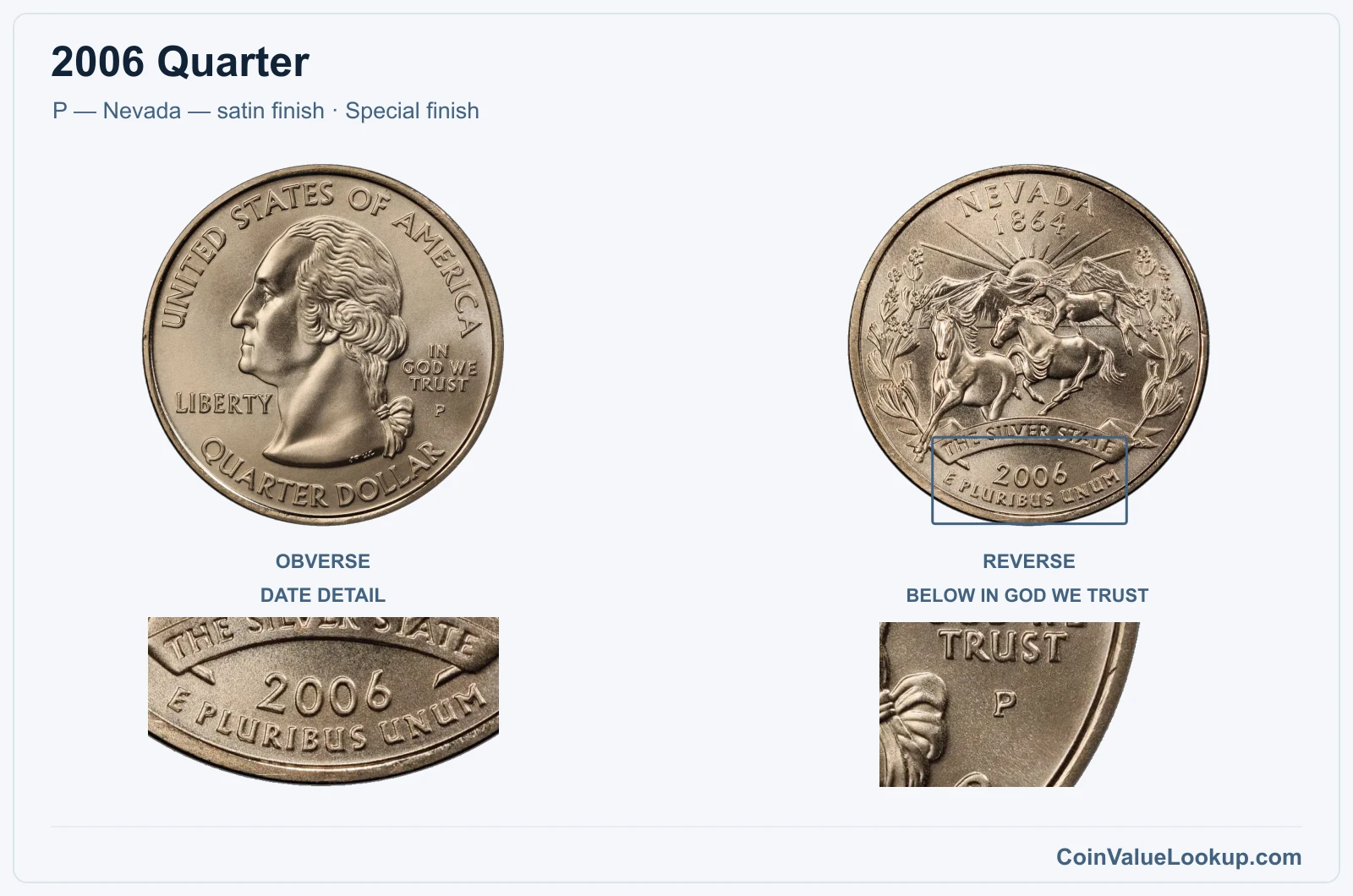
The P-mint Nevada satin finish was distributed in 2006 uncirculated mint sets. It has a fine, even texture across both sides — softer than a proof mirror but distinctly different from a regular business strike's cartwheel luster.
Do not confuse a worn or artificially dulled coin for satin finish. Genuine satin specimens need authentication and individual assessment to establish value, as no standard guide price is adopted for this version.
Range Grade
Price Auction Records Appraisal SP SP 1
—
Coin Identifier
SP 2
—
Coin Identifier
SP 3
—
Coin Identifier
SP 4
—
Coin Identifier
SP 6
—
Coin Identifier
SP 8
—
Coin Identifier
SP 10
—
Coin Identifier
SP 12
—
Coin Identifier
SP 15
—
Coin Identifier
SP 20
—
Coin Identifier
SP 25
—
Coin Identifier
SP 30
—
Coin Identifier
SP 35
—
Coin Identifier
SP 40
—
Coin Identifier
SP 45
—
Coin Identifier
SP 50
—
Coin Identifier
SP 53
—
Coin Identifier
SP 55
—
Coin Identifier
SP 58
—
Coin Identifier
SP 60
—
Coin Identifier
SP 61
—
Coin Identifier
SP 62
—
Coin Identifier
SP 63
—
Coin Identifier
SP 64
—
Coin Identifier
SP 65
—
Coin Identifier
SP 66
—
Coin Identifier
SP 67
Coin Identifier
SP 68
Coin Identifier
SP 69
Coin Identifier
SP 70
—
—
—
2006 Quarter — D — Nevada — regular strike
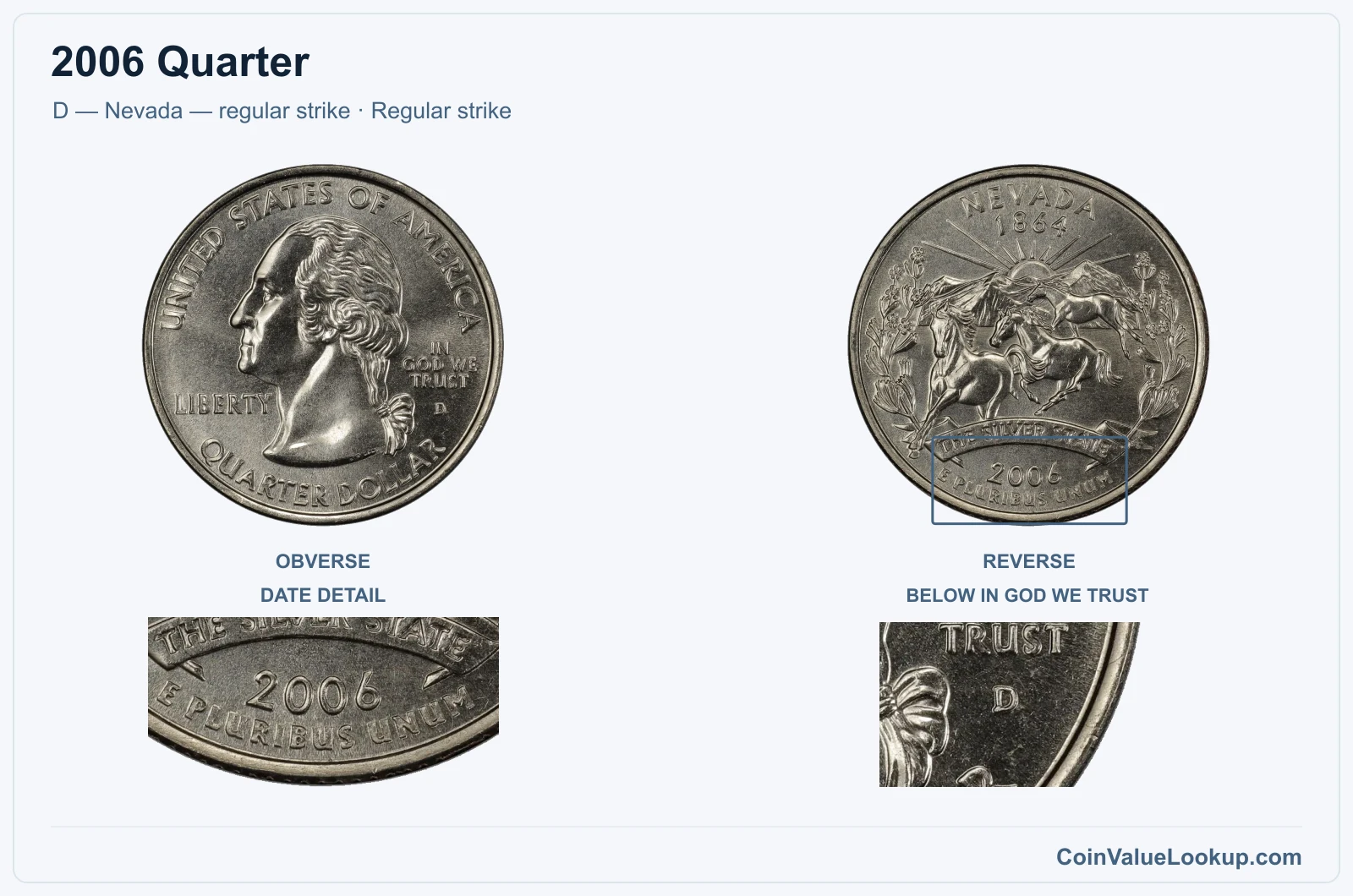
The Denver mint also struck Nevada quarters for general circulation in copper-nickel clad. Look for the D mintmark on the obverse.
Worn examples are worth face value. According to USA Coin Book, an MS60 grades at about $0.49 while an MS65 runs roughly $6.25.
These are guide-level estimates. Condition and original luster make the difference between a quarter that spends and one that sells.
Range Grade
Price Auction Records Appraisal PO PO 1
—
Coin Identifier FR FR 2
—
Coin Identifier AG AG 3
—
Coin Identifier G G 4
—
Coin Identifier
G 6
—
Coin Identifier VG VG 8
—
Coin Identifier
VG 10
—
Coin Identifier F F 12
—
Coin Identifier
F 15
—
Coin Identifier VF VF 20
—
Coin Identifier
VF 25
—
Coin Identifier
VF 30
—
Coin Identifier
VF 35
—
Coin Identifier XF XF 40
—
Coin Identifier
XF 45
—
Coin Identifier AU AU 50
—
Coin Identifier
AU 53
—
Coin Identifier
AU 55
—
Coin Identifier
AU 58
—
Coin Identifier MS MS 60
—
Coin Identifier
MS 61
—
Coin Identifier
MS 62
—
Coin Identifier
MS 63
—
Coin Identifier
MS 64
—
Coin Identifier
MS 65
—
Coin Identifier
MS 66
—
Coin Identifier
MS 67
Coin Identifier
MS 68
Coin Identifier
MS 69
—
—
—
MS 70
—
—
—
2006 Quarter — D — Nevada — satin finish
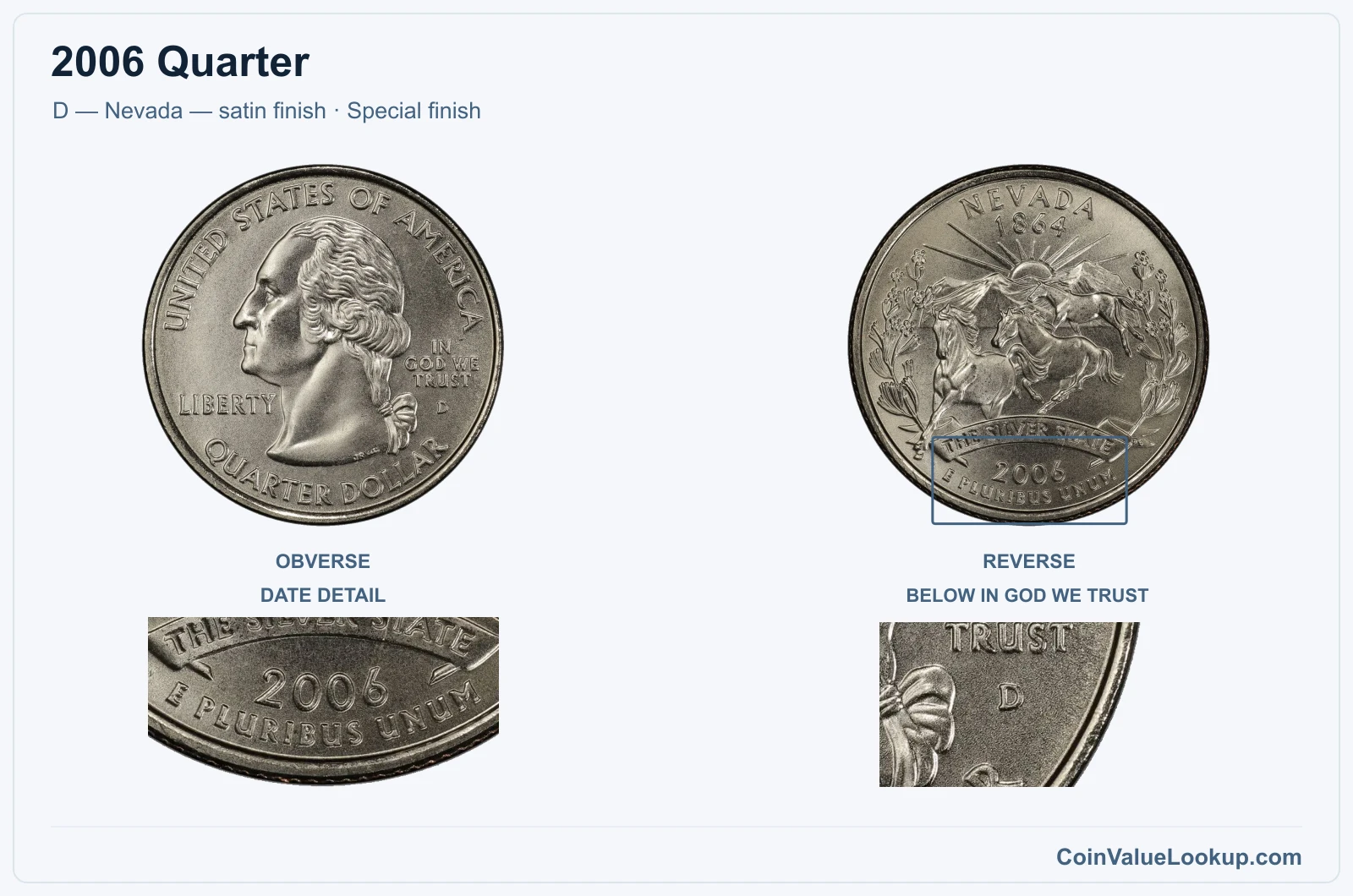
This is the D-mint Nevada satin finish, found in 2006 uncirculated mint sets. Its surface has a uniform fine texture that looks nothing like the standard business strike's sharper luster.
A coin that merely looks dull from wear or cleaning does not qualify. Because no standard guide price is adopted for satin-finish versions, value depends on authenticated identity and individual condition assessment.
Range Grade
Price Auction Records Appraisal SP SP 1
—
Coin Identifier
SP 2
—
Coin Identifier
SP 3
—
Coin Identifier
SP 4
—
Coin Identifier
SP 6
—
Coin Identifier
SP 8
—
Coin Identifier
SP 10
—
Coin Identifier
SP 12
—
Coin Identifier
SP 15
—
Coin Identifier
SP 20
—
Coin Identifier
SP 25
—
Coin Identifier
SP 30
—
Coin Identifier
SP 35
—
Coin Identifier
SP 40
—
Coin Identifier
SP 45
—
Coin Identifier
SP 50
—
Coin Identifier
SP 53
—
Coin Identifier
SP 55
—
Coin Identifier
SP 58
—
Coin Identifier
SP 60
—
Coin Identifier
SP 61
—
Coin Identifier
SP 62
—
Coin Identifier
SP 63
—
Coin Identifier
SP 64
—
Coin Identifier
SP 65
—
Coin Identifier
SP 66
Coin Identifier
SP 67
Coin Identifier
SP 68
Coin Identifier
SP 69
Coin Identifier
SP 70
—
—
—
2006 Quarter — S — Nevada — clad proof
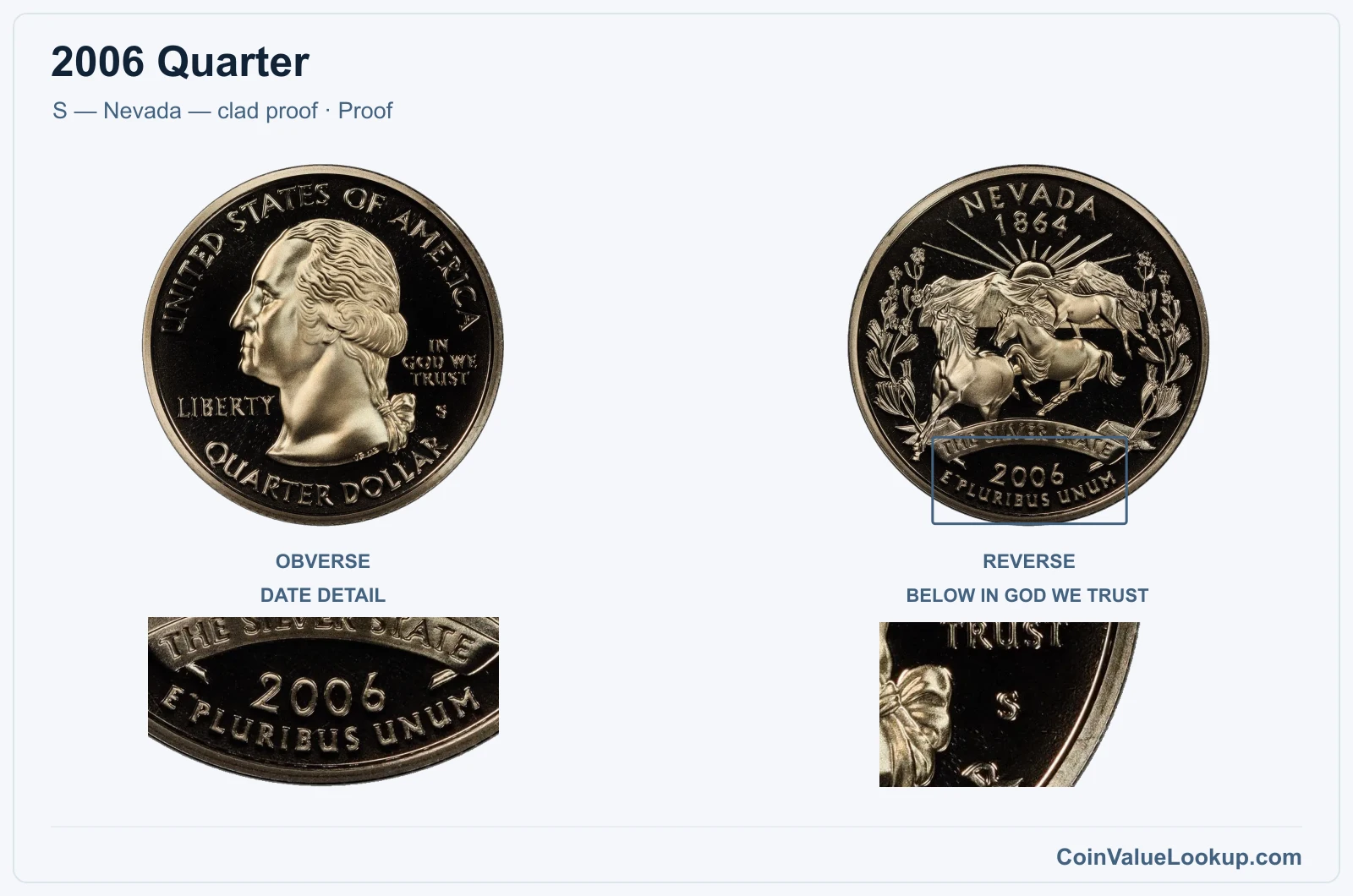
San Francisco struck clad proof Nevada quarters for collector sets. These show mirror-like fields and frosted raised devices.
The composition is still copper-nickel clad — same as business strikes — so do not confuse them with the silver version.
USA Coin Book estimates PR65 at about $5.63. Confirm clad versus silver by checking the edge and weight before applying a price.
Original packaging helps verify which proof set a coin came from.
Range Grade
Price Auction Records Appraisal PR PR 1
—
Coin Identifier
PR 2
—
Coin Identifier
PR 3
—
Coin Identifier
PR 4
—
Coin Identifier
PR 6
—
Coin Identifier
PR 8
—
Coin Identifier
PR 10
—
Coin Identifier
PR 12
—
Coin Identifier
PR 15
—
Coin Identifier
PR 20
—
Coin Identifier
PR 25
—
Coin Identifier
PR 30
—
Coin Identifier
PR 35
—
Coin Identifier
PR 40
—
Coin Identifier
PR 45
—
Coin Identifier
PR 50
—
Coin Identifier
PR 53
—
Coin Identifier
PR 55
—
Coin Identifier
PR 58
—
Coin Identifier
PR 60
—
Coin Identifier
PR 61
—
Coin Identifier
PR 62
—
Coin Identifier
PR 63
—
Coin Identifier
PR 64
—
Coin Identifier
PR 65
—
Coin Identifier
PR 66
—
Coin Identifier
PR 67
—
Coin Identifier
PR 68
—
Coin Identifier
PR 69
Coin Identifier
PR 70
Coin Identifier
2006 Quarter — S — Nevada — silver proof
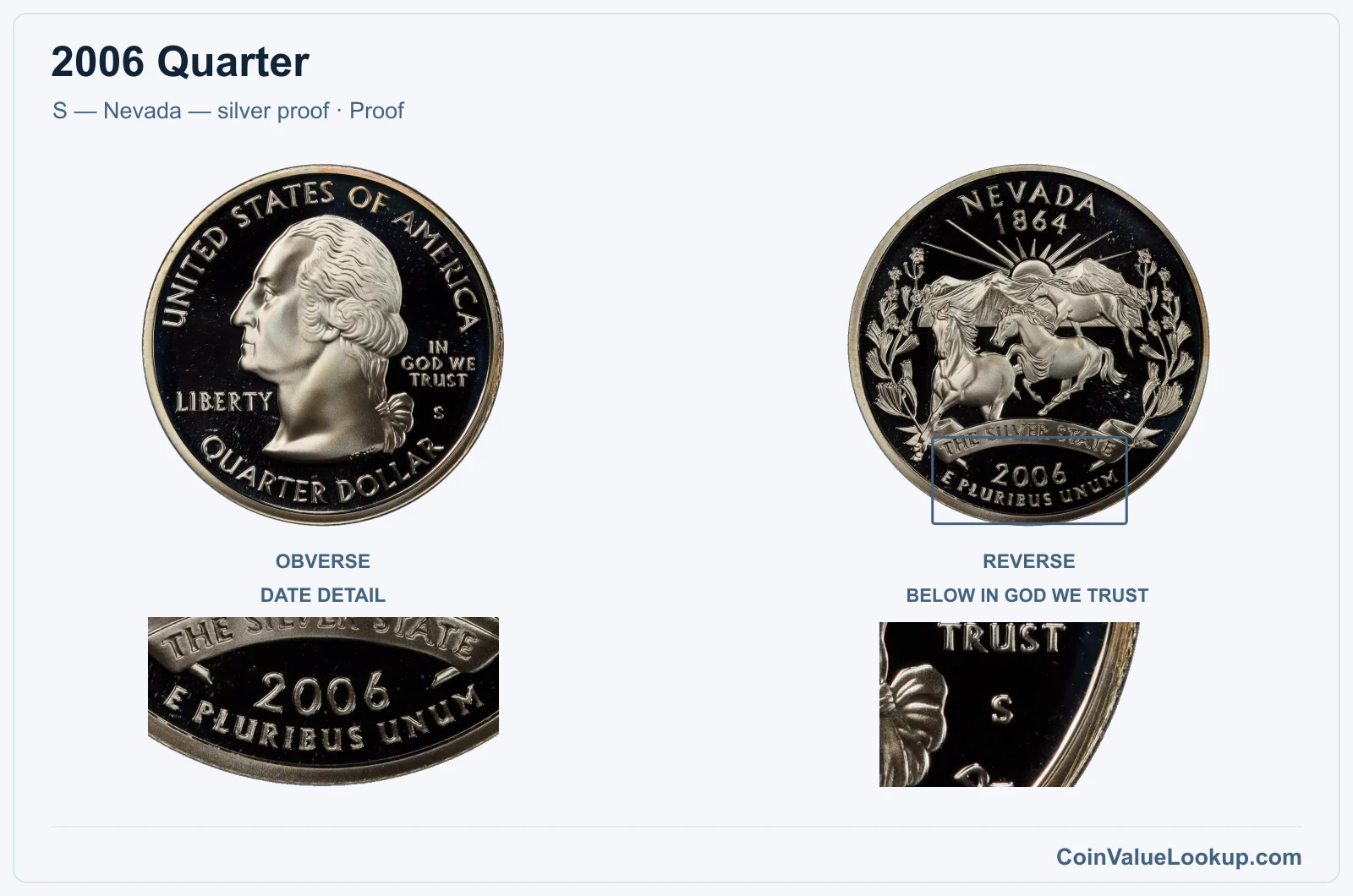
The silver proof Nevada quarter is 90% silver, 10% copper, and weighs approximately 6.25 grams — heavier than the 5.67-gram clad version. The edge will appear uniformly silver-gray with no copper stripe.
USA Coin Book places a PR65 silver proof at about $23.00. That premium over the clad proof comes directly from the precious-metal content and lower mintage.
Keep these separated from clad proofs when checking values.
Range Grade
Price Auction Records Appraisal PR PR 1
—
Coin Identifier
PR 2
—
Coin Identifier
PR 3
—
Coin Identifier
PR 4
—
Coin Identifier
PR 6
—
Coin Identifier
PR 8
—
Coin Identifier
PR 10
—
Coin Identifier
PR 12
—
Coin Identifier
PR 15
—
Coin Identifier
PR 20
—
Coin Identifier
PR 25
—
Coin Identifier
PR 30
—
Coin Identifier
PR 35
—
Coin Identifier
PR 40
—
Coin Identifier
PR 45
—
Coin Identifier
PR 50
—
Coin Identifier
PR 53
—
Coin Identifier
PR 55
—
Coin Identifier
PR 58
—
Coin Identifier
PR 60
—
Coin Identifier
PR 61
—
Coin Identifier
PR 62
—
Coin Identifier
PR 63
—
Coin Identifier
PR 64
—
Coin Identifier
PR 65
—
Coin Identifier
PR 66
—
Coin Identifier
PR 67
—
Coin Identifier
PR 68
—
Coin Identifier
PR 69
Coin Identifier
PR 70
Coin Identifier
2006 Quarter — P — Nebraska — regular strike
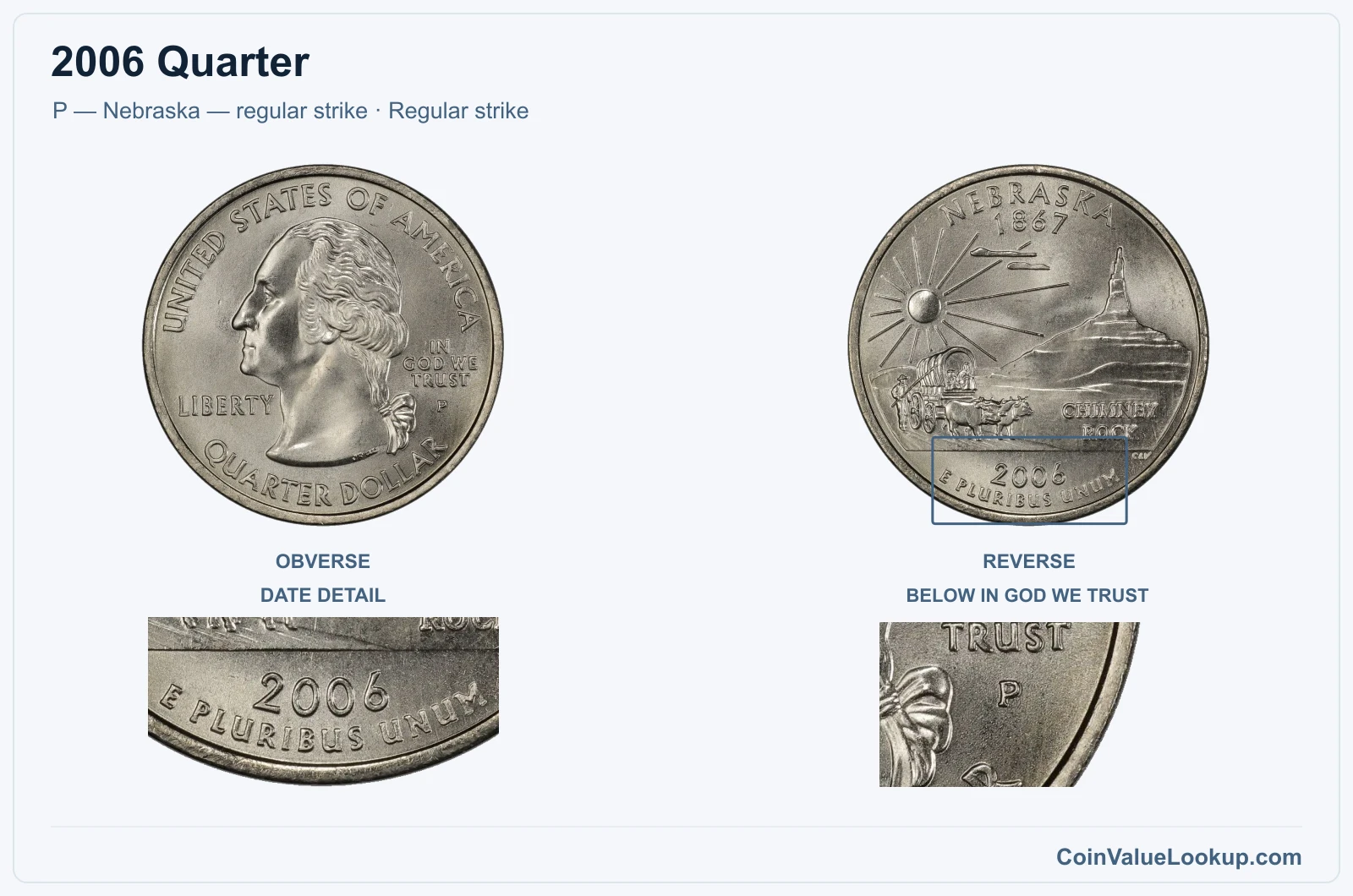
Philadelphia struck Nebraska reverse quarters for everyday circulation. Copper-nickel clad, standard dimensions, with a P mintmark on the obverse.
Circulated pieces are worth face value. The USA Coin Book guide estimate is about $0.49 at MS60 and $1.24 at MS65.
The MS65 figure is lower than the Nevada design at the same grade, so confirm your reverse before using a price chart.
Range Grade
Price Auction Records Appraisal PO PO 1
—
Coin Identifier FR FR 2
—
Coin Identifier AG AG 3
—
Coin Identifier G G 4
—
Coin Identifier
G 6
—
Coin Identifier VG VG 8
—
Coin Identifier
VG 10
—
Coin Identifier F F 12
—
Coin Identifier
F 15
—
Coin Identifier VF VF 20
—
Coin Identifier
VF 25
—
Coin Identifier
VF 30
—
Coin Identifier
VF 35
—
Coin Identifier XF XF 40
—
Coin Identifier
XF 45
—
Coin Identifier AU AU 50
—
Coin Identifier
AU 53
—
Coin Identifier
AU 55
—
Coin Identifier
AU 58
—
Coin Identifier MS MS 60
—
Coin Identifier
MS 61
—
Coin Identifier
MS 62
—
Coin Identifier
MS 63
—
Coin Identifier
MS 64
—
Coin Identifier
MS 65
—
Coin Identifier
MS 66
—
Coin Identifier
MS 67
Coin Identifier
MS 68
Coin Identifier
MS 69
—
—
—
MS 70
—
—
—
2006 Quarter — P — Nebraska — satin finish
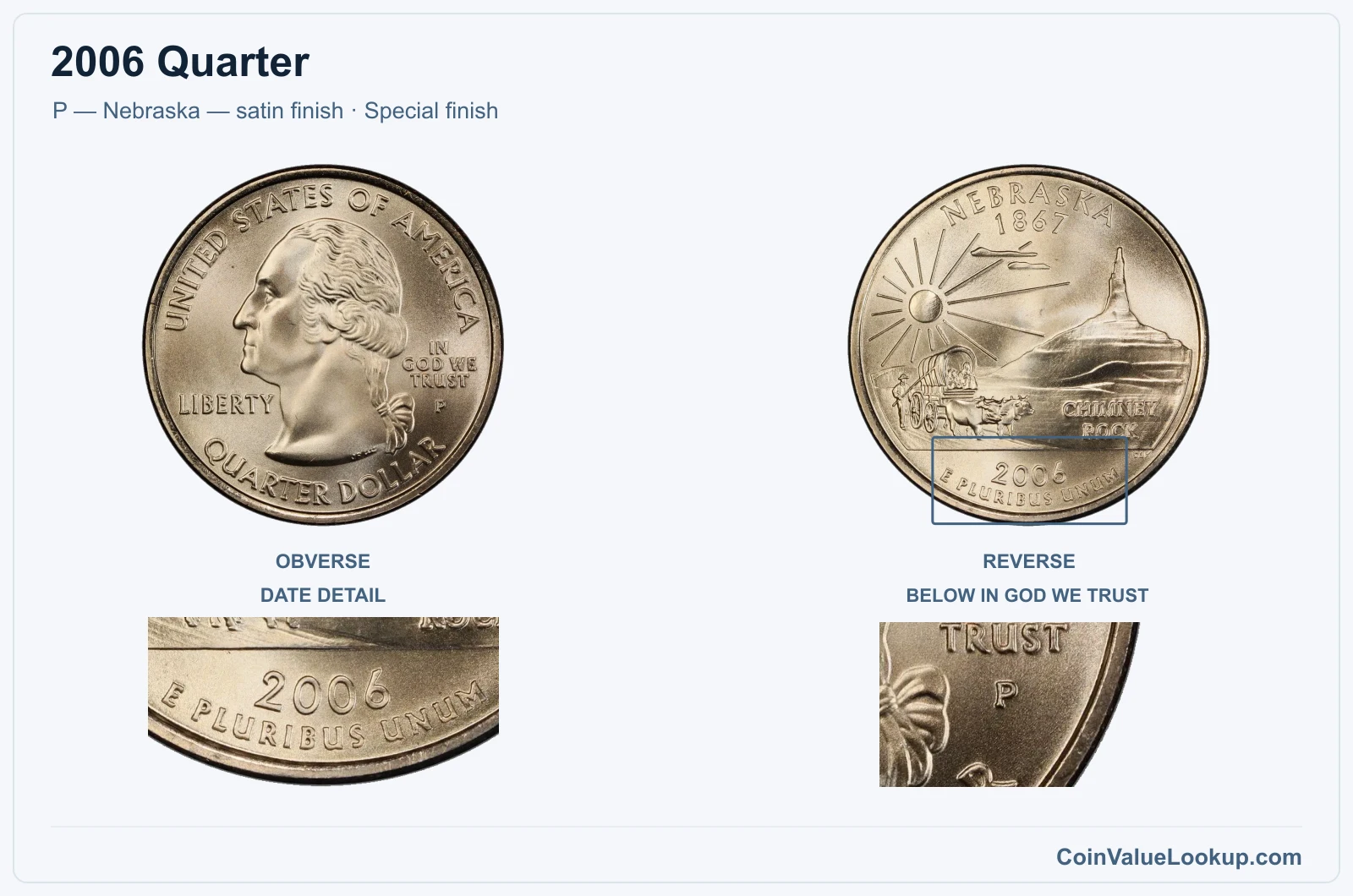
The P-mint Nebraska satin finish came packaged in 2006 uncirculated mint sets. The surface has a distinctive fine grain — not the sharp reflectivity of a proof and not the flowing cartwheel of a business strike.
No standard guide price is adopted for this version. Value requires authenticated identity and individual condition assessment.
A dull or cleaned coin does not qualify as satin finish.
Range Grade
Price Auction Records Appraisal SP SP 1
—
Coin Identifier
SP 2
—
Coin Identifier
SP 3
—
Coin Identifier
SP 4
—
Coin Identifier
SP 6
—
Coin Identifier
SP 8
—
Coin Identifier
SP 10
—
Coin Identifier
SP 12
—
Coin Identifier
SP 15
—
Coin Identifier
SP 20
—
Coin Identifier
SP 25
—
Coin Identifier
SP 30
—
Coin Identifier
SP 35
—
Coin Identifier
SP 40
—
Coin Identifier
SP 45
—
Coin Identifier
SP 50
—
Coin Identifier
SP 53
—
Coin Identifier
SP 55
—
Coin Identifier
SP 58
—
Coin Identifier
SP 60
—
Coin Identifier
SP 61
—
Coin Identifier
SP 62
—
Coin Identifier
SP 63
—
Coin Identifier
SP 64
—
Coin Identifier
SP 65
—
Coin Identifier
SP 66
Coin Identifier
SP 67
—
Coin Identifier
SP 68
Coin Identifier
SP 69
Coin Identifier
SP 70
—
—
—
2006 Quarter — D — Nebraska — regular strike
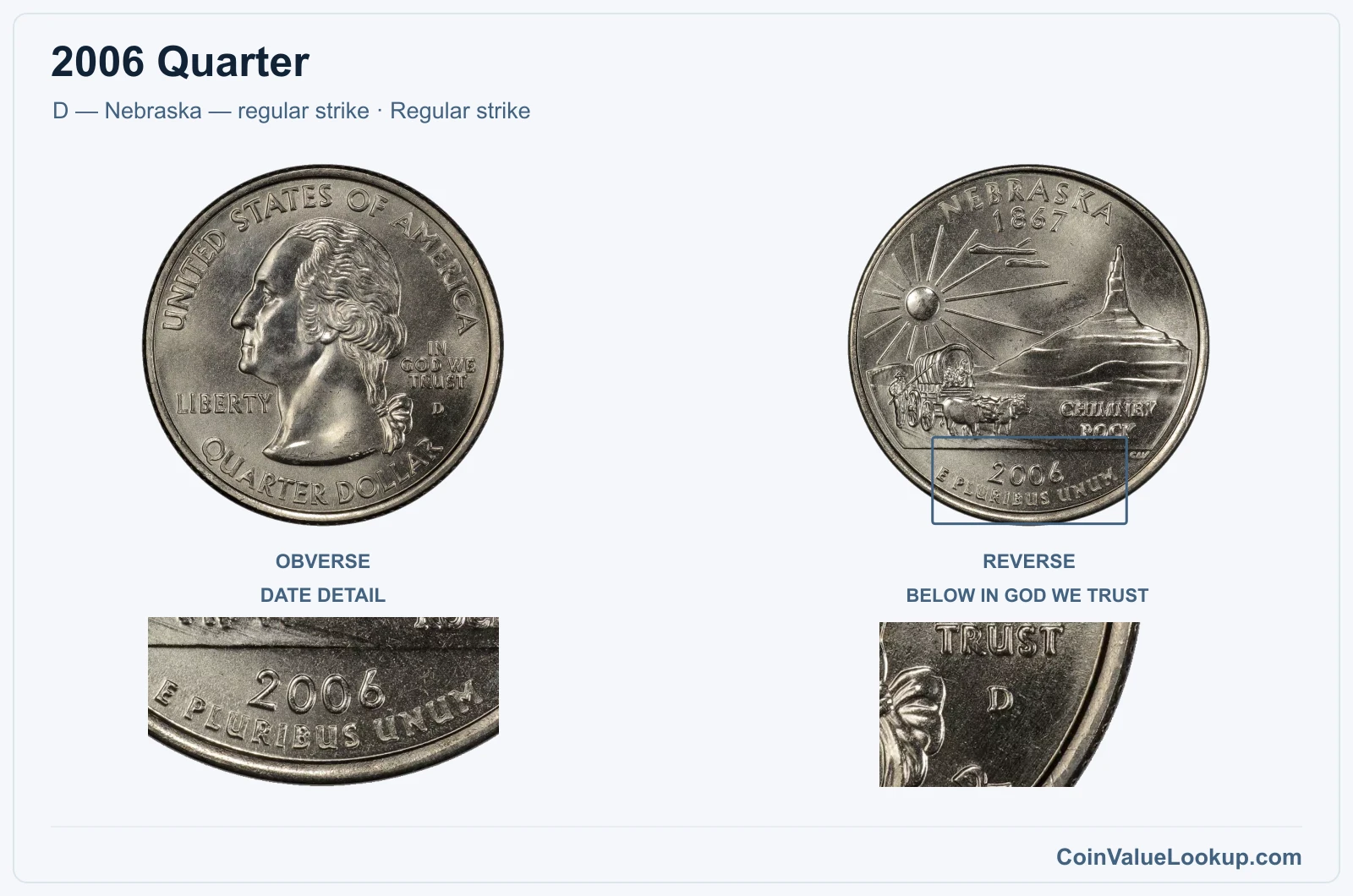
Denver's Nebraska quarter is another high-mintage circulating issue. Copper-nickel clad, D mintmark, Nebraska reverse.
Same specs as the P version.
USA Coin Book estimates about $0.49 at MS60 and $1.24 at MS65. Most examples you find in change are circulated and worth 25 cents.
Original uncirculated rolls are where the higher grades tend to come from.
Range Grade
Price Auction Records Appraisal PO PO 1
—
Coin Identifier FR FR 2
—
Coin Identifier AG AG 3
—
Coin Identifier G G 4
—
Coin Identifier
G 6
—
Coin Identifier VG VG 8
—
Coin Identifier
VG 10
—
Coin Identifier F F 12
—
Coin Identifier
F 15
—
Coin Identifier VF VF 20
—
Coin Identifier
VF 25
—
Coin Identifier
VF 30
—
Coin Identifier
VF 35
—
Coin Identifier XF XF 40
—
Coin Identifier
XF 45
—
Coin Identifier AU AU 50
—
Coin Identifier
AU 53
—
Coin Identifier
AU 55
—
Coin Identifier
AU 58
—
Coin Identifier MS MS 60
—
Coin Identifier
MS 61
—
Coin Identifier
MS 62
—
Coin Identifier
MS 63
—
Coin Identifier
MS 64
—
Coin Identifier
MS 65
—
Coin Identifier
MS 66
—
Coin Identifier
MS 67
Coin Identifier
MS 68
Coin Identifier
MS 69
—
—
—
MS 70
—
—
—
2006 Quarter — D — Nebraska — satin finish
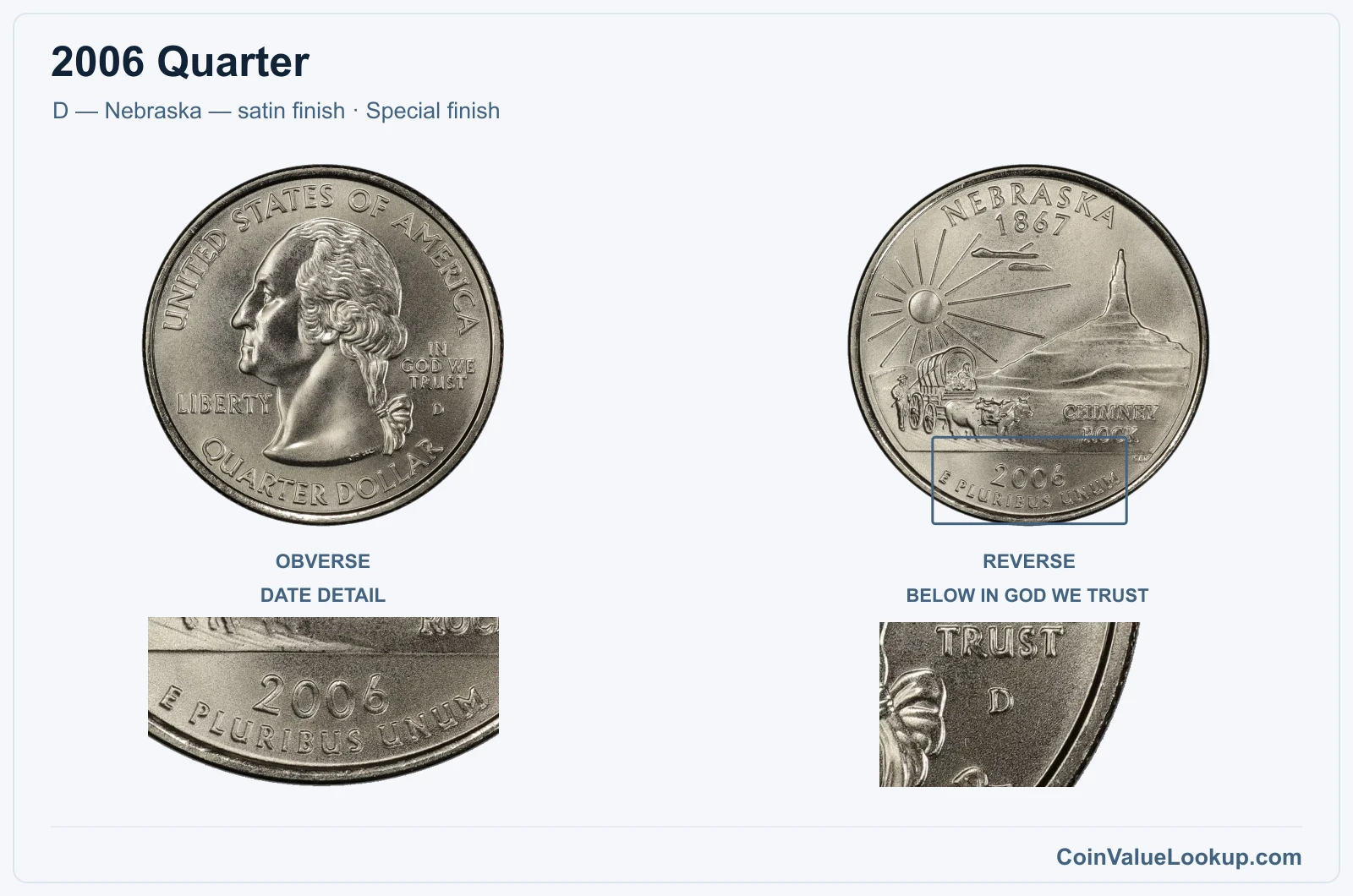
The D-mint Nebraska satin finish was available exclusively through 2006 mint sets. It carries the same fine-textured surface as all satin specimens from that year.
No standard guide price is adopted. Value depends on authenticated identity and condition.
Do not attribute satin finish based on a dull appearance alone — the texture is uniform and deliberate, quite different from a coin that simply lost its luster.
Range Grade
Price Auction Records Appraisal SP SP 1
—
Coin Identifier
SP 2
—
Coin Identifier
SP 3
—
Coin Identifier
SP 4
—
Coin Identifier
SP 6
—
Coin Identifier
SP 8
—
Coin Identifier
SP 10
—
Coin Identifier
SP 12
—
Coin Identifier
SP 15
—
Coin Identifier
SP 20
—
Coin Identifier
SP 25
—
Coin Identifier
SP 30
—
Coin Identifier
SP 35
—
Coin Identifier
SP 40
—
Coin Identifier
SP 45
—
Coin Identifier
SP 50
—
Coin Identifier
SP 53
—
Coin Identifier
SP 55
—
Coin Identifier
SP 58
—
Coin Identifier
SP 60
—
Coin Identifier
SP 61
—
Coin Identifier
SP 62
—
Coin Identifier
SP 63
—
Coin Identifier
SP 64
—
Coin Identifier
SP 65
—
Coin Identifier
SP 66
—
Coin Identifier
SP 67
Coin Identifier
SP 68
Coin Identifier
SP 69
Coin Identifier
SP 70
—
—
—
2006 Quarter — S — Nebraska — clad proof
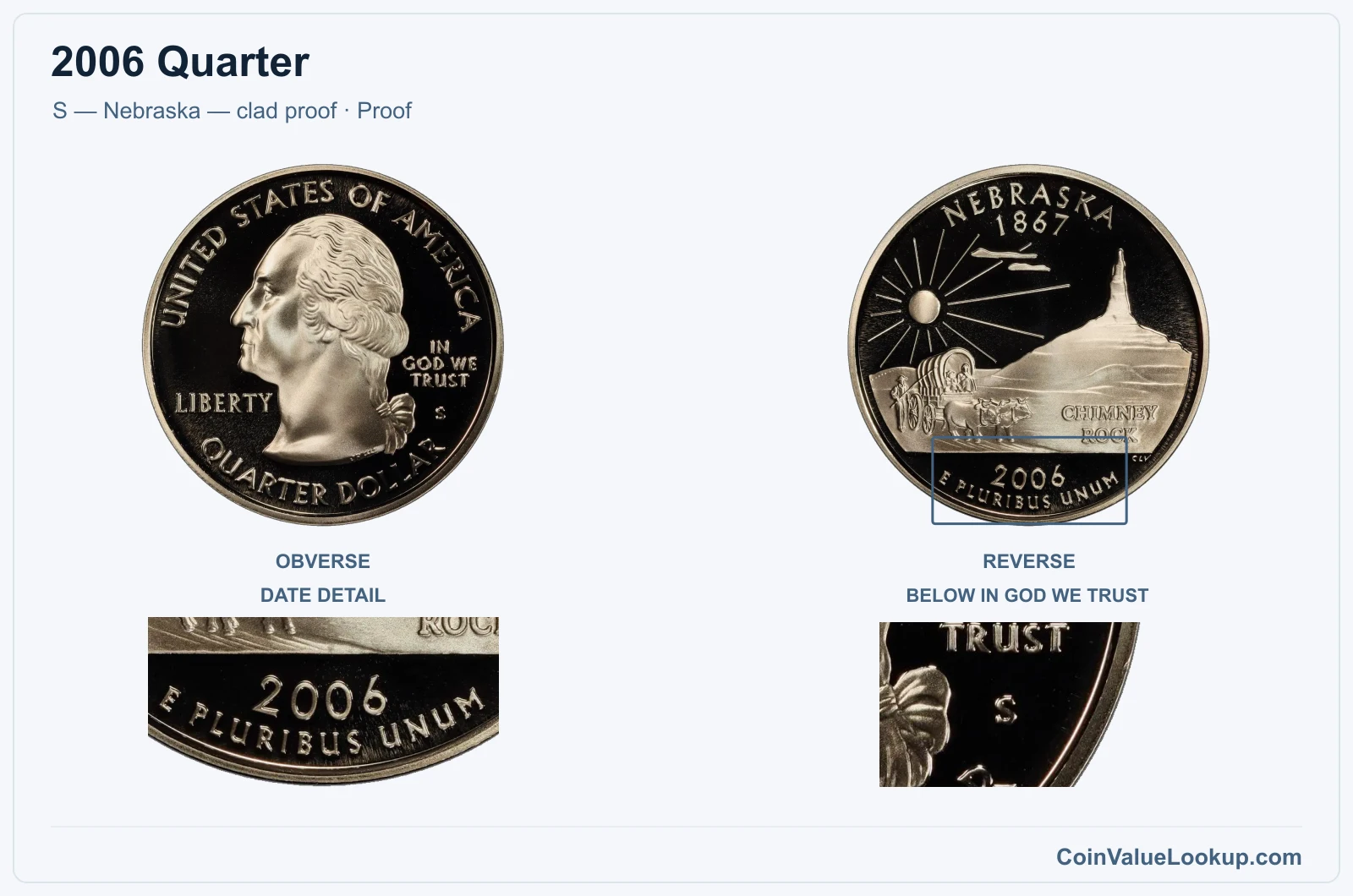
San Francisco produced clad proof Nebraska quarters for proof sets. Mirror fields, frosted devices, copper-nickel clad composition.
Check the edge for the telltale copper stripe that separates this from the silver version.
A PR65 is estimated at about $5.63 by USA Coin Book. Hairlines in the fields from handling are the most common condition issue.
Keeping the coin in its original government packaging preserves both the surface and the provenance.
Range Grade
Price Auction Records Appraisal PR PR 1
—
Coin Identifier
PR 2
—
Coin Identifier
PR 3
—
Coin Identifier
PR 4
—
Coin Identifier
PR 6
—
Coin Identifier
PR 8
—
Coin Identifier
PR 10
—
Coin Identifier
PR 12
—
Coin Identifier
PR 15
—
Coin Identifier
PR 20
—
Coin Identifier
PR 25
—
Coin Identifier
PR 30
—
Coin Identifier
PR 35
—
Coin Identifier
PR 40
—
Coin Identifier
PR 45
—
Coin Identifier
PR 50
—
Coin Identifier
PR 53
—
Coin Identifier
PR 55
—
Coin Identifier
PR 58
—
Coin Identifier
PR 60
—
Coin Identifier
PR 61
—
Coin Identifier
PR 62
—
Coin Identifier
PR 63
—
Coin Identifier
PR 64
—
Coin Identifier
PR 65
—
Coin Identifier
PR 66
—
Coin Identifier
PR 67
—
Coin Identifier
PR 68
—
Coin Identifier
PR 69
Coin Identifier
PR 70
Coin Identifier
2006 Quarter — S — Nebraska — silver proof
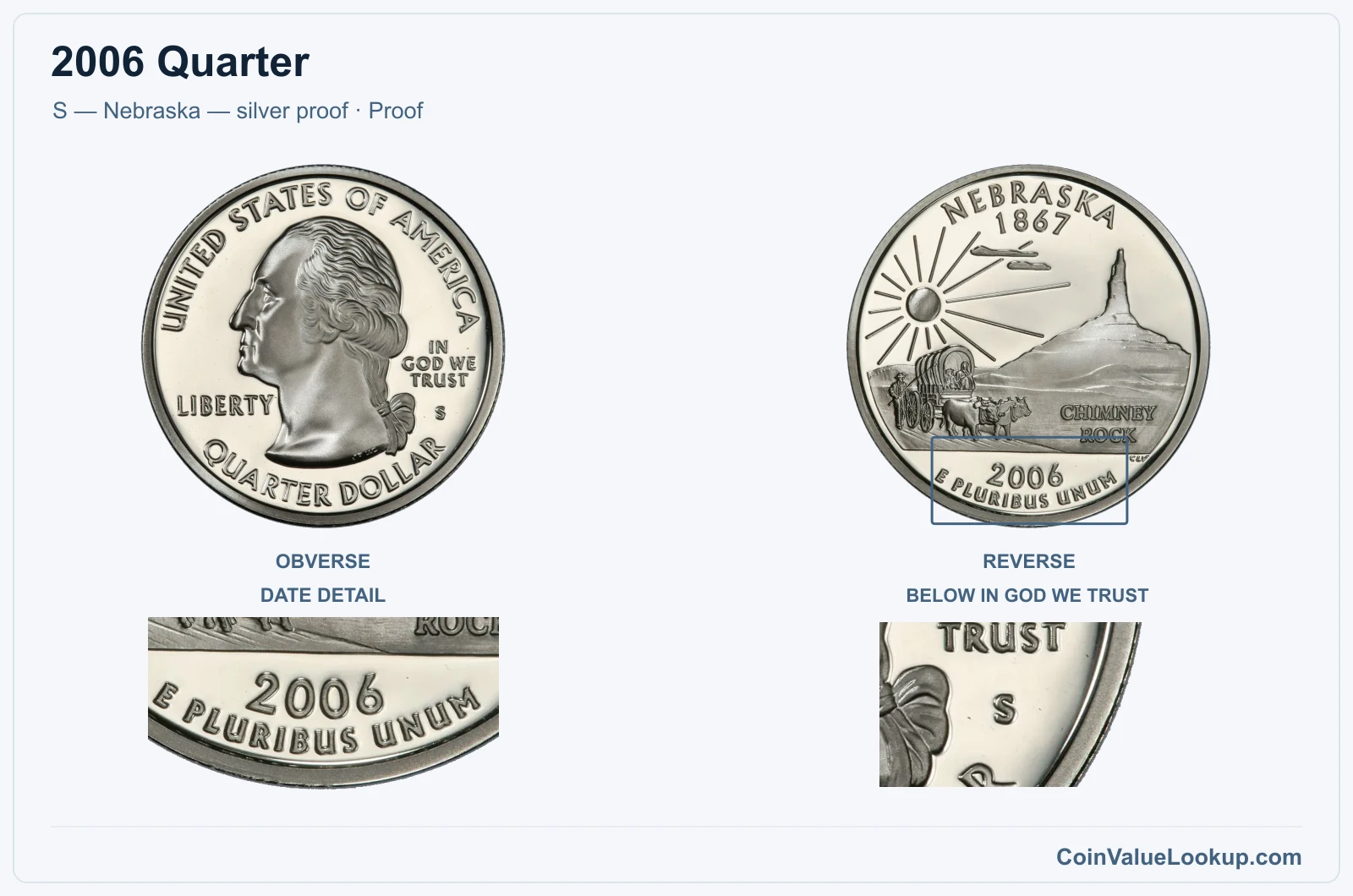
The silver proof Nebraska quarter is struck in 90% silver and weighs about 6.25 grams. Edge inspection is the fastest way to distinguish it from the clad proof — no copper stripe.
USA Coin Book estimates PR65 at roughly $23.00. As with all the 2006 silver proofs, the value premium comes from the silver content and the more limited production for silver proof sets.
Verify composition before pricing.
Coin Value Lookup is a good starting point if you want to compare this coin with other years or denominations.
Range Grade
Price Auction Records Appraisal PR PR 1
—
Coin Identifier
PR 2
—
Coin Identifier
PR 3
—
Coin Identifier
PR 4
—
Coin Identifier
PR 6
—
Coin Identifier
PR 8
—
Coin Identifier
PR 10
—
Coin Identifier
PR 12
—
Coin Identifier
PR 15
—
Coin Identifier
PR 20
—
Coin Identifier
PR 25
—
Coin Identifier
PR 30
—
Coin Identifier
PR 35
—
Coin Identifier
PR 40
—
Coin Identifier
PR 45
—
Coin Identifier
PR 50
—
Coin Identifier
PR 53
—
Coin Identifier
PR 55
—
Coin Identifier
PR 58
—
Coin Identifier
PR 60
—
Coin Identifier
PR 61
—
Coin Identifier
PR 62
—
Coin Identifier
PR 63
—
Coin Identifier
PR 64
—
Coin Identifier
PR 65
—
Coin Identifier
PR 66
—
Coin Identifier
PR 67
—
Coin Identifier
PR 68
—
Coin Identifier
PR 69
Coin Identifier
PR 70
Coin Identifier
2006 Quarter — P — Colorado — regular strike
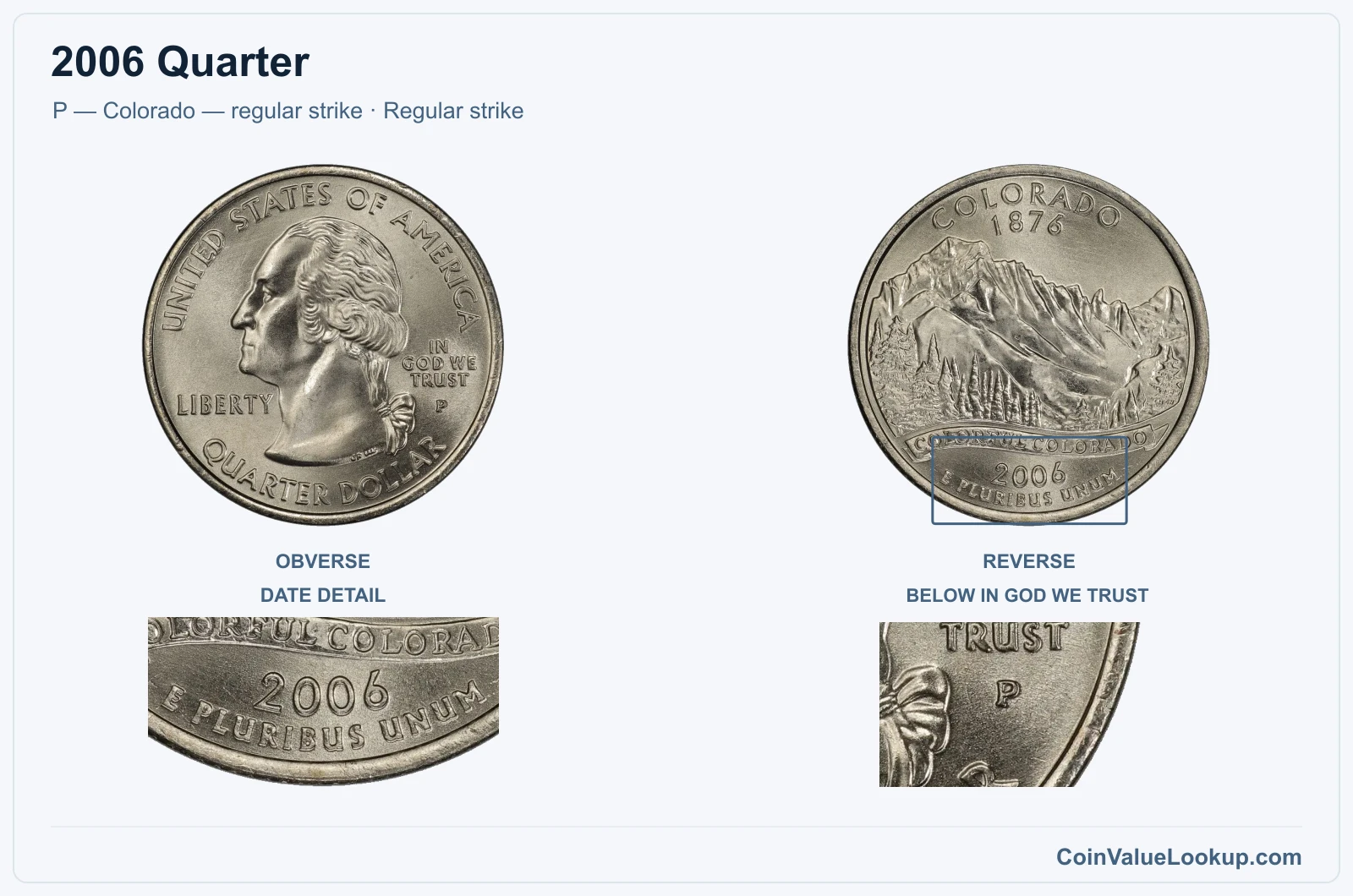
The Philadelphia Colorado quarter is a standard copper-nickel clad business strike. Look for the P mintmark and the Colorado reverse design showing a mountain landscape.
Circulated coins are worth face value. USA Coin Book estimates about $0.49 at MS60 and $2.50 at MS65.
Original luster and absence of bag marks are what push a coin toward that higher grade.
Range Grade
Price Auction Records Appraisal PO PO 1
—
Coin Identifier FR FR 2
—
Coin Identifier AG AG 3
—
Coin Identifier G G 4
—
Coin Identifier
G 6
—
Coin Identifier VG VG 8
—
Coin Identifier
VG 10
—
Coin Identifier F F 12
—
Coin Identifier
F 15
—
Coin Identifier VF VF 20
—
Coin Identifier
VF 25
—
Coin Identifier
VF 30
—
Coin Identifier
VF 35
—
Coin Identifier XF XF 40
—
Coin Identifier
XF 45
—
Coin Identifier AU AU 50
—
Coin Identifier
AU 53
—
Coin Identifier
AU 55
—
Coin Identifier
AU 58
—
Coin Identifier MS MS 60
—
Coin Identifier
MS 61
—
Coin Identifier
MS 62
—
Coin Identifier
MS 63
—
Coin Identifier
MS 64
—
Coin Identifier
MS 65
—
Coin Identifier
MS 66
—
Coin Identifier
MS 67
Coin Identifier
MS 68
Coin Identifier
MS 69
—
—
—
MS 70
—
—
—
2006 Quarter — P — Colorado — satin finish
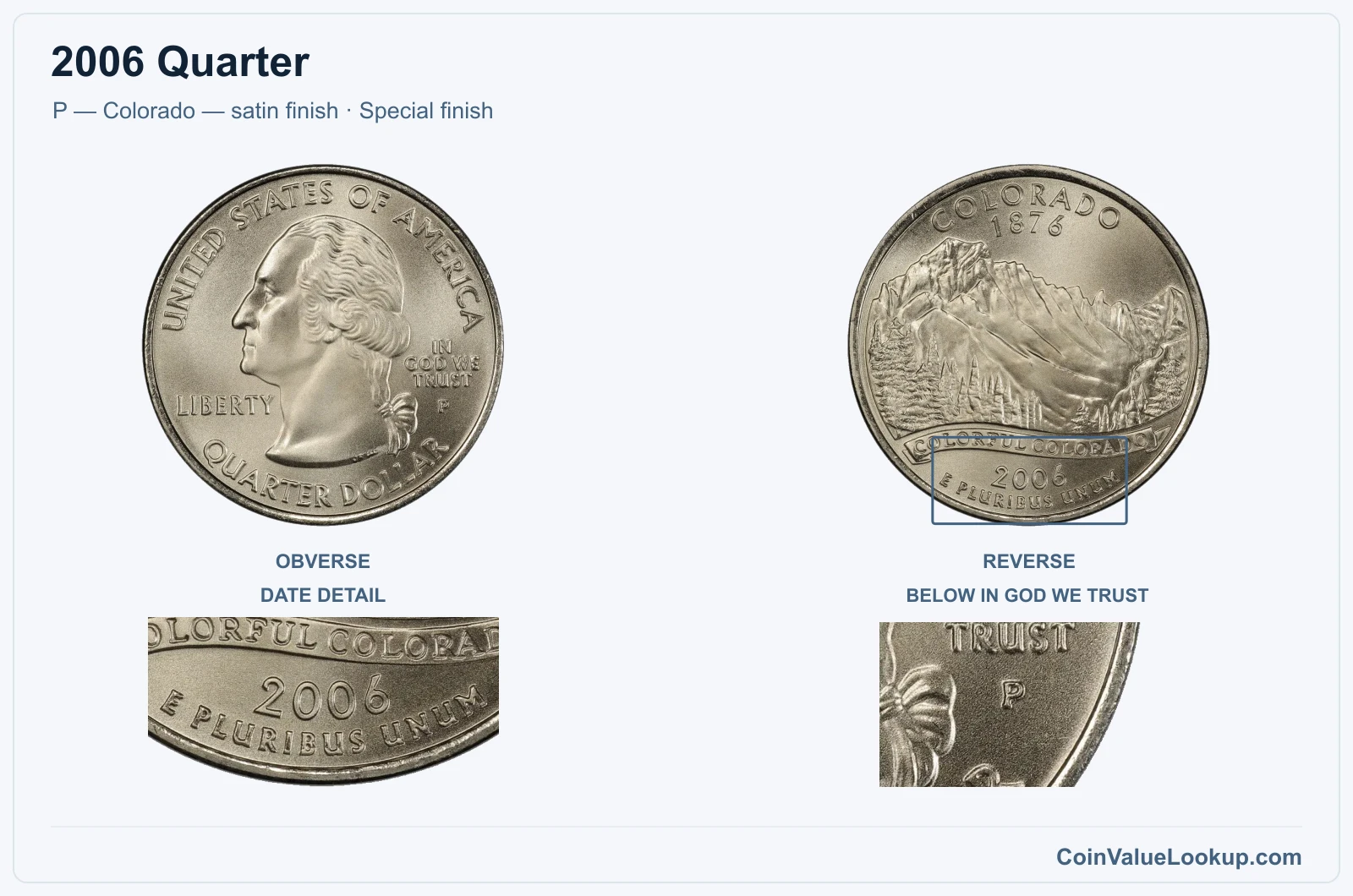
This satin-finish version of the P-mint Colorado quarter came in 2006 uncirculated mint sets. Its surface is evenly textured and distinct from both proofs and regular strikes.
No standard guide price is adopted for satin-finish versions. A coin needs to be authenticated for this finish before any value claim makes sense.
Wear and cleaning can mimic the look to an untrained eye, so compare carefully.
Range Grade
Price Auction Records Appraisal SP SP 1
—
Coin Identifier
SP 2
—
Coin Identifier
SP 3
—
Coin Identifier
SP 4
—
Coin Identifier
SP 6
—
Coin Identifier
SP 8
—
Coin Identifier
SP 10
—
Coin Identifier
SP 12
—
Coin Identifier
SP 15
—
Coin Identifier
SP 20
—
Coin Identifier
SP 25
—
Coin Identifier
SP 30
—
Coin Identifier
SP 35
—
Coin Identifier
SP 40
—
Coin Identifier
SP 45
—
Coin Identifier
SP 50
—
Coin Identifier
SP 53
—
Coin Identifier
SP 55
—
Coin Identifier
SP 58
—
Coin Identifier
SP 60
—
Coin Identifier
SP 61
—
Coin Identifier
SP 62
—
Coin Identifier
SP 63
—
Coin Identifier
SP 64
—
Coin Identifier
SP 65
—
Coin Identifier
SP 66
Coin Identifier
SP 67
Coin Identifier
SP 68
Coin Identifier
SP 69
Coin Identifier
SP 70
—
—
—
2006 Quarter — D — Colorado — regular strike
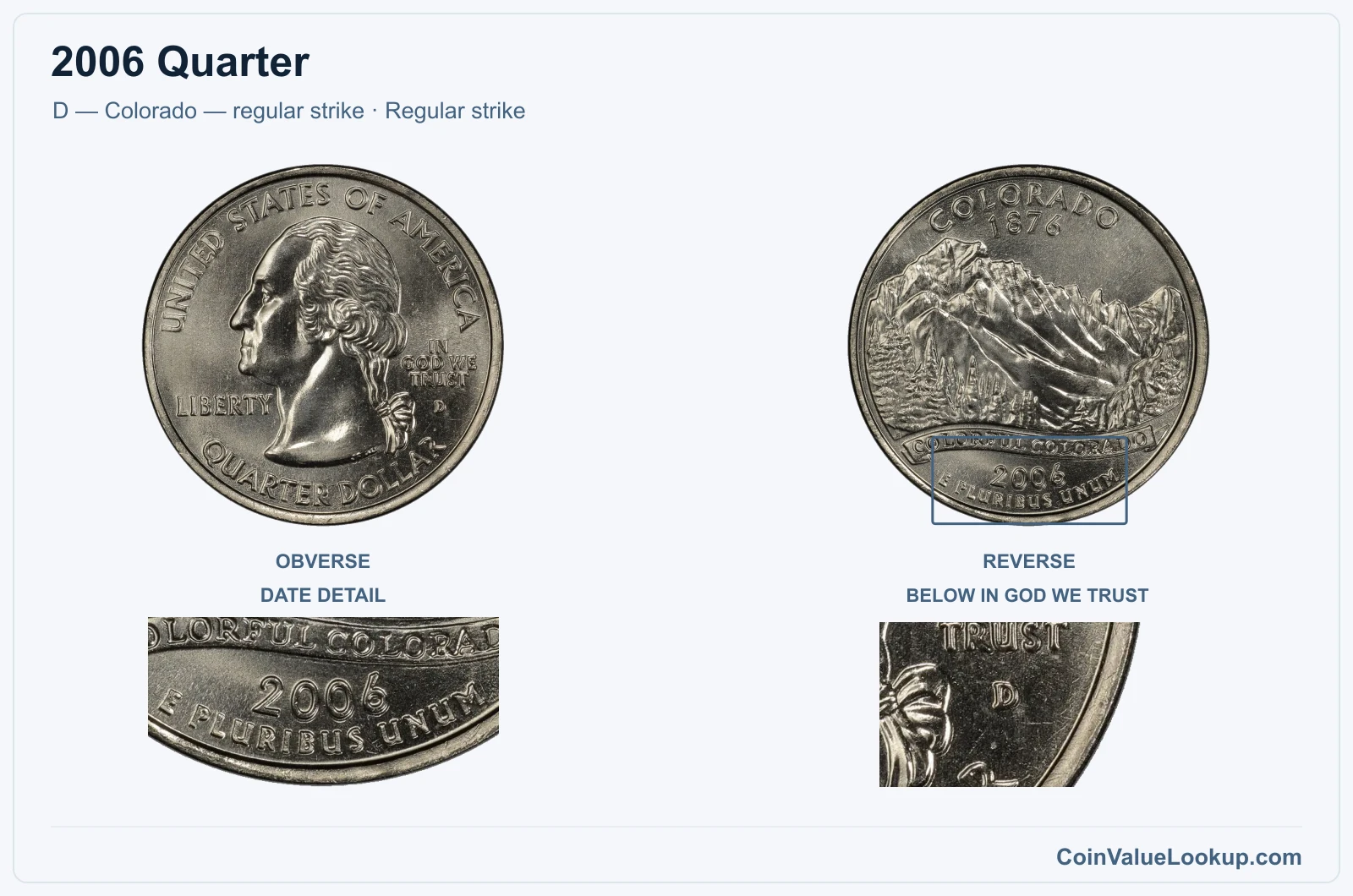
Denver's Colorado quarter is a common circulating issue. Copper-nickel clad, D mintmark, standard quarter dimensions.
USA Coin Book guide estimates are about $0.49 at MS60 and $2.50 at MS65. In pocket change, these are just quarters.
From original rolls or mint-sealed bags, you might find examples clean enough to grade into the mid-60s.
Range Grade
Price Auction Records Appraisal PO PO 1
—
Coin Identifier FR FR 2
—
Coin Identifier AG AG 3
—
Coin Identifier G G 4
—
Coin Identifier
G 6
—
Coin Identifier VG VG 8
—
Coin Identifier
VG 10
—
Coin Identifier F F 12
—
Coin Identifier
F 15
—
Coin Identifier VF VF 20
—
Coin Identifier
VF 25
—
Coin Identifier
VF 30
—
Coin Identifier
VF 35
—
Coin Identifier XF XF 40
—
Coin Identifier
XF 45
—
Coin Identifier AU AU 50
—
Coin Identifier
AU 53
—
Coin Identifier
AU 55
—
Coin Identifier
AU 58
—
Coin Identifier MS MS 60
—
Coin Identifier
MS 61
—
Coin Identifier
MS 62
—
Coin Identifier
MS 63
—
Coin Identifier
MS 64
—
Coin Identifier
MS 65
—
Coin Identifier
MS 66
Coin Identifier
MS 67
Coin Identifier
MS 68
Coin Identifier
MS 69
—
—
—
MS 70
—
—
—
2006 Quarter — D — Colorado — satin finish
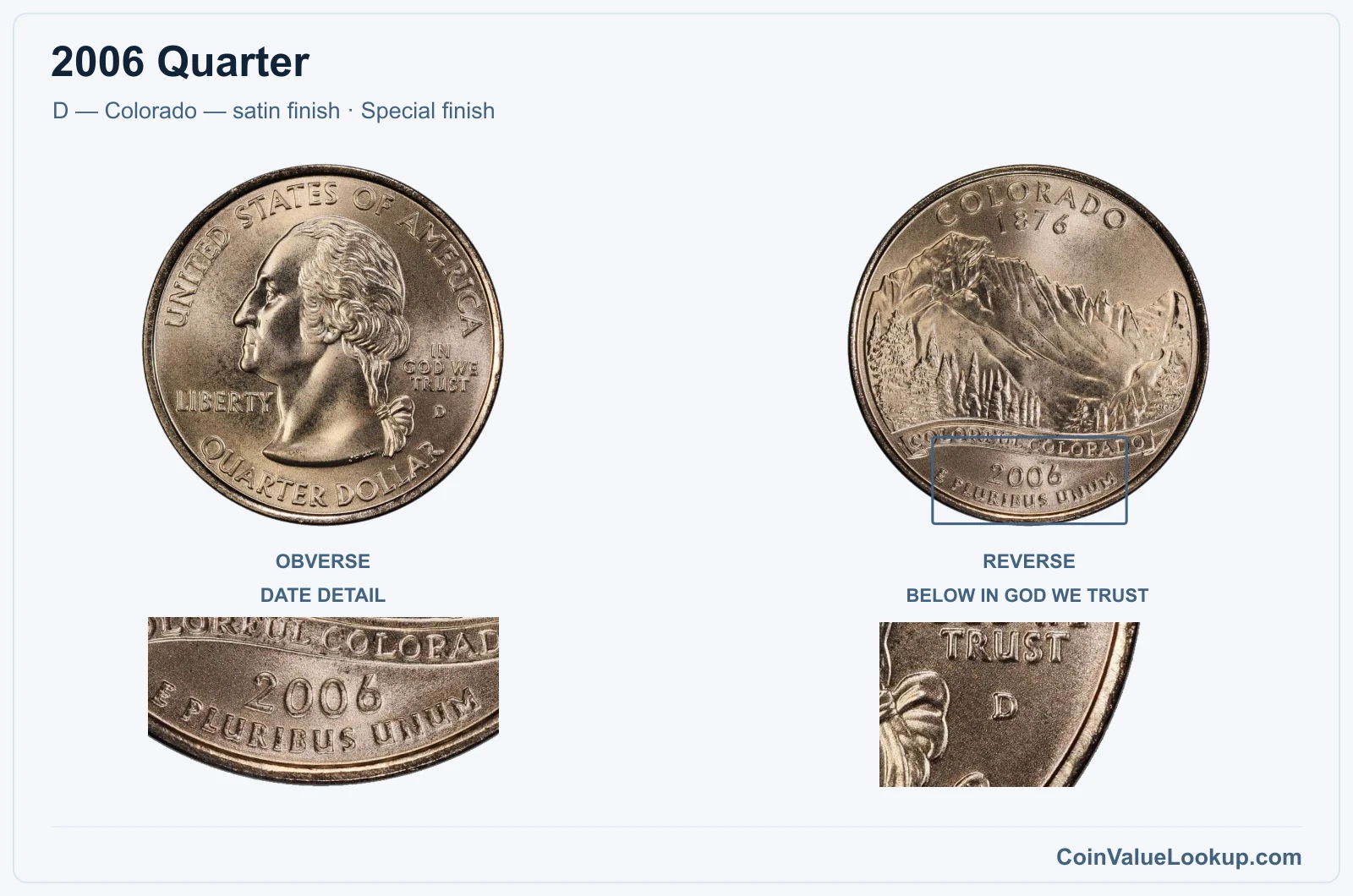
The D-mint Colorado satin finish was part of the 2006 uncirculated mint set. It shares the characteristic fine-grain texture of all that year's satin coins.
No guide price is adopted for this finish. Value depends on authentication and condition.
A coin that merely looks matte or dull from environmental exposure is not a satin finish — the texture is specific and repeatable across all mint-set coins of the same year.
Range Grade
Price Auction Records Appraisal SP SP 1
—
Coin Identifier
SP 2
—
Coin Identifier
SP 3
—
Coin Identifier
SP 4
—
Coin Identifier
SP 6
—
Coin Identifier
SP 8
—
Coin Identifier
SP 10
—
Coin Identifier
SP 12
—
Coin Identifier
SP 15
—
Coin Identifier
SP 20
—
Coin Identifier
SP 25
—
Coin Identifier
SP 30
—
Coin Identifier
SP 35
—
Coin Identifier
SP 40
—
Coin Identifier
SP 45
—
Coin Identifier
SP 50
—
Coin Identifier
SP 53
—
Coin Identifier
SP 55
—
Coin Identifier
SP 58
—
Coin Identifier
SP 60
—
Coin Identifier
SP 61
—
Coin Identifier
SP 62
—
Coin Identifier
SP 63
—
Coin Identifier
SP 64
—
Coin Identifier
SP 65
—
Coin Identifier
SP 66
—
Coin Identifier
SP 67
—
Coin Identifier
SP 68
Coin Identifier
SP 69
Coin Identifier
SP 70
—
—
—
2006 Quarter — S — Colorado — clad proof
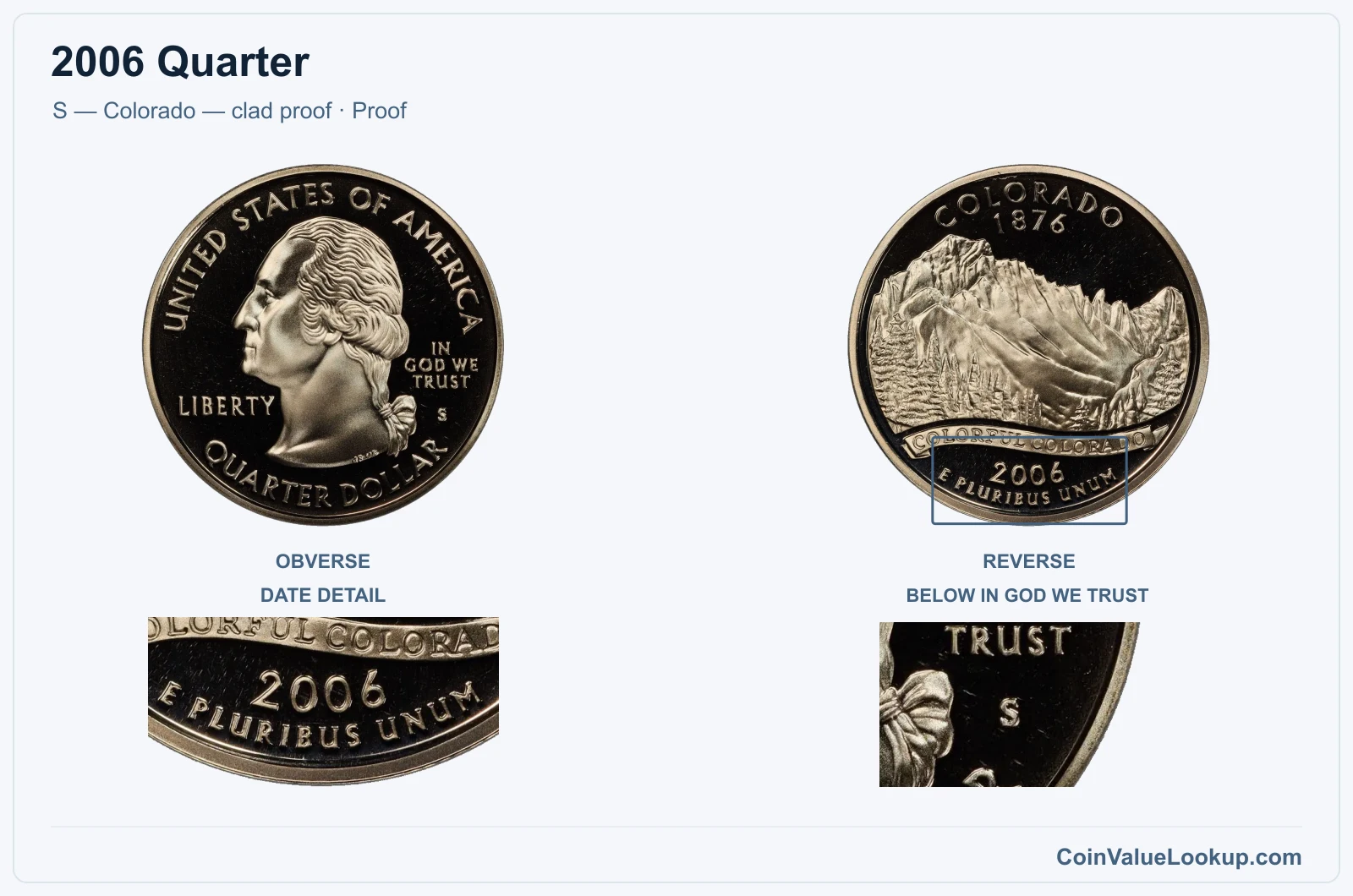
San Francisco's clad proof Colorado quarter features the mirrored fields and frosted devices you expect from a proof. Composition is copper-nickel clad, same alloy as the business strikes.
USA Coin Book estimates PR65 at about $5.63. This is the lower-value proof — do not apply the silver proof price without checking the edge and weight first.
Haze and hairlines in the fields are common on proofs removed from cases.
Range Grade
Price Auction Records Appraisal PR PR 1
—
Coin Identifier
PR 2
—
Coin Identifier
PR 3
—
Coin Identifier
PR 4
—
Coin Identifier
PR 6
—
Coin Identifier
PR 8
—
Coin Identifier
PR 10
—
Coin Identifier
PR 12
—
Coin Identifier
PR 15
—
Coin Identifier
PR 20
—
Coin Identifier
PR 25
—
Coin Identifier
PR 30
—
Coin Identifier
PR 35
—
Coin Identifier
PR 40
—
Coin Identifier
PR 45
—
Coin Identifier
PR 50
—
Coin Identifier
PR 53
—
Coin Identifier
PR 55
—
Coin Identifier
PR 58
—
Coin Identifier
PR 60
—
Coin Identifier
PR 61
—
Coin Identifier
PR 62
—
Coin Identifier
PR 63
—
Coin Identifier
PR 64
—
Coin Identifier
PR 65
—
Coin Identifier
PR 66
—
Coin Identifier
PR 67
—
Coin Identifier
PR 68
—
Coin Identifier
PR 69
Coin Identifier
PR 70
Coin Identifier
2006 Quarter — S — Colorado — silver proof
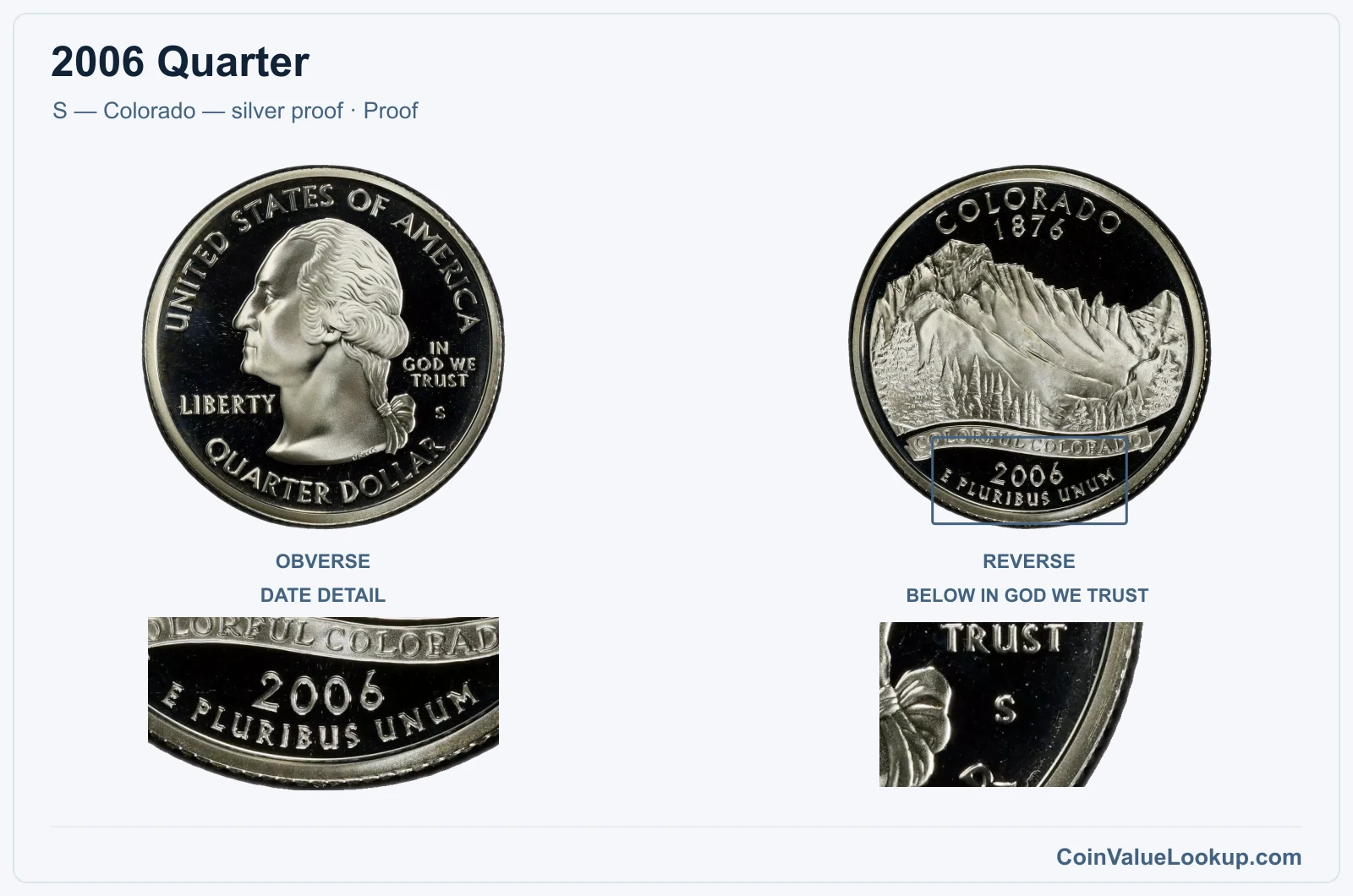
The silver proof Colorado quarter is 90% silver, weighing about 6.25 grams. A uniform silver-gray edge confirms it.
These came in silver proof sets sold directly by the Mint.
At PR65, USA Coin Book estimates about $23.00. The silver content alone accounts for a substantial part of the value, and proof-quality surfaces add the rest.
Keep clad and silver values strictly separated when comparing.
Range Grade
Price Auction Records Appraisal PR PR 1
—
Coin Identifier
PR 2
—
Coin Identifier
PR 3
—
Coin Identifier
PR 4
—
Coin Identifier
PR 6
—
Coin Identifier
PR 8
—
Coin Identifier
PR 10
—
Coin Identifier
PR 12
—
Coin Identifier
PR 15
—
Coin Identifier
PR 20
—
Coin Identifier
PR 25
—
Coin Identifier
PR 30
—
Coin Identifier
PR 35
—
Coin Identifier
PR 40
—
Coin Identifier
PR 45
—
Coin Identifier
PR 50
—
Coin Identifier
PR 53
—
Coin Identifier
PR 55
—
Coin Identifier
PR 58
—
Coin Identifier
PR 60
—
Coin Identifier
PR 61
—
Coin Identifier
PR 62
—
Coin Identifier
PR 63
—
Coin Identifier
PR 64
—
Coin Identifier
PR 65
—
Coin Identifier
PR 66
—
Coin Identifier
PR 67
—
Coin Identifier
PR 68
—
Coin Identifier
PR 69
Coin Identifier
PR 70
Coin Identifier
2006 Quarter — P — North Dakota — regular strike
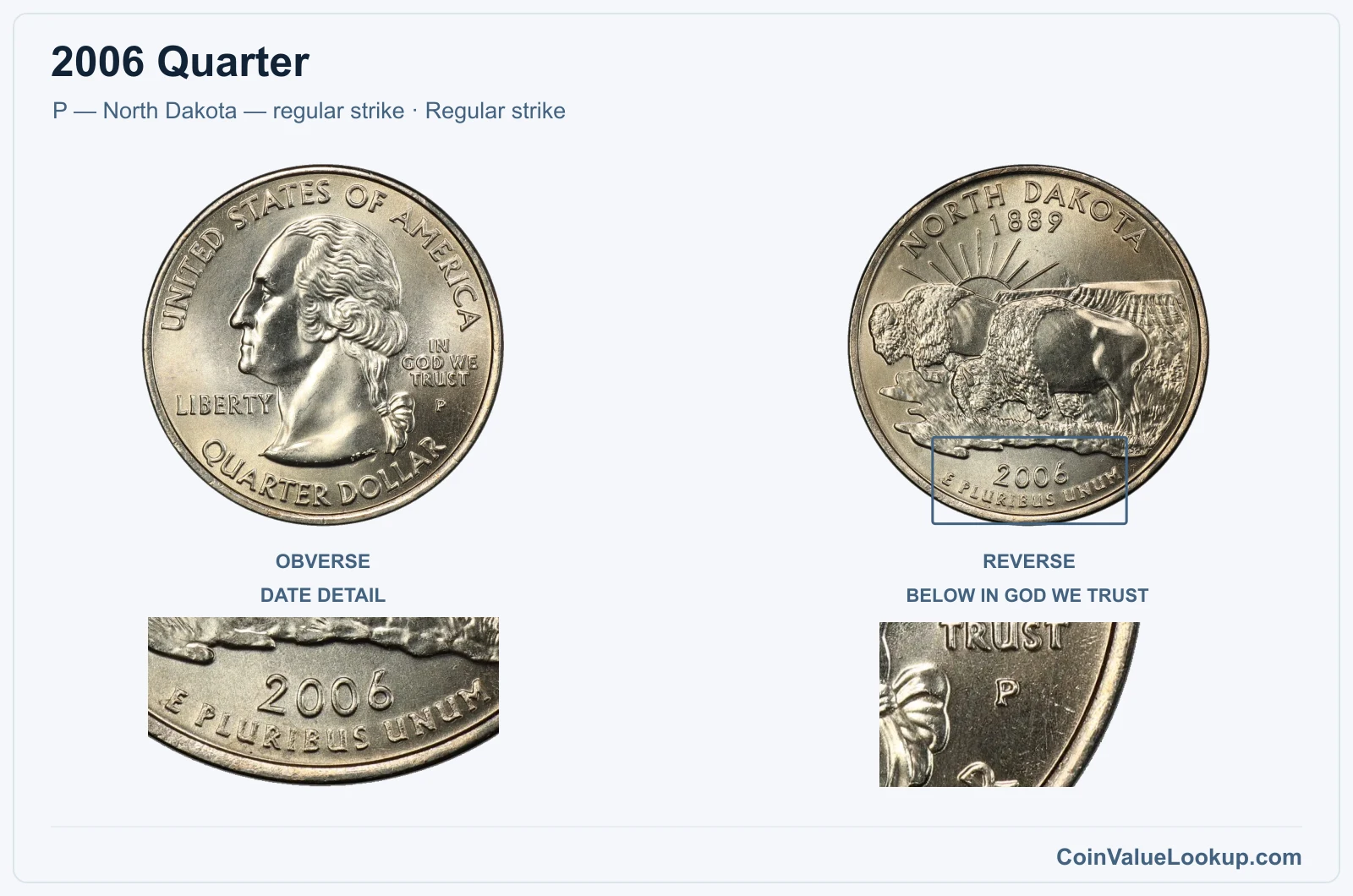
The P-mint North Dakota quarter is a copper-nickel clad business strike. The reverse shows the North Dakota design.
Confirm the P mintmark near Washington's portrait before comparing prices.
Circulated pieces are face value. USA Coin Book estimates about $0.49 at MS60 and $2.50 at MS65.
As with the other 2006 designs, original luster and minimal contact marks separate a collectible coin from pocket change.
Range Grade
Price Auction Records Appraisal PO PO 1
—
Coin Identifier FR FR 2
—
Coin Identifier AG AG 3
—
Coin Identifier G G 4
—
Coin Identifier
G 6
—
Coin Identifier VG VG 8
—
Coin Identifier
VG 10
—
Coin Identifier F F 12
—
Coin Identifier
F 15
—
Coin Identifier VF VF 20
—
Coin Identifier
VF 25
—
Coin Identifier
VF 30
—
Coin Identifier
VF 35
—
Coin Identifier XF XF 40
—
Coin Identifier
XF 45
—
Coin Identifier AU AU 50
—
Coin Identifier
AU 53
—
Coin Identifier
AU 55
—
Coin Identifier
AU 58
—
Coin Identifier MS MS 60
—
Coin Identifier
MS 61
—
Coin Identifier
MS 62
—
Coin Identifier
MS 63
—
Coin Identifier
MS 64
—
Coin Identifier
MS 65
—
Coin Identifier
MS 66
Coin Identifier
MS 67
Coin Identifier
MS 68
—
Coin Identifier
MS 69
—
—
—
MS 70
—
—
—
2006 Quarter — P — North Dakota — satin finish
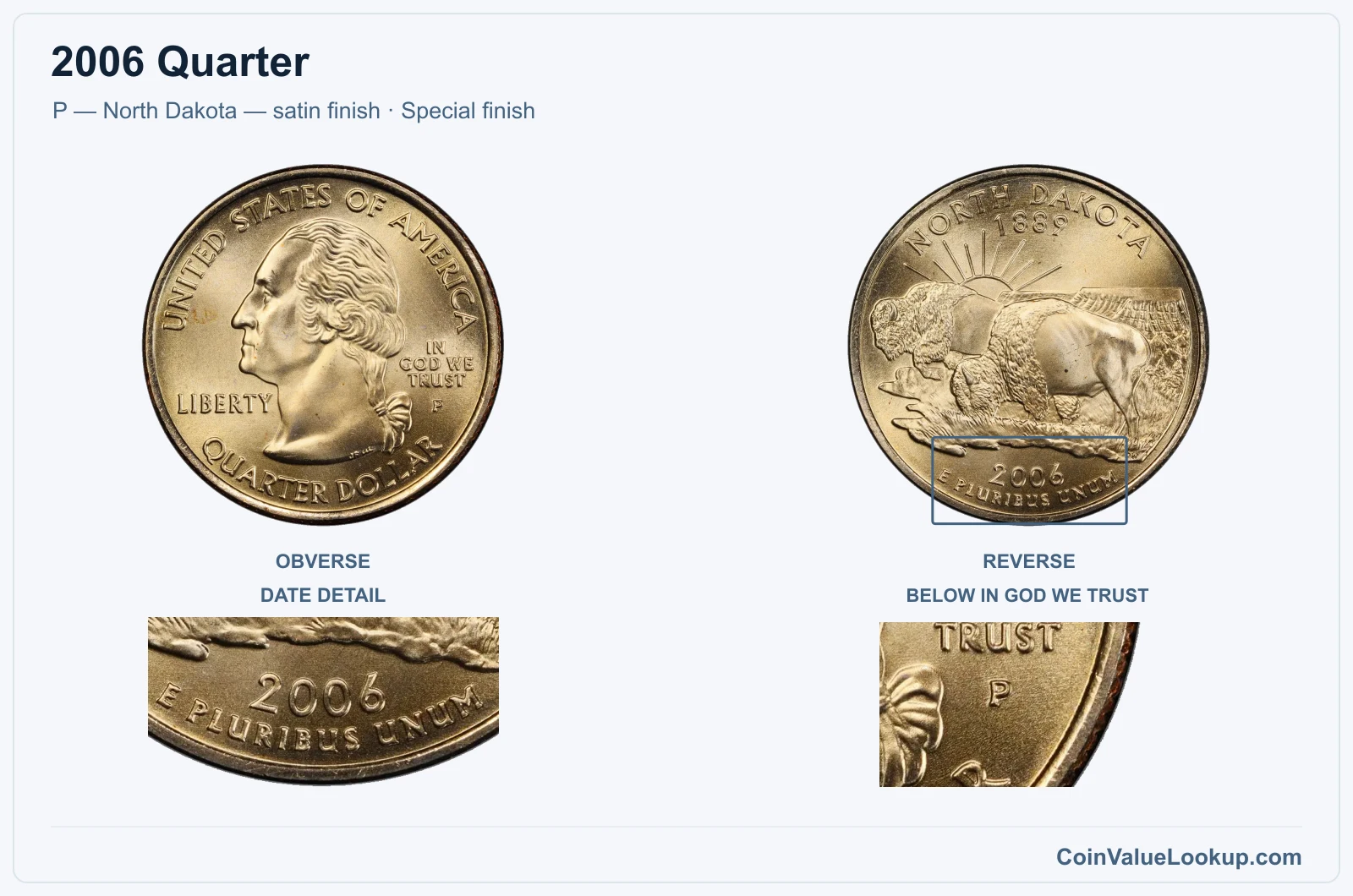
Philadelphia's North Dakota satin finish was packaged in 2006 uncirculated mint sets. The surface texture is deliberately different from a business strike — uniform and slightly soft in appearance.
No standard guide price is adopted for satin-finish quarters. Value requires confirmation of the finish through authentication and depends on the coin's individual condition.
A dull, worn coin is not a satin specimen.
Range Grade
Price Auction Records Appraisal SP SP 1
—
Coin Identifier
SP 2
—
Coin Identifier
SP 3
—
Coin Identifier
SP 4
—
Coin Identifier
SP 6
—
Coin Identifier
SP 8
—
Coin Identifier
SP 10
—
Coin Identifier
SP 12
—
Coin Identifier
SP 15
—
Coin Identifier
SP 20
—
Coin Identifier
SP 25
—
Coin Identifier
SP 30
—
Coin Identifier
SP 35
—
Coin Identifier
SP 40
—
Coin Identifier
SP 45
—
Coin Identifier
SP 50
—
Coin Identifier
SP 53
—
Coin Identifier
SP 55
—
Coin Identifier
SP 58
—
Coin Identifier
SP 60
—
Coin Identifier
SP 61
—
Coin Identifier
SP 62
—
Coin Identifier
SP 63
—
Coin Identifier
SP 64
—
Coin Identifier
SP 65
—
Coin Identifier
SP 66
—
Coin Identifier
SP 67
Coin Identifier
SP 68
Coin Identifier
SP 69
Coin Identifier
SP 70
—
—
—
2006 Quarter — D — North Dakota — regular strike
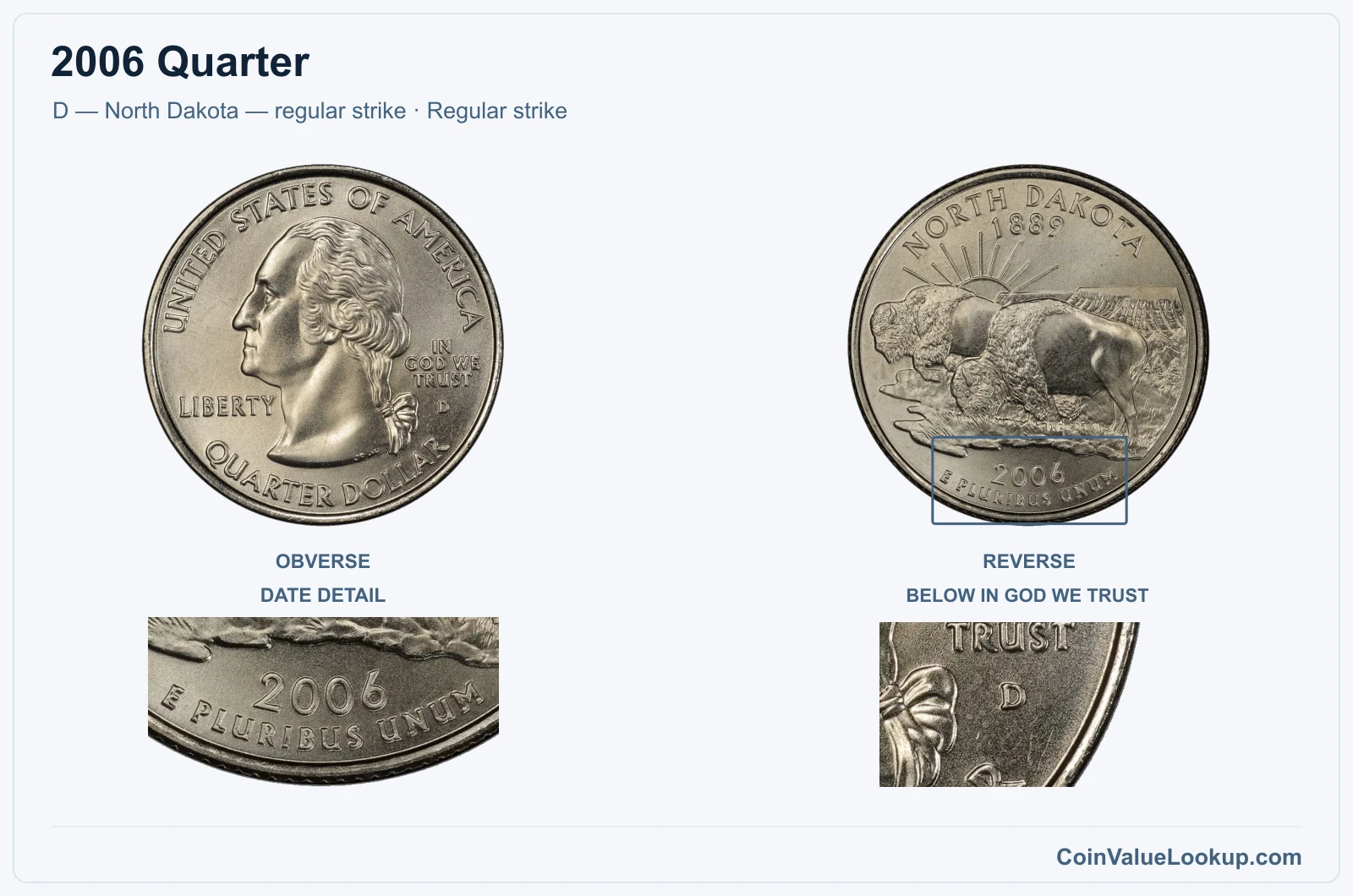
Denver struck North Dakota quarters for circulation in copper-nickel clad. D mintmark, standard 24.26 mm diameter and 5.67-gram weight.
USA Coin Book places an MS60 at about $0.49 and MS65 at $2.50. These are guide estimates and not offers to buy.
Most circulated examples are worth face value.
Range Grade
Price Auction Records Appraisal PO PO 1
—
Coin Identifier FR FR 2
—
Coin Identifier AG AG 3
—
Coin Identifier G G 4
—
Coin Identifier
G 6
—
Coin Identifier VG VG 8
—
Coin Identifier
VG 10
—
Coin Identifier F F 12
—
Coin Identifier
F 15
—
Coin Identifier VF VF 20
—
Coin Identifier
VF 25
—
Coin Identifier
VF 30
—
Coin Identifier
VF 35
—
Coin Identifier XF XF 40
—
Coin Identifier
XF 45
—
Coin Identifier AU AU 50
—
Coin Identifier
AU 53
—
Coin Identifier
AU 55
—
Coin Identifier
AU 58
—
Coin Identifier MS MS 60
—
Coin Identifier
MS 61
—
Coin Identifier
MS 62
—
Coin Identifier
MS 63
—
Coin Identifier
MS 64
—
Coin Identifier
MS 65
—
Coin Identifier
MS 66
—
Coin Identifier
MS 67
Coin Identifier
MS 68
Coin Identifier
MS 69
—
—
—
MS 70
—
—
—
2006 Quarter — D — North Dakota — satin finish
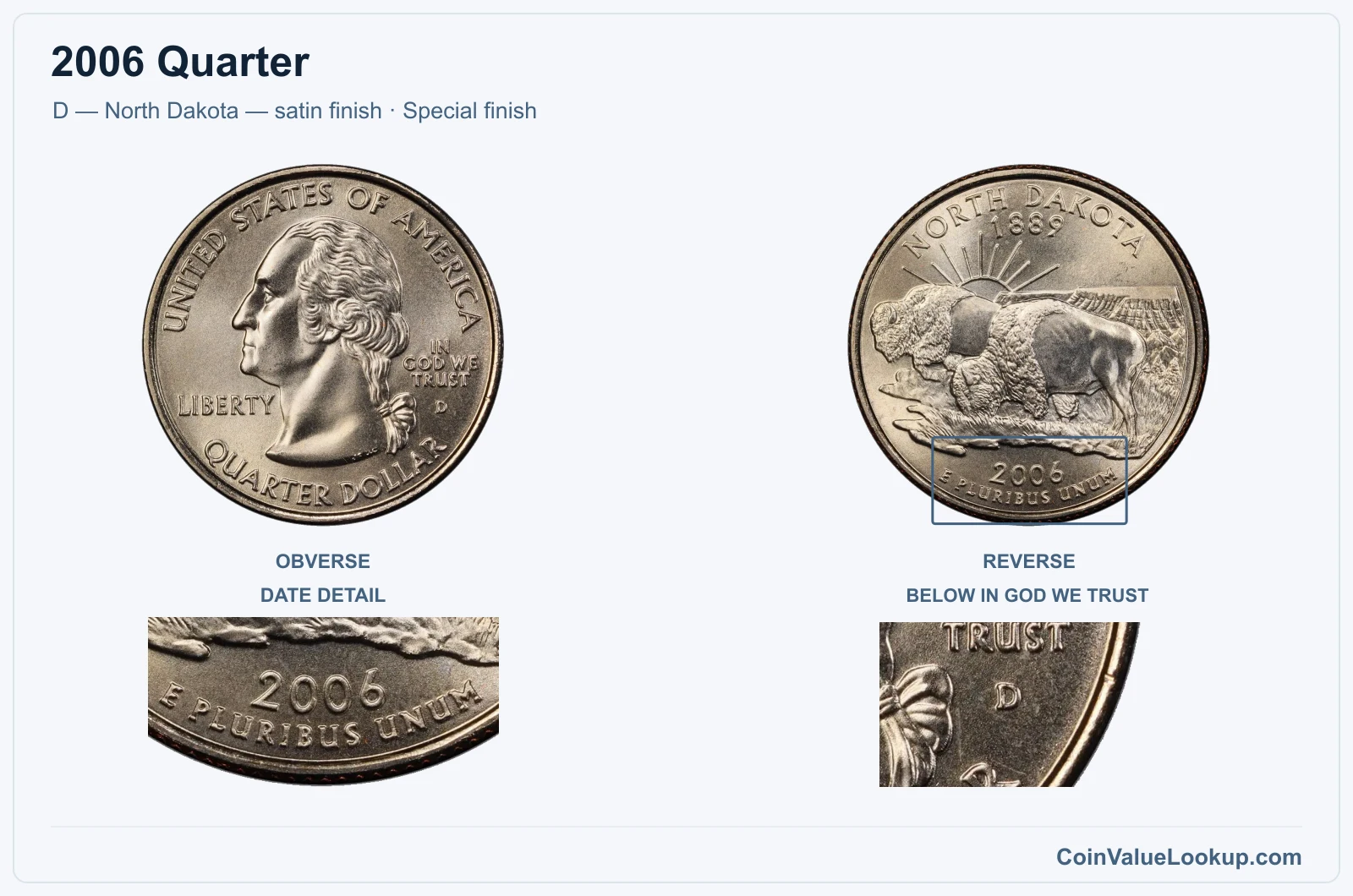
The D-mint North Dakota satin finish came through the 2006 uncirculated mint set program. It has the same even, fine-grained surface as other satin coins from that year.
With no adopted guide price, this version requires individual assessment based on authenticated finish and condition. Do not assume a coin is satin finish just because it looks different from your other quarters — the texture is specific and deliberate.
Range Grade
Price Auction Records Appraisal SP SP 1
—
Coin Identifier
SP 2
—
Coin Identifier
SP 3
—
Coin Identifier
SP 4
—
Coin Identifier
SP 6
—
Coin Identifier
SP 8
—
Coin Identifier
SP 10
—
Coin Identifier
SP 12
—
Coin Identifier
SP 15
—
Coin Identifier
SP 20
—
Coin Identifier
SP 25
—
Coin Identifier
SP 30
—
Coin Identifier
SP 35
—
Coin Identifier
SP 40
—
Coin Identifier
SP 45
—
Coin Identifier
SP 50
—
Coin Identifier
SP 53
—
Coin Identifier
SP 55
—
Coin Identifier
SP 58
—
Coin Identifier
SP 60
—
Coin Identifier
SP 61
—
Coin Identifier
SP 62
—
Coin Identifier
SP 63
—
Coin Identifier
SP 64
—
Coin Identifier
SP 65
—
Coin Identifier
SP 66
—
Coin Identifier
SP 67
—
Coin Identifier
SP 68
Coin Identifier
SP 69
Coin Identifier
SP 70
—
—
—
2006 Quarter — S — North Dakota — clad proof
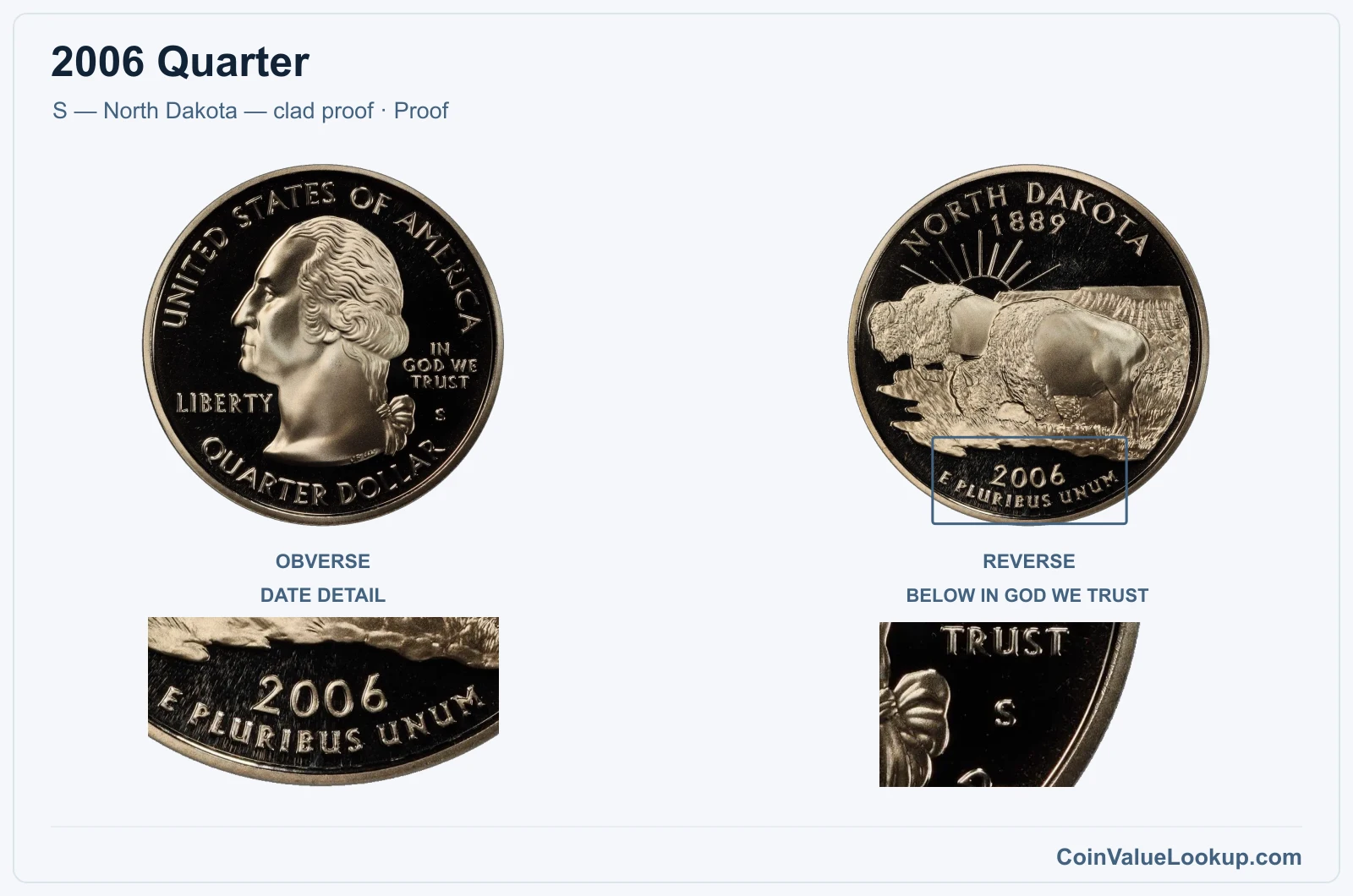
San Francisco's clad proof North Dakota quarter was sold in standard proof sets. Mirror fields, frosted devices, copper-nickel clad composition.
Check that edge for the copper stripe.
USA Coin Book estimates PR65 at about $5.63. Proofs that have been well stored in original packaging tend to retain their surfaces best.
Handling with bare fingers is the fastest way to ruin a proof's fields.
Range Grade
Price Auction Records Appraisal PR PR 1
—
Coin Identifier
PR 2
—
Coin Identifier
PR 3
—
Coin Identifier
PR 4
—
Coin Identifier
PR 6
—
Coin Identifier
PR 8
—
Coin Identifier
PR 10
—
Coin Identifier
PR 12
—
Coin Identifier
PR 15
—
Coin Identifier
PR 20
—
Coin Identifier
PR 25
—
Coin Identifier
PR 30
—
Coin Identifier
PR 35
—
Coin Identifier
PR 40
—
Coin Identifier
PR 45
—
Coin Identifier
PR 50
—
Coin Identifier
PR 53
—
Coin Identifier
PR 55
—
Coin Identifier
PR 58
—
Coin Identifier
PR 60
—
Coin Identifier
PR 61
—
Coin Identifier
PR 62
—
Coin Identifier
PR 63
—
Coin Identifier
PR 64
—
Coin Identifier
PR 65
—
Coin Identifier
PR 66
—
Coin Identifier
PR 67
—
Coin Identifier
PR 68
—
Coin Identifier
PR 69
Coin Identifier
PR 70
Coin Identifier
2006 Quarter — S — North Dakota — silver proof
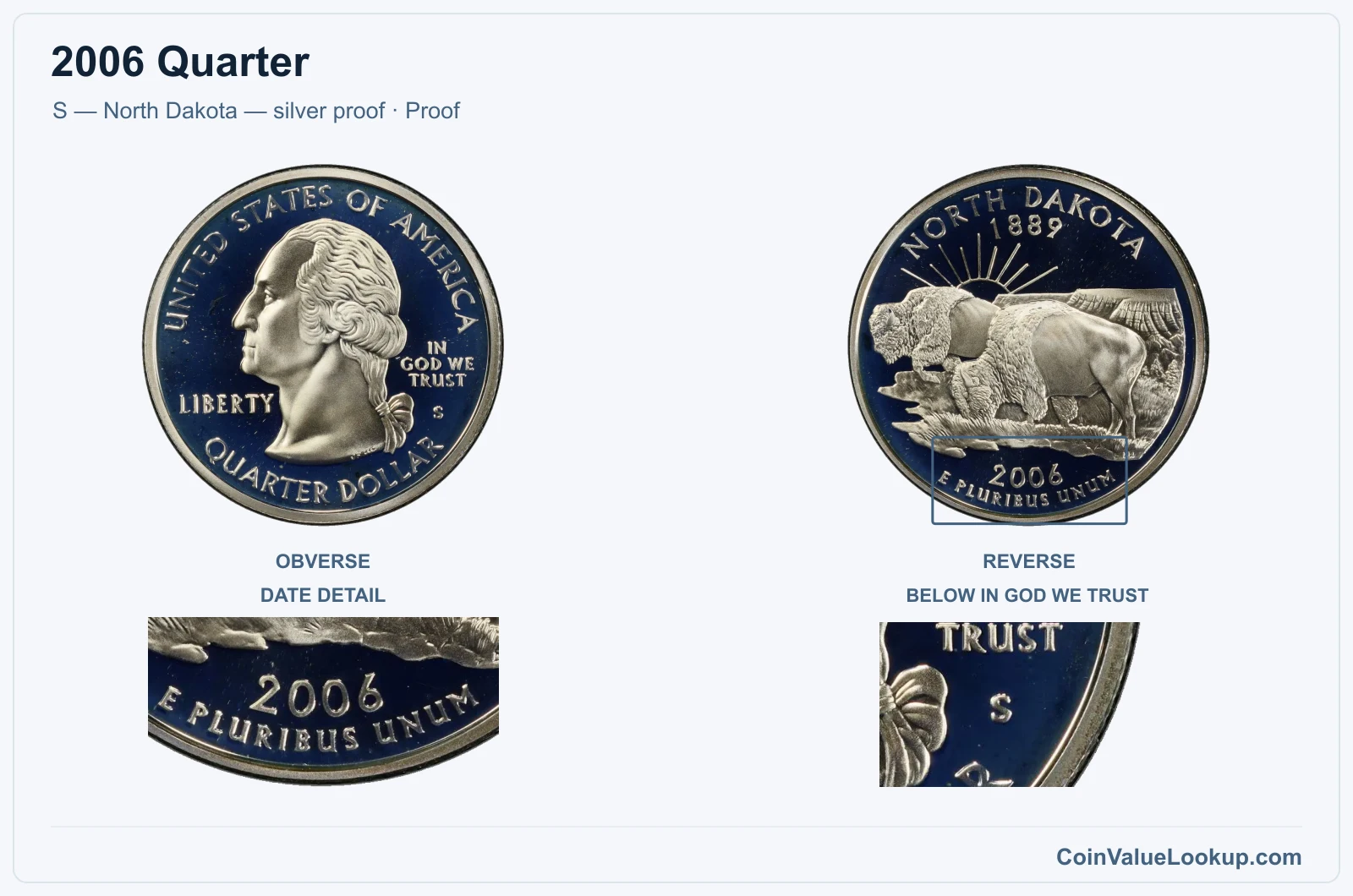
The silver proof North Dakota quarter is 90% silver and weighs approximately 6.25 grams. Its edge is uniformly silver-gray, a quick visual test against the clad version.
USA Coin Book estimates about $23.00 at PR65. This ties with the other 2006 silver proofs for the highest guide anchor in the series this year.
Confirm silver content before celebrating.
Range Grade
Price Auction Records Appraisal PR PR 1
—
Coin Identifier
PR 2
—
Coin Identifier
PR 3
—
Coin Identifier
PR 4
—
Coin Identifier
PR 6
—
Coin Identifier
PR 8
—
Coin Identifier
PR 10
—
Coin Identifier
PR 12
—
Coin Identifier
PR 15
—
Coin Identifier
PR 20
—
Coin Identifier
PR 25
—
Coin Identifier
PR 30
—
Coin Identifier
PR 35
—
Coin Identifier
PR 40
—
Coin Identifier
PR 45
—
Coin Identifier
PR 50
—
Coin Identifier
PR 53
—
Coin Identifier
PR 55
—
Coin Identifier
PR 58
—
Coin Identifier
PR 60
—
Coin Identifier
PR 61
—
Coin Identifier
PR 62
—
Coin Identifier
PR 63
—
Coin Identifier
PR 64
—
Coin Identifier
PR 65
—
Coin Identifier
PR 66
—
Coin Identifier
PR 67
—
Coin Identifier
PR 68
—
Coin Identifier
PR 69
Coin Identifier
PR 70
Coin Identifier
2006 Quarter — P — South Dakota — regular strike
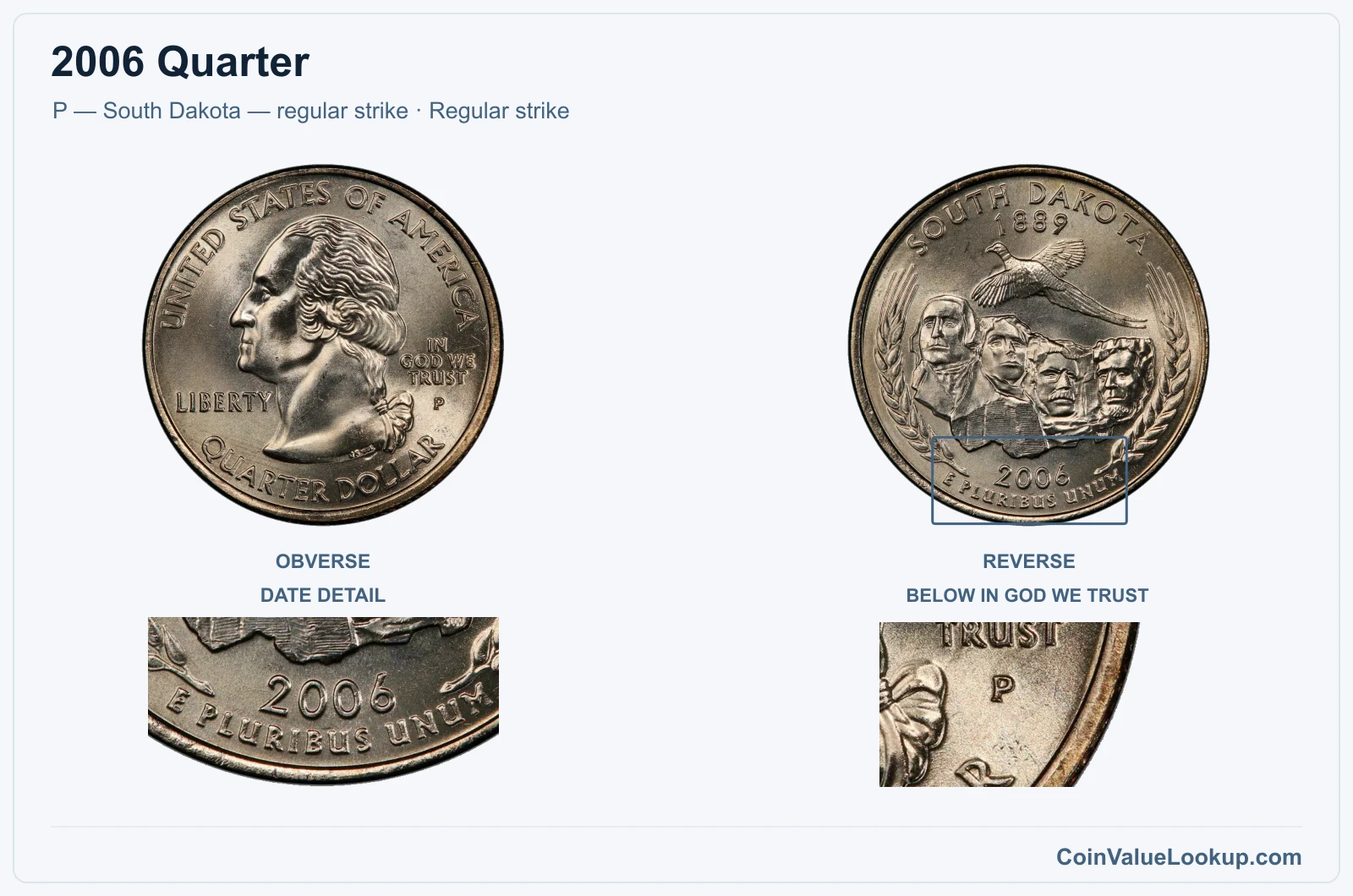
Philadelphia's South Dakota quarter is a copper-nickel clad business strike. The South Dakota reverse is distinct from the other four 2006 state designs, so confirm which one you have.
Worn examples trade at face value. USA Coin Book estimates about $0.49 at MS60 and $2.50 at MS65.
As always, those are retail guide estimates, not guaranteed sale prices.
Range Grade
Price Auction Records Appraisal PO PO 1
—
Coin Identifier FR FR 2
—
Coin Identifier AG AG 3
—
Coin Identifier G G 4
—
Coin Identifier
G 6
—
Coin Identifier VG VG 8
—
Coin Identifier
VG 10
—
Coin Identifier F F 12
—
Coin Identifier
F 15
—
Coin Identifier VF VF 20
—
Coin Identifier
VF 25
—
Coin Identifier
VF 30
—
Coin Identifier
VF 35
—
Coin Identifier XF XF 40
—
Coin Identifier
XF 45
—
Coin Identifier AU AU 50
—
Coin Identifier
AU 53
—
Coin Identifier
AU 55
—
Coin Identifier
AU 58
—
Coin Identifier MS MS 60
—
Coin Identifier
MS 61
—
Coin Identifier
MS 62
—
Coin Identifier
MS 63
—
Coin Identifier
MS 64
—
Coin Identifier
MS 65
—
Coin Identifier
MS 66
—
Coin Identifier
MS 67
Coin Identifier
MS 68
Coin Identifier
MS 69
—
—
—
MS 70
—
—
—
2006 Quarter — P — South Dakota — satin finish
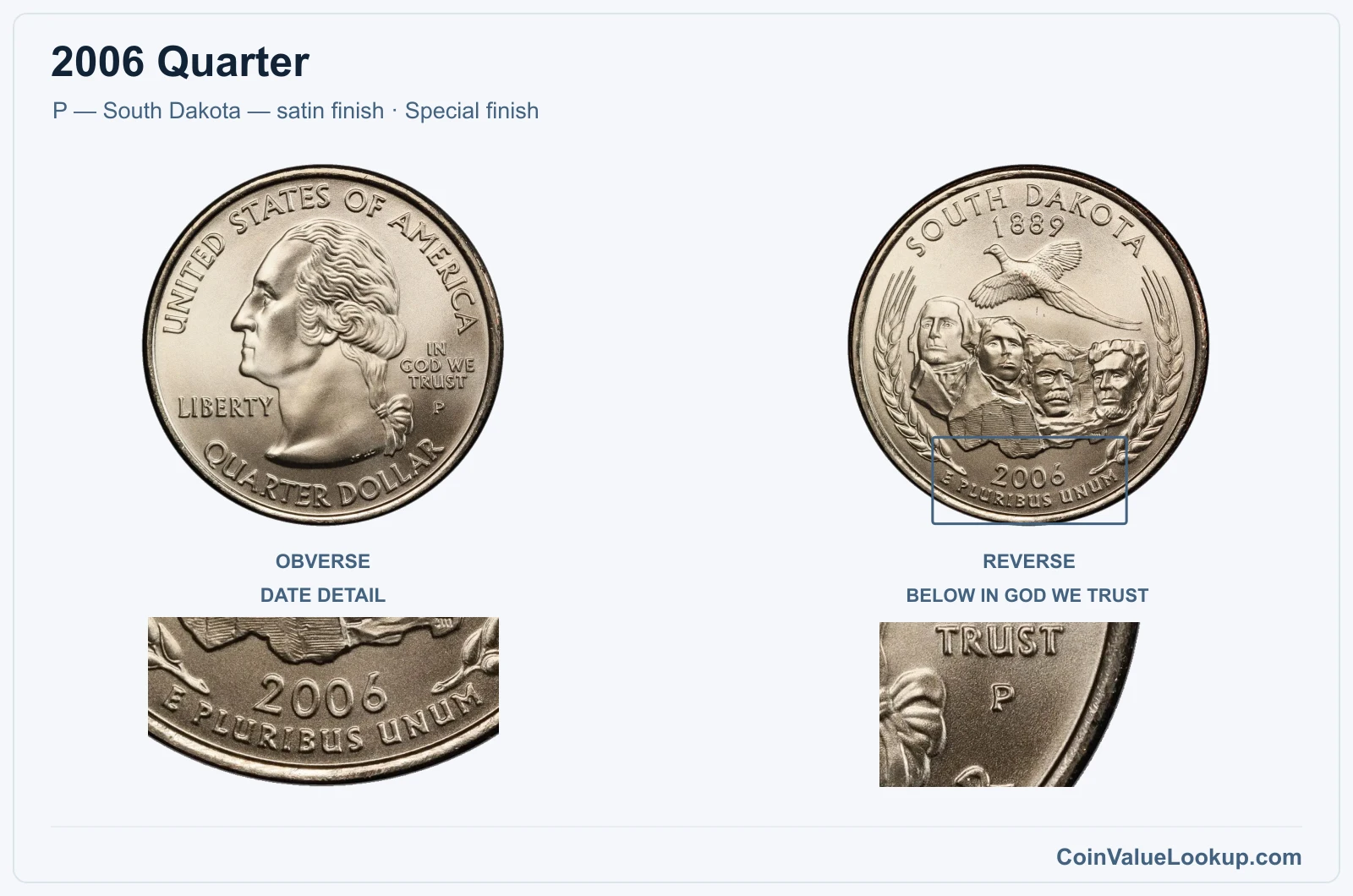
The P-mint South Dakota satin finish was part of the 2006 uncirculated mint set. The surface texture is deliberately uniform and slightly muted compared to a business strike.
No guide price is adopted for satin-finish quarters. Authentication and individual condition assessment determine value.
A surface that merely looks flat from wear or cleaning is not the same as a genuine satin finish.
Range Grade
Price Auction Records Appraisal SP SP 1
—
Coin Identifier
SP 2
—
Coin Identifier
SP 3
—
Coin Identifier
SP 4
—
Coin Identifier
SP 6
—
Coin Identifier
SP 8
—
Coin Identifier
SP 10
—
Coin Identifier
SP 12
—
Coin Identifier
SP 15
—
Coin Identifier
SP 20
—
Coin Identifier
SP 25
—
Coin Identifier
SP 30
—
Coin Identifier
SP 35
—
Coin Identifier
SP 40
—
Coin Identifier
SP 45
—
Coin Identifier
SP 50
—
Coin Identifier
SP 53
—
Coin Identifier
SP 55
—
Coin Identifier
SP 58
—
Coin Identifier
SP 60
—
Coin Identifier
SP 61
—
Coin Identifier
SP 62
—
Coin Identifier
SP 63
—
Coin Identifier
SP 64
—
Coin Identifier
SP 65
—
Coin Identifier
SP 66
Coin Identifier
SP 67
—
Coin Identifier
SP 68
Coin Identifier
SP 69
Coin Identifier
SP 70
—
—
—
2006 Quarter — D — South Dakota — regular strike
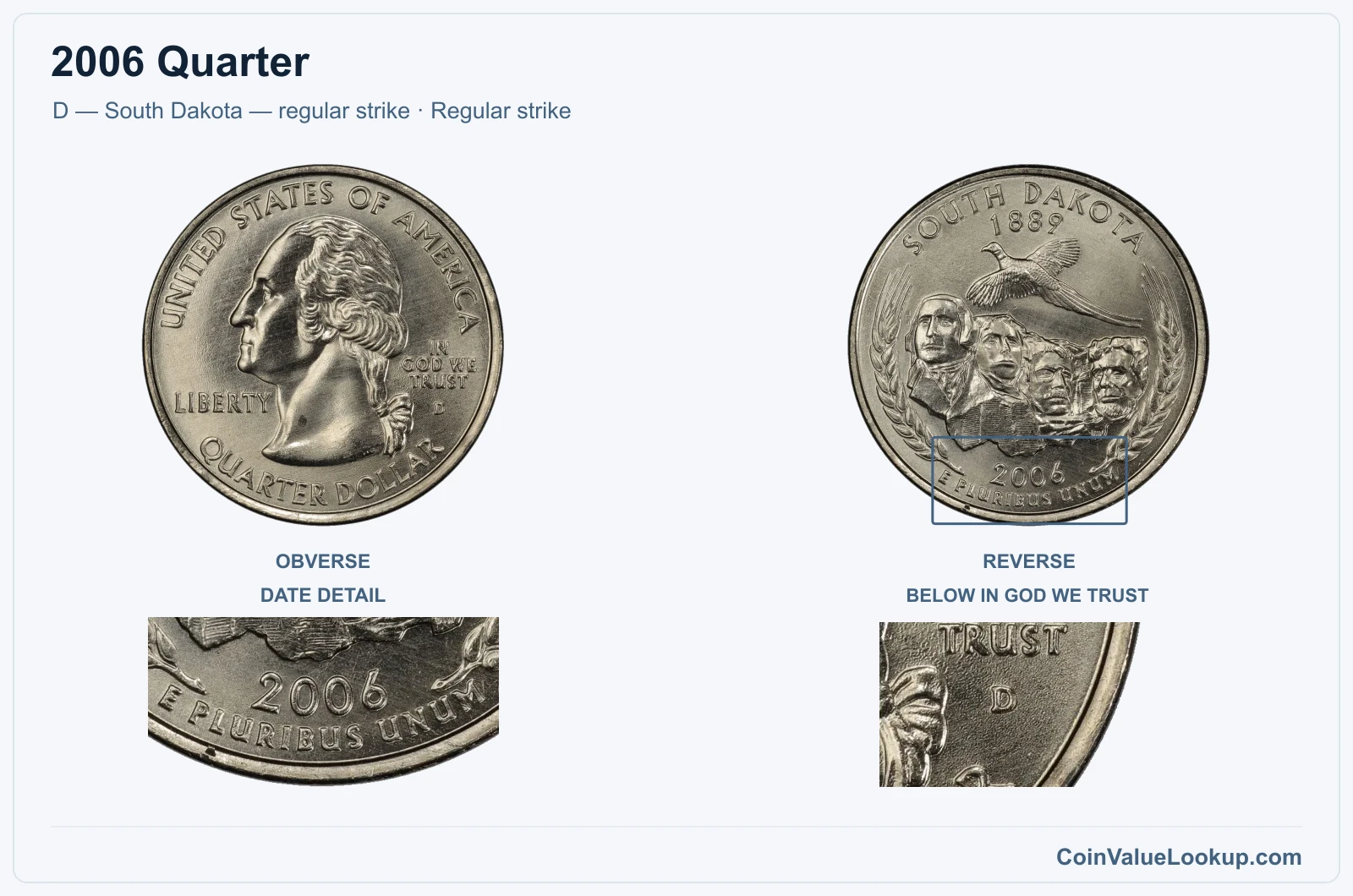
Denver's South Dakota quarter is another common circulating issue. Copper-nickel clad, D mintmark, 5.67 grams, 24.26 mm.
If you found it in a jar of change, it is almost certainly this version.
USA Coin Book guide estimates are about $0.49 at MS60 and $2.50 at MS65. Most pocket-found examples fall well below MS60 and are worth their face value of 25 cents.
Range Grade
Price Auction Records Appraisal PO PO 1
—
Coin Identifier FR FR 2
—
Coin Identifier AG AG 3
—
Coin Identifier G G 4
—
Coin Identifier
G 6
—
Coin Identifier VG VG 8
—
Coin Identifier
VG 10
—
Coin Identifier F F 12
—
Coin Identifier
F 15
—
Coin Identifier VF VF 20
—
Coin Identifier
VF 25
—
Coin Identifier
VF 30
—
Coin Identifier
VF 35
—
Coin Identifier XF XF 40
—
Coin Identifier
XF 45
—
Coin Identifier AU AU 50
—
Coin Identifier
AU 53
—
Coin Identifier
AU 55
—
Coin Identifier
AU 58
—
Coin Identifier MS MS 60
—
Coin Identifier
MS 61
—
Coin Identifier
MS 62
—
Coin Identifier
MS 63
—
Coin Identifier
MS 64
—
Coin Identifier
MS 65
—
Coin Identifier
MS 66
Coin Identifier
MS 67
Coin Identifier
MS 68
Coin Identifier
MS 69
—
—
—
MS 70
—
—
—
2006 Quarter — D — South Dakota — satin finish
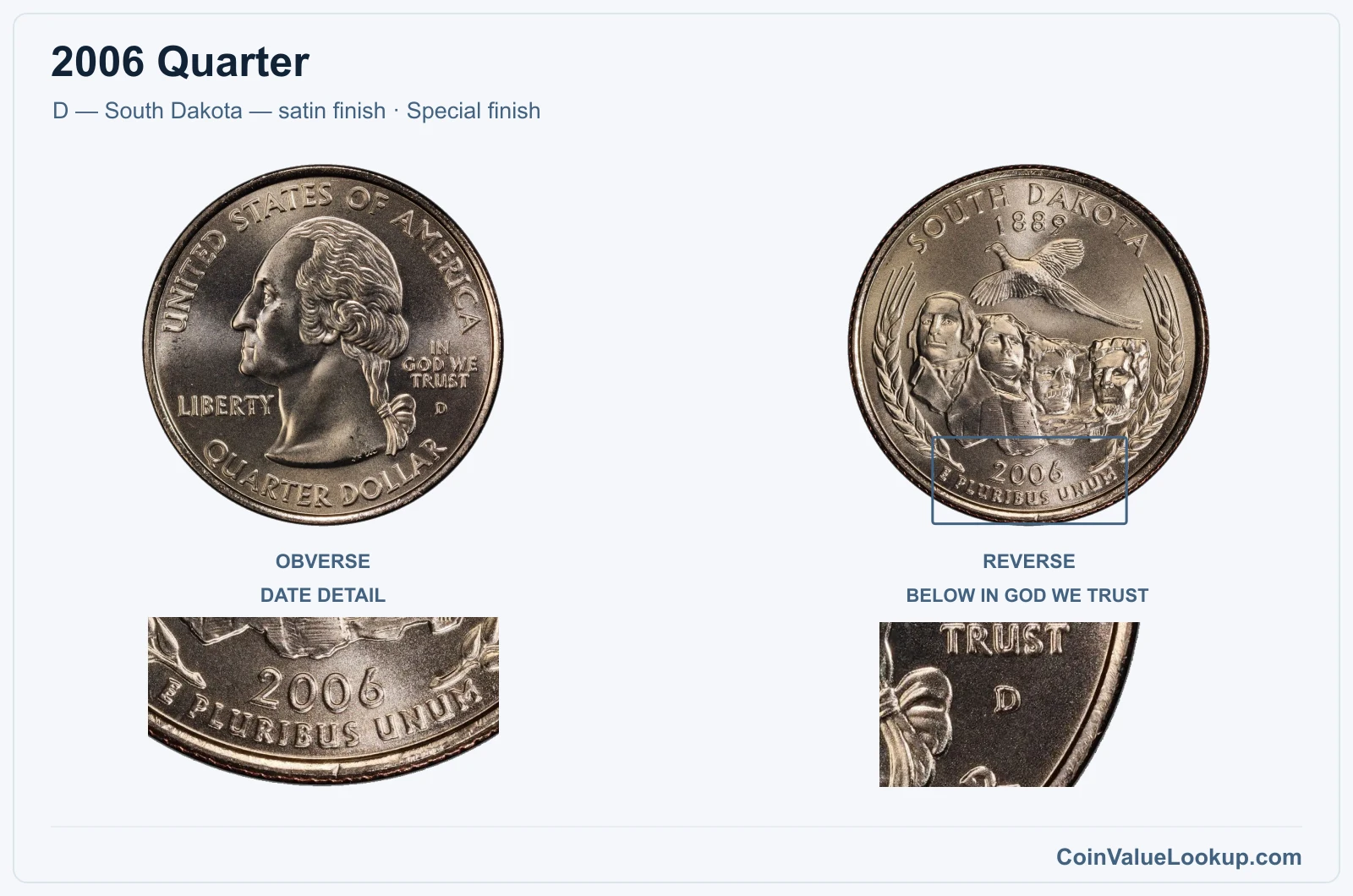
The D-mint South Dakota satin finish came in 2006 mint sets. Same fine-grained texture as the rest of the satin family that year.
No adopted guide price exists for this version. Its value depends on an authenticated finish and the coin's specific condition.
Artificially textured or worn coins should not be confused with genuine satin specimens.
Range Grade
Price Auction Records Appraisal SP SP 1
—
Coin Identifier
SP 2
—
Coin Identifier
SP 3
—
Coin Identifier
SP 4
—
Coin Identifier
SP 6
—
Coin Identifier
SP 8
—
Coin Identifier
SP 10
—
Coin Identifier
SP 12
—
Coin Identifier
SP 15
—
Coin Identifier
SP 20
—
Coin Identifier
SP 25
—
Coin Identifier
SP 30
—
Coin Identifier
SP 35
—
Coin Identifier
SP 40
—
Coin Identifier
SP 45
—
Coin Identifier
SP 50
—
Coin Identifier
SP 53
—
Coin Identifier
SP 55
—
Coin Identifier
SP 58
—
Coin Identifier
SP 60
—
Coin Identifier
SP 61
—
Coin Identifier
SP 62
—
Coin Identifier
SP 63
—
Coin Identifier
SP 64
—
Coin Identifier
SP 65
—
Coin Identifier
SP 66
—
Coin Identifier
SP 67
—
Coin Identifier
SP 68
Coin Identifier
SP 69
Coin Identifier
SP 70
—
—
—
2006 Quarter — S — South Dakota — clad proof
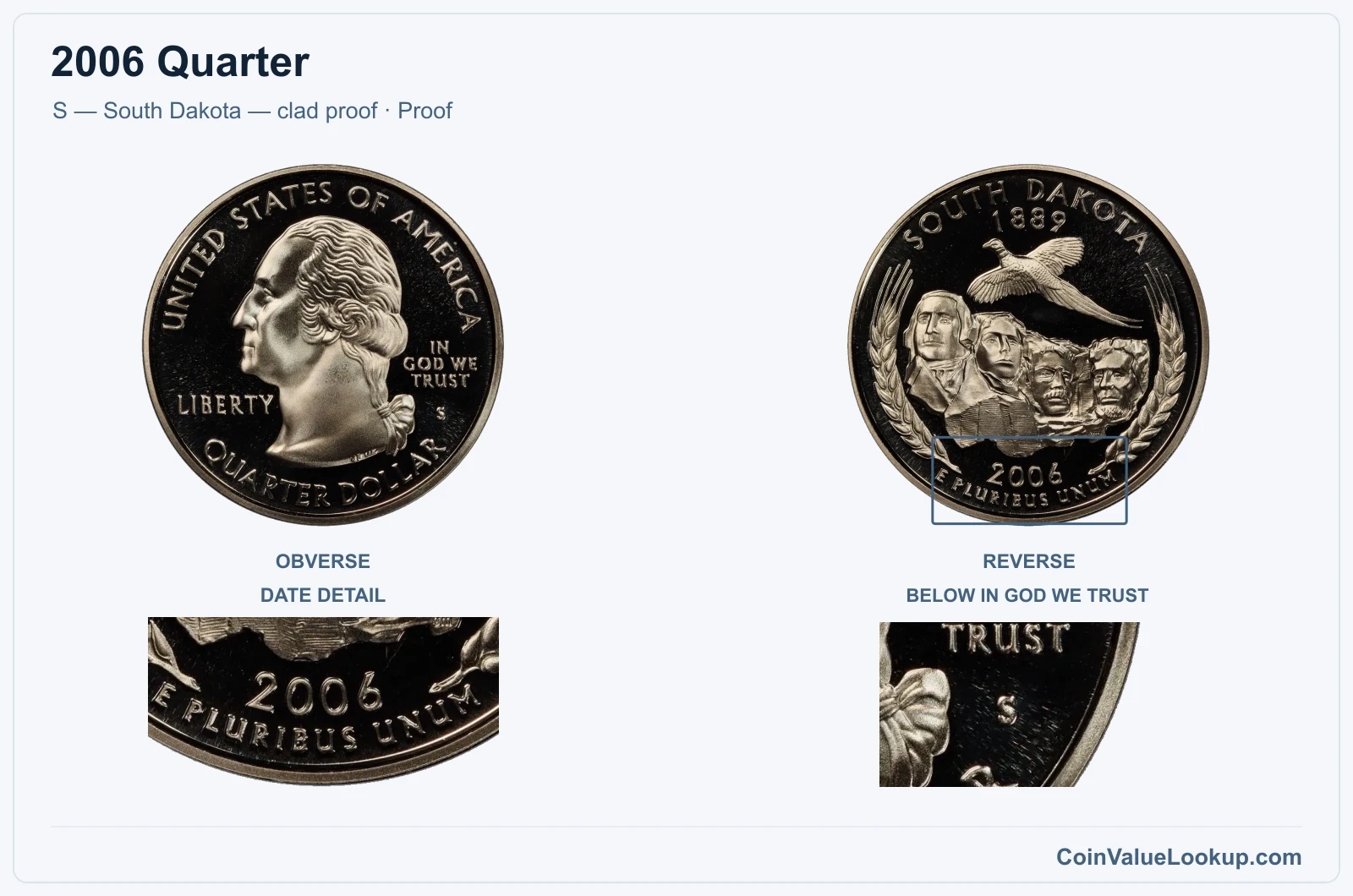
San Francisco struck clad proof South Dakota quarters for standard proof sets. Mirror fields, frosted devices, copper-nickel clad.
Weigh the coin or check the edge if you are not sure whether yours is clad or silver.
USA Coin Book estimates PR65 at about $5.63. Handling marks and haze are the two enemies of proof surfaces.
Keep them cased.
Range Grade
Price Auction Records Appraisal PR PR 1
—
Coin Identifier
PR 2
—
Coin Identifier
PR 3
—
Coin Identifier
PR 4
—
Coin Identifier
PR 6
—
Coin Identifier
PR 8
—
Coin Identifier
PR 10
—
Coin Identifier
PR 12
—
Coin Identifier
PR 15
—
Coin Identifier
PR 20
—
Coin Identifier
PR 25
—
Coin Identifier
PR 30
—
Coin Identifier
PR 35
—
Coin Identifier
PR 40
—
Coin Identifier
PR 45
—
Coin Identifier
PR 50
—
Coin Identifier
PR 53
—
Coin Identifier
PR 55
—
Coin Identifier
PR 58
—
Coin Identifier
PR 60
—
Coin Identifier
PR 61
—
Coin Identifier
PR 62
—
Coin Identifier
PR 63
—
Coin Identifier
PR 64
—
Coin Identifier
PR 65
—
Coin Identifier
PR 66
—
Coin Identifier
PR 67
—
Coin Identifier
PR 68
—
Coin Identifier
PR 69
Coin Identifier
PR 70
Coin Identifier
2006 Quarter — S — South Dakota — silver proof
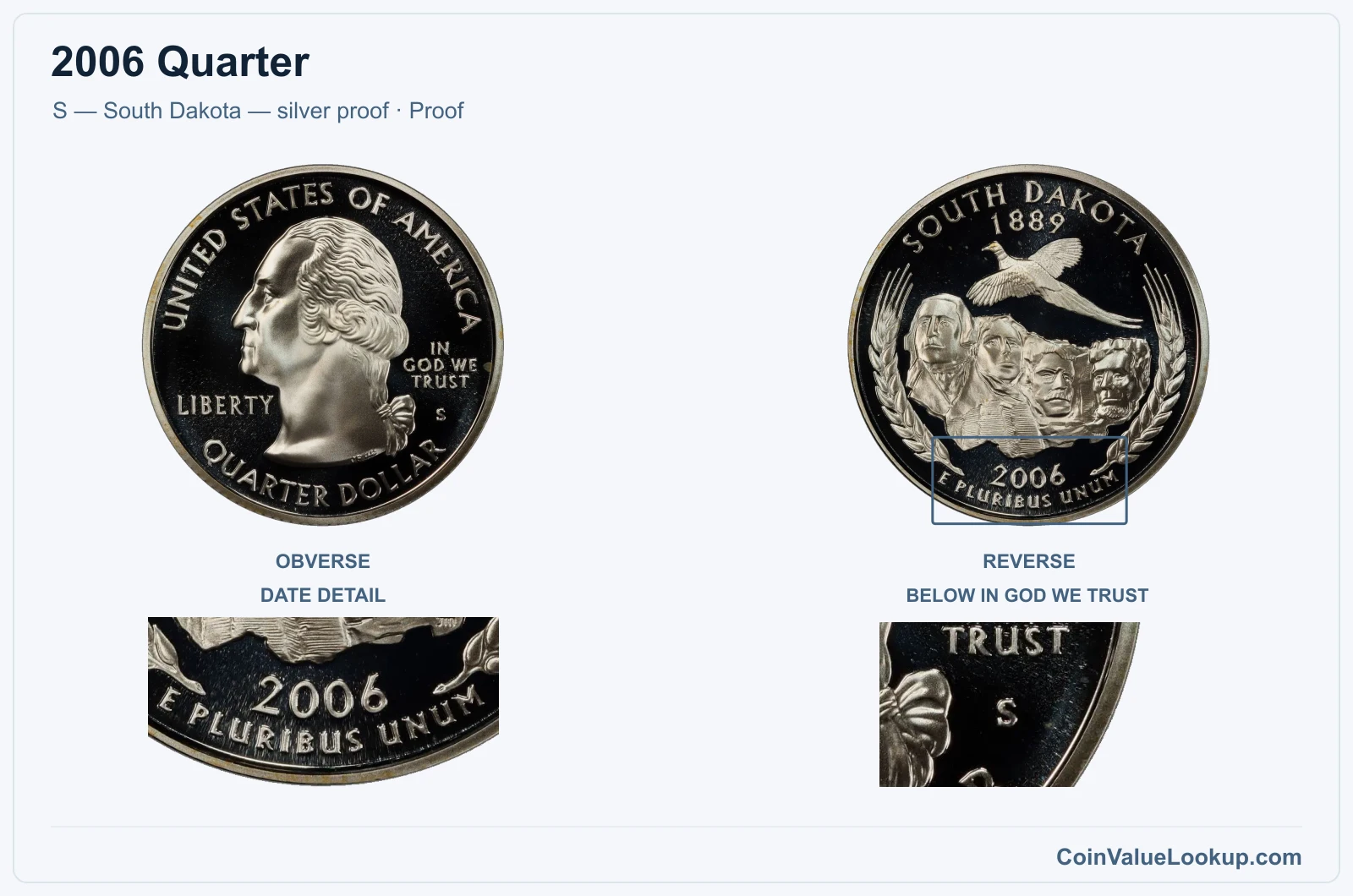
The silver proof South Dakota quarter is 90% silver, weighing about 6.25 grams. The edge is solid silver-gray with no copper stripe.
These were sold in silver proof sets by the U.S. Mint.
USA Coin Book estimates about $23.00 at PR65, matching the other four 2006 silver proofs. Silver content and proof quality both contribute to the premium.
Confirm composition before applying this value.
Range Grade
Price Auction Records Appraisal PR PR 1
—
Coin Identifier
PR 2
—
Coin Identifier
PR 3
—
Coin Identifier
PR 4
—
Coin Identifier
PR 6
—
Coin Identifier
PR 8
—
Coin Identifier
PR 10
—
Coin Identifier
PR 12
—
Coin Identifier
PR 15
—
Coin Identifier
PR 20
—
Coin Identifier
PR 25
—
Coin Identifier
PR 30
—
Coin Identifier
PR 35
—
Coin Identifier
PR 40
—
Coin Identifier
PR 45
—
Coin Identifier
PR 50
—
Coin Identifier
PR 53
—
Coin Identifier
PR 55
—
Coin Identifier
PR 58
—
Coin Identifier
PR 60
—
Coin Identifier
PR 61
—
Coin Identifier
PR 62
—
Coin Identifier
PR 63
—
Coin Identifier
PR 64
—
Coin Identifier
PR 65
—
Coin Identifier
PR 66
—
Coin Identifier
PR 67
—
Coin Identifier
PR 68
—
Coin Identifier
PR 69
Coin Identifier
PR 70
Coin Identifier
2006 Quarter Error List
1. 2006 Quarter — North Dakota — Doubled Die Obverse
A doubled die obverse has been reported on the 2006-P North Dakota quarter. To check for it, compare the obverse lettering and design details against a normal 2006-P North Dakota quarter under good magnification and consistent lighting.
Genuine doubling shows as consistent separation or notching on affected letters or devices — the shift repeats across multiple elements in the same direction.
Do not confuse this with machine doubling, which tends to produce a flat, shelf-like appearance rather than true separated design elements. Reflections under bright light and worn die contours can also mimic doubling.
The value of a doubled die depends on condition, the strength and visibility of the doubling, and third-party authentication.
2. 2006 Quarter — Nevada — Die Break / Cud
Die breaks and cuds have been reported on 2006 Nevada quarters. A cud is a raised, featureless blob that connects to the rim — it forms when a piece of the die breaks away entirely.
Interior die breaks look similar but sit away from the rim.
To identify one, look for a raised area where normal design detail is missing. The boundary between the cud and the remaining design should be distinct.
A rim dent goes inward; a cud pushes outward. Corrosion and interior die chips can create similar bumps but lack the clean rim connection and featureless surface of a true cud.
Value depends on size, location and overall coin condition.
3. 2006 Quarter — Nevada — Struck-Through Error
Struck-through errors have been reported on 2006 Nevada quarters. These happen when foreign material gets between the die and the blank during striking, leaving a depression or impression in the finished coin.
The obstruction might be grease, a thread, a metal fragment or something else entirely.
Look for a localized area where the design is incomplete or shows an unusual indentation. A grease-filled die tends to leave a broader, softer blank area, while a retained foreign object leaves a sharper impression.
Do not confuse ordinary wear, scratches or cleaning damage with a struck-through error — those affect the surface differently and lack the characteristic pressed-in quality. Condition and the distinctiveness of the impression determine value.
4. 2006 Quarter — Nevada — Off-Center Strike
Off-center strikes have been reported on 2006 Nevada quarters. On a genuine off-center coin, the design is visibly shifted so that part of it is missing, and a blank crescent of unstruck metal appears on the opposite side.
The percentage of misalignment and whether the date remains visible are the two biggest factors in desirability. A 5% shift barely looks wrong; a 50% shift with a readable date is dramatic.
Do not confuse a clipped planchet, a one-sided die misalignment or post-mint flattening with an off-center strike. Condition and the degree of offset both affect value.
5. 2006 Quarter — Nevada — Double / Multiple Strike
Double or multiple strikes have been reported on 2006 Nevada quarters. A true double strike shows two separate impressions of the design, often rotated or displaced relative to each other.
The second strike partially overlaps the first, creating a dramatic and unmistakable appearance.
This is different from a doubled die, which is a single strike from a die that already has doubled images on it. It is also different from post-mint damage like a coin being struck by machinery after leaving the press.
Look for two distinct sets of design elements rather than merely enlarged or spread lettering. Value depends on how dramatic the displacement is and the coin's overall condition.
6. 2006 Quarter — Nevada — Missing Clad Layer
Missing clad layer errors have been reported on the 2006-D Nevada quarter. On a normal quarter, the copper-nickel clad layer covers both faces.
When one layer is missing before striking, the exposed face can show a copper-colored tone from the underlying core.
To check, compare the affected side's color with a normal coin. Then look at the edge — a missing clad layer typically shows an uneven sandwich.
Weigh the coin; it should be lighter than the normal 5.67 grams. Do not mistake toning, environmental damage, plating or corrosion for a missing clad layer.
Coins that have had metal chemically removed after minting will show different surface characteristics. Condition and visibility of the error affect value.
7. 2006 Quarter — Nebraska — Off-Center Strike
Off-center strikes have been reported on 2006 Nebraska quarters, primarily documented from the P mint. The hallmark is a displaced design paired with an unstruck crescent on the opposite side.
Part of the design is simply not there.
Higher percentages of offset generally command more interest, especially when the date is still visible. A slight misalignment of just a few percent may not be immediately obvious.
Do not confuse a clipped planchet or a misaligned die with a true off-center strike — a clip removes part of the blank before striking, while a misaligned die shifts only one side. Value depends on the degree of offset and overall condition.
8. 2006 Quarter — Lamination / Split Planchet
Lamination errors have been reported on 2006 quarters. A lamination occurs when layers within the coin's metal separate, creating a peeling flap, a crack or a missing patch on the surface.
This happens due to impurities or trapped gas in the planchet before striking.
To identify one, look for a thin layer of metal lifting away from or completely detached from the coin's surface. Photograph the edge alongside the affected area — the separation is usually visible there too.
Do not mistake scraping, corrosion, deliberate cutting or post-mint damage for a lamination. Genuine laminations show smooth internal surfaces where the metal split naturally.
The size, location and whether the flap is still retained all affect value.
9. 2006 Quarter — Nebraska — Die Crack / Die Chip
Die cracks and die chips have been reported on 2006 Nebraska quarters. A die crack shows up as a thin raised line on the coin's surface, following the path of a fracture in the die.
A die chip appears as a small raised blob where a tiny piece of the die surface broke away.
To spot them, look for raised features that do not belong to the normal design. They are raised because the crack or chip in the die creates a recess that fills with metal.
Do not confuse incuse scratches, corrosion or stuck debris with die cracks. Scratches go into the surface; die cracks sit above it.
Small cracks and chips are common and generally add modest value; larger or more dramatic examples attract more attention.
10. 2006 Quarter — Nebraska — Doubled Die
Doubled die errors have been reported on 2006 Nebraska quarters. A doubled die shows consistent doubling across affected design elements — letters, numbers or devices — because the doubling is in the die itself, not from the coin shifting during striking.
Compare suspected areas against a normal coin under magnification. True doubling shows separated or notched design features that repeat in the same direction across the affected zone.
Machine doubling, by contrast, creates a flat shelf-like effect and is far less collectible. Reflections and lighting angles can also fool you.
The specific die, the visibility of the doubling and the coin's condition all influence value.
11. 2006 Quarter — North Dakota — Wrong Planchet / Off-Metal Strike
A wrong planchet or off-metal strike has been reported for the 2006-P North Dakota quarter. This means the coin was reportedly struck on a blank not intended for a quarter — descriptions reference a washer-type blank.
The result is a coin with incorrect weight, diameter or design completeness.
To evaluate, measure and weigh the coin carefully, then compare those numbers against the standard 5.67-gram, 24.26-mm specifications of a normal clad quarter. Look at the edge and overall design completeness.
Do not confuse plating, corrosion, acid-thinned coins or deliberate alterations with a genuine wrong planchet strike. Authentication is important for this type of error.
Condition, the specific planchet and rarity all factor into value.
12. 2006 Quarter — Colorado — Off-Center Strike
Off-center strikes have been reported on 2006 Colorado quarters. The design is displaced toward one side, leaving a blank crescent of unstruck metal on the other.
The more dramatic the shift, the more collectible the coin — as long as the date remains readable. A barely noticeable 1-2% shift is not particularly exciting; a clear 10% or greater offset is a different story.
Do not confuse a clipped planchet or a misaligned die with a true off-center strike. Post-mint flattening can also distort a coin's appearance.
Value depends on the degree of offset, date visibility and overall condition.
13. 2006 Quarter — Colorado — Die Crack / Die Chip
Die cracks have been reported on 2006 Colorado quarters. These appear as thin raised lines running across the coin's surface, tracing fractures in the steel die that struck it.
Inspect the coin under magnification. Die cracks are raised above the surrounding surface, which distinguishes them from scratches that cut into the metal.
Some cracks are tiny and barely visible; others run across major design elements. An interior die chip is a small raised blob, not a line.
If the crack extends to the rim and a chunk of the die has failed, that becomes a cud — a different category. Value depends on size, position and overall coin condition.
14. 2006 Quarter — Colorado — Die Break / Cud
Cuds have been reported on 2006 Colorado quarters. A cud forms when a section of the die along the rim breaks off completely, leaving a raised, featureless blob connected to the rim on the struck coin.
To identify a cud, look for a raised blank area at the rim where design detail should be. The boundary between the normal design and the cud should be sharp.
Compare against a rim dent — dents go inward, cuds push outward. Corrosion bumps and interior die chips can look similar but lack the rim connection.
Larger cuds affecting recognizable design elements tend to be more collectible. Condition and size both influence value.
15. 2006 Quarter — Colorado — Doubled Die
Doubled die errors have been reported on 2006 Colorado quarters. These show consistent doubling on affected design elements from a die that received a doubled impression during its own creation.
Look at lettering, numbers and key design features under magnification. Genuine doubling repeats in the same direction across multiple elements and shows clear separation or notching.
Machine doubling — which is far more common and far less valuable — produces flat, shelf-like distortions. Reflections and lighting tricks can also mimic doubling to the untrained eye.
The specific die involved, the strength of the doubling and the coin's condition all determine value.
16. 2006 Quarter — Colorado — Missing Clad Layer
Missing clad layer errors have been reported on 2006 Colorado quarters. On a normal coin, both faces are covered with copper-nickel clad over a copper core.
When a clad layer fails to bond or peels away before striking, the exposed face shows a distinctly different color.
Check the edge for an uneven layer structure and weigh the coin — it should be lighter than the standard 5.67 grams. Toning, environmental damage and coins that have had surface metal removed by chemicals after minting can mimic the look.
The key difference is that a genuine missing clad error affects the entire face uniformly and shows in the edge cross-section. Value depends on condition and the visibility of the error.
17. 2006 Quarter — North Dakota — Off-Center Strike
Off-center strikes have been reported on 2006 North Dakota quarters. A genuine off-center coin shows the design shifted to one side with a corresponding unstruck crescent on the opposite edge.
The degree of misalignment matters. A small shift is barely interesting; a significant offset with the date still legible is genuinely collectible.
Do not confuse this with a clipped planchet, which removes metal from the blank before striking, or with post-mint damage that flattens or distorts the coin. One-sided die misalignment can shift only the obverse or reverse without creating the unstruck crescent.
Value depends on the offset percentage and overall condition.
18. 2006 Quarter — North Dakota — Clipped Planchet
Clipped planchet errors have been reported on 2006 North Dakota quarters. A clip occurs when the blank is punched improperly from the metal strip, leaving a curved, straight or irregular missing section along the edge.
Look for a missing portion of the coin's rim and edge where the metal simply was not there before striking. The design near the clip often shows weakness because metal did not flow fully into that area.
Opposite the clip, you may notice a subtle area of weakness too — this is called the Blakesley effect. Do not confuse a filed notch, a cut edge or corrosion damage with a genuine clip.
Value depends on the size and shape of the clip and the coin's overall condition.
19. 2006 Quarter — South Dakota — Off-Center Strike
Off-center strikes have been reported on 2006 South Dakota quarters. The classic sign is a design that is clearly shifted, with an unstruck blank crescent on the opposite side.
Date visibility is critical for collectibility — a dramatically off-center coin where you cannot read the date or identify the state is less desirable than one that retains both. Do not mistake a clipped planchet for an off-center strike; clips remove part of the blank before striking, while an off-center error involves the blank being mispositioned under the dies.
Value depends on the shift percentage and condition.
20. 2006 Quarter — South Dakota — Die Crack / Die Chip
Die cracks and die chips have been reported on 2006 South Dakota quarters. Die cracks appear as raised lines on the coin surface, tracing fractures that developed in the die during use.
Die chips are small raised blobs from tiny pieces of the die face breaking away.
Under magnification, these features sit above the coin's surface — the opposite of a scratch or gouge. If you can feel a line with your fingernail and it is raised, it is likely a die crack.
An interior chip is a small blob within the design; a crack that runs to the rim and results in a featureless raised area becomes a cud. Value depends on size, prominence and overall coin condition.
21. 2006 Quarter — South Dakota — Missing Clad Layer
Missing clad layer errors have been reported on 2006 South Dakota quarters. When the outer copper-nickel layer is absent on one face, the coin can display a copper-toned appearance on that side because the core is exposed.
To verify, examine the edge for an abnormal layer structure and weigh the coin. A genuine missing clad coin will be lighter than the standard 5.67 grams.
Compare the suspect face with a normal coin side by side. Toning, plating removal, corrosion and chemical stripping can all mimic the appearance.
The difference is that a genuine error shows a uniformly affected surface and a visibly altered edge. Value depends on the error's visibility and the coin's condition.
22. 2006 Quarter — South Dakota — Struck-Through Error
Struck-through errors have been reported on 2006 South Dakota quarters. A struck-through occurs when foreign material gets trapped between the die and the blank at the moment of striking, leaving a depression or impression where the design should be fully formed.
The impression can be from grease, a fiber, a metal fragment or other debris. A grease fill tends to leave a broader, smoother blank area, while a solid object creates a sharper, more defined indentation.
Do not confuse normal wear, post-mint scratches or cleaning marks with a struck-through error. Genuine struck-throughs show a pressed-in quality that matches the surrounding strike.
Condition and the distinctiveness of the impression both affect value.