2010 Quarter Coin Value: How Much Is It Worth?
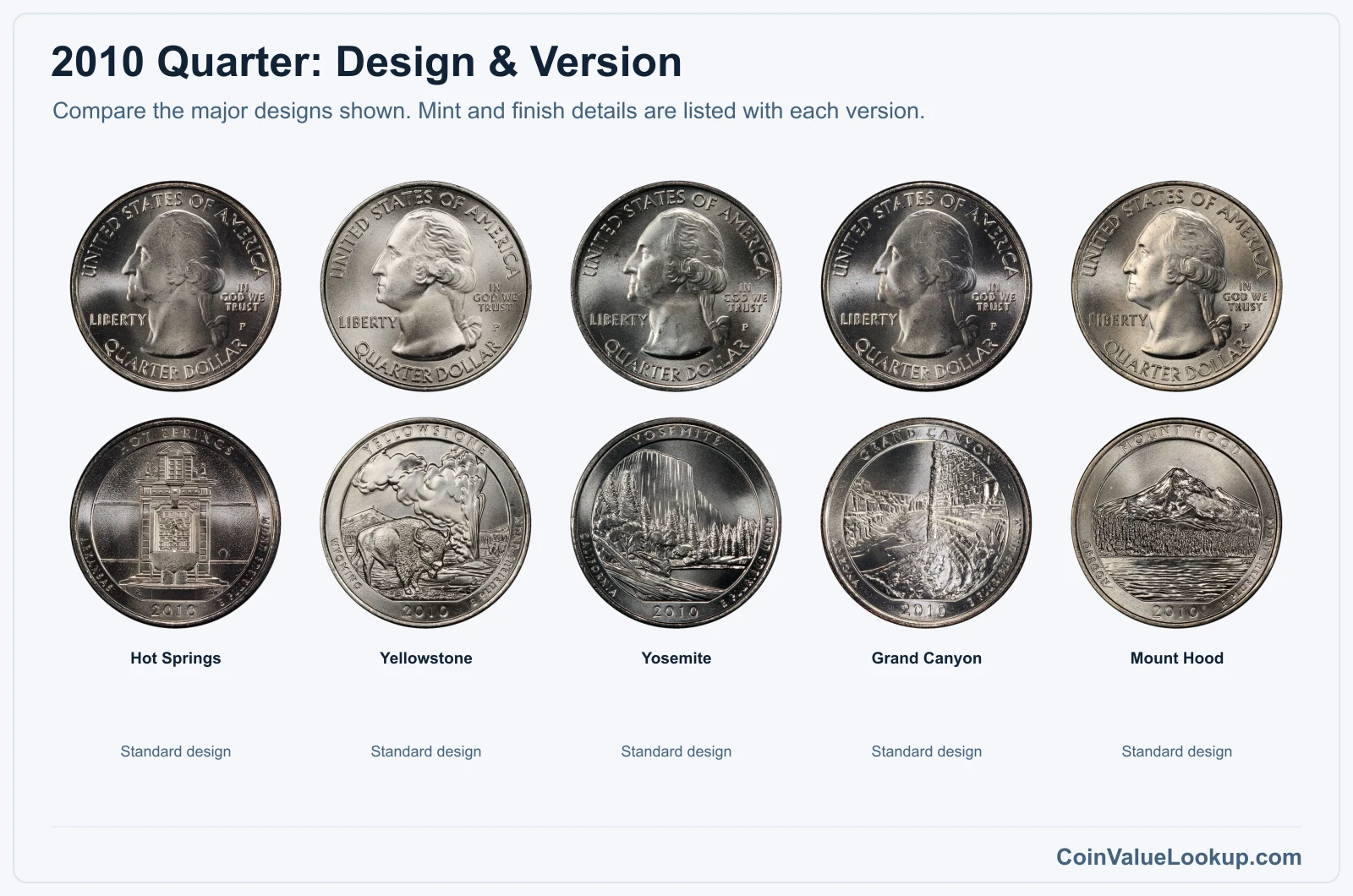
The 2010 quarter belongs to the America the Beautiful series, and five different reverse designs were issued that year: Hot Springs, Yellowstone, Yosemite, Grand Canyon, and Mount Hood. Guide estimates from USA Coin Book range from $0.74 to $23.00 depending on the specific mint, reverse design, finish, and grade.
Which part of that range applies depends entirely on what you are holding.
Fast Way to Identify Your 2010 Quarter
Upload clear photos of the front and back of your 2010 quarter and our identifier can give you a preliminary identification. It will help pin down the mintmark, reverse design, and finish type so you know which version chart to reference.
Both sides are needed since the mintmark sits on the obverse while the reverse tells you which park design you have.
2010 Quarter Value
Upload both sides of your 2010 Quarter.
Front Obverse
Upload photo
Back Reverse
Upload photo
Which 2010 Quarter Versions Are Worth Money?
- S-mint silver proofs — Hot Springs, Yellowstone, Yosemite, Grand Canyon, and Mount Hood — carry the highest guide estimates at $23.00 each in PR65, because they are 90% silver collector issues sold only in proof sets.
- S-mint clad proofs carry a USA Coin Book guide estimate of $5.63 in PR65 for each of the five designs, well above face value.
- Satin-finish P and D quarters from 2010 mint sets are a distinct version worth identifying; values depend on authenticated identity and condition rather than a standard guide row.
Step 1: Identify Your 2010 Quarter Mint Mark and Version
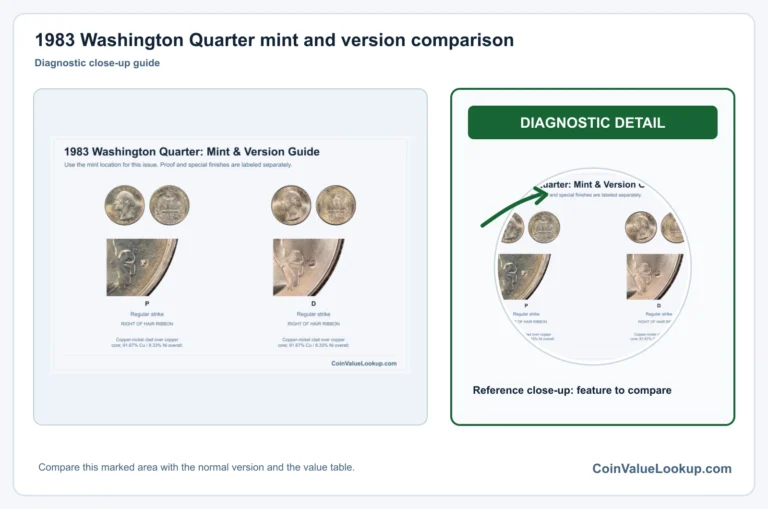
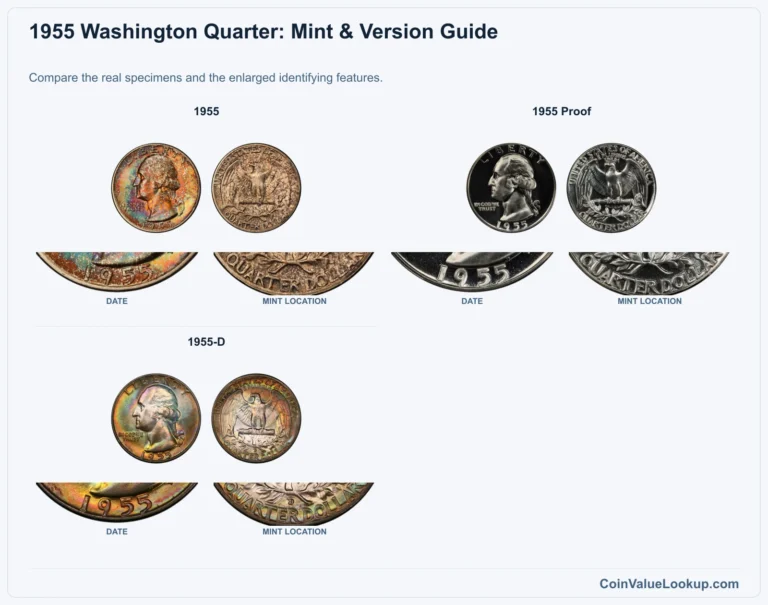
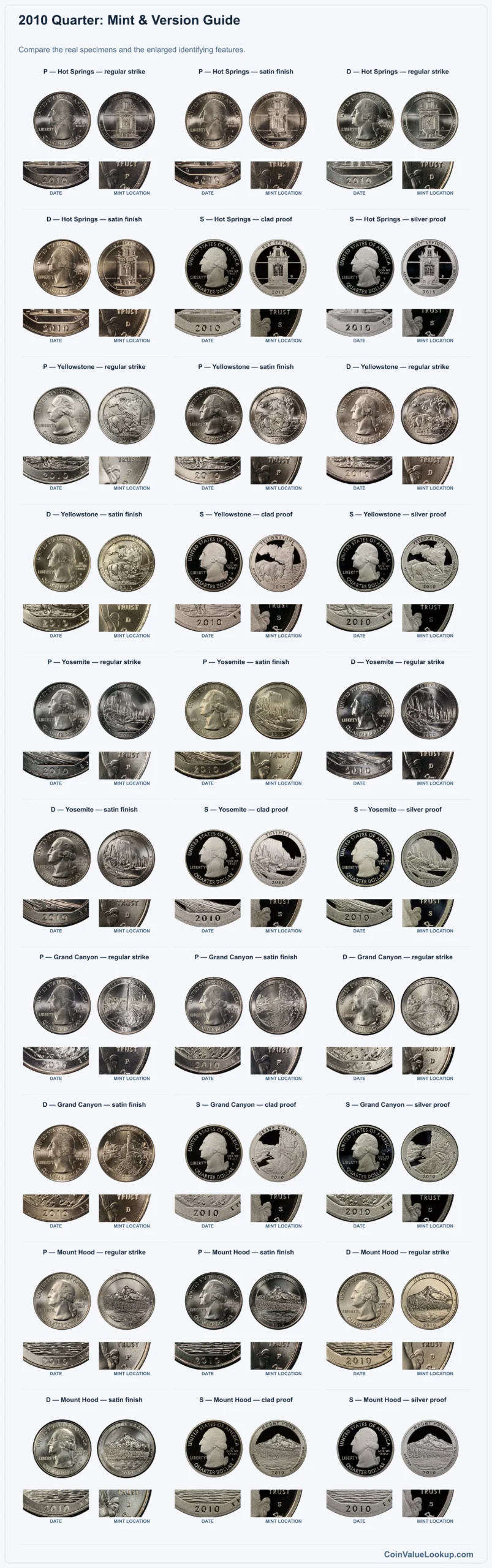
Start with the obverse. The mintmark — P, D, or S — sits near Washington's portrait.
That tells you which facility struck the coin.
Next, flip it over. The five 2010 reverse designs each depict a different national site: Hot Springs (Arkansas), Yellowstone (Wyoming), Yosemite (California), Grand Canyon (Arizona), and Mount Hood (Oregon).
The park name is inscribed on the reverse, so identification is straightforward.
Finish matters too. Business strikes from Philadelphia and Denver have a standard luster.
Satin-finish coins were packaged in 2010 uncirculated mint sets and have a distinctive fine-grained texture that is different from both proof mirrors and normal business-strike cartwheel luster. A worn or artificially dulled coin does not qualify as a satin finish.
S-mint coins come in two compositions: copper-nickel clad proofs and 90% silver proofs. Check the edge — silver proofs show a uniform silver-gray edge, while clad coins reveal layers.
Weight helps too: silver proofs nominally weigh 6.25 g versus 5.67 g for clad. Keep the clad and silver proof values separate; they are not interchangeable.
This guide covers standard 24.26 mm quarter dollars only. The five-ounce silver collector pieces share the same designs but are a completely different product.
Step 2: Check Your 2010 Quarter Grade
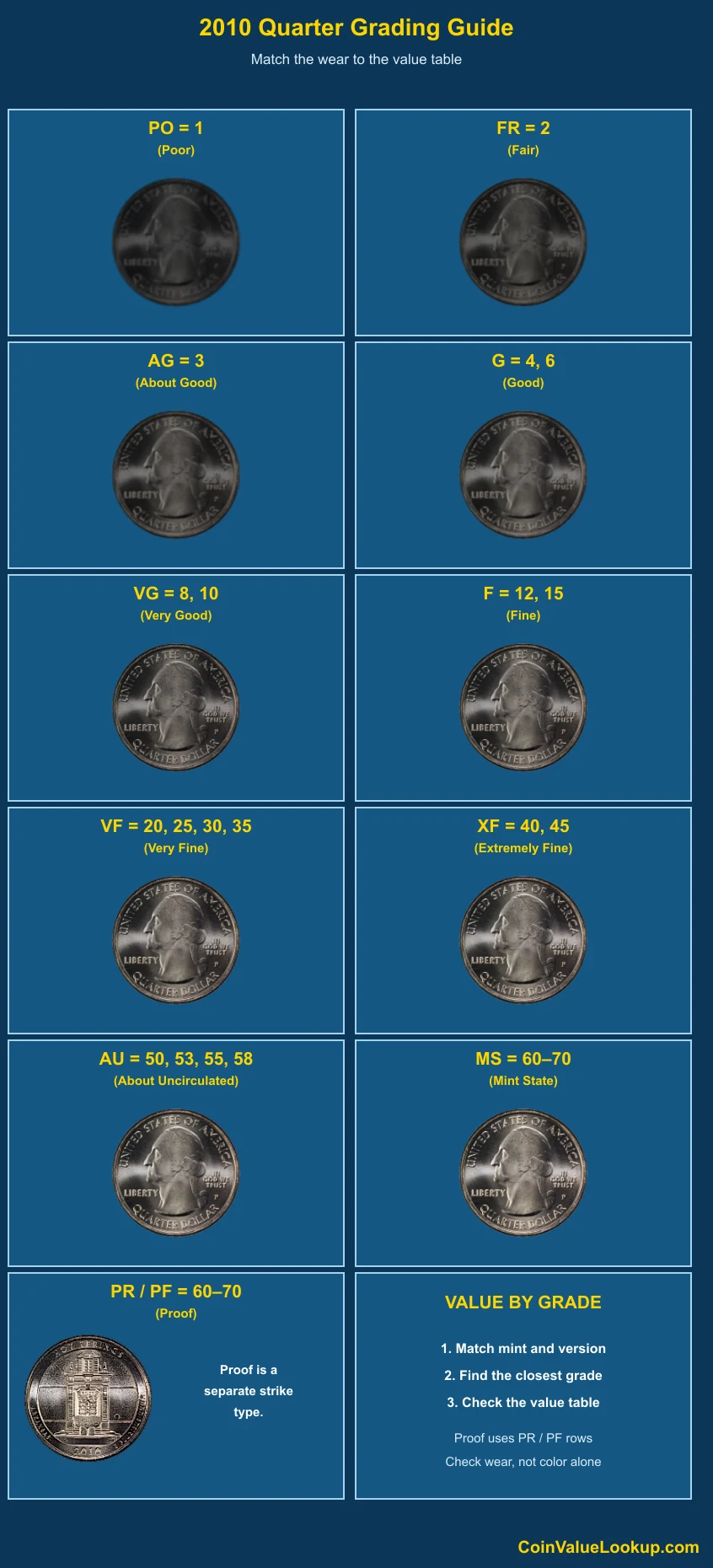
Look at Washington's cheek and the hair strands above his ear first. On a lightly circulated coin those areas flatten before anything else.
On the reverse, the highest relief points of the park design will show the earliest signs of contact.
Compare your coin to the reference image. A coin graded MS60 (Mint State, lowest uncirculated grade) will show no wear but may have bag marks and reduced eye appeal.
An MS65 coin looks clean with strong luster and only minor contact marks. A weak strike can make an unworn coin look less sharp, so do not confuse strike softness with actual wear.
For proofs, inspect the mirror fields under angled light. Hairlines from handling and haze from improper storage lower the grade.
A PR65 proof is attractive overall with only minor imperfections visible under magnification.
Step 3: Check 2010 Quarter Value by Mint and Version
2010 Quarter — P — Hot Springs — regular strike
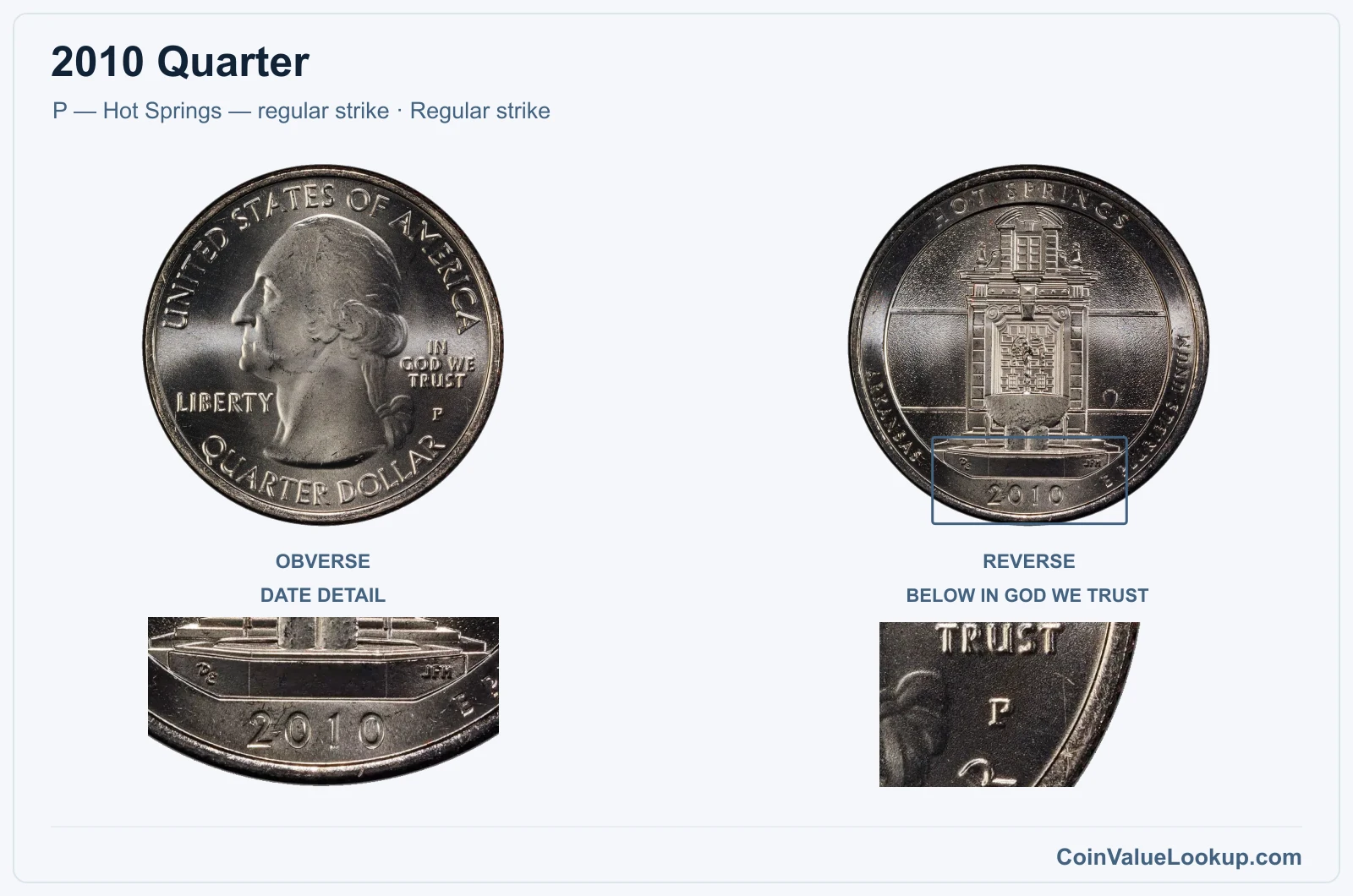
This is the Philadelphia-mint business strike with the Hot Springs reverse. Copper-nickel clad, 24.26 mm, roughly 5.67 g.
You will find these in circulation or in rolls — they are common coins.
USA Coin Book estimates about $0.74 at MS60 and $1.24 at MS65. Worn examples trade at face value.
Confirm the "P" mintmark on the obverse and the Hot Springs building scene on the reverse before using these figures.
Range Grade
Price Auction Records Appraisal PO PO 1
—
Coin Identifier FR FR 2
—
Coin Identifier AG AG 3
—
Coin Identifier G G 4
—
Coin Identifier
G 6
—
Coin Identifier VG VG 8
—
Coin Identifier
VG 10
—
Coin Identifier F F 12
—
Coin Identifier
F 15
—
Coin Identifier VF VF 20
—
Coin Identifier
VF 25
—
Coin Identifier
VF 30
—
Coin Identifier
VF 35
—
Coin Identifier XF XF 40
—
Coin Identifier
XF 45
—
Coin Identifier AU AU 50
—
Coin Identifier
AU 53
—
Coin Identifier
AU 55
—
Coin Identifier
AU 58
—
Coin Identifier MS MS 60
—
Coin Identifier
MS 61
—
Coin Identifier
MS 62
—
Coin Identifier
MS 63
—
Coin Identifier
MS 64
—
Coin Identifier
MS 65
—
Coin Identifier
MS 66
—
Coin Identifier
MS 67
—
Coin Identifier
MS 68
—
—
—
MS 69
—
—
—
MS 70
—
—
—
2010 Quarter — P — Hot Springs — satin finish
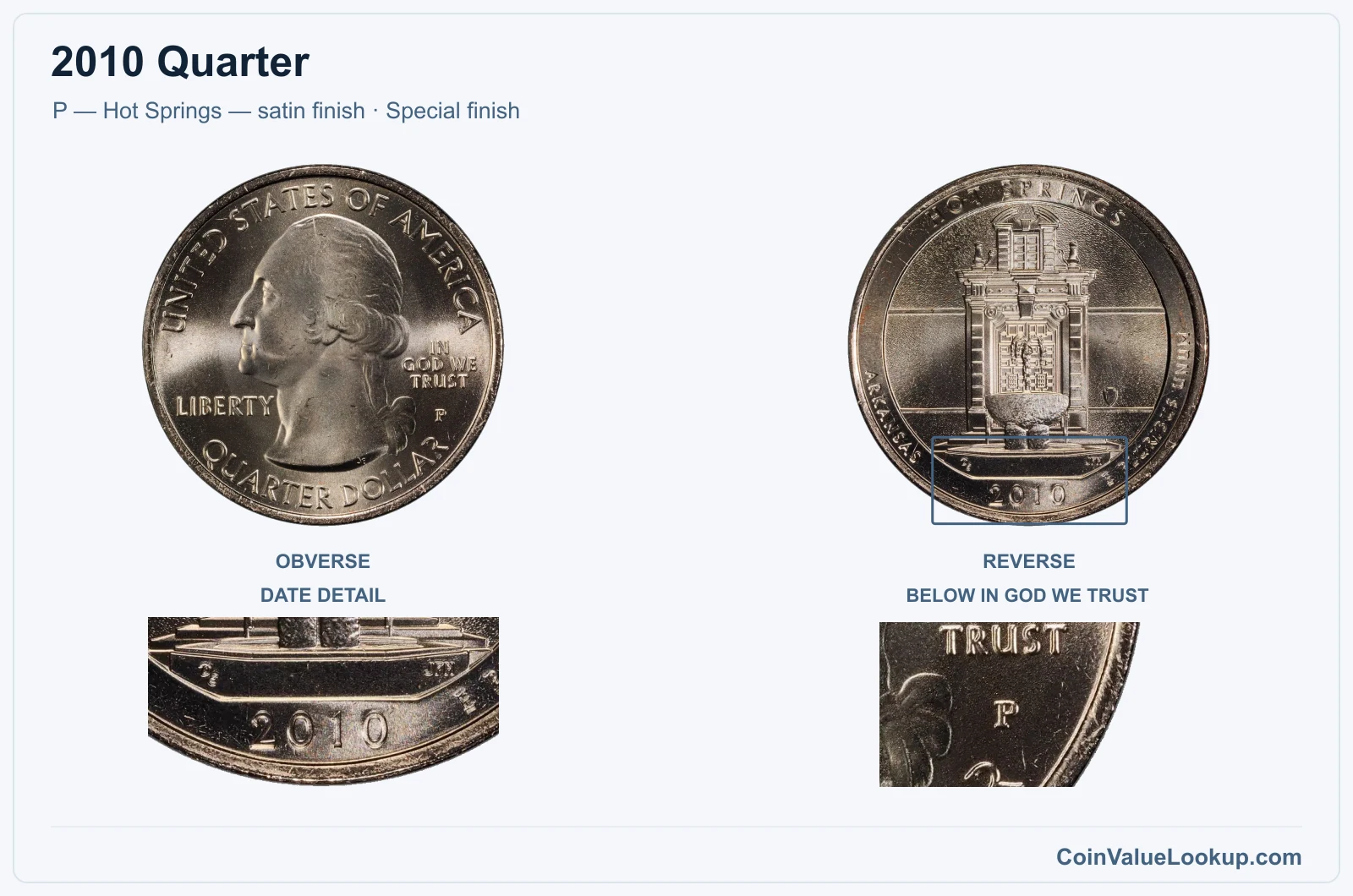
The P-mint Hot Springs satin finish came packaged in the 2010 uncirculated mint set. It has a fine, even texture across both faces that differs from a normal business strike's cartwheel luster and from a proof's mirror fields.
Do not confuse a dull or cleaned coin with a genuine satin finish — authentication matters here. No standard guide price is adopted for this version, so its value depends on authenticated identity, condition, and whether any errors are present.
If you pulled it from an original mint-set holder, that provenance helps.
Range Grade
Price Auction Records Appraisal SP SP 1
—
Coin Identifier
SP 2
—
Coin Identifier
SP 3
—
Coin Identifier
SP 4
—
Coin Identifier
SP 6
—
Coin Identifier
SP 8
—
Coin Identifier
SP 10
—
Coin Identifier
SP 12
—
Coin Identifier
SP 15
—
Coin Identifier
SP 20
—
Coin Identifier
SP 25
—
Coin Identifier
SP 30
—
Coin Identifier
SP 35
—
Coin Identifier
SP 40
—
Coin Identifier
SP 45
—
Coin Identifier
SP 50
—
Coin Identifier
SP 53
—
Coin Identifier
SP 55
—
Coin Identifier
SP 58
—
Coin Identifier
SP 60
—
Coin Identifier
SP 61
—
Coin Identifier
SP 62
—
Coin Identifier
SP 63
—
Coin Identifier
SP 64
—
Coin Identifier
SP 65
—
Coin Identifier
SP 66
—
Coin Identifier
SP 67
—
Coin Identifier
SP 68
—
Coin Identifier
SP 69
—
Coin Identifier
SP 70
—
—
—
2010 Quarter — D — Hot Springs — regular strike
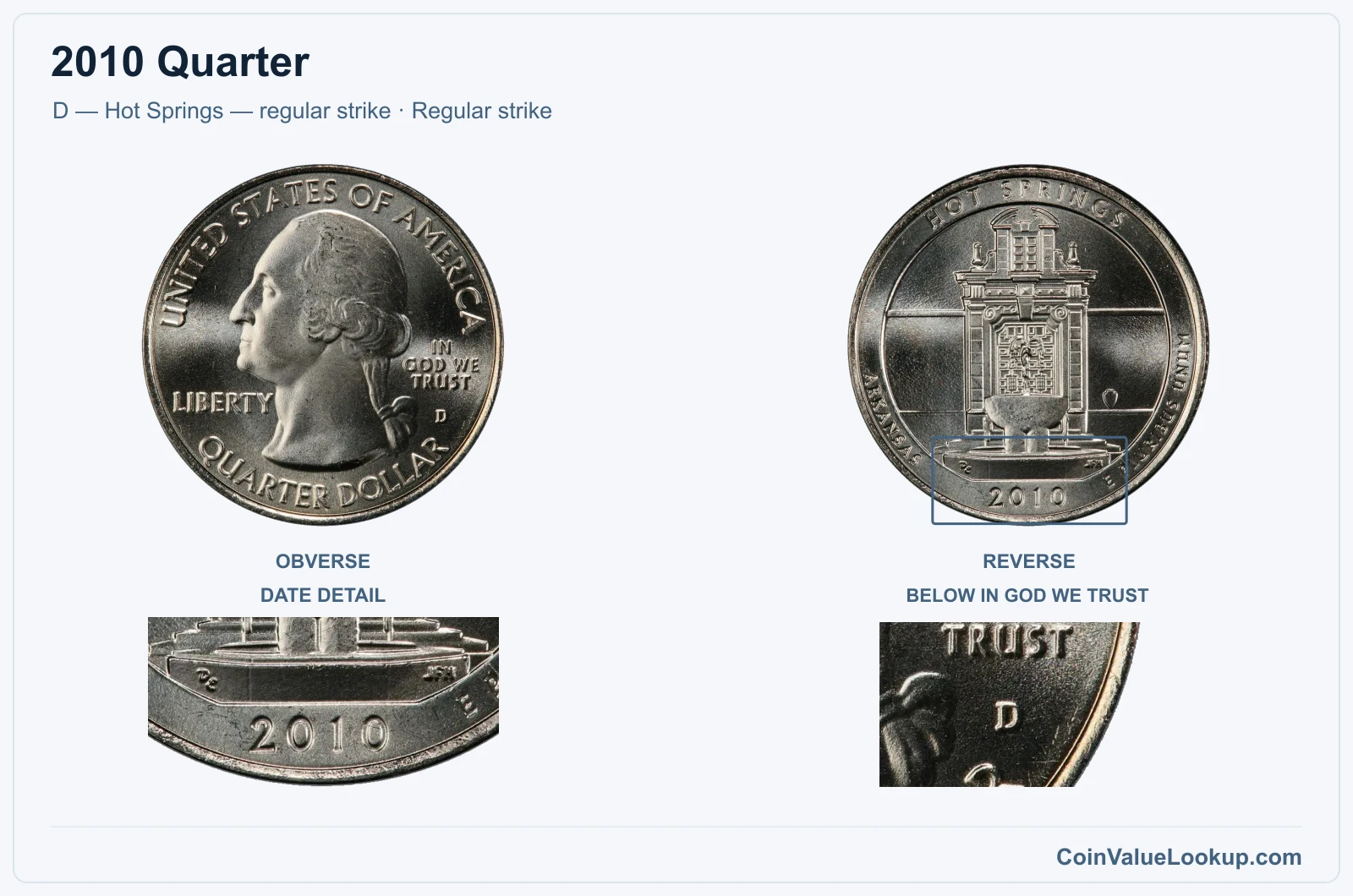
Denver-mint business strike with the Hot Springs reverse. Same copper-nickel clad composition as the P-mint, same 5.67 g nominal weight, same 24.26 mm diameter.
Look for the "D" mintmark.
USA Coin Book lists about $0.74 at MS60 and $1.24 at MS65. Below uncirculated grades, these are face-value coins.
Confirm both the mintmark and the Hot Springs reverse before applying these estimates.
Range Grade
Price Auction Records Appraisal PO PO 1
—
Coin Identifier FR FR 2
—
Coin Identifier AG AG 3
—
Coin Identifier G G 4
—
Coin Identifier
G 6
—
Coin Identifier VG VG 8
—
Coin Identifier
VG 10
—
Coin Identifier F F 12
—
Coin Identifier
F 15
—
Coin Identifier VF VF 20
—
Coin Identifier
VF 25
—
Coin Identifier
VF 30
—
Coin Identifier
VF 35
—
Coin Identifier XF XF 40
—
Coin Identifier
XF 45
—
Coin Identifier AU AU 50
—
Coin Identifier
AU 53
—
Coin Identifier
AU 55
—
Coin Identifier
AU 58
—
Coin Identifier MS MS 60
—
Coin Identifier
MS 61
—
Coin Identifier
MS 62
—
Coin Identifier
MS 63
—
Coin Identifier
MS 64
—
Coin Identifier
MS 65
—
Coin Identifier
MS 66
—
Coin Identifier
MS 67
Coin Identifier
MS 68
—
—
—
MS 69
—
—
—
MS 70
—
—
—
2010 Quarter — D — Hot Springs — satin finish
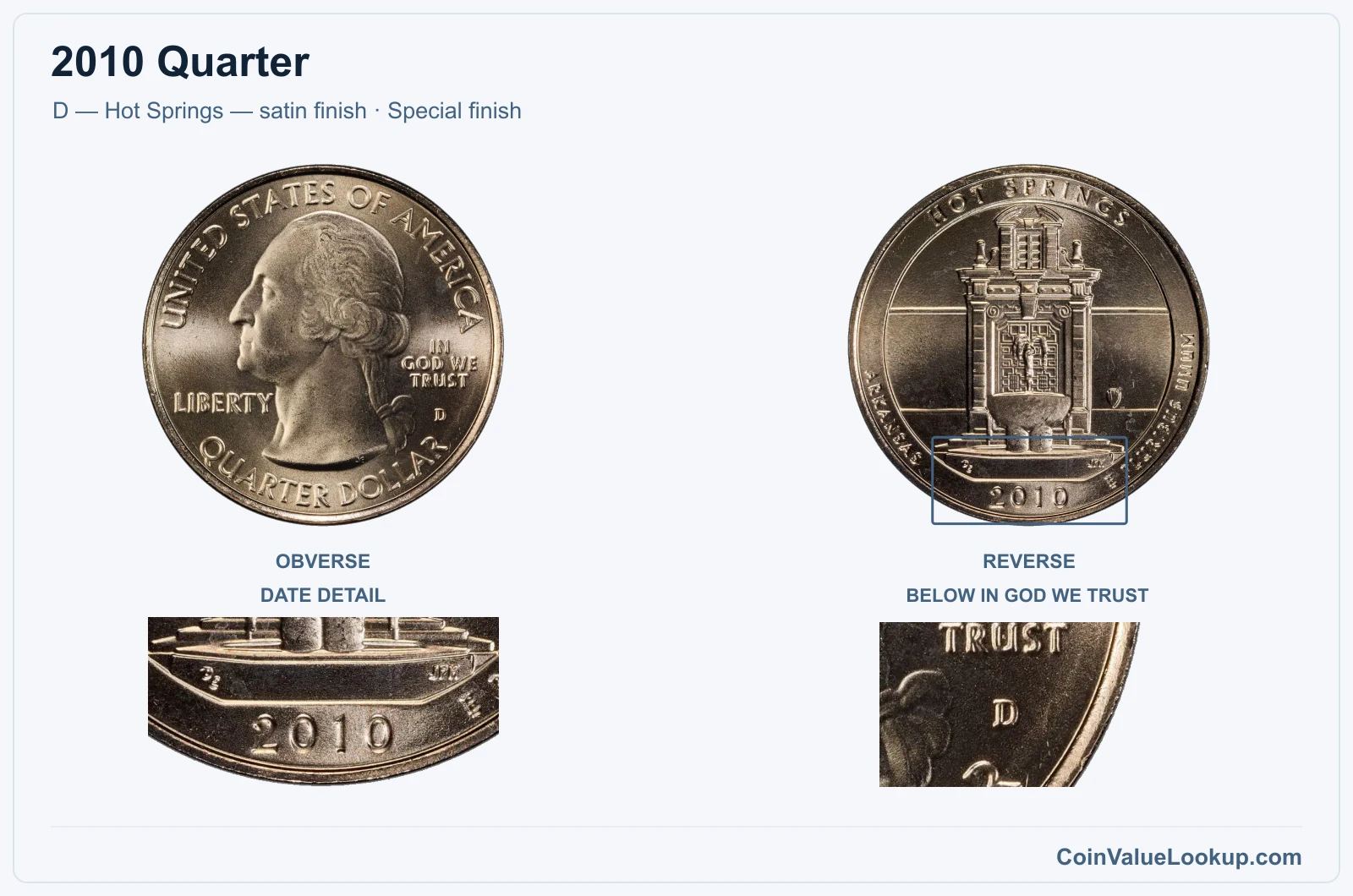
The D-mint Hot Springs satin finish was distributed exclusively in the 2010 uncirculated mint set. Its surface texture is finely granular — distinctly different from circulation strikes.
No adopted guide price exists for this version. Value depends on confirmed satin-finish attribution, the coin's condition, and the presence of any errors.
A coin that simply looks matte from wear or cleaning does not qualify.
Range Grade
Price Auction Records Appraisal SP SP 1
—
Coin Identifier
SP 2
—
Coin Identifier
SP 3
—
Coin Identifier
SP 4
—
Coin Identifier
SP 6
—
Coin Identifier
SP 8
—
Coin Identifier
SP 10
—
Coin Identifier
SP 12
—
Coin Identifier
SP 15
—
Coin Identifier
SP 20
—
Coin Identifier
SP 25
—
Coin Identifier
SP 30
—
Coin Identifier
SP 35
—
Coin Identifier
SP 40
—
Coin Identifier
SP 45
—
Coin Identifier
SP 50
—
Coin Identifier
SP 53
—
Coin Identifier
SP 55
—
Coin Identifier
SP 58
—
Coin Identifier
SP 60
—
Coin Identifier
SP 61
—
Coin Identifier
SP 62
—
Coin Identifier
SP 63
—
Coin Identifier
SP 64
—
Coin Identifier
SP 65
—
Coin Identifier
SP 66
—
Coin Identifier
SP 67
—
Coin Identifier
SP 68
Coin Identifier
SP 69
—
Coin Identifier
SP 70
—
—
—
2010 Quarter — S — Hot Springs — clad proof
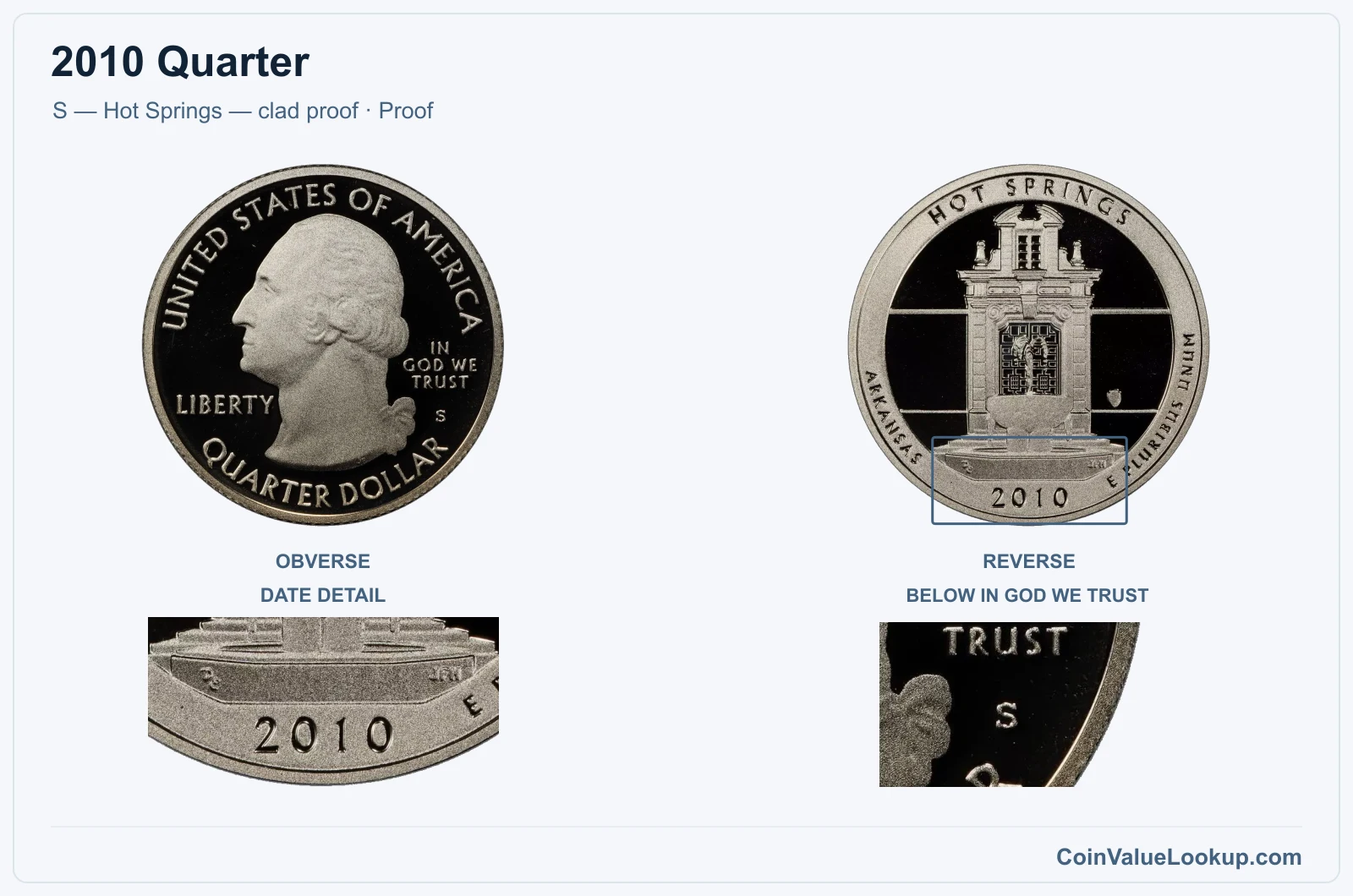
This is the San Francisco clad proof with the Hot Springs reverse. It is copper-nickel clad, the same composition as business strikes, but struck with polished dies on polished planchets to produce mirror fields and frosted devices.
USA Coin Book estimates about $5.63 at PR65. Do not confuse this with the silver proof — check the edge for visible clad layers and weigh it if possible.
The clad proof weighs roughly 5.67 g while the silver proof is about 6.25 g.
Range Grade
Price Auction Records Appraisal PR PR 1
—
Coin Identifier
PR 2
—
Coin Identifier
PR 3
—
Coin Identifier
PR 4
—
Coin Identifier
PR 6
—
Coin Identifier
PR 8
—
Coin Identifier
PR 10
—
Coin Identifier
PR 12
—
Coin Identifier
PR 15
—
Coin Identifier
PR 20
—
Coin Identifier
PR 25
—
Coin Identifier
PR 30
—
Coin Identifier
PR 35
—
Coin Identifier
PR 40
—
Coin Identifier
PR 45
—
Coin Identifier
PR 50
—
Coin Identifier
PR 53
—
Coin Identifier
PR 55
—
Coin Identifier
PR 58
—
Coin Identifier
PR 60
—
Coin Identifier
PR 61
—
Coin Identifier
PR 62
—
Coin Identifier
PR 63
—
Coin Identifier
PR 64
—
Coin Identifier
PR 65
—
Coin Identifier
PR 66
—
Coin Identifier
PR 67
—
Coin Identifier
PR 68
—
Coin Identifier
PR 69
Coin Identifier
PR 70
Coin Identifier
2010 Quarter — S — Hot Springs — silver proof
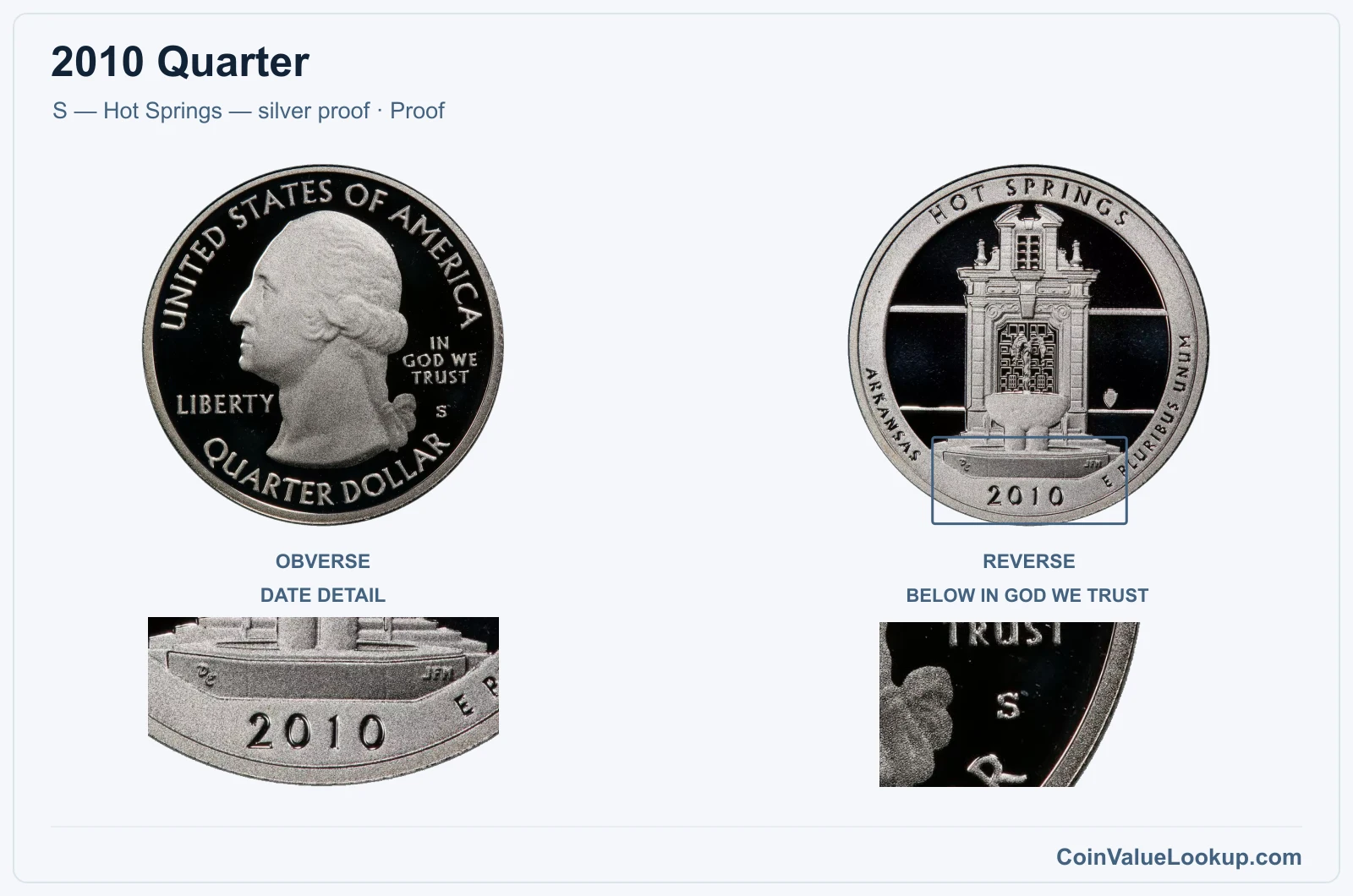
The silver proof Hot Springs quarter is 90% silver and 10% copper, weighing nominally 6.25 g. It was sold in the 2010 silver proof set.
USA Coin Book places this at $23.00 in PR65. The edge appears uniformly silver-gray, with no visible copper band.
Original packaging confirms the silver composition, but weight and edge inspection work if the coin is loose. Keep its value separate from the clad proof — they look similar face-on but the metal content is different.
Range Grade
Price Auction Records Appraisal PR PR 1
—
Coin Identifier
PR 2
—
Coin Identifier
PR 3
—
Coin Identifier
PR 4
—
Coin Identifier
PR 6
—
Coin Identifier
PR 8
—
Coin Identifier
PR 10
—
Coin Identifier
PR 12
—
Coin Identifier
PR 15
—
Coin Identifier
PR 20
—
Coin Identifier
PR 25
—
Coin Identifier
PR 30
—
Coin Identifier
PR 35
—
Coin Identifier
PR 40
—
Coin Identifier
PR 45
—
Coin Identifier
PR 50
—
Coin Identifier
PR 53
—
Coin Identifier
PR 55
—
Coin Identifier
PR 58
—
Coin Identifier
PR 60
—
Coin Identifier
PR 61
—
Coin Identifier
PR 62
—
Coin Identifier
PR 63
—
Coin Identifier
PR 64
—
Coin Identifier
PR 65
—
Coin Identifier
PR 66
—
Coin Identifier
PR 67
—
Coin Identifier
PR 68
—
Coin Identifier
PR 69
Coin Identifier
PR 70
Coin Identifier
2010 Quarter — P — Yellowstone — regular strike
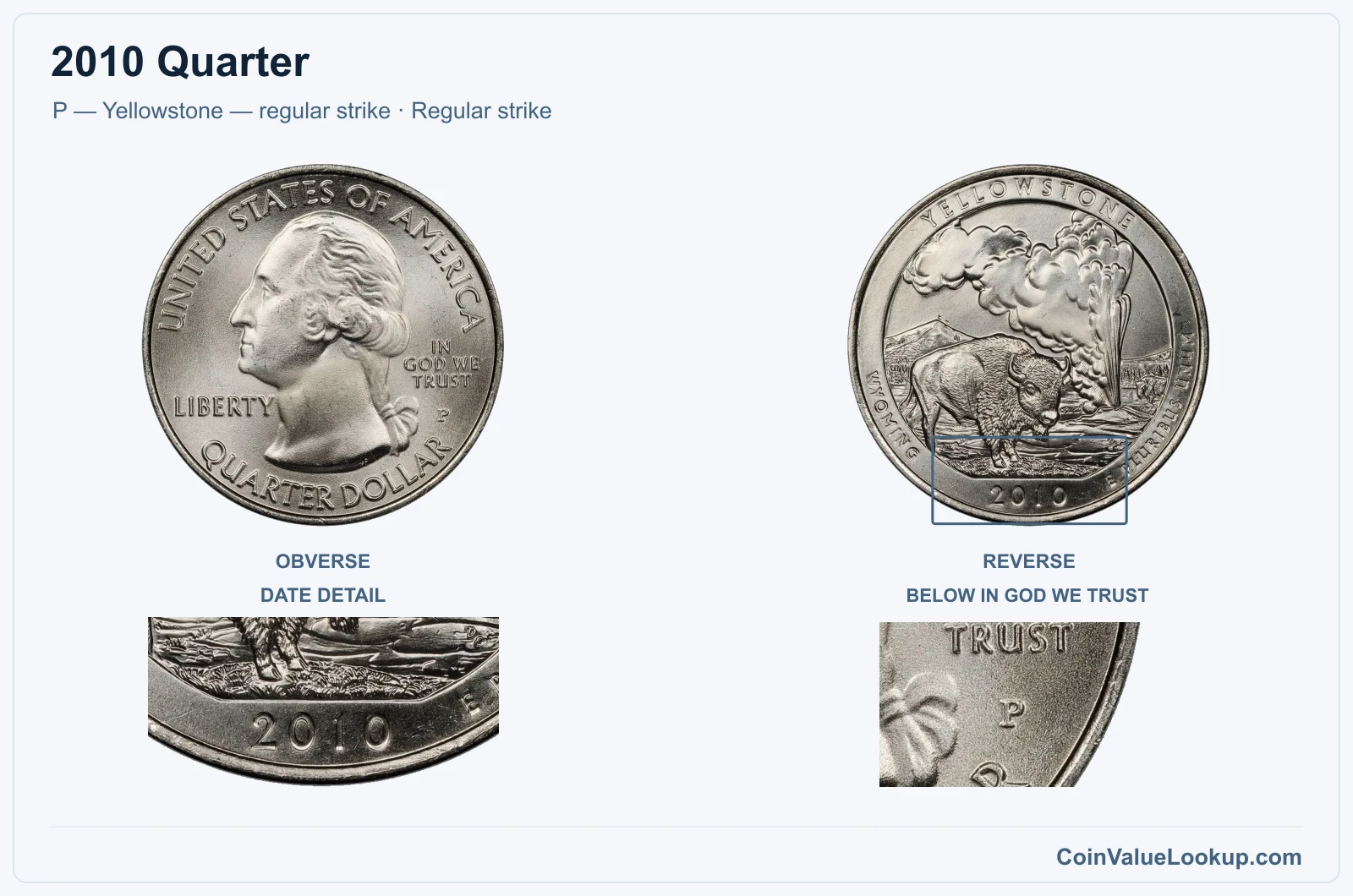
Philadelphia business strike with the Yellowstone reverse depicting the Old Faithful geyser area. Standard copper-nickel clad quarter at 5.67 g.
USA Coin Book estimates roughly $0.74 at MS60 and $1.24 at MS65. Circulated examples are worth face value.
Make sure you read the "P" mintmark and confirm Yellowstone on the reverse before checking values.
Range Grade
Price Auction Records Appraisal PO PO 1
—
Coin Identifier FR FR 2
—
Coin Identifier AG AG 3
—
Coin Identifier G G 4
—
Coin Identifier
G 6
—
Coin Identifier VG VG 8
—
Coin Identifier
VG 10
—
Coin Identifier F F 12
—
Coin Identifier
F 15
—
Coin Identifier VF VF 20
—
Coin Identifier
VF 25
—
Coin Identifier
VF 30
—
Coin Identifier
VF 35
—
Coin Identifier XF XF 40
—
Coin Identifier
XF 45
—
Coin Identifier AU AU 50
—
Coin Identifier
AU 53
—
Coin Identifier
AU 55
—
Coin Identifier
AU 58
—
Coin Identifier MS MS 60
—
Coin Identifier
MS 61
—
Coin Identifier
MS 62
—
Coin Identifier
MS 63
—
Coin Identifier
MS 64
—
Coin Identifier
MS 65
—
Coin Identifier
MS 66
—
Coin Identifier
MS 67
—
Coin Identifier
MS 68
—
—
—
MS 69
—
—
—
MS 70
—
—
—
2010 Quarter — P — Yellowstone — satin finish
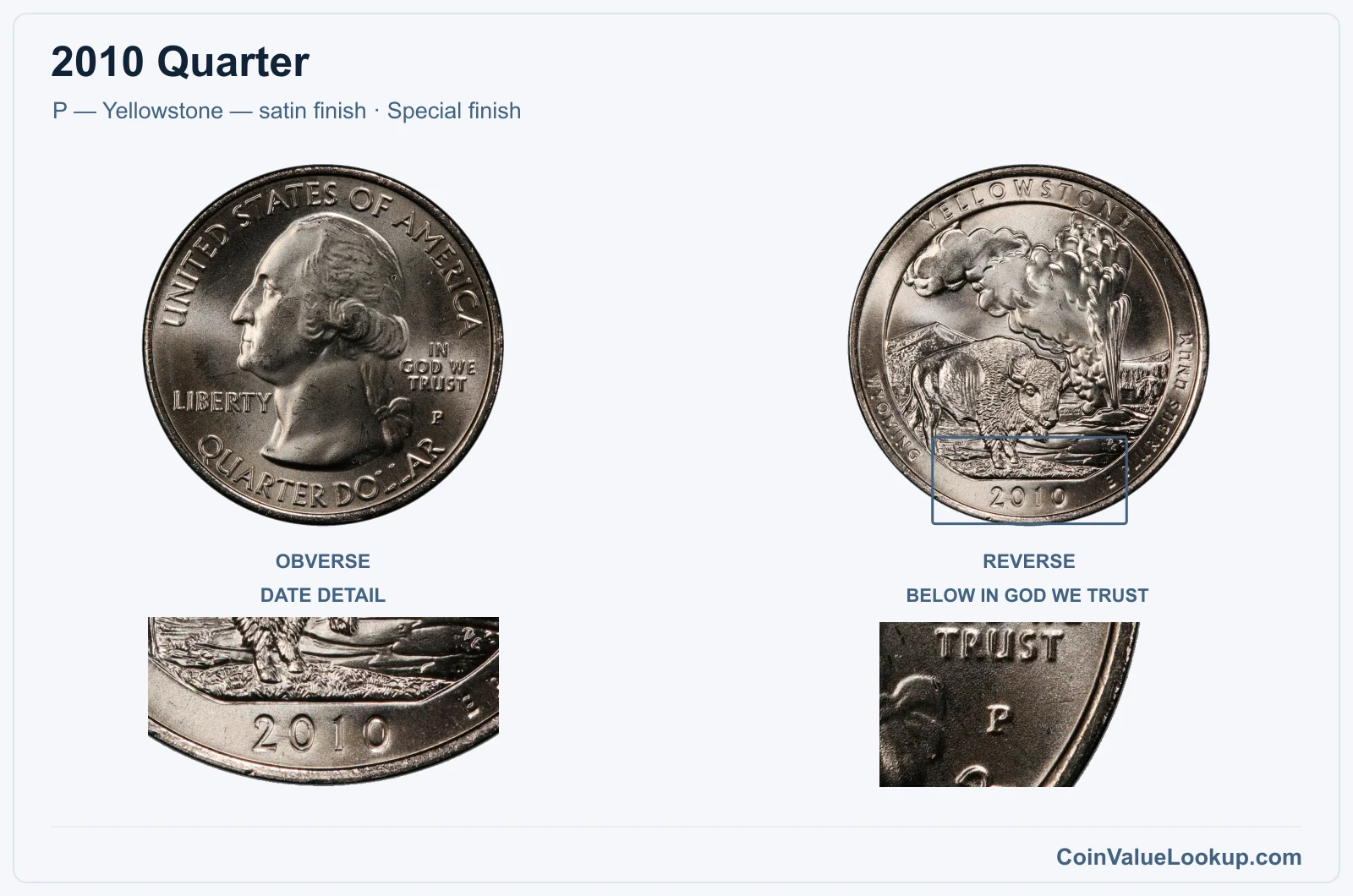
The P-mint Yellowstone satin finish was available only through the 2010 uncirculated mint set. Its surfaces show the characteristic soft, even grain of the satin manufacturing process.
No standard guide price is adopted. Value depends on authenticated identity and condition.
An artificially dulled or worn surface does not equal a satin finish, so provenance from the original mint-set packaging is useful.
Range Grade
Price Auction Records Appraisal SP SP 1
—
Coin Identifier
SP 2
—
Coin Identifier
SP 3
—
Coin Identifier
SP 4
—
Coin Identifier
SP 6
—
Coin Identifier
SP 8
—
Coin Identifier
SP 10
—
Coin Identifier
SP 12
—
Coin Identifier
SP 15
—
Coin Identifier
SP 20
—
Coin Identifier
SP 25
—
Coin Identifier
SP 30
—
Coin Identifier
SP 35
—
Coin Identifier
SP 40
—
Coin Identifier
SP 45
—
Coin Identifier
SP 50
—
Coin Identifier
SP 53
—
Coin Identifier
SP 55
—
Coin Identifier
SP 58
—
Coin Identifier
SP 60
—
Coin Identifier
SP 61
—
Coin Identifier
SP 62
—
Coin Identifier
SP 63
—
Coin Identifier
SP 64
—
Coin Identifier
SP 65
—
Coin Identifier
SP 66
—
Coin Identifier
SP 67
—
Coin Identifier
SP 68
—
Coin Identifier
SP 69
—
Coin Identifier
SP 70
—
—
—
2010 Quarter — D — Yellowstone — regular strike
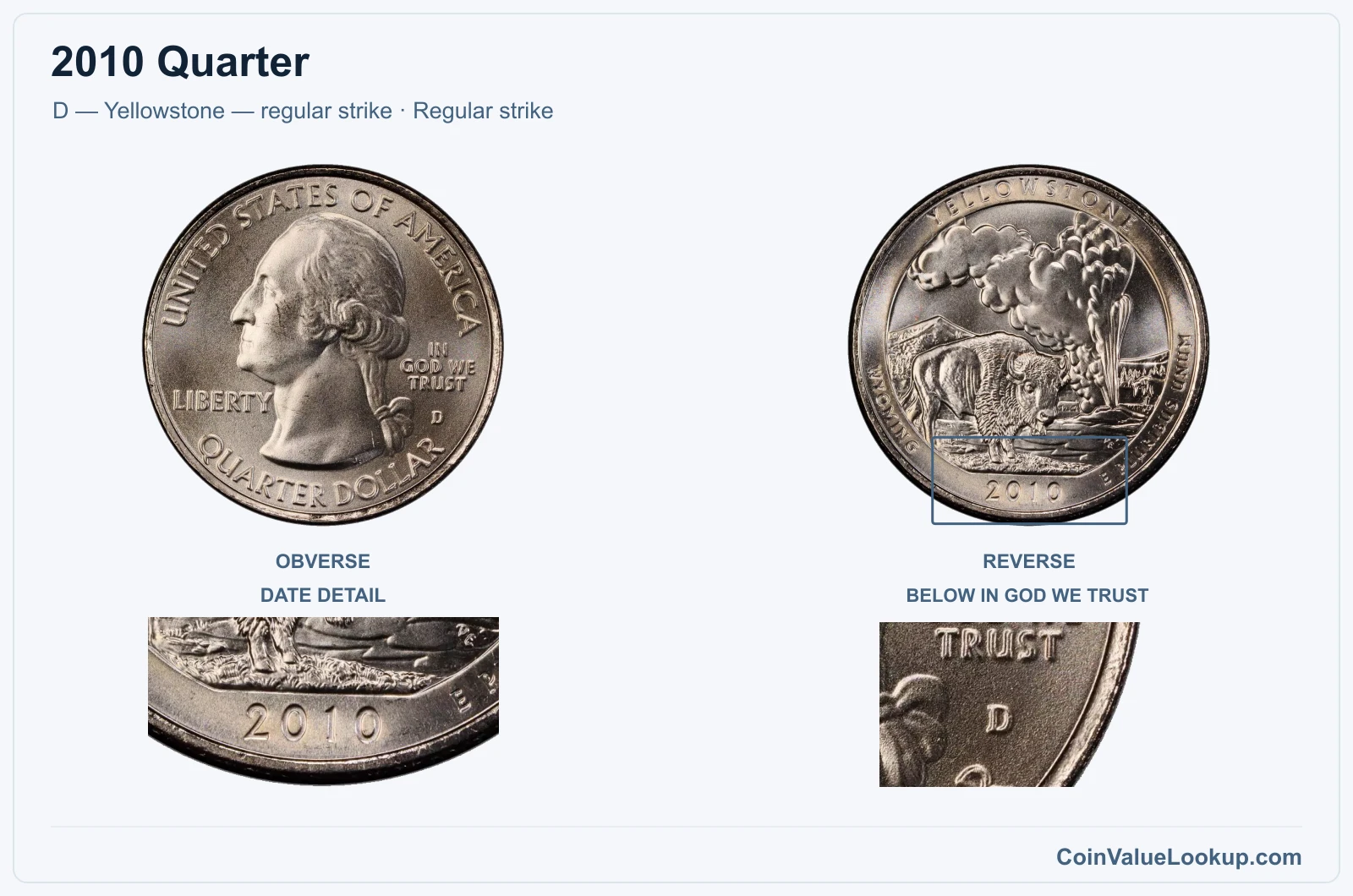
Denver business strike, Yellowstone reverse. Copper-nickel clad, "D" mintmark on the obverse.
Same specifications as the P-mint version.
USA Coin Book lists about $0.74 at MS60 and $1.24 at MS65. Worn pieces trade at face value.
Confirm both the mintmark and the Yellowstone reverse before referencing these guide figures.
Range Grade
Price Auction Records Appraisal PO PO 1
—
Coin Identifier FR FR 2
—
Coin Identifier AG AG 3
—
Coin Identifier G G 4
—
Coin Identifier
G 6
—
Coin Identifier VG VG 8
—
Coin Identifier
VG 10
—
Coin Identifier F F 12
—
Coin Identifier
F 15
—
Coin Identifier VF VF 20
—
Coin Identifier
VF 25
—
Coin Identifier
VF 30
—
Coin Identifier
VF 35
—
Coin Identifier XF XF 40
—
Coin Identifier
XF 45
—
Coin Identifier AU AU 50
—
Coin Identifier
AU 53
—
Coin Identifier
AU 55
—
Coin Identifier
AU 58
—
Coin Identifier MS MS 60
—
Coin Identifier
MS 61
—
Coin Identifier
MS 62
—
Coin Identifier
MS 63
—
Coin Identifier
MS 64
—
Coin Identifier
MS 65
Coin Identifier
MS 66
—
Coin Identifier
MS 67
Coin Identifier
MS 68
—
Coin Identifier
MS 69
—
—
—
MS 70
—
—
—
2010 Quarter — D — Yellowstone — satin finish
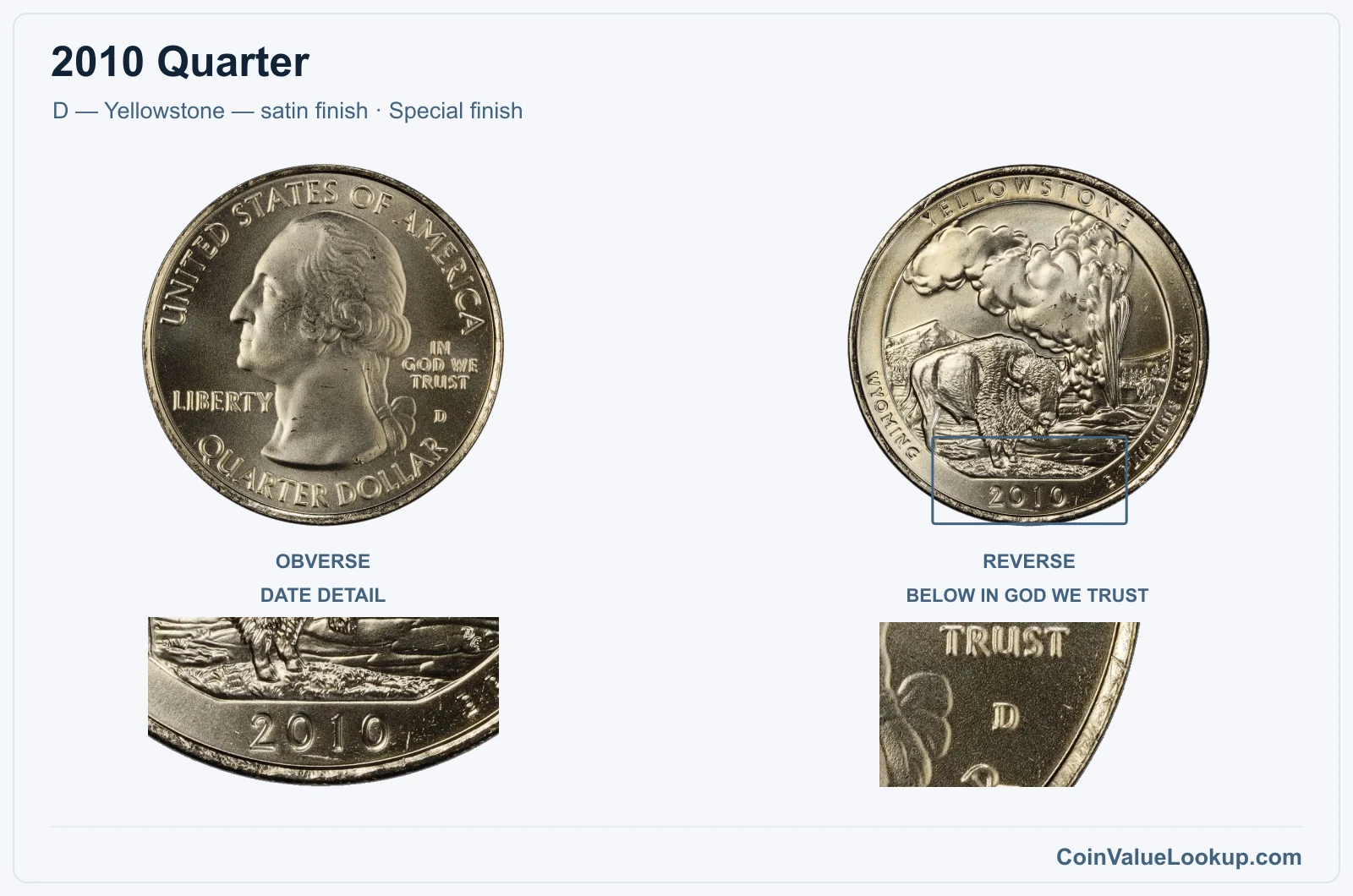
The D-mint Yellowstone satin finish came in the 2010 uncirculated mint set. Like all satin-finish quarters from this year, it has a controlled, fine-textured surface that is neither a normal luster nor a proof mirror.
No adopted guide price exists. Individual value depends on authenticated attribution and condition.
If you suspect you have one, compare the surface carefully to known satin examples rather than guessing from overall dullness.
Range Grade
Price Auction Records Appraisal SP SP 1
—
Coin Identifier
SP 2
—
Coin Identifier
SP 3
—
Coin Identifier
SP 4
—
Coin Identifier
SP 6
—
Coin Identifier
SP 8
—
Coin Identifier
SP 10
—
Coin Identifier
SP 12
—
Coin Identifier
SP 15
—
Coin Identifier
SP 20
—
Coin Identifier
SP 25
—
Coin Identifier
SP 30
—
Coin Identifier
SP 35
—
Coin Identifier
SP 40
—
Coin Identifier
SP 45
—
Coin Identifier
SP 50
—
Coin Identifier
SP 53
—
Coin Identifier
SP 55
—
Coin Identifier
SP 58
—
Coin Identifier
SP 60
—
Coin Identifier
SP 61
—
Coin Identifier
SP 62
—
Coin Identifier
SP 63
—
Coin Identifier
SP 64
—
Coin Identifier
SP 65
—
Coin Identifier
SP 66
—
Coin Identifier
SP 67
—
Coin Identifier
SP 68
—
Coin Identifier
SP 69
—
Coin Identifier
SP 70
—
—
—
2010 Quarter — S — Yellowstone — clad proof
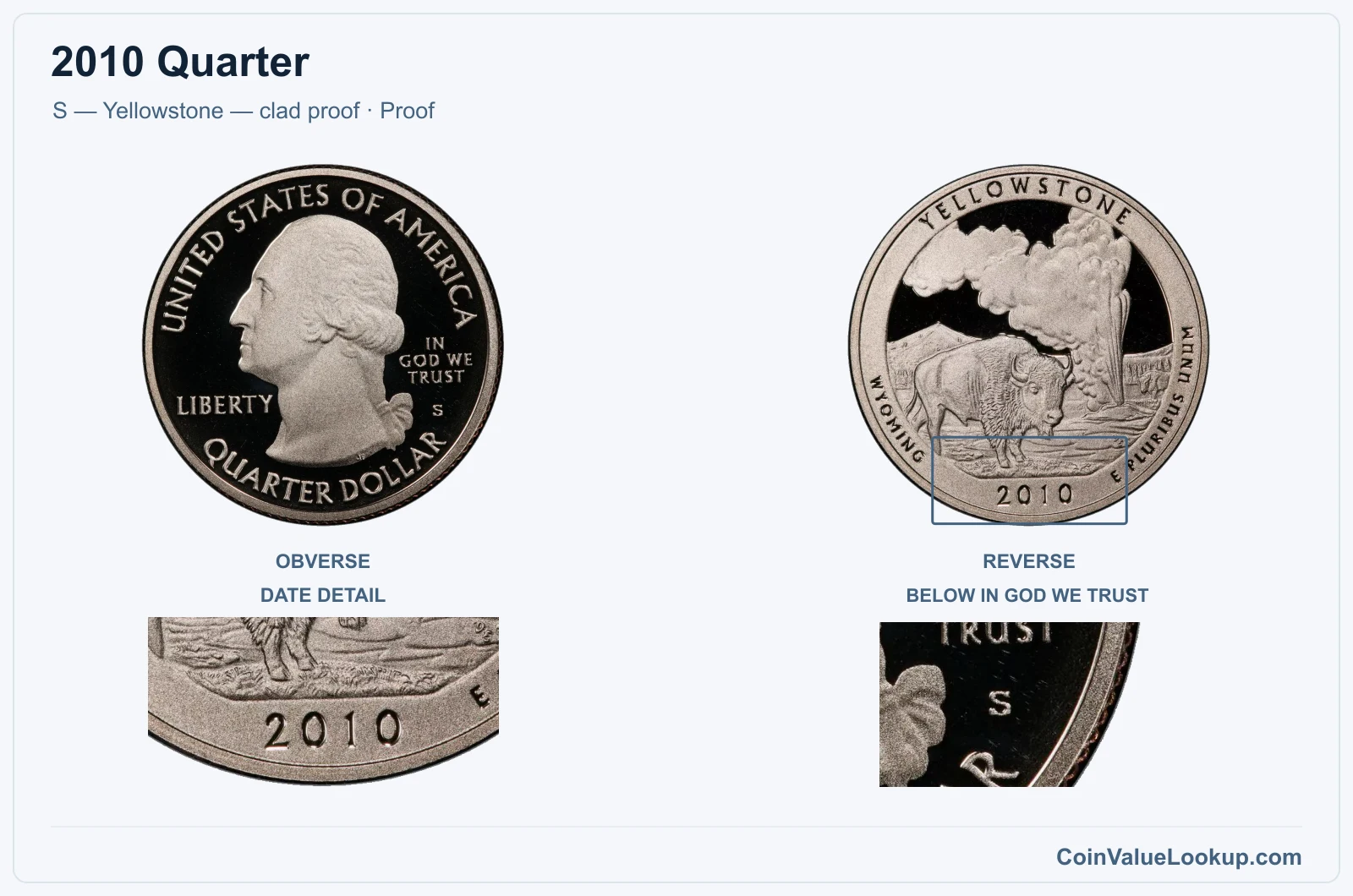
San Francisco clad proof with the Yellowstone reverse. Copper-nickel clad composition, mirror fields, frosted design elements.
This came in the standard 2010 proof set.
USA Coin Book estimates about $5.63 at PR65. Verify the clad composition through edge inspection or weight before applying this figure — the silver proof version carries a different value entirely.
Range Grade
Price Auction Records Appraisal PR PR 1
—
Coin Identifier
PR 2
—
Coin Identifier
PR 3
—
Coin Identifier
PR 4
—
Coin Identifier
PR 6
—
Coin Identifier
PR 8
—
Coin Identifier
PR 10
—
Coin Identifier
PR 12
—
Coin Identifier
PR 15
—
Coin Identifier
PR 20
—
Coin Identifier
PR 25
—
Coin Identifier
PR 30
—
Coin Identifier
PR 35
—
Coin Identifier
PR 40
—
Coin Identifier
PR 45
—
Coin Identifier
PR 50
—
Coin Identifier
PR 53
—
Coin Identifier
PR 55
—
Coin Identifier
PR 58
—
Coin Identifier
PR 60
—
Coin Identifier
PR 61
—
Coin Identifier
PR 62
—
Coin Identifier
PR 63
—
Coin Identifier
PR 64
—
Coin Identifier
PR 65
—
Coin Identifier
PR 66
—
Coin Identifier
PR 67
—
Coin Identifier
PR 68
—
Coin Identifier
PR 69
Coin Identifier
PR 70
Coin Identifier
2010 Quarter — S — Yellowstone — silver proof
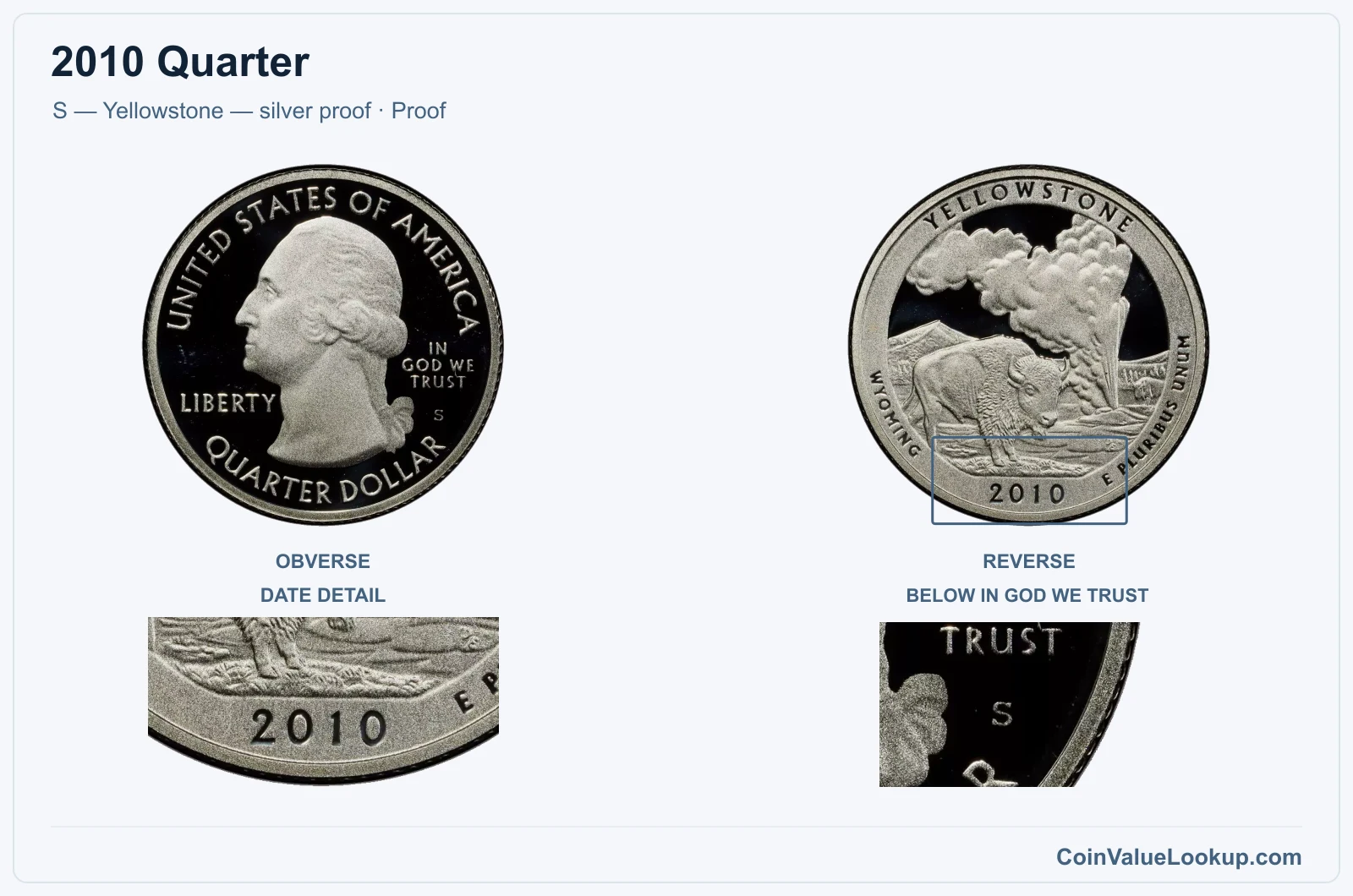
The Yellowstone silver proof is 90% silver, nominally 6.25 g, with a uniform silver-gray edge. It was part of the 2010 silver proof set from San Francisco.
USA Coin Book estimates $23.00 at PR65. The silver content alone gives this coin intrinsic value above face.
Confirm composition through weight or edge color — a clad proof looks nearly identical from the front but is worth considerably less.
Range Grade
Price Auction Records Appraisal PR PR 1
—
Coin Identifier
PR 2
—
Coin Identifier
PR 3
—
Coin Identifier
PR 4
—
Coin Identifier
PR 6
—
Coin Identifier
PR 8
—
Coin Identifier
PR 10
—
Coin Identifier
PR 12
—
Coin Identifier
PR 15
—
Coin Identifier
PR 20
—
Coin Identifier
PR 25
—
Coin Identifier
PR 30
—
Coin Identifier
PR 35
—
Coin Identifier
PR 40
—
Coin Identifier
PR 45
—
Coin Identifier
PR 50
—
Coin Identifier
PR 53
—
Coin Identifier
PR 55
—
Coin Identifier
PR 58
—
Coin Identifier
PR 60
—
Coin Identifier
PR 61
—
Coin Identifier
PR 62
—
Coin Identifier
PR 63
—
Coin Identifier
PR 64
—
Coin Identifier
PR 65
—
Coin Identifier
PR 66
—
Coin Identifier
PR 67
—
Coin Identifier
PR 68
—
Coin Identifier
PR 69
Coin Identifier
PR 70
Coin Identifier
2010 Quarter — P — Yosemite — regular strike
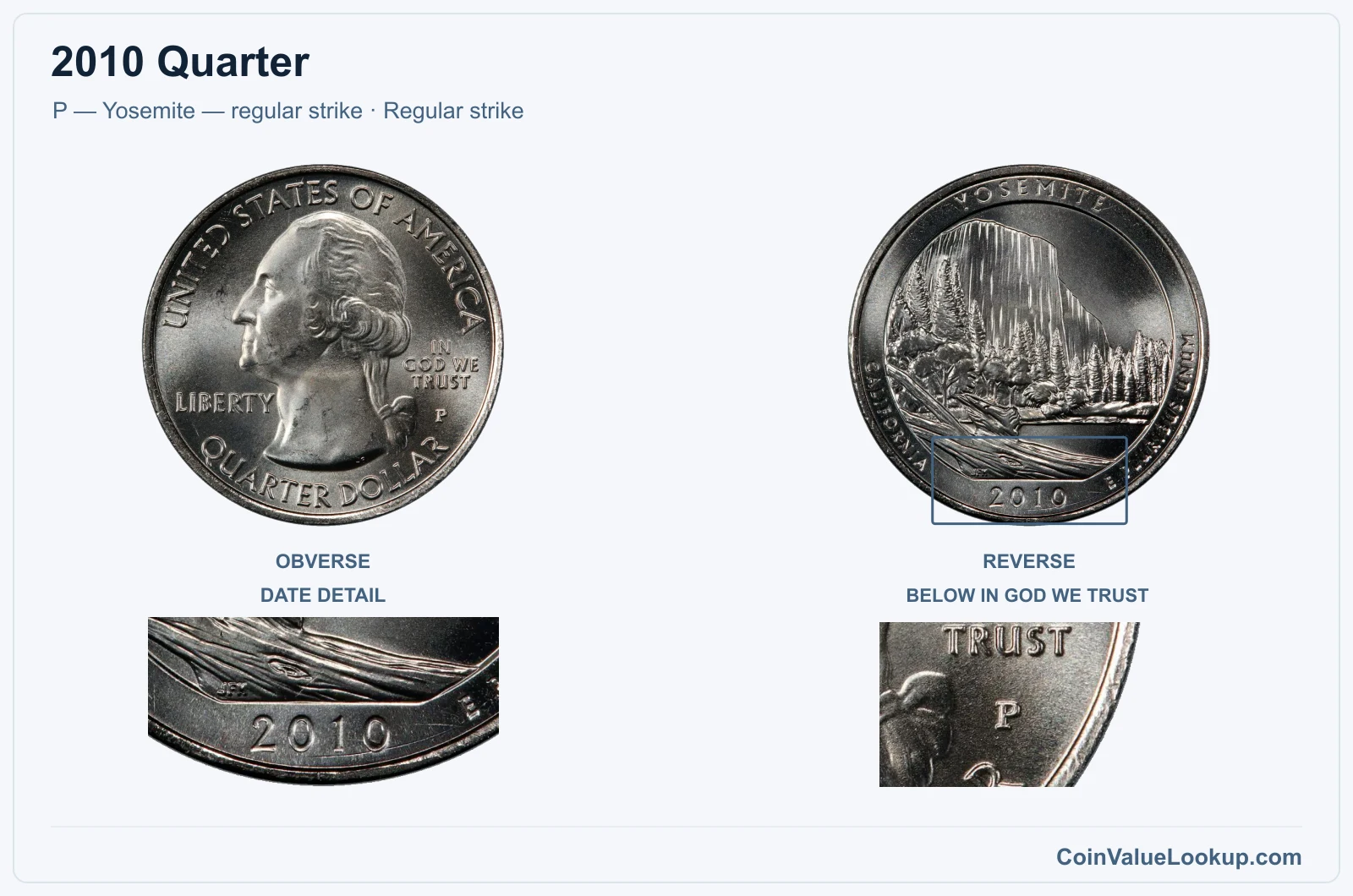
Philadelphia business strike with the Yosemite reverse showing El Capitan. Copper-nickel clad, standard 24.26 mm and 5.67 g.
USA Coin Book estimates about $0.74 at MS60 and $1.24 at MS65. These circulated freely.
A well-worn example is a spender, not a collectible, so condition matters if you are hoping for above-face value.
Range Grade
Price Auction Records Appraisal PO PO 1
—
Coin Identifier FR FR 2
—
Coin Identifier AG AG 3
—
Coin Identifier G G 4
—
Coin Identifier
G 6
—
Coin Identifier VG VG 8
—
Coin Identifier
VG 10
—
Coin Identifier F F 12
—
Coin Identifier
F 15
—
Coin Identifier VF VF 20
—
Coin Identifier
VF 25
—
Coin Identifier
VF 30
—
Coin Identifier
VF 35
—
Coin Identifier XF XF 40
—
Coin Identifier
XF 45
—
Coin Identifier AU AU 50
—
Coin Identifier
AU 53
—
Coin Identifier
AU 55
—
Coin Identifier
AU 58
—
Coin Identifier MS MS 60
—
Coin Identifier
MS 61
—
Coin Identifier
MS 62
—
Coin Identifier
MS 63
—
Coin Identifier
MS 64
—
Coin Identifier
MS 65
—
Coin Identifier
MS 66
Coin Identifier
MS 67
Coin Identifier
MS 68
—
—
—
MS 69
—
—
—
MS 70
—
—
—
2010 Quarter — P — Yosemite — satin finish
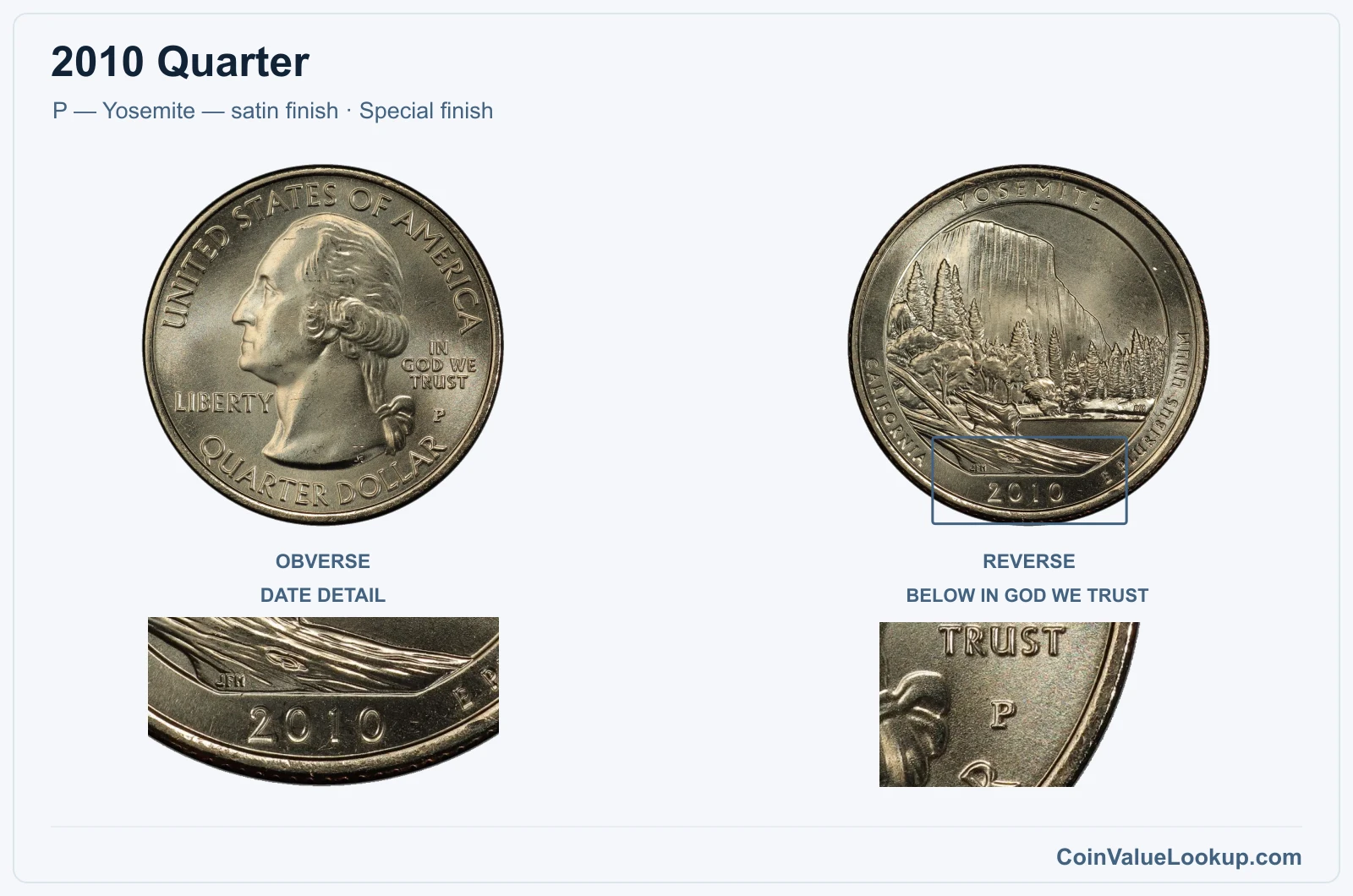
P-mint Yosemite satin finish, distributed in the 2010 uncirculated mint set. The fine-grained surface texture is the key identifier — it is deliberate, not the result of wear or cleaning.
No guide price is adopted for this version. Its value depends on confirmed satin attribution and overall condition.
If your coin came from an opened mint set and you can verify the texture under magnification, you may have something worth further assessment.
Range Grade
Price Auction Records Appraisal SP SP 1
—
Coin Identifier
SP 2
—
Coin Identifier
SP 3
—
Coin Identifier
SP 4
—
Coin Identifier
SP 6
—
Coin Identifier
SP 8
—
Coin Identifier
SP 10
—
Coin Identifier
SP 12
—
Coin Identifier
SP 15
—
Coin Identifier
SP 20
—
Coin Identifier
SP 25
—
Coin Identifier
SP 30
—
Coin Identifier
SP 35
—
Coin Identifier
SP 40
—
Coin Identifier
SP 45
—
Coin Identifier
SP 50
—
Coin Identifier
SP 53
—
Coin Identifier
SP 55
—
Coin Identifier
SP 58
—
Coin Identifier
SP 60
—
Coin Identifier
SP 61
—
Coin Identifier
SP 62
—
Coin Identifier
SP 63
—
Coin Identifier
SP 64
—
Coin Identifier
SP 65
—
Coin Identifier
SP 66
—
Coin Identifier
SP 67
—
Coin Identifier
SP 68
—
Coin Identifier
SP 69
—
Coin Identifier
SP 70
—
—
—
2010 Quarter — D — Yosemite — regular strike
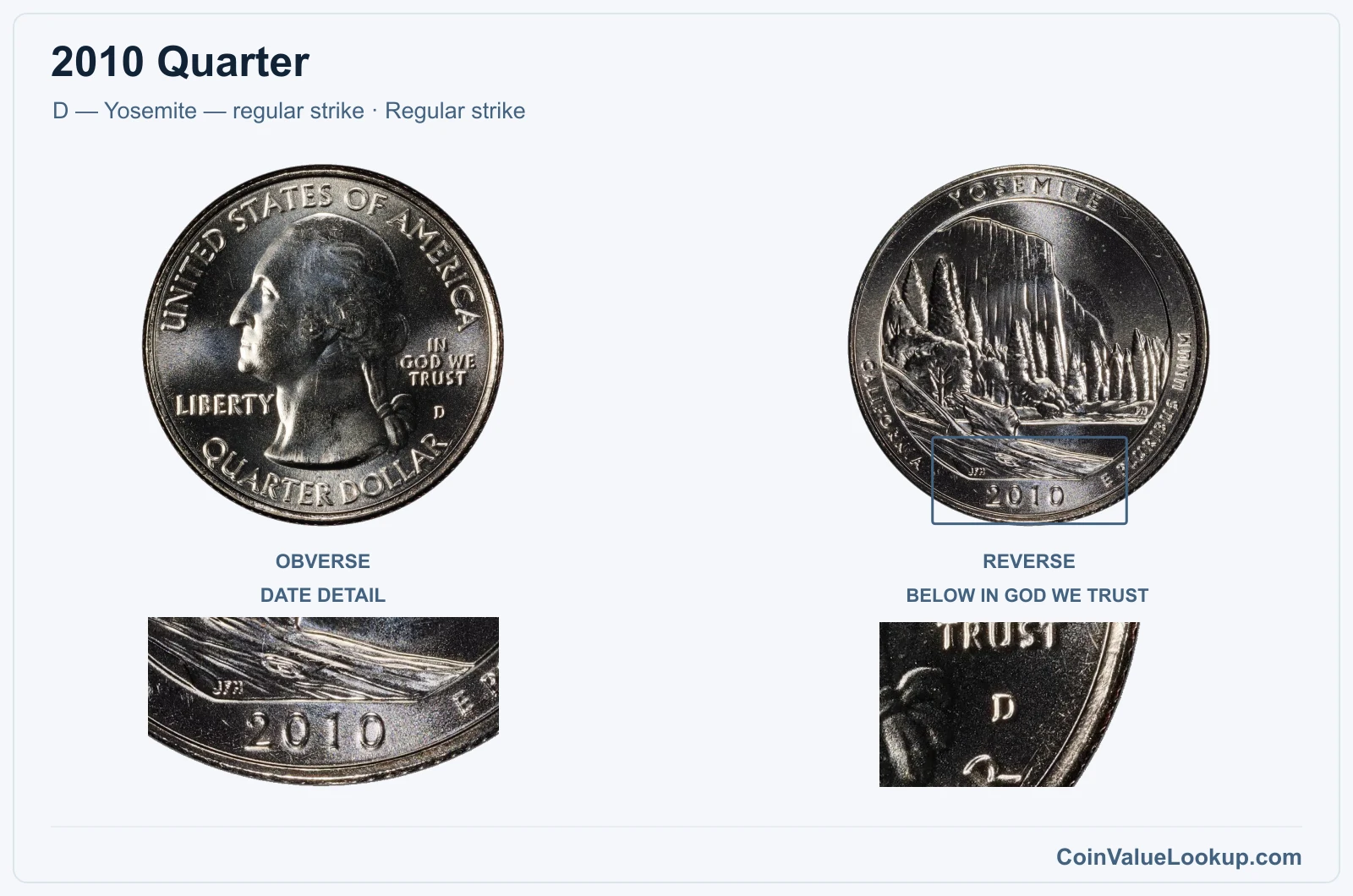
Denver business strike, Yosemite reverse. Look for the "D" mintmark near Washington's portrait.
Standard copper-nickel clad quarter.
USA Coin Book estimates about $0.74 at MS60 and $1.24 at MS65. As with other circulating 2010 quarters, worn examples are worth 25 cents.
Only original, uncirculated pieces carry the guide premium.
Range Grade
Price Auction Records Appraisal PO PO 1
—
Coin Identifier FR FR 2
—
Coin Identifier AG AG 3
—
Coin Identifier G G 4
—
Coin Identifier
G 6
—
Coin Identifier VG VG 8
—
Coin Identifier
VG 10
—
Coin Identifier F F 12
—
Coin Identifier
F 15
—
Coin Identifier VF VF 20
—
Coin Identifier
VF 25
—
Coin Identifier
VF 30
—
Coin Identifier
VF 35
—
Coin Identifier XF XF 40
—
Coin Identifier
XF 45
—
Coin Identifier AU AU 50
—
Coin Identifier
AU 53
—
Coin Identifier
AU 55
—
Coin Identifier
AU 58
—
Coin Identifier MS MS 60
—
Coin Identifier
MS 61
—
Coin Identifier
MS 62
—
Coin Identifier
MS 63
—
Coin Identifier
MS 64
—
Coin Identifier
MS 65
—
Coin Identifier
MS 66
—
Coin Identifier
MS 67
Coin Identifier
MS 68
—
—
—
MS 69
—
—
—
MS 70
—
—
—
2010 Quarter — D — Yosemite — satin finish
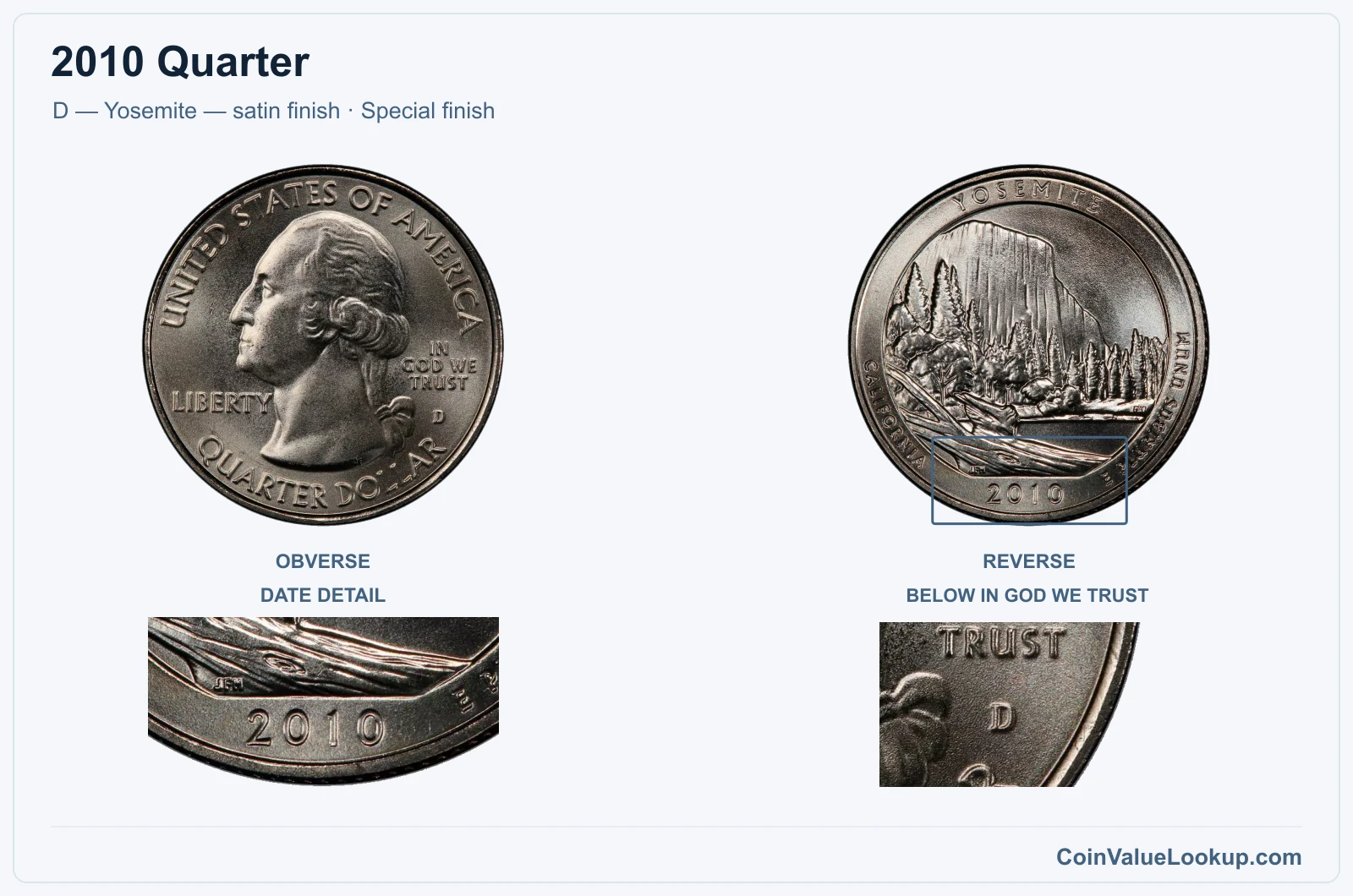
D-mint Yosemite satin finish, from the 2010 uncirculated mint set. The surface is distinct from both normal strikes and proofs — a soft, matte-like grain produced during manufacturing.
No adopted guide price is available. Determining value requires authenticated identity and a condition assessment.
Do not rely on color or perceived dullness alone to attribute a satin finish.
Range Grade
Price Auction Records Appraisal SP SP 1
—
Coin Identifier
SP 2
—
Coin Identifier
SP 3
—
Coin Identifier
SP 4
—
Coin Identifier
SP 6
—
Coin Identifier
SP 8
—
Coin Identifier
SP 10
—
Coin Identifier
SP 12
—
Coin Identifier
SP 15
—
Coin Identifier
SP 20
—
Coin Identifier
SP 25
—
Coin Identifier
SP 30
—
Coin Identifier
SP 35
—
Coin Identifier
SP 40
—
Coin Identifier
SP 45
—
Coin Identifier
SP 50
—
Coin Identifier
SP 53
—
Coin Identifier
SP 55
—
Coin Identifier
SP 58
—
Coin Identifier
SP 60
—
Coin Identifier
SP 61
—
Coin Identifier
SP 62
—
Coin Identifier
SP 63
—
Coin Identifier
SP 64
—
Coin Identifier
SP 65
—
Coin Identifier
SP 66
—
Coin Identifier
SP 67
—
Coin Identifier
SP 68
—
Coin Identifier
SP 69
Coin Identifier
SP 70
—
—
—
2010 Quarter — S — Yosemite — clad proof
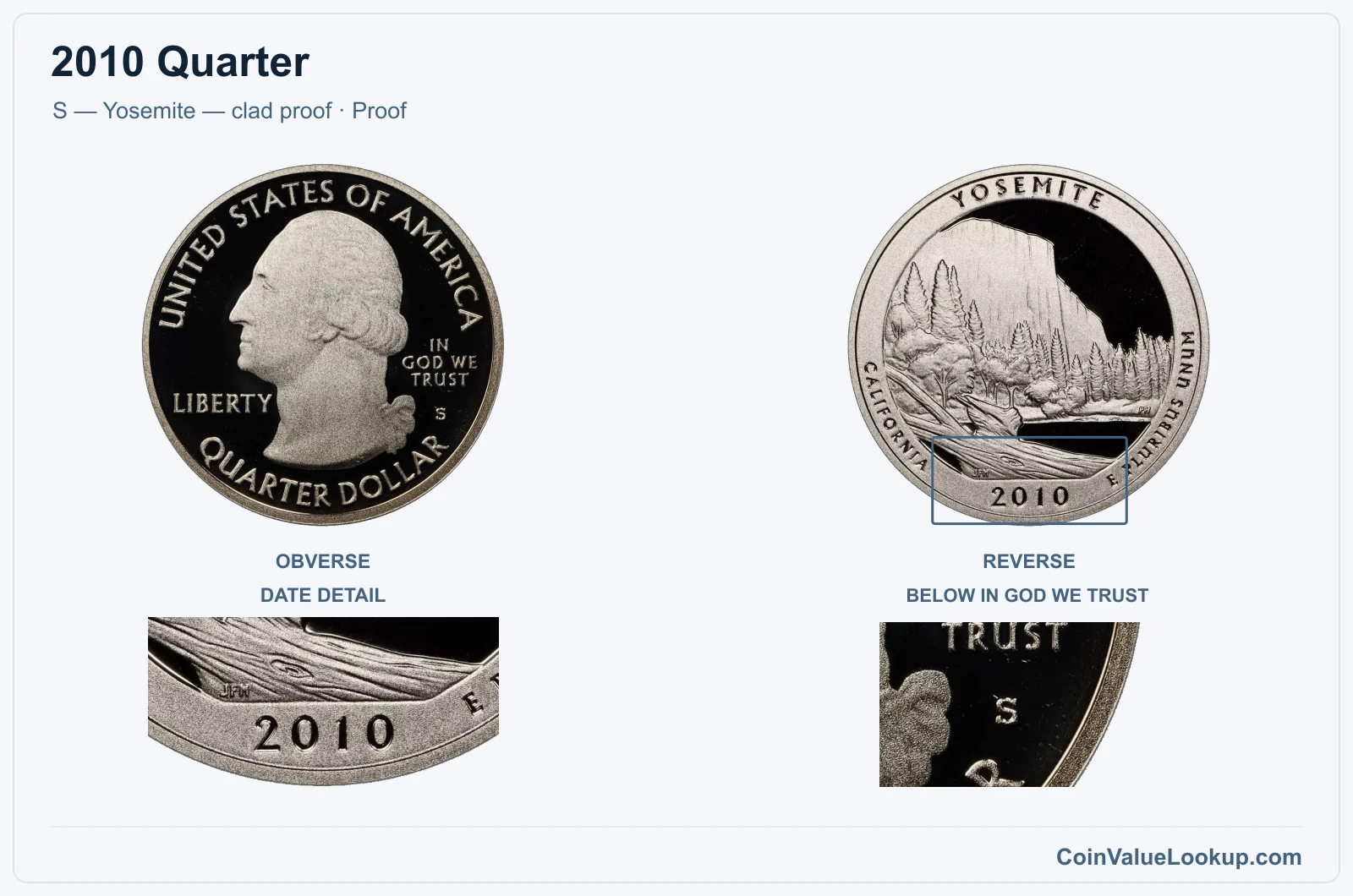
San Francisco clad proof, Yosemite reverse. Mirror fields and frosted devices on a copper-nickel clad planchet.
Sold in the 2010 standard proof set.
USA Coin Book lists about $5.63 at PR65. Check the edge for the telltale clad layering to distinguish it from the silver version.
Handle proofs by the edge — fingerprints on the mirror fields lower eye appeal and can affect grade.
Range Grade
Price Auction Records Appraisal PR PR 1
—
Coin Identifier
PR 2
—
Coin Identifier
PR 3
—
Coin Identifier
PR 4
—
Coin Identifier
PR 6
—
Coin Identifier
PR 8
—
Coin Identifier
PR 10
—
Coin Identifier
PR 12
—
Coin Identifier
PR 15
—
Coin Identifier
PR 20
—
Coin Identifier
PR 25
—
Coin Identifier
PR 30
—
Coin Identifier
PR 35
—
Coin Identifier
PR 40
—
Coin Identifier
PR 45
—
Coin Identifier
PR 50
—
Coin Identifier
PR 53
—
Coin Identifier
PR 55
—
Coin Identifier
PR 58
—
Coin Identifier
PR 60
—
Coin Identifier
PR 61
—
Coin Identifier
PR 62
—
Coin Identifier
PR 63
—
Coin Identifier
PR 64
—
Coin Identifier
PR 65
—
Coin Identifier
PR 66
—
Coin Identifier
PR 67
—
Coin Identifier
PR 68
—
Coin Identifier
PR 69
Coin Identifier
PR 70
Coin Identifier
2010 Quarter — S — Yosemite — silver proof
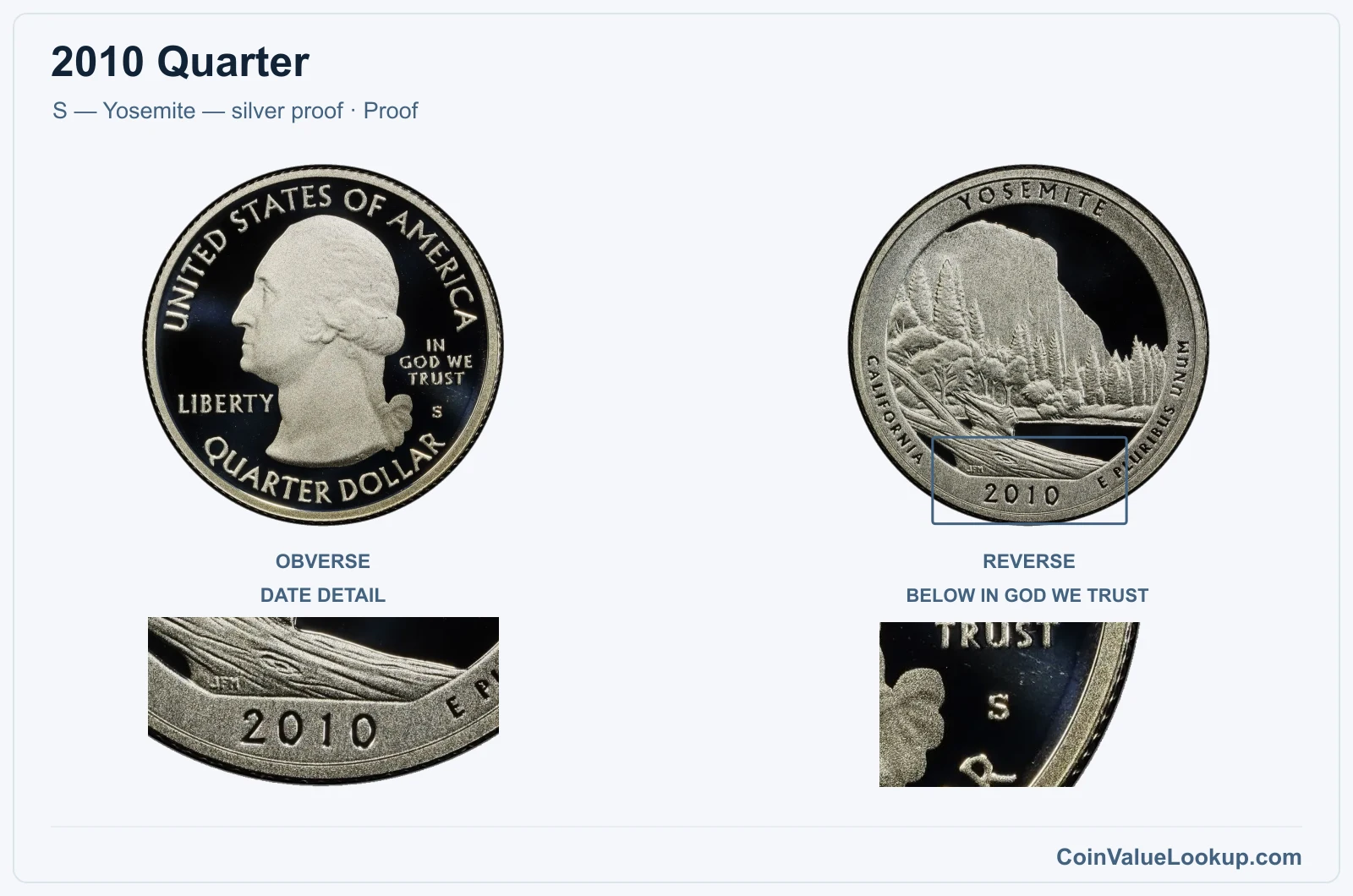
The Yosemite silver proof is 90% silver, 10% copper, with a nominal weight of 6.25 g. Its edge is solid silver-gray.
This came in the 2010 silver proof set.
USA Coin Book estimates $23.00 at PR65. Among the 2010 quarter versions with adopted guide prices, the silver proofs sit at the top.
Confirm the silver composition through edge color or weight, especially if the coin is loose and not in its original government packaging.
Coin Value Lookup is a good place to look up guides for other quarters in this series or different years. If you have a whole set to check, start there.
Range Grade
Price Auction Records Appraisal PR PR 1
—
Coin Identifier
PR 2
—
Coin Identifier
PR 3
—
Coin Identifier
PR 4
—
Coin Identifier
PR 6
—
Coin Identifier
PR 8
—
Coin Identifier
PR 10
—
Coin Identifier
PR 12
—
Coin Identifier
PR 15
—
Coin Identifier
PR 20
—
Coin Identifier
PR 25
—
Coin Identifier
PR 30
—
Coin Identifier
PR 35
—
Coin Identifier
PR 40
—
Coin Identifier
PR 45
—
Coin Identifier
PR 50
—
Coin Identifier
PR 53
—
Coin Identifier
PR 55
—
Coin Identifier
PR 58
—
Coin Identifier
PR 60
—
Coin Identifier
PR 61
—
Coin Identifier
PR 62
—
Coin Identifier
PR 63
—
Coin Identifier
PR 64
—
Coin Identifier
PR 65
—
Coin Identifier
PR 66
—
Coin Identifier
PR 67
—
Coin Identifier
PR 68
—
Coin Identifier
PR 69
Coin Identifier
PR 70
Coin Identifier
2010 Quarter — P — Grand Canyon — regular strike
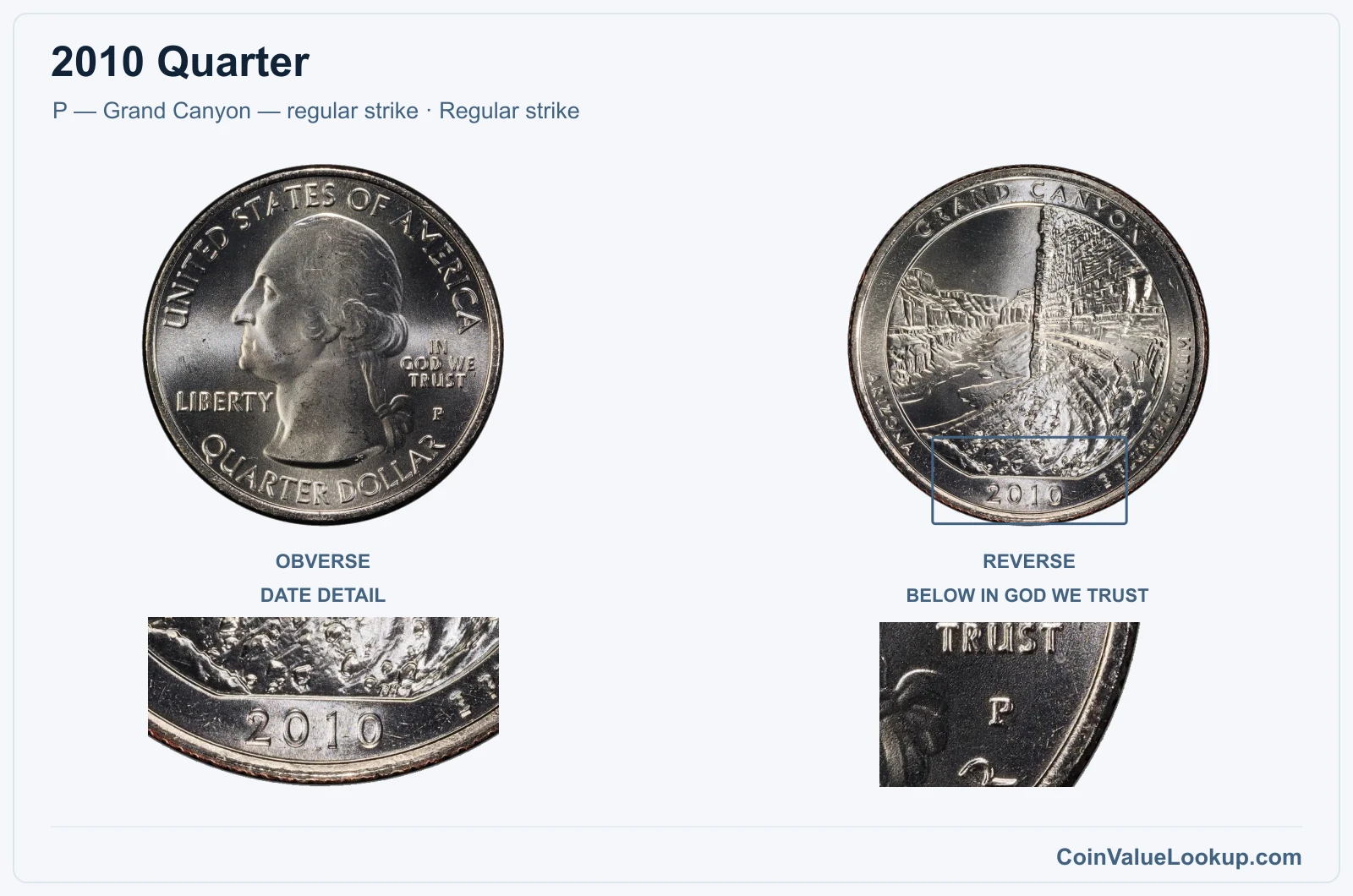
Philadelphia business strike with the Grand Canyon reverse. Copper-nickel clad, 24.26 mm, 5.67 g nominal.
The reverse shows a view of the canyon with the Colorado River.
USA Coin Book estimates roughly $0.74 at MS60 and $1.24 at MS65. Worn examples are face value.
Confirm the "P" mintmark and the Grand Canyon inscription on the reverse.
Range Grade
Price Auction Records Appraisal PO PO 1
—
Coin Identifier FR FR 2
—
Coin Identifier AG AG 3
—
Coin Identifier G G 4
—
Coin Identifier
G 6
—
Coin Identifier VG VG 8
—
Coin Identifier
VG 10
—
Coin Identifier F F 12
—
Coin Identifier
F 15
—
Coin Identifier VF VF 20
—
Coin Identifier
VF 25
—
Coin Identifier
VF 30
—
Coin Identifier
VF 35
—
Coin Identifier XF XF 40
—
Coin Identifier
XF 45
—
Coin Identifier AU AU 50
—
Coin Identifier
AU 53
—
Coin Identifier
AU 55
—
Coin Identifier
AU 58
—
Coin Identifier MS MS 60
—
Coin Identifier
MS 61
—
Coin Identifier
MS 62
—
Coin Identifier
MS 63
—
Coin Identifier
MS 64
—
Coin Identifier
MS 65
—
Coin Identifier
MS 66
—
Coin Identifier
MS 67
—
Coin Identifier
MS 68
—
Coin Identifier
MS 69
—
—
—
MS 70
—
—
—
2010 Quarter — P — Grand Canyon — satin finish
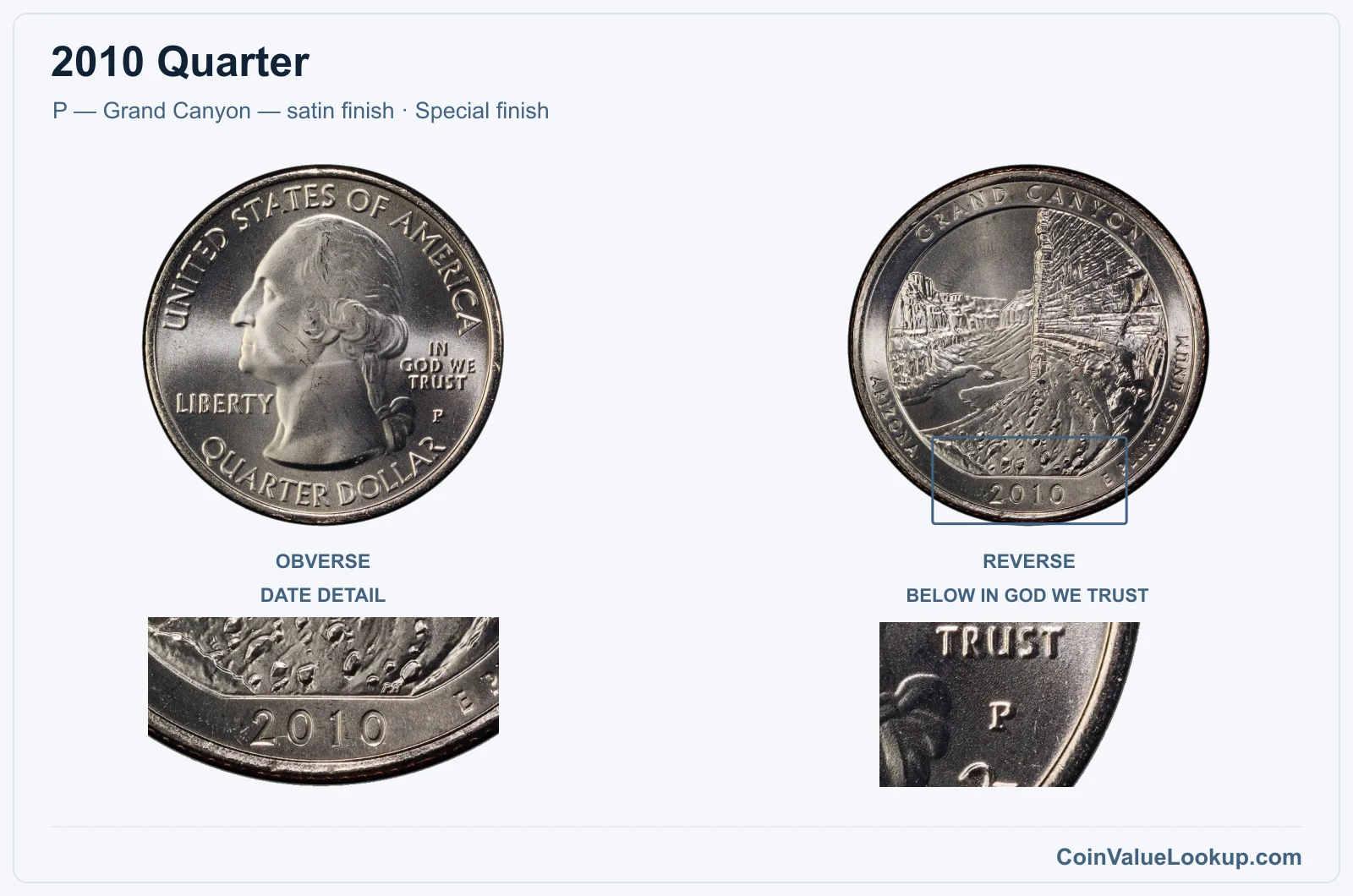
P-mint Grand Canyon satin finish, packaged in the 2010 uncirculated mint set. The surface has that controlled fine grain exclusive to the satin manufacturing process.
No guide price is adopted. Value requires confirmed satin attribution and a condition review.
If you are comparing it to a normal strike, look at the luster pattern — satin finishes lack the strong cartwheel reflection seen on business strikes.
Range Grade
Price Auction Records Appraisal SP SP 1
—
Coin Identifier
SP 2
—
Coin Identifier
SP 3
—
Coin Identifier
SP 4
—
Coin Identifier
SP 6
—
Coin Identifier
SP 8
—
Coin Identifier
SP 10
—
Coin Identifier
SP 12
—
Coin Identifier
SP 15
—
Coin Identifier
SP 20
—
Coin Identifier
SP 25
—
Coin Identifier
SP 30
—
Coin Identifier
SP 35
—
Coin Identifier
SP 40
—
Coin Identifier
SP 45
—
Coin Identifier
SP 50
—
Coin Identifier
SP 53
—
Coin Identifier
SP 55
—
Coin Identifier
SP 58
—
Coin Identifier
SP 60
—
Coin Identifier
SP 61
—
Coin Identifier
SP 62
—
Coin Identifier
SP 63
—
Coin Identifier
SP 64
—
Coin Identifier
SP 65
—
Coin Identifier
SP 66
—
Coin Identifier
SP 67
—
Coin Identifier
SP 68
—
Coin Identifier
SP 69
Coin Identifier
SP 70
—
—
—
2010 Quarter — D — Grand Canyon — regular strike
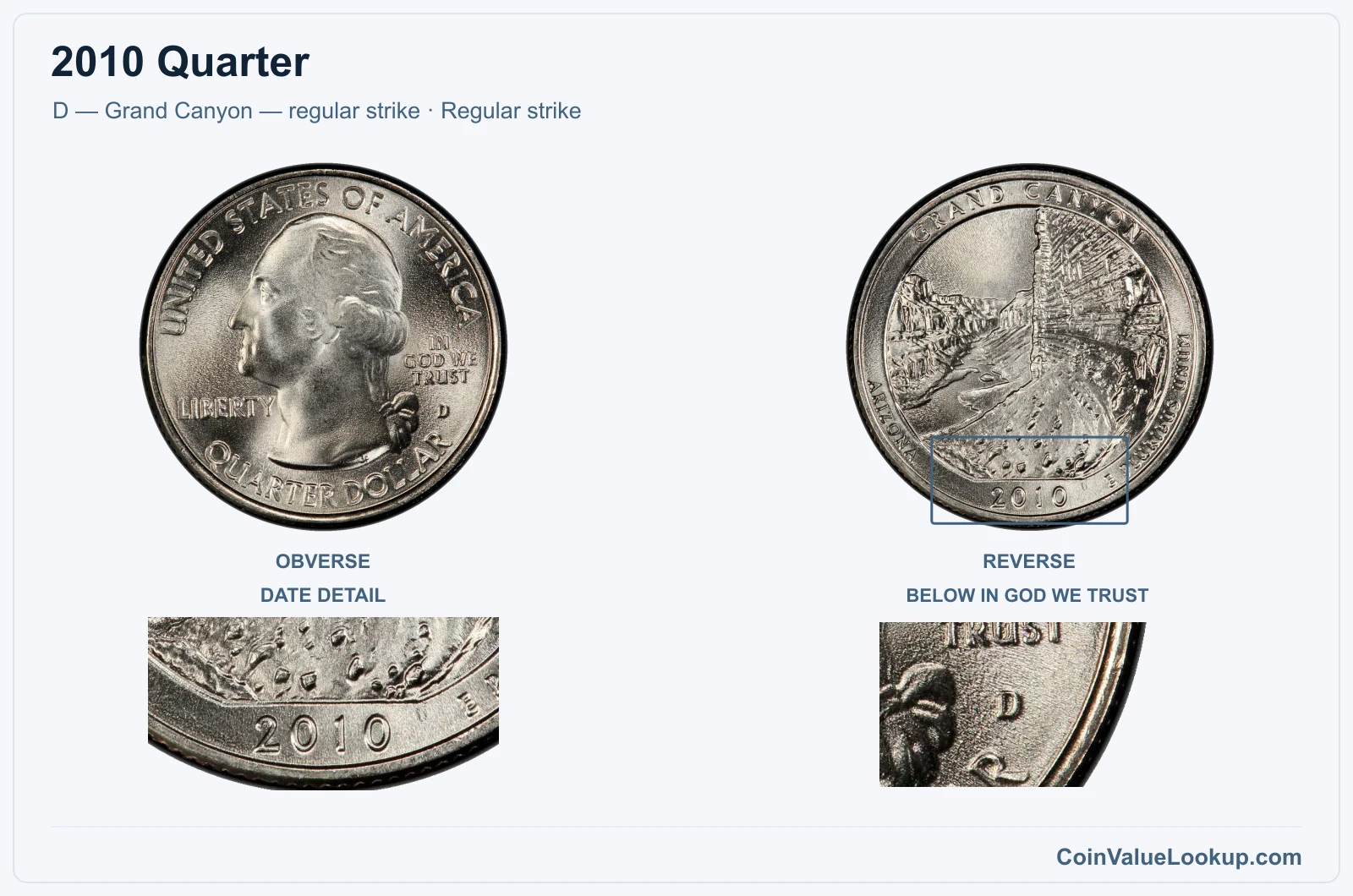
Denver business strike, Grand Canyon reverse. Copper-nickel clad, "D" mintmark on the obverse.
Common in circulation.
USA Coin Book lists about $0.74 at MS60 and $1.24 at MS65. Below uncirculated condition, this is a 25-cent coin.
Only well-preserved, original-surface examples carry the guide premium.
Range Grade
Price Auction Records Appraisal PO PO 1
—
Coin Identifier FR FR 2
—
Coin Identifier AG AG 3
—
Coin Identifier G G 4
—
Coin Identifier
G 6
—
Coin Identifier VG VG 8
—
Coin Identifier
VG 10
—
Coin Identifier F F 12
—
Coin Identifier
F 15
—
Coin Identifier VF VF 20
—
Coin Identifier
VF 25
—
Coin Identifier
VF 30
—
Coin Identifier
VF 35
—
Coin Identifier XF XF 40
—
Coin Identifier
XF 45
—
Coin Identifier AU AU 50
—
Coin Identifier
AU 53
—
Coin Identifier
AU 55
—
Coin Identifier
AU 58
—
Coin Identifier MS MS 60
—
Coin Identifier
MS 61
—
Coin Identifier
MS 62
—
Coin Identifier
MS 63
—
Coin Identifier
MS 64
—
Coin Identifier
MS 65
—
Coin Identifier
MS 66
—
Coin Identifier
MS 67
Coin Identifier
MS 68
Coin Identifier
MS 69
—
—
—
MS 70
—
—
—
2010 Quarter — D — Grand Canyon — satin finish
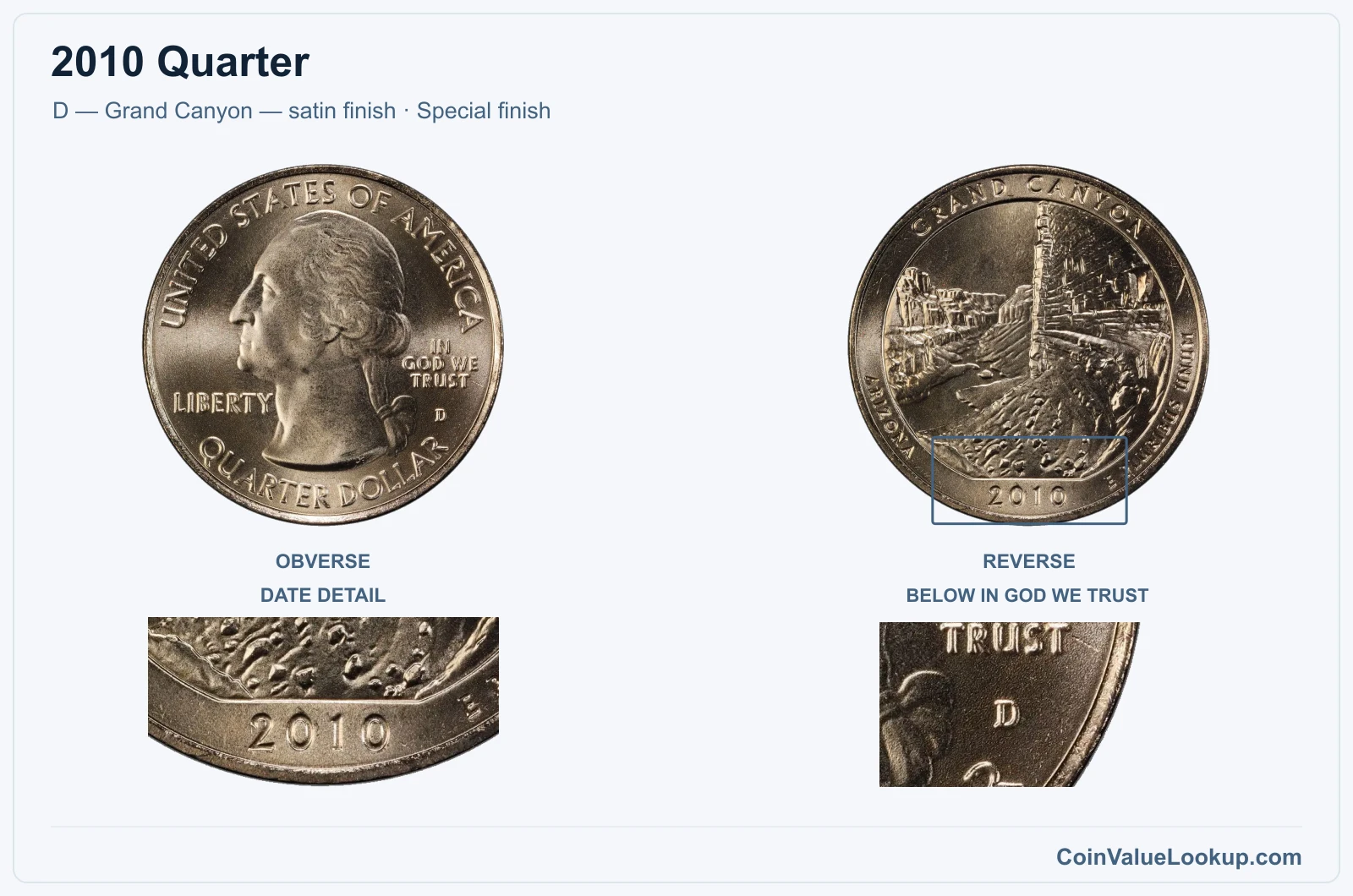
D-mint Grand Canyon satin finish from the 2010 uncirculated mint set. Same composition as a business strike, but the intentionally textured surface sets it apart.
No adopted guide price. Value depends on authenticated satin-finish identity and condition.
A dull or lightly circulated coin is not the same thing as a genuine satin specimen.
Range Grade
Price Auction Records Appraisal SP SP 1
—
Coin Identifier
SP 2
—
Coin Identifier
SP 3
—
Coin Identifier
SP 4
—
Coin Identifier
SP 6
—
Coin Identifier
SP 8
—
Coin Identifier
SP 10
—
Coin Identifier
SP 12
—
Coin Identifier
SP 15
—
Coin Identifier
SP 20
—
Coin Identifier
SP 25
—
Coin Identifier
SP 30
—
Coin Identifier
SP 35
—
Coin Identifier
SP 40
—
Coin Identifier
SP 45
—
Coin Identifier
SP 50
—
Coin Identifier
SP 53
—
Coin Identifier
SP 55
—
Coin Identifier
SP 58
—
Coin Identifier
SP 60
—
Coin Identifier
SP 61
—
Coin Identifier
SP 62
—
Coin Identifier
SP 63
—
Coin Identifier
SP 64
—
Coin Identifier
SP 65
—
Coin Identifier
SP 66
—
Coin Identifier
SP 67
—
Coin Identifier
SP 68
—
Coin Identifier
SP 69
—
Coin Identifier
SP 70
—
—
—
2010 Quarter — S — Grand Canyon — clad proof
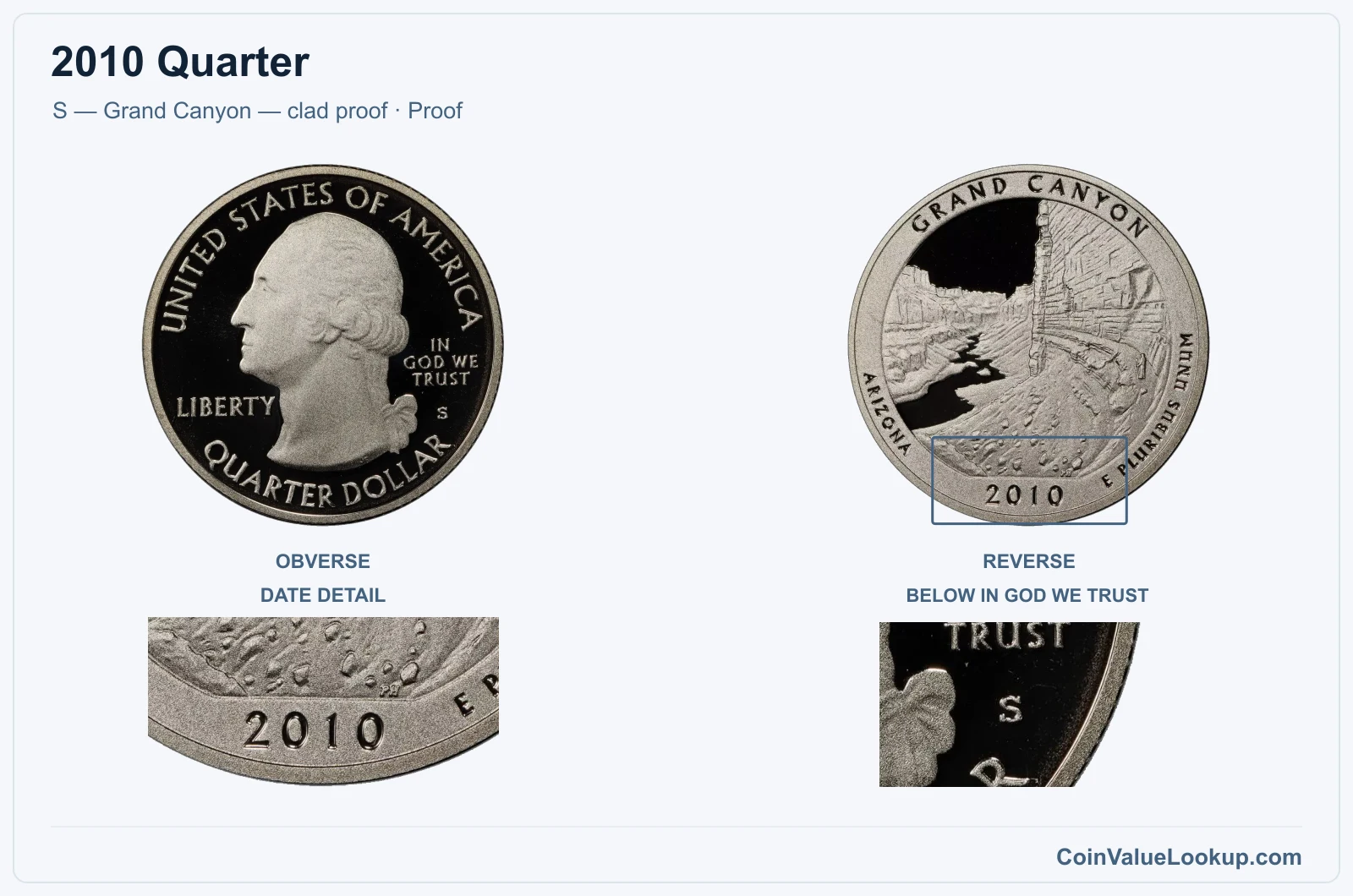
San Francisco clad proof, Grand Canyon reverse. Copper-nickel clad composition with proof mirror fields and frosted devices.
From the 2010 standard proof set.
USA Coin Book estimates about $5.63 at PR65. Distinguish it from the silver proof by checking the edge — visible clad layers mean it is the copper-nickel version.
Range Grade
Price Auction Records Appraisal PR PR 1
—
Coin Identifier
PR 2
—
Coin Identifier
PR 3
—
Coin Identifier
PR 4
—
Coin Identifier
PR 6
—
Coin Identifier
PR 8
—
Coin Identifier
PR 10
—
Coin Identifier
PR 12
—
Coin Identifier
PR 15
—
Coin Identifier
PR 20
—
Coin Identifier
PR 25
—
Coin Identifier
PR 30
—
Coin Identifier
PR 35
—
Coin Identifier
PR 40
—
Coin Identifier
PR 45
—
Coin Identifier
PR 50
—
Coin Identifier
PR 53
—
Coin Identifier
PR 55
—
Coin Identifier
PR 58
—
Coin Identifier
PR 60
—
Coin Identifier
PR 61
—
Coin Identifier
PR 62
—
Coin Identifier
PR 63
—
Coin Identifier
PR 64
—
Coin Identifier
PR 65
—
Coin Identifier
PR 66
—
Coin Identifier
PR 67
—
Coin Identifier
PR 68
—
Coin Identifier
PR 69
Coin Identifier
PR 70
Coin Identifier
2010 Quarter — S — Grand Canyon — silver proof
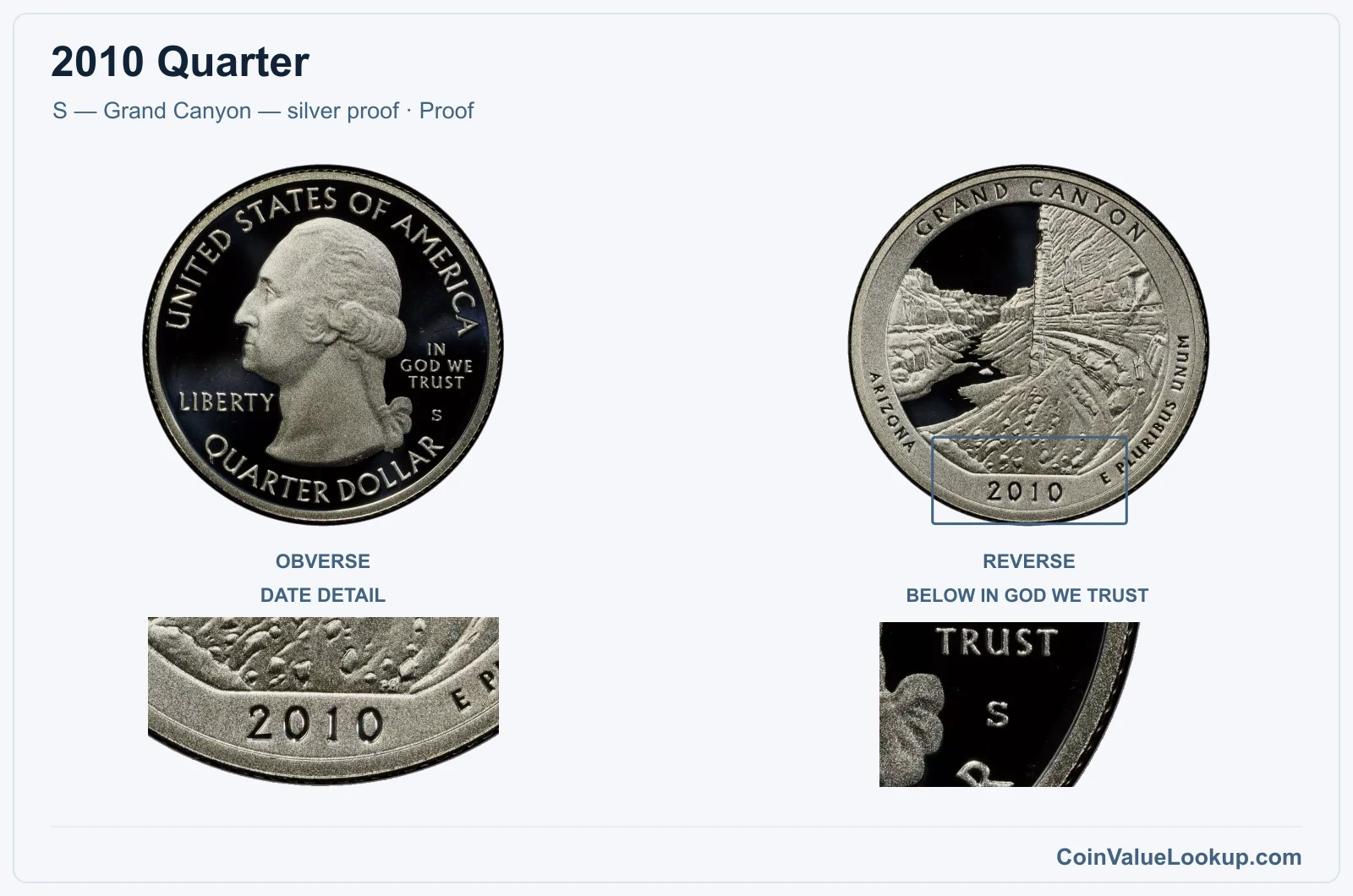
The Grand Canyon silver proof is 90% silver, nominally 6.25 g, with a solid silver-gray edge. Sold in the 2010 silver proof set.
USA Coin Book places this at $23.00 in PR65. The silver content and limited collector-set distribution give it a premium over the clad proof.
Confirm composition through edge inspection or weighing before assuming the higher value.
Range Grade
Price Auction Records Appraisal PR PR 1
—
Coin Identifier
PR 2
—
Coin Identifier
PR 3
—
Coin Identifier
PR 4
—
Coin Identifier
PR 6
—
Coin Identifier
PR 8
—
Coin Identifier
PR 10
—
Coin Identifier
PR 12
—
Coin Identifier
PR 15
—
Coin Identifier
PR 20
—
Coin Identifier
PR 25
—
Coin Identifier
PR 30
—
Coin Identifier
PR 35
—
Coin Identifier
PR 40
—
Coin Identifier
PR 45
—
Coin Identifier
PR 50
—
Coin Identifier
PR 53
—
Coin Identifier
PR 55
—
Coin Identifier
PR 58
—
Coin Identifier
PR 60
—
Coin Identifier
PR 61
—
Coin Identifier
PR 62
—
Coin Identifier
PR 63
—
Coin Identifier
PR 64
—
Coin Identifier
PR 65
—
Coin Identifier
PR 66
—
Coin Identifier
PR 67
—
Coin Identifier
PR 68
—
Coin Identifier
PR 69
Coin Identifier
PR 70
Coin Identifier
2010 Quarter — P — Mount Hood — regular strike
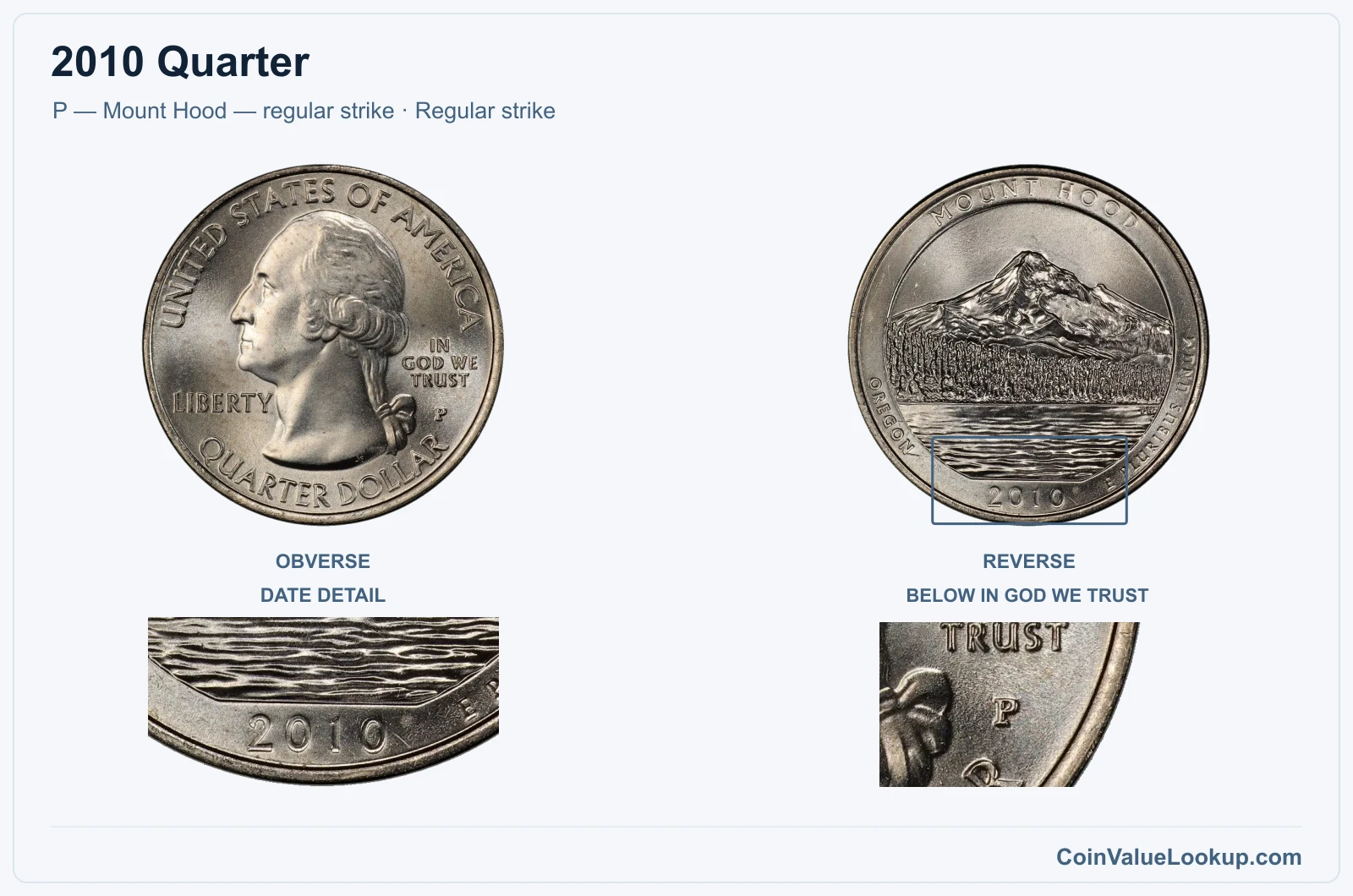
Philadelphia business strike, Mount Hood reverse. Standard copper-nickel clad quarter showing Oregon's Mount Hood with a lake in the foreground.
USA Coin Book estimates about $0.74 at MS60 and $1.24 at MS65. Circulated pieces are worth face value.
Confirm the "P" mintmark and the Mount Hood reverse before comparing to the chart.
Range Grade
Price Auction Records Appraisal PO PO 1
—
Coin Identifier FR FR 2
—
Coin Identifier AG AG 3
—
Coin Identifier G G 4
—
Coin Identifier
G 6
—
Coin Identifier VG VG 8
—
Coin Identifier
VG 10
—
Coin Identifier F F 12
—
Coin Identifier
F 15
—
Coin Identifier VF VF 20
—
Coin Identifier
VF 25
—
Coin Identifier
VF 30
—
Coin Identifier
VF 35
—
Coin Identifier XF XF 40
—
Coin Identifier
XF 45
—
Coin Identifier AU AU 50
—
Coin Identifier
AU 53
—
Coin Identifier
AU 55
—
Coin Identifier
AU 58
—
Coin Identifier MS MS 60
—
Coin Identifier
MS 61
—
Coin Identifier
MS 62
—
Coin Identifier
MS 63
—
Coin Identifier
MS 64
—
Coin Identifier
MS 65
Coin Identifier
MS 66
Coin Identifier
MS 67
Coin Identifier
MS 68
—
—
—
MS 69
—
—
—
MS 70
—
—
—
2010 Quarter — P — Mount Hood — satin finish
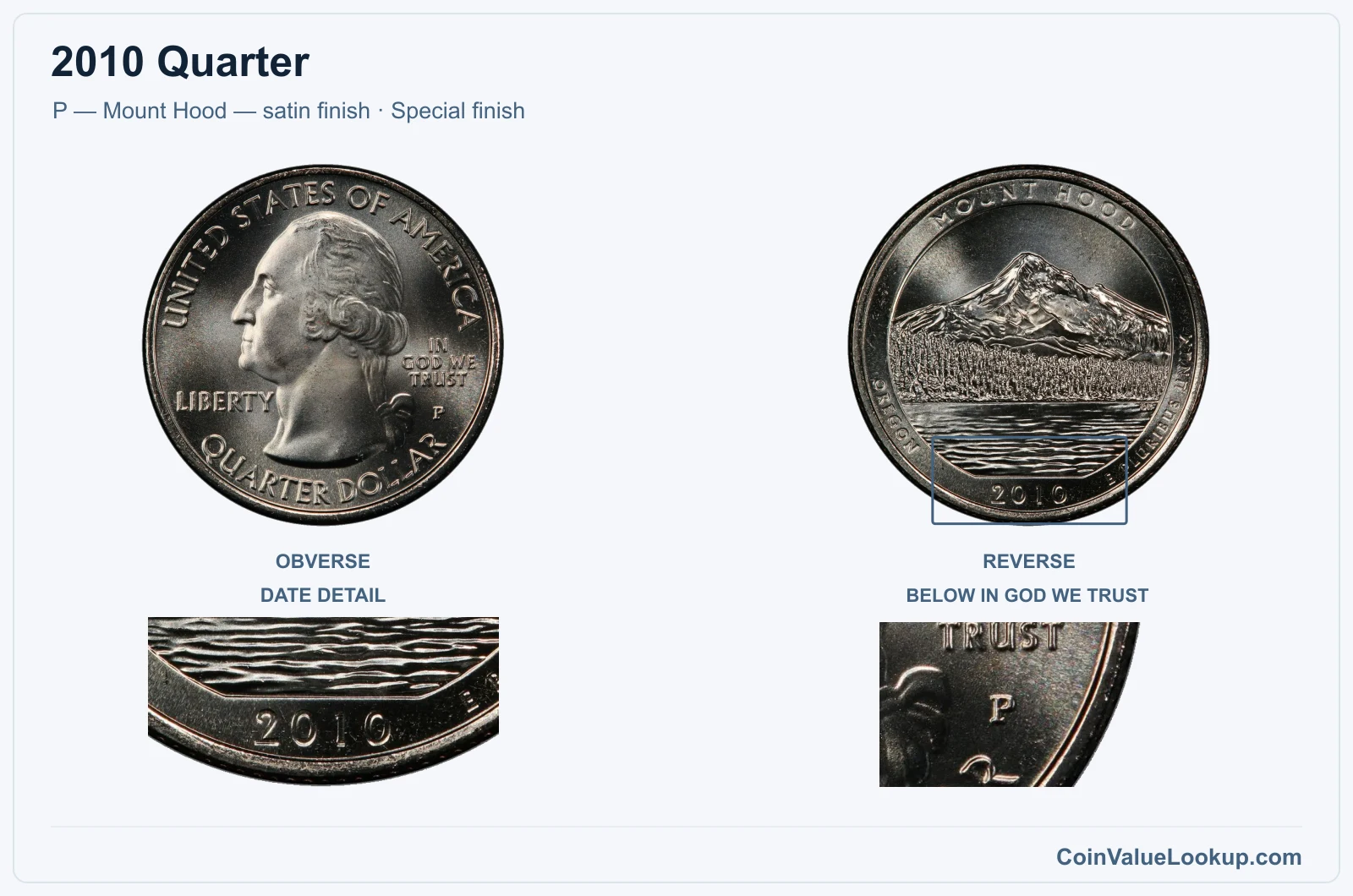
P-mint Mount Hood satin finish, from the 2010 uncirculated mint set. The fine-grained surface texture is manufactured intentionally and is not the result of wear, cleaning, or environmental exposure.
No guide price is adopted. Each coin's value depends on authenticated identity and condition.
If you pulled it directly from an unopened mint set, attribution is more straightforward.
Range Grade
Price Auction Records Appraisal SP SP 1
—
Coin Identifier
SP 2
—
Coin Identifier
SP 3
—
Coin Identifier
SP 4
—
Coin Identifier
SP 6
—
Coin Identifier
SP 8
—
Coin Identifier
SP 10
—
Coin Identifier
SP 12
—
Coin Identifier
SP 15
—
Coin Identifier
SP 20
—
Coin Identifier
SP 25
—
Coin Identifier
SP 30
—
Coin Identifier
SP 35
—
Coin Identifier
SP 40
—
Coin Identifier
SP 45
—
Coin Identifier
SP 50
—
Coin Identifier
SP 53
—
Coin Identifier
SP 55
—
Coin Identifier
SP 58
—
Coin Identifier
SP 60
—
Coin Identifier
SP 61
—
Coin Identifier
SP 62
—
Coin Identifier
SP 63
—
Coin Identifier
SP 64
—
Coin Identifier
SP 65
—
Coin Identifier
SP 66
—
Coin Identifier
SP 67
—
Coin Identifier
SP 68
—
Coin Identifier
SP 69
—
Coin Identifier
SP 70
—
—
—
2010 Quarter — D — Mount Hood — regular strike
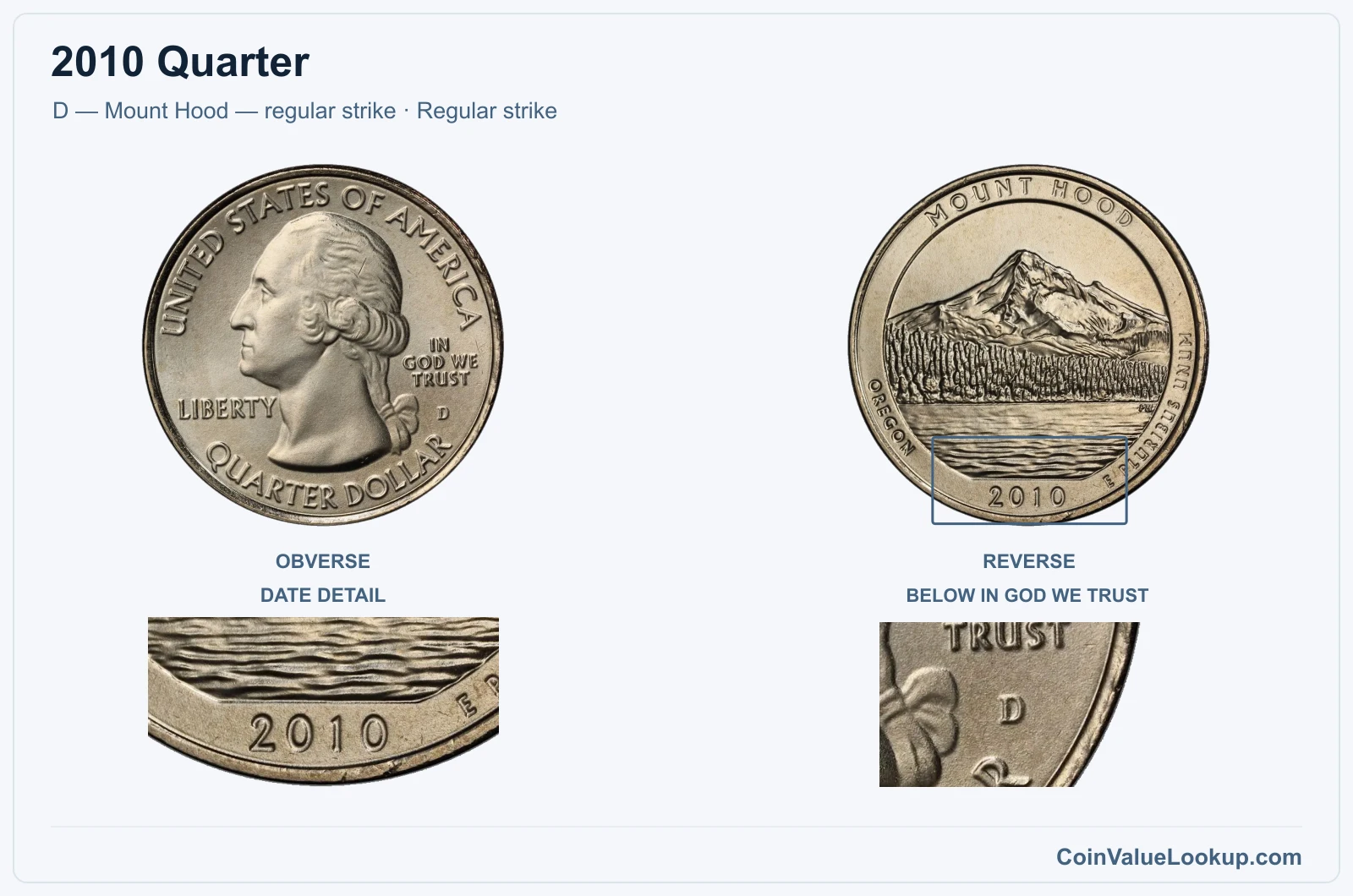
Denver business strike with the Mount Hood reverse. Copper-nickel clad, "D" mintmark.
The last of the five 2010 reverse designs released for circulation.
USA Coin Book lists about $0.74 at MS60 and $1.24 at MS65. Worn examples remain at face value.
Verify both the mintmark and the correct reverse before referencing these figures.
Range Grade
Price Auction Records Appraisal PO PO 1
—
Coin Identifier FR FR 2
—
Coin Identifier AG AG 3
—
Coin Identifier G G 4
—
Coin Identifier
G 6
—
Coin Identifier VG VG 8
—
Coin Identifier
VG 10
—
Coin Identifier F F 12
—
Coin Identifier
F 15
—
Coin Identifier VF VF 20
—
Coin Identifier
VF 25
—
Coin Identifier
VF 30
—
Coin Identifier
VF 35
—
Coin Identifier XF XF 40
—
Coin Identifier
XF 45
—
Coin Identifier AU AU 50
—
Coin Identifier
AU 53
—
Coin Identifier
AU 55
—
Coin Identifier
AU 58
—
Coin Identifier MS MS 60
—
Coin Identifier
MS 61
—
Coin Identifier
MS 62
—
Coin Identifier
MS 63
—
Coin Identifier
MS 64
—
Coin Identifier
MS 65
Coin Identifier
MS 66
—
Coin Identifier
MS 67
Coin Identifier
MS 68
—
—
—
MS 69
—
—
—
MS 70
—
—
—
2010 Quarter — D — Mount Hood — satin finish
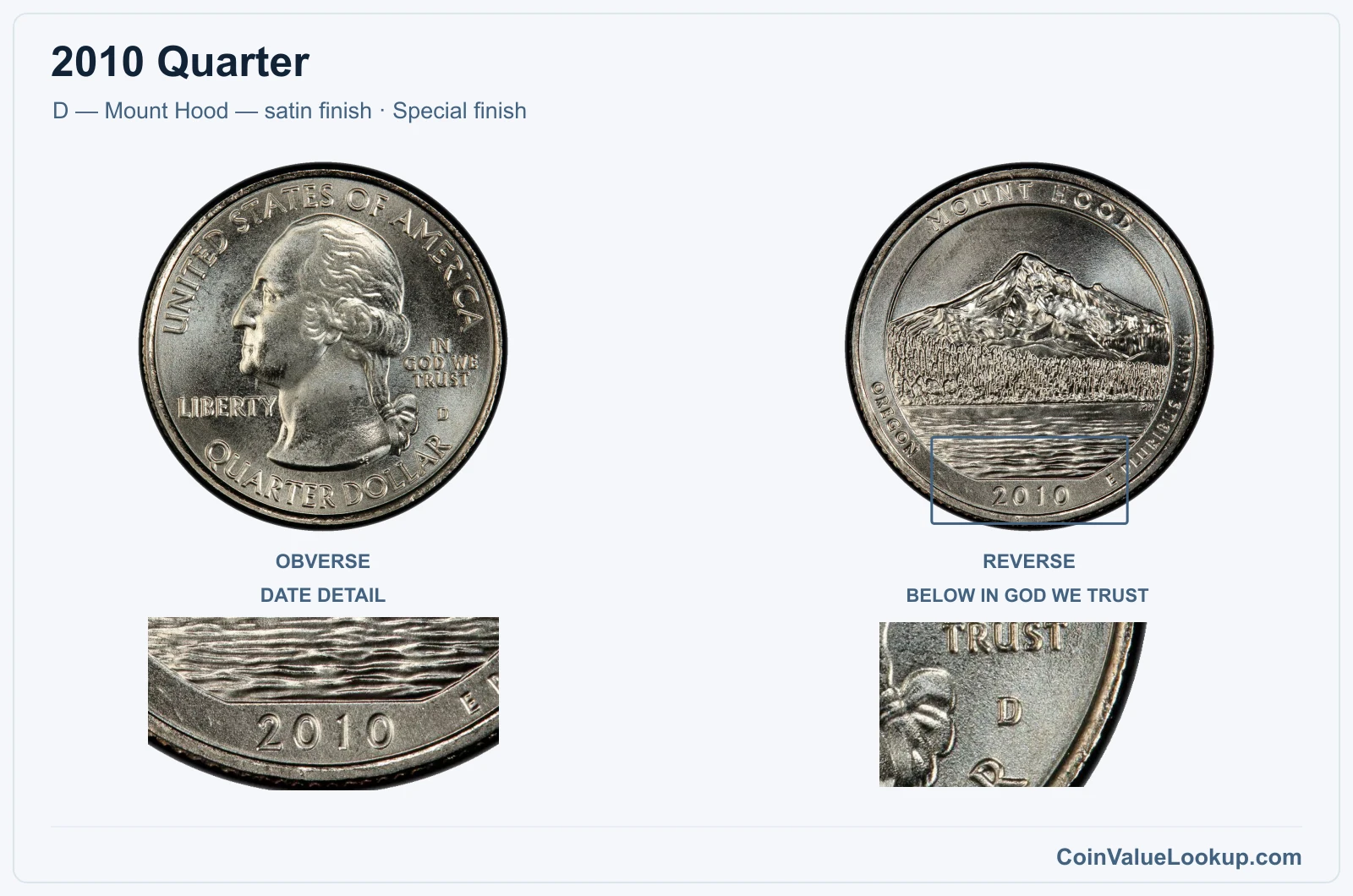
D-mint Mount Hood satin finish, available only through the 2010 uncirculated mint set. Its surface has the consistent, fine-textured grain characteristic of the satin manufacturing process.
No adopted guide price exists. Determining value requires confirmed satin attribution and an assessment of overall condition.
A coin that merely looks dull does not qualify without proper comparison to known satin examples.
Range Grade
Price Auction Records Appraisal SP SP 1
—
Coin Identifier
SP 2
—
Coin Identifier
SP 3
—
Coin Identifier
SP 4
—
Coin Identifier
SP 6
—
Coin Identifier
SP 8
—
Coin Identifier
SP 10
—
Coin Identifier
SP 12
—
Coin Identifier
SP 15
—
Coin Identifier
SP 20
—
Coin Identifier
SP 25
—
Coin Identifier
SP 30
—
Coin Identifier
SP 35
—
Coin Identifier
SP 40
—
Coin Identifier
SP 45
—
Coin Identifier
SP 50
—
Coin Identifier
SP 53
—
Coin Identifier
SP 55
—
Coin Identifier
SP 58
—
Coin Identifier
SP 60
—
Coin Identifier
SP 61
—
Coin Identifier
SP 62
—
Coin Identifier
SP 63
—
Coin Identifier
SP 64
—
Coin Identifier
SP 65
—
Coin Identifier
SP 66
—
Coin Identifier
SP 67
—
Coin Identifier
SP 68
—
Coin Identifier
SP 69
Coin Identifier
SP 70
—
—
—
2010 Quarter — S — Mount Hood — clad proof
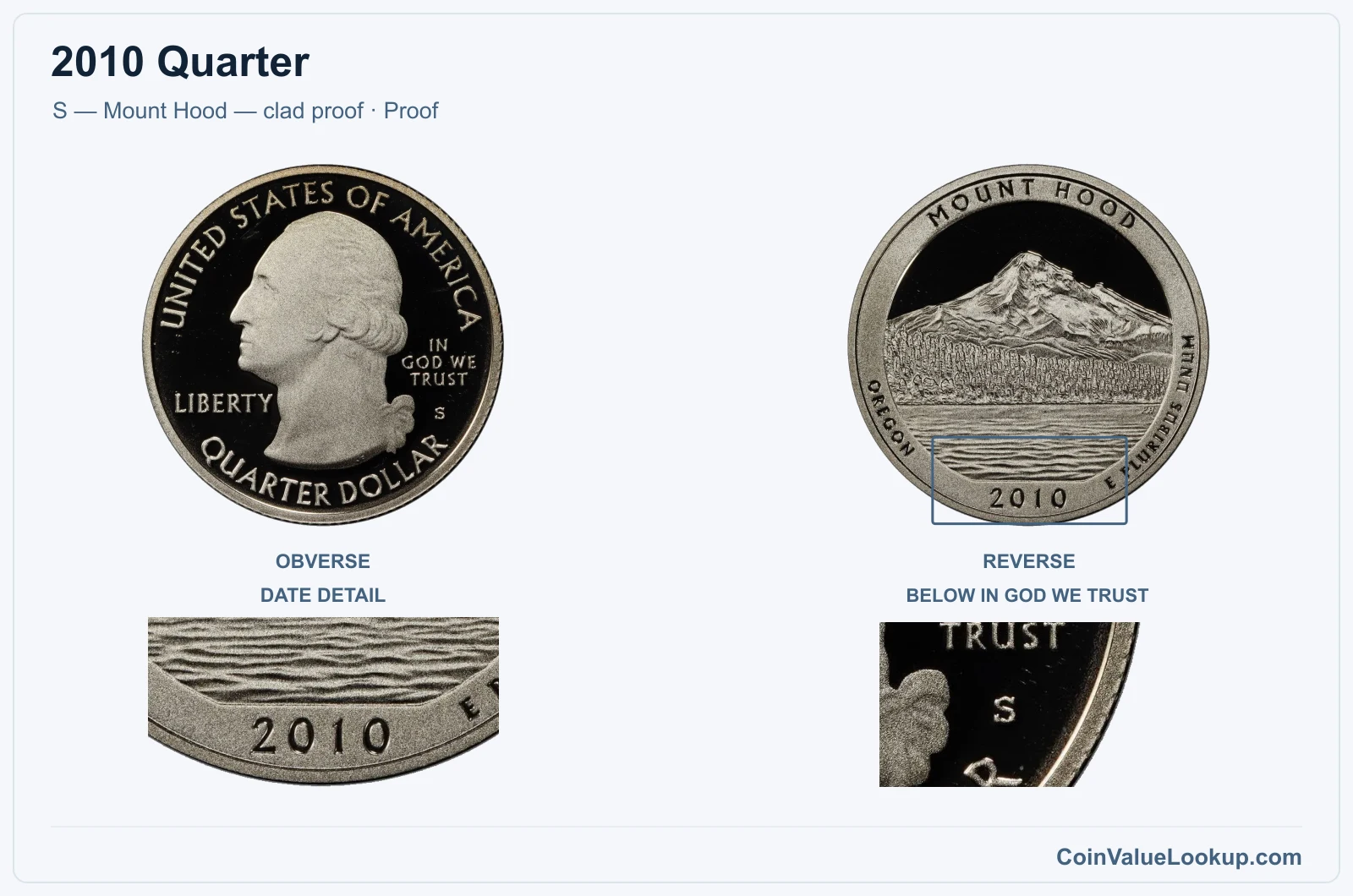
San Francisco clad proof, Mount Hood reverse. Copper-nickel clad composition, mirror fields, frosted devices.
Distributed in the 2010 standard proof set.
USA Coin Book estimates about $5.63 at PR65. Check the edge to confirm clad layers before applying this value — the silver proof version is worth considerably more.
Range Grade
Price Auction Records Appraisal PR PR 1
—
Coin Identifier
PR 2
—
Coin Identifier
PR 3
—
Coin Identifier
PR 4
—
Coin Identifier
PR 6
—
Coin Identifier
PR 8
—
Coin Identifier
PR 10
—
Coin Identifier
PR 12
—
Coin Identifier
PR 15
—
Coin Identifier
PR 20
—
Coin Identifier
PR 25
—
Coin Identifier
PR 30
—
Coin Identifier
PR 35
—
Coin Identifier
PR 40
—
Coin Identifier
PR 45
—
Coin Identifier
PR 50
—
Coin Identifier
PR 53
—
Coin Identifier
PR 55
—
Coin Identifier
PR 58
—
Coin Identifier
PR 60
—
Coin Identifier
PR 61
—
Coin Identifier
PR 62
—
Coin Identifier
PR 63
—
Coin Identifier
PR 64
—
Coin Identifier
PR 65
—
Coin Identifier
PR 66
—
Coin Identifier
PR 67
—
Coin Identifier
PR 68
—
Coin Identifier
PR 69
Coin Identifier
PR 70
Coin Identifier
2010 Quarter — S — Mount Hood — silver proof
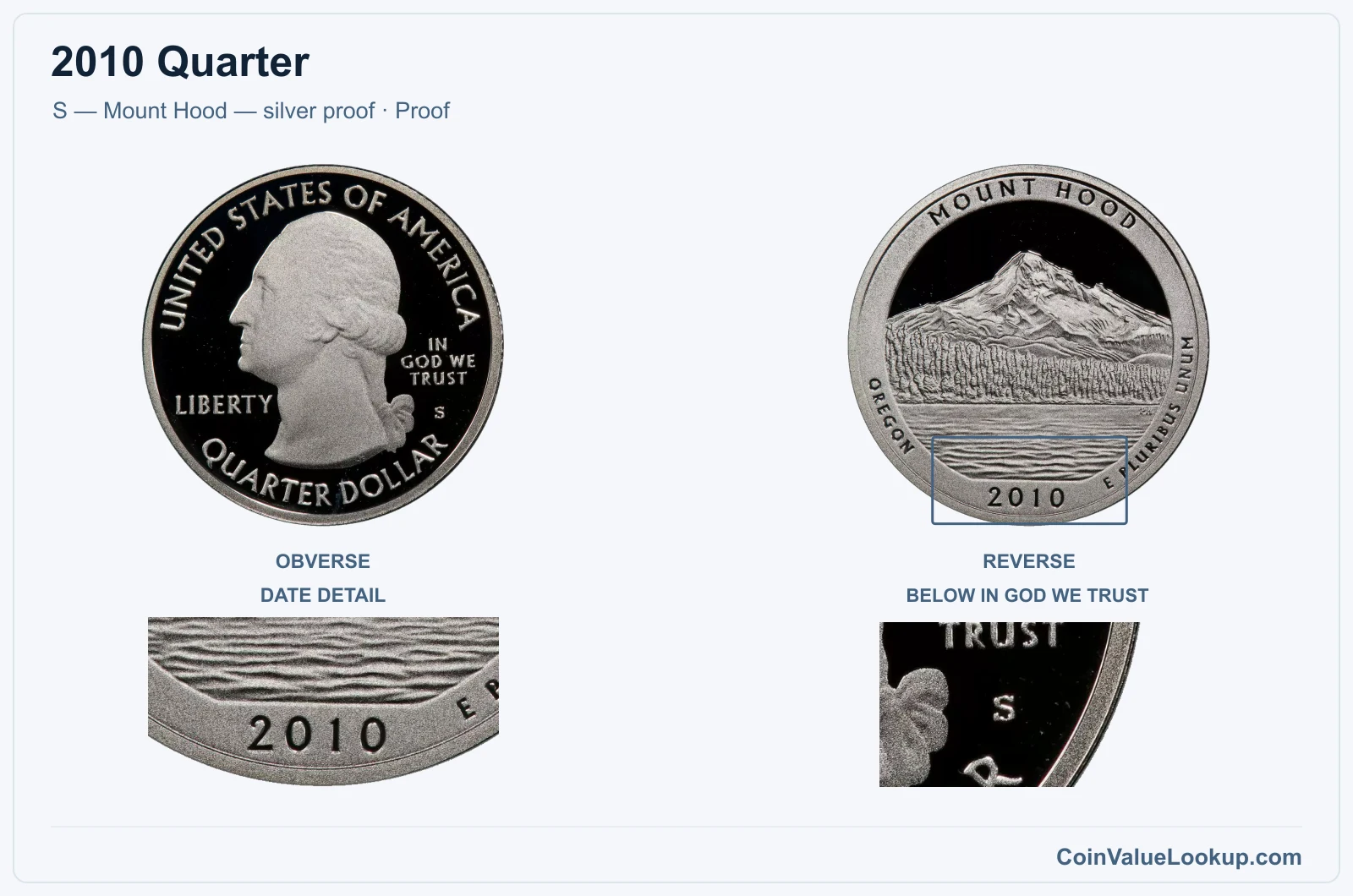
The Mount Hood silver proof is 90% silver, 10% copper, weighing about 6.25 g. Its edge is uniformly silver-gray.
From the 2010 silver proof set.
USA Coin Book estimates $23.00 at PR65. Like the other 2010 silver proofs, the combination of precious-metal content and collector-set packaging supports the premium over clad versions.
Confirm composition before assuming this value applies to your coin.
Range Grade
Price Auction Records Appraisal PR PR 1
—
Coin Identifier
PR 2
—
Coin Identifier
PR 3
—
Coin Identifier
PR 4
—
Coin Identifier
PR 6
—
Coin Identifier
PR 8
—
Coin Identifier
PR 10
—
Coin Identifier
PR 12
—
Coin Identifier
PR 15
—
Coin Identifier
PR 20
—
Coin Identifier
PR 25
—
Coin Identifier
PR 30
—
Coin Identifier
PR 35
—
Coin Identifier
PR 40
—
Coin Identifier
PR 45
—
Coin Identifier
PR 50
—
Coin Identifier
PR 53
—
Coin Identifier
PR 55
—
Coin Identifier
PR 58
—
Coin Identifier
PR 60
—
Coin Identifier
PR 61
—
Coin Identifier
PR 62
—
Coin Identifier
PR 63
—
Coin Identifier
PR 64
—
Coin Identifier
PR 65
—
Coin Identifier
PR 66
—
Coin Identifier
PR 67
—
Coin Identifier
PR 68
—
Coin Identifier
PR 69
Coin Identifier
PR 70
Coin Identifier
2010 Quarter Error List
1. 2010 Quarter — Yellowstone — Clipped Planchet
A clipped planchet on a 2010 Yellowstone quarter means part of the blank was missing before the coin was struck. You will see a curved, straight, or ragged section absent from the edge, and the design in that area will be incomplete or distorted.
Look for a corresponding area of weakness on the opposite side of the coin — metal flow during striking often produces this telltale sign. The edge at the clip should look different from a normal reeded edge.
Do not confuse a post-mint filing, edge cut, or corrosion damage with a genuine clip. Damage after striking tends to show sharp tool marks or pitting rather than a smooth, natural-looking absence.
Value depends on the size and visibility of the clip, the coin's overall condition, and authenticated attribution.
2. 2010 Quarter — Doubled Die Obverse
A doubled die obverse on a 2010 quarter shows consistent doubling in the obverse lettering or design elements — separation or notching that repeats on every coin struck from that die. Compare suspect letters like LIBERTY or IN GOD WE TRUST to a normal example under the same lighting.
Genuine doubled die doubling has a three-dimensional quality: the extra image has its own distinct outline, not a flat shelf. Machine doubling, by contrast, tends to produce flat, shelf-like distortion without true separation.
Reflections and worn die contours can also mimic doubling to the untrained eye. Use magnification and compare multiple points on the obverse.
Value depends on the strength and visibility of the doubling, the specific die involved, and the coin's condition.
3. 2010 Quarter — Doubled Die Reverse
A doubled die reverse on a 2010 quarter shows repeating design elements on the back of the coin — doubled lettering, numerals, or design contours that are consistent across all examples struck from the same die.
Compare the reverse legends and design details to a known normal coin at the same magnification. Genuine doubling shows defined separation between the original and secondary image, not a flat smear.
Machine doubling, random damage, and reflections can all look like doubled dies at first glance. The key is consistency: true doubled die markers appear in the same place and orientation on every coin from that die.
Value depends on the degree of doubling, visibility, and the coin's overall condition.
4. 2010 Quarter — Wrong Planchet / Off-Metal Strike
A 2010 quarter struck on a wrong planchet means the design was impressed onto a blank intended for a different denomination. The reported category specifically mentions a nickel planchet.
To check, weigh your coin and measure its diameter. A quarter planchet should be about 5.67 g and 24.26 mm; a nickel planchet would be different in both weight and size, and the design may be incomplete because the blank is too small.
Be careful — plating loss, corrosion, and acid-treated coins can change a quarter's appearance enough to suggest a wrong metal. Deliberate alterations also exist.
Value depends on authenticated attribution, the specific wrong planchet, and condition.
5. 2010 Quarter — Yosemite — Die Crack / Die Chip
Die cracks on a 2010 Yosemite quarter appear as thin raised lines across the surface. They are caused by a fracture in the die itself, and every coin struck from that cracked die carries the same raised line in the same place.
A die chip is a small raised blob where a piece of the die broke away. Distinguish interior chips from rim-connected breaks (cuds), which are a different category.
Incuse scratches, corrosion lines, and surface debris can look similar. The difference: die cracks are raised, consistent with the struck surface, and positioned identically on other coins from the same die.
Value depends on the size, location, and visual impact of the crack, plus the coin's overall condition.
6. 2010 Quarter — Yosemite — Die Break / Cud
A cud on a 2010 Yosemite quarter is a raised, featureless area that connects to the rim. It forms when a piece of the die breaks away at the edge, and the metal flows into that void during striking.
You will see a smooth, raised blob replacing part of the design along the rim. The boundary between the cud and the remaining normal design is usually distinct.
Do not confuse a rim dent or corrosion buildup with a genuine cud — those are post-mint and typically show different surface texture. An interior die chip that does not touch the rim is also a different category.
Value depends on the cud's size, location, and the coin's condition.
7. 2010 Quarter — Yosemite — Double / Multiple Strike
A double or multiple strike on a 2010 Yosemite quarter means the coin received more than one impression from the dies. You will see two (or more) overlapping design images, usually displaced or rotated relative to each other.
The key diagnostic is separate, identifiable impressions. The second strike may partially obliterate the first, or you may see two distinct outlines of the same design element.
Do not confuse this with a doubled die, which is a single strike from a die with doubled features. Post-mint damage — like pressing a coin against another object — can also create misleading impressions.
Value depends on how dramatic the displacement is, whether the date remains visible, and overall condition.
8. 2010 Quarter — Yellowstone — Die Crack / Die Chip
Die cracks on a 2010 Yellowstone quarter show up as raised lines running across the coin's surface. They form when the steel die develops a fracture during use.
These raised lines follow the same path on every coin struck from that specific die. A small raised blob without a connecting line is a die chip, and if the break connects to the rim it may qualify as a cud instead.
Incuse scratches, foreign material, and corrosion can mimic die cracks. Check that the feature is raised (not recessed) and consistent with the coin's struck surface.
Value depends on the crack's size, prominence, and the coin's overall condition.
9. 2010 Quarter — Yellowstone — Off-Center Strike
An off-center strike on a 2010 Yellowstone quarter occurs when the blank is not properly centered between the dies. The result is a displaced design with a crescent-shaped blank area where no design was impressed.
The greater the percentage off-center, the more dramatic the appearance. Collectors generally prefer examples where the date is still visible.
A clipped planchet or a misaligned die can look somewhat similar, so compare carefully. A clip removes part of the blank itself, while an off-center strike shifts the entire design on an otherwise complete blank.
Post-mint flattening can also distort the rim area. Value depends on the degree of off-center displacement, date visibility, and condition.
10. 2010 Quarter — Hot Springs — Off-Center Strike
An off-center strike on a 2010 Hot Springs quarter displaces the design toward one edge, leaving part of the blank unstruck. You will see a crescent-shaped void where the dies did not reach.
The more dramatic the shift, the more visually striking the coin. Date visibility is important for collector appeal.
Distinguish this from a clipped planchet (missing blank metal, not shifted design) and from a misaligned die (which may show design displacement but typically to a lesser degree). Post-mint flattening can also create misleading edge distortion.
Value depends on the percentage off-center, date visibility, and overall condition.
11. 2010 Quarter — Hot Springs — Broadstrike
A broadstrike on a 2010 Hot Springs quarter happens when the coin is struck without the retaining collar that normally confines the metal and forms the reeded edge. The result is a coin that spreads wider than normal with a soft, unreeded rim.
The design is complete but slightly expanded outward. Check the edge — it will lack normal reeding, and the diameter will measure larger than the standard 24.26 mm.
Do not confuse this with an off-center strike (which shifts the design) or a coin that has been flattened after minting (which would show damage marks). Value depends on how obvious the spread is, whether the design remains fully struck, and overall condition.
12. 2010 Quarter — Hot Springs — Die Crack / Die Chip
Die cracks on a 2010 Hot Springs quarter have been reported near the building details on the reverse. These appear as thin raised lines resulting from fractures in the die.
Small raised blobs (die chips) can also appear where a tiny piece of the die broke away. Both are raised features that repeat on every coin struck from the same damaged die.
Incuse scratches, surface corrosion, and foreign material stuck to the coin can mimic die cracks. Confirm the feature is raised and consistent with the coin's struck surface rather than recessed or irregular.
Value depends on the crack's size, location, visual prominence, and the coin's condition.
13. 2010 Quarter — Hot Springs — Clipped Planchet
A clipped planchet on a 2010 Hot Springs quarter shows a curved section missing from the edge where the blank was incompletely punched from the metal strip. The resulting coin has an incomplete rim and weakened design in that area.
Look for a corresponding weakness on the opposite side of the coin — a classic diagnostic of a genuine clip. The edge at the missing section should show a different texture from the normal reeded rim.
An edge cut, filed notch, or corrosion damage can resemble a clip. Post-mint damage typically leaves sharper, more irregular marks.
Value depends on the size and visibility of the clip, overall condition, and authenticated attribution.
14. 2010 Quarter — Hot Springs — Double / Multiple Strike
A double strike on a 2010 Hot Springs quarter means the coin was struck more than once by the dies, producing two or more overlapping design impressions. You will see displaced or rotated images of the same design elements.
Look for distinct separation between the two impressions. A slight shift might show only subtle doubling of the lettering, while a dramatic displacement can produce two clearly offset portraits.
This is different from a doubled die, where a single strike transfers a doubled image from the die itself. Post-mint impressions and vise damage can also produce misleading overlapping marks.
Value depends on the degree of displacement, visual impact, and overall condition.
15. 2010 Quarter — Hot Springs — Struck-Through Error
A struck-through error on a 2010 Hot Springs quarter occurs when foreign material sits between the die and the planchet during striking. The result is a localized depression, void, or unusual texture where the material blocked the design.
The impression can range from a small grease-filled area (often appearing as a smooth, featureless spot) to a larger obstruction that leaves a distinct shape. A retained piece of foreign material may even remain embedded in the coin.
Do not confuse normal wear, cleaning marks, or scratches with a struck-through error. Genuine examples show a depression or void that is consistent with the struck surface, not added damage.
Value depends on the size, clarity, and location of the impression.
16. 2010 Quarter — Hot Springs — Missing Clad Layer
A missing clad layer on a 2010 Hot Springs quarter means one of the outer nickel-copper layers failed to bond to the blank before striking. The exposed side may show a distinctly different color from a normal quarter.
Check the edge and weigh the coin. A quarter missing one clad layer will weigh less than the standard 5.67 g, and the edge will look different from a normal three-layer cross-section.
Toning, environmental damage, corrosion, and deliberate removal of surface metal can all mimic a missing clad layer. Authentic examples should show consistent coloring across the affected face, not patchy discoloration.
Value depends on authenticated attribution, how much of the layer is missing, and overall condition.
17. 2010 Quarter — Brockage
A brockage on a 2010 quarter occurs when a previously struck coin sticks to a die and impresses its design into the next blank. The result: one side shows the normal design while the other carries an incuse (sunken), mirror-image impression of the same or opposite design.
The brockage impression is recessed and reversed, which distinguishes it from a normal strike. Look at the relief and direction of the mirrored image — it should be the opposite of what you see on a properly struck coin.
Die clashes and post-mint pressing can create somewhat similar effects, but they lack the full, coherent mirror-image quality of a true brockage. Value depends on how complete and clear the brockage impression is, plus the coin's overall condition.
18. 2010 Quarter — Grand Canyon — Off-Center Strike
An off-center strike on a 2010 Grand Canyon quarter shifts the entire design toward one edge of the blank. Part of the coin remains unstruck, creating a crescent-shaped void.
Collectors look at two things: the percentage of displacement and whether the date is still readable. A coin struck 5% off-center is mildly interesting; 20% or more with the date visible gets attention.
A clipped planchet removes part of the blank metal itself, while an off-center strike keeps the full blank but displaces the design. Post-mint flattening and misaligned dies can also look similar at a glance.
Value depends on the severity of the shift, date visibility, and overall condition.
19. 2010 Quarter — Grand Canyon — Broadstrike
A broadstrike on a 2010 Grand Canyon quarter was struck without the collar holding the blank in place. The metal spreads outward, producing a wider coin with a soft, unreeded edge.
The design should be fully present but expanded. Measure the diameter — it will exceed the standard 24.26 mm.
The edge will lack reeding entirely or show partial, distorted reeding.
Do not confuse this with an off-center strike (which displaces the design) or a coin hammered flat outside the mint. Post-mint damage usually leaves tool marks or irregular deformation that does not match the uniform spread of a broadstrike.
Value depends on the degree of spread and overall condition.
20. 2010 Quarter — Grand Canyon — Die Crack / Die Chip
Die cracks on a 2010 Grand Canyon quarter are raised lines caused by fractures in the striking die. They appear on the coin's surface and follow the same path on every example struck from that die.
Small raised lumps — die chips — form when a tiny fragment breaks away from the die face. Both are manufacturing artifacts, not post-mint damage.
Incuse scratches, corrosion deposits, and foreign material can resemble die cracks under poor lighting. Verify the feature is raised and consistent with the struck surface.
Value depends on the crack's size, location, visual prominence, and overall condition of the coin.
21. 2010 Quarter — Grand Canyon — Clipped Planchet
A clipped planchet on a 2010 Grand Canyon quarter results from a misfeed during blank cutting. A curved section of the edge is missing, and the design in that area is incomplete.
Genuine clips usually produce a corresponding area of weakness on the opposite side of the coin. The edge at the clip transitions smoothly from the missing area into the normal reeded edge.
Filed notches, edge cuts, and corrosion damage lack the smooth transition and opposite-side weakness of a true clip. Value depends on the clip's size, the coin's overall appearance, and authenticated attribution.
22. 2010 Quarter — Grand Canyon — Struck-Through Error
A struck-through error on a 2010 Grand Canyon quarter is caused by debris on the die face during striking. It leaves a localized depression, impression, or missing design detail where the foreign material intervened.
Grease fills tend to be smooth and featureless, creating a blank spot in the design. Solid debris can leave a shaped impression.
A retained object — foreign material still embedded in the coin — is a more dramatic variant.
Wear, cleaning, and scratches can all obscure design detail, but they do not produce the distinctive depressed, well-defined voids of a struck-through error. Value depends on the size, clarity, and location of the impression, plus condition.
23. 2010 Quarter — Grand Canyon — Double / Multiple Strike
A double strike on a 2010 Grand Canyon quarter shows two visible impressions of the design, displaced or rotated relative to each other. This happens when the coin is struck more than once.
Look for clearly separate design images rather than just slightly thickened lettering. A dramatic shift produces two identifiable outlines of the portrait or reverse scene.
This differs from a doubled die, where a single strike transfers an already-doubled die image. Post-mint damage (vise marks, re-stamping) can also produce overlapping impressions but typically lacks the uniformity and relief of a genuine double strike.
Value depends on the degree of displacement and overall condition.
24. 2010 Quarter — Grand Canyon — Missing Clad Layer
A missing clad layer on a 2010 Grand Canyon quarter exposes the inner core on one or both faces. The affected side may show a noticeably different color from a standard quarter.
Weigh the coin. A missing clad layer reduces the weight below the standard 5.67 g.
Examine the edge cross-section — a normal clad quarter shows distinct layers, while a missing-layer coin will show an asymmetric or incomplete layer structure.
Toning, corrosion, plating damage, and deliberate surface removal can all produce color changes that look similar. Authentic examples show a uniform color shift across the affected face, consistent with the exposed core.
Value depends on authenticated attribution, extent of the missing layer, and overall condition.
25. 2010 Quarter — Mount Hood — Off-Center Strike
An off-center strike on a 2010 Mount Hood quarter displaces the design, leaving a crescent of unstruck blank along one edge. The full blank is present, but the dies missed their center target.
The percentage of displacement determines how dramatic the error looks. Date visibility is a key factor for collector desirability.
Distinguish this from a clipped planchet (missing blank metal) and a misaligned die (typically a smaller shift on one side only). Post-mint flattening can also distort the rim area.
Value depends on the severity of the shift, whether the date shows, and the coin's condition.
26. 2010 Quarter — Mount Hood — Broadstrike
A broadstrike on a 2010 Mount Hood quarter is the result of a missing or improperly positioned collar during striking. The metal spreads beyond the normal diameter, and the edge lacks standard reeding.
The design should be essentially complete but slightly larger than normal. Measure the diameter — anything above 24.26 mm on a quarter points toward a broadstrike if the design remains fully impressed.
A coin that has been flattened or hammered after minting will show damage marks and inconsistent deformation, unlike the even spread of a genuine broadstrike. Value depends on the degree of expansion, edge profile, and overall condition.
27. 2010 Quarter — Mount Hood — Die Crack / Die Chip
Die cracks and small breaks on a 2010 Mount Hood quarter appear as raised lines or blobs on the coin's surface. They result from fractures or chips in the die during striking.
Every coin struck from the same cracked die will carry the identical raised feature in the same position. That repeatability is the hallmark of a genuine die crack versus random damage.
Incuse scratches, corrosion, and surface deposits can look similar but are recessed or sit on top of the surface rather than being struck into it. Value depends on the crack's size, prominence, and the coin's overall condition.
28. 2010 Quarter — Mount Hood — Clipped Planchet
A clipped planchet on a 2010 Mount Hood quarter shows a missing section along the edge where the blank was not fully punched from the metal strip. The clip can be curved, straight, or ragged.
Check for design weakness opposite the clip — this is a classic diagnostic caused by uneven metal flow during striking. The edge at the clip area transitions from the missing section into the normal reeded edge.
Edge cuts, filing, and corrosion create post-mint damage that lacks the smooth transition and opposite-side weakness of a genuine clip. Value depends on the clip's size, visibility, and authenticated attribution.
29. 2010 Quarter — Mount Hood — Struck-Through Error
A struck-through error on a 2010 Mount Hood quarter happens when debris sits on the die surface during striking. The foreign material prevents the die from fully impressing the design, leaving a depression or void.
Grease-filled areas appear as smooth, blank patches. A solid object leaves a shaped impression, and occasionally the object stays embedded in the coin as a retained strike-through.
Normal wear, cleaning, and scratches reduce design detail too, but they produce different surface textures. A genuine struck-through void has a floor that is consistent with the coin's struck surface.
Value depends on the impression's size, clarity, and location, plus overall condition.
30. 2010 Quarter — Mount Hood — Double / Multiple Strike
A double strike on a 2010 Mount Hood quarter shows two or more overlapping design impressions from the coin being struck more than once. You will see displaced or rotated duplicate images of the design.
The separation between impressions is the key. A slight shift might only duplicate parts of the lettering, while a severe shift can produce two distinct portraits.
Do not confuse this with a doubled die (a single strike from a doubled die) or with post-mint pressing marks. Genuine double strikes show uniform relief and struck-surface quality in both impressions.
Value depends on how dramatic the displacement is and the coin's overall condition.
31. 2010 Quarter — Mount Hood — Missing Clad Layer
A missing clad layer on a 2010 Mount Hood quarter means one of the outer layers did not bond to the blank before striking. The affected face may appear a different color from normal, and the coin will weigh less than the standard 5.67 g.
Examine the edge. A normal clad quarter shows distinct outer layers sandwiching the core.
If one layer is absent, the cross-section will look asymmetric.
Toning, environmental exposure, corrosion, and intentional surface removal can all change a coin's appearance enough to suggest a missing clad layer. Authentic examples show a consistent, uniform color shift, not patchy discoloration.
Value depends on authenticated attribution and the coin's condition.
32. 2010 Quarter — Misaligned Die
A misaligned die error on a 2010 quarter occurs when one die shifts horizontally relative to the other or relative to the blank. The result is a design that appears offset on one face while the other face may look normal or shifted in a different direction.
Compare both sides carefully. A misaligned die shifts one face's design relative to the rim, but the coin's blank itself is fully struck — unlike an off-center strike where the entire coin shows unstruck areas.
A tilted photograph, a slight off-center strike, and post-mint rim damage can all mimic this error. Look for consistent design-to-rim spacing on each face independently.
Value depends on the severity of the misalignment, which face is affected, and overall condition.