1946 Washington Quarter Coin Value: How Much Is It Worth?
A 1946 Washington quarter is a 90% silver coin worth checking closely. Guide estimates start around $16.43 in well-worn Good condition and reach up to about $51 for a Philadelphia example graded MS65.
These are retail guide figures from USA Coin Book, not guaranteed sale prices. Three mint versions exist — Philadelphia, Denver, and San Francisco — all business strikes only.
Fast Way to Identify Your 1946 Washington Quarter
The quickest way to figure out what you have is to upload clear photos of both sides of your coin. A sharp front image shows the date and design details, while the back reveals the mintmark beneath the eagle's tail feathers.
Upload your images for a preliminary identification to help narrow down your coin's version and condition.
1946 Washington Quarter Value
Upload both sides of your 1946 Washington Quarter.
Front Obverse
Upload photo
Back Reverse
Upload photo
Which 1946 Washington Quarter Versions Are Worth Money?
- Philadelphia (no mintmark) coins graded MS65 can be surprisingly elusive despite high mintage — preserved quality matters more than how many were struck.
- Look for original uncirculated surfaces with full luster; post-mint damage or a blank Philadelphia mintmark area does not create a premium error.
- A 1946 doubled die obverse with doubling on LIBERTY and IN GOD WE TRUST, confirmed by a grading service, commands collector interest beyond its silver content.
- The 1946-D repunched mintmark variety shows remnants of a second D punch position, a die variety Denver collectors actively seek out.
- A tapered and cracked planchet error on a 1946 Philadelphia strike is a documented rarity combining two planchet defects on one coin.
Step 1: Identify Your 1946 Washington Quarter Mint Mark and Version
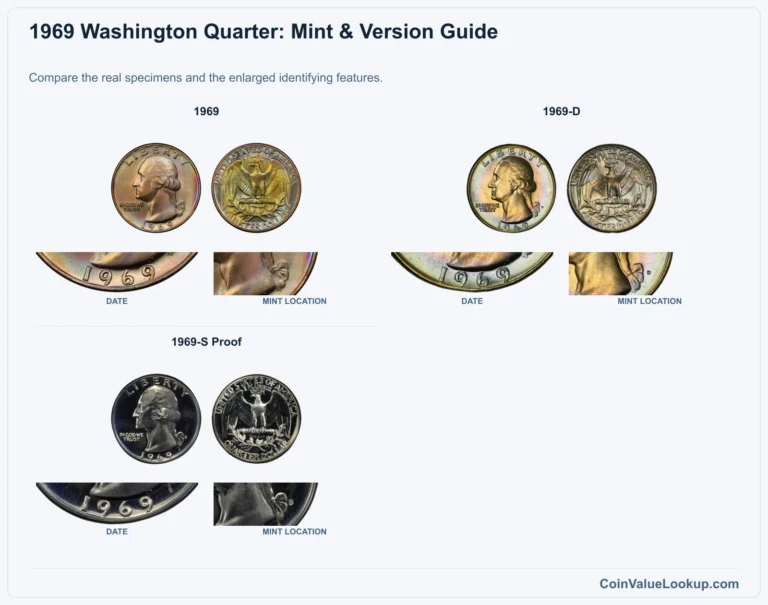
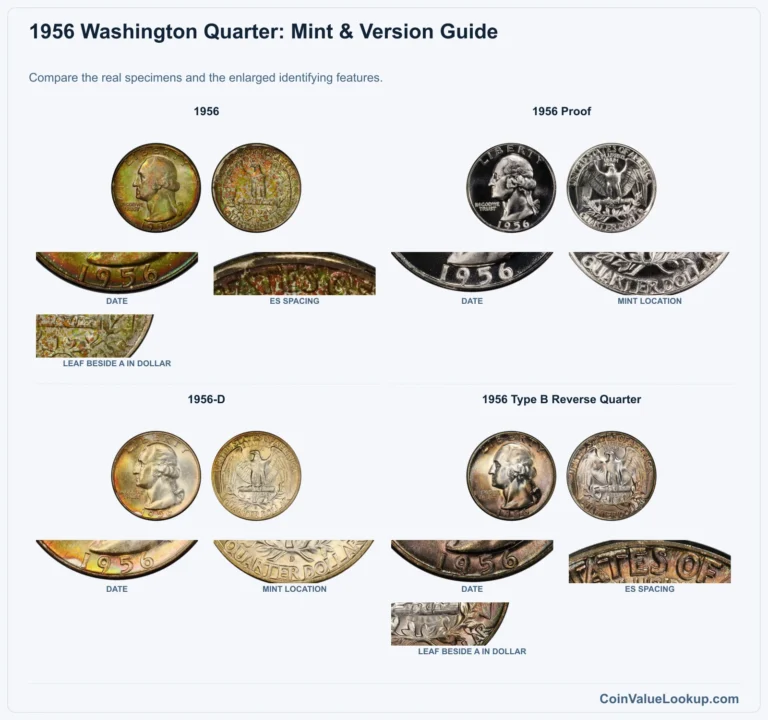
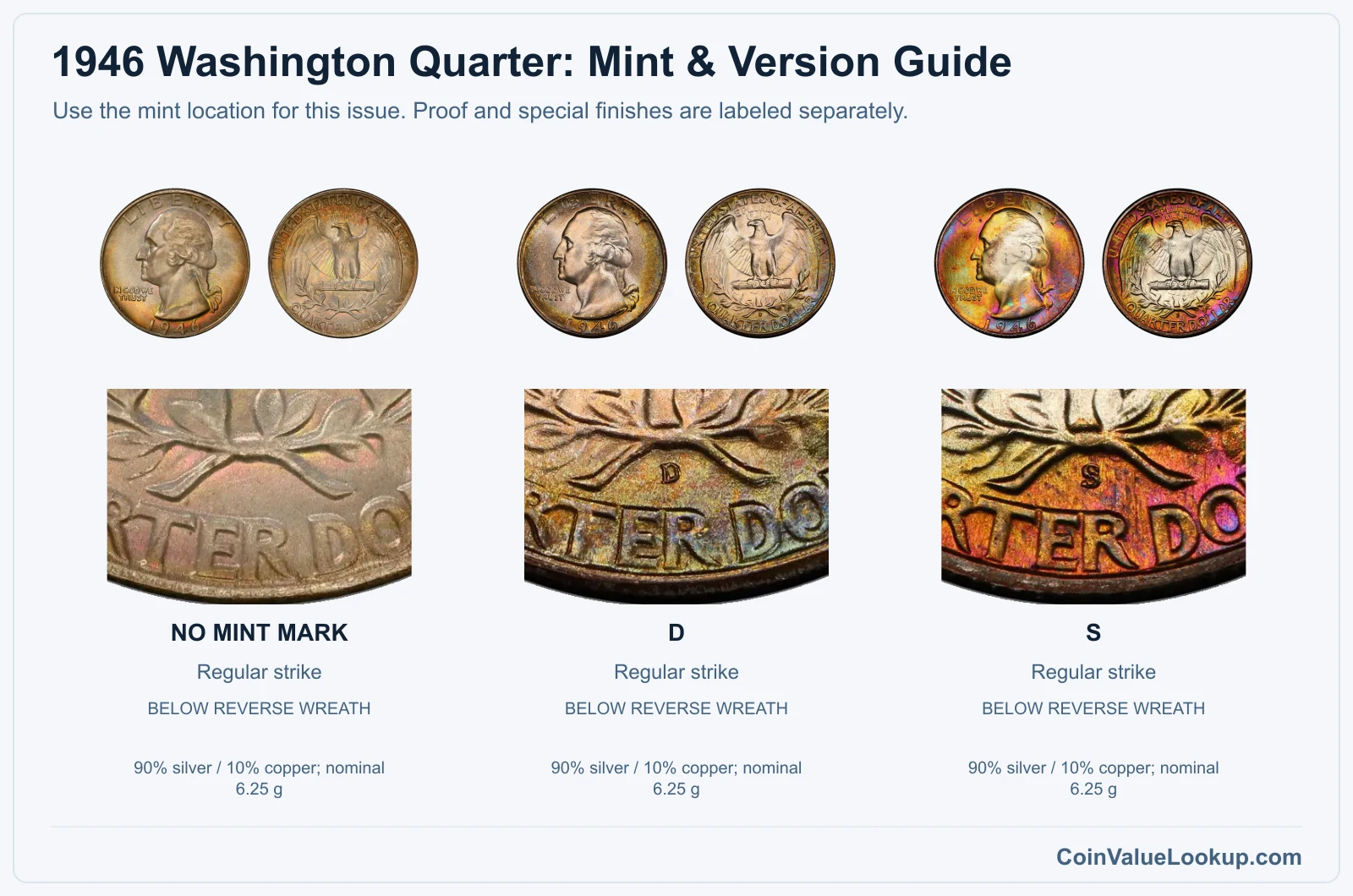
Start with the date on the front — you are looking for 1946. Then flip the coin over and look just below the wreath tied at the bottom.
A small "D" means Denver, an "S" means San Francisco, and a blank space means Philadelphia.
All three versions share the same composition: 90% silver and 10% copper, weighing about 6.25 grams and measuring roughly 24.3 mm across. There are no proof strikes for 1946; wartime production curtailed proofs starting in 1942, so every genuine 1946 Washington quarter is a business strike.
Don't assume a missing mintmark is a mistake or error. For this era, Philadelphia simply didn't use one.
A blank mintmark area is completely normal and expected on the Philadelphia version.
Step 2: Check Your 1946 Washington Quarter Grade
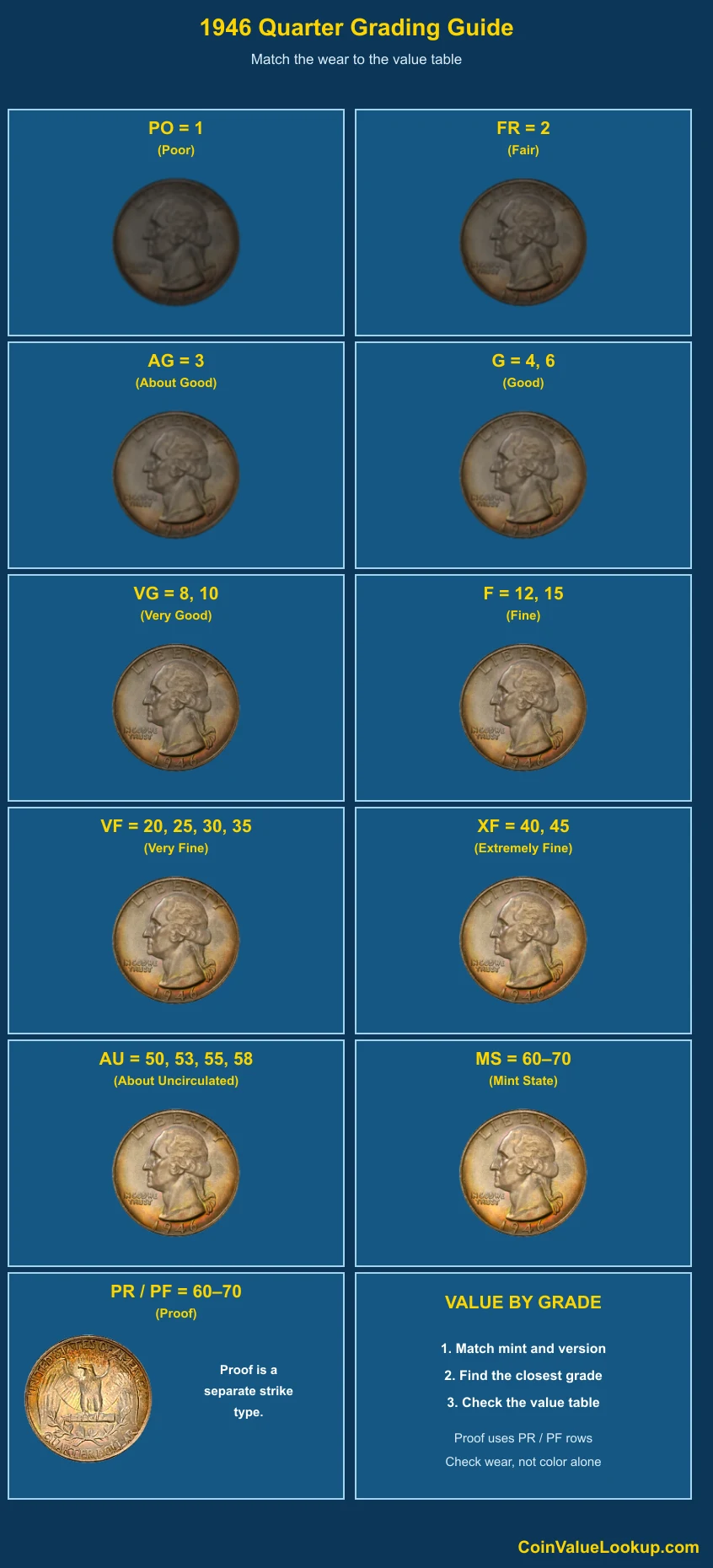
Focus on three key wear points. On the obverse, check Washington's hair detail above the ear and along the cheek and jawline.
On the reverse, examine the eagle's breast feathers. Luster loss paired with flattening in these areas signals genuine circulation wear.
A weak strike can mimic wear, so look carefully at whether the surrounding fields still show original mint luster. If the high points are soft but the fields are bright and undisturbed, you may have a weakly struck coin rather than a worn one.
Use the comparison image to match your coin's wear pattern against known grade examples. Also inspect for cleaning lines, rim dings, and contact marks — these reduce eye appeal and value even if the coin technically retains detail.
Cleaned coins often show fine parallel hairlines visible under a light tilted at an angle.
Step 3: Check 1946 Washington Quarter Value by Mint and Version
1946 Washington Quarter
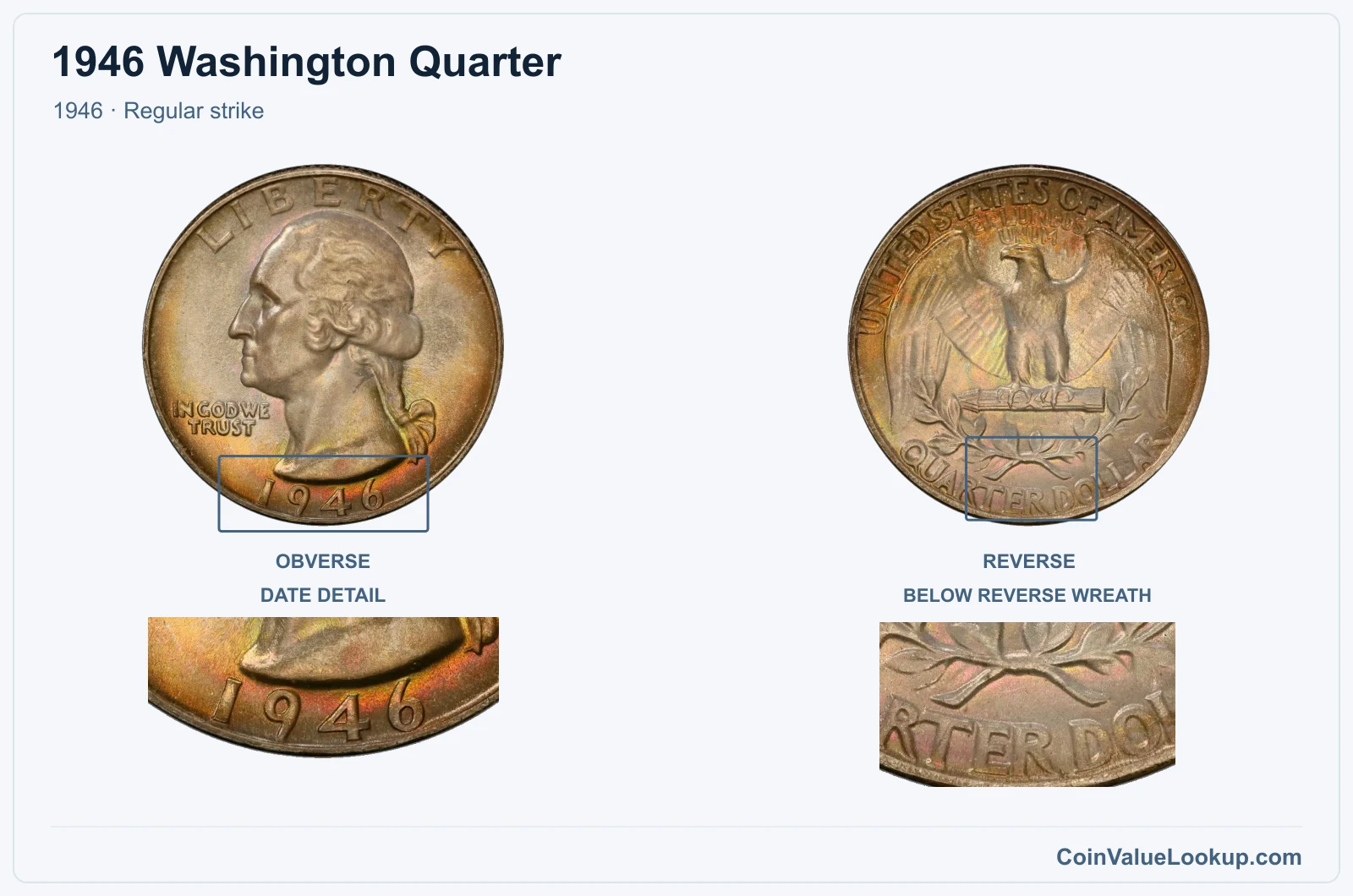
The 1946 Philadelphia quarter has no mintmark — the area below the reverse wreath is simply blank. That is normal for this date and mint.
Composition is 90% silver and 10% copper at a nominal 6.25 grams.
USA Coin Book guide estimates place this coin around $16.43 in G4, about $20 at MS60, and roughly $51 at MS65. Despite Philadelphia's large production run, finding one that actually survived in gem uncirculated condition is harder than you might expect.
San Francisco gems, for instance, turn up more regularly in high grade despite lower mintage. Condition is king here, not rarity on paper.
| Range | Grade | Price | Auction Records | Appraisal |
|---|---|---|---|---|
| PO | PO 1 | — | Coin Identifier | |
| FR | FR 2 | — | Coin Identifier | |
| AG | AG 3 | — | Coin Identifier | |
| G | G 4 | — | Coin Identifier | |
| G 6 | — | Coin Identifier | ||
| VG | VG 8 | — | Coin Identifier | |
| VG 10 | — | Coin Identifier | ||
| F | F 12 | — | Coin Identifier | |
| F 15 | — | Coin Identifier | ||
| VF | VF 20 | — | Coin Identifier | |
| VF 25 | — | Coin Identifier | ||
| VF 30 | — | Coin Identifier | ||
| VF 35 | — | Coin Identifier | ||
| XF | XF 40 | — | Coin Identifier | |
| XF 45 | — | Coin Identifier | ||
| AU | AU 50 | — | Coin Identifier | |
| AU 53 | Coin Identifier | |||
| AU 55 | — | Coin Identifier | ||
| AU 58 | Coin Identifier | |||
| MS | MS 60 | — | Coin Identifier | |
| MS 61 | — | Coin Identifier | ||
| MS 62 | Coin Identifier | |||
| MS 63 | Coin Identifier | |||
| MS 64 | Coin Identifier | |||
| MS 65 | Coin Identifier | |||
| MS 66 | Coin Identifier | |||
| MS 67 | Coin Identifier | |||
| MS 68 | — | — | — | |
| MS 69 | — | — | — | |
| MS 70 | — | — | — |
1946 Washington Quarter — D
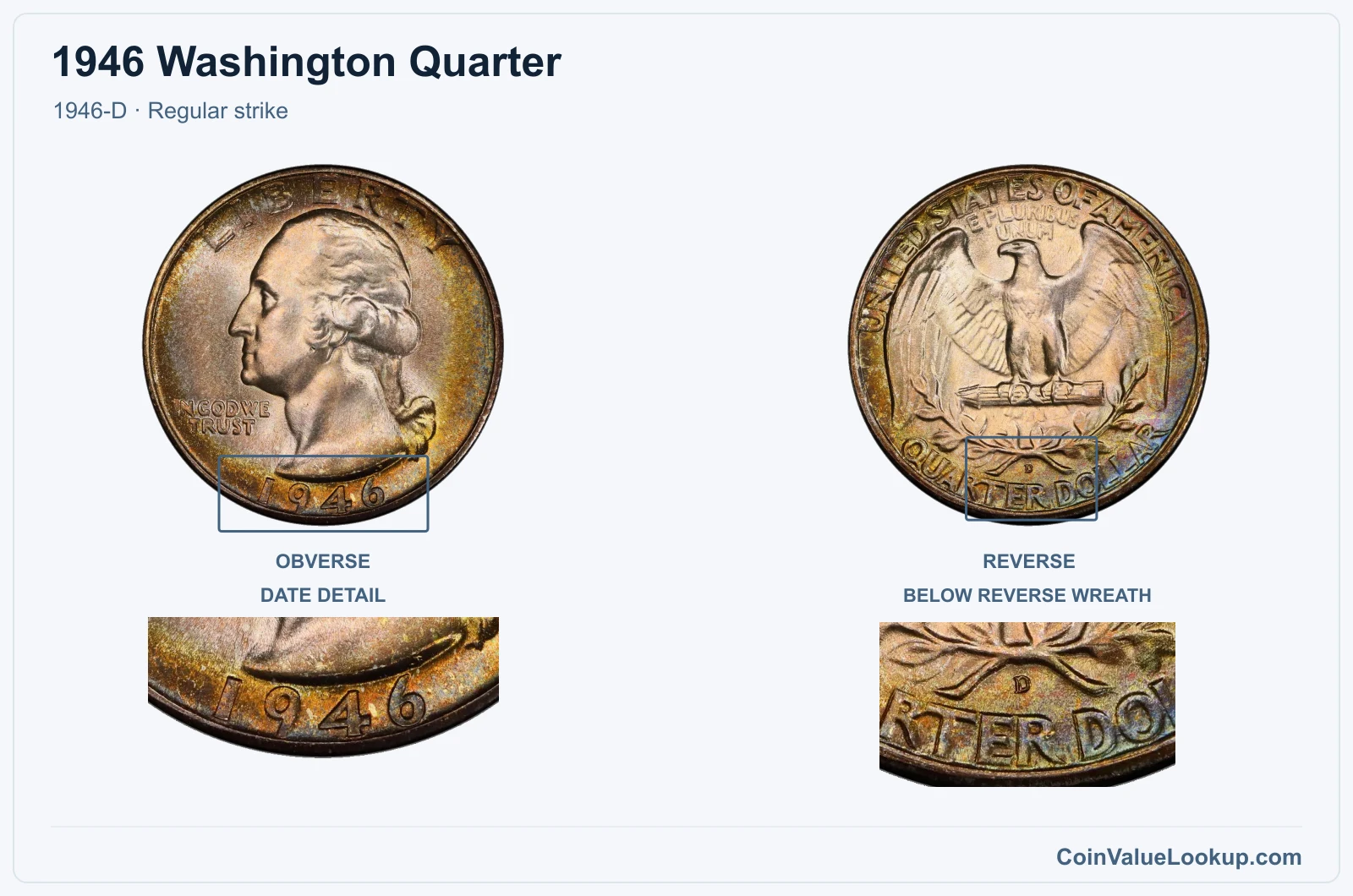
The 1946-D quarter carries a small "D" mintmark below the eagle on the reverse. Same silver alloy — 90% silver, 10% copper — at the standard 6.25 grams.
Guide estimates from USA Coin Book come in at about $16.43 in G4, $20 at MS60, and around $50 at MS65. Denver strikes from this year are common in circulated grades.
The premium really kicks in once you get into solidly uncirculated territory with clean fields and full luster. Check carefully for bag marks on the cheek and eagle breast, since those are the spots that take the most contact during storage and shipping.
| Range | Grade | Price | Auction Records | Appraisal |
|---|---|---|---|---|
| PO | PO 1 | — | Coin Identifier | |
| FR | FR 2 | — | Coin Identifier | |
| AG | AG 3 | — | Coin Identifier | |
| G | G 4 | — | Coin Identifier | |
| G 6 | — | Coin Identifier | ||
| VG | VG 8 | — | Coin Identifier | |
| VG 10 | — | Coin Identifier | ||
| F | F 12 | — | Coin Identifier | |
| F 15 | — | Coin Identifier | ||
| VF | VF 20 | — | Coin Identifier | |
| VF 25 | — | Coin Identifier | ||
| VF 30 | — | Coin Identifier | ||
| VF 35 | — | Coin Identifier | ||
| XF | XF 40 | — | Coin Identifier | |
| XF 45 | Coin Identifier | |||
| AU | AU 50 | — | Coin Identifier | |
| AU 53 | — | Coin Identifier | ||
| AU 55 | — | Coin Identifier | ||
| AU 58 | — | Coin Identifier | ||
| MS | MS 60 | — | Coin Identifier | |
| MS 61 | — | Coin Identifier | ||
| MS 62 | Coin Identifier | |||
| MS 63 | — | Coin Identifier | ||
| MS 64 | Coin Identifier | |||
| MS 65 | Coin Identifier | |||
| MS 66 | Coin Identifier | |||
| MS 67 | Coin Identifier | |||
| MS 68 | Coin Identifier | |||
| MS 69 | — | — | — | |
| MS 70 | — | — | — |
1946 Washington Quarter — S
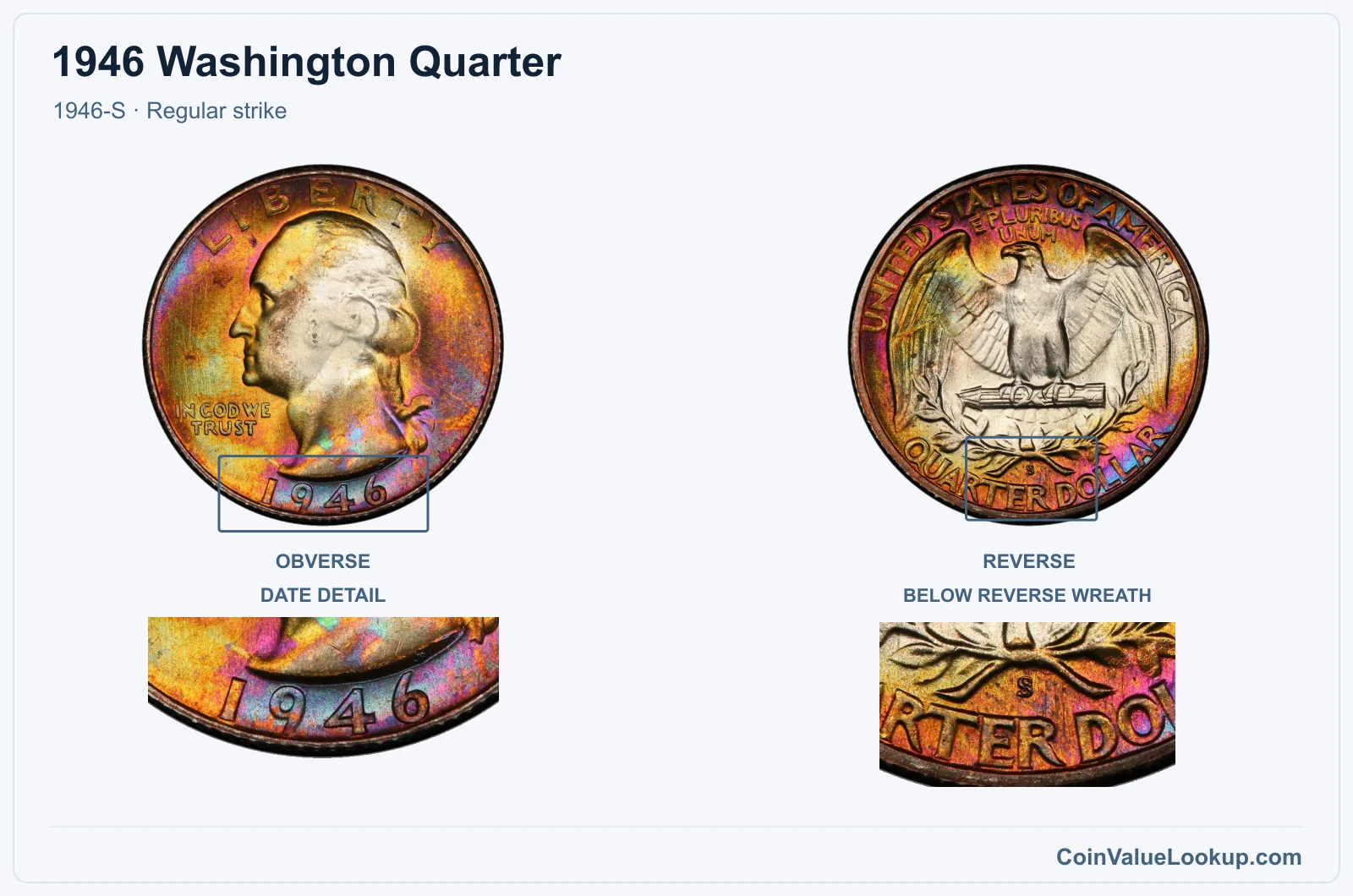
Look for the "S" mintmark below the reverse wreath to confirm a San Francisco strike. It shares the same 90% silver, 10% copper composition and 6.25-gram weight as the other two mints.
USA Coin Book guide estimates run about $16.43 at G4, $20 at MS60, and approximately $46 at MS65. The MS65 figure sits a touch below Philadelphia and Denver, which may seem counterintuitive given the lower mintage.
But more San Francisco coins apparently survived in nice condition, so supply at the gem level is actually a bit better.
Coin Value Lookup is a handy starting point if you want to look up other dates or denominations in the Washington quarter series alongside this one.
| Range | Grade | Price | Auction Records | Appraisal |
|---|---|---|---|---|
| PO | PO 1 | — | Coin Identifier | |
| FR | FR 2 | — | Coin Identifier | |
| AG | AG 3 | — | Coin Identifier | |
| G | G 4 | — | Coin Identifier | |
| G 6 | — | Coin Identifier | ||
| VG | VG 8 | — | Coin Identifier | |
| VG 10 | — | Coin Identifier | ||
| F | F 12 | — | Coin Identifier | |
| F 15 | Coin Identifier | |||
| VF | VF 20 | — | Coin Identifier | |
| VF 25 | — | Coin Identifier | ||
| VF 30 | — | Coin Identifier | ||
| VF 35 | — | Coin Identifier | ||
| XF | XF 40 | — | Coin Identifier | |
| XF 45 | — | Coin Identifier | ||
| AU | AU 50 | — | Coin Identifier | |
| AU 53 | — | Coin Identifier | ||
| AU 55 | — | Coin Identifier | ||
| AU 58 | — | Coin Identifier | ||
| MS | MS 60 | — | Coin Identifier | |
| MS 61 | — | Coin Identifier | ||
| MS 62 | — | Coin Identifier | ||
| MS 63 | Coin Identifier | |||
| MS 64 | Coin Identifier | |||
| MS 65 | Coin Identifier | |||
| MS 66 | Coin Identifier | |||
| MS 67 | Coin Identifier | |||
| MS 68 | Coin Identifier | |||
| MS 69 | — | — | — | |
| MS 70 | — | — | — |
1946 Washington Quarter Error List
1. 1946 Washington Quarter — Doubled Die Obverse
A doubled die obverse on the 1946 Philadelphia quarter shows die-made doubling visible under magnification on LIBERTY and IN GOD WE TRUST. You need a loupe — this is not something you will typically spot at arm's length.
Genuine die doubling produces a second, slightly offset impression with full rounded letter profiles. Machine doubling, by contrast, leaves a flat shelf along one side of the lettering without any real depth.
Scratches, wear marks, and added metal don't replicate the consistent, repeating pattern of a true doubled die.
No specific price range is established for this variety in the research. Value depends on the severity of doubling, overall coin condition, and authentication by a recognized grading service.
Each specimen is assessed individually.
2. 1946 Washington Quarter — Tapered and Cracked Planchet
This documented error on a 1946 Philadelphia quarter combines two planchet defects: the blank was unevenly rolled, producing a tapered thickness, and it developed a crack at approximately three o'clock before or during striking. An NGC-graded MS65 example exists in auction archives.
To identify it, examine the rim and edge for uneven thickness — one side of the coin will appear noticeably thinner than the other. Then look for a fissure radiating from roughly the three o'clock position.
Both features must be present together.
A coin that was simply bent, ground, or squeezed after leaving the mint is not the same thing. A raised die crack on the coin's surface is also a different defect entirely.
No established price range is available; value depends on authentication, condition, and the specific combination of defects confirmed by a grading service.
3. 1946 Washington Quarter — Doubled Die Reverse
A doubled die reverse variety has been cataloged for the 1946 quarter. To look for it, compare your coin's reverse legends and design contours carefully against a normal 1946 quarter at matching magnification.
Genuine doubled die reverses show a second, slightly shifted impression in the lettering or design elements — the doubling has depth and consistency because it originates from the die itself. Machine doubling, reflections under certain lighting, and random post-mint damage can all mimic this effect to the untrained eye, so a side-by-side comparison with a confirmed normal coin is essential.
No specific price data is available for this variety. Value will depend on the visibility of doubling, overall condition, and professional authentication.
If you suspect you have one, third-party grading is the path forward.
4. 1946 Washington Quarter — Repunched Mintmark
A repunched mintmark variety exists on the 1946-D quarter, where the Denver "D" was punched into the die more than once in slightly different positions. The result is a visible remnant of the earlier punch sitting alongside the final mintmark.
To check for it, examine the "D" below the reverse wreath under at least 5x magnification. You are looking for traces of a second "D" that may appear as a partial outline, a notch, or a shadow slightly offset from the primary letter.
Compare it against a normal 1946-D at the same magnification so you can see the difference clearly.
Die chips, corrosion around the mintmark, and machine doubling can all create misleading visual effects. No price range is established for this variety; value depends on the strength of the repunching, coin condition, and professional attribution.