1952 Washington Quarter Coin Value: How Much Is It Worth?
The 1952 Washington quarter is a 90% silver coin struck at three mints, with a Philadelphia proof rounding out the lineup. Circulated examples start around $16.43 in well-worn grades according to USA Coin Book retail estimates, while selected uncirculated pieces in MS65 condition reach up to $54 depending on mint.
These are guide-level retail estimates, not guaranteed sale prices. Identify your mint and grade before quoting any number.
Fast Way to Identify Your 1952 Washington Quarter
Snap clear photos of both the front and back of your 1952 quarter and upload them here for a preliminary identification. This helps narrow down the mint, finish, and any obvious variety features so you can look up the right value range.
Good lighting and a steady hand go a long way.
1952 Washington Quarter Value
Upload both sides of your 1952 Washington Quarter.
Front Obverse
Upload photo
Back Reverse
Upload photo
Which 1952 Washington Quarter Versions Are Worth Money?
- 1952-S quarters in MS65 condition carry the highest business-strike guide estimate at $54, reflecting tighter surviving populations in top grades.
- 1952 Proof quarters at PR65 list around $65; the Superbird proof variety with its S-shaped eagle breast feature has sold individually for thousands at auction.
- A compound error — 1952 quarter struck on a dime planchet with a reverse brockage — sold for $4,700 in NGC MS64, a one-of-a-kind specimen.
- The 1952-S struck on a nickel planchet realized $1,260 in MS61, an unusual wrong-planchet error worth investigating if your coin seems too light or gray.
- Doubled die obverse, doubled die reverse, and repunched mintmark varieties have been cataloged for this year; value depends on visibility and condition.
Step 1: Identify Your 1952 Washington Quarter Mint Mark and Version
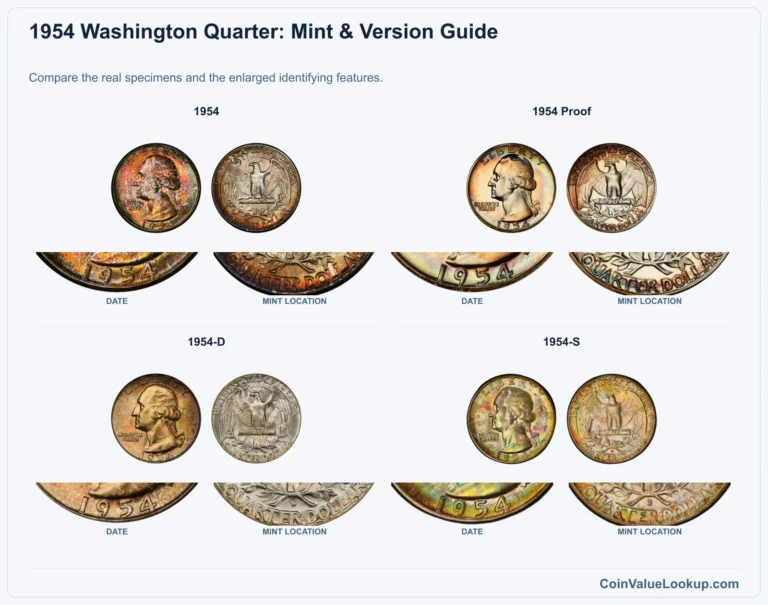
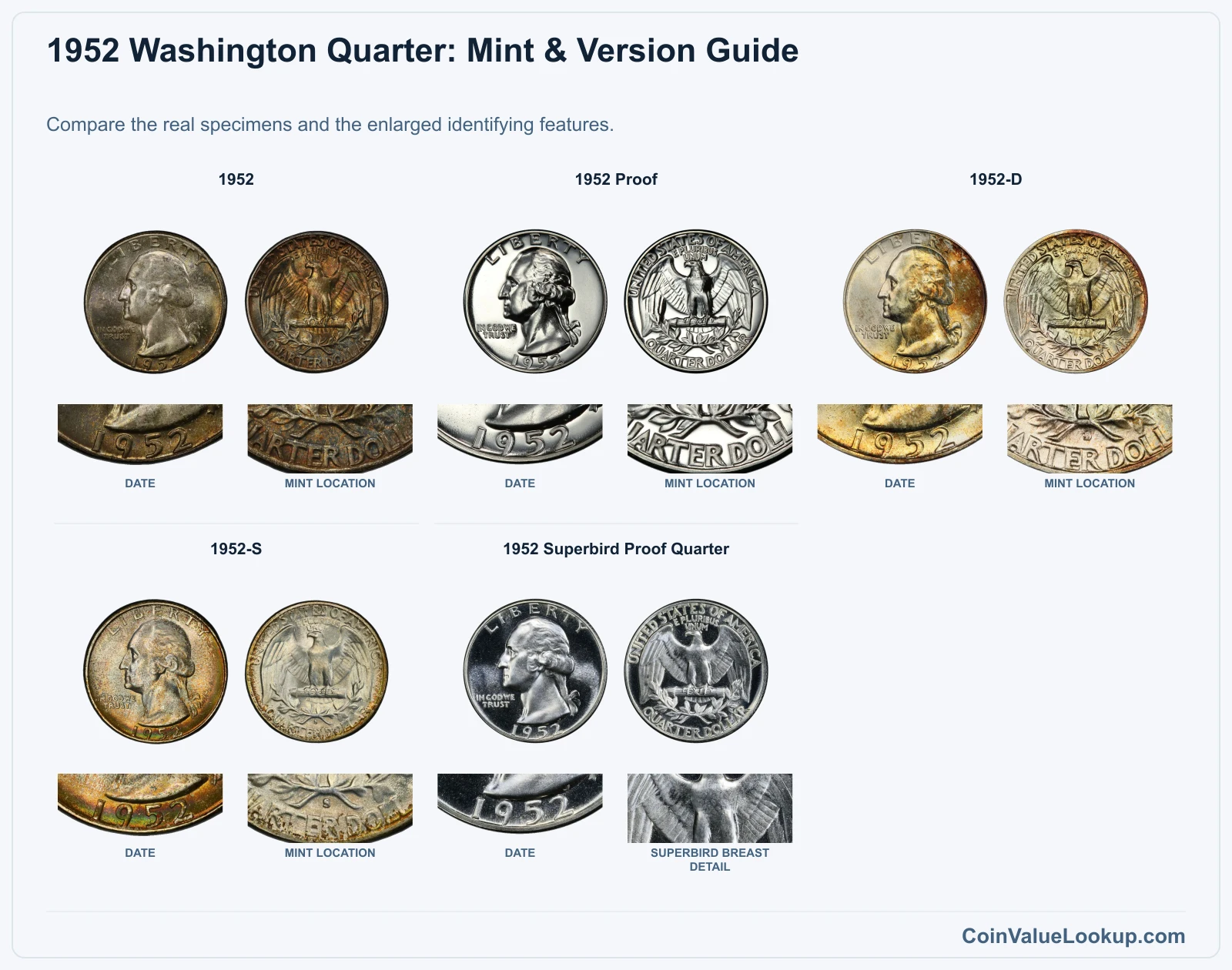
Start with the date on the obverse — you are looking for 1952. Flip to the reverse and check beneath the wreath for a mintmark: a D means Denver, an S means San Francisco, and a blank space means Philadelphia.
All standard 1952 quarters are struck in 90% silver and 10% copper, weighing about 6.25 grams with a diameter near 24.3 mm. That silver content gives even worn coins a baseline floor, but numismatic value depends on mint, grade, and whether you have a business strike or a proof.
Philadelphia also produced proof quarters this year, which have mirror-like reflective fields and exceptionally sharp detail from specially prepared dies. A polished circulation coin is not a proof — the manufacturing process is entirely different.
The Superbird variety is a proof-only die feature found on the eagle's breast; it is not an S mintmark and does not indicate San Francisco production.
Coin Value Lookup is a good starting point if you want to look up guides for other dates and denominations in the Washington quarter series. You can compare across years to see where your coin fits.
Step 2: Check Your 1952 Washington Quarter Grade
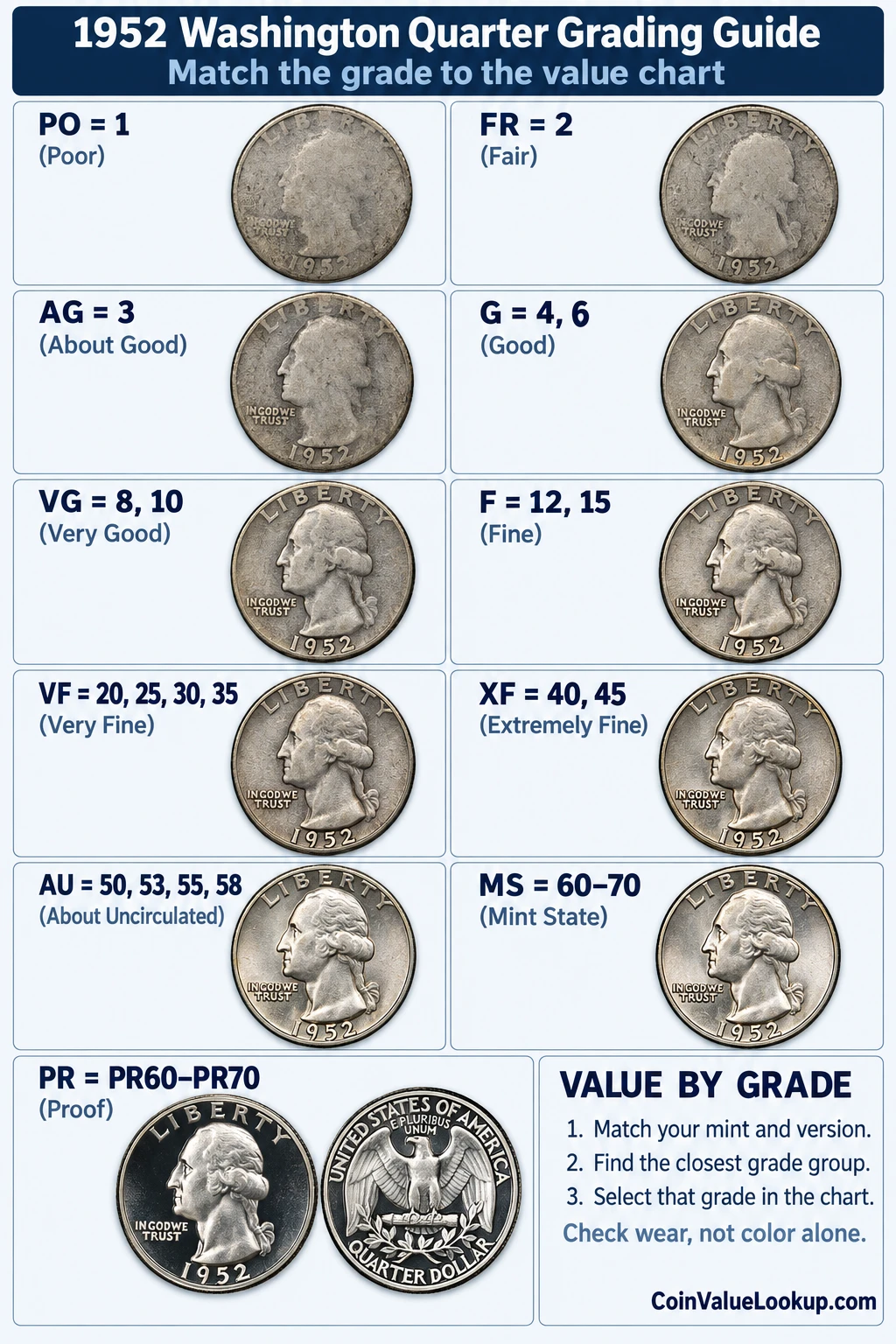
Focus on three wear checkpoints: the hair above Washington's ear, the cheek and jawline, and the eagle's breast feathers on the reverse. In lower grades these areas flatten and lose luster; a coin grading Good-4 will show only an outline of major design elements.
At MS60, full detail remains but you will see contact marks and possibly dull spots from bag handling. By MS65, surfaces are clean with strong original luster and only minor blemishes visible under magnification.
Do not confuse a weakly struck area — which retains luster — with actual wear that strips luster away. Compare your coin to the reference image at matching angles.
For proofs, look for hairlines from mishandling and note whether the fields retain full mirror reflectivity; cameo and deep cameo contrast designations are separate evaluations from the proof grade itself.
Step 3: Check 1952 Washington Quarter Value by Mint and Version
1952 Washington Quarter
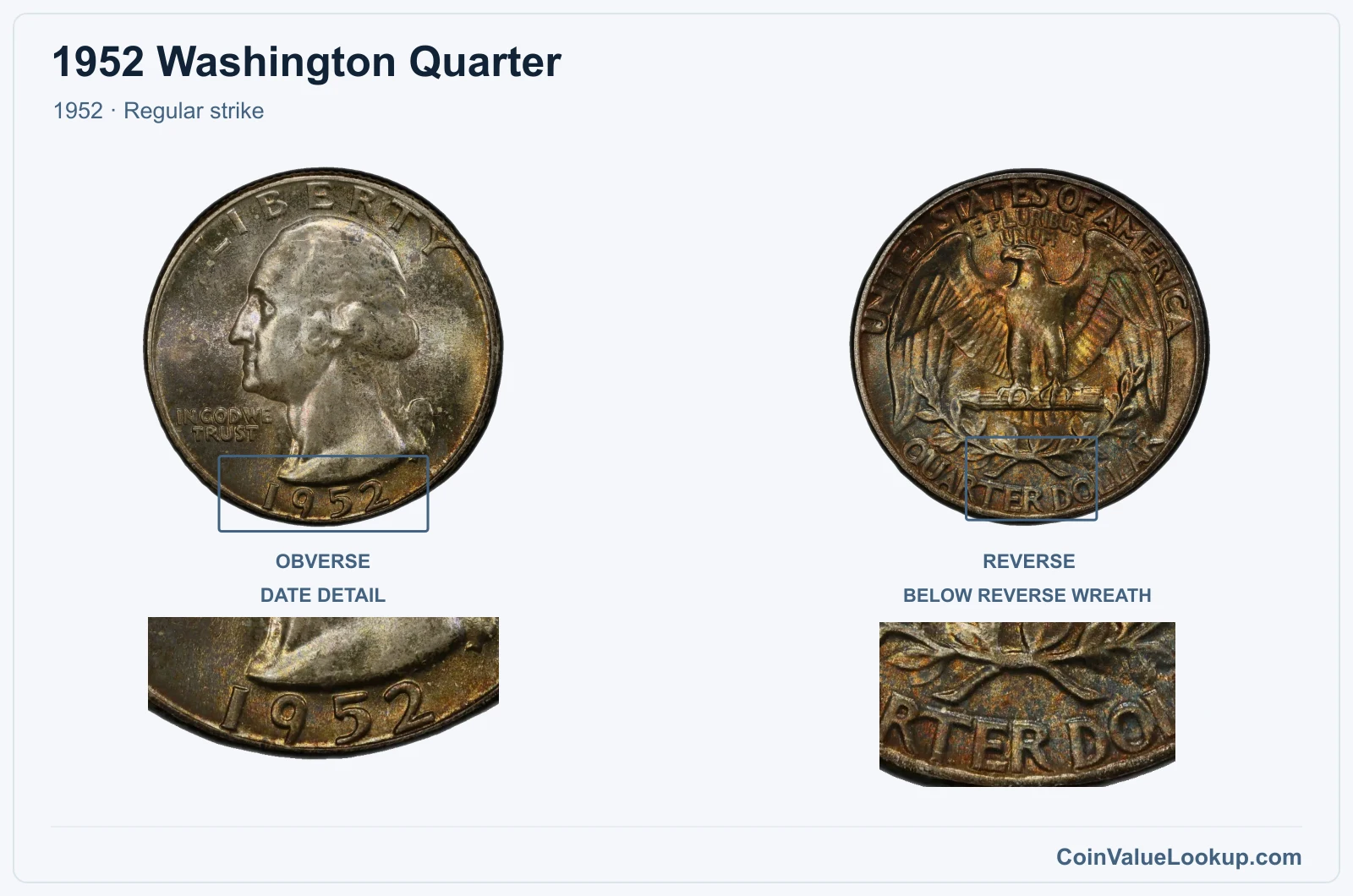
The 1952 Philadelphia quarter has no mintmark — just a blank space below the reverse wreath. It is struck in 90% silver and 10% copper at a nominal 6.25 grams.
USA Coin Book lists this issue at about $16.43 in G4, $20 in MS60, and $39 in MS65. Those are retail guide estimates, not offers.
Original uncirculated surfaces with full luster carry the premium; cleaned or damaged coins trade well below guide levels regardless of technical grade.
| Range | Grade | Price | Auction Records | Appraisal |
|---|---|---|---|---|
| PO | PO 1 | — | Coin Identifier | |
| FR | FR 2 | — | Coin Identifier | |
| AG | AG 3 | — | Coin Identifier | |
| G | G 4 | — | Coin Identifier | |
| G 6 | — | Coin Identifier | ||
| VG | VG 8 | — | Coin Identifier | |
| VG 10 | — | Coin Identifier | ||
| F | F 12 | — | Coin Identifier | |
| F 15 | — | Coin Identifier | ||
| VF | VF 20 | — | Coin Identifier | |
| VF 25 | — | Coin Identifier | ||
| VF 30 | — | Coin Identifier | ||
| VF 35 | — | Coin Identifier | ||
| XF | XF 40 | — | Coin Identifier | |
| XF 45 | — | Coin Identifier | ||
| AU | AU 50 | — | Coin Identifier | |
| AU 53 | — | Coin Identifier | ||
| AU 55 | Coin Identifier | |||
| AU 58 | — | Coin Identifier | ||
| MS | MS 60 | — | Coin Identifier | |
| MS 61 | — | Coin Identifier | ||
| MS 62 | — | Coin Identifier | ||
| MS 63 | — | Coin Identifier | ||
| MS 64 | Coin Identifier | |||
| MS 65 | Coin Identifier | |||
| MS 66 | Coin Identifier | |||
| MS 67 | Coin Identifier | |||
| MS 68 | — | — | — | |
| MS 69 | — | — | — | |
| MS 70 | — | — | — |
1952 Washington Quarter — Proof
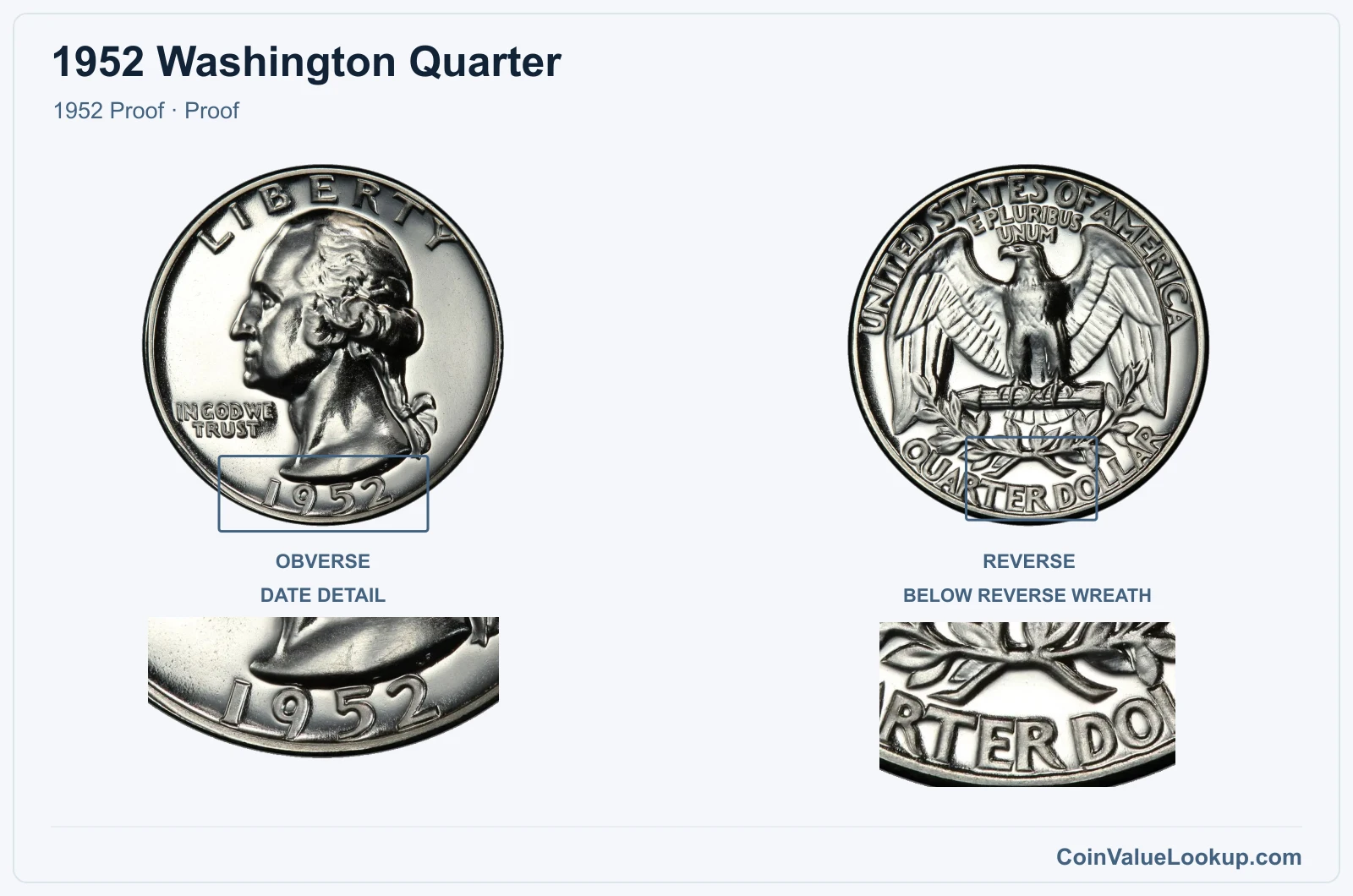
The 1952 proof quarter was struck at Philadelphia on polished planchets using specially prepared dies, producing mirror-like fields and razor-sharp design elements. It shares the same 90% silver composition and has no mintmark.
At PR65, the USA Coin Book guide estimate is around $65. Cameo and deep cameo designations — describing the contrast between frosted devices and reflective fields — are evaluated separately and can affect value significantly.
This is also the only finish where the Superbird variety exists, identified by a small S-shaped feature on the eagle's breast. Do not confuse a proof with a polished circulation strike; genuine proofs show squared rims and distinctly mirrored surfaces that no amount of buffing can replicate.
| Range | Grade | Price | Auction Records | Appraisal |
|---|---|---|---|---|
| PR | PR 1 | — | Coin Identifier | |
| PR 2 | — | Coin Identifier | ||
| PR 3 | — | Coin Identifier | ||
| PR 4 | — | Coin Identifier | ||
| PR 6 | — | Coin Identifier | ||
| PR 8 | — | Coin Identifier | ||
| PR 10 | — | Coin Identifier | ||
| PR 12 | — | Coin Identifier | ||
| PR 15 | — | Coin Identifier | ||
| PR 20 | — | Coin Identifier | ||
| PR 25 | — | Coin Identifier | ||
| PR 30 | — | Coin Identifier | ||
| PR 35 | — | Coin Identifier | ||
| PR 40 | — | Coin Identifier | ||
| PR 45 | — | Coin Identifier | ||
| PR 50 | — | Coin Identifier | ||
| PR 53 | — | Coin Identifier | ||
| PR 55 | — | Coin Identifier | ||
| PR 58 | — | Coin Identifier | ||
| PR 60 | — | Coin Identifier | ||
| PR 61 | — | Coin Identifier | ||
| PR 62 | Coin Identifier | |||
| PR 63 | Coin Identifier | |||
| PR 64 | Coin Identifier | |||
| PR 65 | Coin Identifier | |||
| PR 66 | Coin Identifier | |||
| PR 67 | Coin Identifier | |||
| PR 68 | Coin Identifier | |||
| PR 69 | — | — | — | |
| PR 70 | — | — | — |
1952 Washington Quarter — D
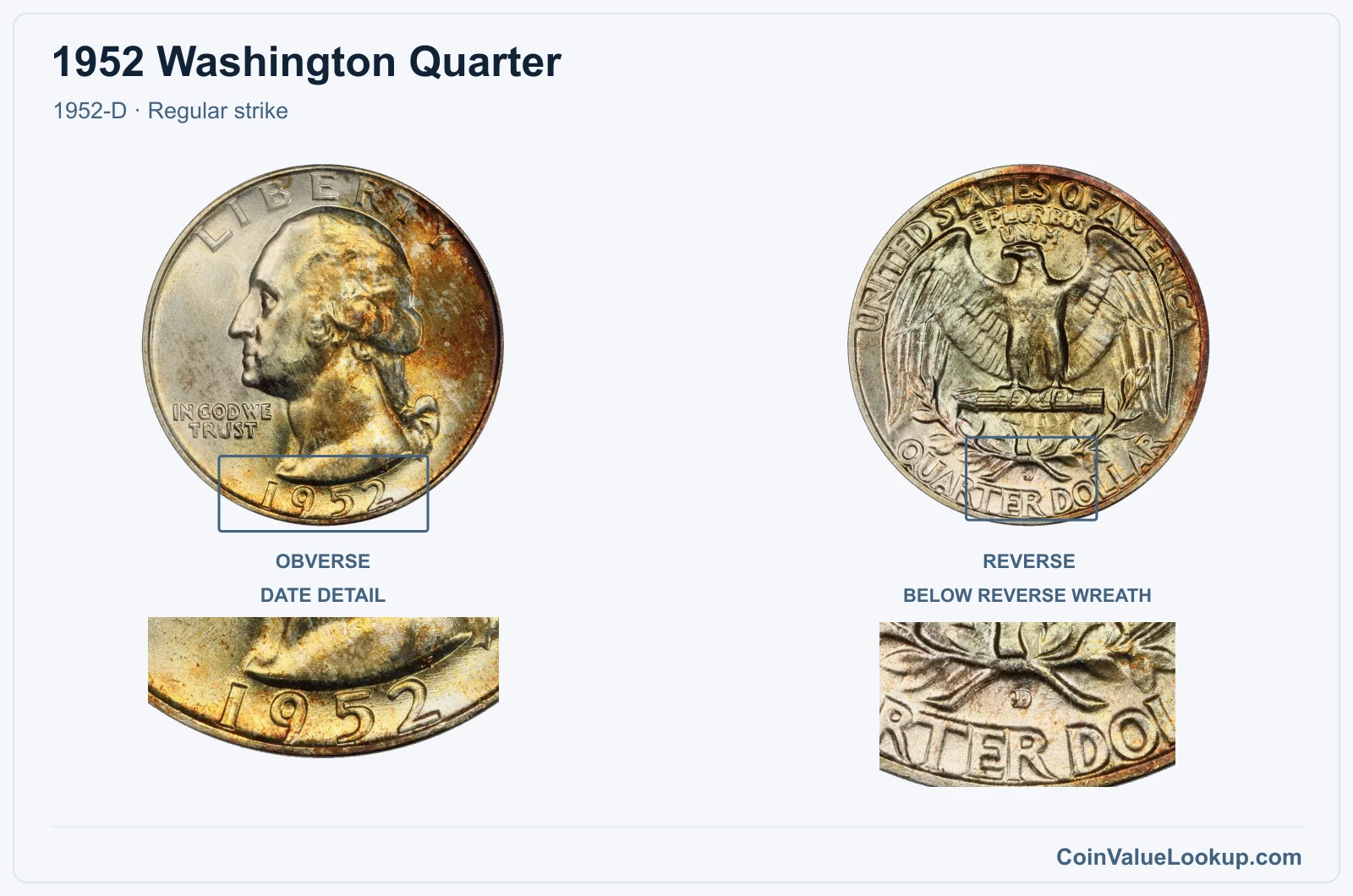
Look for a D mintmark below the wreath on the reverse. The 1952-D shares the standard 90% silver, 10% copper composition at about 6.25 grams.
Guide estimates from USA Coin Book place this issue at roughly $16.43 in G4, $20 in MS60, and $43 in MS65. The Denver mint produced large quantities, so circulated examples are common.
Gem uncirculated coins with clean fields and strong luster are where the modest premium lives.
| Range | Grade | Price | Auction Records | Appraisal |
|---|---|---|---|---|
| PO | PO 1 | — | Coin Identifier | |
| FR | FR 2 | — | Coin Identifier | |
| AG | AG 3 | — | Coin Identifier | |
| G | G 4 | — | Coin Identifier | |
| G 6 | — | Coin Identifier | ||
| VG | VG 8 | — | Coin Identifier | |
| VG 10 | — | Coin Identifier | ||
| F | F 12 | — | Coin Identifier | |
| F 15 | — | Coin Identifier | ||
| VF | VF 20 | — | Coin Identifier | |
| VF 25 | — | Coin Identifier | ||
| VF 30 | — | Coin Identifier | ||
| VF 35 | — | Coin Identifier | ||
| XF | XF 40 | — | Coin Identifier | |
| XF 45 | — | Coin Identifier | ||
| AU | AU 50 | — | Coin Identifier | |
| AU 53 | — | Coin Identifier | ||
| AU 55 | — | Coin Identifier | ||
| AU 58 | — | Coin Identifier | ||
| MS | MS 60 | — | Coin Identifier | |
| MS 61 | — | Coin Identifier | ||
| MS 62 | — | Coin Identifier | ||
| MS 63 | — | Coin Identifier | ||
| MS 64 | Coin Identifier | |||
| MS 65 | Coin Identifier | |||
| MS 66 | Coin Identifier | |||
| MS 67 | Coin Identifier | |||
| MS 68 | — | — | — | |
| MS 69 | — | — | — | |
| MS 70 | — | — | — |
1952 Washington Quarter — S
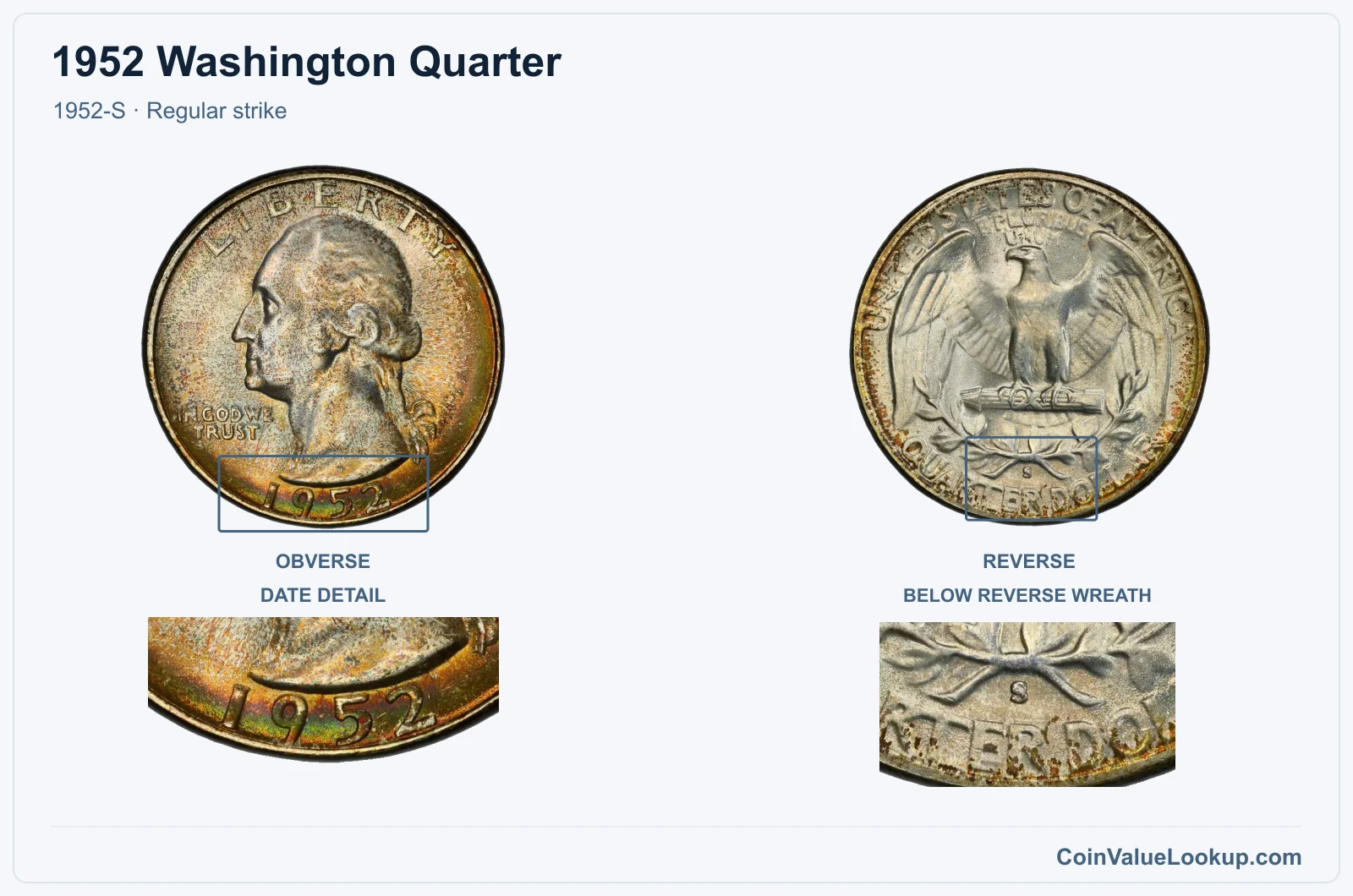
The 1952-S carries an S mintmark beneath the reverse wreath, indicating San Francisco production. Same 90% silver alloy, same 6.25-gram target weight.
USA Coin Book estimates run about $16.43 in G4, $26 in MS60, and $54 in MS65 — the highest business-strike guide figure among the three mints this year. That MS65 premium reflects fewer survivors with pristine surfaces.
Circulated pieces trade near melt, but a well-preserved original example is worth grading carefully.
| Range | Grade | Price | Auction Records | Appraisal |
|---|---|---|---|---|
| PO | PO 1 | — | Coin Identifier | |
| FR | FR 2 | — | Coin Identifier | |
| AG | AG 3 | — | Coin Identifier | |
| G | G 4 | — | Coin Identifier | |
| G 6 | — | Coin Identifier | ||
| VG | VG 8 | — | Coin Identifier | |
| VG 10 | — | Coin Identifier | ||
| F | F 12 | — | Coin Identifier | |
| F 15 | — | Coin Identifier | ||
| VF | VF 20 | — | Coin Identifier | |
| VF 25 | — | Coin Identifier | ||
| VF 30 | — | Coin Identifier | ||
| VF 35 | — | Coin Identifier | ||
| XF | XF 40 | — | Coin Identifier | |
| XF 45 | — | Coin Identifier | ||
| AU | AU 50 | — | Coin Identifier | |
| AU 53 | — | Coin Identifier | ||
| AU 55 | — | Coin Identifier | ||
| AU 58 | — | Coin Identifier | ||
| MS | MS 60 | — | Coin Identifier | |
| MS 61 | — | Coin Identifier | ||
| MS 62 | — | Coin Identifier | ||
| MS 63 | — | Coin Identifier | ||
| MS 64 | Coin Identifier | |||
| MS 65 | Coin Identifier | |||
| MS 66 | Coin Identifier | |||
| MS 67 | Coin Identifier | |||
| MS 68 | Coin Identifier | |||
| MS 69 | — | — | — | |
| MS 70 | — | — | — |
1952 Washington Quarter — Superbird Proof Quarter
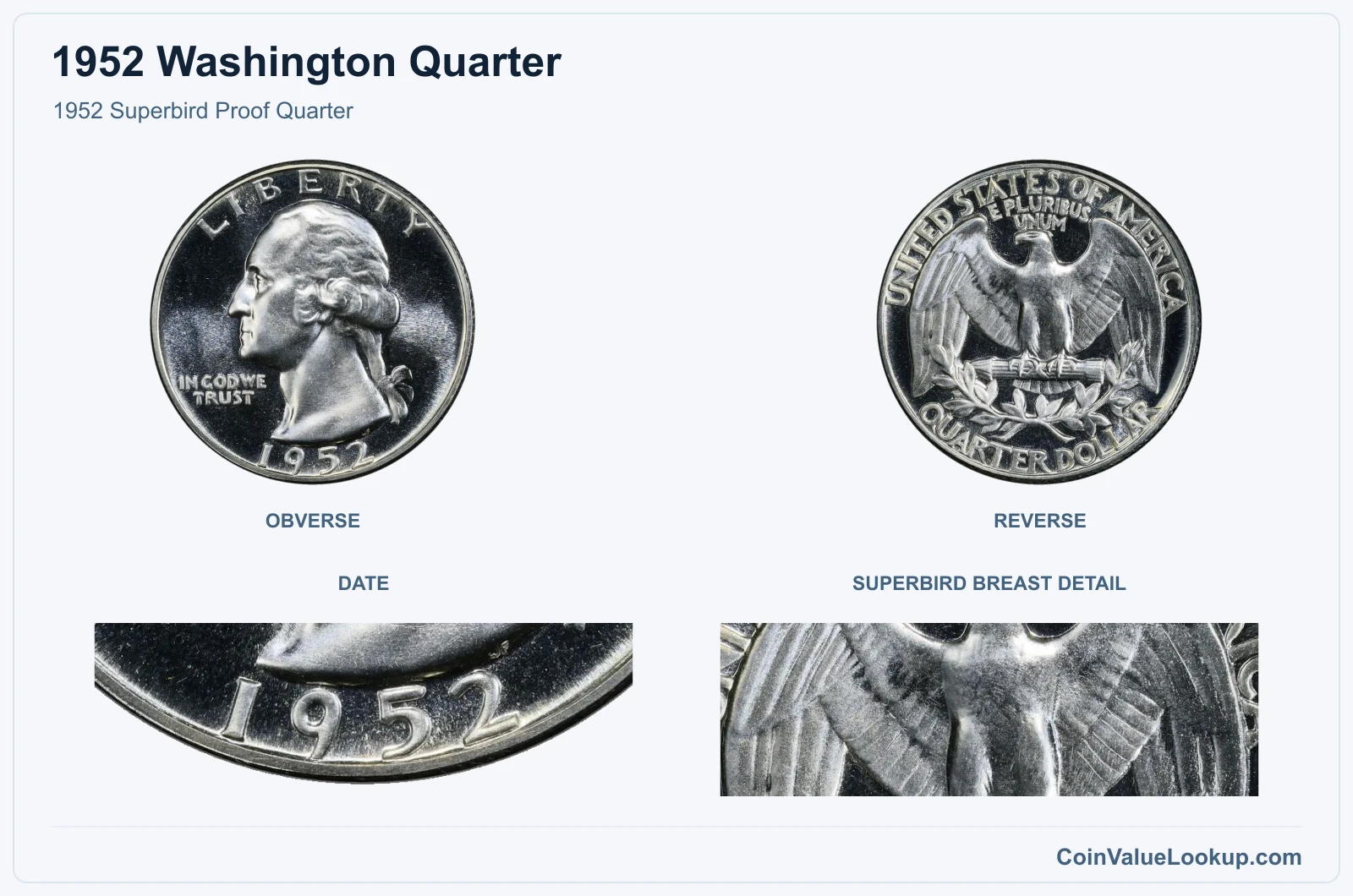
The Superbird is a proof-only variety identified by a small S-shaped die-engraved feature on the eagle's breast. It is not an S mintmark and has nothing to do with San Francisco.
You need magnification to see it clearly.
A PR67 Deep Cameo example sold for $9,600 at Heritage Auctions in October 2020 — a historical single result at that specific grade and contrast designation, not a universal Superbird price. Lower-grade or non-cameo examples will differ substantially.
To check for this variety, enlarge the eagle's breast area on a confirmed proof coin. Business strikes do not carry this feature.
Always retain the proof grade and any cameo or deep cameo designation when evaluating; they matter enormously for this variety.
Range Grade
Price Auction Records Appraisal PR PR 1
—
Coin Identifier
PR 2
—
Coin Identifier
PR 3
—
Coin Identifier
PR 4
—
Coin Identifier
PR 6
—
Coin Identifier
PR 8
—
Coin Identifier
PR 10
—
Coin Identifier
PR 12
—
Coin Identifier
PR 15
—
Coin Identifier
PR 20
—
Coin Identifier
PR 25
—
Coin Identifier
PR 30
—
Coin Identifier
PR 35
—
Coin Identifier
PR 40
—
Coin Identifier
PR 45
—
Coin Identifier
PR 50
—
Coin Identifier
PR 53
—
Coin Identifier
PR 55
—
Coin Identifier
PR 58
—
Coin Identifier
PR 60
—
Coin Identifier
PR 61
—
Coin Identifier
PR 62
—
Coin Identifier
PR 63
Coin Identifier
PR 64
Coin Identifier
PR 65
Coin Identifier
PR 66
Coin Identifier
PR 67
Coin Identifier
PR 68
Coin Identifier
PR 69
—
—
—
PR 70
—
—
—
1952 Washington Quarter Error List
1. 1952 Washington Quarter — Superbird Proof Die Feature
On the eagle's breast of certain 1952 Philadelphia proof quarters, a small S-shaped feature appears that was engraved into the die itself. This is the Superbird diagnostic.
It is not a mintmark and does not indicate San Francisco manufacture.
Use magnification and compare against a normal proof reverse. The genuine feature is strike-made and consistent across authenticated specimens.
Post-mint scratches, cuts, or engraving can mimic unusual shapes on the breast, so look for a clean, die-consistent impression rather than rough tooling marks.
A PR68 example sold for $1,840 at Heritage Auctions in January 2010. That price applies to that specific grade and contrast designation — other grades and designations will vary.
Only proof coins can carry this variety; if your coin is a business strike, the feature is not present.
2. 1952 Washington Quarter — Dime-Planchet Strike with Reverse Brockage
This is an extraordinary compound error: a 1952 quarter struck on a silver dime-sized planchet that also received a reverse brockage. The undersized blank retained a fully visible date but lost peripheral lettering because the planchet was too small to capture the full die impression.
The reverse shows an incuse, mirror-image Washington portrait and motto — the hallmark of a brockage, where an already-struck coin pressed against the blank. This is one combined error specimen, not two separate errors you can find independently on normal quarters.
An NGC MS64 example sold for $4,700 at Heritage Auctions in February 2016. That price reflects the specific compound nature of the piece.
Post-mint trimming or grinding can make a quarter look undersized, so authentication by a major grading service is essential before assuming you hold anything similar.
3. 1952 Washington Quarter — Struck on a Nickel Planchet
A cataloged 1952-S quarter struck on a five-cent planchet weighs just 4.6 grams instead of the standard 6.25 grams. The smaller, lighter blank produces an incomplete peripheral impression while still showing the date and S mintmark.
The coin will appear gray compared to normal silver quarters because it was struck on a copper-nickel blank intended for a Jefferson nickel. Low weight or unusual color alone does not confirm a wrong-planchet error — you need authentic strike flow showing the design was impressed by quarter dies onto the smaller blank, not post-mint damage.
An NGC MS61 specimen realized $1,260 at Heritage Auctions in September 2024. That is an individual result for that specific coin and grade.
Professional attribution is critical for wrong-planchet errors.
4. 1952 Washington Quarter — Doubled Die Obverse
A doubled die obverse has been cataloged for the 1952-D Washington quarter. The variety shows consistent doubling on obverse letters or design elements — look for separation or notching that repeats in the same direction across multiple features.
Compare your coin to a normal 1952-D under the same lighting and magnification. Genuine die doubling appears as a crisp secondary image, distinct from the flat shelf of machine doubling caused by die bounce during striking.
No specific numerical price range is available for this variety. Value depends on the visibility of the doubling, overall coin condition, and professional attribution.
If you spot suspicious doubling, side-by-side comparison with a known normal coin is the best first step.
5. 1952 Washington Quarter — Repunched Mintmark
Repunched mintmark varieties have been cataloged for the 1952-S quarter. The diagnostic is remnants of a previous S punch visible near or beneath the final mintmark position.
Under magnification you may see traces of a shifted letter — a secondary impression that does not align with the primary S.
Do not confuse a die chip, corrosion buildup, or machine doubling around the mintmark with a genuine repunched mintmark. The key distinction is a clearly identifiable second punch impression at a different angle or position.
No numerical price range is adopted for this variety. What a particular specimen brings depends on the clarity of the repunching, overall grade, and whether a grading service has attributed it.
Examine the mintmark area carefully at high magnification against a confirmed normal example.
6. 1952 Washington Quarter — Doubled Die Reverse
A doubled die reverse variety has been reported for the 1952 Washington quarter. The diagnostic involves doubling visible on reverse legends or design contours — compare lettering around the rim and details of the eagle against a normal coin at matching magnification.
Genuine die doubling will be consistent and directional, appearing across multiple letters or design elements. Machine doubling from die bounce typically shows a flat, shelf-like distortion and lacks the crisp secondary image of a true doubled die.
No numerical price has been established for this variety. Its value hinges on how pronounced the doubling is, the coin's overall condition, and attribution by a recognized grading service.
Random nicks, reflections, or wear-related distortions can mimic doubling, so careful comparison is essential before drawing conclusions.