1942 Wheat Penny Coin Value: How Much Is It Worth?
A 1942 Wheat Penny in circulated condition starts around $0.18 at Good-4 and can reach roughly $2.50 to $10 at MS63, depending on the mint. Those guide figures cover ordinary Philadelphia, Denver and San Francisco business strikes.
Proofs, major varieties and recognized errors are priced separately. Original surfaces, wear level and color all affect what a buyer will actually pay.
Fast Way to Identify Your 1942 Wheat Penny
Want a quick read on your 1942 penny? Upload clear photos of the front and back, and our identifier can give you a preliminary idea of which mint and version you have.
Good lighting and a steady shot help — try to capture the mintmark area below the date and the full reverse with both wheat ears visible.
1942 Wheat Penny Value
Upload both sides of your 1942 Wheat Penny.
Front Obverse
Upload photo
Back Reverse
Upload photo
Which 1942 Wheat Penny Versions Are Worth Money?
- The 1942-S commands the highest guide value among circulation strikes, listed at $0.24 in Good-4 and $10 at MS63 — roughly four times the Philadelphia or Denver branch at the upper grade.
- Philadelphia brilliant proofs from 1942 are listed around $50 at PR63, well above any circulated business strike from that year.
- A doubled die obverse, repunched mintmark or significant off-center strike can carry a premium beyond standard guide figures, though values depend on authenticated identity and severity.
- Strong original surfaces with no cleaning or corrosion improve a coin's appeal at every grade level across all three mints.
Step 1: Identify Your 1942 Wheat Penny Mint Mark and Version
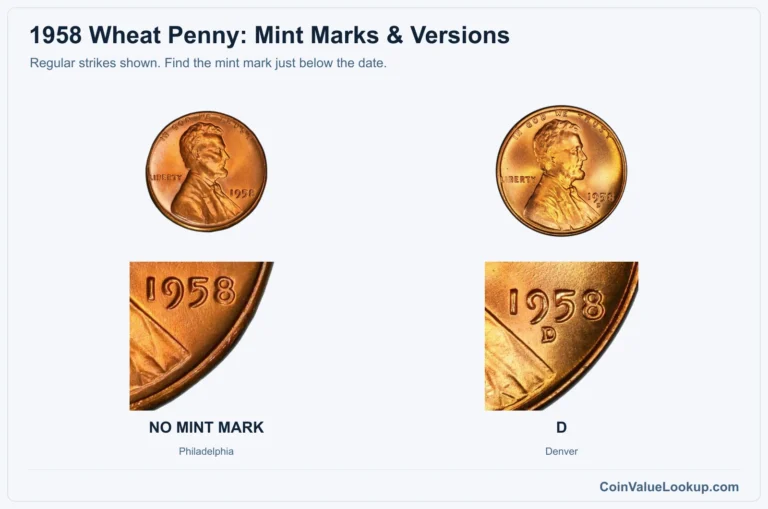
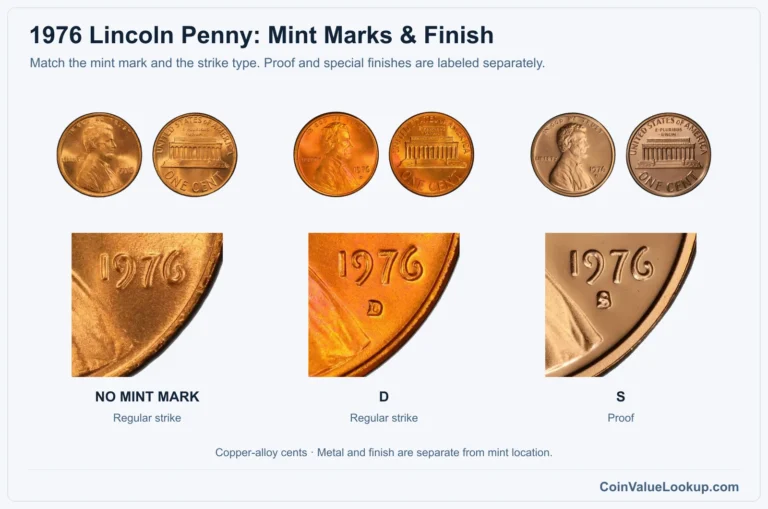
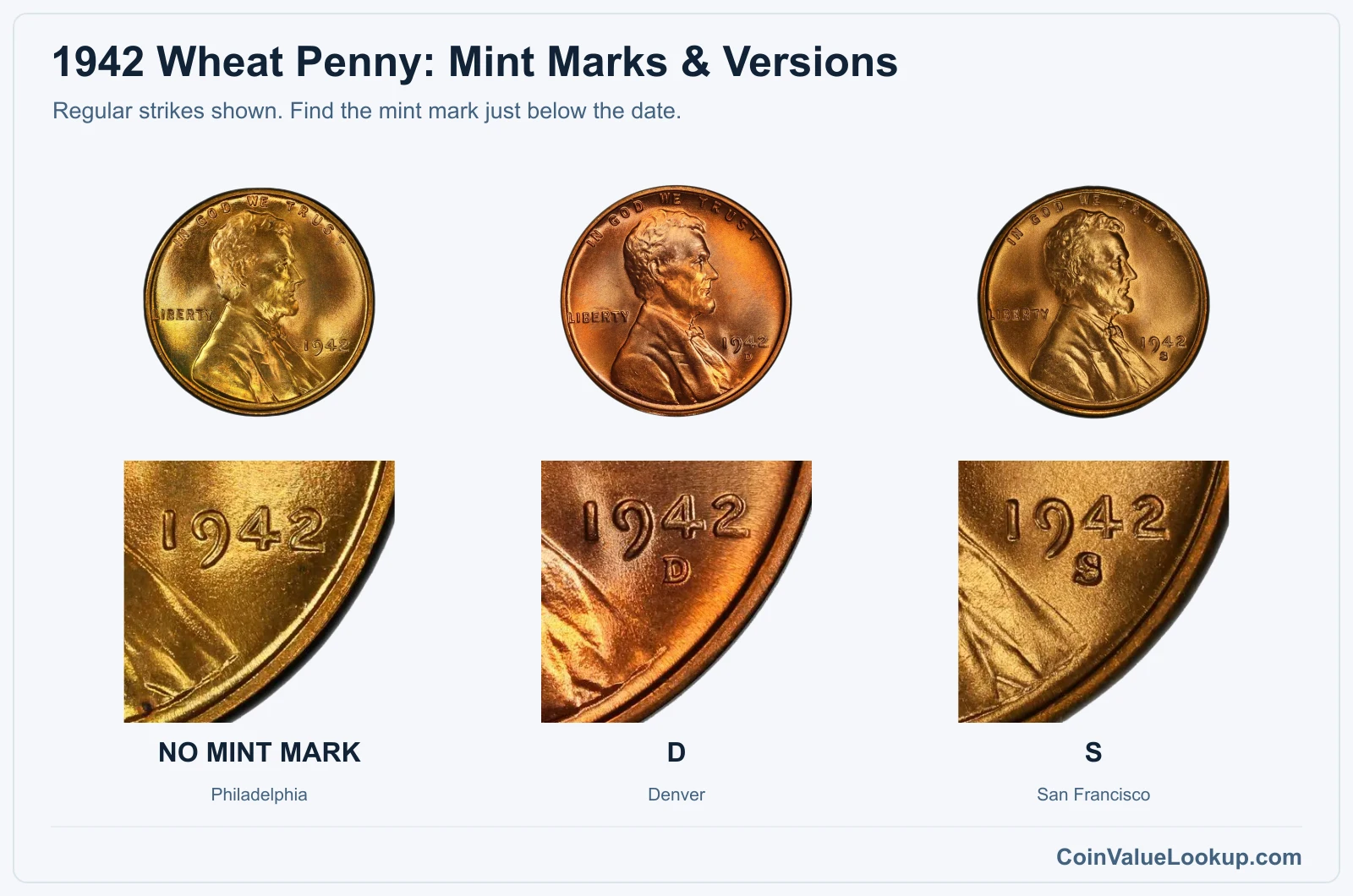
Flip the coin to the obverse and look just below the date on the right side. If there is no small letter, your coin was struck in Philadelphia.
A tiny "D" means Denver, and an "S" means San Francisco.
All three mints produced standard Lincoln Wheat cents in 1942, struck on a 95% copper, 5% tin and zinc planchet weighing about 3.11 grams with a plain edge. The obverse carries Lincoln's portrait; the reverse shows two wheat ears framing "ONE CENT."
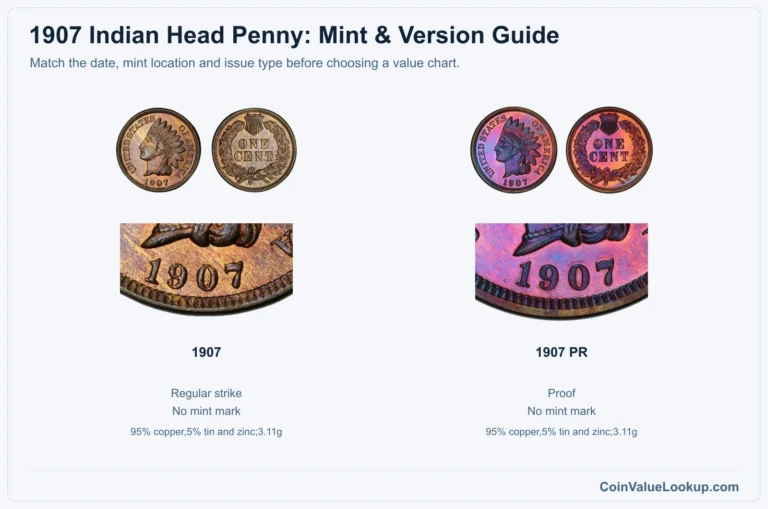
Philadelphia also produced brilliant proof cents for collectors in 1942. These have mirrored fields and sharp detail from specially prepared dies — a polished circulation cent is not a proof, no matter how shiny it looks.
If your coin has ordinary luster and contact marks from rolling around in a cash register, it is a business strike.
Separate proof status from condition and color. Red, brown or red-brown toning describes surface color, not grade.
A brown proof is still a proof; a red business strike is still a business strike.
Step 2: Check Your 1942 Wheat Penny Grade
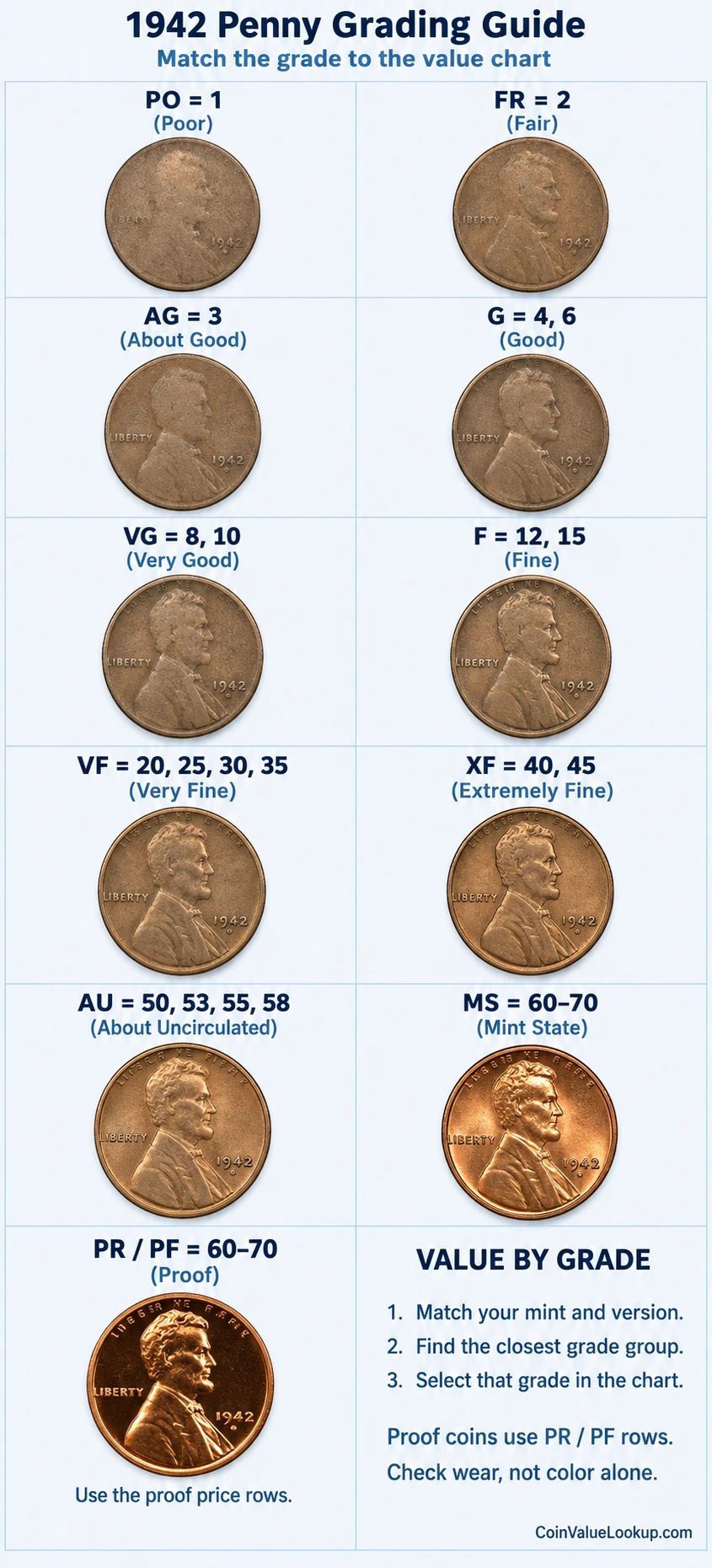
Start with Lincoln's cheekbone and jawline on the obverse. In higher grades these areas show full, rounded contour and original mint luster.
As wear progresses, the cheek flattens first, then the jaw detail softens and hair strands above the ear merge together.
On the reverse, check the individual wheat grains and the vertical lines between the stalks. A coin grading around Good-4 will have a smooth cheek, faint hair detail and mostly flat wheat lines, but the full outline of the design is still readable.
One thing to watch: a weak original strike can leave soft detail that looks like wear but is not. Compare your coin against the reference image and note whether luster is intact in the recessed areas — that is a sign the softness came from the die, not from pocket change.
Color, spots, corrosion and cleaning are separate value factors from wear grade. A coin with attractive original brown toning at MS63 can be more desirable than a cleaned coin someone tried to make look red.
Evaluate surfaces honestly before assuming a high grade.
Step 3: Check 1942 Wheat Penny Value by Mint and Version
1942 Wheat Penny
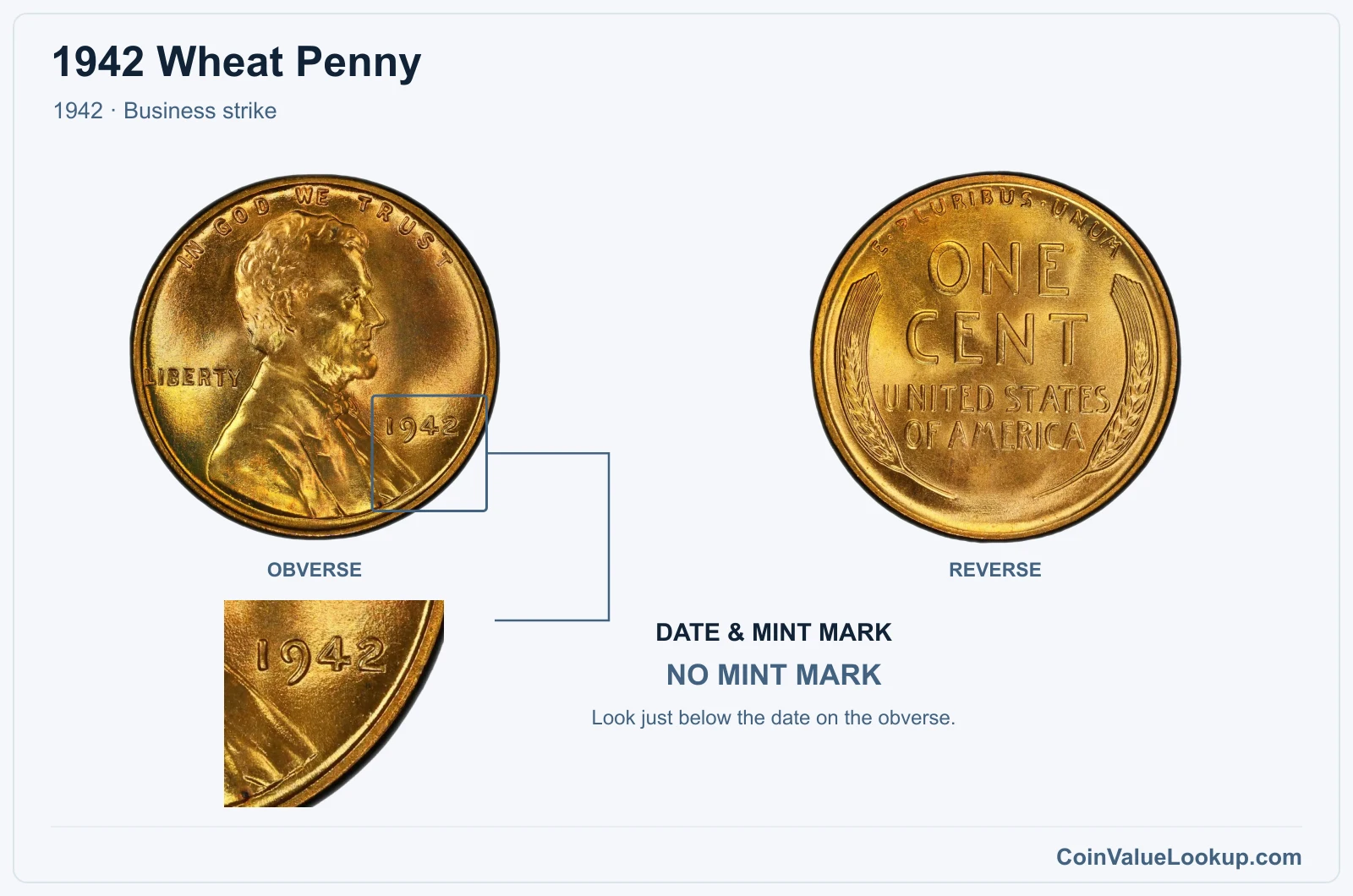
The 1942 Philadelphia cent has no mintmark below the date. It is the most common branch for this year, with guide values of about $0.18 in Good-4 and $2.50 at MS63.
These figures assume an ordinary business strike with no major variety.
Because so many were made, circulated examples turn up constantly. The value jump happens in uncirculated grades, particularly with original red or red-brown surfaces.
Look for full luster across both sides and minimal contact marks to place a coin near MS63.
| Range | Grade | Price | Auction Records | Appraisal |
|---|---|---|---|---|
| PO | PO 1 | — | Coin Identifier | |
| FR | FR 2 | — | Coin Identifier | |
| AG | AG 3 | — | Coin Identifier | |
| G | G 4 | — | Coin Identifier | |
| G 6 | — | Coin Identifier | ||
| VG | VG 8 | — | Coin Identifier | |
| VG 10 | — | Coin Identifier | ||
| F | F 12 | — | Coin Identifier | |
| F 15 | — | Coin Identifier | ||
| VF | VF 20 | — | Coin Identifier | |
| VF 25 | — | Coin Identifier | ||
| VF 30 | — | Coin Identifier | ||
| VF 35 | — | Coin Identifier | ||
| XF | XF 40 | — | Coin Identifier | |
| XF 45 | — | Coin Identifier | ||
| AU | AU 50 | — | Coin Identifier | |
| AU 53 | — | Coin Identifier | ||
| AU 55 | — | Coin Identifier | ||
| AU 58 | — | Coin Identifier | ||
| MS | MS 60 | — | Coin Identifier | |
| MS 61 | — | Coin Identifier | ||
| MS 62 | — | Coin Identifier | ||
| MS 63 | — | Coin Identifier | ||
| MS 64 | Coin Identifier | |||
| MS 65 | Coin Identifier | |||
| MS 66 | Coin Identifier | |||
| MS 67 | Coin Identifier | |||
| MS 68 | — | — | — | |
| MS 69 | — | — | — | |
| MS 70 | — | — | — |
1942 Wheat Penny — D
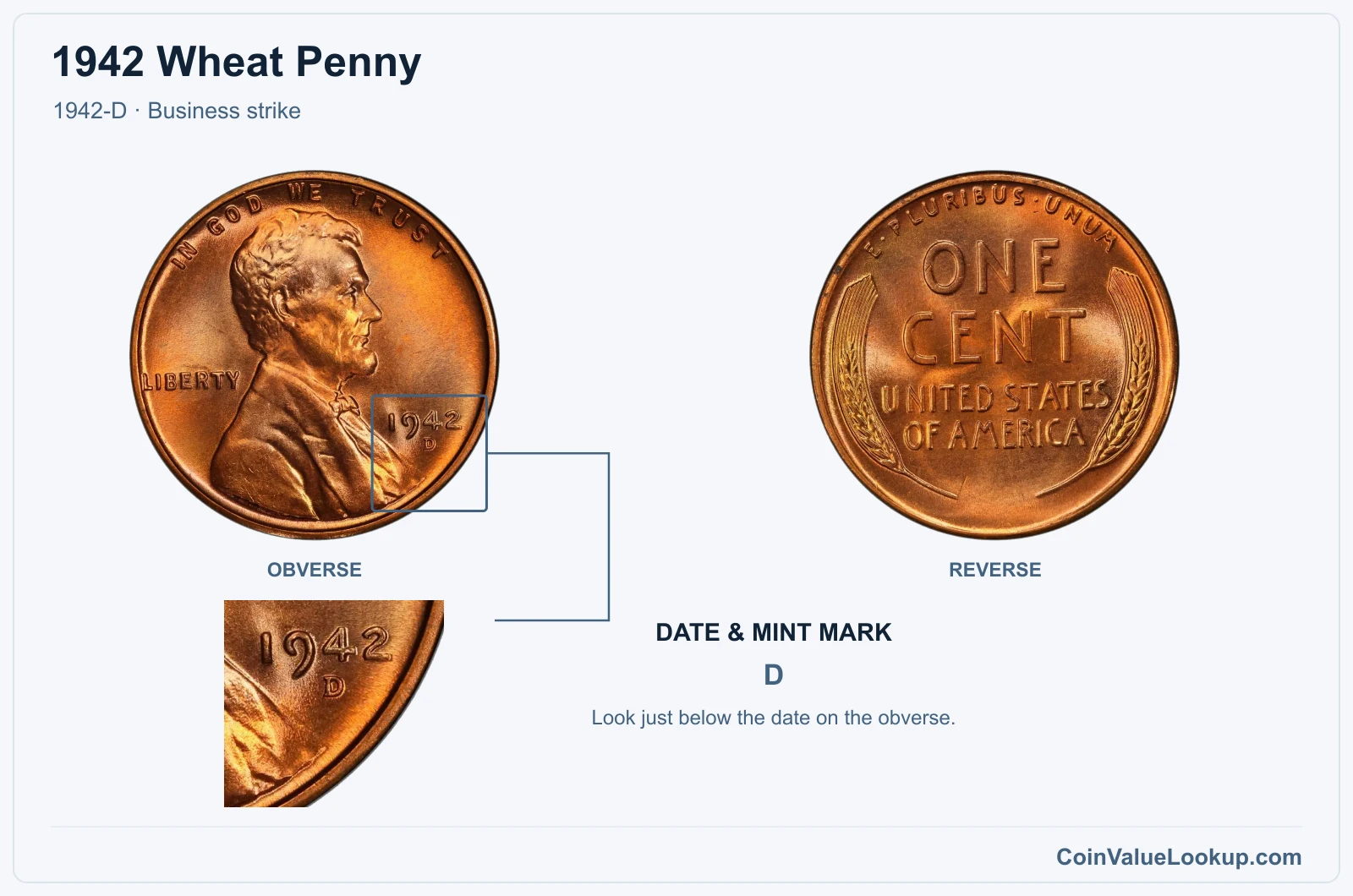
Look for a small "D" mintmark below the date. The 1942-D trades at roughly the same guide levels as the Philadelphia issue — about $0.18 in Good-4 and $2.50 at MS63.
Denver strikes from this era sometimes show slightly softer detail compared to Philadelphia, so do not confuse a mushy strike with heavy wear. Check for luster in the recessed letters and hair detail before downgrading.
As with all branches, cleaning or corrosion drops collector interest fast.
| Range | Grade | Price | Auction Records | Appraisal |
|---|---|---|---|---|
| PO | PO 1 | — | Coin Identifier | |
| FR | FR 2 | — | Coin Identifier | |
| AG | AG 3 | — | Coin Identifier | |
| G | G 4 | — | Coin Identifier | |
| G 6 | — | Coin Identifier | ||
| VG | VG 8 | — | Coin Identifier | |
| VG 10 | — | Coin Identifier | ||
| F | F 12 | — | Coin Identifier | |
| F 15 | — | Coin Identifier | ||
| VF | VF 20 | — | Coin Identifier | |
| VF 25 | — | Coin Identifier | ||
| VF 30 | — | Coin Identifier | ||
| VF 35 | — | Coin Identifier | ||
| XF | XF 40 | — | Coin Identifier | |
| XF 45 | — | Coin Identifier | ||
| AU | AU 50 | — | Coin Identifier | |
| AU 53 | — | Coin Identifier | ||
| AU 55 | — | Coin Identifier | ||
| AU 58 | — | Coin Identifier | ||
| MS | MS 60 | — | Coin Identifier | |
| MS 61 | — | Coin Identifier | ||
| MS 62 | — | Coin Identifier | ||
| MS 63 | — | Coin Identifier | ||
| MS 64 | Coin Identifier | |||
| MS 65 | Coin Identifier | |||
| MS 66 | Coin Identifier | |||
| MS 67 | Coin Identifier | |||
| MS 68 | Coin Identifier | |||
| MS 69 | — | — | — | |
| MS 70 | — | — | — |
1942 Wheat Penny — S
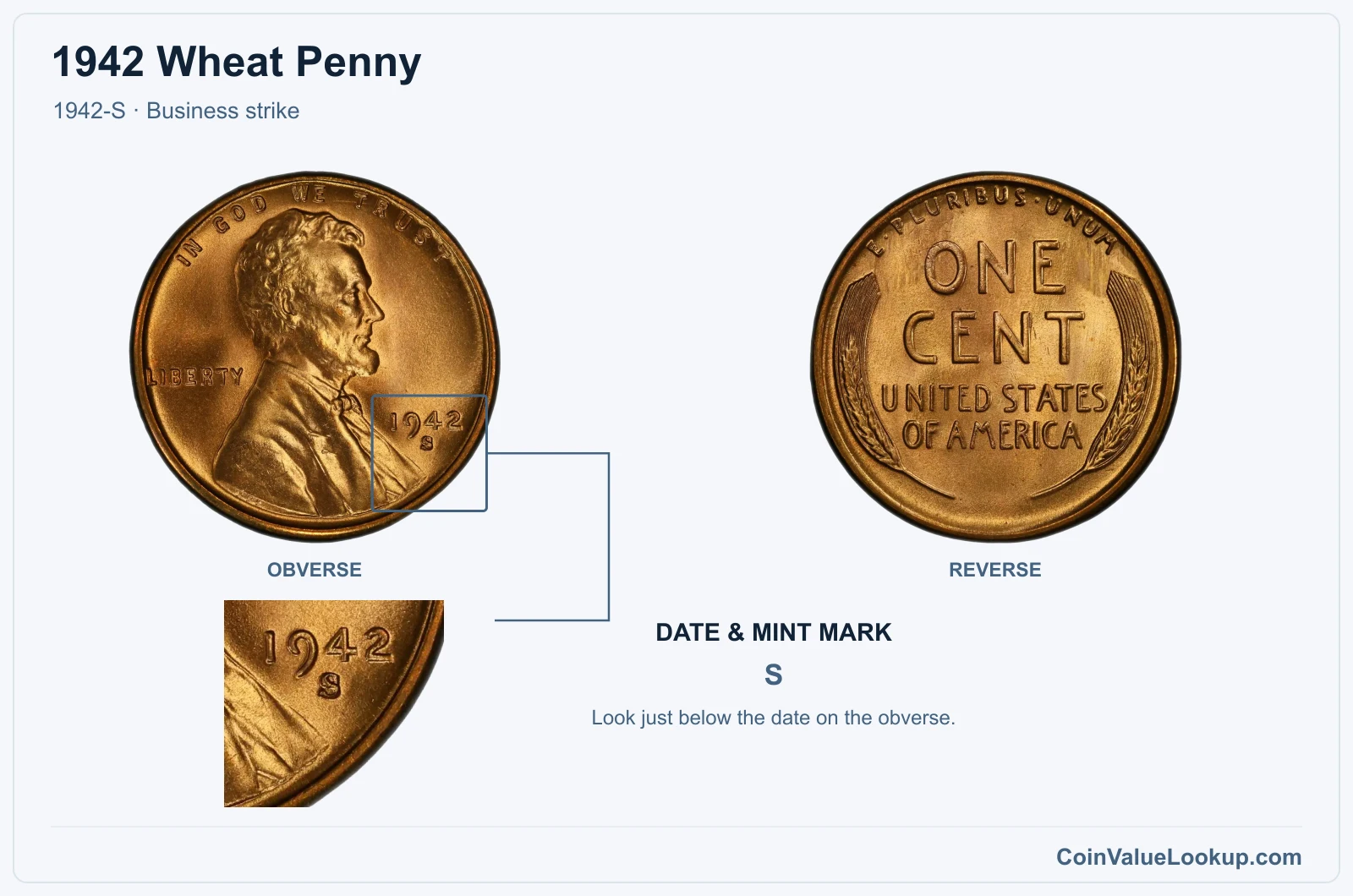
The 1942-S carries a small "S" below the date and stands out from the other two mints. Guide values run about $0.24 in Good-4 and $10 at MS63, making it the priciest regular business strike for 1942.
That higher MS63 figure reflects tighter supply of well-preserved examples. San Francisco strikes sometimes show weaker detail in the hair and wheat ears, so compare carefully against the grading image before deciding your coin is heavily worn.
Original surfaces with even brown toning can still bring solid interest from series collectors.
| Range | Grade | Price | Auction Records | Appraisal |
|---|---|---|---|---|
| PO | PO 1 | — | Coin Identifier | |
| FR | FR 2 | — | Coin Identifier | |
| AG | AG 3 | — | Coin Identifier | |
| G | G 4 | — | Coin Identifier | |
| G 6 | — | Coin Identifier | ||
| VG | VG 8 | — | Coin Identifier | |
| VG 10 | — | Coin Identifier | ||
| F | F 12 | — | Coin Identifier | |
| F 15 | — | Coin Identifier | ||
| VF | VF 20 | — | Coin Identifier | |
| VF 25 | — | Coin Identifier | ||
| VF 30 | — | Coin Identifier | ||
| VF 35 | — | Coin Identifier | ||
| XF | XF 40 | — | Coin Identifier | |
| XF 45 | — | Coin Identifier | ||
| AU | AU 50 | — | Coin Identifier | |
| AU 53 | — | Coin Identifier | ||
| AU 55 | — | Coin Identifier | ||
| AU 58 | — | Coin Identifier | ||
| MS | MS 60 | — | Coin Identifier | |
| MS 61 | — | Coin Identifier | ||
| MS 62 | — | Coin Identifier | ||
| MS 63 | — | Coin Identifier | ||
| MS 64 | Coin Identifier | |||
| MS 65 | Coin Identifier | |||
| MS 66 | Coin Identifier | |||
| MS 67 | Coin Identifier | |||
| MS 68 | Coin Identifier | |||
| MS 69 | — | — | — | |
| MS 70 | — | — | — |
1942 Wheat Penny — PR
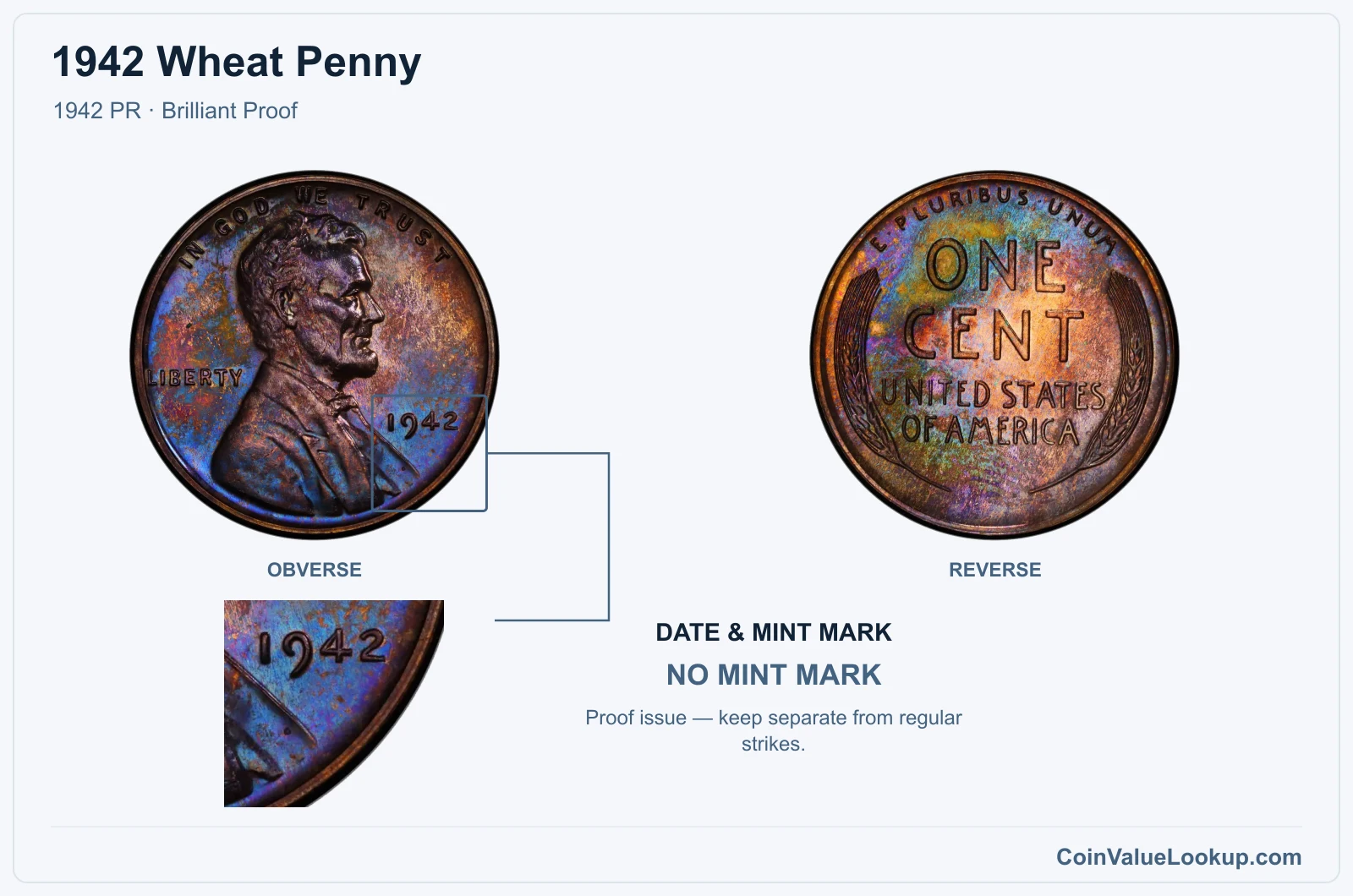
The 1942 proof was struck at Philadelphia on the same copper-alloy planchet as circulation cents, but with specially prepared dies and planchets that produce brilliant, mirrored fields. There is no mintmark.
A guide estimate of about $50 at PR63 puts this well above any business strike of the year.
Coin Value Lookup is a good starting point if you want to compare proof and business-strike values across different Lincoln cent years.
Do not confuse a polished or well-preserved circulation cent for a proof. Genuine proofs have a distinctive mirrored look in the flat fields and knife-sharp rims.
Cameo and deep cameo are contrast designations describing the frosted-device effect, not errors or separate types.
| Range | Grade | Price | Auction Records | Appraisal |
|---|---|---|---|---|
| PR | PR 1 | — | Coin Identifier | |
| PR 2 | — | Coin Identifier | ||
| PR 3 | — | Coin Identifier | ||
| PR 4 | — | Coin Identifier | ||
| PR 6 | — | Coin Identifier | ||
| PR 8 | — | Coin Identifier | ||
| PR 10 | — | Coin Identifier | ||
| PR 12 | — | Coin Identifier | ||
| PR 15 | — | Coin Identifier | ||
| PR 20 | — | Coin Identifier | ||
| PR 25 | — | Coin Identifier | ||
| PR 30 | — | Coin Identifier | ||
| PR 35 | — | Coin Identifier | ||
| PR 40 | — | Coin Identifier | ||
| PR 45 | — | Coin Identifier | ||
| PR 50 | — | Coin Identifier | ||
| PR 53 | — | Coin Identifier | ||
| PR 55 | — | Coin Identifier | ||
| PR 58 | — | Coin Identifier | ||
| PR 60 | — | Coin Identifier | ||
| PR 61 | — | Coin Identifier | ||
| PR 62 | — | Coin Identifier | ||
| PR 63 | Coin Identifier | |||
| PR 64 | Coin Identifier | |||
| PR 65 | Coin Identifier | |||
| PR 66 | — | — | — | |
| PR 67 | — | — | — | |
| PR 68 | — | — | — | |
| PR 69 | — | — | — | |
| PR 70 | — | — | — |
1942 Wheat Penny Error List
1. 1942 Wheat Penny — Doubled Die Obverse
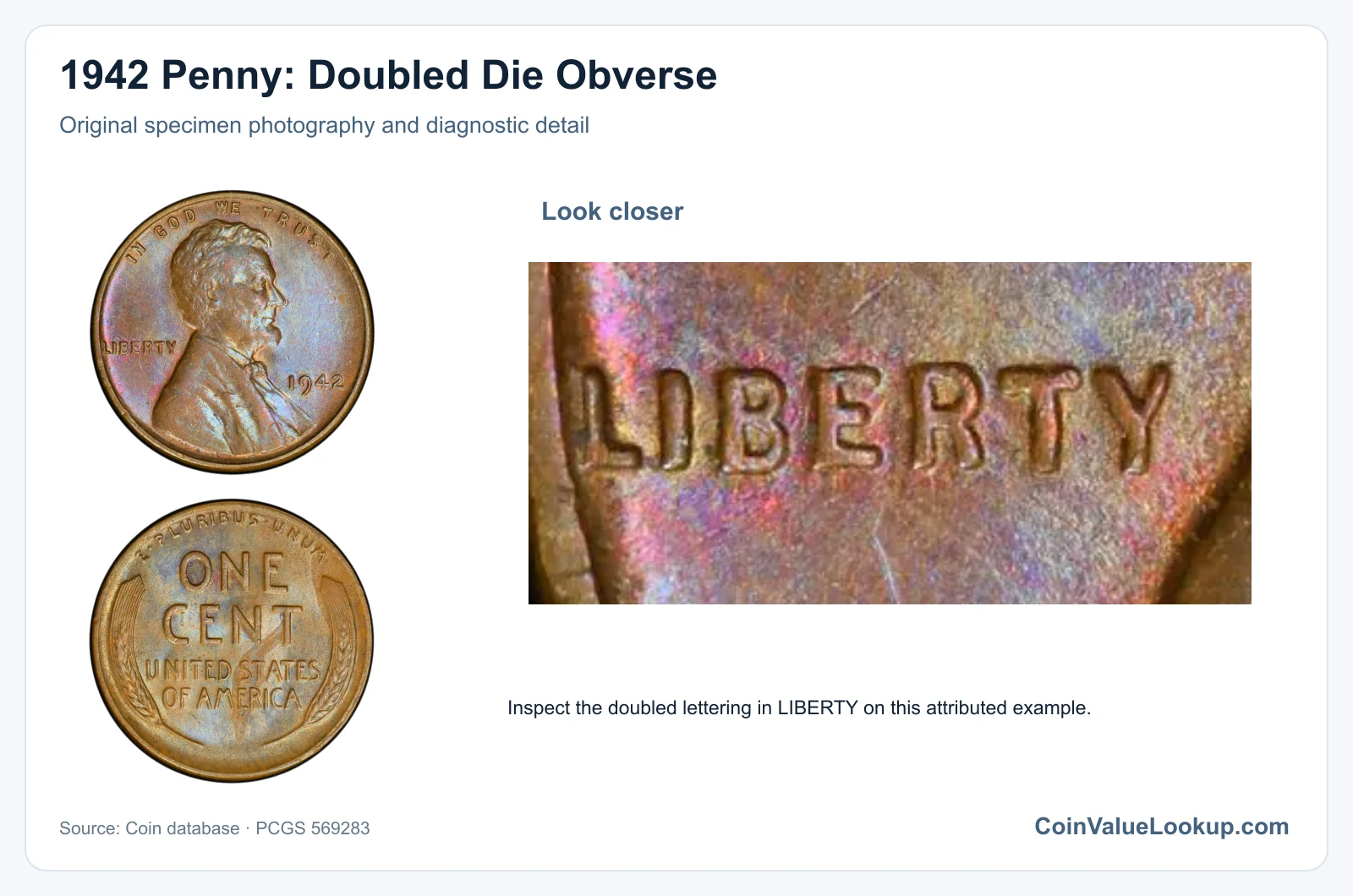
A doubled die obverse on a 1942 Wheat cent shows consistent doubling in the obverse lettering or date, visible as separation, notching or a shelf-like extra image on the affected elements. The key word is consistent — every instance of the doubled feature should show the same direction and magnitude across the design.
To check, compare your coin's obverse lettering under magnification against a normal 1942 cent photographed in matching light. Machine doubling, which is flat and shelf-like without distinct separation, is a common lookalike and does not carry the same collector interest.
Reflections or worn die contours can also mimic doubling at first glance.
Values depend on the authenticated identity of the specific doubled die, the severity of doubling, and overall condition. Individual assessment by a grading service is the practical path for pricing.
2. 1942 Wheat Penny — Repunched Mintmark
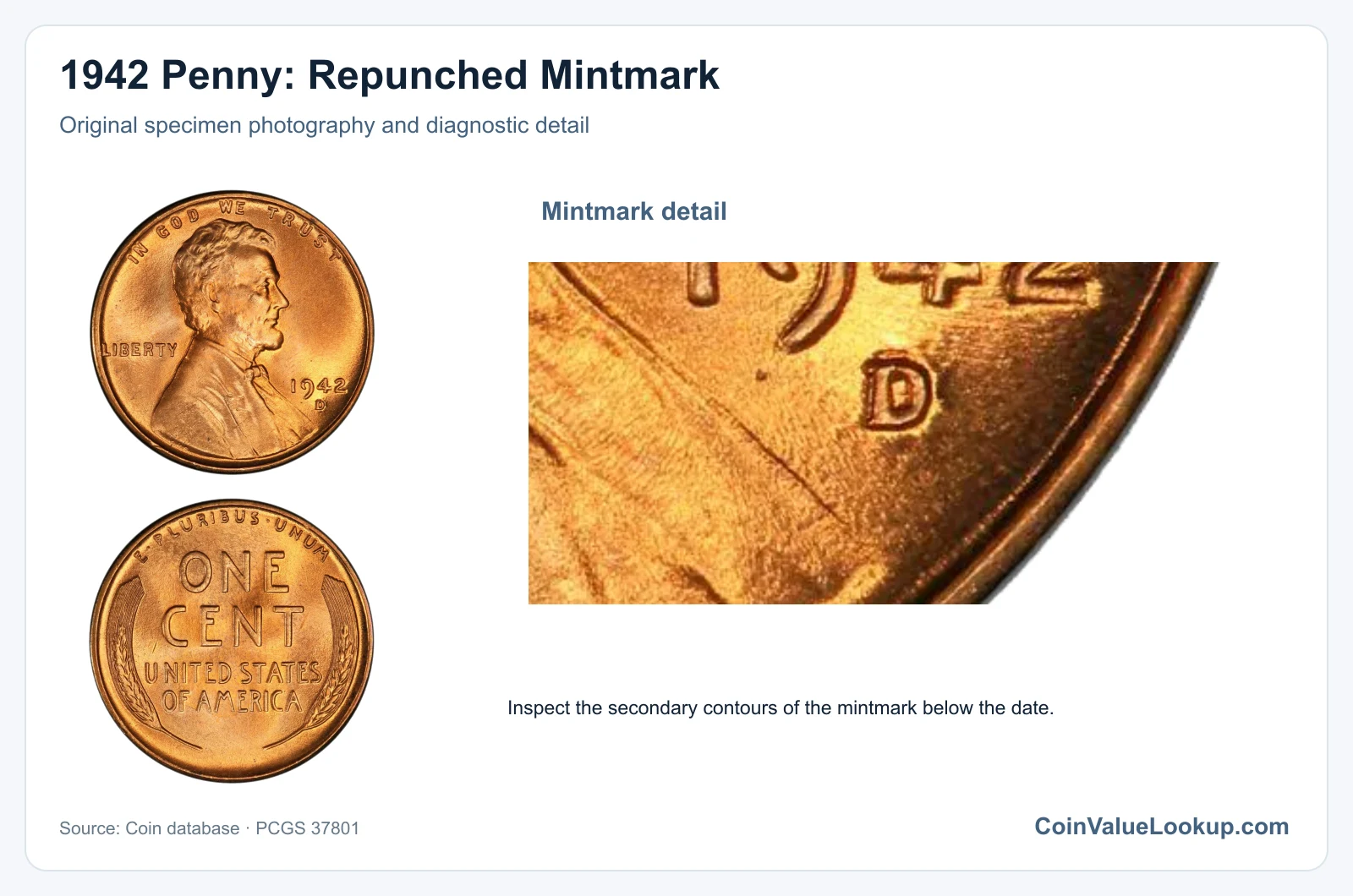
A repunched mintmark appears on Denver or San Francisco 1942 cents — Philadelphia coins have no mintmark to repunch. Look for remnants of a second punch position near or overlapping the primary "D" or "S" below the date.
Under magnification you may see a partial extra letter offset in one direction.
Compare what you see to a normal mintmark at the same magnification. Machine doubling around the mintmark, die chips or simple corrosion can create shapes that look like a secondary punch but are not.
True repunching shows a distinctly positioned extra impression from the original die preparation.
Pricing depends on the specific repunched variety identified, its visibility and the coin's overall grade. Professional authentication helps establish exactly which variety you have.
3. 1942 Wheat Penny — Off-Center Strike
An off-center strike happens when the planchet is not seated properly between the dies. The result is a displaced design with an unstruck crescent of blank metal on one side.
On a 1942 Wheat cent, the most collectible off-center examples still show the full date, since the date is what ties the coin to its year.
Do not confuse an off-center strike with a clipped planchet, which has a curved bite out of the edge, or with post-mint damage where someone flattened or bent the coin. A genuine off-center strike will show the entire design shifted uniformly, with the unstruck area smooth and featureless.
Value depends on the percentage off-center, date visibility and overall condition. Each piece is assessed individually based on these factors.
4. 1942 Wheat Penny — Die Crack / Die Chip
Die cracks show up as thin raised lines on the coin's surface, running across the design or from the rim inward. Die chips appear as small raised blobs, usually within letters or design elements.
Both result from a damaged or fatiguing die transferring its fracture pattern onto every coin it strikes.
On a 1942 cent, look carefully under magnification for raised lines that follow no logical design element. An interior chip — a small raised lump inside a letter, for instance — is different from a rim-connected break, which is classified separately as a cud.
Lookalikes include incuse scratches, corrosion trails or foreign material stuck to the surface. Scratches are recessed, not raised, so that distinction is straightforward under a loupe.
Value depends on prominence, location and overall coin condition; no standard numeric range applies across all die cracks.
5. 1942 Wheat Penny — Die Break / Cud
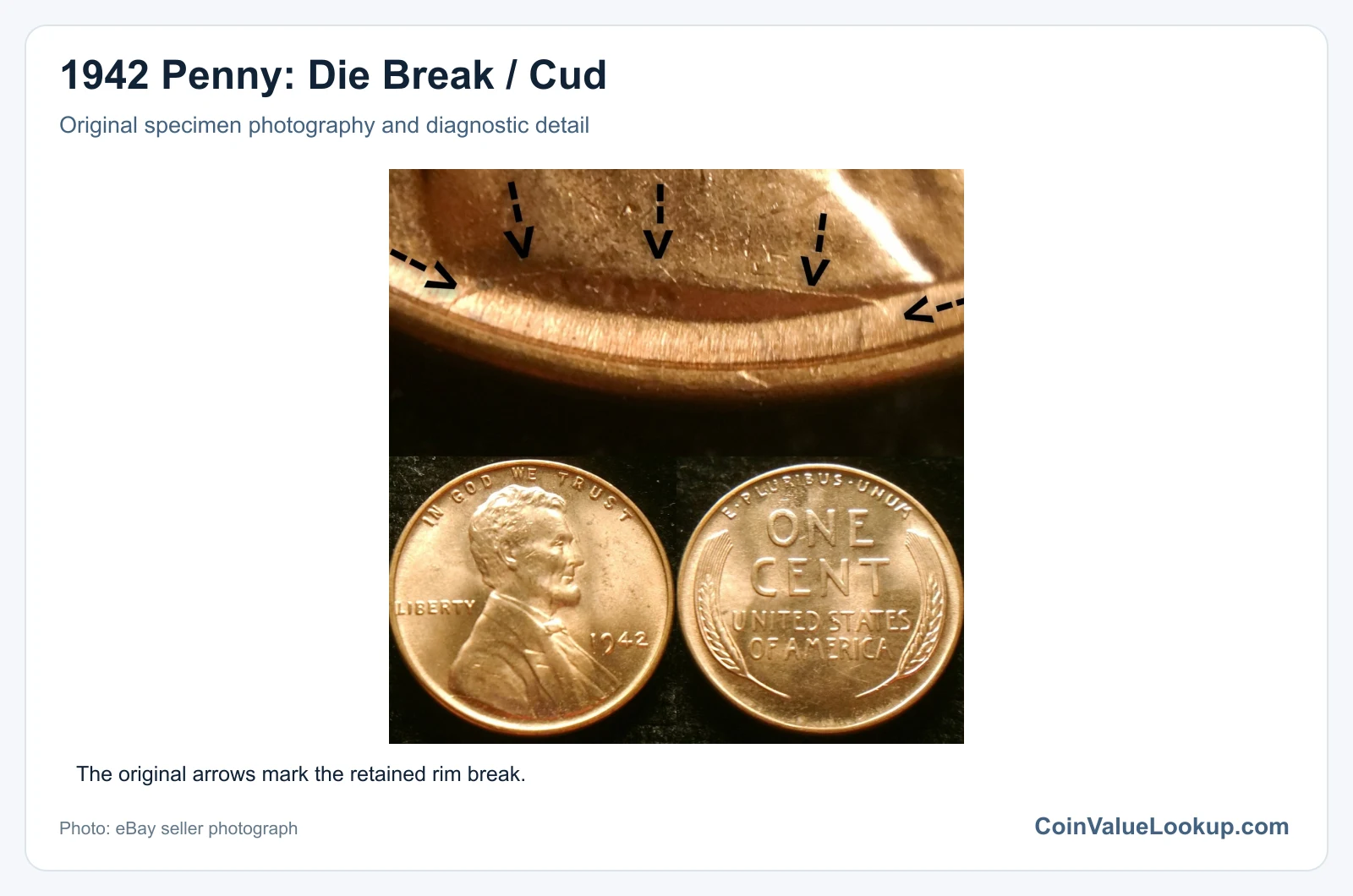
A cud is a major die break that connects to the rim, leaving a raised, featureless blob where part of the design should be. It happens when a chunk of the die breaks away entirely.
The result on the coin is an area with no detail, bordered on one side by the rim and often showing displaced or missing design elements nearby.
Check the boundary of the raised area. A genuine cud has a smooth, flat top and connects cleanly to the rim.
Rim dents, corrosion buildup or interior die chips can look similar but lack that definitive rim connection or have an irregular, damaged texture rather than a smooth plateau.
Pricing depends on the size, location and visual impact of the cud, plus the coin's overall grade. Larger cuds in prominent design areas tend to attract more collector attention.
6. 1942 Wheat Penny — Struck-Through Error
A struck-through error occurs when foreign material — grease, metal filings, thread or another object — sits between the die and planchet during striking. The result is a localized depression or incomplete area in the design where the obstruction blocked the full impression.
On a 1942 cent, look for a defined depression or impression that does not match normal wear patterns. Grease fill-ins tend to produce a smooth, shallow missing area, while a retained foreign object can leave a more dramatic impression with distinct edges.
Do not confuse struck-through areas with ordinary wear, scratches, cleaning marks or a weak strike from a tired die. A struck-through impression is typically sharply bounded and does not extend across the entire coin.
Value depends on the type and size of the obstruction impression, its visual impact and overall coin condition.
7. 1942 Wheat Penny — Wrong Planchet / Off-Metal Strike
A wrong-planchet or off-metal strike means the 1942 Lincoln cent design was impressed onto a blank intended for a different denomination or composition. These are rare and dramatic errors.
To evaluate a suspected wrong-planchet cent, compare the coin's weight, diameter, edge and design completeness against a normal 1942 cent, which should weigh about 3.11 grams with a plain edge on a copper-alloy planchet. A wrong planchet will differ in at least one of these measurements, and the design may be incomplete if the blank was smaller than intended.
Lookalikes are common. Plating, acid treatment, corrosion and deliberate alteration can change a coin's appearance enough to fool a casual glance.
Professional authentication with precise measurements is essential for any suspected wrong-planchet piece, and value is assessed individually based on the confirmed blank type and condition.