1905 Indian Head Penny Coin Value: How Much Is It Worth?
The 1905 Indian Head penny is a common Philadelphia issue, but condition matters a lot. A guide estimate from USA Coin Book places a well-worn example around $2.50 at the G4 grade, while an uncirculated MS63 coin jumps to about $81.
Proofs, errors and original color can push values in different directions. Those figures cover standard circulation and proof branches only, not every possible condition or variety.
Fast Way to Identify Your 1905 Indian Head Penny
Want a quick read on your 1905 Indian Head cent? Upload clear photos of the front and back, and our identifier can give you a preliminary take on what you have.
It will not authenticate, certify or assign an exact grade, but it is a solid starting point before you dig deeper into the details below.
1905 Indian Head Penny Value
Upload both sides of your 1905 Indian Head Penny.
Front Obverse
Upload photo
Back Reverse
Upload photo
Which 1905 Indian Head Penny Versions Are Worth Money?
- A business-strike 1905 in uncirculated condition (MS63) carries a guide value around $81 according to USA Coin Book, far above the $2.50 estimated for a worn G4 example.
- A 1905 proof carries a guide value near $313 at PR63; confirm genuine proof manufacture before assuming this category.
- Original uncirculated surfaces with remaining red color can command stronger interest than cleaned or damaged examples at similar detail levels.
- Authenticated mint errors such as repunched dates, doubled die reverses or off-center strikes require individual assessment and can affect value beyond standard guide figures.
Step 1: Identify Your 1905 Indian Head Penny Mint Mark and Version
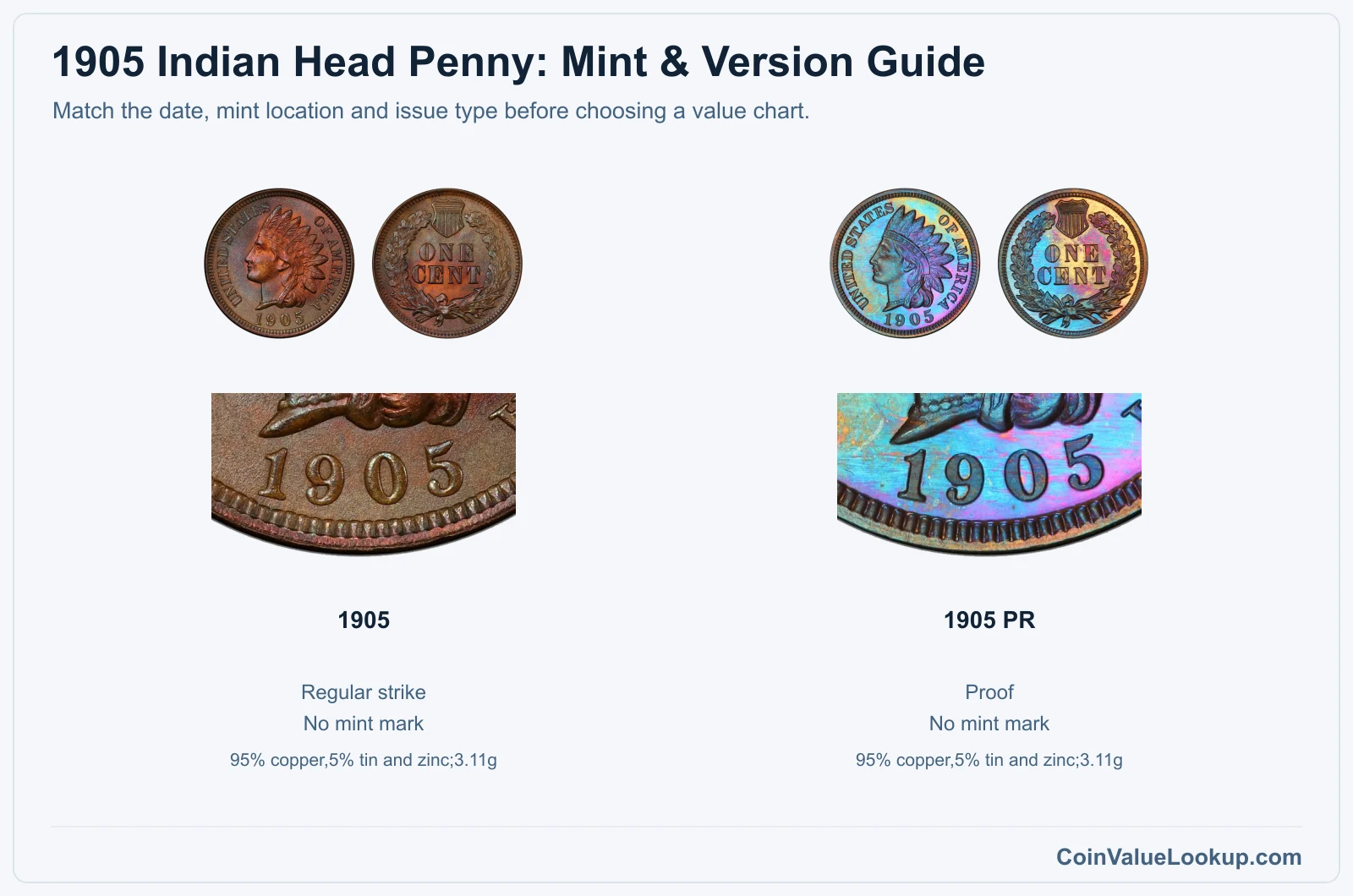
Every regular 1905 Indian Head cent was struck at Philadelphia. There is no mintmark to look for.
The small "L" sometimes visible on the ribbon behind the portrait is the engraver's initial, not a mint indicator.
The obverse shows the familiar Indian portrait wearing a feathered headdress, and the reverse features an oak wreath surrounding a shield with "ONE CENT" in the center. If your coin has a wheat-ear reverse or a plain laurel wreath, you are looking at a different series altogether.
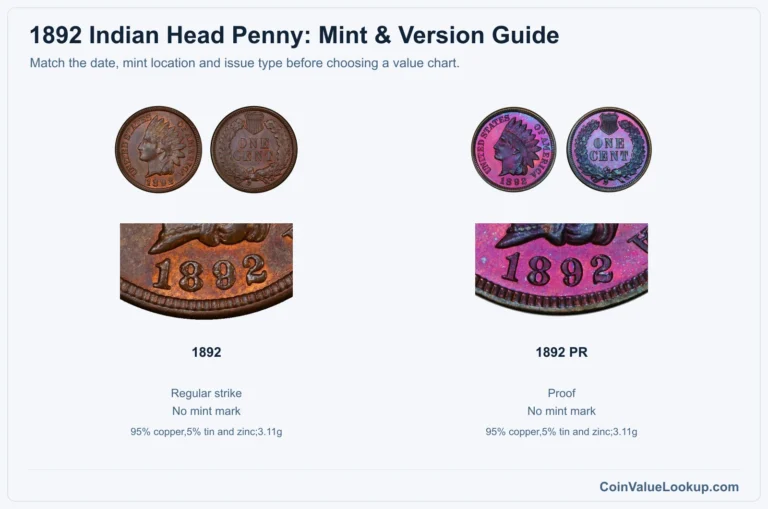
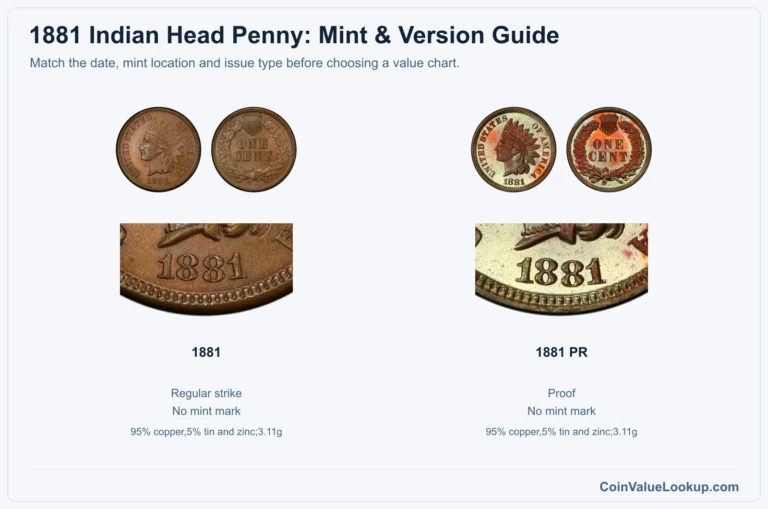
Two distinct production methods exist for this date: business strikes made for circulation and specially manufactured proofs. Proof coins were struck with polished dies on prepared planchets, producing mirrored surfaces and sharp rims.
A shiny business strike that has been cleaned or polished is not a proof, no matter how reflective it looks. Genuine proof origin requires correct surface geometry, rim detail and overall manufacturing characteristics, not just shine.
Before checking any price, confirm your coin is bronze (95% copper, 5% tin and zinc, weighing about 3.11 grams), matches the oak-wreath-and-shield reverse, and determine whether it is a business strike or a proof.
Step 2: Check Your 1905 Indian Head Penny Grade
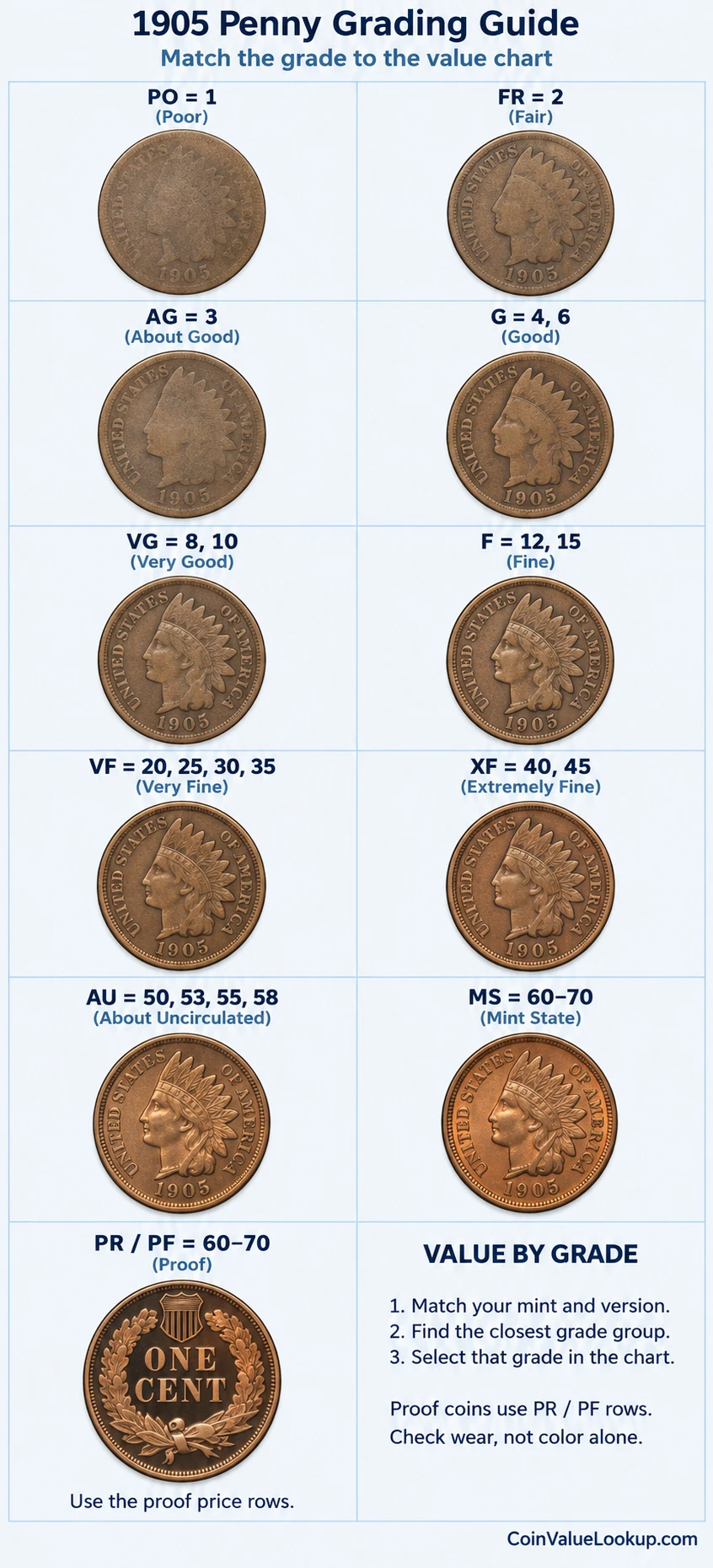
Start with the word LIBERTY on the headband. On a lightly worn coin, all letters should be readable.
As wear increases, the letters merge into the headband until they vanish entirely on heavily circulated pieces.
Do not stop at LIBERTY alone. Check the feather tips above the headband, the hair curls near the ear, and the cheek area.
On the reverse, look at the high points of the wreath leaves and the shield detail.
A weak original strike can leave soft feathers and hair even on an unworn coin. Compare your coin with the reference image to see what normal strike softness looks like versus actual wear from circulation.
Bronze color designations (BN, RB, RD) describe how much original copper-red surface remains. BN means mostly brown, RB is a mix, and RD is mostly original red.
These are color descriptions, not separate materials. Remaining red color on an uncirculated coin generally increases desirability.
Always check for cleaning, scratches, corrosion and rim damage. These problems reduce a coin's marketability regardless of how sharp the detail looks.
Step 3: Check 1905 Indian Head Penny Value by Mint and Version
1905 Indian Head Penny
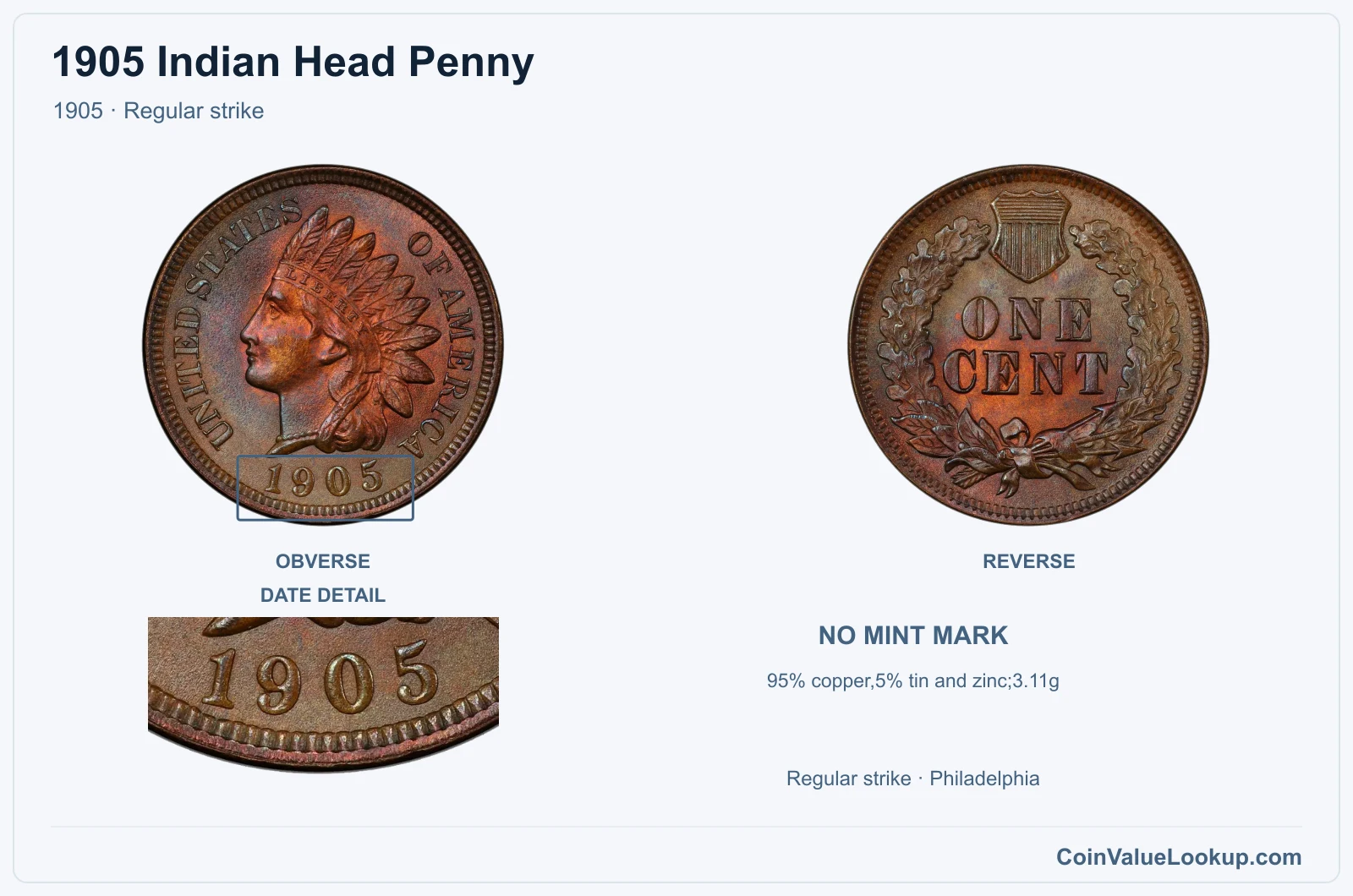
This is the standard 1905 Indian Head cent struck for everyday commerce at Philadelphia. No mintmark appears on this coin.
The composition is 95% copper with 5% tin and zinc, weighing 3.11 grams.
USA Coin Book estimates around $2.50 at G4, a grade where the portrait is heavily worn but the date is still legible. At MS63, meaning uncirculated with minor contact marks, that same guide places it near $81.
The jump from worn to mint-state pricing is steep because survival in original condition is far less common than pocket-change examples.
If you are browsing values for other dates and denominations, Coin Value Lookup is a handy place to look up coin guides across a wide range of U.S. series. It can save you time when you are working through a batch of old cents.
Compare your coin's surfaces honestly. Cleaned or damaged coins do not sell at guide-level prices, and original bronze color adds appeal at the uncirculated tier.
| Range | Grade | Price | Auction Records | Appraisal |
|---|---|---|---|---|
| PO | PO 1 | — | Coin Identifier | |
| FR | FR 2 | — | Coin Identifier | |
| AG | AG 3 | — | Coin Identifier | |
| G | G 4 | — | Coin Identifier | |
| G 6 | — | Coin Identifier | ||
| VG | VG 8 | — | Coin Identifier | |
| VG 10 | — | Coin Identifier | ||
| F | F 12 | — | Coin Identifier | |
| F 15 | Coin Identifier | |||
| VF | VF 20 | — | Coin Identifier | |
| VF 25 | Coin Identifier | |||
| VF 30 | — | Coin Identifier | ||
| VF 35 | — | Coin Identifier | ||
| XF | XF 40 | — | Coin Identifier | |
| XF 45 | Coin Identifier | |||
| AU | AU 50 | — | Coin Identifier | |
| AU 53 | — | Coin Identifier | ||
| AU 55 | — | Coin Identifier | ||
| AU 58 | Coin Identifier | |||
| MS | MS 60 | — | Coin Identifier | |
| MS 61 | — | Coin Identifier | ||
| MS 62 | Coin Identifier | |||
| MS 63 | Coin Identifier | |||
| MS 64 | Coin Identifier | |||
| MS 65 | Coin Identifier | |||
| MS 66 | Coin Identifier | |||
| MS 67 | — | — | — | |
| MS 68 | — | — | — | |
| MS 69 | — | — | — | |
| MS 70 | — | — | — |
1905 Indian Head Penny — PR
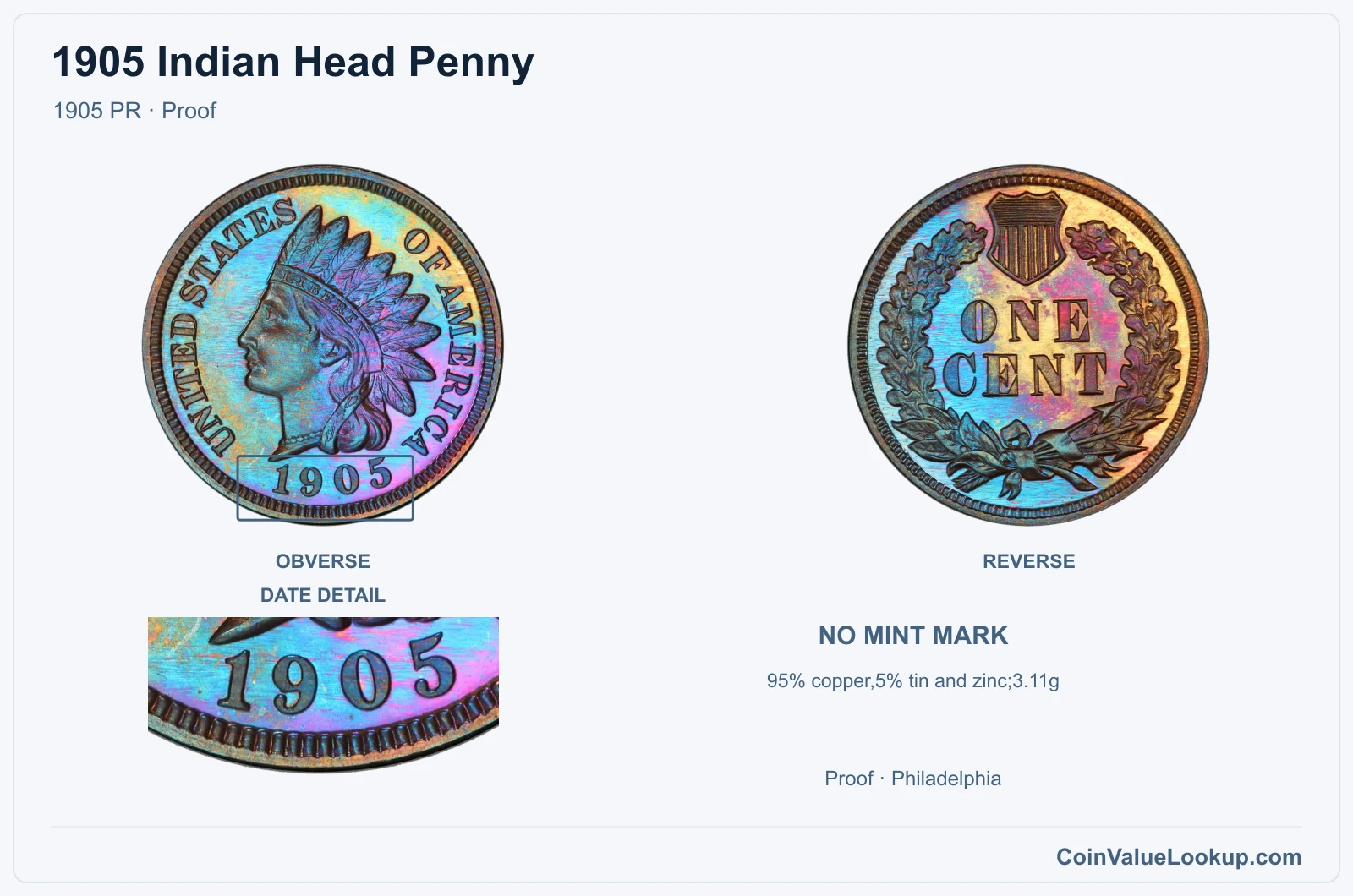
The 1905 proof was a special product sold to collectors directly by the Philadelphia Mint. These coins were struck on polished planchets with specially prepared dies, giving them mirror-like fields and crisp design edges that business strikes cannot match.
At PR63, USA Coin Book estimates a value around $313. That is roughly four times the MS63 business-strike figure, reflecting the deliberate manufacturing process and limited original distribution.
Verification matters here. A genuine proof has square, well-defined rims and deeply reflective fields that look distinctly different from a polished circulation coin.
If someone buffed a business strike on a wheel, it may shine, but the rim geometry and surface texture will not match proof characteristics. Professional authentication is strongly recommended before calling any coin a proof.
Bronze color retention also plays a role at the proof level, just as it does for business strikes.
| Range | Grade | Price | Auction Records | Appraisal |
|---|---|---|---|---|
| PR | PR 1 | — | Coin Identifier | |
| PR 2 | — | Coin Identifier | ||
| PR 3 | — | Coin Identifier | ||
| PR 4 | — | Coin Identifier | ||
| PR 6 | — | Coin Identifier | ||
| PR 8 | — | Coin Identifier | ||
| PR 10 | — | Coin Identifier | ||
| PR 12 | — | Coin Identifier | ||
| PR 15 | — | Coin Identifier | ||
| PR 20 | — | Coin Identifier | ||
| PR 25 | — | Coin Identifier | ||
| PR 30 | — | Coin Identifier | ||
| PR 35 | — | Coin Identifier | ||
| PR 40 | — | Coin Identifier | ||
| PR 45 | — | Coin Identifier | ||
| PR 50 | — | Coin Identifier | ||
| PR 53 | — | Coin Identifier | ||
| PR 55 | — | Coin Identifier | ||
| PR 58 | — | Coin Identifier | ||
| PR 60 | — | Coin Identifier | ||
| PR 61 | — | Coin Identifier | ||
| PR 62 | Coin Identifier | |||
| PR 63 | Coin Identifier | |||
| PR 64 | Coin Identifier | |||
| PR 65 | Coin Identifier | |||
| PR 66 | Coin Identifier | |||
| PR 67 | Coin Identifier | |||
| PR 68 | — | — | — | |
| PR 69 | — | — | — | |
| PR 70 | — | — | — |
1905 Indian Head Penny Error List
1. 1905 Indian Head Penny — Repunched Date
A repunched date on a 1905 Indian Head cent shows traces of an earlier date-punch impression alongside the final numerals. You will see ghosting or offset remnants near one or more digits, most visible under magnification.
This is a die variety, not a struck-coin error, meaning the die itself received the date punch more than once before being used. Do not confuse it with full-design doubling, which involves the entire hub impression.
Look-alikes include damaged dates from post-mint hits and machine doubling, which tends to be flat and shelf-like rather than showing distinct secondary punch outlines. Confirmed examples need individual assessment based on the specific die variety, the coin's condition and the strength of the repunching.
No standard price range applies across all repunched-date varieties of this issue.
2. 1905 Indian Head Penny — Die Break / Cud
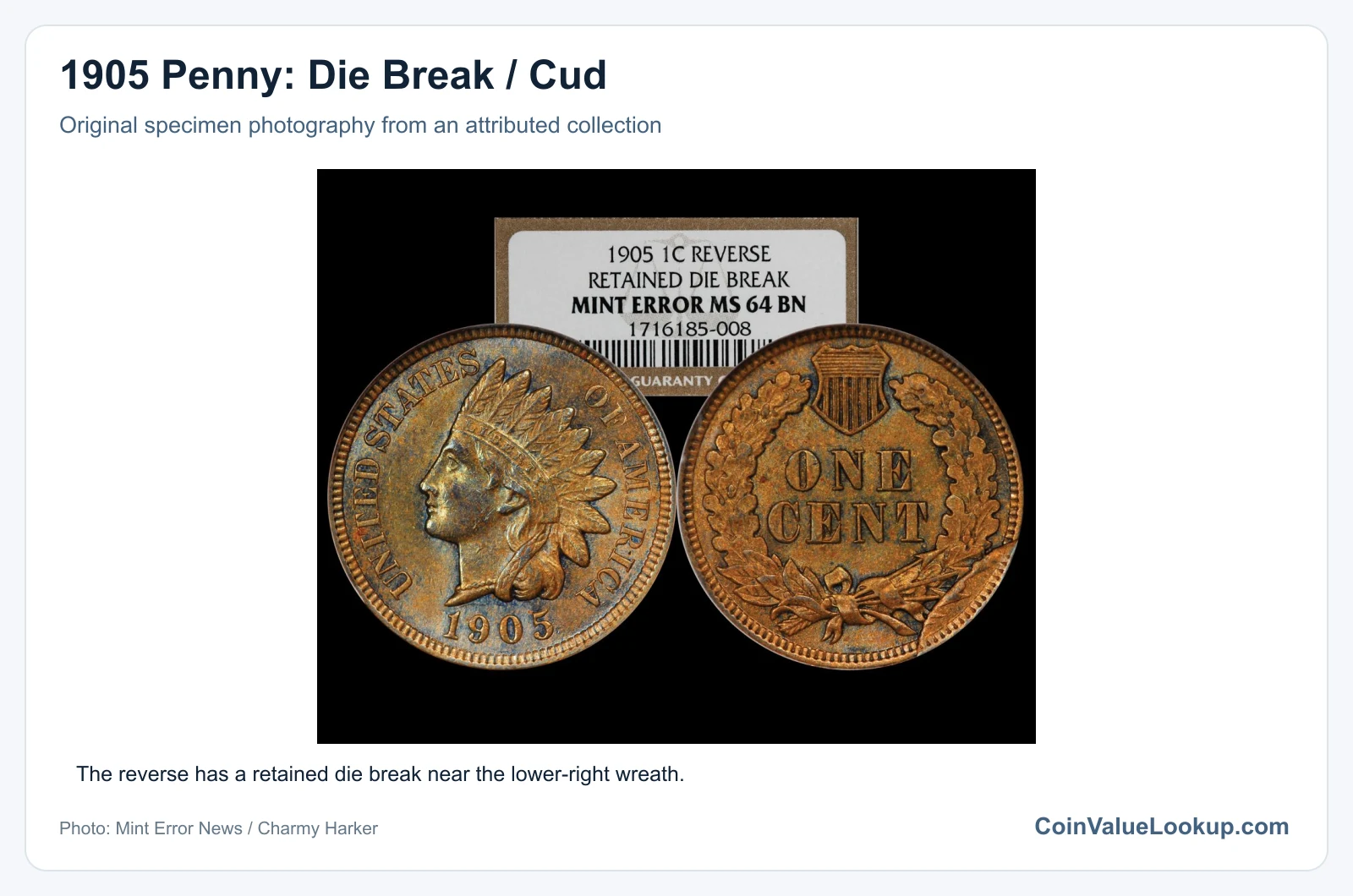
A die break or cud on a 1905 Indian Head cent appears as a raised, irregular blob of metal where part of the die has cracked away. A true cud connects to the rim, creating an area with no design detail, just a smooth raised lump.
Smaller interior die breaks can also occur, leaving raised lumps within the design field that do not reach the rim. Both result from metal fatigue in the die.
Do not mistake rim dents, corrosion buildup or minor die chips for a cud. A genuine cud has a defined boundary where the normal design abruptly stops and the featureless raised area begins.
Value depends on the size, location and the coin's overall condition. Each example needs individual assessment by someone familiar with the variety.
3. 1905 Indian Head Penny — Doubled Die Reverse
A doubled die reverse on this date shows doubling in the reverse legends, wreath or shield contours. The doubling comes from a misaligned secondary hub impression during die manufacture, so it appears consistent from coin to coin struck by the same die.
Compare your reverse lettering and design elements against a known normal 1905 reverse. Genuine hub doubling typically shows separation or notching on serifs and design edges that is uniform and directional.
Machine doubling, which is caused by die bounce during striking, looks flat and shelf-like rather than showing a second fully formed image. Reflections from luster or random post-mint damage can also mimic doubling.
Authentication through a recognized service is the surest way to confirm a doubled die. Value depends on the strength of the doubling and the coin's grade, assessed individually.
4. 1905 Indian Head Penny — Misplaced Date
A misplaced date on the 1905 Indian Head cent means partial date digits appear somewhere they should not, typically embedded in the denticles near the bottom of the obverse or partially within the portrait area, away from the normal date position.
These traces are remnants of an initial date punch that landed off-target before the die was corrected. They often appear as faint, incomplete outlines of one or more numerals.
Do not confuse die chips, random scratches or tiny lumps with misplaced-date remnants. The key test is whether the shape matches part of a recognizable numeral from the date.
Careful comparison with reference photos is essential. Pricing requires individual assessment, factoring in the clarity of the misplaced digit and the coin's overall condition.
5. 1905 Indian Head Penny — Die Crack
A die crack on a 1905 Indian Head cent appears as a thin, raised line running across the coin's surface. It can cross open fields, cut through lettering or follow the rim area.
The line is raised because the crack in the die allowed metal to flow into the gap during striking.
Note where the crack starts and ends. Some are short and barely noticeable; others run across the entire coin.
Larger, more dramatic cracks generally attract more collector interest.
Do not confuse a die crack with an incuse scratch, which is pressed into the surface rather than raised above it. Corrosion lines and displaced-metal scrapes from post-mint damage also look different under magnification.
Confirmed die cracks are valued individually based on prominence, location and the coin's grade.
6. 1905 Indian Head Penny — Wrong Planchet / Off-Metal Strike
A wrong-planchet or off-metal 1905 Indian Head cent means the coin was struck on a blank intended for a different denomination or composition. These are rare and dramatic errors.
To identify one, compare weight, diameter and edge characteristics against the standard 3.11-gram, 19mm bronze specifications. If your coin is noticeably lighter, heavier, smaller, larger or a different color than normal, and the design shows evidence of a genuine strike rather than alteration, you may have a wrong-planchet error.
Be cautious. Plating loss, acid exposure, deliberate thinning and aftermarket alterations can all make a normal coin look unusual.
A coin that simply appears silver or oddly thin is far more likely damaged than struck on the wrong blank. Professional authentication is essential.
Each confirmed example is valued individually.
7. 1905 Indian Head Penny — Off-Center Strike
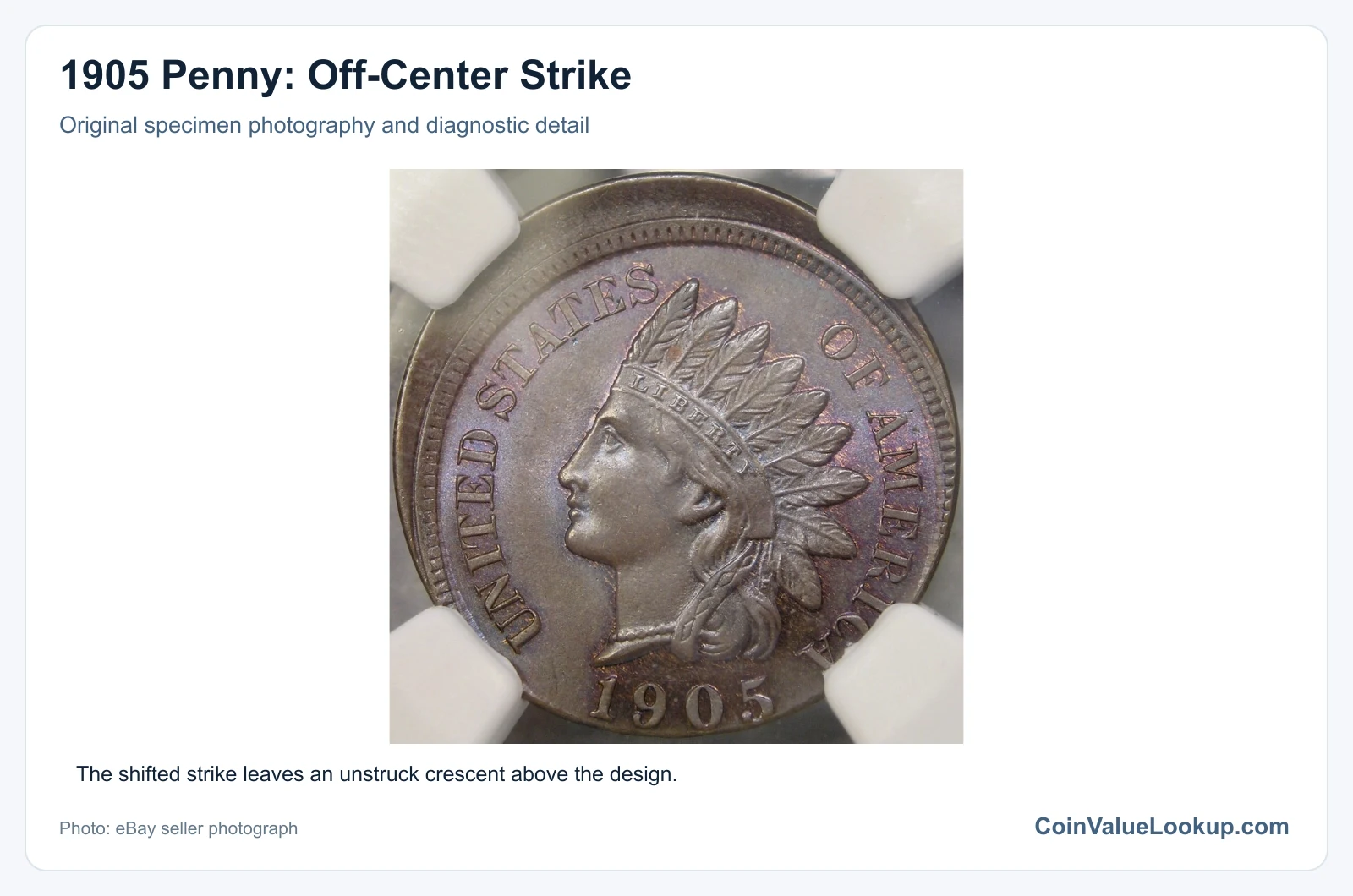
An off-center 1905 Indian Head cent shows a displaced design with an unstruck crescent of blank planchet visible on one side. This happens when the planchet is not properly seated between the dies at the moment of striking.
The percentage of off-center displacement and whether the date remains visible are the two biggest factors collectors care about. A coin that is 10-15% off-center with a full date is more collectible than one struck so far off that you cannot read the year.
Do not confuse a clipped planchet, a one-sided misalignment or post-mint flattening with a true off-center strike. A genuine off-center coin has a smooth, unstruck blank area that follows the shape of the original planchet edge.
Pricing depends on the degree of displacement, date visibility and overall condition, assessed on a coin-by-coin basis.