1971 Washington Quarter Coin Value: How Much Is It Worth?
Most 1971 Washington quarters you find in pocket change are worth face value — 25 cents. These are common copper-nickel clad coins struck at Philadelphia, Denver, and San Francisco.
In higher uncirculated grades, guide estimates from USA Coin Book reach around $7.29 at MS65 for business strikes and about $6.25 at PR65 for the proof. Genuine mint errors can push values much higher, but the typical worn example is a spender, not a collectible.
Fast Way to Identify Your 1971 Washington Quarter
Want a quick read on what you have? Snap clear photos of both the front and back of your 1971 quarter and upload them to our identifier.
It can offer a preliminary identification of your coin's version based on those images. Keep in mind this is not a substitute for professional authentication or grading, but it is a solid first step.
1971 Washington Quarter Value
Upload both sides of your 1971 Washington Quarter.
Front Obverse
Upload photo
Back Reverse
Upload photo
Which 1971 Washington Quarter Versions Are Worth Money?
- The 1971 overstrike on a 1970 quarter is a rare error that sold for $7,930 in MS64 at Heritage Auctions in March 2026.
- A 1971-D quarter struck on a dime planchet brought $345 in AU58 at Heritage Auctions.
- A 1971 quarter on a dime planchet with an obverse indent sold for $504 in MS63 at Heritage in December 2025.
- High-grade uncirculated Philadelphia or Denver coins at MS65 carry a USA Coin Book guide estimate of about $7.29, well above face value.
- The 1971-S proof at PR65 has a guide estimate around $6.25 — modest, but still a collectible issue compared to circulated clad quarters.
Step 1: Identify Your 1971 Washington Quarter Mint Mark and Version
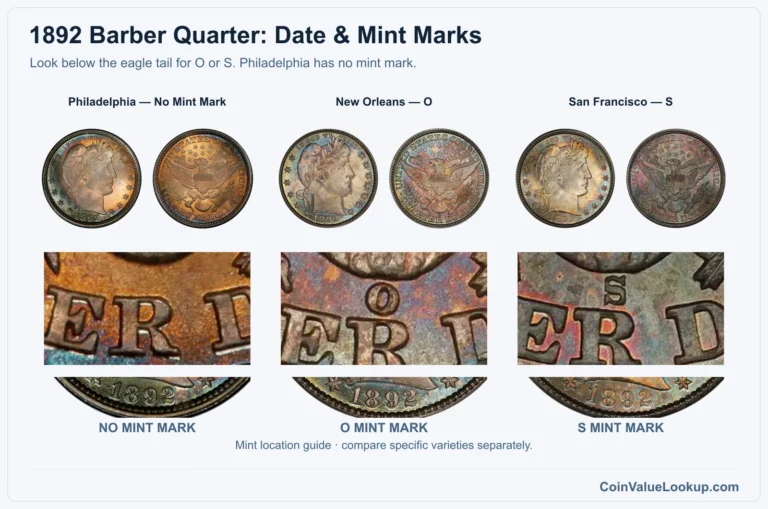
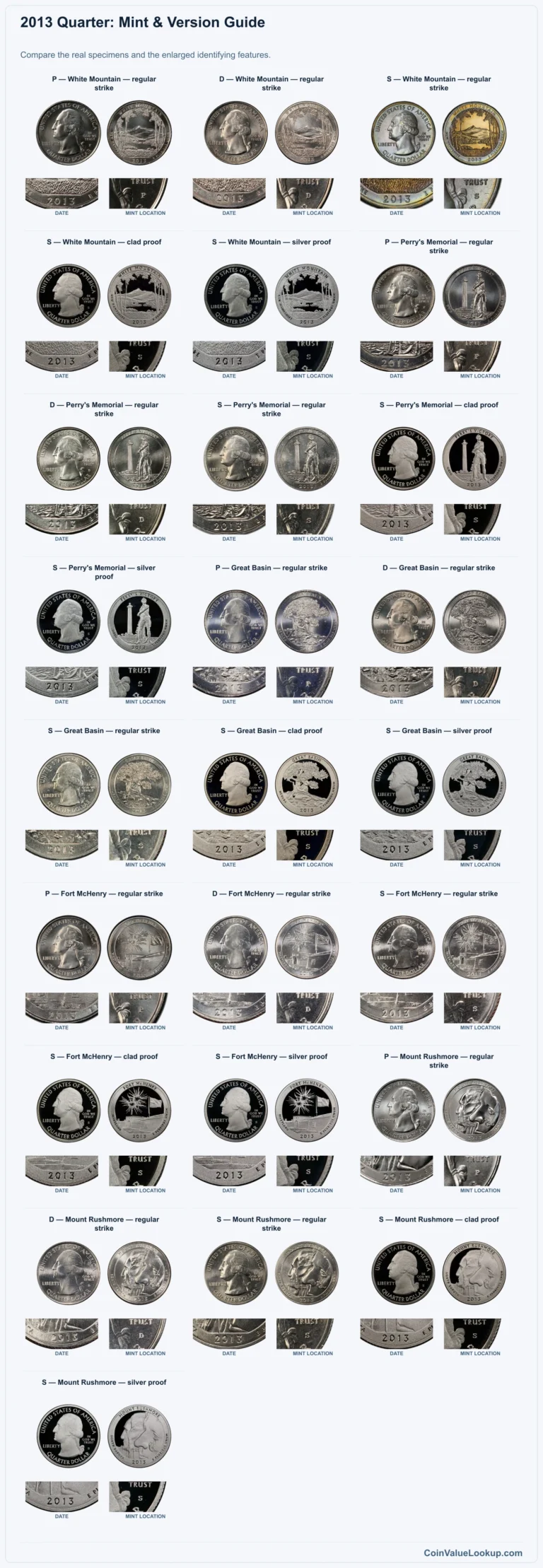
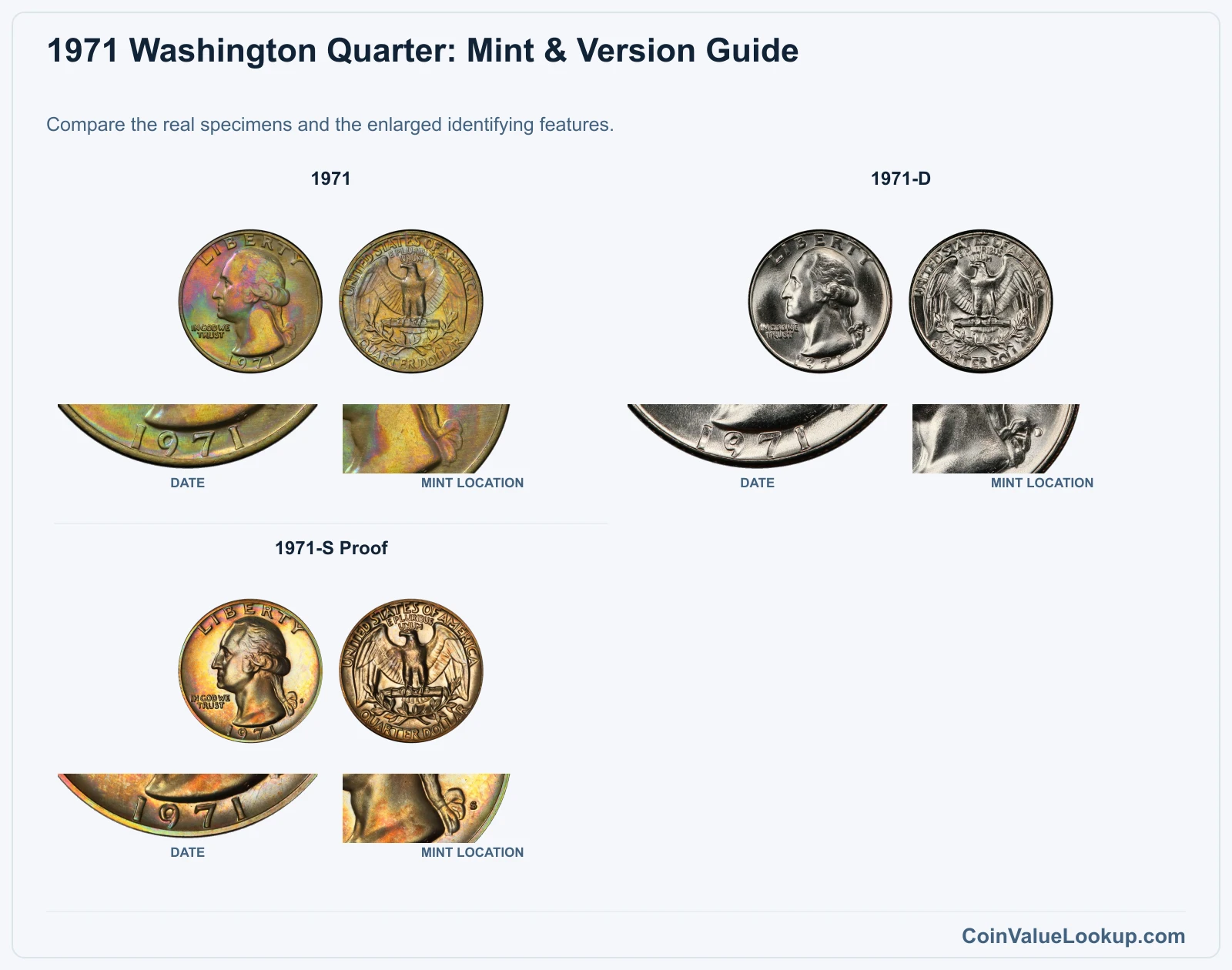
Three versions exist for the 1971 Washington quarter. Philadelphia coins carry no mintmark.
Denver coins show a small D on the obverse, to the right of the ribbon in Washington's hair, near the date. San Francisco coins display an S in the same spot and were struck as proofs only.
All three are copper-nickel clad over a copper core, weighing about 5.67 grams with an approximate 24.3 mm diameter. If you look at the edge, you should see a visible copper stripe sandwiched between the nickel-clad layers.
That copper core line is normal — it does not mean you have a rare silver coin.
A 1971 quarter struck over a 1970 quarter does exist, but that is a specific documented error specimen. It does not mean ordinary 1971 quarters contain any unusual alloy.
Also note that the absence of a mintmark on a Philadelphia coin is standard, not a missing-mintmark error.
Step 2: Check Your 1971 Washington Quarter Grade
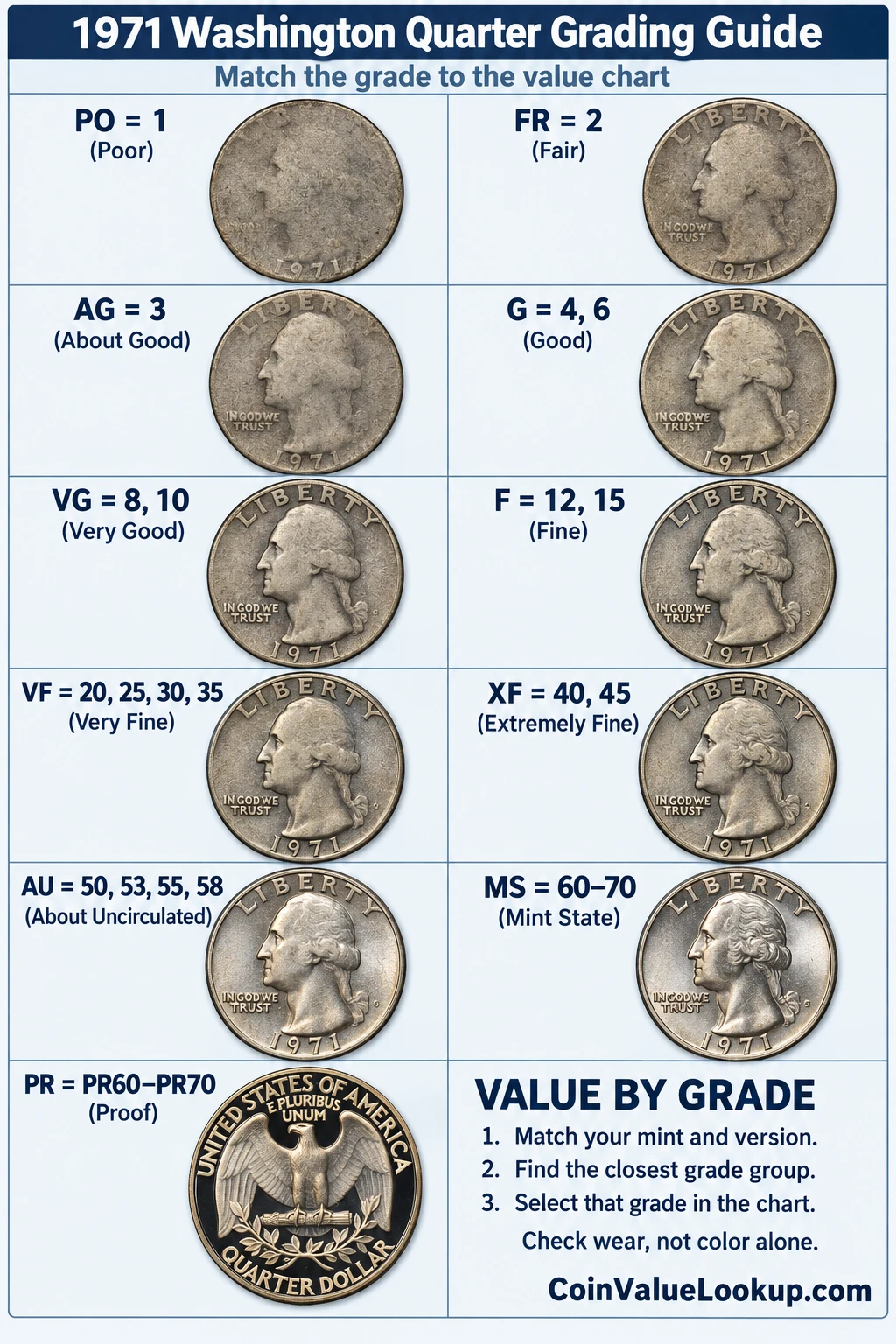
Start by checking Washington's hair detail just above the ear. On a well-worn coin, that area goes flat first.
Next look at the cheek and jawline — friction smooths these quickly in circulation.
Flip to the reverse and examine the eagle's breast feathers. Wear shows up there as a loss of individual feather separation.
Compare your coin to the grading image to see where your example falls on the wear scale.
Surface quality matters too. Bag marks, scratches, and rim dings all reduce a coin's grade and appeal.
A coin with full luster and no contact marks grades higher than one with the same wear but heavy marks.
Proofs are graded differently. Look for hairlines from handling and any haze.
A polished circulation coin cannot become a proof — proof is a manufacturing method, not a condition level.
Step 3: Check 1971 Washington Quarter Value by Mint and Version
1971 Washington Quarter
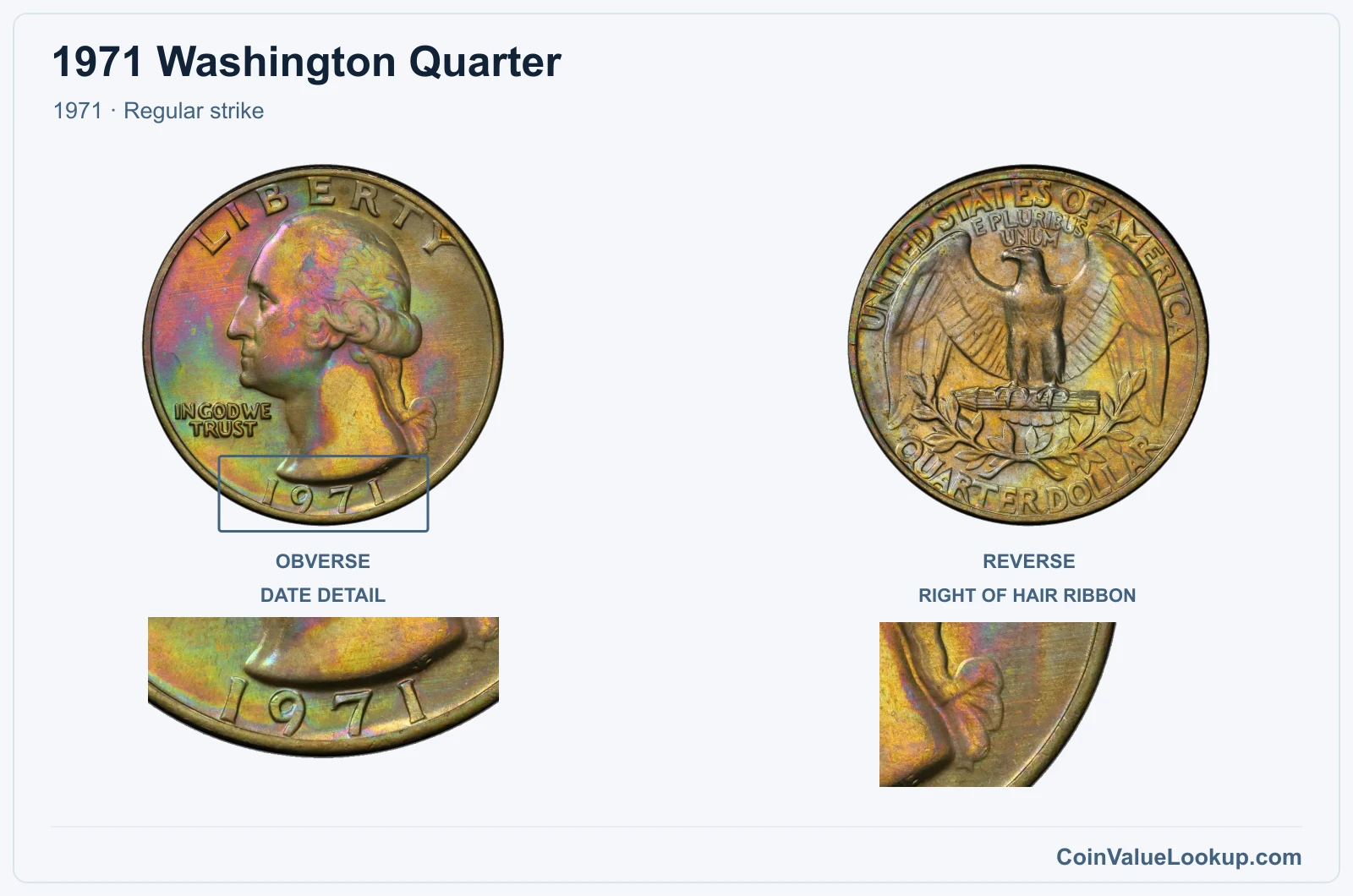
The 1971 Philadelphia quarter has no mintmark on the obverse. It is a standard copper-nickel clad business strike weighing roughly 5.67 grams.
In circulated grades, expect face value — these were produced in large numbers and saw heavy use.
At MS65, the USA Coin Book guide estimate is approximately $7.29. That is a nice uncirculated coin with good luster and minimal marks.
Getting there requires a coin that avoided contact from the moment it left the press.
Coin Value Lookup is a good starting point if you want to compare your 1971 quarter against other Washington quarter years. You can look up guides across the full series to understand where your coin fits.
| Range | Grade | Price | Auction Records | Appraisal |
|---|---|---|---|---|
| PO | PO 1 | — | Coin Identifier | |
| FR | FR 2 | — | Coin Identifier | |
| AG | AG 3 | — | Coin Identifier | |
| G | G 4 | — | Coin Identifier | |
| G 6 | — | Coin Identifier | ||
| VG | VG 8 | — | Coin Identifier | |
| VG 10 | — | Coin Identifier | ||
| F | F 12 | — | Coin Identifier | |
| F 15 | — | Coin Identifier | ||
| VF | VF 20 | — | Coin Identifier | |
| VF 25 | — | Coin Identifier | ||
| VF 30 | — | Coin Identifier | ||
| VF 35 | — | Coin Identifier | ||
| XF | XF 40 | — | Coin Identifier | |
| XF 45 | — | Coin Identifier | ||
| AU | AU 50 | — | Coin Identifier | |
| AU 53 | — | Coin Identifier | ||
| AU 55 | — | Coin Identifier | ||
| AU 58 | — | Coin Identifier | ||
| MS | MS 60 | — | Coin Identifier | |
| MS 61 | — | Coin Identifier | ||
| MS 62 | — | Coin Identifier | ||
| MS 63 | — | Coin Identifier | ||
| MS 64 | Coin Identifier | |||
| MS 65 | — | Coin Identifier | ||
| MS 66 | Coin Identifier | |||
| MS 67 | Coin Identifier | |||
| MS 68 | — | — | — | |
| MS 69 | — | — | — | |
| MS 70 | — | — | — |
1971 Washington Quarter — D
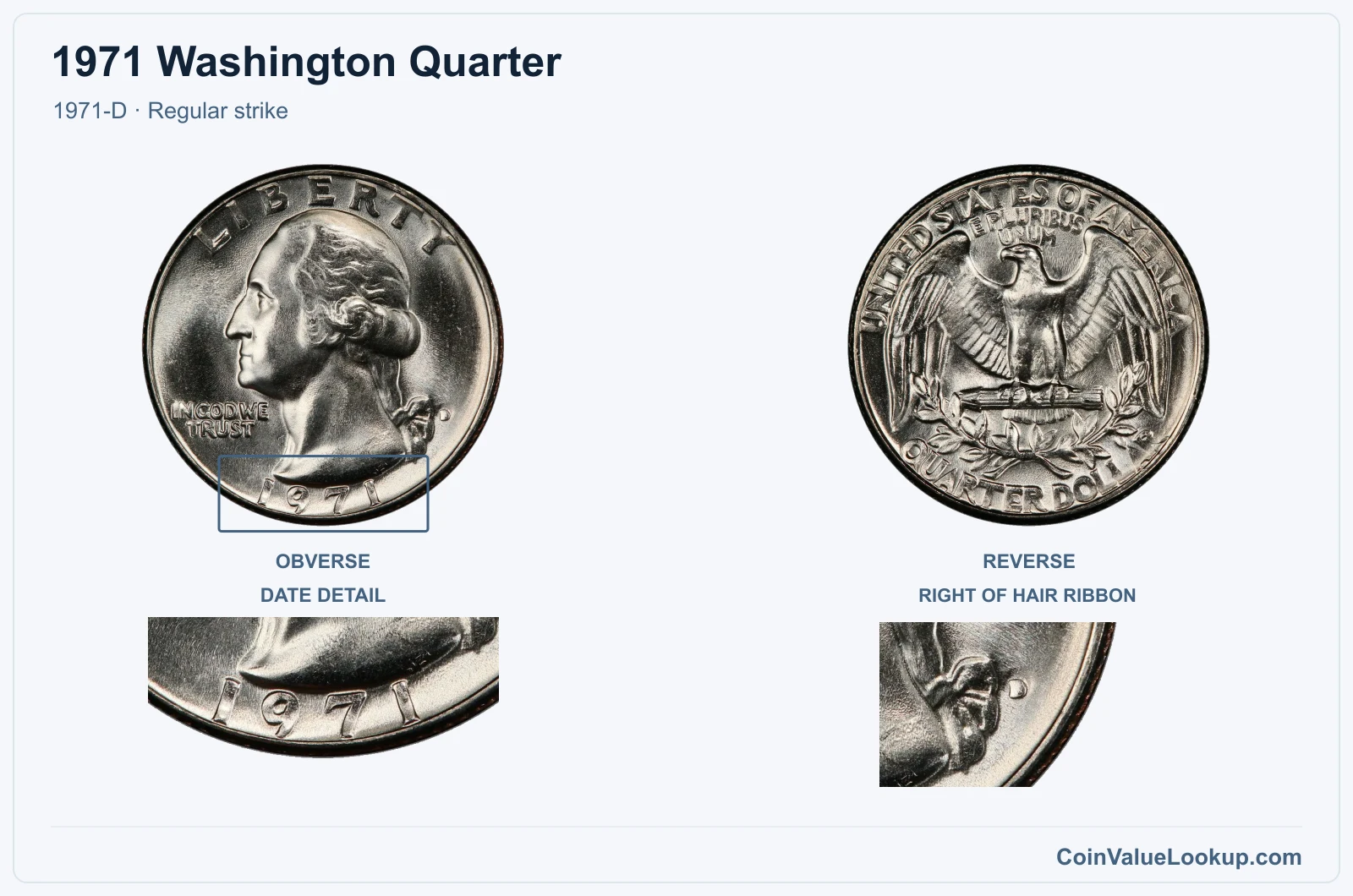
The 1971-D quarter carries a D mintmark on the obverse near the date, confirming it was struck at the Denver Mint. Like the Philadelphia issue, it is copper-nickel clad over a copper core and weighs about 5.67 grams.
Circulated examples are worth 25 cents. The USA Coin Book guide places an MS65 example at around $7.29.
Original, untouched surfaces with strong luster are what separate a dollar-bin coin from a graded holder coin.
Denver also produced the notable dime-planchet error for this year, so if your 1971-D looks suspiciously small, that is worth investigating further.
| Range | Grade | Price | Auction Records | Appraisal |
|---|---|---|---|---|
| PO | PO 1 | — | Coin Identifier | |
| FR | FR 2 | — | Coin Identifier | |
| AG | AG 3 | — | Coin Identifier | |
| G | G 4 | — | Coin Identifier | |
| G 6 | — | Coin Identifier | ||
| VG | VG 8 | — | Coin Identifier | |
| VG 10 | — | Coin Identifier | ||
| F | F 12 | — | Coin Identifier | |
| F 15 | — | Coin Identifier | ||
| VF | VF 20 | — | Coin Identifier | |
| VF 25 | — | Coin Identifier | ||
| VF 30 | — | Coin Identifier | ||
| VF 35 | — | Coin Identifier | ||
| XF | XF 40 | — | Coin Identifier | |
| XF 45 | — | Coin Identifier | ||
| AU | AU 50 | — | Coin Identifier | |
| AU 53 | — | Coin Identifier | ||
| AU 55 | — | Coin Identifier | ||
| AU 58 | — | Coin Identifier | ||
| MS | MS 60 | — | Coin Identifier | |
| MS 61 | — | Coin Identifier | ||
| MS 62 | — | Coin Identifier | ||
| MS 63 | — | Coin Identifier | ||
| MS 64 | Coin Identifier | |||
| MS 65 | Coin Identifier | |||
| MS 66 | Coin Identifier | |||
| MS 67 | Coin Identifier | |||
| MS 68 | Coin Identifier | |||
| MS 69 | — | — | — | |
| MS 70 | — | — | — |
1971 Washington Quarter — S Proof
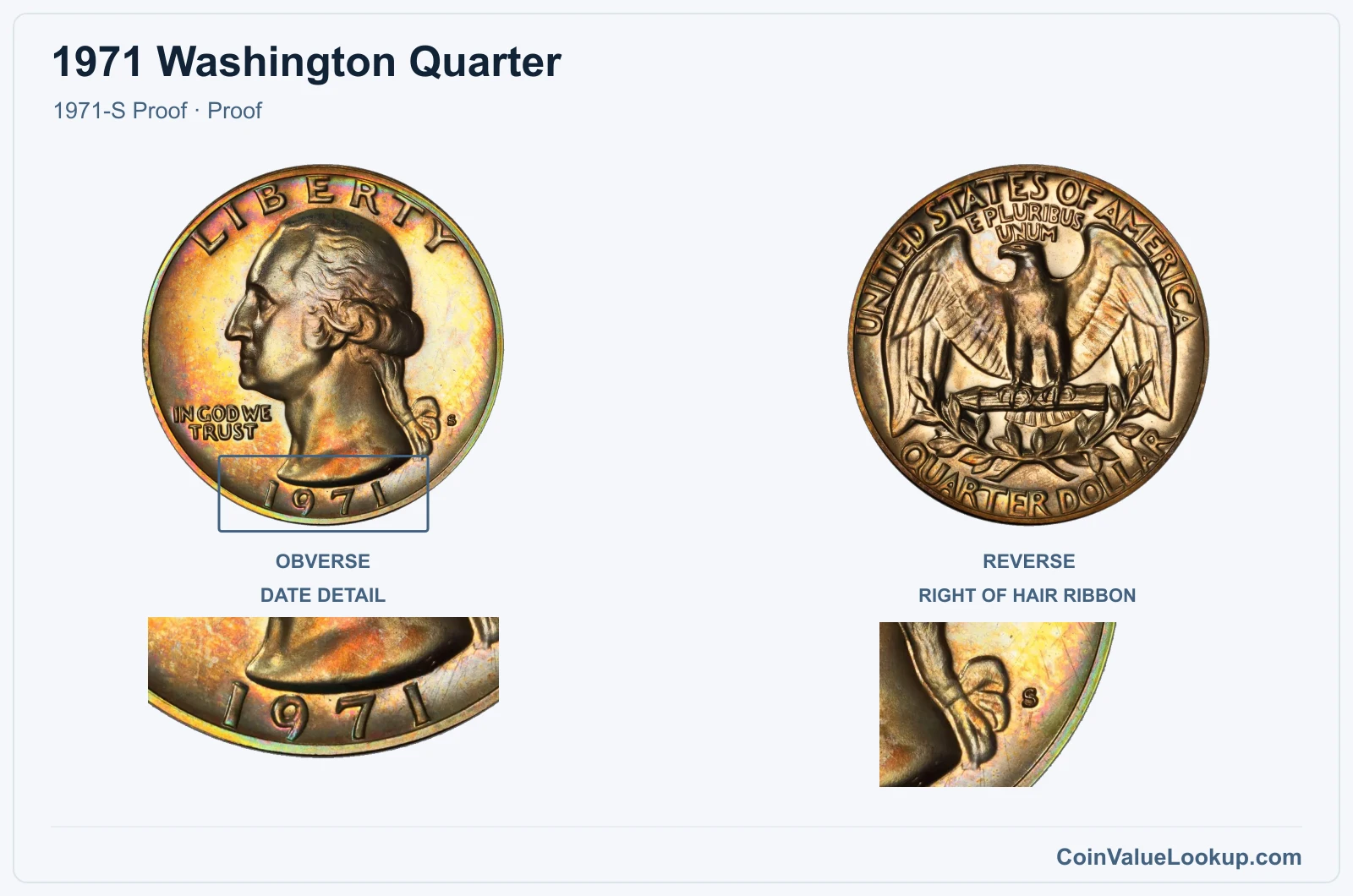
The 1971-S proof was struck at the San Francisco Mint and sold in proof sets. It bears an S mintmark on the obverse.
Proof quarters have sharp, squared-off rims and mirror-like fields that circulated coins simply cannot replicate.
At PR65, the USA Coin Book guide estimate is about $6.25. These were produced in quantity for collectors, so pristine examples are not rare.
Hairlines from mishandling are the most common condition problem.
Remember: a polished business-strike quarter is not a proof. The manufacturing process is entirely different, and experienced graders spot the difference immediately.
| Range | Grade | Price | Auction Records | Appraisal |
|---|---|---|---|---|
| PR | PR 1 | — | Coin Identifier | |
| PR 2 | — | Coin Identifier | ||
| PR 3 | — | Coin Identifier | ||
| PR 4 | — | Coin Identifier | ||
| PR 6 | — | Coin Identifier | ||
| PR 8 | — | Coin Identifier | ||
| PR 10 | — | Coin Identifier | ||
| PR 12 | — | Coin Identifier | ||
| PR 15 | — | Coin Identifier | ||
| PR 20 | — | Coin Identifier | ||
| PR 25 | — | Coin Identifier | ||
| PR 30 | — | Coin Identifier | ||
| PR 35 | — | Coin Identifier | ||
| PR 40 | — | Coin Identifier | ||
| PR 45 | — | Coin Identifier | ||
| PR 50 | — | Coin Identifier | ||
| PR 53 | — | Coin Identifier | ||
| PR 55 | — | Coin Identifier | ||
| PR 58 | — | Coin Identifier | ||
| PR 60 | — | Coin Identifier | ||
| PR 61 | — | Coin Identifier | ||
| PR 62 | — | Coin Identifier | ||
| PR 63 | — | Coin Identifier | ||
| PR 64 | — | Coin Identifier | ||
| PR 65 | — | Coin Identifier | ||
| PR 66 | Coin Identifier | |||
| PR 67 | Coin Identifier | |||
| PR 68 | Coin Identifier | |||
| PR 69 | Coin Identifier | |||
| PR 70 | — | — | — |
1971 Washington Quarter Error List
1. 1971 Washington Quarter — Struck over a 1970 Quarter
This is a 1971 quarter struck over a previously minted 1970 quarter. The host coin's designs show through as ghostly remnants beneath the new strike.
The 1970 date is reported visible near the eagle's right wing and rim area on the reverse.
This is not a doubled die. It is a completely different coin used as a blank.
Both dates and displaced designs from the earlier strike should be identifiable on the surfaces.
A single specimen graded NGC MS64 sold for $7,930 at Heritage Auctions in March 2026. That is one confirmed sale for one specific coin, not a broad market range.
Look-alikes include coins with post-mint filing, hammering, plating, or corrosion that create odd marks. Genuine overstrike surfaces show real strike characteristics — not tooling or damage.
Professional authentication is strongly recommended for any suspected overstrike.
2. 1971 Washington Quarter — Struck on a Dime Planchet
A 1971-D quarter struck on a dime-sized planchet is dramatically undersized. The smaller blank means only part of the design transfers — the date and D mintmark may be partially legible, but peripheral legends like LIBERTY and QUARTER DOLLAR are typically missing entirely.
One PCGS AU58 example sold for $345 at Heritage Auctions in May 2005. Condition and legibility of the date directly affect desirability.
Do not confuse this with a coin that has been filed down, clipped after minting, or intentionally cut. A genuine wrong-planchet error has proper struck surfaces and a natural rim from the striking process.
The edge profile should look like it came from a press, not a workshop. If you suspect you have one, compare the size and weight to a normal dime blank and seek professional attribution.
3. 1971 Washington Quarter — Dime Planchet with Obverse Indent
This compound error combines two problems: a 1971 quarter struck on a dime-sized planchet that also has an obverse indent from a foreign object blocking part of the strike. The result is a small coin missing its peripheral legends, plus a smooth crescent-shaped depression on the obverse where the obstruction sat.
Both diagnostics matter. You need the undersized blank and the indent to match this specific error type.
A single NGC MS63 specimen sold for $504 at Heritage Auctions in December 2025. That gives you a reference point, but it reflects one coin's story at one moment.
Imitations include damaged or filed coins with dents. Genuine examples show proper strike texture on the unaffected areas and a clean, consistent indent shape rather than random post-mint damage.
4. 1971 Washington Quarter — Doubled Die Reverse
A doubled die reverse has been reported for the 1971-P quarter. On this variety, reverse legends or design elements show doubling from a misaligned hub impression during die production.
This is different from machine doubling, which is flat and shelf-like rather than raised and rounded.
To check, compare your coin's reverse lettering and eagle details against a known normal 1971 quarter under magnification. Genuine hub doubling produces raised, separated outlines on affected areas.
No specific price was available for this variety. Value depends on the visibility of the doubling, the coin's overall condition, and market demand for the specific die pair.
Machine doubling, reflections, and random surface damage can all mimic doubled dies to the untrained eye.
5. 1971 Washington Quarter — Off-Center Strike
An off-center strike happens when the planchet is not properly seated between the dies. The result is a displaced design with an unstruck crescent of blank metal on one side.
The more off-center, the more dramatic — but collectors strongly prefer examples where the date remains visible.
This error has been reported for the 1971 quarter. No specific price was available.
Value depends heavily on the percentage off-center, date visibility, and the coin's preservation.
Do not confuse an off-center strike with a clipped planchet, a misaligned die, or a coin that was flattened after leaving the mint. A true off-center coin shows the complete design elements simply shifted in one direction, with blank metal where the collar did not confine the strike.
6. 1971 Washington Quarter — Broadstrike
A broadstrike occurs when a coin is struck without the normal retaining collar that forms the edge and controls diameter. The metal spreads outward, making the coin noticeably wider and thinner than normal.
The design is still centered, unlike an off-center strike.
This error has been reported for the 1971 quarter. No specific price was available.
Condition, the degree of spread, and overall eye appeal all influence collector interest.
Check the edge profile closely. A broadstruck coin lacks the normal reeded edge and has a smooth, expanded rim.
Coins that were flattened after minting — by a train, a vise, or sheer boredom — can look similar but lack proper strike characteristics on their surfaces.
7. 1971 Washington Quarter — Missing Clad Layer
A missing clad layer error means one of the outer nickel-clad layers was absent before the coin was struck. The exposed side shows the copper core, giving that face a distinctly different color and sometimes a slightly softer strike impression.
This error has been reported for the 1971 quarter. No specific price was available.
The value depends on which side is affected, the coin's condition, and how clearly the missing layer is evident.
Compare the affected face, the edge, and the coin's weight against a normal quarter. A genuine missing-clad coin will be lighter than the standard 5.67 grams.
Toning, environmental damage, plating, and corrosion can all change a coin's color and fool you into thinking a clad layer is missing when it is just discolored.
8. 1971 Washington Quarter — Clipped Planchet
A clipped planchet error results from a blank being punched incorrectly from the metal strip, leaving a missing curved or straight section. The clip happens before striking, so the coin's design and rim will show corresponding weakness opposite the missing area.
This error has been reported for the 1971 quarter. No specific price was available.
Value is driven by clip size, type, and overall condition of the coin.
Look at the edge texture carefully. A genuine clip shows a natural, Blakesley-effect weakness on the opposite rim, and the missing area's edge has a different texture than a filed or cut coin.
Post-mint damage — deliberate cutting, filing a notch, or corrosion eating away the edge — will not produce that characteristic opposite-side weakness.
9. 1971 Washington Quarter — Die Crack / Die Chip
Die cracks and die chips are raised features caused by a deteriorating or damaged die. A crack appears as a thin raised line running across the coin's surface, while a chip shows up as a small raised blob, often within a letter or design element.
A larger break connecting to the rim is sometimes called a cud.
Die breaks have been reported for the 1971 quarter. No specific price was available.
Value depends on the size, location, and visual prominence of the break, plus the coin's overall grade.
These are raised features, not incuse ones. Scratches, corrosion lines, and foreign material sitting on the surface can look similar at a glance but are either sunken into the surface or sit loosely on top rather than being part of the struck design.