1967 Washington Quarter Coin Value: How Much Is It Worth?
Most 1967 Washington quarters you pull from a jar are worth face value — 25 cents. These copper-nickel clad coins circulated by the billions.
In higher uncirculated grades the picture changes a bit: a USA Coin Book guide estimate puts an MS65 business strike around $7.29. Special Mint Set pieces and genuine mint errors can carry larger premiums, so the year is worth a closer look.
Fast Way to Identify Your 1967 Washington Quarter
Snap a clear photo of the front and back of your 1967 quarter and upload both images. Our identifier can give you a preliminary read on which version you have — business strike or SMS — and flag anything unusual about the surfaces or strike.
It is not a substitute for professional authentication, but it is a solid first step.
1967 Washington Quarter Value
Upload both sides of your 1967 Washington Quarter.
Front Obverse
Upload photo
Back Reverse
Upload photo
Which 1967 Washington Quarter Versions Are Worth Money?
- A 1967 SMS SP quarter, authenticated by a grading service, commands a premium over ordinary business strikes — condition and finish quality drive the price.
- Wrong-planchet errors are dramatic: a 1967 quarter struck on a cent planchet sold for $2,115 in PCGS MS65 Red and Brown at Heritage in September 2013.
- A broadstruck quarter paired with its matching detached clad layer brought $1,638.75 as a two-piece set at Heritage in April 2008.
- An obverse die break variety in NGC MS65 realized $372 at Heritage in December 2022.
- Quarters struck on five-cent or dime planchets have confirmed auction records and are collectible off-metal errors.
Step 1: Identify Your 1967 Washington Quarter Mint Mark and Version
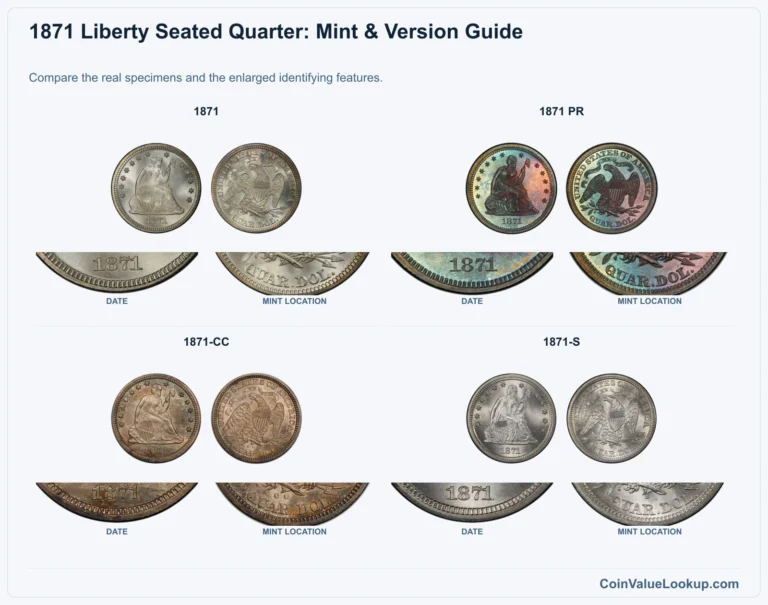
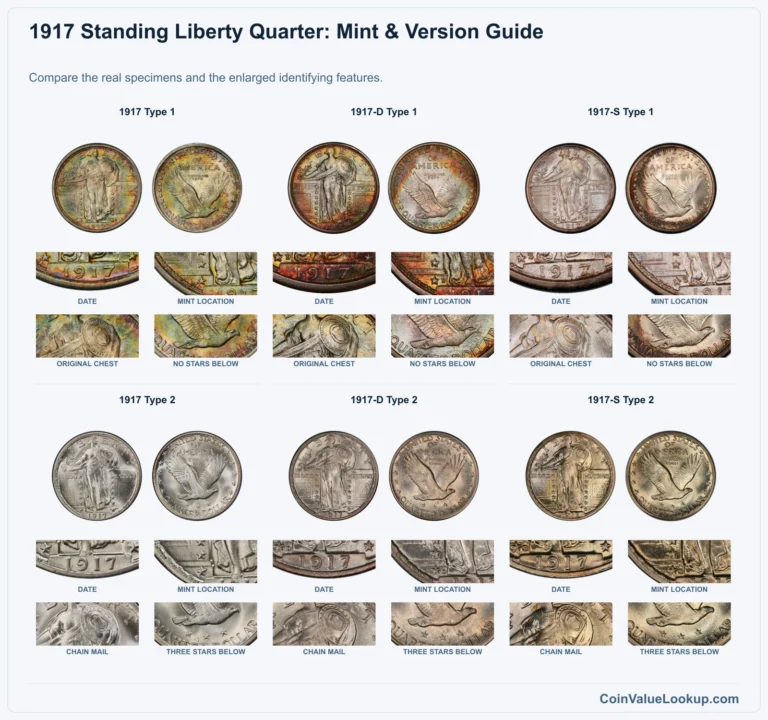
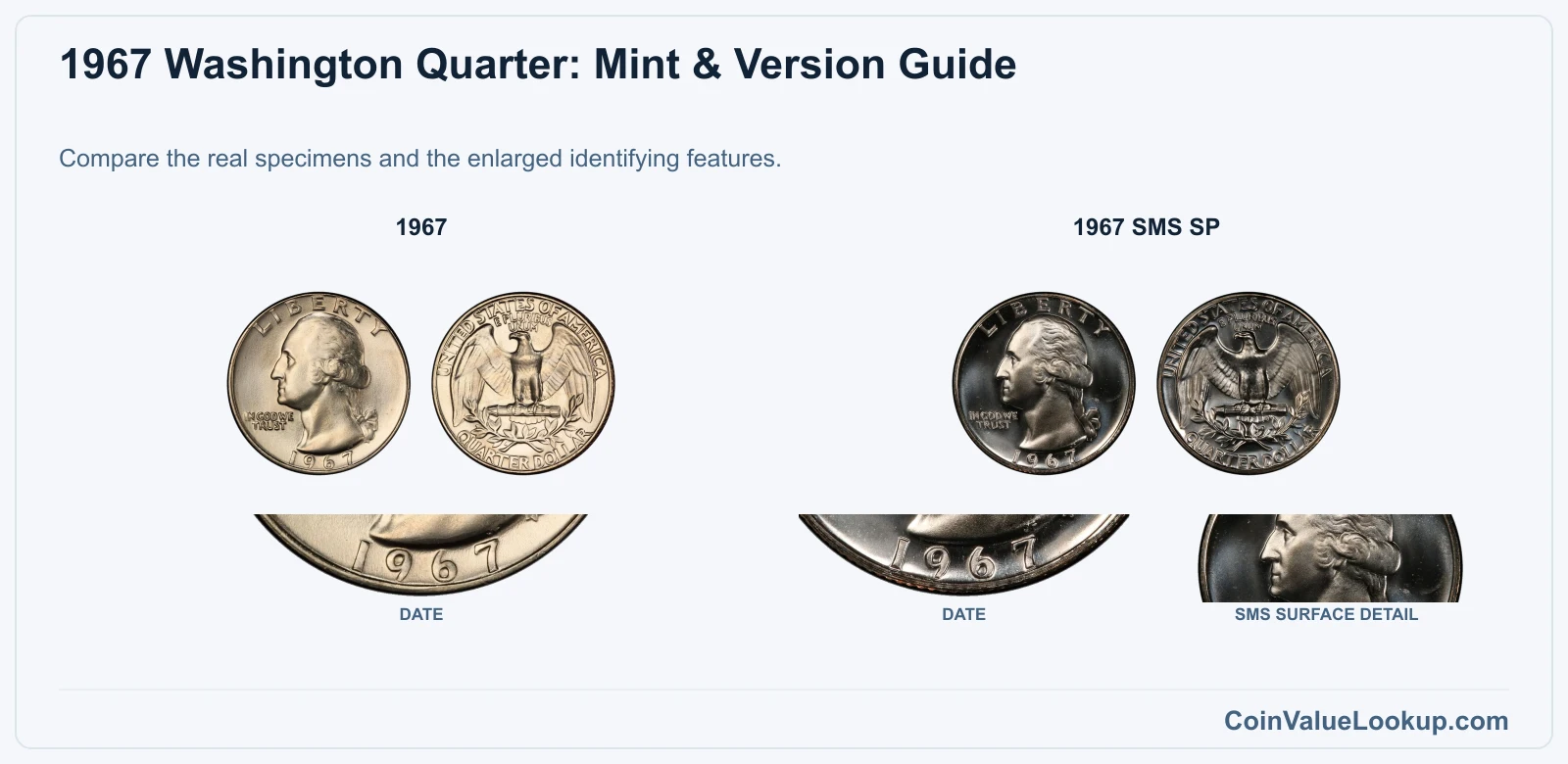
Every 1967 quarter lacks a mintmark. That is normal.
From 1965 through 1967 the Mint suppressed all mintmarks, so a blank space below the date does not mean Philadelphia and does not indicate a missing-mintmark error.
The standard composition is copper-nickel clad over a copper core, with an overall alloy of 91.67 percent copper and 8.33 percent nickel. Normal weight is about 5.67 grams and diameter roughly 24.3 mm.
If you look at the edge of a genuine clad quarter you should see a thin copper core sandwiched between silvery outer layers.
Two legitimate finishes exist for 1967: ordinary business strikes and Special Mint Set (SMS) coins. There is no regular proof quarter this year.
A shiny or reflective surface does not automatically make a coin SMS or proof — polished and cleaned coins can mimic that look. Authenticated SMS coins were sold in government-issued Special Mint Sets and have a distinctive satin or semi-reflective quality that differs from both proof mirrors and normal business luster.
Step 2: Check Your 1967 Washington Quarter Grade
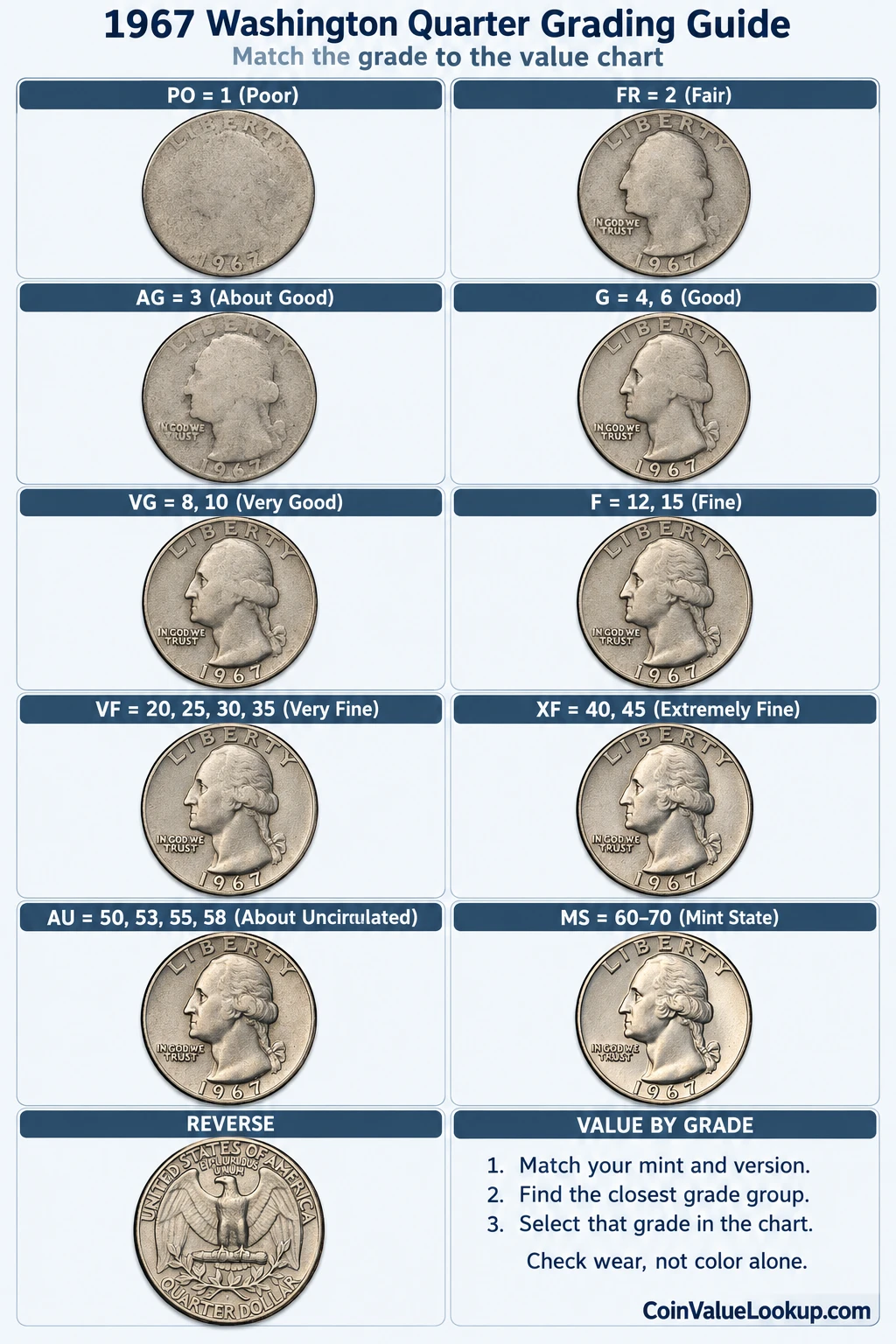
Start at the hair just above Washington's ear. On a well-worn coin, the individual strands merge into a flat patch.
Check the cheekbone and jawline next — rub shows as a dull, smooth area that breaks the original luster.
Flip to the reverse and examine the eagle's breast feathers. High points there wear first, flattening into a featureless shield shape on lower-grade pieces.
Use the comparison image to match your coin's wear pattern against known grade benchmarks.
Surface quality matters beyond wear. Bag marks, rim dings and hairlines from cleaning all pull the grade down.
On SMS coins, evaluate the special finish contrast separately; a coin that has been polished after leaving the mint cannot be reclassified as SMS or proof regardless of how mirror-like it appears.
Step 3: Check 1967 Washington Quarter Value by Mint and Version
1967 Washington Quarter
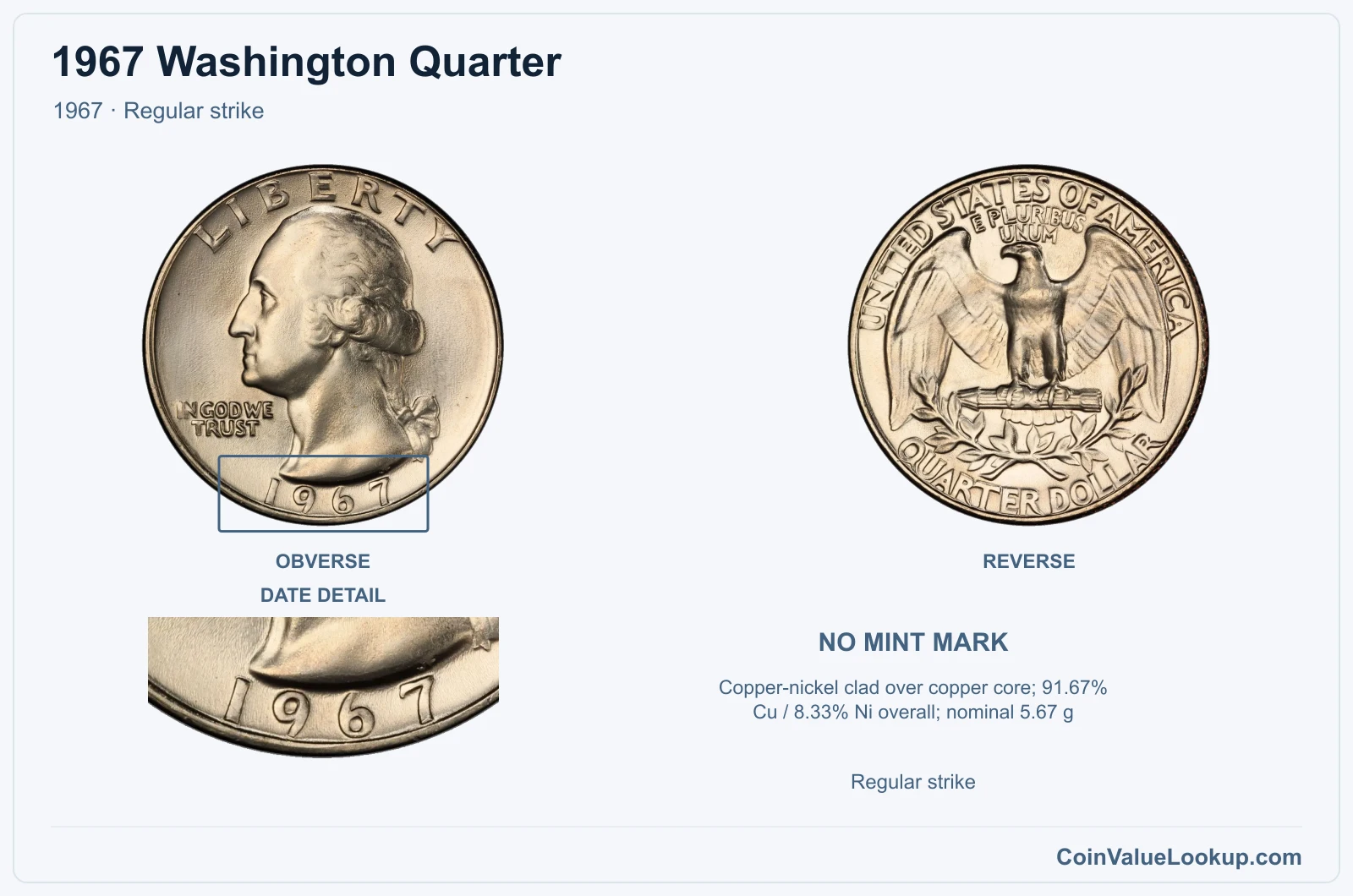
The 1967 business-strike quarter is the coin you will encounter most often. It was made at one or more mints, but because mintmarks were suppressed you cannot attribute it to a specific facility.
The clad composition is copper-nickel over a copper core at 5.67 grams.
In circulated grades these trade at face value. A USA Coin Book guide estimate for MS65 is $7.29.
That is a retail guide figure, not a guaranteed offer. Anything below MS65 is generally a spend-it coin unless a genuine error is present.
Coin Value Lookup is a handy starting point if you want to compare this quarter against other years and denominations in the Washington series.
| Range | Grade | Price | Auction Records | Appraisal |
|---|---|---|---|---|
| PO | PO 1 | — | Coin Identifier | |
| FR | FR 2 | — | Coin Identifier | |
| AG | AG 3 | — | Coin Identifier | |
| G | G 4 | — | Coin Identifier | |
| G 6 | — | Coin Identifier | ||
| VG | VG 8 | — | Coin Identifier | |
| VG 10 | — | Coin Identifier | ||
| F | F 12 | — | Coin Identifier | |
| F 15 | — | Coin Identifier | ||
| VF | VF 20 | — | Coin Identifier | |
| VF 25 | — | Coin Identifier | ||
| VF 30 | — | Coin Identifier | ||
| VF 35 | — | Coin Identifier | ||
| XF | XF 40 | — | Coin Identifier | |
| XF 45 | — | Coin Identifier | ||
| AU | AU 50 | — | Coin Identifier | |
| AU 53 | — | Coin Identifier | ||
| AU 55 | — | Coin Identifier | ||
| AU 58 | — | Coin Identifier | ||
| MS | MS 60 | — | Coin Identifier | |
| MS 61 | — | Coin Identifier | ||
| MS 62 | — | Coin Identifier | ||
| MS 63 | — | Coin Identifier | ||
| MS 64 | Coin Identifier | |||
| MS 65 | Coin Identifier | |||
| MS 66 | Coin Identifier | |||
| MS 67 | Coin Identifier | |||
| MS 68 | Coin Identifier | |||
| MS 69 | — | — | — | |
| MS 70 | — | — | — |
1967 Washington Quarter — SMS SP
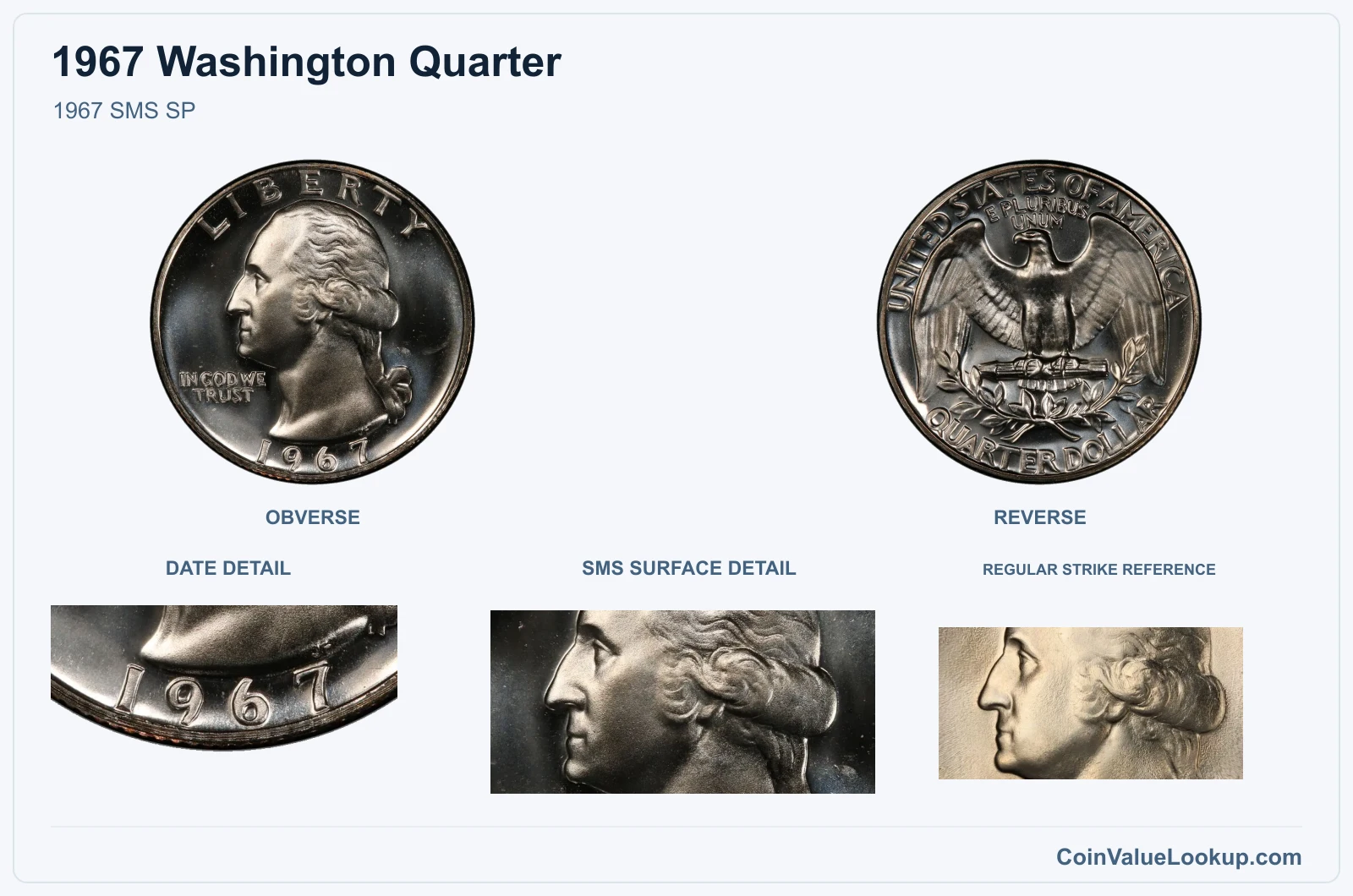
The 1967 SMS SP quarter came in the Special Mint Set sold by the U.S. Mint during the years when proof sets were suspended. These coins have a distinctive satin or lightly reflective finish that sits between a normal business strike and a proof — but a shiny coin is not automatically SMS.
Authentication by a recognized grading service is the reliable way to confirm the designation.
No supported numeric price range is available for this version in the current data. Value depends on the authenticated finish quality, the assigned grade, and whether any recognized variety or error is present.
Because SMS quarters share the same lack of mintmark as business strikes, provenance and surface characteristics are everything. If yours came out of an original government-sealed Special Mint Set, that history supports the attribution.
| Range | Grade | Price | Auction Records | Appraisal |
|---|---|---|---|---|
| SP | SP 1 | — | Coin Identifier | |
| SP 2 | — | Coin Identifier | ||
| SP 3 | — | Coin Identifier | ||
| SP 4 | — | Coin Identifier | ||
| SP 6 | — | Coin Identifier | ||
| SP 8 | — | Coin Identifier | ||
| SP 10 | — | Coin Identifier | ||
| SP 12 | — | Coin Identifier | ||
| SP 15 | — | Coin Identifier | ||
| SP 20 | — | Coin Identifier | ||
| SP 25 | — | Coin Identifier | ||
| SP 30 | — | Coin Identifier | ||
| SP 35 | — | Coin Identifier | ||
| SP 40 | — | Coin Identifier | ||
| SP 45 | — | Coin Identifier | ||
| SP 50 | — | Coin Identifier | ||
| SP 53 | — | Coin Identifier | ||
| SP 55 | — | Coin Identifier | ||
| SP 58 | — | Coin Identifier | ||
| SP 60 | — | Coin Identifier | ||
| SP 61 | — | Coin Identifier | ||
| SP 62 | — | Coin Identifier | ||
| SP 63 | — | Coin Identifier | ||
| SP 64 | — | Coin Identifier | ||
| SP 65 | Coin Identifier | |||
| SP 66 | Coin Identifier | |||
| SP 67 | Coin Identifier | |||
| SP 68 | Coin Identifier | |||
| SP 69 | Coin Identifier | |||
| SP 70 | — | — | — |
1967 Washington Quarter Error List
1. 1967 Washington Quarter — Broadstrike with a Retained Matching Clad-Layer Error
This error involves two pieces that were struck together: a broadstruck 1967 quarter and a separately struck detached clad layer. The broadstruck quarter shows expanded legends and a weak reverse because the collar failed to contain the strike.
The detached clad layer carries an incuse brockage impression of the quarter's reverse, proving the two were in the press at the same time.
A PCGS MS64/MS62 pair sold for $1,638.75 at Heritage in April 2008. That price covers both pieces together — do not assume either piece alone is worth that amount.
Post-mint filing, cutting or corrosion can produce odd-looking fragments, so confirming genuine strike surfaces on both pieces is essential. Only an attributed, certified matched pair carries this kind of premium.
2. 1967 Washington Quarter — Struck on a Cent Planchet
A 1967 quarter struck on a cent planchet is a dramatic wrong-metal error. The smaller copper blank receives the full Washington portrait and eagle, but the peripheral legends and date are partial or distorted because the blank is too small for the quarter dies.
The surfaces should show copper color throughout, not copper plating over a clad quarter.
A PCGS MS65 Red and Brown example sold for $2,115 at Heritage in September 2013. Weight and diameter will be close to a Lincoln cent blank, not a quarter.
Post-mint plating, filing or corrosion can make a normal clad quarter look copper-toned, so color alone is not enough. Certification from a major grading service is the standard for confirming this type of off-metal strike.
3. 1967 Washington Quarter — Struck on a Five-Cent Planchet
When a nickel-sized blank wandered into the quarter press, the result was a 1967 quarter struck on a five-cent planchet. The coin weighs around 5.0 grams — close to a quarter's 5.67 grams but noticeably lighter — and the smaller diameter leaves the date and outer lettering incomplete or distorted.
A 1967 AU50 example certified by ANACS sold for $184 at Heritage in August 2004, and an MS62 NGC coin brought $253 at Heritage in June 2005. Golden or yellowish tone alone does not prove wrong planchet; you need confirmed weight, diameter and edge inspection.
Post-mint damage, hammering or plating can mimic the look. Professional certification is the surest path to confirming this error.
4. 1967 Washington Quarter — Struck on a Dime Planchet
A 1967 quarter struck on a dime planchet is even smaller than the nickel-planchet version. Major legends are pushed off the flan entirely, while the central Washington portrait and eagle remain compact and reasonably well struck.
The edge should show proper clad layers consistent with a dime blank.
An MS63 example sold for $195.50 at Heritage in March 1998. The key diagnostics are diameter and weight matching a dime blank, not a quarter.
A clipped quarter can superficially resemble a small-planchet strike, so edge texture and metal flow deserve careful inspection. Weakness opposite the missing area is a hallmark of a genuine clip, not a wrong planchet.
Certification resolves the distinction.
5. 1967 Washington Quarter — Obverse Die Break
A die break — sometimes called a cud — appears as a raised, featureless blob on the coin's surface where part of the die cracked and fell away. On 1967 quarters, the listed obverse die break shows up in a consistent location on every genuine specimen because it comes from one specific die.
The raised area is the key diagnostic. Scratches, stains and gouges are incuse or cut across the design, while a genuine die break projects above the surrounding surface.
A Heritage lot in December 2022 sold an NGC MS65 example for $372. If you spot an unusual raised lump on your 1967 quarter's obverse, compare its location carefully against known examples before drawing conclusions.
6. 1967 Washington Quarter — Doubled Die Obverse
A doubled die obverse on a 1967 quarter shows consistent doubling on obverse letters or design elements. Under magnification, look for separation or notching on the lettering — the kind of uniform shift that repeats across multiple characters in the same direction.
Machine doubling is the most common lookalike. It produces flat, shelf-like distortion rather than the rounded, separated profiles of a true doubled die.
Reflections and worn die contours can also trick your eye. No supported price range is available for this variety; value depends on the visibility of the doubling, the coin's condition, and professional attribution of the specific die.
Certification confirms whether the doubling is hub-based or mechanical.
7. 1967 Washington Quarter — Off-Center Strike
An off-center strike happens when the planchet is not seated properly between the dies. The result is a displaced design with an unstruck crescent of blank metal on one side.
The most desirable off-center quarters still show a readable date, since that confirms the year.
Do not confuse an off-center strike with a clipped planchet or post-mint flattening. A clip removes part of the blank before striking, while off-center shifts the entire image.
One-sided die misalignment can look similar but behaves differently on obverse versus reverse. No supported price range is available; value depends on the percentage off center, date visibility, and overall condition.
8. 1967 Washington Quarter — Clipped Planchet
A clipped planchet error occurs when the blank is improperly punched from the metal strip before striking. The result is a missing curved, straight or ragged section along the rim.
Genuine clips often show metal-flow weakness on the opposite side of the coin from the missing area, which helps distinguish them from post-mint damage.
Filed notches, edge cuts and corrosion can all mimic a clip. Check the edge texture carefully — a genuine clip will show consistent metal flow, not sharp tool marks.
No supported price range is available for this error. The size and shape of the clip, the coin's grade, and whether the date remains fully visible all influence what a collector might pay.
9. 1967 Washington Quarter — Doubled Die Reverse
A doubled die reverse on the 1967 SMS quarter involves doubling on the reverse legends or design contours. Compare your coin's reverse lettering against a normal example under consistent lighting and magnification.
Look for consistent separation or notching that repeats across several characters rather than random distortion.
Machine doubling is the primary lookalike — it leaves flat, shelf-like impressions instead of the rounded split profiles of a genuine doubled die. Random damage and reflections can also mislead.
No supported price is available for this variety. Value depends on the strength and visibility of the doubling, the coin's authenticated finish and grade, and confirmation by a grading service that the doubling originates from the hub rather than from strike mechanics.