1971 Lincoln Penny Coin Value: How Much Is It Worth?
Ordinary worn 1971 Lincoln pennies are modest collectibles that usually stay close to face value. A guide estimate from USA Coin Book places a well-preserved MS65 example at about $1.24, regardless of mint branch.
The real action is in the doubled die varieties — both no-mintmark business strikes and S proof issues carry separate doubled obverse dies that deserve a closer look.
Original copper color, proper authentication and precise die identification all matter when pricing these coins. A normal S proof in PR65 also sits around $1.24 per the same guide.
Before assuming yours is special, read on.
Fast Way to Identify Your 1971 Lincoln Penny
Snap clear photos of both the front and back of your 1971 penny and upload them to our identifier. It can provide a preliminary identification of your coin's mint branch, finish and general condition based on what is visible.
This is not authentication or exact grading — think of it as a helpful first step before deeper research or professional evaluation.
1971 Penny Value
Upload both sides of your 1971 Lincoln Penny.
Front Obverse
Upload photo
Back Reverse
Upload photo
Which 1971 Lincoln Penny Versions Are Worth Money?
- The 1971 no-mintmark doubled die obverse shows strong splitting on LIBERTY and IN GOD WE TRUST under magnification — individual value depends on authentication and condition.
- The 1971-S proof doubled die obverse doubles the motto and LIBERTY without doubling the date; exact die identification and proof-surface quality drive its price.
- A 1971-D cent struck on a clad dime blank with a second strike 95% off center sold for $862.50 (PCGS MS62, September 2004) — a dramatic combined error.
- A 1971-S business cent combining a curved clip with a double strike sold for $372 (NGC MS62 Brown, November 2020).
Step 1: Identify Your 1971 Lincoln Penny Mint Mark and Version
The 1971 Lincoln cent carries the familiar Lincoln portrait on the obverse and the Lincoln Memorial on the reverse. The alloy is 95% copper and 5% zinc, with a nominal weight of 3.11 grams — these are not the copper-plated zinc cents that came later.
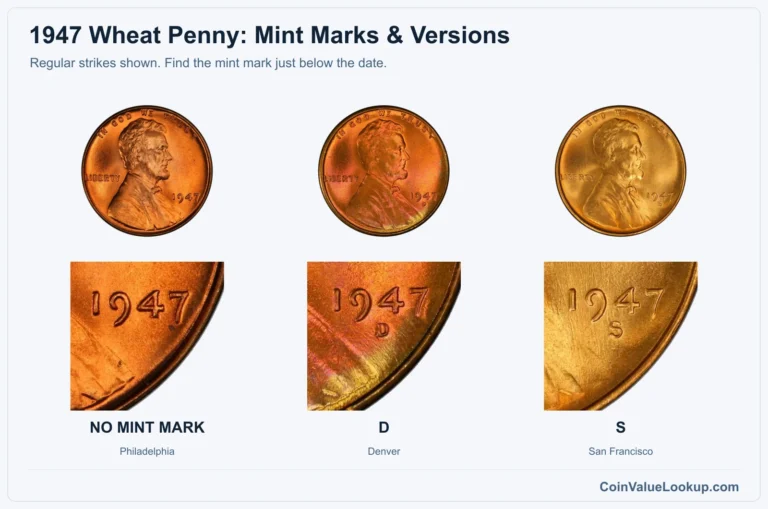
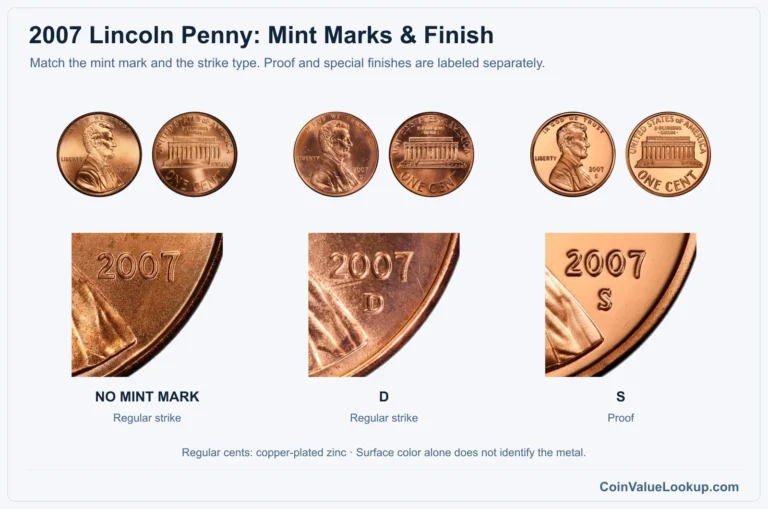
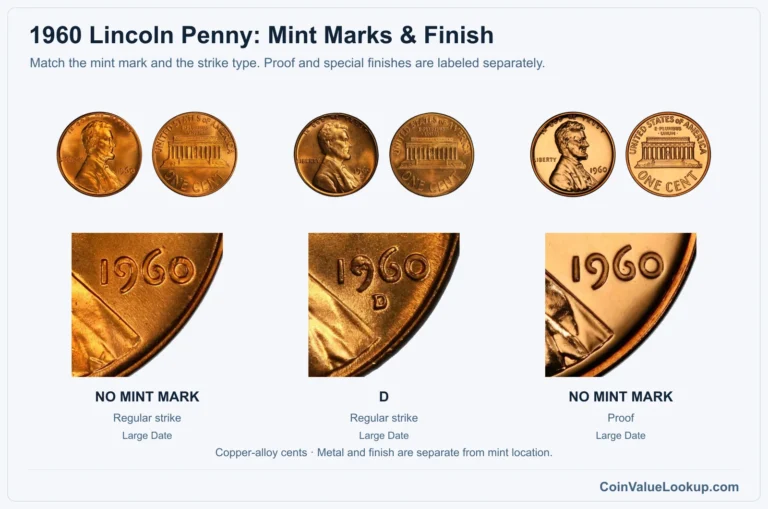
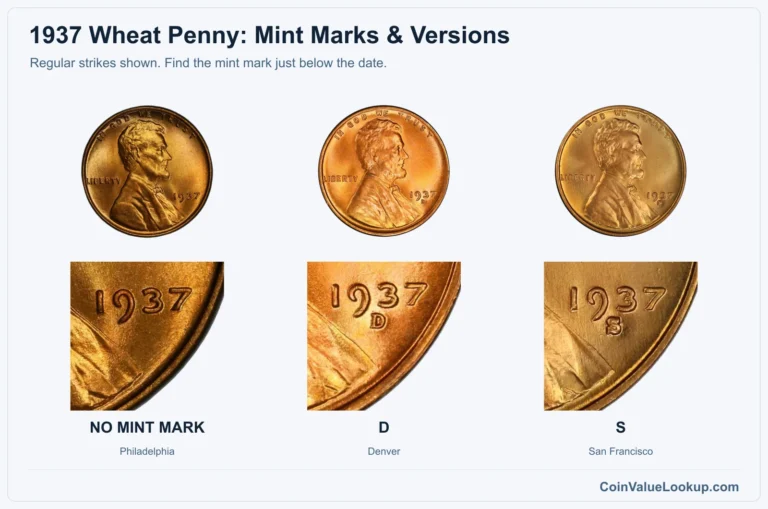
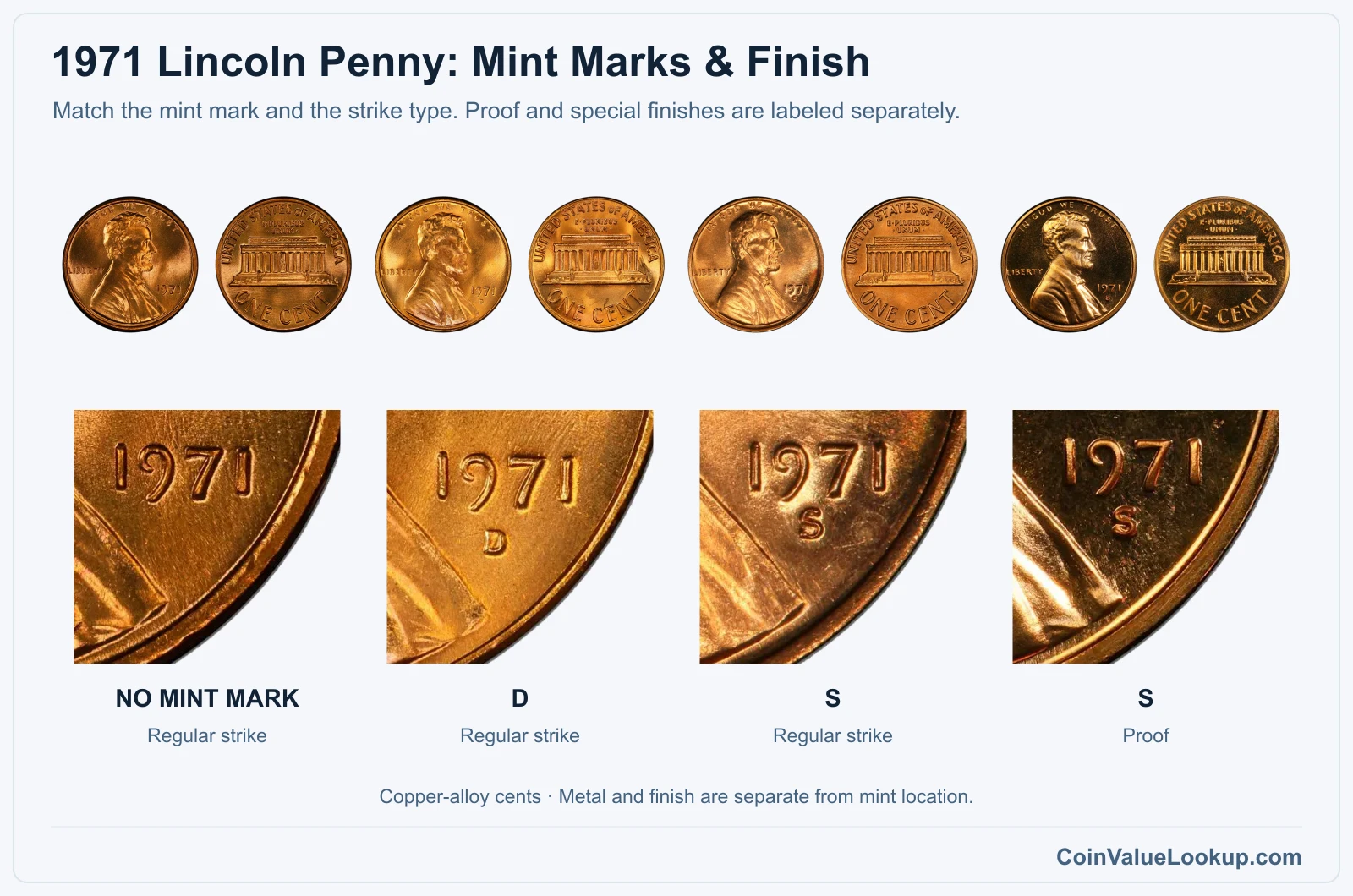
First, check the date. Then look directly below it for a small letter: D means Denver, S means San Francisco, and no letter at all is the Philadelphia catalog branch.
That missing mintmark alone does not confirm any error.
The S mintmark appears on both business strikes and proofs, and these are entirely separate issues. Proofs have mirror-like fields and sharply detailed devices; a business-strike S cent will look like an ordinary circulated coin.
Do not confuse them.
Color designations — Red (RD), Red-Brown (RB) and Brown (BN) — describe how much original copper luster survives. They are not different alloys.
A coin graded MS65 RD will generally command more than the same grade in BN, so note the color when comparing values.
Watch out for altered, plated or chemically cleaned coins. A bright, shiny surface does not equal uncirculated, and an added or removed mintmark is not a variety.
Step 2: Check Your 1971 Lincoln Penny Grade
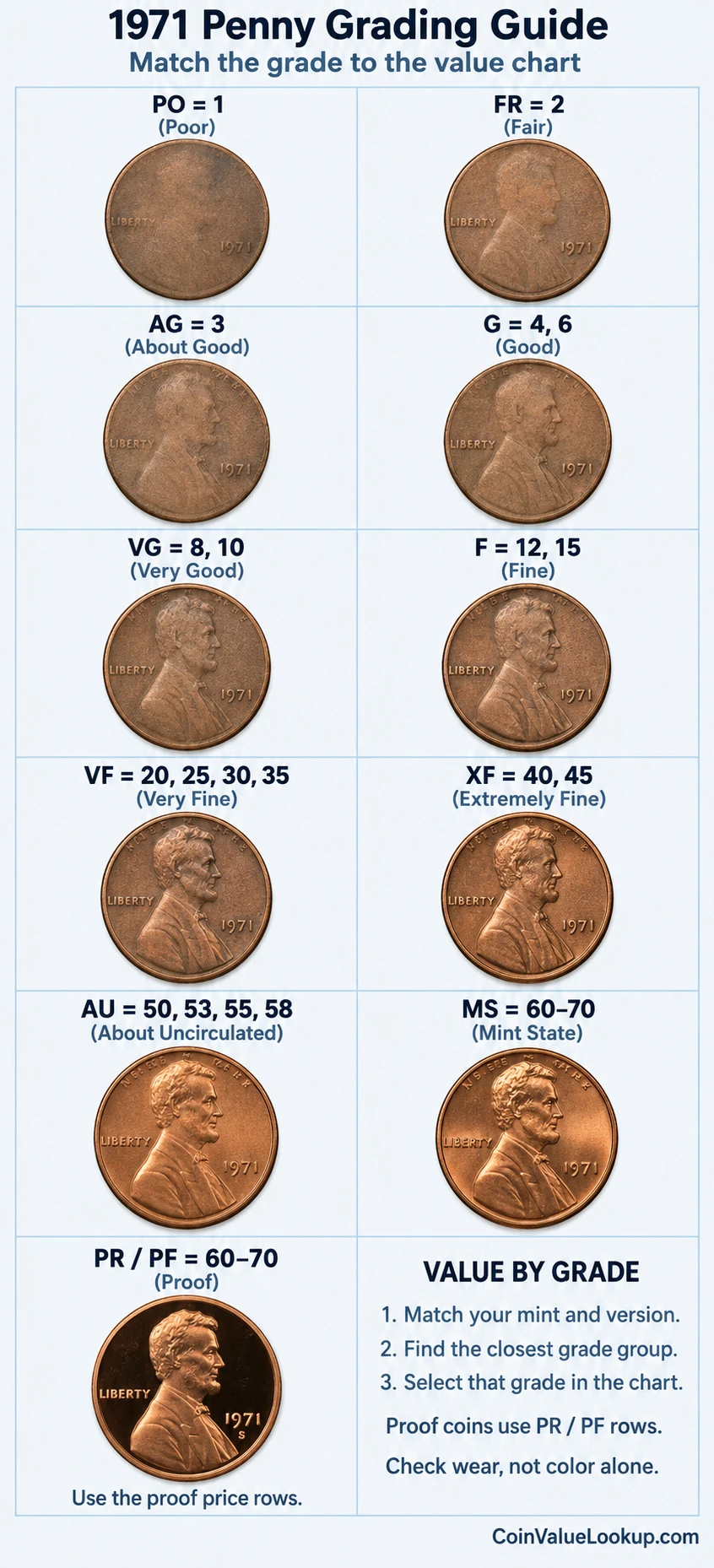
Start on the obverse. Lincoln's cheekbone, jawline and the hair detail just above his ear are the first areas to lose definition as a coin circulates.
Even light wear flattens the highest points there.
Flip it over. The Memorial's horizontal roof line and the tops of the columns wear next.
If those are sharp and the fields still show original luster, you may have an uncirculated coin.
Separate contact marks — bag hits from storage — from actual wear. A coin with full luster but a few scuffs is still uncirculated; it just grades lower within the Mint State range.
Use the comparison image to match your coin's wear pattern against known grade benchmarks.
Dark or toned copper can be uncirculated. Bright copper can be cleaned.
Trust the surface texture, not the color alone. Proof finish is a manufacturing method, not a grade above Mint State — a proof can still show hairlines or haze that lower its assigned number.
Step 3: Check 1971 Lincoln Penny Value by Mint and Version
1971 Lincoln Penny — No Mint Mark — Business
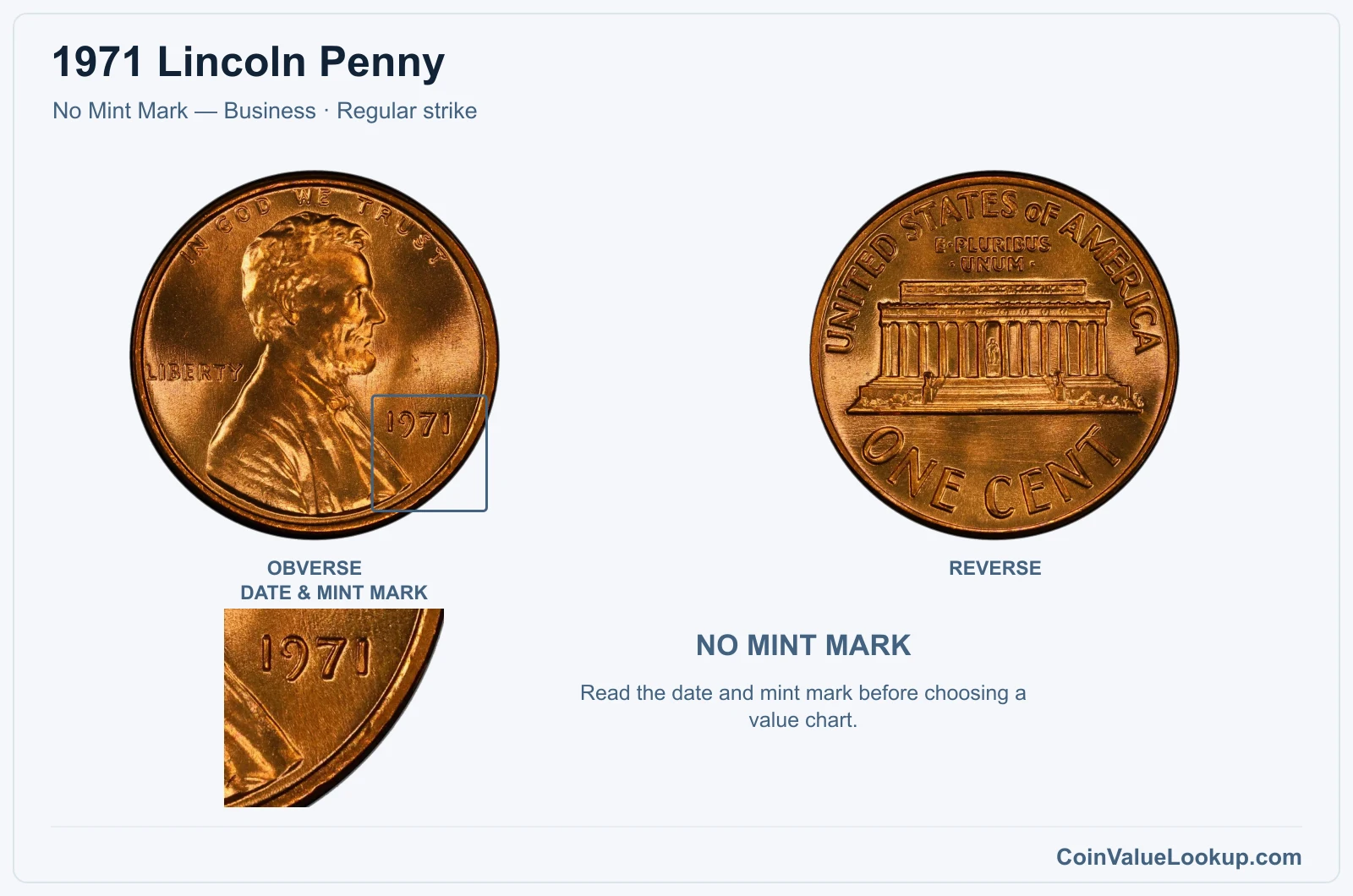
The no-mintmark 1971 penny is the standard Philadelphia-catalog business strike. Look below the date — if there is no small letter, this is your branch.
The alloy is 95% copper and 5% zinc at 3.11 grams.
A USA Coin Book guide estimate puts an MS65 example at about $1.24. Circulated pieces are worth face value or close to it.
Copper-color designation matters: an MS65 Red coin will typically be worth more than an MS65 Brown, so note how much original orange luster remains before comparing prices.
Range Grade
Price1971 No Mint Mark — Business (BN) Price1971 No Mint Mark — Business (RB) Price1971 No Mint Mark — Business (RD) Auction Records Appraisal PO PO 1
—
Coin Identifier FR FR 2
—
Coin Identifier AG AG 3
—
Coin Identifier G G 4
—
Coin Identifier
G 6
—
Coin Identifier VG VG 8
—
Coin Identifier
VG 10
—
Coin Identifier F F 12
—
Coin Identifier
F 15
—
Coin Identifier VF VF 20
—
Coin Identifier
VF 25
—
Coin Identifier
VF 30
—
Coin Identifier
VF 35
—
Coin Identifier XF XF 40
—
Coin Identifier
XF 45
—
Coin Identifier AU AU 50
—
Coin Identifier
AU 53
—
Coin Identifier
AU 55
Coin Identifier
AU 58
—
Coin Identifier MS MS 60
—
—
Coin Identifier
MS 61
—
—
Coin Identifier
MS 62
—
Coin Identifier
MS 63
—
Coin Identifier
MS 64
Coin Identifier
MS 65
Coin Identifier
MS 66
—
Coin Identifier
MS 67
—
Coin Identifier
MS 68
—
—
—
—
—
MS 69
—
—
—
—
—
MS 70
—
—
—
—
—
1971 Lincoln Penny — D — Business
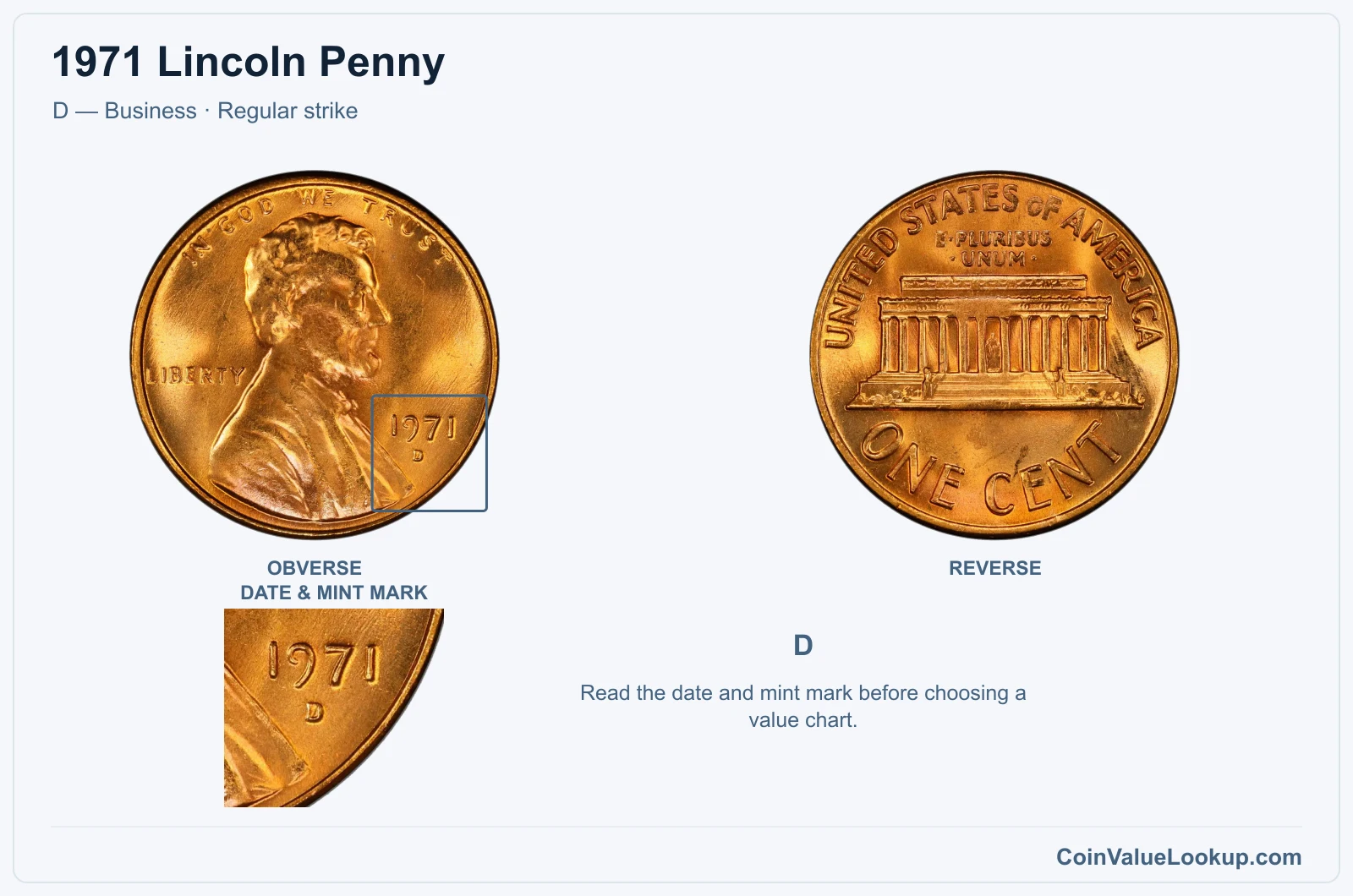
The 1971-D cent carries a small D mintmark below the date, indicating Denver production. Same alloy and weight as the Philadelphia issue — 95% copper, 5% zinc, 3.11 grams.
At MS65, the USA Coin Book guide estimate is $1.24. Worn examples are common and worth very little above face value.
As with all copper Lincoln cents, color preservation separates otherwise identical grades. Check for a clear, unaltered D mintmark before cataloging.
Range Grade
Price1971 D — Business (BN) Price1971 D — Business (RB) Price1971 D — Business (RD) Auction Records Appraisal PO PO 1
—
Coin Identifier FR FR 2
—
Coin Identifier AG AG 3
—
Coin Identifier G G 4
—
Coin Identifier
G 6
—
Coin Identifier VG VG 8
—
Coin Identifier
VG 10
—
Coin Identifier F F 12
—
Coin Identifier
F 15
—
Coin Identifier VF VF 20
—
Coin Identifier
VF 25
—
—
Coin Identifier
VF 30
—
—
Coin Identifier
VF 35
—
—
Coin Identifier XF XF 40
—
Coin Identifier
XF 45
—
Coin Identifier AU AU 50
—
Coin Identifier
AU 53
—
Coin Identifier
AU 55
—
Coin Identifier
AU 58
—
Coin Identifier MS MS 60
—
—
Coin Identifier
MS 61
—
Coin Identifier
MS 62
—
Coin Identifier
MS 63
—
Coin Identifier
MS 64
Coin Identifier
MS 65
—
Coin Identifier
MS 66
Coin Identifier
MS 67
—
—
Coin Identifier
MS 68
—
—
—
—
—
MS 69
—
—
—
—
—
MS 70
—
—
—
—
—
1971 Lincoln Penny — S — Business
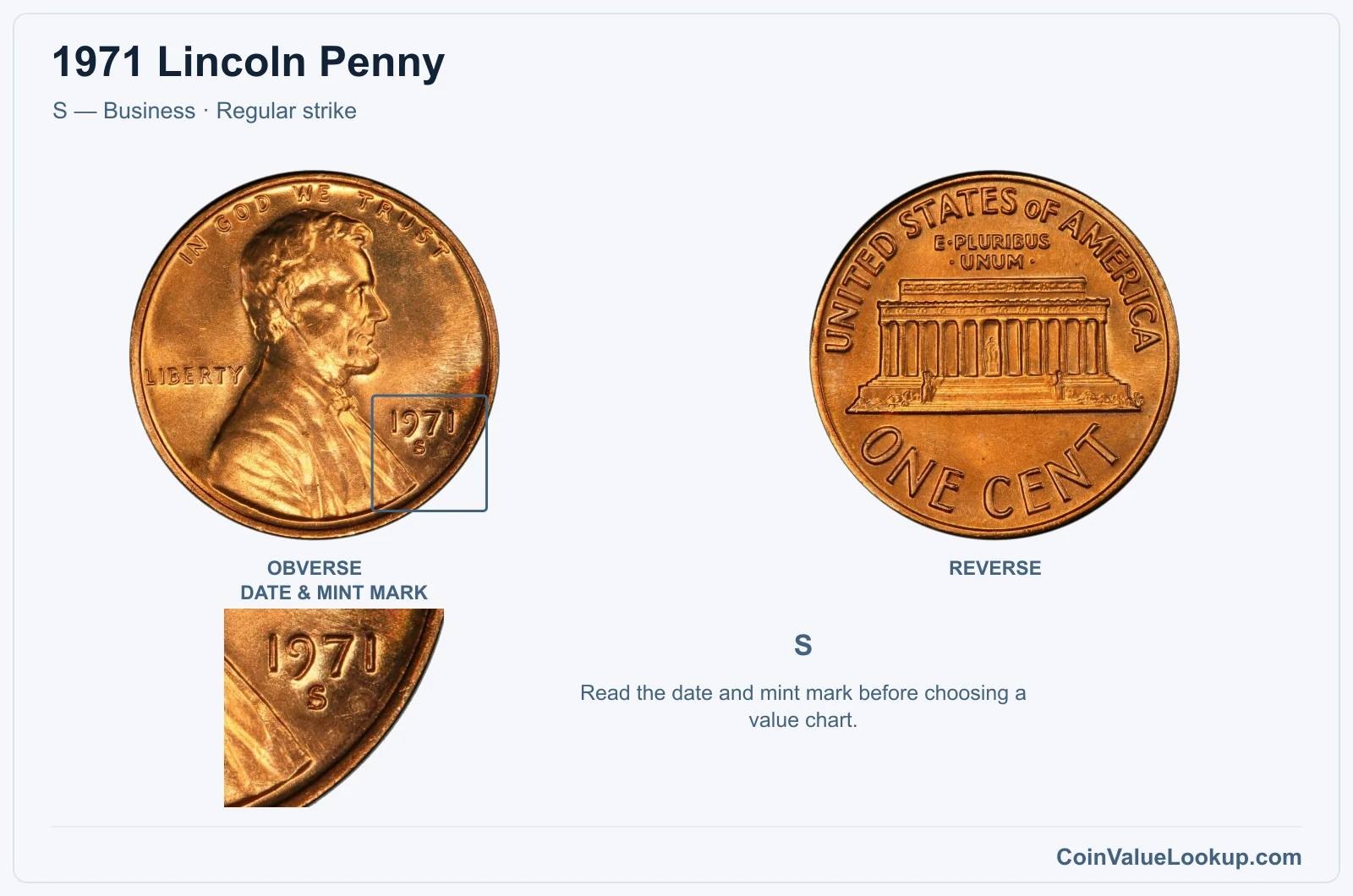
San Francisco also produced business-strike cents in 1971, marked with an S below the date. Do not confuse these with S proofs — business strikes have ordinary satin or cartwheel luster, not mirror fields.
The guide estimate at MS65 is $1.24 per USA Coin Book. Circulated S business strikes are not scarce.
Confirm the finish before pricing, because proof and business values follow completely different tracks even though both carry the S mintmark.
Range Grade
Price1971 S — Business (BN) Price1971 S — Business (RB) Price1971 S — Business (RD) Auction Records Appraisal PO PO 1
—
Coin Identifier FR FR 2
—
Coin Identifier AG AG 3
—
Coin Identifier G G 4
—
Coin Identifier
G 6
—
Coin Identifier VG VG 8
—
Coin Identifier
VG 10
—
Coin Identifier F F 12
—
Coin Identifier
F 15
—
Coin Identifier VF VF 20
—
Coin Identifier
VF 25
—
Coin Identifier
VF 30
—
Coin Identifier
VF 35
—
Coin Identifier XF XF 40
—
Coin Identifier
XF 45
—
Coin Identifier AU AU 50
—
Coin Identifier
AU 53
—
Coin Identifier
AU 55
—
Coin Identifier
AU 58
—
Coin Identifier MS MS 60
—
—
Coin Identifier
MS 61
—
—
Coin Identifier
MS 62
—
Coin Identifier
MS 63
Coin Identifier
MS 64
Coin Identifier
MS 65
Coin Identifier
MS 66
—
Coin Identifier
MS 67
—
—
Coin Identifier
MS 68
—
—
—
—
—
MS 69
—
—
—
—
—
MS 70
—
—
—
—
—
1971 Lincoln Penny — S — Proof
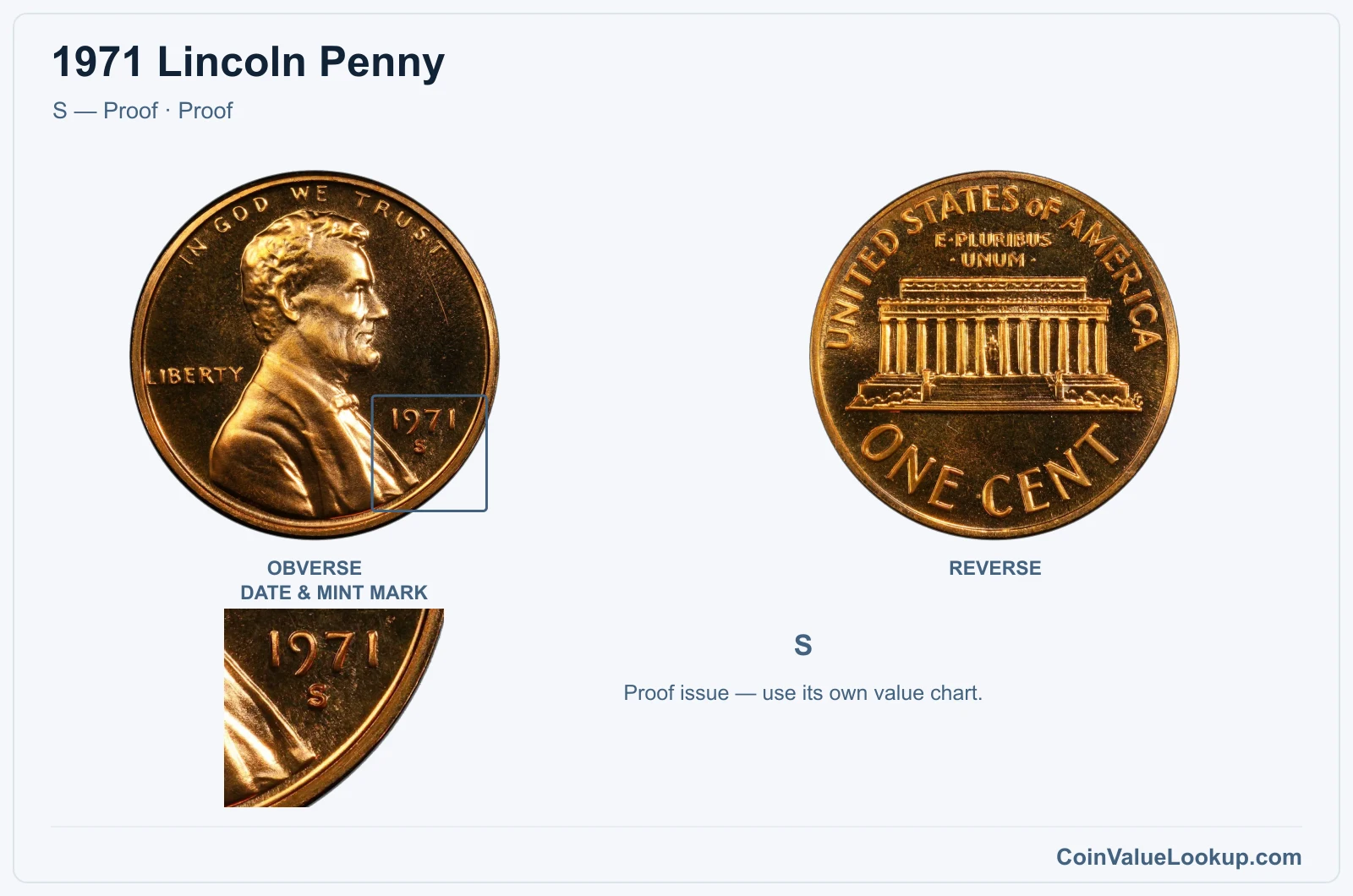
The 1971-S proof penny was struck at San Francisco for collectors, featuring mirror-like fields and crisp device edges. It carries an S mintmark but should never be confused with the S business strike.
A PR65 guide estimate from USA Coin Book is $1.24. Surface hairlines are the main enemy of proof grades — even light handling can knock a coin down several points.
Cameo contrast, where frosted devices stand against mirror fields, is a separate designation that can add value. Always check copper color as well; a proof can be Red, Red-Brown or Brown.
Range Grade
Price1971 S — Proof (CAM) Price1971 S — Proof (DCAM) Auction Records Appraisal PR PR 1
—
Coin Identifier
PR 2
—
Coin Identifier
PR 3
—
Coin Identifier
PR 4
—
Coin Identifier
PR 6
—
Coin Identifier
PR 8
—
Coin Identifier
PR 10
—
Coin Identifier
PR 12
—
Coin Identifier
PR 15
—
Coin Identifier
PR 20
—
Coin Identifier
PR 25
—
Coin Identifier
PR 30
—
Coin Identifier
PR 35
—
Coin Identifier
PR 40
—
Coin Identifier
PR 45
—
Coin Identifier
PR 50
—
Coin Identifier
PR 53
—
Coin Identifier
PR 55
—
Coin Identifier
PR 58
—
Coin Identifier
PR 60
Coin Identifier
PR 61
—
Coin Identifier
PR 62
—
Coin Identifier
PR 63
—
Coin Identifier
PR 64
Coin Identifier
PR 65
Coin Identifier
PR 66
Coin Identifier
PR 67
Coin Identifier
PR 68
Coin Identifier
PR 69
Coin Identifier
PR 70
—
—
—
—
1971 Lincoln Penny — No Mint Mark — Doubled Die Obverse
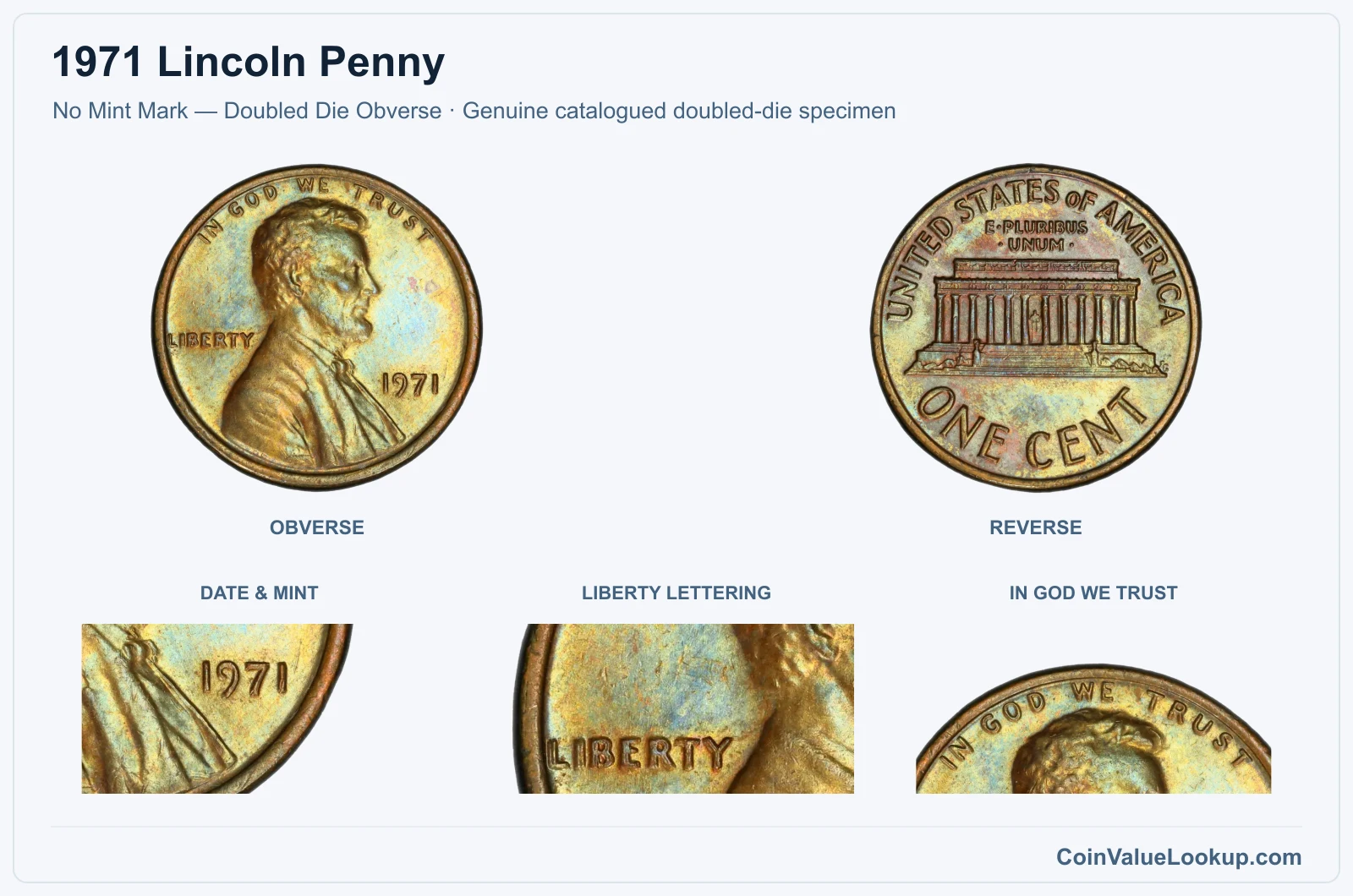
This is the one that gets collectors reaching for a loupe. The 1971 no-mintmark doubled die obverse shows the strongest evidence of die doubling on LIBERTY and IN GOD WE TRUST.
Under magnification you should see rounded secondary relief and split letter corners — not the flat, shelf-like distortion of machine doubling.
There is no single adopted price range for this variety because value depends heavily on authenticated die identity, copper color and condition. A coin certified by a major grading service as the recognized doubled die will command far more than a raw, unattributed example.
If you suspect yours is a match, professional authentication is the path forward.
Coin Value Lookup is a good starting point if you want to compare your coin against other Lincoln cent guides before deciding on next steps.
Range Grade
Price1971 No Mint Mark — Doubled Die Obverse (BN) Price1971 No Mint Mark — Doubled Die Obverse (RB) Price1971 No Mint Mark — Doubled Die Obverse (RD) Auction Records Appraisal PO PO 1
—
Coin Identifier FR FR 2
—
Coin Identifier AG AG 3
—
Coin Identifier G G 4
—
Coin Identifier
G 6
—
Coin Identifier VG VG 8
—
Coin Identifier
VG 10
—
Coin Identifier F F 12
—
Coin Identifier
F 15
—
Coin Identifier VF VF 20
—
Coin Identifier
VF 25
—
Coin Identifier
VF 30
—
Coin Identifier
VF 35
—
Coin Identifier XF XF 40
—
Coin Identifier
XF 45
—
Coin Identifier AU AU 50
Coin Identifier
AU 53
Coin Identifier
AU 55
Coin Identifier
AU 58
Coin Identifier MS MS 60
—
Coin Identifier
MS 61
—
Coin Identifier
MS 62
Coin Identifier
MS 63
Coin Identifier
MS 64
Coin Identifier
MS 65
Coin Identifier
MS 66
—
—
Coin Identifier
MS 67
—
—
—
—
—
MS 68
—
—
—
—
—
MS 69
—
—
—
—
—
MS 70
—
—
—
—
—
1971 Lincoln Penny — S — Proof Doubled Die Obverse
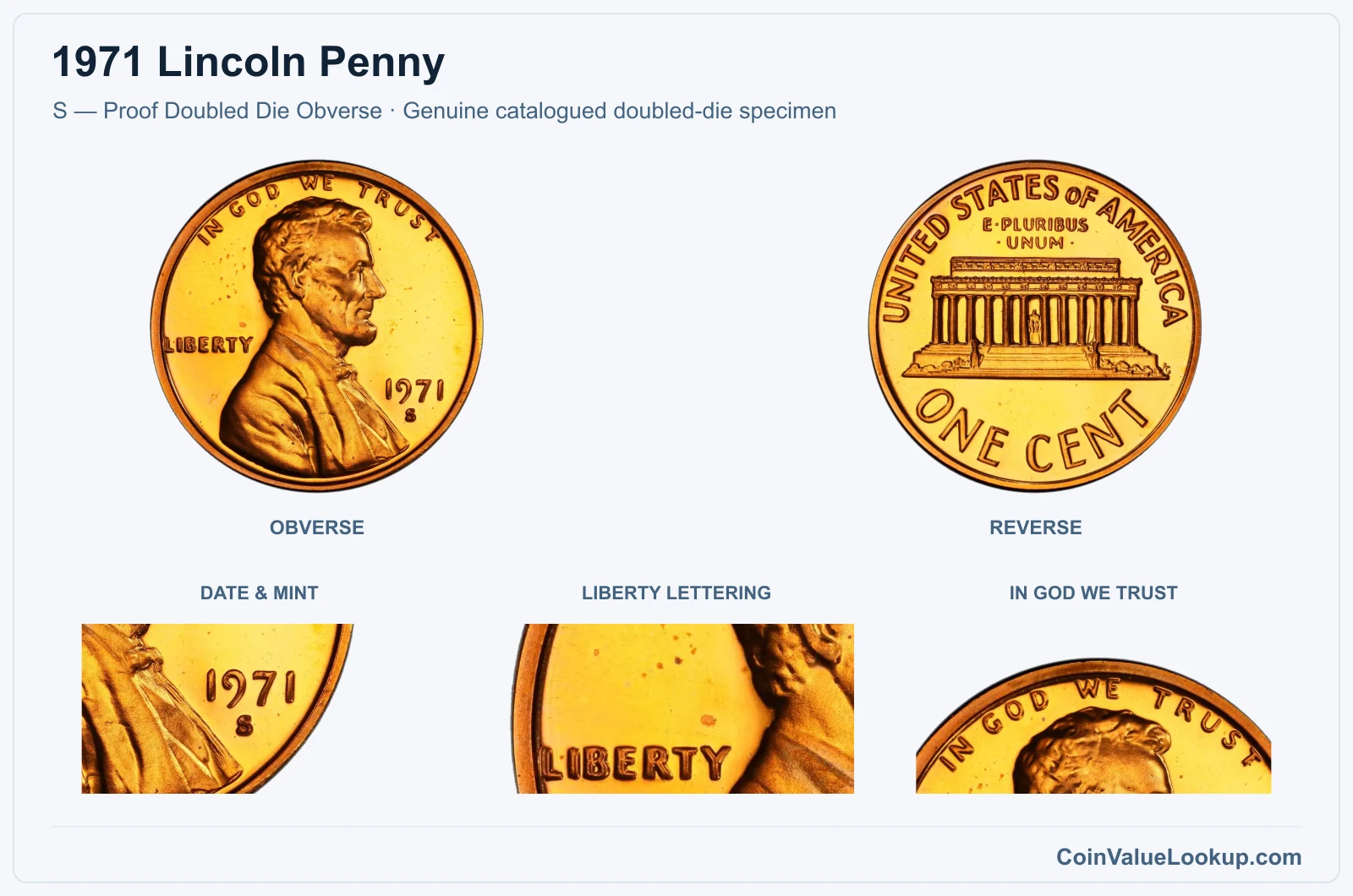
Several proof obverse doubled dies exist for the 1971-S cent, and they are not all the same die. The reference branch illustrated in collector databases typically shows doubling on the motto and LIBERTY without a doubled date.
That distinction matters — exact die identification is required before any price comparison applies.
No universal price range is adopted here because the specific die, surface quality, cameo contrast and copper color all influence what a given coin brings. Confirm proof finish first: mirror fields, sharp rims and an S mintmark.
Then use magnification to check for rounded secondary contours on the motto lettering. Machine doubling on proofs can mimic a doubled die to the naked eye, so careful examination under magnification is essential.
Professional attribution is strongly recommended.
Ordinary-issue reference: Ordinary-issue reference only: The table below shows prices for the 1971-S Lincoln Cent (Modern) (proof). It does not represent the value of the specific S — Proof Doubled Die Obverse variety or its variety premium. Year, mint, metal and strike type are matched; the specific variety is not priced by this table.
Range Grade
Price1971-S Lincoln Cent (Modern) — Ordinary-Issue Reference (Proof) (CAM) Price1971-S Lincoln Cent (Modern) — Ordinary-Issue Reference (Proof) (DCAM) Auction Records Appraisal PR PR 1
—
Coin Identifier
PR 2
—
Coin Identifier
PR 3
—
Coin Identifier
PR 4
—
Coin Identifier
PR 6
—
Coin Identifier
PR 8
—
Coin Identifier
PR 10
—
Coin Identifier
PR 12
—
Coin Identifier
PR 15
—
Coin Identifier
PR 20
—
Coin Identifier
PR 25
—
Coin Identifier
PR 30
—
Coin Identifier
PR 35
—
Coin Identifier
PR 40
—
Coin Identifier
PR 45
—
Coin Identifier
PR 50
—
Coin Identifier
PR 53
—
Coin Identifier
PR 55
—
Coin Identifier
PR 58
—
Coin Identifier
PR 60
Coin Identifier
PR 61
—
Coin Identifier
PR 62
—
Coin Identifier
PR 63
—
Coin Identifier
PR 64
Coin Identifier
PR 65
Coin Identifier
PR 66
Coin Identifier
PR 67
Coin Identifier
PR 68
Coin Identifier
PR 69
Coin Identifier
PR 70
—
—
—
—
1971 Lincoln Penny Error List
1. 1971 Lincoln Penny — Doubled Die Obverse
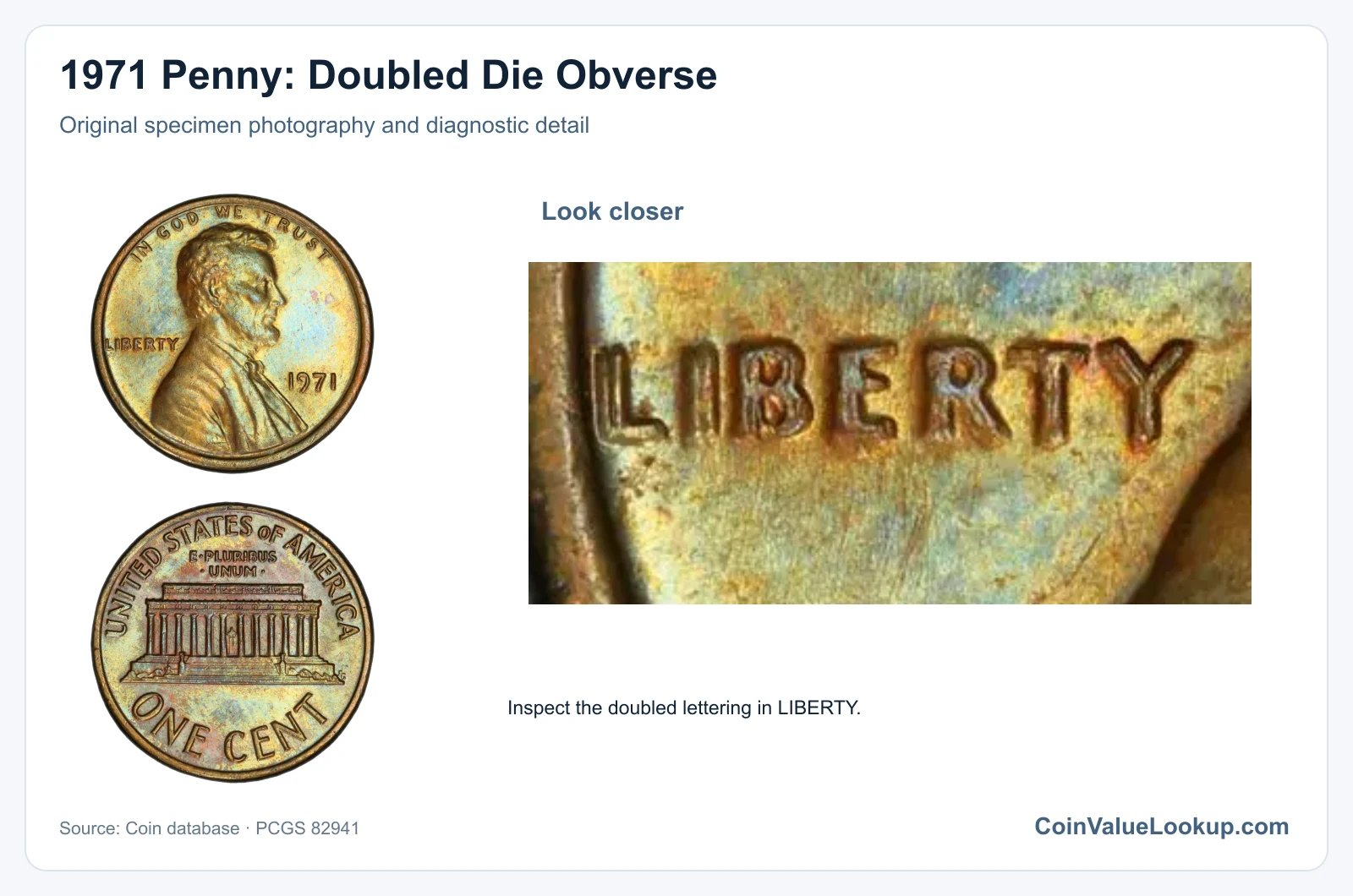
The 1971 no-mintmark doubled die obverse is one of the more recognized Lincoln cent varieties. Under magnification, look at LIBERTY and IN GOD WE TRUST for rounded secondary letter outlines and split corners on individual characters.
The doubling has a three-dimensional quality — raised, rounded extra profiles sitting beside the primary letters.
Do not confuse this with machine doubling, which produces flat, shelf-like distortion with no independent rounded relief. Minor doubled dies from other die pairs also exist but are not the same variety.
No single price range is adopted because value depends on the authenticated die match, the coin's grade and its copper-color designation. A certified example from a major grading service will carry far more confidence — and typically more value — than an unattributed raw coin.
Individual assessment is the right approach here.
2. 1971 Lincoln Penny — Proof Doubled Die Obverse
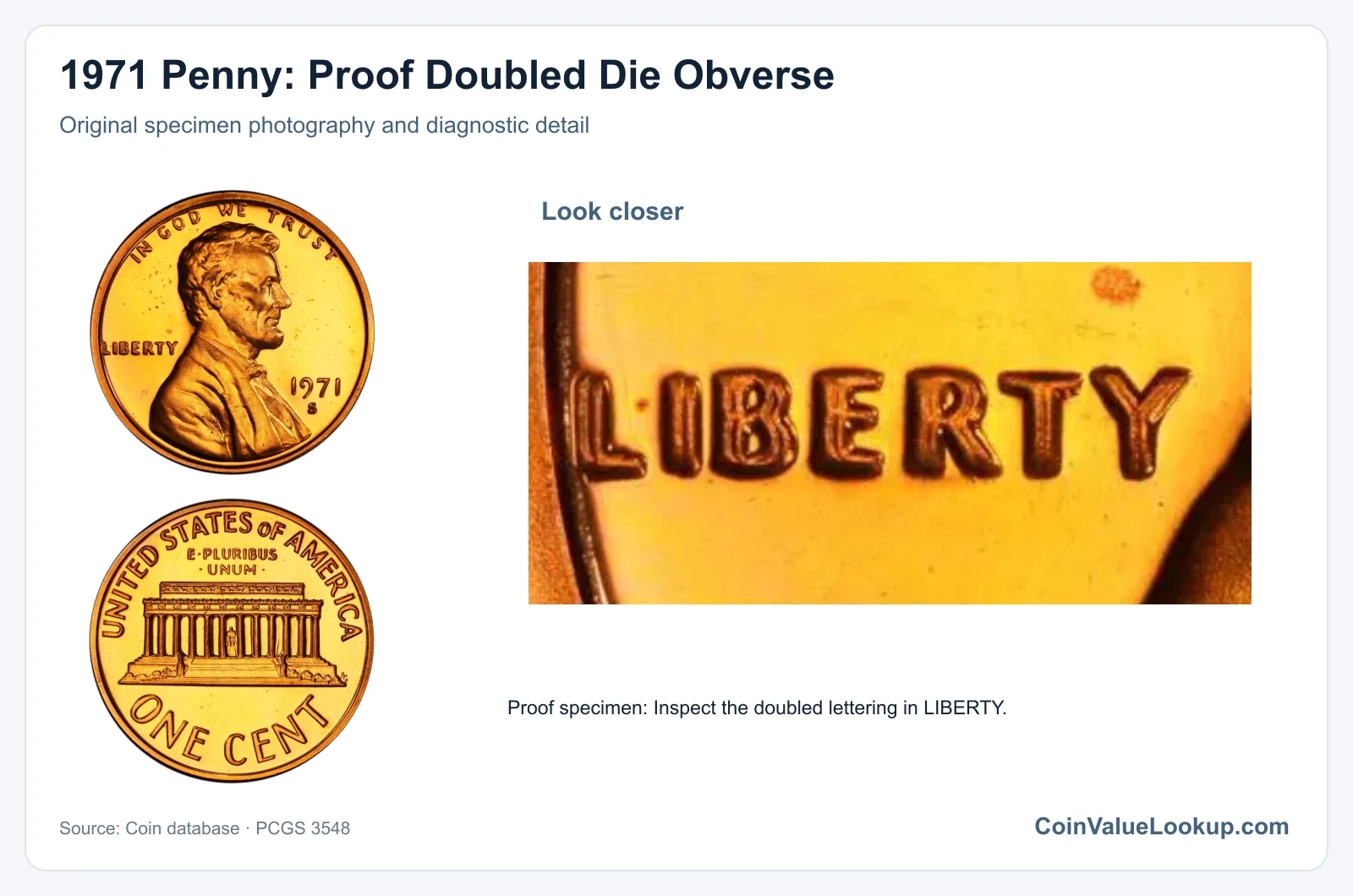
The 1971-S proof doubled die obverse is a proof-only variety — it is not the same die as the no-mintmark business-strike doubled die. On the illustrated branch, doubling appears in the motto and LIBERTY without affecting the date numerals.
That specific combination is the identifier.
Confirm proof finish before anything else: mirror fields, sharp squared rims, S mintmark. Then magnify the motto lettering and look for secondary contours with rounded relief.
Machine doubling on proofs can look convincing at a glance but lacks that independent rounded profile.
No supported price range is adopted. Value depends on the exact die, surface preservation, cameo contrast and color.
Because multiple proof doubled dies exist for this date, precise attribution by a professional grading service is the safest route to an accurate identification and market comparison.
3. 1971 Lincoln Penny — Double Strike on a Dime Blank
This is a compound error: a 1971-D cent struck on a clad dime blank, then hit a second time roughly 95% off center. The result is an undersized planchet — noticeably smaller and lighter than a normal cent — with a tiny second shoulder impression and a reverse indent.
The clad composition of the dime blank is visibly different from the copper-zinc cent alloy. Do not confuse this with simple plating or a solely doubled die; the blank itself is wrong for a cent.
A PCGS MS62 example sold at Heritage Auctions for $862.50 in September 2004. That reflects the combined rarity of two errors on one coin.
A single auction result is not a market range, but it gives a reference point for how these compound errors can trade.
4. 1971 Lincoln Penny — Struck on a Split Planchet
A 1971-D cent struck on a split planchet starts as a blank that cracked apart before the dies hit it. The result weighs roughly 1.6 grams — about half the normal 3.11 grams — and the coin appears thin with weak central detail and exposed internal metal texture on one side.
The source example shows complete design despite an eccentric shape, consistent with an uncentered broadstrike rather than off-center design loss. Do not confuse a split planchet with a coin that was ground down, acid-etched or otherwise altered after leaving the mint.
An NGC example without a numerical grade assigned sold for $59 at Heritage Auctions in June 2023. That single sale is a reference point, not a guaranteed value for every split-planchet 1971-D cent.
5. 1971 Lincoln Penny — Double Strike on a Curved Clipped Blank
This compound error combines a curved clipped planchet with a double strike on a 1971-S business cent. You should see the original curved clip — a crescent-shaped missing section of the blank — alongside overlapping design impressions from two separate strikes.
The clip proves the blank was incomplete before striking, and the double strike adds a second layer of displaced design. Together they create a visually dramatic coin.
Do not mistake a mechanically cut coin or proof manufacturing artifact for this kind of mint error.
An NGC MS62 Brown example sold for $372 at Heritage Auctions in November 2020. That is one recorded sale of one specific coin, so treat it as a reference point rather than a fixed market price.
6. 1971 Lincoln Penny — Obverse Die Cap
An obverse die cap occurs when a struck coin sticks to the upper die and is not ejected. Subsequent strikes press new blanks against the stuck coin, gradually cupping it into a cap shape.
The coin that became the cap shows a normal obverse but a distorted, spread reverse with incuse mirror-image transfer from the coins struck beneath it.
Distinguish a genuine die cap from a coin that was simply bent, squeezed in a vise or weakly struck. A real cap has progressive cupping and transferred design elements that post-mint damage cannot replicate.
Check both sides carefully.
No numerical price range is adopted for this error on the 1971 cent. Value depends on how dramatic the cap formation is, overall condition and collector demand.
Professional evaluation is recommended.
7. 1971 Lincoln Penny — Struck-Through Error
A struck-through error happens when foreign material — grease, a metal fragment, cloth fiber or debris — sits between the die and the planchet during striking. The result is a localized depression or incomplete design area on the finished coin, sometimes preserving the texture or outline of whatever was trapped.
On the 1971-D cent, a reverse struck-through has been reported. Grease fill-ins tend to produce smooth, slightly sunken areas, while retained foreign objects can leave sharper impressions.
Keep those categories distinct when describing what you see.
Do not confuse a struck-through with normal wear, post-mint scratches, cleaning damage or weak strike from worn dies. Genuine struck-throughs show a consistent depth and often sharp boundaries.
No numerical price range is adopted; value depends on visibility, size of the affected area and overall coin condition.