1899 Indian Head Penny Coin Value: How Much Is It Worth?
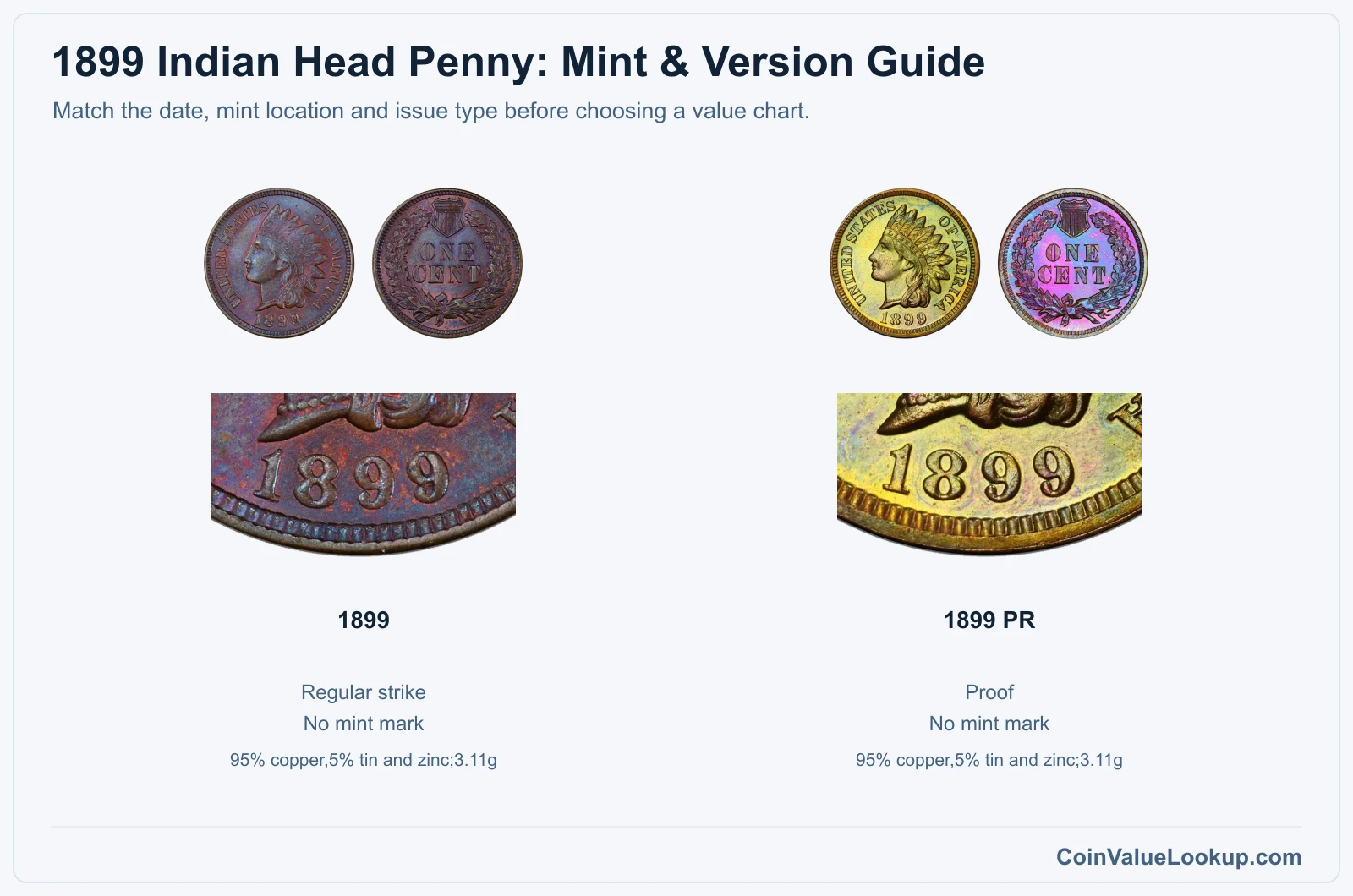
The 1899 Indian Head penny is a Philadelphia-only issue that turns up regularly in old collections and junk boxes. Guide estimates for the standard business strike range from about $3.62 in G4 (a well-worn but readable coin) up to around $92 in MS63 (a sharply detailed, lightly handled example).
Proof coins carry their own pricing. Individual value depends on exact condition, original surfaces and whether the coin qualifies as a recognized variety or error.
Fast Way to Identify Your 1899 Indian Head Penny
The quickest way to get a preliminary read on your 1899 Indian Head penny is to upload clear photos of the front and back. Good lighting and a sharp image let our identifier compare your coin's features against known versions and point you in the right direction.
It is not a substitute for professional authentication, but it helps you figure out what you are holding.
1899 Indian Head Penny Value
Upload both sides of your 1899 Indian Head Penny.
Front Obverse
Upload photo
Back Reverse
Upload photo
Which 1899 Indian Head Penny Versions Are Worth Money?
- A business strike grading MS63 can reach about $92 according to USA Coin Book guide estimates; original surfaces and remaining copper color matter at this level.
- A proof example at PR63 is listed near $313 in the same guide, reflecting the much smaller number originally produced for collectors.
- Recognized die varieties such as repunched dates or misplaced dates require individual assessment but can add a premium when authenticated.
- Off-center strikes, brockages and other confirmed mint errors are scarce on this date and are valued individually by severity and condition.
Step 1: Identify Your 1899 Indian Head Penny Mint Mark and Version
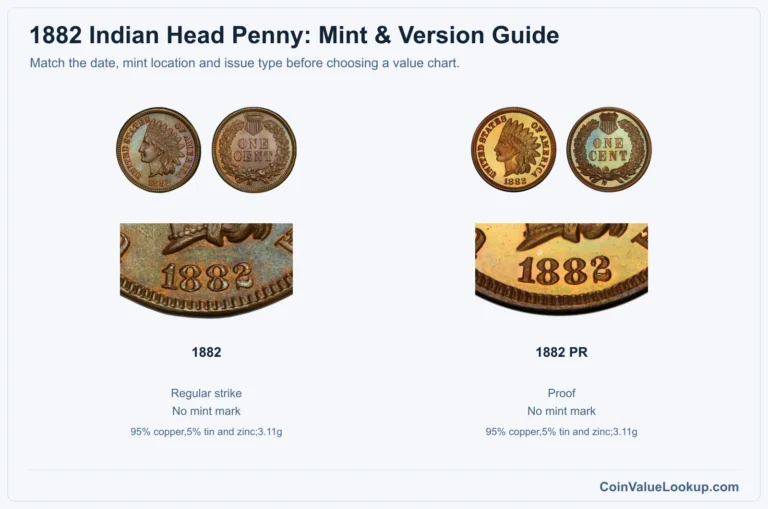
Every regular 1899 Indian Head cent was struck at the Philadelphia Mint. There is no mintmark to look for.
The small "L" you may notice on the ribbon behind the portrait is a designer's initial, not a mint indicator, so do not confuse it with a mintmark from another facility.
The obverse carries Liberty wearing a feathered headdress, and the reverse shows an oak wreath surrounding a shield and the words ONE CENT. If your coin has a wheat-ear reverse or a plain portrait of Lincoln, you have a different series entirely.
Two legitimate branches exist for this date: a standard business strike and a proof. Proofs were made in small numbers for collectors using specially prepared dies and planchets.
A business strike that has been polished to a mirror finish is not a proof. Genuine proofs show precise rim geometry, squared-off edges and a particular reflective quality from the die preparation itself.
Both versions share the same composition: 95% copper with 5% tin and zinc, weighing 3.11 grams. Bronze color designations such as BN (brown), RB (red-brown) and RD (red) describe how much original copper color remains, not different metals.
Step 2: Check Your 1899 Indian Head Penny Grade
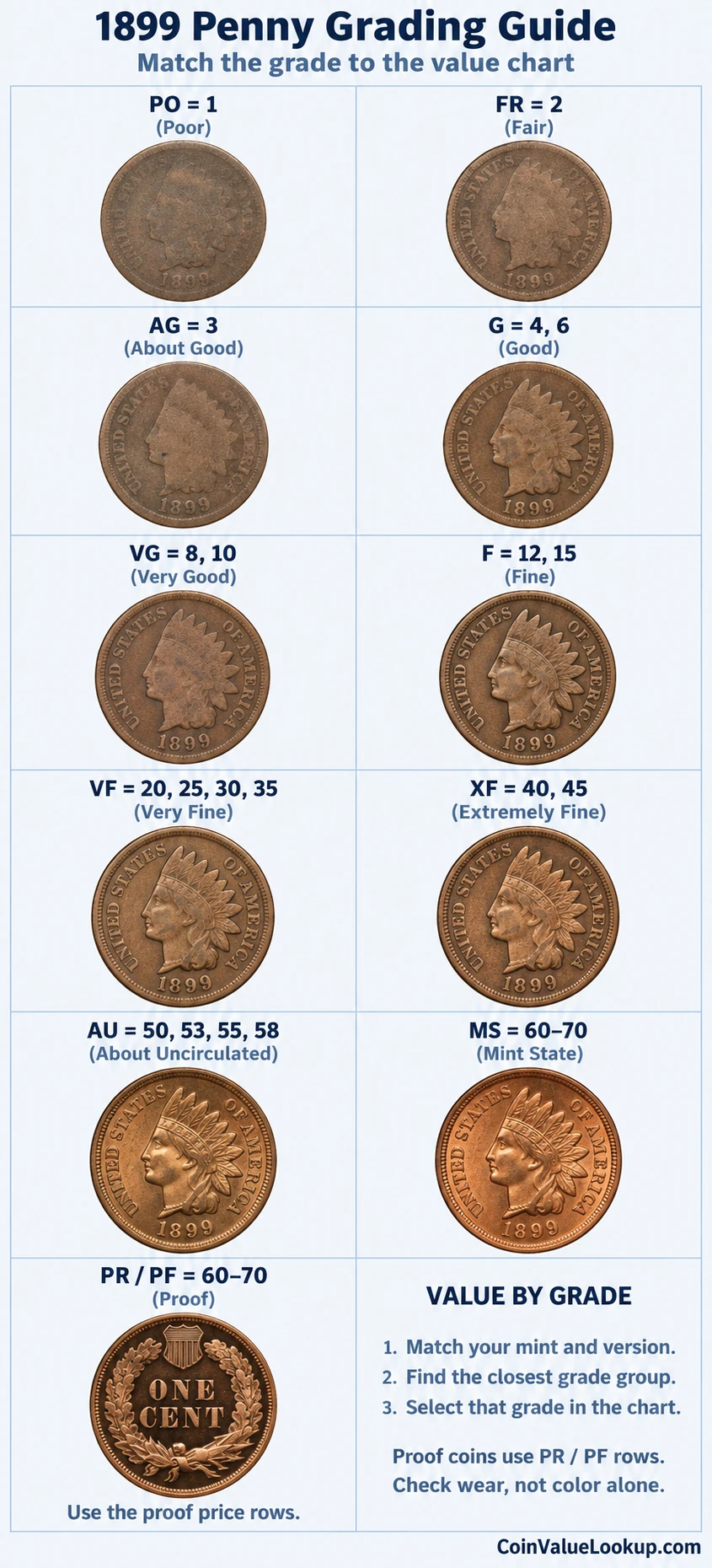
Start with the headband. The word LIBERTY is stamped into the band across the portrait's forehead.
On a well-worn coin, some or all letters merge into the band. At G4, the outline of the portrait is clear but LIBERTY is mostly gone.
By contrast, an MS63 coin retains full LIBERTY, sharp feather tips and original mint luster with only minor contact marks.
Check the feather details above the headband and the hair curls below the ear. These are high points that wear first.
A softly struck coin, however, can show weak feathers even without circulation, so look at the overall surface for luster breaks and friction before downgrading.
On the reverse, examine the leaf veins in the wreath and the shield lines. Flat, smooth leaves signal wear; crisp, separated veins point to a higher grade.
Use the comparison image to match your coin's wear pattern against known grade examples. Pay attention to color, too.
Original surfaces, even if brown, are preferred over a coin that has been cleaned or artificially brightened. Cleaning often leaves hairline scratches visible under magnification and can significantly reduce a coin's market appeal.
Step 3: Check 1899 Indian Head Penny Value by Mint and Version
1899 Indian Head Penny
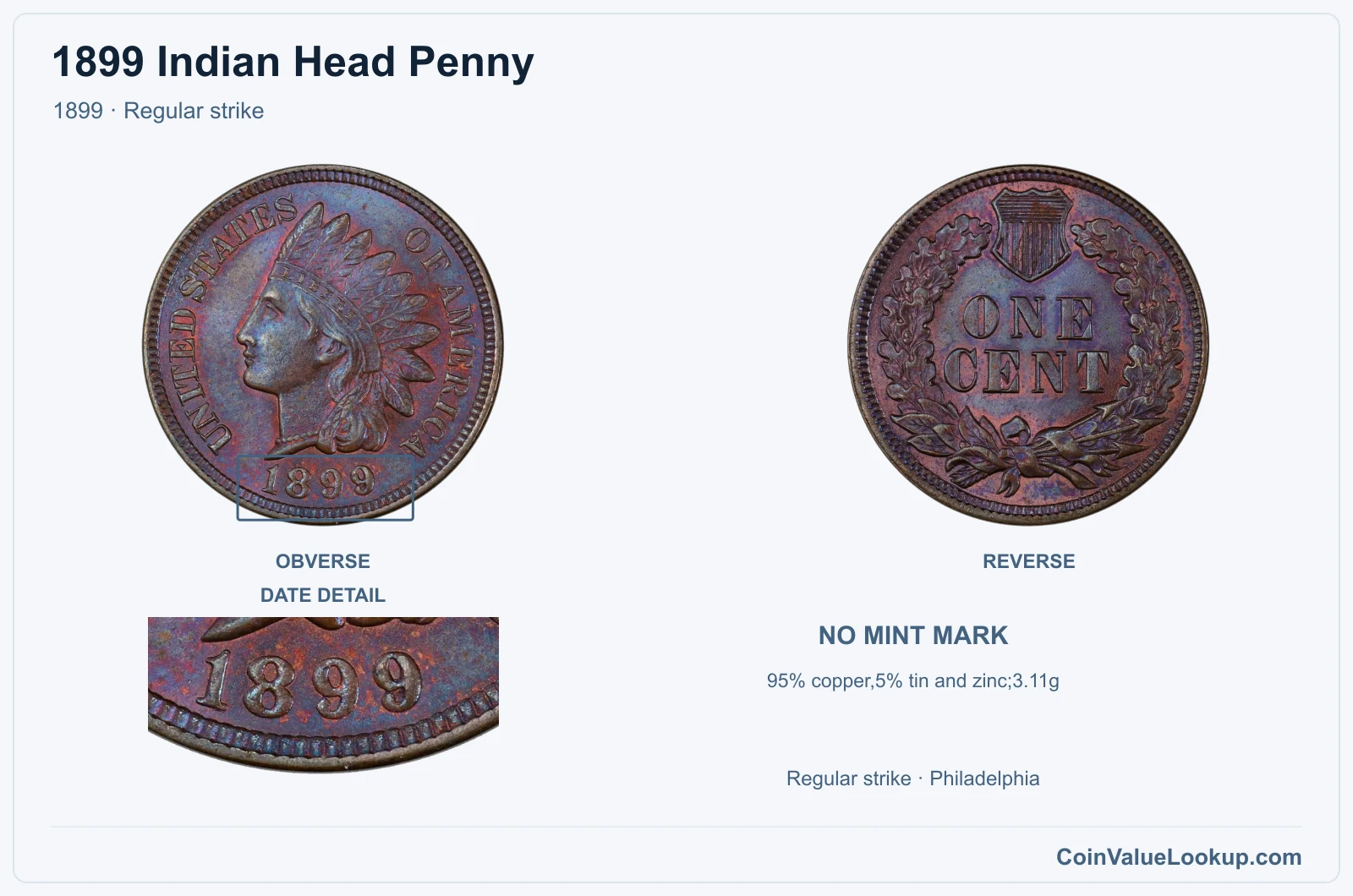
The 1899 business strike is the coin most people will find. It was produced at Philadelphia with no mintmark, struck on a bronze planchet weighing 3.11 grams.
The design pairs the Indian portrait obverse with the oak wreath and shield reverse used from 1860 onward.
USA Coin Book lists a guide estimate of roughly $3.62 at G4 and about $92 at MS63. That is a big spread, and most of it comes down to surface preservation and remaining luster.
A coin with original red-brown or full red color at the uncirculated level will generally outperform a dull brown example at the same technical grade. Cleaned or damaged coins trade below these guide figures regardless of how sharp the details look.
Coin Value Lookup is a good starting point if you want to compare this date against other Indian Head cents or check values across different series.
| Range | Grade | Price | Auction Records | Appraisal |
|---|---|---|---|---|
| PO | PO 1 | — | Coin Identifier | |
| FR | FR 2 | — | Coin Identifier | |
| AG | AG 3 | — | Coin Identifier | |
| G | G 4 | — | Coin Identifier | |
| G 6 | Coin Identifier | |||
| VG | VG 8 | — | Coin Identifier | |
| VG 10 | — | Coin Identifier | ||
| F | F 12 | — | Coin Identifier | |
| F 15 | Coin Identifier | |||
| VF | VF 20 | — | Coin Identifier | |
| VF 25 | — | Coin Identifier | ||
| VF 30 | — | Coin Identifier | ||
| VF 35 | — | Coin Identifier | ||
| XF | XF 40 | — | Coin Identifier | |
| XF 45 | Coin Identifier | |||
| AU | AU 50 | Coin Identifier | ||
| AU 53 | — | Coin Identifier | ||
| AU 55 | — | Coin Identifier | ||
| AU 58 | Coin Identifier | |||
| MS | MS 60 | — | Coin Identifier | |
| MS 61 | Coin Identifier | |||
| MS 62 | Coin Identifier | |||
| MS 63 | Coin Identifier | |||
| MS 64 | Coin Identifier | |||
| MS 65 | Coin Identifier | |||
| MS 66 | Coin Identifier | |||
| MS 67 | — | — | — | |
| MS 68 | — | — | — | |
| MS 69 | — | — | — | |
| MS 70 | — | — | — |
1899 Indian Head Penny — PR
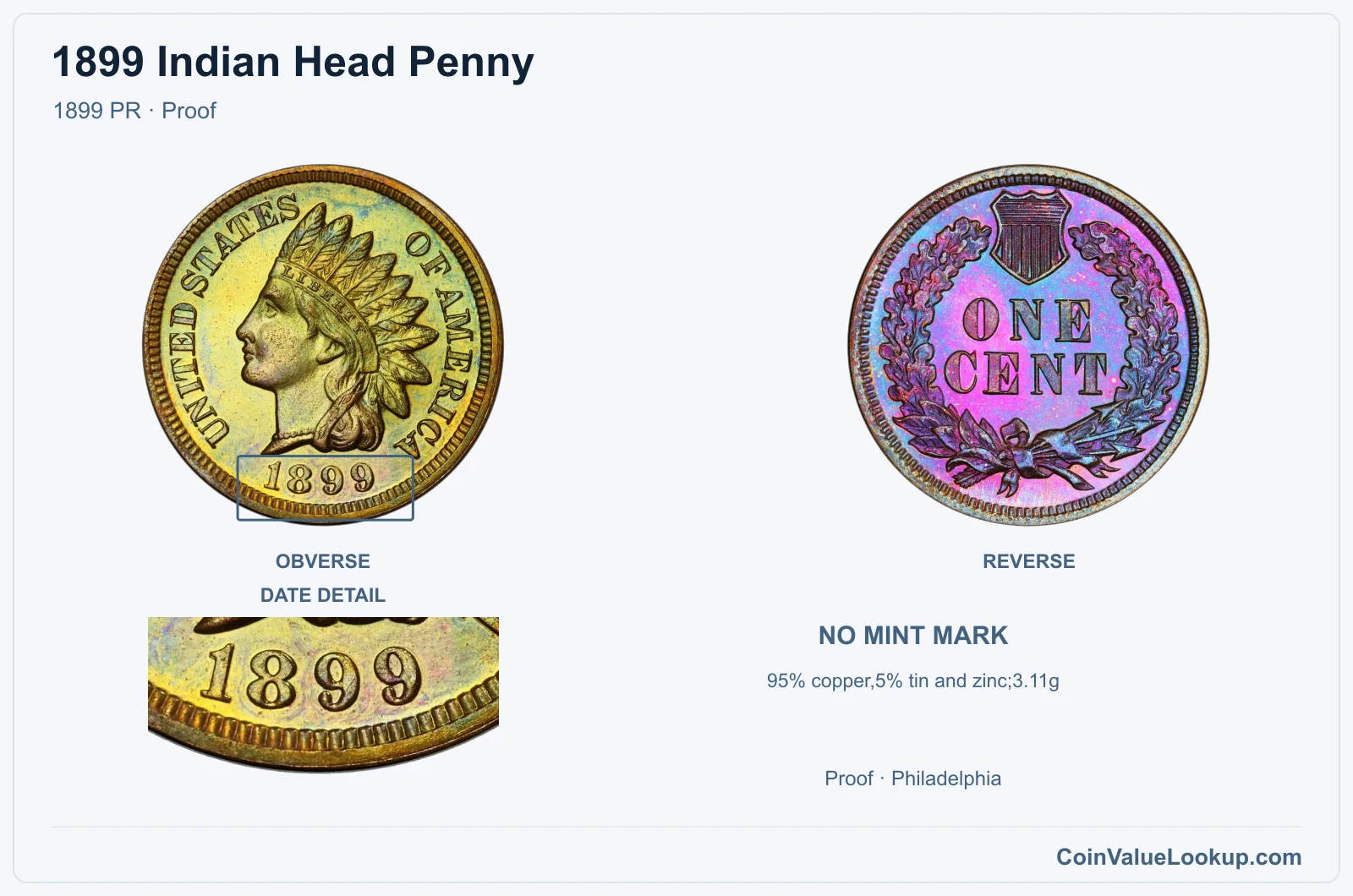
The 1899 proof was a limited-production collector piece struck at Philadelphia on the same bronze composition as the business issue. Proof Indian cents were made with polished dies and carefully prepared planchets, producing sharp detail and reflective fields that differ from even the best uncirculated business strikes.
At PR63, the USA Coin Book guide estimate is around $313. Condition and eye appeal matter enormously with proofs.
Hairlines from mishandling or old cleaning can push a coin below this threshold even if it technically grades PR63.
To confirm proof status, look for squared, knife-like rims, full mirror fields and a level of detail that a standard strike simply does not achieve. A shiny business strike that someone buffed on a cloth is not a proof, no matter how reflective it appears.
When in doubt, professional third-party certification is the safest route before assigning proof value.
| Range | Grade | Price | Auction Records | Appraisal |
|---|---|---|---|---|
| PR | PR 1 | — | Coin Identifier | |
| PR 2 | — | Coin Identifier | ||
| PR 3 | — | Coin Identifier | ||
| PR 4 | — | Coin Identifier | ||
| PR 6 | — | Coin Identifier | ||
| PR 8 | — | Coin Identifier | ||
| PR 10 | — | Coin Identifier | ||
| PR 12 | — | Coin Identifier | ||
| PR 15 | — | Coin Identifier | ||
| PR 20 | — | Coin Identifier | ||
| PR 25 | — | Coin Identifier | ||
| PR 30 | — | Coin Identifier | ||
| PR 35 | — | Coin Identifier | ||
| PR 40 | — | Coin Identifier | ||
| PR 45 | — | Coin Identifier | ||
| PR 50 | — | Coin Identifier | ||
| PR 53 | — | Coin Identifier | ||
| PR 55 | — | Coin Identifier | ||
| PR 58 | — | Coin Identifier | ||
| PR 60 | — | Coin Identifier | ||
| PR 61 | — | Coin Identifier | ||
| PR 62 | Coin Identifier | |||
| PR 63 | — | Coin Identifier | ||
| PR 64 | Coin Identifier | |||
| PR 65 | Coin Identifier | |||
| PR 66 | Coin Identifier | |||
| PR 67 | — | — | — | |
| PR 68 | — | — | — | |
| PR 69 | — | — | — | |
| PR 70 | — | — | — |
1899 Indian Head Penny Error List
1. 1899 Indian Head Penny — Repunched Date
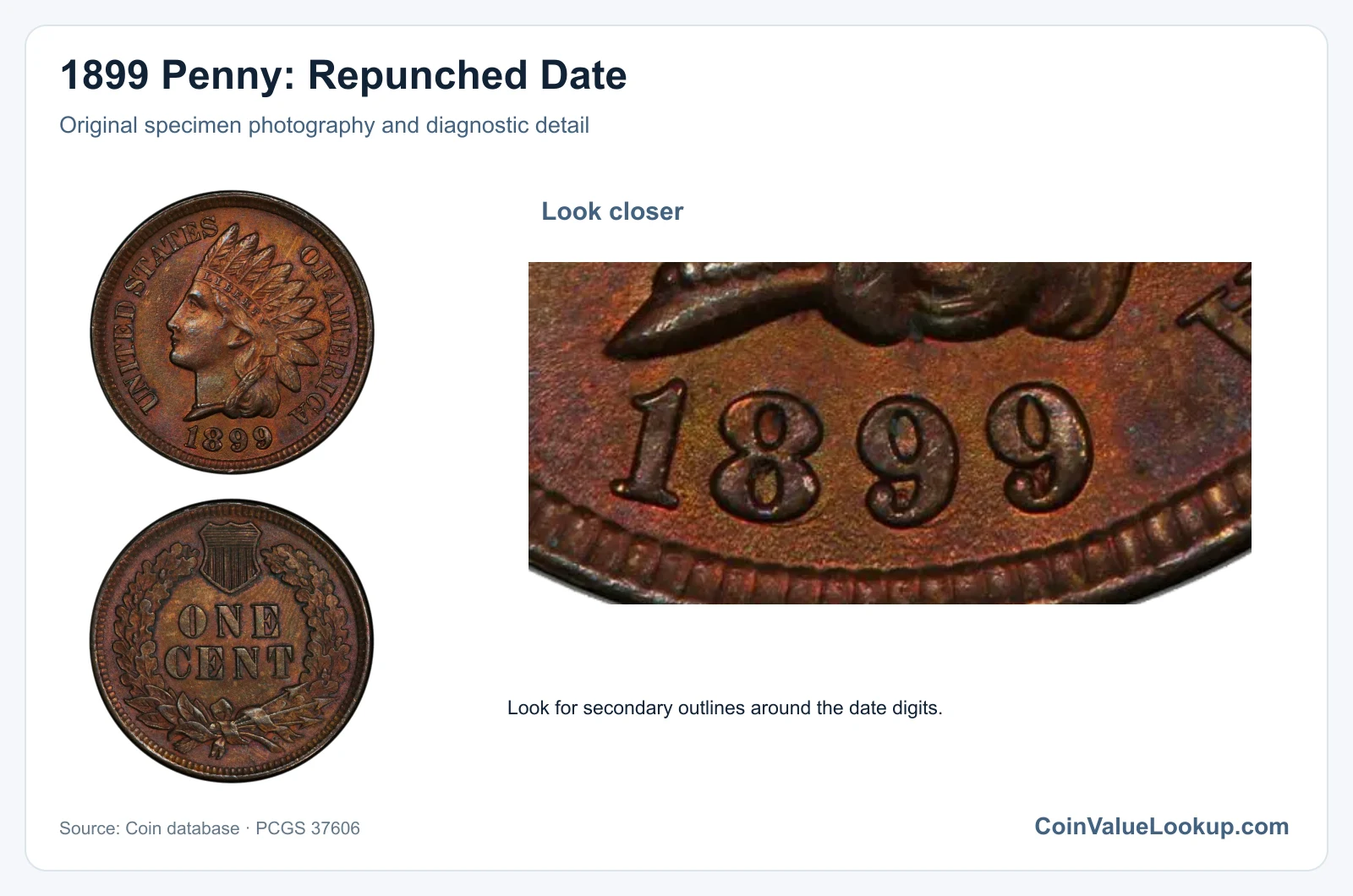
A repunched date on an 1899 Indian cent shows remnants of an earlier position of one or more date digits alongside the final placement. You are looking for ghosting, extra serifs or partial outlines near the base or top of the numerals, especially the two 9s where overlap is easiest to spot.
This is a die variety, not a striking error. The date punch was applied to the die more than once in slightly different positions.
It differs from doubled-die varieties, which involve the entire hub impression rather than just the date.
Do not confuse a damaged or corroded date with a repunched one. Post-mint scratches and machine doubling produce flat, shelf-like displacement rather than the rounded, raised secondary image of a genuine repunch.
Authenticated examples are valued individually based on the clarity of the repunching, the coin's grade and overall demand. There is no fixed price range for this category.
2. 1899 Indian Head Penny — Misplaced Date
A misplaced date occurs when a partial digit from the date punch appears in an unexpected location, typically embedded in the denticles along the rim or partly hidden within the portrait's neck area. On the 1899 cent, look carefully in those zones for the curved top of an 8 or the loop of a 9 where no design element should exist.
These partial impressions are easy to dismiss as random lumps. The key distinction is that they replicate the exact shape and proportions of a date numeral.
Die chips, corrosion spots and scratches lack that precise geometry.
Compare any suspect feature with a known reference photograph of the same variety when possible. Value depends on how visible the misplaced digit is, the coin's condition and collector interest.
No standard price range is established for this category; each coin requires individual assessment, ideally with third-party authentication.
3. 1899 Indian Head Penny — Die Crack
Die cracks appear as raised lines on the coin's surface, running across the field, through lettering or along design elements. They result from stress fractures in the steel die during production.
On an 1899 Indian cent, you might find them anywhere, from the rim through LIBERTY to the wreath on the reverse.
The line will be raised above the surrounding surface, which is the key difference from a scratch. Scratches are incuse, meaning they cut into the metal.
A die crack also follows a path that makes sense for a fracture, often arcing or branching rather than running in a perfectly straight line.
Corrosion streaks and displaced-metal scrapes can also mimic cracks at first glance. Check with magnification.
Pricing is individual, based on the prominence and location of the crack, the coin's overall grade and collector preference.
4. 1899 Indian Head Penny — Die Chip
A die chip shows up as a small raised lump on the coin, usually filling part of a letter, numeral or nearby open field. It happens when a tiny piece of the die surface breaks away, leaving a void that fills with metal during striking.
On an 1899 Indian cent, common spots include inside the loops of letters like O, C or E in ONE CENT, or within the curves of the date digits. The surrounding struck detail will flow smoothly into the raised area, which helps distinguish it from post-mint damage.
Glued debris, gouges and displaced-metal impacts can look similar but lack that seamless transition from normal design into the raised feature. Value for die chips varies widely.
A tiny chip inside a letter adds modest interest; a large, dramatic chip in a prominent location draws more attention. Each example needs individual assessment.
5. 1899 Indian Head Penny — Die Gouge / Named Raised-Line Variety
A die gouge produces a raised line or extra-metal feature on the coin where the die surface was scratched or damaged during production or maintenance. Unlike a die crack, which follows a fracture path, a gouge tends to appear as a short, deliberate-looking mark, sometimes with a distinct beginning and end.
On the 1899 Indian cent, these can appear on either side. Note the exact position relative to nearby design elements and compare with a normal example to confirm the feature is die-made rather than post-strike damage.
Incuse scratches on the coin's surface are the most common lookalike. The difference is relief: a genuine die gouge is raised, while a scratch is sunk into the metal.
Unrelated die cracks can also be confused with gouges, but cracks typically run longer and follow a fracture pattern. Pricing depends on prominence and collector interest, assessed individually.
6. 1899 Indian Head Penny — Off-Center Strike
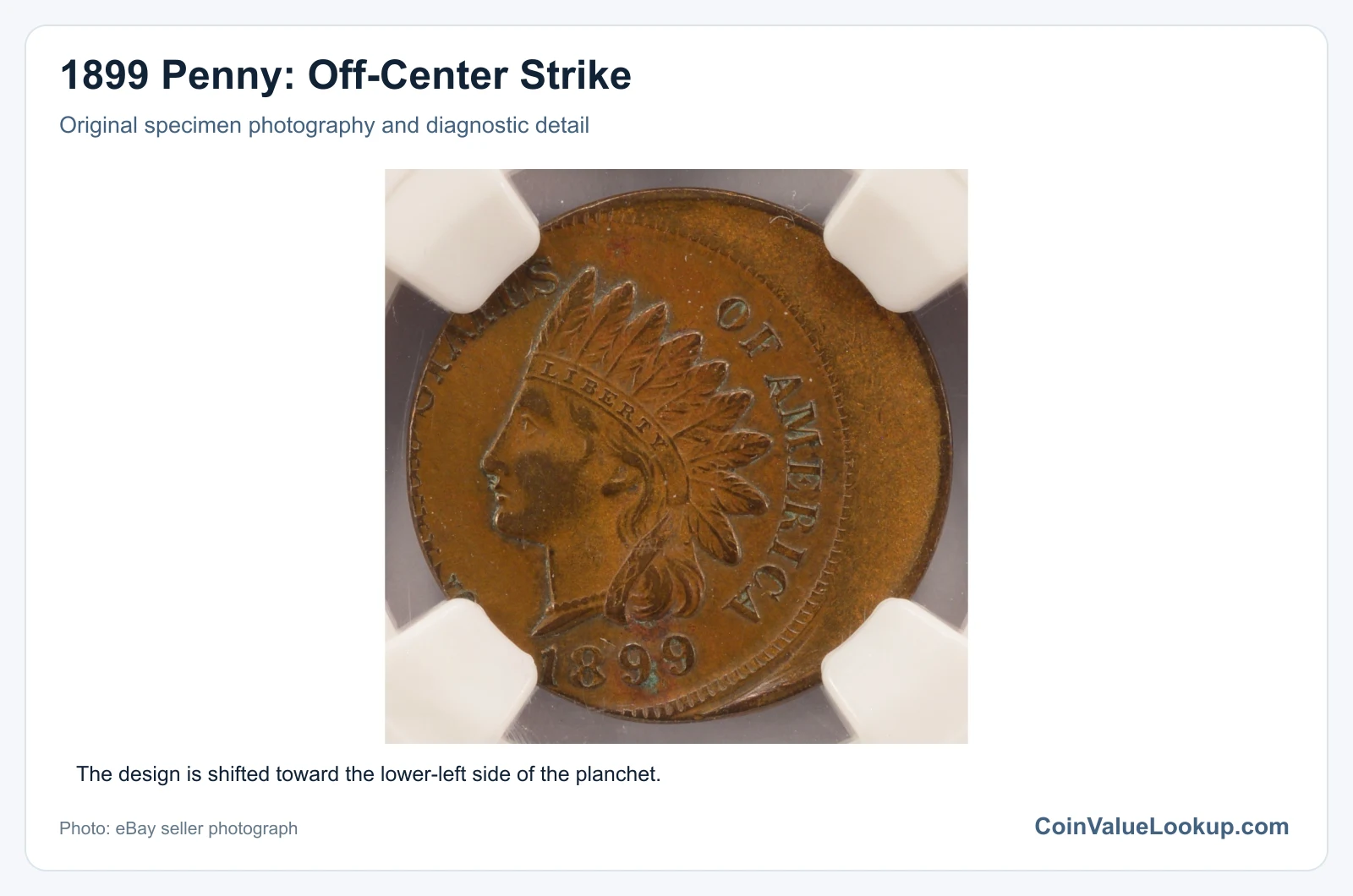
An off-center strike happens when the planchet is not properly seated between the dies, producing a coin with a crescent-shaped blank area and a shifted design. The percentage of off-center displacement and whether the date remains visible are the two biggest factors in desirability.
On an 1899 Indian cent, a coin that is 5–10% off-center with a full date is collectible. Dramatic shifts of 25% or more with a readable date are considerably scarcer.
If the date is missing, attributing the coin to 1899 becomes difficult and value drops.
Do not confuse an off-center strike with a clipped planchet, a misaligned die that shifts one side only, or post-mint flattening from a vise or similar tool. A genuine off-center coin shows a uniform unstruck crescent with the design displaced as a unit.
Each example is valued individually based on the degree of offset, date visibility and condition.
7. 1899 Indian Head Penny — Die Break / Cud
A cud is a specific type of die break where a piece of the die along the rim breaks away entirely. The result on the coin is a raised, featureless blob connected to the rim, replacing whatever design was in that area.
Interior die breaks that do not touch the rim are sometimes called retained die breaks and behave differently.
On an 1899 Indian cent, check the rim area carefully. A cud will have a smooth, raised surface with no design detail, and you can usually see where the normal design stops and the blank metal begins.
Rim dents, corrosion buildup and interior die chips can all mimic a cud at first glance. The distinguishing feature is that a true cud is connected to the rim and replaces a section of the die's design.
Pricing depends on the size and location; no fixed range applies. Individual assessment with authentication is recommended.
8. 1899 Indian Head Penny — Clipped Planchet
A clipped planchet error means the blank was cut incorrectly before striking, leaving the coin with a missing curved, straight or ragged section. On an 1899 Indian cent, the clip usually appears as a smooth, curved bite out of the edge where the blank overlapped a previously punched hole in the metal strip.
Look for a corresponding area of weakness on the opposite side of the coin from the clip. Metal flow during striking creates this characteristic pattern, and its presence helps confirm the clip happened before the coin was struck.
Post-mint damage such as filed edges, deliberate cuts or corrosion along the rim can imitate a clip. Genuine clips show undisturbed metal flow at the missing area and consistent edge texture.
Size matters for value: a tiny clip adds modest interest, while a large one affecting a significant portion of the design is more desirable. Each coin is assessed individually.
9. 1899 Indian Head Penny — Double / Multiple Strike
A double or multiple strike occurs when a coin is struck more than once by the dies, with the planchet shifting or rotating between impacts. The result is two or more overlapping but offset design impressions on the same coin.
On an 1899 Indian cent, you would see a secondary set of design elements displaced from the primary strike.
This is different from a doubled die, which involves the hub impression on the die itself and produces consistent doubling on every coin struck by that die. A double strike is unique to the individual coin and shows a physically separate, often rotated second impression.
Post-mint pressing of one coin against another can create a similar appearance but lacks the sharp, fully formed second impression of a genuine restrike. Machine doubling, which produces flat shelf-like displacement, is another common lookalike.
Confirmed double strikes on Indian cents are scarce and valued individually based on the degree of displacement and the coin's overall condition.
10. 1899 Indian Head Penny — Brockage
A brockage happens when a previously struck coin sticks to a die and impresses its design into the next blank that enters the press. The result is one normal side and one side showing an incuse, mirror-image version of the stuck coin's design.
It is one of the more visually dramatic mint errors.
On an 1899 Indian cent, a brockage would display the Indian portrait or wreath in sunken relief, reversed left-to-right, on one face. The opposite face would appear normally struck.
The incuse image should show appropriate depth and detail consistent with a struck transfer rather than post-mint pressing.
Die clashes, where dies contact each other without a planchet, can leave faint ghost images but lack the full incuse depth of a brockage. Coins pressed together after leaving the mint also mimic brockages but tend to show uneven, shallow impressions.
Genuine brockages are rare on Indian cents and are valued individually based on the completeness of the transferred image and the coin's condition.