1936 Mercury Dime Coin Value: How Much Is It Worth?
A 1936 Mercury Dime in well-worn condition starts around $5.73 in G4, while uncirculated examples can reach roughly $41 to $72 at MS65 depending on the mint. Full Bands strikes, the Philadelphia proof, and recognized error varieties each carry their own separate value considerations.
Three business-strike mints and one proof finish exist for this date.
Fast Way to Identify Your 1936 Mercury Dime
Want a quick read on your 1936 Mercury Dime? Upload clear photos of both the front and back of your coin, and our identifier can offer a preliminary take on which mint and version you might have.
This is not a substitute for professional authentication, but it is a solid first step toward understanding what you are holding.
1936 Mercury Dime Value
Upload both sides of your 1936 Mercury Dime.
Front Obverse
Upload photo
Back Reverse
Upload photo
Which 1936 Mercury Dime Versions Are Worth Money?
- Philadelphia proof strikes in PR65 carry a USA Coin Book guide estimate around $1,247, making them the standout version for this date.
- Denver business strikes at MS65 are estimated near $72, the highest among the three circulation issues at that grade.
- San Francisco MS65 examples sit around $50 in guide estimates, above Philadelphia business strikes at the same grade.
- A 1936-D/D repunched mintmark is a recognized variety worth inspecting Denver coins for under magnification.
- Full Bands examples can command premiums above standard MS prices, though FB values are tracked separately from the regular guide figures listed here.
Step 1: Identify Your 1936 Mercury Dime Mint Mark and Version
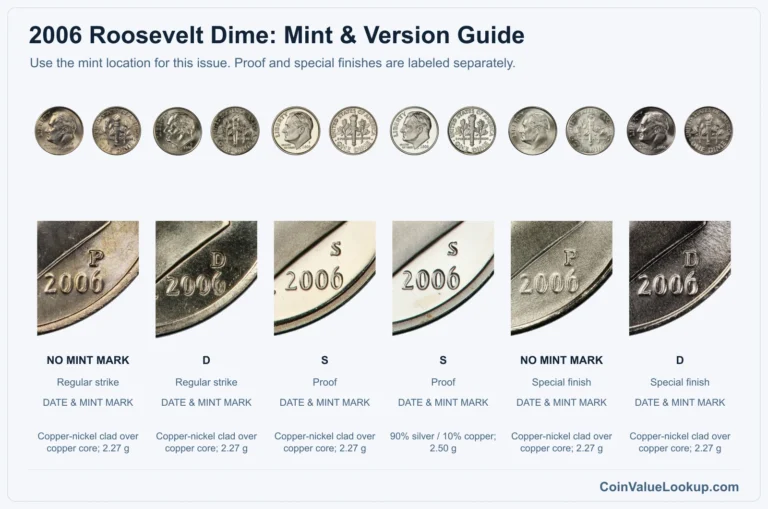
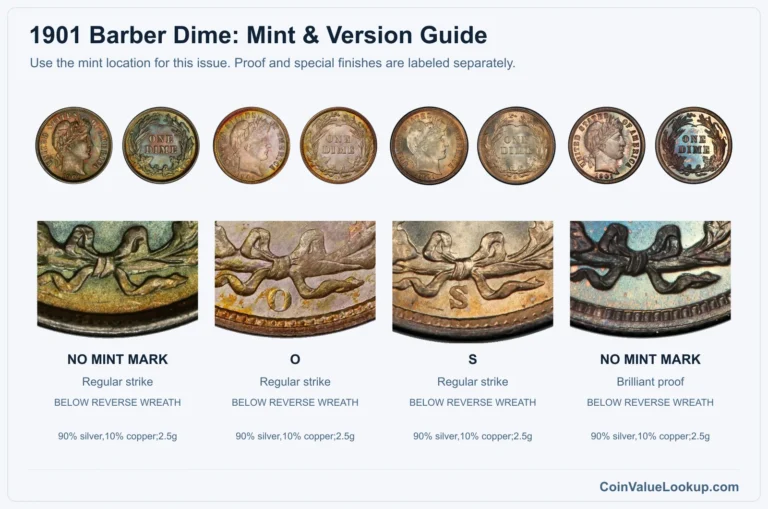
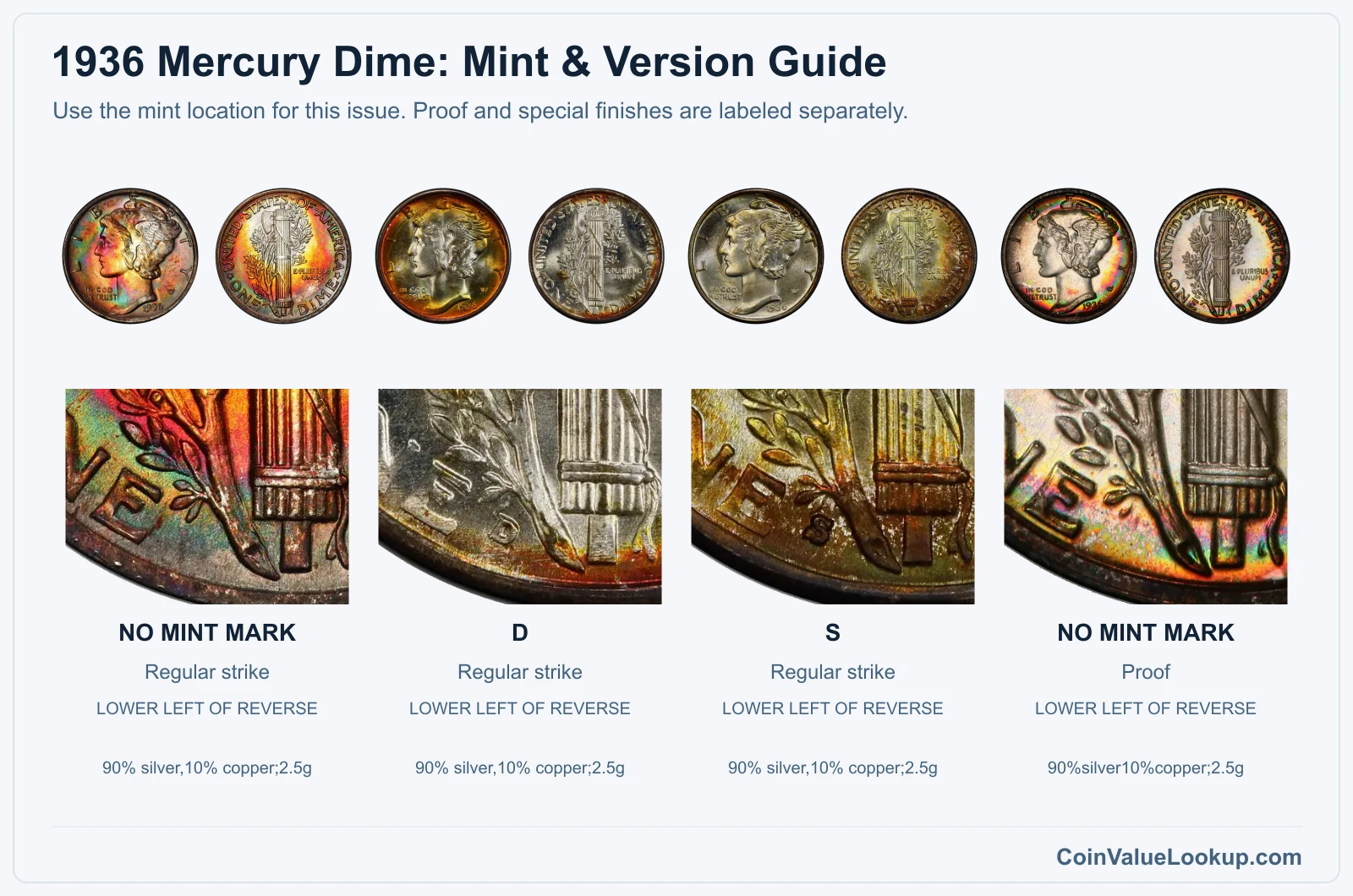
Three business-strike mints produced 1936 Mercury Dimes: Philadelphia, Denver, and San Francisco. Philadelphia coins carry no mintmark at all.
Denver pieces show a small "D" and San Francisco pieces show an "S," both located on the lower left of the reverse near the word ONE.
The "AW" monogram on the obverse is Adolph Weinman's designer initials, not a mintmark and definitely not a West Point indicator. Every 1936 dime is struck in 90% silver and 10% copper, weighing about 2.5 grams with a reeded edge and a diameter of 17.9 mm.
Philadelphia also produced brilliant proof strikes this year. There is no satin-finish Mercury Dime proof for 1936, so if someone offers you one, that is a red flag.
Proofs are a manufacturing method, not a higher grade than Mint State.
Step 2: Check Your 1936 Mercury Dime Grade
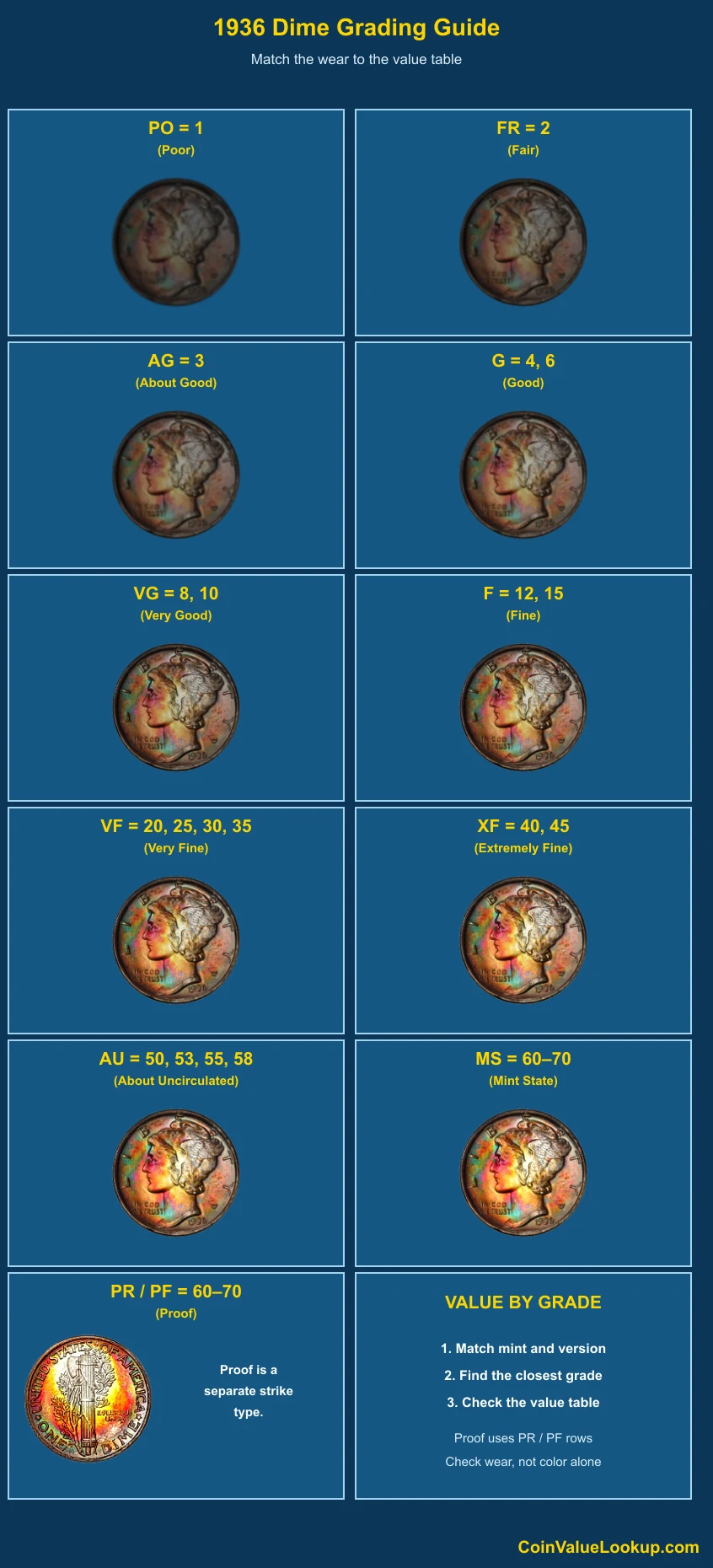
Start by examining Liberty's hair detail directly above and in front of the ear. On a well-circulated coin, this area flattens first.
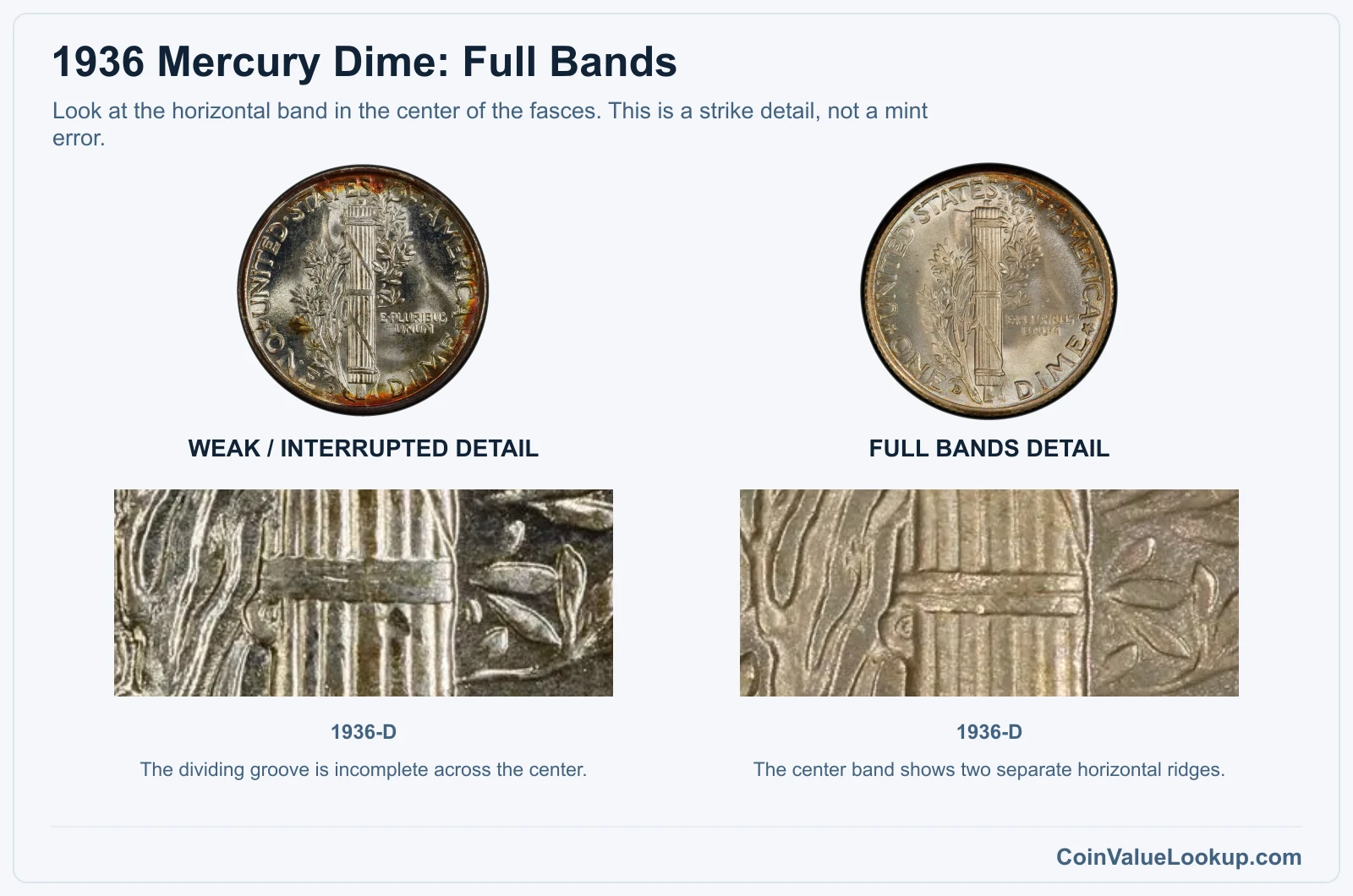
Next check the wings on the cap and the horizontal bands on the reverse fasces.
Weak bands do not automatically mean a coin circulated. Some branch-mint strikes simply left the press with mushy detail, so compare the overall luster and surface marks before jumping to a grade.
Look for cleaning. A coin that has been harshly wiped will show hairlines under angled light and often has an unnatural brightness.
Contact marks from bag storage are normal on mint-state pieces, but deep gouges or rim dings will pull the grade down.
Full Bands is a separate strike designation, not a grade. NGC evaluates central and outer band separation; different grading services may apply slightly different criteria.
Use the comparison image to gauge where your coin lands on the wear scale before worrying about FB status.
Step 3: Check 1936 Mercury Dime Value by Mint and Version
1936 Mercury Dime — No Mint Mark — Silver Circulation
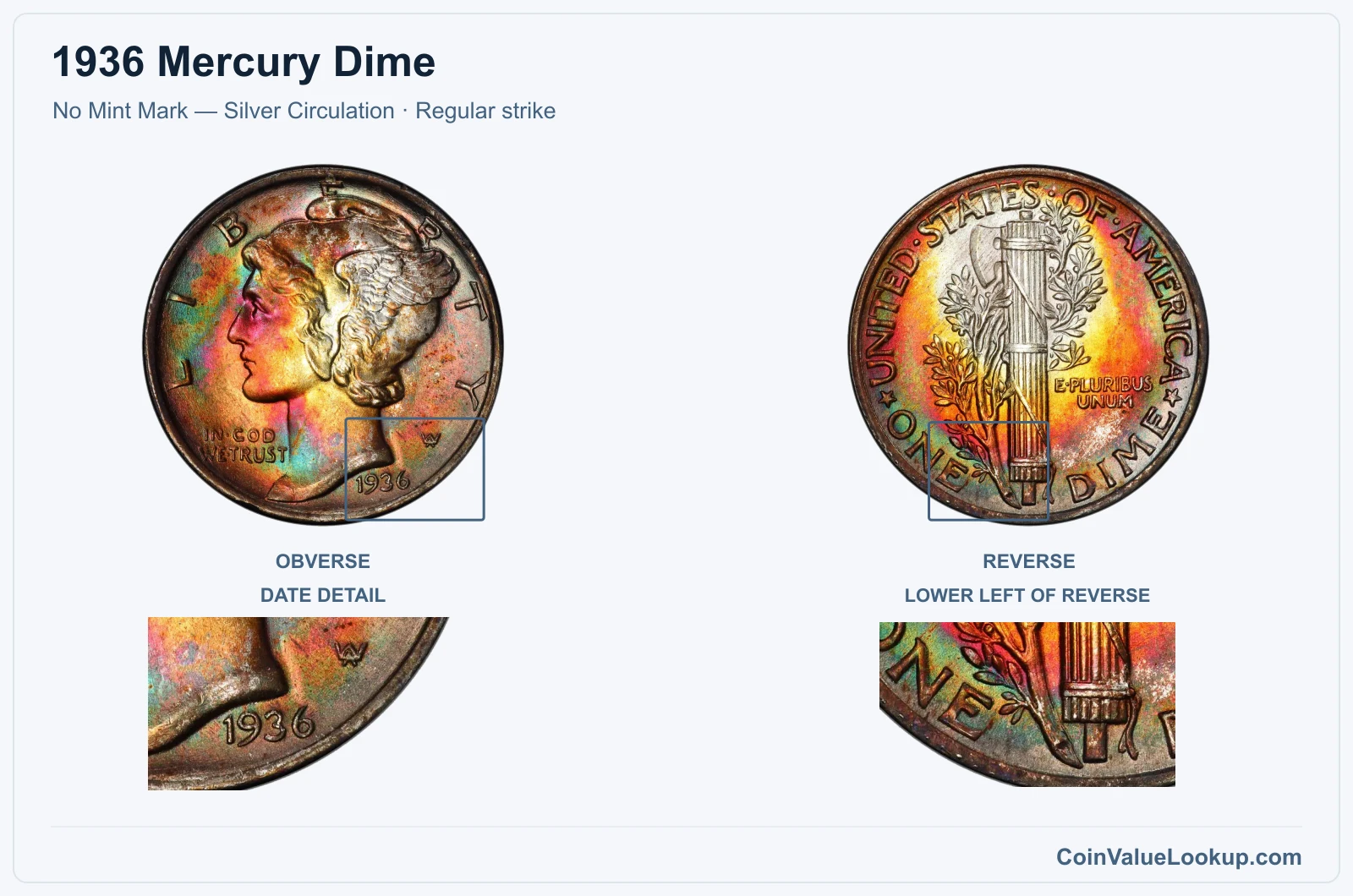
The 1936 Philadelphia dime has no mintmark. Look at the lower-left reverse beside ONE and confirm the space is blank.
USA Coin Book estimates place this issue at about $5.73 in G4 and around $41 in MS65.
Full Bands pieces trade at a premium above the standard MS65 figure, but those prices are tracked on a separate basis and are not inferred from the regular guide. Millions were struck, so finding one in circulated grades is straightforward.
The challenge is locating a clean, original-surface gem.
Range Grade
Price Auction Records Appraisal PO PO 1
—
Coin Identifier FR FR 2
—
Coin Identifier AG AG 3
—
Coin Identifier G G 4
—
Coin Identifier
G 6
—
Coin Identifier VG VG 8
—
Coin Identifier
VG 10
—
Coin Identifier F F 12
—
Coin Identifier
F 15
—
Coin Identifier VF VF 20
—
Coin Identifier
VF 25
—
Coin Identifier
VF 30
—
Coin Identifier
VF 35
—
Coin Identifier XF XF 40
—
Coin Identifier
XF 45
—
Coin Identifier AU AU 50
—
Coin Identifier
AU 53
—
Coin Identifier
AU 55
—
Coin Identifier
AU 58
Coin Identifier MS MS 60
—
Coin Identifier
MS 61
—
Coin Identifier
MS 62
Coin Identifier
MS 63
Coin Identifier
MS 64
Coin Identifier
MS 65
Coin Identifier
MS 66
Coin Identifier
MS 67
Coin Identifier
MS 68
Coin Identifier
MS 69
—
—
—
MS 70
—
—
—
1936 Mercury Dime — D — Silver Circulation
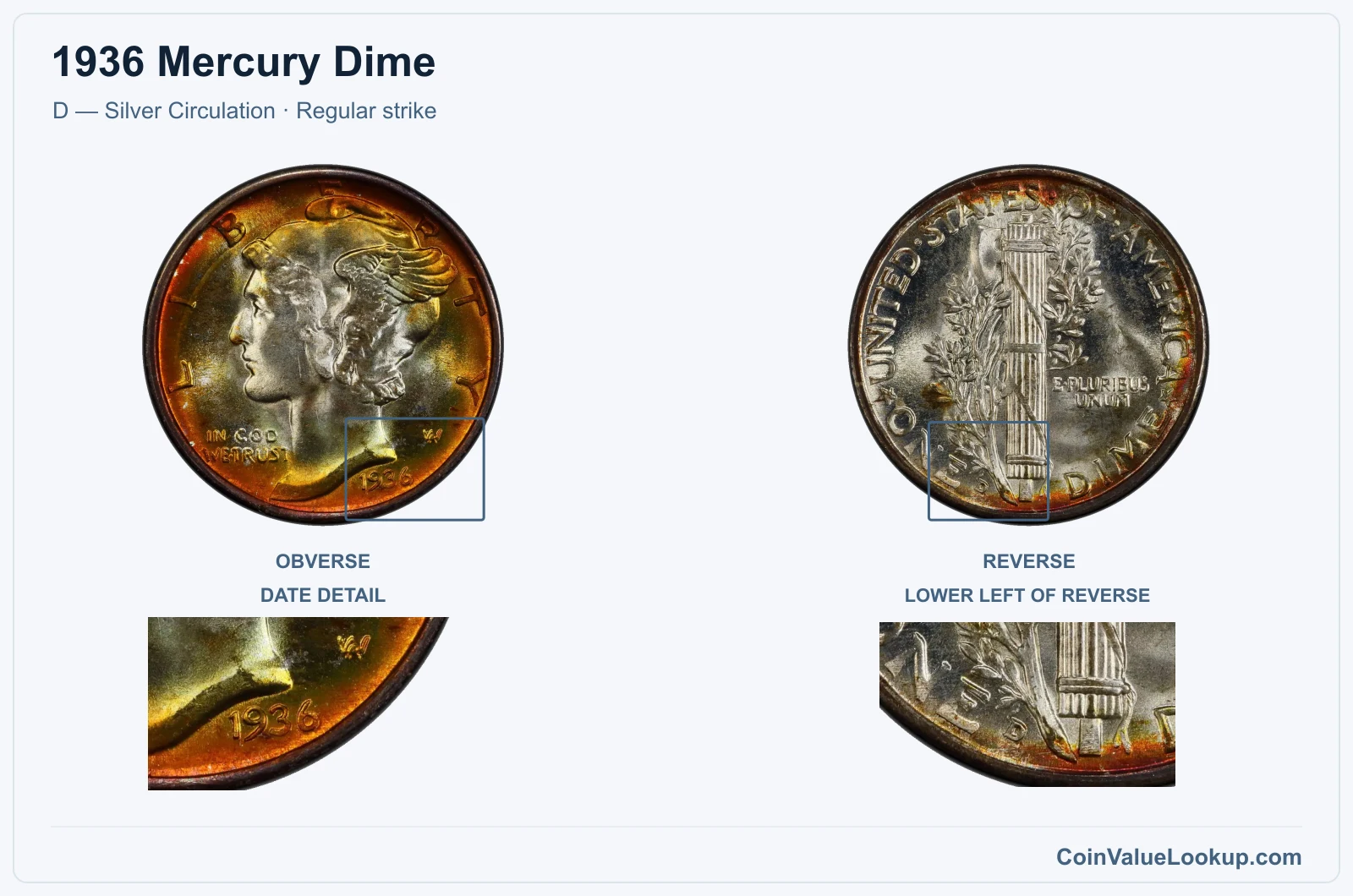
Denver strikes carry a small "D" mintmark on the lower-left reverse. In G4, USA Coin Book lists the same $5.73 starting point as the other mints, but the gap widens at the top end: an MS65 Denver coin is estimated around $72, the highest of the three business-strike mints for this date.
Denver coins are also worth examining under magnification for the recognized 1936-D/D repunched mintmark variety. Full Bands status adds further premium when the central and outer bands on the fasces show full separation, though FB pricing is tracked separately from these standard figures.
Range Grade
Price Auction Records Appraisal PO PO 1
—
Coin Identifier FR FR 2
—
Coin Identifier AG AG 3
—
Coin Identifier G G 4
—
Coin Identifier
G 6
—
Coin Identifier VG VG 8
—
Coin Identifier
VG 10
—
Coin Identifier F F 12
—
Coin Identifier
F 15
Coin Identifier VF VF 20
—
Coin Identifier
VF 25
—
Coin Identifier
VF 30
—
Coin Identifier
VF 35
—
Coin Identifier XF XF 40
—
Coin Identifier
XF 45
—
Coin Identifier AU AU 50
—
Coin Identifier
AU 53
—
Coin Identifier
AU 55
—
Coin Identifier
AU 58
Coin Identifier MS MS 60
—
Coin Identifier
MS 61
—
Coin Identifier
MS 62
—
Coin Identifier
MS 63
Coin Identifier
MS 64
Coin Identifier
MS 65
Coin Identifier
MS 66
Coin Identifier
MS 67
Coin Identifier
MS 68
—
—
—
MS 69
—
—
—
MS 70
—
—
—
1936 Mercury Dime — S — Silver Circulation
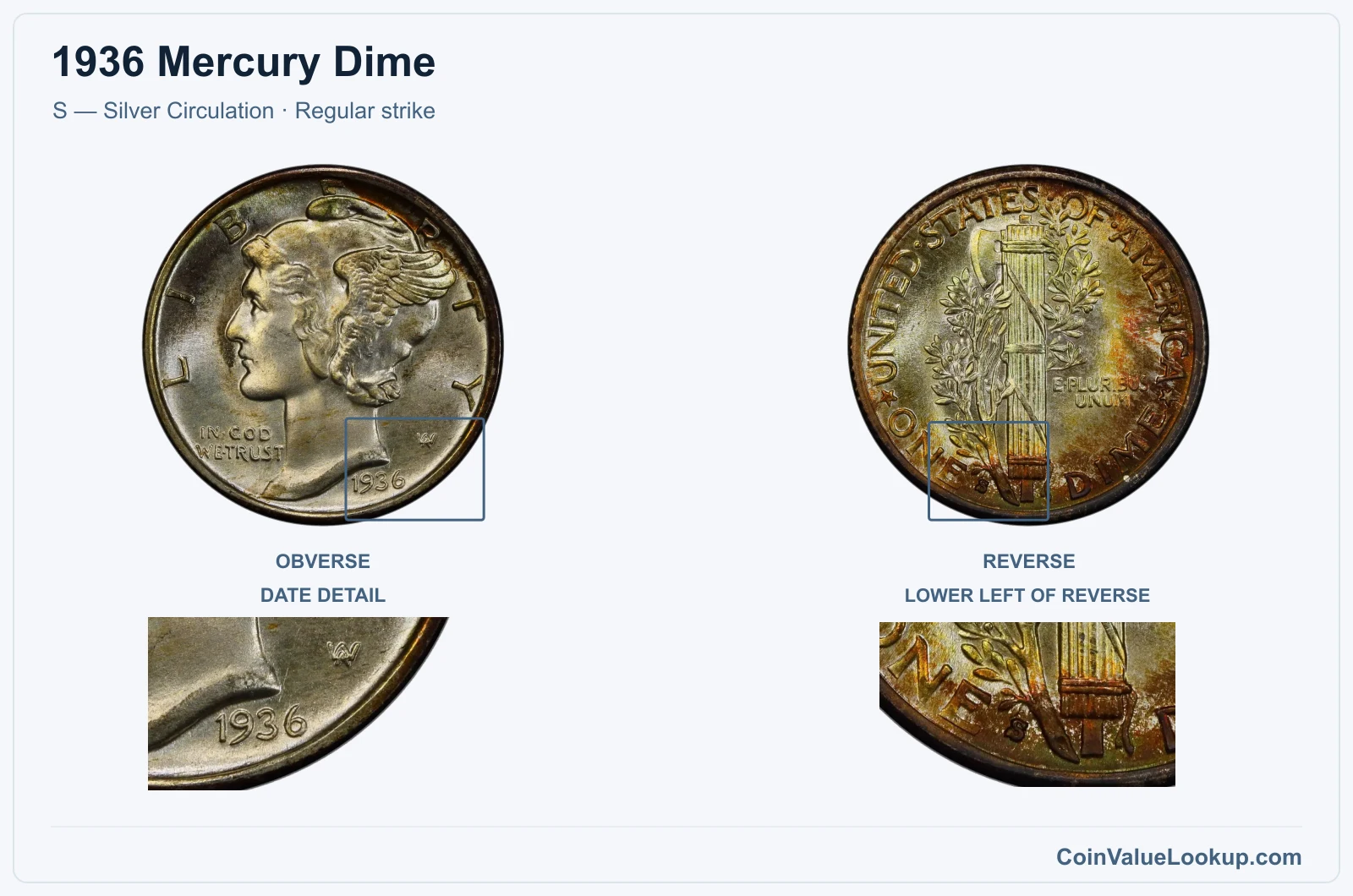
San Francisco dimes show an "S" mintmark in the same lower-left reverse position. Guide estimates from USA Coin Book put this coin at about $5.73 in G4 and roughly $50 at MS65, slotting it between the Philadelphia and Denver business strikes at gem level.
Coin Value Lookup is a handy place to look up guides for other Mercury Dime dates and mints if you are working through a collection. As with the other mints, Full Bands examples carry a separate premium not reflected in the standard MS65 figure.
Range Grade
Price Auction Records Appraisal PO PO 1
—
Coin Identifier FR FR 2
—
Coin Identifier AG AG 3
—
Coin Identifier G G 4
—
Coin Identifier
G 6
—
Coin Identifier VG VG 8
—
Coin Identifier
VG 10
—
Coin Identifier F F 12
—
Coin Identifier
F 15
—
Coin Identifier VF VF 20
—
Coin Identifier
VF 25
—
Coin Identifier
VF 30
—
Coin Identifier
VF 35
—
Coin Identifier XF XF 40
—
Coin Identifier
XF 45
—
Coin Identifier AU AU 50
—
Coin Identifier
AU 53
—
Coin Identifier
AU 55
—
Coin Identifier
AU 58
—
Coin Identifier MS MS 60
—
Coin Identifier
MS 61
—
Coin Identifier
MS 62
—
Coin Identifier
MS 63
Coin Identifier
MS 64
Coin Identifier
MS 65
Coin Identifier
MS 66
Coin Identifier
MS 67
Coin Identifier
MS 68
Coin Identifier
MS 69
—
—
—
MS 70
—
—
—
1936 Mercury Dime — No Mint Mark — Silver Proof
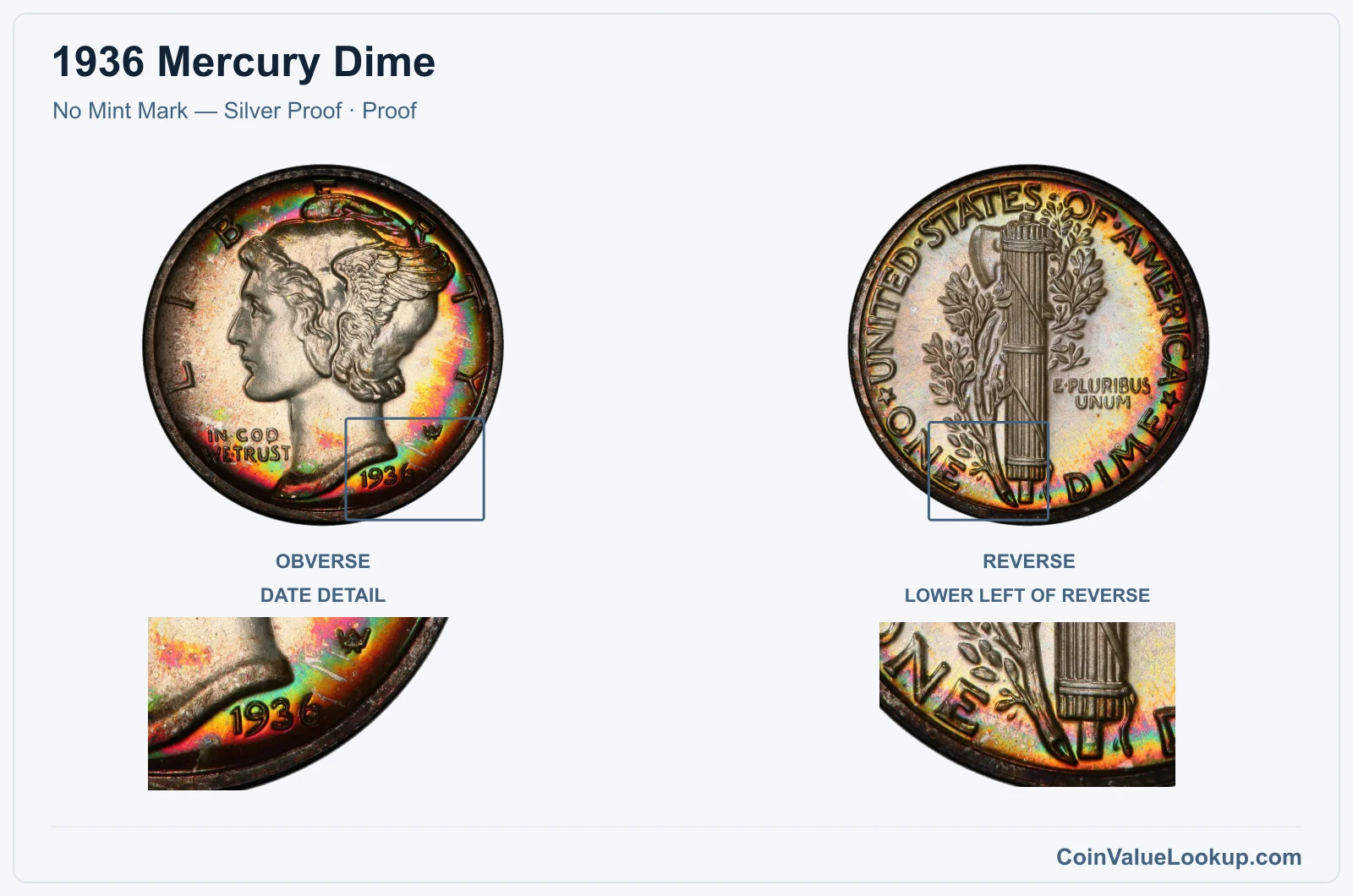
Philadelphia struck brilliant proof Mercury Dimes from 1936 through 1942, and the 1936 is the first year of the run. These were made with polished dies and specially prepared planchets, giving them mirror-like fields and sharply defined details.
There is no satin proof for this series.
USA Coin Book estimates a PR65 example at about $1,247. That figure reflects the limited production and collector demand for the earliest proof Mercury issues.
Cameo contrast, where the devices appear frosty against mirror fields, may add to desirability, but it is considered a quality filter rather than a different alloy or version. No Full Bands filter applies to proof pricing here.
Range Grade
Price Auction Records Appraisal PR PR 1
—
Coin Identifier
PR 2
—
Coin Identifier
PR 3
—
Coin Identifier
PR 4
—
Coin Identifier
PR 6
—
Coin Identifier
PR 8
—
Coin Identifier
PR 10
—
Coin Identifier
PR 12
—
Coin Identifier
PR 15
—
Coin Identifier
PR 20
—
Coin Identifier
PR 25
—
Coin Identifier
PR 30
—
Coin Identifier
PR 35
—
Coin Identifier
PR 40
—
Coin Identifier
PR 45
—
Coin Identifier
PR 50
—
Coin Identifier
PR 53
—
Coin Identifier
PR 55
—
Coin Identifier
PR 58
Coin Identifier
PR 60
Coin Identifier
PR 61
Coin Identifier
PR 62
Coin Identifier
PR 63
Coin Identifier
PR 64
Coin Identifier
PR 65
Coin Identifier
PR 66
Coin Identifier
PR 67
Coin Identifier
PR 68
Coin Identifier
PR 69
—
—
—
PR 70
—
—
—
1936 Mercury Dime Error List
1. 1936 Mercury Dime — Off-Center Strike
An off-center strike happens when the planchet is not properly seated between the dies. On a 1936 dime, look for a crescent-shaped blank area along one edge where the design was never impressed, with the remaining design shifted in the opposite direction.
The most desirable off-center dimes still show the full date, since that confirms the year. Condition, the percentage of off-center shift, and date visibility all factor into value, but no specific price range is established here.
Do not confuse an off-center strike with a clipped planchet, a one-sided die misalignment, or post-mint damage such as flattening from a vise. True off-center coins show uniform metal thickness in the struck area and a clean unstruck crescent.
2. 1936 Mercury Dime — Doubled Die Obverse
A doubled die obverse on a 1936 dime shows consistent, repeatable doubling on obverse design elements such as lettering or Liberty's profile. Under magnification and matching light, look for separation or notching on letters that appears in the same position on every confirmed example.
True hub doubling has a three-dimensional, shelf-like quality. Machine doubling, by contrast, produces flat, shelf-less shelving that looks like a shadow.
Reflections under strong light can also mimic doubling, so compare carefully against a known normal coin.
The value of a doubled die depends on the visibility of the doubling and the coin's overall condition. No specific price data is available here, so individual assessment by a grading service is the safest route for any coin you suspect carries this error.
3. 1936 Mercury Dime — Die Crack / Die Chip
Die cracks appear as thin raised lines on the coin's surface, running where the steel die fractured during production. Die chips are small raised blobs of metal filling a void in the die.
Both are struck into the coin, so they sit above the surrounding field.
On a 1936 dime, check both sides for lines connecting design elements or running from the rim inward. A crack that reaches the rim and displaces a chunk of design is called a cud, which is a more dramatic variation.
Do not mistake incuse scratches, corrosion trails, or stuck-on debris for die cracks. A genuine crack is raised, metallic, and consistent with the coin's surface texture.
Value depends on size, location, and the coin's grade, but no adopted price range exists for this entry.
4. 1936 Mercury Dime — Clipped Planchet
A clipped planchet error means the blank was improperly punched from the silver strip before striking. On a 1936 dime you will see a missing curved, straight, or ragged section along the edge.
The clip was present before the coin was struck, so the remaining design near the clip often shows slight weakness.
Look at the edge texture where the missing section meets the rim. Genuine clips frequently show a characteristic area of metal-flow weakness on the opposite side of the coin, called the Blakesley effect.
Filed notches, deliberate edge cuts, and corrosion can mimic a clip. Compare edge metal carefully: a real clip has a smooth or slightly irregular contour consistent with the original blank, not tool marks.
Value varies with clip size, type, and overall condition.
5. 1936 Mercury Dime — Repunched Mintmark
A repunched mintmark occurs when the mintmark punch was applied more than once in slightly different positions. On the 1936-D, look for traces of a second "D" peeking out from beneath or beside the primary mintmark on the lower-left reverse.
You will need at least 5x to 10x magnification. Compare your coin's mintmark against a known normal 1936-D at the same magnification and lighting angle.
The remnants of the earlier punch position should show as a consistent secondary outline, not random roughness.
Machine doubling around the mintmark, small die chips, and corrosion can all create lookalike effects. True repunching shows a distinctly offset second impression with its own contour.
Value depends on the clarity of the repunching and the coin's condition, but no specific price is established here.