1916 Wheat Penny Coin Value: How Much Is It Worth?
A 1916 Wheat Penny ranges from roughly $0.61 in well-worn Good-4 condition up to about $249 at MS63, depending on which mint struck your coin. Those guide figures cover the three regular business-strike issues.
Proofs, major varieties and error coins carry separate pricing. Original surfaces, color and the degree of wear all shape what any individual piece is actually worth.
Fast Way to Identify Your 1916 Wheat Penny
The quickest way to start figuring out what you have is to upload clear photos of both the front and back of your 1916 penny. Our identifier can give you a preliminary read on the mint, design type and general condition from those images.
It is not a substitute for professional authentication, but it will point you in the right direction fast.
1916 Wheat Penny Value
Upload both sides of your 1916 Wheat Penny.
Front Obverse
Upload photo
Back Reverse
Upload photo
Which 1916 Wheat Penny Versions Are Worth Money?
- The 1916-S commands the highest guide values among business strikes, listed at about $2.19 in G4 and $249 at MS63, because collectors pay a premium for this mint.
- The 1916 matte proof is the final year of that finish for Lincoln cents, with a PR63 guide value near $3,429, placing it well above any regular-issue 1916.
- Denver issues (1916-D) carry moderate premiums over Philadelphia, roughly $1.24 in G4 and $154 at MS63, making the mintmark worth checking on every coin.
- Recognized error types such as doubled die obverse, repunched mintmark and broadstrike examples exist for 1916 and are valued individually by authenticated identity and condition.
Step 1: Identify Your 1916 Wheat Penny Mint Mark and Version
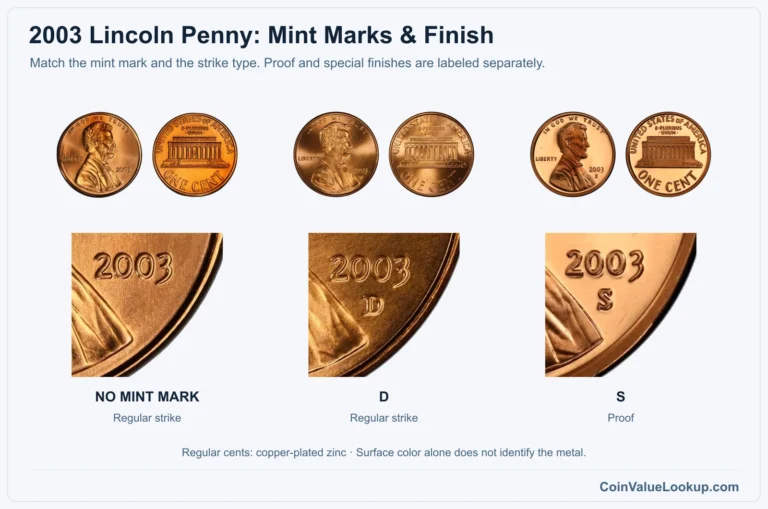
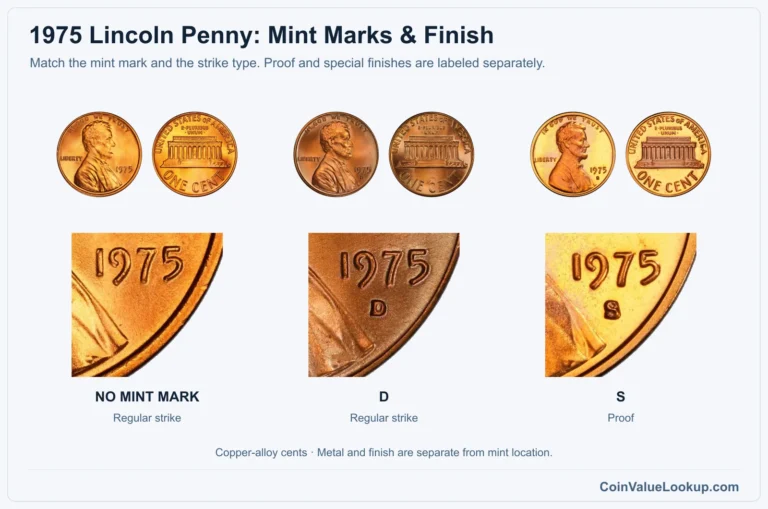
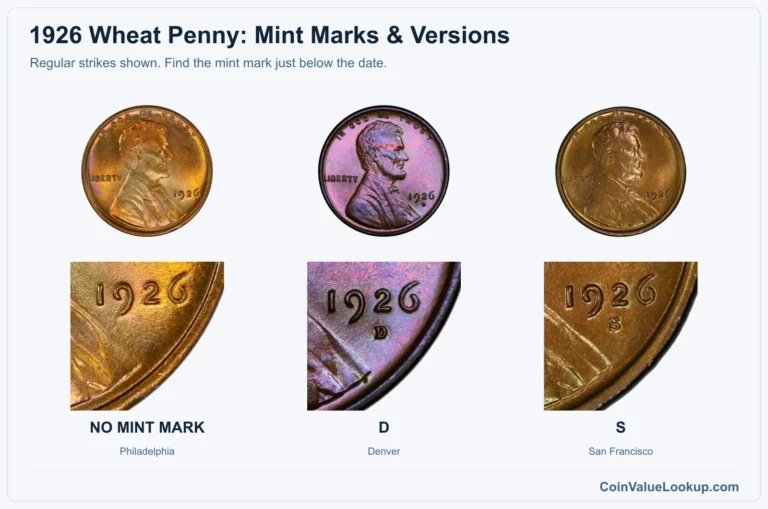
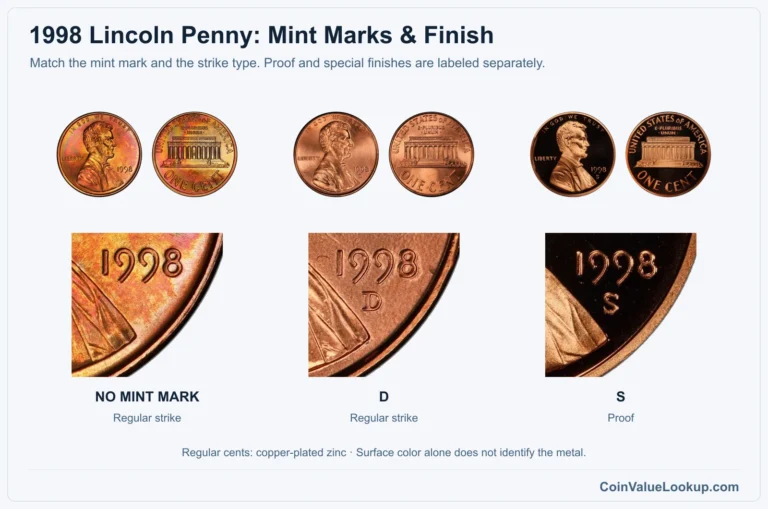
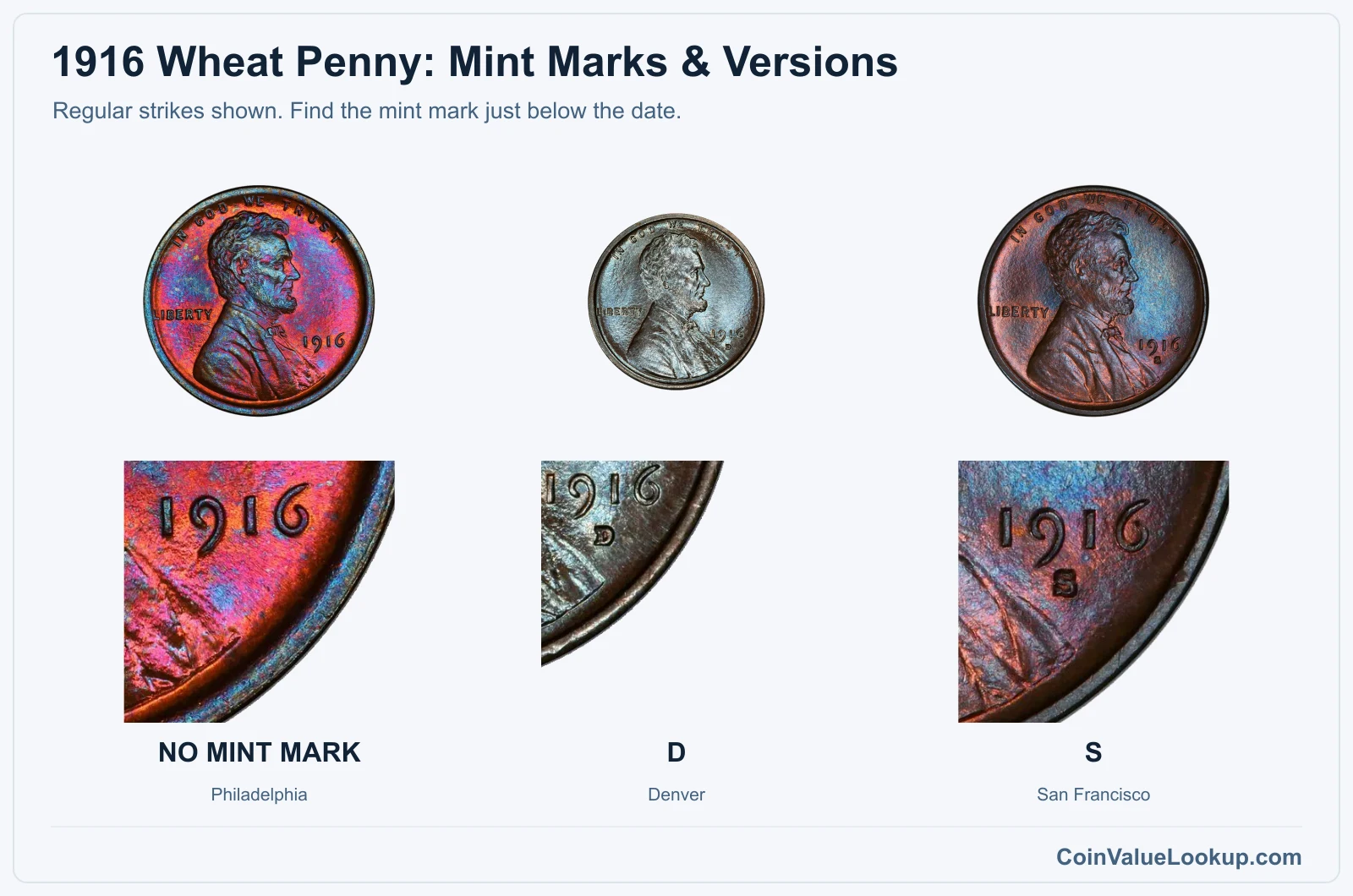
Flip your coin over and look just below the date on the obverse. If there is no small letter, your coin was struck at Philadelphia.
A tiny "D" means Denver, and an "S" means San Francisco. Every 1916 cent should show Lincoln's portrait on the front and two wheat ears on the reverse, weigh about 3.11 grams, and have a plain (smooth) edge.
The alloy is 95% copper with 5% tin and zinc.
Philadelphia also struck matte proof cents in 1916, the last year that finish was produced for the series. A matte proof has squared-off rims and a distinctive granular surface that looks very different from the mirror finish on modern proofs.
Do not confuse a well-struck business coin with a proof just because it has sharp detail.
Branch-mint coins from Denver and San Francisco sometimes show softer strikes from the factory. That softness is not the same as circulation wear, so compare your coin carefully before assuming a low grade.
Step 2: Check Your 1916 Wheat Penny Grade
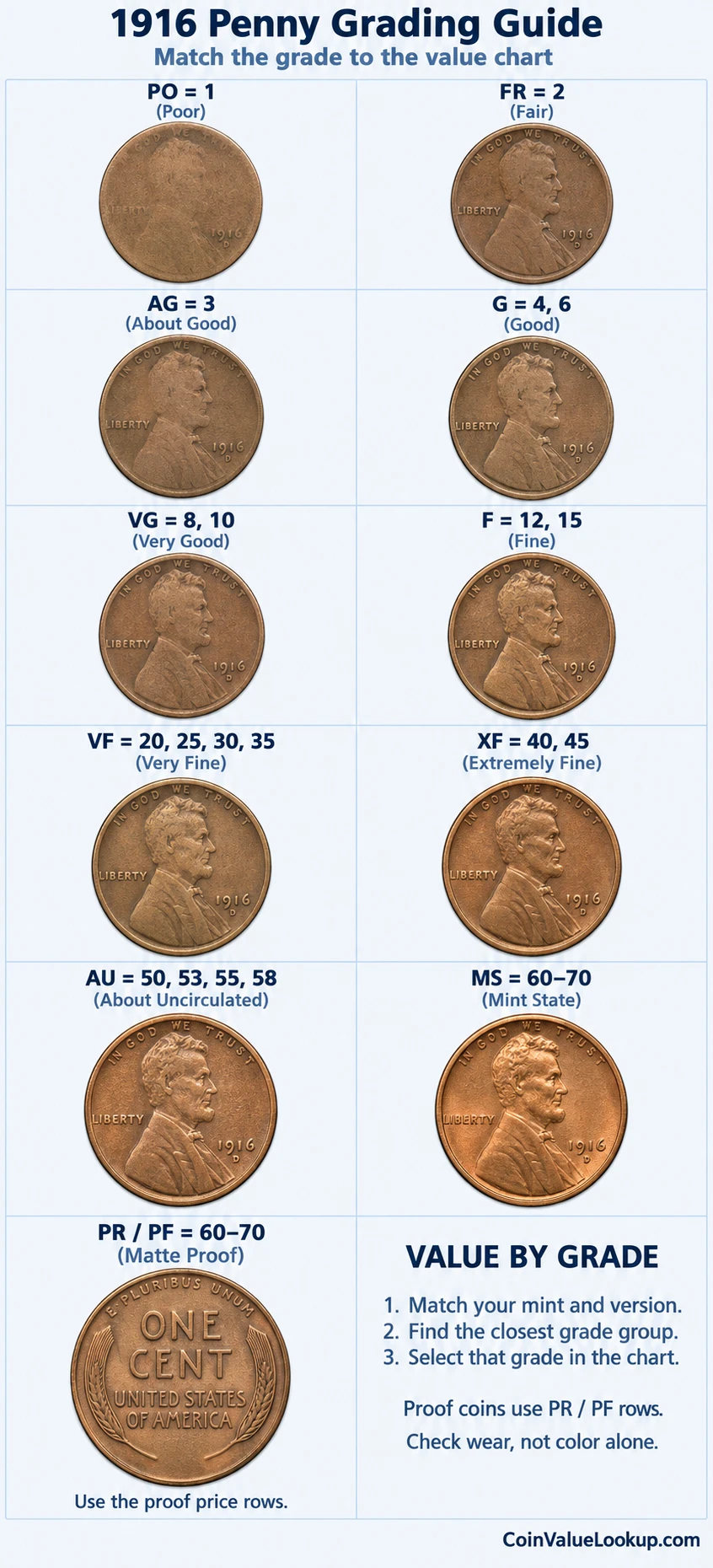
Start with Lincoln's cheekbone, jawline and the fine hair strands above his ear. These are the highest points and the first places wear will show.
On the reverse, check the individual grain lines inside the wheat ears and the horizontal lines between them.
A coin in Good-4 will have a visible date and outline of Lincoln but most fine detail is gone. By Fine-12 the major hair and wheat details reappear.
Mint State means no wear at all, with original luster across the surfaces.
Weak original strikes can mimic wear. If the softness is limited to one area but luster remains everywhere, suspect a strike issue rather than handling.
Use the comparison image to calibrate what normal high-point sharpness looks like for this date.
Color matters separately from grade. Red, red-brown and brown describe how much original copper tone remains.
Spots, corrosion and evidence of cleaning each reduce a coin's appeal regardless of the technical grade, so examine the surfaces under good light.
Step 3: Check 1916 Wheat Penny Value by Mint and Version
1916 Wheat Penny
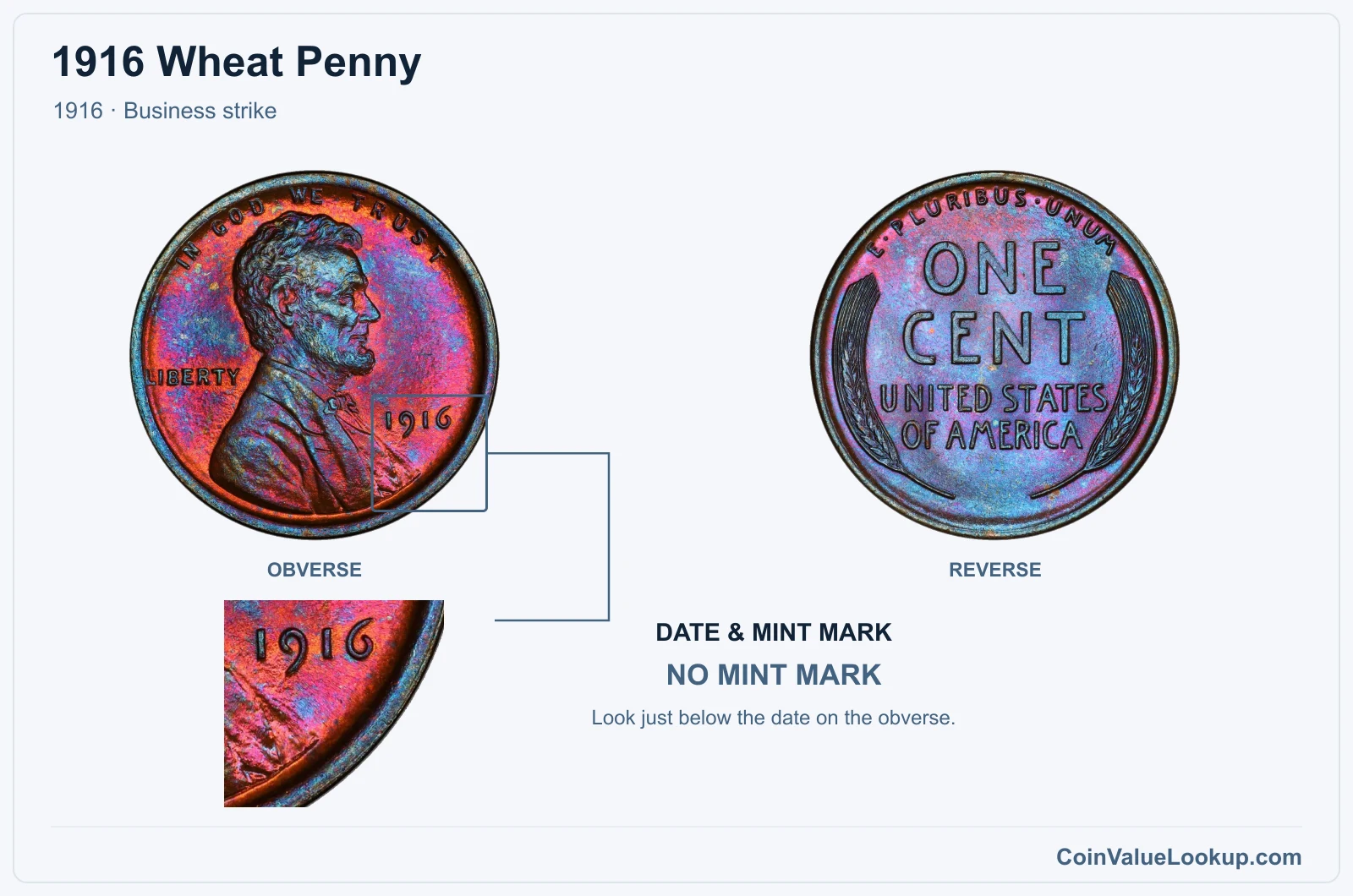
The 1916 Philadelphia cent has no mintmark below the date. It is the most commonly encountered issue of this year.
In well-worn Good-4 condition, guide values sit around $0.61, climbing to roughly $43 at MS63. Because Philadelphia also produced matte proofs this year, be careful not to confuse a sharply struck business coin with a proof.
Look at the rim profile and surface texture. A regular strike will show normal mint luster, while a matte proof has a distinctive granular finish and squared rims.
| Range | Grade | Price | Auction Records | Appraisal |
|---|---|---|---|---|
| PO | PO 1 | — | Coin Identifier | |
| FR | FR 2 | — | Coin Identifier | |
| AG | AG 3 | — | Coin Identifier | |
| G | G 4 | — | Coin Identifier | |
| G 6 | — | Coin Identifier | ||
| VG | VG 8 | — | Coin Identifier | |
| VG 10 | — | Coin Identifier | ||
| F | F 12 | — | Coin Identifier | |
| F 15 | — | Coin Identifier | ||
| VF | VF 20 | — | Coin Identifier | |
| VF 25 | — | Coin Identifier | ||
| VF 30 | — | Coin Identifier | ||
| VF 35 | Coin Identifier | |||
| XF | XF 40 | — | Coin Identifier | |
| XF 45 | — | Coin Identifier | ||
| AU | AU 50 | — | Coin Identifier | |
| AU 53 | — | Coin Identifier | ||
| AU 55 | Coin Identifier | |||
| AU 58 | Coin Identifier | |||
| MS | MS 60 | — | Coin Identifier | |
| MS 61 | — | Coin Identifier | ||
| MS 62 | Coin Identifier | |||
| MS 63 | Coin Identifier | |||
| MS 64 | Coin Identifier | |||
| MS 65 | Coin Identifier | |||
| MS 66 | — | Coin Identifier | ||
| MS 67 | — | — | — | |
| MS 68 | — | — | — | |
| MS 69 | — | — | — | |
| MS 70 | — | — | — |
1916 Wheat Penny — D
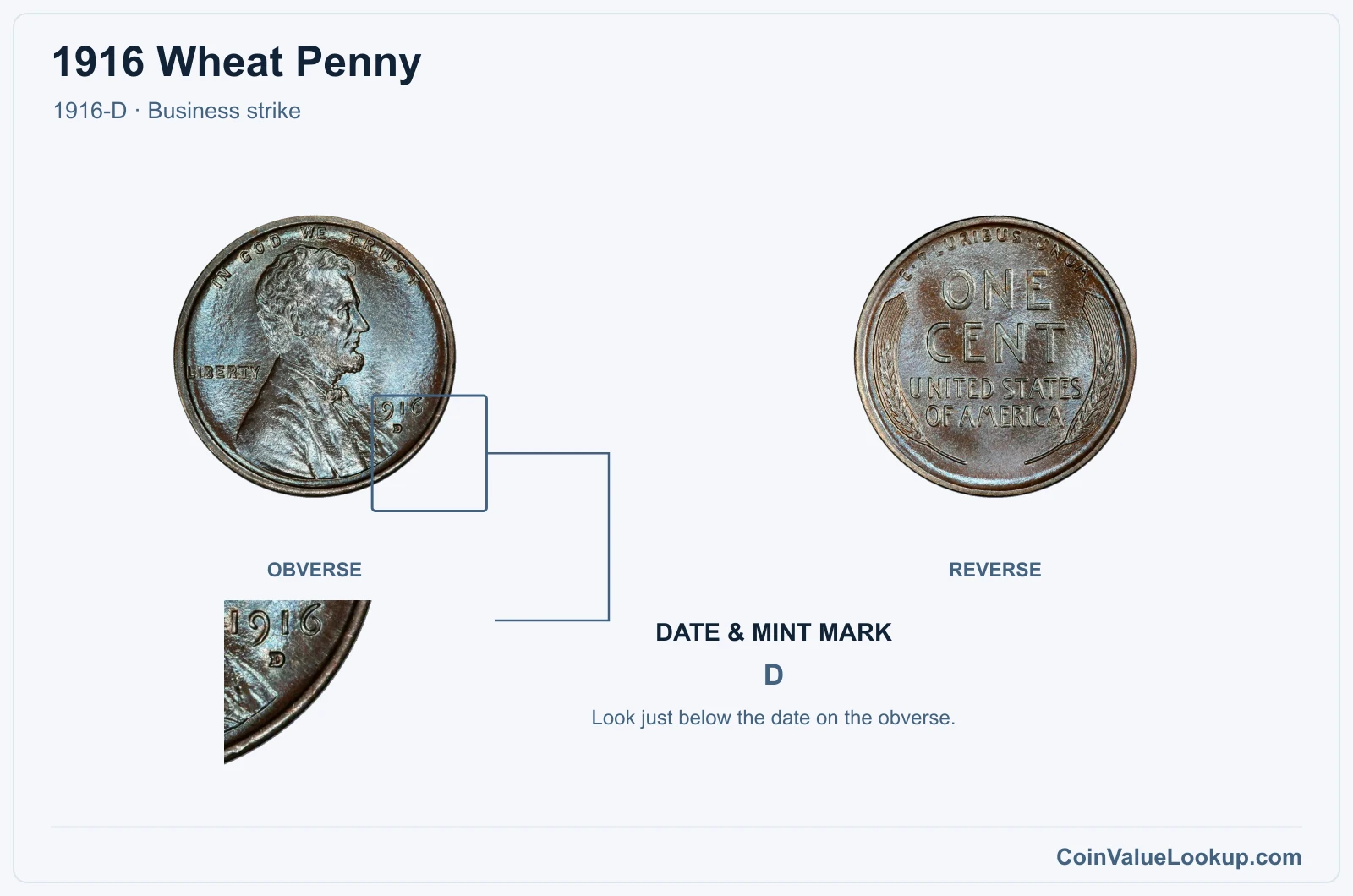
Look for a small "D" mintmark below the date. The 1916-D trades at a guide value of about $1.24 in Good-4 and around $154 at MS63.
Denver strikes of this era can show softer detail in the hair and wheat ears straight from the mint, so do not automatically downgrade a coin that looks slightly mushy if the luster is intact. Compare high points against the reference image.
This is a solid mid-range issue collectors seek out in better grades.
Coin Value Lookup is a handy starting point if you want to compare this Denver issue against other dates and mints in the Wheat cent series.
| Range | Grade | Price | Auction Records | Appraisal |
|---|---|---|---|---|
| PO | PO 1 | — | Coin Identifier | |
| FR | FR 2 | — | Coin Identifier | |
| AG | AG 3 | — | Coin Identifier | |
| G | G 4 | — | Coin Identifier | |
| G 6 | — | Coin Identifier | ||
| VG | VG 8 | — | Coin Identifier | |
| VG 10 | — | Coin Identifier | ||
| F | F 12 | — | Coin Identifier | |
| F 15 | — | Coin Identifier | ||
| VF | VF 20 | — | Coin Identifier | |
| VF 25 | — | Coin Identifier | ||
| VF 30 | — | Coin Identifier | ||
| VF 35 | — | Coin Identifier | ||
| XF | XF 40 | — | Coin Identifier | |
| XF 45 | Coin Identifier | |||
| AU | AU 50 | Coin Identifier | ||
| AU 53 | — | Coin Identifier | ||
| AU 55 | Coin Identifier | |||
| AU 58 | Coin Identifier | |||
| MS | MS 60 | — | Coin Identifier | |
| MS 61 | Coin Identifier | |||
| MS 62 | Coin Identifier | |||
| MS 63 | Coin Identifier | |||
| MS 64 | Coin Identifier | |||
| MS 65 | Coin Identifier | |||
| MS 66 | Coin Identifier | |||
| MS 67 | — | Coin Identifier | ||
| MS 68 | — | — | — | |
| MS 69 | — | — | — | |
| MS 70 | — | — | — |
1916 Wheat Penny — S
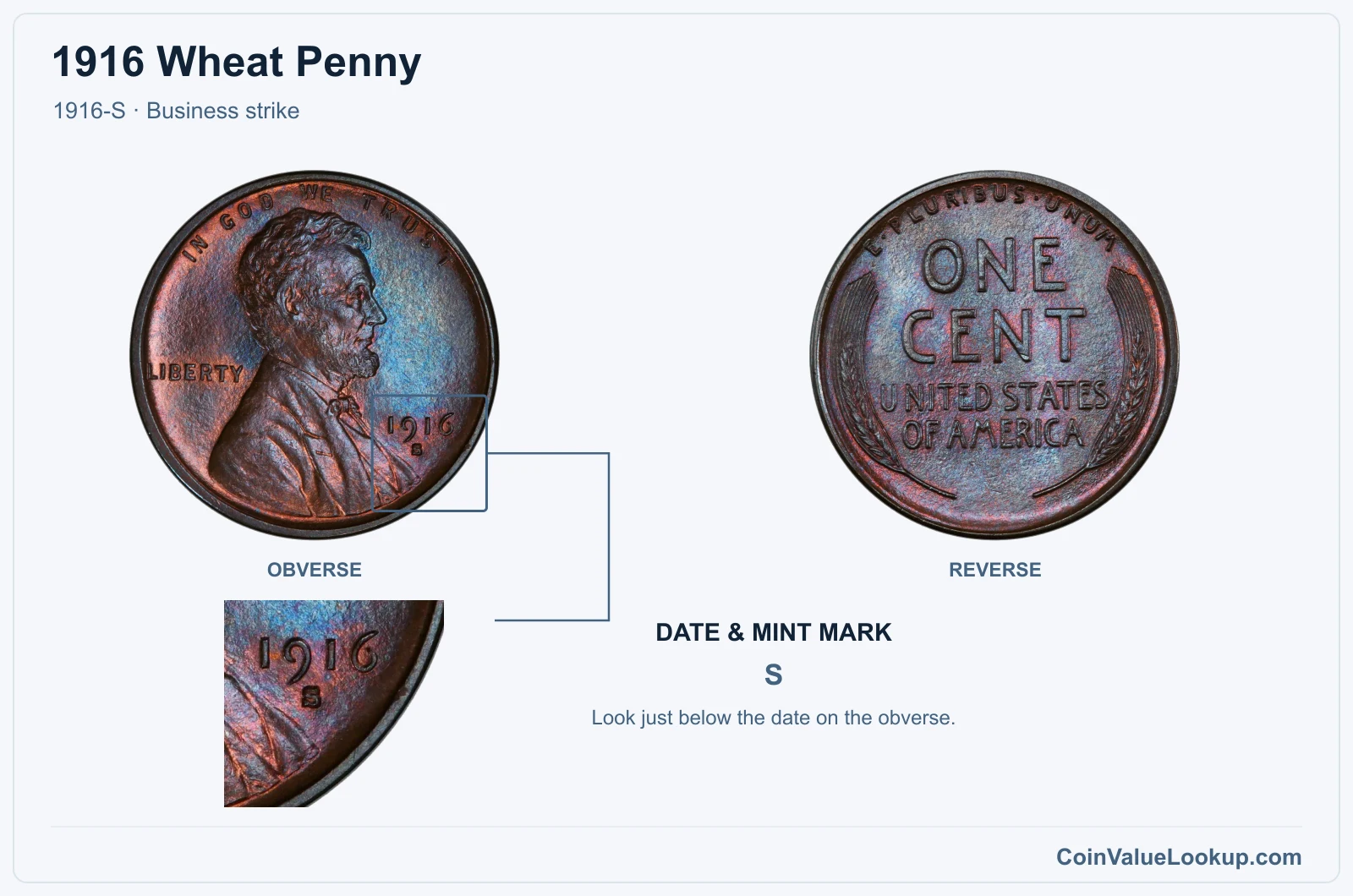
A small "S" below the date identifies the San Francisco issue, which carries the highest guide values among 1916 business strikes. Expect around $2.19 in Good-4 and about $249 at MS63.
San Francisco pieces are actively pursued by collectors building complete Wheat cent sets, and nice original examples with strong detail bring competitive offers. Like the Denver coin, branch-mint strike softness can appear.
Judge wear by luster loss on the high points, not just sharpness of the design elements.
| Range | Grade | Price | Auction Records | Appraisal |
|---|---|---|---|---|
| PO | PO 1 | — | Coin Identifier | |
| FR | FR 2 | — | Coin Identifier | |
| AG | AG 3 | — | Coin Identifier | |
| G | G 4 | — | Coin Identifier | |
| G 6 | — | Coin Identifier | ||
| VG | VG 8 | — | Coin Identifier | |
| VG 10 | — | Coin Identifier | ||
| F | F 12 | — | Coin Identifier | |
| F 15 | — | Coin Identifier | ||
| VF | VF 20 | — | Coin Identifier | |
| VF 25 | — | Coin Identifier | ||
| VF 30 | — | Coin Identifier | ||
| VF 35 | Coin Identifier | |||
| XF | XF 40 | Coin Identifier | ||
| XF 45 | Coin Identifier | |||
| AU | AU 50 | Coin Identifier | ||
| AU 53 | Coin Identifier | |||
| AU 55 | Coin Identifier | |||
| AU 58 | Coin Identifier | |||
| MS | MS 60 | — | Coin Identifier | |
| MS 61 | Coin Identifier | |||
| MS 62 | Coin Identifier | |||
| MS 63 | Coin Identifier | |||
| MS 64 | Coin Identifier | |||
| MS 65 | Coin Identifier | |||
| MS 66 | Coin Identifier | |||
| MS 67 | — | — | — | |
| MS 68 | — | — | — | |
| MS 69 | — | — | — | |
| MS 70 | — | — | — |
1916 Wheat Penny — PR
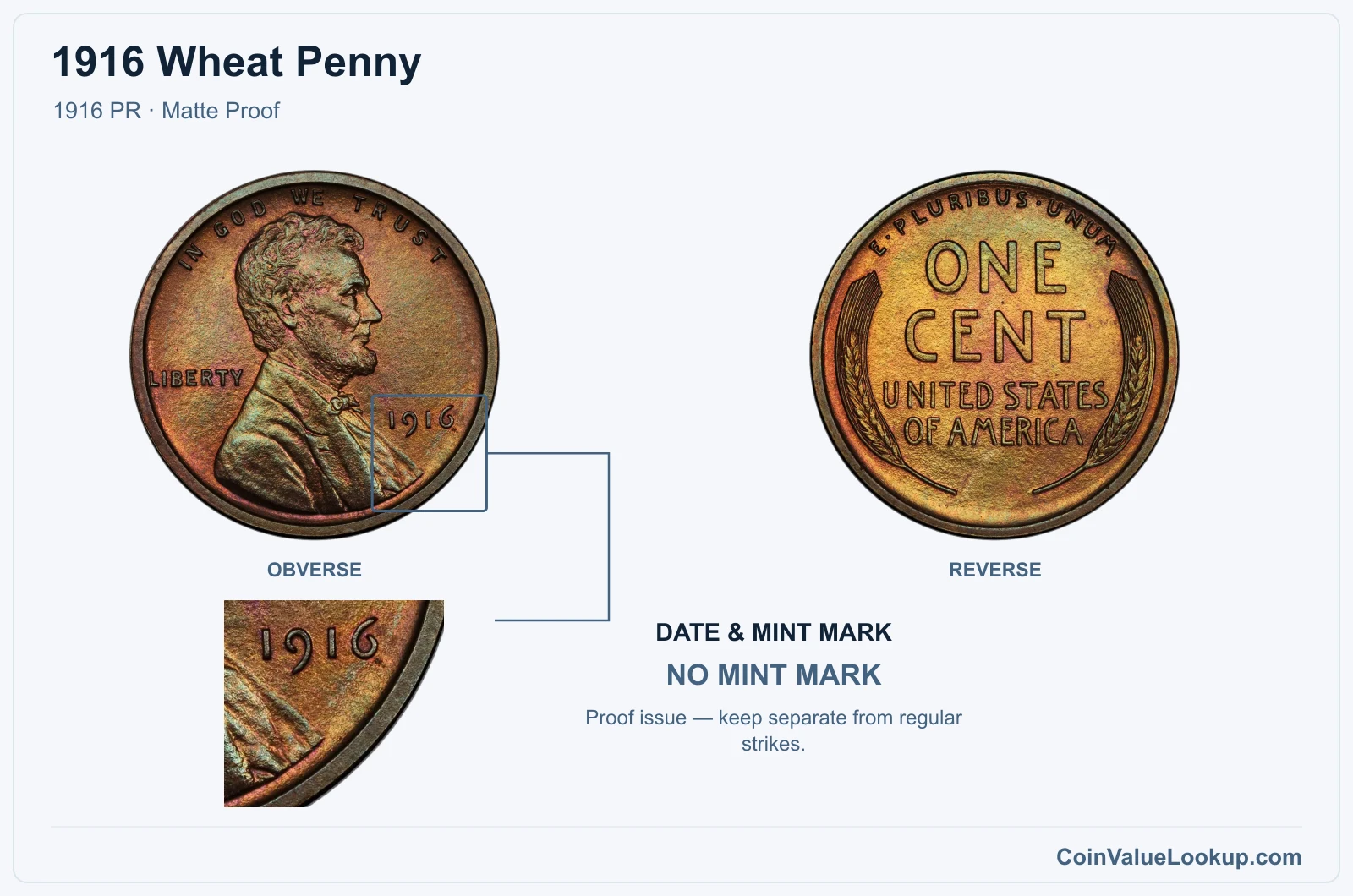
The 1916 matte proof is a Philadelphia product with no mintmark, and it is the last year Lincoln cent matte proofs were made. That alone gives it strong collector demand.
A PR63 example carries a guide value near $3,429. Identifying one takes more than a sharp strike.
Genuine matte proofs have a prepared granular surface, not the brilliant mirror finish of later proofs. The rims are squared and precise, and overall detail is exceptionally sharp.
If your coin simply looks lustrous and well-preserved, it is almost certainly a nice business strike, not a proof. Professional authentication is strongly recommended before assuming you hold one of these.
| Range | Grade | Price | Auction Records | Appraisal |
|---|---|---|---|---|
| PR | PR 1 | — | Coin Identifier | |
| PR 2 | — | Coin Identifier | ||
| PR 3 | — | Coin Identifier | ||
| PR 4 | — | Coin Identifier | ||
| PR 6 | — | Coin Identifier | ||
| PR 8 | — | Coin Identifier | ||
| PR 10 | — | Coin Identifier | ||
| PR 12 | — | Coin Identifier | ||
| PR 15 | — | Coin Identifier | ||
| PR 20 | — | Coin Identifier | ||
| PR 25 | — | Coin Identifier | ||
| PR 30 | — | Coin Identifier | ||
| PR 35 | — | Coin Identifier | ||
| PR 40 | — | Coin Identifier | ||
| PR 45 | — | Coin Identifier | ||
| PR 50 | — | Coin Identifier | ||
| PR 53 | — | Coin Identifier | ||
| PR 55 | — | Coin Identifier | ||
| PR 58 | Coin Identifier | |||
| PR 60 | — | Coin Identifier | ||
| PR 61 | — | Coin Identifier | ||
| PR 62 | — | Coin Identifier | ||
| PR 63 | Coin Identifier | |||
| PR 64 | Coin Identifier | |||
| PR 65 | Coin Identifier | |||
| PR 66 | Coin Identifier | |||
| PR 67 | — | Coin Identifier | ||
| PR 68 | — | — | — | |
| PR 69 | — | — | — | |
| PR 70 | — | — | — |
1916 Wheat Penny Error List
1. 1916 Wheat Penny — Doubled Die Obverse
A doubled die obverse on a 1916 Wheat cent shows consistent doubling in the obverse lettering or design elements. Under magnification, look for separation or notching on letters such as LIBERTY, IN GOD WE TRUST or the date numerals.
The doubling should be uniform and repeatable across the affected area, not random or flat-shelf in appearance.
Machine doubling is the most common lookalike. It produces a flat, shelf-like distortion rather than the rounded separation of a true doubled die.
Reflections from worn dies can also mimic doubling under certain lighting. Pricing depends entirely on the specific variety, its severity and the coin's authenticated condition, so no standard range applies.
Professional grading is the safest route to confirming this type of error.
2. 1916 Wheat Penny — Repunched Mintmark
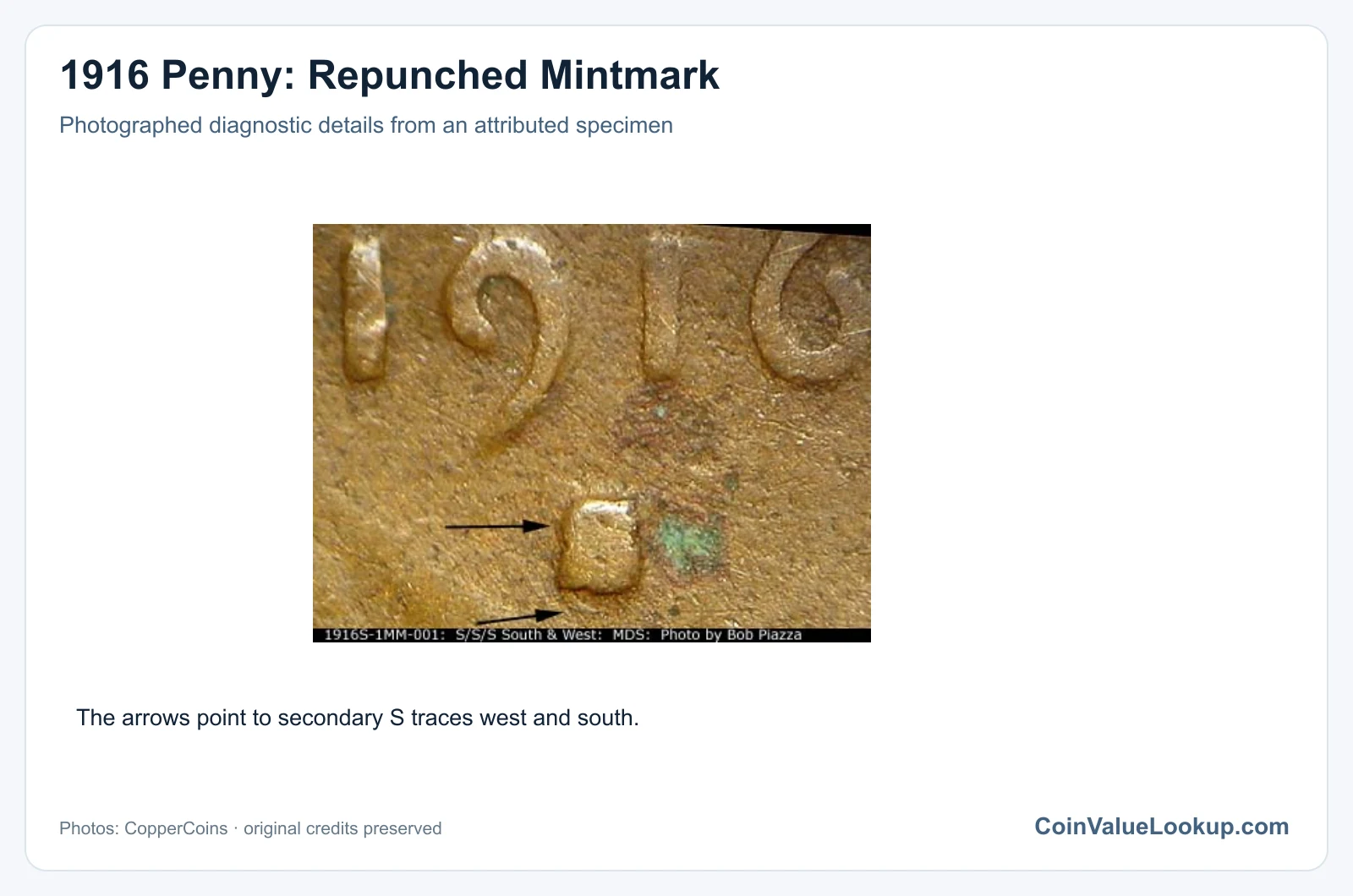
Repunched mintmarks apply only to the 1916-D and 1916-S, since Philadelphia coins carry no mintmark. Look below the date for traces of a second mintmark position, showing as a shadow or remnant letter offset from the primary punch.
You will need at least 5x magnification and good directional lighting.
Corrosion around the mintmark, minor die chips and machine doubling can all create shapes that look like a repunched mark but are not. Compare your coin at matching magnification to a confirmed normal example.
The value of a repunched mintmark depends on its clarity, the specific variety and the overall grade of the coin. Each piece is assessed individually once authenticated.
3. 1916 Wheat Penny — Lamination / Split Planchet
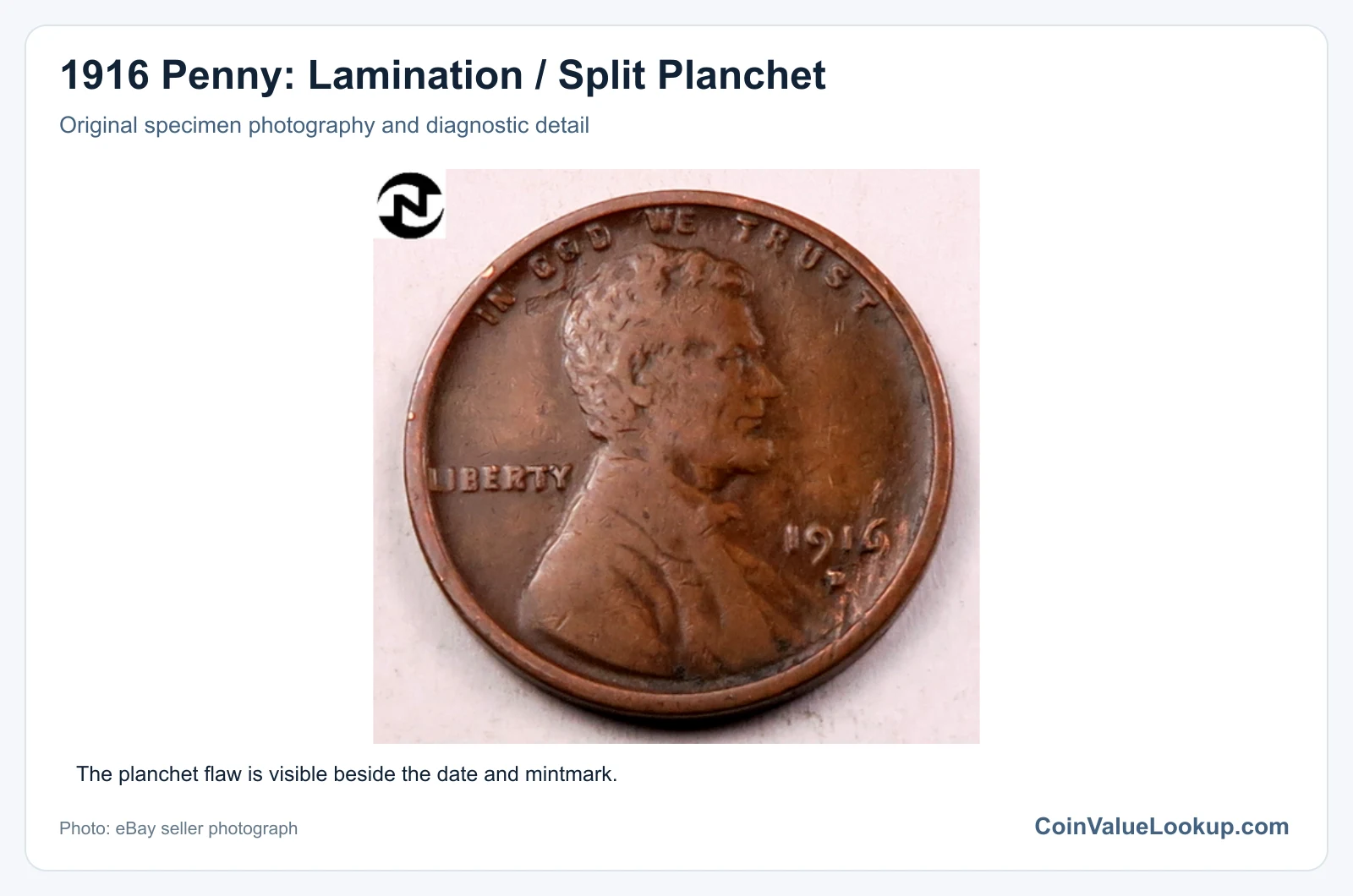
Lamination errors happen when the planchet alloy separates internally, producing peeling metal, a retained flap or a visible split within the copper surface. On a 1916 cent, look for a raised section of metal that appears ready to lift away, or an area where a layer has already detached.
Photograph both the affected face and the edge together so the depth of the separation is clear. Scraping damage, corrosion pitting and coins that have been deliberately cut or gouged can look similar at first glance.
The key difference is that a genuine lamination follows the contour of the planchet rather than showing tool marks or random corrosion patterns. Value depends on the size and visual impact of the flaw, plus the coin's overall condition, so individual assessment is necessary.
4. 1916 Wheat Penny — Off-Center Strike
An off-center strike occurs when the planchet is not properly seated between the dies, shifting the design to one side and leaving an unstruck crescent of blank metal. On a 1916 cent the most collectible examples retain a full, readable date despite the misalignment.
Do not confuse an off-center strike with a clipped planchet, which shows a curved bite out of otherwise centered design, or with post-mint damage from a vise or hammer. A genuine off-center coin will have a consistent blank crescent opposite the shifted design and no damage marks on the unstruck area.
Value varies widely with the percentage of off-center shift and whether the date is visible, so each example needs individual evaluation.
5. 1916 Wheat Penny — Die Crack / Die Chip
Die cracks appear as thin raised lines running across the coin's surface, caused by fractures in the steel die during production. Die chips are small raised blobs from a tiny piece of the die face breaking away.
Both are genuine mint-made features.
On a 1916 cent, check both faces for fine raised ridges that follow no design element. An interior chip is a small isolated bump, while a crack often runs from one design element to another or from the rim inward.
Incuse scratches, corrosion trails and debris stuck to the surface can mimic these features but will be recessed or irregularly textured rather than cleanly raised. Each die crack or chip is valued by its size, location and the coin's condition.
6. 1916 Wheat Penny — BIE Die Break
A BIE error is a specific type of die break that leaves a small raised vertical bar or blob between the letters B and E in LIBERTY on the obverse. It happens when the die cracks in that narrow space, and it is one of the most popular minor varieties among Wheat cent collectors.
To spot one, examine LIBERTY under magnification. The raised feature should be clearly connected to or sitting between those two letters and should be raised above the field, not incuse.
Dirt, scratches or tiny bits of foreign material stuck in the letters can mimic the appearance. Cleaning the coin is not recommended.
Value depends on the prominence of the break and the coin's overall grade, assessed individually.
7. 1916 Wheat Penny — Die Break / Cud
A cud is a major die break that connects to the rim, leaving a raised, featureless lump of metal where part of the design should be. It forms when a section of the die edge breaks away entirely.
On a 1916 cent, look for a smooth raised area along the rim that interrupts the normal lettering or design.
Do not confuse a cud with a rim dent or ding from post-mint damage, which will be recessed rather than raised. Interior die chips also differ because they sit away from the rim.
A true cud will have a clear boundary where normal design detail stops and the flat raised mass begins. Size and location heavily influence collector interest, and each piece requires individual assessment for value.
8. 1916 Wheat Penny — Broadstrike
A broadstrike occurs when the coin is struck without the normal retaining collar, allowing the metal to spread outward. The design is present but the coin appears wider and thinner than normal, with a distorted or missing rim.
The 1916-D has been specifically documented with an uncentered broadstrike example.
Look at the edge profile. A broadstrike will show outward metal flow and a weak or absent rim all the way around, unlike an off-center strike where part of the planchet stays blank.
Post-mint flattening from a press or heavy object can stretch a coin similarly, but it usually leaves uneven distortion and tool marks. Genuine broadstrikes are valued individually based on how dramatic the spread is and the coin's authenticated condition.