1966 Roosevelt Dime Coin Value: How Much Is It Worth?
Ordinary worn 1966 Roosevelt dimes are worth their ten-cent face value. A guide estimate for an uncirculated MS65 example is about $2.79 according to USA Coin Book.
The real action starts when you look at Special Mint Set finishes, specific varieties and mint errors, each of which can carry a meaningful premium over that baseline.
Fast Way to Identify Your 1966 Roosevelt Dime
Snap clear photos of both the front and back of your 1966 dime and upload them here. That gives us a starting point for preliminary identification — figuring out whether you have an ordinary business strike, a Special Mint Set coin, or something with an error worth investigating further.
Good lighting and a steady hand help a lot.
1966 Roosevelt Dime Value
Upload both sides of your 1966 Roosevelt Dime.
Front Obverse
Upload photo
Back Reverse
Upload photo
Which 1966 Roosevelt Dime Versions Are Worth Money?
- Business-strike examples in MS65 or higher with Full Bands torch detail can exceed the base guide estimate.
- Special Mint Set dimes with genuine cameo contrast are a separate collectible category worth individual assessment.
- The SMS "Five on Cheek" variety is recognized by PCGS and trades based on authenticated attribution and condition.
- A Major Obverse Die Break on business strikes adds a premium once the raised displaced metal is confirmed.
- Missing Obverse Clad Layer After Strike — one NGC MS62 specimen sold for $79 at Heritage Auctions in December 2020.
- Off-Center Strikes retaining the date command attention; a roughly 35% off-center example has been certified NGC MS64.
Step 1: Identify Your 1966 Roosevelt Dime Mint Mark and Version
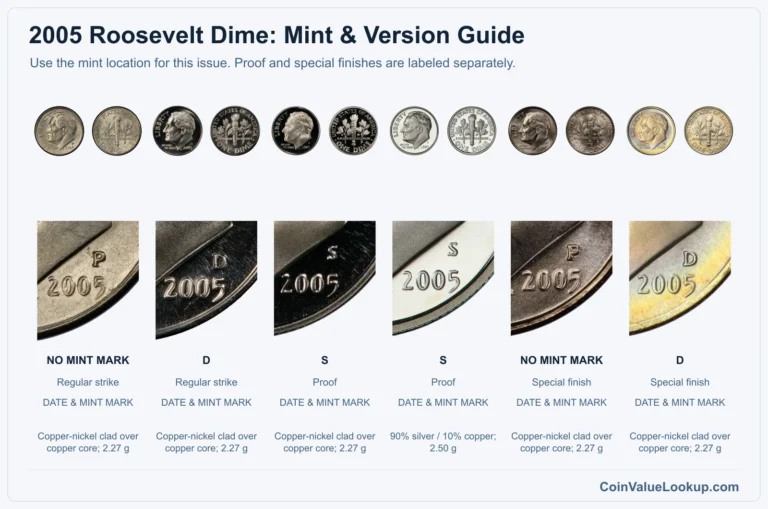
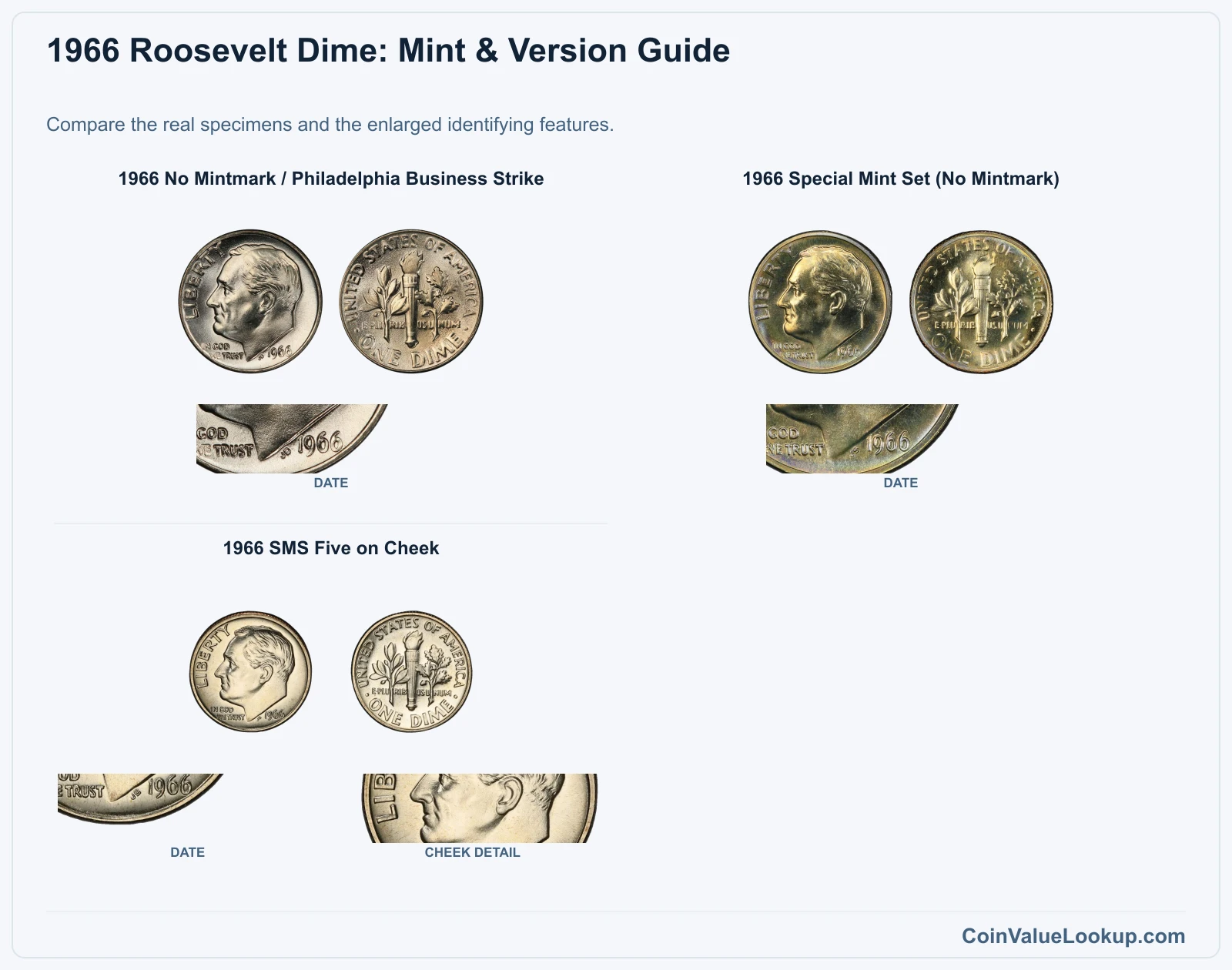
Every 1966 Roosevelt dime lacks a mintmark. That is normal — neither ordinary business strikes nor Special Mint Set coins received one during 1965–1967.
So you cannot sort versions by a tiny letter near the date.
The standard metal is copper-nickel clad over a copper core, weighing about 2.27 grams and measuring roughly 17.9 mm across. No silver or proof version exists for 1966.
If your dime looks silver-colored and weighs the expected amount, it is the regular clad composition. Color alone is not a reliable alloy test.
To tell a business strike from a Special Mint Set piece, look at the overall surface quality. SMS coins typically show sharper detail and a more reflective finish than circulation strikes, though they are not proofs.
Some SMS dimes display cameo contrast — frosted devices against mirror-like fields — which is a separate collectible distinction.
Step 2: Check Your 1966 Roosevelt Dime Grade
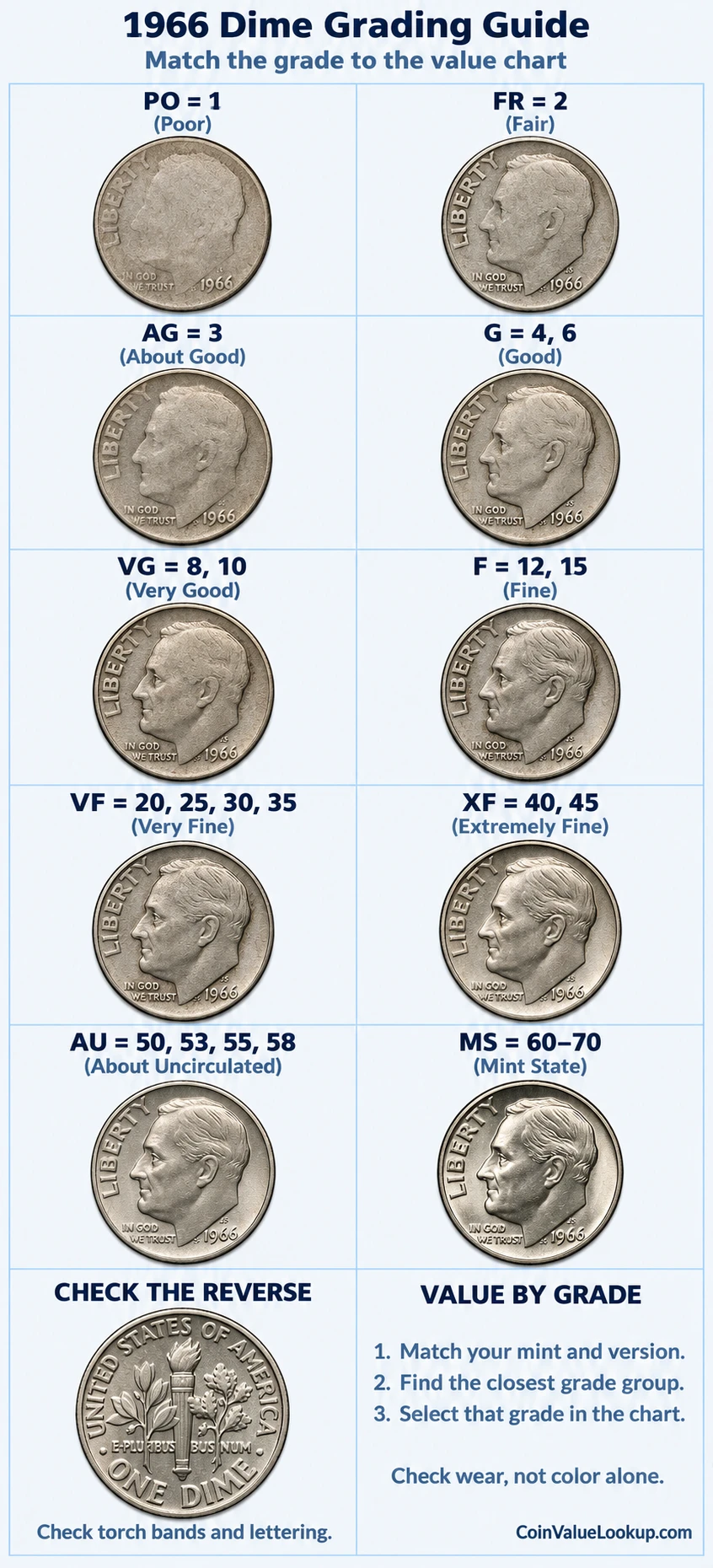
Start with Roosevelt's cheekbone and jawline. Those are the highest points on the obverse, and they lose detail first as a coin circulates.
On the reverse, check the torch and the leaf clusters flanking it.
Tilt the coin under a single light source. Broken or patchy luster signals wear, while a flat, lifeless look across the devices often means cleaning — which drops the grade regardless of remaining detail.
Hairlines and scratches from improper handling count against a coin too.
Full Bands is a strike designation, not a grade. It refers to the clear separation of both horizontal band pairs on the torch.
A coin can be MS65 without Full Bands, or MS63 with them. Grade and strike designation are evaluated separately.
Use the comparison image to match your coin's wear pattern against known grade benchmarks. That side-by-side approach beats guessing every time.
Step 3: Check 1966 Roosevelt Dime Value by Mint and Version
1966 Roosevelt Dime — No Mintmark / Philadelphia Business Strike
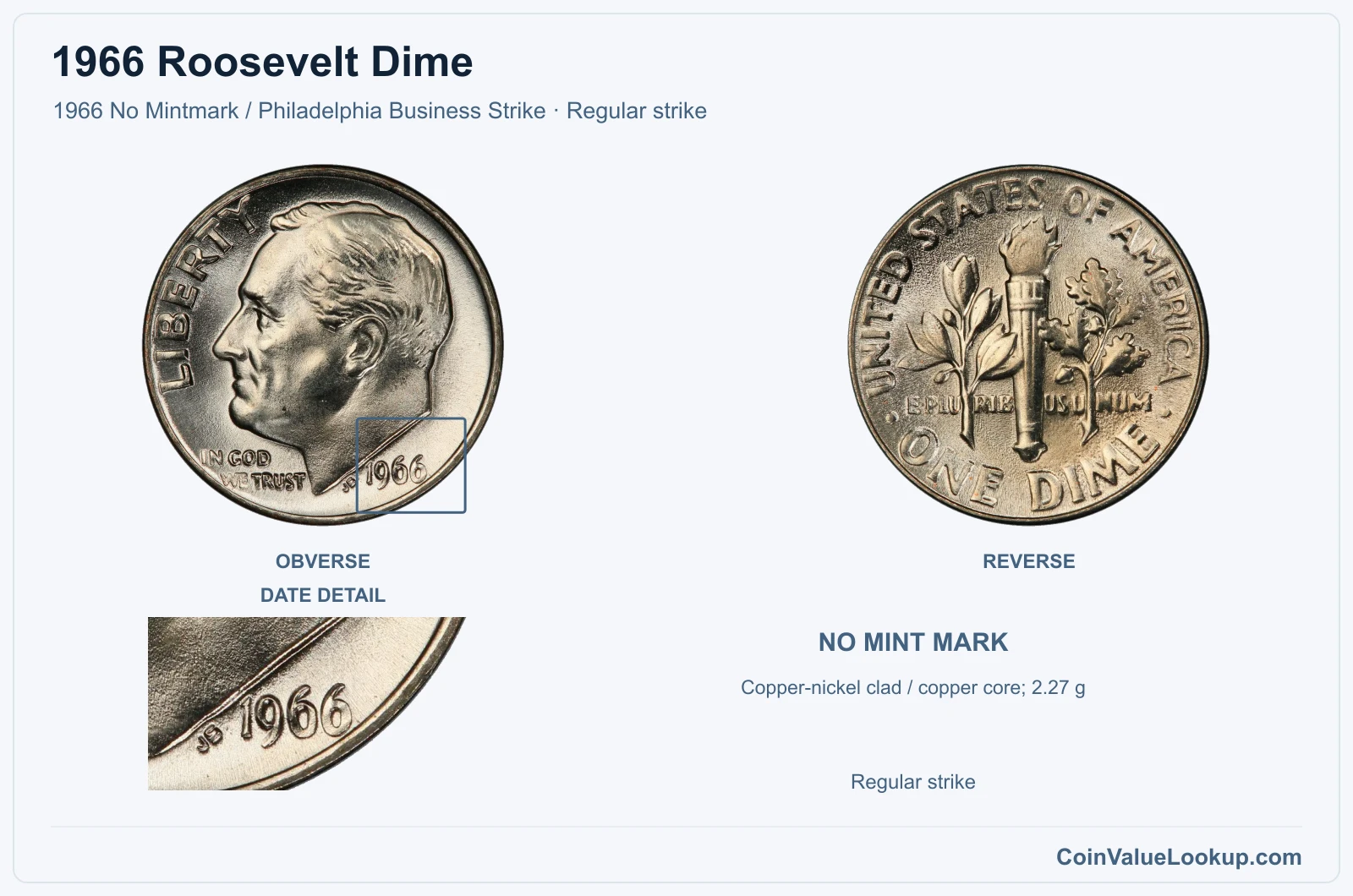
This is the standard 1966 dime you will find in pocket change. It has no mintmark, which is expected — not a sign of anything special.
The metal is copper-nickel clad over a copper core at about 2.27 grams.
In circulated condition, it is worth face value. The USA Coin Book guide estimate for MS65 is $2.79.
Coins with original, undamaged surfaces and Full Bands torch detail are the ones that command a bit more attention from collectors.
Coin Value Lookup is a good place to look up guides for other Roosevelt dime dates if you are sorting through a group. Compare coins of matching grade and Full Bands designation for an accurate picture of where your piece sits.
Range Grade
Price Auction Records Appraisal PO PO 1
—
Coin Identifier FR FR 2
—
Coin Identifier AG AG 3
—
Coin Identifier G G 4
—
Coin Identifier
G 6
—
Coin Identifier VG VG 8
—
Coin Identifier
VG 10
—
Coin Identifier F F 12
—
Coin Identifier
F 15
—
Coin Identifier VF VF 20
—
Coin Identifier
VF 25
—
Coin Identifier
VF 30
—
Coin Identifier
VF 35
—
Coin Identifier XF XF 40
—
Coin Identifier
XF 45
—
Coin Identifier AU AU 50
—
Coin Identifier
AU 53
—
Coin Identifier
AU 55
—
Coin Identifier
AU 58
Coin Identifier MS MS 60
—
Coin Identifier
MS 61
—
Coin Identifier
MS 62
—
Coin Identifier
MS 63
—
Coin Identifier
MS 64
—
Coin Identifier
MS 65
Coin Identifier
MS 66
Coin Identifier
MS 67
Coin Identifier
MS 68
Coin Identifier
MS 69
—
—
—
MS 70
—
—
—
1966 Roosevelt Dime — Special Mint Set (No Mintmark)
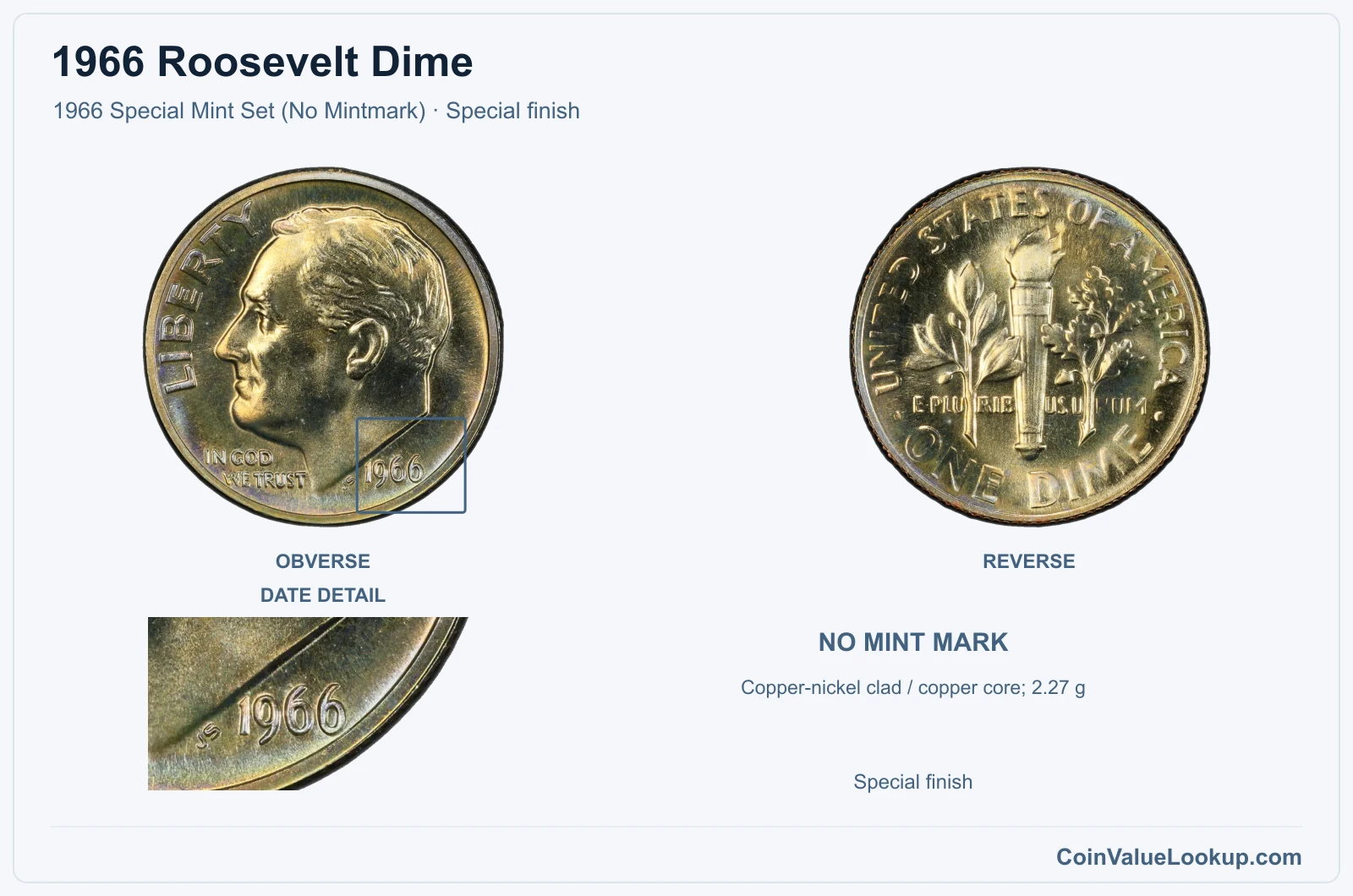
Special Mint Set dimes were produced at the San Francisco facility during 1965–1967. They carry no mintmark, just like business strikes, so the surface finish is your main clue.
Look for sharper rims, crisper device edges and a more reflective field than a typical circulation coin.
SMS is not a proof. It is a distinct manufacturing finish that falls somewhere between a business strike and a proof in visual quality.
Some SMS dimes show cameo contrast — frosted raised elements against mirrored fields — and those tend to attract collector interest.
No specific guide price range was adopted for this version, so value depends on the individual coin's authenticated condition, finish quality and whether cameo or deep cameo designations apply. Third-party grading makes a real difference here.
Range Grade
Price Auction Records Appraisal SP SP 1
—
Coin Identifier
SP 2
—
Coin Identifier
SP 3
—
Coin Identifier
SP 4
—
Coin Identifier
SP 6
—
Coin Identifier
SP 8
—
Coin Identifier
SP 10
—
Coin Identifier
SP 12
—
Coin Identifier
SP 15
—
Coin Identifier
SP 20
—
Coin Identifier
SP 25
—
Coin Identifier
SP 30
—
Coin Identifier
SP 35
—
Coin Identifier
SP 40
—
Coin Identifier
SP 45
—
Coin Identifier
SP 50
—
Coin Identifier
SP 53
—
Coin Identifier
SP 55
—
Coin Identifier
SP 58
—
Coin Identifier
SP 60
—
Coin Identifier
SP 61
—
Coin Identifier
SP 62
—
Coin Identifier
SP 63
—
Coin Identifier
SP 64
—
Coin Identifier
SP 65
Coin Identifier
SP 66
Coin Identifier
SP 67
Coin Identifier
SP 68
Coin Identifier
SP 69
Coin Identifier
SP 70
—
—
—
1966 Roosevelt Dime — SMS Five on Cheek
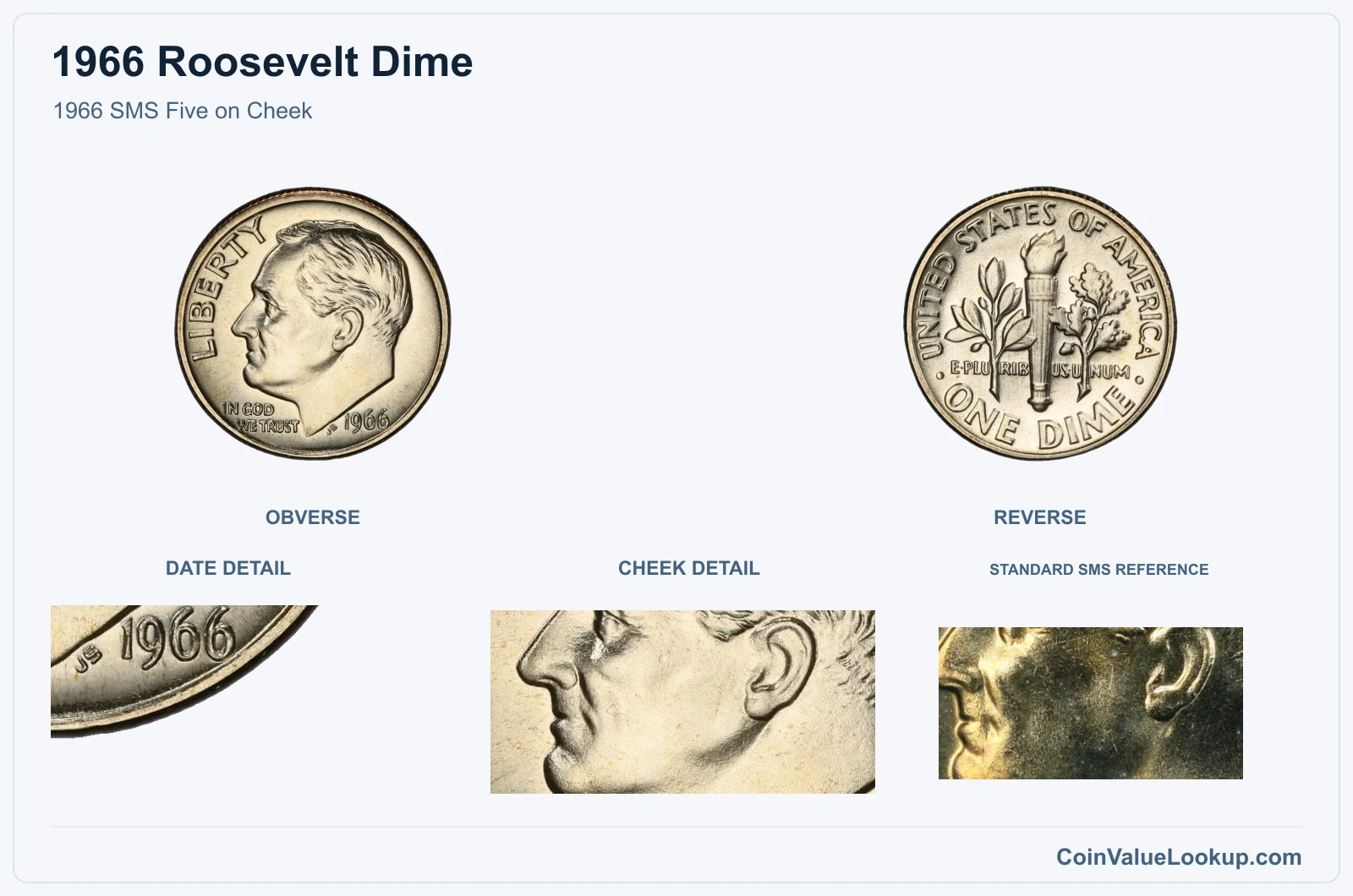
This is a recognized PCGS variety specific to 1966 Special Mint Set dimes. The nickname comes from a raised marking on Roosevelt's cheek that roughly resembles the numeral five.
It is not literally a transferred date digit — the name is a collector shorthand for the shape.
Only attributed SMS specimens qualify. If your coin is a regular business strike or the cheek mark does not match the known diagnostic, it is a different coin.
Look for the feature under magnification and compare against an attributed example.
No specific guide price range was adopted for this variety. Value depends on the individual coin's condition, clarity of the cheek feature and third-party attribution.
Unattributed examples are harder to sell at a premium.
Range Grade
Price Auction Records Appraisal SP SP 1
—
Coin Identifier
SP 2
—
Coin Identifier
SP 3
—
Coin Identifier
SP 4
—
Coin Identifier
SP 6
—
Coin Identifier
SP 8
—
Coin Identifier
SP 10
—
Coin Identifier
SP 12
—
Coin Identifier
SP 15
—
Coin Identifier
SP 20
—
Coin Identifier
SP 25
—
Coin Identifier
SP 30
—
Coin Identifier
SP 35
—
Coin Identifier
SP 40
—
Coin Identifier
SP 45
—
Coin Identifier
SP 50
—
Coin Identifier
SP 53
—
Coin Identifier
SP 55
—
Coin Identifier
SP 58
—
Coin Identifier
SP 60
—
Coin Identifier
SP 61
—
Coin Identifier
SP 62
—
Coin Identifier
SP 63
—
Coin Identifier
SP 64
—
Coin Identifier
SP 65
—
Coin Identifier
SP 66
—
Coin Identifier
SP 67
—
Coin Identifier
SP 68
—
—
—
SP 69
—
—
—
SP 70
—
—
—
1966 Roosevelt Dime Error List
1. 1966 Roosevelt Dime — Major Obverse Die Break
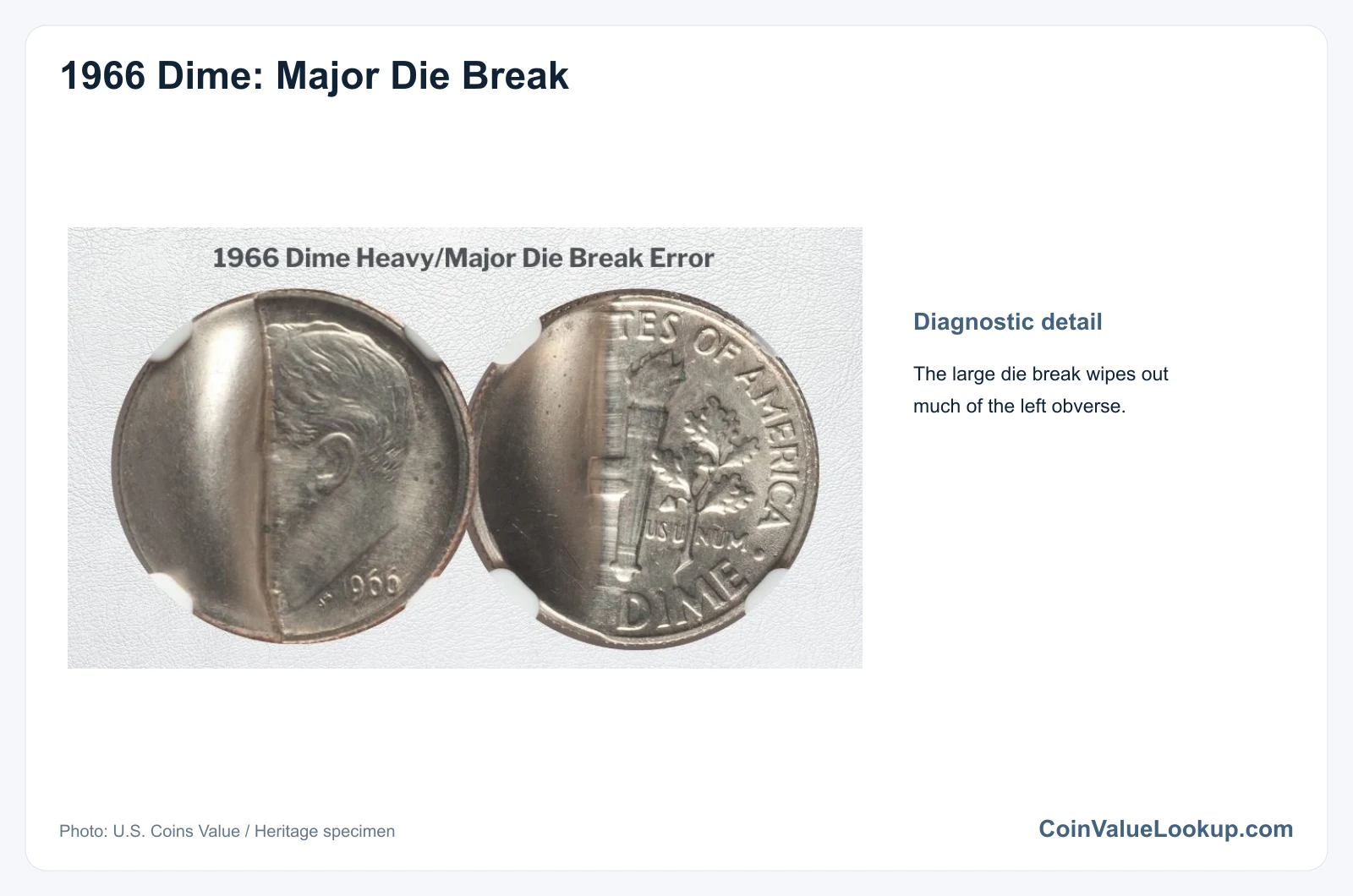
A major obverse die break shows up as raised, irregular displaced metal on the front of the coin. It forms when part of the die surface cracks and metal fills the gap during striking.
You should see a distinct ridge or blob that clearly does not belong to the normal design.
This applies to 1966 business-strike clad dimes. An NGC MS66 specimen of this error has been documented through Heritage Auctions.
Do not confuse a die break with post-mint dings, corrosion bumps or generic contact marks. A genuine die break follows a consistent pattern and appears raised, not gouged.
No specific price range was adopted for this error. The coin's value depends on the size and location of the break, overall grade and third-party certification confirming the attribution.
2. 1966 Roosevelt Dime — Missing Obverse Clad Layer After Strike
When the obverse clad layer separates after the coin is struck, the copper core underneath is exposed. The result is a dime with a visibly different color on one side — copper-toned rather than silvery — and a noticeably lighter weight.
One certified example, graded NGC MS62 and weighing just 1.8 grams, sold for $79 at Heritage Auctions in December 2020. That is a single documented sale, not a guaranteed price for every copper-looking dime you find.
The key distinction is "after strike." The design was fully impressed before the layer came off. Post-mint environmental damage, abrasion or corrosion can mimic the look, so compare weight and surface character to a certified specimen.
This error applies to 1966 business-strike clad dimes.
3. 1966 Roosevelt Dime — Off-Center Strike
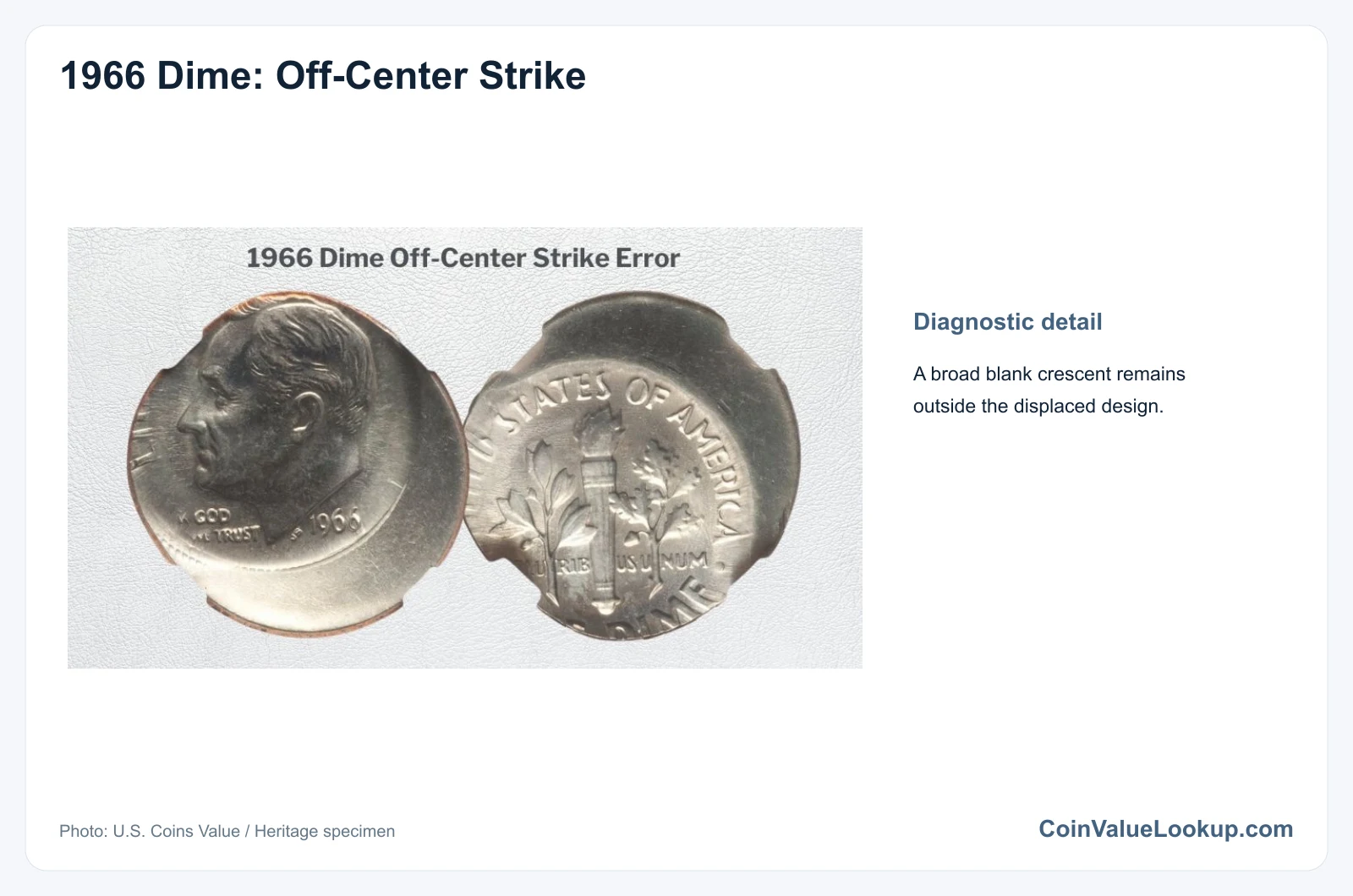
An off-center strike happens when the planchet is not seated properly in the collar during striking. The design shifts to one side, leaving a blank crescent of unstruck metal on the opposite edge.
The displacement should appear on both sides of the coin. If only one side looks shifted, you may have a misaligned die instead, which is a less dramatic error.
A broadstrike — where the collar fails entirely — is also different.
One example, approximately 35% off center, was certified NGC MS64 and appeared in a Heritage Auctions lot. Retaining the date is important — collectors strongly prefer off-center dimes where you can still read 1966.
No specific price range was adopted; value depends on the percentage of displacement, whether the date is visible, and the coin's overall condition.
4. 1966 Roosevelt Dime — Five-Shaped Cheek Mark on SMS
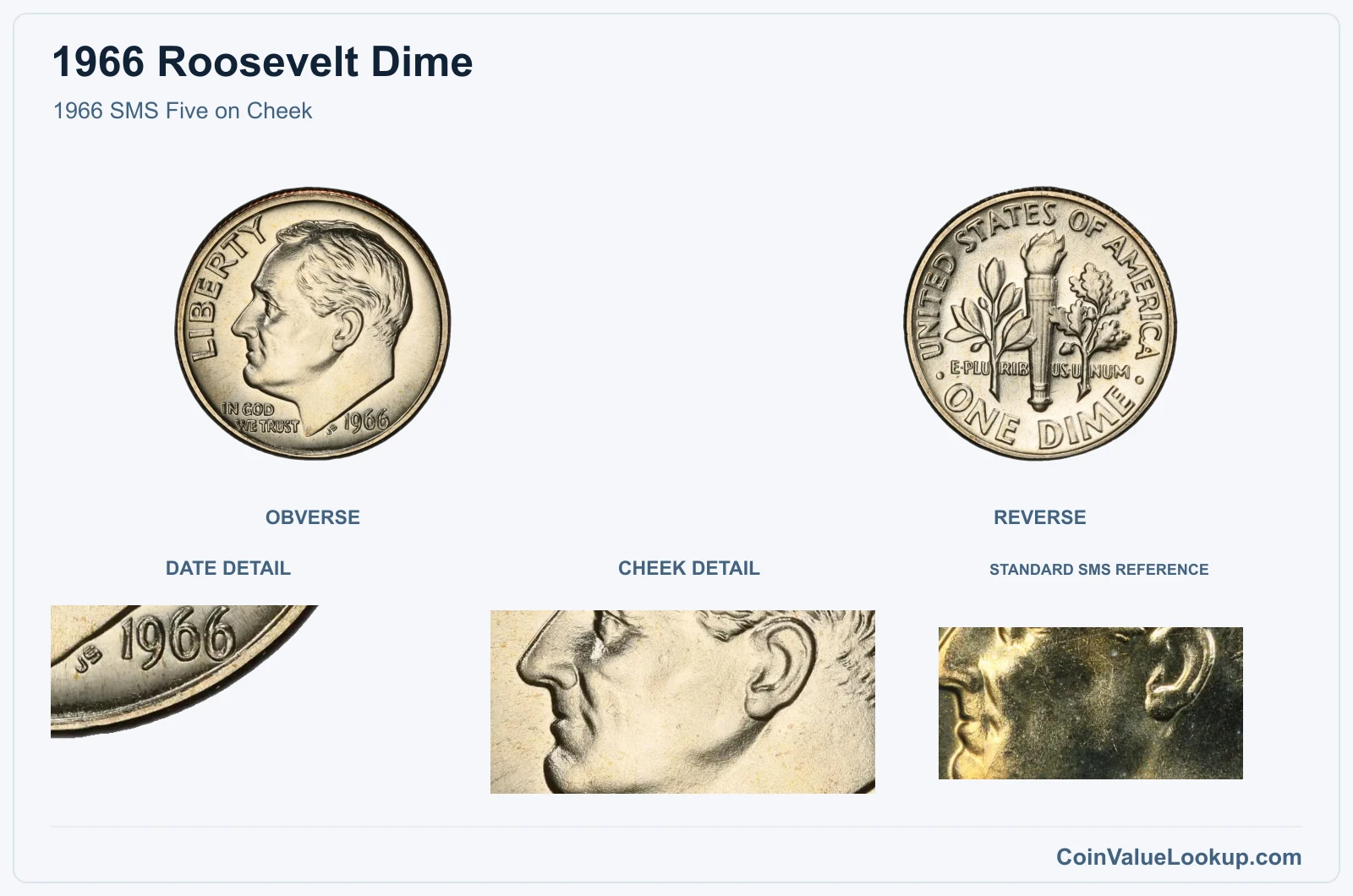
This variety is specific to 1966 Special Mint Set dimes and is recognized by PCGS. It gets its name from a raised marking on Roosevelt's cheek that loosely resembles a numeral five.
The nickname describes the shape, not a confirmed production mechanism.
Only SMS specimens qualify. If you have a business-strike 1966 dime with a cheek mark, it is something else — possibly post-mint damage.
Compare your coin under magnification to an attributed example, paying attention to the exact shape and position of the feature.
Lookalikes include scratches, contact marks and corrosion that happen after the coin leaves the mint. No specific price range was adopted.
Value hinges on third-party attribution confirming the variety, plus the coin's overall condition and surface quality.
5. 1966 Roosevelt Dime — Doubled Die Obverse
A Doubled Die Obverse on a 1966 dime shows consistent doubling on obverse design elements — typically letters or portions of the portrait. Under magnification, look for separation or notching on the affected features rather than a flat, shelf-like displacement.
The flat-shelf look is the hallmark of machine doubling, which is a strike artifact with little collector value. True doubled-die doubling has depth and consistency across the affected area.
Compare directly against a normal 1966 dime under the same lighting to spot the difference.
No specific price range was adopted. What a doubled-die dime is worth depends on the strength and visibility of the doubling, the coin's grade, and whether it has been attributed by a third-party grading service.
6. 1966 Roosevelt Dime — Doubled Die Reverse
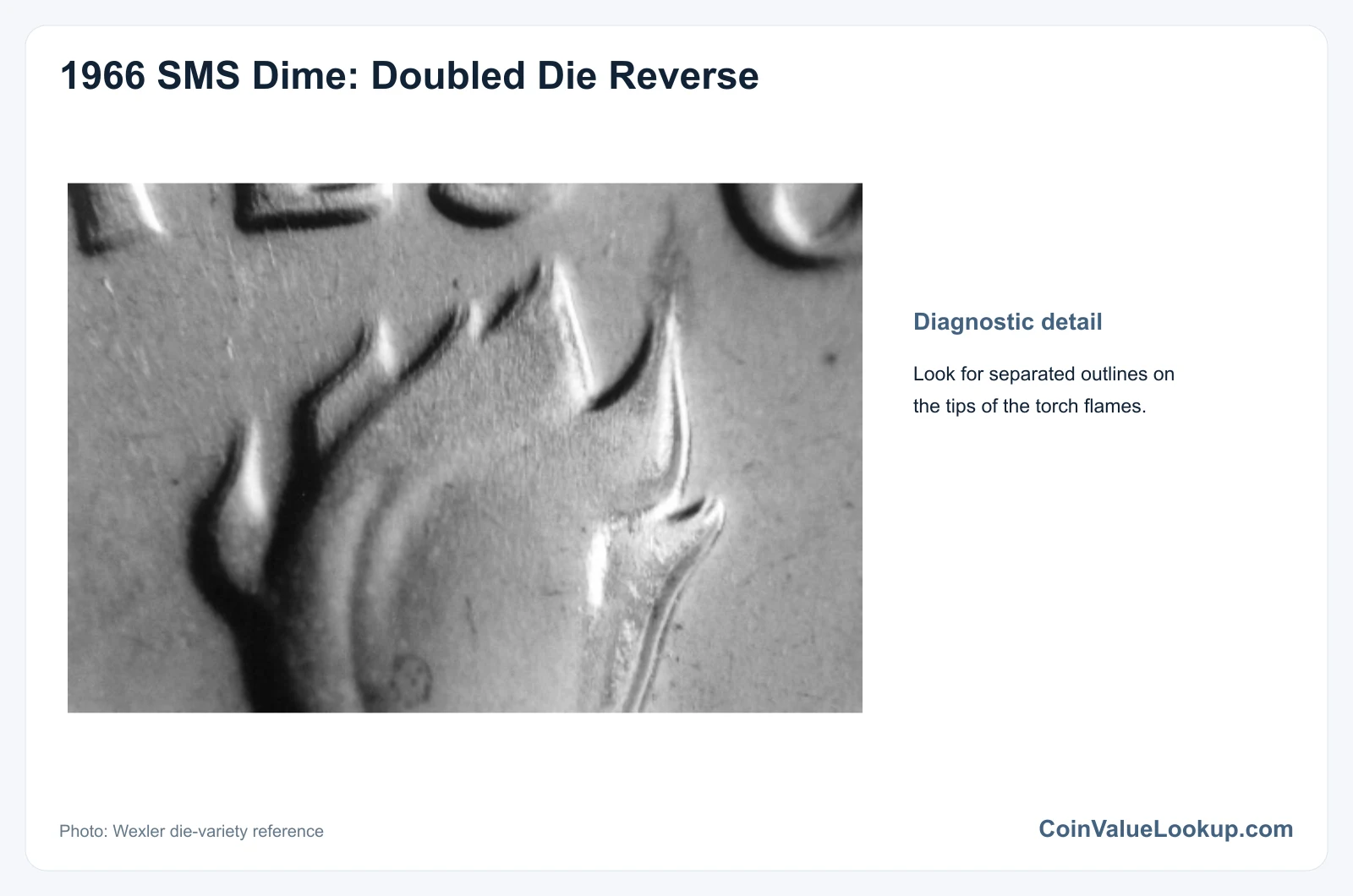
A Doubled Die Reverse involves doubling on the back of the coin — the torch, lettering, or other reverse design elements. The doubling should be consistent and repeatable across the affected area, not random or one-sided.
Compare your coin's reverse legends and design contours with a normal 1966 dime. Genuine doubled-die features show clear separation, while machine doubling tends to look like a flat shadow and is far more common.
Random nicks and abrasion are not doubling at all.
No specific price range was adopted for this variety. The premium depends on how strong the doubling is, which design elements are affected, the coin's overall grade, and third-party attribution.
A certified example with clear doubling will always command more confidence from buyers.
7. 1966 Roosevelt Dime — Clipped Planchet
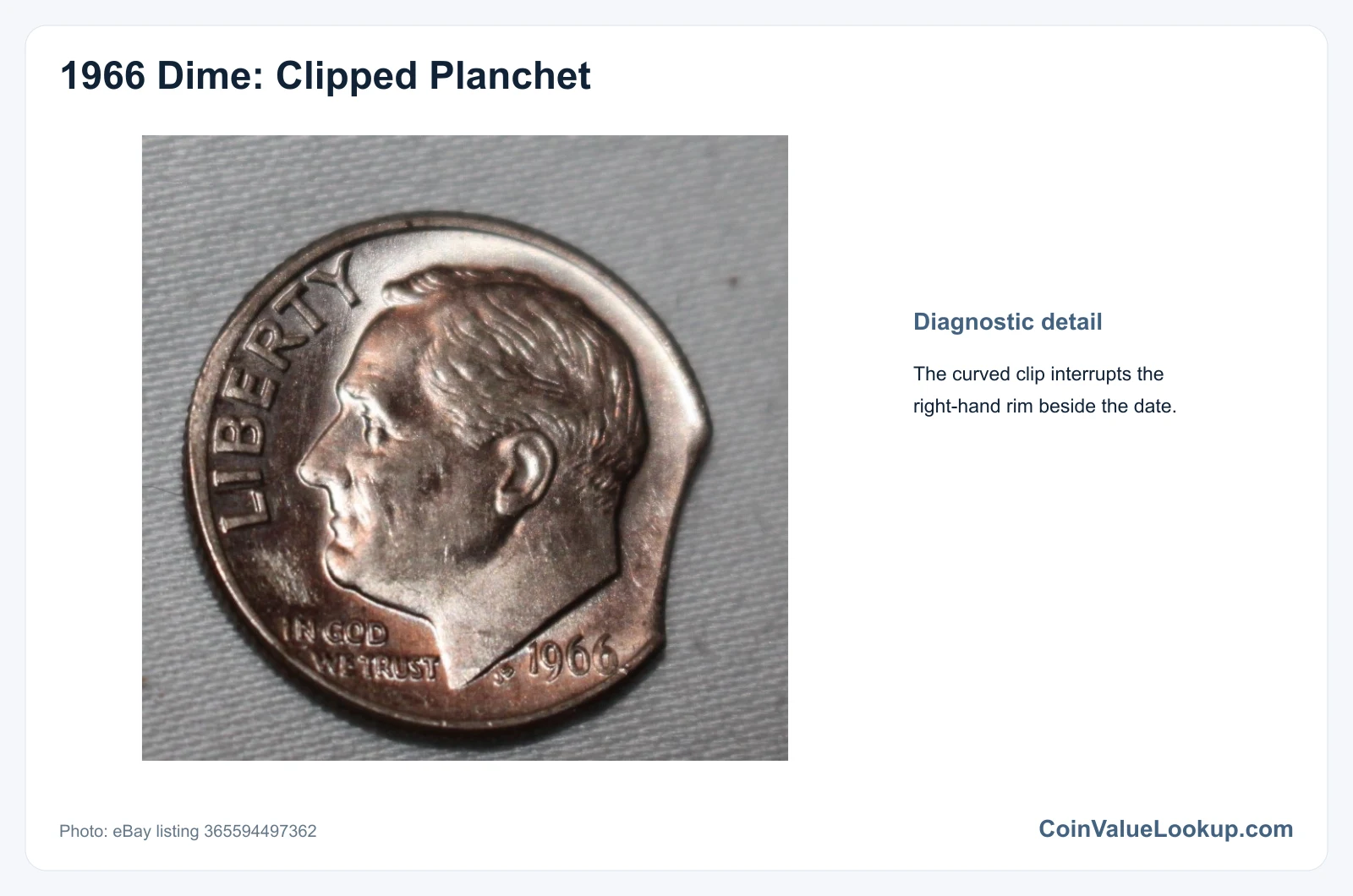
A clipped planchet error means part of the original blank was missing before the coin was struck. You will see a curved, straight, or irregularly shaped portion of the rim and design simply absent.
Often there is a corresponding area of weakness on the opposite side of the coin where metal flow was restricted.
Do not confuse this with a filed edge or post-mint damage. A genuine clip shows smooth, undisturbed metal flow at the boundary and may display a characteristic "Blakesley effect" — a weak area directly opposite the clip.
An edge that looks cut, notched or corroded is almost certainly damage.
No specific price range was adopted. Value depends on the size and type of clip, whether the date remains visible, and the coin's overall condition.
Third-party certification helps establish authenticity.