1971 Kennedy Half Dollar Coin Value: How Much Is It Worth?
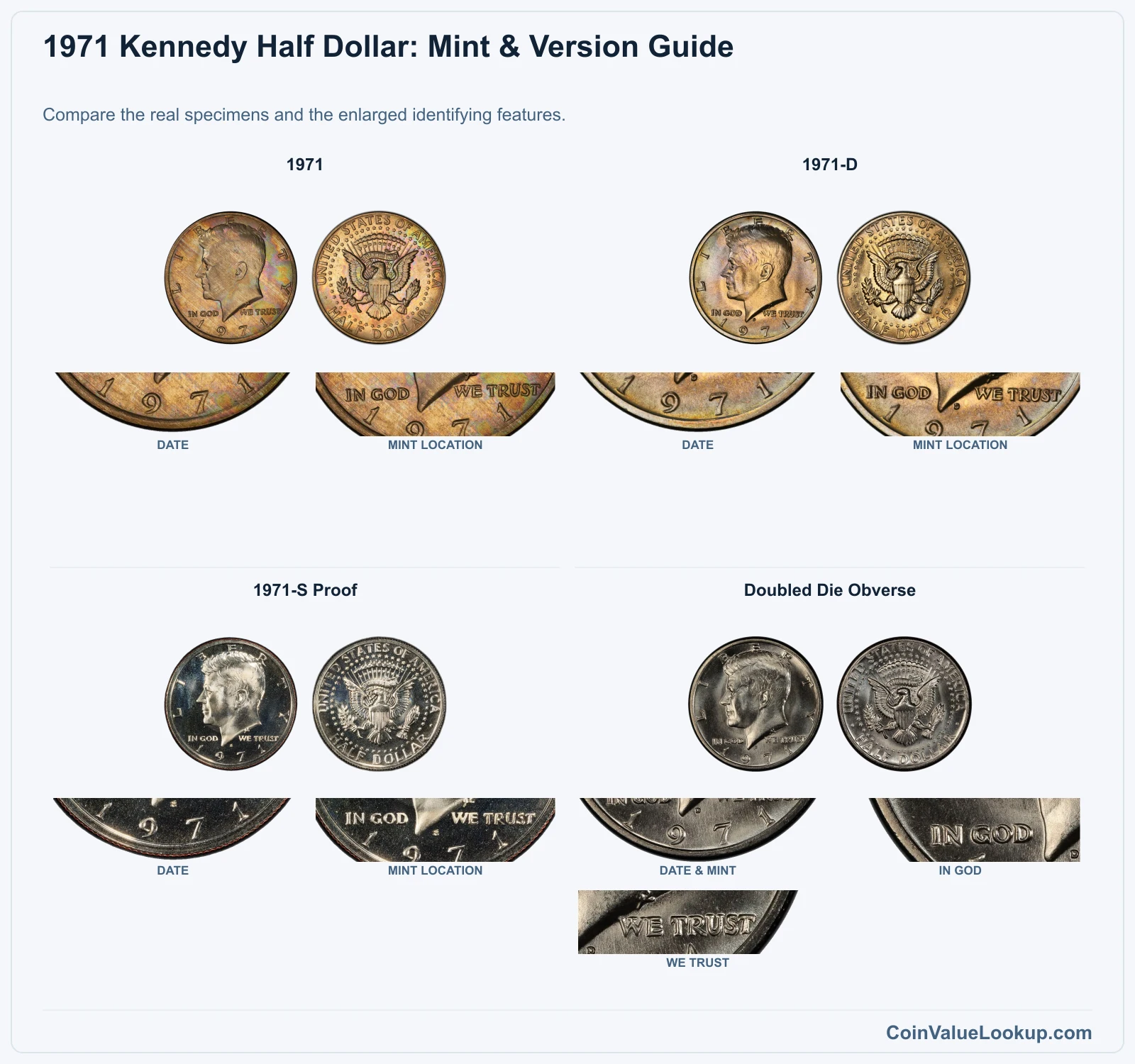
A typical circulated 1971 Kennedy half dollar is worth face value — fifty cents. In uncirculated condition around MS63, a guide estimate from USA Coin Book puts it at roughly $3.62.
This was the first year the Kennedy half switched from 40% silver to ordinary copper-nickel clad for regular circulation strikes, so most examples you find in change carry no silver premium at all.
Collector proofs, authenticated varieties and genuine mint errors occupy a different price tier entirely. Keep reading to learn which versions matter and how to tell them apart.
Fast Way to Identify Your 1971 Kennedy Half Dollar
The quickest way to get a preliminary identification of your 1971 Kennedy half dollar is to upload clear photos of the front and back. That lets us check the mintmark location, surface finish and any visible doubling or anomalies.
A sharp, well-lit image of each side goes a long way toward narrowing down what you have.
1971 Kennedy Half Dollar Value
Upload both sides of your 1971 Kennedy Half Dollar.
Front Obverse
Upload photo
Back Reverse
Upload photo
Which 1971 Kennedy Half Dollar Versions Are Worth Money?
- 1971-D Doubled Die Obverse — rounded, separated doubling visible in TRUST; value depends on authentication and condition.
- 1971-D struck on a leftover 40% silver planchet — a PCGS AU55 example sold for $6,037.50 at Heritage Auctions in September 2003.
- 1971-D struck on a cent planchet — a PCGS MS62 Red and Brown example brought $3,720 at Heritage Auctions in September 2019.
- 1971-S Proof Doubled Die Reverse — a documented proof variety; value varies with visibility and condition.
- Off-center strikes with a visible date command collector premiums that depend on the percentage of displacement.
- Missing FG designer initials on the reverse — caused by die polishing; value varies with completeness and condition.
Step 1: Identify Your 1971 Kennedy Half Dollar Mint Mark and Version
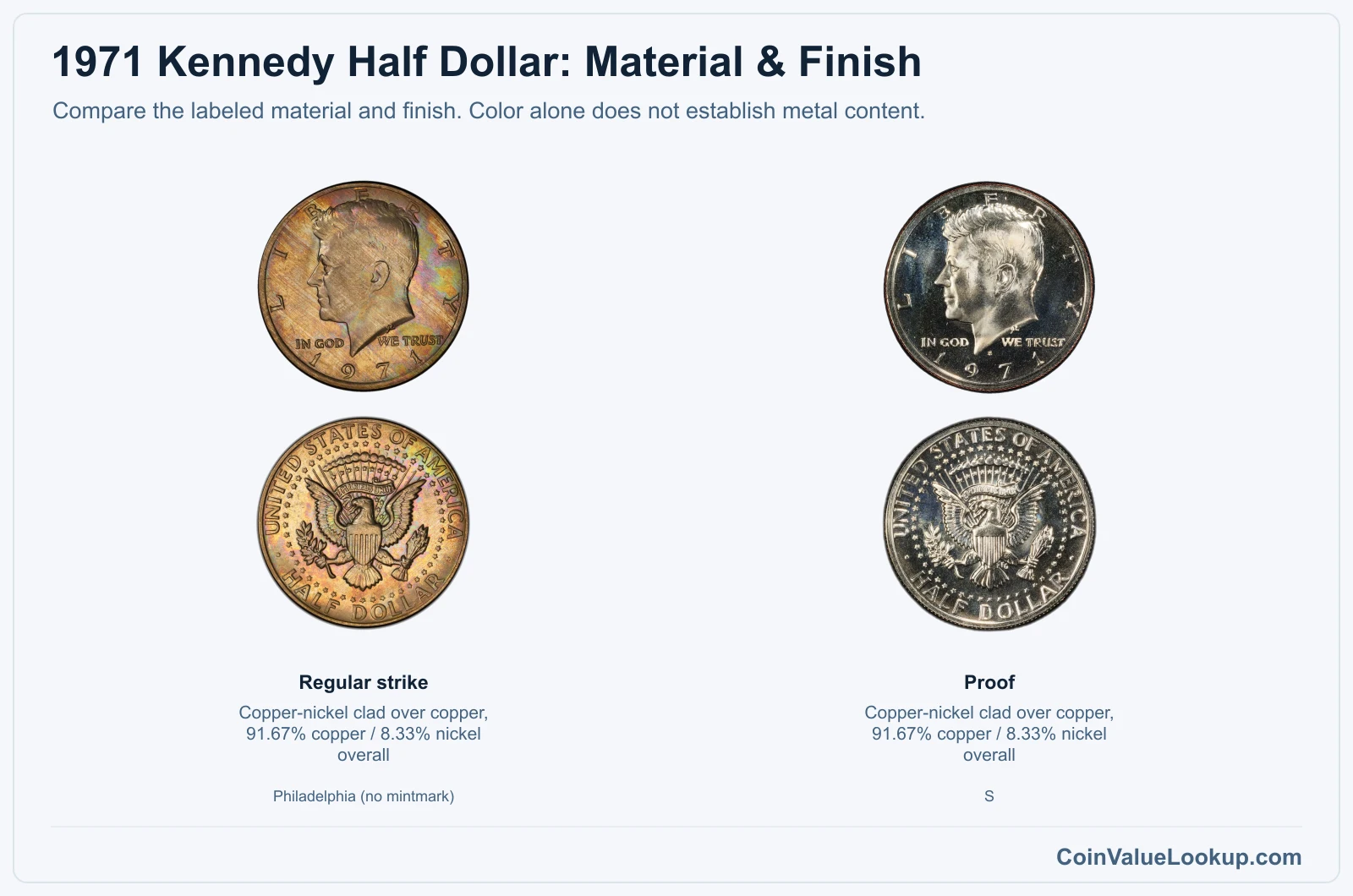
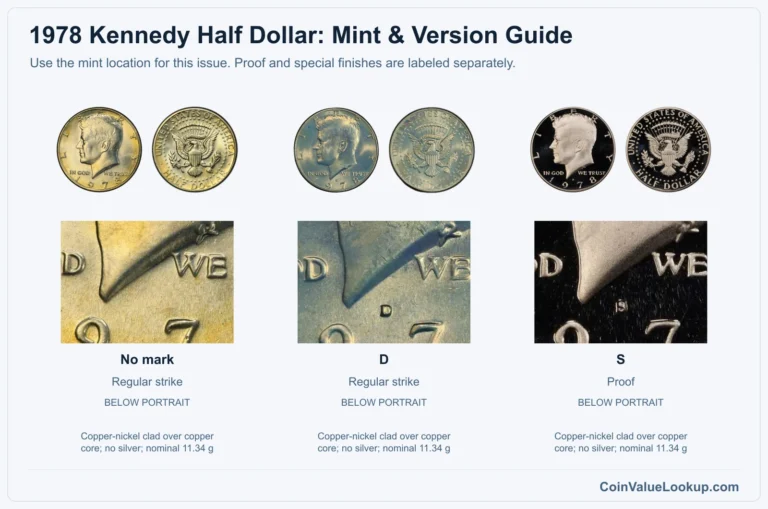
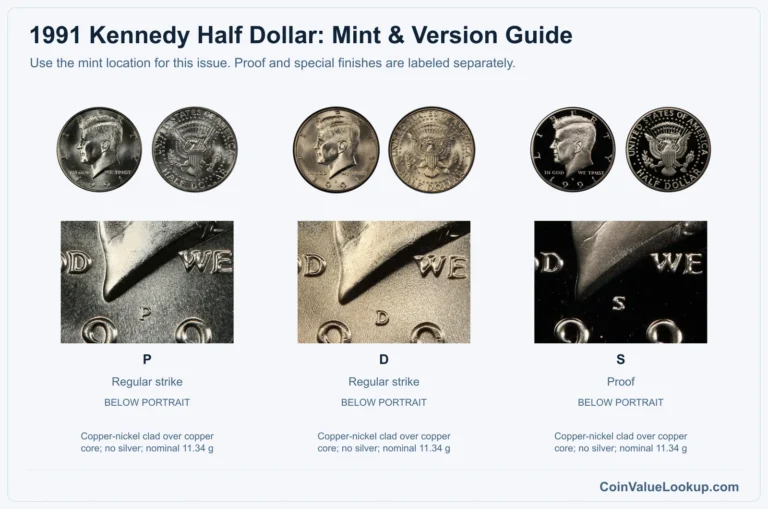
Three basic versions exist for 1971: the Philadelphia strike (no mintmark), the Denver strike (D mintmark) and the San Francisco proof (S mintmark). The mintmark sits on the obverse, just below Kennedy's neck and above the date.
All three are copper-nickel clad, not silver.
The coin weighs about 11.34 grams and measures roughly 30.61 mm across. Look at the edge — a copper-nickel clad half shows a visible copper-colored stripe sandwiched between silvery outer layers.
A uniformly silver-gray edge could signal something unusual, but edge color alone is not proof of a rare alloy.
Weight and color are useful screening tools. They are not substitutes for professional authentication, especially when a scarce transitional silver planchet is suspected.
Step 2: Check Your 1971 Kennedy Half Dollar Grade
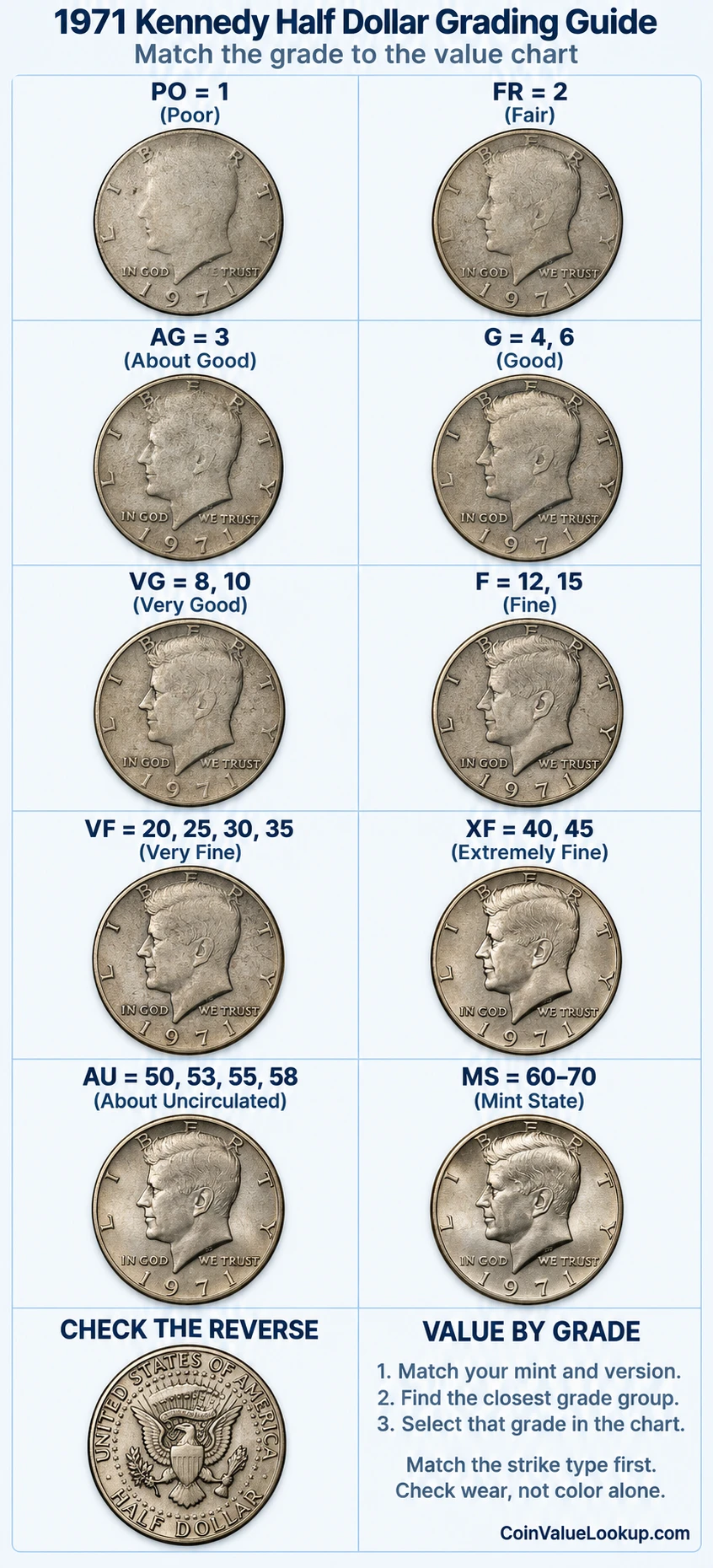
Focus on the hair detail above Kennedy's ear, the cheek and the jawline. On a well-preserved coin these areas retain full luster with no flatness or rubbing.
Compare your coin side by side with same-type reference images to calibrate your eye.
On the reverse, check the eagle's breast feathers, tail feathers and shield lines. Many 1971 halves came weakly struck on the shield from the factory, so do not automatically downgrade a coin for soft detail there.
Separate contact marks and hairlines from actual circulation wear. Bag marks on a mint-state coin lower the grade but are a different problem than the smooth, even metal loss you see on a coin that spent years in pockets.
Proof is a finish, not a grade above Mint State. A proof coin can still have impairments, hairlines or haze that affect its grade within the proof scale.
Step 3: Check 1971 Kennedy Half Dollar Value by Mint and Version
1971 Kennedy Half Dollar
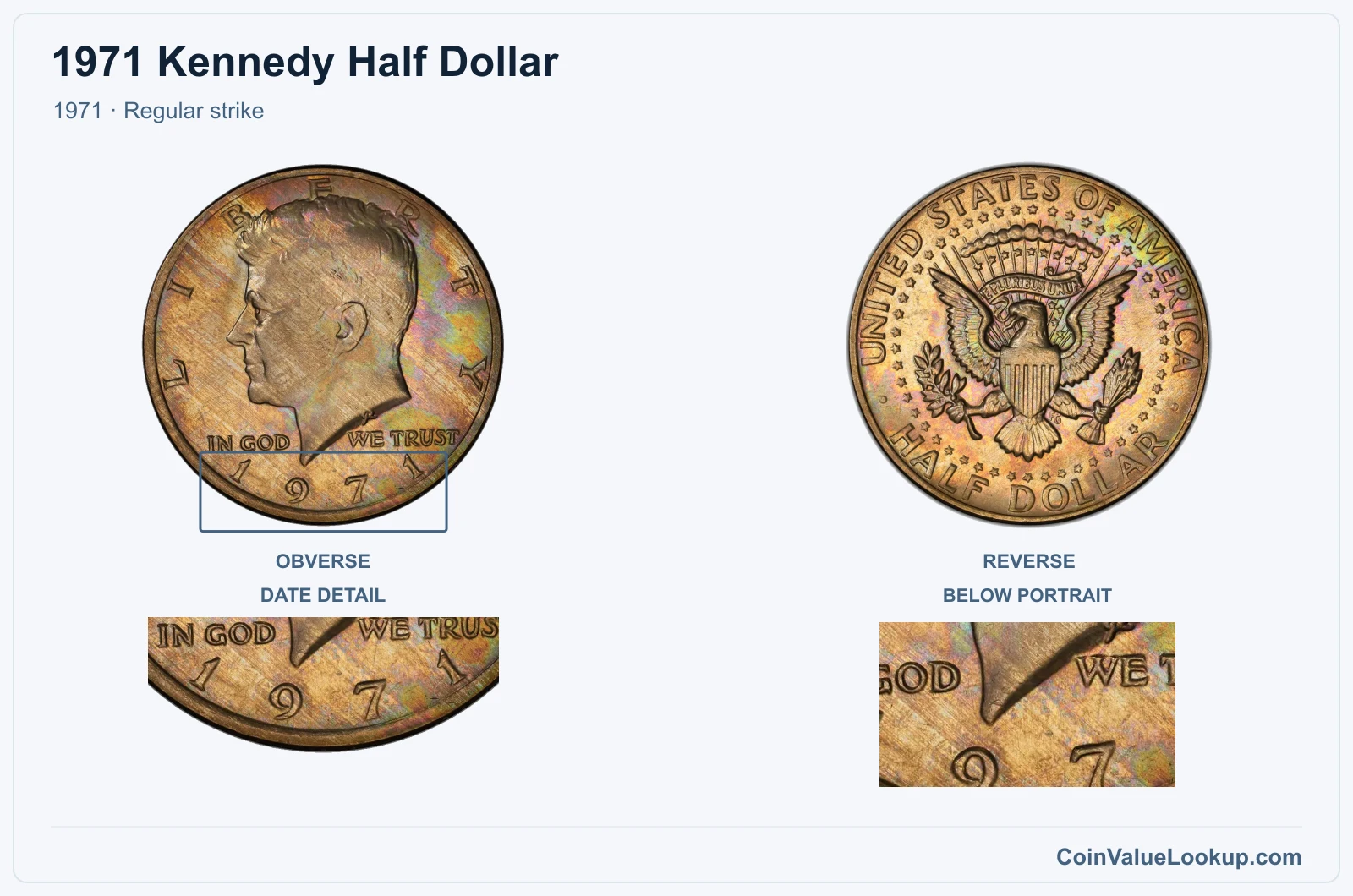
The 1971 Philadelphia half dollar carries no mintmark. It is the most common version you will encounter in pocket change or bank rolls.
Copper-nickel clad, 11.34 grams nominal, with Kennedy on the obverse and the presidential-seal eagle on the reverse.
A USA Coin Book guide estimate places an MS63 example at about $3.62. Circulated pieces are worth face value.
Weak shield lines on the reverse are a known strike characteristic for 1971-onward halves, not necessarily a sign of heavy wear.
| Range | Grade | Price | Auction Records | Appraisal |
|---|---|---|---|---|
| PO | PO 1 | — | Coin Identifier | |
| FR | FR 2 | — | Coin Identifier | |
| AG | AG 3 | — | Coin Identifier | |
| G | G 4 | — | Coin Identifier | |
| G 6 | — | Coin Identifier | ||
| VG | VG 8 | — | Coin Identifier | |
| VG 10 | — | Coin Identifier | ||
| F | F 12 | — | Coin Identifier | |
| F 15 | — | Coin Identifier | ||
| VF | VF 20 | — | Coin Identifier | |
| VF 25 | — | Coin Identifier | ||
| VF 30 | — | Coin Identifier | ||
| VF 35 | — | Coin Identifier | ||
| XF | XF 40 | — | Coin Identifier | |
| XF 45 | — | Coin Identifier | ||
| AU | AU 50 | — | Coin Identifier | |
| AU 53 | — | Coin Identifier | ||
| AU 55 | Coin Identifier | |||
| AU 58 | — | Coin Identifier | ||
| MS | MS 60 | — | Coin Identifier | |
| MS 61 | Coin Identifier | |||
| MS 62 | Coin Identifier | |||
| MS 63 | — | Coin Identifier | ||
| MS 64 | Coin Identifier | |||
| MS 65 | Coin Identifier | |||
| MS 66 | Coin Identifier | |||
| MS 67 | Coin Identifier | |||
| MS 68 | — | — | — | |
| MS 69 | — | — | — | |
| MS 70 | — | — | — |
1971 Kennedy Half Dollar — D
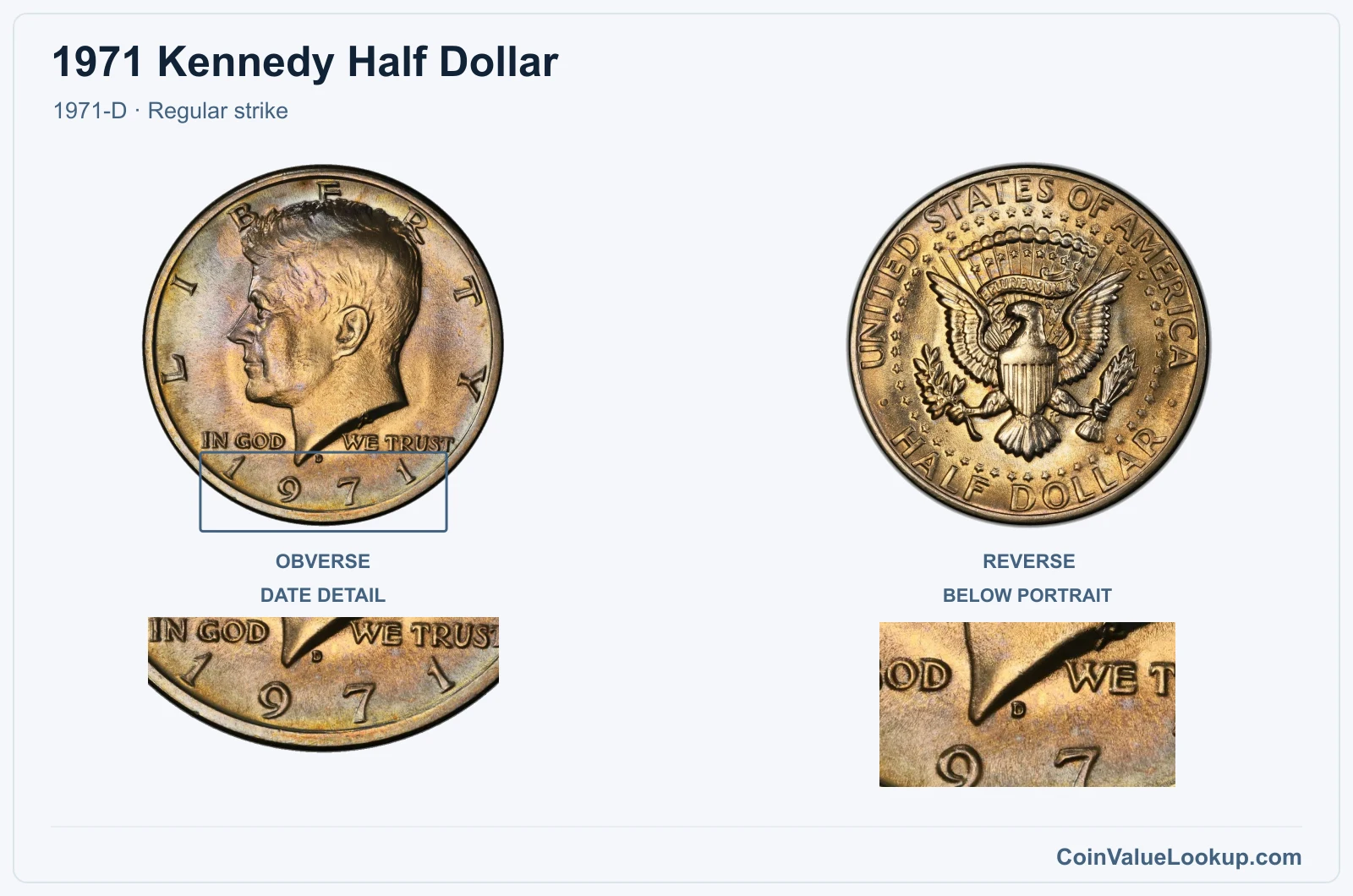
The 1971-D was struck in Denver and carries a small D mintmark below Kennedy's neck. Same copper-nickel clad composition and weight as the Philadelphia issue.
At MS63 the USA Coin Book guide estimate is also around $3.62. Worn examples trade at face value.
This mint mark is important to note because several documented errors — the doubled die obverse, the silver transitional strike and the cent-planchet strike — are specifically attributed to the Denver issue.
Coin Value Lookup is a handy starting point if you want to look up other Kennedy half dollar years or denominations while you are sorting through your collection.
| Range | Grade | Price | Auction Records | Appraisal |
|---|---|---|---|---|
| PO | PO 1 | — | Coin Identifier | |
| FR | FR 2 | — | Coin Identifier | |
| AG | AG 3 | — | Coin Identifier | |
| G | G 4 | — | Coin Identifier | |
| G 6 | — | Coin Identifier | ||
| VG | VG 8 | — | Coin Identifier | |
| VG 10 | — | Coin Identifier | ||
| F | F 12 | — | Coin Identifier | |
| F 15 | — | Coin Identifier | ||
| VF | VF 20 | — | Coin Identifier | |
| VF 25 | — | Coin Identifier | ||
| VF 30 | — | Coin Identifier | ||
| VF 35 | — | Coin Identifier | ||
| XF | XF 40 | — | Coin Identifier | |
| XF 45 | — | Coin Identifier | ||
| AU | AU 50 | — | Coin Identifier | |
| AU 53 | — | Coin Identifier | ||
| AU 55 | Coin Identifier | |||
| AU 58 | Coin Identifier | |||
| MS | MS 60 | Coin Identifier | ||
| MS 61 | — | Coin Identifier | ||
| MS 62 | Coin Identifier | |||
| MS 63 | Coin Identifier | |||
| MS 64 | Coin Identifier | |||
| MS 65 | Coin Identifier | |||
| MS 66 | Coin Identifier | |||
| MS 67 | Coin Identifier | |||
| MS 68 | Coin Identifier | |||
| MS 69 | — | — | — | |
| MS 70 | — | — | — |
1971 Kennedy Half Dollar — S Proof
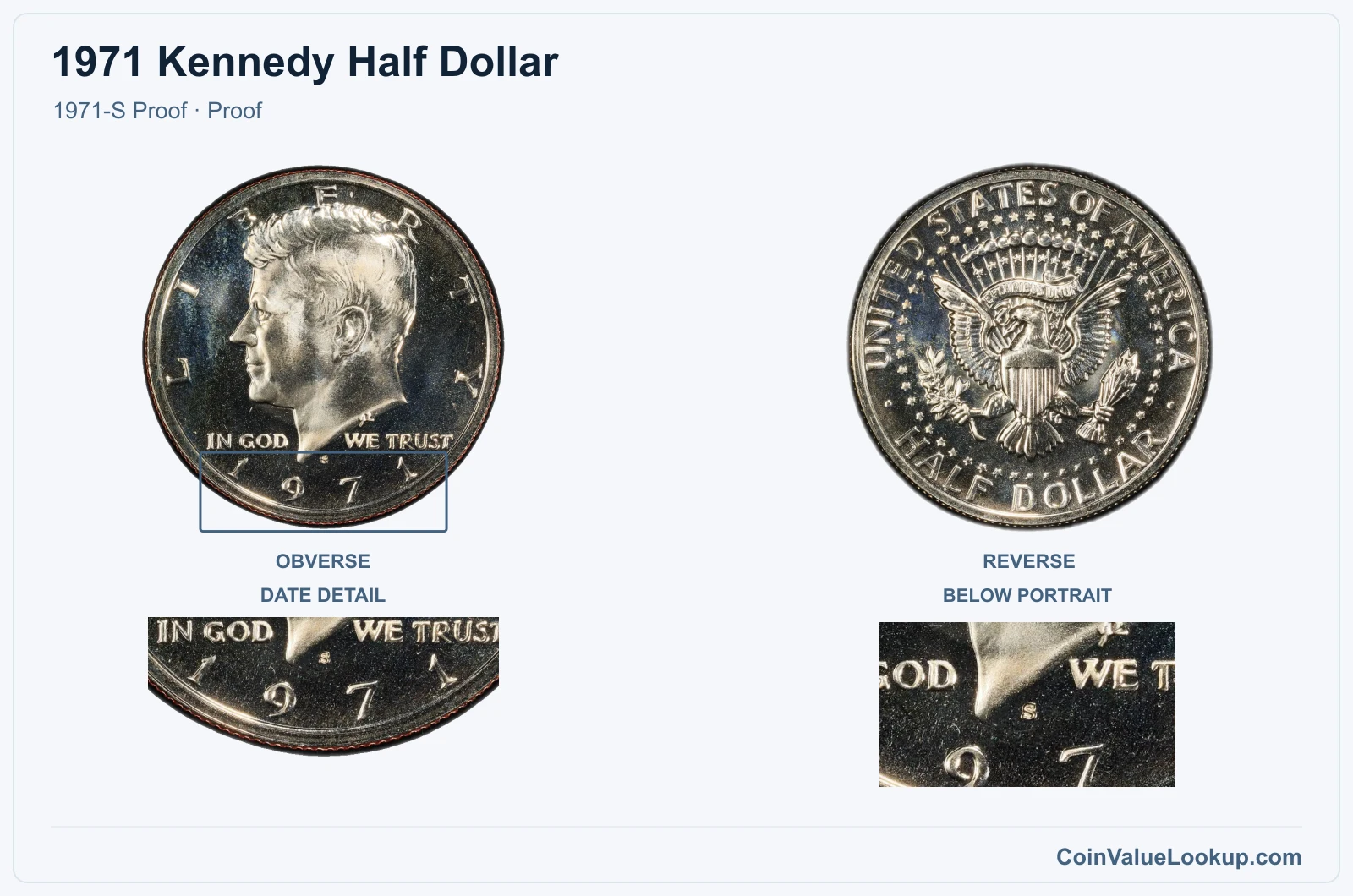
The 1971-S Proof was produced at San Francisco exclusively for collector proof sets. It carries an S mintmark and displays the mirrored fields and sharp detail typical of proof manufacturing.
Despite its premium finish, this is still copper-nickel clad with no silver content.
A USA Coin Book guide estimate for PR65 is about $4.96. These were sold in sealed government sets, so most surviving examples are well preserved.
Proof is a method of manufacture, not a grade — hairlines, haze or mishandling will lower the assigned proof grade.
| Range | Grade | Price | Auction Records | Appraisal |
|---|---|---|---|---|
| PR | PR 1 | — | Coin Identifier | |
| PR 2 | — | Coin Identifier | ||
| PR 3 | — | Coin Identifier | ||
| PR 4 | — | Coin Identifier | ||
| PR 6 | — | Coin Identifier | ||
| PR 8 | — | Coin Identifier | ||
| PR 10 | — | Coin Identifier | ||
| PR 12 | — | Coin Identifier | ||
| PR 15 | — | Coin Identifier | ||
| PR 20 | — | Coin Identifier | ||
| PR 25 | — | Coin Identifier | ||
| PR 30 | — | Coin Identifier | ||
| PR 35 | — | Coin Identifier | ||
| PR 40 | — | Coin Identifier | ||
| PR 45 | — | Coin Identifier | ||
| PR 50 | — | Coin Identifier | ||
| PR 53 | — | Coin Identifier | ||
| PR 55 | — | Coin Identifier | ||
| PR 58 | — | Coin Identifier | ||
| PR 60 | Coin Identifier | |||
| PR 61 | — | Coin Identifier | ||
| PR 62 | — | Coin Identifier | ||
| PR 63 | — | Coin Identifier | ||
| PR 64 | — | Coin Identifier | ||
| PR 65 | — | Coin Identifier | ||
| PR 66 | Coin Identifier | |||
| PR 67 | Coin Identifier | |||
| PR 68 | Coin Identifier | |||
| PR 69 | Coin Identifier | |||
| PR 70 | — | — | — |
1971 Kennedy Half Dollar — Doubled Die Obverse
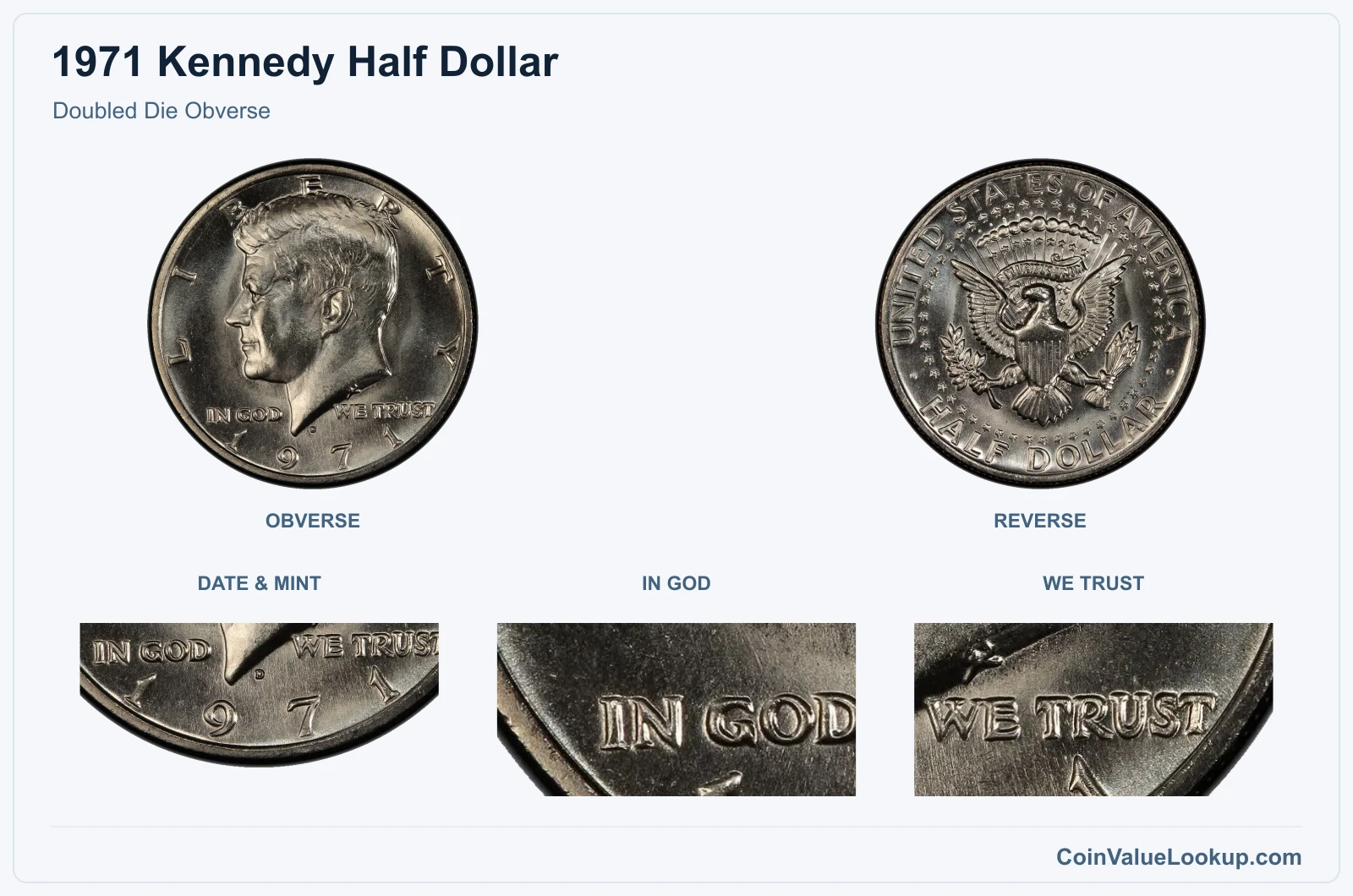
The 1971-D Doubled Die Obverse is a Denver business-strike variety showing hub doubling on the obverse legends. The doubling is most visible in the word TRUST, particularly on the letters U, S and T, where you can see rounded, separated outlines rather than a single crisp impression.
Do not confuse this with flat, shelf-like machine doubling, which is a different and far less valuable phenomenon. The genuine variety shows consistent, rounded spread that matches the attributed die pattern.
No guide price is adopted for this variety; its value depends on authentication, the specific die match and the coin's overall condition. A certified attribution from a major grading service is the standard expectation for trading these.
Ordinary-issue reference: Ordinary-issue reference only: The table below shows prices for the 1971-D Kennedy Half Dollar (regular strike). It does not represent the value of the specific Doubled Die Obverse variety or its variety premium. Year, mint, metal and strike type are matched; the specific variety is not priced by this table.
Range Grade
Price Auction Records Appraisal PO PO 1
—
Coin Identifier FR FR 2
—
Coin Identifier AG AG 3
—
Coin Identifier G G 4
—
Coin Identifier
G 6
—
Coin Identifier VG VG 8
—
Coin Identifier
VG 10
—
Coin Identifier F F 12
—
Coin Identifier
F 15
—
Coin Identifier VF VF 20
—
Coin Identifier
VF 25
—
Coin Identifier
VF 30
—
Coin Identifier
VF 35
—
Coin Identifier XF XF 40
—
Coin Identifier
XF 45
—
Coin Identifier AU AU 50
—
Coin Identifier
AU 53
—
Coin Identifier
AU 55
Coin Identifier
AU 58
Coin Identifier MS MS 60
Coin Identifier
MS 61
—
Coin Identifier
MS 62
Coin Identifier
MS 63
Coin Identifier
MS 64
Coin Identifier
MS 65
Coin Identifier
MS 66
Coin Identifier
MS 67
Coin Identifier
MS 68
Coin Identifier
MS 69
—
—
—
MS 70
—
—
—
1971 Kennedy Half Dollar Error List
1. 1971 Kennedy Half Dollar — Doubled Die Obverse
The 1971-D Doubled Die Obverse shows rounded, separated doubling in the word TRUST — focus on the U, S and T. The spread is smooth and consistent, not the flat mechanical shelfing you see from loose die chatter during striking.
This variety applies to Denver (D mintmark) business strikes only. The exact spread pattern must match the attributed die; not every bit of funny-looking lettering qualifies.
Glare, post-mint damage and coins that were literally struck twice (double strikes) can all mimic doubling to an untrained eye.
No numerical price range is adopted for this variety. Value depends on authenticated identity, the severity of the doubling visible to the naked eye and the coin's preservation.
Professional certification is the practical baseline for buying or selling one of these.
2. 1971 Kennedy Half Dollar — Struck on a Leftover 40% Silver Planchet
A 1971-D Kennedy half struck on a leftover 40% silver planchet is a genuine transitional error — the Mint accidentally used a blank from the previous silver-clad program. The nominal weight difference is small, roughly 11.50 grams versus the standard 11.34 grams, so a kitchen scale reading alone is not enough to confirm it.
A PCGS AU55 example sold for $6,037.50 at Heritage Auctions in September 2003. That is one documented sale, not a guaranteed market price for every specimen.
Lookalikes include silver-plated coins, naturally toned clad coins, coins weighed on inaccurate scales and halves with manipulated edges. This is a 40% silver layered planchet, not a 90% silver coin.
Authentication with alloy verification and original undamaged surfaces are essential before any premium can be claimed.
3. 1971 Kennedy Half Dollar — Struck on a Cent Planchet
A 1971-D Kennedy half struck on a Lincoln cent planchet is a dramatic wrong-planchet error. The small copper-alloy blank retains a bold D mintmark, lightly visible date digits and a partial central portrait, while outer legends like LIBERTY and the denomination run off the edge of the undersized blank.
A PCGS MS62 Red and Brown example brought $3,720 at Heritage Auctions in September 2019. That is one sale for one certified coin.
Do not confuse this with a half dollar that has been cut down, filed, plated or damaged after leaving the Mint. A genuine wrong-planchet strike shows properly struck surfaces across the area covered by the blank, with a natural unstruck edge where the dies had no metal to impress.
Both sides and the full outline need to be consistent with the error.
4. 1971 Kennedy Half Dollar — Doubled Die Reverse
A Doubled Die Reverse has been reported for the 1971-S Proof Kennedy half dollar. On this variety, reverse legends and design contours show doubling compared to a normal proof specimen of the same year.
Compare your coin's reverse lettering and device edges closely against a known normal example, using magnification. The doubling should be consistent and repeatable in the same location on every confirmed specimen of the die.
Machine doubling, reflections from proof surfaces and random post-strike damage can all mimic true hub doubling. No numerical price is adopted for this variety; value depends on the visibility of the doubling, authenticated die attribution and overall condition.
5. 1971 Kennedy Half Dollar — Off-Center Strike
Off-center strikes occur when the planchet is not properly seated between the dies. The result is a displaced design with an unstruck crescent along one side of the coin.
The more dramatic the displacement — and the more of the date that remains visible — the more collectors tend to value the piece.
Do not confuse an off-center strike with a clipped planchet, one-sided die misalignment or post-mint flattening. A genuine off-center coin shows the full design shifted in one direction with a corresponding blank area, not random distortion.
No numerical price is adopted. Value depends on the percentage off-center, date visibility and overall condition of the struck portion.
6. 1971 Kennedy Half Dollar — Missing FG Initials
The initials FG (for designer Frank Gasparro) normally appear on the reverse near the eagle's right leg. On some 1971 halves, die polishing at the Mint removed these initials partially or entirely before the die was put into service.
Compare the area around where FG should be with a normal reverse. On a genuine missing-FG die, the surrounding feather detail often remains sharp because the die was polished, not worn down through use.
Wear, grease fill during striking and deliberate post-mint removal can all produce a similar look. A worn coin that simply lost its FG through circulation is not the same thing.
No numerical price is adopted; value depends on completeness of the absence, supporting die characteristics and overall condition.