1896 Indian Head Penny Coin Value: How Much Is It Worth?
The 1896 Indian Head penny is a Philadelphia-only issue struck in bronze. Guide estimates for ordinary circulation examples run from about $3.62 in Good (G4) condition up to around $92 in Mint State (MS63), while proofs carry their own separate pricing.
Those anchors cover standard business strikes and proof finishes — major varieties and mint errors require individual evaluation beyond these figures.
Fast Way to Identify Your 1896 Indian Head Penny
Upload clear photos of both the front and back of your 1896 Indian Head cent for a preliminary identification. Good lighting at a slight angle helps capture surface detail, luster and any unusual features near the date or lettering.
This step can help sort out which branch and condition category your coin falls into before you dig deeper.
1896 Indian Head Penny Value
Upload both sides of your 1896 Indian Head Penny.
Front Obverse
Upload photo
Back Reverse
Upload photo
Which 1896 Indian Head Penny Versions Are Worth Money?
- Business strikes in original Mint State condition (MS63) are guided near $92 — far above the $3.62 a worn G4 example brings, making surface preservation the biggest value driver.
- Proof examples carry a guide value around $313 at PR63, reflecting their limited special production and collector demand.
- Coins retaining original red or red-brown color tend to attract stronger interest than fully toned brown pieces in equivalent technical grade.
- Several die varieties including repunched dates, doubled die obverses and misplaced dates are reported for this year and require individual assessment when authenticated.
Step 1: Identify Your 1896 Indian Head Penny Mint Mark and Version
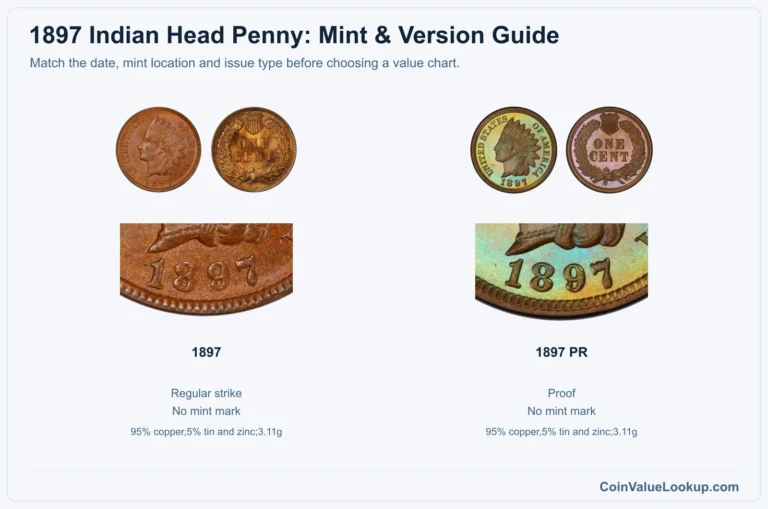
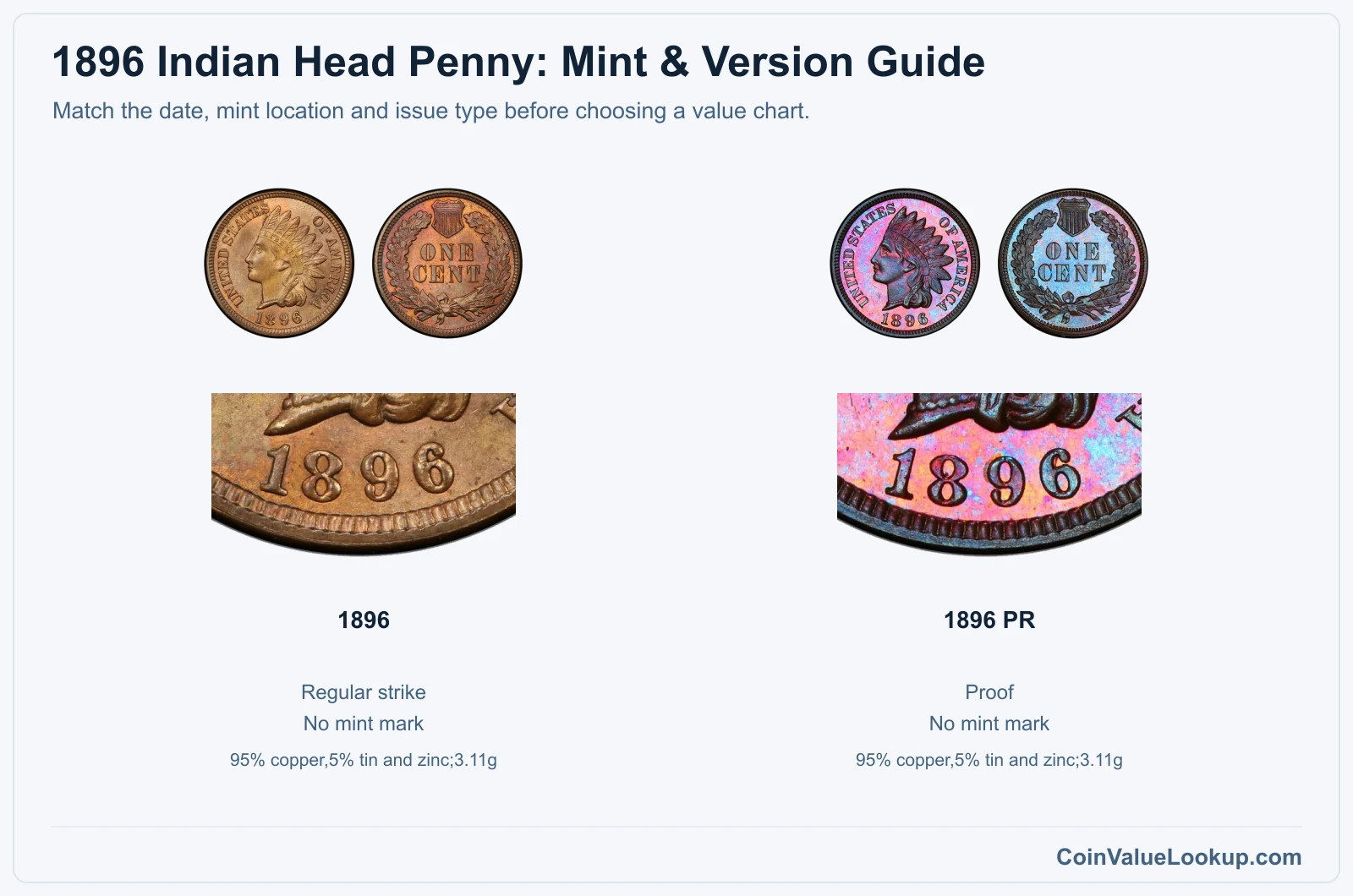
Every regular 1896 Indian Head cent was struck at the Philadelphia Mint, so there is no mintmark to look for. The small "L" on the ribbon behind the neck is the engraver's initial, not a mintmark — don't confuse the two.
The obverse shows the familiar Indian portrait with a feathered headdress and the headband reading LIBERTY. The reverse features an oak wreath surrounding "ONE CENT" with a small shield at the top.
If your coin has a laurel wreath instead of an oak wreath, or shows Lincoln's portrait, you're looking at a different series entirely.
The two main branches for this date are the business strike and the proof. Proofs were specially manufactured with polished dies and planchets, producing sharp rims and mirror-like fields.
A shiny coin is not automatically a proof — many business strikes have been polished over the decades, and that mirror look alone does not prove proof origin. True proofs show squared-off rims and a specific die finish that cleaning cannot replicate.
Bronze color designations (BN, RB, RD) describe how much original copper-red color survives on the surface. These are color descriptions, not separate materials — all 1896 cents are the same 95% copper, 5% tin and zinc alloy at 3.11 grams.
Step 2: Check Your 1896 Indian Head Penny Grade
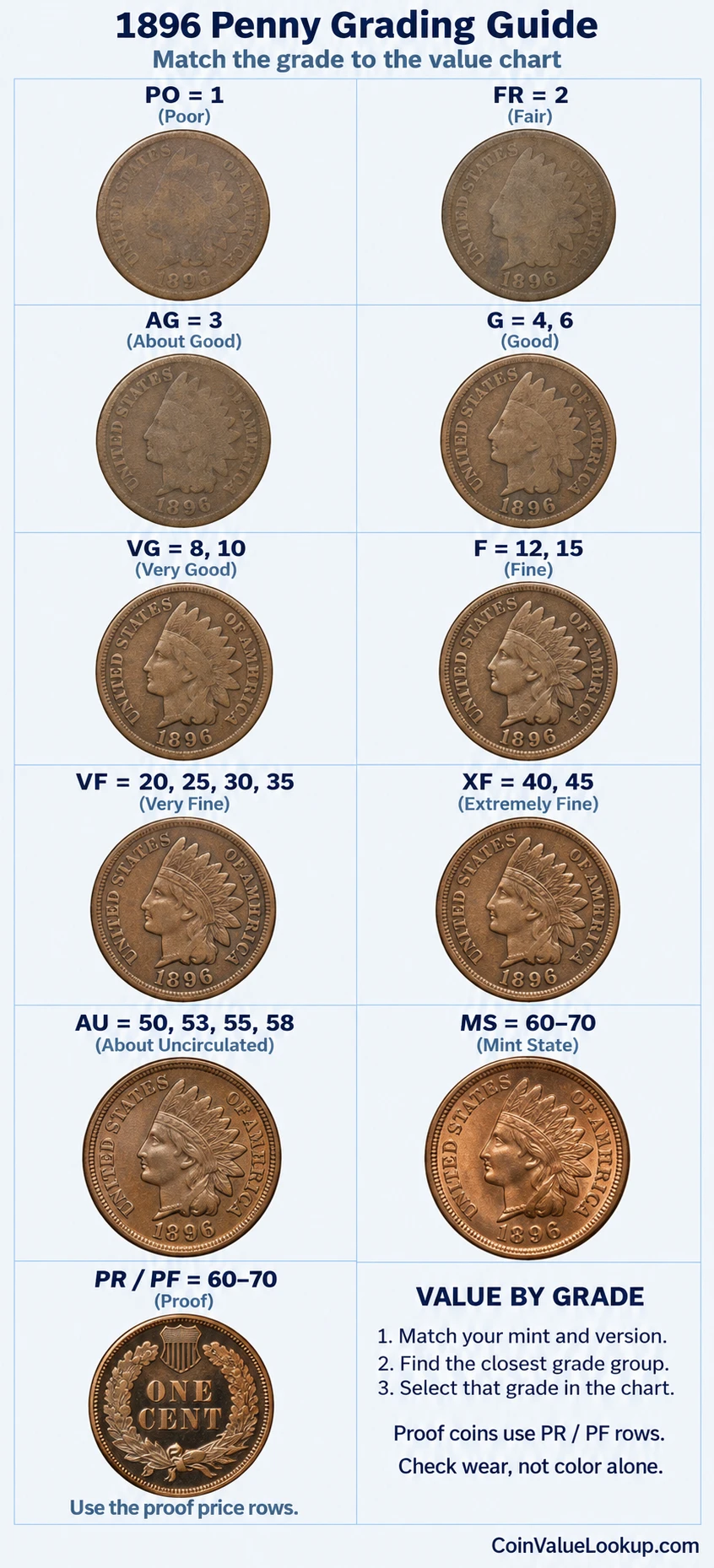
Start with the headband. On a well-worn coin, LIBERTY fades from the outside letters inward — the "L" and "Y" go first, then the middle letters.
A coin showing a full, sharp LIBERTY is at least in the Fine range, assuming that sharpness comes from wear resistance and not a weak strike.
Check the feather tips above the headband and the hair curls below the ear. These are high points that contact surfaces first.
On a coin grading Very Fine, you'll see some flattening on the feather tips but the individual feathers remain defined.
Flip it over. The wreath leaves and the shield at the top lose detail as grade drops.
In Good condition, the wreath outline is visible but internal leaf veins are mostly gone.
Here's the catch: some 1896 cents left the mint with soft strikes on the feathers or hair detail. A weakly struck Mint State coin can look like it has wear when it doesn't.
Check luster before downgrading — original mint luster on the protected areas is the giveaway that it never circulated. Use the comparison image to calibrate your eye against known grade examples.
Surface problems matter too. Cleaning, scratches, corrosion and environmental damage all reduce a coin's market appeal regardless of how much design detail survives.
Step 3: Check 1896 Indian Head Penny Value by Mint and Version
1896 Indian Head Penny
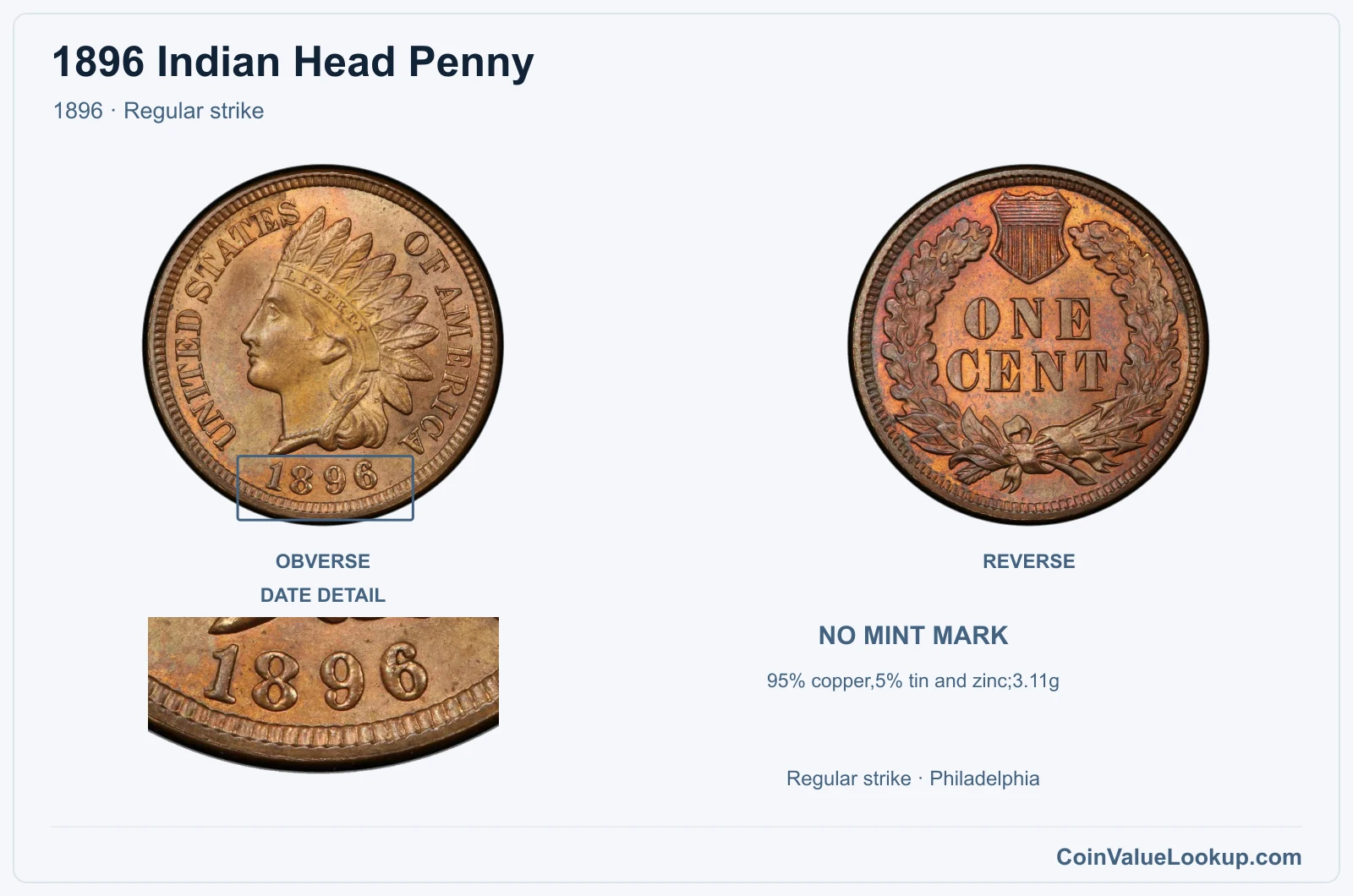
The standard 1896 business strike was produced at Philadelphia with no mintmark, struck in bronze (95% copper, 5% tin and zinc) weighing 3.11 grams. Guide values range from roughly $3.62 in G4 — a coin with heavy wear but readable features — up to about $92 in MS63, where most design details are sharp and some original luster remains.
Original surfaces matter a lot with these. A coin that has been cleaned, whizzed or retoned will trade below guide figures even if the underlying detail looks decent.
When comparing prices, match both the grade and the surface quality. Don't borrow pricing from rare varieties or proofs — this is the common Philadelphia circulation issue, and it should be valued on its own merits.
| Range | Grade | Price | Auction Records | Appraisal |
|---|---|---|---|---|
| PO | PO 1 | — | Coin Identifier | |
| FR | FR 2 | — | Coin Identifier | |
| AG | AG 3 | — | Coin Identifier | |
| G | G 4 | — | Coin Identifier | |
| G 6 | — | Coin Identifier | ||
| VG | VG 8 | — | Coin Identifier | |
| VG 10 | — | Coin Identifier | ||
| F | F 12 | — | Coin Identifier | |
| F 15 | — | Coin Identifier | ||
| VF | VF 20 | Coin Identifier | ||
| VF 25 | — | Coin Identifier | ||
| VF 30 | — | Coin Identifier | ||
| VF 35 | — | Coin Identifier | ||
| XF | XF 40 | Coin Identifier | ||
| XF 45 | — | Coin Identifier | ||
| AU | AU 50 | Coin Identifier | ||
| AU 53 | Coin Identifier | |||
| AU 55 | Coin Identifier | |||
| AU 58 | Coin Identifier | |||
| MS | MS 60 | — | Coin Identifier | |
| MS 61 | — | Coin Identifier | ||
| MS 62 | Coin Identifier | |||
| MS 63 | Coin Identifier | |||
| MS 64 | Coin Identifier | |||
| MS 65 | Coin Identifier | |||
| MS 66 | Coin Identifier | |||
| MS 67 | — | — | — | |
| MS 68 | — | — | — | |
| MS 69 | — | — | — | |
| MS 70 | — | — | — |
1896 Indian Head Penny — PR
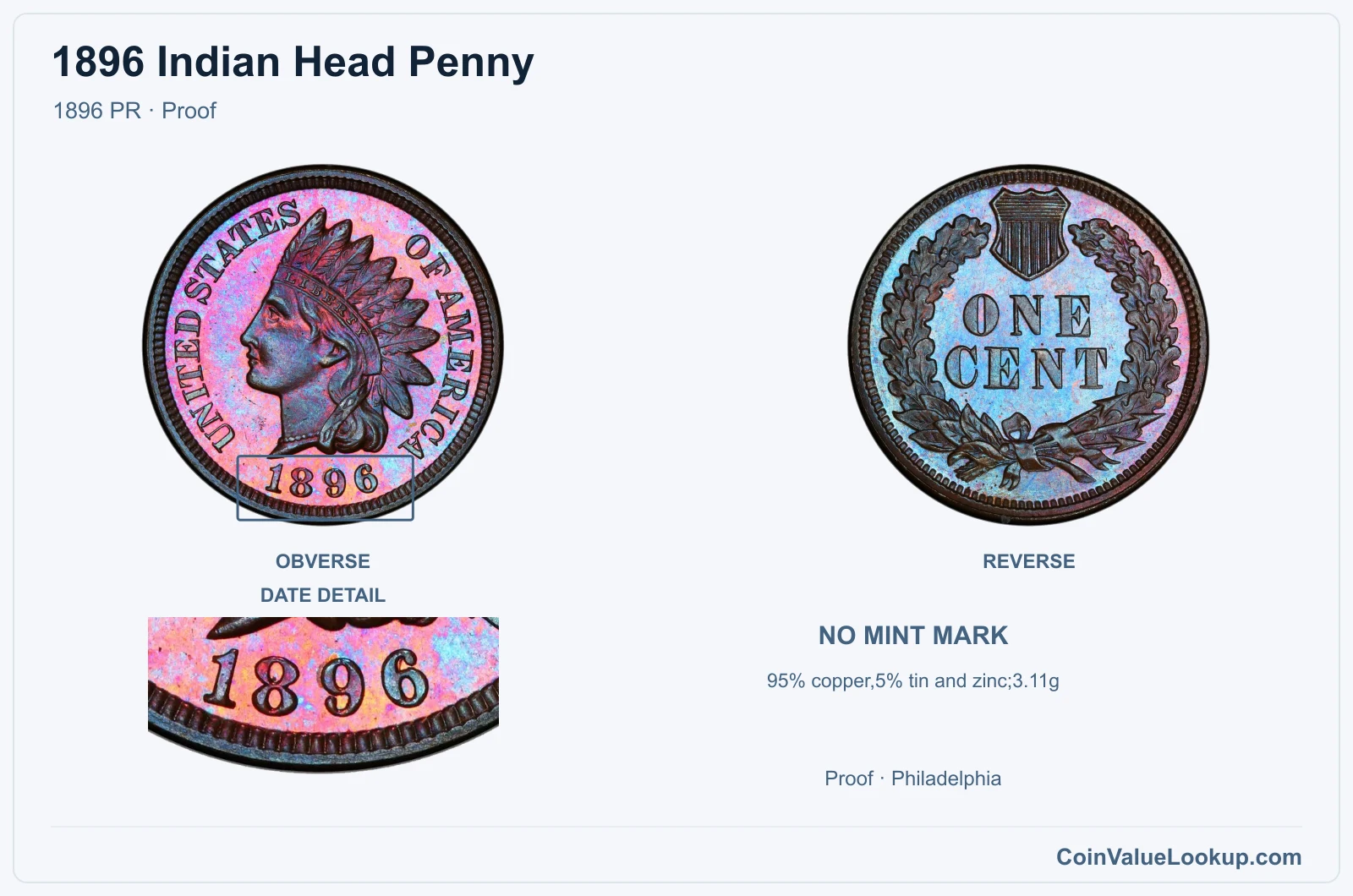
The 1896 proof Indian Head cent was a special striking from Philadelphia, using the same bronze composition and weight as the business strike but manufactured with polished dies and carefully prepared planchets. At PR63, the guide value sits around $313.
Identifying a genuine proof takes more than spotting a shiny surface. Look for squared-off, knife-edge rims and deeply mirrored fields that reflect like glass even after decades of toning.
The design elements should show crisp, fully formed details from edge to edge. A business strike that someone buffed on a cloth will have rounded rims, hairline scratches across the fields, and softened detail — dead giveaways.
Coin Value Lookup can help you start sorting out what you have by pulling up guides for Indian Head cents and other series, so you can compare your coin against documented examples before seeking professional authentication.
| Range | Grade | Price | Auction Records | Appraisal |
|---|---|---|---|---|
| PR | PR 1 | — | Coin Identifier | |
| PR 2 | — | Coin Identifier | ||
| PR 3 | — | Coin Identifier | ||
| PR 4 | — | Coin Identifier | ||
| PR 6 | — | Coin Identifier | ||
| PR 8 | — | Coin Identifier | ||
| PR 10 | — | Coin Identifier | ||
| PR 12 | — | Coin Identifier | ||
| PR 15 | — | Coin Identifier | ||
| PR 20 | — | Coin Identifier | ||
| PR 25 | — | Coin Identifier | ||
| PR 30 | — | Coin Identifier | ||
| PR 35 | — | Coin Identifier | ||
| PR 40 | — | Coin Identifier | ||
| PR 45 | — | Coin Identifier | ||
| PR 50 | — | Coin Identifier | ||
| PR 53 | — | Coin Identifier | ||
| PR 55 | — | Coin Identifier | ||
| PR 58 | — | Coin Identifier | ||
| PR 60 | — | Coin Identifier | ||
| PR 61 | — | Coin Identifier | ||
| PR 62 | Coin Identifier | |||
| PR 63 | Coin Identifier | |||
| PR 64 | Coin Identifier | |||
| PR 65 | Coin Identifier | |||
| PR 66 | Coin Identifier | |||
| PR 67 | — | — | — | |
| PR 68 | — | — | — | |
| PR 69 | — | — | — | |
| PR 70 | — | — | — |
1896 Indian Head Penny Error List
1. 1896 Indian Head Penny — Repunched Date
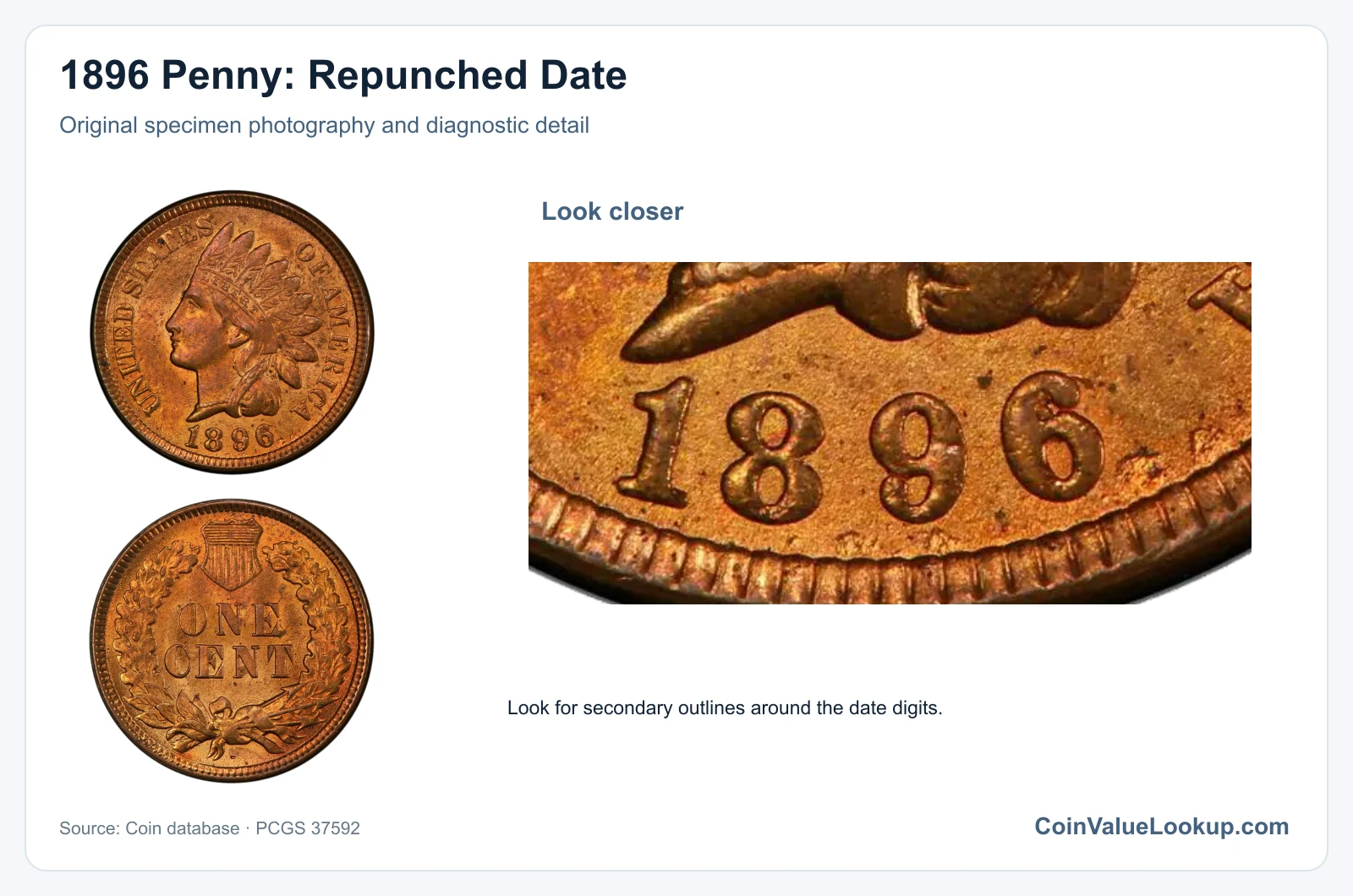
A repunched date on an 1896 Indian Head cent shows remnants of an earlier position of one or more date numerals beside the final, correctly placed digits. You'll typically see faint shadows or partial outlines of a "1," "8," "9" or "6" offset slightly from the primary impression.
This is a die variety, not a doubled die — the date punch was applied separately from the main hub, so only the numerals are affected. To confirm, compare each digit against a normal 1896 under the same magnification and lighting.
Don't confuse this with damage. A coin that was hit or scraped near the date can show displaced metal that loosely mimics a second impression.
Machine doubling also produces flat shelf-like distortion rather than the distinct notching of a true repunched date. Values depend on the specific variety, its visual strength and the coin's overall condition — each example needs individual assessment by an authenticated attribution.
2. 1896 Indian Head Penny — Die Break / Cud
A die break or cud on an 1896 Indian Head cent appears as a raised, featureless blob of metal where a piece of the die chipped away before or during the striking process. A true cud connects to the rim, creating an unmistakable lump that interrupts the normal design border.
Interior die breaks that don't reach the rim are sometimes called retained breaks.
Look at the boundary carefully. The raised area should flow smoothly from the coin's surface without sharp tool marks or gouges.
A rim dent caused by post-mint damage typically creates a depressed area with displaced metal pushed inward, which is the opposite of what a cud does.
Corrosion bumps and interior die chips can also mimic small breaks, so size, location and the presence of a clean boundary all matter. Pricing for die breaks varies significantly with size, location and overall coin grade, so individual professional assessment is the way to go.
3. 1896 Indian Head Penny — Misplaced Date
A misplaced date variety shows partial impressions of one or more date digits in the wrong location — often embedded in the denticles along the rim or partially visible near the portrait, well away from the normal date position at the bottom of the obverse.
These occur because the date punch accidentally contacted the die in the wrong spot before the final, correct placement. What you're looking for is the recognizable shape of a numeral — a curve matching a "9" or "6," or a straight segment matching a "1" — in an area where no digit belongs.
The main lookalikes are die chips, random scratches and small bumps that can superficially resemble part of a number. Compare the suspected digit against the actual date digits on the same coin.
A true misplaced date will share the same font style and proportions. Each confirmed example needs individual assessment based on its clarity, location and the coin's condition.
4. 1896 Indian Head Penny — Die Crack
Die cracks appear as thin, raised lines running across the coin's field or through design elements. On an 1896 Indian Head cent, they can show up anywhere — crossing the portrait, running through lettering, or stretching from the rim into the field.
The key word is raised. Because a crack in the die is a gap, metal flows into that gap during striking and produces a line that sits above the coin's surface.
Run your fingernail across it; you should feel it.
An incuse scratch — a groove cut into the surface — is the opposite and results from post-mint damage. Corrosion lines and displaced-metal scrapes can also mimic cracks but lack the clean, consistent profile of a die-produced feature.
Minor die cracks are common on well-used dies and generally add modest collector interest. Dramatic cracks spanning the full diameter or intersecting major design elements draw more attention.
Values depend on severity, location and overall coin grade.
5. 1896 Indian Head Penny — Die Chip
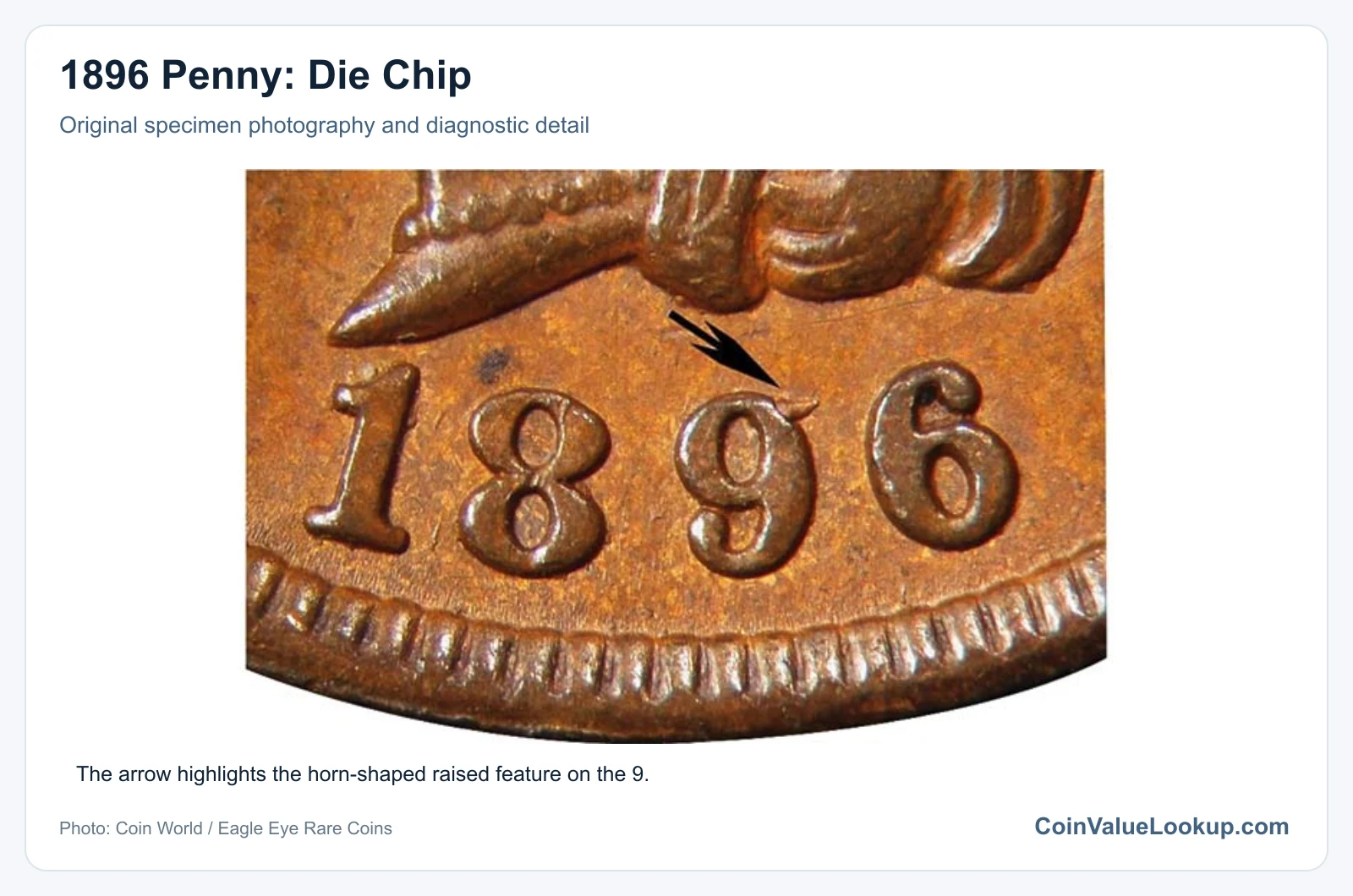
A die chip on an 1896 Indian Head cent shows up as a small, raised lump of metal — usually filling part of a letter, a gap in the design, or a small area of the open field. It happens when a tiny piece of the die surface flakes away, leaving a void that fills with metal during striking.
Look at how the surrounding struck detail flows into the lump. On a genuine die chip, the transition is smooth because the metal was pressed into the void during the same strike that formed the rest of the coin.
A gouge or nick from post-mint damage typically has sharp edges and displaced metal around it. Glue residue or other foreign material sitting on top of the surface is another common lookalike.
Die chips are relatively minor varieties, but certain locations — like chips that alter a date digit or a prominent letter — attract more collector interest. Each needs individual evaluation.
6. 1896 Indian Head Penny — Doubled Die Obverse
A doubled die obverse on an 1896 Indian Head cent results from a misalignment during the die-making process, producing consistent doubling across portions of the obverse design. Look for separation, notching or thickening on the LIBERTY headband letters, the date numerals, or the stars around the border.
The doubling should be consistent — if you see it on one letter, nearby letters struck from the same area of the die should show a similar direction and degree of offset. Examine the coin under steady magnification and compare directly against a known normal example in matching light.
Machine doubling is the most common lookalike. It produces a flat, shelf-like distortion that lacks the rounded, distinct secondary image of a true doubled die.
Worn die contours and light reflections can also fool you at first glance. Confirmed doubled die varieties require individual assessment for value, based on the strength of the doubling, overall eye appeal and the coin's grade.
7. 1896 Indian Head Penny — Off-Center Strike
An off-center strike happens when the planchet isn't seated properly in the collar before the dies come together, shifting the entire design to one side and leaving an unstruck crescent of blank metal on the opposite edge.
On an 1896 Indian Head cent, the percentage of off-center displacement and whether the date remains fully visible are the two biggest factors collectors care about. A 5% off-center coin is a curiosity; a 15–25% off-center coin with a complete date is genuinely scarce and desirable for this series.
Don't confuse an off-center strike with a clipped planchet, where a piece of the blank was missing before striking. Clips show a curved or straight missing edge but the design is still centered.
One-sided die misalignment or post-mint flattening can also create misleading appearances. Each off-center example requires individual assessment based on displacement percentage, date visibility and overall condition.