1976 Lincoln Penny Coin Value: How Much Is It Worth?
Most 1976 Lincoln pennies you pull from a jar are worth face value. A USA Coin Book guide estimate places an uncirculated MS65 example around $1.24, while a proof in PR65 sits near $3.85.
The real upside comes from authenticated mint errors and original, high-grade copper surfaces — not from the date alone.
Fast Way to Identify Your 1976 Lincoln Penny
Want a quick read on what you have? Upload clear photos of the front and back of your 1976 penny, and our identifier can help with a preliminary identification of the version and condition.
It works best with good lighting and a steady shot, so prop the coin on a dark surface and get both sides in focus.
1976 Penny Value
Upload both sides of your 1976 Lincoln Penny.
Front Obverse
Upload photo
Back Reverse
Upload photo
Which 1976 Lincoln Penny Versions Are Worth Money?
- High-grade uncirculated examples with full original red (RD) copper color are the premium business-strike coins to look for.
- Authenticated striking errors — such as double strikes, off-center strikes, or wrong-planchet coins — carry individual premiums well above face value and should be assessed on their own merits.
Step 1: Identify Your 1976 Lincoln Penny Mint Mark and Version
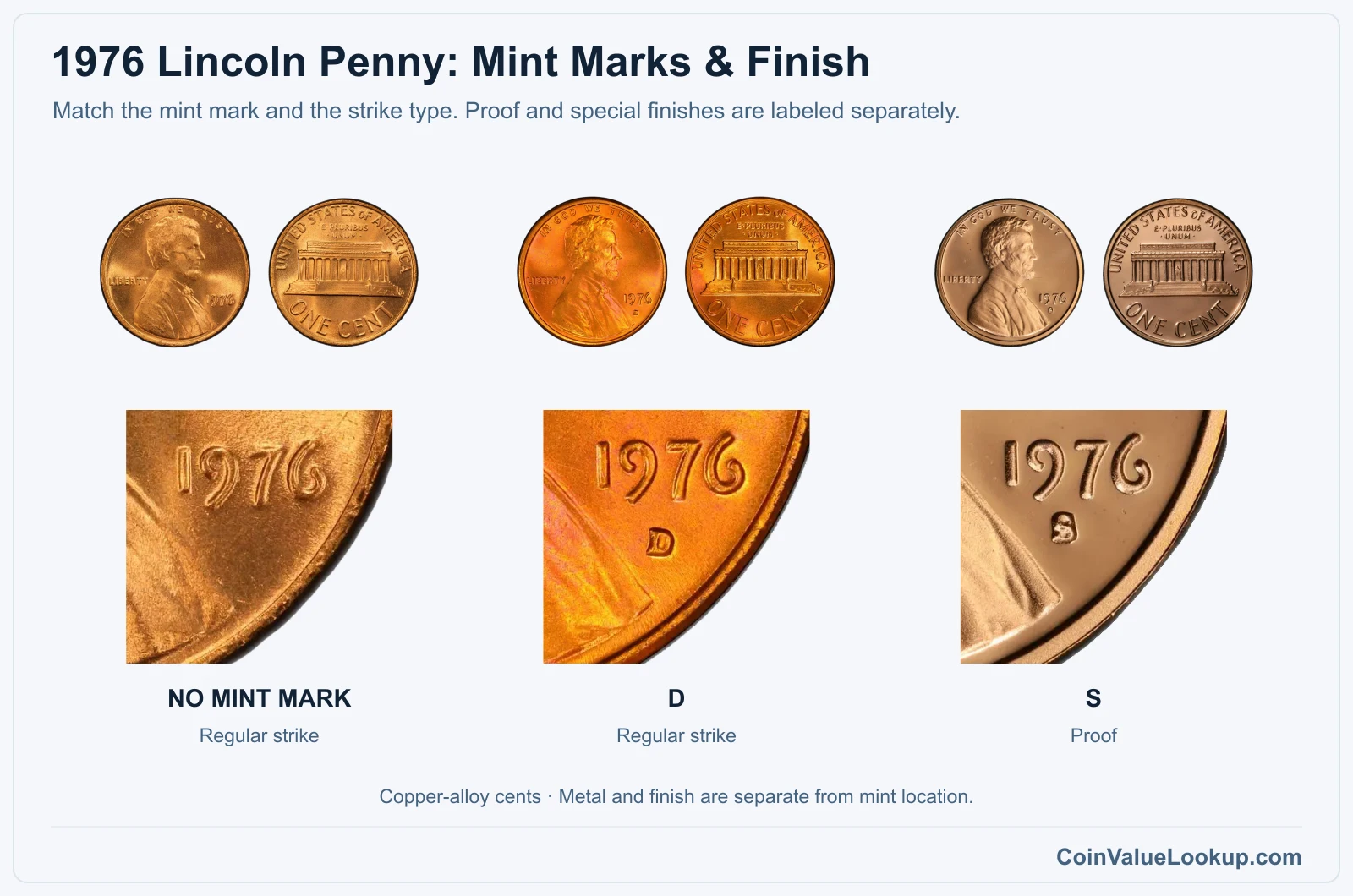
The 1976 Lincoln cent carries the familiar Lincoln portrait on the obverse and the Memorial building on the reverse, with a plain (smooth) edge. Normal composition is 95% copper and 5% zinc, weighing about 3.11 grams.
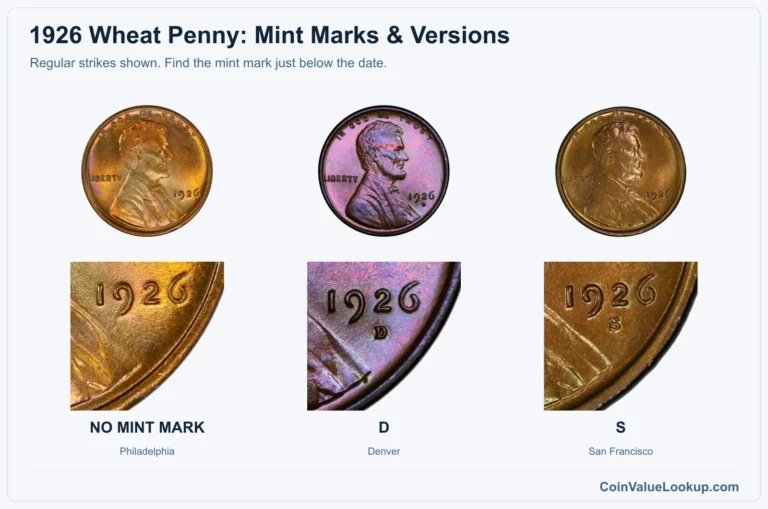
Three catalog branches exist for this date. The no-mintmark version and the D (Denver) version are business strikes made for circulation.
A mintmark, when present, sits just below the date on the obverse.
The S version is a proof-only issue from San Francisco, produced for collector sets — there is no normal S circulation penny for 1976. Proof coins have mirror-like fields from specially prepared dies; that finish is a manufacturing method, not a grade above uncirculated.
Copper color designations — Brown (BN), Red-Brown (RB) and Red (RD) — describe how much original mint-red luster the surface retains. They are not different metals.
Similarly, Cameo (CAM) and Deep Cameo (DCAM) describe the contrast on proofs between frosty devices and mirror fields. These are surface-quality filters, not separate alloys.
One common misconception: the 1976 cent does not have a dual-dated 1776–1976 Bicentennial design. That treatment was reserved for the quarter, half dollar and dollar.
Your penny just says 1976.
Step 2: Check Your 1976 Lincoln Penny Grade
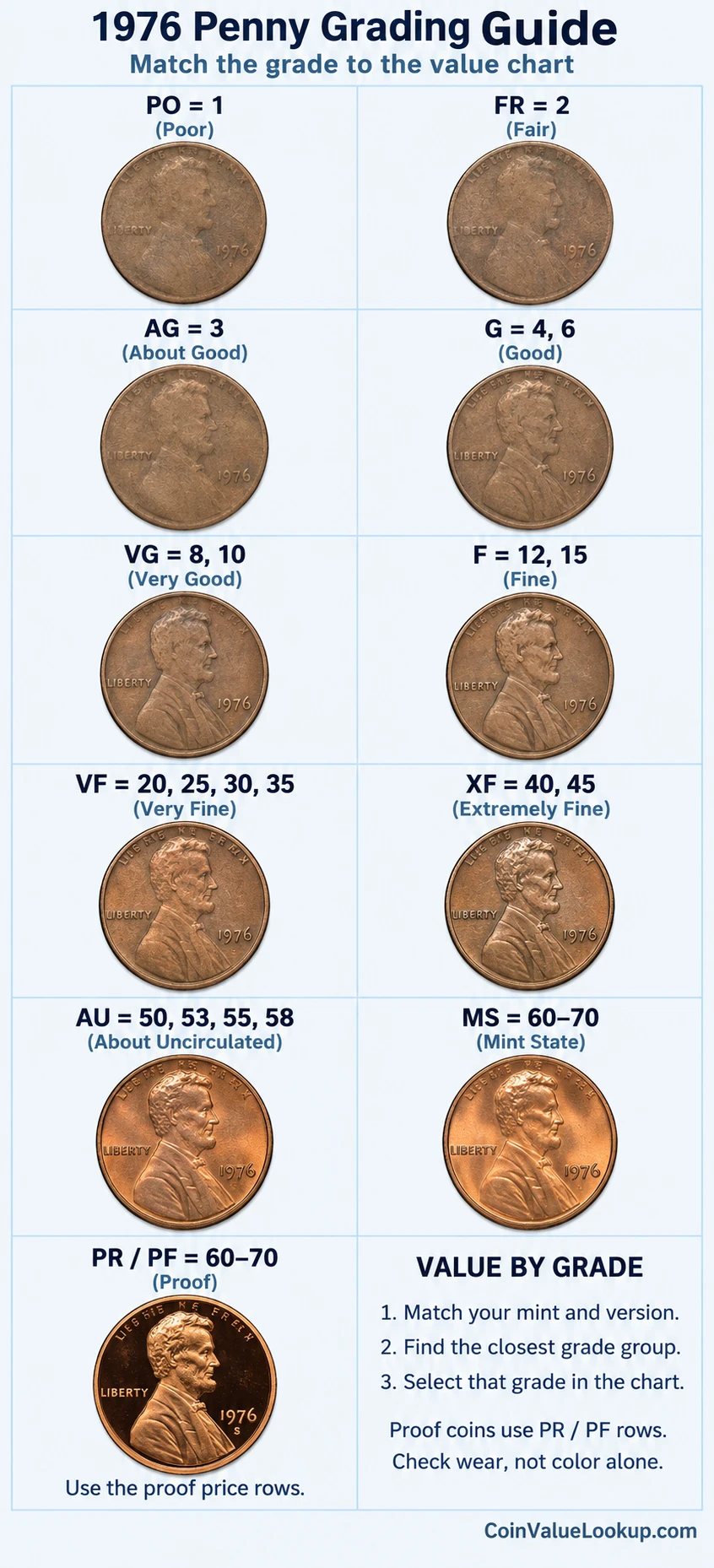
Start by checking Lincoln's cheekbone, jawline and the hair detail above his ear. Those are the highest points on the obverse and the first places to lose detail.
On the reverse, examine the roof of the Memorial and the tops of the columns.
The difference between About Uncirculated (AU) and Mint State (MS) comes down to luster and high-point wear. If the original mint sheen is broken on the cheek or jaw, you are looking at AU or lower, regardless of how bright the coin appears.
Color alone does not determine grade.
For proofs, look for hairline scratches across the mirror fields, spots, or any evidence of cleaning. Refer to the comparison image to see how a clean, original surface differs from one with post-mint disturbance.
Do not attempt to clean a copper coin or strip its surface — that permanently lowers its collector value.
Step 3: Check 1976 Lincoln Penny Value by Mint and Version
1976 Lincoln Penny
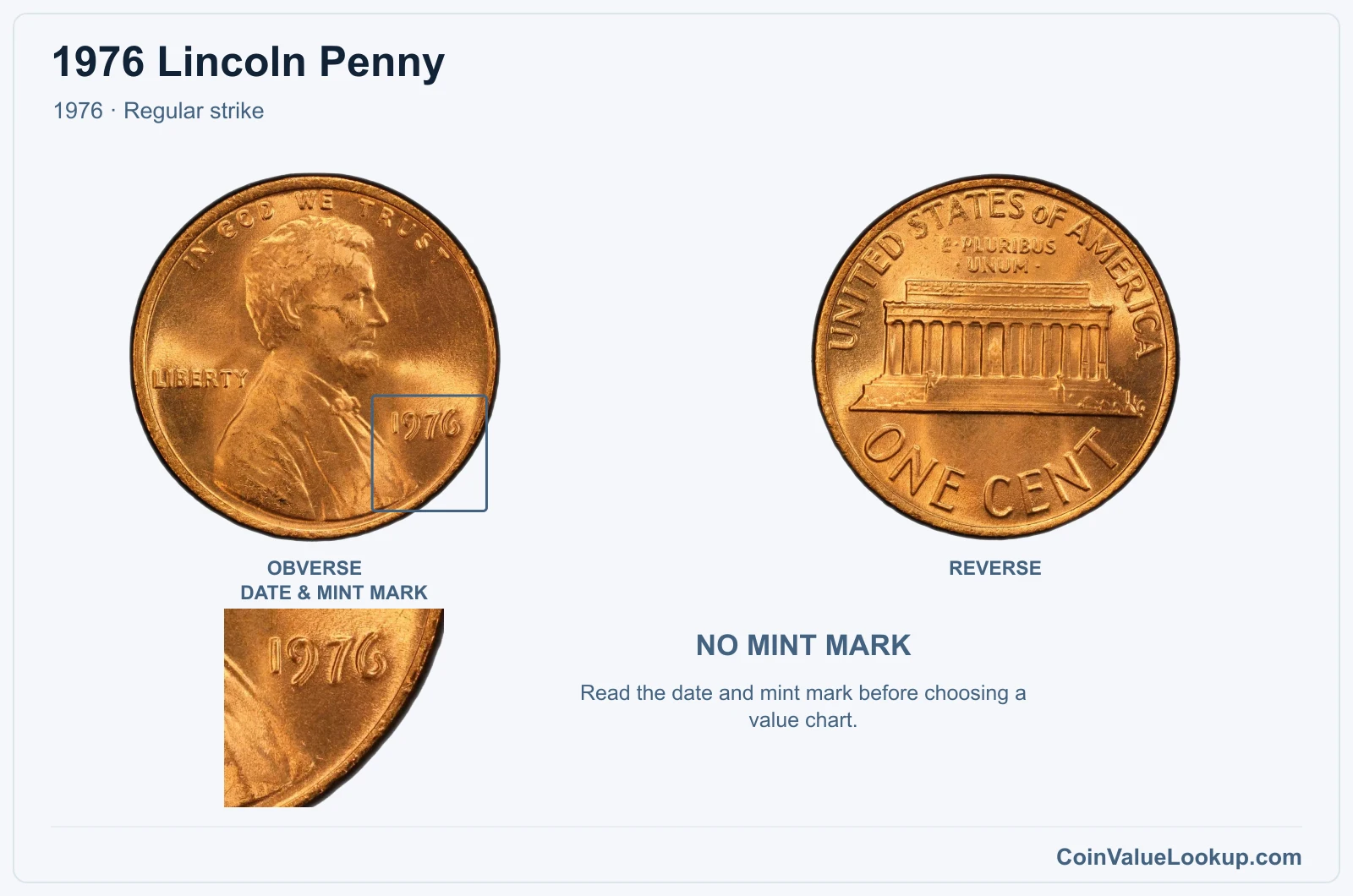
The 1976 no-mintmark cent is the most commonly encountered branch. It is a business strike on the standard 95% copper / 5% zinc planchet, weighing about 3.11 grams.
No mintmark appears below the date.
A USA Coin Book guide estimate puts a nice MS65 example around $1.24. In circulated condition, these are essentially worth a cent.
What moves the needle is original copper color and clean surfaces — a fully red gem-grade coin is a different animal from a brown, bag-marked one.
If you see mirror-like fields on your coin, you are probably holding a proof, not an unusually high-grade business strike. Match the finish first, then the grade.
| Range | Grade | Price | Auction Records | Appraisal |
|---|---|---|---|---|
| PO | PO 1 | — | Coin Identifier | |
| FR | FR 2 | — | Coin Identifier | |
| AG | AG 3 | — | Coin Identifier | |
| G | G 4 | — | Coin Identifier | |
| G 6 | — | Coin Identifier | ||
| VG | VG 8 | — | Coin Identifier | |
| VG 10 | — | Coin Identifier | ||
| F | F 12 | — | Coin Identifier | |
| F 15 | — | Coin Identifier | ||
| VF | VF 20 | — | Coin Identifier | |
| VF 25 | — | Coin Identifier | ||
| VF 30 | — | Coin Identifier | ||
| VF 35 | — | Coin Identifier | ||
| XF | XF 40 | — | Coin Identifier | |
| XF 45 | — | Coin Identifier | ||
| AU | AU 50 | — | Coin Identifier | |
| AU 53 | — | Coin Identifier | ||
| AU 55 | — | Coin Identifier | ||
| AU 58 | — | Coin Identifier | ||
| MS | MS 60 | — | Coin Identifier | |
| MS 61 | — | Coin Identifier | ||
| MS 62 | — | Coin Identifier | ||
| MS 63 | — | Coin Identifier | ||
| MS 64 | Coin Identifier | |||
| MS 65 | Coin Identifier | |||
| MS 66 | Coin Identifier | |||
| MS 67 | Coin Identifier | |||
| MS 68 | Coin Identifier | |||
| MS 69 | — | — | — | |
| MS 70 | — | — | — |
1976 Lincoln Penny — D
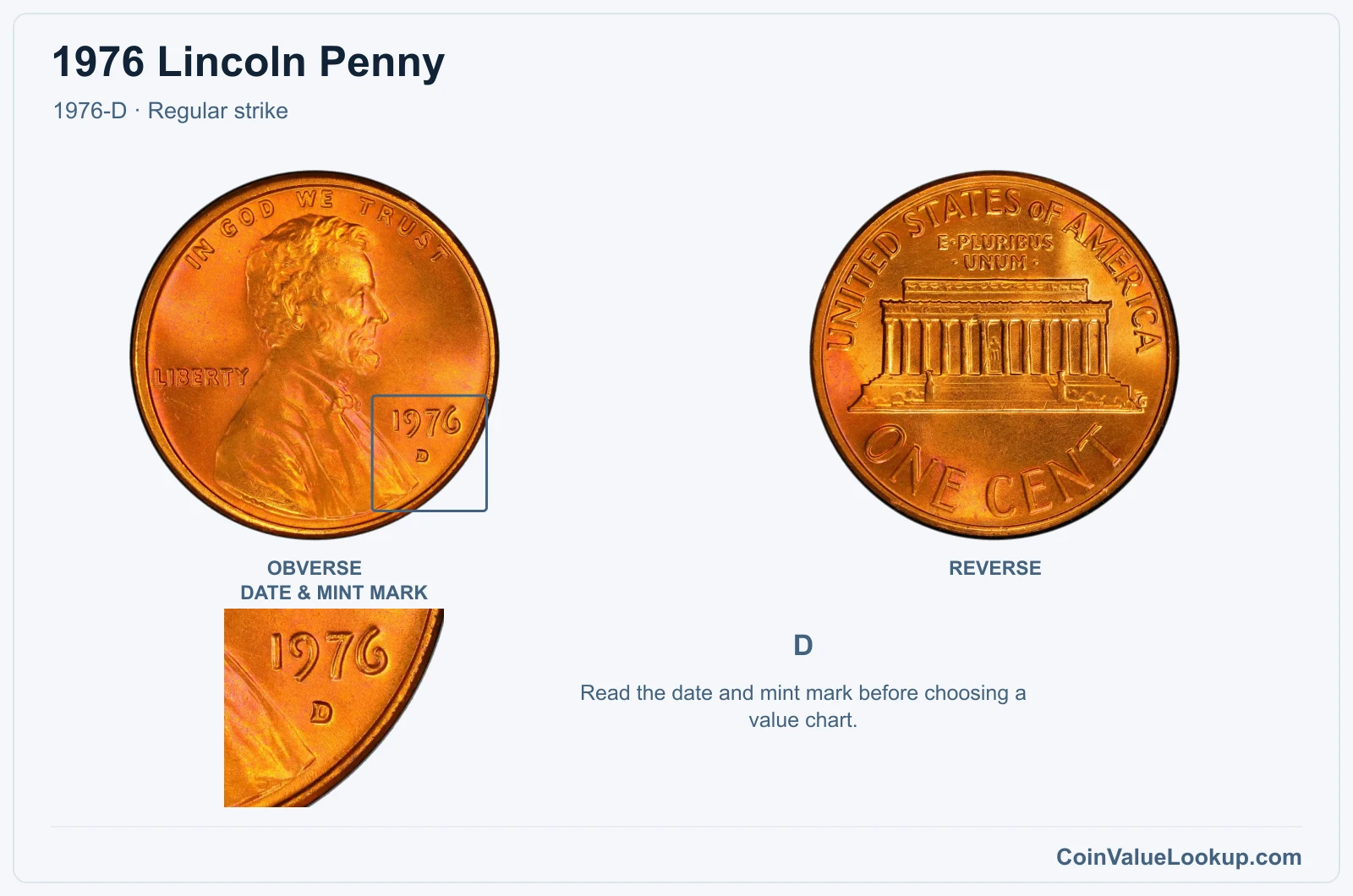
The 1976-D comes from the Denver Mint and carries a small "D" mintmark below the date. Same 95% copper / 5% zinc composition, same 3.11-gram target weight.
Guide value at MS65 is also about $1.24, per USA Coin Book. Denver struck enormous quantities of cents in 1976, so finding one in pocket change is trivial.
Finding one with blazing original red surfaces and minimal contact marks is the hard part.
Coin Value Lookup is a handy starting point if you want to look up guide values for other dates and denominations while you sort through your collection.
| Range | Grade | Price | Auction Records | Appraisal |
|---|---|---|---|---|
| PO | PO 1 | — | Coin Identifier | |
| FR | FR 2 | — | Coin Identifier | |
| AG | AG 3 | — | Coin Identifier | |
| G | G 4 | — | Coin Identifier | |
| G 6 | — | Coin Identifier | ||
| VG | VG 8 | — | Coin Identifier | |
| VG 10 | — | Coin Identifier | ||
| F | F 12 | — | Coin Identifier | |
| F 15 | — | Coin Identifier | ||
| VF | VF 20 | — | Coin Identifier | |
| VF 25 | — | Coin Identifier | ||
| VF 30 | — | Coin Identifier | ||
| VF 35 | — | Coin Identifier | ||
| XF | XF 40 | — | Coin Identifier | |
| XF 45 | — | Coin Identifier | ||
| AU | AU 50 | — | Coin Identifier | |
| AU 53 | — | Coin Identifier | ||
| AU 55 | — | Coin Identifier | ||
| AU 58 | — | Coin Identifier | ||
| MS | MS 60 | — | Coin Identifier | |
| MS 61 | — | Coin Identifier | ||
| MS 62 | — | Coin Identifier | ||
| MS 63 | — | Coin Identifier | ||
| MS 64 | — | Coin Identifier | ||
| MS 65 | Coin Identifier | |||
| MS 66 | Coin Identifier | |||
| MS 67 | Coin Identifier | |||
| MS 68 | — | — | — | |
| MS 69 | — | — | — | |
| MS 70 | — | — | — |
1976 Lincoln Penny — S PR
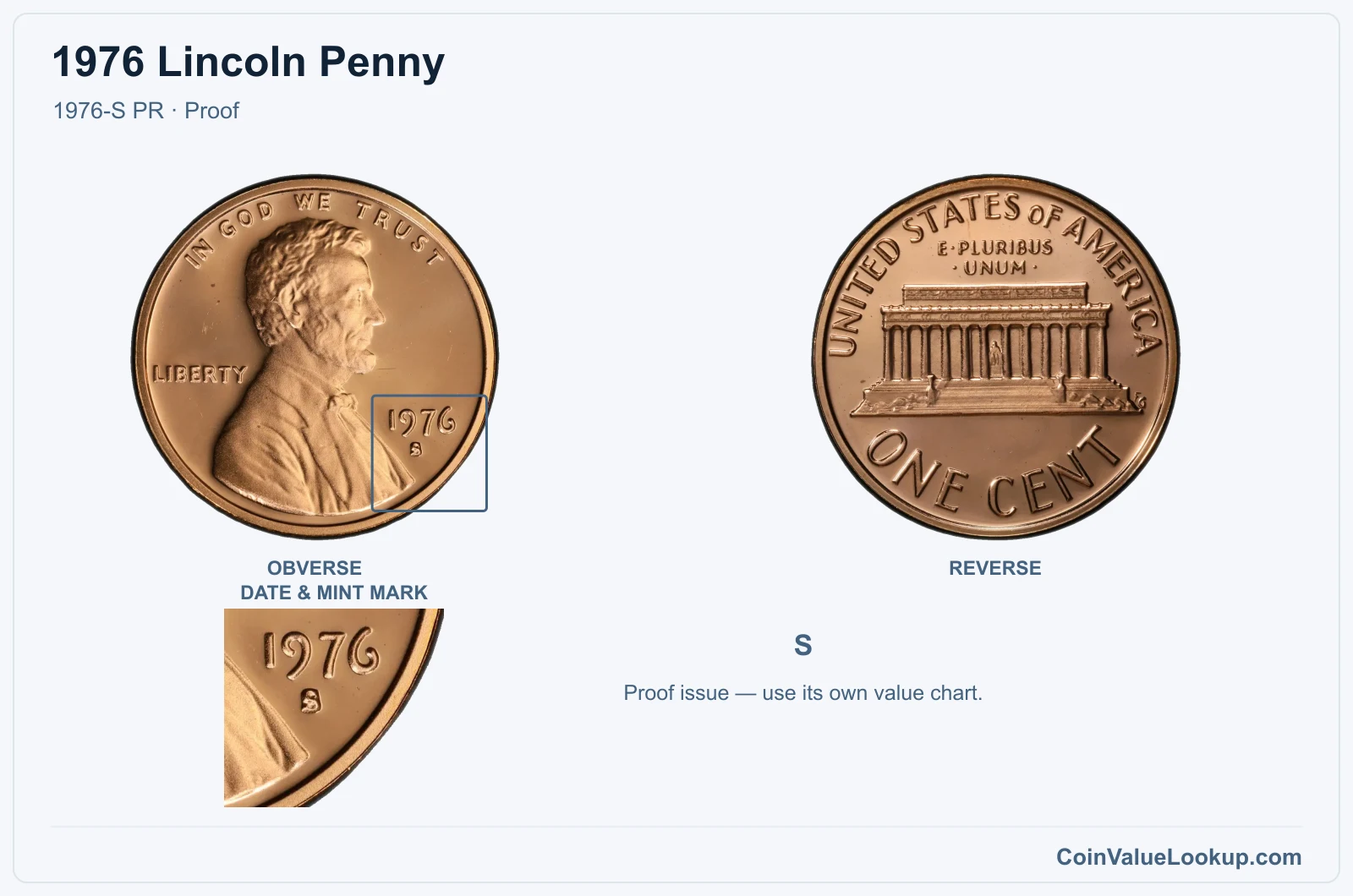
The 1976-S is exclusively a proof coin, struck at the San Francisco Mint for collector sets. It has a small "S" below the date and mirror-like fields created by specially prepared dies.
A PR65 example carries a USA Coin Book guide estimate of roughly $3.85. Premiums climb with contrast — Cameo and Deep Cameo designations indicate strong frosting on the portrait and lettering against those mirror fields.
Handling matters here. Proof surfaces are unforgiving; a single fingerprint or a wipe with a cloth can leave hairlines that drop the grade.
Store these in their original government packaging whenever possible.
| Range | Grade | Price | Auction Records | Appraisal |
|---|---|---|---|---|
| PR | PR 1 | — | Coin Identifier | |
| PR 2 | — | Coin Identifier | ||
| PR 3 | — | Coin Identifier | ||
| PR 4 | — | Coin Identifier | ||
| PR 6 | — | Coin Identifier | ||
| PR 8 | — | Coin Identifier | ||
| PR 10 | — | Coin Identifier | ||
| PR 12 | — | Coin Identifier | ||
| PR 15 | — | Coin Identifier | ||
| PR 20 | — | Coin Identifier | ||
| PR 25 | — | Coin Identifier | ||
| PR 30 | — | Coin Identifier | ||
| PR 35 | — | Coin Identifier | ||
| PR 40 | — | Coin Identifier | ||
| PR 45 | — | Coin Identifier | ||
| PR 50 | — | Coin Identifier | ||
| PR 53 | — | Coin Identifier | ||
| PR 55 | — | Coin Identifier | ||
| PR 58 | — | Coin Identifier | ||
| PR 60 | Coin Identifier | |||
| PR 61 | — | Coin Identifier | ||
| PR 62 | — | Coin Identifier | ||
| PR 63 | — | Coin Identifier | ||
| PR 64 | Coin Identifier | |||
| PR 65 | Coin Identifier | |||
| PR 66 | Coin Identifier | |||
| PR 67 | Coin Identifier | |||
| PR 68 | Coin Identifier | |||
| PR 69 | Coin Identifier | |||
| PR 70 | — | Coin Identifier |
1976 Lincoln Penny Error List
1. 1976 Lincoln Penny — Double Strike, Second Off Center
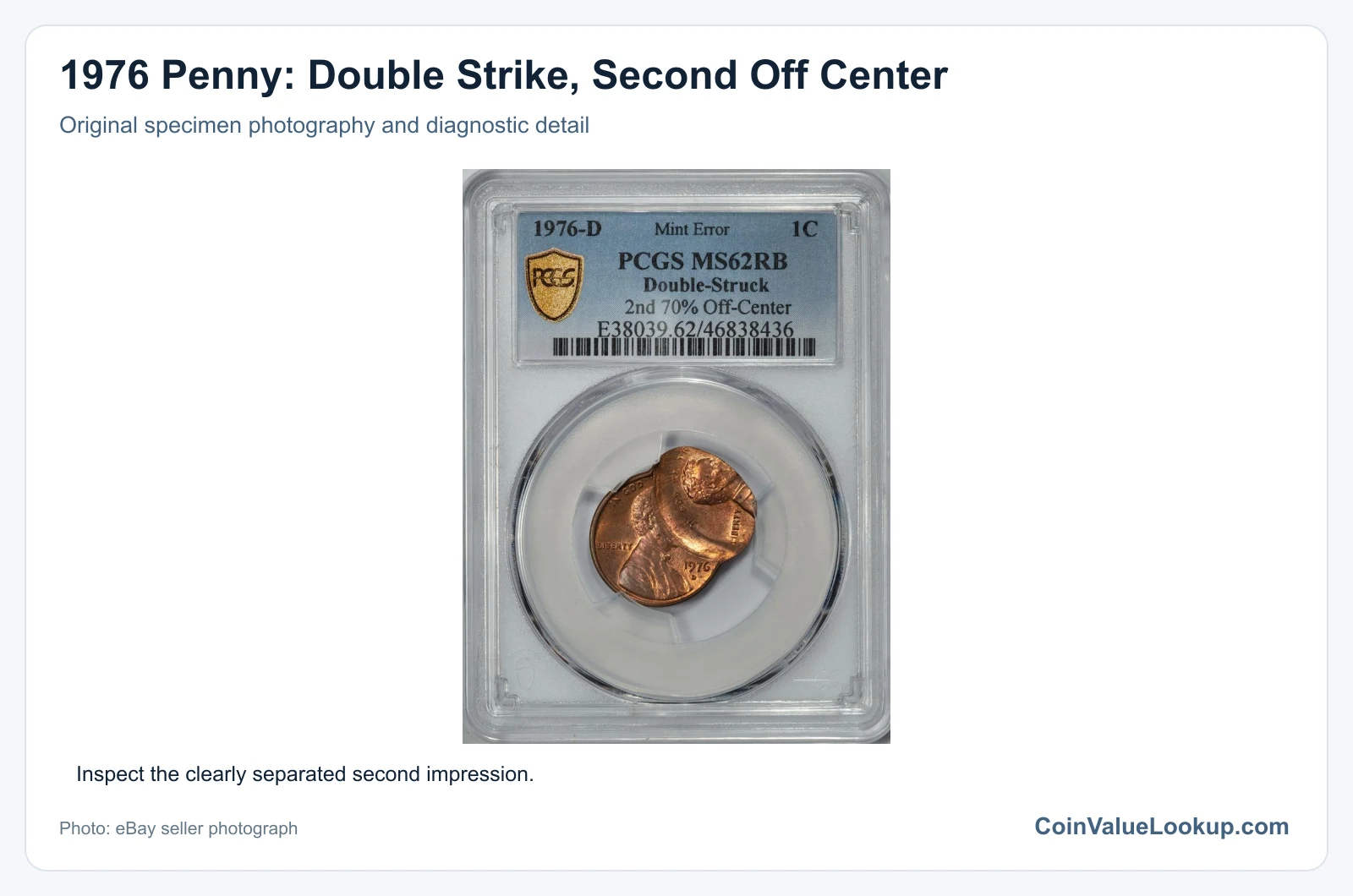
A double-struck 1976-D cent shows two complete impressions of the design, with the second strike displaced significantly from the first. This is not a doubled die, which produces minor design doubling within a single strike.
On a true double strike you can see two distinct outlines of Lincoln's portrait and two sets of lettering, often at dramatically different angles.
A PCGS MS64 Red-Brown 1976-D cent with a second strike 70% off center sold for $360 at Heritage Auctions in June 2025. That is a single recorded sale, not a guaranteed price range.
Value depends on the degree of displacement, whether the date remains visible, and the coin's overall condition.
Look-alikes include machine doubling (flat, shelf-like distortion) and vise damage from post-mint compression. Neither produces two fully separated designs.
2. 1976 Lincoln Penny — Obverse Die Break
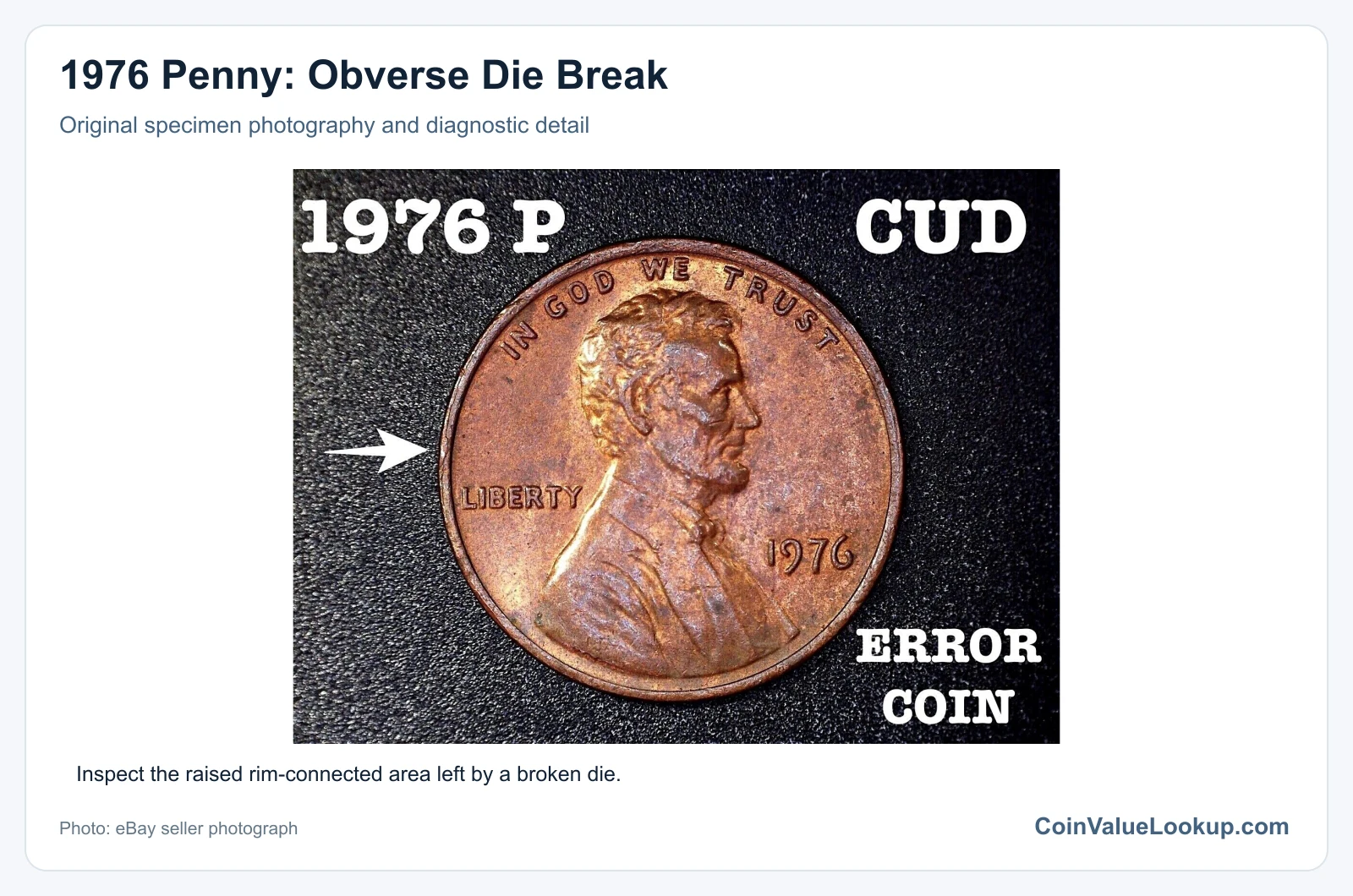
An obverse die break on a 1976 no-mintmark cent appears as a raised, irregular blob of metal where part of the die cracked and fell away. The coin's striking pressure forced metal into that void, creating a lump that replaces the normal design in that area.
An NGC MS63 Brown example with an attributed obverse die break sold for $84 at Heritage Auctions in June 2025. That sale reflects one specific coin's size of break, location and condition — not a universal price for all die breaks.
Before you get excited, check whether the raised area is actually part of the coin's metal or something stuck on top. Solder, dried glue and post-mint dents can mimic a die break but will show different texture and edge characteristics under magnification.
3. 1976 Lincoln Penny — Rolled-Thick Planchet
A rolled-thick planchet error means the copper strip fed into the blanking press was thicker than normal. The result is a coin that weighs more and has a visibly thicker edge than a standard 3.11-gram cent.
One authenticated 1976-D example weighed 3.78 grams and was graded PCGS MS63 Brown.
These are assessed individually based on authenticated identity, the degree of weight deviation and overall condition. There is no single adopted price range for this category.
To check at home, weigh your coin on a gram-accurate scale and compare the edge thickness side-by-side with a normal 1976 cent. If your coin is noticeably heavier but looks like a normal cent design, it may warrant professional evaluation.
Watch out for coins with solder on the rim, two coins glued together, or an unreliable scale giving you a false reading.
4. 1976 Lincoln Penny — Doubled Die Obverse
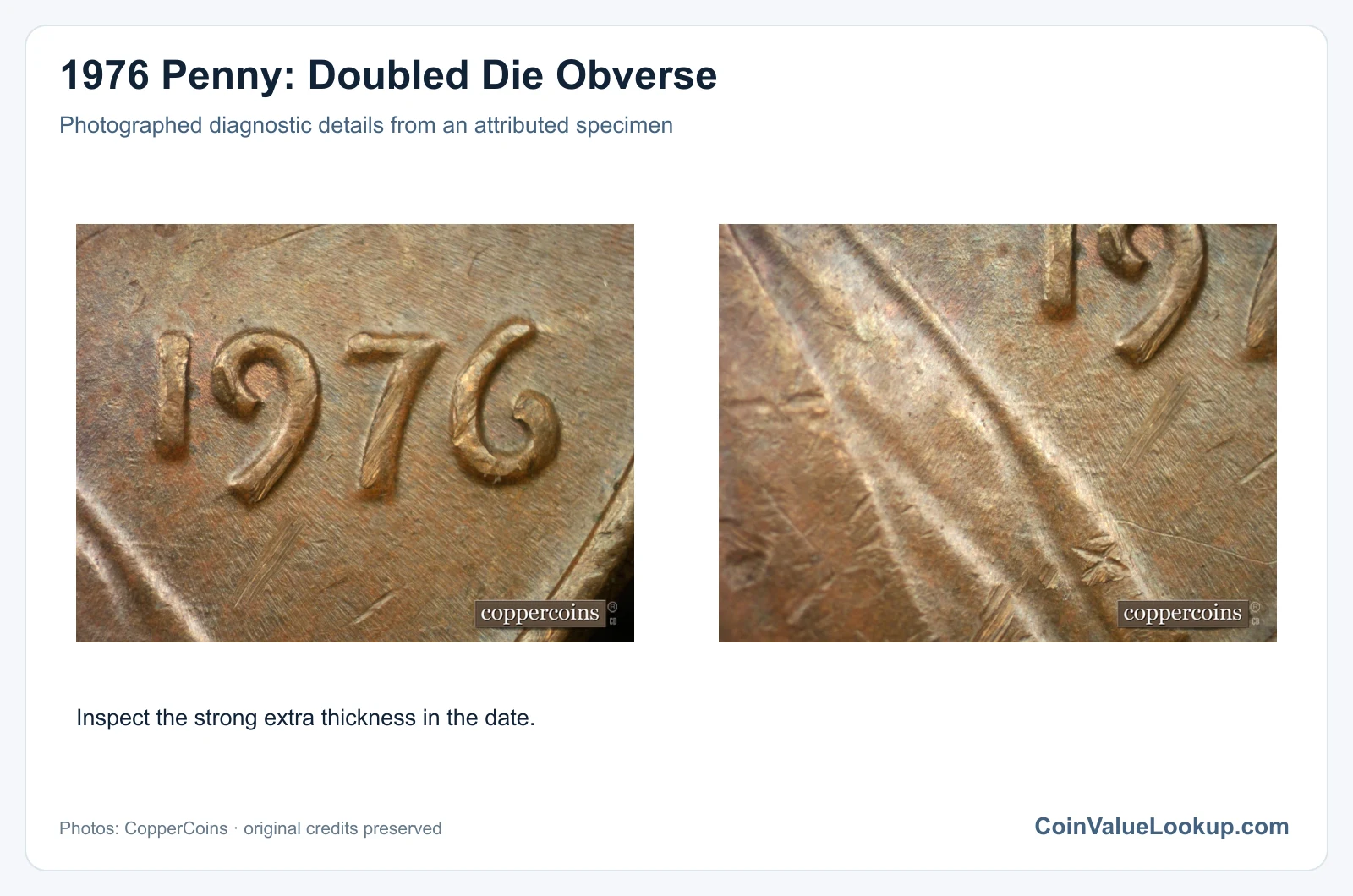
A doubled die obverse on a 1976 cent shows consistent doubling of design elements — typically letters in LIBERTY or IN GOD WE TRUST — visible as separation or notching on the edges of those letters. The doubling is baked into the die itself, so every coin struck from that die shows the same pattern in the same location.
Condition, the strength of visible doubling, and the specific die variety all affect value. No single numerical price range is adopted for this category.
To check your coin, compare the obverse lettering under magnification against a known-normal 1976 cent in similar lighting. Genuine die doubling produces raised, rounded secondary images.
Machine doubling, by contrast, leaves flat shelf-like distortion that lacks the crisp separation of a true doubled die. Worn die contours can also trick you at low magnification.
5. 1976 Lincoln Penny — Repunched Mintmark
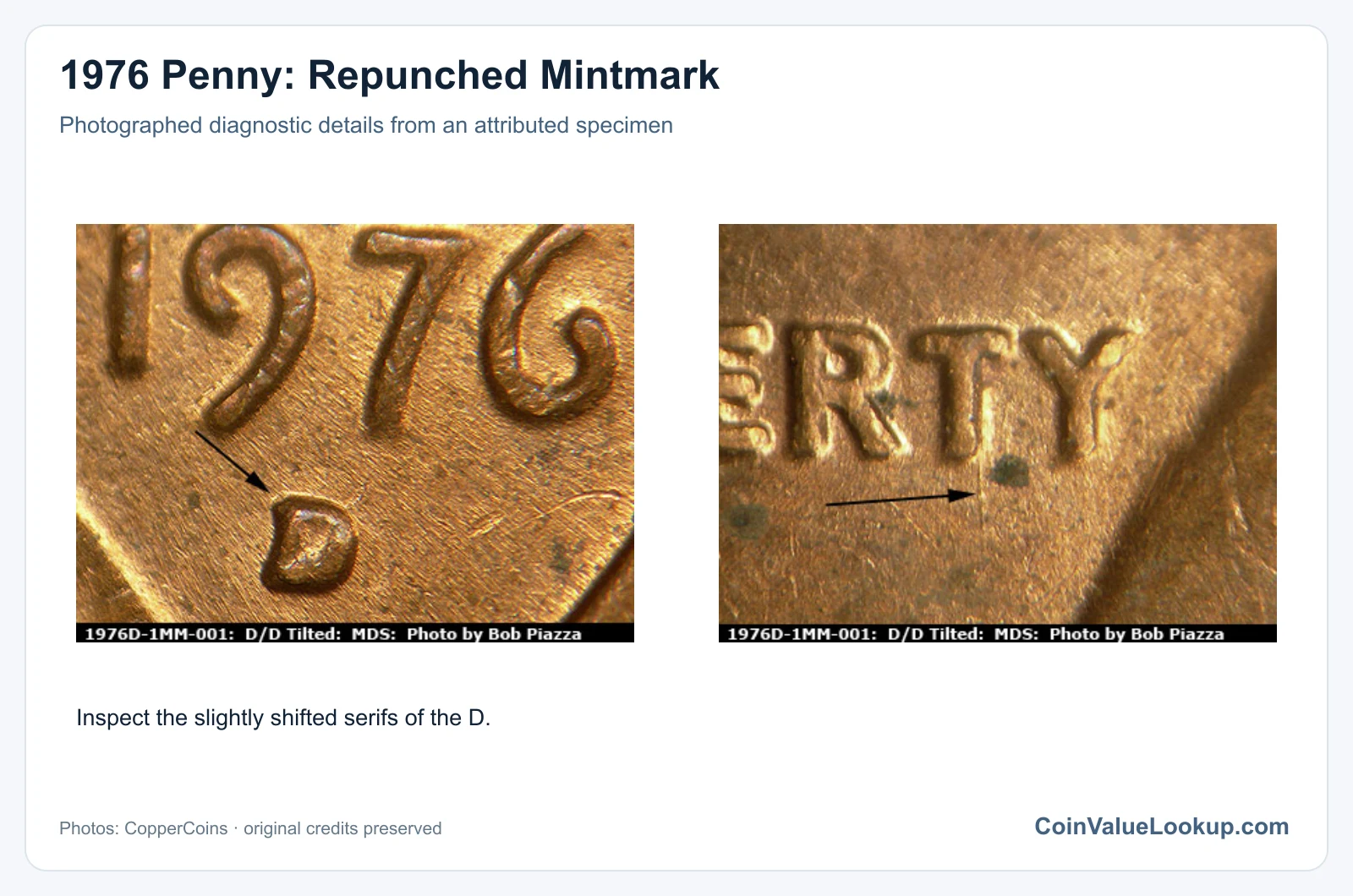
A repunched mintmark occurs when the mintmark punch was applied more than once in slightly different positions on the working die. On a 1976 cent, look for traces of a second "D" peeking out from behind or beside the primary mintmark below the date.
Value depends on the visibility of the repunching, overall coin condition, and which specific die is involved. No adopted price range exists for this category.
Use at least 10x magnification and compare your mintmark directly against a normal example under the same lighting. Genuine repunching shows a distinct secondary outline of the mintmark letter.
Die chips, corrosion around the mintmark, or flat machine doubling can mimic this effect, so look for the shape of an actual letter in the remnant, not just a bump or smear.
6. 1976 Lincoln Penny — Off-Center Strike
An off-center strike happens when the planchet is not properly seated between the dies at the moment of striking. The result is a crescent-shaped blank area on one side with the design shifted away from center.
Collectors prize off-center cents that still show a complete, readable date — without the date, the coin is much harder to attribute and less desirable. The percentage of off-center displacement and overall condition drive value.
No adopted numerical price range is available for this category.
Do not confuse an off-center strike with a clipped planchet, which is a blank issue, or with post-mint damage like someone flattening part of the rim. A genuine off-center strike shows a smooth, unstruck area with normal planchet surface, and the entire design shifts uniformly in one direction.
7. 1976 Lincoln Penny — Clipped Planchet
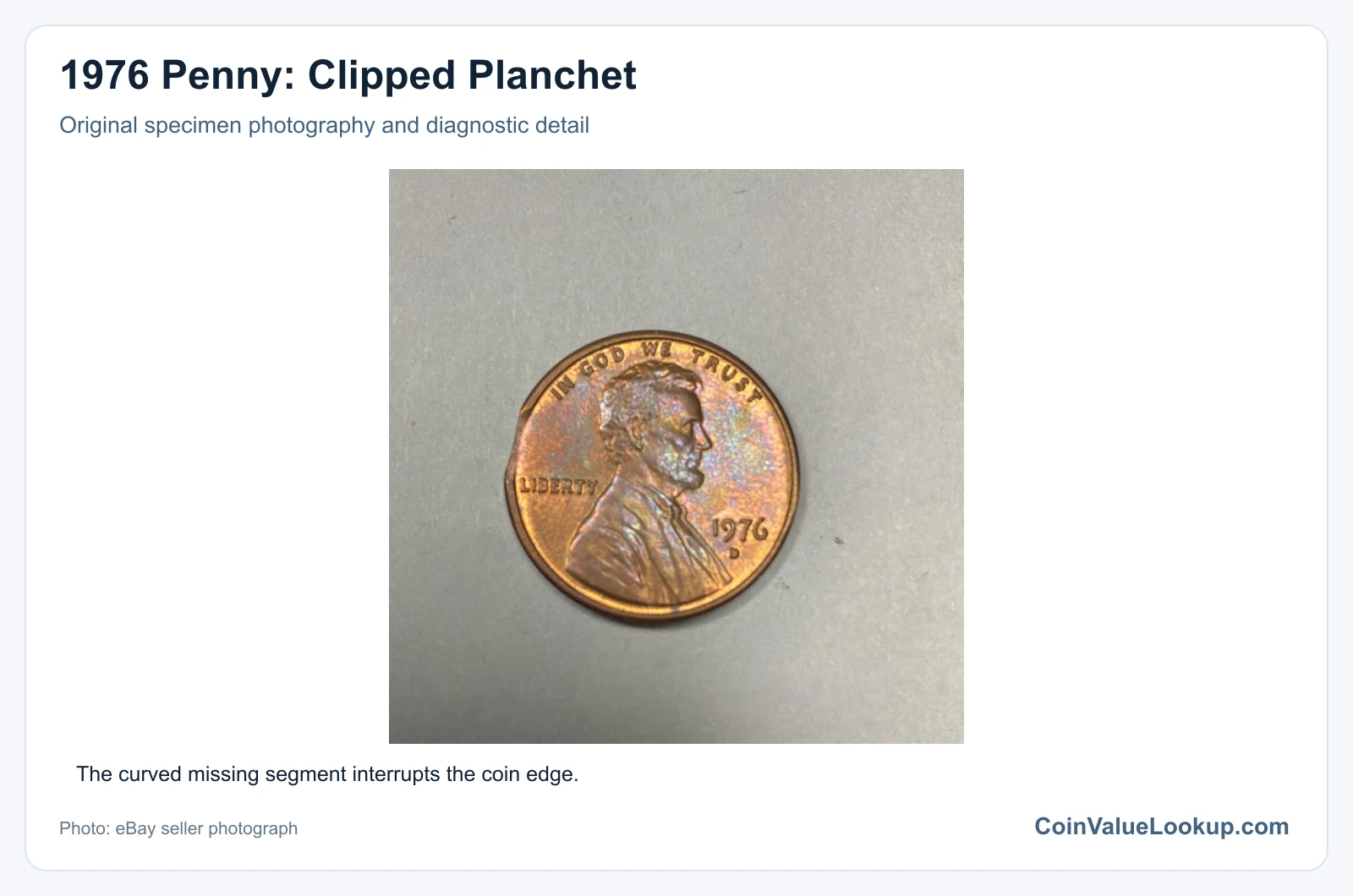
A clipped planchet error means a portion of the coin blank was missing before the coin was struck. Clips come in different shapes — curved (most common), straight, or ragged — depending on what went wrong during the blanking process.
Look for a section of the rim and adjacent design that is simply absent, with metal flow weakness on the opposite side of the coin. That opposite-side weakness, sometimes called the Blakesley effect, helps confirm a genuine clip versus post-mint damage.
No adopted price range applies to this category; value depends on the size and type of clip, whether the date is intact, and overall condition. A filed notch, a deliberate edge cut, or corrosion eating into the rim can look similar at first glance but will show tool marks or pitting rather than smooth, tapered metal flow.
8. 1976 Lincoln Penny — Struck on a Dime Planchet
A 1976 cent struck on a dime planchet is a wrong-planchet error. The coin will be noticeably smaller and lighter than a normal cent, because a dime blank is a different diameter and weight.
The Lincoln design will appear truncated, with portions of the outer design missing entirely.
To evaluate at home, measure the diameter and weigh the coin, then compare against normal cent specifications (about 19 mm and 3.11 g). Do not assume the coin is on a dime blank just because it looks shiny — plating, cleaning, or environmental exposure can change a normal cent's appearance.
No adopted numerical price range is available. Value would be assessed individually based on authenticated identity, condition, and how much of the design survived the strike.
A normal cent that has been ground down or plated after leaving the mint is the main look-alike to rule out.