2016 Quarter Coin Value: How Much Is It Worth?
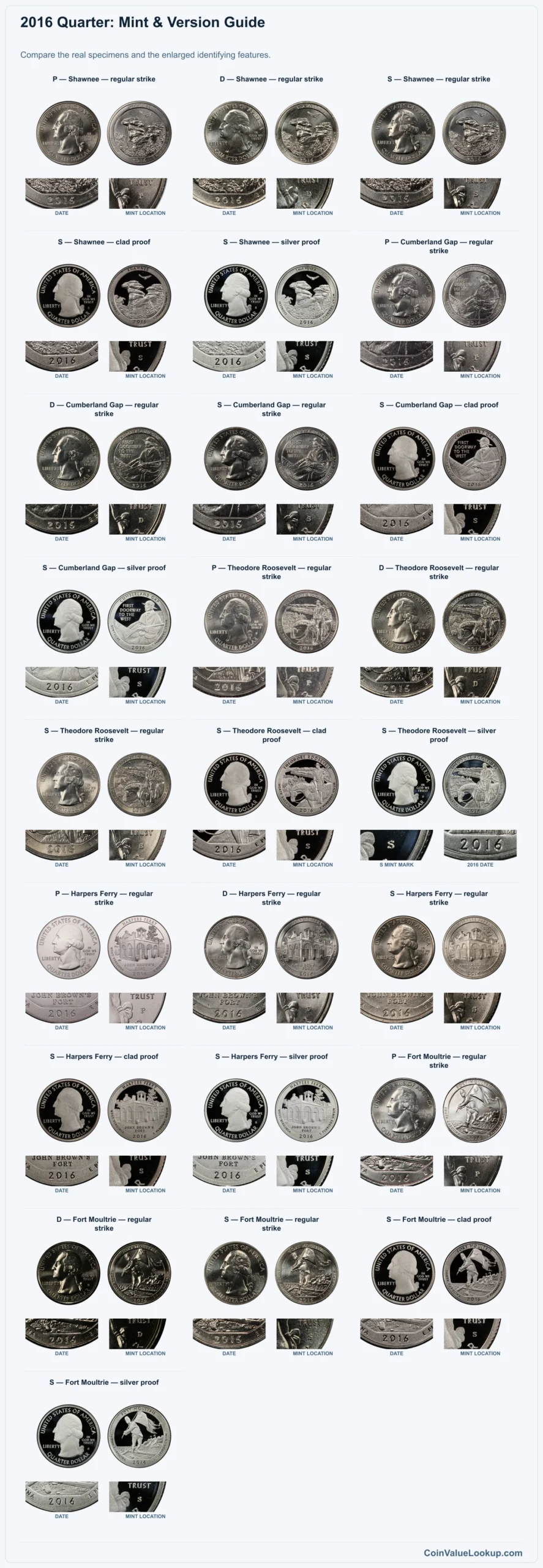
The 2016 quarter belongs to the America the Beautiful series and comes in five different reverse designs: Shawnee, Cumberland Gap, Theodore Roosevelt, Harpers Ferry and Fort Moultrie. Guide estimates from USA Coin Book range from about $0.61 to $24.00 depending on the specific mint, reverse design, finish and condition.
Your coin's value depends on nailing down each of those details, so let's walk through them.
Fast Way to Identify Your 2016 Quarter
The quickest way to start is to upload clear photos of both sides of your coin. A front shot shows the mintmark and date, while the back reveals which of the five 2016 reverse designs you have.
From there we can offer a preliminary identification of your coin's version, though this is not a substitute for professional authentication or grading.
2016 Quarter Value
Upload both sides of your 2016 Quarter.
Front Obverse
Upload photo
Back Reverse
Upload photo
Which 2016 Quarter Versions Are Worth Money?
- S-mint silver proofs across all five designs carry the highest guide estimates at $24.00 each in PR65, owing to their 90% silver composition and limited collector-market production.
- S-mint clad proofs are listed at about $5.63 in PR65 per USA Coin Book, a step above circulation strikes but well below their silver counterparts.
- S-mint regular strikes from collector sets guide at roughly $3.62 in MS65, more than P or D business strikes because they were not released into general circulation.
- Most P and D circulation strikes trade near face value when worn; original uncirculated examples guide at about $1.24 in MS65.
Step 1: Identify Your 2016 Quarter Mint Mark and Version
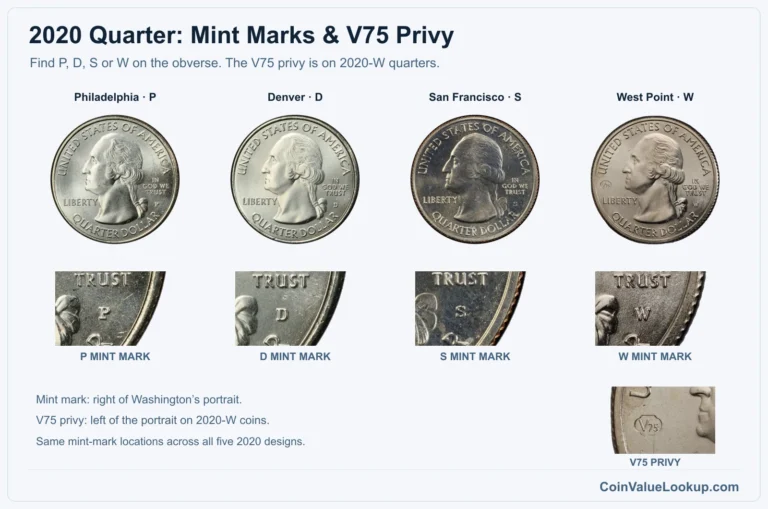
Start with the obverse. Look for the small mintmark letter near Washington's portrait: P for Philadelphia, D for Denver, S for San Francisco.
That letter alone does not tell you the finish, so keep reading.
Flip the coin over. The reverse will show one of five designs: Shawnee National Forest (a horse and rider), Cumberland Gap (a frontiersman), Theodore Roosevelt National Park (bison and landscape), Harpers Ferry (John Brown's Fort), or Fort Moultrie (the fort with a flag).
Match the image, not just the inscription, because a statehood or anniversary date in the design is not the minting year.
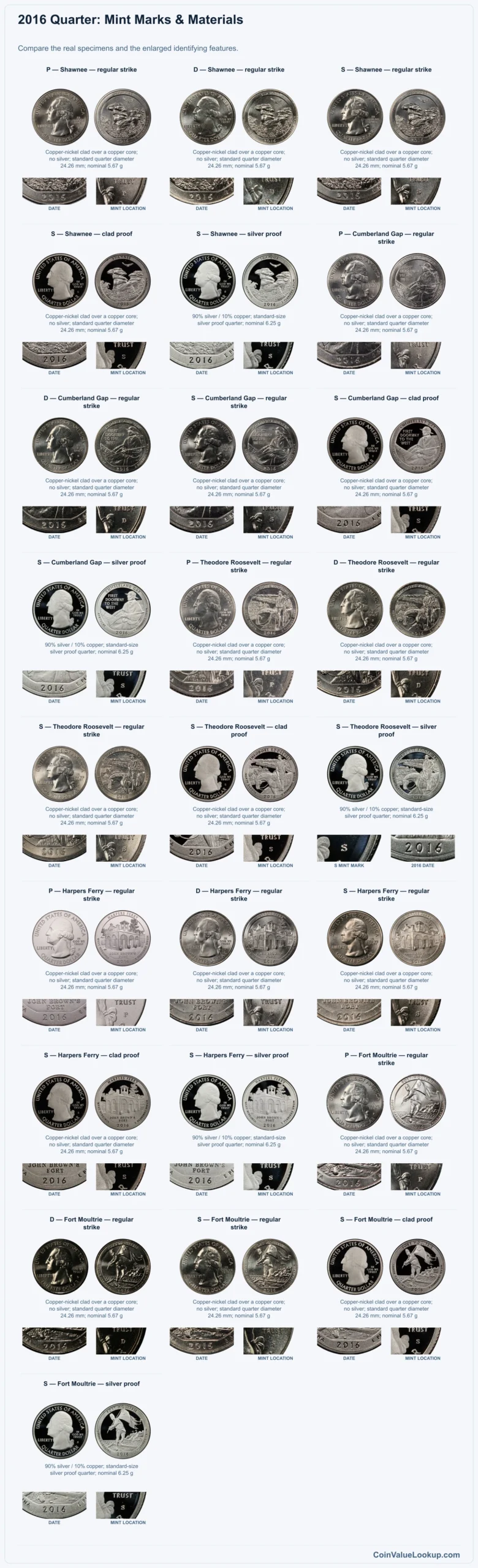
If your coin has an S mintmark, you need to determine whether it is a regular uncirculated strike, a clad proof or a silver proof. Proofs have mirror-like reflective fields and sharply frosted raised devices.
To separate clad from silver, check the edge: a copper-nickel clad coin shows a visible copper-colored stripe between the outer layers, while a silver proof does not. Weight helps too: clad quarters weigh about 5.67 grams and silver proofs about 6.25 grams.
This guide covers standard 24.26 mm quarters only. Five-ounce silver collector pieces share the same designs but are an entirely different product with different values.
Step 2: Check Your 2016 Quarter Grade
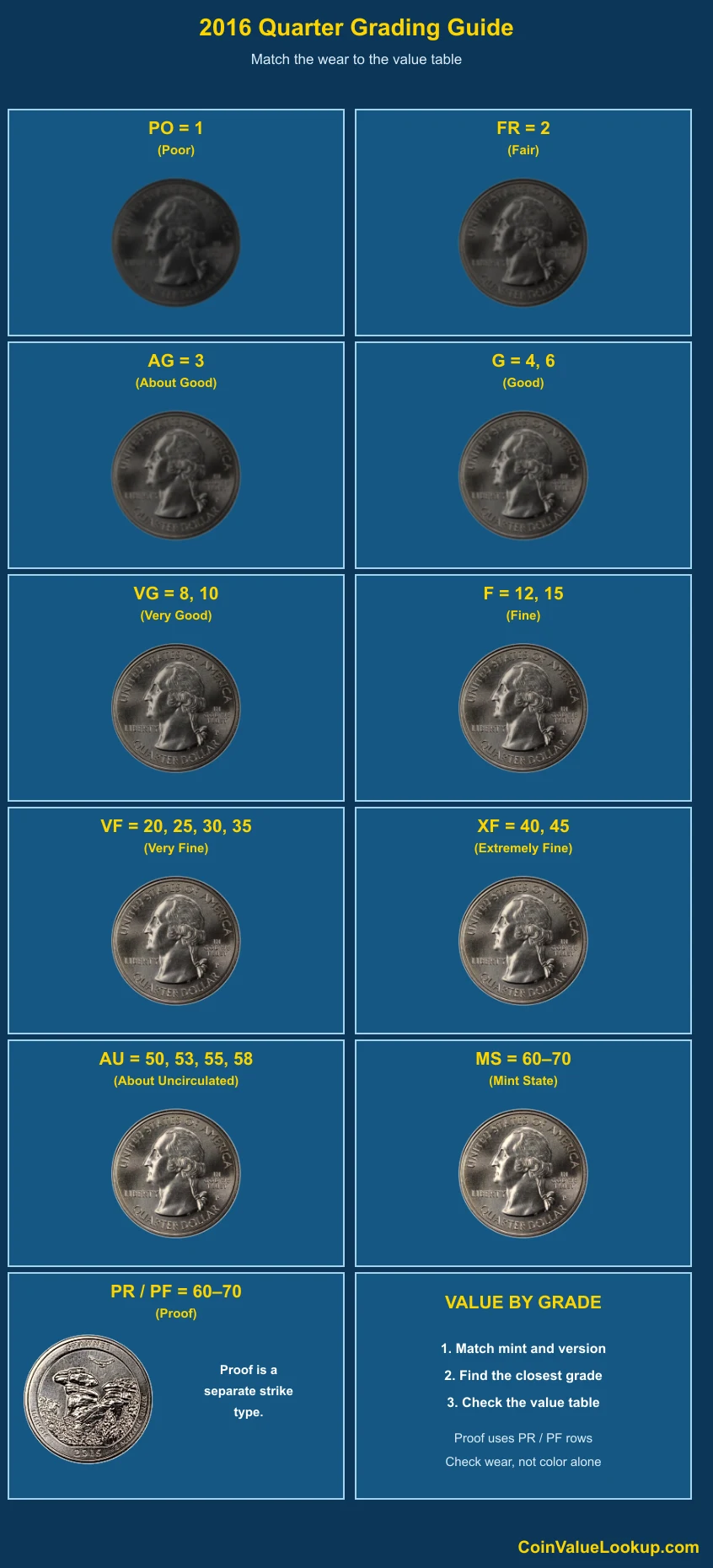
On the obverse, focus on Washington's cheekbone and the hair detail directly above his ear. These are the first spots to lose definition as a coin circulates.
A coin grading around MS60 will have full design but may show contact marks from handling, while an MS65 example retains strong original luster with only minor marks in non-focal areas.
For proof coins, tilt the coin under a single light source. Hairline scratches and haze across the mirrored fields are the main condition killers.
A PR65 proof may have a few faint hairlines visible under magnification but should look clean to the unaided eye.
Use the comparison image to match your coin's wear pattern. A coin with a mushy strike can look worn even if it never circulated, so compare luster alongside detail.
Do not assume a shiny coin is high grade if the luster comes from cleaning rather than original mint bloom.
Step 3: Check 2016 Quarter Value by Mint and Version
2016 Quarter — P — Shawnee — regular strike
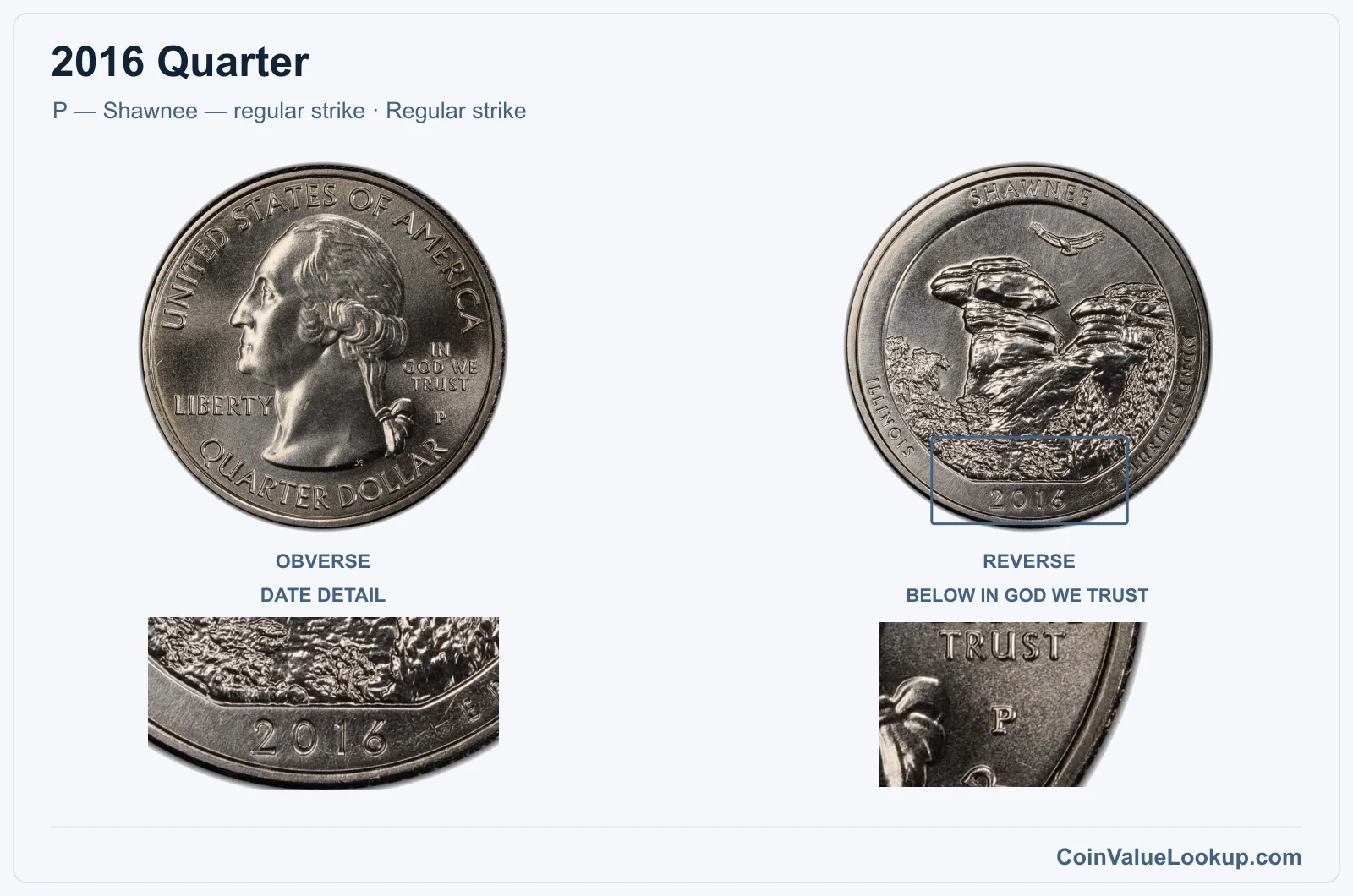
The 2016 P Shawnee quarter was struck at Philadelphia in copper-nickel clad. The reverse depicts a horse and rider in Shawnee National Forest.
Worn examples are worth face value in everyday transactions.
USA Coin Book lists guide estimates of about $0.61 in MS60 and $1.24 in MS65 for original uncirculated pieces. Look for the P mintmark on the obverse and confirm the Shawnee reverse before comparing condition.
Range Grade
Price Auction Records Appraisal PO PO 1
—
Coin Identifier FR FR 2
—
Coin Identifier AG AG 3
—
Coin Identifier G G 4
—
Coin Identifier
G 6
—
Coin Identifier VG VG 8
—
Coin Identifier
VG 10
—
Coin Identifier F F 12
—
Coin Identifier
F 15
—
Coin Identifier VF VF 20
—
Coin Identifier
VF 25
—
Coin Identifier
VF 30
—
Coin Identifier
VF 35
—
Coin Identifier XF XF 40
—
Coin Identifier
XF 45
—
Coin Identifier AU AU 50
—
Coin Identifier
AU 53
—
Coin Identifier
AU 55
—
Coin Identifier
AU 58
—
Coin Identifier MS MS 60
—
Coin Identifier
MS 61
—
Coin Identifier
MS 62
—
Coin Identifier
MS 63
—
Coin Identifier
MS 64
—
Coin Identifier
MS 65
—
Coin Identifier
MS 66
—
Coin Identifier
MS 67
—
Coin Identifier
MS 68
—
—
—
MS 69
—
—
—
MS 70
—
—
—
2016 Quarter — D — Shawnee — regular strike
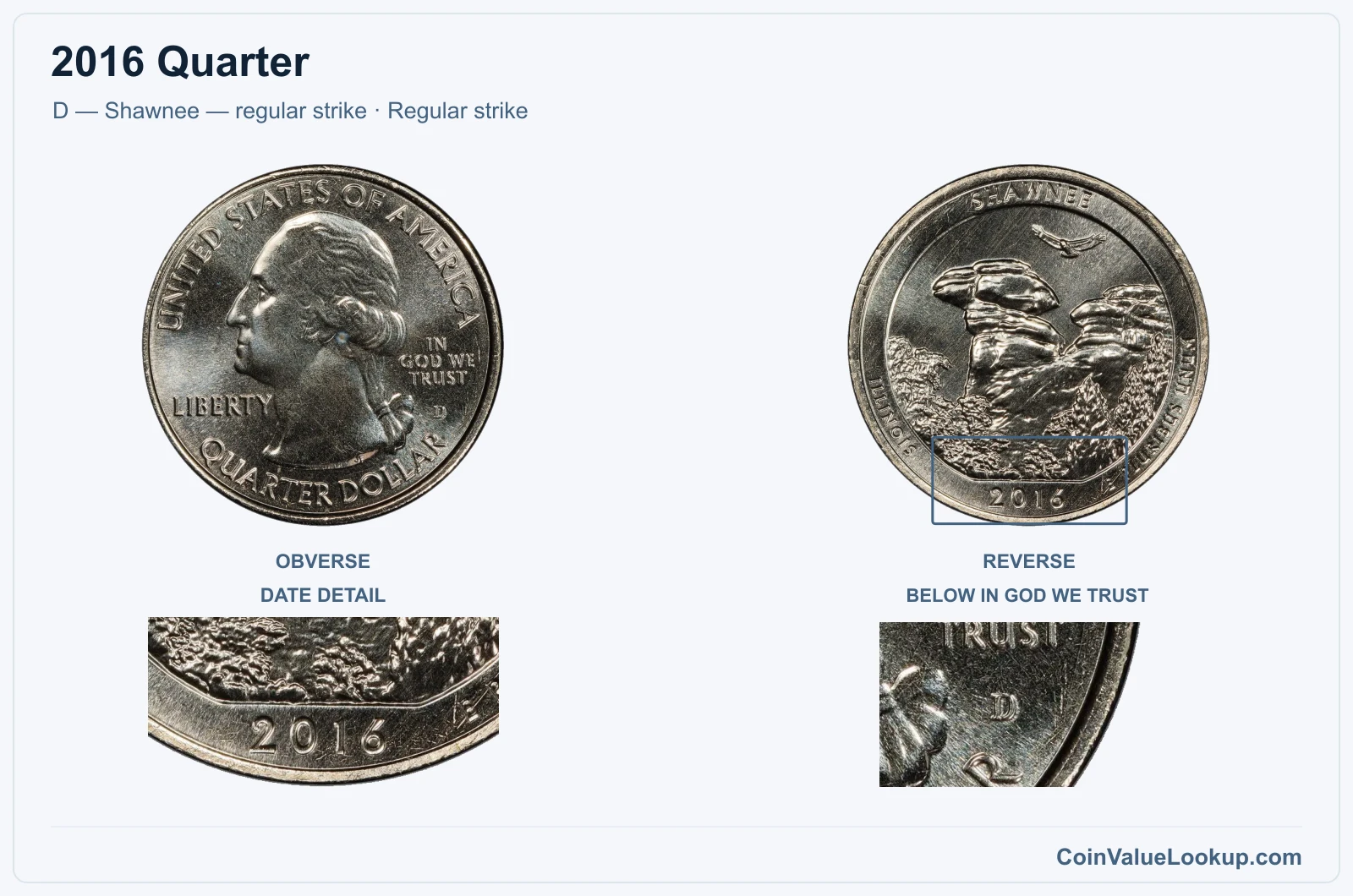
Denver produced its own run of the Shawnee design in the same copper-nickel clad composition. The D mintmark appears on the obverse near Washington's ponytail.
Guide estimates from USA Coin Book sit at about $0.61 in MS60 and $1.24 in MS65. As with the Philadelphia version, circulated examples trade at face value.
Only coins kept in original uncirculated condition attract a small premium.
Range Grade
Price Auction Records Appraisal PO PO 1
—
Coin Identifier FR FR 2
—
Coin Identifier AG AG 3
—
Coin Identifier G G 4
—
Coin Identifier
G 6
—
Coin Identifier VG VG 8
—
Coin Identifier
VG 10
—
Coin Identifier F F 12
—
Coin Identifier
F 15
—
Coin Identifier VF VF 20
—
Coin Identifier
VF 25
—
Coin Identifier
VF 30
—
Coin Identifier
VF 35
—
Coin Identifier XF XF 40
—
Coin Identifier
XF 45
—
Coin Identifier AU AU 50
—
Coin Identifier
AU 53
—
Coin Identifier
AU 55
—
Coin Identifier
AU 58
—
Coin Identifier MS MS 60
—
Coin Identifier
MS 61
—
Coin Identifier
MS 62
—
Coin Identifier
MS 63
—
Coin Identifier
MS 64
—
Coin Identifier
MS 65
—
Coin Identifier
MS 66
—
Coin Identifier
MS 67
—
Coin Identifier
MS 68
Coin Identifier
MS 69
—
—
—
MS 70
—
—
—
2016 Quarter — S — Shawnee — regular strike
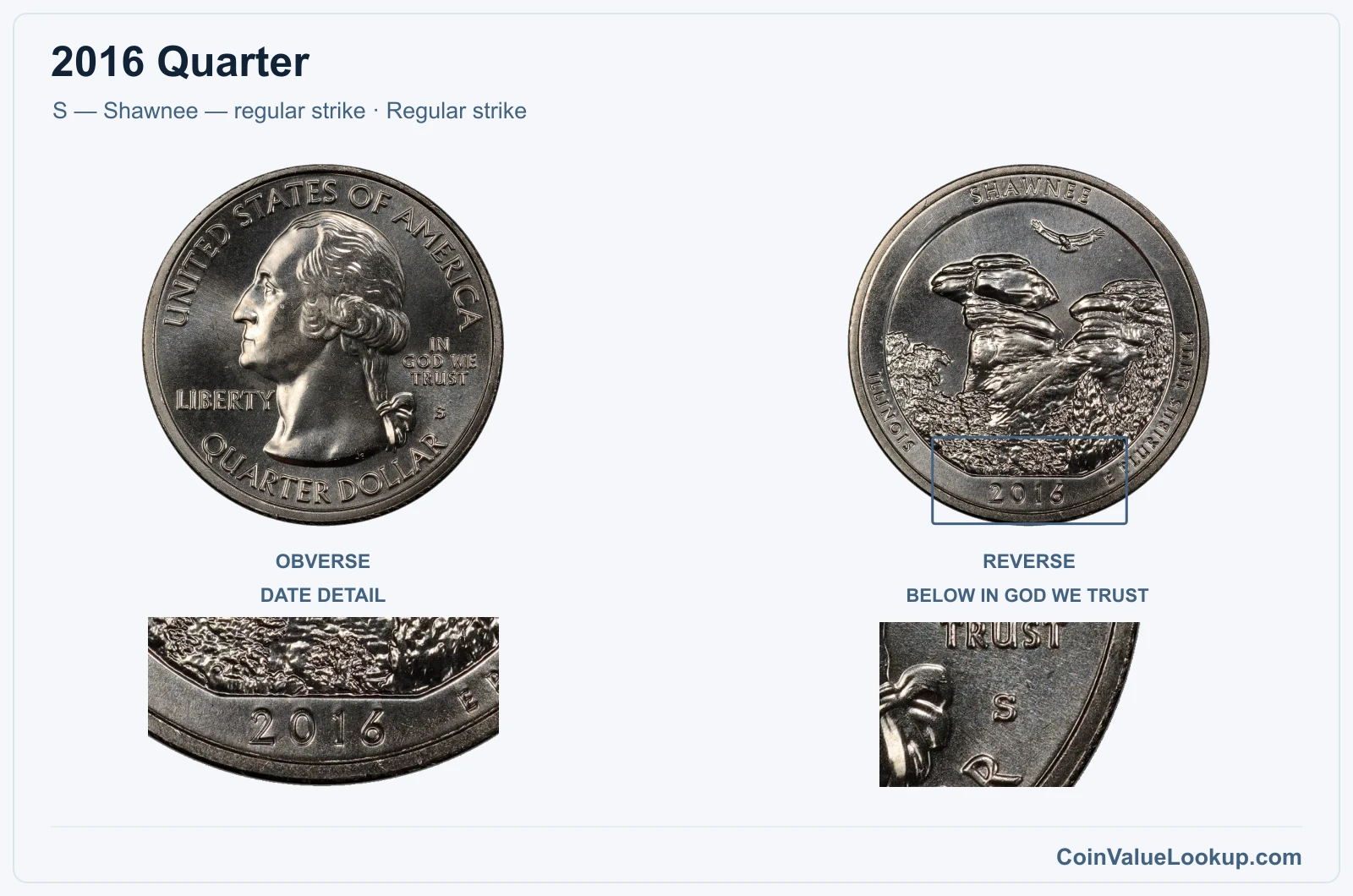
San Francisco struck a non-proof, uncirculated version of the Shawnee quarter for collector sets. An S mintmark does not automatically mean proof, so check the surface finish before assuming a higher value.
This coin is copper-nickel clad, the same composition as P and D strikes. USA Coin Book lists it at about $3.62 in MS65, a modest step up from the circulation-strike versions because it was sold only through mint sets and never released into pocket change.
Range Grade
Price Auction Records Appraisal PO PO 1
—
Coin Identifier FR FR 2
—
Coin Identifier AG AG 3
—
Coin Identifier G G 4
—
Coin Identifier
G 6
—
Coin Identifier VG VG 8
—
Coin Identifier
VG 10
—
Coin Identifier F F 12
—
Coin Identifier
F 15
—
Coin Identifier VF VF 20
—
Coin Identifier
VF 25
—
Coin Identifier
VF 30
—
Coin Identifier
VF 35
—
Coin Identifier XF XF 40
—
Coin Identifier
XF 45
—
Coin Identifier AU AU 50
—
Coin Identifier
AU 53
—
Coin Identifier
AU 55
—
Coin Identifier
AU 58
—
Coin Identifier MS MS 60
—
Coin Identifier
MS 61
—
Coin Identifier
MS 62
—
Coin Identifier
MS 63
—
Coin Identifier
MS 64
—
Coin Identifier
MS 65
—
Coin Identifier
MS 66
—
Coin Identifier
MS 67
—
Coin Identifier
MS 68
—
—
—
MS 69
—
—
—
MS 70
—
—
—
2016 Quarter — S — Shawnee — clad proof
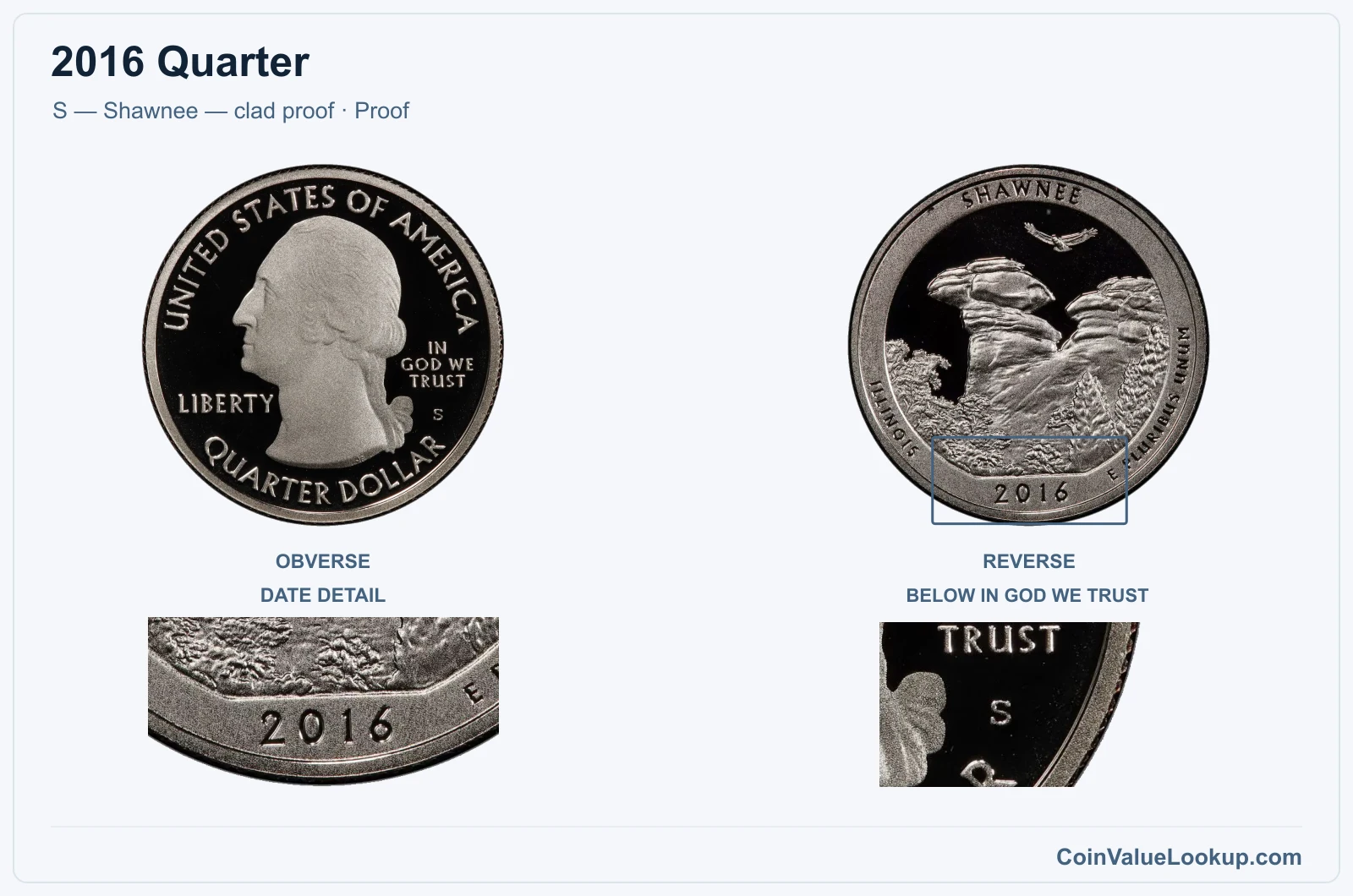
The clad proof Shawnee quarter was struck at San Francisco with mirror fields and frosted devices. It is copper-nickel clad, not silver, so check the edge for a copper-colored stripe between the outer layers.
USA Coin Book estimates this coin at about $5.63 in PR65. Do not confuse it with the silver proof, which has a higher precious-metal content and a distinctly different guide value.
Weight and edge color are your quickest confirmation tools.
Range Grade
Price Auction Records Appraisal PR PR 1
—
Coin Identifier
PR 2
—
Coin Identifier
PR 3
—
Coin Identifier
PR 4
—
Coin Identifier
PR 6
—
Coin Identifier
PR 8
—
Coin Identifier
PR 10
—
Coin Identifier
PR 12
—
Coin Identifier
PR 15
—
Coin Identifier
PR 20
—
Coin Identifier
PR 25
—
Coin Identifier
PR 30
—
Coin Identifier
PR 35
—
Coin Identifier
PR 40
—
Coin Identifier
PR 45
—
Coin Identifier
PR 50
—
Coin Identifier
PR 53
—
Coin Identifier
PR 55
—
Coin Identifier
PR 58
—
Coin Identifier
PR 60
—
Coin Identifier
PR 61
—
Coin Identifier
PR 62
—
Coin Identifier
PR 63
—
Coin Identifier
PR 64
—
Coin Identifier
PR 65
—
Coin Identifier
PR 66
—
Coin Identifier
PR 67
—
Coin Identifier
PR 68
—
Coin Identifier
PR 69
—
Coin Identifier
PR 70
—
Coin Identifier
2016 Quarter — S — Shawnee — silver proof
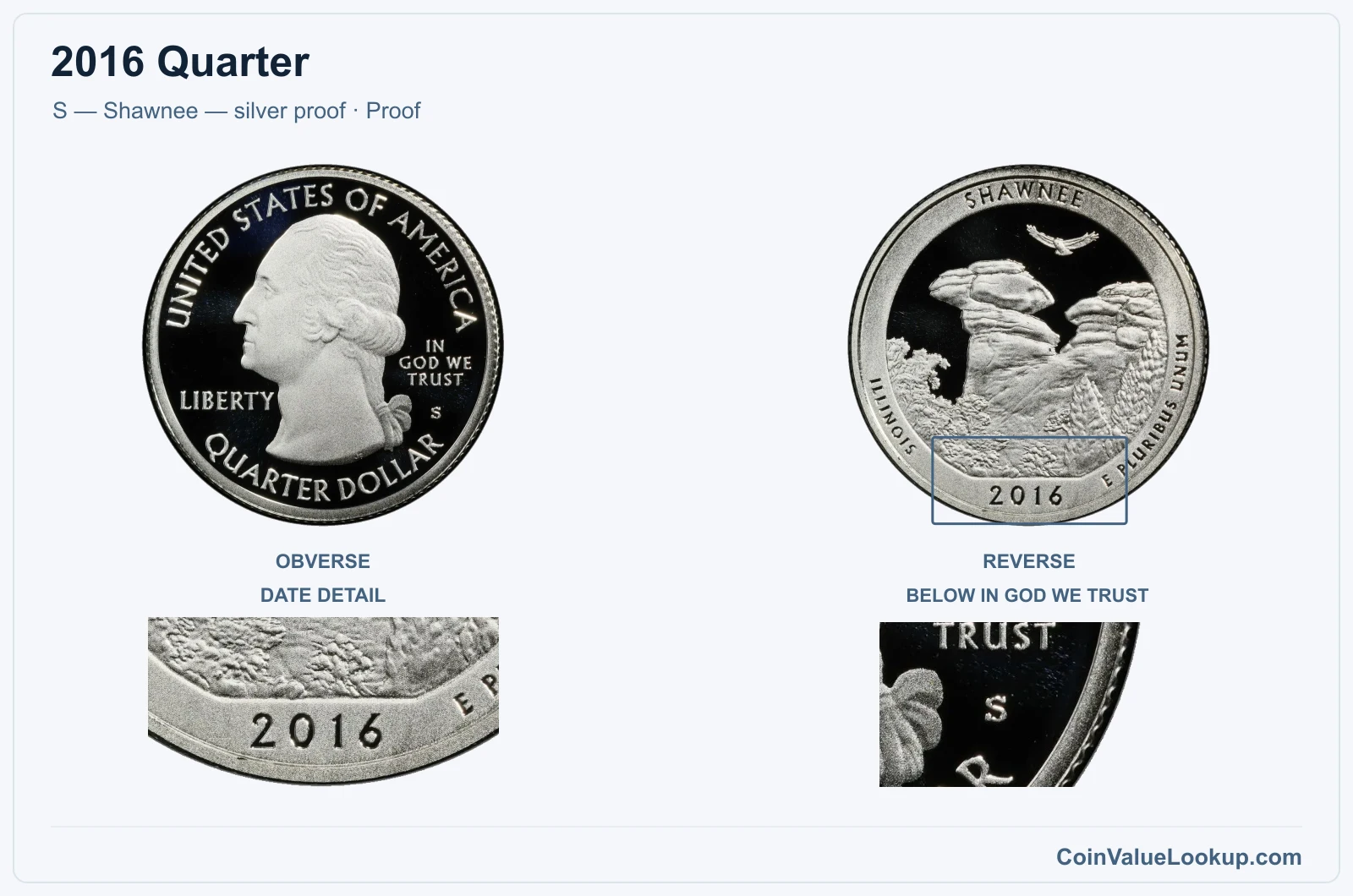
The silver proof version of the 2016 Shawnee quarter is composed of 90% silver and 10% copper, weighing about 6.25 grams compared to roughly 5.67 grams for clad issues. It carries the same mirror-field, frosted-device proof finish as its clad counterpart, but the edge will show a uniform silvery color with no copper stripe.
USA Coin Book places this coin at about $24.00 in PR65, the highest guide figure among 2016 Shawnee quarters. Confirming the silver composition through weight or original government packaging is important before applying this estimate.
Range Grade
Price Auction Records Appraisal PR PR 1
—
Coin Identifier
PR 2
—
Coin Identifier
PR 3
—
Coin Identifier
PR 4
—
Coin Identifier
PR 6
—
Coin Identifier
PR 8
—
Coin Identifier
PR 10
—
Coin Identifier
PR 12
—
Coin Identifier
PR 15
—
Coin Identifier
PR 20
—
Coin Identifier
PR 25
—
Coin Identifier
PR 30
—
Coin Identifier
PR 35
—
Coin Identifier
PR 40
—
Coin Identifier
PR 45
—
Coin Identifier
PR 50
—
Coin Identifier
PR 53
—
Coin Identifier
PR 55
—
Coin Identifier
PR 58
—
Coin Identifier
PR 60
—
Coin Identifier
PR 61
—
Coin Identifier
PR 62
—
Coin Identifier
PR 63
—
Coin Identifier
PR 64
—
Coin Identifier
PR 65
—
Coin Identifier
PR 66
—
Coin Identifier
PR 67
—
Coin Identifier
PR 68
—
Coin Identifier
PR 69
—
Coin Identifier
PR 70
—
Coin Identifier
2016 Quarter — P — Cumberland Gap — regular strike
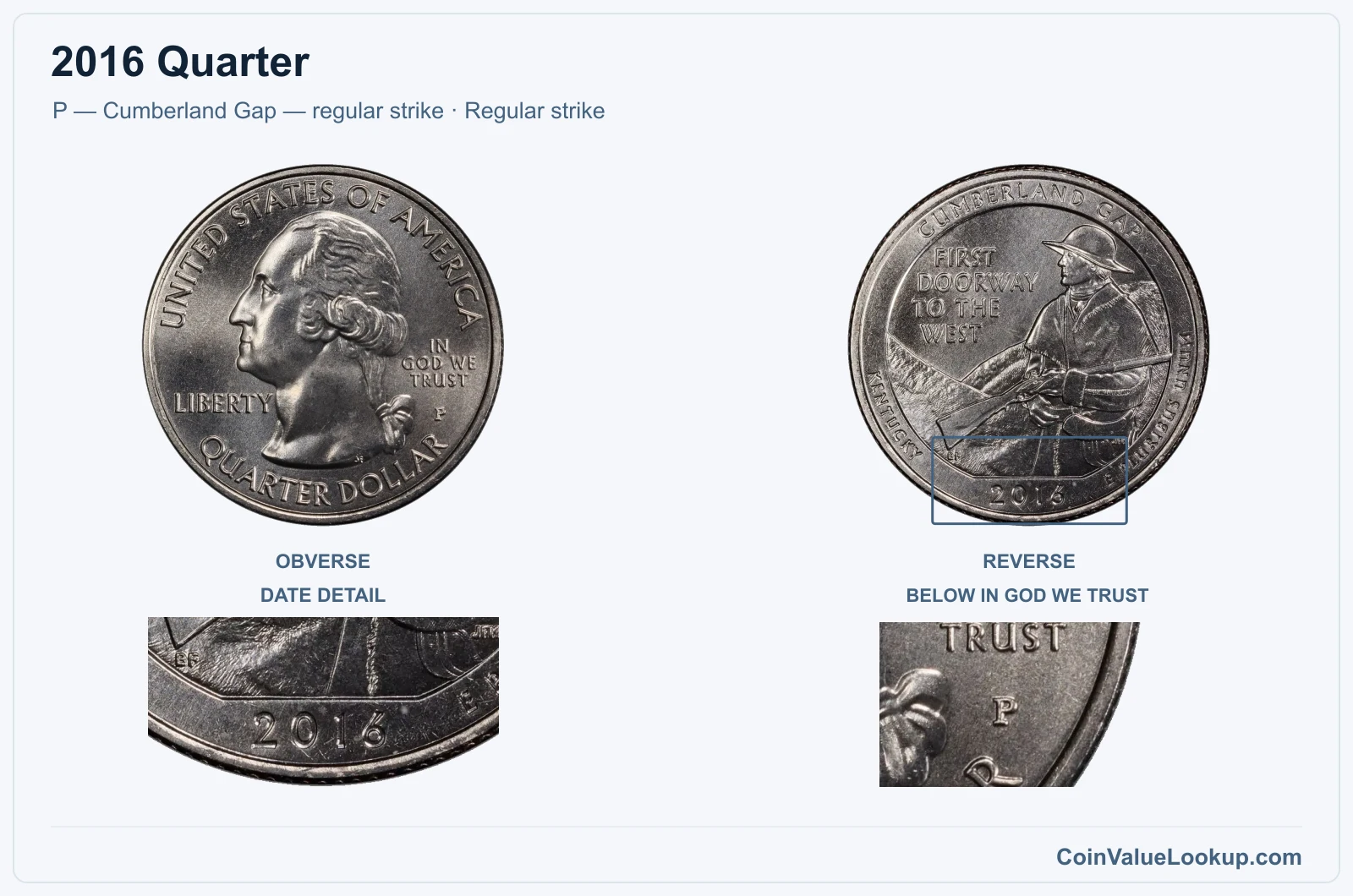
Philadelphia's Cumberland Gap quarter features a frontiersman on the reverse, struck in copper-nickel clad. Like every P-mint business strike from 2016, it entered general circulation.
Guide estimates from USA Coin Book are about $0.61 in MS60 and $1.24 in MS65. Worn coins trade at face value.
Match the Cumberland Gap reverse and the P mintmark before comparing your coin's condition to the guide.
Range Grade
Price Auction Records Appraisal PO PO 1
—
Coin Identifier FR FR 2
—
Coin Identifier AG AG 3
—
Coin Identifier G G 4
—
Coin Identifier
G 6
—
Coin Identifier VG VG 8
—
Coin Identifier
VG 10
—
Coin Identifier F F 12
—
Coin Identifier
F 15
—
Coin Identifier VF VF 20
—
Coin Identifier
VF 25
—
Coin Identifier
VF 30
—
Coin Identifier
VF 35
—
Coin Identifier XF XF 40
—
Coin Identifier
XF 45
—
Coin Identifier AU AU 50
—
Coin Identifier
AU 53
—
Coin Identifier
AU 55
—
Coin Identifier
AU 58
—
Coin Identifier MS MS 60
—
Coin Identifier
MS 61
—
Coin Identifier
MS 62
—
Coin Identifier
MS 63
—
Coin Identifier
MS 64
—
Coin Identifier
MS 65
—
Coin Identifier
MS 66
—
Coin Identifier
MS 67
—
Coin Identifier
MS 68
—
—
—
MS 69
—
—
—
MS 70
—
—
—
2016 Quarter — D — Cumberland Gap — regular strike
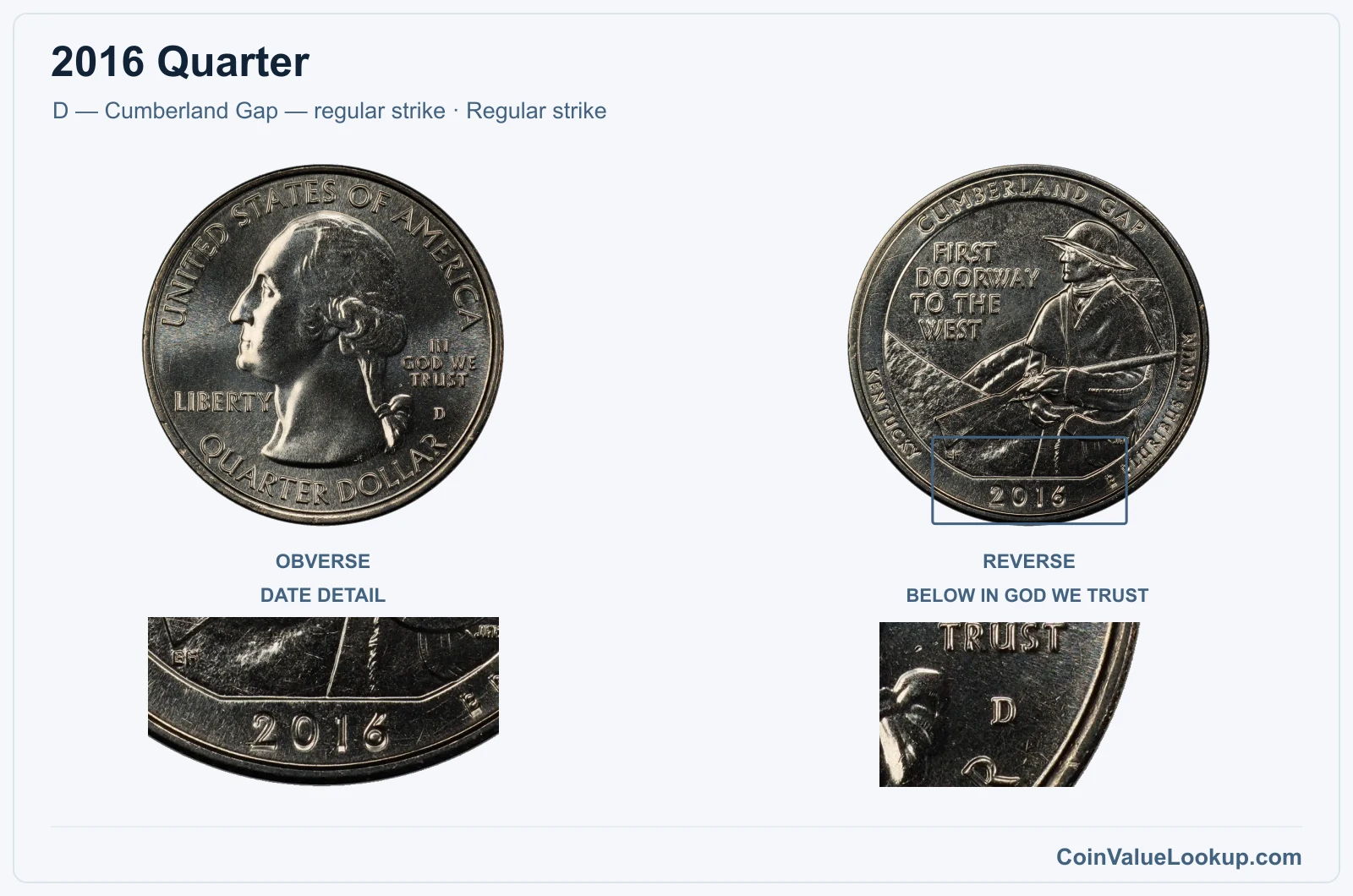
The Denver version of the Cumberland Gap quarter is identical in composition and design to the Philadelphia strike, differing only by mintmark. Look for the D on the obverse.
USA Coin Book estimates about $0.61 in MS60 and $1.24 in MS65. Circulated pieces are worth twenty-five cents.
Only original, uncirculated examples with good luster earn the small premium these guides reflect.
Range Grade
Price Auction Records Appraisal PO PO 1
—
Coin Identifier FR FR 2
—
Coin Identifier AG AG 3
—
Coin Identifier G G 4
—
Coin Identifier
G 6
—
Coin Identifier VG VG 8
—
Coin Identifier
VG 10
—
Coin Identifier F F 12
—
Coin Identifier
F 15
—
Coin Identifier VF VF 20
—
Coin Identifier
VF 25
—
Coin Identifier
VF 30
—
Coin Identifier
VF 35
—
Coin Identifier XF XF 40
—
Coin Identifier
XF 45
—
Coin Identifier AU AU 50
—
Coin Identifier
AU 53
—
Coin Identifier
AU 55
—
Coin Identifier
AU 58
—
Coin Identifier MS MS 60
—
Coin Identifier
MS 61
—
Coin Identifier
MS 62
—
Coin Identifier
MS 63
—
Coin Identifier
MS 64
—
Coin Identifier
MS 65
—
Coin Identifier
MS 66
—
Coin Identifier
MS 67
—
Coin Identifier
MS 68
—
Coin Identifier
MS 69
—
—
—
MS 70
—
—
—
2016 Quarter — S — Cumberland Gap — regular strike
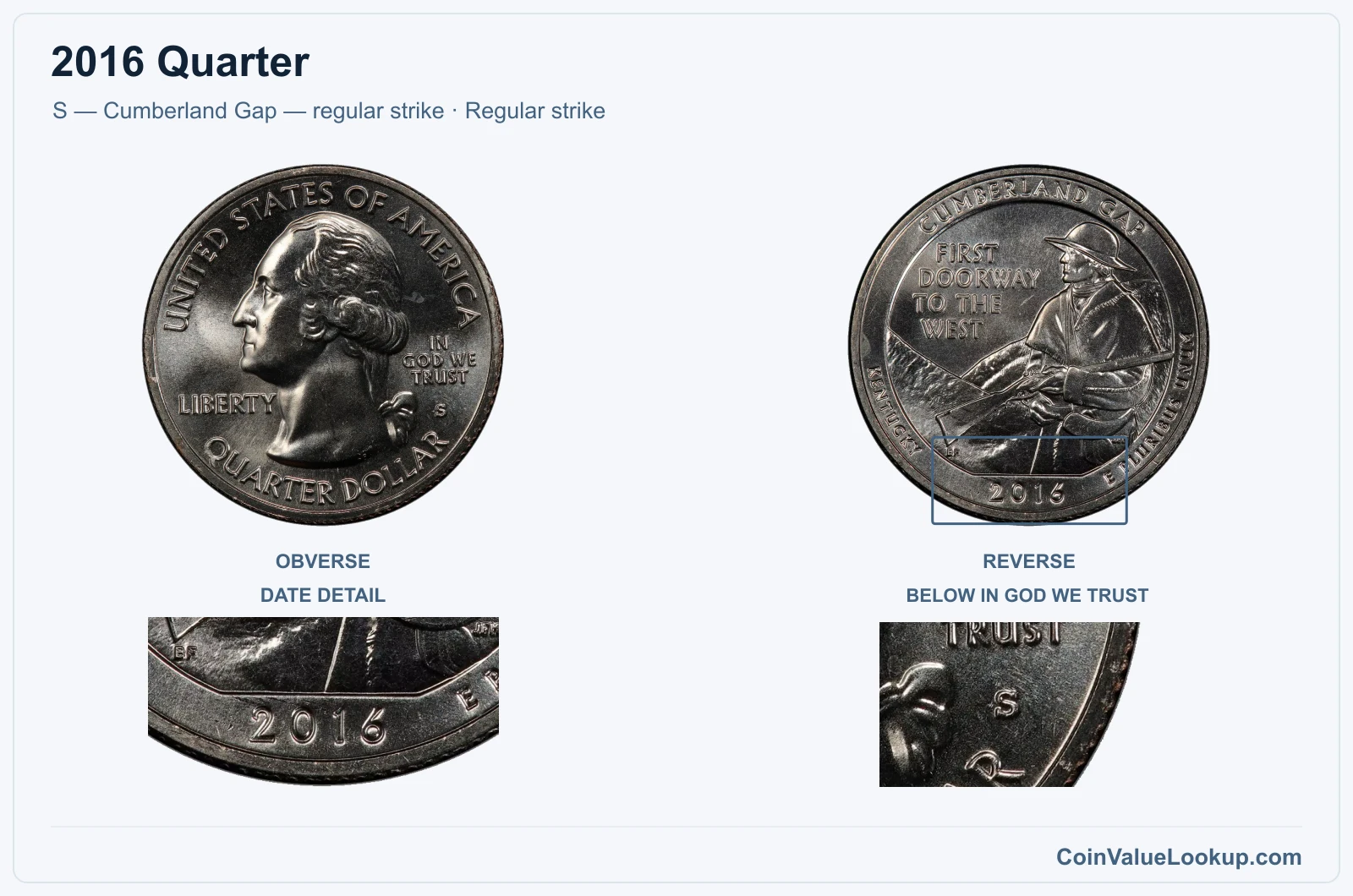
San Francisco produced a regular-strike Cumberland Gap quarter for collector mint sets. This is a copper-nickel clad coin, not a proof, despite carrying the S mintmark.
The surfaces will have a satin or normal business-strike appearance rather than mirror fields.
USA Coin Book guides this version at about $3.62 in MS65. It commands a small premium because it was distributed only through collector channels, not through banks or everyday commerce.
Range Grade
Price Auction Records Appraisal PO PO 1
—
Coin Identifier FR FR 2
—
Coin Identifier AG AG 3
—
Coin Identifier G G 4
—
Coin Identifier
G 6
—
Coin Identifier VG VG 8
—
Coin Identifier
VG 10
—
Coin Identifier F F 12
—
Coin Identifier
F 15
—
Coin Identifier VF VF 20
—
Coin Identifier
VF 25
—
Coin Identifier
VF 30
—
Coin Identifier
VF 35
—
Coin Identifier XF XF 40
—
Coin Identifier
XF 45
—
Coin Identifier AU AU 50
—
Coin Identifier
AU 53
—
Coin Identifier
AU 55
—
Coin Identifier
AU 58
—
Coin Identifier MS MS 60
—
Coin Identifier
MS 61
—
Coin Identifier
MS 62
—
Coin Identifier
MS 63
—
Coin Identifier
MS 64
—
Coin Identifier
MS 65
—
Coin Identifier
MS 66
—
Coin Identifier
MS 67
—
Coin Identifier
MS 68
—
—
—
MS 69
—
—
—
MS 70
—
—
—
2016 Quarter — S — Cumberland Gap — clad proof
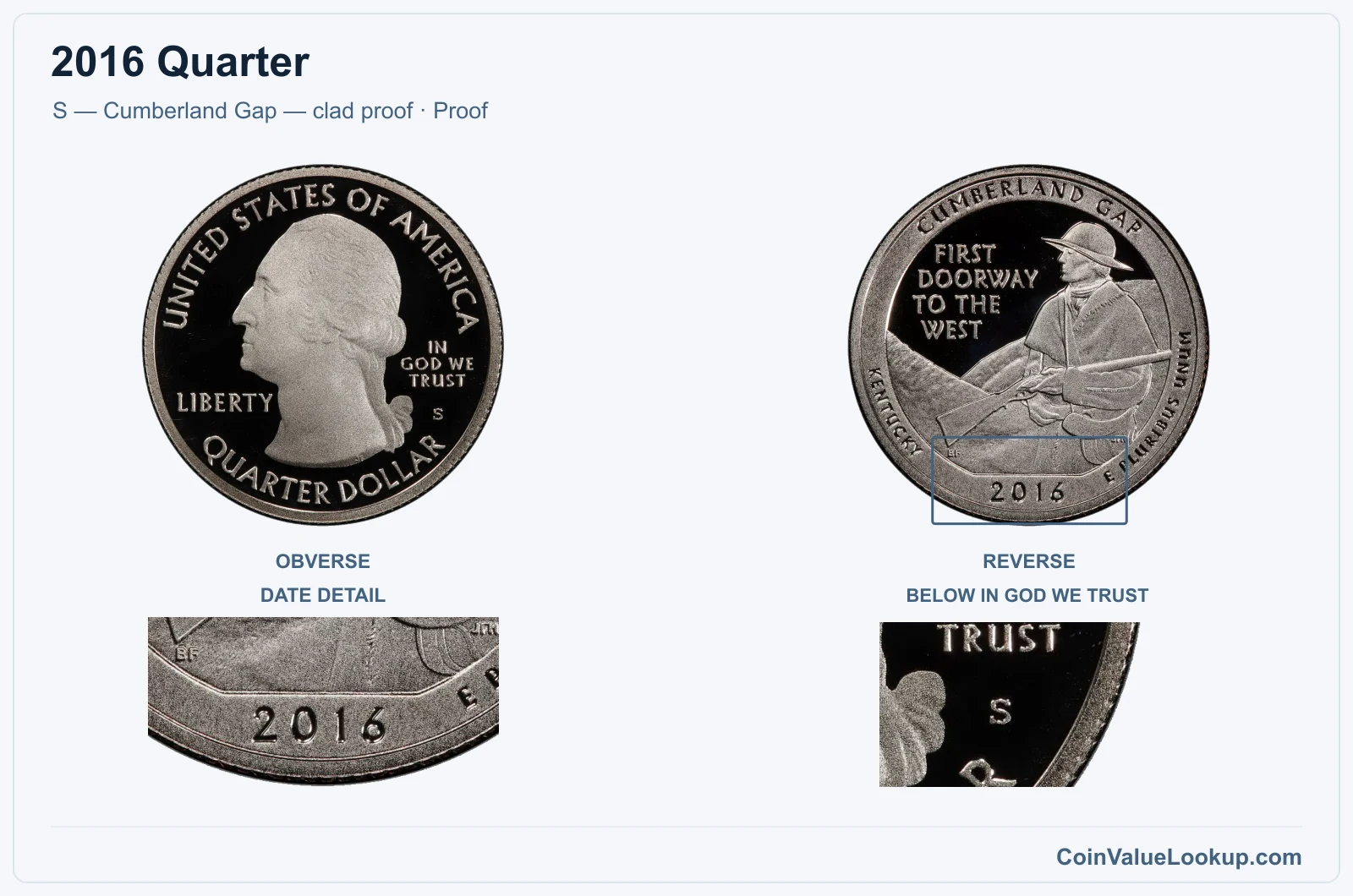
The clad proof Cumberland Gap quarter has the characteristic mirrored fields and frosted raised devices of a proof coin. Composition is copper-nickel clad, confirmed by the visible copper stripe along the edge.
USA Coin Book lists it at about $5.63 in PR65. Keep this value separate from the silver proof; the two look similar at first glance, but weight and edge color tell them apart quickly.
Range Grade
Price Auction Records Appraisal PR PR 1
—
Coin Identifier
PR 2
—
Coin Identifier
PR 3
—
Coin Identifier
PR 4
—
Coin Identifier
PR 6
—
Coin Identifier
PR 8
—
Coin Identifier
PR 10
—
Coin Identifier
PR 12
—
Coin Identifier
PR 15
—
Coin Identifier
PR 20
—
Coin Identifier
PR 25
—
Coin Identifier
PR 30
—
Coin Identifier
PR 35
—
Coin Identifier
PR 40
—
Coin Identifier
PR 45
—
Coin Identifier
PR 50
—
Coin Identifier
PR 53
—
Coin Identifier
PR 55
—
Coin Identifier
PR 58
—
Coin Identifier
PR 60
—
Coin Identifier
PR 61
—
Coin Identifier
PR 62
—
Coin Identifier
PR 63
—
Coin Identifier
PR 64
—
Coin Identifier
PR 65
—
Coin Identifier
PR 66
—
Coin Identifier
PR 67
—
Coin Identifier
PR 68
—
Coin Identifier
PR 69
—
Coin Identifier
PR 70
—
Coin Identifier
2016 Quarter — S — Cumberland Gap — silver proof
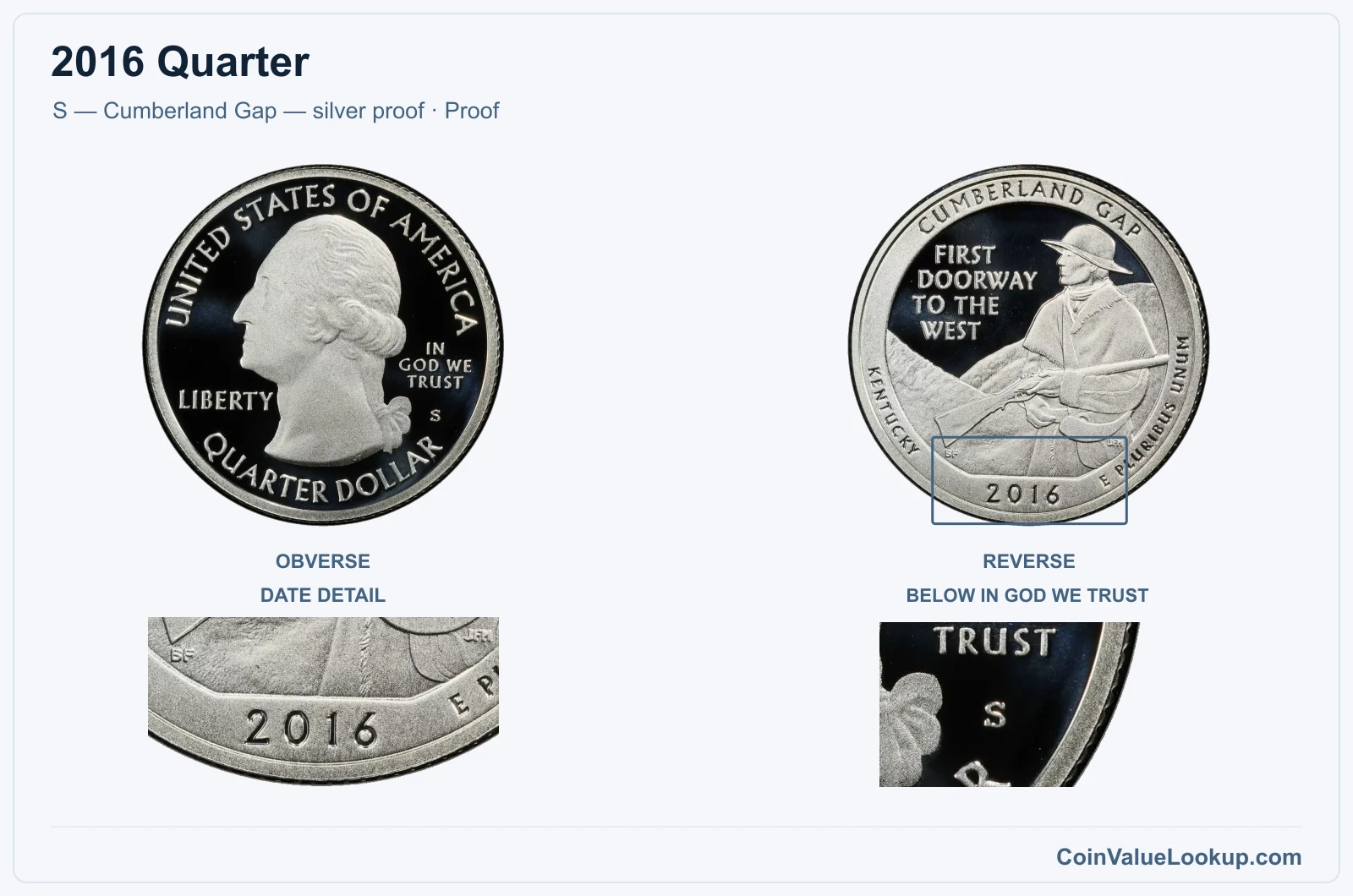
The silver proof Cumberland Gap quarter is 90% silver and 10% copper, weighing approximately 6.25 grams. Its edge shows a uniform silver tone without the copper stripe visible on clad issues.
At about $24.00 in PR65 per USA Coin Book, this is the premium version of the Cumberland Gap design. Original mint packaging is the easiest way to confirm silver composition if you do not have a scale handy.
Range Grade
Price Auction Records Appraisal PR PR 1
—
Coin Identifier
PR 2
—
Coin Identifier
PR 3
—
Coin Identifier
PR 4
—
Coin Identifier
PR 6
—
Coin Identifier
PR 8
—
Coin Identifier
PR 10
—
Coin Identifier
PR 12
—
Coin Identifier
PR 15
—
Coin Identifier
PR 20
—
Coin Identifier
PR 25
—
Coin Identifier
PR 30
—
Coin Identifier
PR 35
—
Coin Identifier
PR 40
—
Coin Identifier
PR 45
—
Coin Identifier
PR 50
—
Coin Identifier
PR 53
—
Coin Identifier
PR 55
—
Coin Identifier
PR 58
—
Coin Identifier
PR 60
—
Coin Identifier
PR 61
—
Coin Identifier
PR 62
—
Coin Identifier
PR 63
—
Coin Identifier
PR 64
—
Coin Identifier
PR 65
—
Coin Identifier
PR 66
—
Coin Identifier
PR 67
—
Coin Identifier
PR 68
—
Coin Identifier
PR 69
—
Coin Identifier
PR 70
—
Coin Identifier
2016 Quarter — P — Theodore Roosevelt — regular strike
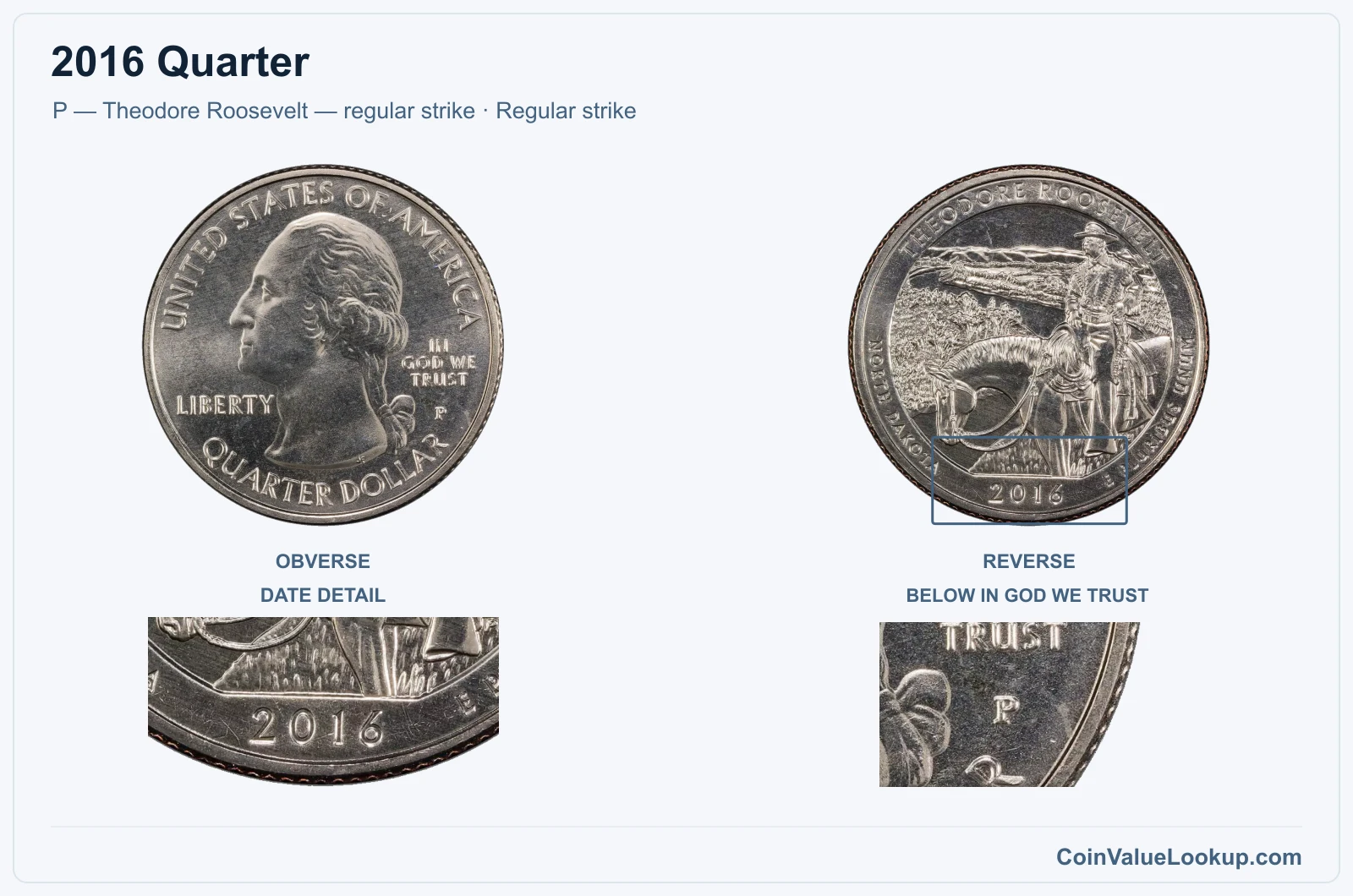
Philadelphia struck the Theodore Roosevelt National Park quarter in copper-nickel clad for general circulation. The reverse shows a bison scene associated with the North Dakota park.
USA Coin Book guides this coin at about $0.61 in MS60 and $1.24 in MS65. Most examples you find in change are worth face value.
Uncirculated rolls and mint sets are the typical source for collectible specimens.
Range Grade
Price Auction Records Appraisal PO PO 1
—
Coin Identifier FR FR 2
—
Coin Identifier AG AG 3
—
Coin Identifier G G 4
—
Coin Identifier
G 6
—
Coin Identifier VG VG 8
—
Coin Identifier
VG 10
—
Coin Identifier F F 12
—
Coin Identifier
F 15
—
Coin Identifier VF VF 20
—
Coin Identifier
VF 25
—
Coin Identifier
VF 30
—
Coin Identifier
VF 35
—
Coin Identifier XF XF 40
—
Coin Identifier
XF 45
—
Coin Identifier AU AU 50
—
Coin Identifier
AU 53
—
Coin Identifier
AU 55
—
Coin Identifier
AU 58
—
Coin Identifier MS MS 60
—
Coin Identifier
MS 61
—
Coin Identifier
MS 62
—
Coin Identifier
MS 63
—
Coin Identifier
MS 64
—
Coin Identifier
MS 65
—
Coin Identifier
MS 66
—
Coin Identifier
MS 67
—
Coin Identifier
MS 68
Coin Identifier
MS 69
—
—
—
MS 70
—
—
—
2016 Quarter — D — Theodore Roosevelt — regular strike
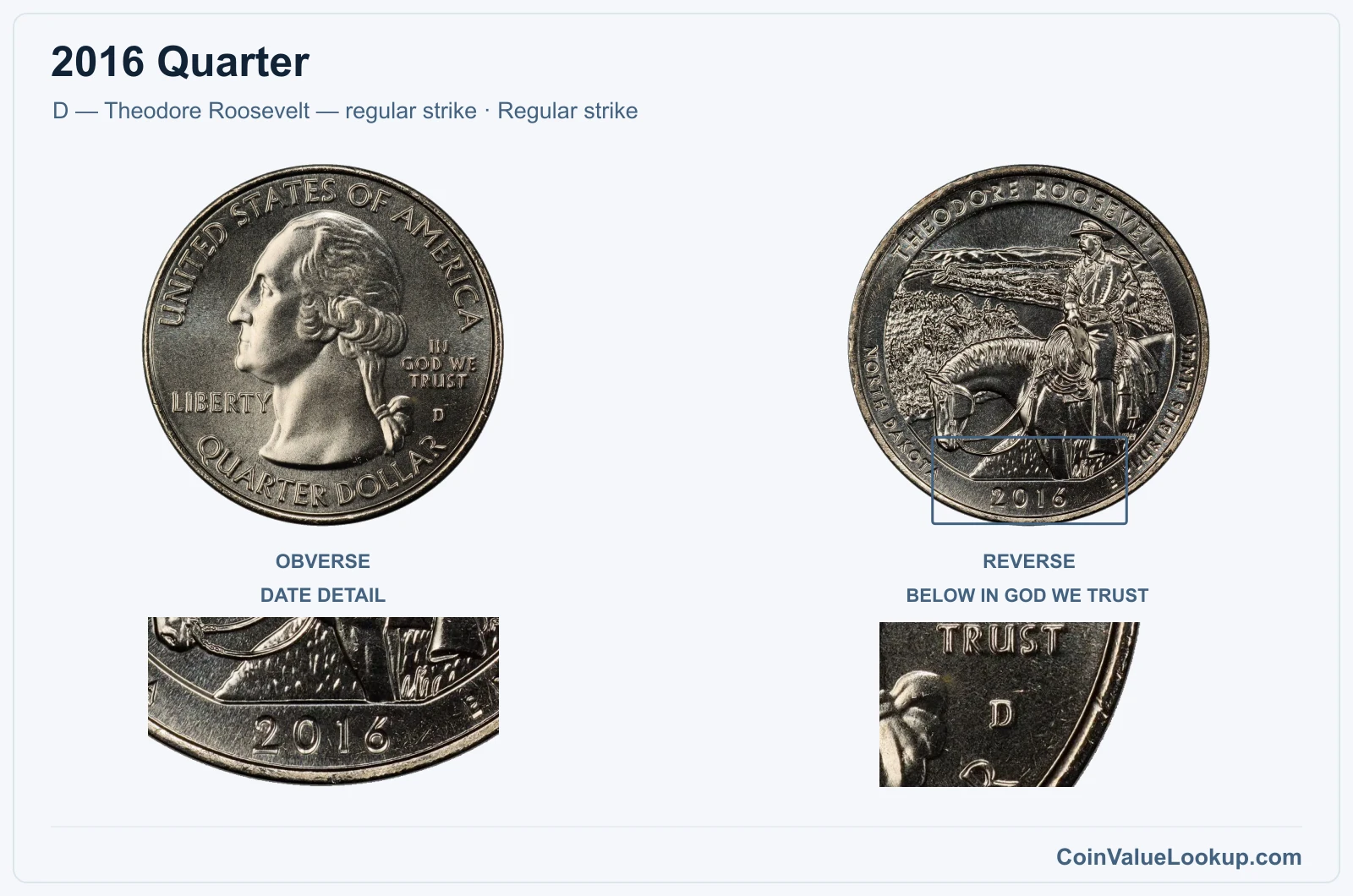
Denver's Theodore Roosevelt quarter shares the same design and copper-nickel clad composition, distinguished only by the D mintmark on the obverse.
Guide estimates from USA Coin Book are about $0.61 in MS60 and $1.24 in MS65. As with other business-strike 2016 quarters, circulated coins do not carry a collector premium.
Condition matters only when the coin has never been spent.
Range Grade
Price Auction Records Appraisal PO PO 1
—
Coin Identifier FR FR 2
—
Coin Identifier AG AG 3
—
Coin Identifier G G 4
—
Coin Identifier
G 6
—
Coin Identifier VG VG 8
—
Coin Identifier
VG 10
—
Coin Identifier F F 12
—
Coin Identifier
F 15
—
Coin Identifier VF VF 20
—
Coin Identifier
VF 25
—
Coin Identifier
VF 30
—
Coin Identifier
VF 35
—
Coin Identifier XF XF 40
—
Coin Identifier
XF 45
—
Coin Identifier AU AU 50
—
Coin Identifier
AU 53
—
Coin Identifier
AU 55
—
Coin Identifier
AU 58
—
Coin Identifier MS MS 60
—
Coin Identifier
MS 61
—
Coin Identifier
MS 62
—
Coin Identifier
MS 63
—
Coin Identifier
MS 64
—
Coin Identifier
MS 65
—
Coin Identifier
MS 66
—
Coin Identifier
MS 67
—
Coin Identifier
MS 68
—
—
—
MS 69
—
—
—
MS 70
—
—
—
2016 Quarter — S — Theodore Roosevelt — regular strike
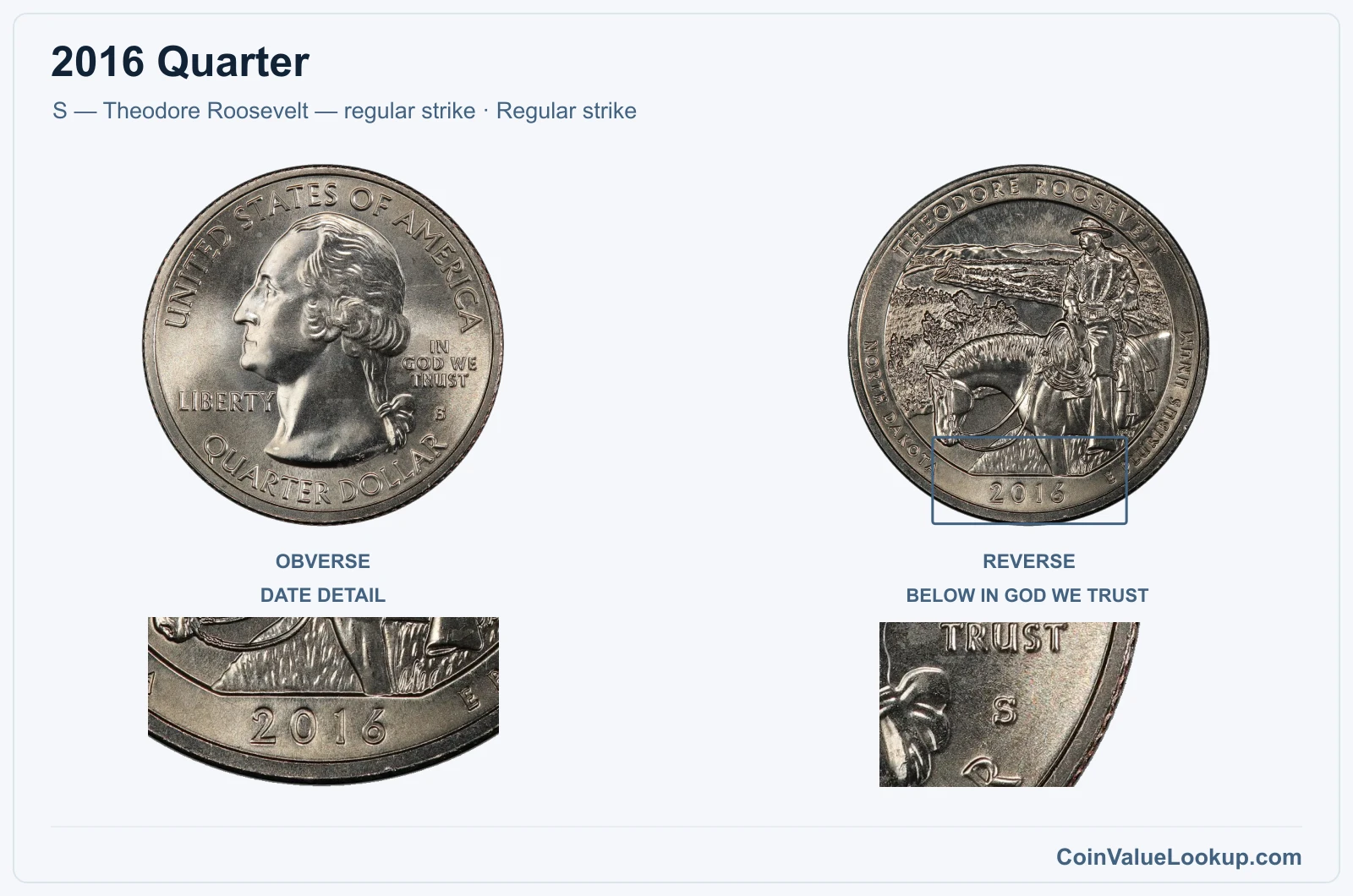
The S-mint regular strike Theodore Roosevelt quarter was produced for collector sets, not general circulation. Despite the S mintmark, this is not a proof.
Its surfaces lack the deep mirror finish of proof coinage.
Composition is copper-nickel clad, and USA Coin Book estimates about $3.62 in MS65. The slight premium over P and D strikes reflects its limited distribution through official mint-set sales.
Range Grade
Price Auction Records Appraisal PO PO 1
—
Coin Identifier FR FR 2
—
Coin Identifier AG AG 3
—
Coin Identifier G G 4
—
Coin Identifier
G 6
—
Coin Identifier VG VG 8
—
Coin Identifier
VG 10
—
Coin Identifier F F 12
—
Coin Identifier
F 15
—
Coin Identifier VF VF 20
—
Coin Identifier
VF 25
—
Coin Identifier
VF 30
—
Coin Identifier
VF 35
—
Coin Identifier XF XF 40
—
Coin Identifier
XF 45
—
Coin Identifier AU AU 50
—
Coin Identifier
AU 53
—
Coin Identifier
AU 55
—
Coin Identifier
AU 58
—
Coin Identifier MS MS 60
—
Coin Identifier
MS 61
—
Coin Identifier
MS 62
—
Coin Identifier
MS 63
—
Coin Identifier
MS 64
—
Coin Identifier
MS 65
—
Coin Identifier
MS 66
—
Coin Identifier
MS 67
—
Coin Identifier
MS 68
—
—
—
MS 69
—
—
—
MS 70
—
—
—
2016 Quarter — S — Theodore Roosevelt — clad proof
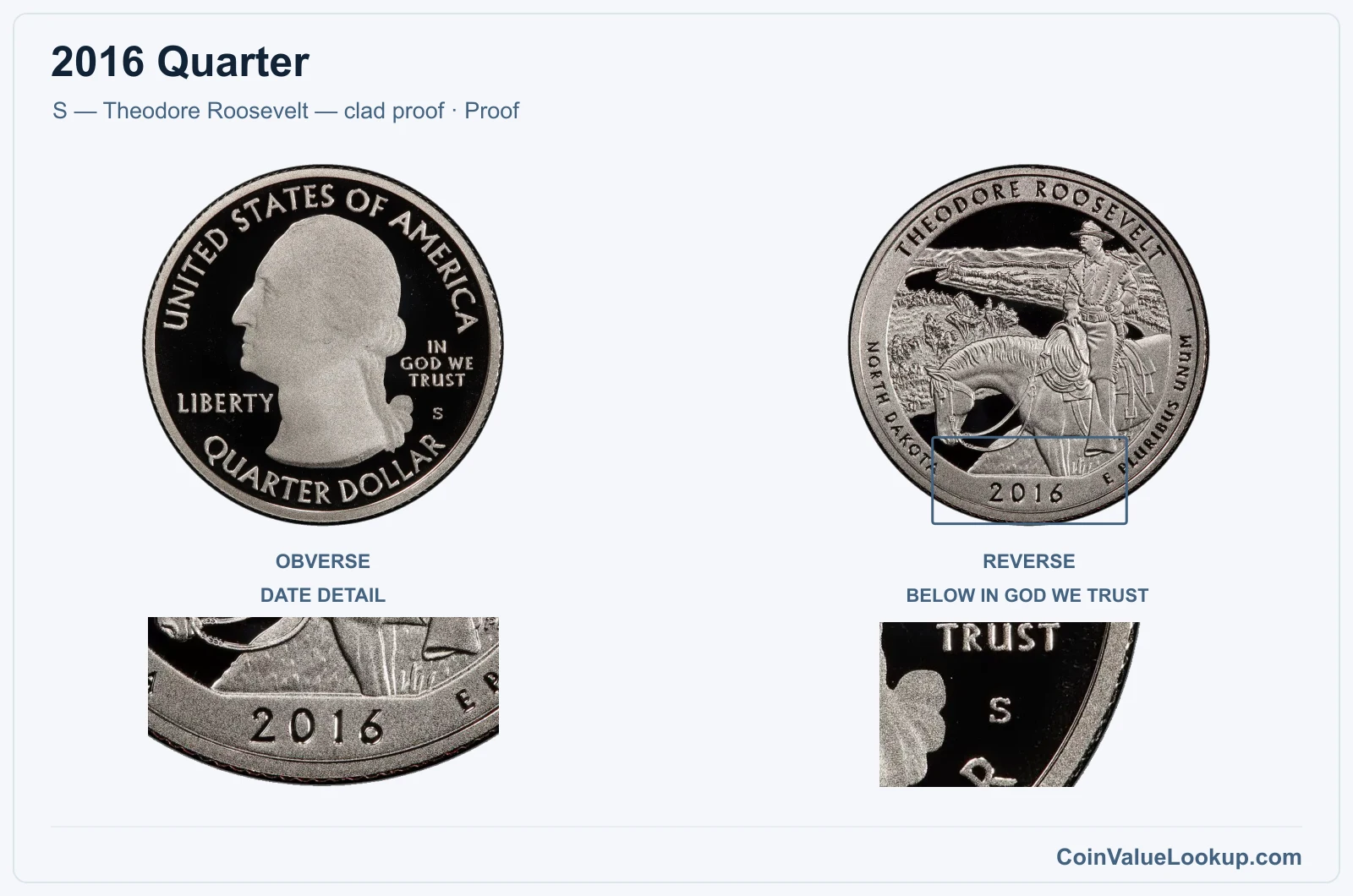
San Francisco's clad proof Theodore Roosevelt quarter features mirrored fields and frosted devices. It is copper-nickel clad, so look for that telltale copper edge stripe.
USA Coin Book estimates about $5.63 in PR65. Proof quarters like this were sold in annual proof sets.
Even light handling can introduce hairlines that affect the grade, so coins still sealed in original packaging tend to be in the best condition.
Range Grade
Price Auction Records Appraisal PR PR 1
—
Coin Identifier
PR 2
—
Coin Identifier
PR 3
—
Coin Identifier
PR 4
—
Coin Identifier
PR 6
—
Coin Identifier
PR 8
—
Coin Identifier
PR 10
—
Coin Identifier
PR 12
—
Coin Identifier
PR 15
—
Coin Identifier
PR 20
—
Coin Identifier
PR 25
—
Coin Identifier
PR 30
—
Coin Identifier
PR 35
—
Coin Identifier
PR 40
—
Coin Identifier
PR 45
—
Coin Identifier
PR 50
—
Coin Identifier
PR 53
—
Coin Identifier
PR 55
—
Coin Identifier
PR 58
—
Coin Identifier
PR 60
—
Coin Identifier
PR 61
—
Coin Identifier
PR 62
—
Coin Identifier
PR 63
—
Coin Identifier
PR 64
—
Coin Identifier
PR 65
—
Coin Identifier
PR 66
—
Coin Identifier
PR 67
—
Coin Identifier
PR 68
—
Coin Identifier
PR 69
—
Coin Identifier
PR 70
—
Coin Identifier
2016 Quarter — S — Theodore Roosevelt — silver proof
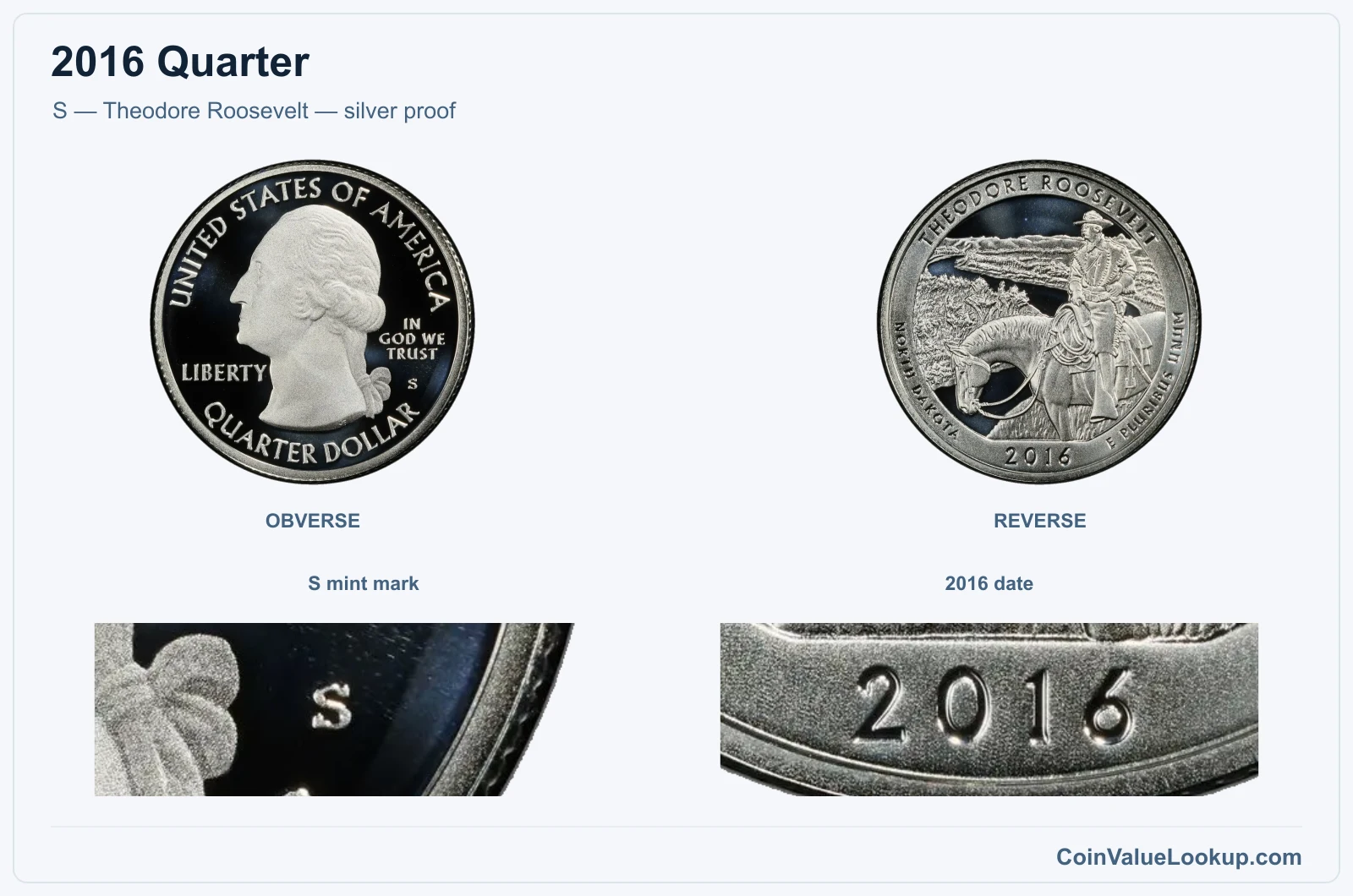
The silver proof Theodore Roosevelt quarter is 90% silver and 10% copper, weighing about 6.25 grams. The edge appears uniformly silver.
Mirror fields and frosted devices match the clad proof, so the weight or edge check is your main differentiator.
USA Coin Book lists this at about $24.00 in PR65, the highest guide anchor for any 2016 Theodore Roosevelt quarter. Silver proof sets from the U.S. Mint are the original source for these coins.
Coin Value Lookup is a good starting point if you want to look up guide values for other years and denominations in this series. It can help you compare across the full America the Beautiful program.
Range Grade
Price Auction Records Appraisal PR PR 1
—
Coin Identifier
PR 2
—
Coin Identifier
PR 3
—
Coin Identifier
PR 4
—
Coin Identifier
PR 6
—
Coin Identifier
PR 8
—
Coin Identifier
PR 10
—
Coin Identifier
PR 12
—
Coin Identifier
PR 15
—
Coin Identifier
PR 20
—
Coin Identifier
PR 25
—
Coin Identifier
PR 30
—
Coin Identifier
PR 35
—
Coin Identifier
PR 40
—
Coin Identifier
PR 45
—
Coin Identifier
PR 50
—
Coin Identifier
PR 53
—
Coin Identifier
PR 55
—
Coin Identifier
PR 58
—
Coin Identifier
PR 60
—
Coin Identifier
PR 61
—
Coin Identifier
PR 62
—
Coin Identifier
PR 63
—
Coin Identifier
PR 64
—
Coin Identifier
PR 65
—
Coin Identifier
PR 66
—
Coin Identifier
PR 67
—
Coin Identifier
PR 68
—
Coin Identifier
PR 69
—
Coin Identifier
PR 70
—
Coin Identifier
2016 Quarter — P — Harpers Ferry — regular strike
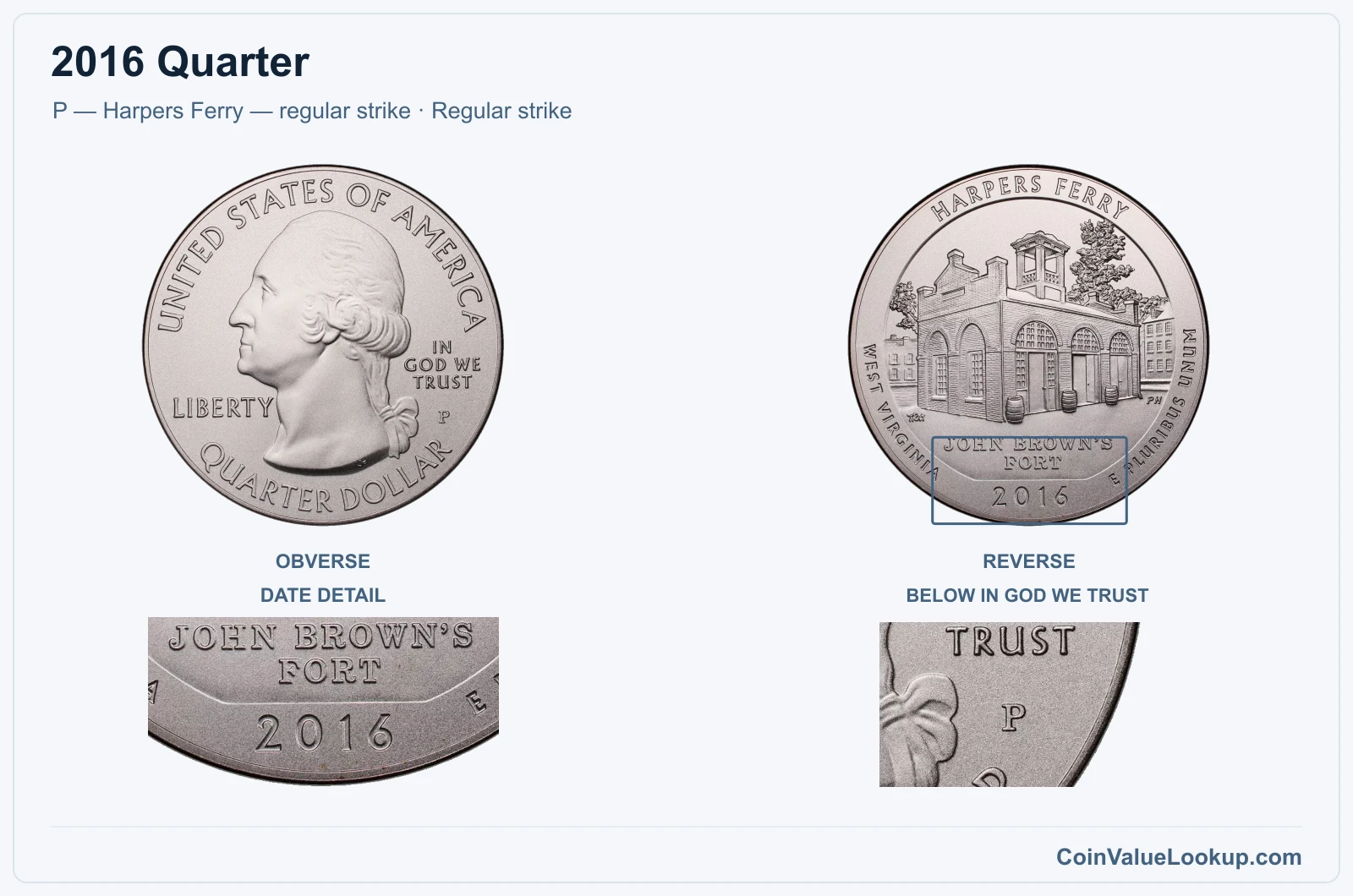
The Philadelphia Harpers Ferry quarter depicts John Brown's Fort on the reverse, struck in copper-nickel clad. This design entered everyday circulation alongside the other 2016 issues.
USA Coin Book guides it at about $0.61 in MS60 and $1.24 in MS65. Circulated coins are face value.
Confirm both the P mintmark and the Harpers Ferry reverse before looking up the condition-specific price.
Range Grade
Price Auction Records Appraisal PO PO 1
—
Coin Identifier FR FR 2
—
Coin Identifier AG AG 3
—
Coin Identifier G G 4
—
Coin Identifier
G 6
—
Coin Identifier VG VG 8
—
Coin Identifier
VG 10
—
Coin Identifier F F 12
—
Coin Identifier
F 15
—
Coin Identifier VF VF 20
—
Coin Identifier
VF 25
—
Coin Identifier
VF 30
—
Coin Identifier
VF 35
—
Coin Identifier XF XF 40
—
Coin Identifier
XF 45
—
Coin Identifier AU AU 50
—
Coin Identifier
AU 53
—
Coin Identifier
AU 55
—
Coin Identifier
AU 58
—
Coin Identifier MS MS 60
—
Coin Identifier
MS 61
—
Coin Identifier
MS 62
—
Coin Identifier
MS 63
—
Coin Identifier
MS 64
—
Coin Identifier
MS 65
—
Coin Identifier
MS 66
—
Coin Identifier
MS 67
—
Coin Identifier
MS 68
—
—
—
MS 69
—
—
—
MS 70
—
—
—
2016 Quarter — D — Harpers Ferry — regular strike
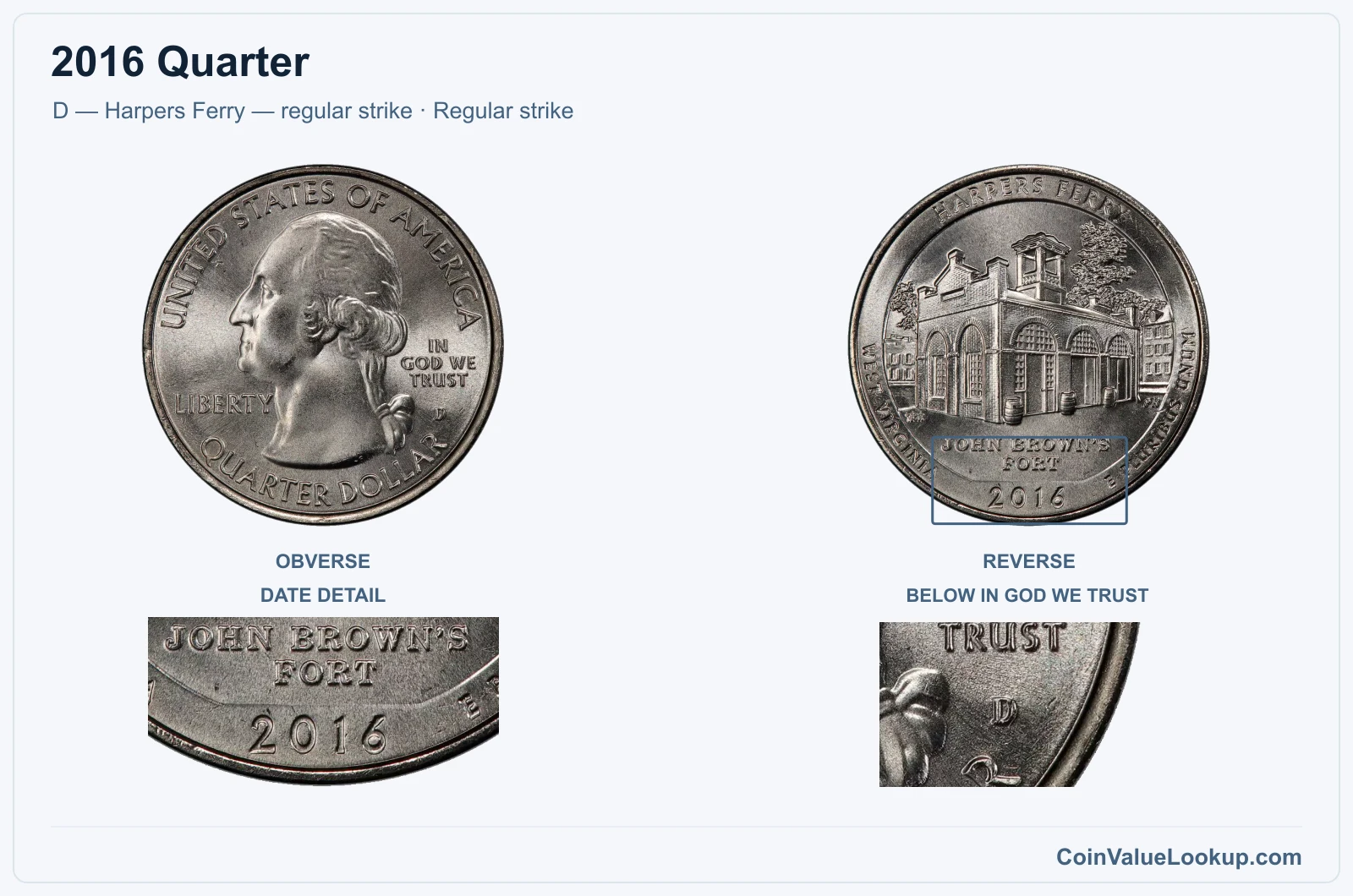
Denver's Harpers Ferry quarter is the same copper-nickel clad coin with a D mintmark. Nothing about the design or composition differs from the Philadelphia version.
Guide estimates are about $0.61 in MS60 and $1.24 in MS65 per USA Coin Book. Only truly uncirculated examples with original luster are worth pulling from a roll.
Worn pieces are still quarters.
Range Grade
Price Auction Records Appraisal PO PO 1
—
Coin Identifier FR FR 2
—
Coin Identifier AG AG 3
—
Coin Identifier G G 4
—
Coin Identifier
G 6
—
Coin Identifier VG VG 8
—
Coin Identifier
VG 10
—
Coin Identifier F F 12
—
Coin Identifier
F 15
—
Coin Identifier VF VF 20
—
Coin Identifier
VF 25
—
Coin Identifier
VF 30
—
Coin Identifier
VF 35
—
Coin Identifier XF XF 40
—
Coin Identifier
XF 45
—
Coin Identifier AU AU 50
—
Coin Identifier
AU 53
—
Coin Identifier
AU 55
—
Coin Identifier
AU 58
—
Coin Identifier MS MS 60
—
Coin Identifier
MS 61
—
Coin Identifier
MS 62
—
Coin Identifier
MS 63
—
Coin Identifier
MS 64
—
Coin Identifier
MS 65
—
Coin Identifier
MS 66
—
Coin Identifier
MS 67
—
Coin Identifier
MS 68
—
—
—
MS 69
—
—
—
MS 70
—
—
—
2016 Quarter — S — Harpers Ferry — regular strike
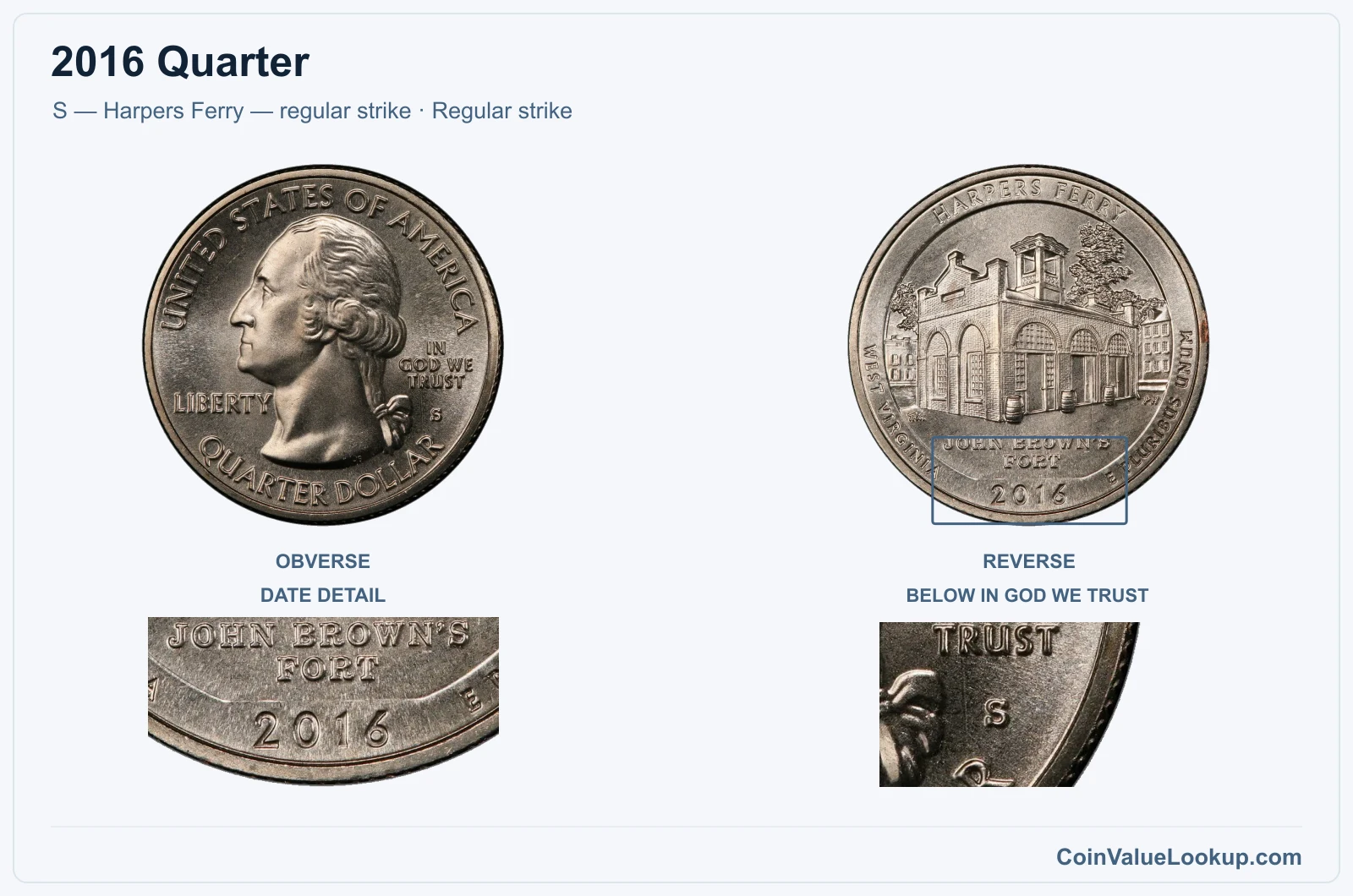
The S-mint regular strike Harpers Ferry quarter was made for collector sets, not pocket change. It carries the S mintmark but does not have proof mirror fields.
Check the surface carefully before classifying it.
USA Coin Book estimates about $3.62 in MS65 for this version. Its copper-nickel clad composition matches the P and D strikes.
The small premium exists because distribution was limited to official collector products.
Range Grade
Price Auction Records Appraisal PO PO 1
—
Coin Identifier FR FR 2
—
Coin Identifier AG AG 3
—
Coin Identifier G G 4
—
Coin Identifier
G 6
—
Coin Identifier VG VG 8
—
Coin Identifier
VG 10
—
Coin Identifier F F 12
—
Coin Identifier
F 15
—
Coin Identifier VF VF 20
—
Coin Identifier
VF 25
—
Coin Identifier
VF 30
—
Coin Identifier
VF 35
—
Coin Identifier XF XF 40
—
Coin Identifier
XF 45
—
Coin Identifier AU AU 50
—
Coin Identifier
AU 53
—
Coin Identifier
AU 55
—
Coin Identifier
AU 58
—
Coin Identifier MS MS 60
—
Coin Identifier
MS 61
—
Coin Identifier
MS 62
—
Coin Identifier
MS 63
—
Coin Identifier
MS 64
—
Coin Identifier
MS 65
—
Coin Identifier
MS 66
—
Coin Identifier
MS 67
—
Coin Identifier
MS 68
—
—
—
MS 69
—
—
—
MS 70
—
—
—
2016 Quarter — S — Harpers Ferry — clad proof
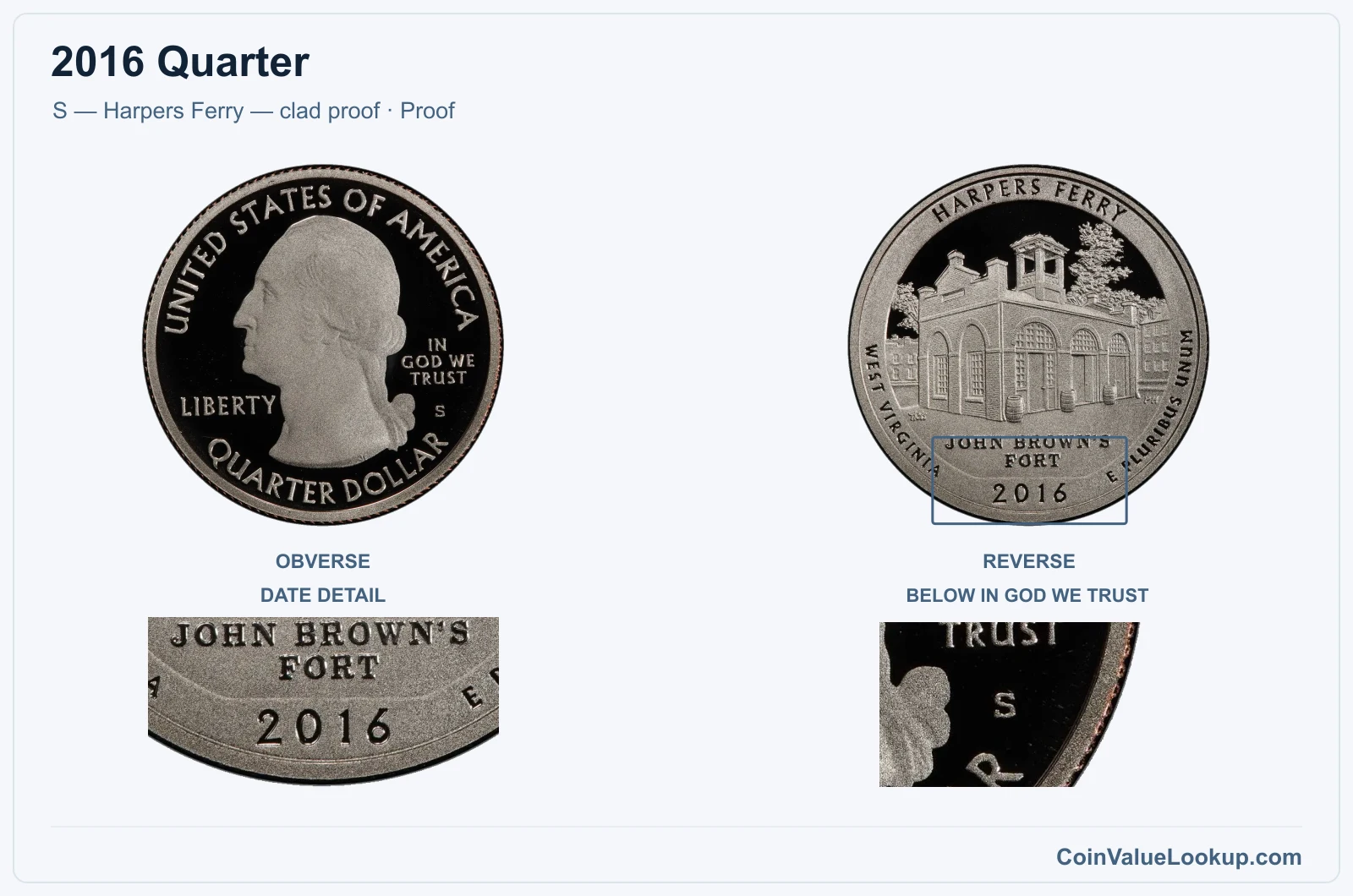
The clad proof Harpers Ferry quarter from San Francisco has reflective mirror fields and frosted devices. Its copper-nickel clad composition is confirmed by the copper stripe visible on the coin's edge.
USA Coin Book lists about $5.63 in PR65. Keep this figure separate from the silver proof.
Weight and edge appearance are the fastest ways to distinguish the two when packaging is not available.
Range Grade
Price Auction Records Appraisal PR PR 1
—
Coin Identifier
PR 2
—
Coin Identifier
PR 3
—
Coin Identifier
PR 4
—
Coin Identifier
PR 6
—
Coin Identifier
PR 8
—
Coin Identifier
PR 10
—
Coin Identifier
PR 12
—
Coin Identifier
PR 15
—
Coin Identifier
PR 20
—
Coin Identifier
PR 25
—
Coin Identifier
PR 30
—
Coin Identifier
PR 35
—
Coin Identifier
PR 40
—
Coin Identifier
PR 45
—
Coin Identifier
PR 50
—
Coin Identifier
PR 53
—
Coin Identifier
PR 55
—
Coin Identifier
PR 58
—
Coin Identifier
PR 60
—
Coin Identifier
PR 61
—
Coin Identifier
PR 62
—
Coin Identifier
PR 63
—
Coin Identifier
PR 64
—
Coin Identifier
PR 65
—
Coin Identifier
PR 66
—
Coin Identifier
PR 67
—
Coin Identifier
PR 68
—
Coin Identifier
PR 69
—
Coin Identifier
PR 70
—
Coin Identifier
2016 Quarter — S — Harpers Ferry — silver proof
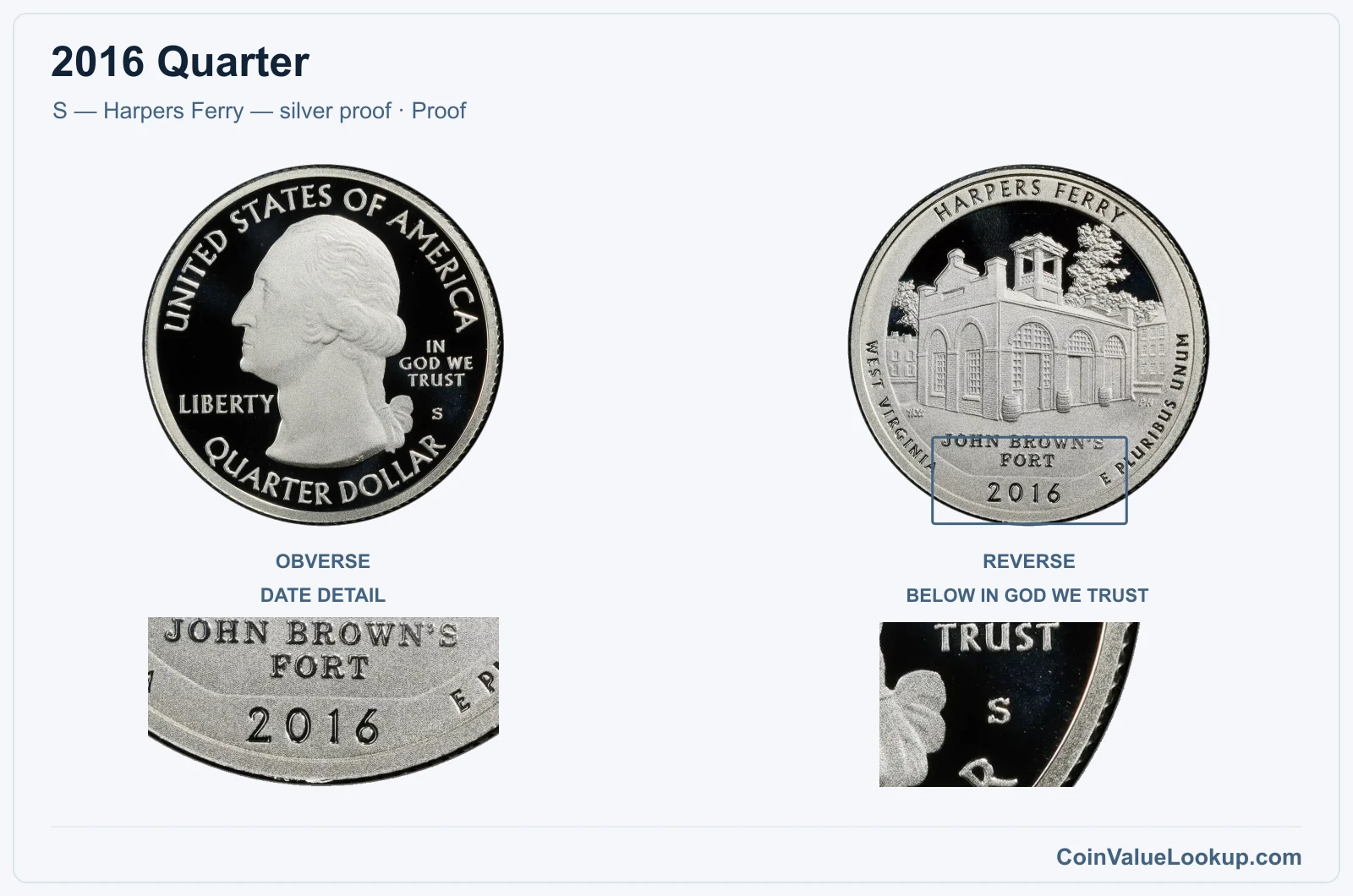
The silver proof Harpers Ferry quarter weighs about 6.25 grams and is composed of 90% silver and 10% copper. The edge shows solid silver color with no copper stripe.
At about $24.00 in PR65 per USA Coin Book, this is the top-value version of the 2016 Harpers Ferry design for this grade. If you have the original silver proof set holder, that confirms the composition without needing a scale.
Range Grade
Price Auction Records Appraisal PR PR 1
—
Coin Identifier
PR 2
—
Coin Identifier
PR 3
—
Coin Identifier
PR 4
—
Coin Identifier
PR 6
—
Coin Identifier
PR 8
—
Coin Identifier
PR 10
—
Coin Identifier
PR 12
—
Coin Identifier
PR 15
—
Coin Identifier
PR 20
—
Coin Identifier
PR 25
—
Coin Identifier
PR 30
—
Coin Identifier
PR 35
—
Coin Identifier
PR 40
—
Coin Identifier
PR 45
—
Coin Identifier
PR 50
—
Coin Identifier
PR 53
—
Coin Identifier
PR 55
—
Coin Identifier
PR 58
—
Coin Identifier
PR 60
—
Coin Identifier
PR 61
—
Coin Identifier
PR 62
—
Coin Identifier
PR 63
—
Coin Identifier
PR 64
—
Coin Identifier
PR 65
—
Coin Identifier
PR 66
—
Coin Identifier
PR 67
—
Coin Identifier
PR 68
—
Coin Identifier
PR 69
—
Coin Identifier
PR 70
—
Coin Identifier
2016 Quarter — P — Fort Moultrie — regular strike
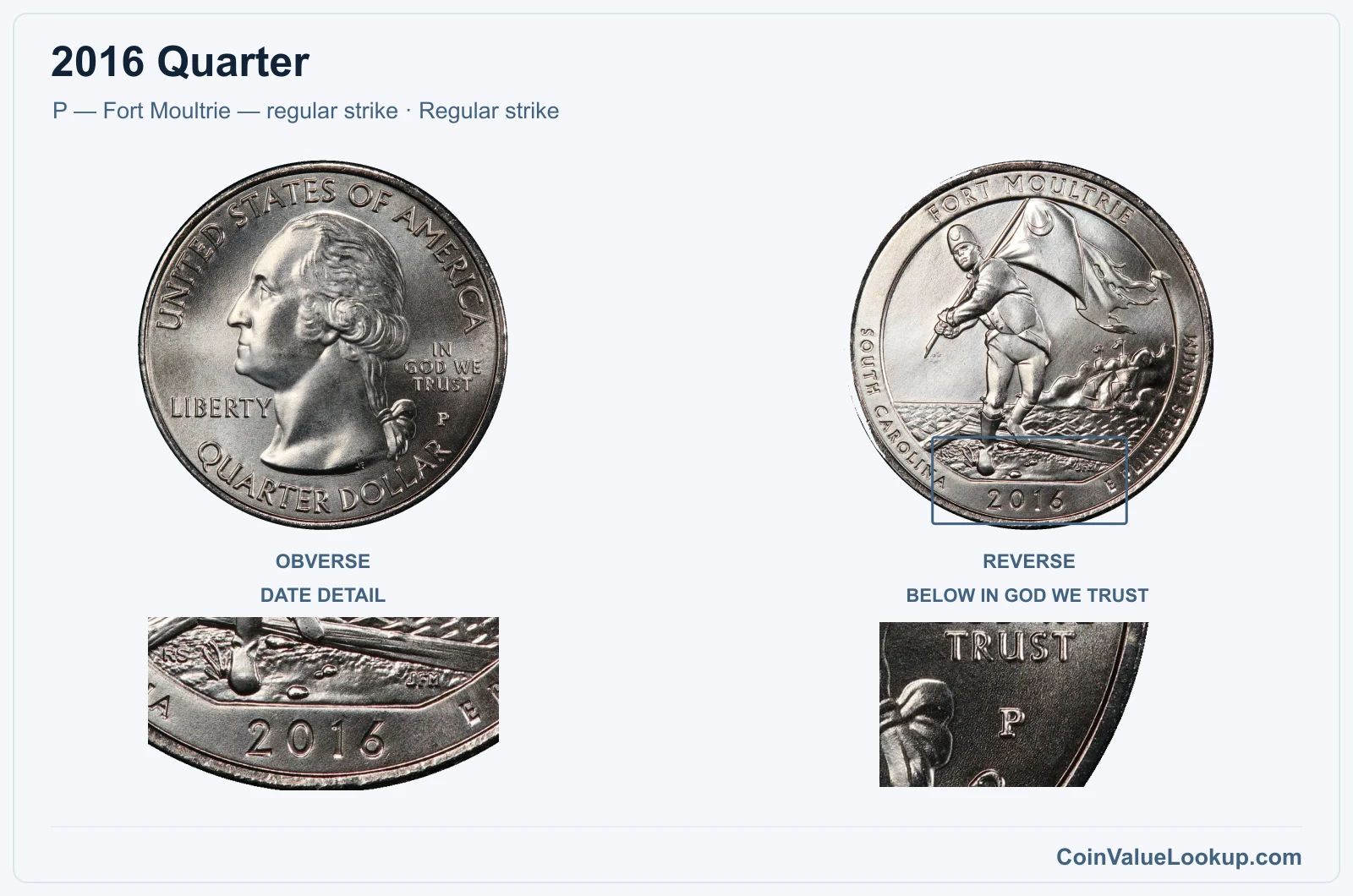
Philadelphia's Fort Moultrie quarter shows the historic fort with its flag on the reverse, struck in copper-nickel clad. This was the fifth and final 2016 quarter design released into circulation.
USA Coin Book estimates about $0.61 in MS60 and $1.24 in MS65. Worn examples are worth face value.
Check for the P mintmark and the Fort Moultrie reverse before applying these figures.
Range Grade
Price Auction Records Appraisal PO PO 1
—
Coin Identifier FR FR 2
—
Coin Identifier AG AG 3
—
Coin Identifier G G 4
—
Coin Identifier
G 6
—
Coin Identifier VG VG 8
—
Coin Identifier
VG 10
—
Coin Identifier F F 12
—
Coin Identifier
F 15
—
Coin Identifier VF VF 20
—
Coin Identifier
VF 25
—
Coin Identifier
VF 30
—
Coin Identifier
VF 35
—
Coin Identifier XF XF 40
—
Coin Identifier
XF 45
—
Coin Identifier AU AU 50
—
Coin Identifier
AU 53
—
Coin Identifier
AU 55
—
Coin Identifier
AU 58
—
Coin Identifier MS MS 60
—
Coin Identifier
MS 61
—
Coin Identifier
MS 62
—
Coin Identifier
MS 63
—
Coin Identifier
MS 64
—
Coin Identifier
MS 65
—
Coin Identifier
MS 66
—
Coin Identifier
MS 67
—
Coin Identifier
MS 68
—
—
—
MS 69
—
—
—
MS 70
—
—
—
2016 Quarter — D — Fort Moultrie — regular strike
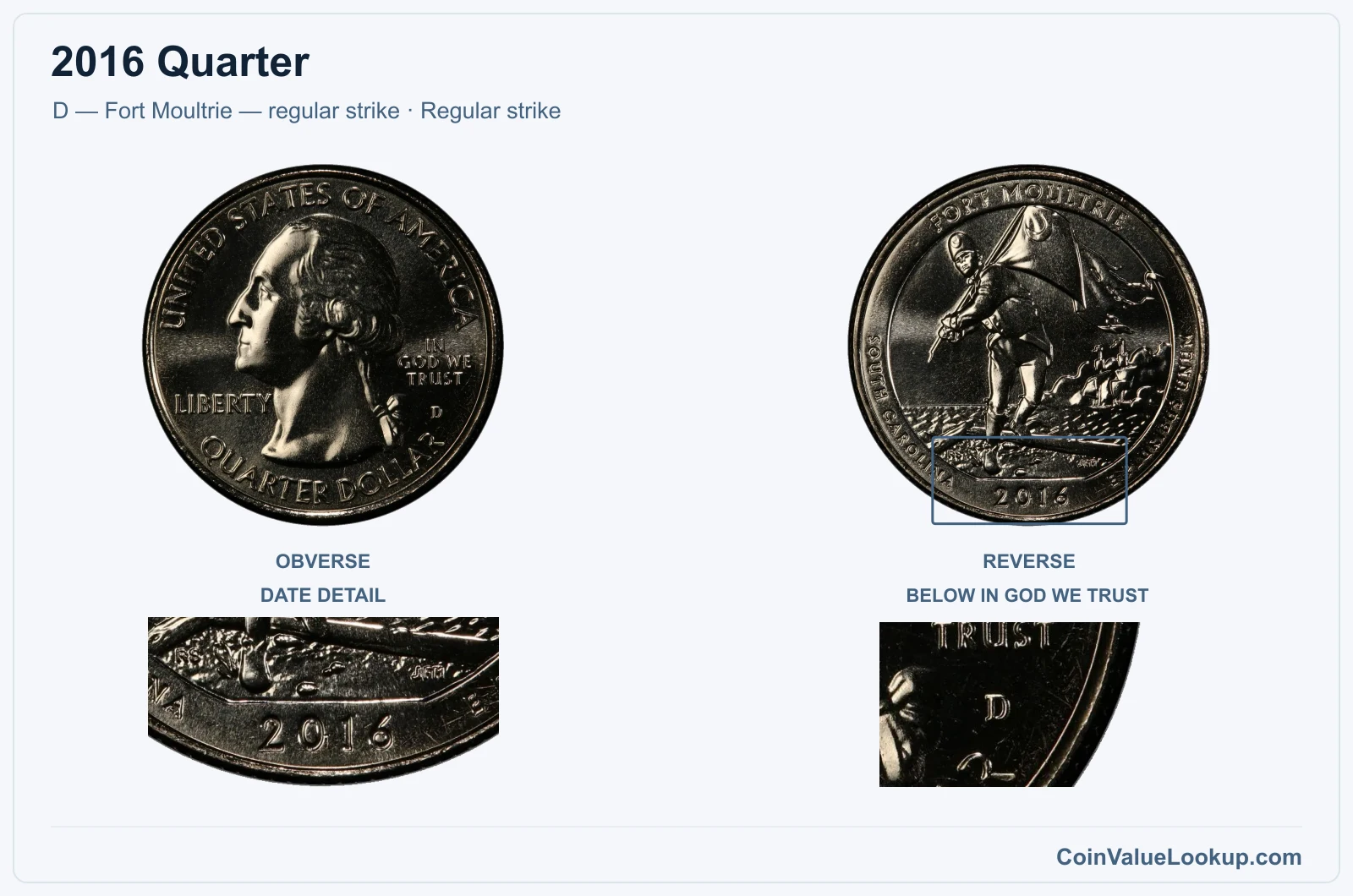
The Denver Fort Moultrie quarter shares the same reverse design and copper-nickel clad composition. Only the D mintmark on the obverse separates it from the Philadelphia strike.
Guide estimates from USA Coin Book are about $0.61 in MS60 and $1.24 in MS65. Most circulated examples are worth twenty-five cents.
Pristine rolls or mint-set coins are the source for collectible pieces.
Range Grade
Price Auction Records Appraisal PO PO 1
—
Coin Identifier FR FR 2
—
Coin Identifier AG AG 3
—
Coin Identifier G G 4
—
Coin Identifier
G 6
—
Coin Identifier VG VG 8
—
Coin Identifier
VG 10
—
Coin Identifier F F 12
—
Coin Identifier
F 15
—
Coin Identifier VF VF 20
—
Coin Identifier
VF 25
—
Coin Identifier
VF 30
—
Coin Identifier
VF 35
—
Coin Identifier XF XF 40
—
Coin Identifier
XF 45
—
Coin Identifier AU AU 50
—
Coin Identifier
AU 53
—
Coin Identifier
AU 55
—
Coin Identifier
AU 58
—
Coin Identifier MS MS 60
—
Coin Identifier
MS 61
—
Coin Identifier
MS 62
—
Coin Identifier
MS 63
—
Coin Identifier
MS 64
—
Coin Identifier
MS 65
—
Coin Identifier
MS 66
—
Coin Identifier
MS 67
—
Coin Identifier
MS 68
—
Coin Identifier
MS 69
—
—
—
MS 70
—
—
—
2016 Quarter — S — Fort Moultrie — regular strike
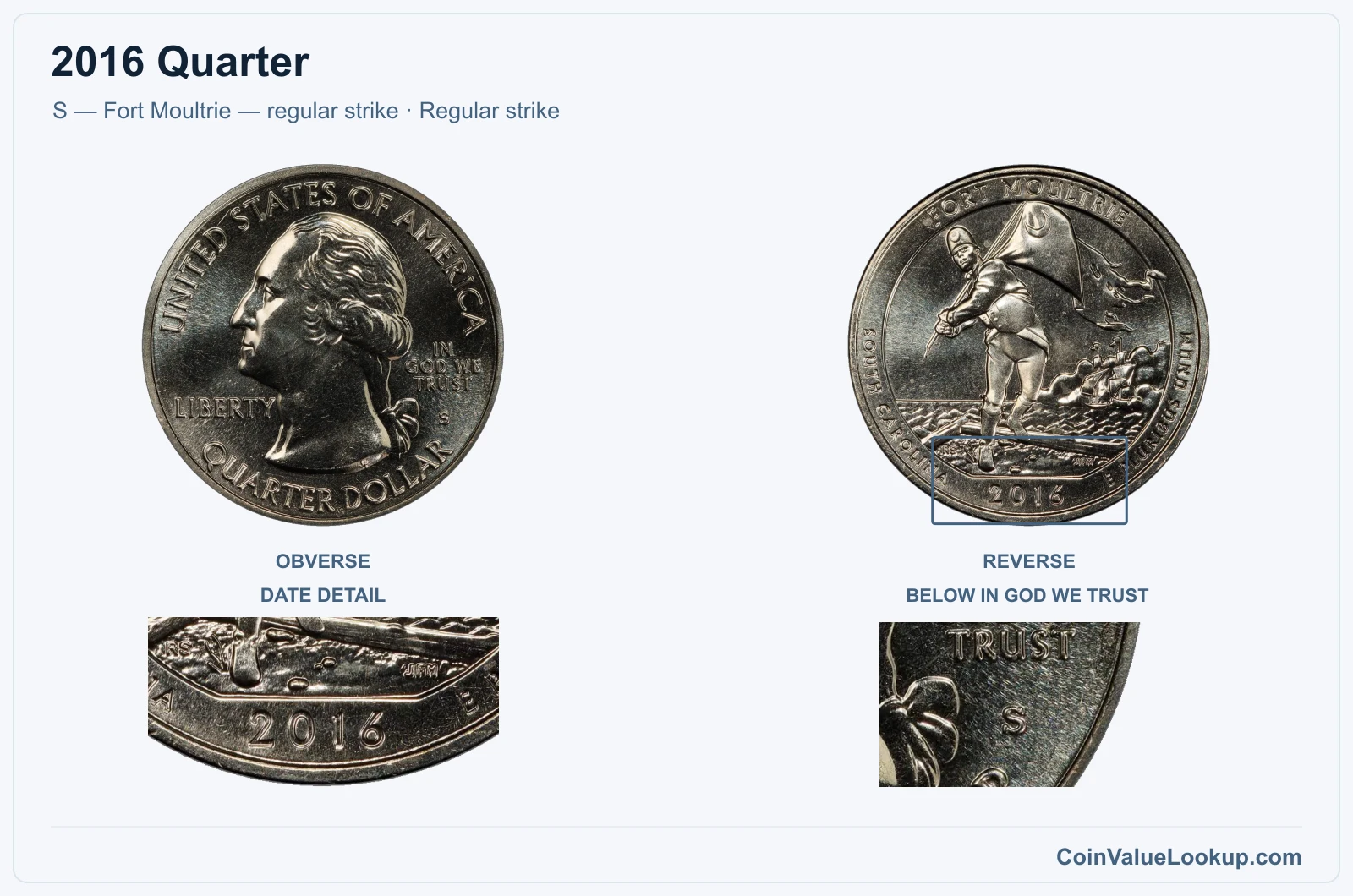
San Francisco struck a regular, non-proof Fort Moultrie quarter for collector sets. The S mintmark does not make it a proof.
Examine the surface: a normal satin or business-strike luster means this is the uncirculated collector version, not a proof.
USA Coin Book guides it at about $3.62 in MS65. The limited collector-channel distribution accounts for the premium over P and D strikes.
Range Grade
Price Auction Records Appraisal PO PO 1
—
Coin Identifier FR FR 2
—
Coin Identifier AG AG 3
—
Coin Identifier G G 4
—
Coin Identifier
G 6
—
Coin Identifier VG VG 8
—
Coin Identifier
VG 10
—
Coin Identifier F F 12
—
Coin Identifier
F 15
—
Coin Identifier VF VF 20
—
Coin Identifier
VF 25
—
Coin Identifier
VF 30
—
Coin Identifier
VF 35
—
Coin Identifier XF XF 40
—
Coin Identifier
XF 45
—
Coin Identifier AU AU 50
—
Coin Identifier
AU 53
—
Coin Identifier
AU 55
—
Coin Identifier
AU 58
—
Coin Identifier MS MS 60
—
Coin Identifier
MS 61
—
Coin Identifier
MS 62
—
Coin Identifier
MS 63
—
Coin Identifier
MS 64
—
Coin Identifier
MS 65
—
Coin Identifier
MS 66
—
Coin Identifier
MS 67
—
Coin Identifier
MS 68
—
—
—
MS 69
—
—
—
MS 70
—
—
—
2016 Quarter — S — Fort Moultrie — clad proof
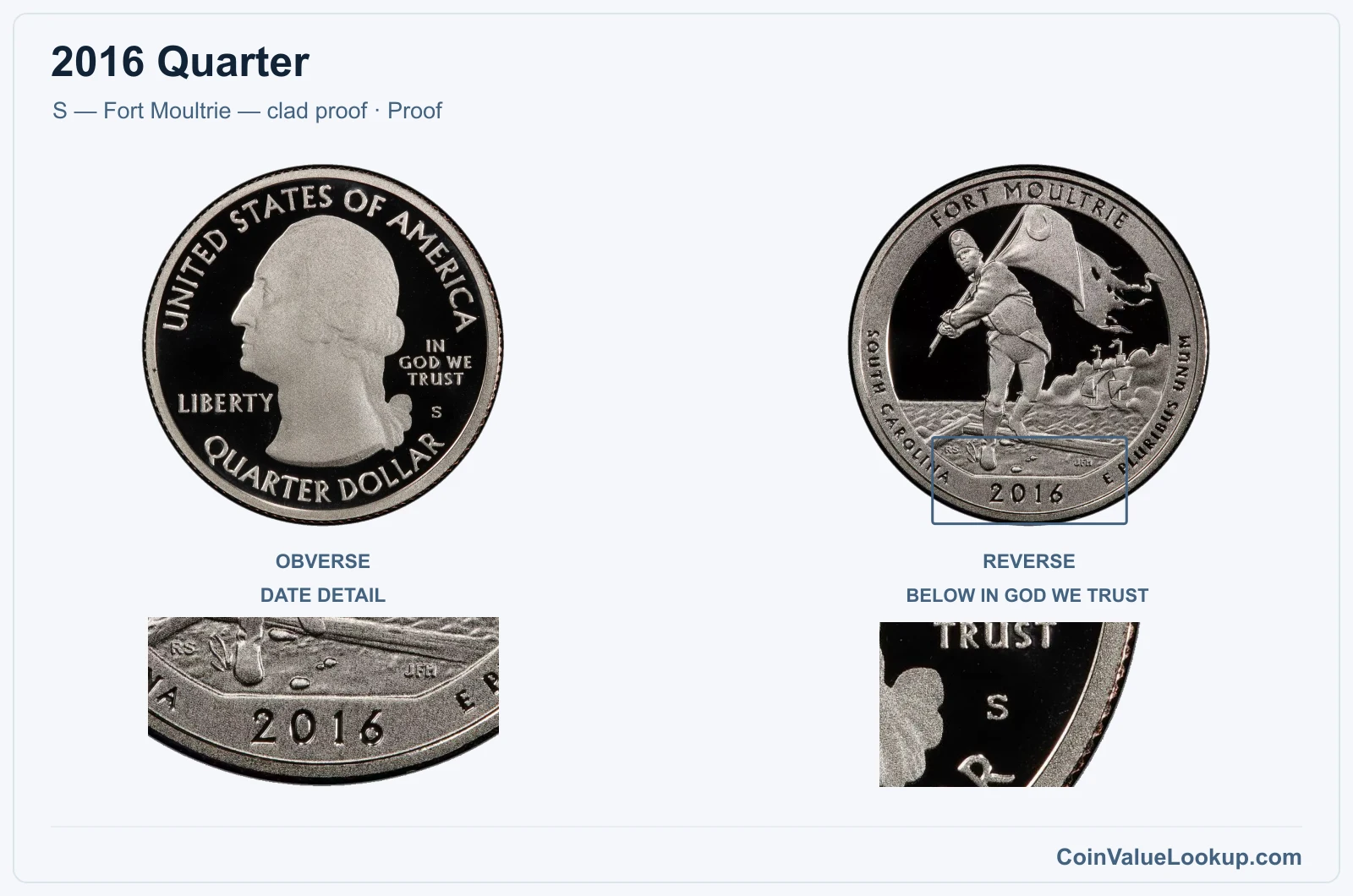
The clad proof Fort Moultrie quarter has San Francisco's characteristic mirror fields and frosted devices. Composition is copper-nickel clad.
Check the edge for the copper stripe to confirm it is not the silver version.
USA Coin Book estimates about $5.63 in PR65. These came in the standard annual proof sets.
Handle them by the edges; even fingerprints on the mirror fields can affect appearance and grade.
Range Grade
Price Auction Records Appraisal PR PR 1
—
Coin Identifier
PR 2
—
Coin Identifier
PR 3
—
Coin Identifier
PR 4
—
Coin Identifier
PR 6
—
Coin Identifier
PR 8
—
Coin Identifier
PR 10
—
Coin Identifier
PR 12
—
Coin Identifier
PR 15
—
Coin Identifier
PR 20
—
Coin Identifier
PR 25
—
Coin Identifier
PR 30
—
Coin Identifier
PR 35
—
Coin Identifier
PR 40
—
Coin Identifier
PR 45
—
Coin Identifier
PR 50
—
Coin Identifier
PR 53
—
Coin Identifier
PR 55
—
Coin Identifier
PR 58
—
Coin Identifier
PR 60
—
Coin Identifier
PR 61
—
Coin Identifier
PR 62
—
Coin Identifier
PR 63
—
Coin Identifier
PR 64
—
Coin Identifier
PR 65
—
Coin Identifier
PR 66
—
Coin Identifier
PR 67
—
Coin Identifier
PR 68
—
Coin Identifier
PR 69
—
Coin Identifier
PR 70
—
Coin Identifier
2016 Quarter — S — Fort Moultrie — silver proof
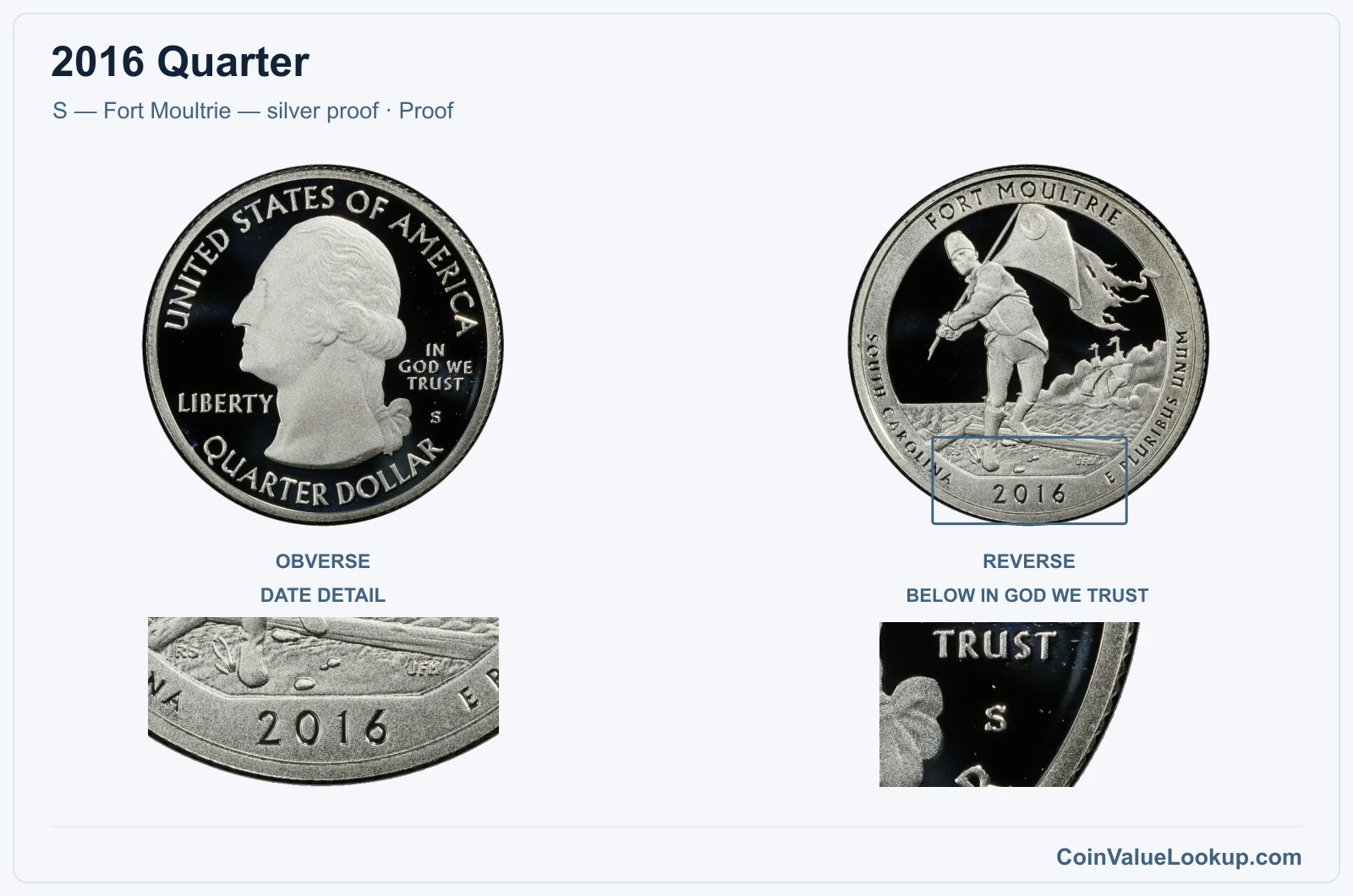
The silver proof Fort Moultrie quarter is 90% silver and 10% copper, weighing roughly 6.25 grams. The uniform silver edge immediately sets it apart from the clad proof.
USA Coin Book places this version at about $24.00 in PR65, tying it with the other four silver proof designs as the highest-valued standard 2016 quarter at that grade. Original silver proof set packaging is the simplest way to verify composition.
Range Grade
Price Auction Records Appraisal PR PR 1
—
Coin Identifier
PR 2
—
Coin Identifier
PR 3
—
Coin Identifier
PR 4
—
Coin Identifier
PR 6
—
Coin Identifier
PR 8
—
Coin Identifier
PR 10
—
Coin Identifier
PR 12
—
Coin Identifier
PR 15
—
Coin Identifier
PR 20
—
Coin Identifier
PR 25
—
Coin Identifier
PR 30
—
Coin Identifier
PR 35
—
Coin Identifier
PR 40
—
Coin Identifier
PR 45
—
Coin Identifier
PR 50
—
Coin Identifier
PR 53
—
Coin Identifier
PR 55
—
Coin Identifier
PR 58
—
Coin Identifier
PR 60
—
Coin Identifier
PR 61
—
Coin Identifier
PR 62
—
Coin Identifier
PR 63
—
Coin Identifier
PR 64
—
Coin Identifier
PR 65
—
Coin Identifier
PR 66
—
Coin Identifier
PR 67
—
Coin Identifier
PR 68
—
Coin Identifier
PR 69
—
Coin Identifier
PR 70
—
Coin Identifier
2016 Quarter Error List
1. 2016 Quarter — Die Cap / Capped-Die Strike
A die cap error happens when a struck coin sticks to one of the dies and becomes a "cap" over it. Subsequent blanks are then struck through this trapped coin, producing a cupped or bowl-shaped piece with a mirror-image design impressed from the cap rather than directly from the die.
On 2016 quarters, look for a coin that is distinctly cupped or dome-shaped, with one side showing a normal strike and the other showing a spread, reversed impression. This is different from a coin that was simply bent or squeezed in a vise after leaving the mint.
Post-mint damage produces irregular bends without the characteristic brockage image.
Condition, the degree of cupping and the visibility of the transferred design all affect what a die cap error is worth. No specific price is adopted here because each example varies significantly.
2. 2016 Quarter — Shawnee — Die Crack / Die Chip
Die cracks on the 2016 Shawnee quarter have been reported across the horse's body or the reins on the reverse. These appear as thin, raised lines on the coin's surface, caused by fractures in the steel die that transferred during striking.
A die crack is raised above the field. That is the key distinction.
Scratches from circulation or handling are incised into the surface, cutting into the metal rather than sitting above it. Corrosion or foreign material stuck to the surface can also mimic a crack at first glance, but under magnification the texture and contour will differ.
Small interior die chips look like tiny raised blobs rather than lines. If a crack extends all the way to the rim and leaves a blob of raised metal, that crosses into cud territory.
The size, location and boldness of the crack determine collector interest; no specific price is adopted for this category.
3. 2016 Quarter — Shawnee — Struck-Through Error
Struck-through errors on the 2016 Shawnee quarter have been reported where grease or debris flattened details of the rider's face or the saddle area. During production, foreign material sitting on the die prevented the full design from transferring to the planchet.
A grease-filled die produces a smooth, flat area where detail should be. The surface in that zone is typically level with the surrounding field, not scratched or pitted.
Compare with a normal Shawnee quarter: the missing detail will be localized and clearly bounded, not the gradual fading you see from wear.
Do not confuse a struck-through area with cleaning damage, which leaves tiny parallel lines, or ordinary circulation wear, which softens high points first. The value of struck-through errors depends on how dramatic and clearly defined the missing area is.
No specific price is adopted.
4. 2016 Quarter — Shawnee — Clipped Planchet
Clipped planchet errors on the 2016 Shawnee quarter occur when the blank was incompletely punched from the metal strip before striking. The result is a missing section along the rim, typically curved, that cuts into the design.
Look at the edge where the clip occurred. The metal will show a characteristic flow or weakness opposite the clip, sometimes called the Blakesley effect, where the rim on the far side is slightly weak.
This flow pattern is absent on coins that were filed, cut or corroded after leaving the mint.
A straight clip, a curved clip and a ragged clip each have a different shape depending on where the overlap with a previous punch or the strip edge occurred. Larger clips that remove more of the design tend to attract more collector attention.
No specific price is adopted for this error because the size and location vary widely.
5. 2016 Quarter — Shawnee — Doubled Die Obverse
A doubled die obverse has been reported on 2016 Shawnee quarters, with doubling visible in the word "Liberty" or the date numerals. This type of error originates in the die-making process, so every coin struck from that die shows the same doubling.
To check, compare the lettering on your coin to a normal 2016 quarter under the same lighting and magnification. True hub doubling shows consistent separation or notching on the affected letters, and it will appear identical from coin to coin struck by that die.
Machine doubling, the common lookalike, creates a flat, shelf-like distortion rather than a crisp secondary image. Reflections and die wear can also create an illusion of doubling.
No specific price is adopted because the strength and location of the doubling vary, and each example needs individual evaluation.
6. 2016 Quarter — Shawnee — Broadstrike
A broadstrike occurs when a 2016 Shawnee quarter is struck without the retaining collar that normally confines the planchet. The coin spreads outward, resulting in a piece that is wider than the standard 24.26 mm diameter, with blurred or absent rim detail.
The design is usually complete or nearly so, just expanded. That distinguishes a broadstrike from an off-center strike, where part of the design is missing entirely.
Measure the diameter: a genuine broadstrike will be visibly larger than a normal quarter.
Post-mint flattening, such as from being run over or placed on a railroad track, can widen a coin, but it also distorts the design unevenly and flattens one or both faces. A broadstrike retains well-formed design elements despite the spread.
The value depends on how dramatic the collar miss was; no specific price is adopted.
7. 2016 Quarter — Shawnee — Die Break / Cud
A die break or cud on the 2016 Shawnee quarter occurs when a piece of the die physically breaks away. On the finished coin, this leaves a raised, featureless blob of metal where the design should be.
A true cud connects to the rim. The raised area replaces part of the normal design and rim profile, and the boundary between the cud and the intact design is usually sharp.
Interior die breaks that do not reach the rim are sometimes called retained die breaks and tend to be smaller.
Do not confuse a cud with a rim dent from post-mint damage, which pushes metal inward rather than raising it outward. Corrosion can also build up material on the surface, but it has a pitted or rough texture unlike the smooth, uniform blob of a cud.
No specific price is adopted because size and location strongly influence collector interest.
8. 2016 Quarter — Wrong Planchet / Off-Metal Strike
A 2016 quarter struck on a wrong planchet has been reported, specifically a quarter design struck on a nickel-sized blank. When the wrong blank enters the striking press, the resulting coin has the quarter's design but the wrong weight, diameter or edge characteristics.
To evaluate this, weigh the coin and measure its diameter carefully. A standard quarter blank is 24.26 mm and about 5.67 grams; a nickel blank is 21.21 mm and about 5.00 grams.
On a wrong-planchet strike, the design may be incomplete around the edges because the smaller blank could not receive the full impression.
Lookalikes include coins that have been plated, acid-etched or intentionally altered to change their appearance or weight. Genuine wrong-planchet errors will show consistent metal composition throughout, with no peeling layers or chemical residue.
No specific price is adopted because each wrong-planchet error is evaluated individually based on the specific combination.
9. 2016 Quarter — Harpers Ferry — Die Crack / Die Chip
Die cracks have been documented on the 2016 Harpers Ferry quarter, appearing on the John Brown's Fort design on the reverse. Like the Shawnee die cracks, these show up as raised lines running across the coin's surface where the die fractured during production.
Examine the reverse carefully under magnification. The raised nature of a die crack is the single best diagnostic: real cracks sit above the field, while post-mint scratches cut below it.
Foreign material stuck to the surface or corrosion streaks may run in similar directions but lack the clean, linear profile of a die crack.
Small raised blobs near the crack may be die chips. If a crack reaches the rim and leaves a raised featureless mass, it becomes a cud.
The visibility and location of the crack determine collector interest. No specific price is adopted for this error category.
10. 2016 Quarter — Shawnee — Off-Center Strike
An off-center strike on the 2016 Shawnee quarter happens when the planchet is not properly centered between the dies during striking. Part of the design is missing, replaced by a blank crescent of unstruck metal.
The percentage of off-center displacement and whether the date remains visible are the two biggest factors collectors care about. A coin struck 5% off-center with full date will attract different interest than one struck 50% off-center with no date.
Do not confuse an off-center strike with a clipped planchet, which removes a portion of the blank before striking, or with post-mint flattening that merely distorts the edge. An off-center coin's design is shifted, not missing from a defective blank.
No specific price is adopted because value depends heavily on the displacement percentage and remaining visible design.
11. 2016 Quarter — Harpers Ferry — Doubled Die Reverse
A doubled die reverse has been reported on the 2016 Harpers Ferry quarter, with doubling visible in the lettering of "Harpers Ferry" on the reverse. This is a die-manufacturing error, meaning every coin from the affected die carries the same doubling pattern.
Compare your coin's reverse lettering against a normal example under identical lighting. Genuine hub doubling produces a consistent secondary image or notching on the affected letters.
The doubling will look the same on every coin struck by that particular die.
Machine doubling is the most common lookalike. It produces a flat, shelf-like displacement that lacks the sharp definition of true die doubling.
Random damage, scratches and reflections can also mimic doubling under certain angles. No specific price is adopted for this error; the strength and clarity of the doubling, along with the coin's overall condition, determine its collector appeal.