1980 Kennedy Half Dollar Coin Value: How Much Is It Worth?
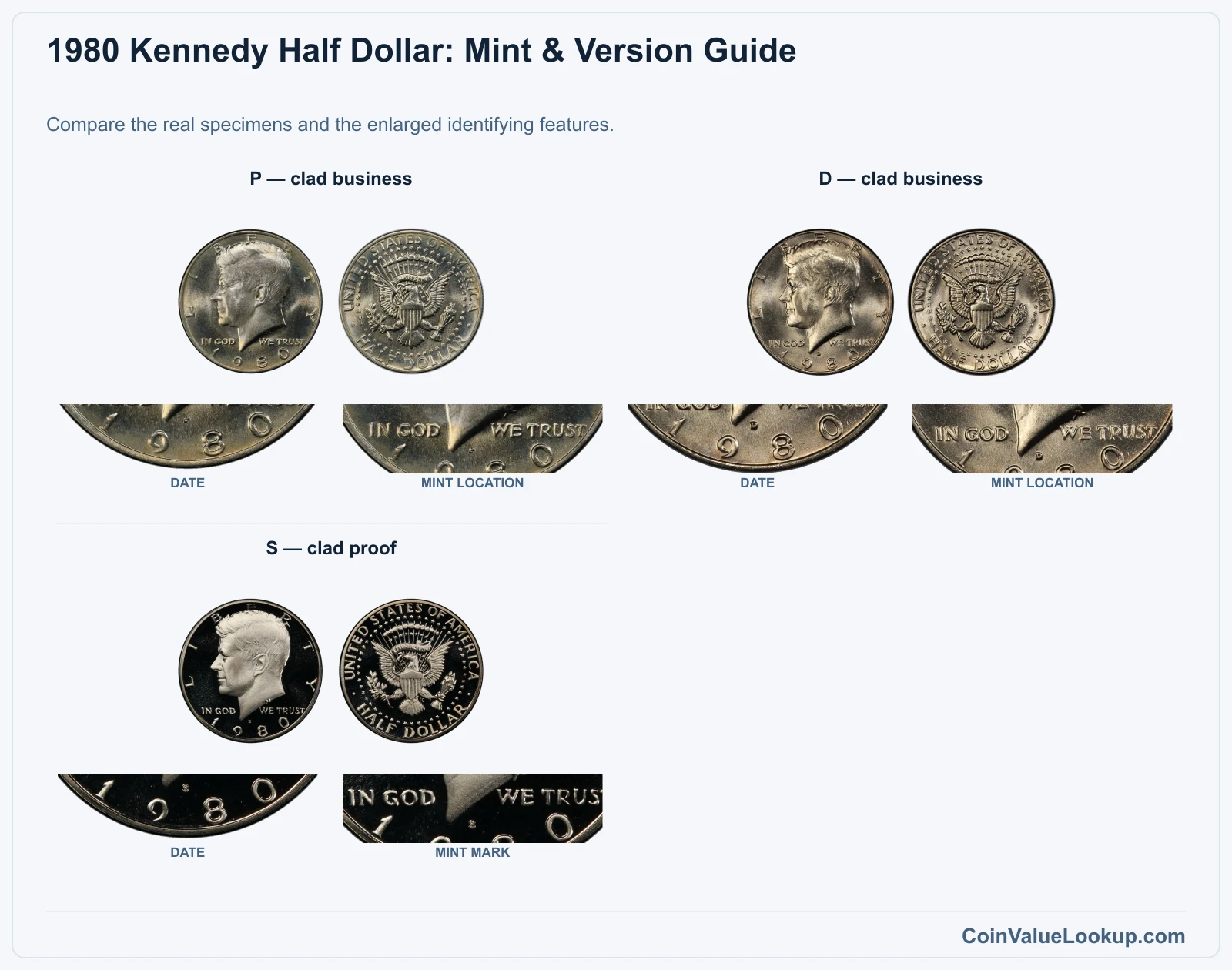
The 1980 Kennedy half dollar carries a 50-cent face value, and most circulated examples are worth exactly that. These are copper-nickel clad coins, not silver.
Collector guide estimates place well-preserved examples around $3.62 at the MS65 or PR65 level, depending on mint and finish. Before assuming your coin is ordinary, check the mintmark, finish and condition — proofs and mint-state survivors deserve a closer look.
Fast Way to Identify Your 1980 Kennedy Half Dollar
The quickest way to start is by uploading clear photos of both the front and back of your coin. This gives you a preliminary identification of the mint, finish and general condition.
Good lighting and a steady shot help — try to capture the mintmark area beneath Kennedy's portrait and the full reverse eagle design.
1980 Kennedy Half Dollar Value
Upload both sides of your 1980 Kennedy Half Dollar.
Front Obverse
Upload photo
Back Reverse
Upload photo
Which 1980 Kennedy Half Dollar Versions Are Worth Money?
- Check the mintmark beneath Kennedy's portrait: P, D, and S each correspond to a different version with its own value range.
- San Francisco proof coins in pristine condition with clean mirror fields are the collector-oriented issue for this year.
- Well-preserved Philadelphia or Denver business strikes graded MS65 or higher can exceed face value — most circulated examples do not.
- Mint-made errors such as doubled dies, off-center strikes and wrong-planchet coins are reported for this date and are worth investigating.
Step 1: Identify Your 1980 Kennedy Half Dollar Mint Mark and Version
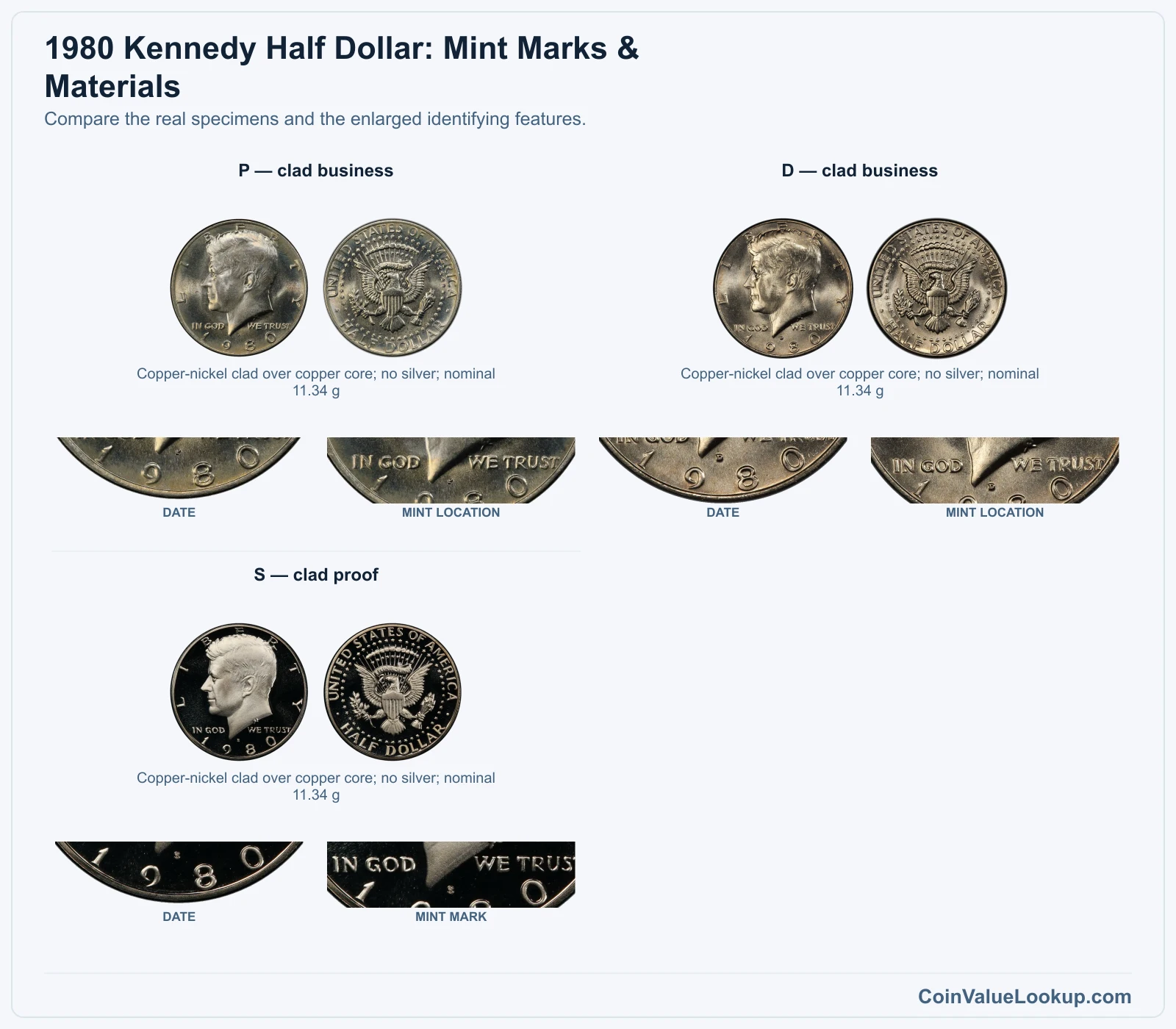
Look beneath Kennedy's portrait, just above the date. On 1980 half dollars, a "P" marks Philadelphia, a "D" marks Denver, and an "S" marks San Francisco.
Earlier Kennedy halves from Philadelphia carried no mintmark at all, but starting in 1980 the P was added — so if yours has no mintmark, it is likely not from 1980.
All three 1980 issues are copper-nickel clad. None contain silver.
Do not assume a half dollar is silver based on toning, lighting or surface color — these can all fool you. If you want to verify, check the edge: a clad coin shows a visible copper stripe sandwiched between silver-colored layers.
The San Francisco coin is a proof, struck with polished dies and sold in sealed sets. Its fields should be mirror-like and devices frosted.
If your S-mint coin looks like a normal business strike, examine it carefully — it may have been mishandled or is a different year entirely.
Coin Value Lookup is a useful starting point if you are trying to identify Kennedy halves or other U.S. coins across multiple years and denominations. You can look up guides by series to narrow down what you have.
Step 2: Check Your 1980 Kennedy Half Dollar Grade
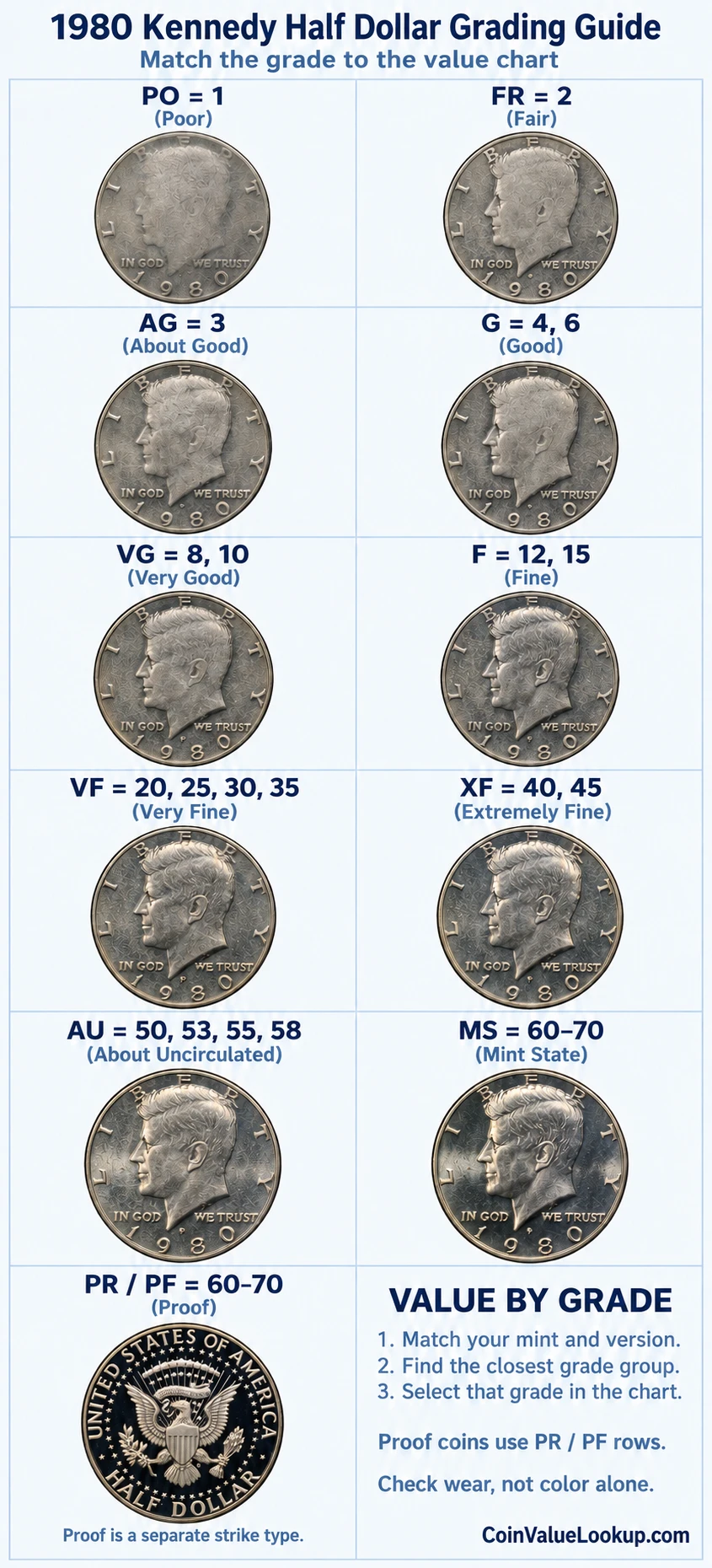
Start with Kennedy's cheek and jawline. On a well-circulated coin, the high points there go flat first.
Next check the hair directly above the ear — that area loses detail quickly with wear.
On the reverse, the eagle's breast feathers and the tops of the wings are the wear checkpoints. If those details are sharp and fully struck, you may be looking at an uncirculated coin.
Bag marks matter. A coin pulled straight from a mint bag can still show nicks and contact marks from jostling against other coins during shipping.
These are not circulation wear, but they do lower the grade. Compare your coin to the reference image to gauge where it falls.
Proofs get their own grading scale. Look for hairlines across the mirror fields — these come from cleaning or improper handling.
Haze and fingerprint residue also drag down proof grades. A clean, untouched proof in its original capsule is always the ideal.
Step 3: Check 1980 Kennedy Half Dollar Value by Mint and Version
1980 Kennedy Half Dollar — P — clad business
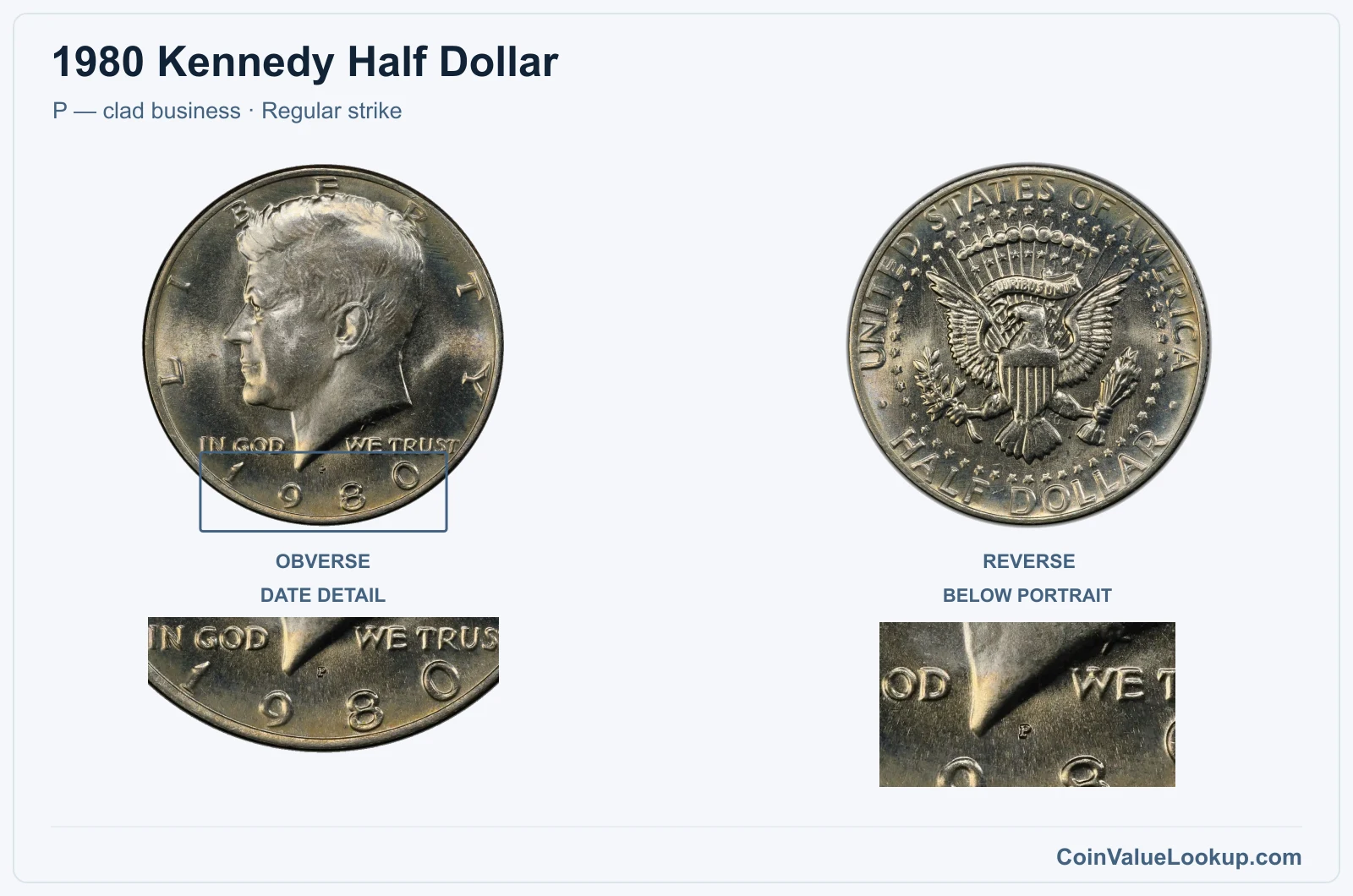
The 1980-P is a Philadelphia business strike on a copper-nickel clad planchet. Look for the small "P" mintmark beneath Kennedy's portrait — this was the first year Philadelphia half dollars carried one.
Most circulated examples trade at face value.
In well-preserved condition, the picture changes. A USA Coin Book guide estimate places the MS65 grade at roughly $3.62.
That is a guide figure, not a guaranteed offer, but it tells you that a clean, lustrous example with minimal bag marks is worth setting aside. Check for full hair detail above the ear and sharp eagle feathers on the reverse to gauge whether yours might qualify.
Range Grade
Price Auction Records Appraisal PO PO 1
—
Coin Identifier FR FR 2
—
Coin Identifier AG AG 3
—
Coin Identifier G G 4
—
Coin Identifier
G 6
—
Coin Identifier VG VG 8
—
Coin Identifier
VG 10
—
Coin Identifier F F 12
—
Coin Identifier
F 15
—
Coin Identifier VF VF 20
—
Coin Identifier
VF 25
—
Coin Identifier
VF 30
—
Coin Identifier
VF 35
—
Coin Identifier XF XF 40
—
Coin Identifier
XF 45
—
Coin Identifier AU AU 50
—
Coin Identifier
AU 53
—
Coin Identifier
AU 55
—
Coin Identifier
AU 58
Coin Identifier MS MS 60
Coin Identifier
MS 61
—
Coin Identifier
MS 62
—
Coin Identifier
MS 63
Coin Identifier
MS 64
Coin Identifier
MS 65
Coin Identifier
MS 66
Coin Identifier
MS 67
Coin Identifier
MS 68
—
—
—
MS 69
—
—
—
MS 70
—
—
—
1980 Kennedy Half Dollar — D — clad business
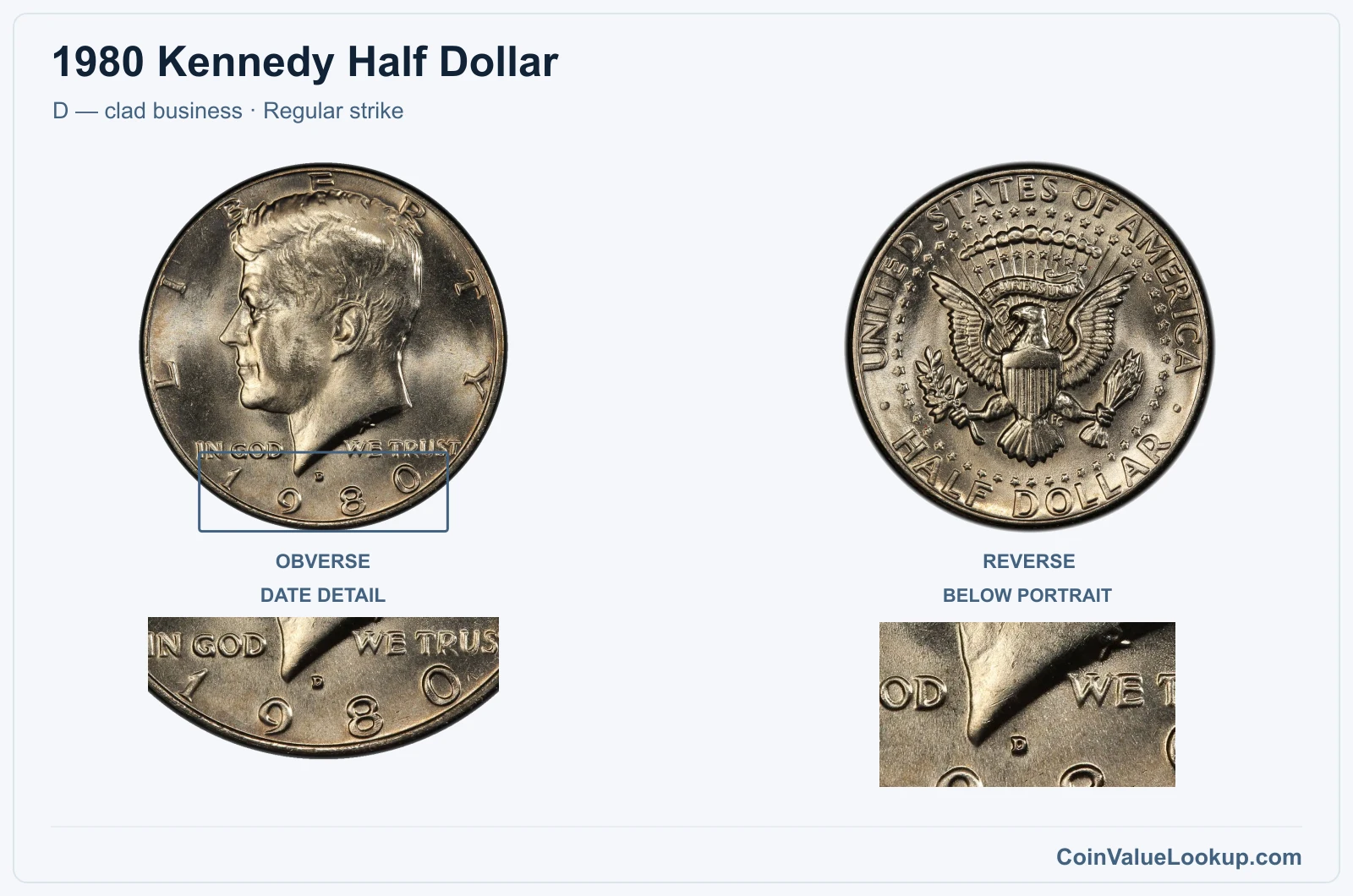
The 1980-D comes from the Denver Mint and shares the same copper-nickel clad composition. Its mintmark is a "D" in the same location beneath Kennedy's portrait.
Production was high, so finding one in pocket change is easy — finding one in top condition is another story.
At MS65, the USA Coin Book guide estimate is around $3.62. Circulated pieces are face-value coins.
If your 1980-D has strong luster, clean fields and sharp strike detail on both the hair and eagle, it could be worth preserving in a holder rather than spending at a vending machine.
Range Grade
Price Auction Records Appraisal PO PO 1
—
Coin Identifier FR FR 2
—
Coin Identifier AG AG 3
—
Coin Identifier G G 4
—
Coin Identifier
G 6
—
Coin Identifier VG VG 8
—
Coin Identifier
VG 10
—
Coin Identifier F F 12
—
Coin Identifier
F 15
—
Coin Identifier VF VF 20
—
Coin Identifier
VF 25
—
Coin Identifier
VF 30
—
Coin Identifier
VF 35
—
Coin Identifier XF XF 40
—
Coin Identifier
XF 45
—
Coin Identifier AU AU 50
—
Coin Identifier
AU 53
—
Coin Identifier
AU 55
—
Coin Identifier
AU 58
—
Coin Identifier MS MS 60
—
Coin Identifier
MS 61
—
Coin Identifier
MS 62
—
Coin Identifier
MS 63
—
Coin Identifier
MS 64
Coin Identifier
MS 65
Coin Identifier
MS 66
Coin Identifier
MS 67
Coin Identifier
MS 68
Coin Identifier
MS 69
—
—
—
MS 70
—
—
—
1980 Kennedy Half Dollar — S — clad proof
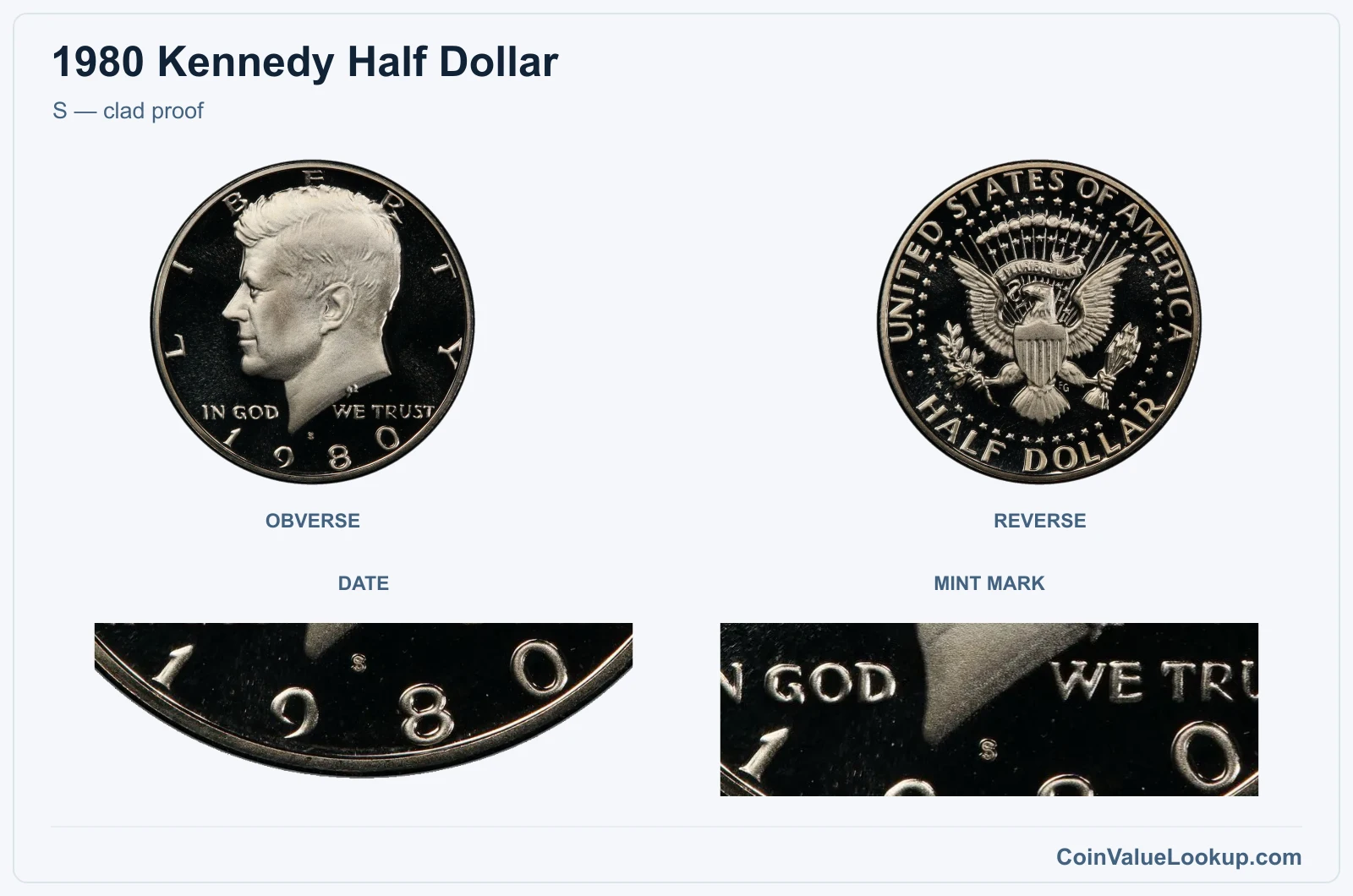
The 1980-S is a San Francisco clad proof, struck on the same copper-nickel clad planchet as the business strikes but with polished dies that produce mirror-like fields and frosted raised devices. These were sold in proof sets, not released into circulation.
At PR65, the USA Coin Book guide estimate sits at $3.62. Condition is everything with proofs.
Hairlines across the mirror fields, haze from improper storage, or fingerprints will hurt the grade. A coin still sealed in its original government packaging is your best bet for a clean example.
Compare the contrast between fields and devices — strong, even frosting over sharp detail is what collectors look for.
Range Grade
Price Auction Records Appraisal PR PR 1
—
Coin Identifier
PR 2
—
Coin Identifier
PR 3
—
Coin Identifier
PR 4
—
Coin Identifier
PR 6
—
Coin Identifier
PR 8
—
Coin Identifier
PR 10
—
Coin Identifier
PR 12
—
Coin Identifier
PR 15
—
Coin Identifier
PR 20
—
Coin Identifier
PR 25
—
Coin Identifier
PR 30
—
Coin Identifier
PR 35
—
Coin Identifier
PR 40
—
Coin Identifier
PR 45
—
Coin Identifier
PR 50
—
Coin Identifier
PR 53
—
Coin Identifier
PR 55
—
Coin Identifier
PR 58
—
Coin Identifier
PR 60
—
Coin Identifier
PR 61
—
Coin Identifier
PR 62
—
Coin Identifier
PR 63
—
Coin Identifier
PR 64
—
Coin Identifier
PR 65
—
Coin Identifier
PR 66
Coin Identifier
PR 67
Coin Identifier
PR 68
Coin Identifier
PR 69
Coin Identifier
PR 70
Coin Identifier
1980 Kennedy Half Dollar Error List
1. 1980 Kennedy Half Dollar — Doubled Die Obverse
A doubled die obverse on the 1980 Kennedy half shows consistent doubling on obverse design elements — letters, the date, or parts of Kennedy's portrait. The key word is consistent: true hub doubling produces uniform separation or notching across affected areas, visible under magnification.
Do not confuse this with machine doubling, which leaves a flat, shelf-like distortion and is far more common. Machine doubling is mechanical slop from a loose die, not a die variety, and it adds little or no premium.
Condition and the strength of the doubling both affect value. No specific price range is available for this variety, so individual assessment is necessary.
If you spot what looks like doubling, compare it against a normal 1980 coin under the same lighting before drawing conclusions.
2. 1980 Kennedy Half Dollar — Doubled Die Reverse
A doubled die reverse on the 1980 Kennedy half involves doubling visible on the reverse design — the eagle, lettering such as UNITED STATES OF AMERICA, or the denomination. As with the obverse variety, look for consistent separation or notching rather than a flat shelf.
Machine doubling is the usual lookalike here. It tends to appear as a mushy, raised shelf along one side of the letters rather than a crisp second impression.
Random post-mint damage or reflections under certain lighting can also mimic doubling.
Value depends on visibility, the specific die, and the coin's overall condition. No adopted price range is available, so each example needs to be evaluated on its own merits.
A clear close-up photograph of the affected area is the first step toward a proper identification.
3. 1980 Kennedy Half Dollar — Clashed Dies
A clashed die error occurs when the obverse and reverse dies strike each other without a planchet between them. The impact transfers faint impressions of the opposite design onto each die, and those ghost images then appear on subsequently struck coins.
On a 1980 Kennedy half, look for traces of Kennedy's profile showing faintly in the reverse fields, or parts of the eagle appearing on the obverse. These transferred elements should align with where the opposing die would have made contact.
Do not mistake random scratches, raised die-polish lines, or post-strike damage for clash marks. True clash impressions follow the geometry of the opposing design.
No specific price range is adopted for this error on the 1980 date, so value depends on clarity and condition.
4. 1980 Kennedy Half Dollar — Off-Center Strike
An off-center strike happens when the planchet is not seated properly between the dies at the moment of striking. The result is a design that is shifted to one side, leaving a blank crescent of unstruck metal on the opposite edge.
The percentage of off-center displacement matters. A slight shift of a few percent is less dramatic than a coin struck 20 or 50 percent off center.
Collectors generally prefer examples where the date remains fully visible despite the misalignment.
Lookalikes include clipped planchets, which remove a curved section of metal before striking, and post-mint damage like deliberate flattening. A genuine off-center coin will show the design displaced relative to the rim in a consistent direction.
No adopted price is available for this variety, so each coin's value depends on the degree of the error and its condition.
5. 1980 Kennedy Half Dollar — Wrong Planchet / Off-Metal Strike
A wrong-planchet error means the half dollar dies struck a blank intended for a different denomination. For 1980, a reported example involves a Philadelphia half dollar struck on a Susan B.
Anthony dollar planchet. The result is a coin that carries the Kennedy half design but with the wrong size, weight and edge characteristics.
To check, compare your coin's diameter and weight against a normal 1980-P half dollar. A wrong-planchet coin will feel off immediately — lighter or smaller, with the design possibly incomplete at the edges because the planchet was not large enough to receive the full impression.
Lookalikes include coins that have been plated, corroded, acid-treated, or deliberately altered to change their appearance or weight. No adopted price range is available for this error, so the value of any confirmed example depends on authentication, the specific planchet involved, and the coin's condition.