1889 Morgan Silver Dollar Coin Value: How Much Is It Worth?
The 1889 Morgan Silver Dollar is a coin that rewards careful identification. Guide estimates range from about $74.00 for a well-worn Philadelphia strike up to $361,606.00 for a gem-quality Carson City example, depending on mint, grade and finish.
That spread is enormous, so the first job is figuring out exactly which version you hold. A common Philadelphia coin in average circulated condition sits near the low end, while the scarce CC mintmark pushes values into a different universe entirely.
Fast Way to Identify Your 1889 Morgan Silver Dollar
The quickest way to start is to upload clear photos of both the front and back of your coin. Our identifier can give you a preliminary read on the mint, design and general condition from those images alone.
It will not authenticate errors or assign a certified grade, but it narrows the field fast so you know what to research next.
1889 Morgan Silver Dollar Value
Upload both sides of your 1889 Morgan Silver Dollar.
Front Obverse
Upload photo
Back Reverse
Upload photo
Which 1889 Morgan Silver Dollar Versions Are Worth Money?
- The 1889-CC is the key date of this group, with guide estimates from $1,164 in G4 to $361,606 in MS65, making correct mintmark identification critical.
- 1889 Proof (PR) strikes are a separate manufacturing finish requiring professional authentication; no guide price was adopted, so individual assessment matters.
- The 1889-O reaches $3,285 at MS65 versus $74 in G4, so condition makes a major difference for New Orleans coins.
- The 1889-S carries a slight premium over Philadelphia in lower grades ($93 vs. $74 at G4) and climbs to $1,711 at MS65.
- PL and DMPL surface designations on business strikes can affect pricing but are not proof coins; verify before paying a premium.
Step 1: Identify Your 1889 Morgan Silver Dollar Mint Mark and Version
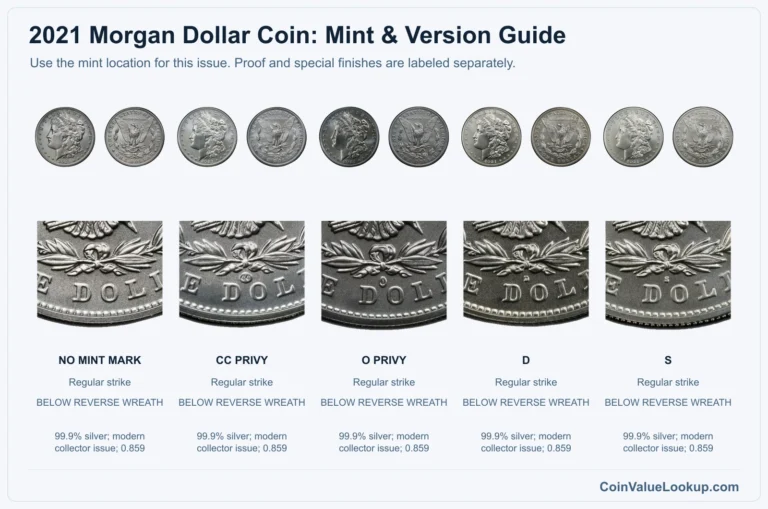
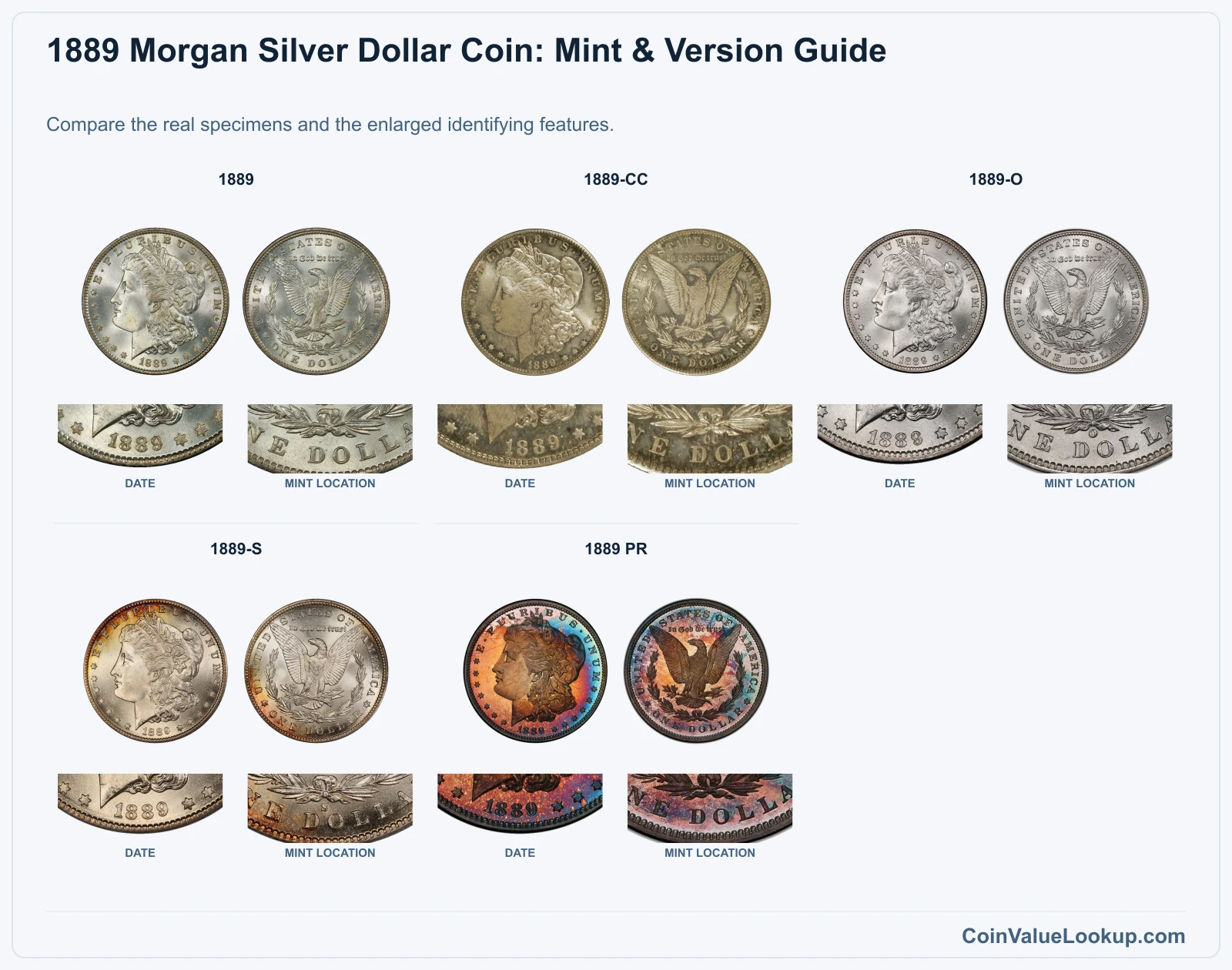
Flip the coin to the reverse (eagle side) and look directly below the bow that ties the wreath together. That is where you will find the mintmark, or the absence of one.
No mintmark means Philadelphia. A "CC" is Carson City, "O" is New Orleans, and "S" is San Francisco.
All four mints struck 1889-dated Morgan Dollars.
The coin is 90% silver and 10% copper, weighing 26.73 grams. If yours feels light or does not pass a magnet test, question its authenticity before worrying about value.
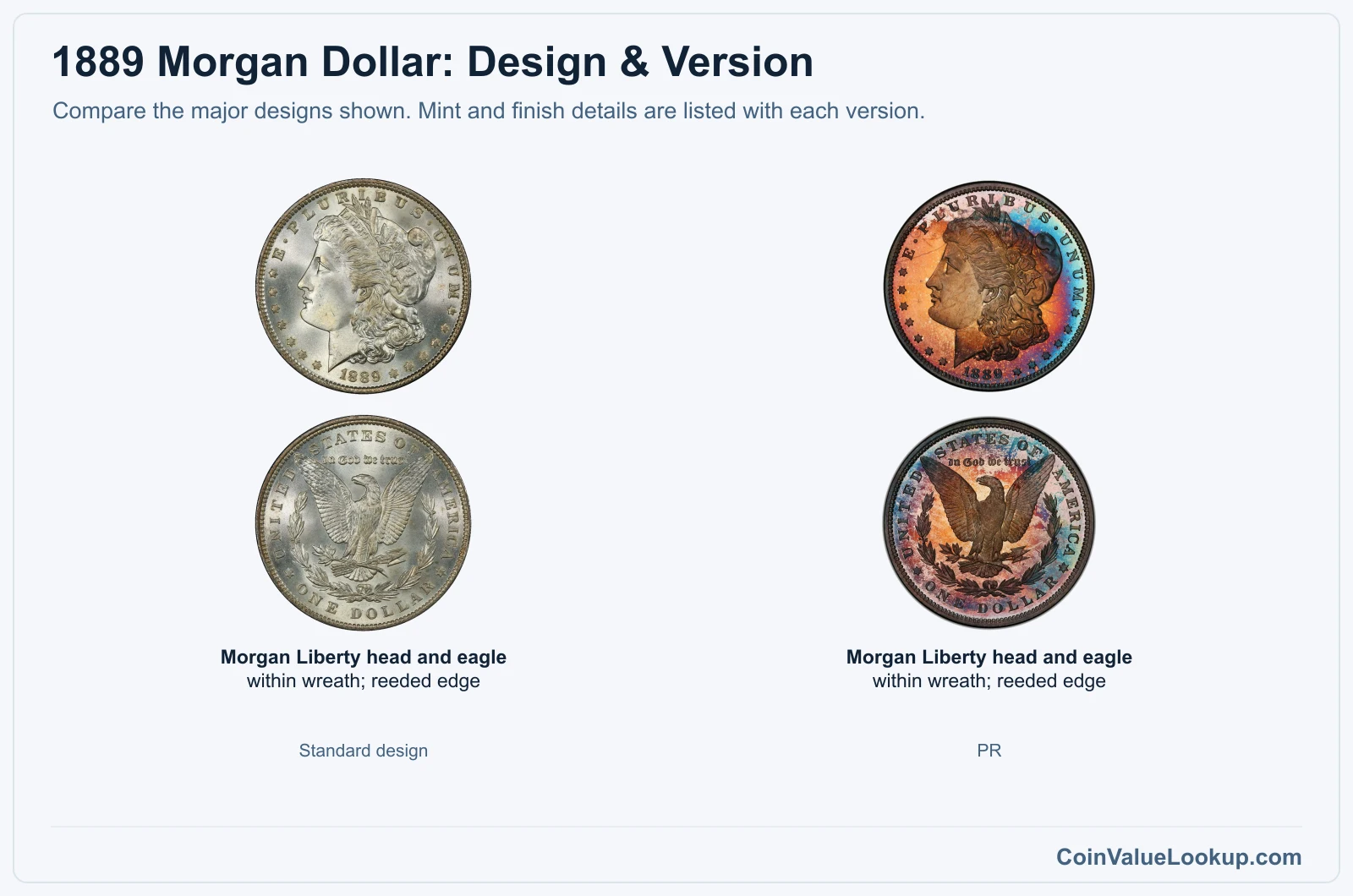
The obverse shows Liberty wearing a Phrygian cap with a wheat-and-cotton wreath, designed by George T. Morgan.
The reverse features an eagle with outstretched wings clutching arrows and an olive branch, surrounded by a wreath. The edge is reeded.
One more branch exists for this year: proof strikes. Proofs were a special manufacturing finish made at Philadelphia, not simply shiny or high-grade regular coins.
If you suspect you have one, professional authentication is essential, because a brilliant uncirculated business strike can look superficially similar. Prooflike (PL) and deep-mirror prooflike (DMPL) are surface designations applied to eligible business strikes and are not the same thing as proof manufacture.
Step 2: Check Your 1889 Morgan Silver Dollar Grade
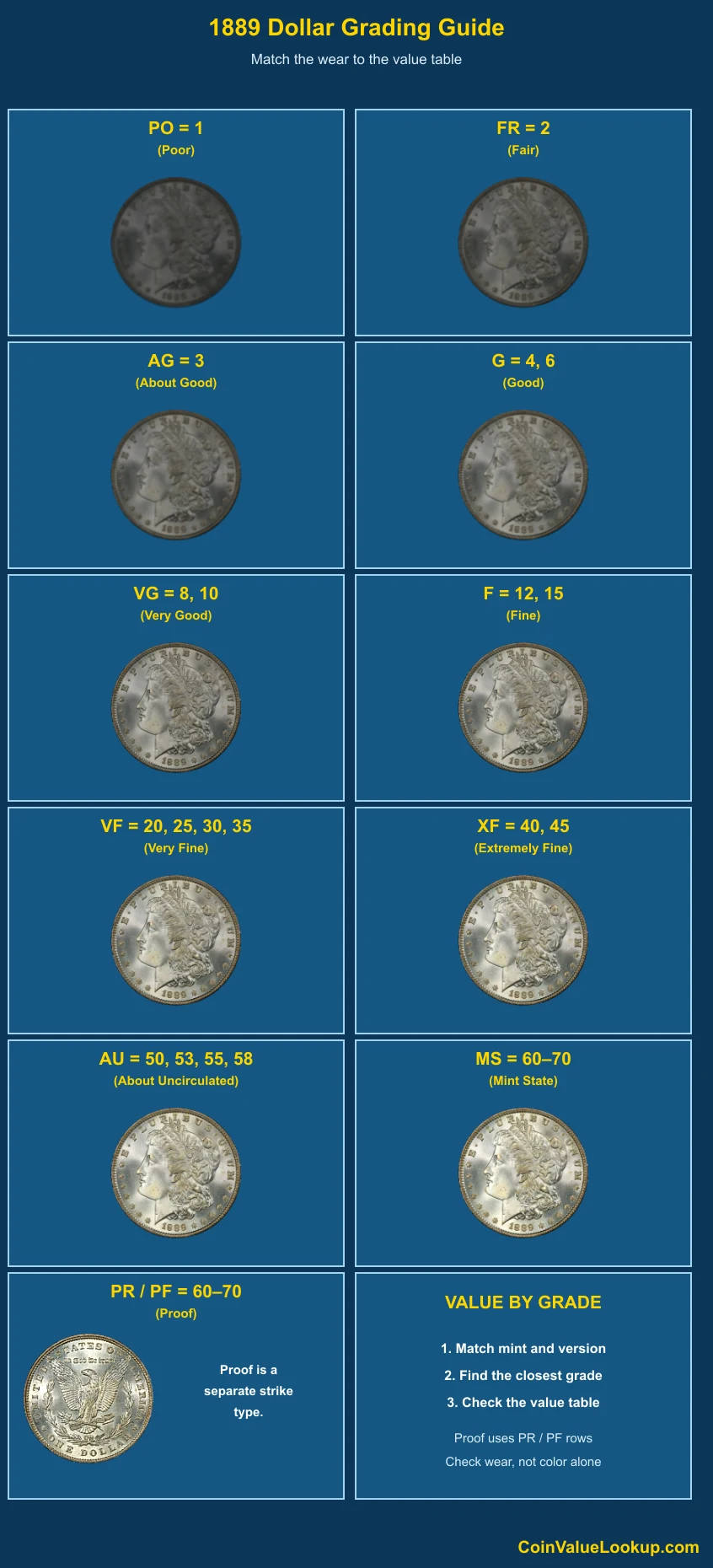
Start at Liberty's hair just above the ear. On a well-circulated coin, those strands blend into a flat mass.
Move to the cheek, then the cap details. On the reverse, check the eagle's breast feathers.
These are the highest points of the design and the first to show wear.
Bag marks matter too. Morgan Dollars were stored in heavy canvas bags at the mint, so even uncirculated coins can have contact marks that lower their Mint State grade.
A coin with full luster but heavy bag marks might grade MS-60, while a clean, lustrous example could reach MS-65 or higher. Compare your coin to the grading image provided, which shows circulated, About Uncirculated and Mint State examples side by side.
Cleaned or polished coins lose their original surface texture. They grade lower than coins with natural toning and luster, even when the underlying detail is sharp.
If the fields look unnaturally bright or have tiny hairline scratches in a uniform direction, the coin has likely been cleaned.
Step 3: Check 1889 Morgan Silver Dollar Value by Mint and Version
1889 Morgan Silver Dollar
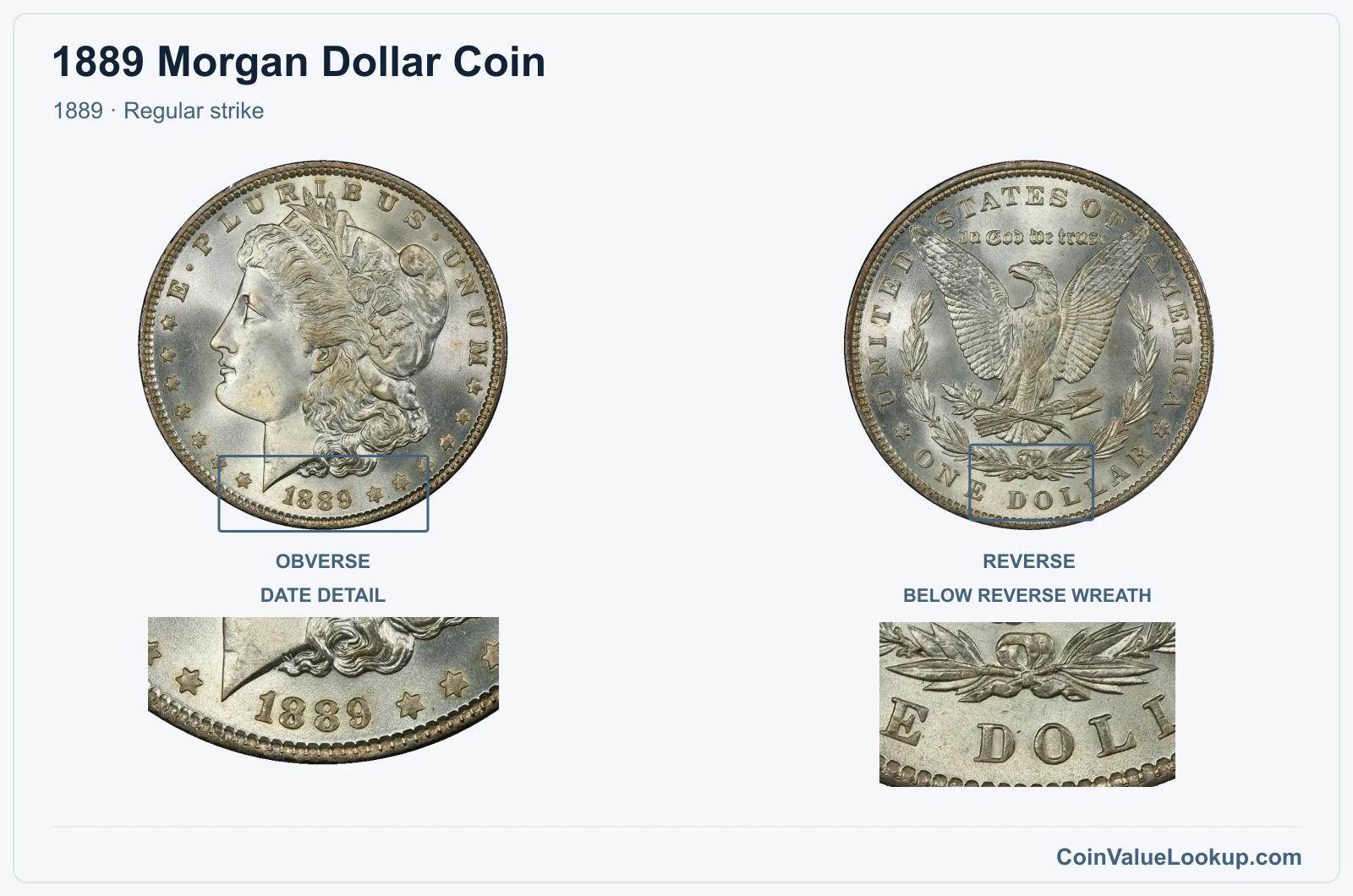
The 1889 Philadelphia Morgan Dollar has no mintmark on the reverse. It is the most available version this year, which keeps circulated prices modest.
A USA Coin Book guide estimate puts a G4 example around $74.00 and an MS65 near $349.00. These are guide figures, not guaranteed sale prices.
Original, untouched surfaces are what collectors want. If the coin has been cleaned or polished, expect it to trade below guide levels for its apparent grade.
Prooflike surfaces sometimes appear on Philadelphia business strikes, but do not confuse that mirror-like look with a proof; they are different manufacturing processes.
Range Grade
Price Auction Records Appraisal PO PO 1
—
Coin Identifier FR FR 2
—
Coin Identifier AG AG 3
—
Coin Identifier G G 4
—
Coin Identifier
G 6
—
Coin Identifier VG VG 8
—
Coin Identifier
VG 10
—
Coin Identifier F F 12
—
Coin Identifier
F 15
—
Coin Identifier VF VF 20
—
Coin Identifier
VF 25
—
Coin Identifier
VF 30
Coin Identifier
VF 35
—
Coin Identifier XF XF 40
—
Coin Identifier
XF 45
Coin Identifier AU AU 50
Coin Identifier
AU 53
Coin Identifier
AU 55
Coin Identifier
AU 58
Coin Identifier MS MS 60
Coin Identifier
MS 61
Coin Identifier
MS 62
Coin Identifier
MS 63
Coin Identifier
MS 64
Coin Identifier
MS 65
Coin Identifier
MS 66
Coin Identifier
MS 67
Coin Identifier
MS 68
Coin Identifier
MS 69
—
—
—
MS 70
—
—
—
1889 Morgan Silver Dollar — CC
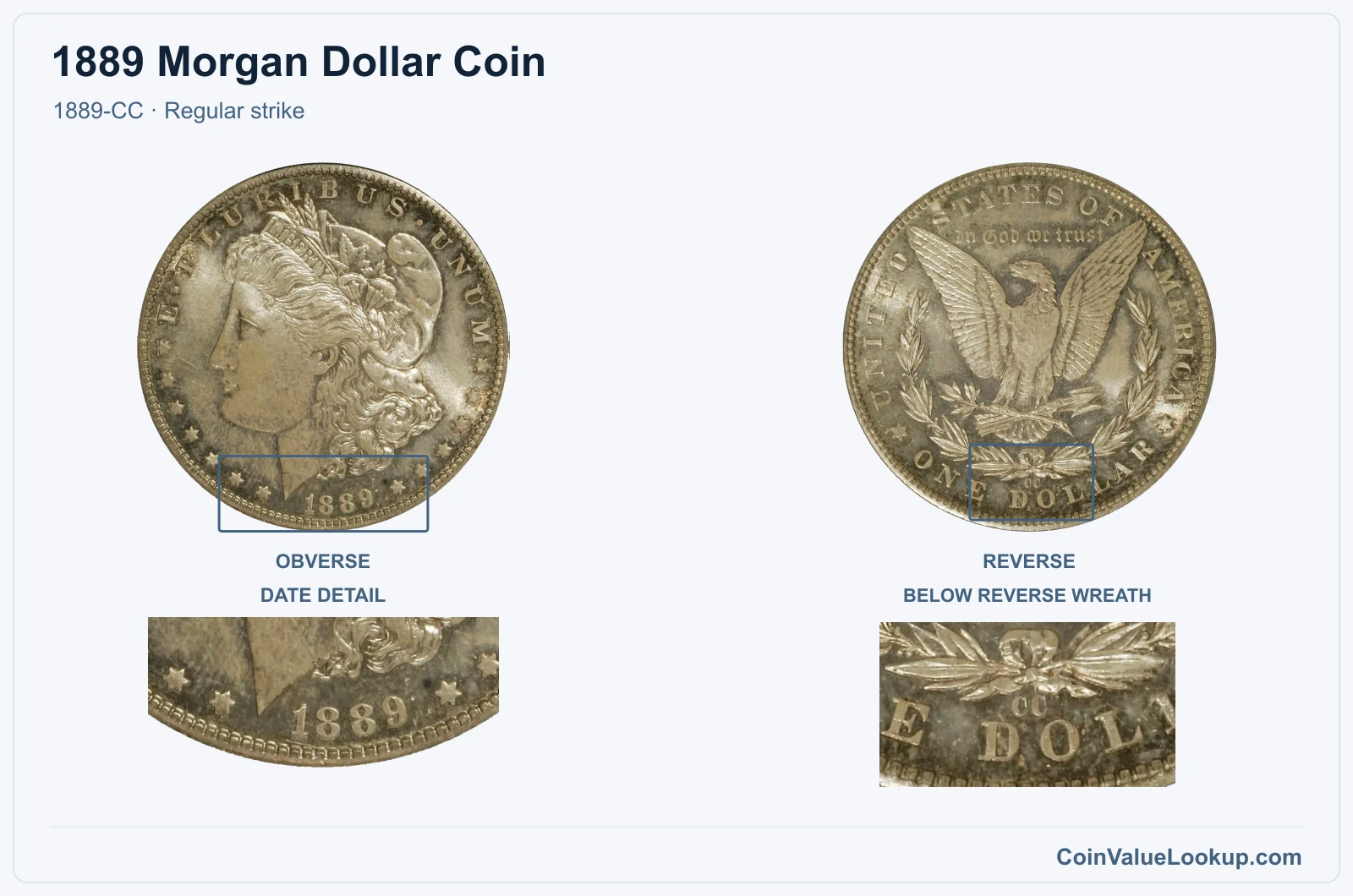
The 1889-CC is the coin everyone flips over to check. Look for the small "CC" mintmark beneath the wreath bow on the reverse.
Carson City production for this date was limited, and survivors in any grade command strong premiums.
Guide estimates from USA Coin Book place a G4 at roughly $1,164.00 and an MS65 at $361,606.00. That MS65 figure reflects extreme rarity at the gem level, not a typical transaction.
Even heavily worn examples are worth serious money compared to their Philadelphia counterparts.
Because the premium is so large, counterfeits and added mintmarks are a real concern. If you believe you have an 1889-CC, professional third-party authentication is a smart investment before selling or insuring it.
Original surfaces and confirmed grade drive value; a cleaned or damaged example will trade well below guide estimates for its wear level.
Coin Value Lookup is a good starting point if you want to look up guides for other Morgan Dollar dates and mints while you research your CC.
Range Grade
Price Auction Records Appraisal PO PO 1
Coin Identifier FR FR 2
Coin Identifier AG AG 3
Coin Identifier G G 4
Coin Identifier
G 6
Coin Identifier VG VG 8
Coin Identifier
VG 10
Coin Identifier F F 12
Coin Identifier
F 15
Coin Identifier VF VF 20
Coin Identifier
VF 25
Coin Identifier
VF 30
Coin Identifier
VF 35
Coin Identifier XF XF 40
Coin Identifier
XF 45
Coin Identifier AU AU 50
Coin Identifier
AU 53
Coin Identifier
AU 55
Coin Identifier
AU 58
Coin Identifier MS MS 60
Coin Identifier
MS 61
Coin Identifier
MS 62
Coin Identifier
MS 63
Coin Identifier
MS 64
Coin Identifier
MS 65
Coin Identifier
MS 66
—
Coin Identifier
MS 67
—
Coin Identifier
MS 68
Coin Identifier
MS 69
—
—
—
MS 70
—
—
—
1889 Morgan Silver Dollar — O
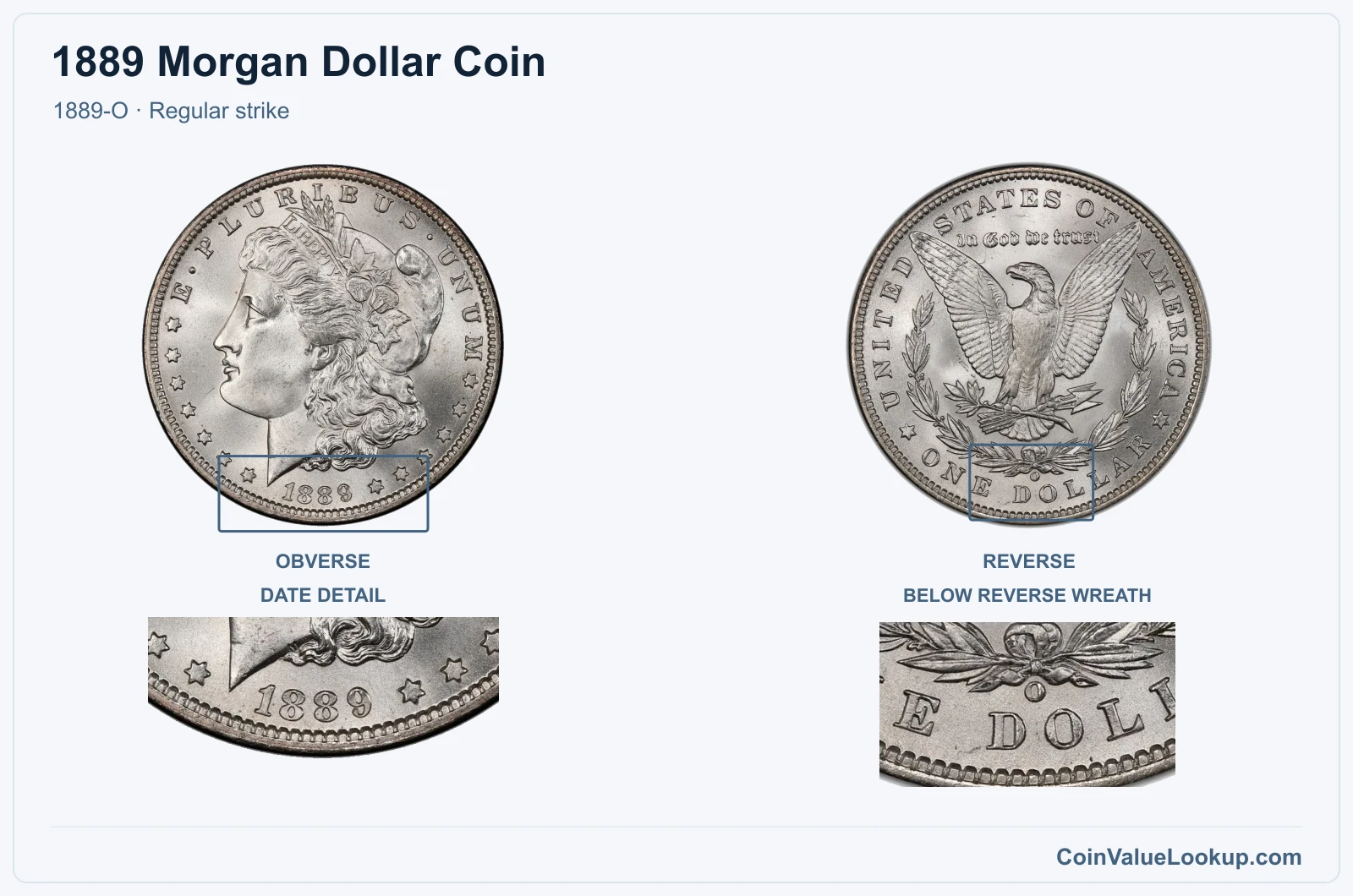
The 1889-O carries the "O" mintmark for New Orleans. In lower circulated grades it tracks close to the Philadelphia issue, with a G4 guide estimate around $74.00.
The gap widens at the top end: an MS65 is estimated near $3,285.00, reflecting the difficulty of finding sharply struck, mark-free New Orleans coins in gem condition.
New Orleans Morgans are sometimes weakly struck compared to Philadelphia or San Francisco issues. Weak strikes can make the hair and feather details look worn even on an uncirculated coin, so pay attention to luster and surface quality, not just sharpness, when grading.
Range Grade
Price Auction Records Appraisal PO PO 1
Coin Identifier FR FR 2
—
Coin Identifier AG AG 3
Coin Identifier G G 4
—
Coin Identifier
G 6
Coin Identifier VG VG 8
Coin Identifier
VG 10
Coin Identifier F F 12
Coin Identifier
F 15
—
Coin Identifier VF VF 20
Coin Identifier
VF 25
Coin Identifier
VF 30
Coin Identifier
VF 35
Coin Identifier XF XF 40
Coin Identifier
XF 45
Coin Identifier AU AU 50
Coin Identifier
AU 53
Coin Identifier
AU 55
Coin Identifier
AU 58
Coin Identifier MS MS 60
Coin Identifier
MS 61
Coin Identifier
MS 62
Coin Identifier
MS 63
Coin Identifier
MS 64
Coin Identifier
MS 65
Coin Identifier
MS 66
Coin Identifier
MS 67
—
—
—
MS 68
—
—
—
MS 69
—
—
—
MS 70
—
—
—
1889 Morgan Silver Dollar — S
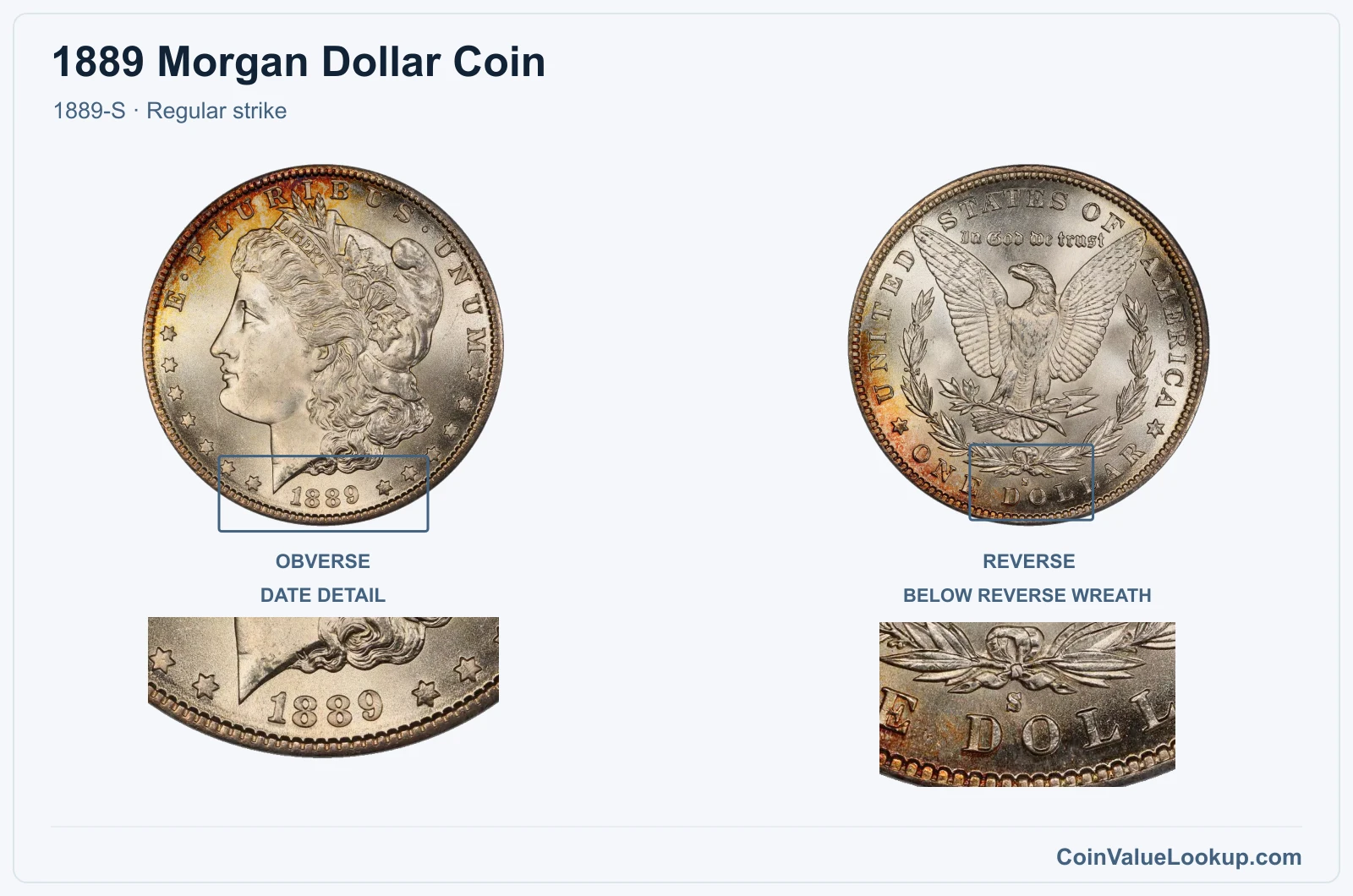
Look for the small "S" mintmark beneath the wreath bow to confirm a San Francisco strike. The 1889-S starts slightly higher than Philadelphia in circulated grades, with a G4 guide estimate around $93.00.
At the gem level, an MS65 is estimated near $1,711.00.
San Francisco coins from this era tend to have good strike quality, so a sharp example is not unusual. Original surfaces and absence of cleaning still matter most when comparing your coin to guide estimates.
PL or DMPL surfaces can appear on eligible San Francisco business strikes and may affect pricing, but they do not make a coin a proof.
Range Grade
Price Auction Records Appraisal PO PO 1
—
Coin Identifier FR FR 2
—
Coin Identifier AG AG 3
Coin Identifier G G 4
—
Coin Identifier
G 6
—
Coin Identifier VG VG 8
—
Coin Identifier
VG 10
—
Coin Identifier F F 12
—
Coin Identifier
F 15
—
Coin Identifier VF VF 20
—
Coin Identifier
VF 25
—
Coin Identifier
VF 30
—
Coin Identifier
VF 35
Coin Identifier XF XF 40
Coin Identifier
XF 45
Coin Identifier AU AU 50
Coin Identifier
AU 53
Coin Identifier
AU 55
Coin Identifier
AU 58
Coin Identifier MS MS 60
Coin Identifier
MS 61
Coin Identifier
MS 62
Coin Identifier
MS 63
Coin Identifier
MS 64
Coin Identifier
MS 65
Coin Identifier
MS 66
Coin Identifier
MS 67
—
Coin Identifier
MS 68
—
—
—
MS 69
—
—
—
MS 70
—
—
—
1889 Morgan Silver Dollar — PR
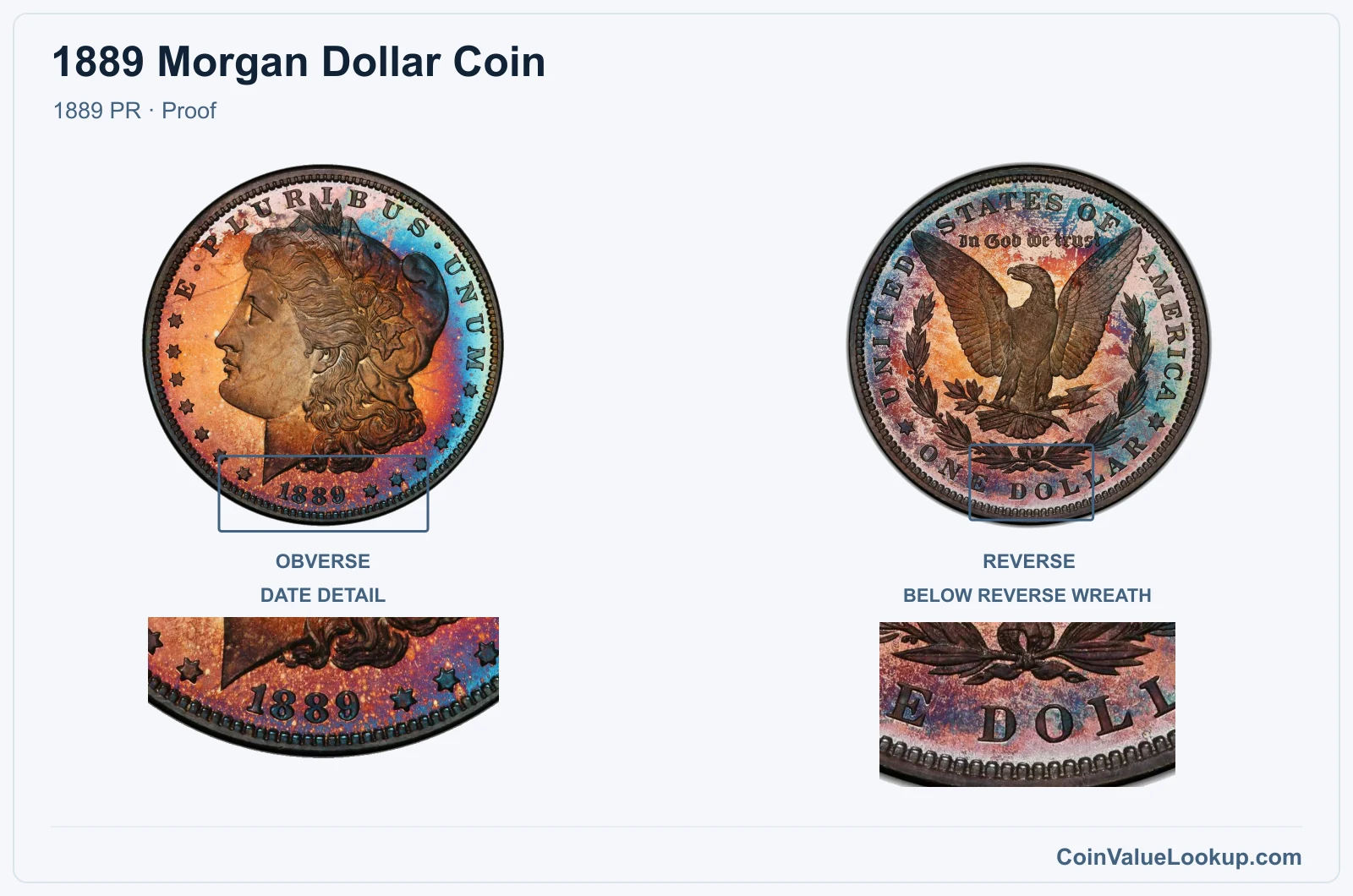
The 1889 Proof Morgan Dollar was struck at Philadelphia using specially prepared dies and planchets. It carries no mintmark.
Proof is a manufacturing method, not a grade above Mint State, so a brilliant uncirculated business strike is not the same thing no matter how shiny it looks.
No supported guide price was adopted for this version, meaning each coin's value depends on its authenticated identity and individual condition. Professional certification is essentially mandatory here.
The number of proofs produced in any given Morgan Dollar year was small, and surviving examples in original condition are scarce. If your coin has deeply mirrored fields, sharp squared-off rims and frosted devices with no bag marks, it could be a proof candidate worth submitting to a grading service.
Range Grade
Price Auction Records Appraisal PR PR 1
—
Coin Identifier
PR 2
—
Coin Identifier
PR 3
—
Coin Identifier
PR 4
—
Coin Identifier
PR 6
—
Coin Identifier
PR 8
—
Coin Identifier
PR 10
—
Coin Identifier
PR 12
—
Coin Identifier
PR 15
—
Coin Identifier
PR 20
—
Coin Identifier
PR 25
—
Coin Identifier
PR 30
—
Coin Identifier
PR 35
—
Coin Identifier
PR 40
—
Coin Identifier
PR 45
—
Coin Identifier
PR 50
—
Coin Identifier
PR 53
—
Coin Identifier
PR 55
—
Coin Identifier
PR 58
—
Coin Identifier
PR 60
Coin Identifier
PR 61
Coin Identifier
PR 62
Coin Identifier
PR 63
Coin Identifier
PR 64
Coin Identifier
PR 65
Coin Identifier
PR 66
Coin Identifier
PR 67
Coin Identifier
PR 68
Coin Identifier
PR 69
—
—
—
PR 70
—
—
—
1889 Morgan Silver Dollar Error List
1. 1889 Morgan Silver Dollar — Clashed Dies
A clashed-die 1889 Morgan Dollar shows faint traces of the opposite design in the fields. This happens when the obverse and reverse dies strike each other without a planchet between them, transferring impressions.
On the obverse you might see ghostly outlines of the eagle's wing tips or tail feathers; on the reverse, traces of Liberty's hair or cap may appear.
These marks will be aligned with where the opposing design would normally sit, which helps separate a genuine clash from random scratches or contact marks. Scratches run in arbitrary directions and do not mirror the opposite die's features.
A brockage, where a struck coin acts as a die, looks different because the transferred image is incuse.
No specific price was adopted for this error. Value depends on the visibility of the clash, the coin's overall condition, and whether the error has been verified by a grading service.
2. 1889 Morgan Silver Dollar — Rotated Dies
A rotated-die error means the obverse and reverse are not aligned in the normal orientation. To check, hold the obverse upright and rotate the coin top-to-bottom along a vertical axis.
On a normally aligned U.S. coin, the reverse should also appear upright. If the reverse is tilted, you may have a die rotation.
The degree of rotation matters. A few degrees is minor and common; a significant rotation, say 45 degrees or more, draws more collector interest.
Be careful when checking from photographs, because a camera can rotate an image independently of the actual coin alignment. Always confirm with the physical coin in hand.
No price was adopted for this error on the 1889 Morgan Dollar. Condition, degree of rotation and third-party verification all factor into what a rotated-die example might bring.
3. 1889 Morgan Silver Dollar — Off-Center Strike
An off-center strike occurs when the planchet is not properly seated between the dies, producing a design that is shifted to one side with an unstruck crescent of blank metal on the opposite edge. Heritage Auctions has listed an 1889 Silver Dollar struck roughly 5% off center.
Small percentages like 5% are subtle. Look for a slight displacement of the design and a sliver of blank metal along one rim.
The date should still be fully visible on a collectible off-center Morgan. A coin missing the date loses much of its attribution value.
Do not confuse an off-center strike with a clipped planchet, which removes a curved chunk of metal, or with post-mint damage where someone flattened or bent the coin after it left the press. A genuine off-center strike shows the full design elements that remain, just displaced.
No specific price was adopted. The percentage of offset, whether the date is readable, and the coin's grade all influence value.
4. 1889 Morgan Silver Dollar — Broadstrike
A broadstrike happens when the coin is struck without the normal retaining collar that forms the reeded edge and confines the metal to its proper diameter. The result is a coin that spreads outward, appearing slightly larger than normal with a distorted or missing edge reeding.
The entire design is still present on a broadstrike, which distinguishes it from an off-center error where part of the design is missing. It also differs from post-mint flattening: a genuine broadstrike shows uniform metal spread from the force of the strike, while a coin squashed in a vise or by machinery after minting will have uneven distortion and possibly tool marks.
Check the edge carefully. On a true broadstrike the reeding will be partially or fully absent because no collar was in place.
No price was adopted for this error on the 1889 Morgan Dollar. The degree of spread, overall condition and professional verification determine what collectors will pay.