1956 Wheat Penny Coin Value: How Much Is It Worth?
A 1956 Wheat Penny in ordinary circulated condition carries a guide value around $0.06 at Fine-12, climbing to roughly $1.24 at MS63 for either the Philadelphia or Denver mint. Those anchors cover standard business strikes only.
Proofs, the recognized D Above Shadow D variety, and error coins are priced on different scales. Original surfaces, color and wear all affect what a specific coin will bring.
Fast Way to Identify Your 1956 Wheat Penny
Want a quick read on your 1956 penny? Upload clear photos of the front and back, and the identifier can give you a preliminary identification of which mint and version you have.
Good lighting and a close shot of the mintmark area help the most. This is not authentication or exact grading, but it points you in the right direction before you dig deeper.
1956 Wheat Penny Value
Upload both sides of your 1956 Wheat Penny.
Front Obverse
Upload photo
Back Reverse
Upload photo
Which 1956 Wheat Penny Versions Are Worth Money?
- The 1956-D Above Shadow D variety shows a repunched mintmark with an underlying shadow D and can reach around $92 at MS63, far above a normal 1956-D.
- Philadelphia brilliant proofs carry a guide value near $7.29 at PR63, a significant step up from the $1.24 MS63 ceiling on business strikes.
- Strong original surfaces and a verified collectible error such as a doubled die or wrong-planchet strike can affect value well beyond standard guide figures.
Step 1: Identify Your 1956 Wheat Penny Mint Mark and Version
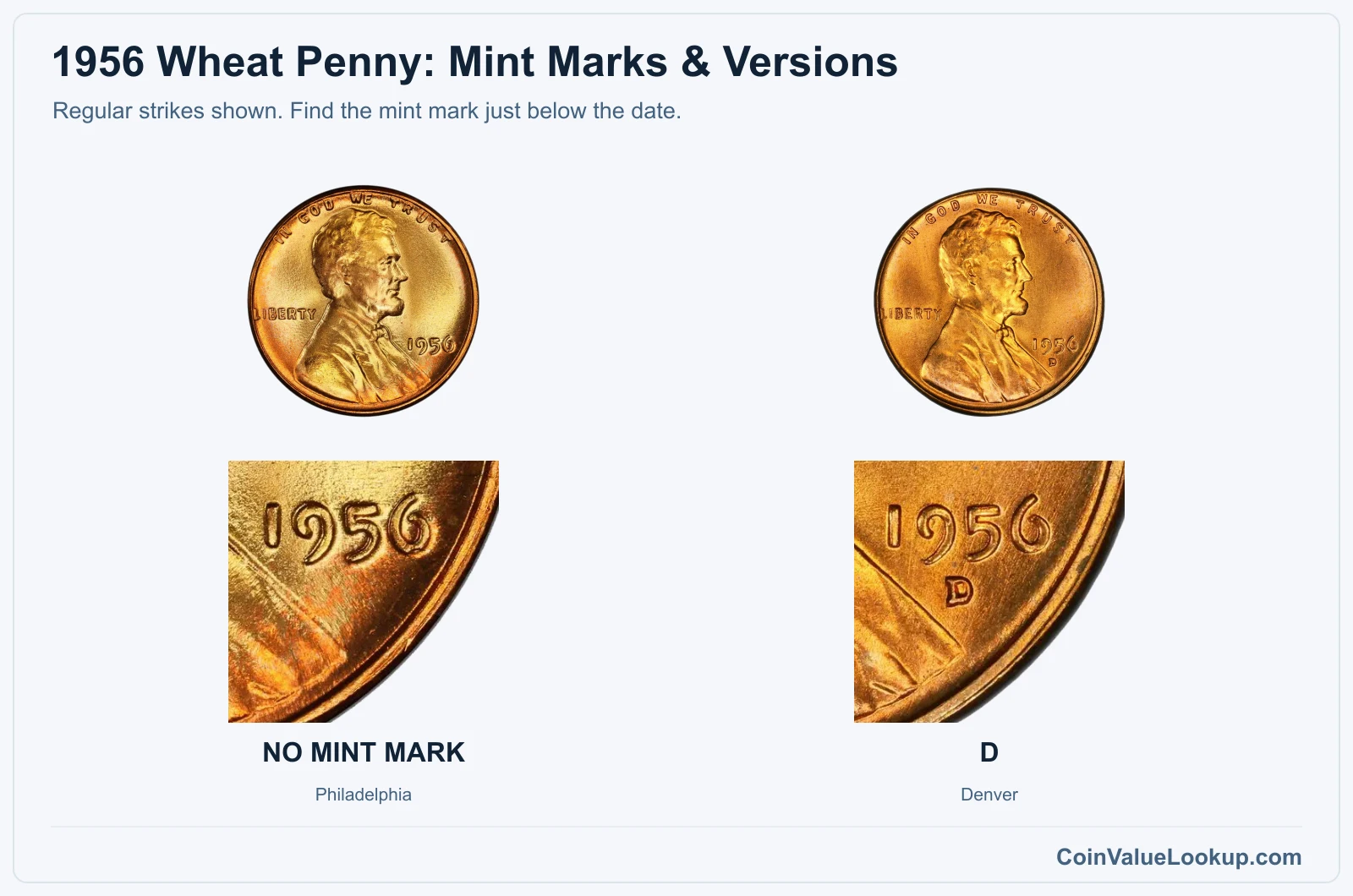
Only two mints struck circulation 1956 Wheat cents: Philadelphia and Denver. There is no San Francisco issue this year.
Flip the coin to the obverse and look just below the date. If you see a small "D," it is a Denver strike.
No letter at all means Philadelphia.
Philadelphia also produced brilliant proof cents in 1956, but those are a separate manufacturing finish with mirrored fields, not simply a high-grade circulated coin. A polished circulation cent is not a proof, no matter how shiny someone made it.
Weight should be close to 3.11 grams on a standard copper-alloy planchet with a plain edge.
The reverse features two wheat ears flanking ONE CENT. Color descriptions like red, red-brown, or brown describe surface tone, not grade, and the guide values listed here do not specify color, so treat those anchors accordingly.
Step 2: Check Your 1956 Wheat Penny Grade
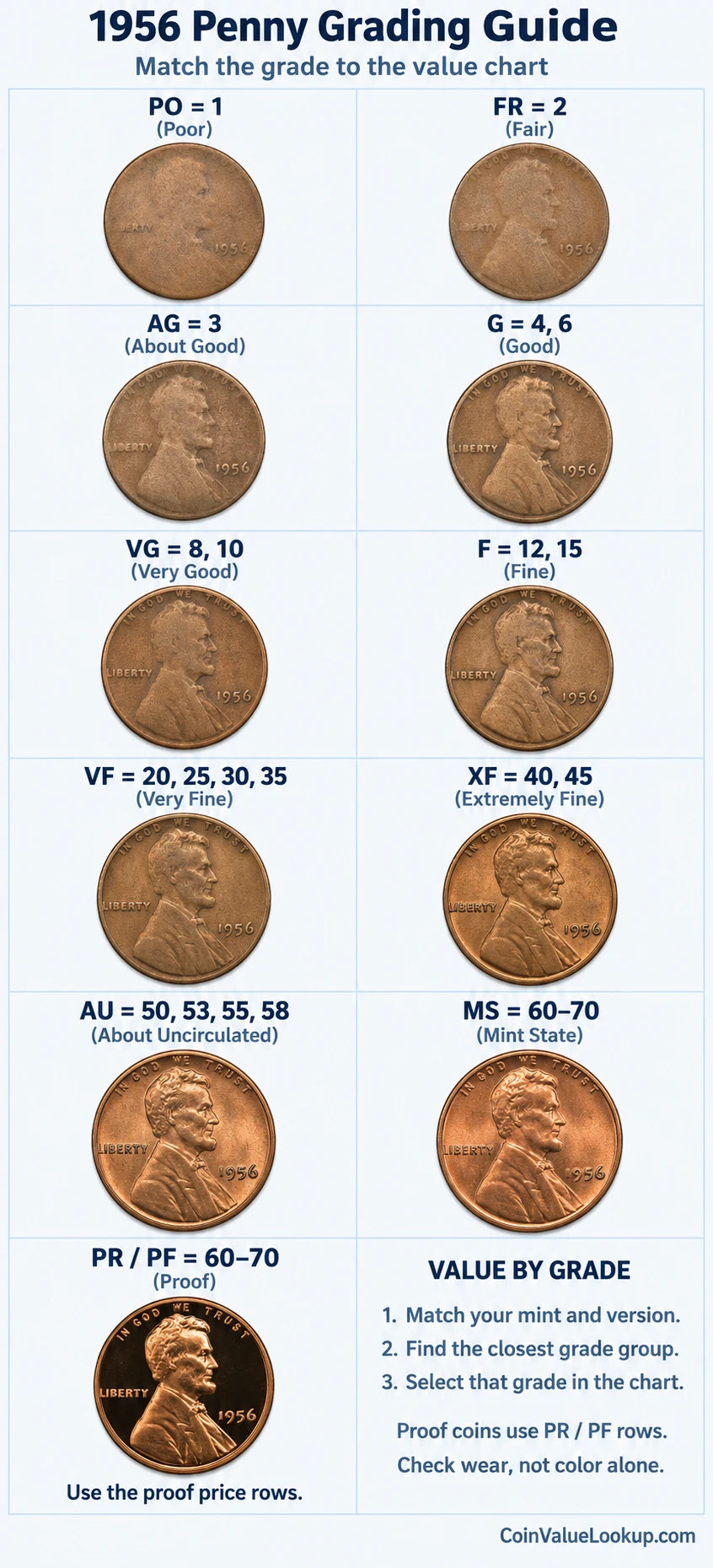
Start with Lincoln's cheekbone, jaw, and the fine hair detail above his ear. Those are the first areas to show wear.
A coin grading Fine-12 will have visible flatness across those high points but still retain clear outlines.
On the reverse, check the wheat stalks for sharpness in the individual grain lines and the parallel lines between the ears. Luster loss shows up there quickly.
Keep in mind that a weak original strike can leave soft detail that looks like wear but is not. Compare your coin to the reference image for the same grade to separate strike softness from actual circulation wear.
Color, spots, corrosion, and evidence of cleaning are separate value factors. A brown coin with original surfaces can be more desirable than a bright one that has been cleaned.
Do not assume a red-toned coin automatically commands the highest price unless a certified color designation supports it.
Step 3: Check 1956 Wheat Penny Value by Mint and Version
1956 Wheat Penny
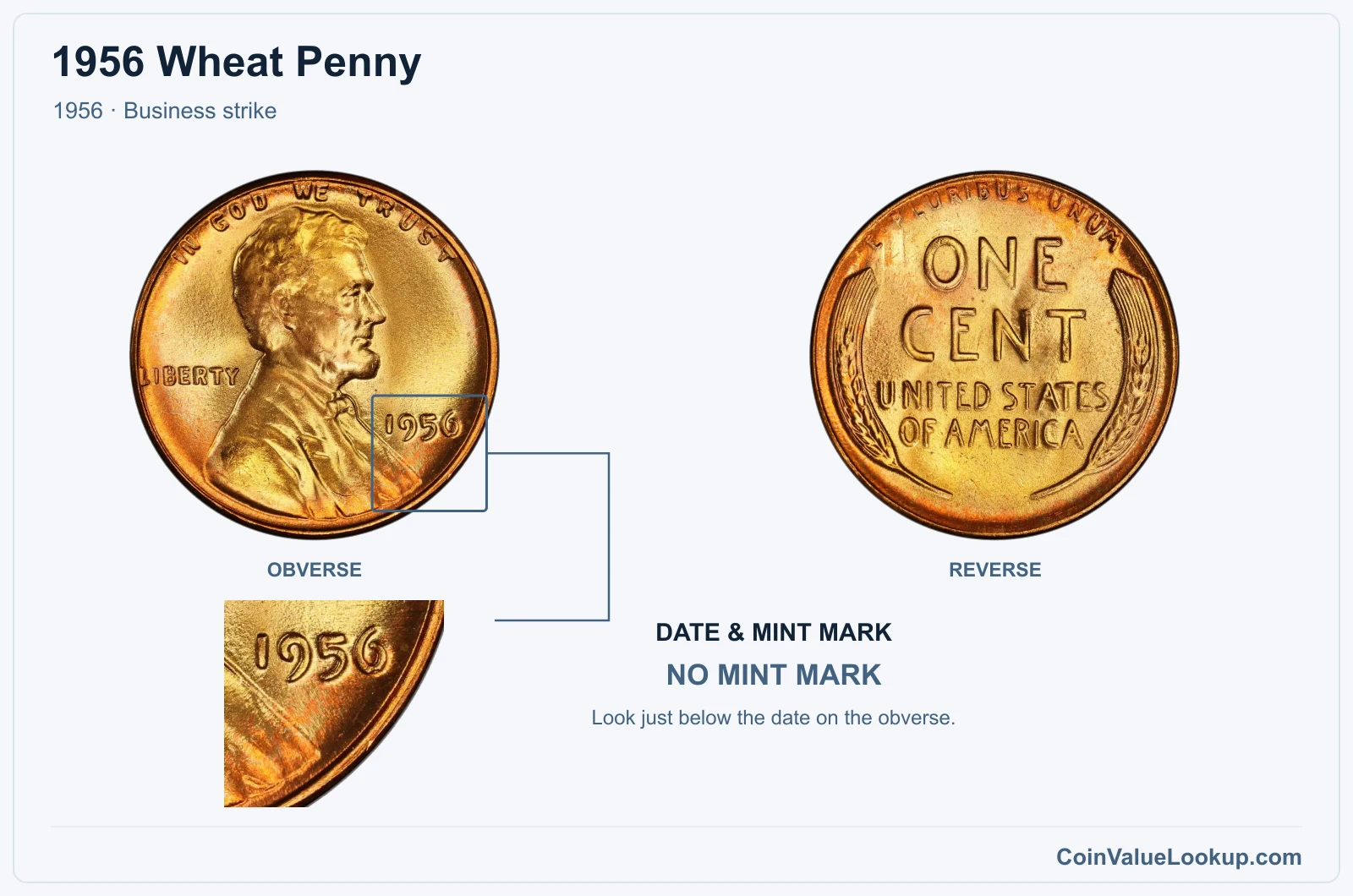
The 1956 Philadelphia cent has no mintmark below the date. It is a standard business strike on a 95% copper, 5% tin and zinc planchet weighing about 3.11 grams.
Guide values run from roughly $0.06 in Fine-12 to $1.24 at MS63. That is not a lot of money, but a coin with blazing original luster and clean surfaces in a high Mint State grade can still attract interest.
Make sure you are not looking at a proof; Philadelphia made both formats this year, and they are valued on completely different scales.
| Range | Grade | Price | Auction Records | Appraisal |
|---|---|---|---|---|
| PO | PO 1 | — | Coin Identifier | |
| FR | FR 2 | — | Coin Identifier | |
| AG | AG 3 | — | Coin Identifier | |
| G | G 4 | — | Coin Identifier | |
| G 6 | — | Coin Identifier | ||
| VG | VG 8 | — | Coin Identifier | |
| VG 10 | — | Coin Identifier | ||
| F | F 12 | — | Coin Identifier | |
| F 15 | — | Coin Identifier | ||
| VF | VF 20 | — | Coin Identifier | |
| VF 25 | — | Coin Identifier | ||
| VF 30 | — | Coin Identifier | ||
| VF 35 | — | Coin Identifier | ||
| XF | XF 40 | — | Coin Identifier | |
| XF 45 | — | Coin Identifier | ||
| AU | AU 50 | — | Coin Identifier | |
| AU 53 | — | Coin Identifier | ||
| AU 55 | — | Coin Identifier | ||
| AU 58 | — | Coin Identifier | ||
| MS | MS 60 | — | Coin Identifier | |
| MS 61 | — | Coin Identifier | ||
| MS 62 | — | Coin Identifier | ||
| MS 63 | Coin Identifier | |||
| MS 64 | Coin Identifier | |||
| MS 65 | Coin Identifier | |||
| MS 66 | Coin Identifier | |||
| MS 67 | Coin Identifier | |||
| MS 68 | Coin Identifier | |||
| MS 69 | — | — | — | |
| MS 70 | — | — | — |
1956 Wheat Penny — D
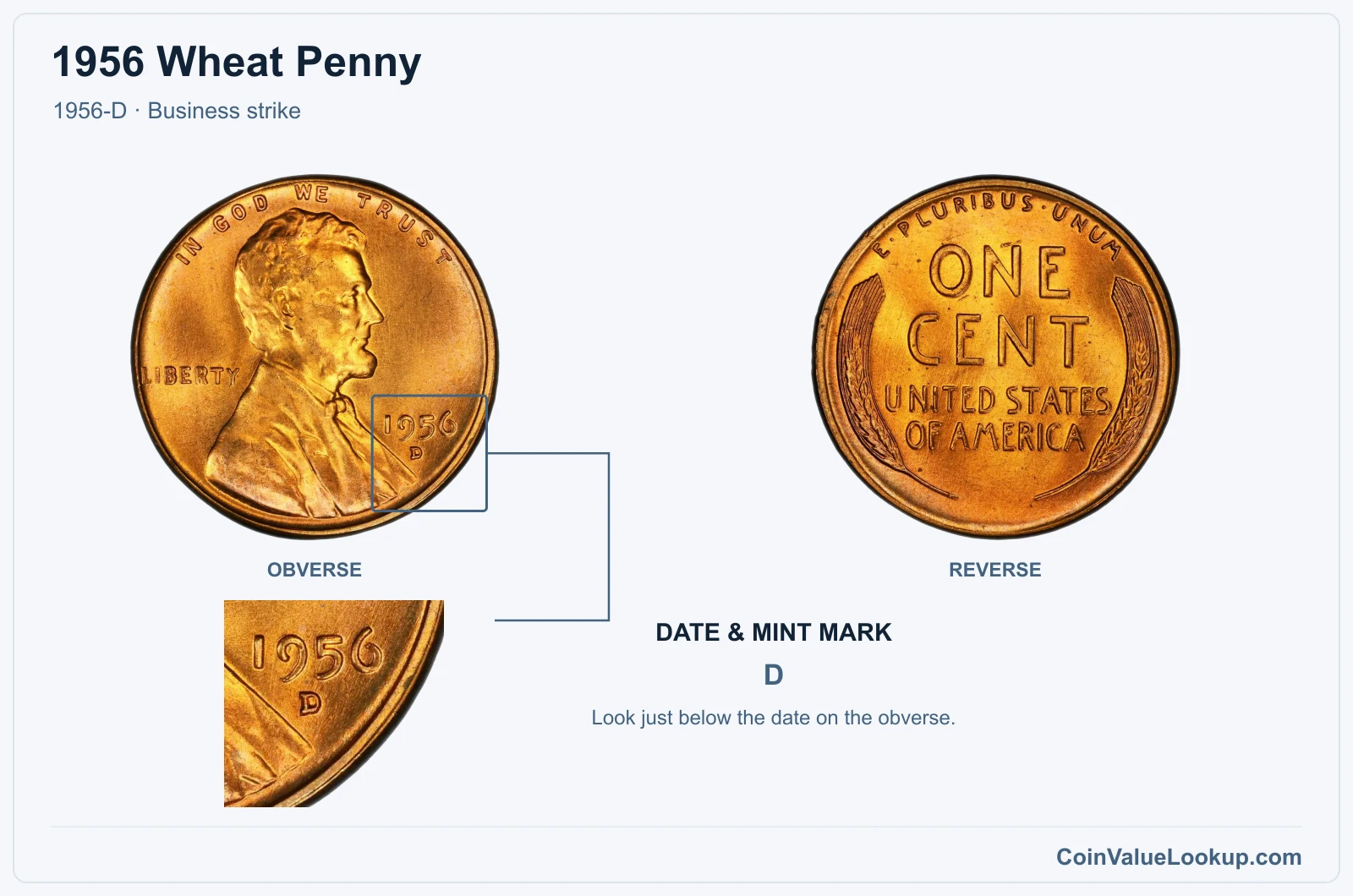
Look for the small "D" mintmark below the date. The 1956-D was struck at Denver on the same copper-alloy planchet as its Philadelphia sibling.
Guide values match the Philadelphia issue: about $0.06 at Fine-12, up to $1.24 at MS63. Most examples you find in pocket change are well-circulated, but Denver produced plenty, so Mint State survivors are not scarce.
Before setting it aside as common, examine the mintmark area closely. A secondary shadow beneath the D could mean you have the much more valuable D Above Shadow D variety.
Coin Value Lookup is a useful starting point if you want to look up guide values for other dates and mints in the Wheat cent series.
| Range | Grade | Price | Auction Records | Appraisal |
|---|---|---|---|---|
| PO | PO 1 | — | Coin Identifier | |
| FR | FR 2 | — | Coin Identifier | |
| AG | AG 3 | — | Coin Identifier | |
| G | G 4 | — | Coin Identifier | |
| G 6 | — | Coin Identifier | ||
| VG | VG 8 | — | Coin Identifier | |
| VG 10 | — | Coin Identifier | ||
| F | F 12 | — | Coin Identifier | |
| F 15 | — | Coin Identifier | ||
| VF | VF 20 | — | Coin Identifier | |
| VF 25 | — | Coin Identifier | ||
| VF 30 | — | Coin Identifier | ||
| VF 35 | — | Coin Identifier | ||
| XF | XF 40 | — | Coin Identifier | |
| XF 45 | — | Coin Identifier | ||
| AU | AU 50 | — | Coin Identifier | |
| AU 53 | — | Coin Identifier | ||
| AU 55 | — | Coin Identifier | ||
| AU 58 | — | Coin Identifier | ||
| MS | MS 60 | — | Coin Identifier | |
| MS 61 | — | Coin Identifier | ||
| MS 62 | — | Coin Identifier | ||
| MS 63 | Coin Identifier | |||
| MS 64 | Coin Identifier | |||
| MS 65 | Coin Identifier | |||
| MS 66 | Coin Identifier | |||
| MS 67 | Coin Identifier | |||
| MS 68 | — | — | — | |
| MS 69 | — | — | — | |
| MS 70 | — | — | — |
1956 Wheat Penny — PR
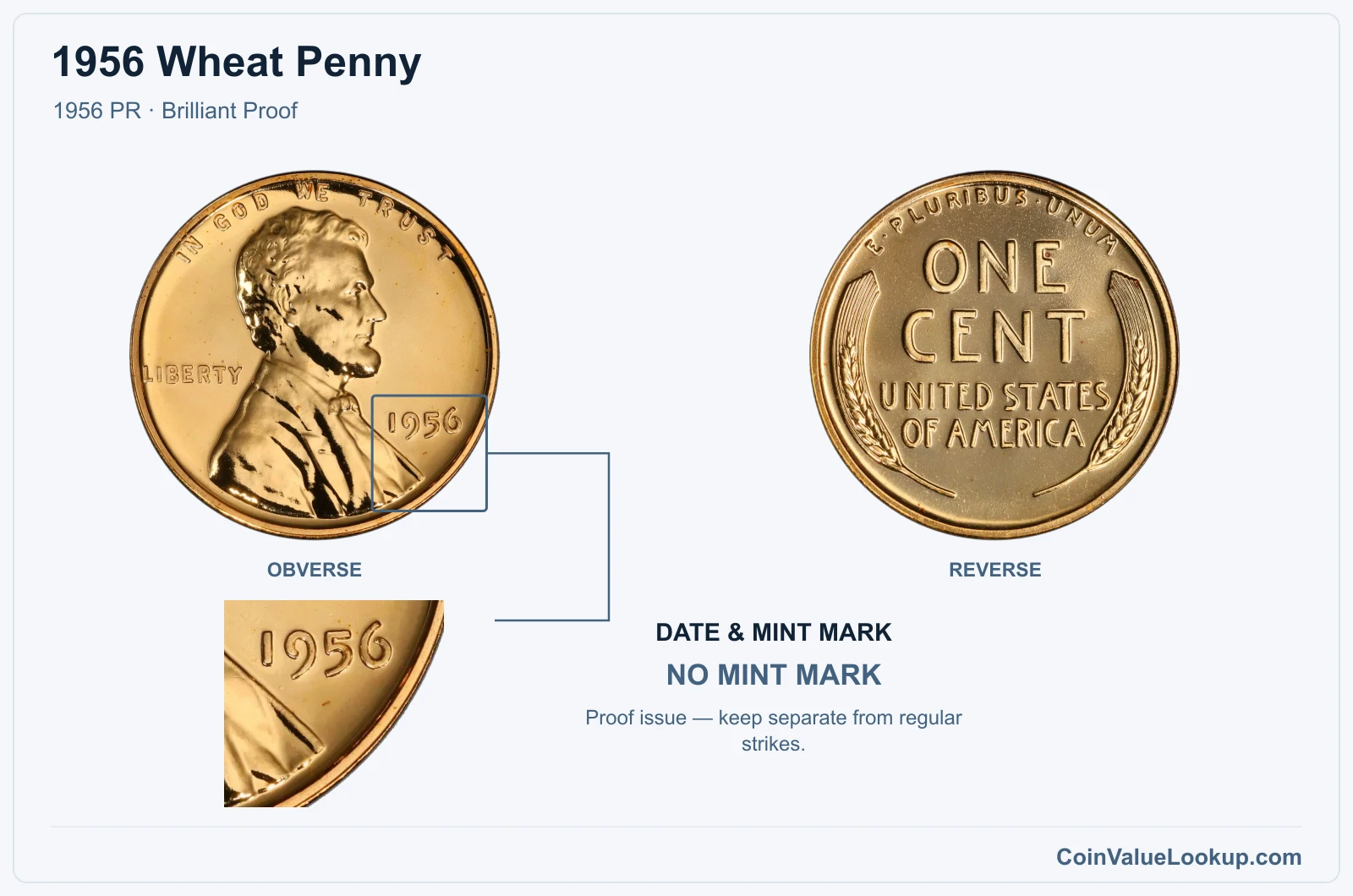
The 1956 proof cent was struck at Philadelphia with brilliant mirrored fields and sharp design detail from specially prepared dies. No mintmark appears on these coins.
A guide value of approximately $7.29 at PR63 puts it well above a business strike of the same date. Cameo and deep cameo contrast designations describe the degree of frost on the devices against those mirrored fields; they are not errors, just collector-preferred finishes that can carry their own premiums.
A polished circulation coin is not a proof, so look for the characteristic mirror surface and squared-off rims before you assume you have one.
| Range | Grade | Price | Auction Records | Appraisal |
|---|---|---|---|---|
| PR | PR 1 | — | Coin Identifier | |
| PR 2 | — | Coin Identifier | ||
| PR 3 | — | Coin Identifier | ||
| PR 4 | — | Coin Identifier | ||
| PR 6 | — | Coin Identifier | ||
| PR 8 | — | Coin Identifier | ||
| PR 10 | — | Coin Identifier | ||
| PR 12 | — | Coin Identifier | ||
| PR 15 | — | Coin Identifier | ||
| PR 20 | — | Coin Identifier | ||
| PR 25 | — | Coin Identifier | ||
| PR 30 | — | Coin Identifier | ||
| PR 35 | — | Coin Identifier | ||
| PR 40 | — | Coin Identifier | ||
| PR 45 | — | Coin Identifier | ||
| PR 50 | — | Coin Identifier | ||
| PR 53 | — | Coin Identifier | ||
| PR 55 | — | Coin Identifier | ||
| PR 58 | — | Coin Identifier | ||
| PR 60 | — | Coin Identifier | ||
| PR 61 | — | Coin Identifier | ||
| PR 62 | — | Coin Identifier | ||
| PR 63 | Coin Identifier | |||
| PR 64 | Coin Identifier | |||
| PR 65 | Coin Identifier | |||
| PR 66 | Coin Identifier | |||
| PR 67 | Coin Identifier | |||
| PR 68 | Coin Identifier | |||
| PR 69 | — | — | — | |
| PR 70 | — | — | — |
1956 Wheat Penny — D Above Shadow D
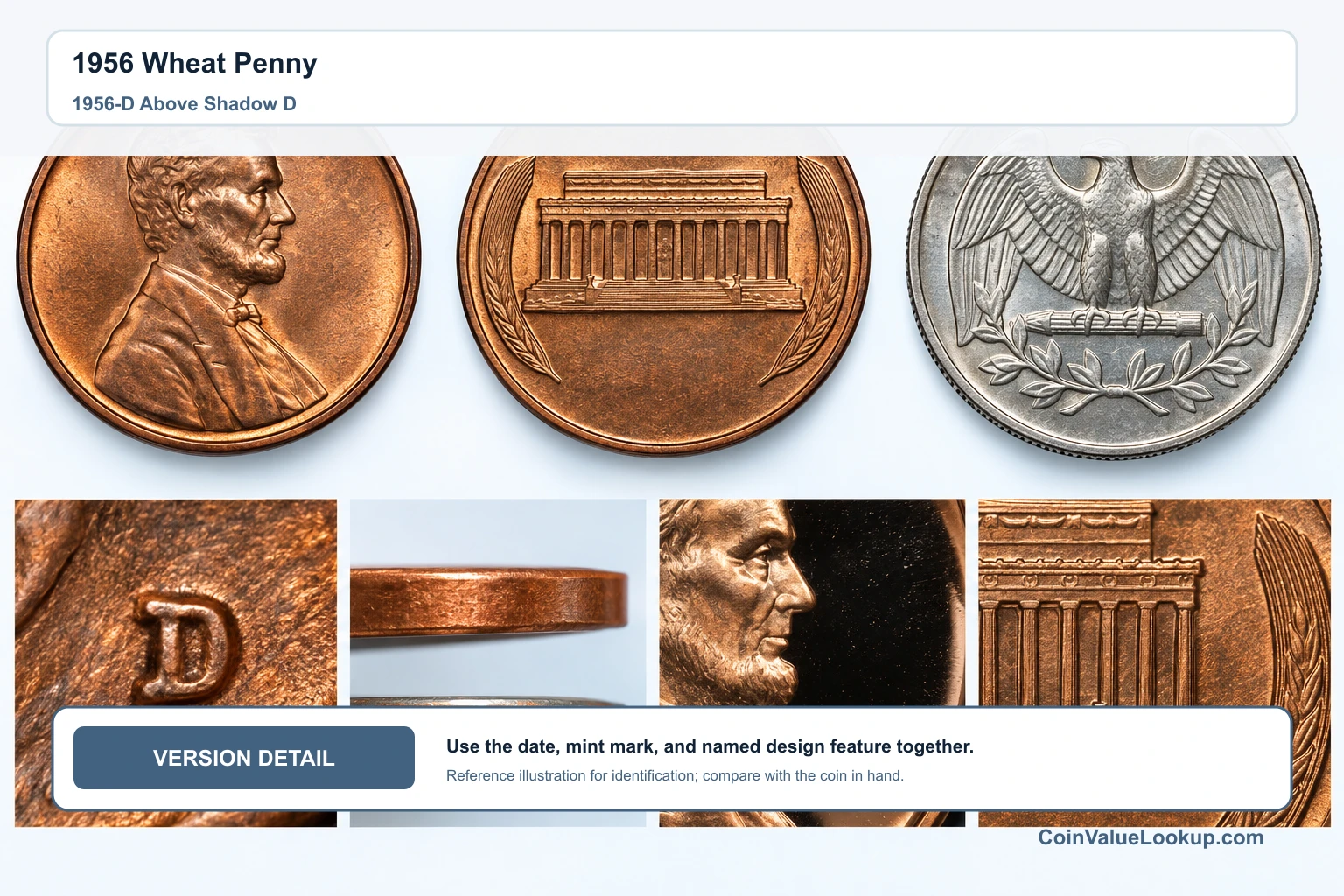
This is the headline variety for 1956 collectors. The D Above Shadow D shows the normal Denver mintmark sitting above a visible remnant of a second, misaligned D punch.
Under magnification you can see the ghostly outline of the underlying letter, usually slightly offset from the final position. Do not confuse this with the flat, shelf-like distortion of machine doubling, which lacks a distinctly separate letter form.
Guide values reflect the jump in demand: around $3.62 in Good-4 and roughly $92 at MS63. That is a dramatic premium over a regular 1956-D.
Authentication by a recognized grading service is the surest way to confirm the variety, because photos alone can be ambiguous at lower magnifications. If you have a 1956-D, give that mintmark a careful look before tossing it in the junk bin.
Ordinary-issue reference: Ordinary-issue reference only: The table below shows prices for the 1956-D Lincoln Cent (Wheat Reverse) (regular strike). It does not represent the value of the specific 1956-D Above Shadow D variety or its variety premium. Year, mint, metal and strike type are matched; the specific variety is not priced by this table.
Range Grade
Price1956-D Lincoln Cent (Wheat Reverse) — Ordinary-Issue Reference (Regular Strike) (BN) Price1956-D Lincoln Cent (Wheat Reverse) — Ordinary-Issue Reference (Regular Strike) (RB) Price1956-D Lincoln Cent (Wheat Reverse) — Ordinary-Issue Reference (Regular Strike) (RD) Auction Records Appraisal PO PO 1
—
Coin Identifier FR FR 2
—
Coin Identifier AG AG 3
—
Coin Identifier G G 4
—
Coin Identifier
G 6
—
Coin Identifier VG VG 8
—
Coin Identifier
VG 10
—
Coin Identifier F F 12
—
Coin Identifier
F 15
—
Coin Identifier VF VF 20
—
Coin Identifier
VF 25
—
Coin Identifier
VF 30
—
Coin Identifier
VF 35
—
Coin Identifier XF XF 40
—
Coin Identifier
XF 45
—
Coin Identifier AU AU 50
—
Coin Identifier
AU 53
—
Coin Identifier
AU 55
—
Coin Identifier
AU 58
—
Coin Identifier MS MS 60
—
—
Coin Identifier
MS 61
—
Coin Identifier
MS 62
Coin Identifier
MS 63
Coin Identifier
MS 64
Coin Identifier
MS 65
Coin Identifier
MS 66
Coin Identifier
MS 67
Coin Identifier
MS 68
—
—
—
—
—
MS 69
—
—
—
—
—
MS 70
—
—
—
—
—
1956 Wheat Penny Error List
1. 1956 Wheat Penny — Repunched Mintmark
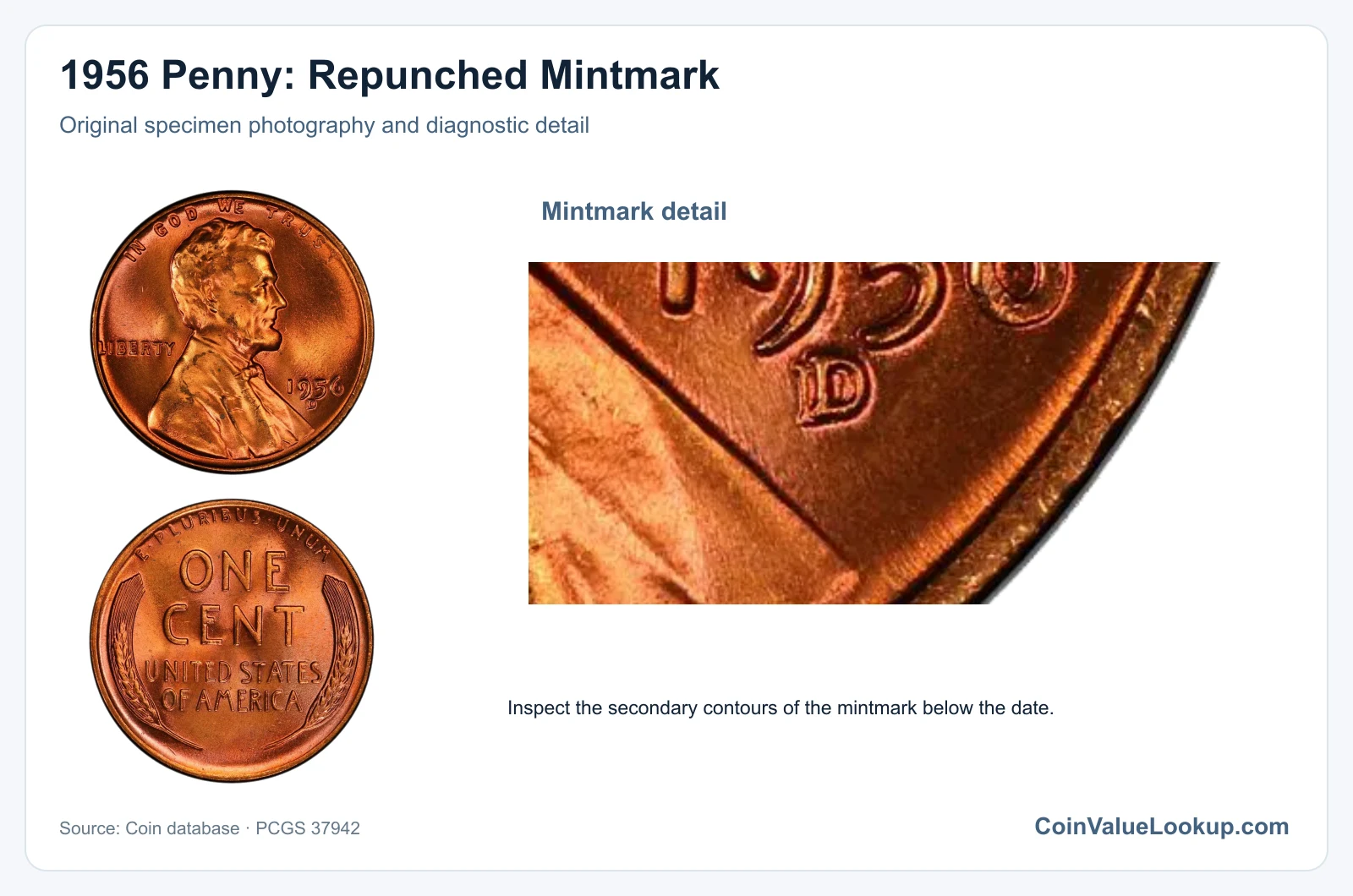
A repunched mintmark on a 1956 cent applies only to the Denver issue, since Philadelphia carried no mintmark to repunch. Look at the D below the date under at least 5x magnification.
A genuine RPM will show traces of an earlier punch position, typically a partial letter protruding from behind or beside the final D.
The key distinction is that the remnant should have the same rounded, punched-in character as the primary mintmark. Machine doubling, by contrast, creates a flat shelf with no independent depth.
Die chips or corrosion can also mimic a secondary letter, so compare your coin to a known normal 1956-D at the same magnification. No specific price range is adopted for this category; value depends on the authenticated identity of the particular die pair, the severity of the repunching, and the coin's overall condition.
2. 1956 Wheat Penny — Doubled Die Obverse
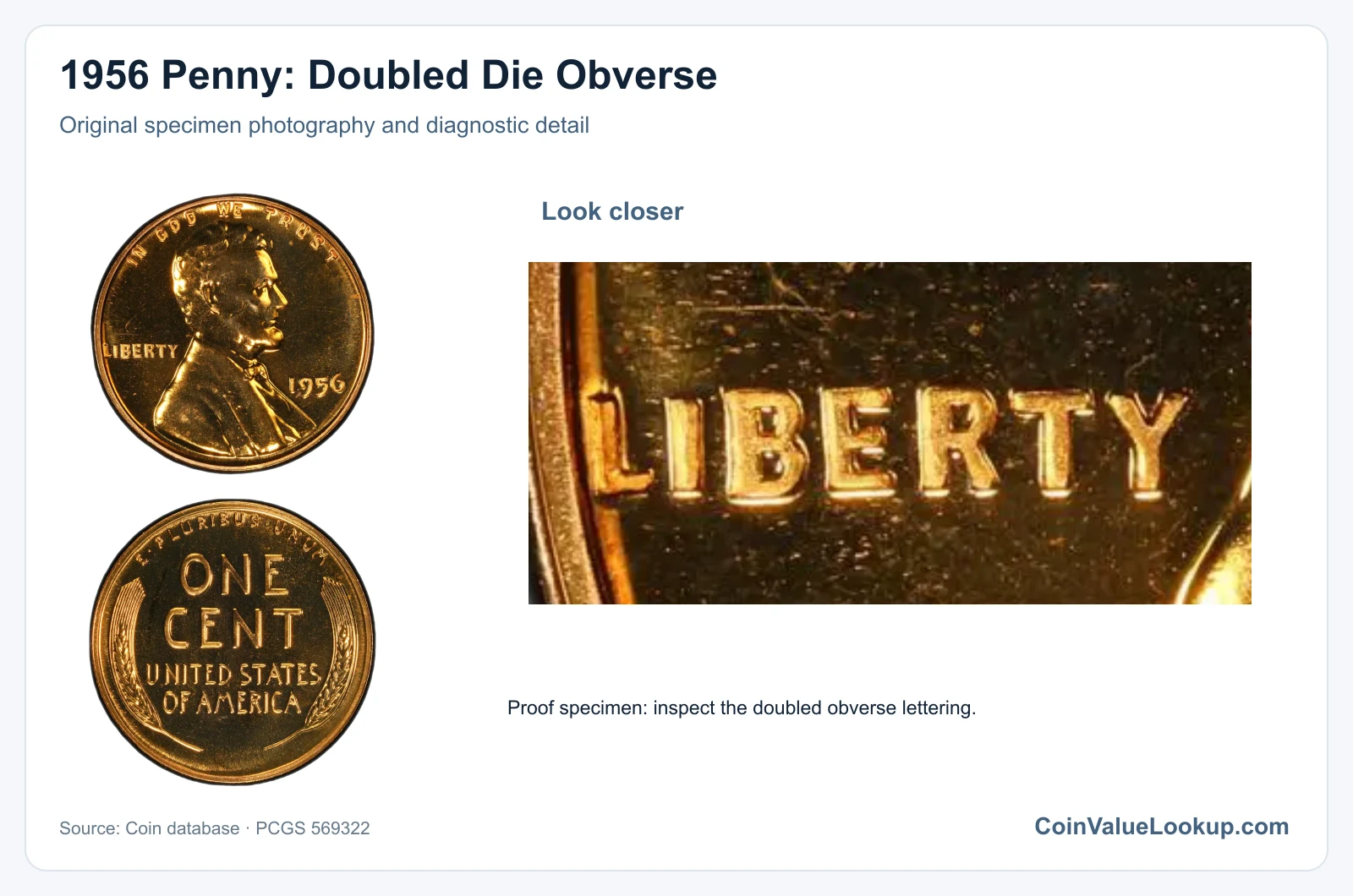
A doubled die obverse on a 1956 Wheat cent shows consistent separation or notching on obverse lettering or design elements. The doubling comes from a misaligned hub impression during die making, so it repeats identically on every coin struck by that die.
Compare LIBERTY, IN GOD WE TRUST, and the date on your coin against a normal 1956 example under the same lighting. True hub doubling produces distinct, raised secondary contours with their own depth.
Machine doubling, which is far more common, leaves a flat, shelf-like distortion that lacks independent relief.
Reflections or worn die contours can also fool you under certain angles. No specific price range is adopted here; assessment depends on authenticated die identity, doubling strength, and grade.
3. 1956 Wheat Penny — Doubled Die Reverse
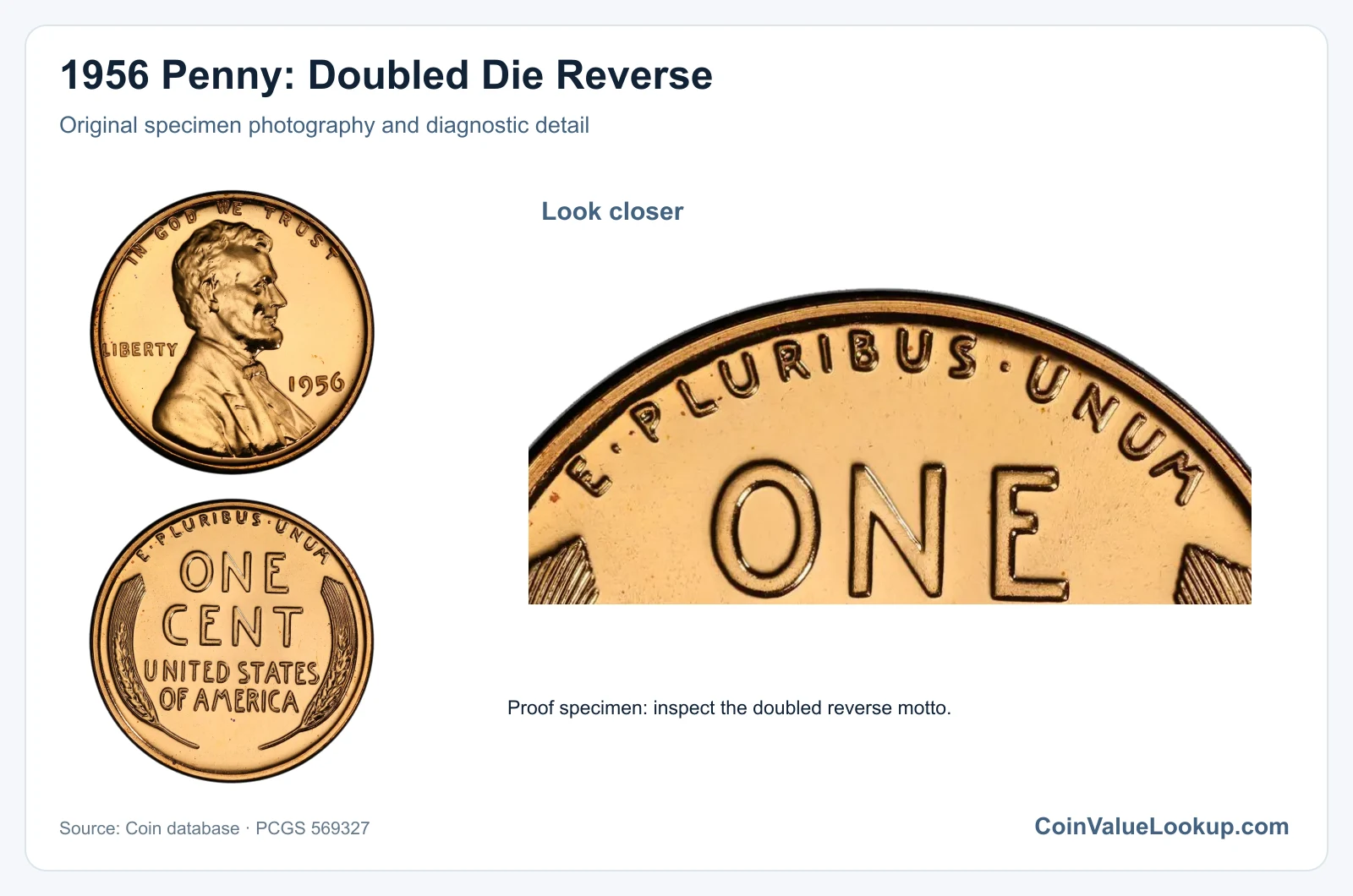
A doubled die reverse affects the back of the coin. On a 1956 Wheat cent, check ONE CENT, UNITED STATES OF AMERICA, and E PLURIBUS UNUM for signs of consistent, raised secondary lettering or design separation.
Genuine hub doubling will show up the same way on every letter or element that was affected, and each doubled contour has its own relief. Machine doubling, by contrast, tends to flatten detail in one direction and lacks independent depth.
Random nicks and damage will not repeat symmetrically across multiple letters.
Compare with a normal same-year reverse at matching magnification. No specific price range is adopted for this error; value hinges on authenticated identity, the visibility of the doubling, and the coin's condition.
4. 1956 Wheat Penny — Wrong Planchet / Off-Metal Strike
A wrong-planchet or off-metal strike means a 1956 Wheat cent die struck a blank intended for a different denomination or composition. The result looks like a normal 1956 cent in design, but the weight, diameter, edge, or color will be noticeably different.
To check, weigh your coin on a precise scale and compare it to the standard 3.11 grams. Measure the diameter and inspect the edge.
If it is significantly off, you may have something unusual. Be cautious, though.
Plating loss, acid treatment, and deliberate alteration can all change a coin's appearance and weight. Corrosion can make a copper cent look silver-toned.
No specific price range is adopted for this category. Value depends on third-party authentication confirming the blank's identity and the coin's overall condition.
5. 1956 Wheat Penny — BIE Die Break
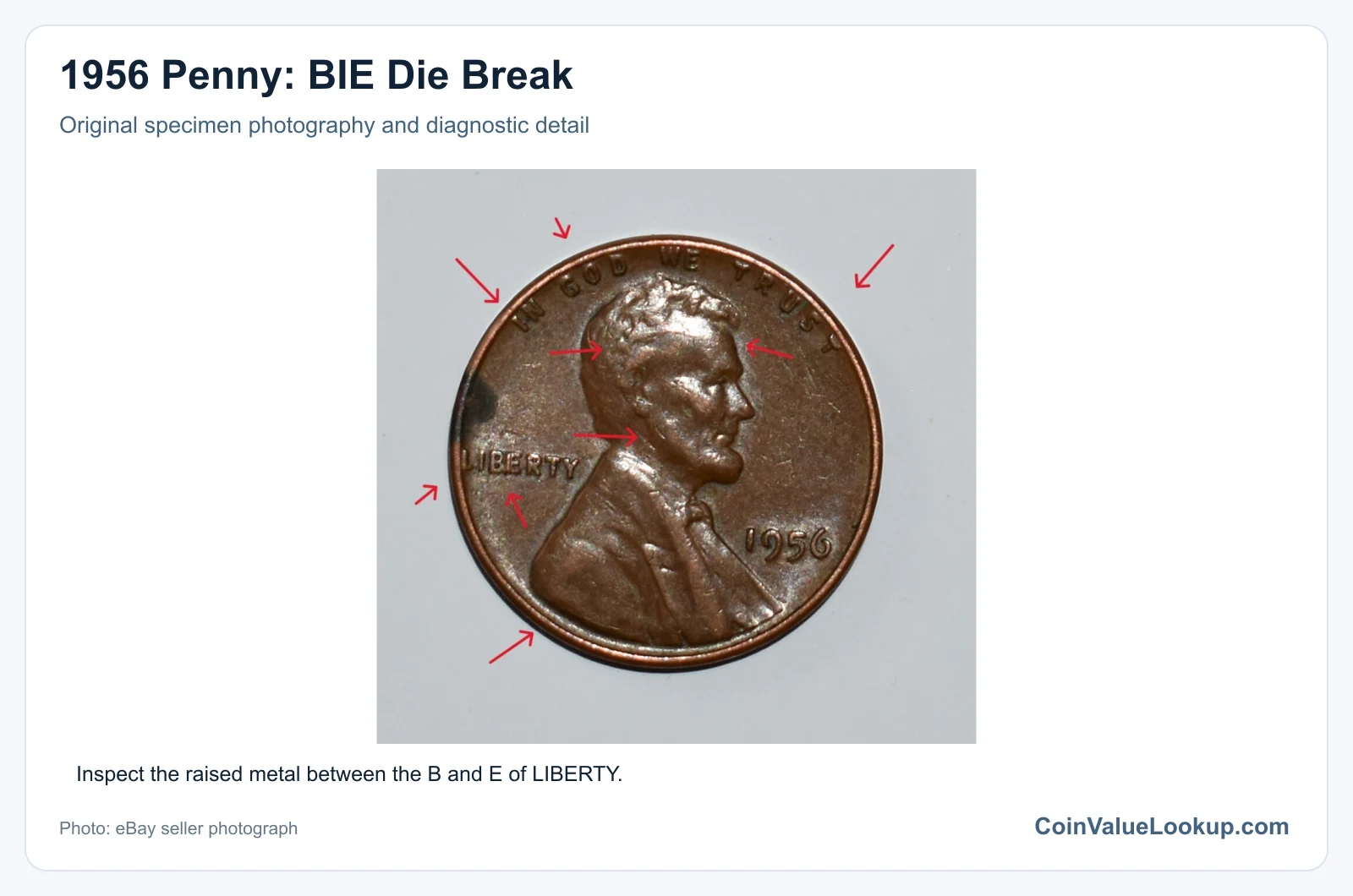
A BIE die break shows up as a small raised vertical line or blob between the letters B and E in LIBERTY. It is caused by a crack or chip in the die face that fills with metal during striking, leaving a bump that can look like a tiny capital I.
Check your 1956 cent's LIBERTY under magnification. A genuine BIE will be raised above the field, with the same texture and metal flow as the surrounding design.
Dirt lodged in the letters, a scratch, or a bit of foreign material stuck to the surface can mimic the effect but will not be raised in the same organic way.
No specific price range is adopted. These are collected as a fun die-break variety; value depends on the size and clarity of the break and the coin's overall grade.
6. 1956 Wheat Penny — Misplaced Mintmark
A misplaced mintmark means the D punch landed in an unusual position, away from its normal spot below the date. On a 1956 cent, this would involve the Denver mintmark appearing noticeably off-location, perhaps partially embedded in a numeral or displaced well to one side.
Compare your coin to a normal 1956-D to confirm the mintmark truly sits outside the standard range of placement. Minor positional variation is normal and does not qualify.
Also, surface marks, scratches, and small die chips can look like letter fragments in odd spots.
No specific price range is adopted. Valuation depends on authenticated die identity, the degree of displacement, and overall condition of the coin.
7. 1956 Wheat Penny — Die Cap / Capped-Die Strike
A die cap or capped-die strike is a dramatic mint error. It happens when a struck coin sticks to the upper die and remains there as subsequent blanks are fed into the press.
The stuck coin gradually cups into a cap shape, and the coins struck beneath it receive a distorted, spread-out impression of the stuck coin's reverse rather than the normal die design.
If you think you have one, look for a distinctly cupped shape and an obverse or reverse that shows a mirrored, spread impression of the opposing design. A coin that is simply bent, vice-damaged, or weakly struck is not a die cap.
No specific price range is adopted for this error. Authentic examples are scarce and should be evaluated individually by a recognized grading service.