1813 Classic Head Cent Coin Value: How Much Is It Worth?
The 1813 Classic Head cent is a scarce early copper coin that commands real money even in well-worn condition. Guide estimates from USA Coin Book place this date at roughly $313 in Good-4 condition up to about $3,083 in Extremely Fine-40.
These are guide figures, not guaranteed offers, and your coin's actual value depends on its exact condition, surfaces, and whether it carries any mint errors or unusual characteristics.
Fast Way to Identify Your 1813 Classic Head Cent
Want a quick read on what you have? Upload clear photos of both the front and back of your 1813 cent and our identifier can give you a preliminary identification.
Good lighting and a straight-on angle help — try to capture the full rim on both sides so the date, portrait, and wreath details are all visible.
1813 Classic Head Cent Value
Upload both sides of your 1813 Classic Head Cent.
Front Obverse
Upload photo
Back Reverse
Upload photo
Which 1813 Classic Head Cent Versions Are Worth Money?
- The 1813 Classic Head cent in Extremely Fine-40 condition carries a USA Coin Book guide estimate around $3,083, making condition the primary driver of value for this date.
- Even heavily worn examples near Good-4 guide at about $313, reflecting genuine scarcity — this is a low-mintage early copper date worth identifying carefully.
- Coins with confirmed mint errors such as off-center strikes or brockages require individual professional assessment, as no standard price range applies.
Step 1: Identify Your 1813 Classic Head Cent Mint Mark and Version
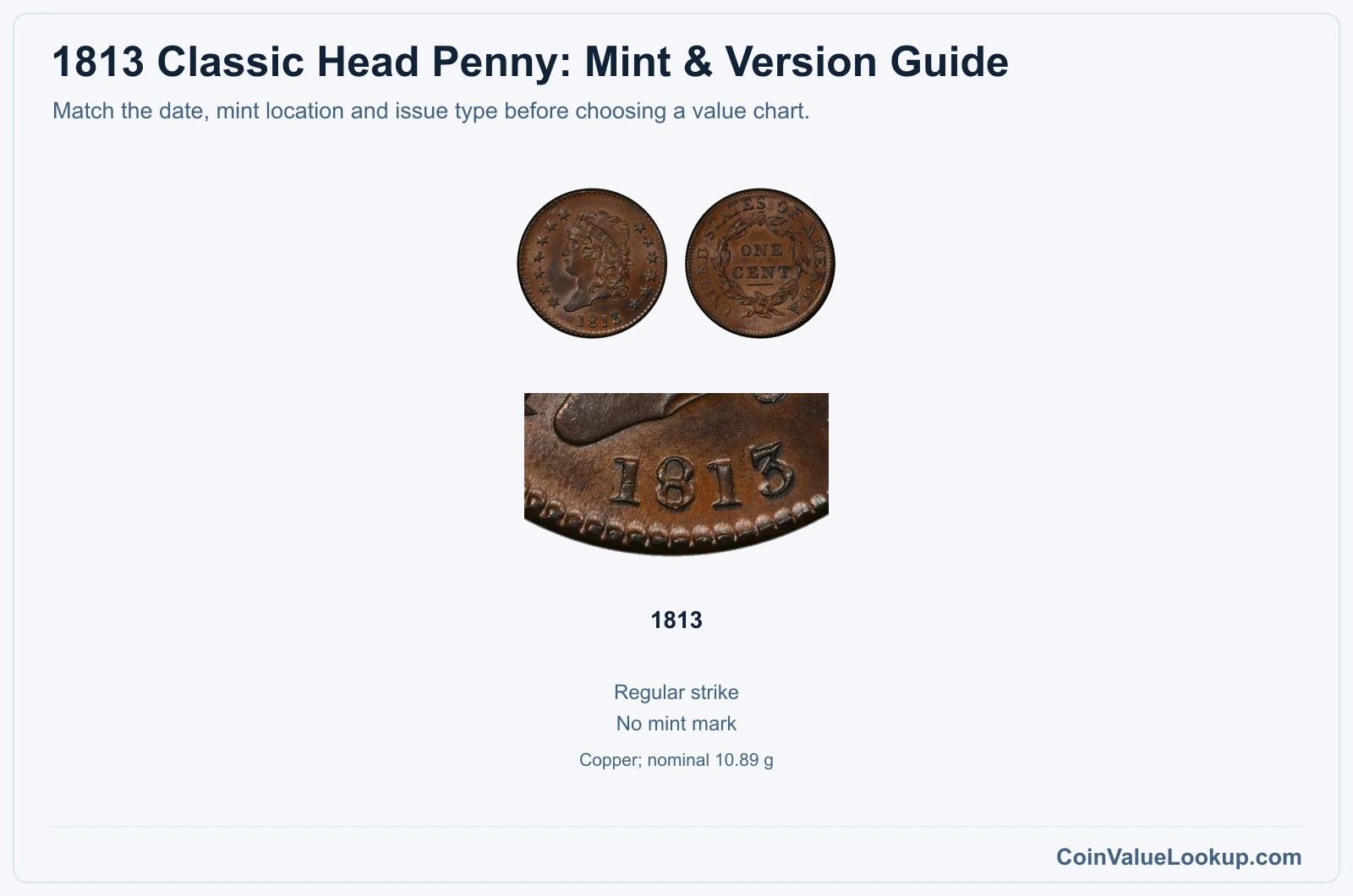
The Classic Head cent features a left-facing portrait of Liberty wearing a headband inscribed LIBERTY, surrounded by thirteen stars and the date 1813 below. Flip it over and you'll find ONE CENT inside a laurel wreath, with UNITED STATES OF AMERICA around the border.
Philadelphia struck these, and there is no mintmark anywhere on the coin. If someone tells you about a branch-mint version, walk away.
Look closely at both faces and the edge. Date-punch shape, legend spacing, and wreath details help confirm you have the right series and not a contemporary counterfeit or an altered date from another year.
Weight can support identification — the nominal spec is about 10.89 grams in copper — but wear, corrosion, and the wide production tolerances of 1813-era coinage mean weight alone will not prove authenticity. Pair it with a careful visual comparison to known examples.
Step 2: Check Your 1813 Classic Head Cent Grade
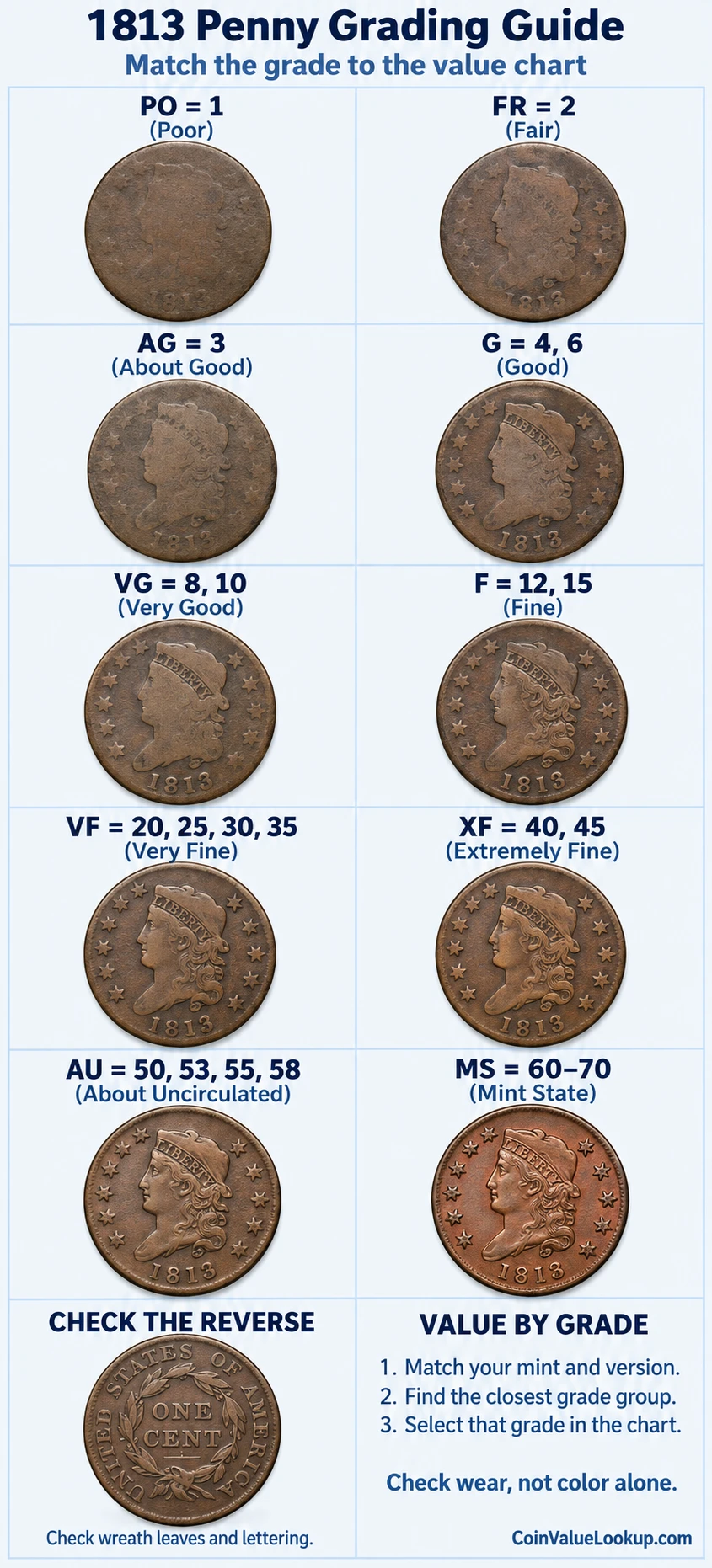
Start with the portrait. On a well-worn coin the hair curls above Liberty's ear merge together first, then the cheek flattens.
A Good-4 coin will show a clear outline of the portrait and a readable date, but most interior detail is gone.
As you move up the scale toward Extremely Fine, individual hair strands reappear and the headband lettering sharpens. On the reverse, check the leaf detail in the wreath — higher grades show distinct veins and separation between leaves.
Don't confuse a weak strike with heavy wear. Some 1813 cents left the press with soft spots, especially near the stars or wreath tips, and that is a production characteristic rather than a sign the coin circulated heavily.
Surface problems matter a lot on early copper. Corrosion, porosity, old cleaning, or tooling can push the market value well below what the guide estimates suggest for a given grade.
Original brown or chocolate surfaces are what experienced buyers want to see. Color designations like BN, RB, and RD describe the remaining original red on copper — they are not separate alloys or finishes.
Compare your coin to the reference image to gauge where it falls.
Step 3: Check 1813 Classic Head Cent Value by Mint and Version
1813 Classic Head Cent
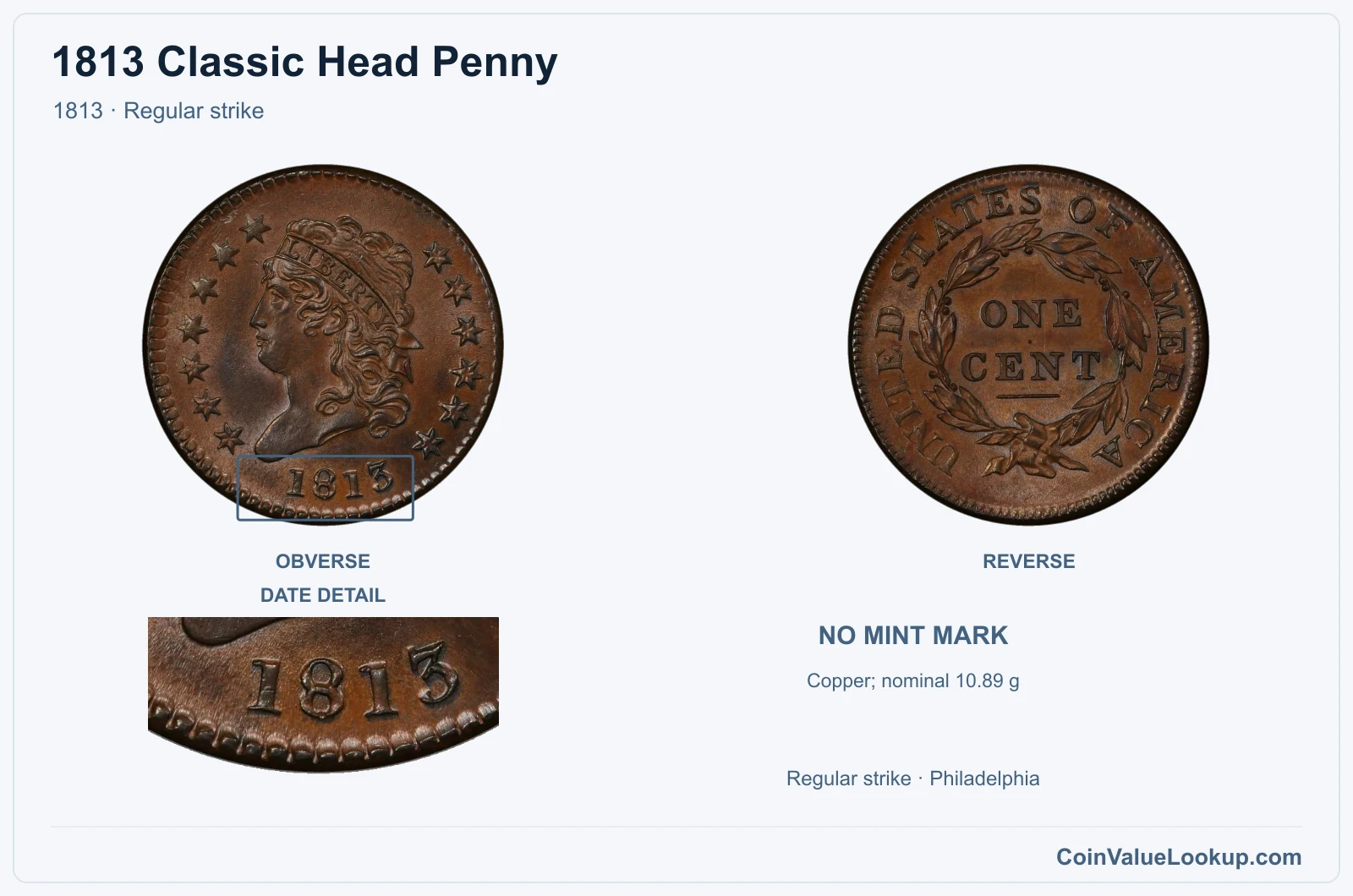
The 1813 Classic Head cent was struck at Philadelphia with no mintmark, on a copper planchet weighing nominally 10.89 grams. There is only one standard business-strike version for this date.
USA Coin Book guide estimates range from about $313 at Good-4 to roughly $3,083 at Extremely Fine-40, with prices climbing steeply as detail improves.
When evaluating your coin, focus on original surfaces over brightness. A dark, naturally toned example with strong detail will typically outperform a cleaned or corroded coin that looks lighter.
Match the portrait and wreath to confirmed Classic Head cent images — the design ran from 1808 through 1814, so neighboring dates share the same look.
Coin Value Lookup is a handy starting point if you want to compare this date against other Classic Head cents or different series entirely.
| Range | Grade | Price | Auction Records | Appraisal |
|---|---|---|---|---|
| PO | PO 1 | — | Coin Identifier | |
| FR | FR 2 | — | Coin Identifier | |
| AG | AG 3 | Coin Identifier | ||
| G | G 4 | Coin Identifier | ||
| G 6 | Coin Identifier | |||
| VG | VG 8 | Coin Identifier | ||
| VG 10 | Coin Identifier | |||
| F | F 12 | Coin Identifier | ||
| F 15 | Coin Identifier | |||
| VF | VF 20 | Coin Identifier | ||
| VF 25 | Coin Identifier | |||
| VF 30 | Coin Identifier | |||
| VF 35 | Coin Identifier | |||
| XF | XF 40 | Coin Identifier | ||
| XF 45 | Coin Identifier | |||
| AU | AU 50 | Coin Identifier | ||
| AU 53 | Coin Identifier | |||
| AU 55 | Coin Identifier | |||
| AU 58 | Coin Identifier | |||
| MS | MS 60 | — | Coin Identifier | |
| MS 61 | Coin Identifier | |||
| MS 62 | Coin Identifier | |||
| MS 63 | Coin Identifier | |||
| MS 64 | Coin Identifier | |||
| MS 65 | Coin Identifier | |||
| MS 66 | — | — | — | |
| MS 67 | — | — | — | |
| MS 68 | — | — | — | |
| MS 69 | — | — | — | |
| MS 70 | — | — | — |
1813 Classic Head Cent Error List
1. 1813 Classic Head Cent — Lamination / Split Planchet
A lamination error on an 1813 Classic Head cent shows up as a strip or flap of copper peeling away from the coin's surface. The metal separates within the planchet itself, sometimes lifting a thin layer that stays attached at one edge.
Photograph the affected face and the edge together so the depth of the split is visible.
These can look superficially like corrosion damage, scraping from a tool, or even a deliberately shaved coin. The key difference is that a genuine lamination follows the coin's contour and reveals clean metal underneath, while post-mint damage tends to leave irregular gouges or pitting.
No standard price range is adopted for this error on the 1813 date — value depends entirely on the severity of the split, the coin's overall grade, and professional authentication.
2. 1813 Classic Head Cent — Die Crack
Die cracks appear as thin raised lines running across the coin's surface. They form because the steel die fractured during use, and the crack transferred as a ridge onto every coin struck afterward.
On an 1813 cent, look for these lines crossing open fields or cutting through letters and stars.
The raised nature is the giveaway. A scratch or corrosion line sits below the surface or at surface level, while a genuine die crack stands slightly above it.
Tool marks tend to be sharper and more random in direction. Minor die cracks are fairly common on early copper because dies wore quickly, so the size and location of the crack influence collector interest.
No numeric price premium is adopted here — each piece needs individual evaluation based on the crack's prominence, the coin's condition, and confirmed authenticity.
3. 1813 Classic Head Cent — Off-Center Strike
An off-center strike happens when the planchet is not seated properly between the dies, producing a design that is shifted to one side with an unstruck crescent of blank metal on the opposite edge. On a coin this old and scarce, even a modest percentage off-center draws attention.
The date must remain visible for the coin to be attributed to 1813, which matters enormously for value. Without the date, you have an interesting error on an unidentifiable early cent — a very different proposition.
Do not confuse off-center strikes with clipped planchets (which have a curved missing section but a centered design) or post-mint flattening from a vise or similar pressure. No adopted price range exists for this error on the 1813 Classic Head cent; assessment depends on the percentage off-center, date visibility, overall condition, and third-party authentication.
4. 1813 Classic Head Cent — Brockage
A brockage occurs when a previously struck coin sticks to a die and acts as the die for the next blank fed into the press. The result is one normal side and one side showing an incuse, mirror-image impression of the same design.
On an 1813 Classic Head cent, this would be a dramatic and very rare error.
To confirm a brockage, check that the mirror-image side is sunk into the metal rather than raised, and that it reads backward. Compare it against the normal face to verify the designs match.
Die clashes can leave faint ghost impressions, and coins pressed together after leaving the mint can simulate a brockage, but neither will produce the deep, complete incuse mirror image of a true brockage. No standard price range is adopted — a confirmed example would require professional authentication and individual valuation based on its completeness and condition.