1826 Coronet Head Cent Coin Value: How Much Is It Worth?
The 1826 Coronet Head Cent is a coin that rewards careful identification. Guide estimates range from about $38 in G4 to over $12,153 in MS63, depending on the exact variety.
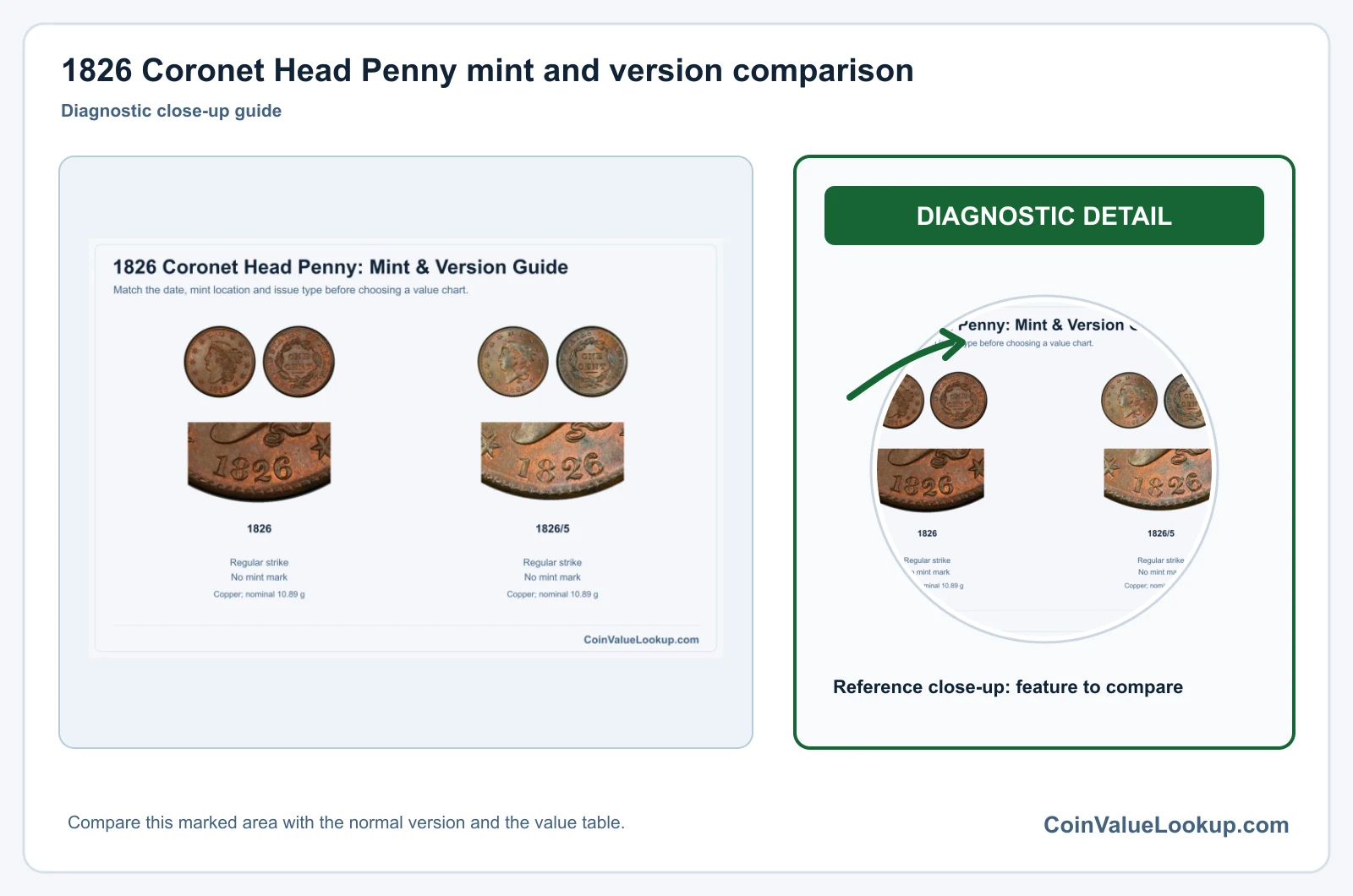
The normal date and the 1826/5 overdate are distinct branches with very different values, so figuring out which one you have matters. Proof examples and major errors need individual assessment beyond standard guide figures.
Fast Way to Identify Your 1826 Coronet Head Cent
The quickest way to start figuring out what your 1826 cent is worth is to upload clear photos of the front and back. Our identifier uses those images for a preliminary identification of the variety and approximate condition.
It is not authentication or certified grading, but it gives you a useful starting point before you dig deeper.
1826 Coronet Head Cent Value
Upload both sides of your 1826 Coronet Head Cent.
Front Obverse
Upload photo
Back Reverse
Upload photo
Which 1826 Coronet Head Cent Versions Are Worth Money?
- The 1826/5 overdate, with remnants of a 5 beneath the 6, carries guide values from $81 in G4 to $12,153 in MS63 — substantially more than the normal date at every grade level.
- The normal-date 1826 in high mint-state condition (MS63) is listed around $3,084, making well-preserved examples worth careful inspection.
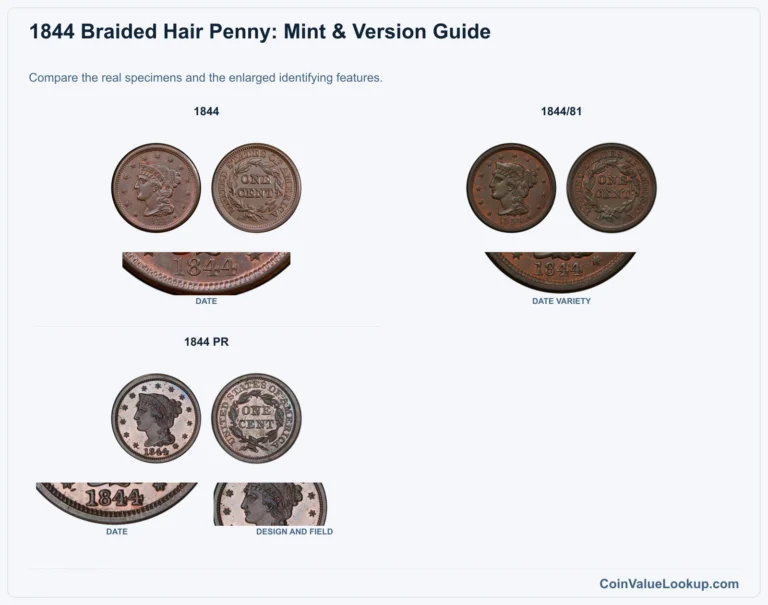
- Proof 1826 cents are extremely rare early copper proofs that require individual professional assessment; no standard guide price applies.
- Prominent mint errors such as off-center strikes, die breaks, and rotated dies on this date are reported categories that merit closer examination by a specialist.
Step 1: Identify Your 1826 Coronet Head Cent Mint Mark and Version
All 1826 Coronet Head Cents were struck at Philadelphia, so there is no mintmark to look for. The key identification task is separating the normal-date 1826 from the 1826/5 overdate.
For the overdate, examine the final digit of the date closely. Remnants of a "5" will be visible beneath the "6," usually as extra curves or misaligned serifs that do not belong to a cleanly punched six.
A loupe or magnifying glass helps enormously here.
Inspect both faces and the edge carefully. Date-punch shape, legend wording, and wreath details can change the correct category.
Weight should be around 10.89 grams in copper, but wear, corrosion, and original production tolerances mean weight alone cannot prove authenticity or variety.
Proof examples are a separate manufacturing category entirely. Polishing a business strike does not create a proof.
Genuine early proofs require attribution of surfaces, rims, and die characteristics by someone who knows what to look for.
Step 2: Check Your 1826 Coronet Head Cent Grade
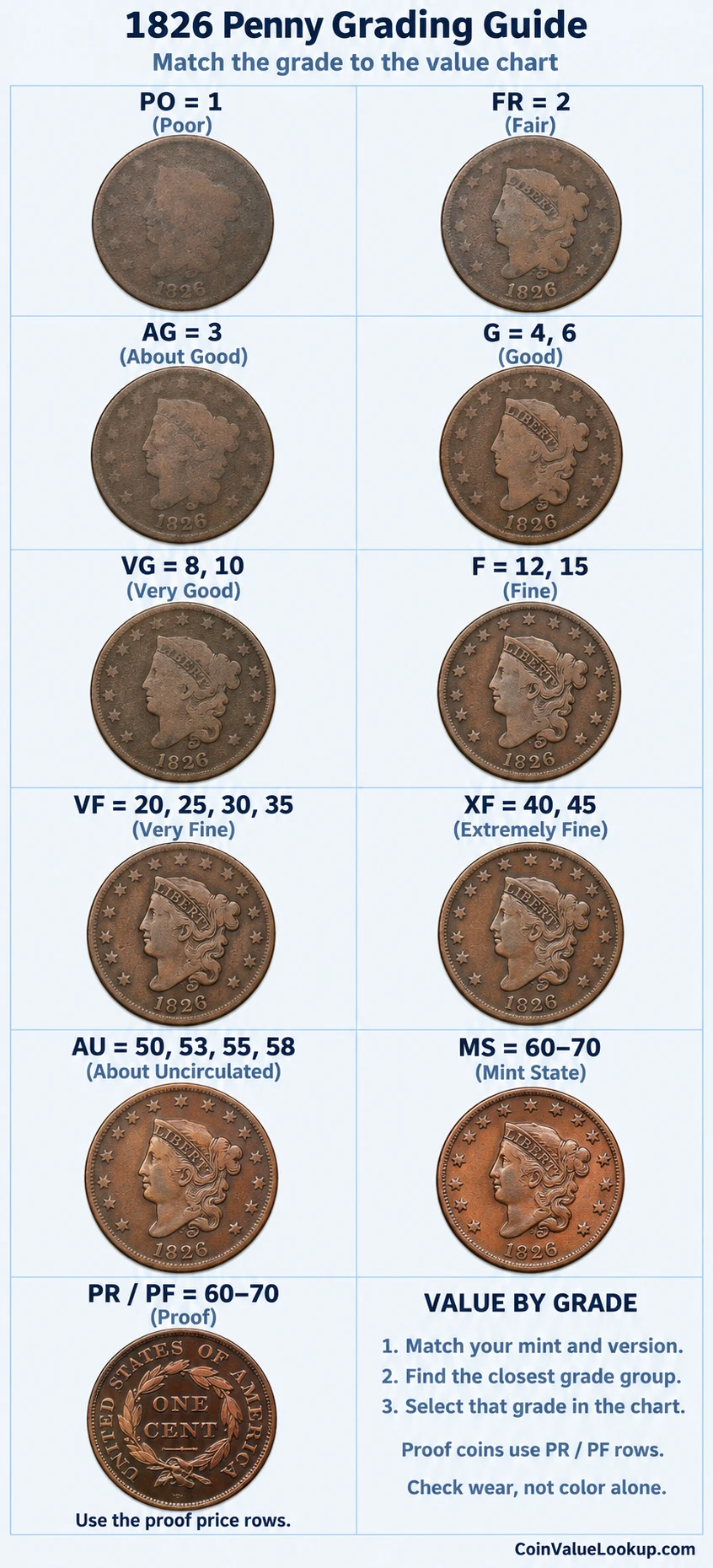
Compare your coin's portrait hair detail and cheek definition against known grade examples of the same type. The wreath leaf relief on the reverse and the sharpness of the lettering are equally important checkpoints.
Use the comparison image as your baseline.
Separate honest circulation wear from other problems. A weakly struck coin can look worn even when it is not, and corrosion or porosity eats detail in ways that mimic wear but reduce market value much more sharply.
BN, RB, and RD are color designations on copper coins, not different alloys. A coin described as RD retains most of its original mint-red color, while BN has toned to brown.
Color affects value significantly in higher grades. Proof is a manufacturing finish, not a grade above Mint State.
Step 3: Check 1826 Coronet Head Cent Value by Mint and Version
1826 Coronet Head Cent
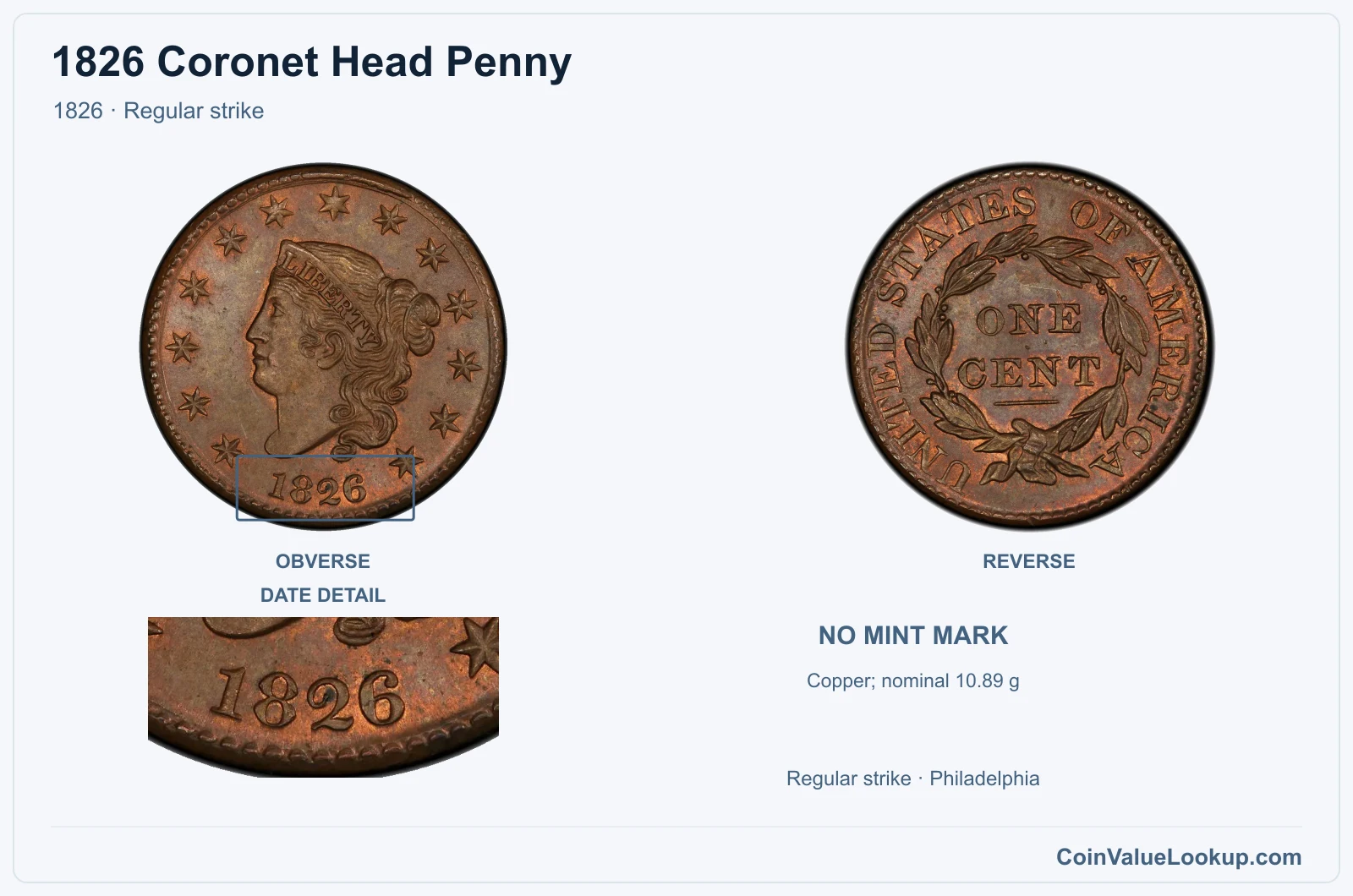
This is the standard 1826 Coronet Head Cent, struck in copper at Philadelphia with no mintmark. The obverse shows Liberty wearing a coronet inscribed LIBERTY, surrounded by stars and the date.
The reverse displays ONE CENT within a wreath.
USA Coin Book guide estimates place this variety at about $38 in G4 and around $3,084 in MS63. That is a big spread, and most surviving examples fall on the lower end — these circulated hard.
A clean, problem-free example in any mint-state grade is uncommon enough to deserve a second look.
Make sure there are no traces of a "5" under the final digit. If you see extra curves or outlines beneath the 6, you may have the more valuable overdate instead.
| Range | Grade | Price | Auction Records | Appraisal |
|---|---|---|---|---|
| PO | PO 1 | — | Coin Identifier | |
| FR | FR 2 | — | Coin Identifier | |
| AG | AG 3 | — | Coin Identifier | |
| G | G 4 | Coin Identifier | ||
| G 6 | — | Coin Identifier | ||
| VG | VG 8 | Coin Identifier | ||
| VG 10 | Coin Identifier | |||
| F | F 12 | Coin Identifier | ||
| F 15 | Coin Identifier | |||
| VF | VF 20 | Coin Identifier | ||
| VF 25 | Coin Identifier | |||
| VF 30 | Coin Identifier | |||
| VF 35 | Coin Identifier | |||
| XF | XF 40 | Coin Identifier | ||
| XF 45 | Coin Identifier | |||
| AU | AU 50 | Coin Identifier | ||
| AU 53 | Coin Identifier | |||
| AU 55 | Coin Identifier | |||
| AU 58 | Coin Identifier | |||
| MS | MS 60 | Coin Identifier | ||
| MS 61 | Coin Identifier | |||
| MS 62 | Coin Identifier | |||
| MS 63 | Coin Identifier | |||
| MS 64 | Coin Identifier | |||
| MS 65 | Coin Identifier | |||
| MS 66 | Coin Identifier | |||
| MS 67 | — | — | — | |
| MS 68 | — | — | — | |
| MS 69 | — | — | — | |
| MS 70 | — | — | — |
1826 Coronet Head Cent — /5
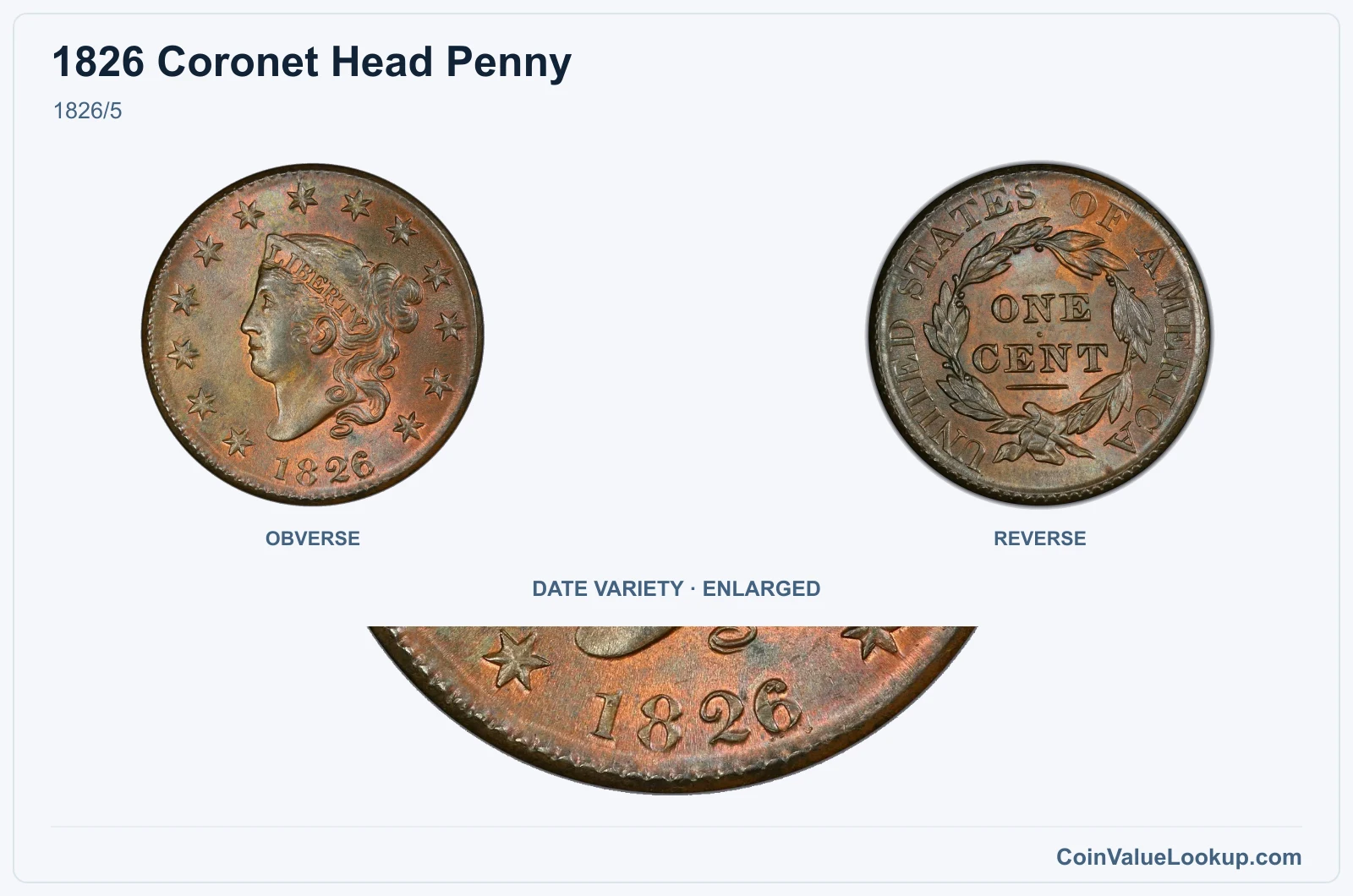
The 1826/5 is the overdate variety, created when a die originally punched with an 1825 date was re-engraved with a 6 over the 5. Remnants of the underlying 5 are visible beneath the final digit, often showing as mismatched curves or extra serifs that a normal 6 does not have.
This variety carries significantly higher guide values than the normal date. USA Coin Book lists it at roughly $81 in G4 and about $12,153 in MS63.
Even in well-worn grades, the premium over the ordinary 1826 is roughly double.
Coin Value Lookup is a good place to compare guide values for other Coronet Head Cent dates alongside this one. If you are building a date set or just curious about neighboring years, it can save you time.
Identification depends on a close look at the date under magnification. On heavily worn coins the overdate traces can become faint, so patience and good lighting matter.
| Range | Grade | Price | Auction Records | Appraisal |
|---|---|---|---|---|
| PO | PO 1 | — | Coin Identifier | |
| FR | FR 2 | — | Coin Identifier | |
| AG | AG 3 | — | Coin Identifier | |
| G | G 4 | Coin Identifier | ||
| G 6 | Coin Identifier | |||
| VG | VG 8 | Coin Identifier | ||
| VG 10 | Coin Identifier | |||
| F | F 12 | — | Coin Identifier | |
| F 15 | — | Coin Identifier | ||
| VF | VF 20 | Coin Identifier | ||
| VF 25 | Coin Identifier | |||
| VF 30 | — | Coin Identifier | ||
| VF 35 | Coin Identifier | |||
| XF | XF 40 | Coin Identifier | ||
| XF 45 | — | Coin Identifier | ||
| AU | AU 50 | — | Coin Identifier | |
| AU 53 | Coin Identifier | |||
| AU 55 | Coin Identifier | |||
| AU 58 | Coin Identifier | |||
| MS | MS 60 | Coin Identifier | ||
| MS 61 | Coin Identifier | |||
| MS 62 | Coin Identifier | |||
| MS 63 | Coin Identifier | |||
| MS 64 | Coin Identifier | |||
| MS 65 | — | Coin Identifier | ||
| MS 66 | Coin Identifier | |||
| MS 67 | — | — | — | |
| MS 68 | — | — | — | |
| MS 69 | — | — | — | |
| MS 70 | — | — | — |
1826 Coronet Head Cent — Proof
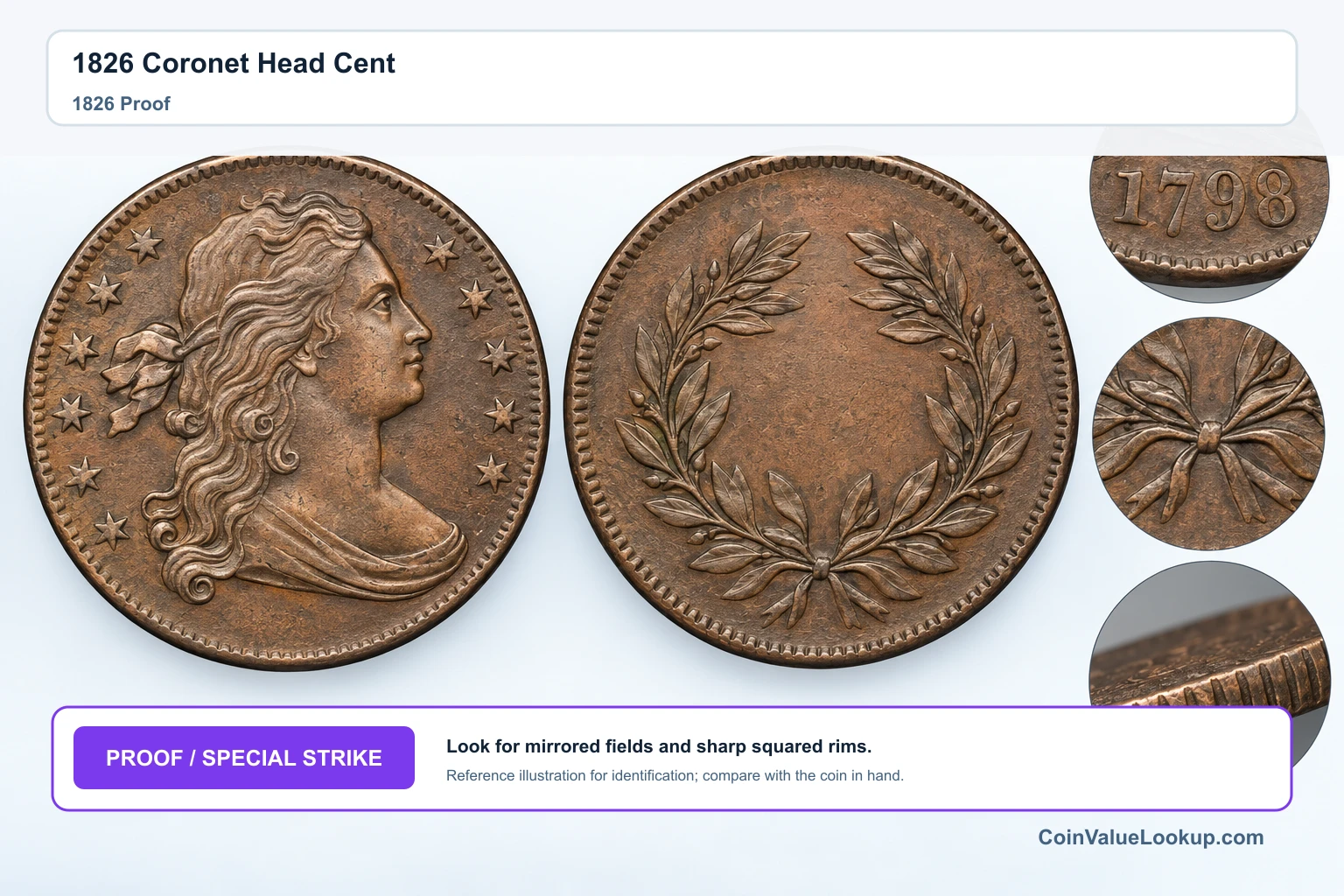
Proof 1826 Coronet Head Cents are extremely rare early copper proofs. These were special strikes with carefully prepared dies and planchets, producing sharper detail and distinctive surfaces compared to regular business strikes.
No standard numeric guide price is adopted for this issue. Each proof example requires individual assessment based on its authenticated identity, surface condition, rim quality, and die characteristics.
A cataloged listing by a major grading service confirms the proof designation exists, but it is not a recent market transaction.
The critical point: polishing a business strike does not turn it into a proof. Genuine proofs show specific die preparation evidence — mirrored fields, squared rims, and careful strike quality — that cannot be faked by rubbing.
If you believe you have one, professional authentication is the only responsible next step.
Values by grade are not available for this coin yet.
1826 Coronet Head Cent Error List
1. 1826 Coronet Head Cent — Off-Center Strike
An off-center strike happens when the planchet is not seated properly between the dies. The result is a displaced design with an unstruck crescent of blank metal along part of the rim.
The more off-center the strike, the more dramatic the appearance.
For collector interest, the date needs to remain fully visible. An off-center cent missing the date loses most of its premium because the year cannot be confirmed.
Look at the overall shape — the coin should still be round, just mis-struck.
Do not confuse an off-center strike with a clipped planchet, one-sided die misalignment, or post-mint flattening from damage. Post-strike damage tends to show metal flow or tool marks that a genuine mis-strike does not.
No standard guide price is adopted for this error on the 1826 cent; value depends on the degree of offset, date visibility, and authenticated condition.
2. 1826 Coronet Head Cent — Die Break / Cud
A die break or cud occurs when a piece of the die cracks away, leaving a raised blob of metal on the struck coin. A true cud connects to the rim, while interior die breaks appear as raised lines or lumps within the design field.
On an 1826 cent, look for an area where normal design detail is replaced by a smooth, raised lump that merges into the rim edge. The boundary between the cud and the surviving design should be distinct and follow the shape of the missing die fragment.
Rim dents, corrosion buildup, and small interior die chips can all mimic a cud at first glance. Dents push metal inward rather than raising it, and corrosion lacks the sharp boundary a die break leaves.
No numeric guide price is adopted for this error; assessment depends on the size, location, and authenticated identity of the coin.
3. 1826 Coronet Head Cent — Lamination / Split Planchet
A lamination or split planchet error shows as peeling metal, a retained flap, or visible separation within the copper. On early copper cents this can look dramatic — a layer of metal lifting away from the coin's body, sometimes partially detached.
Photograph the edge and the affected face together for the best documentation. Genuine laminations reveal clean separation layers consistent with the original copper stock, not surface scraping or deliberate cuts.
The lookalikes here are corrosion pitting, post-mint scrapes, and deliberately altered coins. Corrosion tends to be uneven and porous, while a lamination follows a more uniform plane within the metal.
A deliberately cut coin usually shows tool marks at the separation edge. No standard guide price is adopted for lamination errors on the 1826 cent; each example requires individual evaluation based on severity and overall coin condition.
4. 1826 Coronet Head Cent — Rotated Dies
Rotated dies produce a coin where the obverse and reverse are not aligned in the standard orientation. On US coins, normal alignment means that when you hold the obverse upright and flip the coin top to bottom, the reverse should also appear upright.
To check, hold your 1826 cent with Liberty facing you right-side up. Rotate the coin on its vertical axis.
If the reverse wreath and lettering are tilted, you may have a rotation error. Minor rotations of a few degrees are less significant; major rotations approaching 90 or 180 degrees are far more dramatic.
Be careful not to mistake a rotated photograph or a coin held at an angle for a genuine die rotation. Compare against a known normal example.
No numeric guide price is adopted for this error; value depends on the degree of rotation and authenticated condition.
5. 1826 Coronet Head Cent — Overdate
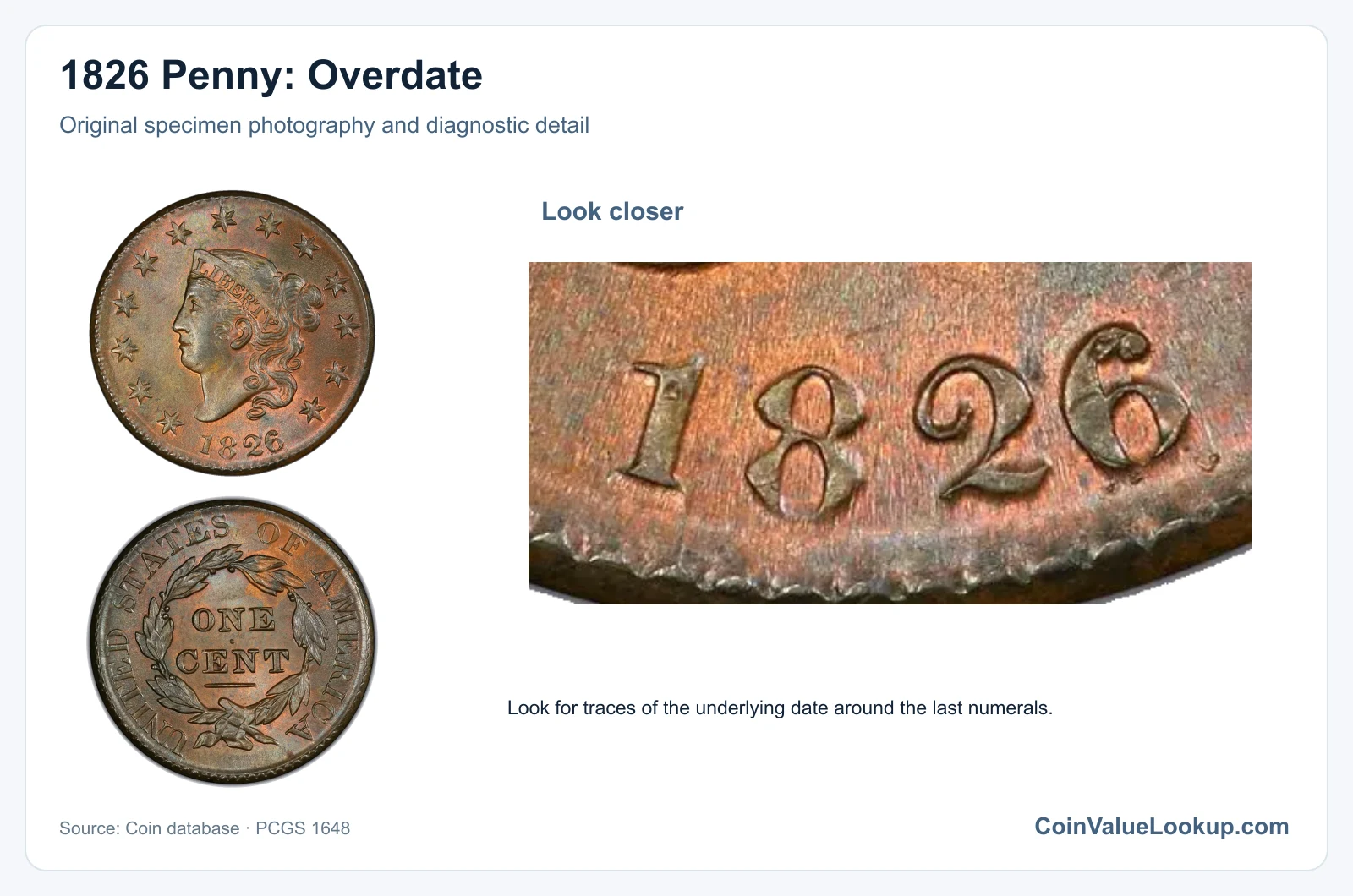
The overdate error category on the 1826 cent refers primarily to the well-known 1826/5 variety, where surviving contours of a "5" are visible beneath the final "6" in the date. This was created during die production, not during striking, making it a die variety rather than a strike error in the traditional sense.
Look for extra curves, misaligned serifs, or shadow outlines beneath the 6 that do not belong to a cleanly cut numeral. Under magnification, the underlying 5 usually shows as a rounded bottom loop or an angled top that conflicts with the straight geometry of a 6.
Do not confuse a damaged date or ordinary machine doubling with a genuine overdate. Damage tends to be irregular and inconsistent, while machine doubling produces flat shelf-like doubling rather than the distinct second-digit contour of an overdate.
No separate numeric error price is adopted beyond the 1826/5 variety branch listed above; assessment depends on authenticated attribution.