1835 Coronet Head Cent Coin Value: How Much Is It Worth?
The 1835 Coronet Head Cent is a coin that rewards careful variety identification. Guide estimates for ordinary business strikes range from about $38 in G4 to $2,340 in MS63, depending on the exact variety.
Three distinct die varieties exist for this date, plus a rare proof category that requires individual assessment. Identify your specific branch before assuming any value.
Fast Way to Identify Your 1835 Coronet Head Cent
The quickest way to start figuring out what you have is to upload clear photos of the front and back of your 1835 cent. A preliminary identification can help you narrow down which variety you're holding, whether it's a Head of 1836, a Small 8, or a Large 8 type.
Good lighting and a steady shot make all the difference.
1835 Coronet Head Cent Value
Upload both sides of your 1835 Coronet Head Cent.
Front Obverse
Upload photo
Back Reverse
Upload photo
Which 1835 Coronet Head Cent Versions Are Worth Money?
- The Large 8, Stars variety commands the highest guide estimate among business strikes, reaching about $2,340 in MS63 per USA Coin Book.
- The Small 8, Stars variety is listed up to roughly $1,445 in MS63, making well-preserved examples worth close attention.
- The Head of 1836 variety uses a different portrait punch and guides to about $1,127 in MS63, so it pays to check the bust style.
- Proof 1835 cents are extremely rare and require professional attribution of die characteristics, surfaces, and rims; no standard guide price applies.
- Mint errors such as off-center strikes or clipped planchets on this date deserve individual evaluation, especially when the date remains visible.
Step 1: Identify Your 1835 Coronet Head Cent Mint Mark and Version
All 1835 Coronet Head Cents were struck at Philadelphia, so there is no mintmark to look for. The key identification challenge is telling the three business-strike varieties apart.
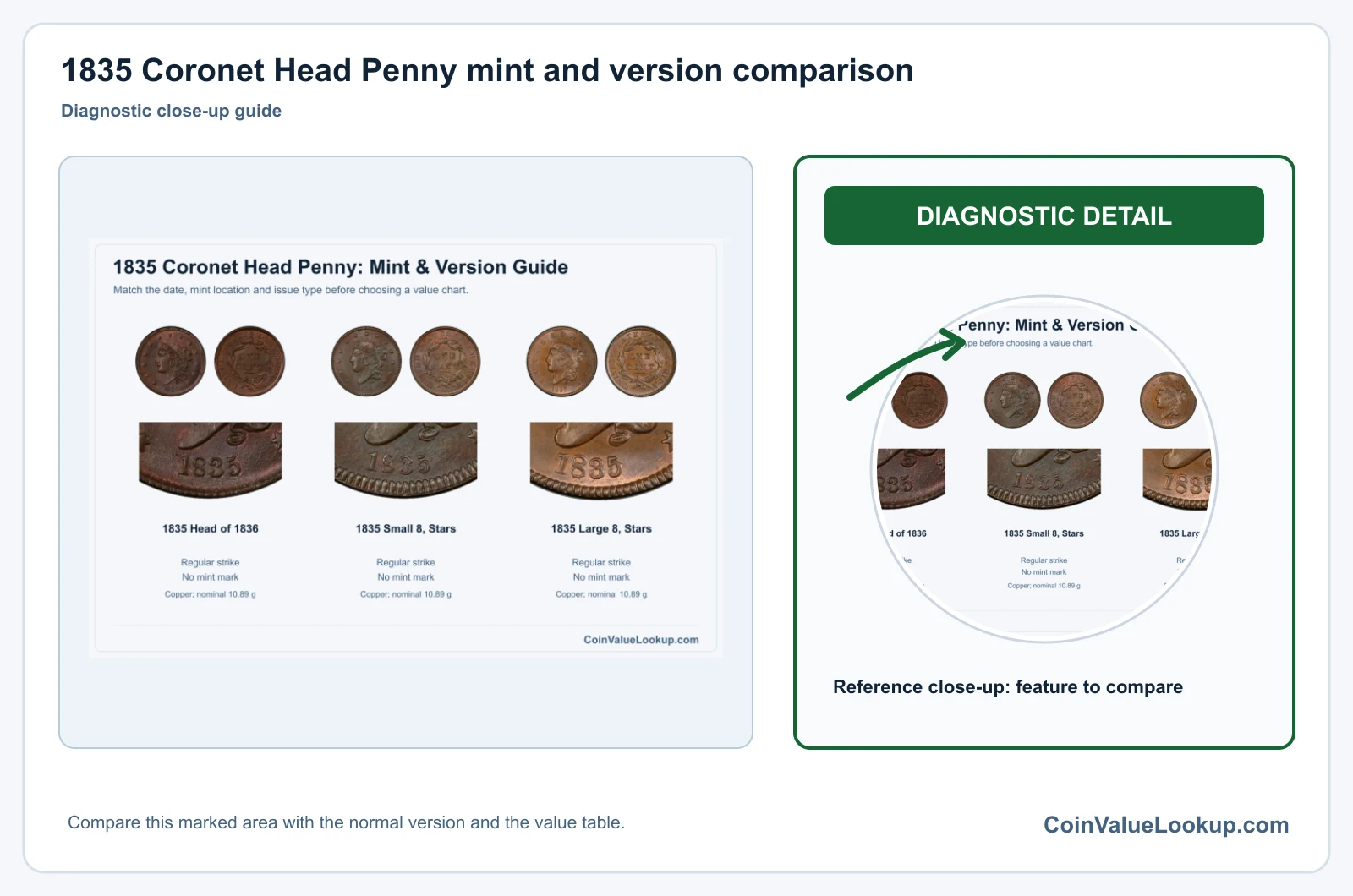
First, check the portrait style. The "Head of 1836" uses a noticeably different bust punch than the older-style head found on the Small 8 and Large 8 varieties.
If the portrait matches the 1836 design, you have your answer right there.
If the head is the older style, turn your attention to the date. The numeral "8" in the date comes in two sizes.
A Small 8 is narrower and more delicate; the Large 8 is visibly wider and bolder. The stars on the obverse also differ between these two varieties, so compare their size and spacing against known reference images.
The material is copper with a nominal weight of 10.89 grams. Weight can support identification, but wear, corrosion, and the production tolerances of the 1830s mean weight alone cannot prove authenticity.
Inspect the edge, the wreath details, and the legend wording on both sides before settling on a classification.
Step 2: Check Your 1835 Coronet Head Cent Grade
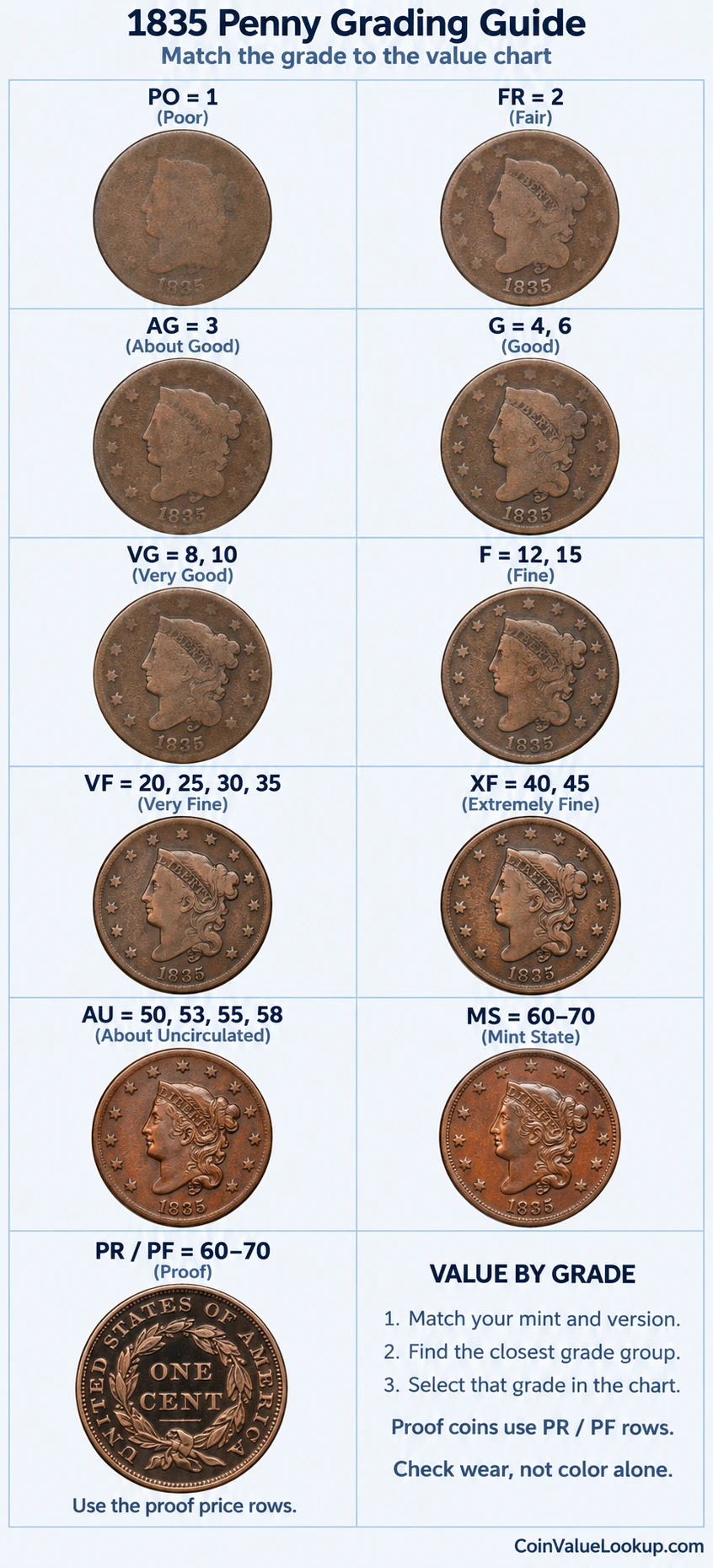
When grading an 1835 Coronet Head Cent, focus on Liberty's hair detail over the ear and across the forehead, the smoothness of the cheek, and the sharpness of the wreath leaves on the reverse. In lower grades like G4, the portrait outline and "LIBERTY" on the headband will be mostly worn away; by MS63, full hair strands and leaf veins should be visible with original luster.
Be careful to separate honest wear from other problems. A weakly struck coin can look worn even if it never circulated, and corrosion or porosity can eat away detail in ways that mimic heavy use.
Surface issues like these lower market appeal well beyond what the apparent grade might suggest.
Copper cents are described with color designations: BN (brown), RB (red-brown), and RD (red). These describe the remaining original color on the copper surface, not different metals.
More original red color generally means higher value at a given grade. Use the comparison image to match your coin's wear pattern against known examples of the same type.
Step 3: Check 1835 Coronet Head Cent Value by Mint and Version
1835 Coronet Head Cent — Head of 1836
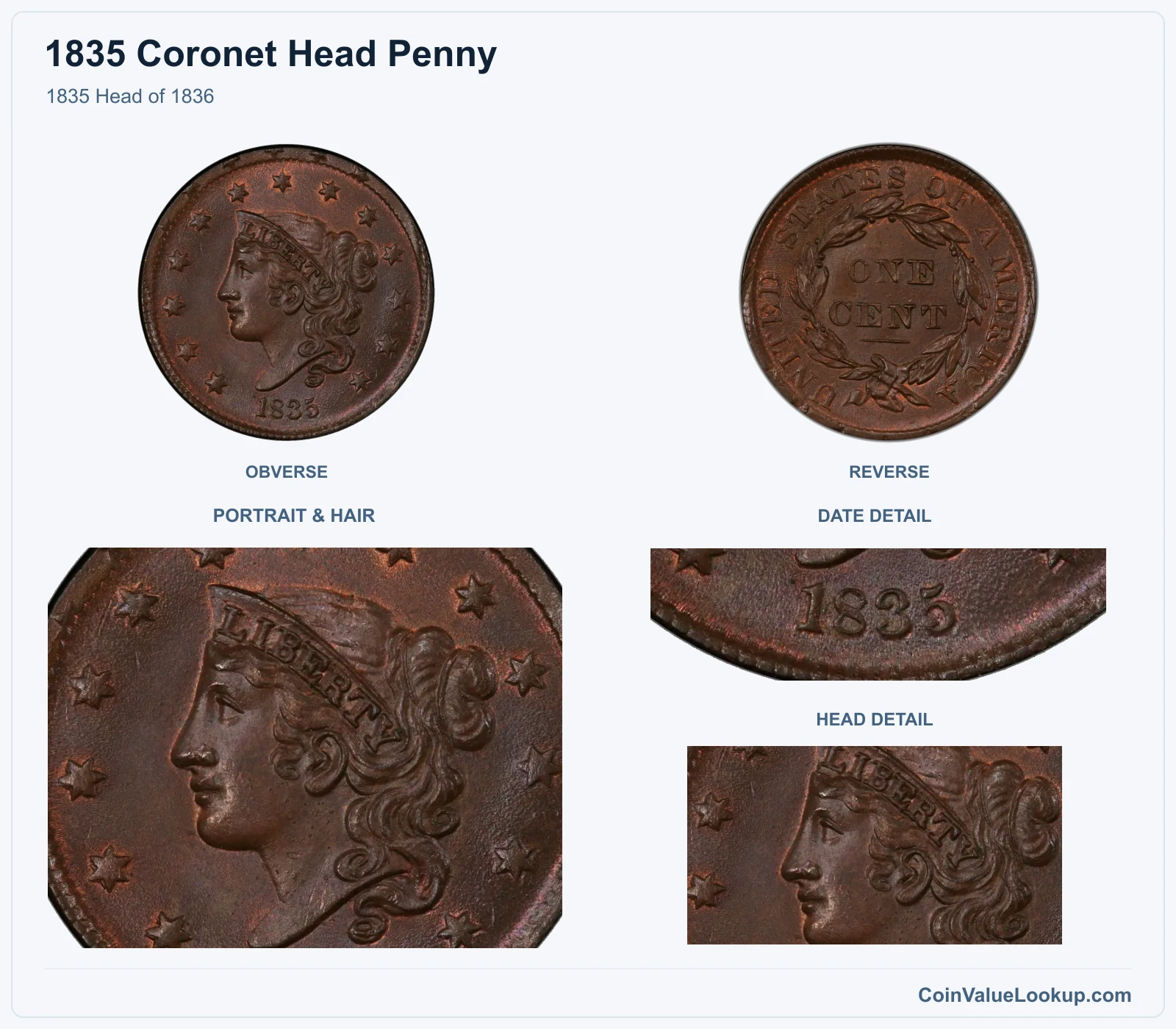
The 1835 Head of 1836 variety uses a redesigned portrait punch that would become standard the following year. If your coin's bust looks subtly different from other 1835 cents, this is likely why.
It was struck at Philadelphia in copper, weighing nominally 10.89 grams, with no mintmark.
USA Coin Book lists this variety from about $38 in G4 up to roughly $1,127 in MS63 for business strikes. That makes it the most affordable of the three varieties at the top end, though all three share the same $38 entry point in well-worn condition.
Confirming the portrait match is the single most important step in identifying this branch.
| Range | Grade | Price | Auction Records | Appraisal |
|---|---|---|---|---|
| PO | PO 1 | — | Coin Identifier | |
| FR | FR 2 | — | Coin Identifier | |
| AG | AG 3 | — | Coin Identifier | |
| G | G 4 | Coin Identifier | ||
| G 6 | Coin Identifier | |||
| VG | VG 8 | Coin Identifier | ||
| VG 10 | Coin Identifier | |||
| F | F 12 | Coin Identifier | ||
| F 15 | — | Coin Identifier | ||
| VF | VF 20 | — | Coin Identifier | |
| VF 25 | Coin Identifier | |||
| VF 30 | Coin Identifier | |||
| VF 35 | Coin Identifier | |||
| XF | XF 40 | Coin Identifier | ||
| XF 45 | Coin Identifier | |||
| AU | AU 50 | Coin Identifier | ||
| AU 53 | Coin Identifier | |||
| AU 55 | Coin Identifier | |||
| AU 58 | Coin Identifier | |||
| MS | MS 60 | — | Coin Identifier | |
| MS 61 | Coin Identifier | |||
| MS 62 | Coin Identifier | |||
| MS 63 | Coin Identifier | |||
| MS 64 | Coin Identifier | |||
| MS 65 | Coin Identifier | |||
| MS 66 | Coin Identifier | |||
| MS 67 | — | — | — | |
| MS 68 | — | — | — | |
| MS 69 | — | — | — | |
| MS 70 | — | — | — |
1835 Coronet Head Cent — Small 8, Stars
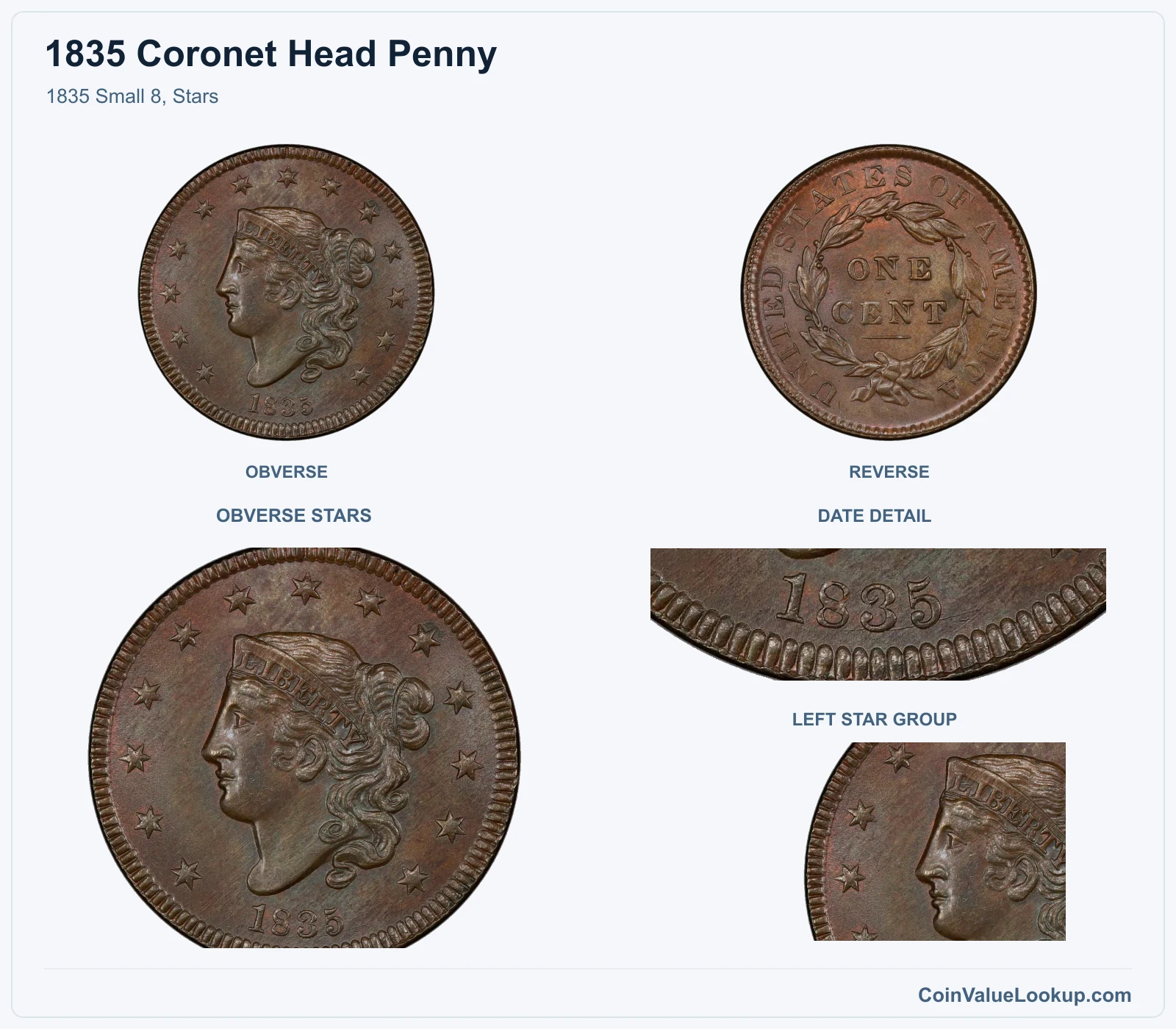
The 1835 Small 8, Stars variety keeps the older-style portrait and pairs it with a noticeably smaller, more delicate numeral "8" in the date. The stars on the obverse are also distinctive compared to the Large 8 version, so check both features together.
Struck in copper at Philadelphia with no mintmark, this variety guides from about $38 in G4 to approximately $1,445 in MS63 according to USA Coin Book. The jump in value from circulated to mint state is steep, which is typical for early copper.
Even a mid-grade example with original surfaces can be worth tracking down.
Coin Value Lookup is a helpful starting point if you want to look up guide values for other dates and denominations in this series. It covers a wide range of U.S. coin types and years.
| Range | Grade | Price | Auction Records | Appraisal |
|---|---|---|---|---|
| PO | PO 1 | — | Coin Identifier | |
| FR | FR 2 | — | Coin Identifier | |
| AG | AG 3 | — | Coin Identifier | |
| G | G 4 | Coin Identifier | ||
| G 6 | Coin Identifier | |||
| VG | VG 8 | Coin Identifier | ||
| VG 10 | Coin Identifier | |||
| F | F 12 | — | Coin Identifier | |
| F 15 | Coin Identifier | |||
| VF | VF 20 | Coin Identifier | ||
| VF 25 | Coin Identifier | |||
| VF 30 | Coin Identifier | |||
| VF 35 | Coin Identifier | |||
| XF | XF 40 | Coin Identifier | ||
| XF 45 | Coin Identifier | |||
| AU | AU 50 | Coin Identifier | ||
| AU 53 | Coin Identifier | |||
| AU 55 | Coin Identifier | |||
| AU 58 | Coin Identifier | |||
| MS | MS 60 | Coin Identifier | ||
| MS 61 | Coin Identifier | |||
| MS 62 | Coin Identifier | |||
| MS 63 | Coin Identifier | |||
| MS 64 | Coin Identifier | |||
| MS 65 | Coin Identifier | |||
| MS 66 | Coin Identifier | |||
| MS 67 | — | — | — | |
| MS 68 | — | — | — | |
| MS 69 | — | — | — | |
| MS 70 | — | — | — |
1835 Coronet Head Cent — Large 8, Stars
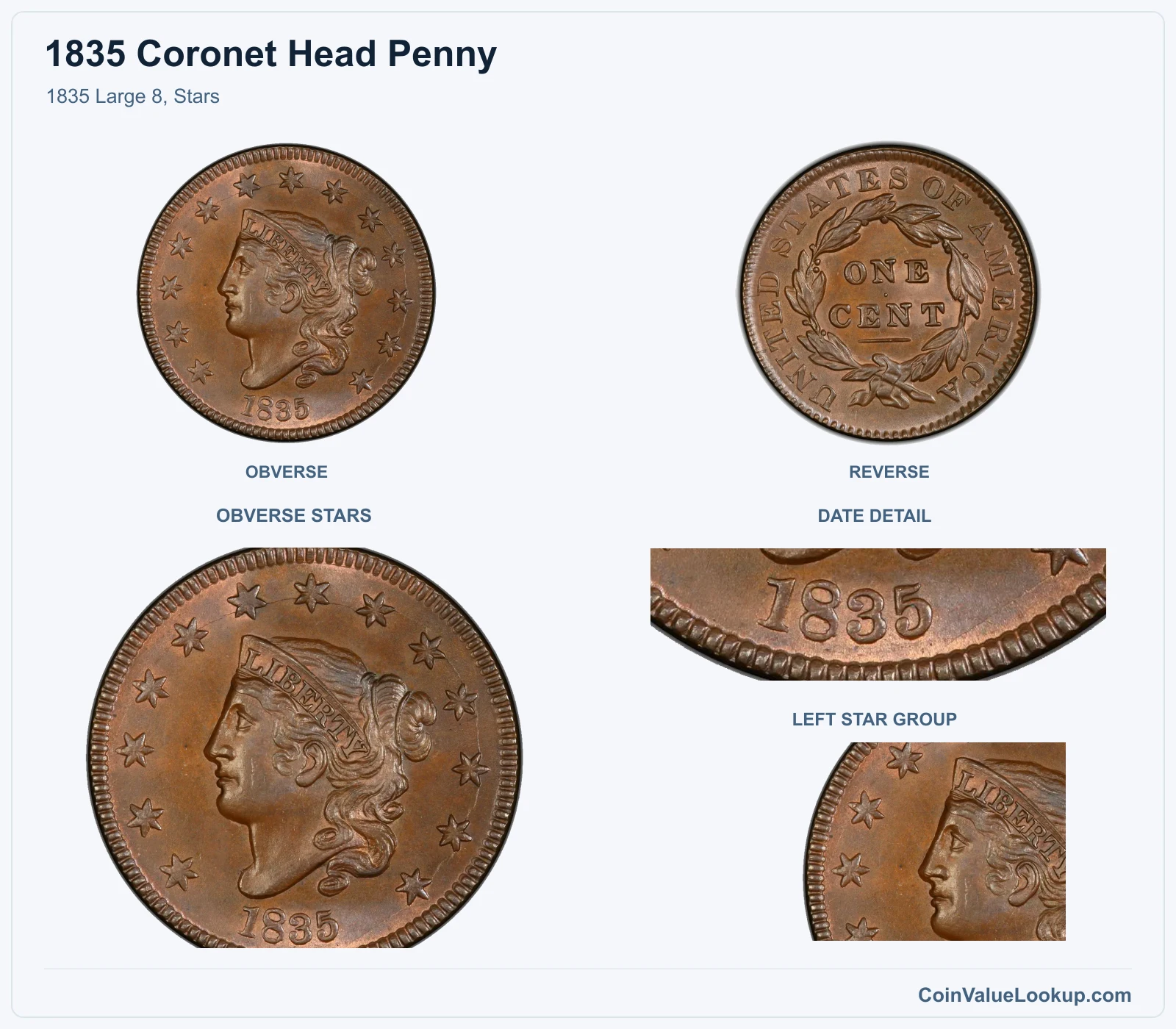
The 1835 Large 8, Stars is the variety that tops the guide charts for this date. The "8" in the date is visibly wider and heavier than on the Small 8 version, and the obverse stars differ as well.
Both clues should be checked; one alone can be misleading on a worn coin.
USA Coin Book estimates range from about $38 in G4 to roughly $2,340 in MS63, the highest listed value among the three business-strike varieties for this year. The premium over the other varieties becomes most apparent at higher grades, so accurate grading matters as much as correct variety attribution.
This is another Philadelphia copper issue at the standard 10.89-gram nominal weight, with no mintmark.
| Range | Grade | Price | Auction Records | Appraisal |
|---|---|---|---|---|
| PO | PO 1 | — | Coin Identifier | |
| FR | FR 2 | — | Coin Identifier | |
| AG | AG 3 | — | Coin Identifier | |
| G | G 4 | Coin Identifier | ||
| G 6 | — | Coin Identifier | ||
| VG | VG 8 | — | Coin Identifier | |
| VG 10 | Coin Identifier | |||
| F | F 12 | — | Coin Identifier | |
| F 15 | Coin Identifier | |||
| VF | VF 20 | Coin Identifier | ||
| VF 25 | — | Coin Identifier | ||
| VF 30 | Coin Identifier | |||
| VF 35 | — | Coin Identifier | ||
| XF | XF 40 | Coin Identifier | ||
| XF 45 | Coin Identifier | |||
| AU | AU 50 | Coin Identifier | ||
| AU 53 | Coin Identifier | |||
| AU 55 | Coin Identifier | |||
| AU 58 | Coin Identifier | |||
| MS | MS 60 | — | Coin Identifier | |
| MS 61 | Coin Identifier | |||
| MS 62 | — | Coin Identifier | ||
| MS 63 | Coin Identifier | |||
| MS 64 | Coin Identifier | |||
| MS 65 | — | Coin Identifier | ||
| MS 66 | — | — | — | |
| MS 67 | — | — | — | |
| MS 68 | — | — | — | |
| MS 69 | — | — | — | |
| MS 70 | — | — | — |
1835 Coronet Head Cent — Proof
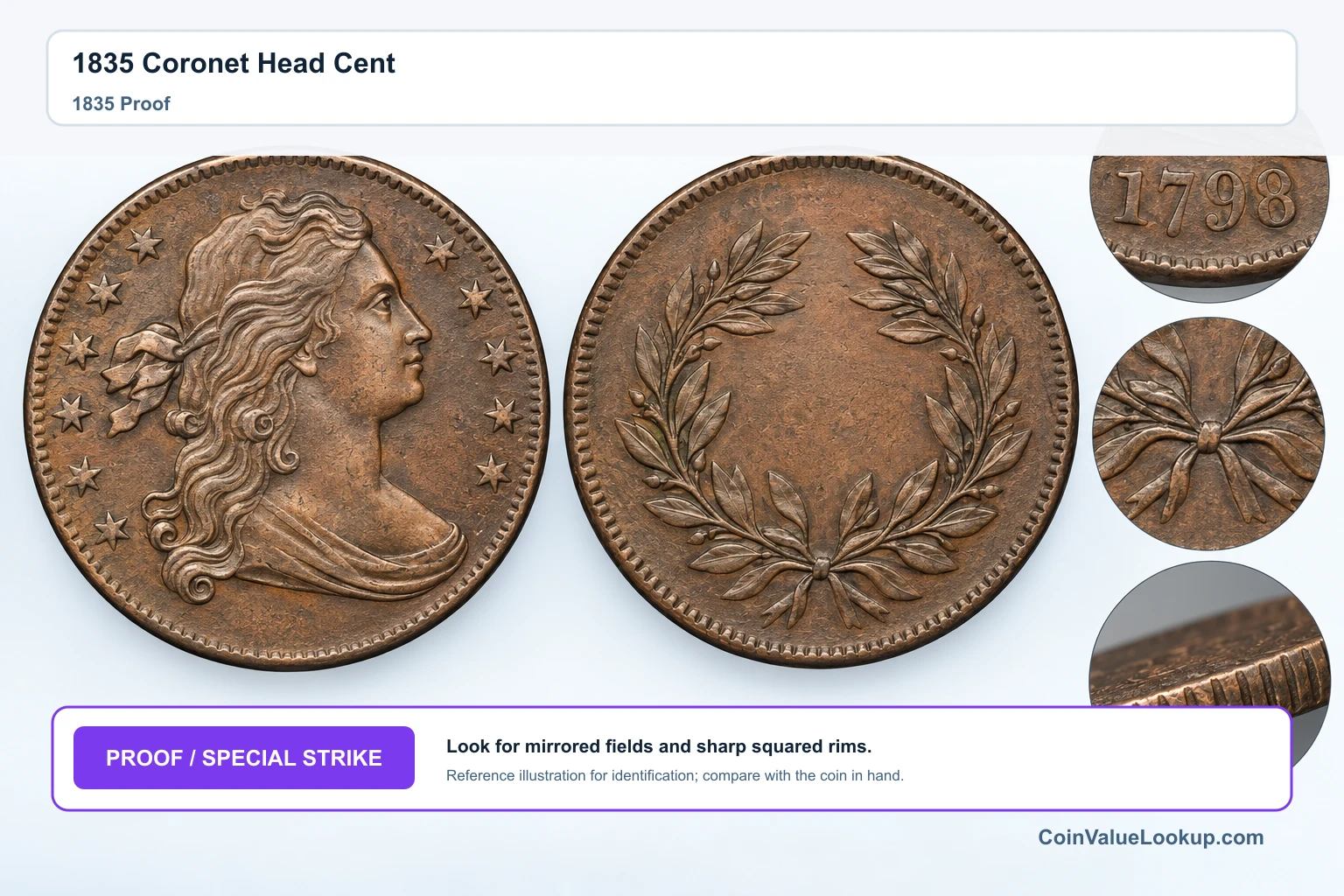
Proof 1835 Coronet Head Cents are genuinely rare early copper proofs. A true proof is defined by its method of manufacture — specially prepared dies, polished planchets, and carefully controlled striking — not by how shiny a coin looks.
Polishing a business strike does not create a proof.
No standard guide price is adopted for this issue. Each example requires individual assessment based on its authenticated identity, surface quality, rim characteristics, and die diagnostics.
Professional attribution is essential because early proof copper can be confused with well-preserved business strikes or later restrikes. If you suspect you have one, third-party certification from a major grading service is the appropriate next step.
Do not assume proof status based on appearance alone; the die characteristics and production evidence must match documented proof die pairs for this date.
Values by grade are not available for this coin yet.
1835 Coronet Head Cent Error List
1. 1835 Coronet Head Cent — Off-Center Strike
An off-center strike on an 1835 Coronet Head Cent occurs when the planchet is not properly centered between the dies at the moment of striking. The result is a displaced design with an unstruck crescent of blank copper on one side.
The more dramatic the shift, the larger the blank area.
Retaining a fully visible date is critical to the coin's collectibility. Without the date, attribution becomes difficult and value drops sharply.
Look carefully at the displacement to confirm it is consistent across the entire design, not just one edge.
Don't confuse an off-center strike with a clipped planchet, one-sided die misalignment, or post-mint damage like flattening from a vise. Each coin requires individual evaluation based on its authenticated identity and the degree of the error; no standard guide price is available for this category.
2. 1835 Coronet Head Cent — Split Planchet
A split planchet error means the copper blank separated into layers during or after striking. One face will show the normal struck design, while the exposed interior surface reveals the raw internal copper, which often has a rough, grainy texture quite different from the struck surface.
To confirm authenticity, record the coin's weight and examine the edge. A genuine split will show the coin is significantly underweight compared to the standard 10.89 grams, and the edge will display evidence of the separation rather than a clean cut.
Watch out for coins that have been ground down, acid-etched, or deliberately split after leaving the mint. These post-mint alterations mimic the look of a true split planchet but lack the telltale metal-flow characteristics.
No standard guide price applies; value depends on authenticated identity, condition, and how much of the original design survives.
3. 1835 Coronet Head Cent — Rotated Dies
Rotated dies on an 1835 cent mean the obverse and reverse are misaligned relative to normal U.S. coin orientation. To check, hold the obverse upright and flip the coin top-to-bottom along the vertical axis.
The reverse should appear upright; if it's tilted, you may have a die rotation.
Small rotations of a few degrees are common and generally unremarkable. Larger rotations — 45 degrees, 90 degrees, or especially 180 degrees — draw more collector interest.
The further off-axis the reverse sits, the more unusual the coin.
Be careful with photographs. A picture can be rotated digitally, or the coin itself might have been turned sideways in its holder, creating a false impression of die rotation.
Always verify in hand. No standard guide price exists for this error on the 1835 cent; each example needs individual assessment based on the degree of rotation and overall condition.
4. 1835 Coronet Head Cent — Clipped Planchet
A clipped planchet occurs when the blank is punched from the copper strip in a way that overlaps a previously punched hole or the strip's edge. The result is a coin missing a curved, straight, or irregularly shaped portion of its rim and field.
On a genuine clip, you may also notice design weakness on the opposite side of the coin from the missing area, caused by uneven metal flow during striking.
Compare the edge texture at the clip to the rest of the rim. A true clip will show a different surface character — often smoother or with a natural break — while a filed notch or deliberate cut will leave tool marks.
Corrosion can also eat away an edge and mimic a clip, so look closely.
No standard guide price is adopted for clipped 1835 cents. Value depends on the size and type of clip, whether the date remains fully visible, and the coin's overall condition and authenticated identity.