1868 Indian Head Penny Coin Value: How Much Is It Worth?
An 1868 Indian Head penny in well-worn Good-4 condition carries a guide value around $61, while an uncirculated example at MS63 is listed near $527. Proofs, major die varieties, and mint errors require separate evaluation.
These guide figures come from published retail estimates and are not guaranteed purchase offers.
Fast Way to Identify Your 1868 Indian Head Penny
Want a quick read on your 1868 Indian Head cent? Upload clear photos of both the front and back of your coin, and our identifier can offer a preliminary take on which version you have and its approximate condition.
Good lighting and a steady hand make all the difference.
1868 Indian Head Penny Value
Upload both sides of your 1868 Indian Head Penny.
Front Obverse
Upload photo
Back Reverse
Upload photo
Which 1868 Indian Head Penny Versions Are Worth Money?
- Business strikes range from about $61 at Good-4 to roughly $527 at MS63 per published guide estimates; original surfaces and remaining copper color matter.
- Proofs carry a guide value near $468 at PR63, but confirming genuine proof manufacture is essential before applying proof pricing.
- Die varieties such as doubled dies, repunched dates, and cuds are reported for this date and can carry premiums based on severity and authenticated identity.
- Cleaning, corrosion, or artificial toning reduce the marketability and value of any 1868 Indian Head cent regardless of its technical grade.
Step 1: Identify Your 1868 Indian Head Penny Mint Mark and Version
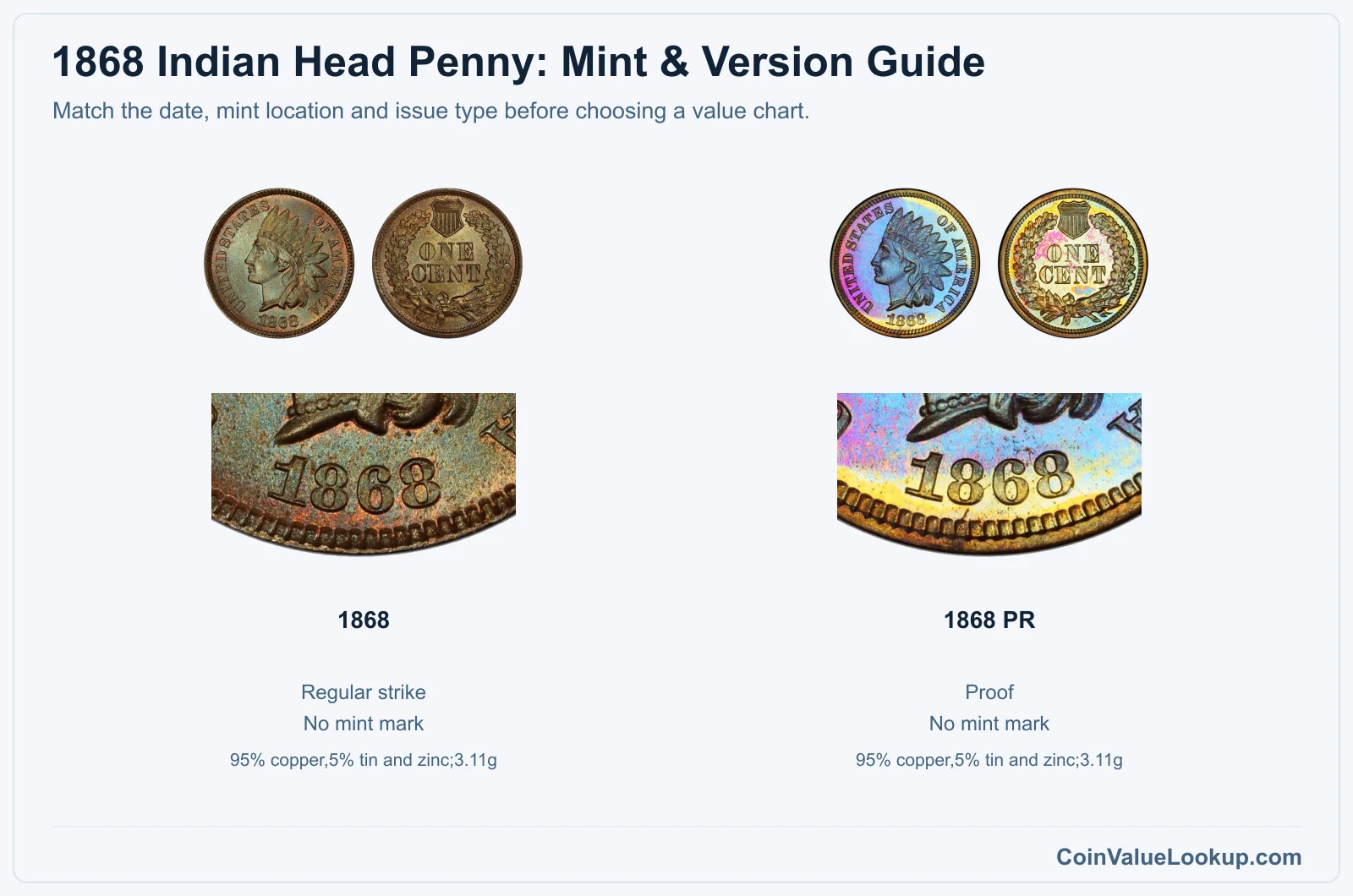
Every regular 1868 Indian Head cent was struck at the Philadelphia Mint. There is no mintmark on this coin.
The small "L" you might spot on the ribbon behind the portrait is a designer's initial, not a mint indicator.
The obverse shows the Indian portrait with a feathered headdress and the word LIBERTY on the headband. The reverse features an oak wreath surrounding a shield, with "ONE CENT" at center.
If your coin has wheat stalks or a Lincoln portrait, you have a different series entirely.
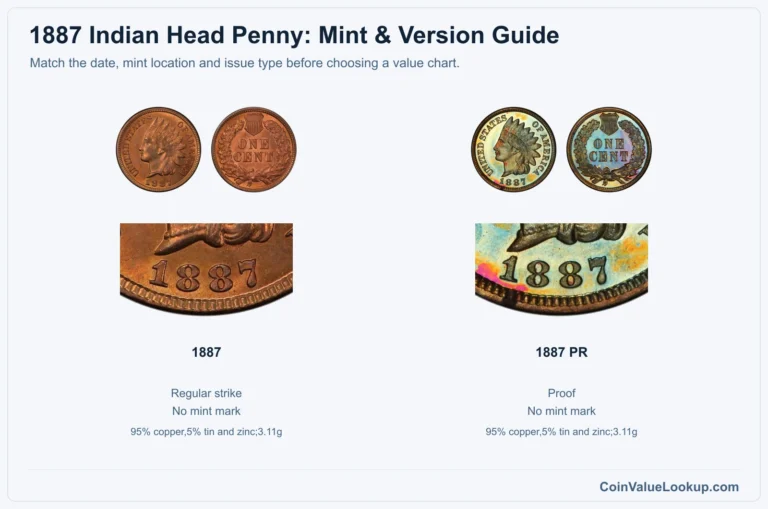
The 1868 comes in two production types: standard business strikes made for circulation, and proofs manufactured with polished dies and specially prepared planchets for collectors. A proof is a method of manufacture, not a higher grade than Mint State.
A circulation coin that someone has polished to a mirror shine is not a proof, no matter how shiny it looks. Genuine proofs typically show squared-off rims, fully struck details, and a distinctive mirrored field.
Before looking up any value, pin down exactly which version you hold: business strike or proof. Then assess the surface condition and how much original bronze color remains.
Step 2: Check Your 1868 Indian Head Penny Grade
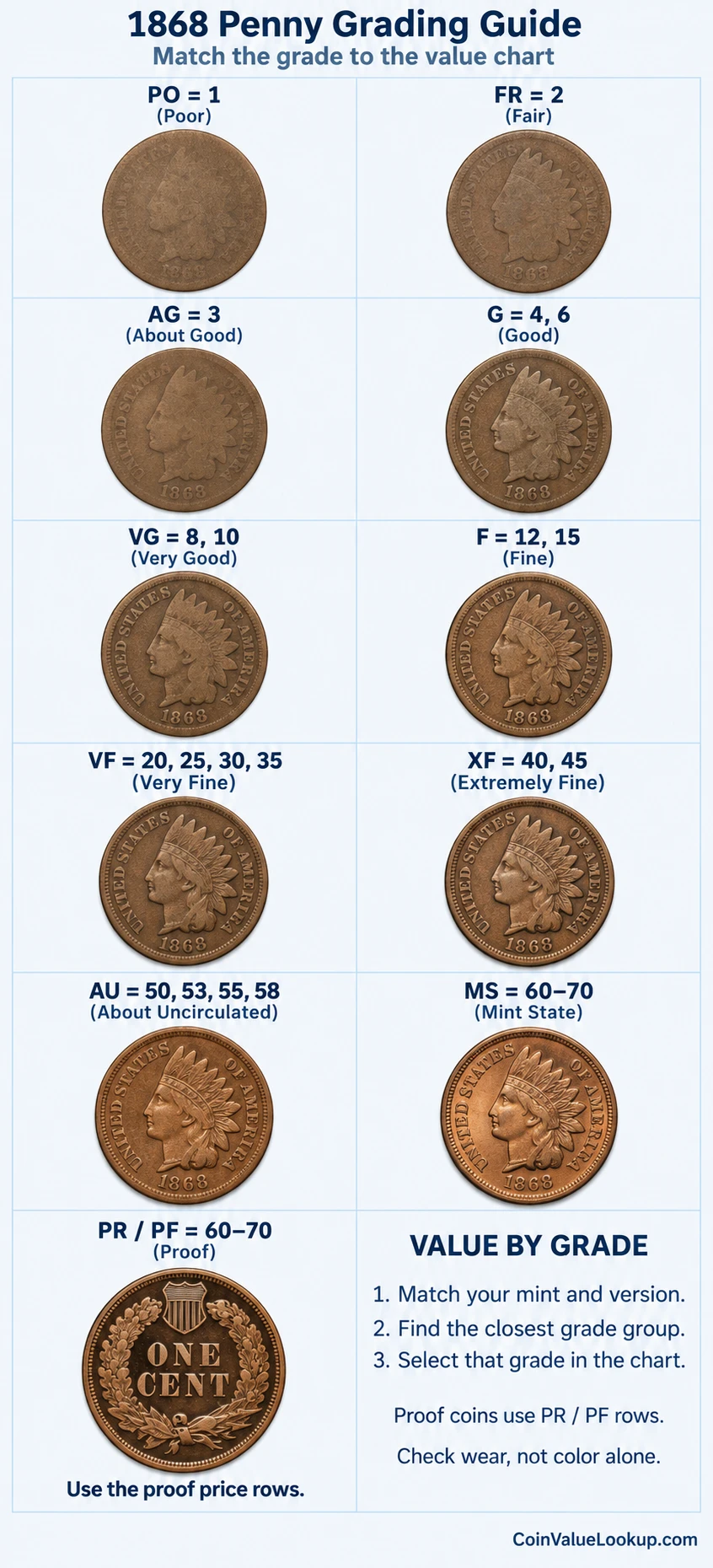
Start with the headband. On a well-worn coin the word LIBERTY will be partially or fully gone.
At lower grades like Good-4, just the outline of the portrait and wreath remain. Around Very Fine, most letters in LIBERTY should be readable, and individual feather lines start showing up.
Check the cheek and hair above the ear next. These are high points that lose detail first from circulation wear.
On the reverse, the leaf tips and shield details wear down in a predictable sequence.
Here is the tricky part: the 1868 can come with a soft original strike. Some coins left the press with mushy feathers or hair detail that looks like wear but is not.
Do not downgrade a coin based on one weak area alone. Look at the overall luster and surface consistency instead.
Bronze color designations like BN (brown), RB (red-brown), and RD (red) describe how much original copper color survives. They are not separate materials.
A coin with full original red surfaces commands more than a fully toned brown example in the same technical grade. Use the comparison image to match your coin's wear pattern against known grade benchmarks.
Step 3: Check 1868 Indian Head Penny Value by Mint and Version
1868 Indian Head Penny
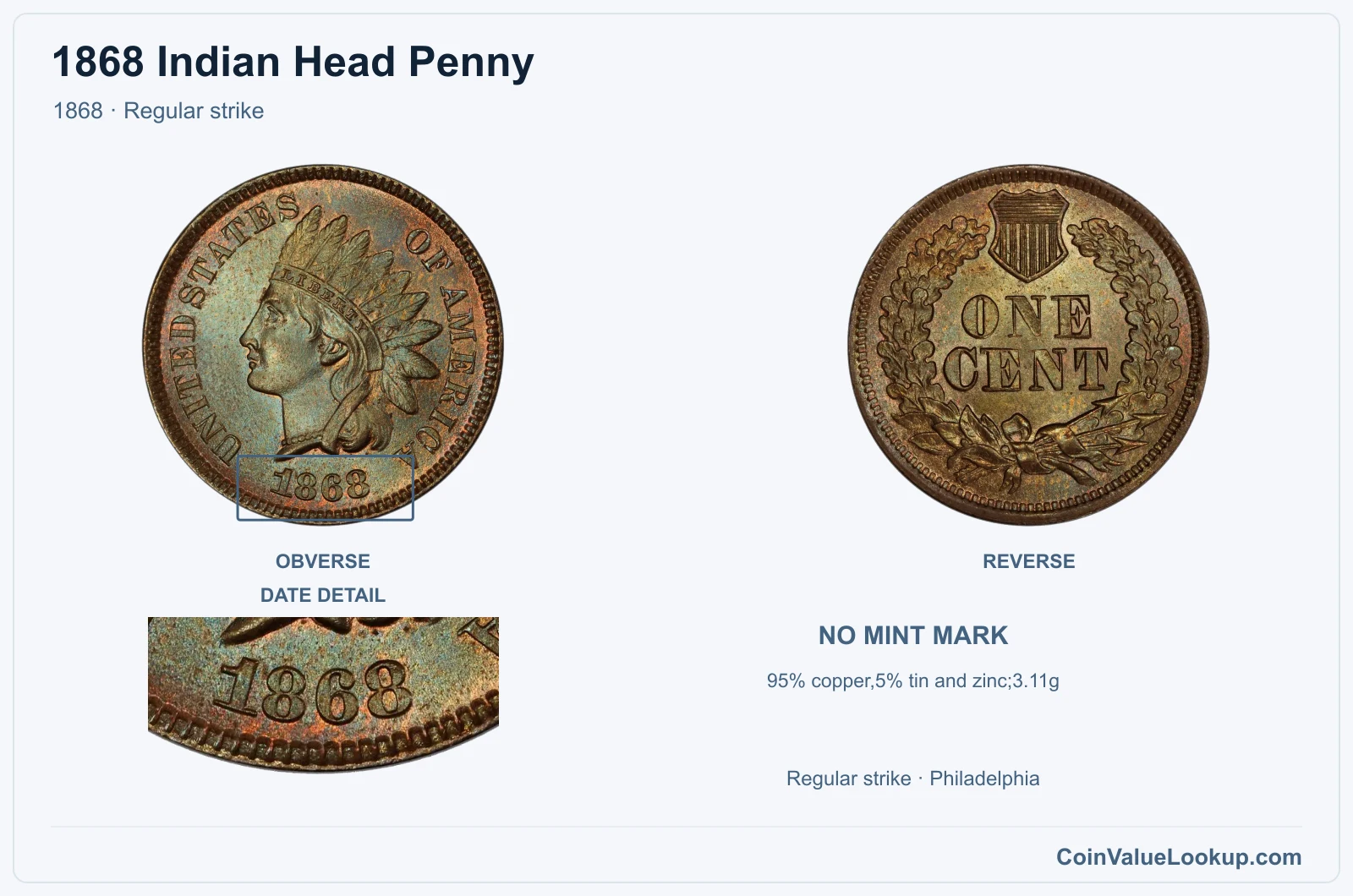
The standard 1868 Indian Head cent is a Philadelphia business strike on a bronze planchet of 95% copper with 5% tin and zinc, weighing 3.11 grams. No mintmark appears on the coin.
Published guide values place this version at roughly $61 in Good-4 and around $527 in MS63, though actual transaction prices depend on surface quality, strike sharpness, and remaining original color.
When evaluating your coin, compare it against examples of the same grade and surface type. A brown-toned MS63 and a red MS63 are very different animals in the marketplace.
Do not borrow pricing from rare die varieties or proofs when valuing a standard business strike.
| Range | Grade | Price | Auction Records | Appraisal |
|---|---|---|---|---|
| PO | PO 1 | — | Coin Identifier | |
| FR | FR 2 | — | Coin Identifier | |
| AG | AG 3 | — | Coin Identifier | |
| G | G 4 | Coin Identifier | ||
| G 6 | Coin Identifier | |||
| VG | VG 8 | Coin Identifier | ||
| VG 10 | Coin Identifier | |||
| F | F 12 | Coin Identifier | ||
| F 15 | Coin Identifier | |||
| VF | VF 20 | Coin Identifier | ||
| VF 25 | Coin Identifier | |||
| VF 30 | Coin Identifier | |||
| VF 35 | Coin Identifier | |||
| XF | XF 40 | Coin Identifier | ||
| XF 45 | Coin Identifier | |||
| AU | AU 50 | Coin Identifier | ||
| AU 53 | Coin Identifier | |||
| AU 55 | Coin Identifier | |||
| AU 58 | Coin Identifier | |||
| MS | MS 60 | — | Coin Identifier | |
| MS 61 | Coin Identifier | |||
| MS 62 | Coin Identifier | |||
| MS 63 | Coin Identifier | |||
| MS 64 | Coin Identifier | |||
| MS 65 | Coin Identifier | |||
| MS 66 | Coin Identifier | |||
| MS 67 | Coin Identifier | |||
| MS 68 | — | — | — | |
| MS 69 | — | — | — | |
| MS 70 | — | — | — |
1868 Indian Head Penny — PR
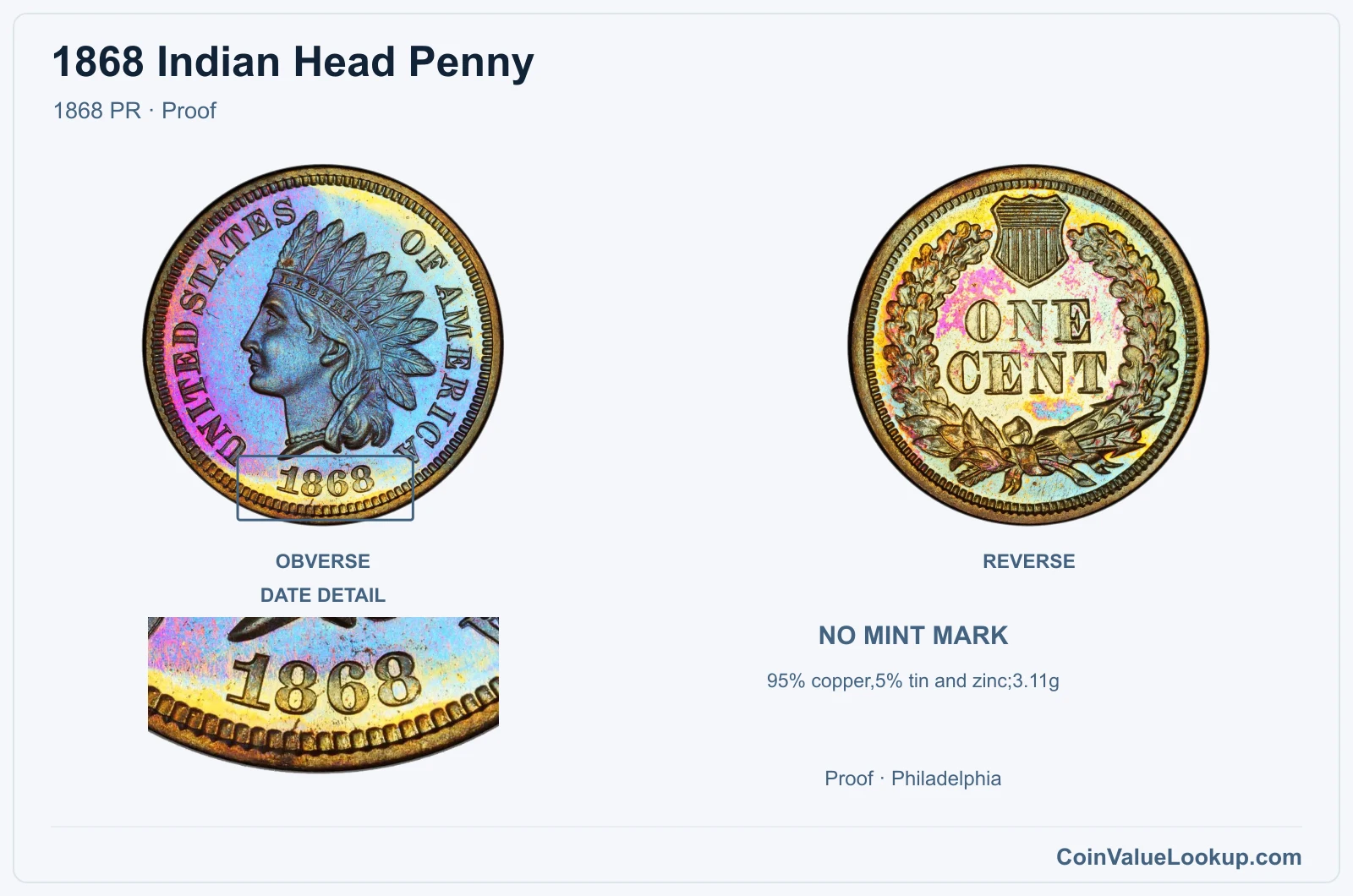
The 1868 proof Indian Head cent was specially struck at Philadelphia using polished dies and carefully prepared planchets. It shares the same bronze composition and weight as the business strike: 95% copper, 5% tin and zinc, 3.11 grams.
A published guide lists this version at approximately $468 in PR63.
Identifying a genuine proof takes more than a glance. Look for squared, well-defined rims and deeply mirrored fields with sharp, complete design details.
The strike quality should be noticeably superior to a typical circulation coin. A business strike that has been polished or dipped might look reflective, but it will lack the precise rim geometry and field characteristics of a true proof.
Coin Value Lookup is a handy starting point if you want to compare your coin across different series and dates before seeking professional authentication.
| Range | Grade | Price | Auction Records | Appraisal |
|---|---|---|---|---|
| PR | PR 1 | — | Coin Identifier | |
| PR 2 | — | Coin Identifier | ||
| PR 3 | — | Coin Identifier | ||
| PR 4 | — | Coin Identifier | ||
| PR 6 | — | Coin Identifier | ||
| PR 8 | — | Coin Identifier | ||
| PR 10 | — | Coin Identifier | ||
| PR 12 | — | Coin Identifier | ||
| PR 15 | — | Coin Identifier | ||
| PR 20 | — | Coin Identifier | ||
| PR 25 | — | Coin Identifier | ||
| PR 30 | — | Coin Identifier | ||
| PR 35 | — | Coin Identifier | ||
| PR 40 | — | Coin Identifier | ||
| PR 45 | — | Coin Identifier | ||
| PR 50 | — | Coin Identifier | ||
| PR 53 | — | Coin Identifier | ||
| PR 55 | — | Coin Identifier | ||
| PR 58 | — | Coin Identifier | ||
| PR 60 | — | Coin Identifier | ||
| PR 61 | — | Coin Identifier | ||
| PR 62 | Coin Identifier | |||
| PR 63 | Coin Identifier | |||
| PR 64 | Coin Identifier | |||
| PR 65 | Coin Identifier | |||
| PR 66 | — | Coin Identifier | ||
| PR 67 | Coin Identifier | |||
| PR 68 | — | — | — | |
| PR 69 | — | — | — | |
| PR 70 | — | — | — |
1868 Indian Head Penny Error List
1. 1868 Indian Head Penny — Die Break / Cud
A cud on an 1868 Indian Head cent appears as a raised, featureless blob of metal connected to the rim. It forms when a chunk of the die breaks away entirely, leaving nothing to stamp that portion of the design.
The result is a smooth, raised area where design detail should be.
To confirm a cud, check that the raised area connects directly to the rim and that the surrounding design is displaced or missing in a way consistent with a broken die. A rim dent pushed inward, a patch of corrosion, or a small interior die chip can mimic the look but will differ in profile and position.
Cuds are reported for this date, and their value depends on the size, location, and the coin's overall condition. Professional authentication is the safest route for an accurate assessment.
2. 1868 Indian Head Penny — Doubled Die Obverse
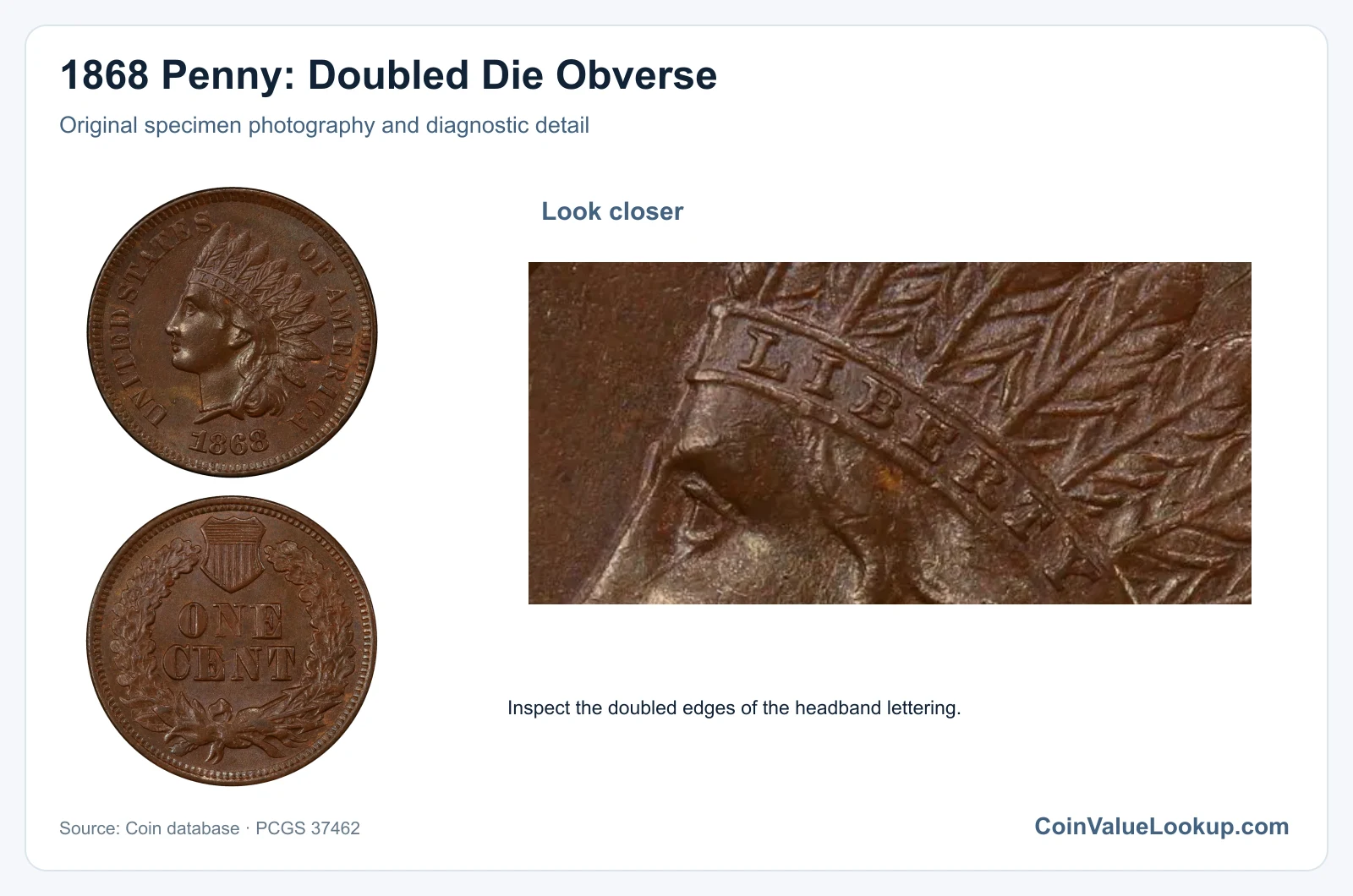
A doubled die obverse on an 1868 Indian Head cent shows consistent doubling on obverse design elements, such as the date digits, LIBERTY letters, or the portrait details. Under magnification, you should see a clear secondary image with separation or notching that repeats across multiple features on the same side of the coin.
The key word is consistent. Machine doubling, which is flat and shelf-like, tends to appear randomly and lacks the crisp secondary outline of a true doubled die.
Reflections from worn dies can also trick you under certain lighting angles. Compare your coin against a known normal example under the same light to see if the doubling holds up.
Doubled die obverse varieties for this date are reported in published catalogs, and value hinges on the strength of the doubling, the coin's grade, and authenticated identification.
3. 1868 Indian Head Penny — Misplaced Date
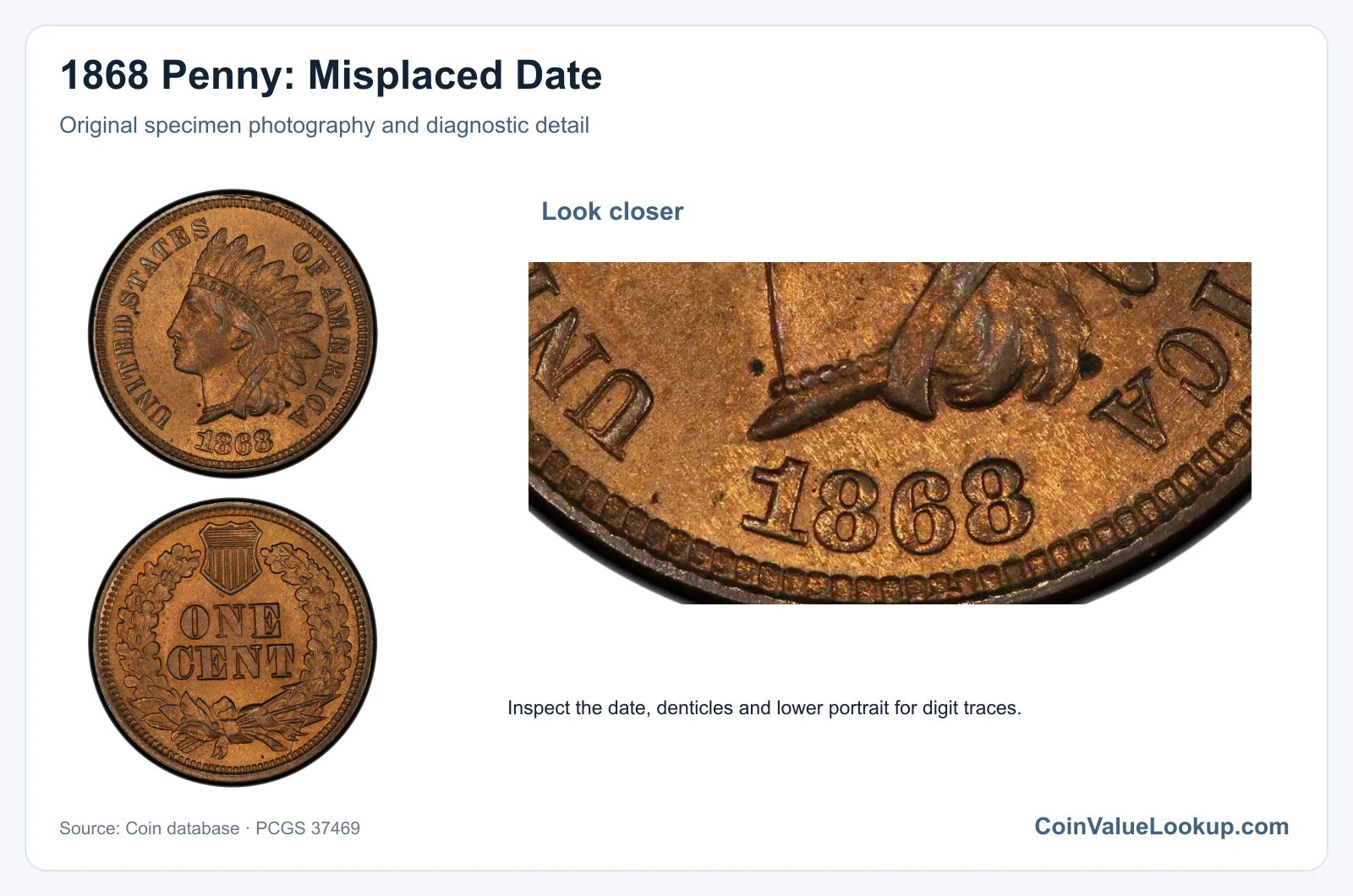
A misplaced date variety on an 1868 Indian Head cent shows partial remnants of date digits in the wrong location, typically embedded in the denticles near the rim or partially hidden near the portrait. These traces appear because the date punch initially struck the die in an incorrect position before the final, correct placement was applied.
To spot one, look carefully at the denticles below the date and the area around the bust truncation. You are hunting for faint outlines or partial curves that match the shape of a numeral.
Random die chips, scratches, or tiny bumps can look similar at first glance but will not form a recognizable digit shape. Authentication and careful comparison with a reference photograph are important.
The value of a confirmed misplaced date depends on its clarity, the coin's condition, and its authenticated identity.
4. 1868 Indian Head Penny — Repunched Date
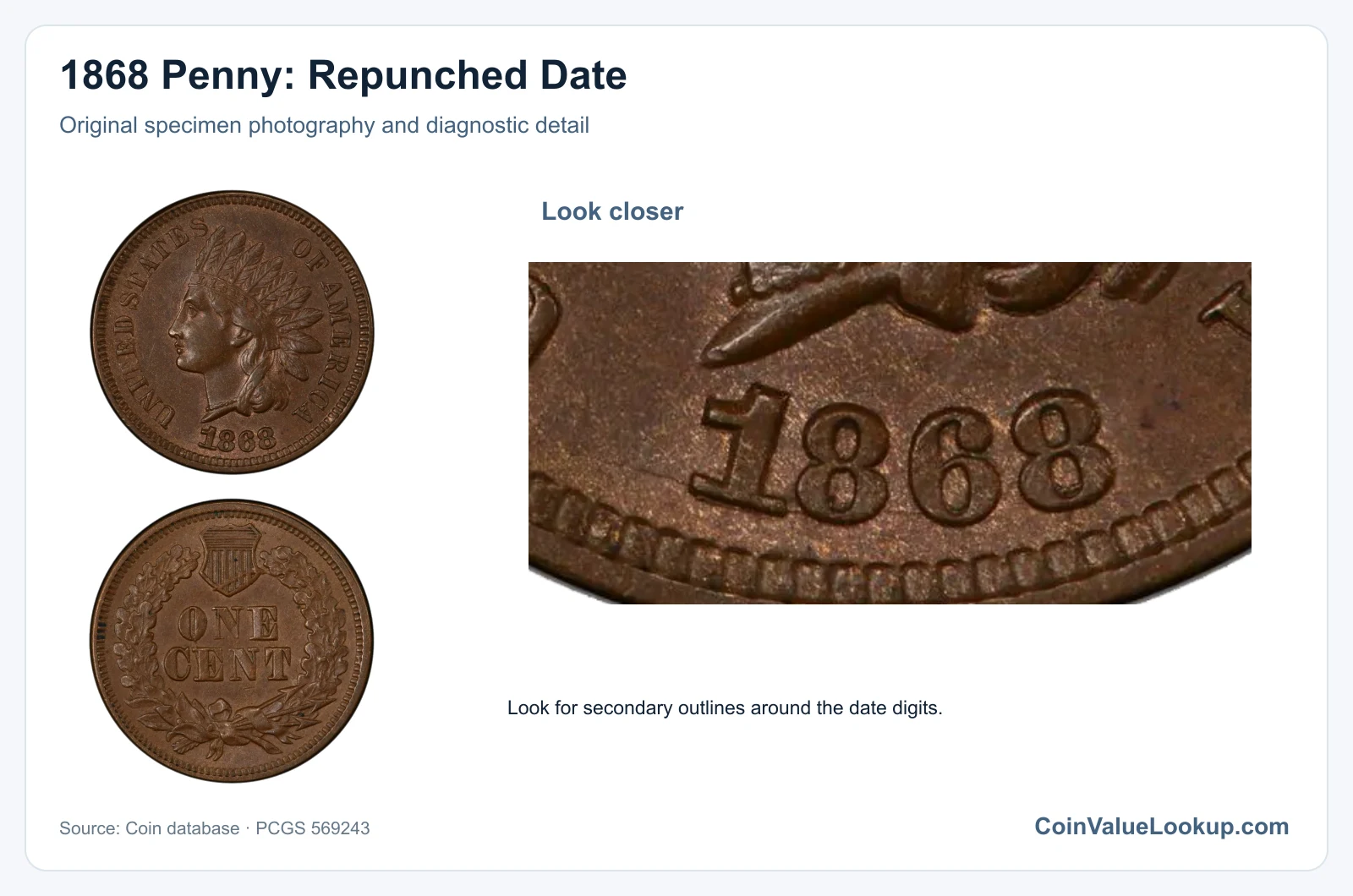
A repunched date on an 1868 Indian Head cent displays remnants of an earlier punch position visible beside or beneath the final date numerals. During production, the date was hand-punched into each working die individually, and sometimes the first impression landed slightly off.
The corrected second punch left the final digits in place, but traces of the initial attempt remain.
This is different from a doubled die, which involves misalignment of the entire hub impression. With a repunched date, only the date area shows the extra image.
Look for faint secondary outlines, especially on the tops or bases of the 1, 8, 6, or 8 digits. Damage to the date area or flat machine doubling can be confused with repunching but will lack the distinct punch-shaped remnant.
Value depends on visibility, authenticated identity, and overall coin condition.
5. 1868 Indian Head Penny — Die Crack
A die crack on an 1868 Indian Head cent appears as a thin, raised line running across the coin's surface. It can cross open fields, cut through lettering, or trace along design elements.
The line is raised because a fracture in the steel die allowed metal to flow into the crack during striking.
To distinguish a genuine die crack from post-mint damage, remember that die cracks are raised above the surface, while scratches are incised into it. A scratch will often show displaced metal along its edges and may change direction abruptly.
Corrosion lines tend to follow grain patterns and feel rough rather than sharp. Die cracks on this date are documented in published references, and their collector premium depends on length, location, and the coin's overall grade.
Professional evaluation is recommended for any significant crack you believe adds value.