1879 Indian Head Penny Coin Value: How Much Is It Worth?
The 1879 Indian Head penny is a solid Philadelphia-only issue that collectors at every level can chase. Selected guide estimates place regular examples between about $12 at Good-4 and $207 at MS63, according to USA Coin Book.
Proofs, major varieties, and mint errors fall outside that span and require their own evaluation. These figures are retail guide estimates, not guaranteed offers, and actual value depends on the specific coin's condition and surfaces.
Fast Way to Identify Your 1879 Indian Head Penny
Want a quick read on your 1879 Indian Head cent? Upload clear photos of both the front and back of your coin using the identifier on this page.
That gives you a preliminary identification based on what's visible — the mint, finish type, and design details. It is not a substitute for professional authentication or precise grading, but it is a solid starting point.
1879 Indian Head Penny Value
Upload both sides of your 1879 Indian Head Penny.
Front Obverse
Upload photo
Back Reverse
Upload photo
Which 1879 Indian Head Penny Versions Are Worth Money?
- Business strikes range from about $12 at Good-4 to $207 at MS63 per USA Coin Book; original surfaces and remaining red color push values higher within those grades.
- Proof examples carry a guide value near $313 at PR63; confirm proof manufacturing details rather than relying on a shiny surface alone.
- Repunched date varieties, die cracks, and die breaks (cuds) exist for this date and can add a premium depending on severity and authentication.
- Coins with full original red luster in uncirculated grades are scarcer than brown or red-brown survivors; color matters for bronze Indian cents.
Step 1: Identify Your 1879 Indian Head Penny Mint Mark and Version
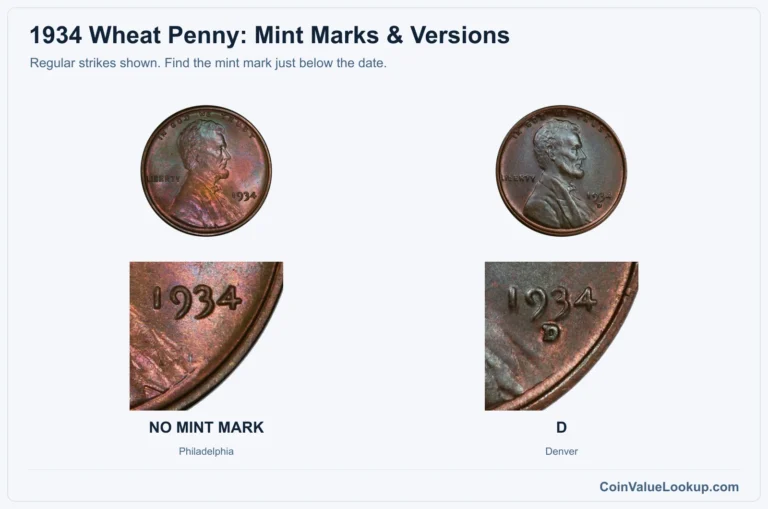
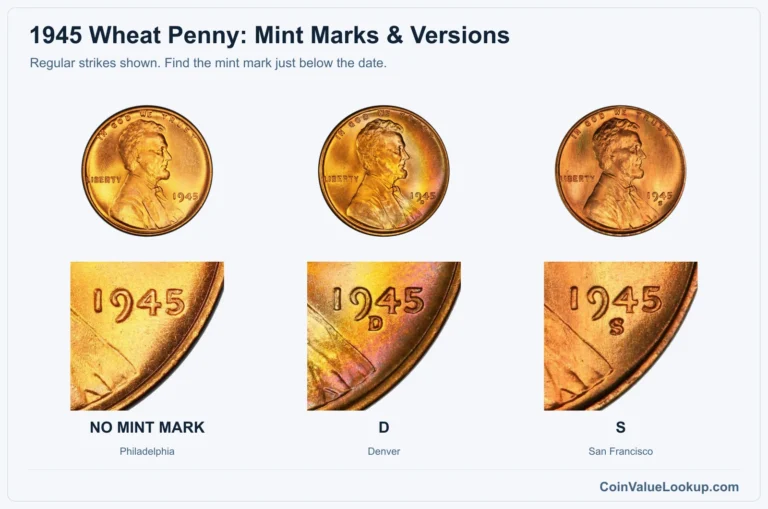
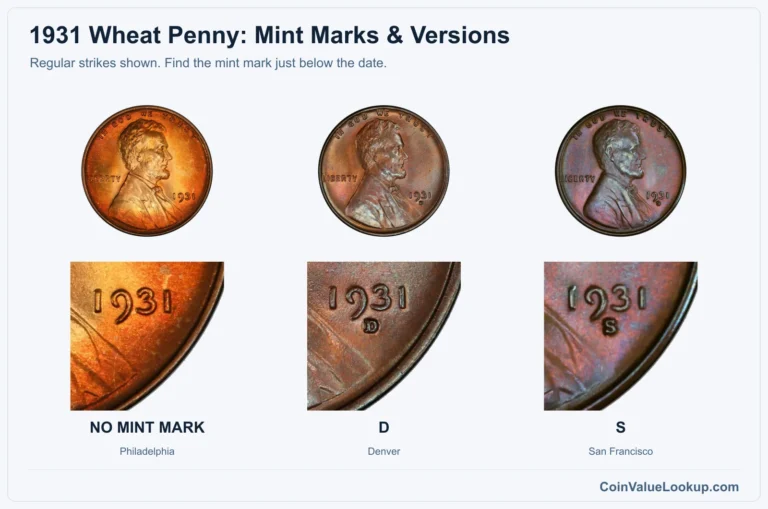
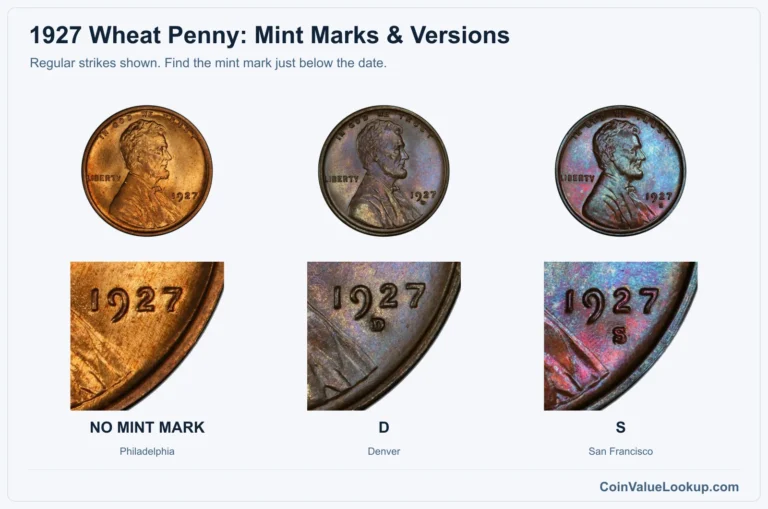
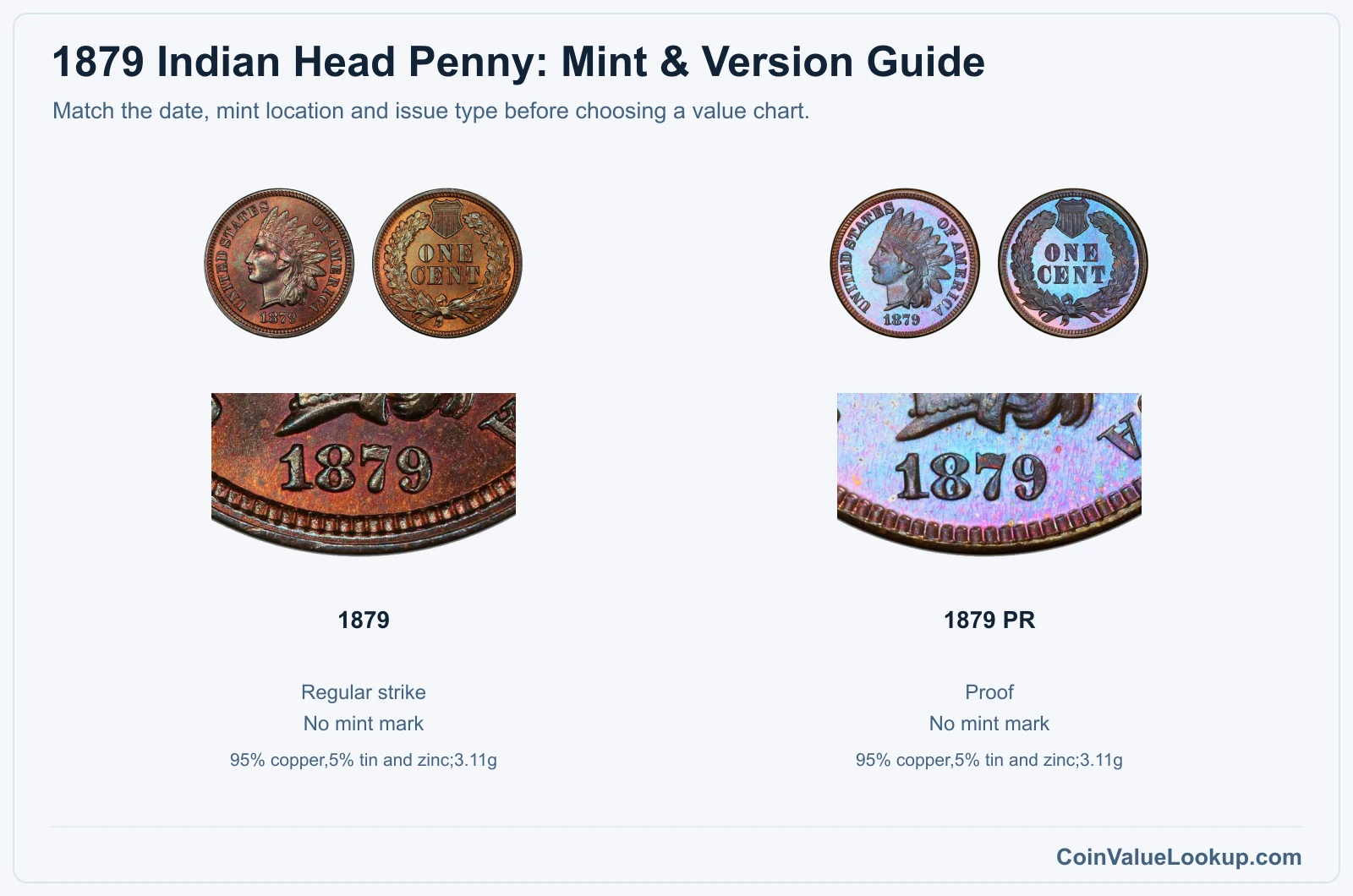
Every regular 1879 Indian Head cent was struck at Philadelphia. There is no mintmark to hunt for on this date.
The small "L" on the ribbon behind the neck is a designer's initial, not a mint indicator — a common mix-up for beginners.
On the obverse you should see the Native American portrait wearing a feathered headdress with LIBERTY spelled out on the headband. Flip the coin over and look for the oak wreath framing ONE CENT, topped by a small shield.
If you see wheat ears or a Lincoln portrait instead, you have a different series entirely.
The big fork in valuation is business strike versus proof. Business strikes were made for circulation by the millions.
Proofs were specially manufactured in small numbers with polished dies and carefully prepared planchets. A mirror-like surface alone does not confirm proof origin — plenty of business strikes have been polished over the decades to mimic that look.
Proof verification requires examining the rim geometry, die finish, and overall manufacturing characteristics, ideally confirmed by a third-party grading service.
Step 2: Check Your 1879 Indian Head Penny Grade
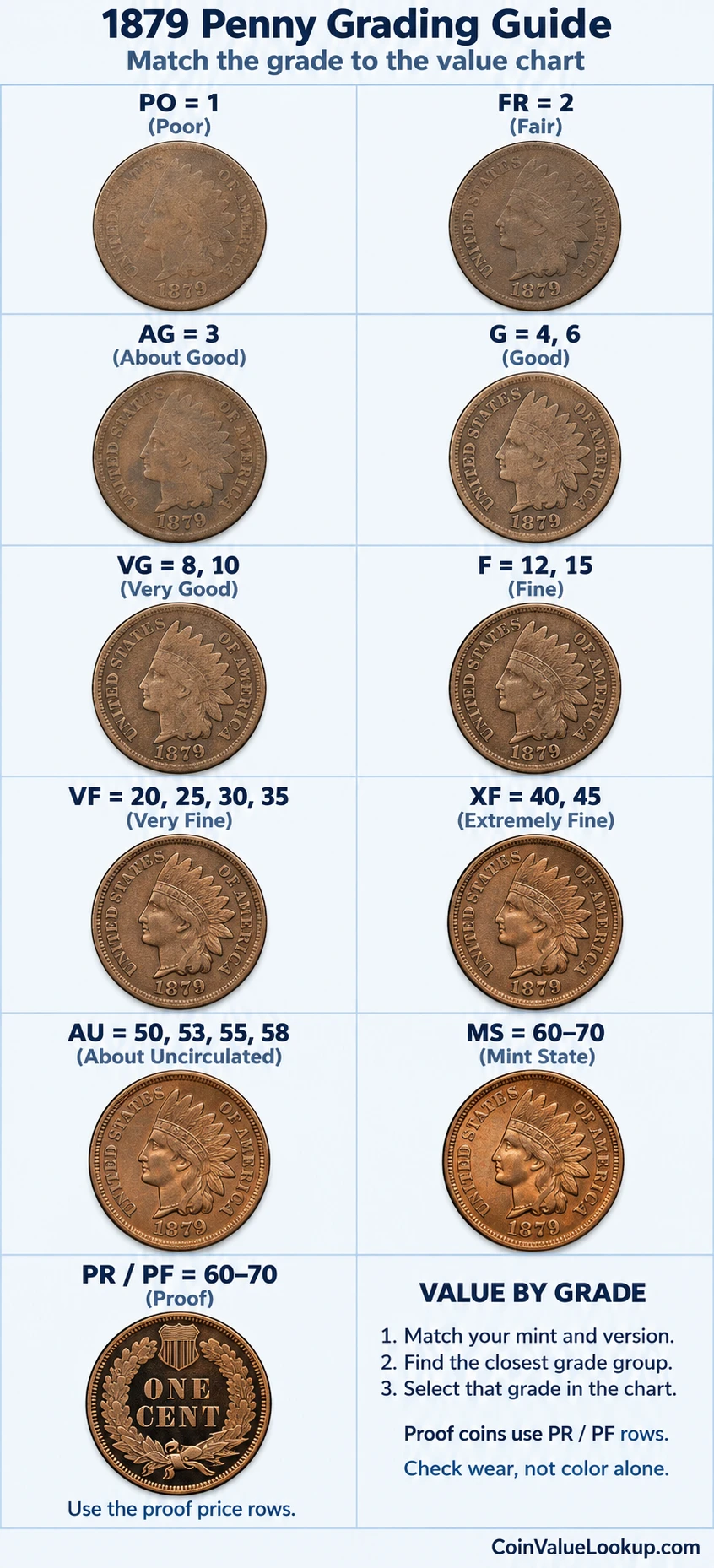
Start with the headband. On a well-worn coin, LIBERTY disappears letter by letter; a Good-4 example may show little more than a smooth band.
Move to the feather tips above the ear and the hair curls behind the portrait — these are high points that wear first.
On the reverse, check the leaf detail in the wreath and the definition of the shield. A coin grading around MS63 retains full design detail plus original mint luster, though minor contact marks are expected at that level.
One important caveat: the 1879 Indian cent can come softly struck from the factory, especially on the feather tips and hair detail. A weak strike is not the same as wear.
Look at the surrounding luster and surface texture before concluding the coin circulated.
Bronze color designations — BN (brown), RB (red-brown), and RD (red) — describe how much original copper color remains. They are not separate metals.
More original red generally means a higher premium, but the USA Coin Book guide figures used here do not specify a color tier, so do not assume they reflect full-red pricing. Use the comparison image on this page to judge where your coin's wear and color land relative to established grades.
Step 3: Check 1879 Indian Head Penny Value by Mint and Version
1879 Indian Head Penny
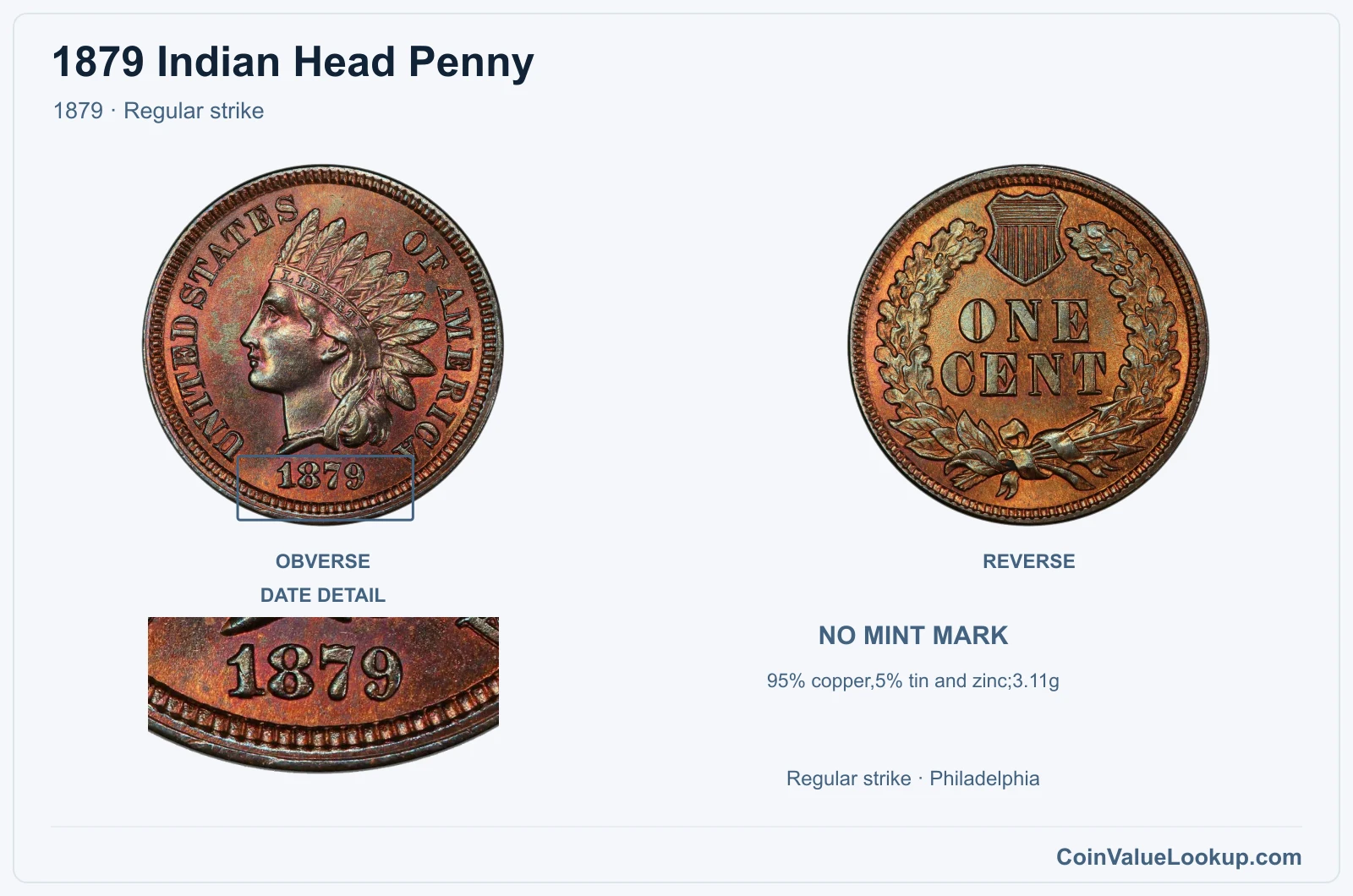
The standard 1879 Indian Head cent is a Philadelphia business strike on a bronze planchet — 95% copper with 5% tin and zinc, weighing 3.11 grams. No mintmark appears on legitimate examples.
USA Coin Book lists retail guide values from about $12 in Good-4 to $207 in MS63.
Condition drives everything here. A well-circulated brown example is affordable and common.
Push into uncirculated territory with original surfaces and remaining copper color, and the price climbs quickly. Cleaned or corroded coins trade well below guide figures regardless of technical grade.
Compare your coin's wear honestly to grading references before borrowing price numbers from higher tiers.
| Range | Grade | Price | Auction Records | Appraisal |
|---|---|---|---|---|
| PO | PO 1 | — | Coin Identifier | |
| FR | FR 2 | — | Coin Identifier | |
| AG | AG 3 | — | Coin Identifier | |
| G | G 4 | — | Coin Identifier | |
| G 6 | — | Coin Identifier | ||
| VG | VG 8 | Coin Identifier | ||
| VG 10 | — | Coin Identifier | ||
| F | F 12 | — | Coin Identifier | |
| F 15 | — | Coin Identifier | ||
| VF | VF 20 | — | Coin Identifier | |
| VF 25 | — | Coin Identifier | ||
| VF 30 | — | Coin Identifier | ||
| VF 35 | Coin Identifier | |||
| XF | XF 40 | Coin Identifier | ||
| XF 45 | Coin Identifier | |||
| AU | AU 50 | Coin Identifier | ||
| AU 53 | Coin Identifier | |||
| AU 55 | Coin Identifier | |||
| AU 58 | Coin Identifier | |||
| MS | MS 60 | Coin Identifier | ||
| MS 61 | Coin Identifier | |||
| MS 62 | Coin Identifier | |||
| MS 63 | Coin Identifier | |||
| MS 64 | Coin Identifier | |||
| MS 65 | Coin Identifier | |||
| MS 66 | — | Coin Identifier | ||
| MS 67 | — | — | — | |
| MS 68 | — | — | — | |
| MS 69 | — | — | — | |
| MS 70 | — | — | — |
1879 Indian Head Penny — PR
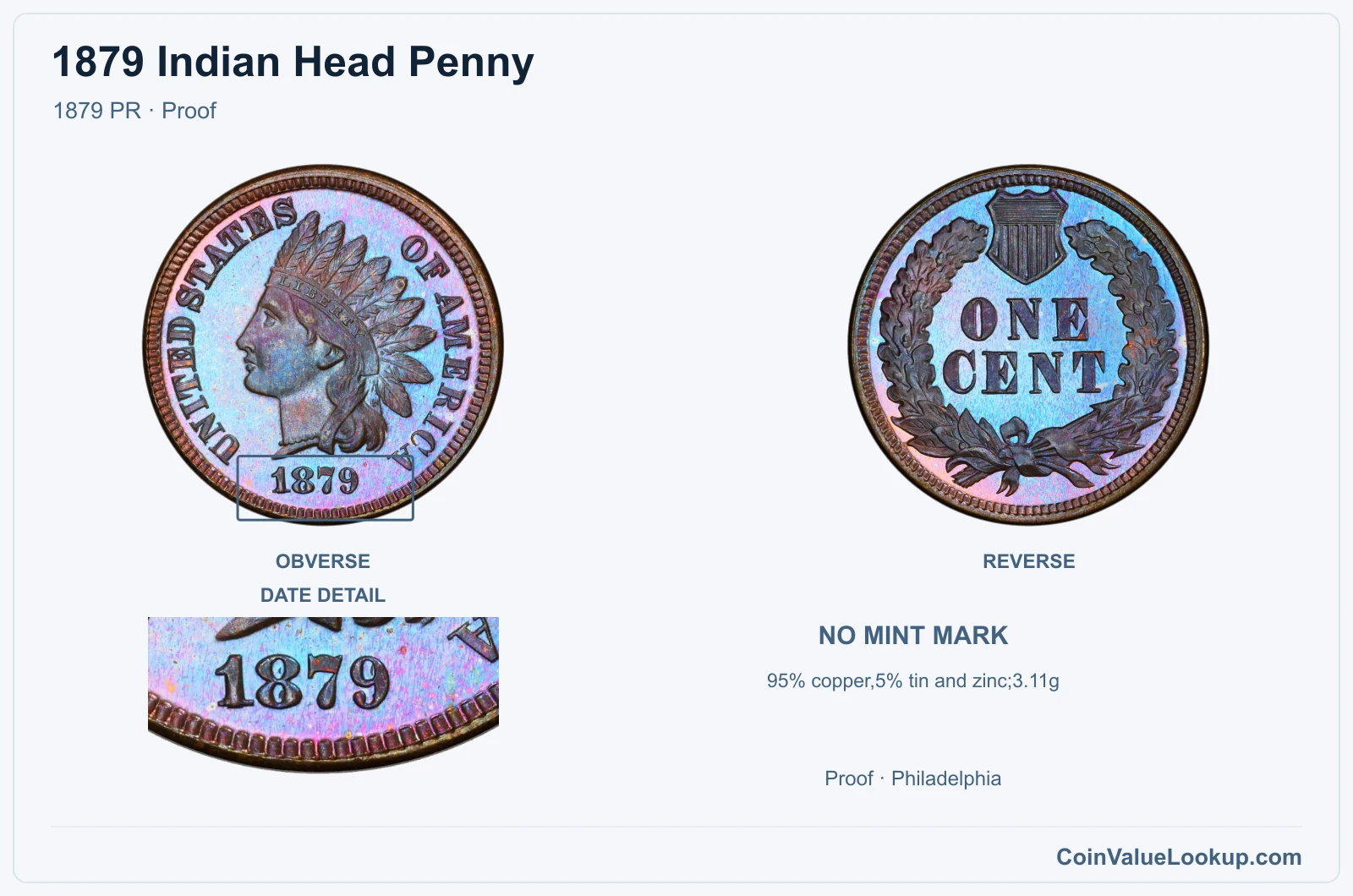
The 1879 proof Indian Head cent was struck on the same bronze composition as regular issues — 95% copper, 5% tin and zinc at 3.11 grams — but with specially prepared dies and planchets at Philadelphia. USA Coin Book places the PR63 guide estimate around $313.
Identifying a genuine proof requires more than a shiny surface. Look for squared-off, knife-sharp rims and fully mirrored fields with sharp, frosted design elements.
The strike quality is typically superior to business issues. A polished circulation coin will still show rounded rims and die characteristics inconsistent with proof manufacture.
If you are unsure, professional third-party authentication is the safest route.
Coin Value Lookup is a good place to start when you want to look up guide values for other dates in the Indian Head series or compare across denominations before sending a coin off for certification.
| Range | Grade | Price | Auction Records | Appraisal |
|---|---|---|---|---|
| PR | PR 1 | — | Coin Identifier | |
| PR 2 | — | Coin Identifier | ||
| PR 3 | — | Coin Identifier | ||
| PR 4 | — | Coin Identifier | ||
| PR 6 | — | Coin Identifier | ||
| PR 8 | — | Coin Identifier | ||
| PR 10 | — | Coin Identifier | ||
| PR 12 | — | Coin Identifier | ||
| PR 15 | — | Coin Identifier | ||
| PR 20 | — | Coin Identifier | ||
| PR 25 | — | Coin Identifier | ||
| PR 30 | — | Coin Identifier | ||
| PR 35 | — | Coin Identifier | ||
| PR 40 | — | Coin Identifier | ||
| PR 45 | — | Coin Identifier | ||
| PR 50 | — | Coin Identifier | ||
| PR 53 | — | Coin Identifier | ||
| PR 55 | — | Coin Identifier | ||
| PR 58 | — | Coin Identifier | ||
| PR 60 | — | Coin Identifier | ||
| PR 61 | — | Coin Identifier | ||
| PR 62 | Coin Identifier | |||
| PR 63 | Coin Identifier | |||
| PR 64 | Coin Identifier | |||
| PR 65 | Coin Identifier | |||
| PR 66 | Coin Identifier | |||
| PR 67 | — | Coin Identifier | ||
| PR 68 | — | — | — | |
| PR 69 | — | — | — | |
| PR 70 | — | — | — |
1879 Indian Head Penny Error List
1. 1879 Indian Head Penny — Repunched Date
A repunched date on the 1879 Indian cent shows remnants of an earlier date-punch impression sitting slightly offset from the final numerals. You might see faint ghost digits — particularly doubling on the 1, 8, 7, or 9 — peeking out beside or below the primary date.
This is a die variety created during manufacture when the date punch was applied more than once in slightly different positions.
Do not confuse this with machine doubling, which produces flat, shelf-like distortion across the entire design rather than isolated extra impressions at the date. Likewise, a damaged or corroded date area can mimic a repunch to the untrained eye.
Genuine repunched dates have sharp, raised secondary impressions consistent across multiple examples from the same die.
No specific price range is adopted here. Value depends on the clarity of the repunching, the coin's overall grade, and authentication by a recognized grading service.
2. 1879 Indian Head Penny — Die Crack
Die cracks appear as thin, raised lines running across the coin's surface — through the field, across lettering, or along design elements. On an 1879 Indian cent, you might spot one crossing the obverse portrait or trailing across the reverse wreath.
These form when the steel die develops stress fractures during use, and the crack fills with metal during striking.
The key diagnostic: the line is raised, not incised. A scratch or scrape cuts into the surface and sits below the surrounding metal.
Corrosion lines tend to be irregular and pitted. Machine-caused contact marks are usually random.
A die crack follows a consistent path and appears in the same location on every coin struck from that cracked die.
Pricing depends on the crack's length, location, and the coin's condition. No adopted price range exists for this category; individual assessment by an authenticated example is the appropriate approach.
3. 1879 Indian Head Penny — Die Break / Cud
A die break — often called a cud when it connects to the rim — occurs when a chunk of the die physically breaks away. The result on the coin is a raised, featureless blob of metal where design detail should be.
On an 1879 Indian cent, a cud typically appears as a smooth lump along the rim that obliterates part of the legend or border.
Interior die breaks that do not reach the rim also exist. These show up as raised irregular areas within the design field.
Either way, the displaced area will feel raised and lack normal design detail.
Do not confuse a cud with a rim dent or ding, which is post-strike damage that pushes metal inward rather than raising it. Corrosion blisters and small die chips can also mimic a break but lack the distinct boundary and scale of a true cud.
No specific price range is adopted; value depends on the break's size, location, visual impact, and the coin's authenticated grade.