1881 Indian Head Penny Coin Value: How Much Is It Worth?
The 1881 Indian Head penny is a straightforward Philadelphia issue that collectors encounter regularly. Selected guide values for ordinary circulated-to-uncirculated examples run from about $6.25 at G4 to $112 at MS63, based on USA Coin Book retail estimates.
Proofs, major varieties, and mint errors require separate evaluation, and these figures are not guaranteed offers.
Fast Way to Identify Your 1881 Indian Head Penny
Want a quick read on what you have? Upload clear photos of both the front and back of your 1881 Indian Head cent for a preliminary identification.
Good lighting and a steady shot help distinguish surface details, color, and any unusual features that might affect which branch your coin falls into.
1881 Indian Head Penny Value
Upload both sides of your 1881 Indian Head Penny.
Front Obverse
Upload photo
Back Reverse
Upload photo
Which 1881 Indian Head Penny Versions Are Worth Money?
- A standard 1881 business strike in MS63 condition lists around $112 in the USA Coin Book guide — original surfaces and remaining color matter at this level.
- An 1881 proof in PR63 condition lists around $313, but confirming genuine proof manufacture is essential before applying proof pricing.
- Repunched date varieties exist for this year and can carry a premium depending on authenticated identity, visibility, and condition.
- Die breaks, cuds, and die chips are reported for the 1881 date and may add collector interest when clearly visible and properly attributed.
Step 1: Identify Your 1881 Indian Head Penny Mint Mark and Version
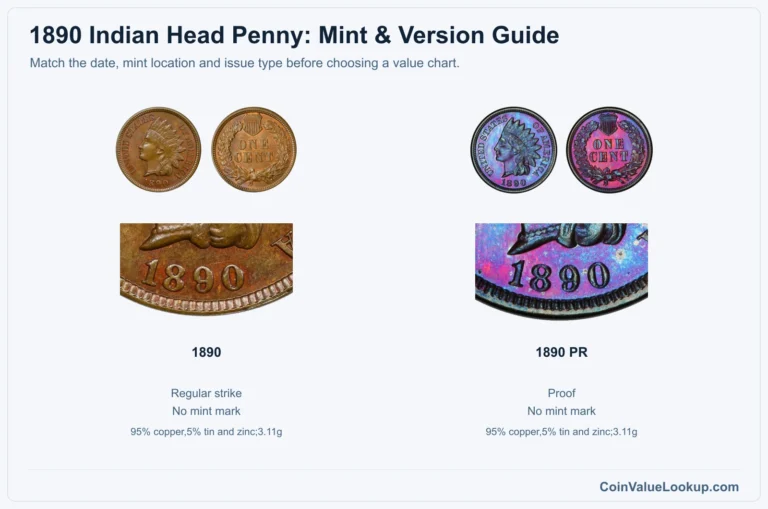
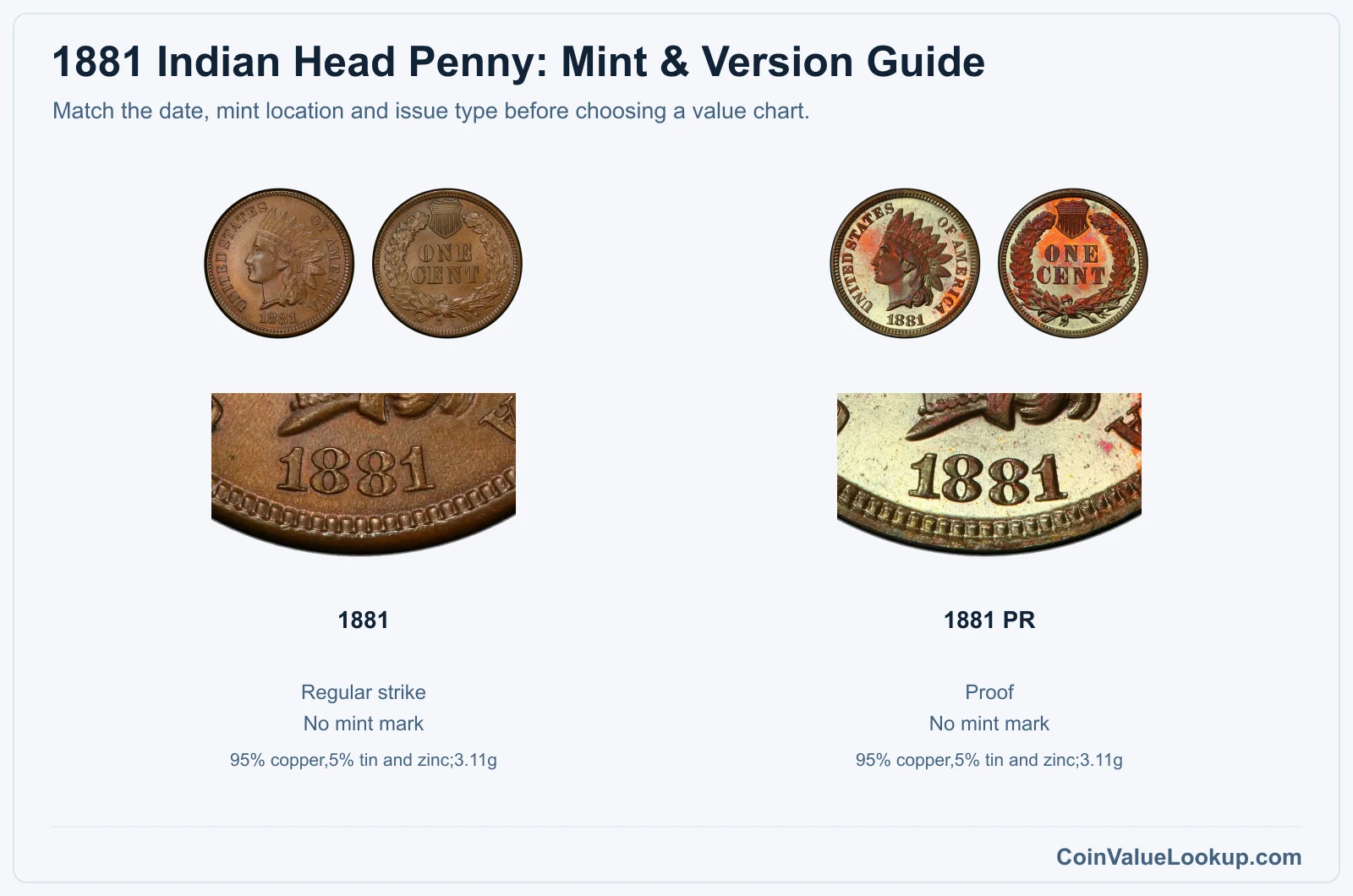
Every regular 1881 Indian Head cent was struck at the Philadelphia Mint. There is no mintmark on this coin, and the small "L" on the ribbon behind the neck is a designer's initial, not a mint identifier.
The obverse shows the familiar Indian portrait with a feathered headdress, while the reverse features an oak wreath surrounding a shield.
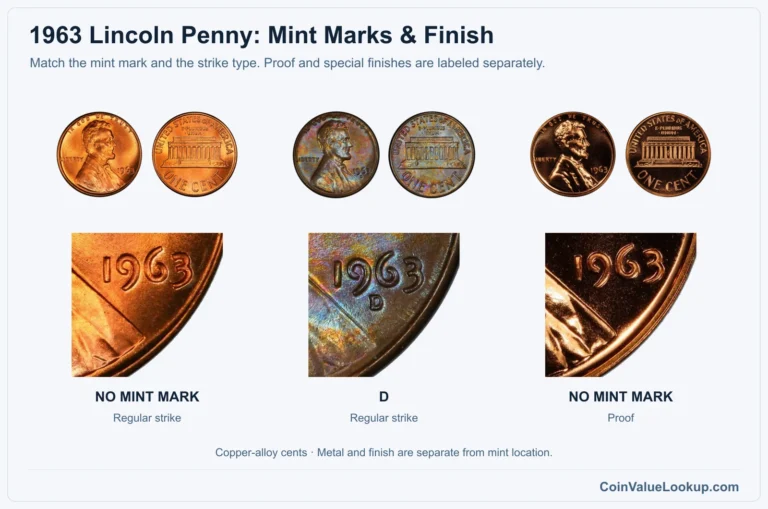
Before you look up any price, determine whether your coin is a standard business strike or a specially manufactured proof. Proof coins were made with polished dies and planchets for collectors, and they have a distinct mirrored surface and sharp rim geometry.
A business strike that someone has polished to a shine is not a proof, no matter how reflective it looks.
Also note the alloy. By 1881 the series had long since switched to bronze (95% copper, 5% tin and zinc, weighing 3.11 grams).
If your coin weighs around 4.67 grams, you may be looking at an earlier copper-nickel issue from 1859–1864, which is a different animal entirely.
Step 2: Check Your 1881 Indian Head Penny Grade
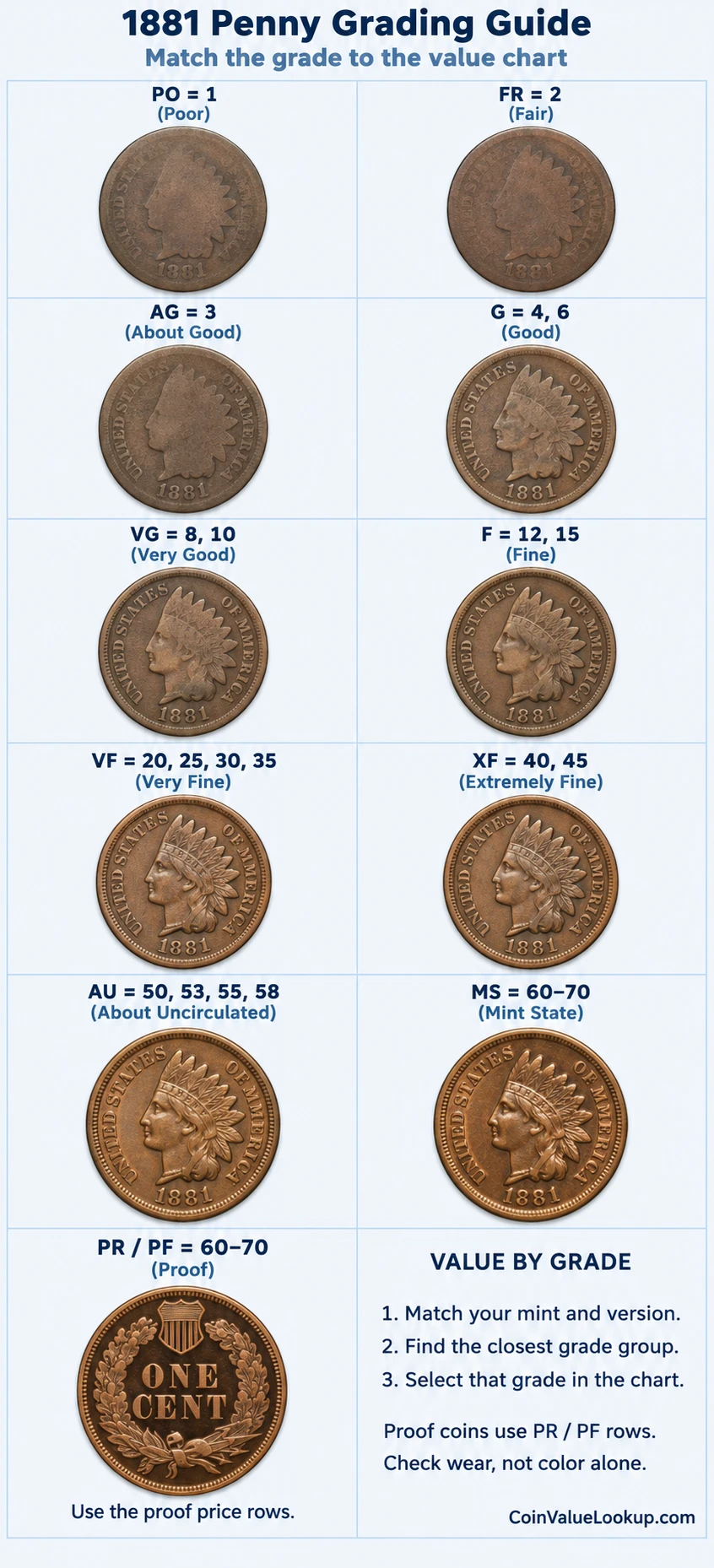
Start with the word LIBERTY on the headband. On a well-worn coin, these letters fade progressively; a G4 example may show only partial outlines.
Move to the feather tips above the headband, the hair curls behind the ear, and the cheek — these are the first high points to lose sharpness from circulation.
On the reverse, check the wreath leaves and the shield detail. Flat, mushy leaves paired with a smooth shield suggest heavy wear.
Here is the tricky part: some 1881 cents left the mint with a soft strike, especially in the feather and hair areas. A weak strike can mimic wear if you are not careful.
Look at the overall luster and surface flow before downgrading based on one soft spot. Compare your coin against the grading comparison image to see how detail loss progresses across grades.
Bronze color designations (BN, RB, RD) describe how much original copper-red color remains. These are color labels, not separate materials.
A full red (RD) coin retains most of its original mint luster and color, while a brown (BN) coin has toned naturally over time. Cleaning, corrosion, or environmental damage can hurt marketability regardless of the technical grade.
Step 3: Check 1881 Indian Head Penny Value by Mint and Version
1881 Indian Head Penny
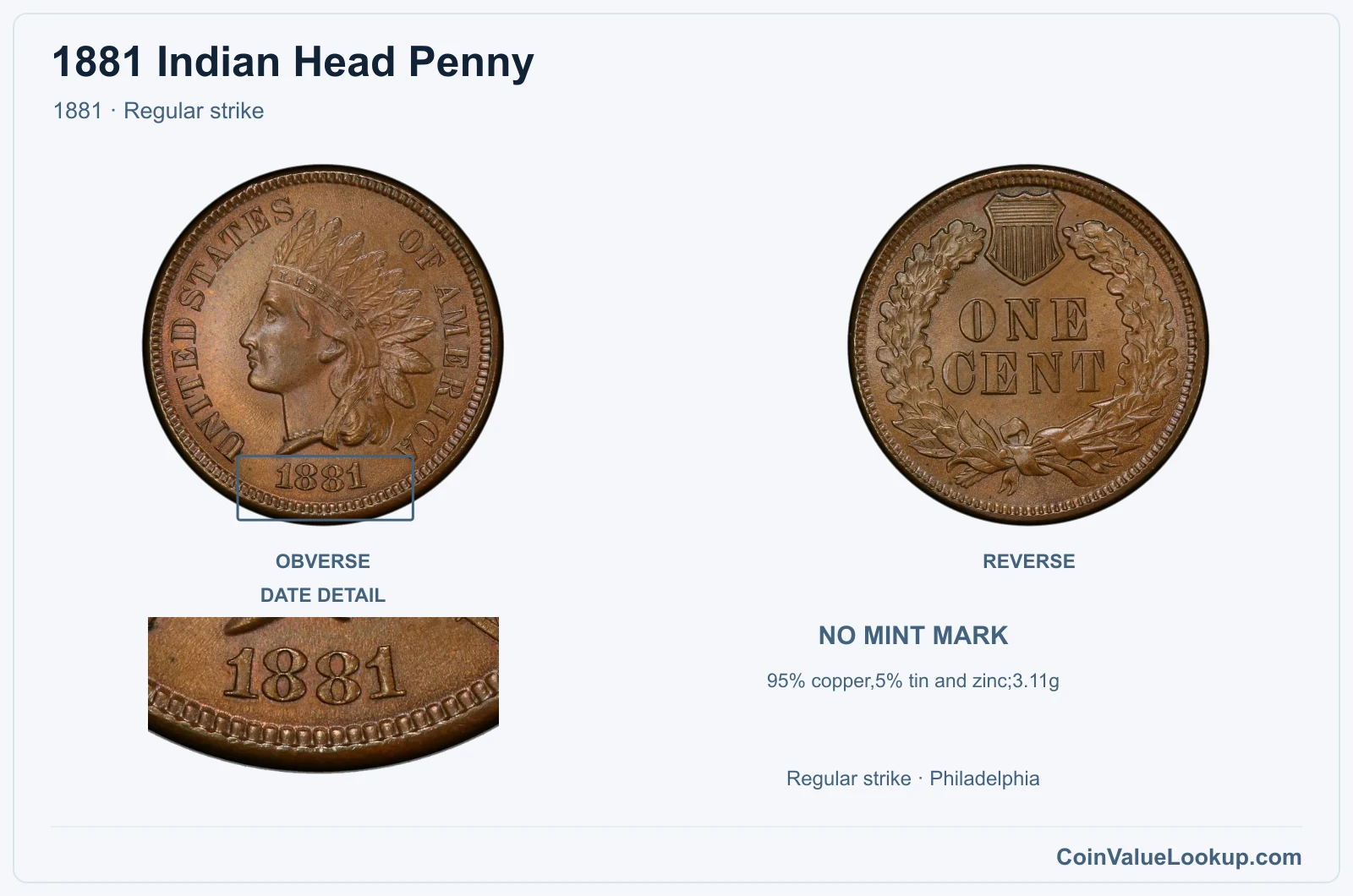
The standard 1881 Indian Head cent is a Philadelphia business strike in bronze, weighing 3.11 grams. There is no mintmark.
USA Coin Book lists a retail estimate of about $6.25 in G4 and around $112 in MS63.
Condition and originality drive most of the value here. A coin with full, undisturbed luster and remaining red-copper color will appeal to collectors far more than one that has been cleaned or shows environmental damage.
Compare like grades and original surfaces when evaluating your piece — do not borrow pricing from rare varieties or proofs.
| Range | Grade | Price | Auction Records | Appraisal |
|---|---|---|---|---|
| PO | PO 1 | — | Coin Identifier | |
| FR | FR 2 | — | Coin Identifier | |
| AG | AG 3 | Coin Identifier | ||
| G | G 4 | — | Coin Identifier | |
| G 6 | — | Coin Identifier | ||
| VG | VG 8 | — | Coin Identifier | |
| VG 10 | — | Coin Identifier | ||
| F | F 12 | — | Coin Identifier | |
| F 15 | Coin Identifier | |||
| VF | VF 20 | — | Coin Identifier | |
| VF 25 | — | Coin Identifier | ||
| VF 30 | — | Coin Identifier | ||
| VF 35 | — | Coin Identifier | ||
| XF | XF 40 | — | Coin Identifier | |
| XF 45 | Coin Identifier | |||
| AU | AU 50 | Coin Identifier | ||
| AU 53 | — | Coin Identifier | ||
| AU 55 | Coin Identifier | |||
| AU 58 | Coin Identifier | |||
| MS | MS 60 | Coin Identifier | ||
| MS 61 | — | Coin Identifier | ||
| MS 62 | Coin Identifier | |||
| MS 63 | Coin Identifier | |||
| MS 64 | Coin Identifier | |||
| MS 65 | Coin Identifier | |||
| MS 66 | Coin Identifier | |||
| MS 67 | — | — | — | |
| MS 68 | — | — | — | |
| MS 69 | — | — | — | |
| MS 70 | — | — | — |
1881 Indian Head Penny — PR
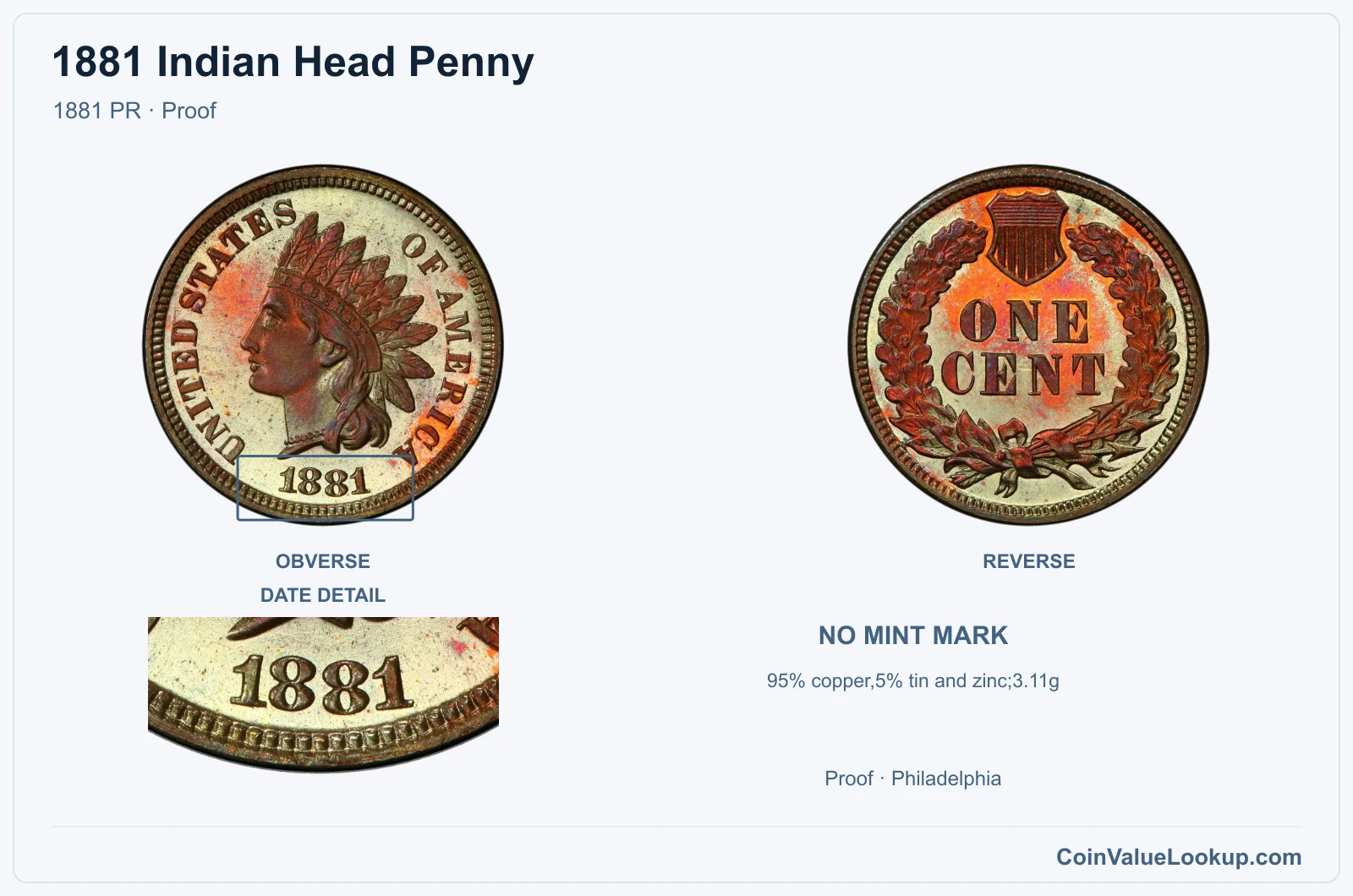
The 1881 proof Indian Head cent was a limited collector issue, also struck at Philadelphia with no mintmark, using the same bronze composition. USA Coin Book lists a PR63 example at approximately $313.
Proof status is a manufacturing method, not a grade above mint state. Genuine proofs show mirrored fields, squared-off rims, and exceptionally sharp detail from specially prepared dies and planchets.
If your coin simply looks shiny from polishing, that is not proof manufacture.
Coin Value Lookup can help you explore guides for other dates and denominations in the Indian Head cent series if you want to compare values across years.
Verify proof surfaces, rim geometry, and overall manufacturing character before applying proof pricing. Third-party authentication is the safest route for confirming a coin's proof origin.
| Range | Grade | Price | Auction Records | Appraisal |
|---|---|---|---|---|
| PR | PR 1 | — | Coin Identifier | |
| PR 2 | — | Coin Identifier | ||
| PR 3 | — | Coin Identifier | ||
| PR 4 | — | Coin Identifier | ||
| PR 6 | — | Coin Identifier | ||
| PR 8 | — | Coin Identifier | ||
| PR 10 | — | Coin Identifier | ||
| PR 12 | — | Coin Identifier | ||
| PR 15 | — | Coin Identifier | ||
| PR 20 | — | Coin Identifier | ||
| PR 25 | — | Coin Identifier | ||
| PR 30 | — | Coin Identifier | ||
| PR 35 | — | Coin Identifier | ||
| PR 40 | — | Coin Identifier | ||
| PR 45 | — | Coin Identifier | ||
| PR 50 | — | Coin Identifier | ||
| PR 53 | — | Coin Identifier | ||
| PR 55 | — | Coin Identifier | ||
| PR 58 | — | Coin Identifier | ||
| PR 60 | — | Coin Identifier | ||
| PR 61 | — | Coin Identifier | ||
| PR 62 | Coin Identifier | |||
| PR 63 | Coin Identifier | |||
| PR 64 | Coin Identifier | |||
| PR 65 | Coin Identifier | |||
| PR 66 | Coin Identifier | |||
| PR 67 | Coin Identifier | |||
| PR 68 | — | — | — | |
| PR 69 | — | — | — | |
| PR 70 | — | — | — |
1881 Indian Head Penny Error List
1. 1881 Indian Head Penny — Repunched Date
A repunched date on an 1881 Indian Head cent shows remnants of an earlier date-punch position alongside the final numerals. Look closely at each digit — you may see doubling, offset shadows, or partial extra impressions that do not align perfectly with the finished date.
This is a die variety created during the manufacturing process when the date punch was applied more than once in slightly different positions. It is distinct from mechanical doubling of the entire design, which is a strike anomaly and generally less collectible.
Watch out for lookalikes. A damaged date from a hit or scratch can mimic a repunch, and machine doubling tends to produce flat, shelf-like images rather than the rounded secondary impressions of a true repunched date.
Value depends on the specific variety, its visibility, and the coin's overall condition, so individual assessment by an authenticated attribution service is the reliable path.
2. 1881 Indian Head Penny — Die Crack
Die cracks appear as thin, raised lines running across the coin's field or through design elements. On an 1881 Indian Head cent, you might see one crossing a letter, cutting through the wreath, or trailing from the rim inward.
These lines are raised because metal fills the crack in the working die during striking.
To confirm a die crack, note where it starts and where it ends. Genuine cracks follow a consistent raised profile.
A scratch, by contrast, is incuse — it digs into the surface rather than rising above it. Corrosion lines and displaced-metal scrapes can also fool you, so check with magnification.
The value of a die crack depends on its prominence, location, and the coin's grade. No fixed price range applies; each piece needs individual evaluation based on the authenticated identity and severity of the crack.
3. 1881 Indian Head Penny — Die Break / Cud
A cud is a specific type of die break where a piece of the die rim has broken away entirely. The result on the coin is a raised, featureless blob connected to the rim, replacing whatever design detail was originally there.
On an 1881 Indian Head cent, a cud might obliterate part of a letter or a section of the wreath near the edge.
Do not confuse a cud with a rim dent or corrosion buildup. A genuine cud is raised, has a distinct boundary where the normal design stops, and connects directly to the rim.
Interior die breaks that do not touch the rim are related but classified separately.
Cuds tend to attract collector attention because they are visually dramatic. Pricing depends on size, location, and overall coin condition, so individual assessment through professional attribution is the way to go.
4. 1881 Indian Head Penny — Die Chip
A die chip shows up as a small, localized raised lump on the coin's surface, usually filling part of a letter, numeral, or nearby open field. On an 1881 Indian Head cent, you might spot one inside the loop of an "8" or within a letter of LIBERTY or the legend.
The key diagnostic is that the surrounding struck detail flows smoothly into the raised lump. The chip results from a tiny piece of the die face breaking away, leaving a void that fills with metal during striking.
Lookalikes include surface gouges, glued debris, or displaced-metal impacts from contact damage. Those tend to disturb the surrounding surface rather than blending into it.
Value varies with the chip's size, position, and the coin's condition, so professional assessment is recommended rather than relying on a fixed price.