1997 Lincoln Penny Coin Value: How Much Is It Worth?
A typical 1997 Lincoln penny in worn condition is worth about one cent. In Mint State 65, a USA Coin Book guide estimate places the no-mintmark and D issues at around $0.36 each, while the 1997-S proof sits near $12.00 at PR65.
The real action is in error coins and the doubled-ear variety, so grab a loupe before you dump that jar of change.
Fast Way to Identify Your 1997 Lincoln Penny
Snap clear, well-lit photos of both the front and back of your 1997 penny and upload them here. Our identifier can give you a preliminary read on mint, finish and obvious variety traits.
It is not a substitute for professional authentication or precise grading, but it is a solid first step toward figuring out what you have.
1997 Penny Value
Upload both sides of your 1997 Lincoln Penny.
Front Obverse
Upload photo
Back Reverse
Upload photo
Which 1997 Lincoln Penny Versions Are Worth Money?
- The 1997 no-mintmark doubled-ear variety shows a second earlobe contour on Lincoln, with lesser doubling in the hair and beard — value depends on authenticated identity and condition.
- The 1997-S proof in PR65 carries a guide estimate around $12.00; higher grades and deep-cameo contrast can shift that number, so confirm finish and color before comparing.
Step 1: Identify Your 1997 Lincoln Penny Mint Mark and Version
The 1997 Lincoln cent uses the familiar Lincoln portrait obverse and Lincoln Memorial reverse with a plain (smooth) edge. It is copper-plated zinc, weighing a nominal 2.50 g, with 97.5 percent zinc and 2.5 percent copper overall.
A copper color does not mean it is a solid-copper coin.
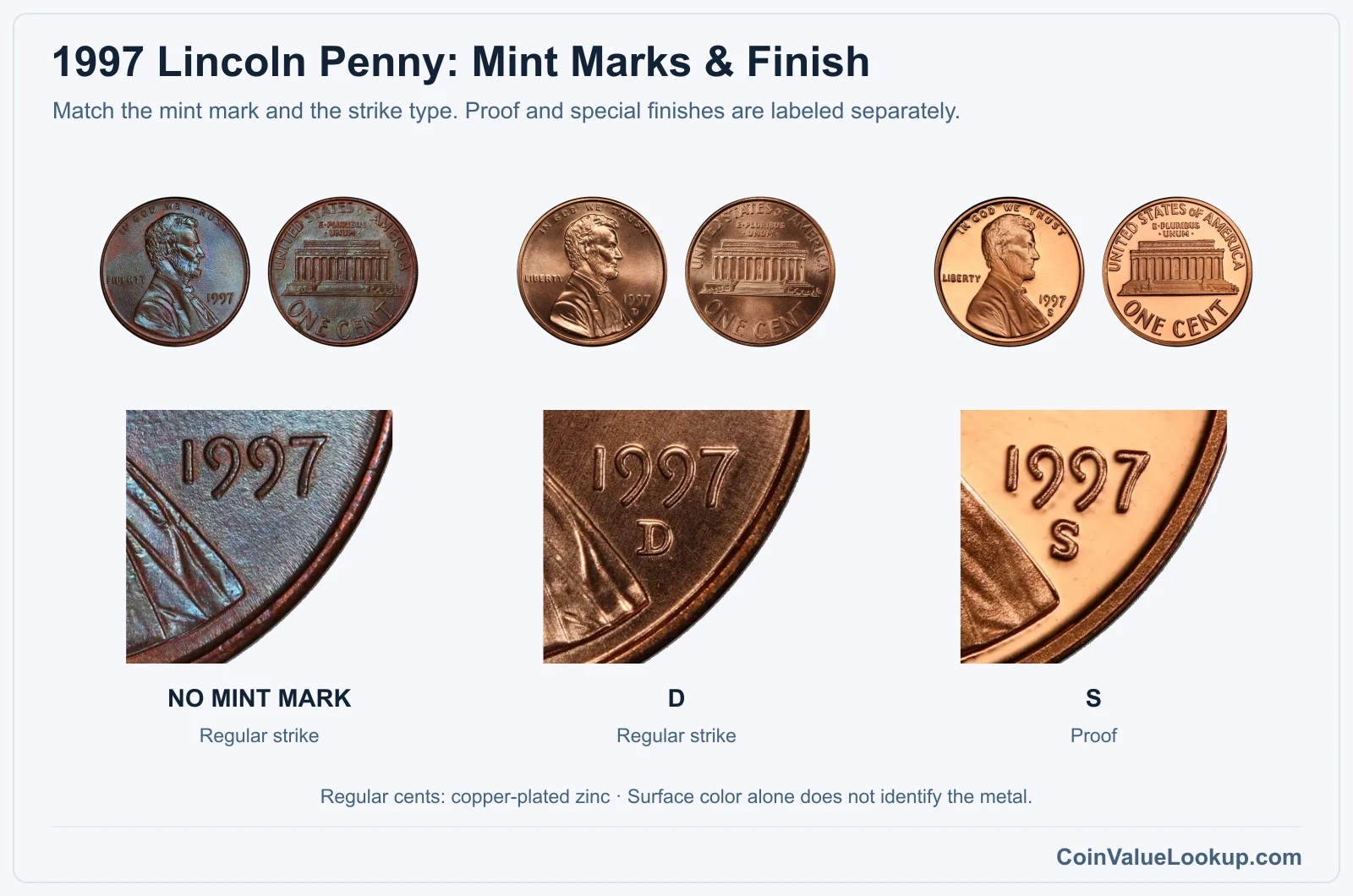
Three regular branches exist: the Philadelphia issue (no mintmark), the Denver issue (D mintmark) and the San Francisco proof (S mintmark). The mintmark sits below the date on the obverse.
There is no normal P-letter or S-letter circulation issue for this year.
Color designations like BN, RB and RD describe how much original copper luster remains. Cameo and Deep Cameo labels apply to proof contrast.
These are filters for comparison, not separate alloys. Do not confuse a no-mintmark business strike with a rare proof omission based on the absence of a letter alone.
Step 2: Check Your 1997 Lincoln Penny Grade
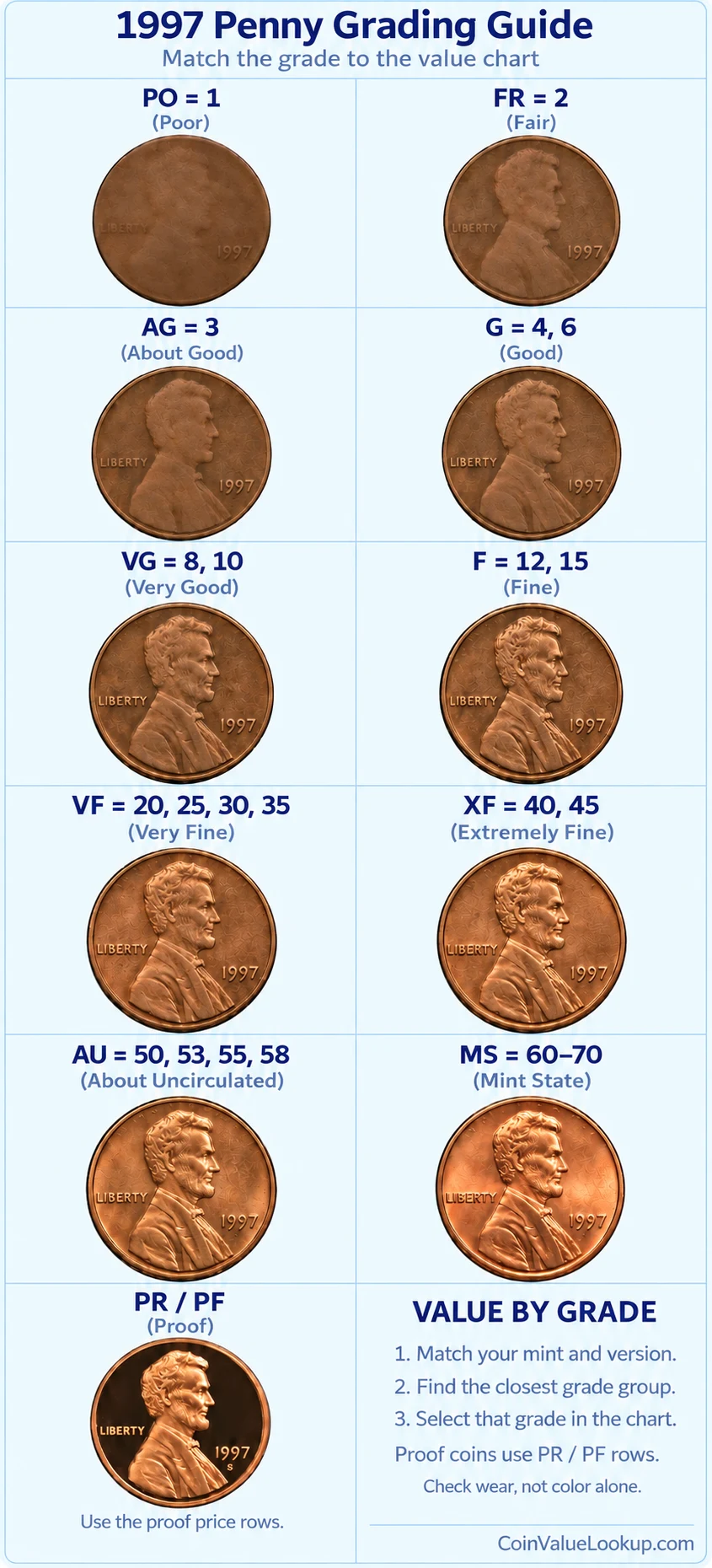
Focus on the high points first. On the obverse, check Lincoln's cheekbone, jawline and hair detail above the ear.
On the reverse, look at the roof line and the tops of the columns on the Memorial. These are the first areas to lose sharpness as the coin circulates.
Grade through remaining luster, contact marks and actual wear rather than copper color alone. A bright red coin with a big scratch is not automatically worth more than a brown coin with clean surfaces.
Plating splits, bubbles, corrosion spots and signs of cleaning are surface problems, not varieties. An exposed zinc patch where the copper layer has broken down does not create a premium by itself.
Use the comparison image to match your coin's wear level against known grade examples for this type.
Step 3: Check 1997 Lincoln Penny Value by Mint and Version
1997 Lincoln Penny
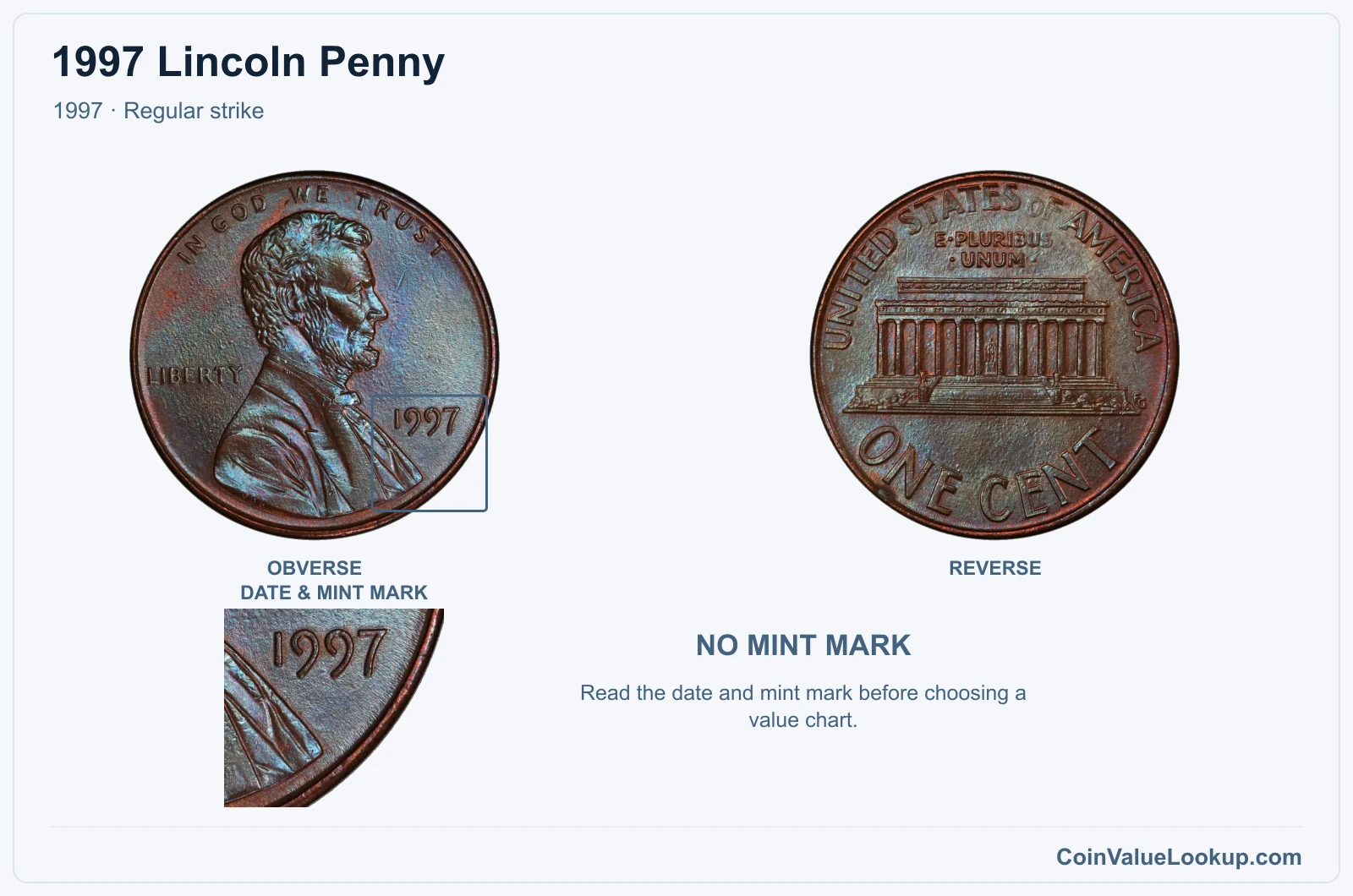
The 1997 Philadelphia cent has no mintmark and is the most common branch you will find in pocket change. It is copper-plated zinc at a nominal 2.50 g.
In circulated condition it is worth face value. At MS65, the USA Coin Book guide estimate is $0.36.
When evaluating one of these, match the grade, the amount of original copper color remaining and the overall surface condition. A nice red example with no marks will always outperform a spotted or corroded coin at the same technical grade.
| Range | Grade | Price | Auction Records | Appraisal |
|---|---|---|---|---|
| PO | PO 1 | — | Coin Identifier | |
| FR | FR 2 | — | Coin Identifier | |
| AG | AG 3 | — | Coin Identifier | |
| G | G 4 | — | Coin Identifier | |
| G 6 | — | Coin Identifier | ||
| VG | VG 8 | — | Coin Identifier | |
| VG 10 | — | Coin Identifier | ||
| F | F 12 | — | Coin Identifier | |
| F 15 | — | Coin Identifier | ||
| VF | VF 20 | — | Coin Identifier | |
| VF 25 | — | Coin Identifier | ||
| VF 30 | — | Coin Identifier | ||
| VF 35 | — | Coin Identifier | ||
| XF | XF 40 | — | Coin Identifier | |
| XF 45 | — | Coin Identifier | ||
| AU | AU 50 | — | Coin Identifier | |
| AU 53 | — | Coin Identifier | ||
| AU 55 | — | Coin Identifier | ||
| AU 58 | — | Coin Identifier | ||
| MS | MS 60 | — | Coin Identifier | |
| MS 61 | — | Coin Identifier | ||
| MS 62 | — | Coin Identifier | ||
| MS 63 | — | Coin Identifier | ||
| MS 64 | — | Coin Identifier | ||
| MS 65 | — | Coin Identifier | ||
| MS 66 | — | Coin Identifier | ||
| MS 67 | — | Coin Identifier | ||
| MS 68 | — | Coin Identifier | ||
| MS 69 | — | — | — | |
| MS 70 | — | — | — |
1997 Lincoln Penny — D
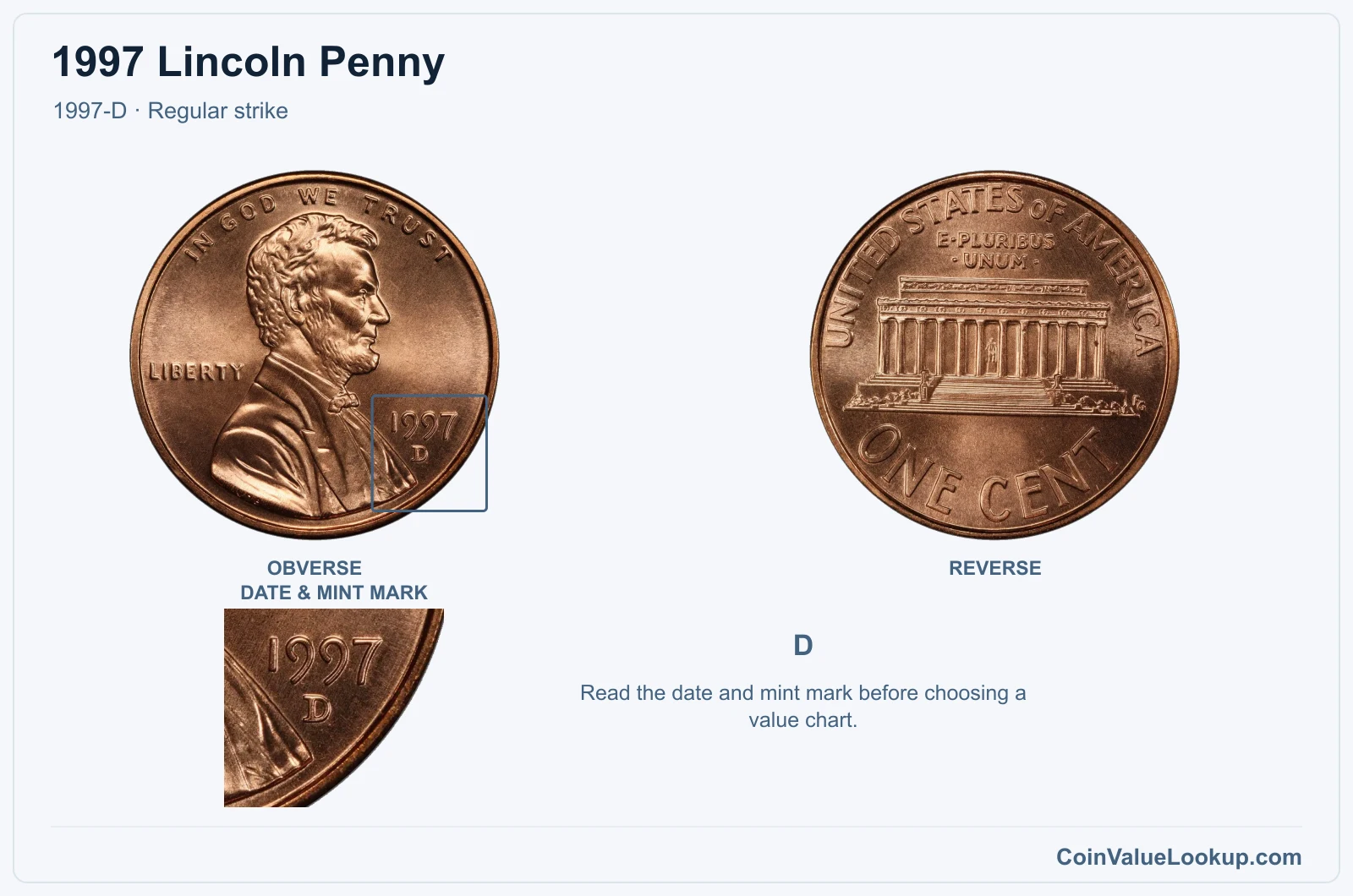
The 1997-D was struck in Denver and carries a small D below the date. Same copper-plated zinc composition, same nominal 2.50 g weight.
At MS65 the guide estimate is $0.36, identical to its Philadelphia sibling.
Circulated examples are worth one cent. If you are searching rolls, look for full luster and clean cheek and jaw detail.
Color and surface quality matter more than the mintmark on common-date cents like this one.
| Range | Grade | Price | Auction Records | Appraisal |
|---|---|---|---|---|
| PO | PO 1 | — | Coin Identifier | |
| FR | FR 2 | — | Coin Identifier | |
| AG | AG 3 | — | Coin Identifier | |
| G | G 4 | — | Coin Identifier | |
| G 6 | — | Coin Identifier | ||
| VG | VG 8 | — | Coin Identifier | |
| VG 10 | — | Coin Identifier | ||
| F | F 12 | — | Coin Identifier | |
| F 15 | — | Coin Identifier | ||
| VF | VF 20 | — | Coin Identifier | |
| VF 25 | — | Coin Identifier | ||
| VF 30 | — | Coin Identifier | ||
| VF 35 | — | Coin Identifier | ||
| XF | XF 40 | — | Coin Identifier | |
| XF 45 | — | Coin Identifier | ||
| AU | AU 50 | — | Coin Identifier | |
| AU 53 | — | Coin Identifier | ||
| AU 55 | — | Coin Identifier | ||
| AU 58 | — | Coin Identifier | ||
| MS | MS 60 | — | Coin Identifier | |
| MS 61 | — | Coin Identifier | ||
| MS 62 | — | Coin Identifier | ||
| MS 63 | — | Coin Identifier | ||
| MS 64 | — | Coin Identifier | ||
| MS 65 | Coin Identifier | |||
| MS 66 | Coin Identifier | |||
| MS 67 | Coin Identifier | |||
| MS 68 | Coin Identifier | |||
| MS 69 | — | Coin Identifier | ||
| MS 70 | — | — | — |
1997 Lincoln Penny — S PR
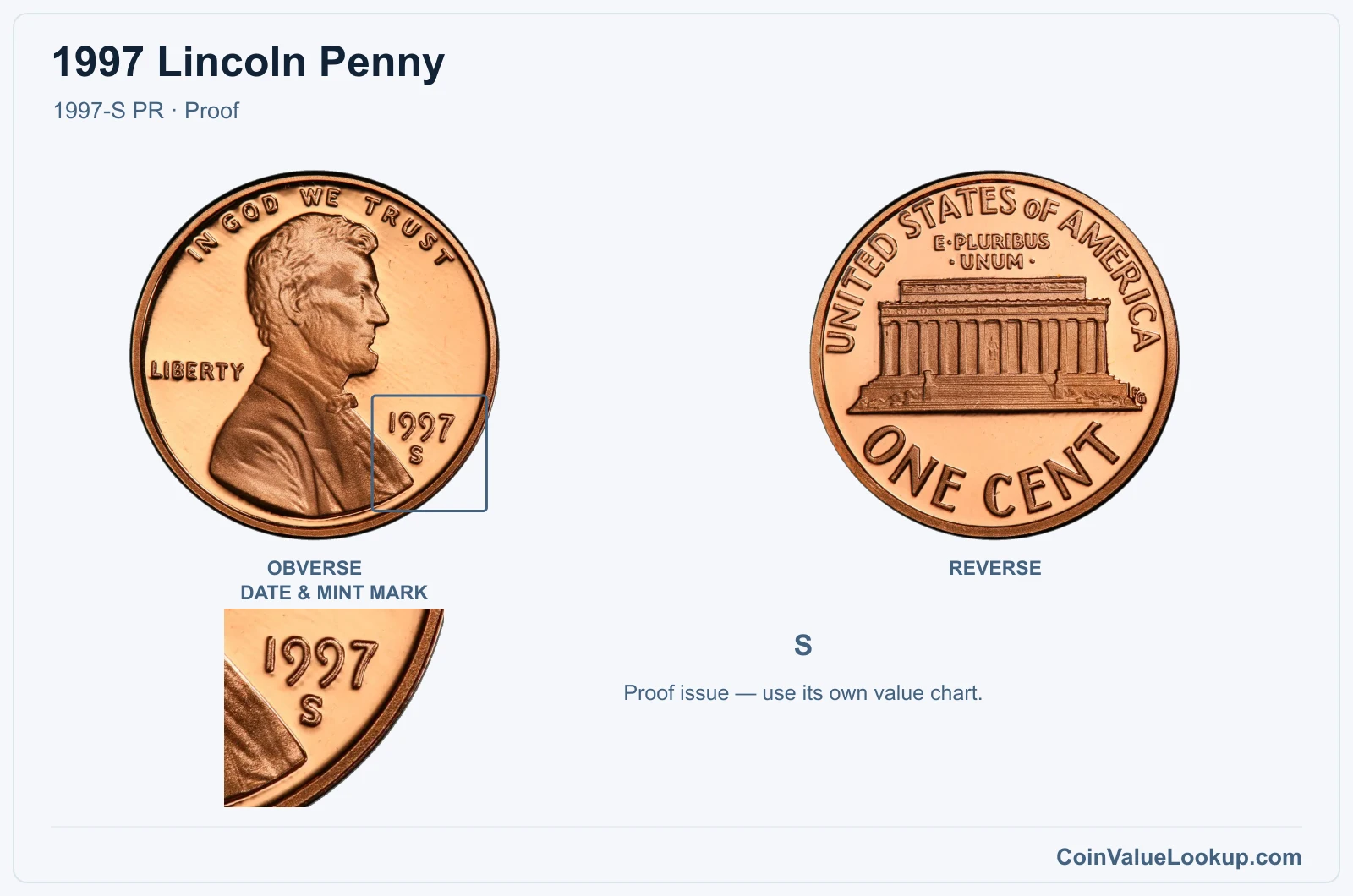
The 1997-S is a proof issue from San Francisco, sold in collector sets rather than released into circulation. It carries the same copper-plated zinc composition.
The USA Coin Book guide estimate at PR65 is $12.00.
Proof is a manufacturing finish, not a grade above Mint State. Keep contrast designations like Cameo or Deep Cameo separate from the numerical grade when comparing values.
Color — whether full red or toned — also affects desirability. If you find one of these loose in a junk drawer, someone probably broke up a proof set years ago.
Coin Value Lookup is a handy place to look up guides for other years and denominations in the Lincoln series if you are working through an inherited collection.
| Range | Grade | Price | Auction Records | Appraisal |
|---|---|---|---|---|
| PR | PR 1 | — | Coin Identifier | |
| PR 2 | — | Coin Identifier | ||
| PR 3 | — | Coin Identifier | ||
| PR 4 | — | Coin Identifier | ||
| PR 6 | — | Coin Identifier | ||
| PR 8 | — | Coin Identifier | ||
| PR 10 | — | Coin Identifier | ||
| PR 12 | — | Coin Identifier | ||
| PR 15 | — | Coin Identifier | ||
| PR 20 | — | Coin Identifier | ||
| PR 25 | — | Coin Identifier | ||
| PR 30 | — | Coin Identifier | ||
| PR 35 | — | Coin Identifier | ||
| PR 40 | — | Coin Identifier | ||
| PR 45 | — | Coin Identifier | ||
| PR 50 | — | Coin Identifier | ||
| PR 53 | — | Coin Identifier | ||
| PR 55 | — | Coin Identifier | ||
| PR 58 | — | Coin Identifier | ||
| PR 60 | Coin Identifier | |||
| PR 61 | — | Coin Identifier | ||
| PR 62 | — | Coin Identifier | ||
| PR 63 | — | Coin Identifier | ||
| PR 64 | — | Coin Identifier | ||
| PR 65 | — | Coin Identifier | ||
| PR 66 | — | Coin Identifier | ||
| PR 67 | — | Coin Identifier | ||
| PR 68 | Coin Identifier | |||
| PR 69 | Coin Identifier | |||
| PR 70 | Coin Identifier |
1997 Lincoln Penny — No Mint Mark — Doubled Ear
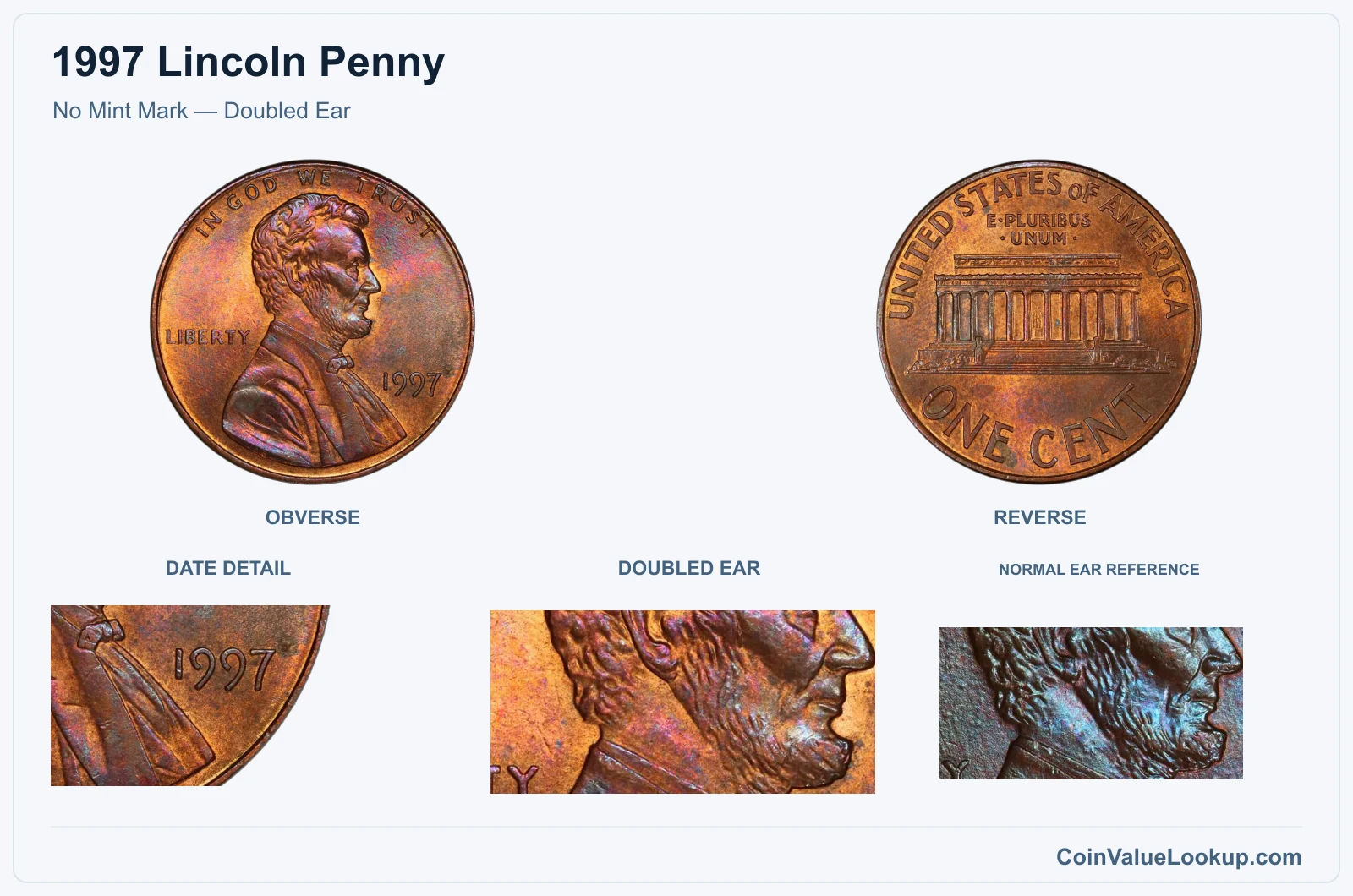
This is the 1997 no-mintmark doubled-ear variety. Look at Lincoln's ear for a second earlobe contour — an extra raised ridge that follows the shape of the original ear.
Lesser doubling also appears in the hair and beard area around and above the ear.
Use a loupe and compare your coin side-by-side with a confirmed attributed example from the same year. A random die chip or a surface dent near the ear is not the same thing.
Genuine doubling will follow a consistent contour.
There is no adopted numerical price range for this variety. Value depends on authenticated identity, the strength of the doubling and overall condition.
Professional attribution from a grading service is the safest route if you believe you have a match.
Range Grade
Price1997 No Mint Mark — Doubled Ear (BN) Price1997 No Mint Mark — Doubled Ear (RB) Price1997 No Mint Mark — Doubled Ear (RD) Auction Records Appraisal PO PO 1
—
Coin Identifier FR FR 2
—
Coin Identifier AG AG 3
—
Coin Identifier G G 4
—
Coin Identifier
G 6
—
Coin Identifier VG VG 8
—
Coin Identifier
VG 10
—
Coin Identifier F F 12
—
Coin Identifier
F 15
—
Coin Identifier VF VF 20
—
Coin Identifier
VF 25
—
Coin Identifier
VF 30
—
Coin Identifier
VF 35
—
Coin Identifier XF XF 40
—
Coin Identifier
XF 45
—
Coin Identifier AU AU 50
—
Coin Identifier
AU 53
—
Coin Identifier
AU 55
—
Coin Identifier
AU 58
—
Coin Identifier MS MS 60
—
—
Coin Identifier
MS 61
—
—
Coin Identifier
MS 62
—
Coin Identifier
MS 63
—
Coin Identifier
MS 64
—
Coin Identifier
MS 65
—
Coin Identifier
MS 66
—
Coin Identifier
MS 67
—
—
Coin Identifier
MS 68
—
—
—
Coin Identifier
MS 69
—
—
—
—
—
MS 70
—
—
—
—
—
1997 Lincoln Penny Error List
1. 1997 Lincoln Penny — Doubled Ear
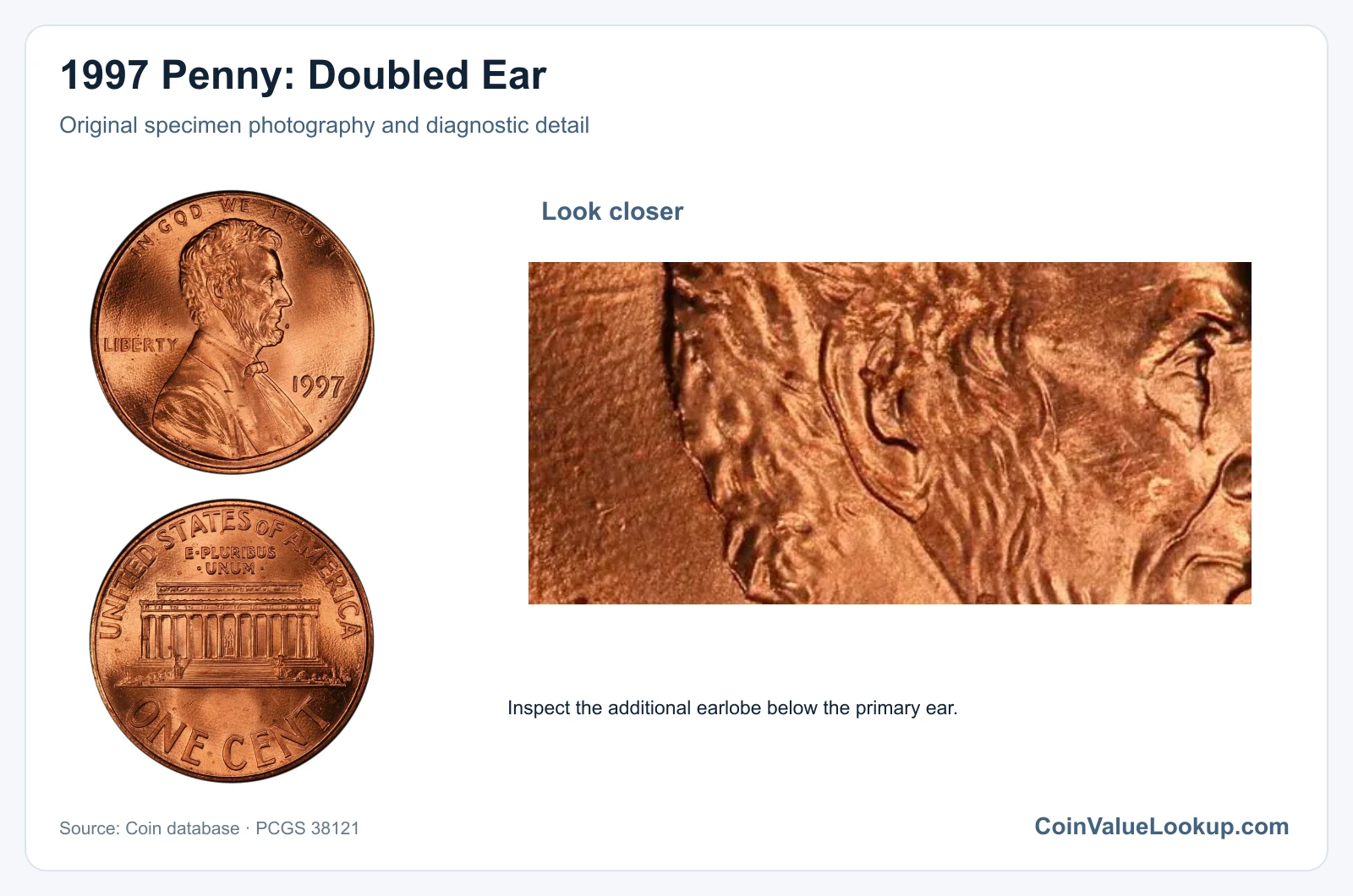
The doubled-ear error on 1997 no-mintmark business cents shows an extra earlobe contour — essentially a second outline of the lower ear. You may also see lesser doubling in the nearby hair and beard detail.
Compare your coin at the same magnification against both a normal 1997 cent and a confirmed attributed example.
The lookalike to watch for is a random die chip or a surface dent that happens to sit near the ear. Genuine doubling traces a consistent contour rather than an irregular blob.
There is no adopted numerical price range for this error. Value depends on authenticated identity, the clarity of the doubling and the coin's overall condition and grade.
2. 1997 Lincoln Penny — Cent Struck over a Dime
A 1997 cent struck over a 1997-P dime is a dramatic wrong-planchet error where an already-struck Roosevelt dime was fed back through the press and received the Lincoln cent dies. Both the cent design and traces of the earlier dime design — Roosevelt's portrait, the torch reverse — survive on the coin.
You need to identify both dates separately.
This is different from a cent struck on a blank dime planchet, which would show only the cent design on a silver-colored blank. It is also not a mule, which pairs two clean die designs.
One NGC MS66 example sold for $1,207.50 in March 2009, but that is a single recorded sale, not a general price range. Condition and the clarity of the surviving host-dime details drive individual value.
3. 1997 Lincoln Penny — Double Strike with Displaced Impression
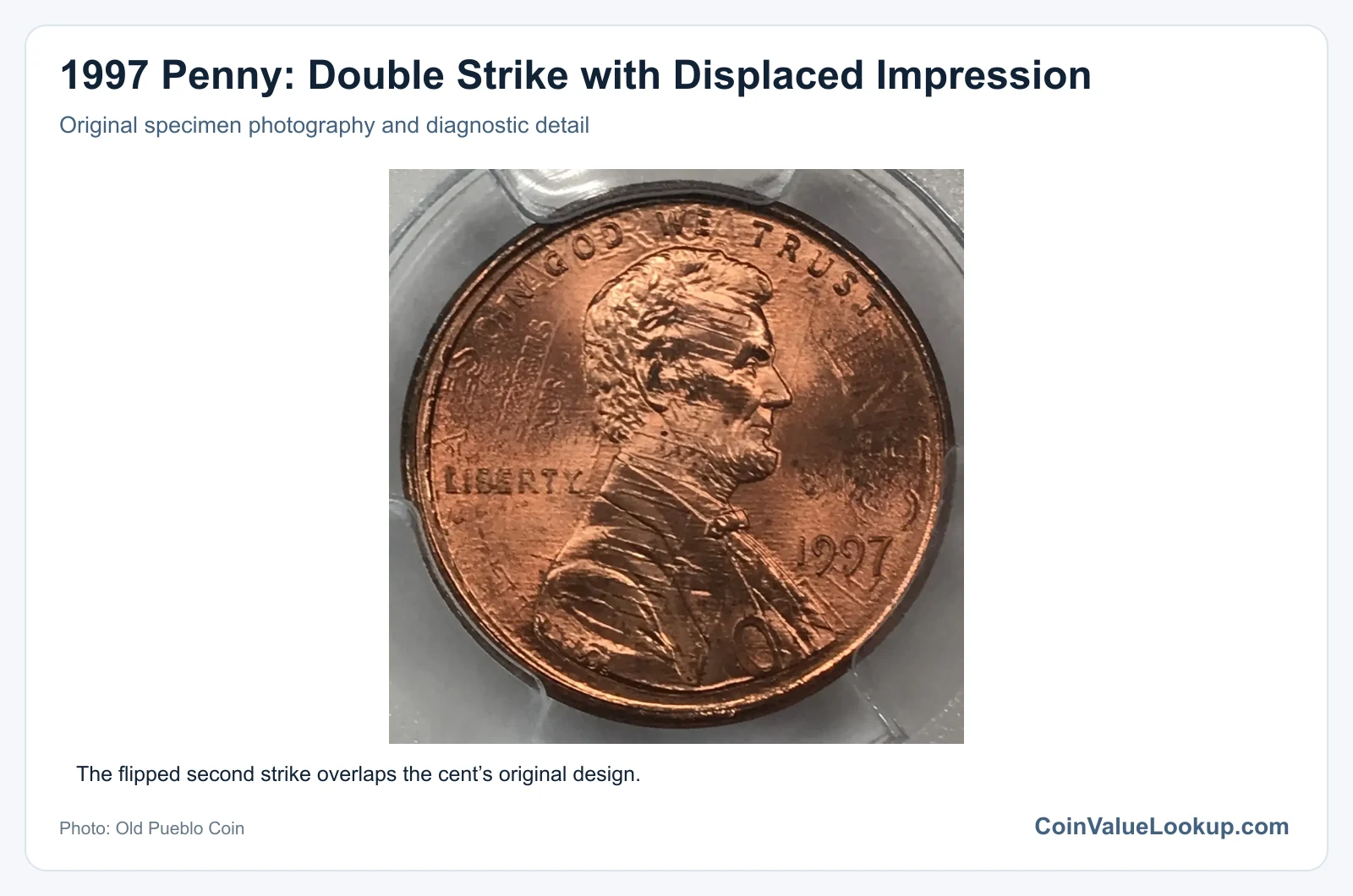
A double-struck 1997 no-mintmark cent with a displaced impression shows two physically separate impressions of the Lincoln design on the same coin. The reported type is a flipover double strike, meaning the coin was flipped between the first and second hits.
Two dates and two overlapping portraits are visible in different positions.
Do not confuse this with a doubled die, which is a single impression from a die that was itself doubled during production. Machine doubling — flat, shelf-like distortion — and vise-made damage from post-mint squeezing are also common lookalikes.
An ANACS MS63 Red example sold for $144 in March 2026, but that single result is not a market range. Grade, color and the degree of displacement all affect individual value.
4. 1997 Lincoln Penny — Off-Center Strike
An off-center strike happens when the planchet is not properly seated between the dies, resulting in a displaced design and an unstruck crescent of blank metal along one edge. The more dramatic the offset, the more visually striking the coin.
The key for collectors is that the date must remain visible. A 50-percent off-center coin with a clear 1997 date is far more desirable than a 10-percent shift.
There is no adopted numerical price for this error on 1997 cents. Condition, the percentage of offset and date visibility all factor into individual assessment.
Do not confuse an off-center strike with a clipped planchet, a one-sided die misalignment or post-mint flattening from a vise or hammer.
5. 1997 Lincoln Penny — BIE Die Break
A BIE die break shows up as a small raised vertical bar or blob between the letters B and E in LIBERTY on the obverse. It is caused by a crack or chip in the die face that fills with metal during striking, leaving a raised mark on the finished coin.
Inspect LIBERTY carefully under magnification. The raised bridge should connect to or sit between B and E with the surrounding surface otherwise normal.
Dirt lodged between letters, a scratch across the field or a piece of added metal can all mimic this error. There is no adopted numerical price for a 1997 BIE.
Value depends on the size and clarity of the break and the coin's overall condition.
6. 1997 Lincoln Penny — Unplated / Partly Unplated Planchet
An unplated or partly unplated 1997 cent is missing some or all of its original copper plating, exposing the gray zinc core underneath. The coin will look silvery or dull gray rather than copper-toned.
Weight and edge examination help confirm whether the plating was absent before striking or lost afterward.
The critical distinction is between a genuine mint error — where the planchet entered the press without full plating — and environmental damage. Chemical stripping, corrosion and deliberate alteration can all remove copper plating after the coin leaves the mint.
A genuine unplated error typically shows clean, sharp design detail on the exposed zinc. There is no adopted numerical price for this error on 1997 cents; individual value depends on condition, the extent of missing plating and authenticated status.
7. 1997 Lincoln Penny — Struck on the Wrong Planchet
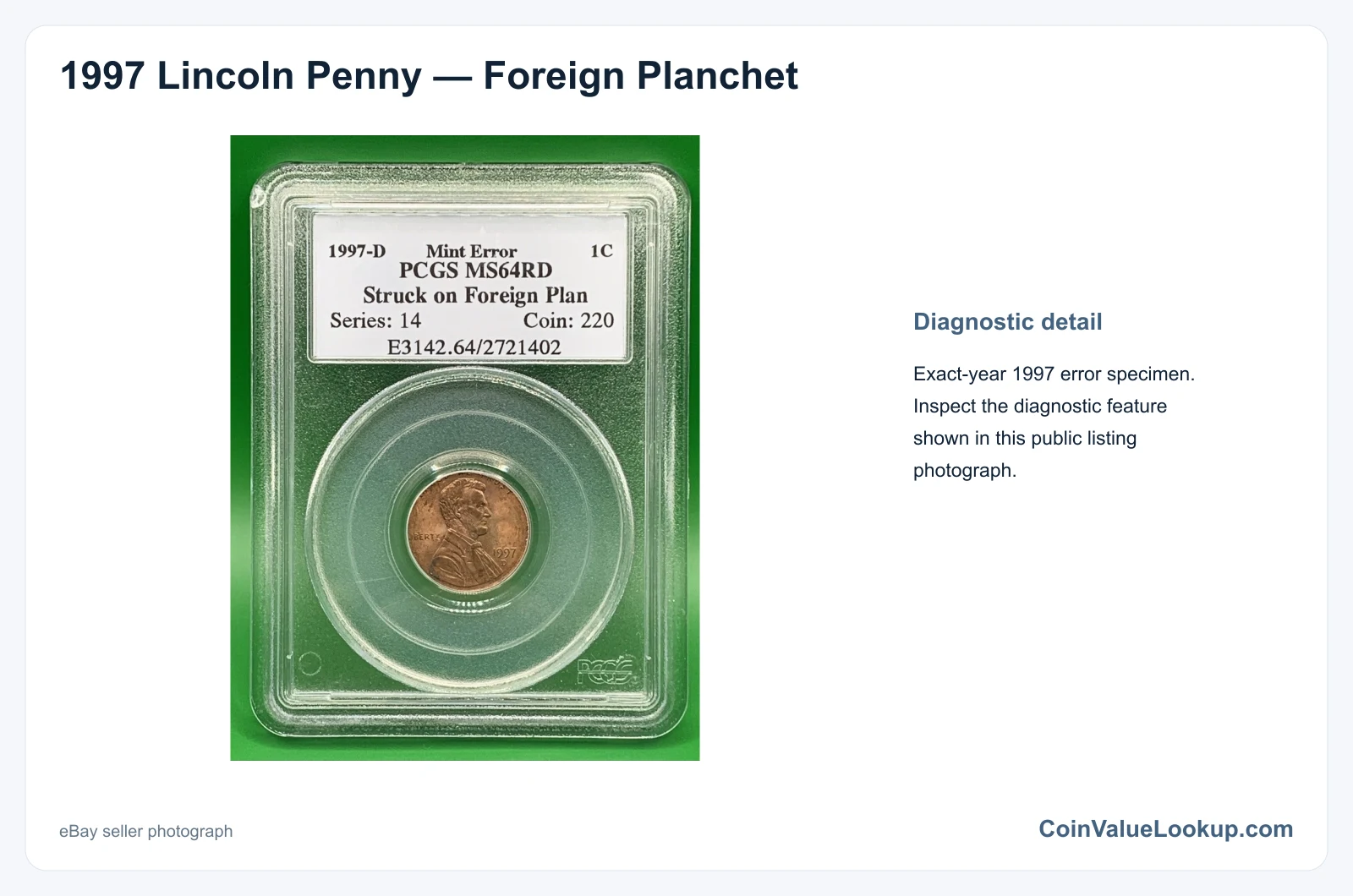
A 1997 cent struck on the wrong planchet means the Lincoln dies struck a blank intended for a different denomination. Compare the coin's weight, diameter and edge to a normal cent (copper-plated zinc, 2.50 g nominal, 19 mm).
If any of those measurements are off, you may have a wrong-planchet error.
This is different from the separate cent-struck-over-a-dime category, where the host was an already struck coin rather than a blank. It is also not the same as a plating anomaly or an intentional size alteration.
There is no adopted numerical price for this error on 1997 cents. Condition and the specific wrong planchet involved drive individual value.
Professional authentication is essential for this type of claim.