2006 Lincoln Penny Coin Value: How Much Is It Worth?
Most 2006 Lincoln pennies you pull from a jar are worth face value — one cent. In uncirculated condition, a regular Philadelphia or Denver example grades around $0.36 at MS65 according to USA Coin Book, while a San Francisco proof runs about $4.96 at PR65.
Special varieties and mint errors occupy their own markets, and values there depend on the specific coin's identity and condition.
Fast Way to Identify Your 2006 Lincoln Penny
Snap a clear photo of both sides of your 2006 penny and upload them here for a preliminary identification. Good lighting and a steady shot help distinguish mintmarks, surface finishes, and potential errors.
This is not a substitute for professional authentication, but it is a solid first step toward understanding what you have.
2006 Penny Value
Upload both sides of your 2006 Lincoln Penny.
Front Obverse
Upload photo
Back Reverse
Upload photo
Which 2006 Lincoln Penny Versions Are Worth Money?
- Clean, original surfaces and strong preservation matter more than which mint struck an ordinary 2006 cent — condition drives value on these common dates.
- San Francisco proofs should be evaluated using proof grades and cameo designations, not circulation-strike standards.
- Satin-finish cents from 2006 Mint Sets are a separate category from regular strikes and need individual assessment based on authenticated identity and condition.
Step 1: Identify Your 2006 Lincoln Penny Mint Mark and Version
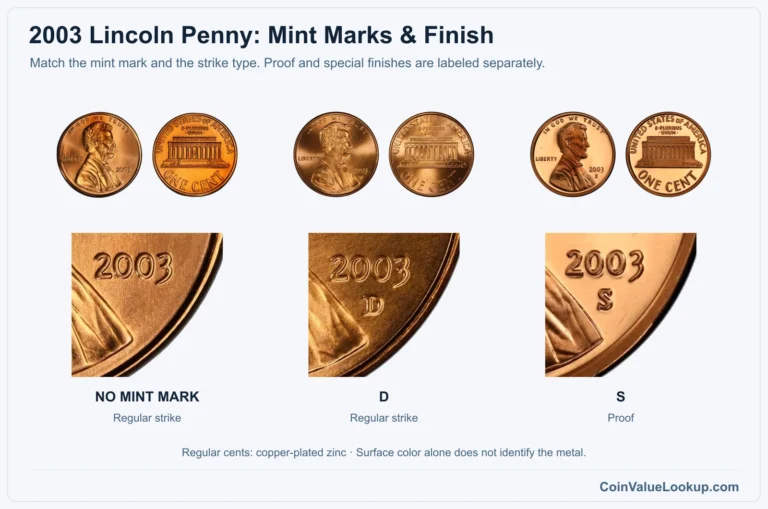
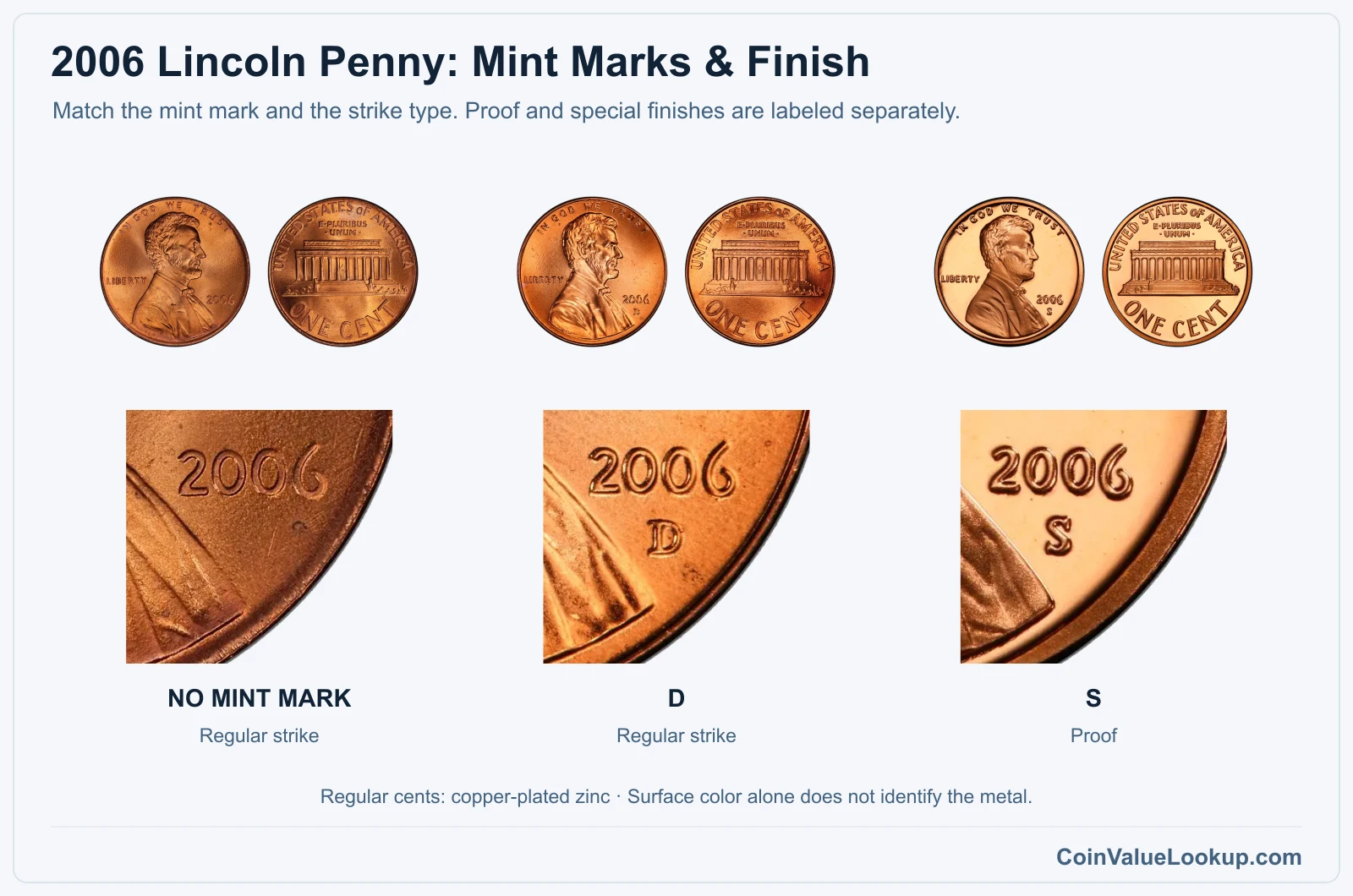
Start by checking below the date on the obverse. No mintmark means Philadelphia.
A small "D" means Denver. An "S" means San Francisco proof.
All standard 2006 cents are copper-plated zinc, weighing about 2.50 grams with a plain edge and 19.05 mm diameter. Color alone — whether bright copper, brown, or something odd — cannot prove a different alloy.
You also need to identify the finish. Regular circulation strikes have a typical luster.
Proofs show mirrored fields and sharply struck devices. Satin-finish coins, issued in 2006 Uncirculated Mint Sets, have a distinctive soft, even sheen that is neither a normal business strike nor a proof.
Mixing up these three categories leads to incorrect comparisons, so get the finish right before anything else.
Step 2: Check Your 2006 Lincoln Penny Grade
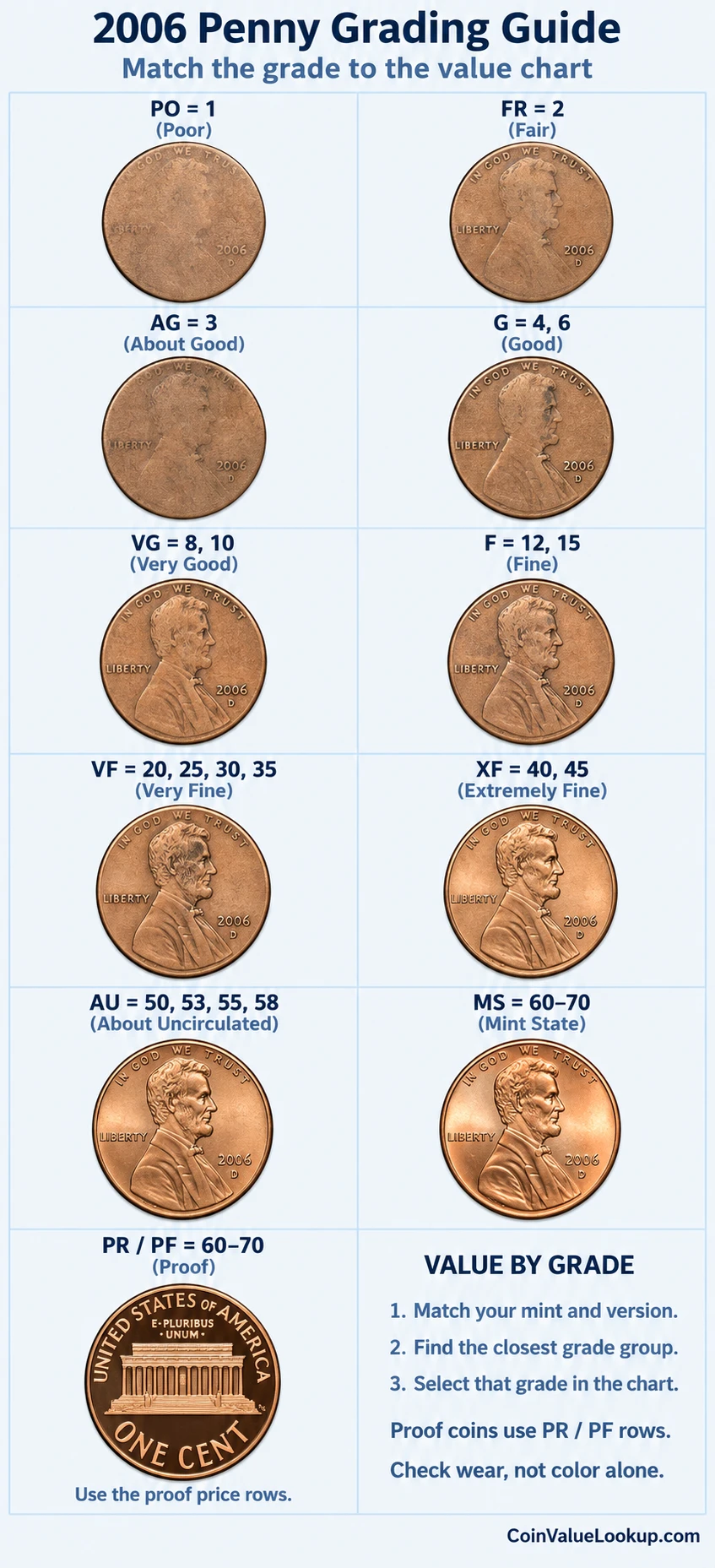
Focus on Lincoln's cheek, jawline, and the hair detail above his ear — those are the first places to lose definition as a coin circulates. On the reverse, check the columns and horizontal lines of the Memorial.
A coin with full detail everywhere and original luster is in the uncirculated range.
Color designations like Red, Red-Brown, and Brown describe how much original copper plating color remains. They are separate from the numerical grade.
A coin can be technically uncirculated but toned brown.
Corrosion spots, cleaning marks, and contact dings all reduce a coin's grade and appeal. Use the comparison image to match your coin's wear against known grade benchmarks.
Even among uncirculated coins, surface quality makes the difference between a common piece and one worth a modest premium.
Step 3: Check 2006 Lincoln Penny Value by Mint and Version
2006 Lincoln Penny
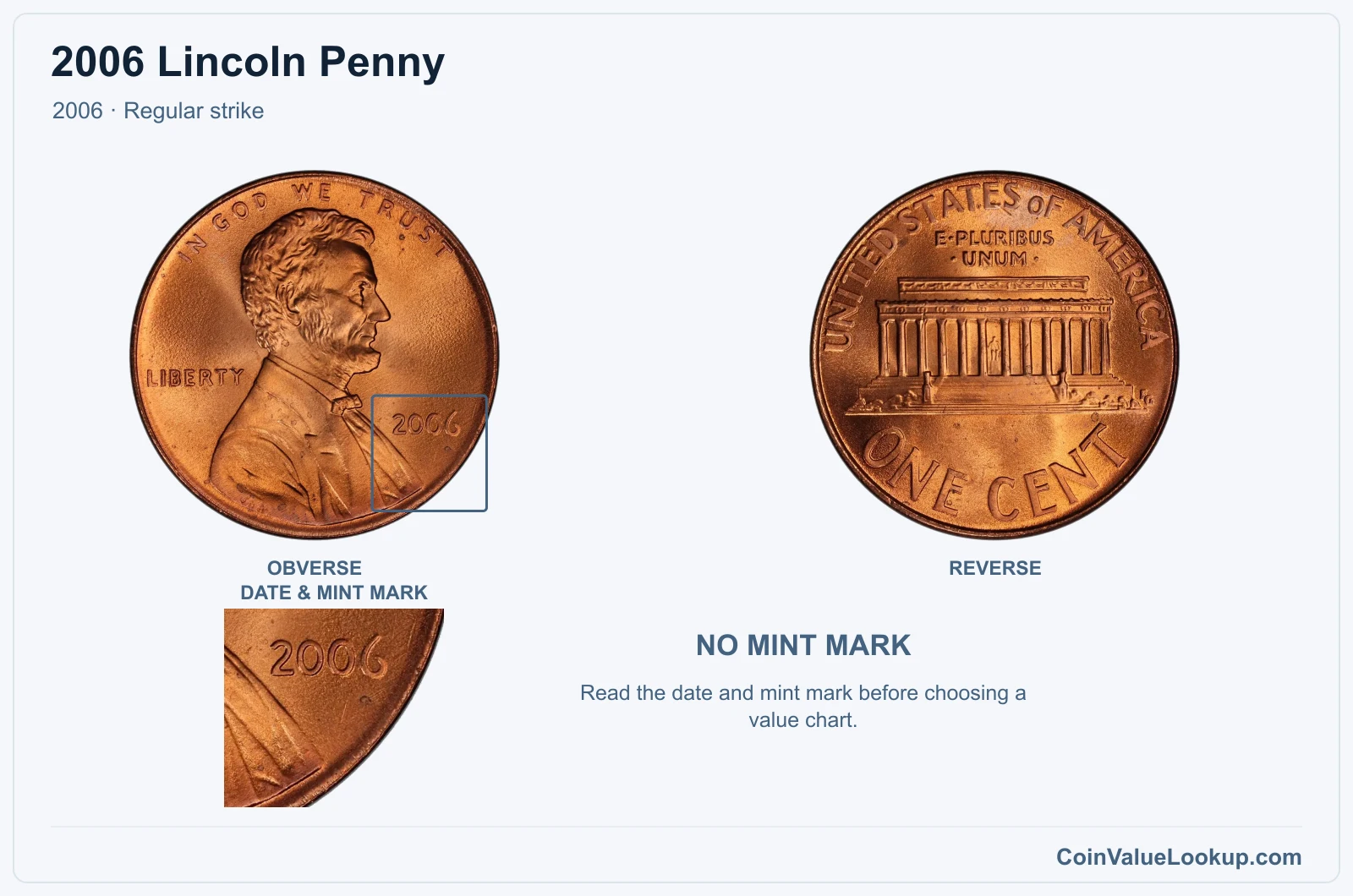
The 2006 Philadelphia cent has no mintmark below the date. It is a regular business strike on copper-plated zinc, weighing about 2.50 grams.
Millions were produced, so circulated examples are worth face value.
At MS65, a USA Coin Book guide estimate is $0.36. Being uncirculated alone does not make this a special coin — you need clean surfaces, strong luster, and minimal contact marks to reach that grade.
Do not confuse a well-preserved circulation strike with the separate satin specimen finish.
| Range | Grade | Price | Auction Records | Appraisal |
|---|---|---|---|---|
| PO | PO 1 | — | Coin Identifier | |
| FR | FR 2 | — | Coin Identifier | |
| AG | AG 3 | — | Coin Identifier | |
| G | G 4 | — | Coin Identifier | |
| G 6 | — | Coin Identifier | ||
| VG | VG 8 | — | Coin Identifier | |
| VG 10 | — | Coin Identifier | ||
| F | F 12 | — | Coin Identifier | |
| F 15 | — | Coin Identifier | ||
| VF | VF 20 | — | Coin Identifier | |
| VF 25 | — | Coin Identifier | ||
| VF 30 | — | Coin Identifier | ||
| VF 35 | — | Coin Identifier | ||
| XF | XF 40 | — | Coin Identifier | |
| XF 45 | — | Coin Identifier | ||
| AU | AU 50 | — | Coin Identifier | |
| AU 53 | — | Coin Identifier | ||
| AU 55 | — | Coin Identifier | ||
| AU 58 | — | Coin Identifier | ||
| MS | MS 60 | — | Coin Identifier | |
| MS 61 | — | Coin Identifier | ||
| MS 62 | — | Coin Identifier | ||
| MS 63 | — | Coin Identifier | ||
| MS 64 | Coin Identifier | |||
| MS 65 | Coin Identifier | |||
| MS 66 | Coin Identifier | |||
| MS 67 | Coin Identifier | |||
| MS 68 | Coin Identifier | |||
| MS 69 | — | — | — | |
| MS 70 | — | — | — |
2006 Lincoln Penny — D
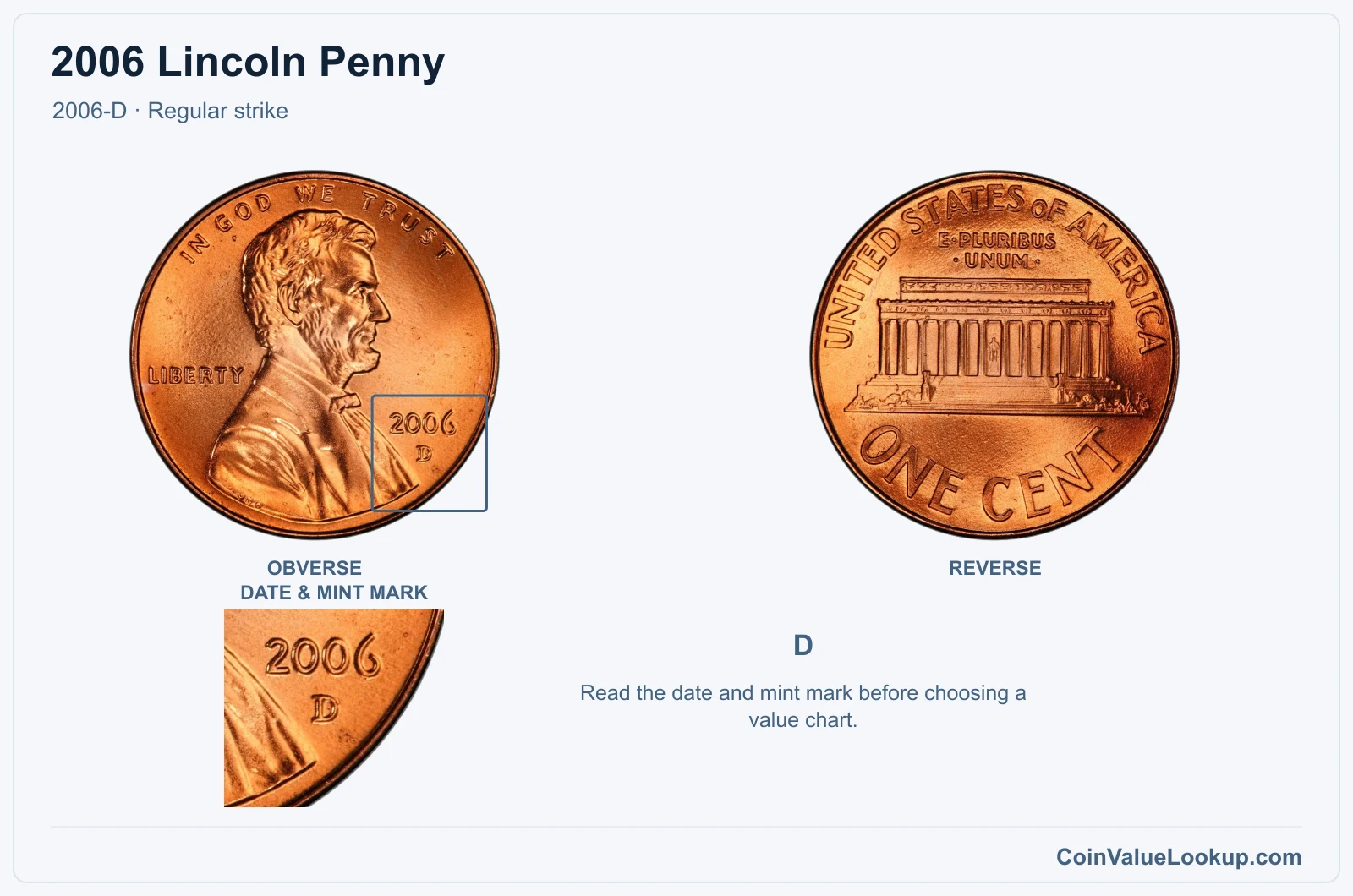
Look for the small "D" mintmark below the date. The 2006-D cent is a Denver business strike, same copper-plated zinc composition and 2.50-gram weight as the Philadelphia issue.
A USA Coin Book guide estimate places MS65 examples at $0.36. In worn condition, it is a one-cent coin.
For any meaningful collector value, you need uncirculated preservation with original color and surfaces free of spots or scratches.
Coin Value Lookup is a useful place to look up guides for other dates and denominations in the Lincoln cent series if you are sorting through a larger group of coins.
| Range | Grade | Price | Auction Records | Appraisal |
|---|---|---|---|---|
| PO | PO 1 | — | Coin Identifier | |
| FR | FR 2 | — | Coin Identifier | |
| AG | AG 3 | — | Coin Identifier | |
| G | G 4 | — | Coin Identifier | |
| G 6 | — | Coin Identifier | ||
| VG | VG 8 | — | Coin Identifier | |
| VG 10 | — | Coin Identifier | ||
| F | F 12 | — | Coin Identifier | |
| F 15 | — | Coin Identifier | ||
| VF | VF 20 | — | Coin Identifier | |
| VF 25 | — | Coin Identifier | ||
| VF 30 | — | Coin Identifier | ||
| VF 35 | — | Coin Identifier | ||
| XF | XF 40 | — | Coin Identifier | |
| XF 45 | — | Coin Identifier | ||
| AU | AU 50 | — | Coin Identifier | |
| AU 53 | — | Coin Identifier | ||
| AU 55 | — | Coin Identifier | ||
| AU 58 | — | Coin Identifier | ||
| MS | MS 60 | — | Coin Identifier | |
| MS 61 | — | Coin Identifier | ||
| MS 62 | — | Coin Identifier | ||
| MS 63 | — | Coin Identifier | ||
| MS 64 | — | Coin Identifier | ||
| MS 65 | Coin Identifier | |||
| MS 66 | — | Coin Identifier | ||
| MS 67 | Coin Identifier | |||
| MS 68 | Coin Identifier | |||
| MS 69 | — | — | — | |
| MS 70 | — | — | — |
2006 Lincoln Penny — S PR
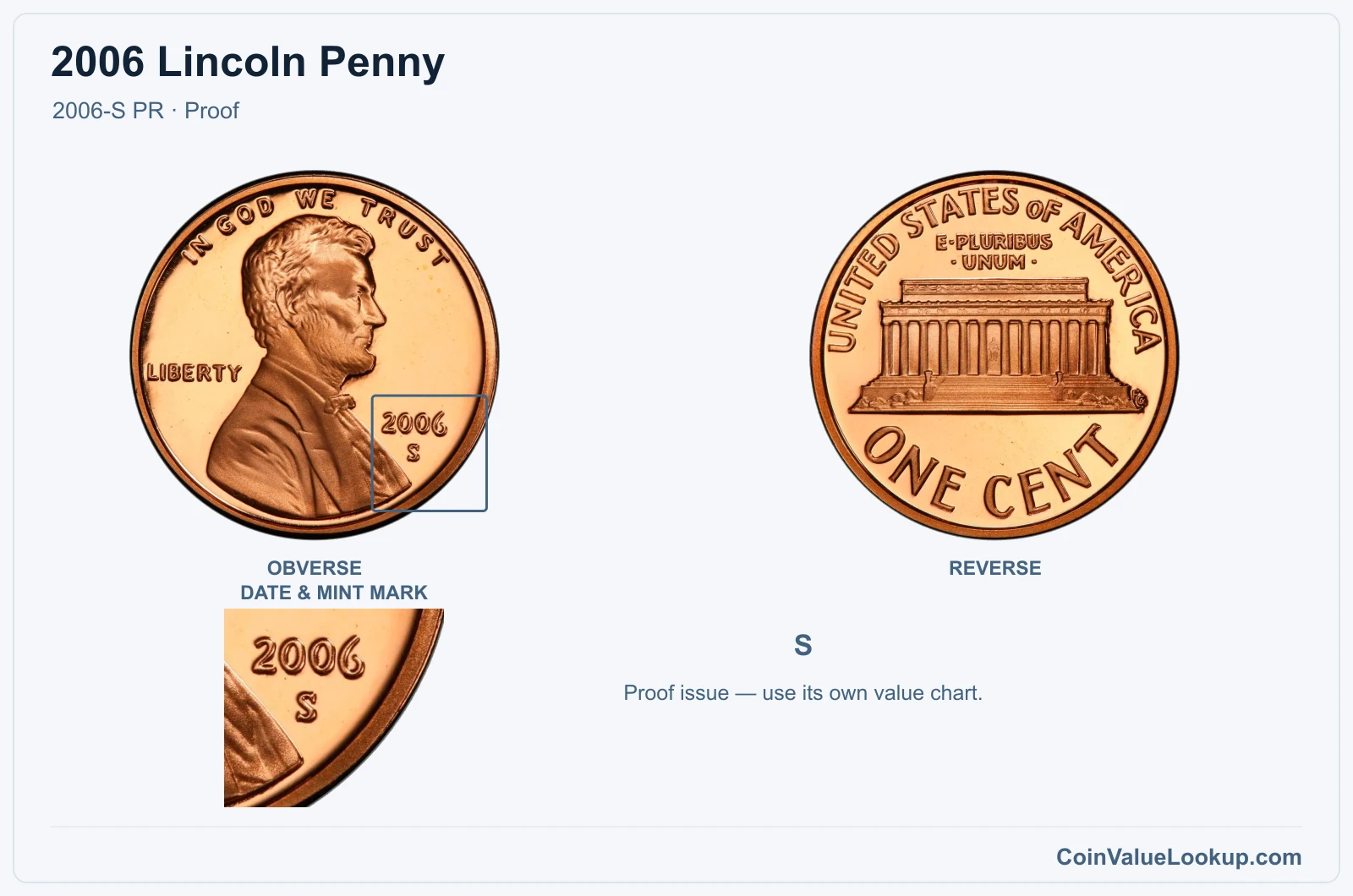
The 2006-S proof was struck at San Francisco and carries an "S" mintmark. Proofs have mirrored fields and crisply defined devices, produced with specially prepared dies and planchets.
A USA Coin Book guide estimate puts the PR65 at $4.96. Cameo and deep cameo designations — describing the contrast between frosted devices and reflective fields — are graded separately and can affect value.
Compare your coin against proof-grade references, not circulation-strike scales. These came in sealed Proof Sets, so most survivors are in excellent condition.
| Range | Grade | Price | Auction Records | Appraisal |
|---|---|---|---|---|
| PR | PR 1 | — | Coin Identifier | |
| PR 2 | — | Coin Identifier | ||
| PR 3 | — | Coin Identifier | ||
| PR 4 | — | Coin Identifier | ||
| PR 6 | — | Coin Identifier | ||
| PR 8 | — | Coin Identifier | ||
| PR 10 | — | Coin Identifier | ||
| PR 12 | — | Coin Identifier | ||
| PR 15 | — | Coin Identifier | ||
| PR 20 | — | Coin Identifier | ||
| PR 25 | — | Coin Identifier | ||
| PR 30 | — | Coin Identifier | ||
| PR 35 | — | Coin Identifier | ||
| PR 40 | — | Coin Identifier | ||
| PR 45 | — | Coin Identifier | ||
| PR 50 | — | Coin Identifier | ||
| PR 53 | — | Coin Identifier | ||
| PR 55 | — | Coin Identifier | ||
| PR 58 | — | Coin Identifier | ||
| PR 60 | — | Coin Identifier | ||
| PR 61 | — | Coin Identifier | ||
| PR 62 | — | Coin Identifier | ||
| PR 63 | — | Coin Identifier | ||
| PR 64 | — | Coin Identifier | ||
| PR 65 | — | Coin Identifier | ||
| PR 66 | — | Coin Identifier | ||
| PR 67 | — | Coin Identifier | ||
| PR 68 | — | Coin Identifier | ||
| PR 69 | Coin Identifier | |||
| PR 70 | Coin Identifier |
2006 Lincoln Penny — Satin Finish SP
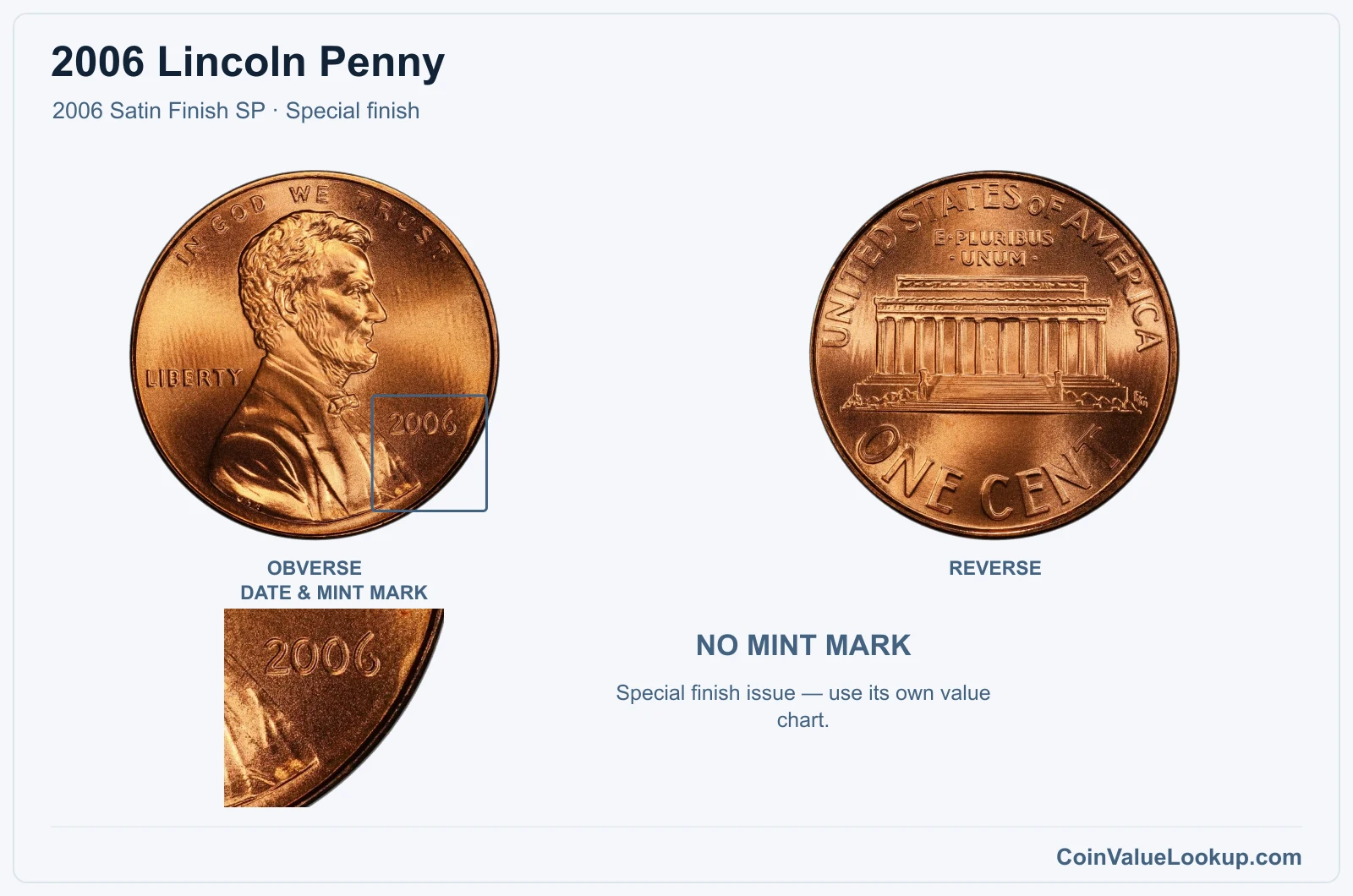
In 2006, the U.S. Mint issued satin-finish cents in its Uncirculated Mint Set. The Philadelphia version has no mintmark, just like the regular business strike, but the surface is distinctly different — a soft, even luster rather than the cartwheel shine of a normal strike or the mirror fields of a proof.
Because satin-finish coins are a separate manufacturing category, they should be evaluated on their own terms. No specific guide price is adopted here; value depends on authenticated identity, the coin's condition, and its surface preservation.
If you have a coin from an original 2006 Mint Set, that context supports the satin identification.
| Range | Grade | Price | Auction Records | Appraisal |
|---|---|---|---|---|
| SP | SP 1 | — | Coin Identifier | |
| SP 2 | — | Coin Identifier | ||
| SP 3 | — | Coin Identifier | ||
| SP 4 | — | Coin Identifier | ||
| SP 6 | — | Coin Identifier | ||
| SP 8 | — | Coin Identifier | ||
| SP 10 | — | Coin Identifier | ||
| SP 12 | — | Coin Identifier | ||
| SP 15 | — | Coin Identifier | ||
| SP 20 | — | Coin Identifier | ||
| SP 25 | — | Coin Identifier | ||
| SP 30 | — | Coin Identifier | ||
| SP 35 | — | Coin Identifier | ||
| SP 40 | — | Coin Identifier | ||
| SP 45 | — | Coin Identifier | ||
| SP 50 | — | Coin Identifier | ||
| SP 53 | — | Coin Identifier | ||
| SP 55 | — | Coin Identifier | ||
| SP 58 | — | Coin Identifier | ||
| SP 60 | — | Coin Identifier | ||
| SP 61 | — | Coin Identifier | ||
| SP 62 | — | Coin Identifier | ||
| SP 63 | — | Coin Identifier | ||
| SP 64 | — | Coin Identifier | ||
| SP 65 | — | Coin Identifier | ||
| SP 66 | Coin Identifier | |||
| SP 67 | Coin Identifier | |||
| SP 68 | Coin Identifier | |||
| SP 69 | Coin Identifier | |||
| SP 70 | Coin Identifier |
2006 Lincoln Penny — D Satin Finish SP
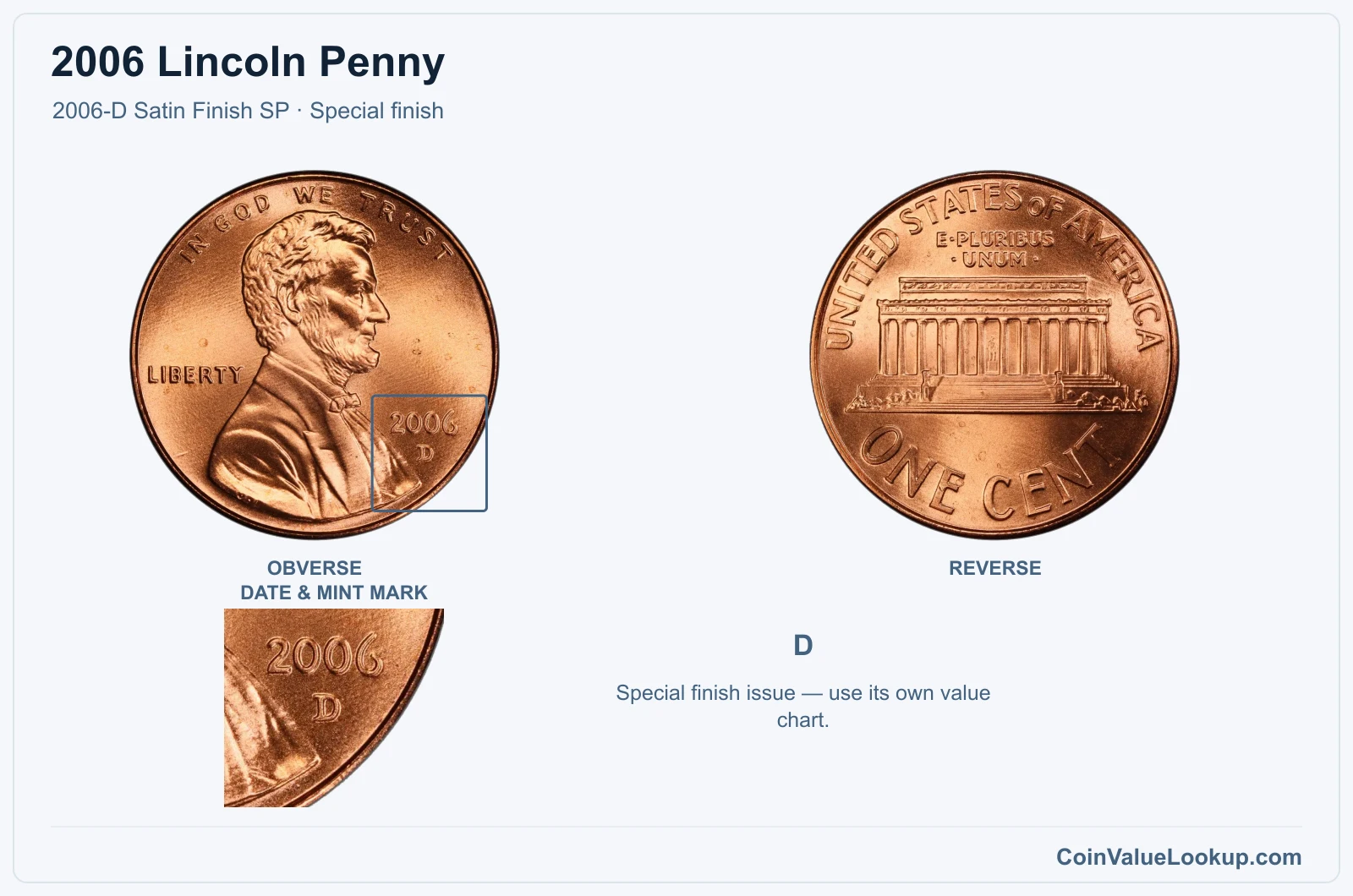
The 2006-D satin-finish cent was also included in the 2006 Uncirculated Mint Set. It carries a "D" mintmark and has the same distinctive soft luster that separates it from a regular Denver business strike.
These are not proof coins and they are not ordinary strikes. Satin specimens need individual assessment based on their authenticated identity and condition.
No specific guide price is adopted for this version. If your coin came from a sealed Mint Set and shows that characteristic even sheen without proof-like mirrors, you are likely looking at the satin finish.
| Range | Grade | Price | Auction Records | Appraisal |
|---|---|---|---|---|
| SP | SP 1 | — | Coin Identifier | |
| SP 2 | — | Coin Identifier | ||
| SP 3 | — | Coin Identifier | ||
| SP 4 | — | Coin Identifier | ||
| SP 6 | — | Coin Identifier | ||
| SP 8 | — | Coin Identifier | ||
| SP 10 | — | Coin Identifier | ||
| SP 12 | — | Coin Identifier | ||
| SP 15 | — | Coin Identifier | ||
| SP 20 | — | Coin Identifier | ||
| SP 25 | — | Coin Identifier | ||
| SP 30 | — | Coin Identifier | ||
| SP 35 | — | Coin Identifier | ||
| SP 40 | — | Coin Identifier | ||
| SP 45 | — | Coin Identifier | ||
| SP 50 | — | Coin Identifier | ||
| SP 53 | — | Coin Identifier | ||
| SP 55 | — | Coin Identifier | ||
| SP 58 | — | Coin Identifier | ||
| SP 60 | — | Coin Identifier | ||
| SP 61 | — | Coin Identifier | ||
| SP 62 | — | Coin Identifier | ||
| SP 63 | — | Coin Identifier | ||
| SP 64 | — | Coin Identifier | ||
| SP 65 | — | Coin Identifier | ||
| SP 66 | Coin Identifier | |||
| SP 67 | Coin Identifier | |||
| SP 68 | Coin Identifier | |||
| SP 69 | Coin Identifier | |||
| SP 70 | — | — | — |
2006 Lincoln Penny Error List
1. 2006 Lincoln Penny — Doubled Die Obverse
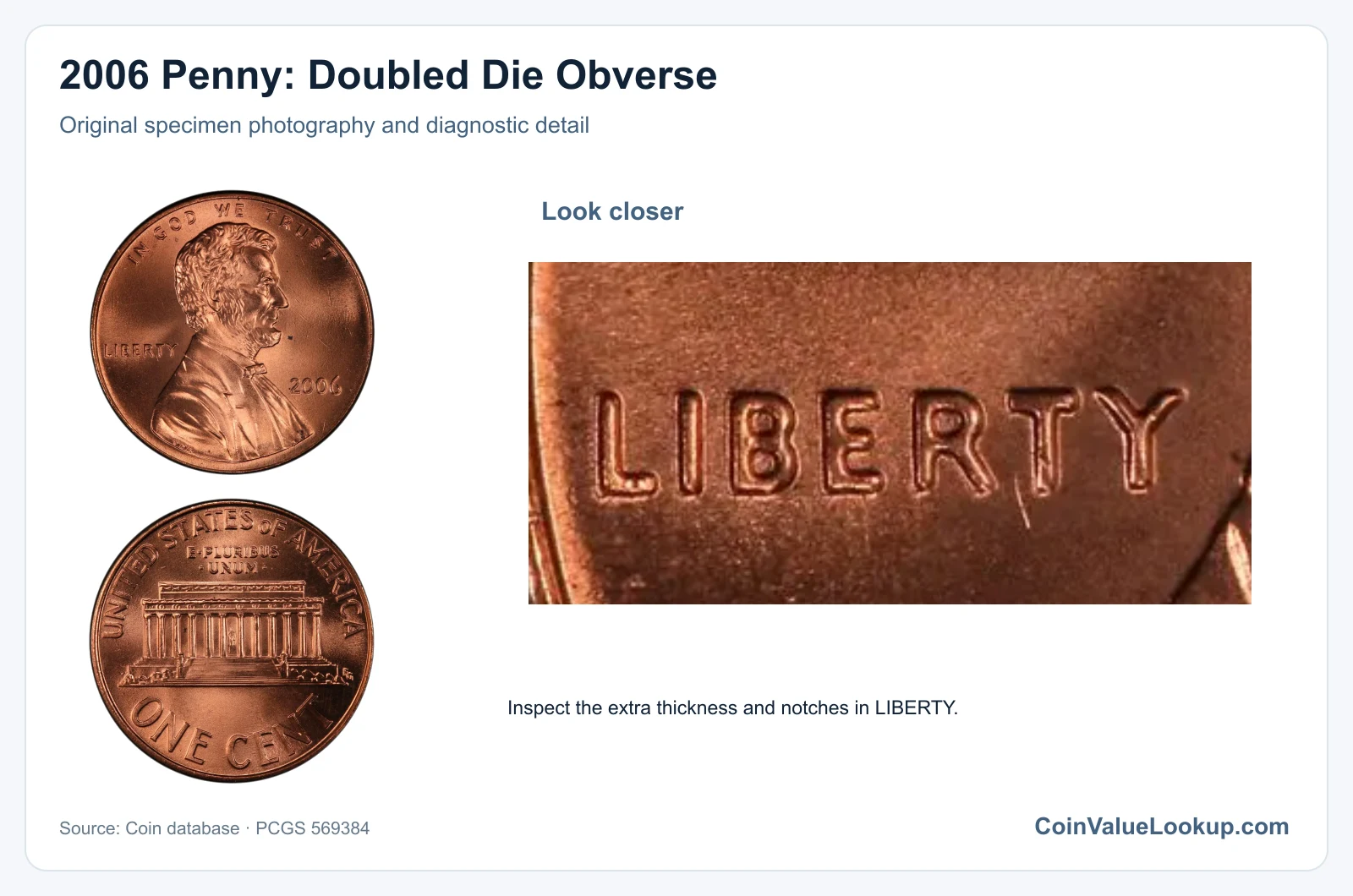
A doubled die obverse on a 2006 Lincoln cent shows consistent doubling — separation or notching — on obverse lettering or design elements. You want to compare suspect letters carefully against a normal 2006 cent under the same lighting.
The key word is "consistent." True doubled dies repeat the same doubling pattern across the affected area. Machine doubling, by contrast, tends to produce flat, shelf-like distortion and lacks the sharp secondary image.
Reflections and worn die marks can also mimic doubling to the untrained eye.
No specific price is adopted for this category. Value depends on the strength and location of the doubling, the coin's overall condition, and professional authentication.
If you think you see it, get a second opinion from a grading service.
2. 2006 Lincoln Penny — Off-Center Strike
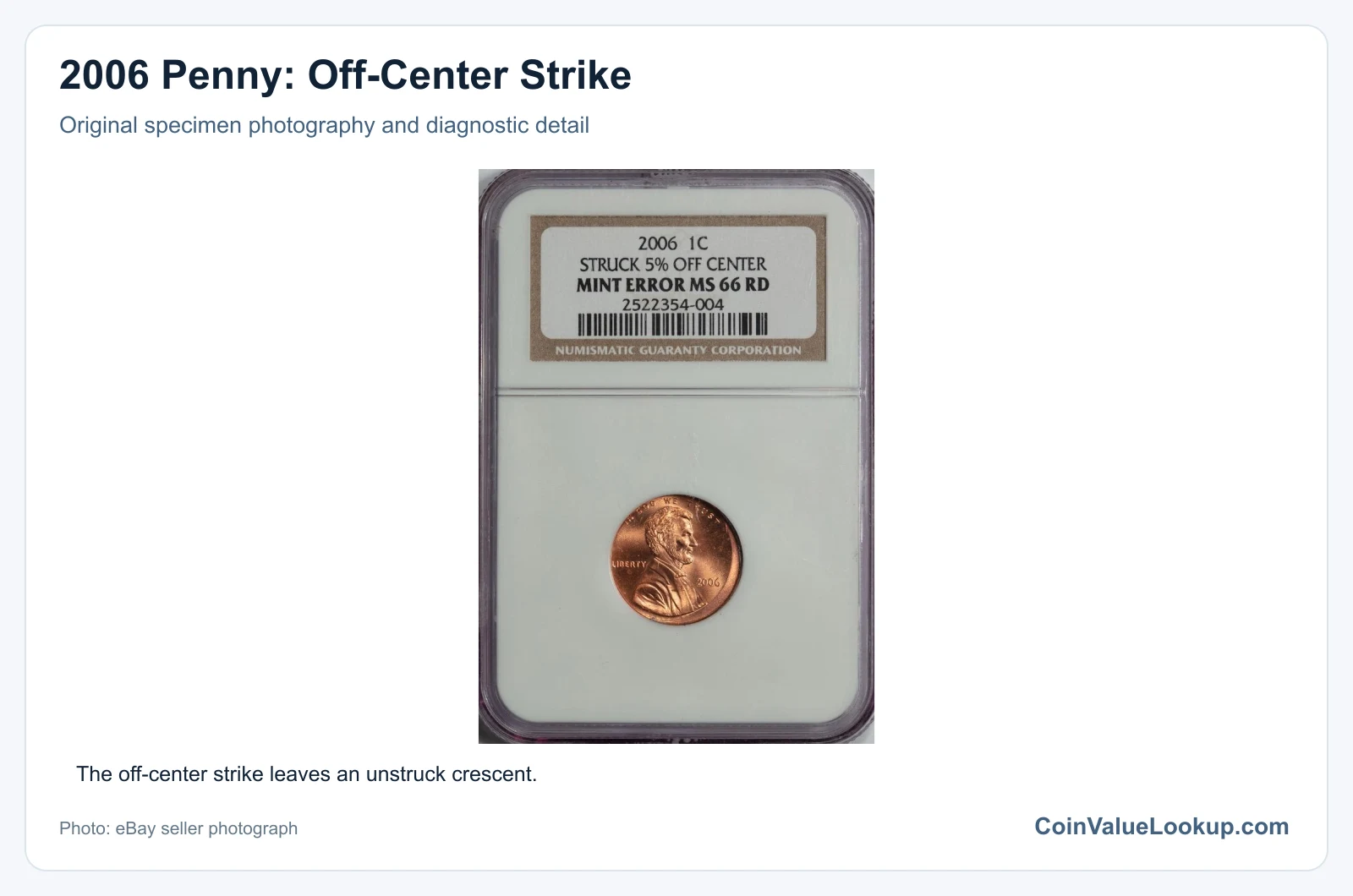
An off-center strike happens when the planchet is not properly seated between the dies. The result is a displaced design with an unstruck crescent of blank metal along one edge.
The date needs to remain visible for a 2006 off-center cent to attract collector interest. A small percentage off-center is common and minor; dramatic shifts — say 10% or more with a full date — draw more attention.
Do not confuse an off-center strike with a clipped planchet, which has a different edge profile, or with post-mint damage like a coin that was flattened by something after leaving the Mint. No specific price is adopted; each example needs individual evaluation based on the degree of misalignment, date visibility, and condition.
3. 2006 Lincoln Penny — Broadstrike
A broadstrike occurs when a coin is struck without the normal retaining collar that forms the edge and controls diameter. The result is a coin that spreads outward, appearing slightly larger than normal with a distorted rim.
The full design is still present on both sides — that is what separates a broadstrike from an off-center error, where part of the design is missing entirely. Also watch out for coins that were simply flattened after minting; those show damage patterns rather than the even metal flow of a genuine broadstrike.
Check the edge profile carefully. No specific price is adopted for this error.
Value depends on how dramatic the spread is, overall condition, and whether the coin has been authenticated by a third-party grading service.
4. 2006 Lincoln Penny — BIE Die Break
The BIE die break is a well-known Lincoln cent variety. It shows up as a small raised vertical line or blob between the letters B and E in LIBERTY, caused by a crack or chip in the die.
Look at LIBERTY under magnification. A genuine die break will be raised metal — part of the coin's surface — not something sitting on top of it.
Dirt, scratches, or glue residue can mimic the appearance but will look different under a loupe. The surrounding letters and field should appear normal.
No specific price is adopted for this variety on a 2006 cent. These are collected as minor die-break curiosities, and value depends on the size and clarity of the break as well as overall coin condition.
5. 2006 Lincoln Penny — Wrong Planchet / Off-Metal Strike
A wrong-planchet error means the 2006 Lincoln cent dies struck a blank intended for a different coin. This is one of the more dramatic error types, but also one of the most frequently misidentified.
To check, compare your coin's weight, diameter, and edge against the standard 2.50-gram, 19.05 mm, plain-edge specification. If the numbers are off and the design shows incomplete strike characteristics consistent with a different-sized blank, you may have something real.
Do not assume a different metal based on color alone — plating loss, corrosion, and acid exposure can all change a coin's appearance.
No specific price is adopted. Any suspected wrong-planchet coin should be professionally authenticated, because deliberate alterations are common in this category.