2007 Lincoln Penny Coin Value: How Much Is It Worth?
Most 2007 Lincoln pennies you pull from a jar are worth face value — one cent. In uncirculated condition, a guide estimate for a regular Philadelphia or Denver cent is about $0.36 at the MS65 grade level.
San Francisco proof examples carry a guide estimate around $4.96 at PR65. Special varieties and mint errors occupy their own markets, and no single maximum applies across the board.
These are grade-specific retail estimates from a published guide, not guaranteed purchase offers.
Fast Way to Identify Your 2007 Lincoln Penny
Want a quick read on what you have? Upload clear photos of the front and back of your 2007 penny and the identifier can give you a preliminary identification — helping you figure out the mint, finish type, and version branch your coin belongs to.
That is the fastest first step before digging into condition and value details.
2007 Penny Value
Upload both sides of your 2007 Lincoln Penny.
Front Obverse
Upload photo
Back Reverse
Upload photo
Which 2007 Lincoln Penny Versions Are Worth Money?
- Philadelphia and Denver business strikes in MS65 or higher condition with clean, original surfaces carry guide values above face — about $0.36 at MS65.
- San Francisco proof cents graded PR65 carry a guide estimate of $4.96; cameo and deep cameo designations are evaluated separately.
- Satin-finish specimen coins from collector mint sets are a distinct product and should not be confused with ordinary strikes — their value depends on authenticated identity and condition.
- Recognized mint errors such as doubled dies, off-center strikes, and unplated planchets can trade well above normal values, assessed individually by type and severity.
Step 1: Identify Your 2007 Lincoln Penny Mint Mark and Version
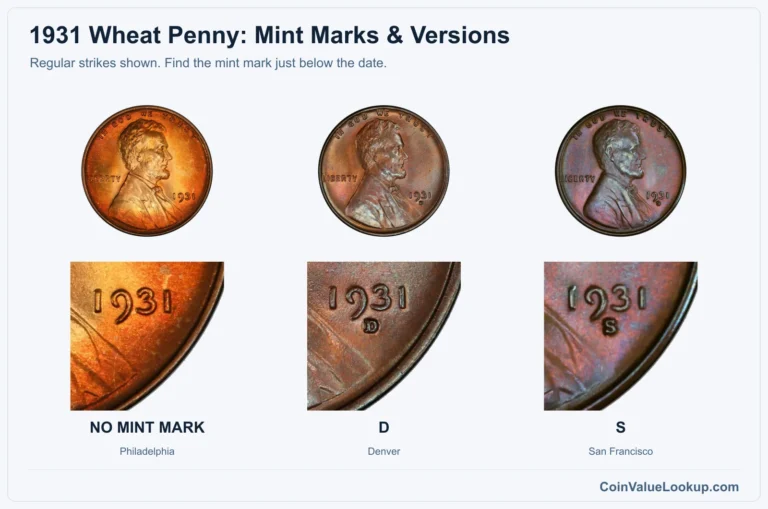
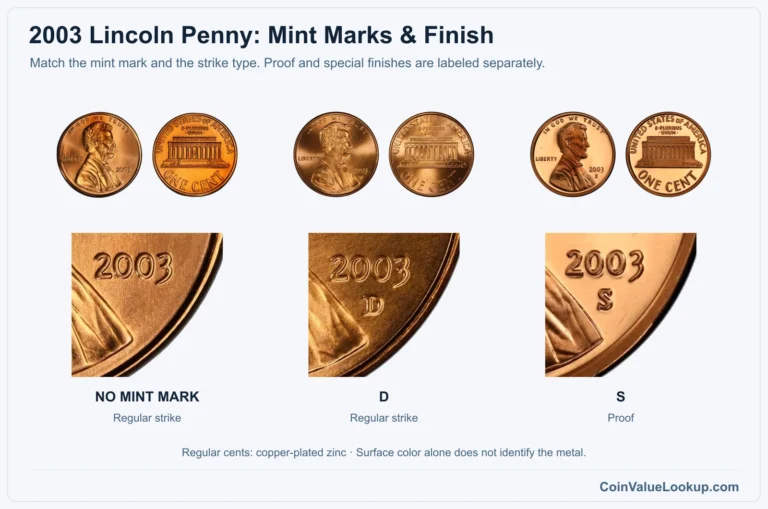
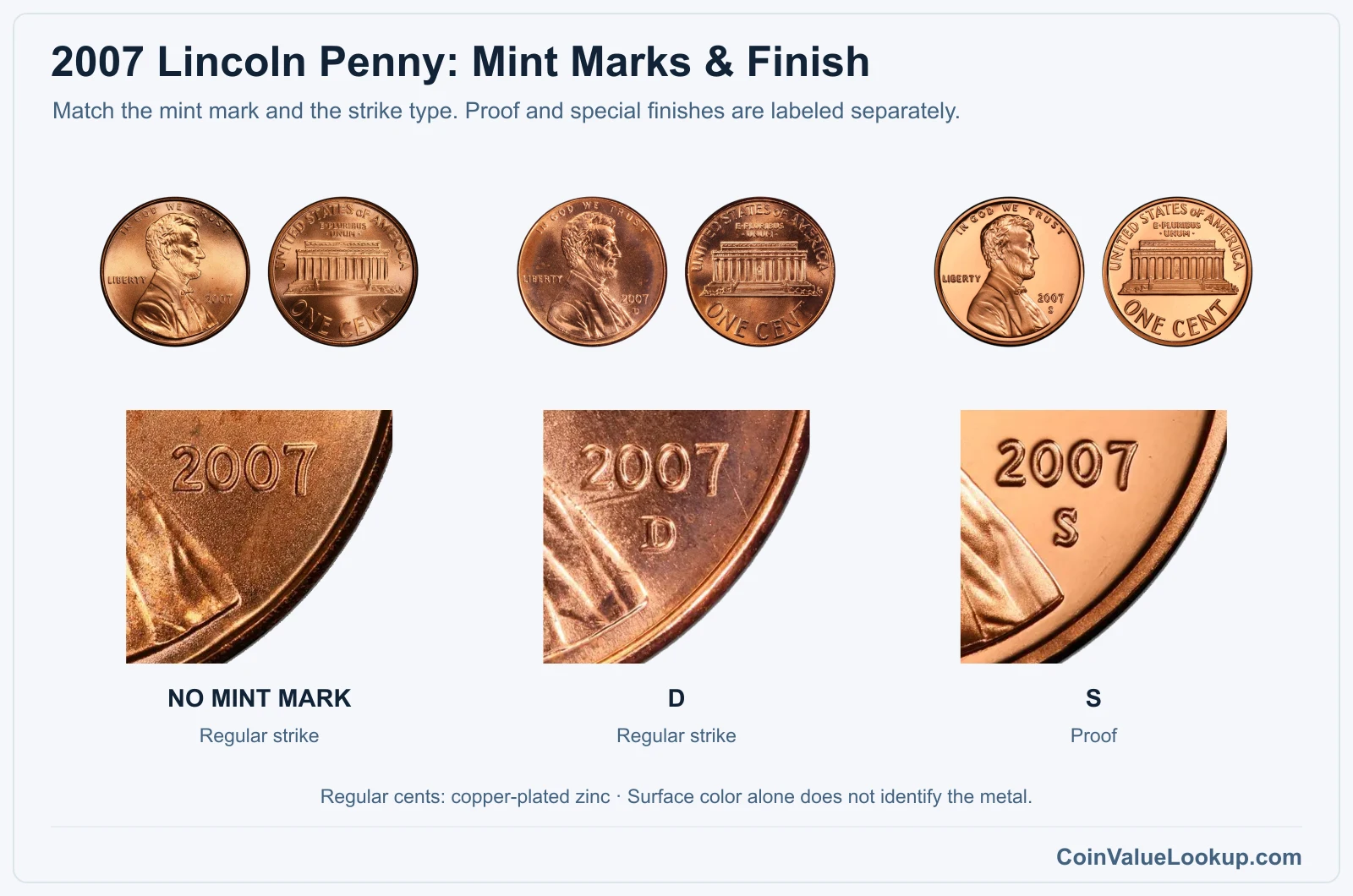
Flip the coin to the front and look just below the date. No letter at all means Philadelphia.
A small "D" means Denver. An "S" means San Francisco, and on this date those are proof coins only.
All 2007 Lincoln cents use a copper-plated zinc composition — 97.5% zinc core with 2.5% copper plating overall, weighing a nominal 2.50 grams. Color alone cannot prove a different alloy, so don't assume a silvery or dark coin is something exotic without further testing.
The reverse is the familiar Lincoln Memorial design, used from 1959 through 2008. Three finishes exist for 2007: regular business strikes (Philadelphia and Denver), proof strikes from San Francisco with mirrored fields, and satin specimen strikes issued in collector mint sets from both Philadelphia and Denver.
Telling a satin finish from a regular strike matters — satin coins have a distinctive soft, even luster that is neither the cartwheel shine of a business strike nor the mirror-and-frost look of a proof.
Step 2: Check Your 2007 Lincoln Penny Grade
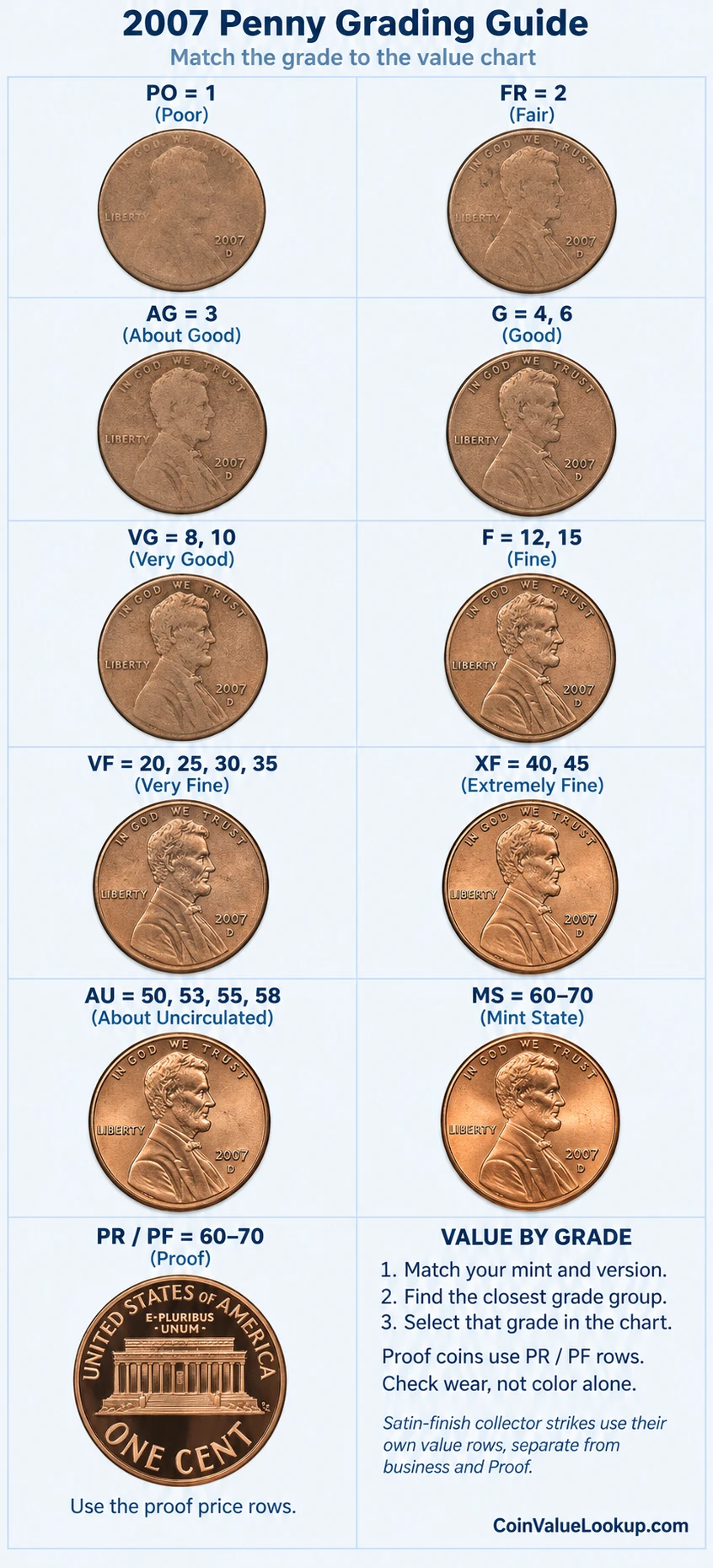
Start with Lincoln's cheekbone and jawline. On a well-preserved coin these areas show full rounded contour and no flat spots.
Then check the hair detail above the ear — fine strands disappear quickly with wear. On the reverse, look at the tiny Lincoln statue inside the Memorial and the column details; both soften early.
Use the comparison image to match your coin's wear pattern against known grade benchmarks. Luster is a big deal on modern zinc cents: an original, unbroken mint glow across both sides supports a higher grade.
Color is graded separately from wear. Red, red-brown, and brown designations describe how much original copper tone the plating retains, not how worn the coin is.
Contact marks, corrosion, dark spots, and any sign of cleaning all reduce a coin's grade and desirability regardless of how sharp the design still looks.
Step 3: Check 2007 Lincoln Penny Value by Mint and Version
2007 Lincoln Penny
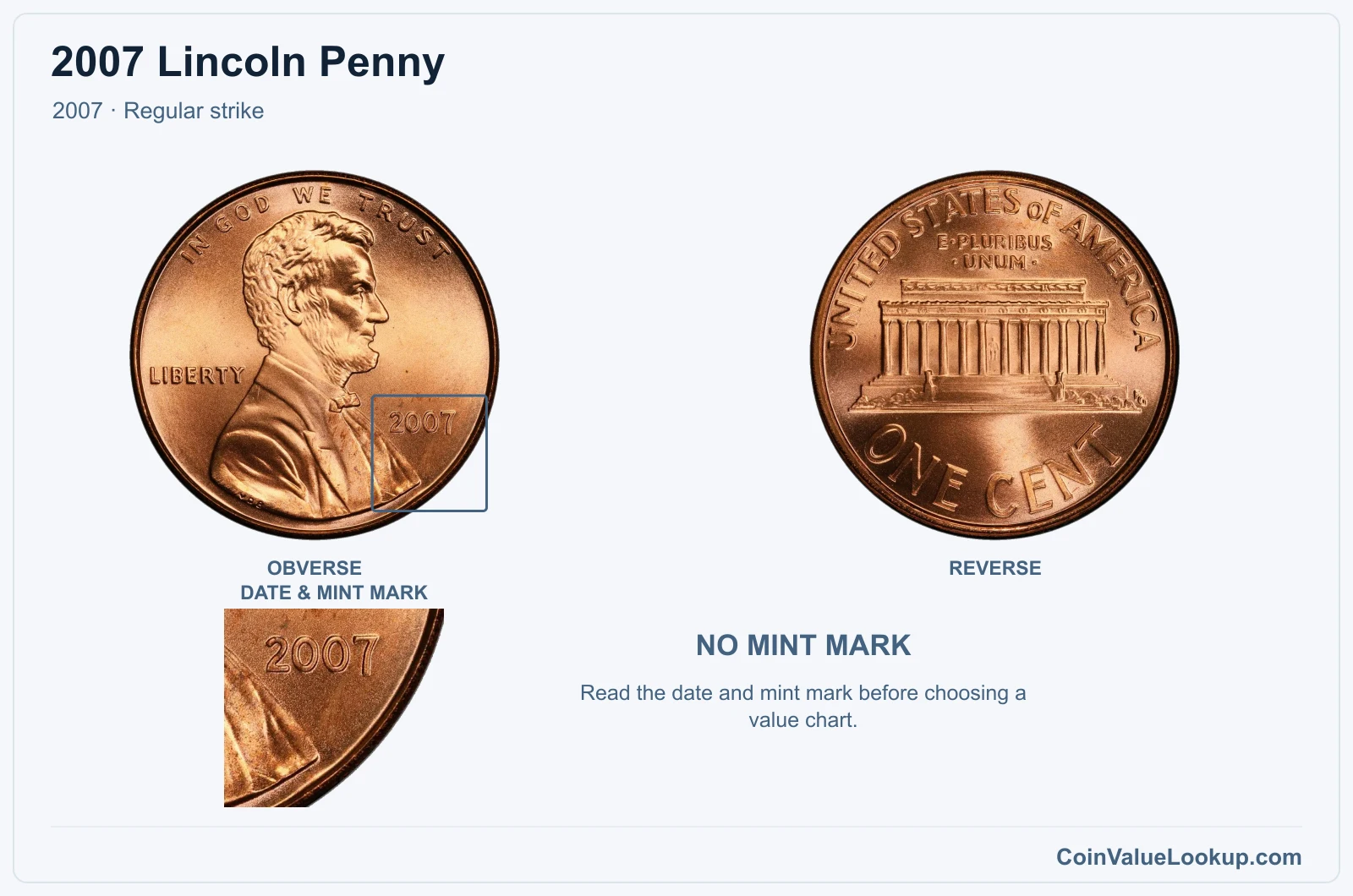
The 2007 Philadelphia cent has no mintmark below the date. It is a regular business strike on copper-plated zinc, weighing about 2.50 grams.
Billions were made, so circulated examples are worth face value. In gem uncirculated condition at MS65, a published guide estimate is $0.36.
The key to any premium is clean original surfaces with full luster and minimal contact marks — not just being unspent. Do not confuse this with the satin-finish Philadelphia cent sold in collector sets; the strike texture and luster are different.
| Range | Grade | Price | Auction Records | Appraisal |
|---|---|---|---|---|
| PO | PO 1 | — | Coin Identifier | |
| FR | FR 2 | — | Coin Identifier | |
| AG | AG 3 | — | Coin Identifier | |
| G | G 4 | — | Coin Identifier | |
| G 6 | — | Coin Identifier | ||
| VG | VG 8 | — | Coin Identifier | |
| VG 10 | — | Coin Identifier | ||
| F | F 12 | — | Coin Identifier | |
| F 15 | — | Coin Identifier | ||
| VF | VF 20 | — | Coin Identifier | |
| VF 25 | — | Coin Identifier | ||
| VF 30 | — | Coin Identifier | ||
| VF 35 | — | Coin Identifier | ||
| XF | XF 40 | — | Coin Identifier | |
| XF 45 | — | Coin Identifier | ||
| AU | AU 50 | — | Coin Identifier | |
| AU 53 | — | Coin Identifier | ||
| AU 55 | — | Coin Identifier | ||
| AU 58 | — | Coin Identifier | ||
| MS | MS 60 | — | Coin Identifier | |
| MS 61 | — | Coin Identifier | ||
| MS 62 | — | Coin Identifier | ||
| MS 63 | — | Coin Identifier | ||
| MS 64 | — | Coin Identifier | ||
| MS 65 | — | Coin Identifier | ||
| MS 66 | Coin Identifier | |||
| MS 67 | Coin Identifier | |||
| MS 68 | — | Coin Identifier | ||
| MS 69 | — | — | — | |
| MS 70 | — | — | — |
2007 Lincoln Penny — D
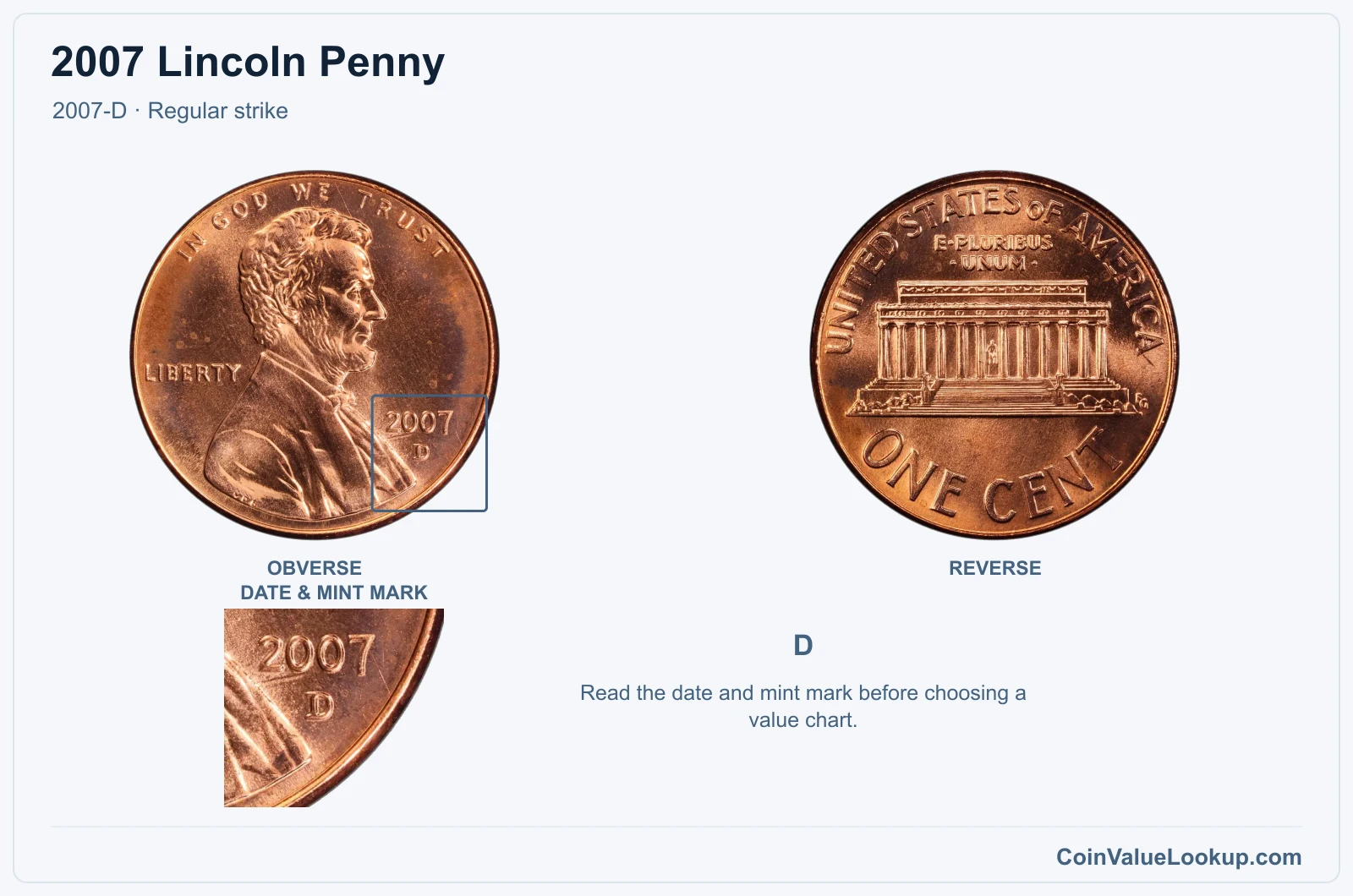
Look for the small "D" mintmark below the date. This is the Denver business strike, same copper-plated zinc composition and 2.50-gram weight as its Philadelphia sibling.
Circulated pieces are one-cent coins, period. At MS65, the guide estimate is $0.36.
Strong, original red color and few bag marks separate a coin worth a small premium from one worth exactly what it says on the tin. As with Philadelphia strikes, satin-finish Denver cents from mint sets are a separate category.
| Range | Grade | Price | Auction Records | Appraisal |
|---|---|---|---|---|
| PO | PO 1 | — | Coin Identifier | |
| FR | FR 2 | — | Coin Identifier | |
| AG | AG 3 | — | Coin Identifier | |
| G | G 4 | — | Coin Identifier | |
| G 6 | — | Coin Identifier | ||
| VG | VG 8 | — | Coin Identifier | |
| VG 10 | — | Coin Identifier | ||
| F | F 12 | — | Coin Identifier | |
| F 15 | — | Coin Identifier | ||
| VF | VF 20 | — | Coin Identifier | |
| VF 25 | — | Coin Identifier | ||
| VF 30 | — | Coin Identifier | ||
| VF 35 | — | Coin Identifier | ||
| XF | XF 40 | — | Coin Identifier | |
| XF 45 | — | Coin Identifier | ||
| AU | AU 50 | — | Coin Identifier | |
| AU 53 | — | Coin Identifier | ||
| AU 55 | — | Coin Identifier | ||
| AU 58 | — | Coin Identifier | ||
| MS | MS 60 | — | Coin Identifier | |
| MS 61 | — | Coin Identifier | ||
| MS 62 | — | Coin Identifier | ||
| MS 63 | — | Coin Identifier | ||
| MS 64 | — | Coin Identifier | ||
| MS 65 | — | Coin Identifier | ||
| MS 66 | Coin Identifier | |||
| MS 67 | Coin Identifier | |||
| MS 68 | — | Coin Identifier | ||
| MS 69 | — | — | — | |
| MS 70 | — | — | — |
2007 Lincoln Penny — S PR
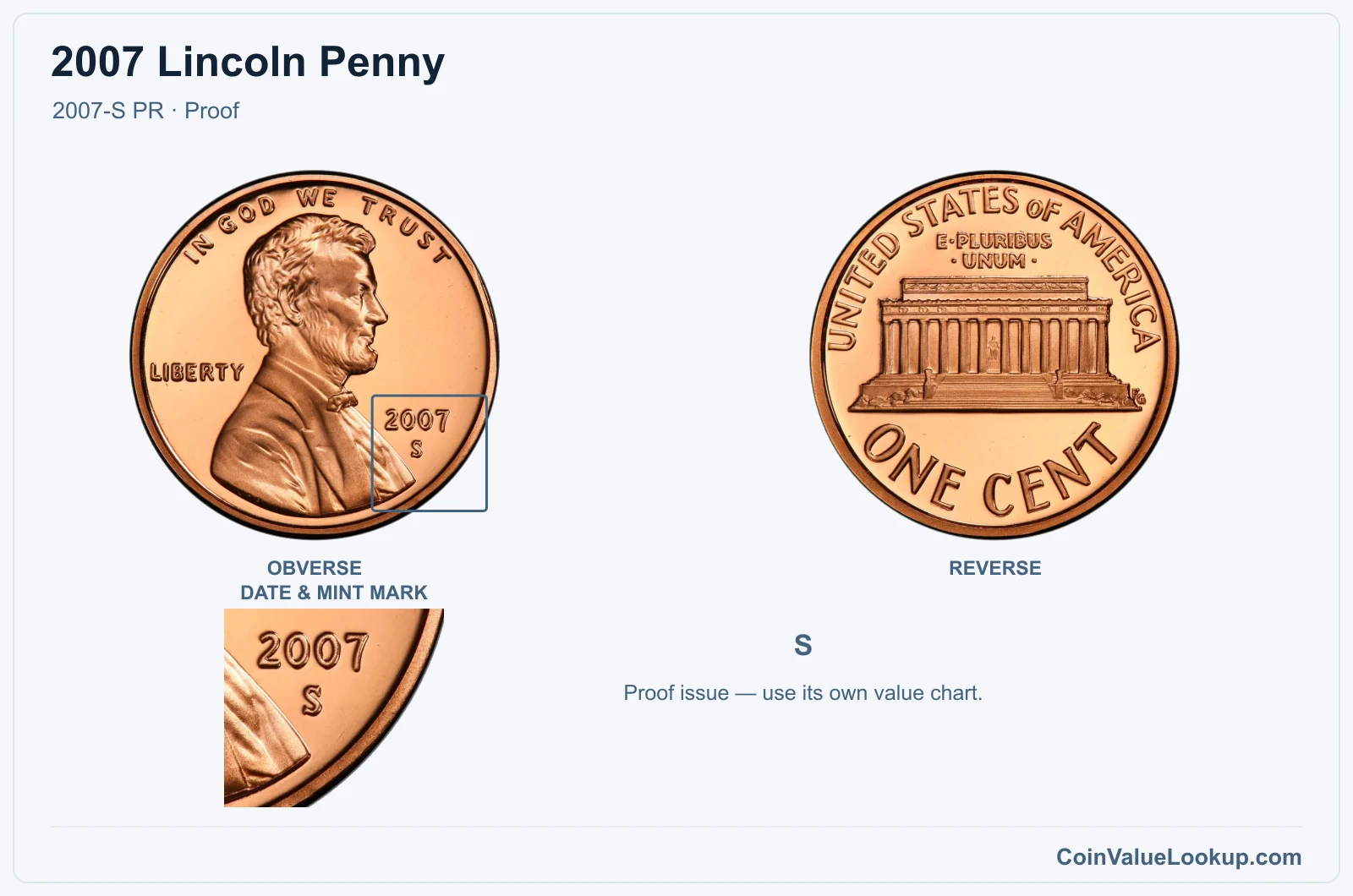
The 2007-S proof was struck at San Francisco for collector sets and carries an "S" mintmark. Proofs have mirrored fields and sharply defined devices — this is a manufacturing finish, not a grade above mint state.
At PR65, a guide estimate is $4.96. Cameo and deep cameo designations describe the degree of frost contrast on the raised design against the mirror fields; those carry their own value tiers and should be compared within proof-specific grades, not against circulation strikes.
Coin Value Lookup is a handy starting point if you want to compare this proof with other Lincoln cent dates or look up additional denominations.
| Range | Grade | Price | Auction Records | Appraisal |
|---|---|---|---|---|
| PR | PR 1 | — | Coin Identifier | |
| PR 2 | — | Coin Identifier | ||
| PR 3 | — | Coin Identifier | ||
| PR 4 | — | Coin Identifier | ||
| PR 6 | — | Coin Identifier | ||
| PR 8 | — | Coin Identifier | ||
| PR 10 | — | Coin Identifier | ||
| PR 12 | — | Coin Identifier | ||
| PR 15 | — | Coin Identifier | ||
| PR 20 | — | Coin Identifier | ||
| PR 25 | — | Coin Identifier | ||
| PR 30 | — | Coin Identifier | ||
| PR 35 | — | Coin Identifier | ||
| PR 40 | — | Coin Identifier | ||
| PR 45 | — | Coin Identifier | ||
| PR 50 | — | Coin Identifier | ||
| PR 53 | — | Coin Identifier | ||
| PR 55 | — | Coin Identifier | ||
| PR 58 | — | Coin Identifier | ||
| PR 60 | — | Coin Identifier | ||
| PR 61 | — | Coin Identifier | ||
| PR 62 | — | Coin Identifier | ||
| PR 63 | — | Coin Identifier | ||
| PR 64 | — | Coin Identifier | ||
| PR 65 | — | Coin Identifier | ||
| PR 66 | — | Coin Identifier | ||
| PR 67 | — | Coin Identifier | ||
| PR 68 | Coin Identifier | |||
| PR 69 | Coin Identifier | |||
| PR 70 | Coin Identifier |
2007 Lincoln Penny — Satin Finish SP
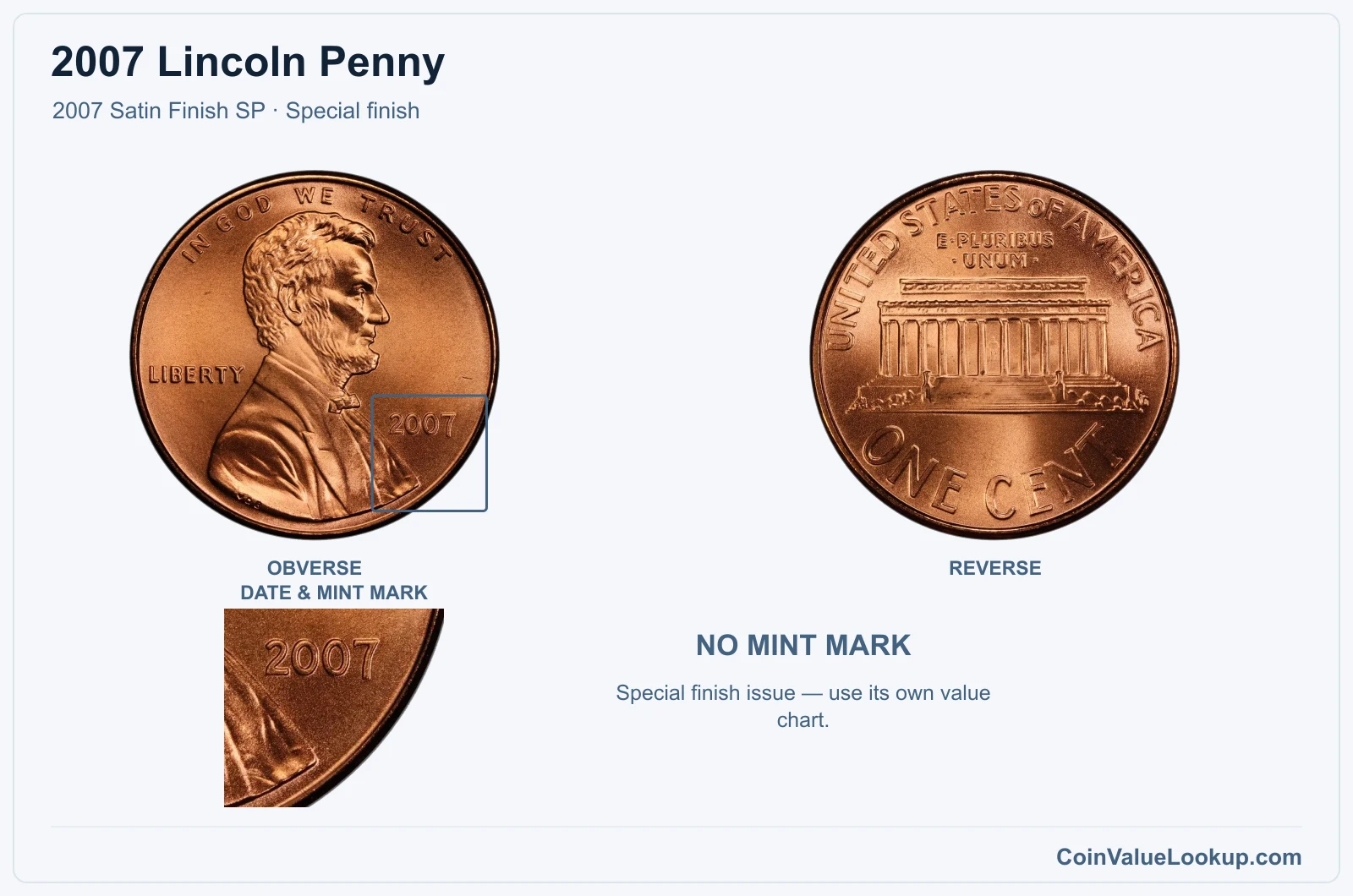
The 2007 satin-finish Philadelphia cent was packaged in the U.S. Mint's annual uncirculated coin set, produced from 2005 through 2010. It has no mintmark, just like the regular business strike, so the finish itself is your identification clue.
Satin coins show a uniform, softly frosted luster across both sides — distinct from the sharp cartwheel shine of a business strike and the mirror fields of a proof. No specific guide price is adopted for this version; value depends on authenticated identity, condition, and market demand at the time of sale.
| Range | Grade | Price | Auction Records | Appraisal |
|---|---|---|---|---|
| SP | SP 1 | — | Coin Identifier | |
| SP 2 | — | Coin Identifier | ||
| SP 3 | — | Coin Identifier | ||
| SP 4 | — | Coin Identifier | ||
| SP 6 | — | Coin Identifier | ||
| SP 8 | — | Coin Identifier | ||
| SP 10 | — | Coin Identifier | ||
| SP 12 | — | Coin Identifier | ||
| SP 15 | — | Coin Identifier | ||
| SP 20 | — | Coin Identifier | ||
| SP 25 | — | Coin Identifier | ||
| SP 30 | — | Coin Identifier | ||
| SP 35 | — | Coin Identifier | ||
| SP 40 | — | Coin Identifier | ||
| SP 45 | — | Coin Identifier | ||
| SP 50 | — | Coin Identifier | ||
| SP 53 | — | Coin Identifier | ||
| SP 55 | — | Coin Identifier | ||
| SP 58 | — | Coin Identifier | ||
| SP 60 | — | Coin Identifier | ||
| SP 61 | — | Coin Identifier | ||
| SP 62 | — | Coin Identifier | ||
| SP 63 | — | Coin Identifier | ||
| SP 64 | — | Coin Identifier | ||
| SP 65 | — | Coin Identifier | ||
| SP 66 | Coin Identifier | |||
| SP 67 | — | Coin Identifier | ||
| SP 68 | Coin Identifier | |||
| SP 69 | Coin Identifier | |||
| SP 70 | — | — | — |
2007 Lincoln Penny — D Satin Finish SP
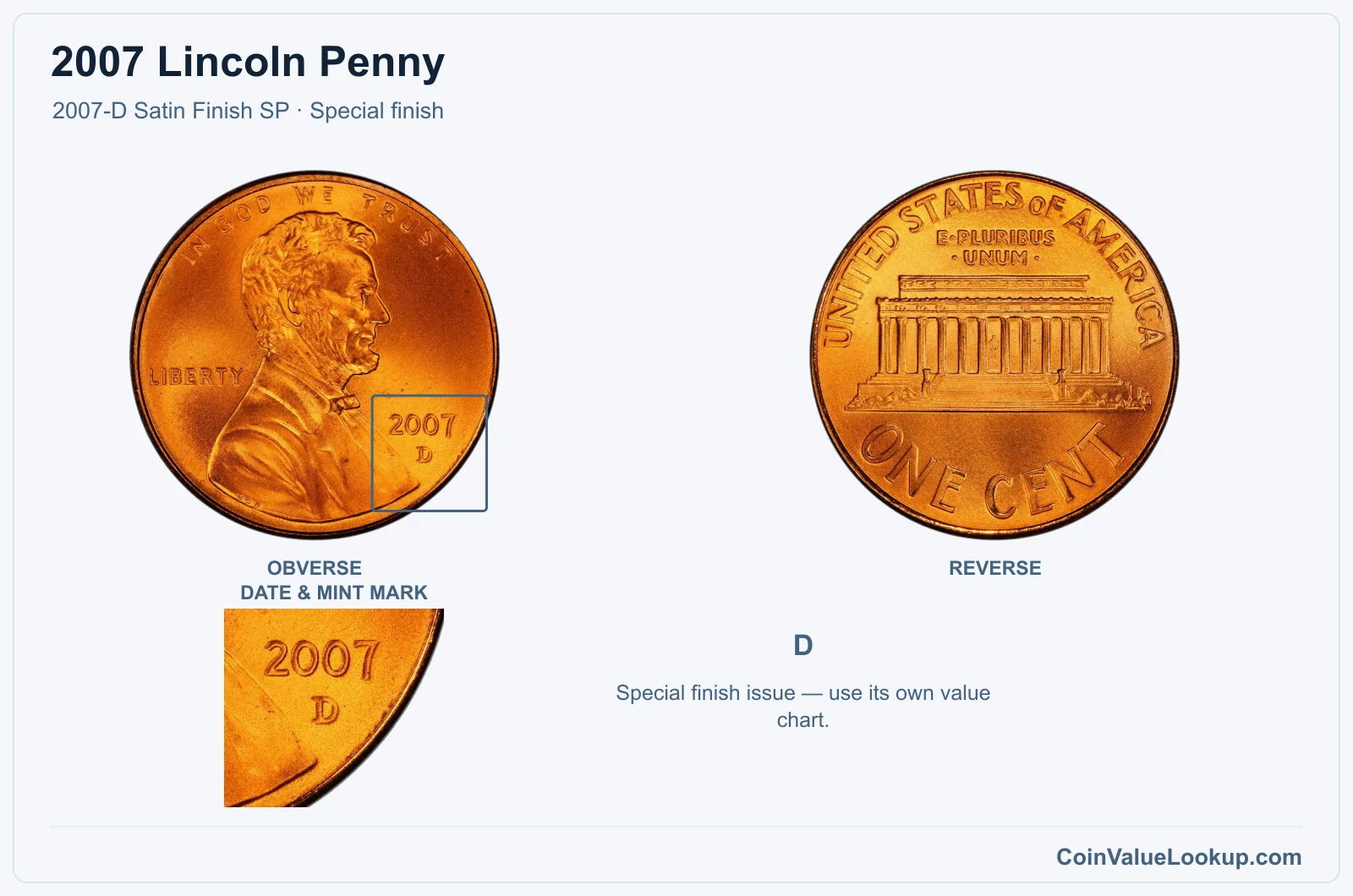
The Denver counterpart of the satin specimen carries a "D" mintmark and was also exclusive to the 2007 uncirculated mint set. It shares the same copper-plated zinc composition and 2.50-gram weight as every other 2007 cent, but its satin texture sets it apart under a loupe or even in hand.
Collectors grade these on the specimen scale rather than the standard mint-state scale. No specific guide price is adopted here; authenticated identity and surface preservation drive what a particular coin will bring on the market.
| Range | Grade | Price | Auction Records | Appraisal |
|---|---|---|---|---|
| SP | SP 1 | — | Coin Identifier | |
| SP 2 | — | Coin Identifier | ||
| SP 3 | — | Coin Identifier | ||
| SP 4 | — | Coin Identifier | ||
| SP 6 | — | Coin Identifier | ||
| SP 8 | — | Coin Identifier | ||
| SP 10 | — | Coin Identifier | ||
| SP 12 | — | Coin Identifier | ||
| SP 15 | — | Coin Identifier | ||
| SP 20 | — | Coin Identifier | ||
| SP 25 | — | Coin Identifier | ||
| SP 30 | — | Coin Identifier | ||
| SP 35 | — | Coin Identifier | ||
| SP 40 | — | Coin Identifier | ||
| SP 45 | — | Coin Identifier | ||
| SP 50 | — | Coin Identifier | ||
| SP 53 | — | Coin Identifier | ||
| SP 55 | — | Coin Identifier | ||
| SP 58 | — | Coin Identifier | ||
| SP 60 | — | Coin Identifier | ||
| SP 61 | — | Coin Identifier | ||
| SP 62 | — | Coin Identifier | ||
| SP 63 | — | Coin Identifier | ||
| SP 64 | — | Coin Identifier | ||
| SP 65 | — | Coin Identifier | ||
| SP 66 | Coin Identifier | |||
| SP 67 | — | Coin Identifier | ||
| SP 68 | Coin Identifier | |||
| SP 69 | Coin Identifier | |||
| SP 70 | — | — | — |
2007 Lincoln Penny Error List
1. 2007 Lincoln Penny — Doubled Die Obverse
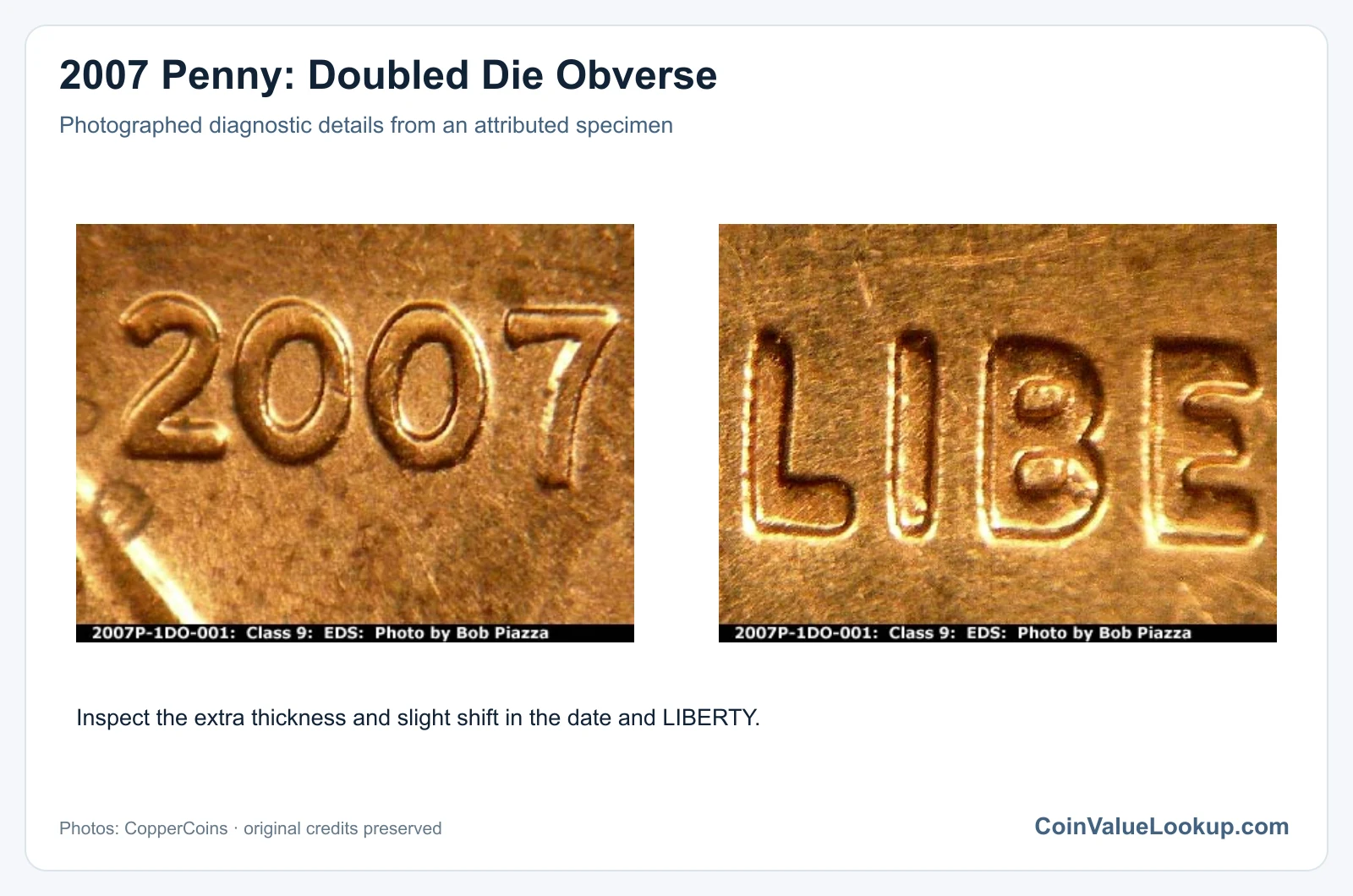
A doubled die obverse on a 2007 Lincoln cent shows consistent doubling — separation or notching — on obverse lettering or design elements. The key word is consistent: the doubling should repeat the same way across affected areas, not shift randomly.
Compare your coin to a normal 2007 cent under the same lighting angle, focusing on lettering edges around IN GOD WE TRUST and LIBERTY.
Machine doubling is the most common lookalike. It tends to produce a flat, shelf-like distortion rather than the rounded, separated profiles of a true doubled die.
Reflections and worn die contours can also mimic doubling under certain light. No specific price is established for this category; value depends on the particular die, the strength of doubling, and the coin's overall condition as confirmed by professional authentication.
2. 2007 Lincoln Penny — Doubled Die Reverse
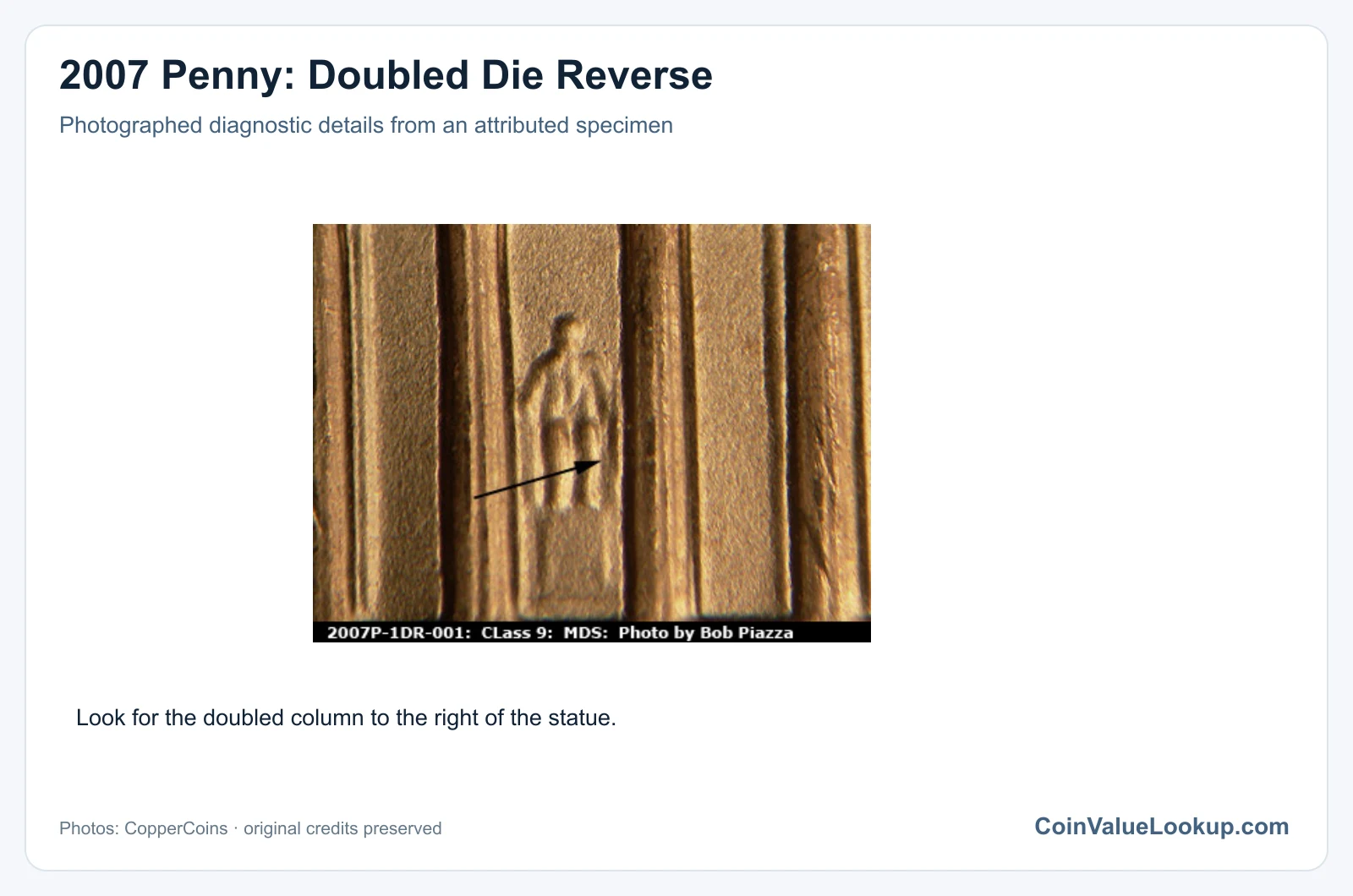
A doubled die reverse affects the back of the coin — look at the reverse legends like UNITED STATES OF AMERICA, E PLURIBUS UNUM, or ONE CENT, and the Memorial's architectural lines. True die doubling creates a second, offset impression of the design element that is consistent across the affected zone.
Machine doubling is again the usual suspect and tends to show flat, mushy distortion rather than crisp separated outlines. Random post-strike damage and reflections can also fool you in photos.
Examine the coin under magnification with steady, directional light. No specific price is adopted for this error; each example needs individual assessment based on the die involved, doubling strength, and grade.
3. 2007 Lincoln Penny — Off-Center Strike
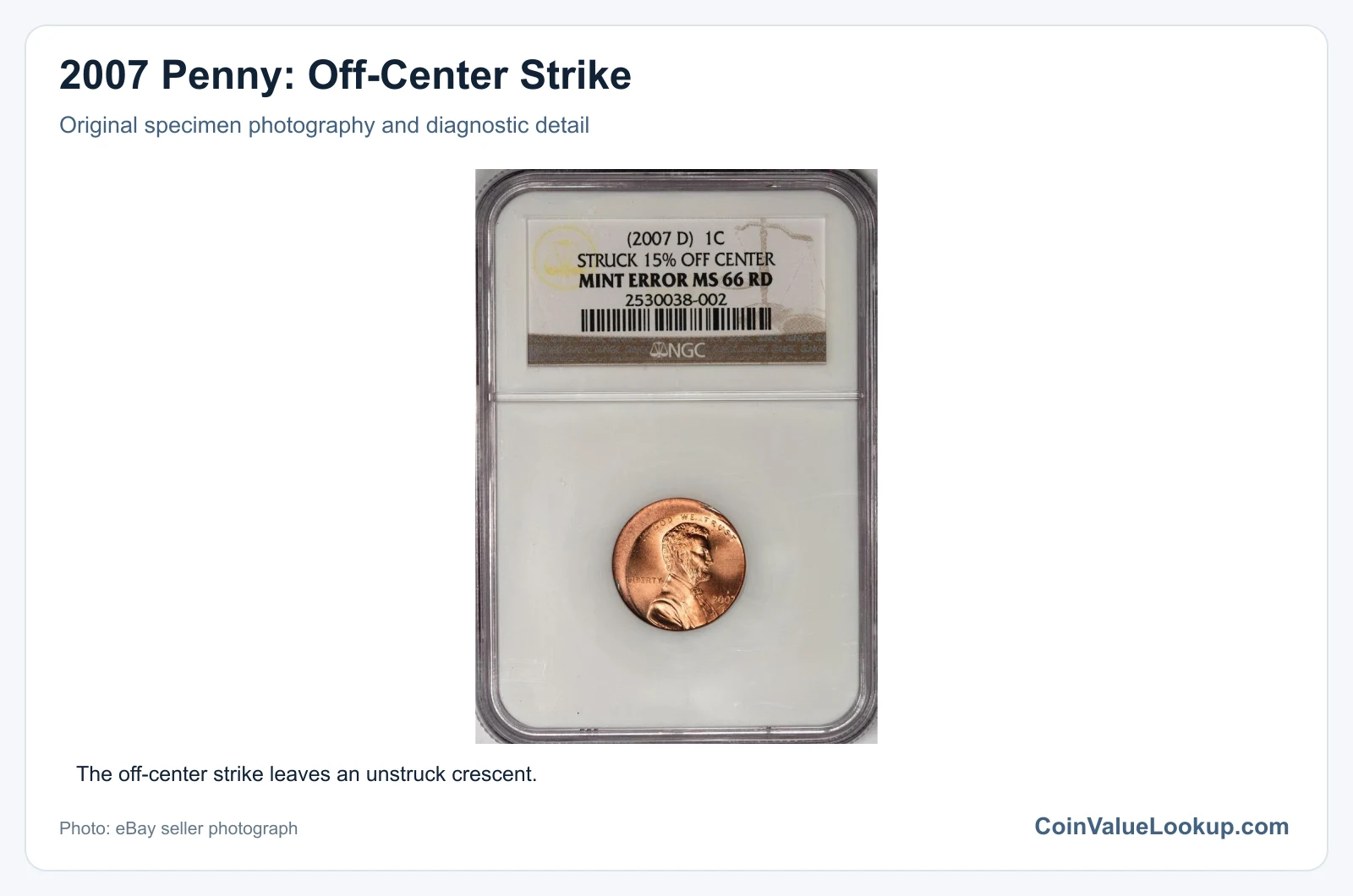
An off-center strike happens when the planchet is not properly seated between the dies. The result is a design that is shifted to one side with an unstruck crescent of blank metal on the opposite edge.
The more off-center the strike and the more of the date that remains visible, the more desirable the error.
Don't confuse this with a clipped planchet, which removes a curved bite from the edge but still shows a centered design, or with one-sided misalignment where both sides are struck but shifted relative to each other. Post-mint flattening can also create deceptive blank-looking areas.
No specific price is adopted; each piece is evaluated individually by percentage of displacement, date visibility, and condition.
4. 2007 Lincoln Penny — Flip-Over Double Strike
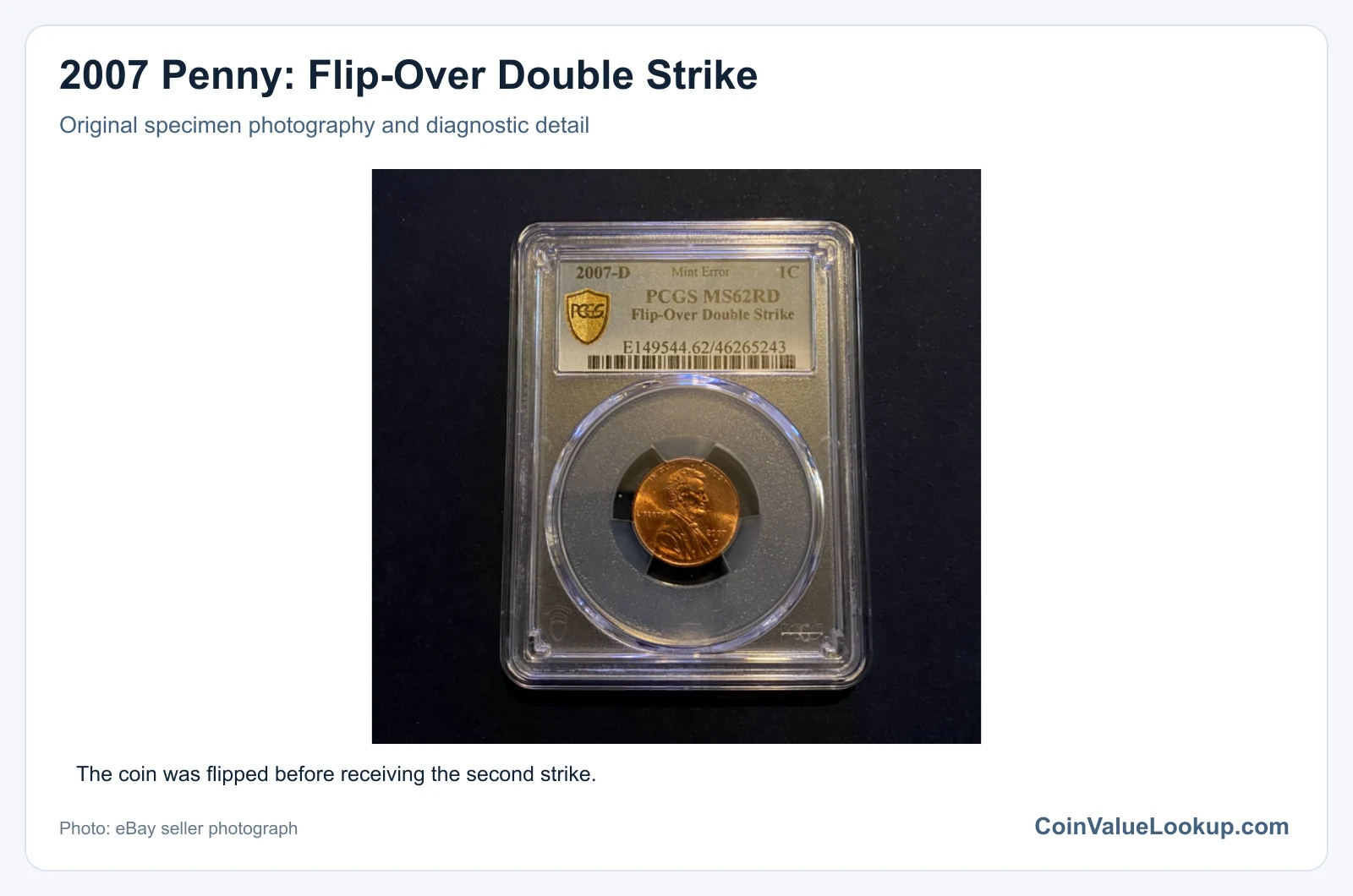
A flip-over double strike is dramatic. The coin is struck once normally, then flips and receives a second strike, so you see overlapping obverse and reverse designs on the same face.
Both impressions should show genuine struck detail — sharp, raised elements from both dies crossing over each other.
These are uncommon and visually obvious. A doubled die is a completely different animal — it involves one strike from a defective die, not two strikes from normal dies.
Post-mint impressions added by pressing coins together outside the mint lack the full-force strike characteristics. No price is adopted for this category; value hinges on the clarity and completeness of both impressions and the coin's authenticated condition.
5. 2007 Lincoln Penny — Clashed Dies
Clashed dies occur when the obverse and reverse dies strike each other without a planchet between them. The impact transfers traces of each die's design onto the opposing die.
Subsequent coins struck by those dies show ghost-like outlines from the wrong side — for example, faint Memorial columns appearing on Lincoln's portrait, or chin and shoulder outlines on the reverse.
These transferred features should align with where the opposite design would be expected during normal striking. Random scratches, raised lines from die polishing, or a brockage are not die clashes.
No specific price is adopted for this error; assessment depends on the strength and visibility of the transferred design and the coin's overall condition.
6. 2007 Lincoln Penny — Unplated / Partly Unplated Planchet
A 2007 cent struck on an unplated or partly unplated planchet will show exposed zinc where the copper coating is missing. Fully unplated examples look silvery-gray and weigh slightly less than the standard 2.50 grams because the copper layer is absent.
Partly unplated coins show patchy copper coverage with areas of zinc showing through.
The critical distinction is between a mint error — where the plating was missing before striking — and post-mint damage. Coins that have been chemically stripped of their plating or have corroded away their copper layer can look similar but show different surface characteristics under magnification.
Retain edge and weight information when seeking authentication. No price is adopted; value depends on the extent of missing plating and confirmed authenticity.
7. 2007 Lincoln Penny — Interior Die Break
An interior die break shows up as a raised, irregular blob or line of extra metal on the coin's surface, away from the rim. It is caused by a piece of the die cracking and recessing, allowing metal to fill that void during striking.
The raised feature should have defined boundaries and sit among otherwise normal design elements.
Do not call an interior break a rim cud — cuds specifically involve the die rim and create a flat, featureless area at the coin's edge. Incuse scratches, corrosion bumps, and foreign material stuck to the surface can mimic small die breaks.
No specific price is adopted; value depends on the size, location, and visual impact of the break, plus the coin's grade.
8. 2007 Lincoln Penny — Struck-Through Error
A struck-through error happens when foreign material — grease, a metal fragment, thread, or other debris — gets between the die and the planchet during striking. The result is a localized depression, an impression of the object, or an area of incomplete design.
Grease-filled dies produce soft, mushy spots, while a retained foreign object can leave a sharp impression or even remain embedded.
Ordinary wear, cleaning, and weak strikes from worn dies are the usual lookalikes. The difference is that a struck-through defect is localized and appears within otherwise well-struck areas.
No price is adopted for this category; each piece is assessed individually by the type and size of the obstruction, its visual impact, and the coin's authenticated condition.