2024 Lincoln Penny Coin Value: How Much Is It Worth?
A 2024 Lincoln penny pulled from pocket change is worth one cent. That is the reality for the vast majority of these coins in circulated condition.
In higher uncirculated grades, a guide estimate places a 2024 or 2024-D cent around $0.36 at MS65, while a 2024-S proof carries a guide estimate near $6.26 at PR65. These are guide figures from USA Coin Book, not guaranteed sale prices.
Collector finishes, recognized varieties and confirmed errors each occupy their own pricing lane.
Fast Way to Identify Your 2024 Lincoln Penny
Snap a clear photo of both the front and back of your 2024 penny and upload them to our identifier. This gives you a preliminary identification of the mint, design match and overall condition so you know which version you are holding.
It is not a substitute for professional authentication or certified grading, but it is a solid first step before you dig deeper.
2024 Penny Value
Upload both sides of your 2024 Lincoln Penny.
Front Obverse
Upload photo
Back Reverse
Upload photo
Which 2024 Lincoln Penny Versions Are Worth Money?
- A 2024 or 2024-D cent in original uncirculated condition with full red surfaces carries a modest premium over face value; guide estimates place MS65 examples around $0.36.
- A 2024-S proof penny, produced for collectors at the San Francisco Mint, has a PR65 guide estimate of roughly $6.26, making it the version most likely to exceed face value in this year's lineup.
Step 1: Identify Your 2024 Lincoln Penny Mint Mark and Version
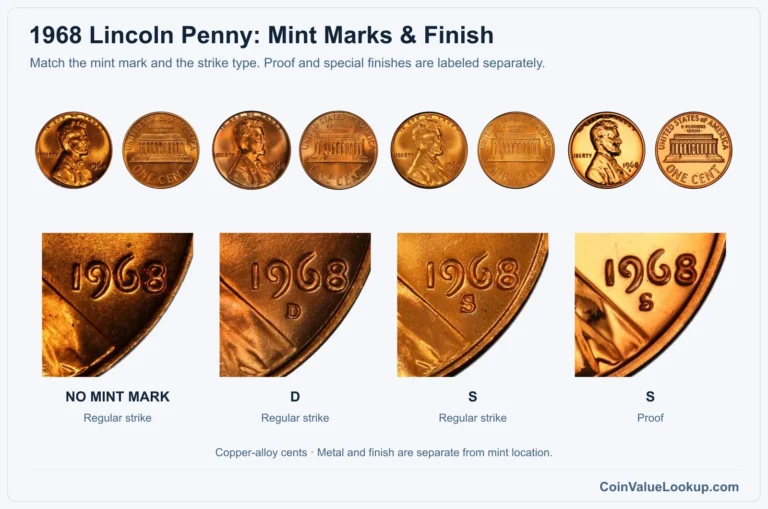
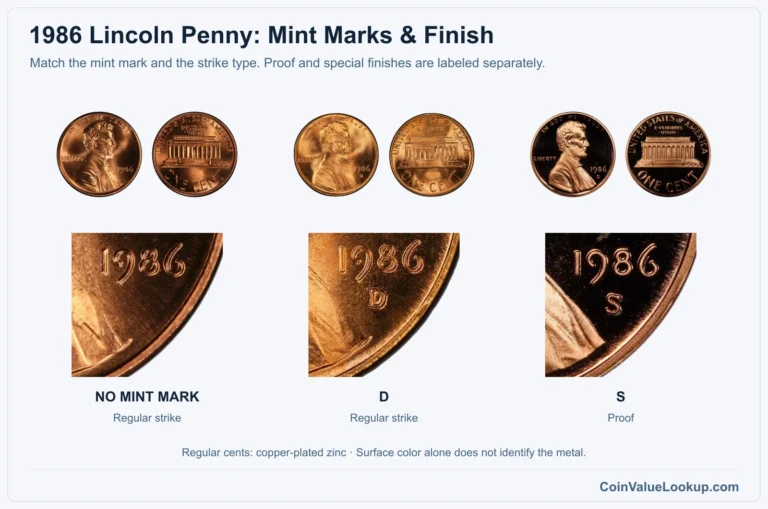
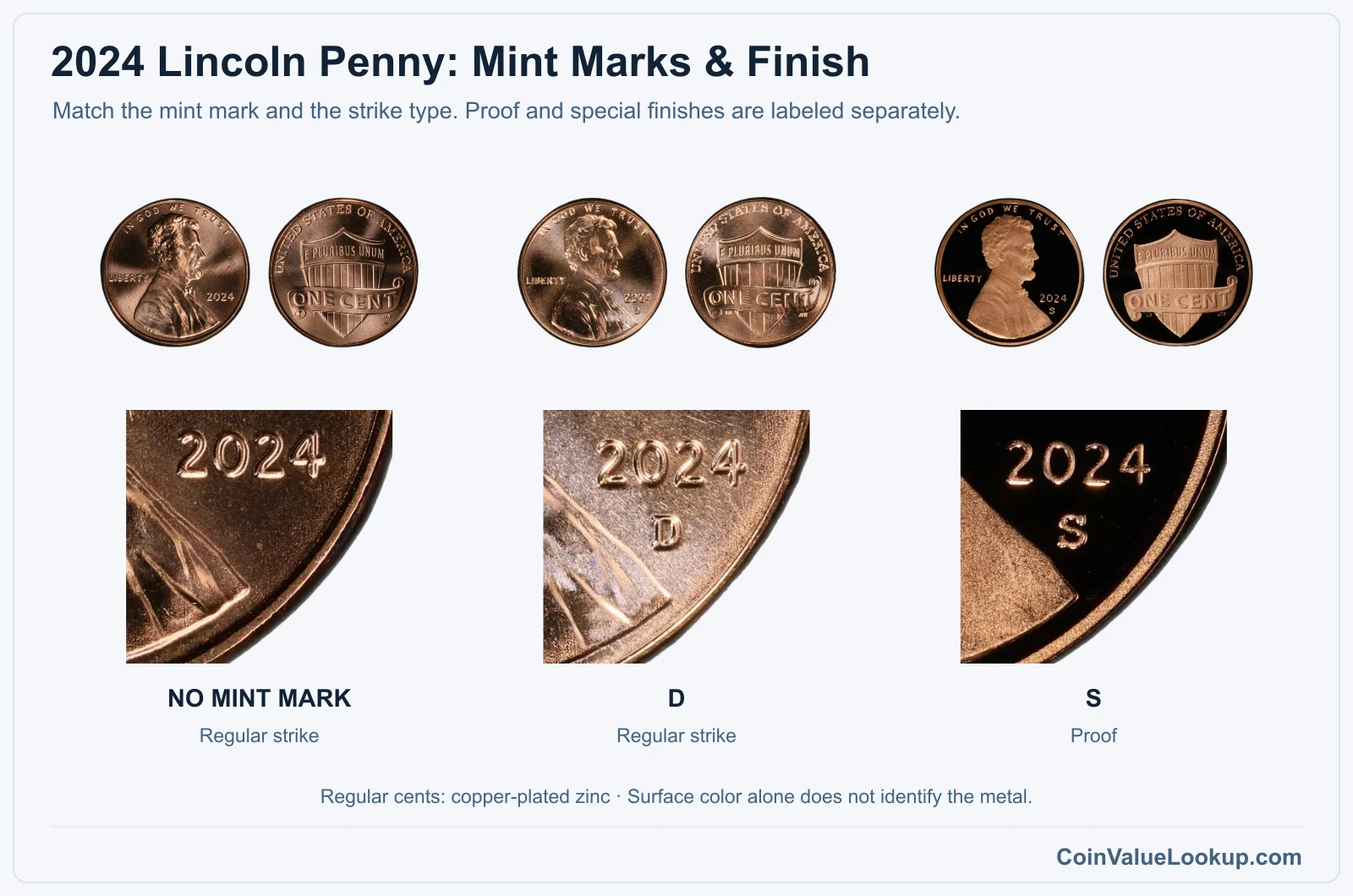
Flip your coin to the obverse. The date reads 2024, and immediately below it you will either see no mintmark, a small D, or a small S.
No letter means Philadelphia. A D means Denver.
An S means San Francisco, and those are virtually always proof coins sold in collector sets.
The reverse should show the Union Shield design that has appeared on Lincoln cents since 2010. If you see something else on the back, you may be looking at a different series entirely.
All standard 2024 cents are copper-plated zinc, weighing a nominal 2.50 grams. The copper is just a thin plating over a zinc core.
You cannot identify an off-metal error by color alone; a precise weight check and a professional opinion matter far more than eyeballing.
Step 2: Check Your 2024 Lincoln Penny Grade
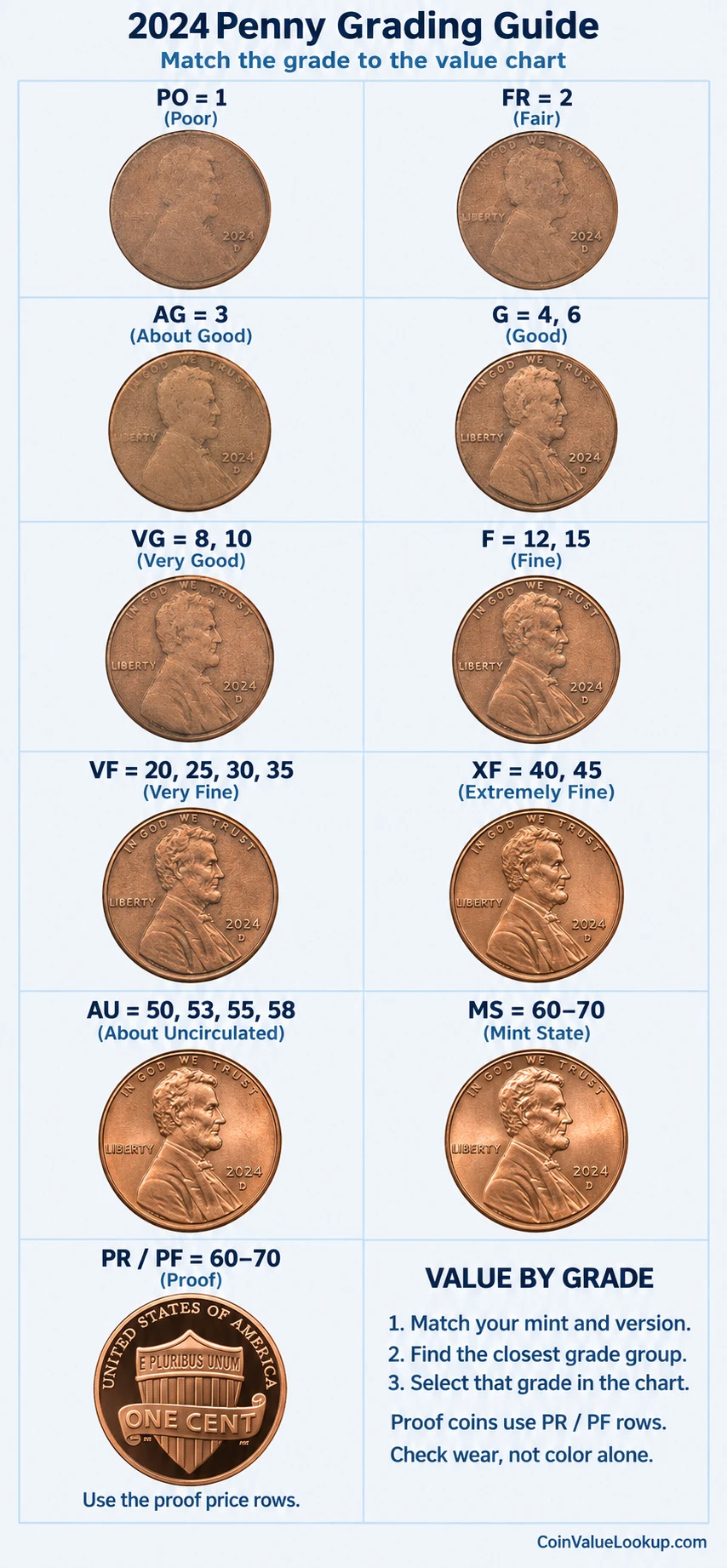
Start with Lincoln's cheek and jawline on the obverse. On a well-circulated coin these areas flatten first, losing fine hair detail and the subtle contour of his cheekbone.
A coin with full original luster and no wear on these high points is a candidate for Mint State grades.
On the reverse, check the horizontal lines of the Union Shield. They wear down gradually, so count how many remain sharp.
A coin with complete shield detail, undisturbed luster and no contact marks is approaching the MS65 range.
Color designations, RD for full red, RB for red-brown, and BN for brown, describe the remaining original copper tone. They are graded separately from wear.
A coin can be technically uncirculated but toned brown, and that affects its market appeal.
Use the comparison image to match your coin's wear pattern against known grade benchmarks. Proof coins have mirror-like fields and frosted devices by design; that is a manufacturing finish, not a grade above Mint State.
Step 3: Check 2024 Lincoln Penny Value by Mint and Version
2024 Lincoln Penny — Shield
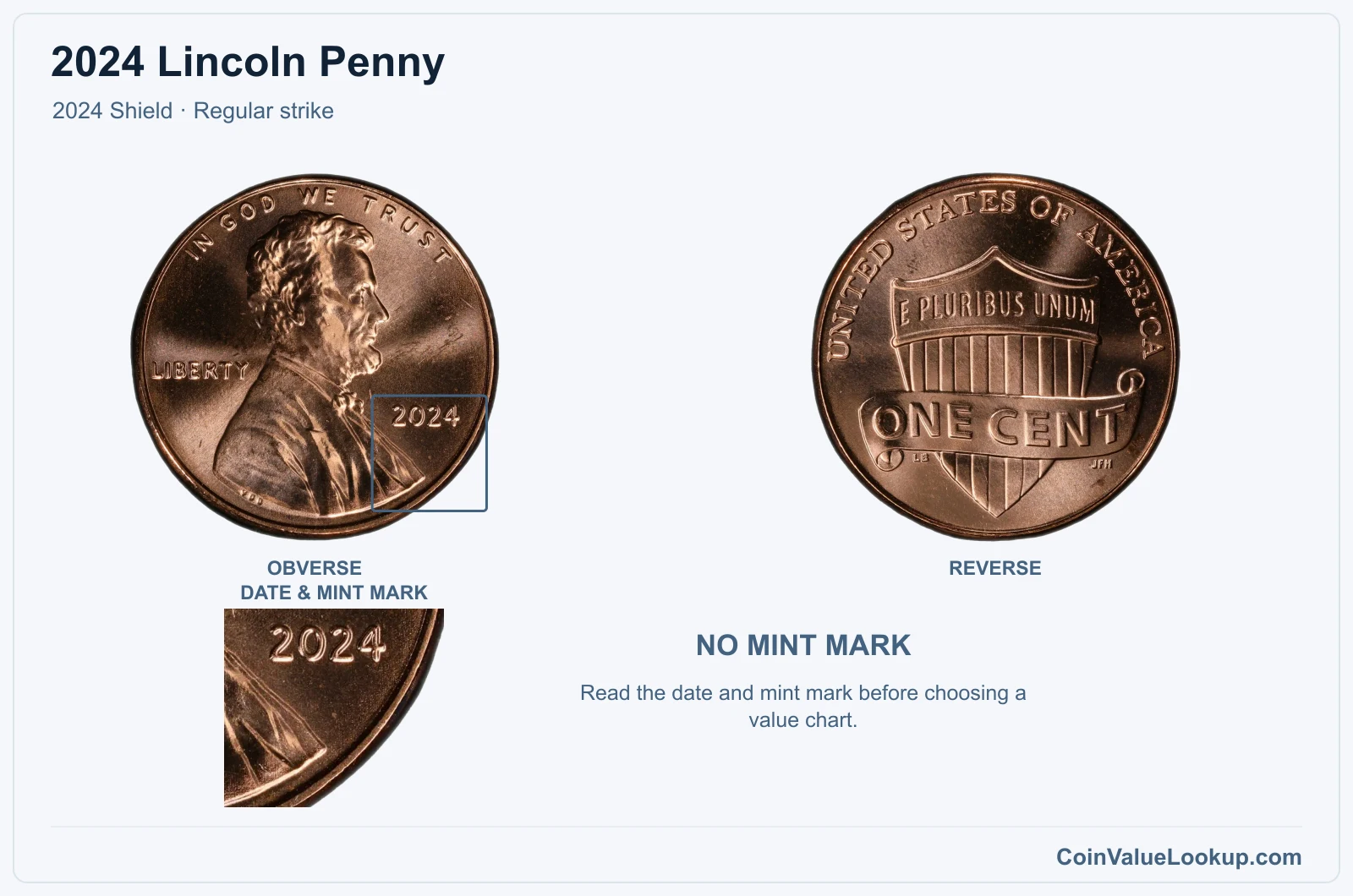
The 2024 Philadelphia cent has no mintmark below the date. It is a standard business-strike coin made from copper-plated zinc weighing about 2.50 grams.
Billions of these enter circulation every year, so finding one in your change is completely normal.
In worn condition, this coin is worth one cent. A guide estimate from USA Coin Book places an MS65 example at $0.36.
To reach that grade, the coin needs full luster, no visible wear on Lincoln's portrait and minimal contact marks. Original red color helps, too.
| Range | Grade | Price | Auction Records | Appraisal |
|---|---|---|---|---|
| PO | PO 1 | — | Coin Identifier | |
| FR | FR 2 | — | Coin Identifier | |
| AG | AG 3 | — | Coin Identifier | |
| G | G 4 | — | Coin Identifier | |
| G 6 | — | Coin Identifier | ||
| VG | VG 8 | — | Coin Identifier | |
| VG 10 | — | Coin Identifier | ||
| F | F 12 | — | Coin Identifier | |
| F 15 | — | Coin Identifier | ||
| VF | VF 20 | — | Coin Identifier | |
| VF 25 | — | Coin Identifier | ||
| VF 30 | — | Coin Identifier | ||
| VF 35 | — | Coin Identifier | ||
| XF | XF 40 | — | Coin Identifier | |
| XF 45 | — | Coin Identifier | ||
| AU | AU 50 | — | Coin Identifier | |
| AU 53 | — | Coin Identifier | ||
| AU 55 | — | Coin Identifier | ||
| AU 58 | — | Coin Identifier | ||
| MS | MS 60 | — | Coin Identifier | |
| MS 61 | — | Coin Identifier | ||
| MS 62 | — | Coin Identifier | ||
| MS 63 | — | Coin Identifier | ||
| MS 64 | — | Coin Identifier | ||
| MS 65 | — | Coin Identifier | ||
| MS 66 | — | — | — | |
| MS 67 | — | — | — | |
| MS 68 | — | — | — | |
| MS 69 | — | — | — | |
| MS 70 | — | — | — |
2024 Lincoln Penny — D Shield
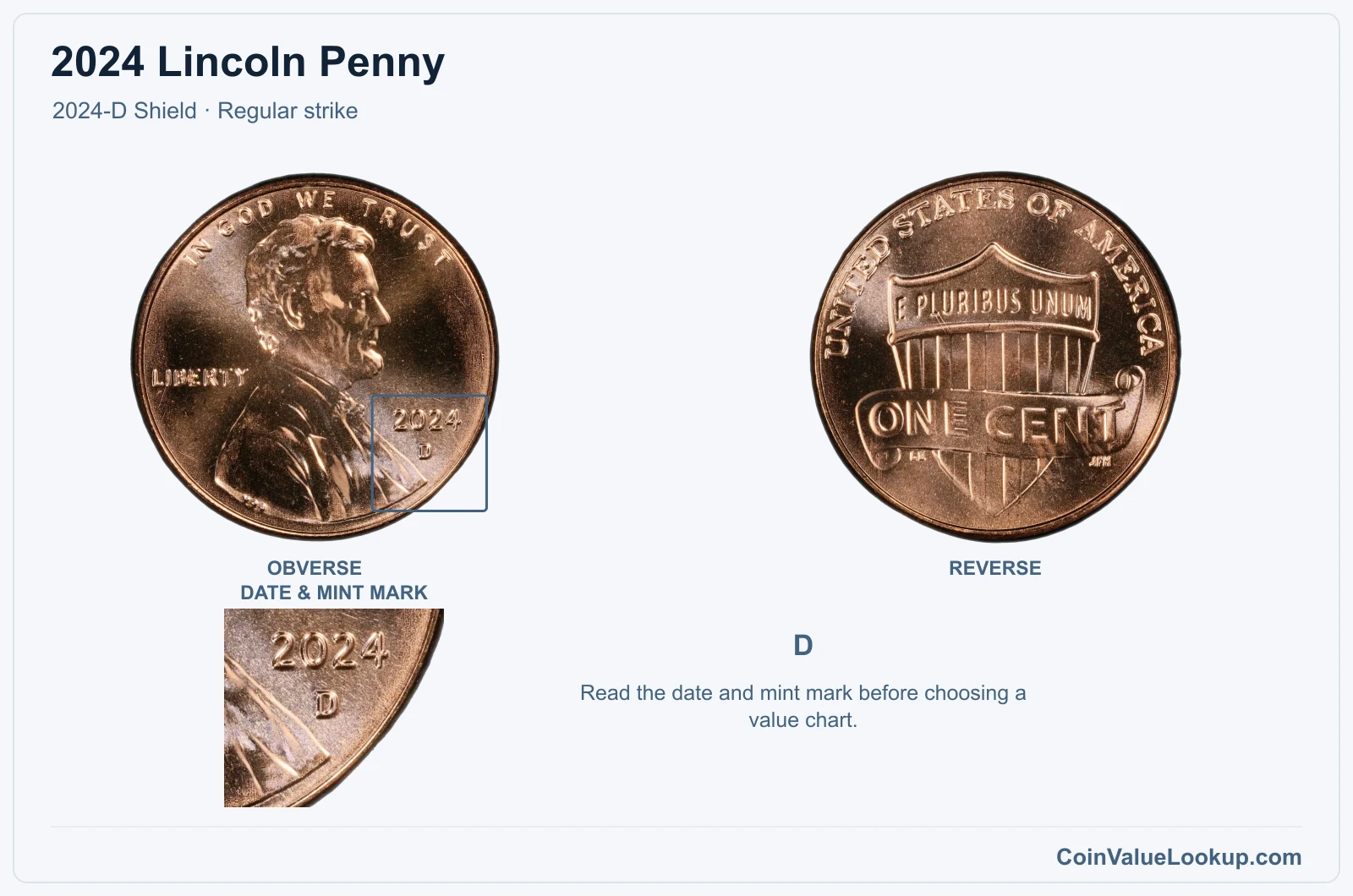
The 2024-D cent carries a small D mintmark below the date, identifying it as a Denver Mint product. Same copper-plated zinc composition, same 2.50-gram weight, same Union Shield reverse.
Circulated examples trade at face value. The MS65 guide estimate is $0.36, identical to its Philadelphia sibling.
Look for full, undisturbed luster and sharp detail across both the portrait and the shield to determine whether your coin approaches uncirculated territory.
Coin Value Lookup is a handy starting point if you want to look up values for other dates and denominations in the Lincoln cent series or beyond.
| Range | Grade | Price | Auction Records | Appraisal |
|---|---|---|---|---|
| PO | PO 1 | — | Coin Identifier | |
| FR | FR 2 | — | Coin Identifier | |
| AG | AG 3 | — | Coin Identifier | |
| G | G 4 | — | Coin Identifier | |
| G 6 | — | Coin Identifier | ||
| VG | VG 8 | — | Coin Identifier | |
| VG 10 | — | Coin Identifier | ||
| F | F 12 | — | Coin Identifier | |
| F 15 | — | Coin Identifier | ||
| VF | VF 20 | — | Coin Identifier | |
| VF 25 | — | Coin Identifier | ||
| VF 30 | — | Coin Identifier | ||
| VF 35 | — | Coin Identifier | ||
| XF | XF 40 | — | Coin Identifier | |
| XF 45 | — | Coin Identifier | ||
| AU | AU 50 | — | Coin Identifier | |
| AU 53 | — | Coin Identifier | ||
| AU 55 | — | Coin Identifier | ||
| AU 58 | — | Coin Identifier | ||
| MS | MS 60 | — | Coin Identifier | |
| MS 61 | — | Coin Identifier | ||
| MS 62 | — | Coin Identifier | ||
| MS 63 | — | Coin Identifier | ||
| MS 64 | — | Coin Identifier | ||
| MS 65 | — | Coin Identifier | ||
| MS 66 | — | Coin Identifier | ||
| MS 67 | — | Coin Identifier | ||
| MS 68 | — | — | — | |
| MS 69 | — | — | — | |
| MS 70 | — | — | — |
2024 Lincoln Penny — S Shield PR
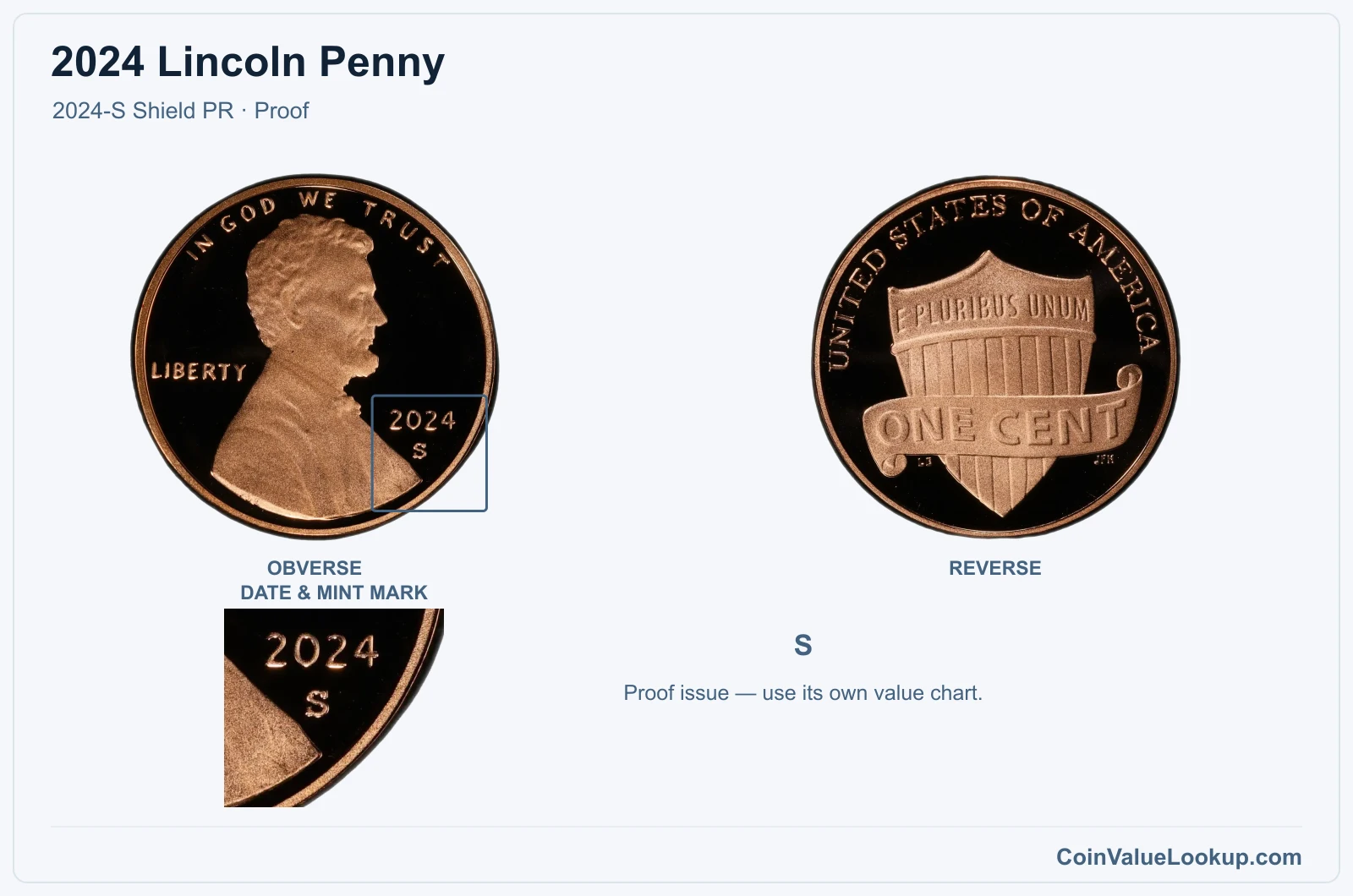
The 2024-S proof cent is struck at the San Francisco Mint and sold in collector proof sets, not released into circulation. Look for the S mintmark below the date, mirror-like fields, and sharply frosted devices.
A PR65 guide estimate from USA Coin Book is $6.26. That is a guide figure, not a guaranteed buyback price.
Proof coins should show no handling marks or haze on those mirror surfaces to grade well. Cameo or deep cameo contrast, where the frosted portrait stands out strongly against the reflective field, is evaluated separately and can influence desirability.
| Range | Grade | Price | Auction Records | Appraisal |
|---|---|---|---|---|
| PR | PR 1 | — | Coin Identifier | |
| PR 2 | — | Coin Identifier | ||
| PR 3 | — | Coin Identifier | ||
| PR 4 | — | Coin Identifier | ||
| PR 6 | — | Coin Identifier | ||
| PR 8 | — | Coin Identifier | ||
| PR 10 | — | Coin Identifier | ||
| PR 12 | — | Coin Identifier | ||
| PR 15 | — | Coin Identifier | ||
| PR 20 | — | Coin Identifier | ||
| PR 25 | — | Coin Identifier | ||
| PR 30 | — | Coin Identifier | ||
| PR 35 | — | Coin Identifier | ||
| PR 40 | — | Coin Identifier | ||
| PR 45 | — | Coin Identifier | ||
| PR 50 | — | Coin Identifier | ||
| PR 53 | — | Coin Identifier | ||
| PR 55 | — | Coin Identifier | ||
| PR 58 | — | Coin Identifier | ||
| PR 60 | — | Coin Identifier | ||
| PR 61 | — | Coin Identifier | ||
| PR 62 | — | Coin Identifier | ||
| PR 63 | — | Coin Identifier | ||
| PR 64 | — | Coin Identifier | ||
| PR 65 | — | Coin Identifier | ||
| PR 66 | — | Coin Identifier | ||
| PR 67 | — | Coin Identifier | ||
| PR 68 | — | Coin Identifier | ||
| PR 69 | — | Coin Identifier | ||
| PR 70 | — | Coin Identifier |
2024 Lincoln Penny Error List
1. 2024 Lincoln Penny — Doubled Die Obverse
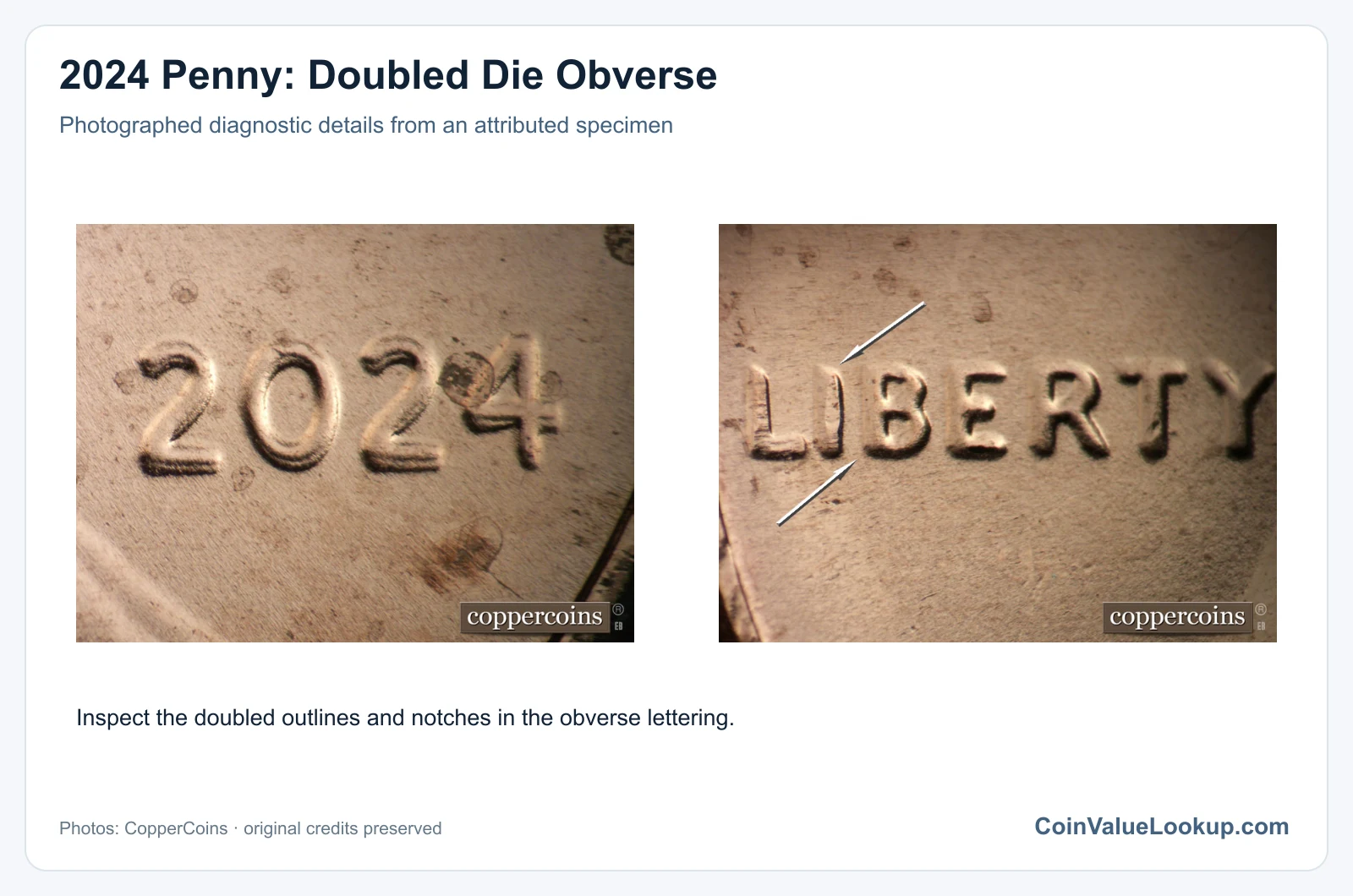
A doubled die obverse on a 2024-D Lincoln cent shows extra thickness or a secondary image on design elements. Source-reported diagnostics point to doubling visible near the VDB initials on Lincoln's shoulder and around the letters of LIBERTY.
To check, compare your coin's obverse lettering and the VDB area against a normal 2024-D cent under magnification. Genuine hub doubling produces a consistent shelf or secondary outline that repeats in the same direction across affected areas.
Do not confuse this with machine doubling, which tends to look flat and shelf-like in a single direction without the raised, separated quality of a true doubled die. Reflections under certain lighting can also mimic doubling.
Value depends on the severity of the doubling, the coin's condition and whether it has been authenticated by a recognized grading service.
2. 2024 Lincoln Penny — Struck-Through Error
A struck-through error on a 2024-D cent occurs when foreign material, often grease, sits between the die and the planchet during striking. The result is missing or weakened design detail where the obstruction blocked the impression.
Source reports describe grease-obstructed reverse lettering and a separate instance of a missing VDB on the obverse attributed to grease fill. A missing VDB alone is not proof of a struck-through error; normal die wear or a filled die can look very similar.
Look for a smooth, flat area where detail should exist, with clearly defined boundaries around the missing portion. Wear, cleaning and scratches all remove detail too, but they leave different surface textures.
Authentication matters here, because the difference between a genuine struck-through and ordinary weakness is often subtle. Pricing depends on the size, location and clarity of the obstruction, assessed on a coin-by-coin basis.
3. 2024 Lincoln Penny — Die Crack / Die Chip
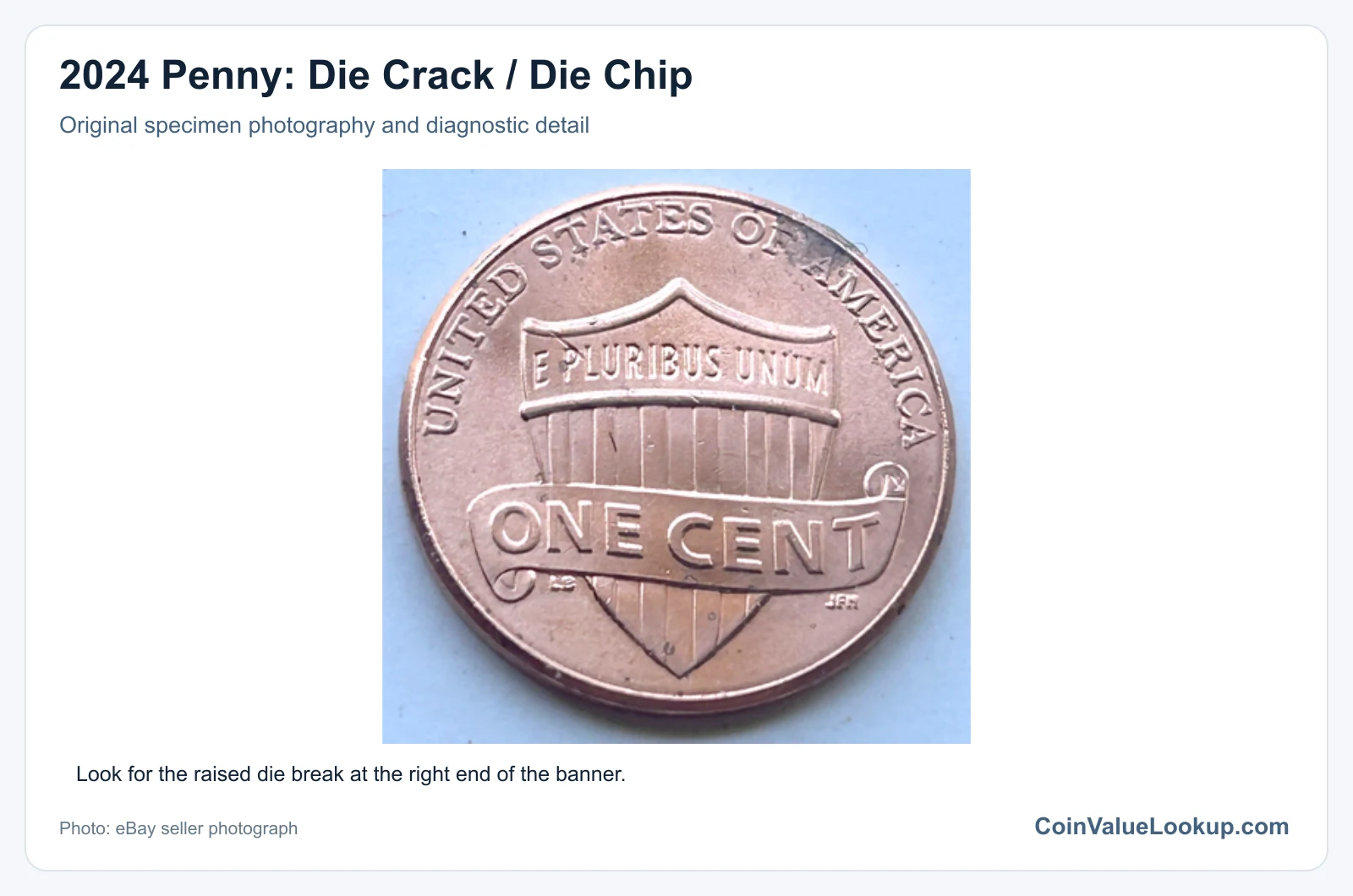
Die cracks on a 2024-D Lincoln cent appear as thin raised lines on the coin's surface, created when the steel die itself develops a fracture. Die chips show up as small raised blobs where a tiny piece of the die face broke away, leaving a void that fills with metal during striking.
These raised features are the key diagnostic: they sit above the coin's normal surface. An incuse scratch, by contrast, is pressed into the surface.
Corrosion or foreign material stuck to the coin can mimic a raised line, so inspect carefully under magnification.
An interior die chip is different from a rim-connected break. Small, isolated cracks and chips are relatively common on modern cents and their value depends on size, prominence, location and the coin's overall condition.
Each example needs individual assessment.
4. 2024 Lincoln Penny — Die Gouge / Named Raised-Line Variety
A die gouge on a 2024-D cent is a raised line or mark caused by damage to the die surface itself, transferred onto every coin struck from that die. Source reports describe a distinctive raised W-shaped line at Lincoln's coat and shoulder area.
Because it originates from the die, this mark is raised on the coin, not incuse. That is the fastest way to distinguish it from a post-mint scratch, which cuts into the surface.
Compare your coin's shoulder area to a normal 2024-D cent side by side.
Do not confuse a die gouge with a die crack. Cracks follow stress fractures in the die and tend to be thinner and more linear, while gouges result from physical damage to the die face and can have irregular shapes.
Value is assessed individually based on the gouge's visibility, location and the coin's condition.
5. 2024 Lincoln Penny — Off-Center Strike
An off-center strike happens when the planchet is not properly seated between the dies, so part of the design is missing and a blank crescent of unstruck metal appears along the edge. On a 2024 Lincoln cent, the key question is whether the date remains fully visible; a readable date significantly affects collector interest.
Do not confuse an off-center strike with a clipped planchet, which has a curved cut-out from a punching error, or with post-mint damage that flattened one side. A genuine off-center coin shows a complete shift of the entire design in one direction with a matching blank area opposite.
The percentage of off-center displacement and the coin's overall condition determine value on a case-by-case basis. Professional authentication is recommended for significant examples.
6. 2024 Lincoln Penny — Double / Multiple Strike
A double or multiple strike means the coin was struck more than once by the dies, with each impression landing in a slightly different position or rotation. The result is two or more overlapping but distinctly separate images of the design on the same planchet.
Look for a clearly displaced second impression rather than just thickened lettering. Genuine multiple strikes produce a ghost-like duplicate of major design elements, often rotated or shifted enough to see both versions of Lincoln's portrait.
This is different from a doubled die, which originates in the die-making process and appears identical on every coin from that die. It also differs from post-mint vice marks or alterations.
Value depends on the degree of separation, whether both strikes are identifiable and the coin's condition. Authentication is strongly recommended.
7. 2024 Lincoln Penny — Rotated Dies
Rotated dies produce a coin where the obverse and reverse are misaligned from normal US coin orientation. To test, hold your penny with Lincoln upright, then flip it top to bottom like turning a page.
The Union Shield should appear upright. If it is tilted or upside down, you may have a die rotation error.
Make sure you are flipping correctly, top to bottom, not left to right. A photograph taken at an angle or a coin casually turned sideways can create a false impression of rotation.
The degree of rotation matters. Small rotations of a few degrees are less significant than dramatic ones approaching 90 or 180 degrees.
Each coin's value depends on the rotation severity, overall condition and professional verification of the error.
8. 2024 Lincoln Penny — Die Break / Cud
A cud is a specific type of die break where a chunk of the die along the rim breaks away completely. The resulting coin shows a raised, featureless blob of metal that connects to the rim, replacing part of the normal design in that area.
The rim connection is what separates a cud from an interior die chip or crack. If the raised area does not touch the rim, it is a retained die break, not technically a cud.
Rim dents and corrosion can superficially resemble a cud but are incuse or irregular rather than raised and smooth.
Look for the boundary where normal design detail ends and the blank raised area begins. Cuds on 2024 Lincoln cents are assessed individually for size, location and coin condition.
Larger cuds that obscure recognizable design elements tend to draw more collector attention.