1928 Wheat Penny Coin Value: How Much Is It Worth?
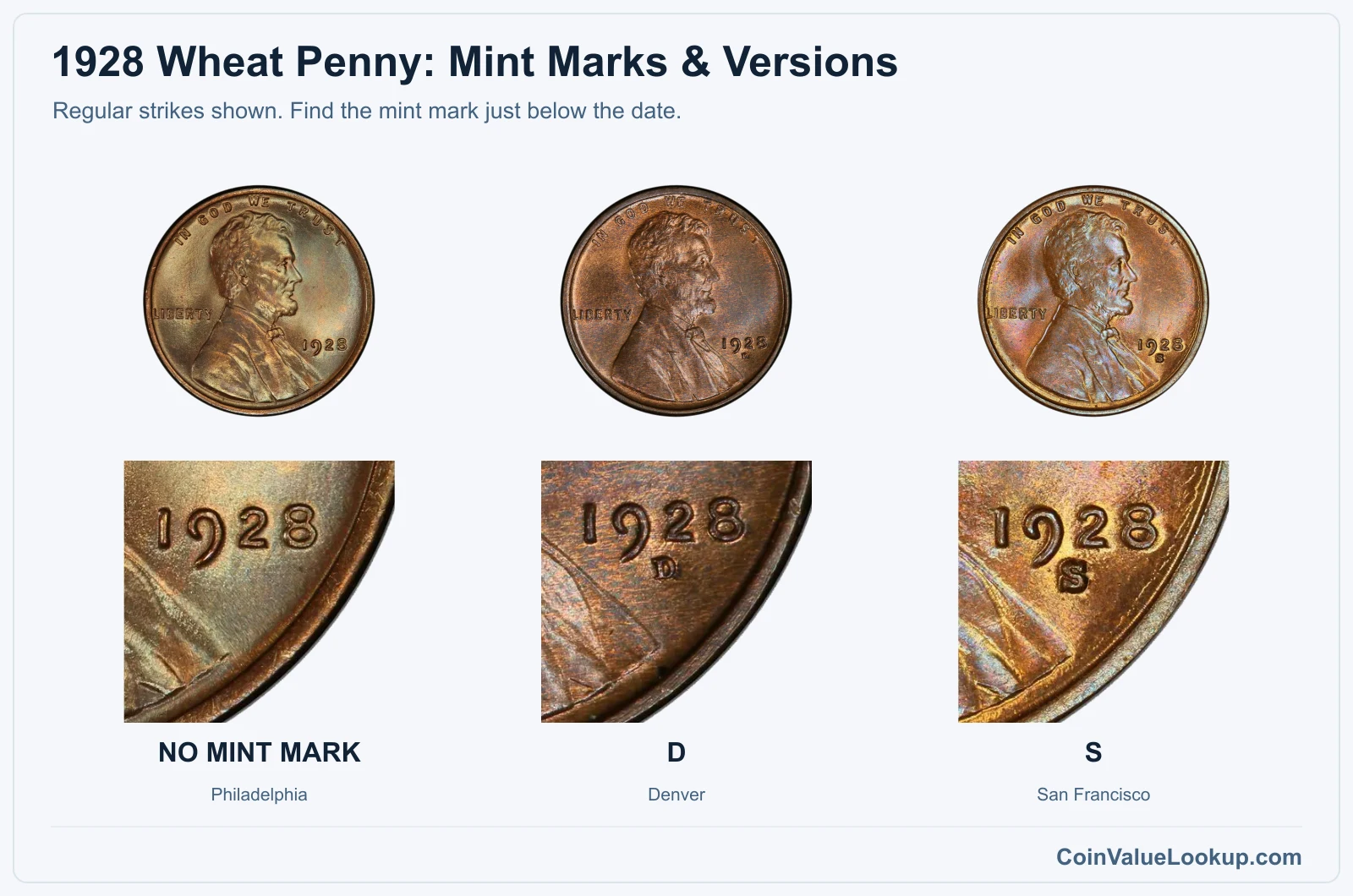
A 1928 Wheat Penny in circulated condition starts around $0.30 in Good-4 grade and can reach up to $154 at MS63, depending on which mint produced it. Those anchors span the Philadelphia, Denver, and San Francisco business strikes.
Proofs were not made this year. Major varieties like the Large S and collectible errors are valued separately, and original surfaces, color, and wear all affect what a buyer will actually pay.
Fast Way to Identify Your 1928 Wheat Penny
Snap a clear photo of the front and back of your 1928 cent and upload both images for a preliminary identification. This helps narrow down the mint, variety, and approximate condition so you know which version you are holding.
Good lighting and a close-up of the mintmark area make a real difference.
1928 Wheat Penny Value
Upload both sides of your 1928 Wheat Penny.
Front Obverse
Upload photo
Back Reverse
Upload photo
Which 1928 Wheat Penny Versions Are Worth Money?
- The 1928-S in MS63 carries the highest guide anchor among standard strikes at $154, driven by lower survival rates in top condition.
- The 1928-D at MS63 lists around $100 in guide estimates, making uncirculated Denver coins worth a careful look.
- The 1928-S Large S is a recognized punch variety valued individually by authenticated identity and condition rather than a fixed guide price.
- Even common Philadelphia strikes jump from about $0.30 in Good-4 to $19 at MS63, so an uncirculated example in original surfaces is worth checking.
- Collectible mint errors such as off-center strikes or repunched mintmarks on any 1928 cent add value assessed on a case-by-case basis.
Step 1: Identify Your 1928 Wheat Penny Mint Mark and Version
Flip the coin to the reverse first and confirm two wheat ears flanking ONE CENT. That is your Wheat reverse.
The coin should weigh roughly 3.11 grams with a plain edge, struck in 95% copper with 5% tin and zinc.
Now check for a mintmark just below the date on the obverse. No letter means Philadelphia.
A D means Denver. An S means San Francisco.
San Francisco coins need a closer look. Two recognized punch sizes exist for the S mintmark this year: the standard Small S and a distinctly larger Large S.
Compare your S at magnification against known examples of each; size and shape differences are visible with a loupe. Philadelphia and Denver had single standard punches, so their identification is more straightforward.
No proof cents were produced for 1928, so every genuine example is a business strike. Red, red-brown, or brown color describes the surviving surface tone, not the manufacturing method or the grade.
Step 2: Check Your 1928 Wheat Penny Grade
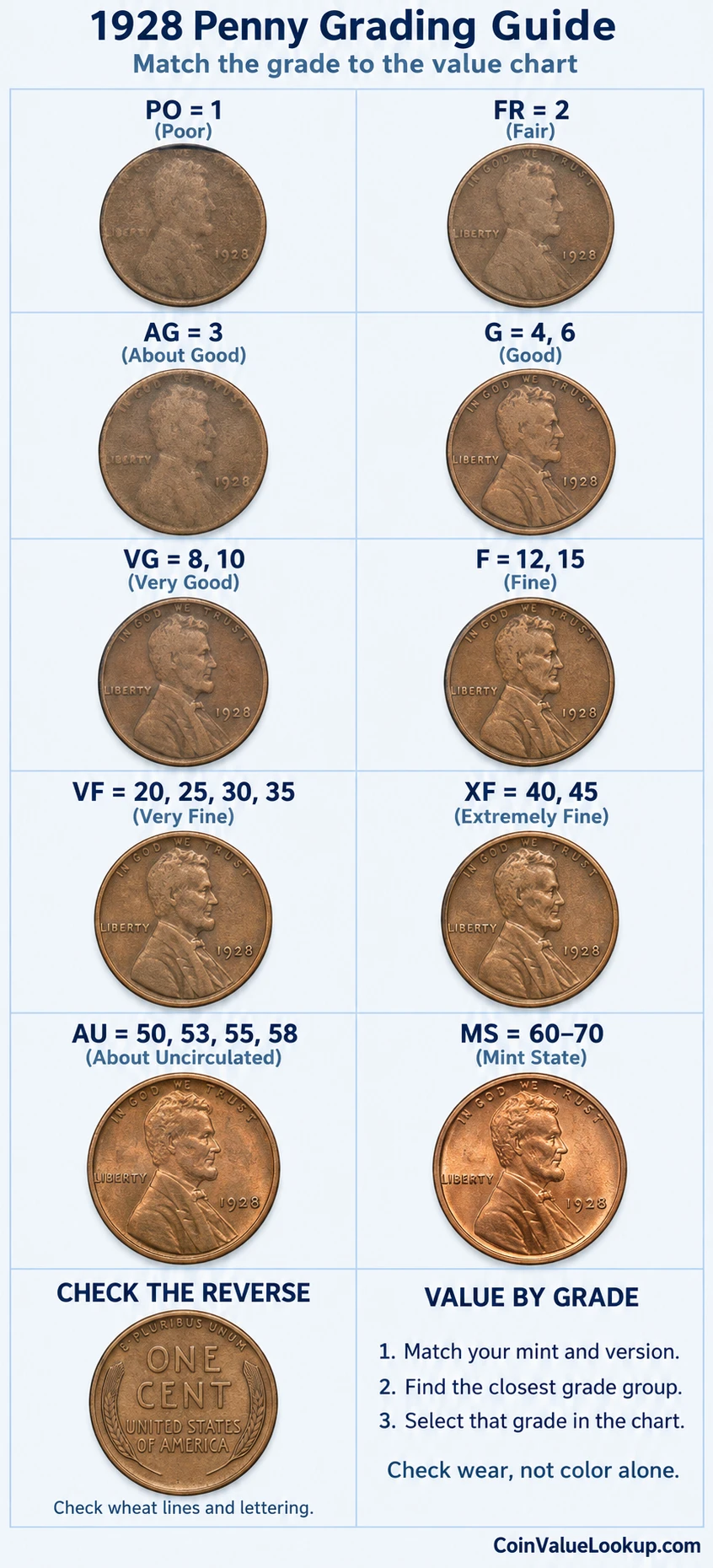
Start with Lincoln's cheekbone and jawline on the obverse. In lower grades these flatten first, then the hair detail above the ear softens.
A coin in Good-4 will show a clear outline of Lincoln but little interior detail.
On the reverse, look at the individual wheat grains and the horizontal lines between them. As wear increases, the grains merge and the lines disappear.
An MS63 coin retains full grain separation, complete hair strands, and original mint luster across the surfaces.
Weak strikes can mimic wear, though. A softly struck coin may show mushy detail at the high points even without any actual circulation wear.
Luster is your tiebreaker: a weakly struck uncirculated coin still has unbroken cartwheel shine.
Use the comparison image to match your coin's wear pattern against known grade examples. Color, spots, corrosion, and signs of cleaning are separate factors that affect value independently of the wear grade.
A brown uncirculated cent is not the same market animal as a full red one.
Step 3: Check 1928 Wheat Penny Value by Mint and Version
1928 Wheat Penny
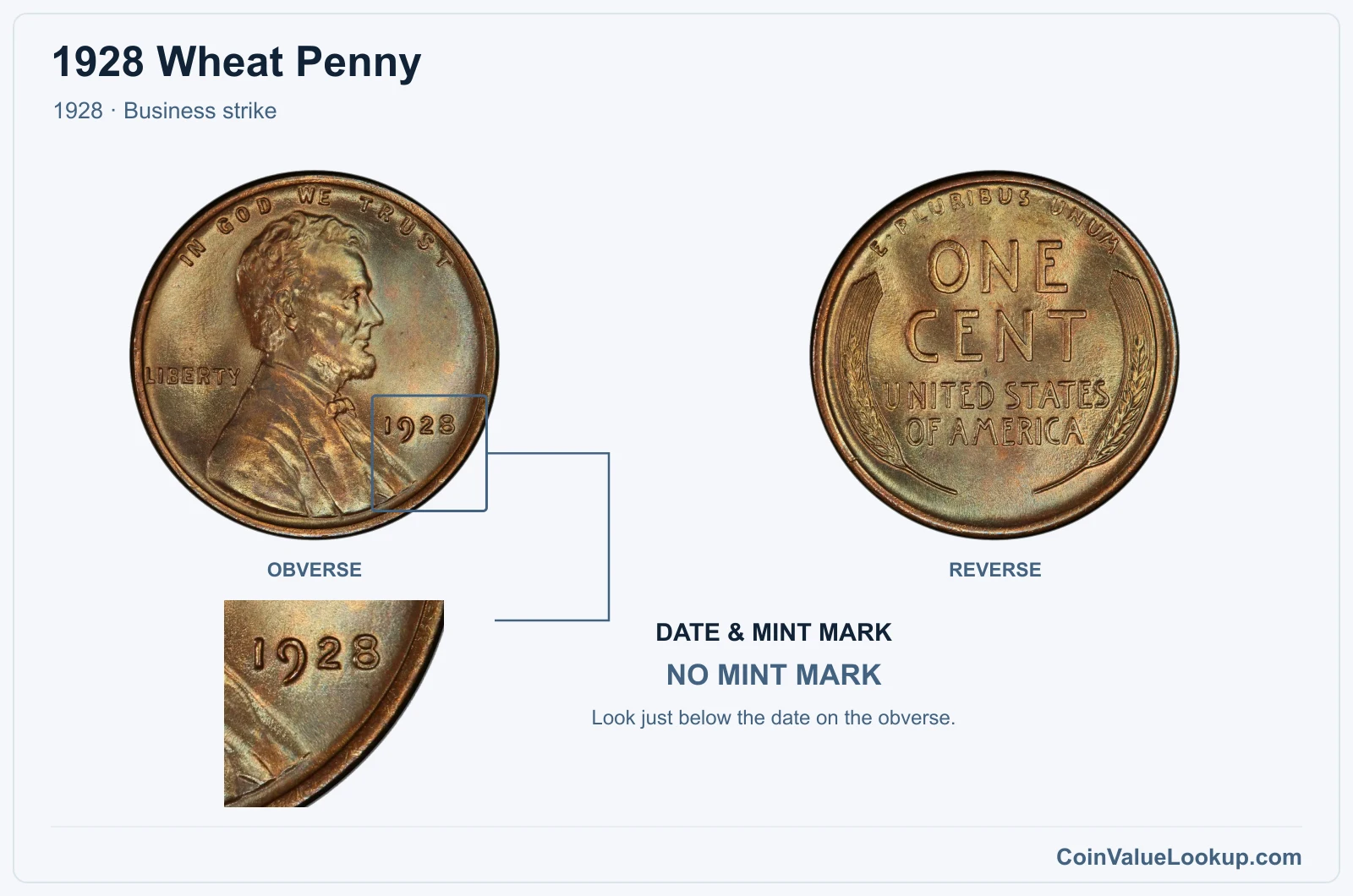
The 1928 Philadelphia cent has no mintmark below the date. It is the most common of the three mints this year and trades at the lower end of the value range.
Guide estimates place it around $0.30 in Good-4 and roughly $19 in MS63. Those figures assume unspecified color, so a certified red example would carry a different premium than a brown one at the same technical grade.
For a circulated piece sitting in a junk box, you are looking at pocket change in value. The real payoff comes if yours is uncirculated with original luster intact.
Check the high points and look for that unbroken cartwheel shine before getting excited.
| Range | Grade | Price | Auction Records | Appraisal |
|---|---|---|---|---|
| PO | PO 1 | — | Coin Identifier | |
| FR | FR 2 | — | Coin Identifier | |
| AG | AG 3 | — | Coin Identifier | |
| G | G 4 | — | Coin Identifier | |
| G 6 | — | Coin Identifier | ||
| VG | VG 8 | — | Coin Identifier | |
| VG 10 | — | Coin Identifier | ||
| F | F 12 | — | Coin Identifier | |
| F 15 | — | Coin Identifier | ||
| VF | VF 20 | — | Coin Identifier | |
| VF 25 | — | Coin Identifier | ||
| VF 30 | — | Coin Identifier | ||
| VF 35 | — | Coin Identifier | ||
| XF | XF 40 | — | Coin Identifier | |
| XF 45 | Coin Identifier | |||
| AU | AU 50 | — | Coin Identifier | |
| AU 53 | — | Coin Identifier | ||
| AU 55 | — | Coin Identifier | ||
| AU 58 | — | Coin Identifier | ||
| MS | MS 60 | — | Coin Identifier | |
| MS 61 | — | Coin Identifier | ||
| MS 62 | Coin Identifier | |||
| MS 63 | Coin Identifier | |||
| MS 64 | Coin Identifier | |||
| MS 65 | Coin Identifier | |||
| MS 66 | — | — | — | |
| MS 67 | — | — | — | |
| MS 68 | — | — | — | |
| MS 69 | — | — | — | |
| MS 70 | — | — | — |
1928 Wheat Penny — D
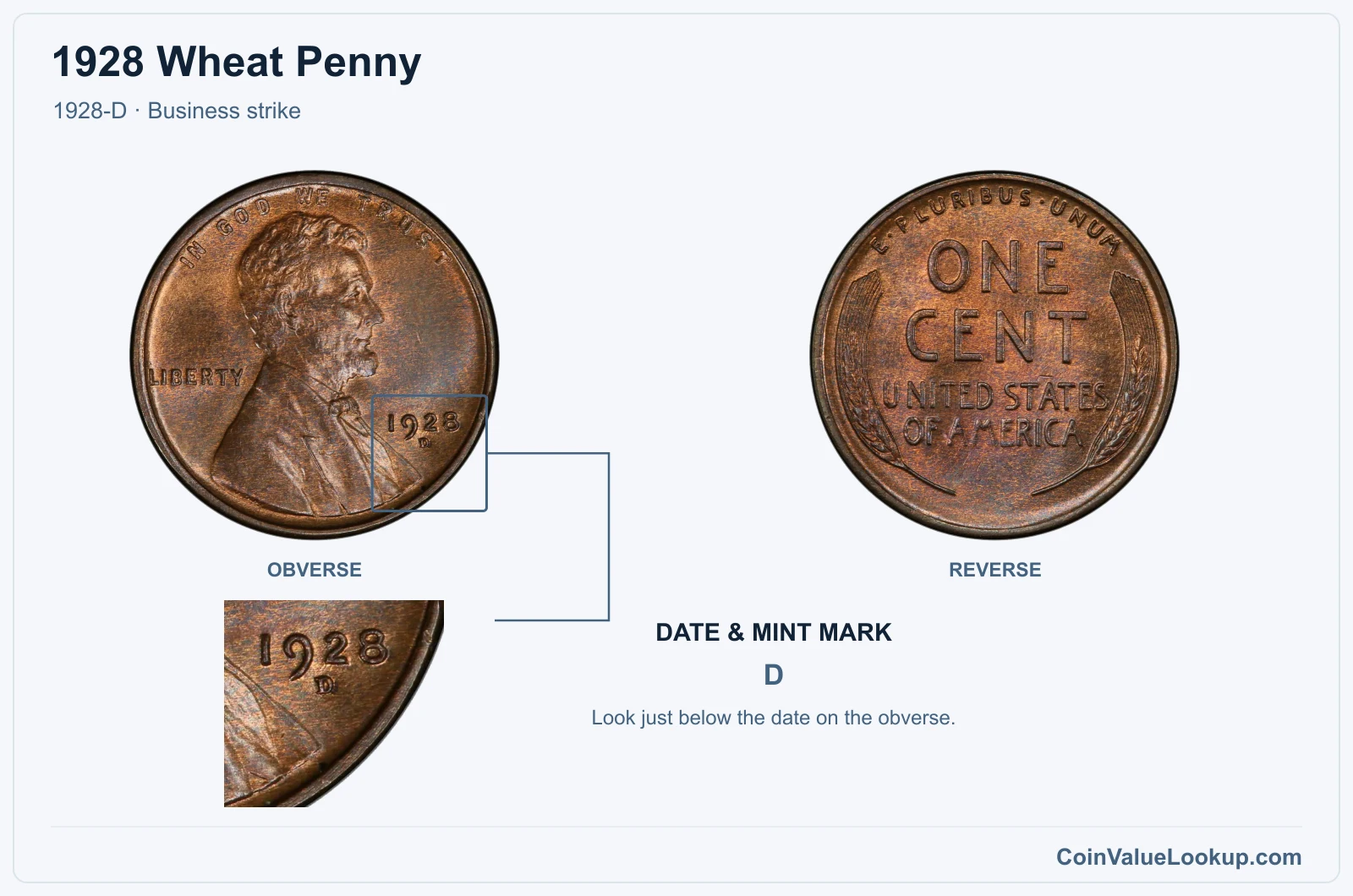
Look for a small D mintmark below the date. Denver struck fewer of these than Philadelphia, and that scarcity shows in the price gap.
Guide estimates run about $0.93 in Good-4 and around $100 at MS63. The jump from circulated to mint state is steep, which tells you most survivors saw heavy use.
Condition matters enormously here. A well-worn example is a dollar coin.
An original, lustrous uncirculated piece is a legitimate collector coin. Color and surface quality separate the okay specimens from the ones that command attention at auction.
Coin Value Lookup is a good starting point if you want to compare values for other dates and mints in the Lincoln Wheat series. It can help you figure out which coins in your collection are worth a deeper look.
| Range | Grade | Price | Auction Records | Appraisal |
|---|---|---|---|---|
| PO | PO 1 | — | Coin Identifier | |
| FR | FR 2 | — | Coin Identifier | |
| AG | AG 3 | — | Coin Identifier | |
| G | G 4 | — | Coin Identifier | |
| G 6 | — | Coin Identifier | ||
| VG | VG 8 | — | Coin Identifier | |
| VG 10 | — | Coin Identifier | ||
| F | F 12 | — | Coin Identifier | |
| F 15 | — | Coin Identifier | ||
| VF | VF 20 | — | Coin Identifier | |
| VF 25 | — | Coin Identifier | ||
| VF 30 | — | Coin Identifier | ||
| VF 35 | — | Coin Identifier | ||
| XF | XF 40 | Coin Identifier | ||
| XF 45 | Coin Identifier | |||
| AU | AU 50 | Coin Identifier | ||
| AU 53 | Coin Identifier | |||
| AU 55 | Coin Identifier | |||
| AU 58 | Coin Identifier | |||
| MS | MS 60 | — | Coin Identifier | |
| MS 61 | Coin Identifier | |||
| MS 62 | Coin Identifier | |||
| MS 63 | Coin Identifier | |||
| MS 64 | Coin Identifier | |||
| MS 65 | Coin Identifier | |||
| MS 66 | Coin Identifier | |||
| MS 67 | — | — | — | |
| MS 68 | — | — | — | |
| MS 69 | — | — | — | |
| MS 70 | — | — | — |
1928 Wheat Penny — S
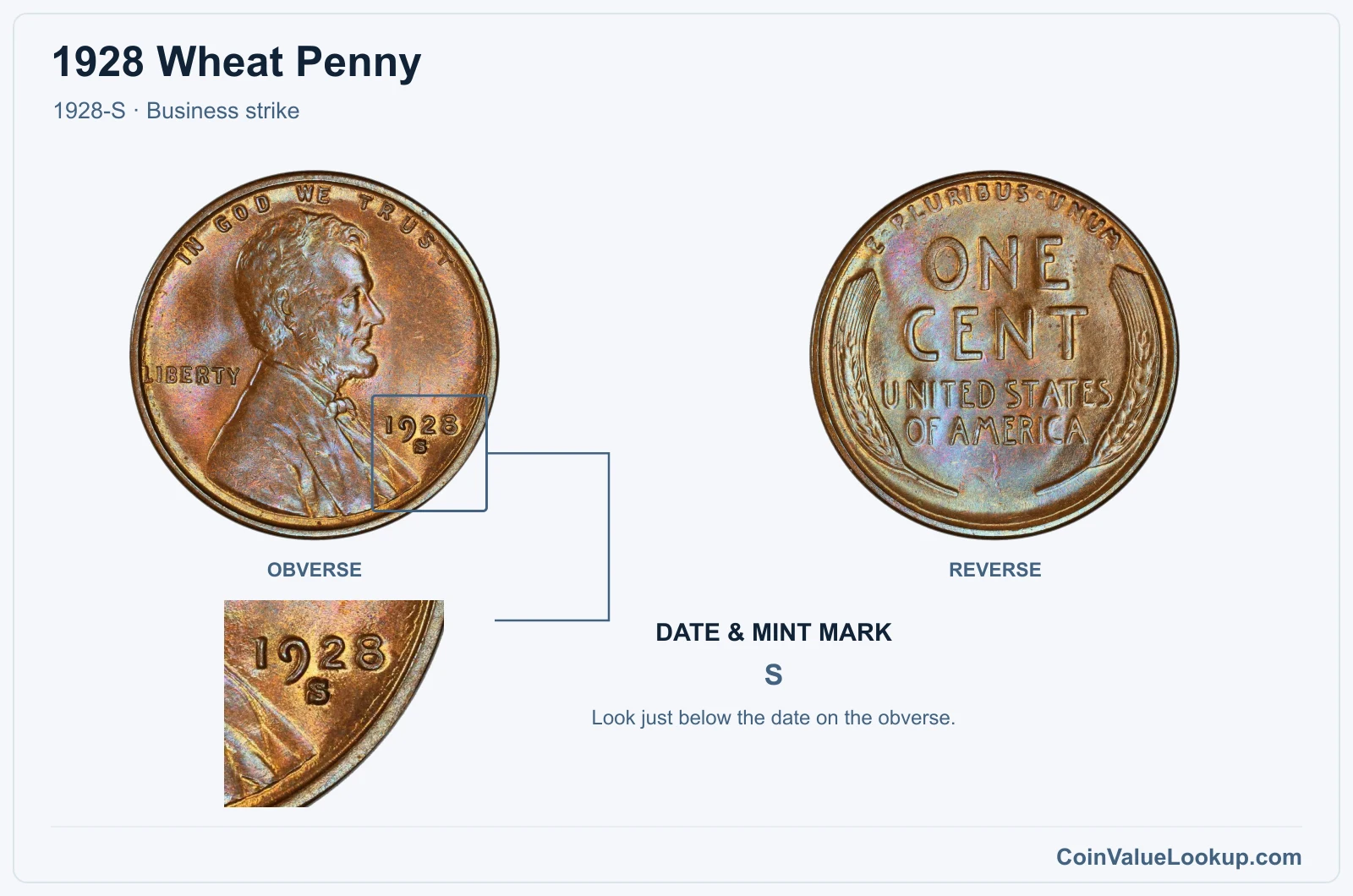
The standard 1928-S carries a Small S mintmark below the date. San Francisco cents from this era often come weakly struck, so do not confuse soft detail with heavy wear.
Guide estimates sit at roughly $1.24 in Good-4 and climb to about $154 in MS63, the highest among the three regular 1928 mints. Survivors in uncirculated condition are genuinely scarce, which is why the premium is so dramatic.
Before assuming you have a high-grade coin, verify full luster and check for any trace of friction on Lincoln's cheek. Even light cleaning knocks appeal and value down significantly.
| Range | Grade | Price | Auction Records | Appraisal |
|---|---|---|---|---|
| PO | PO 1 | — | Coin Identifier | |
| FR | FR 2 | — | Coin Identifier | |
| AG | AG 3 | — | Coin Identifier | |
| G | G 4 | — | Coin Identifier | |
| G 6 | — | Coin Identifier | ||
| VG | VG 8 | — | Coin Identifier | |
| VG 10 | — | Coin Identifier | ||
| F | F 12 | — | Coin Identifier | |
| F 15 | — | Coin Identifier | ||
| VF | VF 20 | — | Coin Identifier | |
| VF 25 | — | Coin Identifier | ||
| VF 30 | — | Coin Identifier | ||
| VF 35 | — | Coin Identifier | ||
| XF | XF 40 | — | Coin Identifier | |
| XF 45 | Coin Identifier | |||
| AU | AU 50 | Coin Identifier | ||
| AU 53 | Coin Identifier | |||
| AU 55 | Coin Identifier | |||
| AU 58 | Coin Identifier | |||
| MS | MS 60 | — | Coin Identifier | |
| MS 61 | Coin Identifier | |||
| MS 62 | Coin Identifier | |||
| MS 63 | Coin Identifier | |||
| MS 64 | Coin Identifier | |||
| MS 65 | Coin Identifier | |||
| MS 66 | — | — | — | |
| MS 67 | — | — | — | |
| MS 68 | — | — | — | |
| MS 69 | — | — | — | |
| MS 70 | — | — | — |
1928 Wheat Penny — S Large S
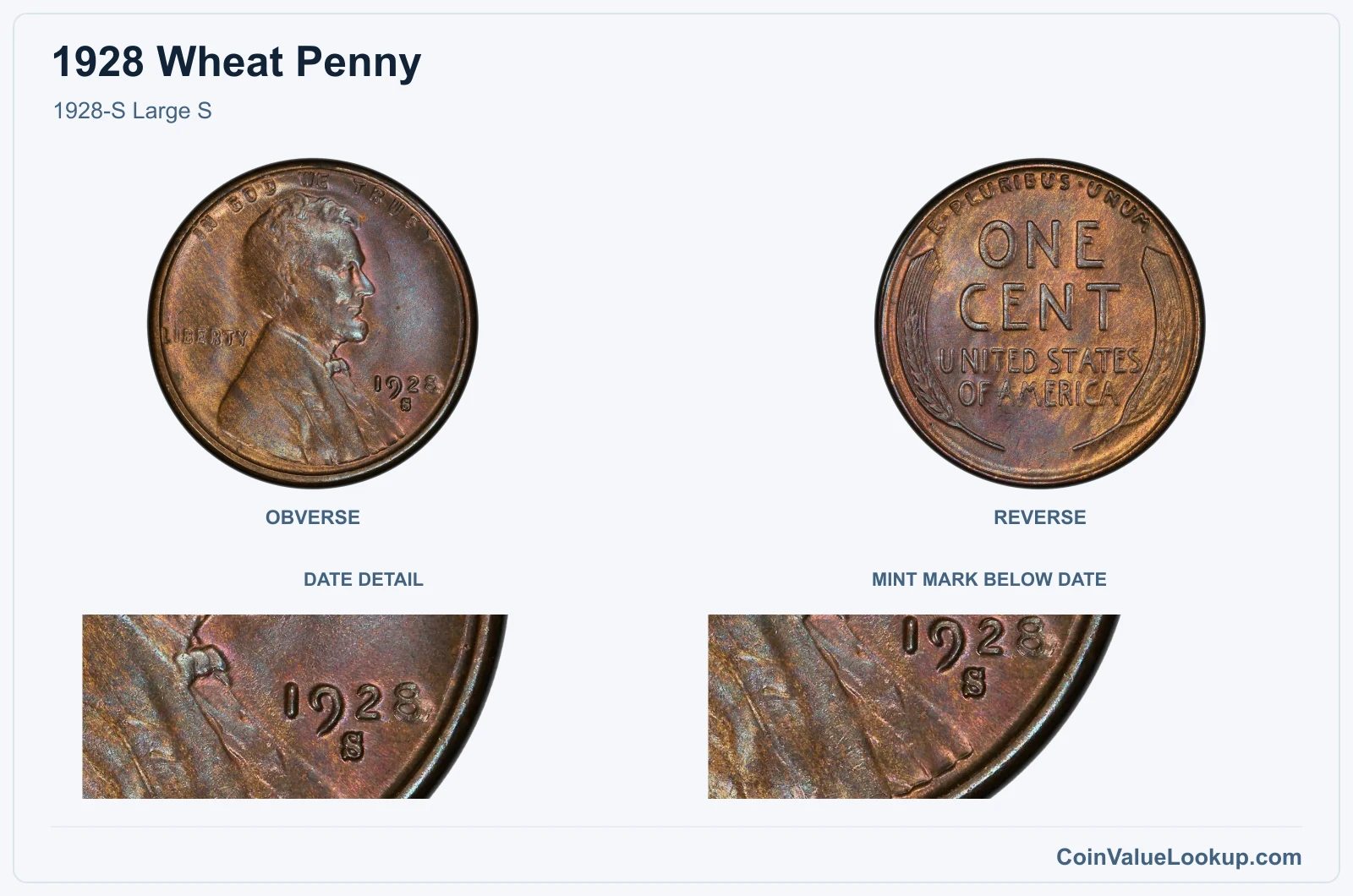
This is the recognized Large S mintmark punch variety for 1928 San Francisco cents. The S on these coins is visibly larger and sometimes slightly different in shape compared to the standard Small S used on most 1928-S cents.
To identify it, you need magnification and a side-by-side comparison with a confirmed Small S example at equal scale. The size difference is apparent once you know what to look for, but casual glances can miss it.
This is a normal punch variety, not a repunched mintmark.
No fixed guide price is adopted for this variety. Value depends on authenticated identity and the coin's individual condition and surfaces.
If you suspect you have one, third-party certification is the practical route to confirming the variety and establishing its market standing.
Ordinary-issue reference: Ordinary-issue reference only: The table below shows prices for the 1928-S Lincoln Cent (Wheat Reverse) (regular strike). It does not represent the value of the specific 1928-S Large S variety or its variety premium. Year, mint, metal and strike type are matched; the specific variety is not priced by this table.
Range Grade
Price1928-S Lincoln Cent (Wheat Reverse) — Ordinary-Issue Reference (Regular Strike) (BN) Price1928-S Lincoln Cent (Wheat Reverse) — Ordinary-Issue Reference (Regular Strike) (RB) Price1928-S Lincoln Cent (Wheat Reverse) — Ordinary-Issue Reference (Regular Strike) (RD) Auction Records Appraisal PO PO 1
—
Coin Identifier FR FR 2
—
Coin Identifier AG AG 3
—
Coin Identifier G G 4
—
Coin Identifier
G 6
—
Coin Identifier VG VG 8
—
Coin Identifier
VG 10
—
Coin Identifier F F 12
—
Coin Identifier
F 15
—
Coin Identifier VF VF 20
—
Coin Identifier
VF 25
—
Coin Identifier
VF 30
—
Coin Identifier
VF 35
—
Coin Identifier XF XF 40
—
Coin Identifier
XF 45
Coin Identifier AU AU 50
Coin Identifier
AU 53
Coin Identifier
AU 55
Coin Identifier
AU 58
Coin Identifier MS MS 60
—
Coin Identifier
MS 61
Coin Identifier
MS 62
Coin Identifier
MS 63
Coin Identifier
MS 64
Coin Identifier
MS 65
Coin Identifier
MS 66
—
—
Coin Identifier
MS 67
—
—
—
—
—
MS 68
—
—
—
—
—
MS 69
—
—
—
—
—
MS 70
—
—
—
—
—
1928 Wheat Penny Error List
1. 1928 Wheat Penny — Off-Center Strike
An off-center strike happens when the planchet is not seated properly between the dies. The result is a displaced design with an unstruck crescent of blank metal along one edge.
The key diagnostic is that the design shifts uniformly in one direction. Both the obverse and reverse will be offset together.
For collector appeal, the date needs to remain fully visible; a dateless off-center cent loses most of its premium.
Do not confuse this with a clipped planchet, which produces a curved bite out of the edge, or post-mint damage from a vise or hammer. A genuine off-center strike shows clean, original planchet edge where the die did not reach.
No fixed price range is adopted for this error on the 1928 cent. Value depends on the percentage of off-center shift, date visibility, mint, and overall condition, assessed individually.
2. 1928 Wheat Penny — BIE Die Break
A BIE error is a specific type of die break that creates a raised vertical line or blob between the letters B and E in LIBERTY on the obverse. It looks like a tiny capital I squeezed between those two letters.
The cause is a crack or chip in the die surface. Metal flows into the void during striking, leaving a raised feature on the finished coin.
Look for it under magnification.
The main lookalikes are dirt lodged between the letters, a scratch, or an added piece of material glued on after striking. A genuine BIE is raised metal that is part of the coin's surface, not sitting on top of it.
It will also show consistent wear matching the rest of the coin.
No adopted price range exists for this error on the 1928 cent. Each piece is valued individually based on the size and clarity of the break, the coin's grade, and overall eye appeal.
3. 1928 Wheat Penny — Struck-Through Error
A struck-through error occurs when foreign material sits between the die and the planchet during striking. The result is a localized depression or incomplete area in the design where the obstruction blocked the full impression.
Different types exist. A grease-filled die leaves a smooth, shallow blank area.
A retained foreign object, like a thread or metal fragment, can leave a distinct impression of its shape pressed into the surface.
Do not confuse struck-through marks with ordinary wear, scratches, or cleaning damage. A genuine struck-through depression has a defined boundary and the surrounding design remains properly struck.
Wear, by contrast, affects the highest points first and creates a gradual loss of detail.
No fixed price is adopted for struck-through errors on the 1928 cent. Value is assessed individually based on the type and size of the obstruction impression, the coin's mint, and its overall condition.
4. 1928 Wheat Penny — Repunched Mintmark
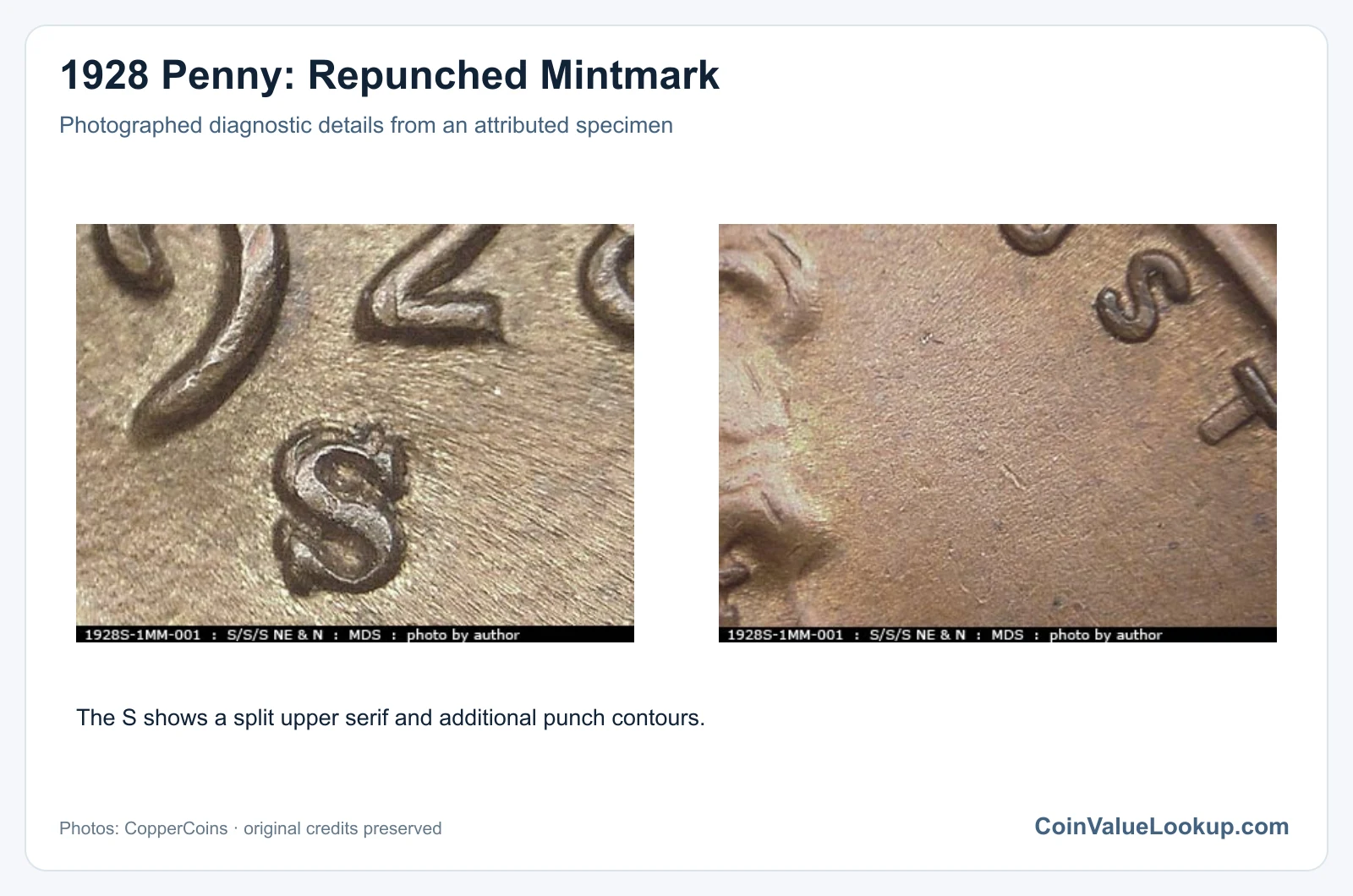
A repunched mintmark shows traces of a second, slightly offset position of the mintmark beneath or beside the primary one. On 1928 cents, this applies only to the D and S mint issues; Philadelphia coins carry no mintmark and therefore cannot show an RPM.
Under magnification, look for remnants of a separately positioned punch near the base of the mintmark. You might see a partial second letter peeking out from behind the final strike.
Compare your coin to a normal mintmark at the same magnification to spot the extra impression.
Machine doubling, die chips, or corrosion around the mintmark can mimic an RPM. Machine doubling tends to produce flat, shelf-like displacement rather than the rounded, distinct second punch of a true RPM.
No fixed guide price is adopted for this error. Each example is valued individually based on the clarity and position of the repunching, the coin's mint, and its condition.
5. 1928 Wheat Penny — Doubled Die Reverse
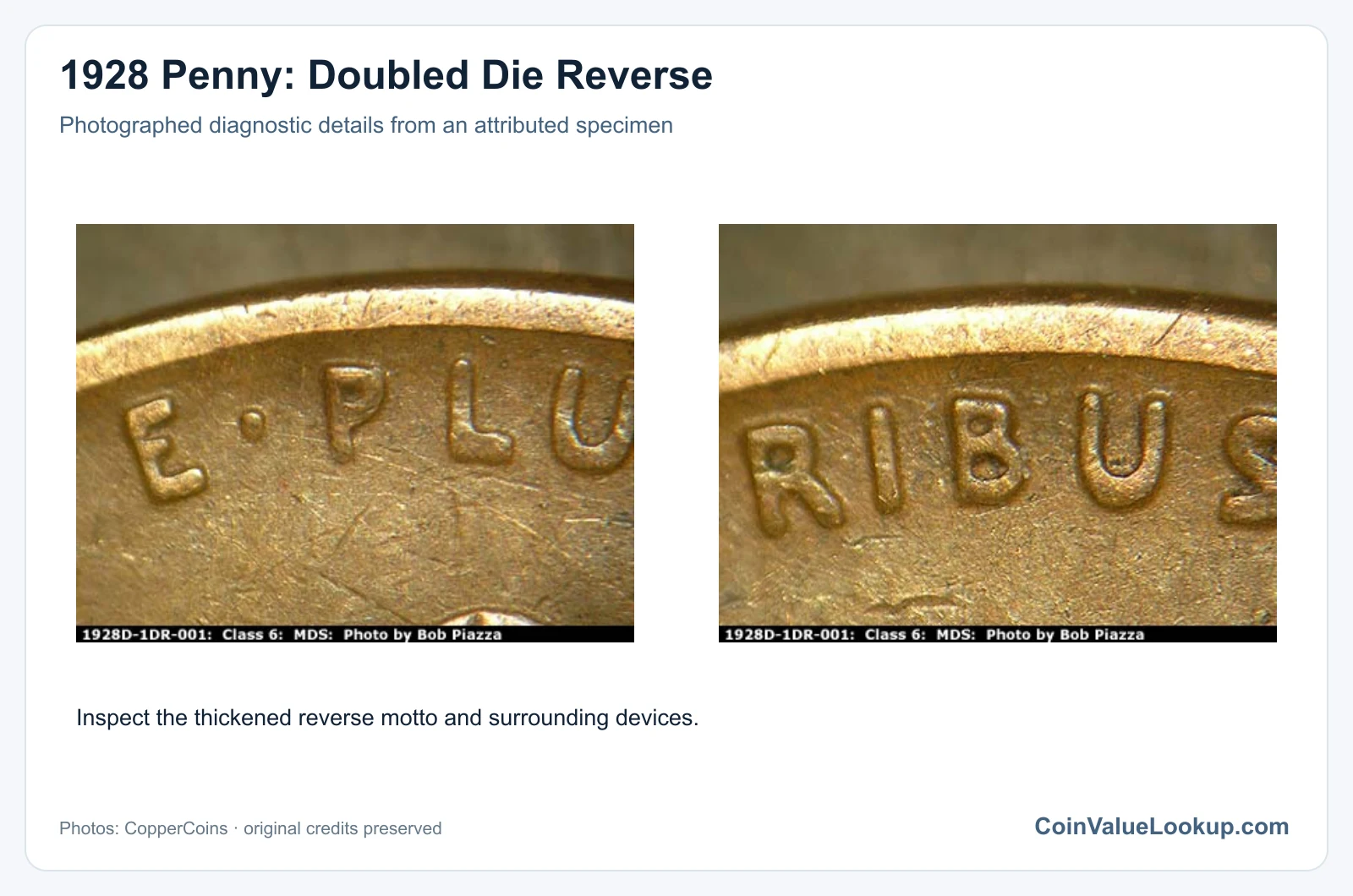
A doubled die reverse shows doubling on the reverse design elements caused by a misaligned hub impression during die manufacturing. This is different from machine doubling, which happens during the striking process and produces flat, shelf-like distortion.
To check, compare your coin's reverse lettering and design contours against a known normal example. True hub doubling creates a second, rounded set of design elements with separation visible under magnification.
Pay close attention to ONE CENT, E PLURIBUS UNUM, and the wheat ear details.
Machine doubling, reflections from the coin's surface, and random post-mint damage are common lookalikes. Machine doubling typically shows as a flat, unidirectional spread rather than the distinct notched separation of a genuine doubled die.
No fixed price range is adopted for this error on the 1928 cent. Value depends on the strength and location of the doubling, the coin's mint, grade, and the level of third-party authentication.