1932 Wheat Penny Coin Value: How Much Is It Worth?
A 1932 Wheat Penny in circulated condition starts around $2.50 in Good-4 and can reach about $34 in Mint State 63, based on USA Coin Book guide estimates. Those anchors cover the two mints that produced cents this year — Philadelphia and Denver.
No 1932-S exists, and no regular proofs were struck. Original surfaces, color and wear all affect what a buyer will actually pay, so treat those figures as starting points rather than guaranteed offers.
Fast Way to Identify Your 1932 Wheat Penny
Want a quick read on your 1932 penny? Upload clear photos of the front and back, and our identifier can give you a preliminary take on the mint, version and general condition.
Good lighting and a steady shot help — try to capture the full coin without glare. This is not a substitute for professional authentication, but it points you in the right direction.
1932 Wheat Penny Value
Upload both sides of your 1932 Wheat Penny.
Front Obverse
Upload photo
Back Reverse
Upload photo
Which 1932 Wheat Penny Versions Are Worth Money?
- Only two mints produced 1932 cents — Philadelphia and Denver — so check the mintmark first to narrow your search.
- Mint State examples with strong original surfaces command the highest guide values for the date, around $34 at MS63.
- A confirmed collectible error such as a doubled die obverse or repunched mintmark can carry a separate premium beyond normal date values.
- Cleaned or corroded coins lose much of their collector appeal, even if the underlying grade is high.
- Color designation (red, red-brown, brown) is a distinct value factor; the guide anchors here do not specify color, so certified red coins may trade differently.
Step 1: Identify Your 1932 Wheat Penny Mint Mark and Version
Start by flipping the coin over. You should see two wheat ears framing "ONE CENT" on the reverse — that confirms the Wheat Penny design used from 1909 through 1958.
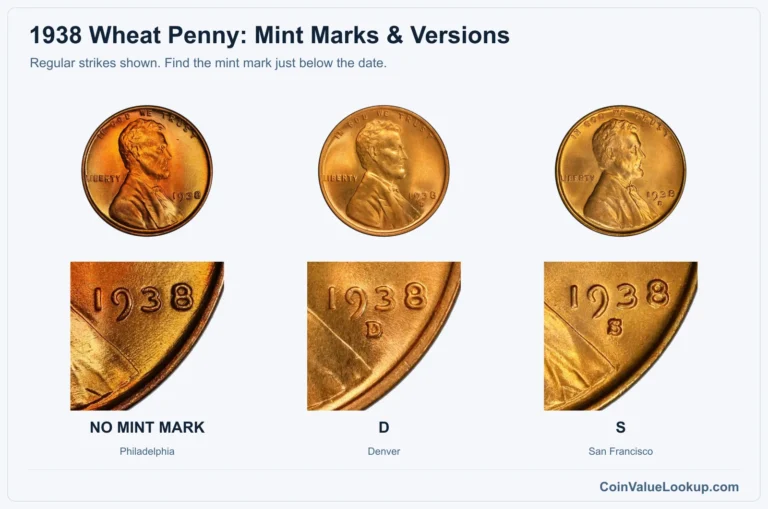
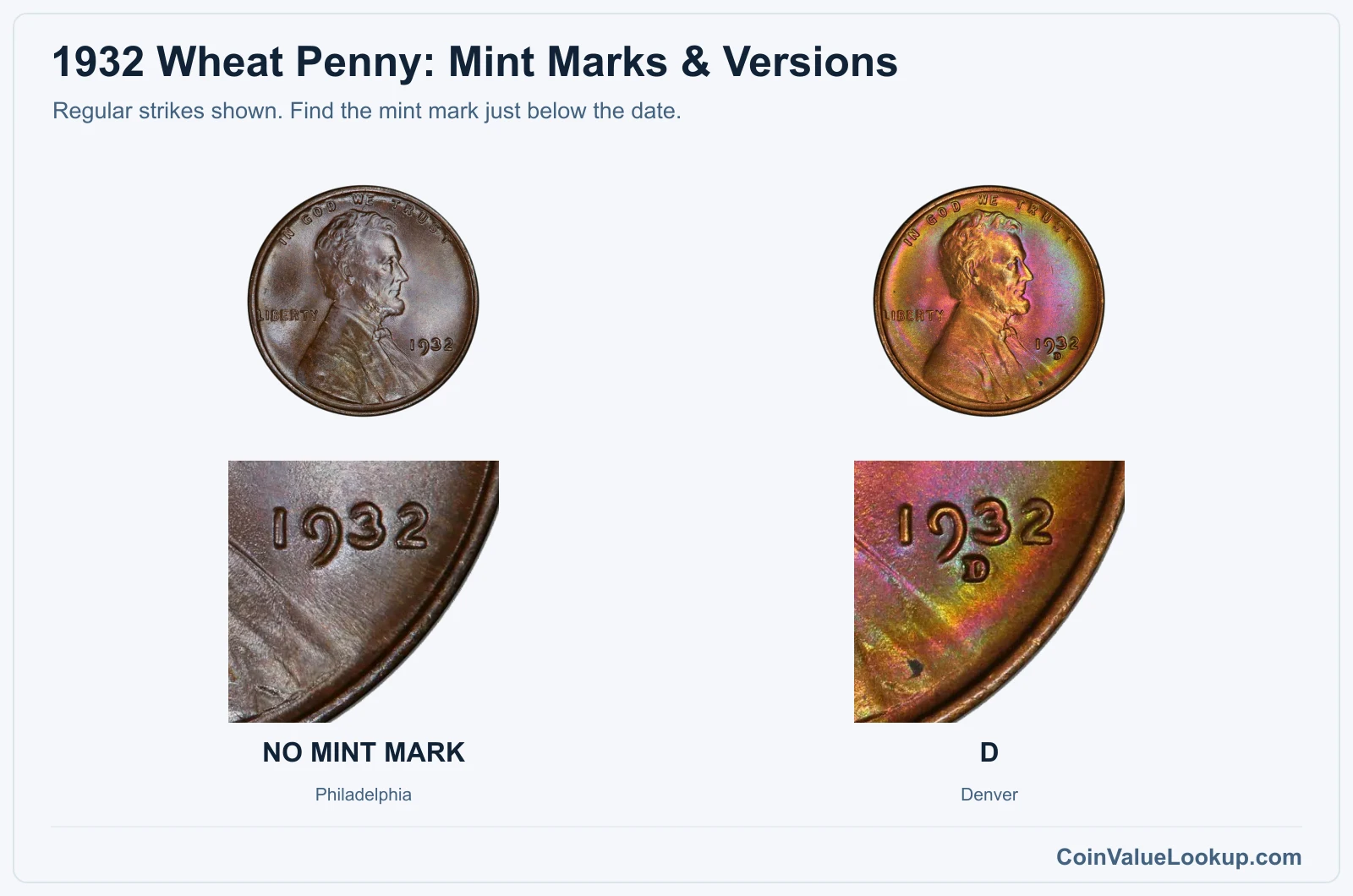
Now check below the date on the obverse. A small "D" means Denver.
No letter at all means Philadelphia. Those are the only two mints that struck cents dated 1932; there is no 1932-S.
The coin should weigh approximately 3.11 grams on a kitchen scale and have a plain (smooth) edge. It is 95% copper with 5% tin and zinc.
If it sticks to a magnet or feels unusually light, you may have a damaged or altered piece rather than a genuine 1932 cent.
Color matters for value but does not determine the grade by itself. A coin can be red, red-brown or brown and still sit at the same wear grade.
Cleaning strips original color and leaves an unnatural brightness that experienced buyers spot quickly.
Step 2: Check Your 1932 Wheat Penny Grade
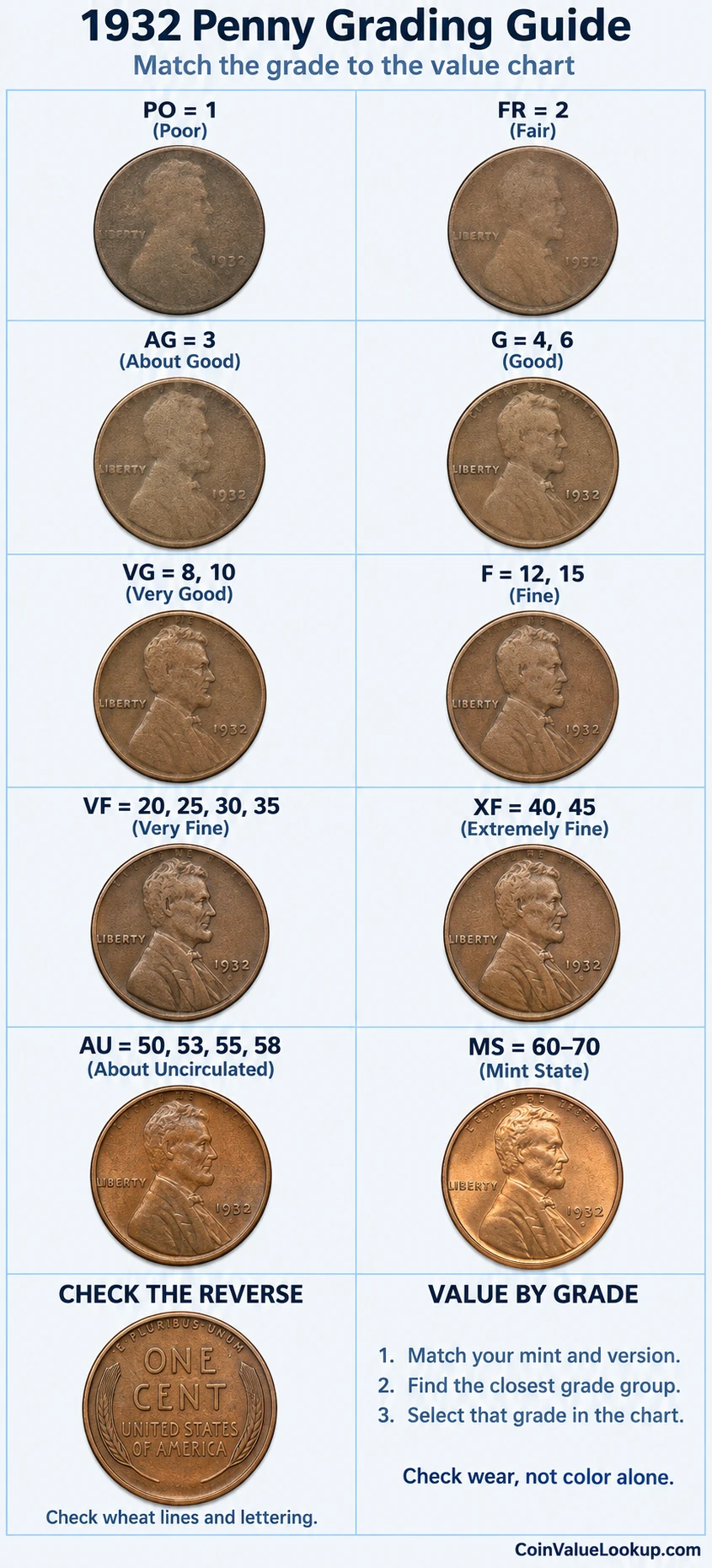
Focus on Lincoln's cheekbone, jawline and the fine hair detail above his ear — those are the highest points and the first to show wear. On the reverse, the individual wheat grains and the horizontal lines between the stalks wear down in a predictable sequence as the grade drops.
Compare your coin against the grading image nearby. A Good-4 example will have a flat portrait with the outline still clear, while an MS63 coin should show full original luster with only minor contact marks.
One trap: a weakly struck coin can look worn even though it never circulated. If the luster is intact all around the rims but the hair detail is soft, suspect the strike before you assume wear.
Spots, corrosion and evidence of cleaning are separate factors that lower a coin's appeal regardless of the technical grade.
Coin Value Lookup is a handy place to look up guides for other dates and denominations in the Wheat Penny series. If you are working through a collection or a jar of old pennies, it can save you a lot of time.
Step 3: Check 1932 Wheat Penny Value by Mint and Version
1932 Wheat Penny
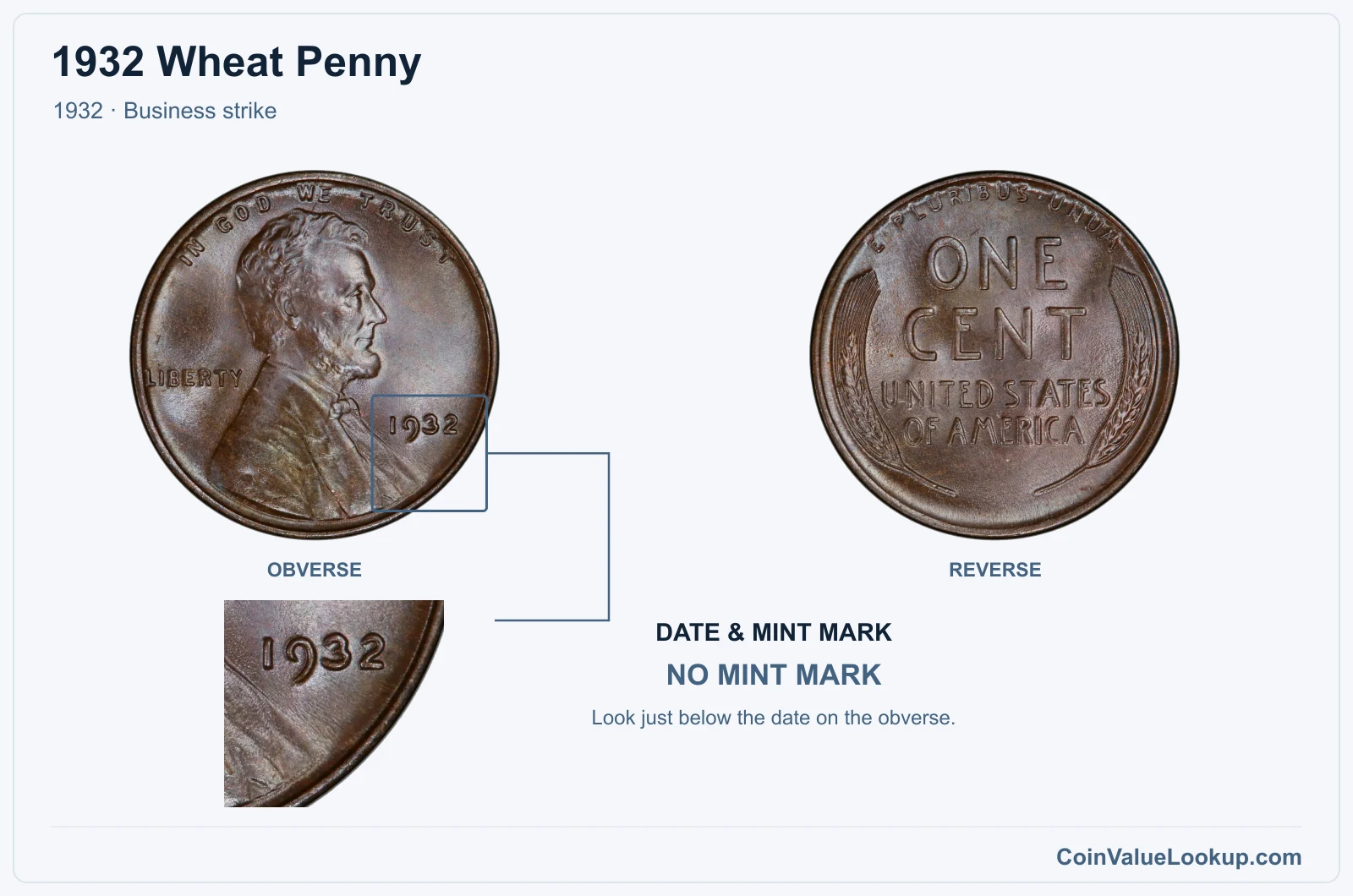
The 1932 Philadelphia cent carries no mintmark — just a bare space below the date. This is the standard business-strike issue in 95% copper with 5% tin and zinc, weighing about 3.11 grams with a plain edge.
USA Coin Book lists a guide value near $2.50 in Good-4 and roughly $34 in MS63. Those figures do not specify color designation, so a certified full-red example may trade at a different level than an undesignated or brown coin.
Look for original, problem-free surfaces when evaluating any example of this date.
| Range | Grade | Price | Auction Records | Appraisal |
|---|---|---|---|---|
| PO | PO 1 | — | Coin Identifier | |
| FR | FR 2 | — | Coin Identifier | |
| AG | AG 3 | — | Coin Identifier | |
| G | G 4 | — | Coin Identifier | |
| G 6 | — | Coin Identifier | ||
| VG | VG 8 | — | Coin Identifier | |
| VG 10 | — | Coin Identifier | ||
| F | F 12 | — | Coin Identifier | |
| F 15 | — | Coin Identifier | ||
| VF | VF 20 | — | Coin Identifier | |
| VF 25 | — | Coin Identifier | ||
| VF 30 | — | Coin Identifier | ||
| VF 35 | — | Coin Identifier | ||
| XF | XF 40 | — | Coin Identifier | |
| XF 45 | — | Coin Identifier | ||
| AU | AU 50 | — | Coin Identifier | |
| AU 53 | — | Coin Identifier | ||
| AU 55 | — | Coin Identifier | ||
| AU 58 | — | Coin Identifier | ||
| MS | MS 60 | — | Coin Identifier | |
| MS 61 | — | Coin Identifier | ||
| MS 62 | Coin Identifier | |||
| MS 63 | Coin Identifier | |||
| MS 64 | Coin Identifier | |||
| MS 65 | — | Coin Identifier | ||
| MS 66 | — | — | — | |
| MS 67 | — | — | — | |
| MS 68 | — | — | — | |
| MS 69 | — | — | — | |
| MS 70 | — | — | — |
1932 Wheat Penny — D
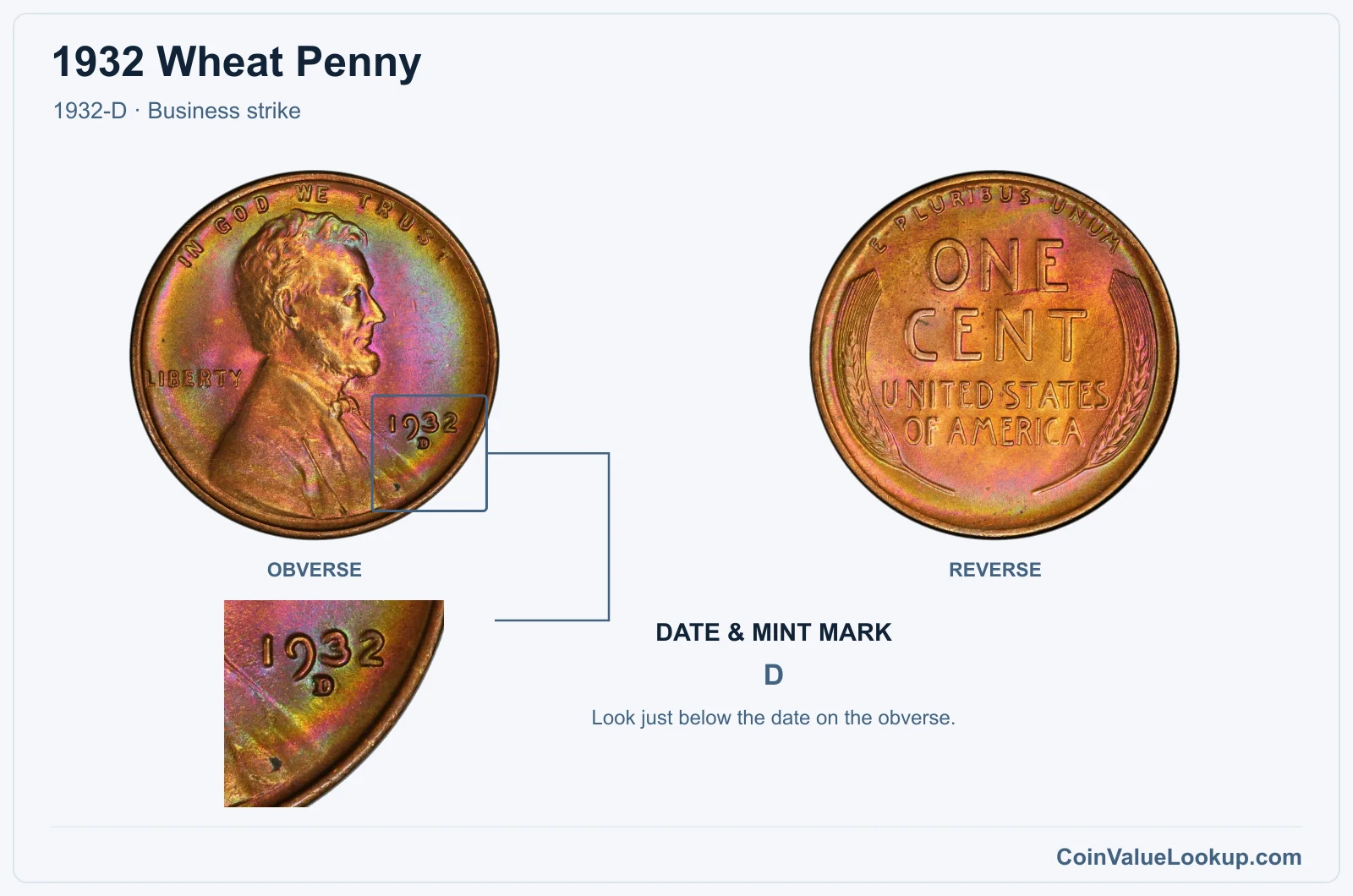
The 1932-D is the Denver Mint issue, identified by a small "D" mintmark sitting below the date on the obverse. Same composition, same weight, same design as the Philadelphia version.
Guide estimates from USA Coin Book place it at about $2.50 in Good-4 and around $34 at the MS63 level. As with all Wheat cents, those anchors assume unspecified color; a fully red uncirculated piece or a sharply original example may move the conversation in a different direction.
Denver is also the only mint where a repunched mintmark variety is possible for this date, so give that "D" an extra look under magnification.
| Range | Grade | Price | Auction Records | Appraisal |
|---|---|---|---|---|
| PO | PO 1 | — | Coin Identifier | |
| FR | FR 2 | — | Coin Identifier | |
| AG | AG 3 | — | Coin Identifier | |
| G | G 4 | — | Coin Identifier | |
| G 6 | — | Coin Identifier | ||
| VG | VG 8 | — | Coin Identifier | |
| VG 10 | — | Coin Identifier | ||
| F | F 12 | — | Coin Identifier | |
| F 15 | — | Coin Identifier | ||
| VF | VF 20 | — | Coin Identifier | |
| VF 25 | — | Coin Identifier | ||
| VF 30 | — | Coin Identifier | ||
| VF 35 | — | Coin Identifier | ||
| XF | XF 40 | — | Coin Identifier | |
| XF 45 | — | Coin Identifier | ||
| AU | AU 50 | — | Coin Identifier | |
| AU 53 | Coin Identifier | |||
| AU 55 | — | Coin Identifier | ||
| AU 58 | Coin Identifier | |||
| MS | MS 60 | — | Coin Identifier | |
| MS 61 | — | Coin Identifier | ||
| MS 62 | — | Coin Identifier | ||
| MS 63 | Coin Identifier | |||
| MS 64 | Coin Identifier | |||
| MS 65 | — | Coin Identifier | ||
| MS 66 | Coin Identifier | |||
| MS 67 | — | — | — | |
| MS 68 | — | — | — | |
| MS 69 | — | — | — | |
| MS 70 | — | — | — |
1932 Wheat Penny Error List
1. 1932 Wheat Penny — Doubled Die Obverse
A doubled die obverse on a 1932 Wheat cent shows consistent doubling — separation or notching — on the obverse lettering or design elements. The key word is consistent: genuine hub doubling repeats in the same direction across multiple letters or features.
Compare your coin to a normal 1932 cent under the same lighting and magnification.
The most common lookalike is machine doubling, which produces a flat, shelf-like distortion rather than the rounded, distinct secondary image of a true doubled die. Worn die contours and reflections from a shiny surface can also fool you.
Because no specific numeric value is supported for this variety, each coin needs individual assessment based on its authenticated identity, the strength of the doubling and overall condition.
2. 1932 Wheat Penny — Off-Center Strike
An off-center strike happens when the planchet is not seated properly between the dies, leaving part of the design missing and an unstruck crescent of blank metal visible. On a 1932 cent, the value of an off-center error depends heavily on the percentage of misalignment and whether the full date remains readable — a date-visible off-center coin is far more collectible than one where the year is clipped away.
Do not confuse this with a clipped planchet, which shows a curved bite out of the edge, or with post-mint damage where someone flattened part of the rim. A genuine off-center strike will have a smooth, unstruck area that follows the original planchet shape.
No specific price range is supported here; value depends on the authenticated error, its severity and the coin's condition.
3. 1932 Wheat Penny — Die Crack / Die Chip
Die cracks appear as thin, raised lines on the coin's surface where the steel die fractured during use. Die chips are small raised blobs caused by a tiny piece of the die breaking away.
Both are mint-made and part of the original strike, so they will be raised rather than incised.
On a 1932 Wheat cent, look carefully at areas of high stress — around the rim, through lettering, or across Lincoln's portrait. A crack that connects to the rim starts moving into cud territory, which is a separate category.
Scratches, corrosion lines and foreign material sitting on the surface can mimic a die crack, but those are incuse (pressed in) or removable, not raised. Value for die cracks and chips varies widely by location, size and visual impact, so individual assessment by an authenticated example is the right approach.
4. 1932 Wheat Penny — Die Break / Cud
A cud is a major die break that connects to the rim, leaving a raised, featureless blob where part of the design should be. It forms when a chunk of the die physically breaks off.
On a 1932 cent you might find one along the obverse rim near lettering or on the reverse near the wheat stalks.
The boundary between the cud and the remaining design should be sharp and irregular, not smooth. A rim dent or corrosion buildup can look similar at first glance, but dents are depressed into the metal and corrosion has a rough, pitted texture.
An interior die chip that does not reach the rim is classified separately as a die crack or chip, not a cud. No supported price range exists for this error on the 1932 date, so each piece needs to be evaluated on its own based on size, location and authenticated condition.
5. 1932 Wheat Penny — Repunched Mintmark
A repunched mintmark is possible only on the 1932-D, since Philadelphia cents carry no mintmark to repunch. Look at the "D" below the date under at least 5x magnification.
A genuine RPM will show traces of a second punch position — a partial extra outline, a notch or a shadow sitting at a slightly different angle from the primary "D."
Compare it to a normal 1932-D at matching magnification so you have a baseline. Machine doubling on the mintmark produces a flat shelf rather than a distinct secondary image.
A die chip or corrosion buildup around the letter can also create confusing shapes. No specific price range is adopted for this variety, so the value of any confirmed RPM depends on its authenticated identity, the clarity of the repunching and the coin's overall grade and surface quality.