1933 Wheat Penny Coin Value: How Much Is It Worth?
A 1933 Wheat Penny in circulated condition starts around $2.50 in Good-4 grade for the Philadelphia issue, climbing to roughly $38 at MS63 for that same mint. The Denver coin carries different anchors.
Proofs, major varieties, and error coins are priced separately from these guide estimates, and original surfaces, wear level, and color all affect what a buyer will actually pay.
Fast Way to Identify Your 1933 Wheat Penny
The quickest way to get a preliminary read on your 1933 Wheat Penny is to snap clear photos of both the front and back, then upload them to our identifier. It can help with mint recognition and general condition, though it does not replace professional authentication, exact grading, or certified error verification.
Good lighting and a steady hand go a long way.
1933 Wheat Penny Value
Upload both sides of your 1933 Wheat Penny.
Front Obverse
Upload photo
Back Reverse
Upload photo
Which 1933 Wheat Penny Versions Are Worth Money?
- The 1933 Philadelphia cent ranges from about $2.50 in Good-4 to $38 at MS63 per guide estimates — worth checking your mintmark carefully.
- The 1933-D Denver cent starts higher in low grades, around $6.25 in Good-4, though its MS63 guide value of $30 sits below the Philadelphia issue at that level.
- Error coins such as off-center strikes or die breaks can carry premiums assessed individually by authenticated identity, condition, and severity.
- Strong original surfaces without cleaning or corrosion improve collector appeal across both mints.
Step 1: Identify Your 1933 Wheat Penny Mint Mark and Version
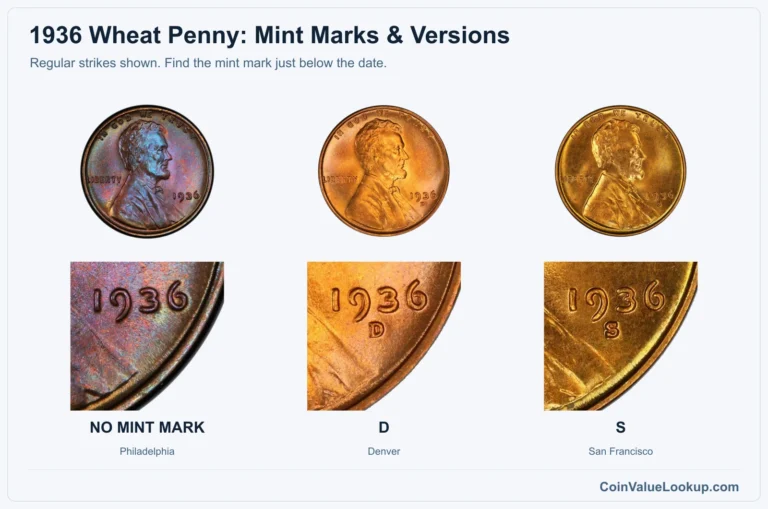
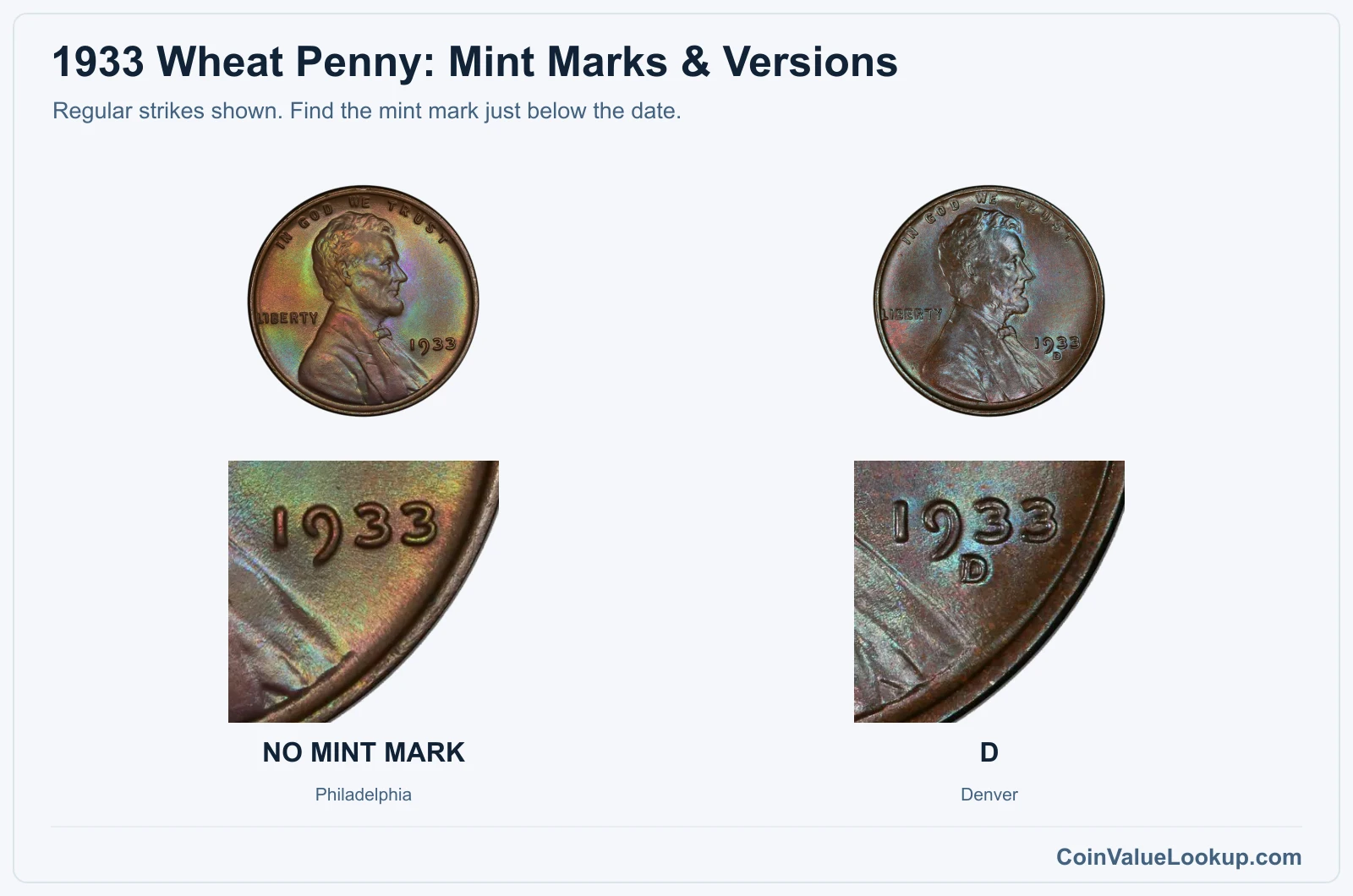
Flip your coin over and look just below the date on the obverse. If there is no tiny letter there, you have a Philadelphia strike.
A small "D" means Denver. Those are the only two mints that produced cents dated 1933 — there is no 1933-S, and no regular proof issue exists for this date.
The coin should show Lincoln's portrait on the front and two wheat ears framing "ONE CENT" on the back. It is a standard copper-alloy cent: 95% copper with 5% tin and zinc, weighing about 3.11 grams, with a plain (smooth) edge.
If your coin is noticeably lighter, magnetic, or has a reeded edge, it is something else entirely.
Color matters but does not by itself determine grade. A brown coin can outgrade a red one if its surfaces are sharper.
Separate color, cleaning, and corrosion from actual wear when you evaluate your piece.
Step 2: Check Your 1933 Wheat Penny Grade
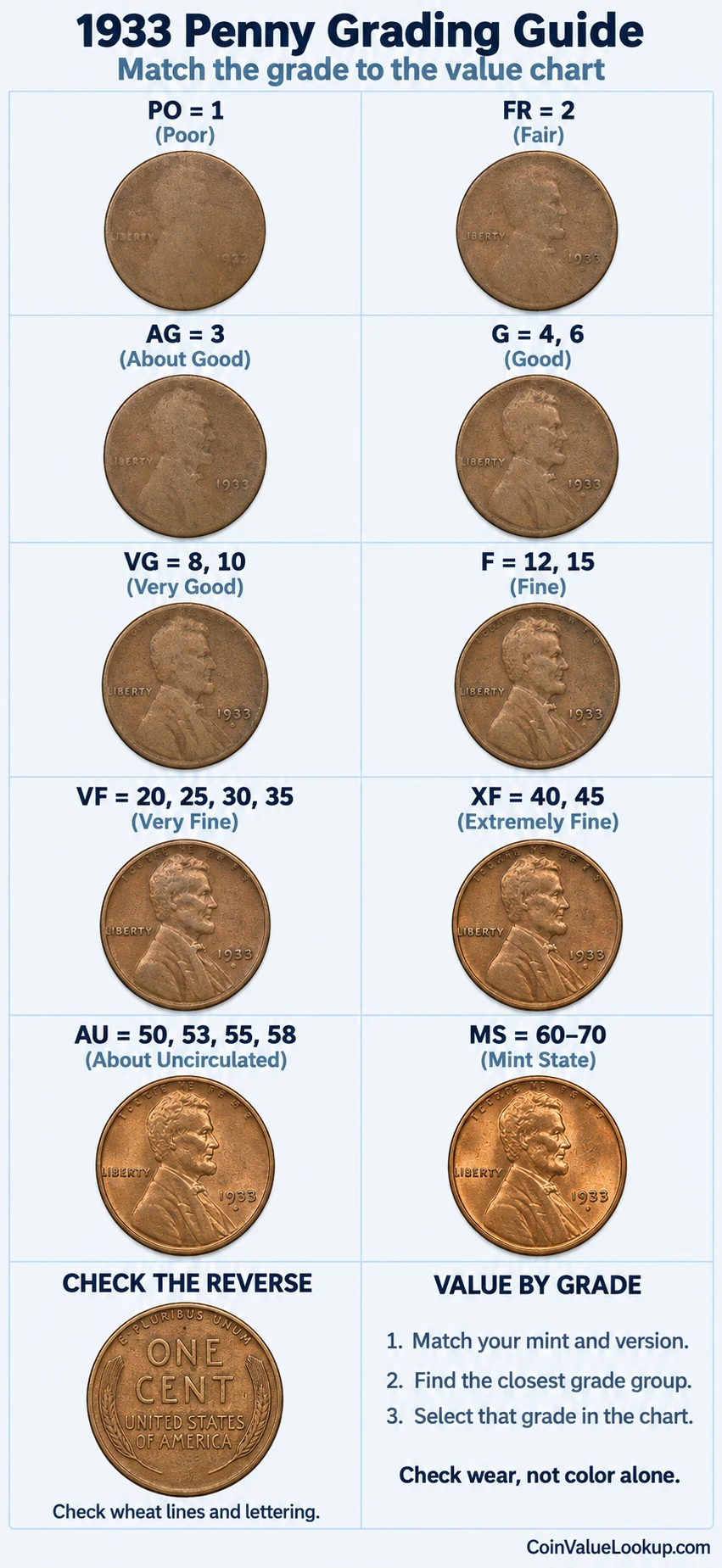
Start with Lincoln's cheekbone and jawline — those are the highest points and the first places wear shows up. On a well-circulated coin, the cheek will be flat and the jaw merges into the neck.
A coin grading around Good-4 still shows a clear outline of Lincoln but most fine detail is gone.
Move to the hair above the ear. Individual strands should be visible on higher-grade pieces.
If they are mushy but the rest of the coin looks sharp, you might be looking at a weak original strike rather than wear — that happens.
On the reverse, check the wheat grain lines and the horizontal lines between the stalks. Compare what you see to the reference image.
Luster is your friend: original mint sheen on the high points usually means minimal wear.
Spots, corrosion, and evidence of cleaning are separate value factors. A cleaned coin with sharp detail will still trade below an original, naturally toned piece of the same technical grade.
Do not assume a bright copper surface means a higher grade — sometimes it means someone got busy with a pencil eraser.
Step 3: Check 1933 Wheat Penny Value by Mint and Version
1933 Wheat Penny
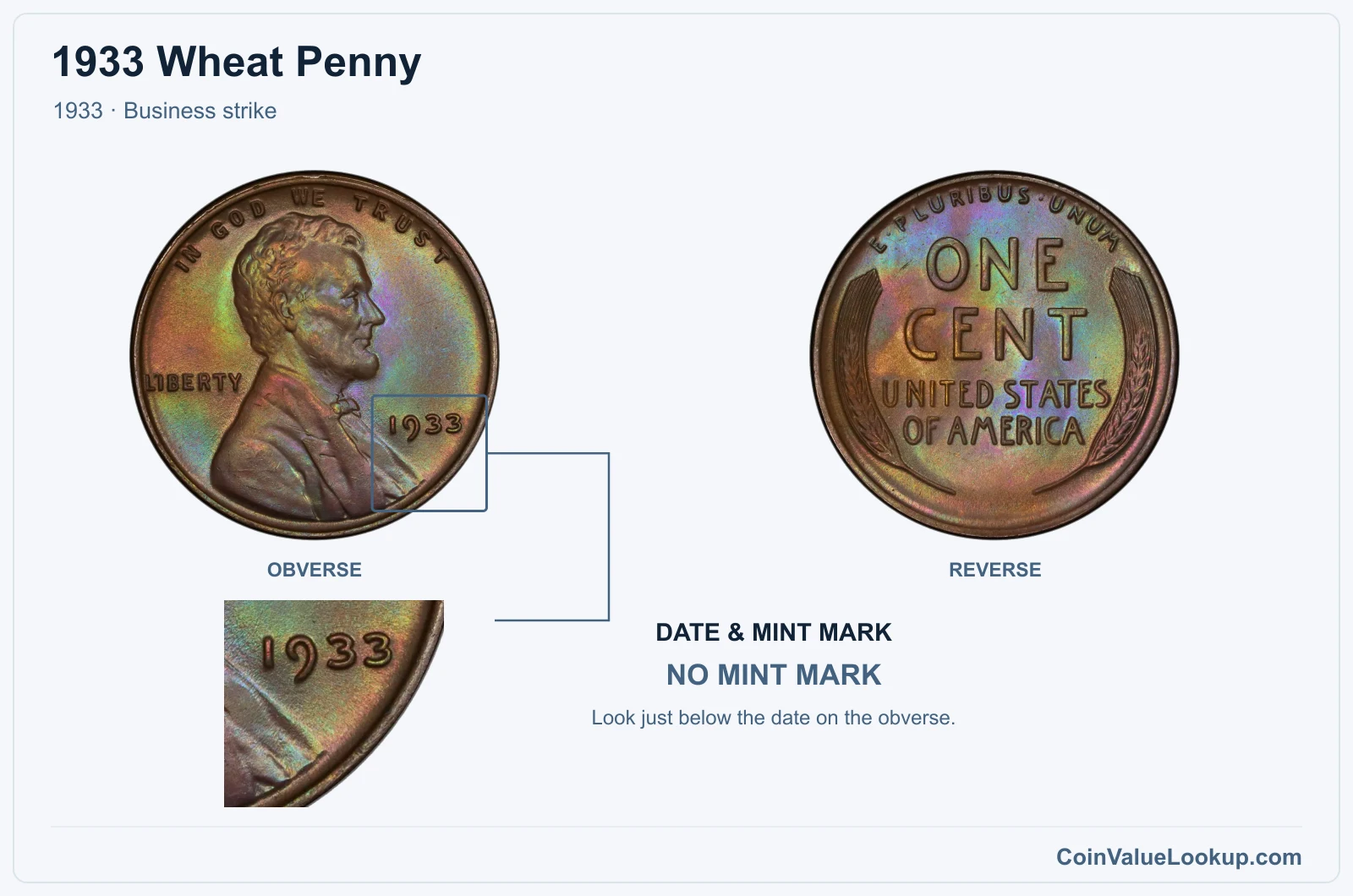
The 1933 Philadelphia cent has no mintmark below the date. It is a business strike in the standard 95% copper, 5% tin and zinc composition, weighing about 3.11 grams with a plain edge.
Guide estimates place this coin around $2.50 in Good-4 and approximately $38 at MS63. Those figures assume original, unimpaired surfaces and do not specify color designation, so do not treat them as certified Red quotes.
Lower-grade examples are common enough. The jump to Mint State is where things get interesting, because survivors with full original luster from 1933 are not as plentiful as later dates.
Match your coin's actual wear and surface quality to the grade before comparing prices.
| Range | Grade | Price | Auction Records | Appraisal |
|---|---|---|---|---|
| PO | PO 1 | — | Coin Identifier | |
| FR | FR 2 | — | Coin Identifier | |
| AG | AG 3 | — | Coin Identifier | |
| G | G 4 | — | Coin Identifier | |
| G 6 | — | Coin Identifier | ||
| VG | VG 8 | — | Coin Identifier | |
| VG 10 | — | Coin Identifier | ||
| F | F 12 | — | Coin Identifier | |
| F 15 | — | Coin Identifier | ||
| VF | VF 20 | — | Coin Identifier | |
| VF 25 | — | Coin Identifier | ||
| VF 30 | — | Coin Identifier | ||
| VF 35 | — | Coin Identifier | ||
| XF | XF 40 | — | Coin Identifier | |
| XF 45 | — | Coin Identifier | ||
| AU | AU 50 | — | Coin Identifier | |
| AU 53 | — | Coin Identifier | ||
| AU 55 | — | Coin Identifier | ||
| AU 58 | Coin Identifier | |||
| MS | MS 60 | — | Coin Identifier | |
| MS 61 | — | Coin Identifier | ||
| MS 62 | — | Coin Identifier | ||
| MS 63 | — | Coin Identifier | ||
| MS 64 | Coin Identifier | |||
| MS 65 | — | Coin Identifier | ||
| MS 66 | Coin Identifier | |||
| MS 67 | — | — | — | |
| MS 68 | — | — | — | |
| MS 69 | — | — | — | |
| MS 70 | — | — | — |
1933 Wheat Penny — D
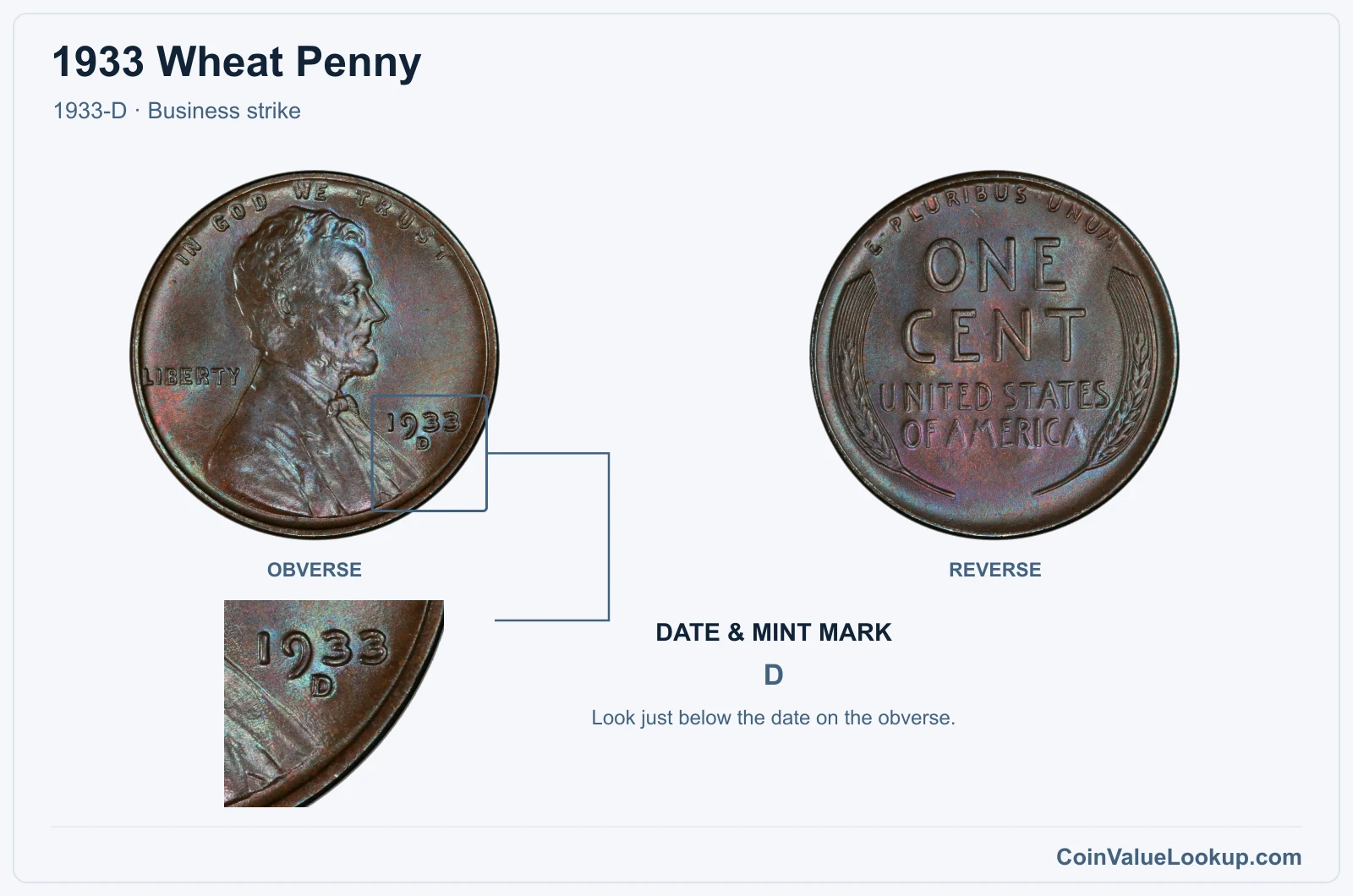
Look for a small "D" mintmark below the date to confirm a Denver strike. Same specs as the Philadelphia coin: 95% copper with 5% tin and zinc, 3.11 grams, plain edge, Lincoln portrait over wheat reverse.
Guide estimates put the 1933-D at about $6.25 in Good-4 and roughly $30 at MS63. That higher circulated floor compared to the Philadelphia issue reflects a tighter surviving population in collector hands.
Yet at MS63 the guide actually lists it slightly below the no-mintmark coin — supply and demand do not always scale the way you would expect.
Coin Value Lookup is a good starting point if you want to compare this date against other Wheat cents or look up related denominations. You can browse by year and series to see where your coin fits in the broader picture.
| Range | Grade | Price | Auction Records | Appraisal |
|---|---|---|---|---|
| PO | PO 1 | — | Coin Identifier | |
| FR | FR 2 | — | Coin Identifier | |
| AG | AG 3 | — | Coin Identifier | |
| G | G 4 | — | Coin Identifier | |
| G 6 | — | Coin Identifier | ||
| VG | VG 8 | — | Coin Identifier | |
| VG 10 | — | Coin Identifier | ||
| F | F 12 | — | Coin Identifier | |
| F 15 | — | Coin Identifier | ||
| VF | VF 20 | — | Coin Identifier | |
| VF 25 | — | Coin Identifier | ||
| VF 30 | — | Coin Identifier | ||
| VF 35 | — | Coin Identifier | ||
| XF | XF 40 | — | Coin Identifier | |
| XF 45 | Coin Identifier | |||
| AU | AU 50 | — | Coin Identifier | |
| AU 53 | — | Coin Identifier | ||
| AU 55 | Coin Identifier | |||
| AU 58 | — | Coin Identifier | ||
| MS | MS 60 | — | Coin Identifier | |
| MS 61 | — | Coin Identifier | ||
| MS 62 | — | Coin Identifier | ||
| MS 63 | Coin Identifier | |||
| MS 64 | — | Coin Identifier | ||
| MS 65 | — | Coin Identifier | ||
| MS 66 | — | Coin Identifier | ||
| MS 67 | — | — | — | |
| MS 68 | — | — | — | |
| MS 69 | — | — | — | |
| MS 70 | — | — | — |
1933 Wheat Penny Error List
1. 1933 Wheat Penny — BIE Die Break
A BIE die break shows up as a small raised vertical line or blob between the letters B and E in LIBERTY on the obverse. It is caused by a crack or chip in the die that fills with metal during striking, creating a bump that was not part of the original design.
To check, look at LIBERTY under magnification and see if there is a distinct raised bridge connecting or sitting between B and E. The surrounding letter surfaces and fields should look normal, which helps separate a genuine die break from dirt, a scratch, or something stuck to the coin after it left the mint.
No specific numeric premium is supported for the 1933 date. Value depends on the authenticated identity of the error, its severity, and the coin's overall condition — a third-party grading service attribution is the most reliable way to establish what you have.
2. 1933 Wheat Penny — Off-Center Strike
An off-center strike happens when the planchet is not seated properly between the dies, so part of the design is shifted and a blank crescent of unstruck metal appears on one side. The more dramatic the shift, the more visually striking the coin.
For collector appeal, the date needs to remain fully visible. A 1933 cent struck 10–15% off-center with a readable date is a different proposition than one struck 50% off-center where half the legend is missing.
Look for a smooth, unstruck crescent — not a ragged clip or a dent from post-mint damage.
Confusing this with a clipped planchet or one-sided die misalignment is the main trap. Clips have a distinct curved or straight edge where metal was sheared before striking, and misalignment shifts one side while the other stays centered.
Pricing depends entirely on the specific coin's authenticated identity, percentage of displacement, and condition.
3. 1933 Wheat Penny — Struck-Through Error
A struck-through error occurs when a foreign object — grease, a metal fragment, thread, or other debris — sits between the die and the planchet during the strike. The result is a localized depression or incomplete area in the design where the obstruction blocked the die's impression.
Grease fill-ins tend to leave smooth, rounded depressions. A retained foreign object might leave a distinct impression of its own shape.
Either way, the key diagnostic is that the affected area sits below the normal surface plane and does not show the expected design detail.
Do not confuse this with ordinary wear, scratches, cleaning marks, or a weak strike from tired dies. Wear affects high points gradually and uniformly, while a struck-through defect appears in a specific, often oddly-shaped patch.
No numeric price range is supported for 1933 struck-through cents; individual assessment by a grading service considers the error's type, size, and the coin's overall grade.
4. 1933 Wheat Penny — Die Break / Cud
A cud is a specific type of die break where a piece of the die breaks away at the rim, leaving a raised, featureless lump of metal on the finished coin that connects to the edge. Interior die breaks can produce similar raised features but do not touch the rim and are classified differently.
To identify a cud on a 1933 cent, look for a raised blob along the rim that disrupts the normal design — the area will be smooth and slightly rounded, with the adjacent design elements appearing to stop abruptly at its boundary. The coin's edge beneath the cud should still be intact.
Rim dents from post-mint damage look different: they are typically depressed rather than raised, and the surrounding metal shows displacement or distortion. Corrosion can also mimic a rough raised area but lacks the clean boundary of a true cud.
No specific price data is supported for this date; value is assessed individually based on authenticated identity, cud size, location, and the coin's condition.