1892 Barber Dime Coin Value: How Much Is It Worth?
The 1892 Barber dime holds a special place as the first year of Charles Barber's long-running Liberty Head design. Business strikes were produced at Philadelphia, New Orleans, and San Francisco, and Philadelphia also struck a limited number of proofs.
Guide estimates for ordinary circulation strikes range from about $14 at G4 to $967 at MS63, depending on mint and condition. Proofs and error varieties carry their own separate value considerations.
Fast Way to Identify Your 1892 Barber Dime
The quickest way to get a preliminary read on your 1892 Barber dime is to snap clear photos of the front and back, then upload them using our identifier tool. This helps pin down mintmark, approximate grade, and surface condition so you know where to focus your research.
It is not a substitute for professional authentication or certified grading, but it gives you a solid starting point.
1892 Barber Dime Value
Upload both sides of your 1892 Barber Dime.
Front Obverse
Upload photo
Back Reverse
Upload photo
Which 1892 Barber Dime Versions Are Worth Money?
- The San Francisco mint issue (S mintmark) commands the highest guide values of any business strike this year, with estimates around $90 even in G4 and roughly $967 at MS63.
- New Orleans coins (O mintmark) carry a modest premium over Philadelphia across the grade range, with guide estimates of about $19 at G4 and $441 at MS63.
- Philadelphia proof strikes, identified by mirrored fields and sharp rims, are estimated around $616 at PR63 and are a distinct manufacturing finish, not simply a high-grade coin.
- Repunched date varieties, die breaks, clashed dies, and die cap errors have been reported for 1892 Barber dimes and are worth inspecting for under magnification.
Step 1: Identify Your 1892 Barber Dime Mint Mark and Version
The 1892 Barber dime shows Liberty facing right on the obverse, wearing a cap and laurel wreath, with the word LIBERTY on the headband. The reverse displays ONE DIME inside an open wreath tied with a bow at the bottom.
Do not confuse this with the earlier Seated Liberty or the later Mercury dime.
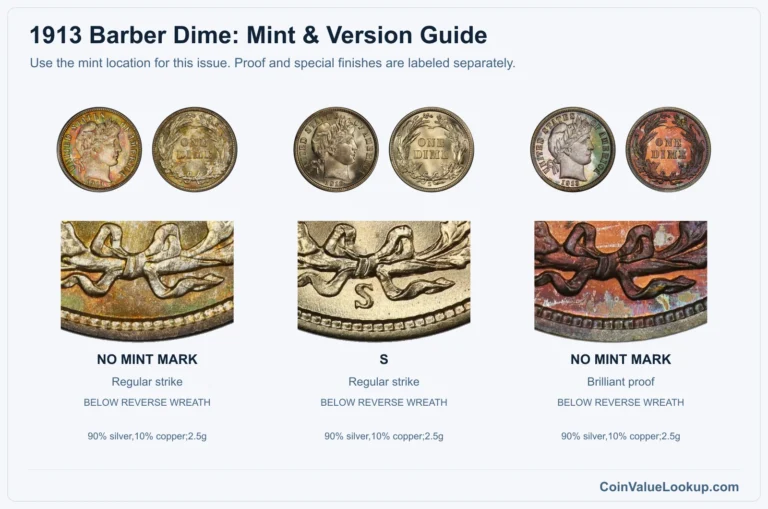
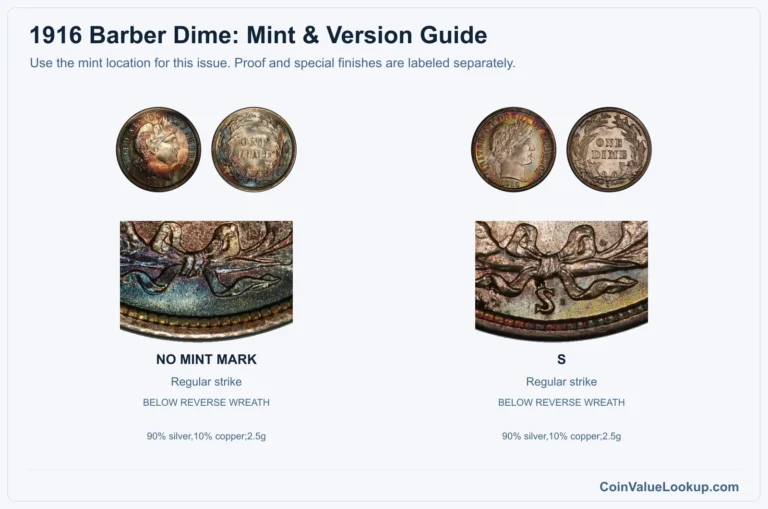
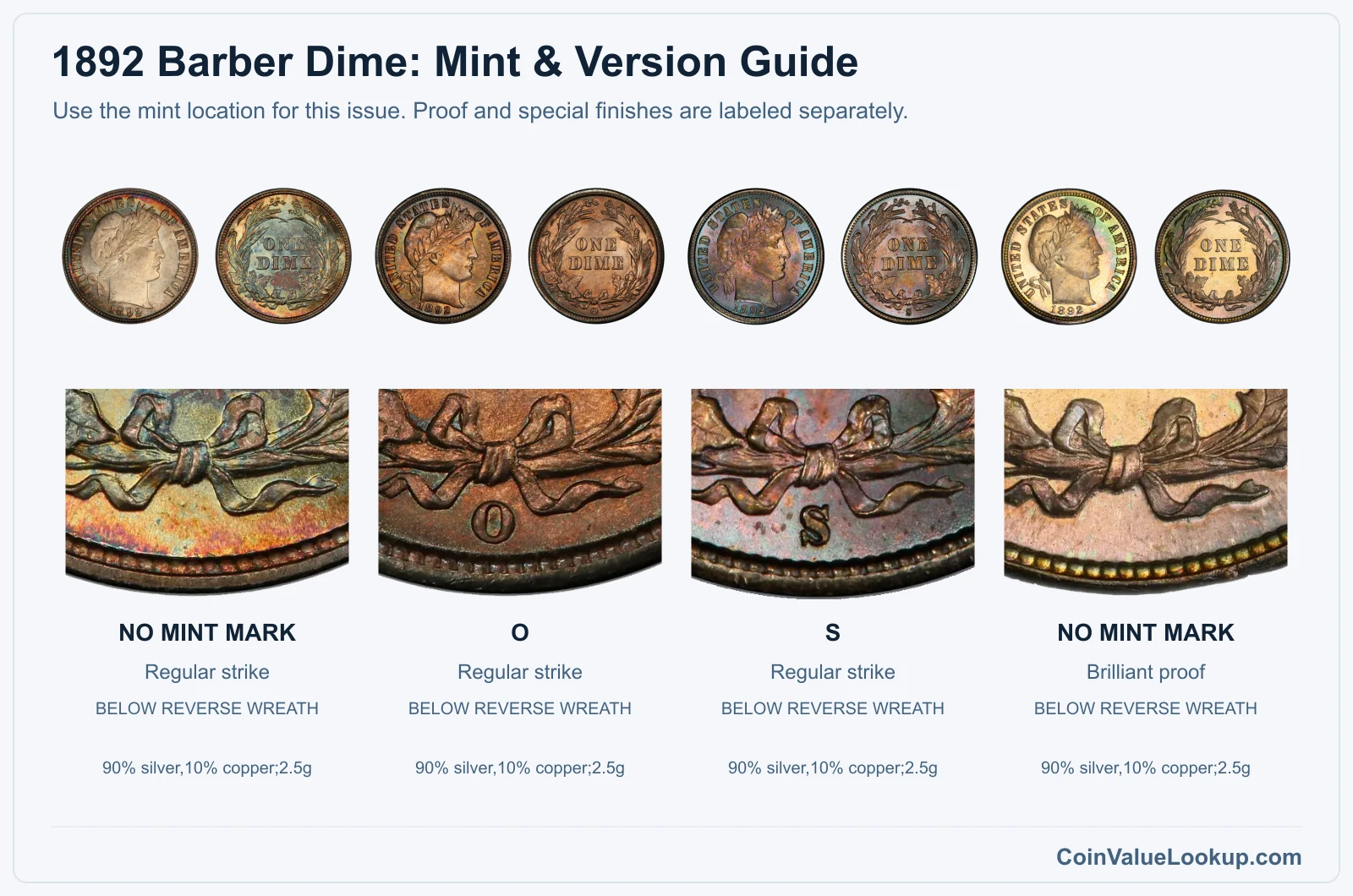
Three mints produced business strikes this year. Philadelphia coins carry no mintmark.
New Orleans coins have an O below the wreath bow on the reverse. San Francisco coins show an S in that same spot.
If you do not see a letter there, you have a Philadelphia coin.
All standard 1892 Barber dimes are struck in 90% silver and 10% copper, weigh 2.5 grams, measure 17.9 mm across, and have a reeded edge. These specs are consistent across all three mints and the proof issue.
Step 2: Check Your 1892 Barber Dime Grade
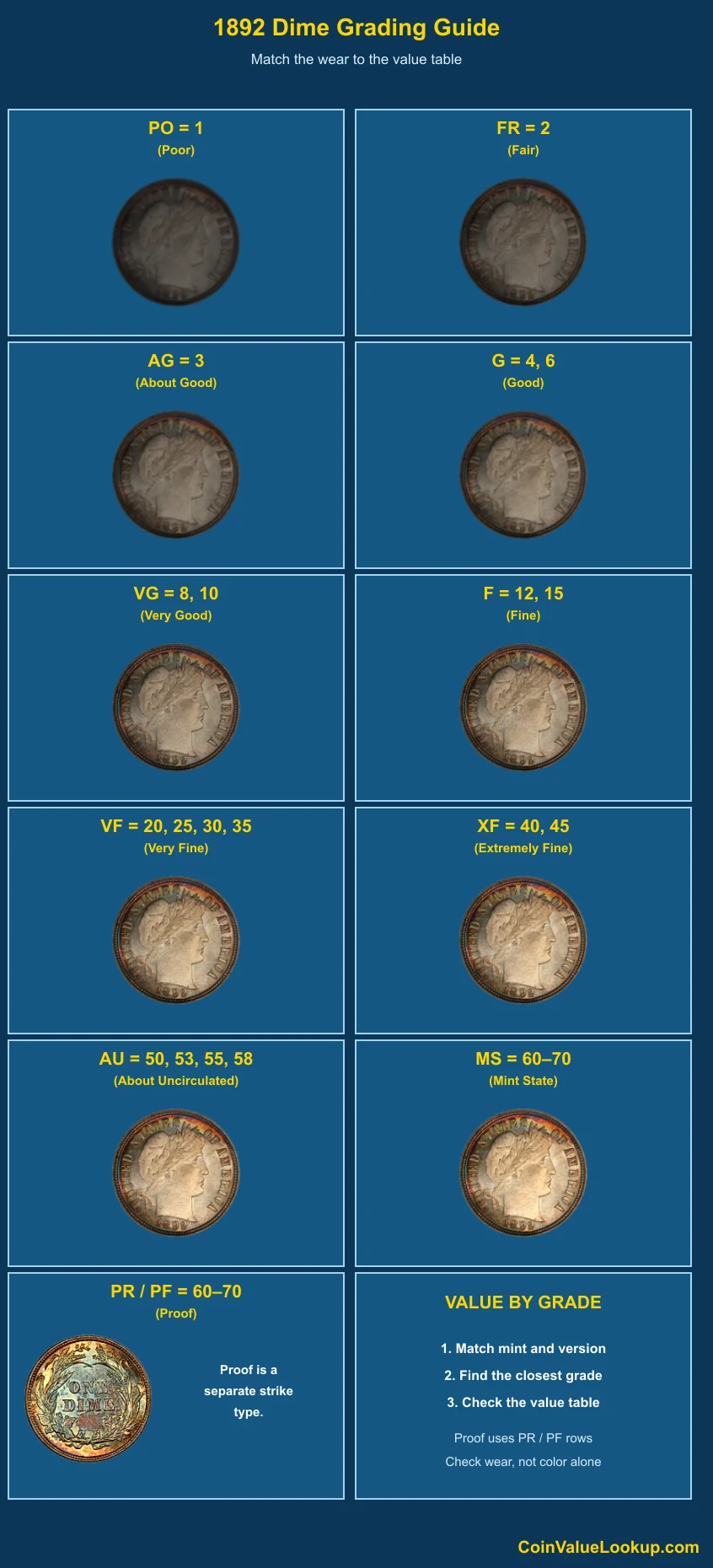
Grading a Barber dime means reading actual wear across the whole coin, not just counting letters in LIBERTY. Start with the headband.
On a well-preserved coin every letter is sharp and fully separated from the surrounding hair detail. As the coin wears, those letters merge into the hair, starting with LI and eventually losing the whole word.
Check Liberty's cheek next. It is a high point and picks up contact early.
A flat, smooth cheek with no hair detail above it signals heavy wear. On the reverse, examine the wreath leaves for flattening, especially the tips and the ribbon bow at the bottom.
New Orleans coins are sometimes weakly struck from the factory, so a soft headband does not always mean wear. Look at the luster in protected areas to judge whether softness is from the strike or from circulation.
For Mint State, unbroken original luster should cover the entire surface. Hairlines from old cleaning count against a coin even if no wear is present.
Compare your coin to the grading image to calibrate your eye on where wear appears first versus where strike weakness tends to hide.
Step 3: Check 1892 Barber Dime Value by Mint and Version
1892 Barber Dime — No Mint Mark — Silver Circulation
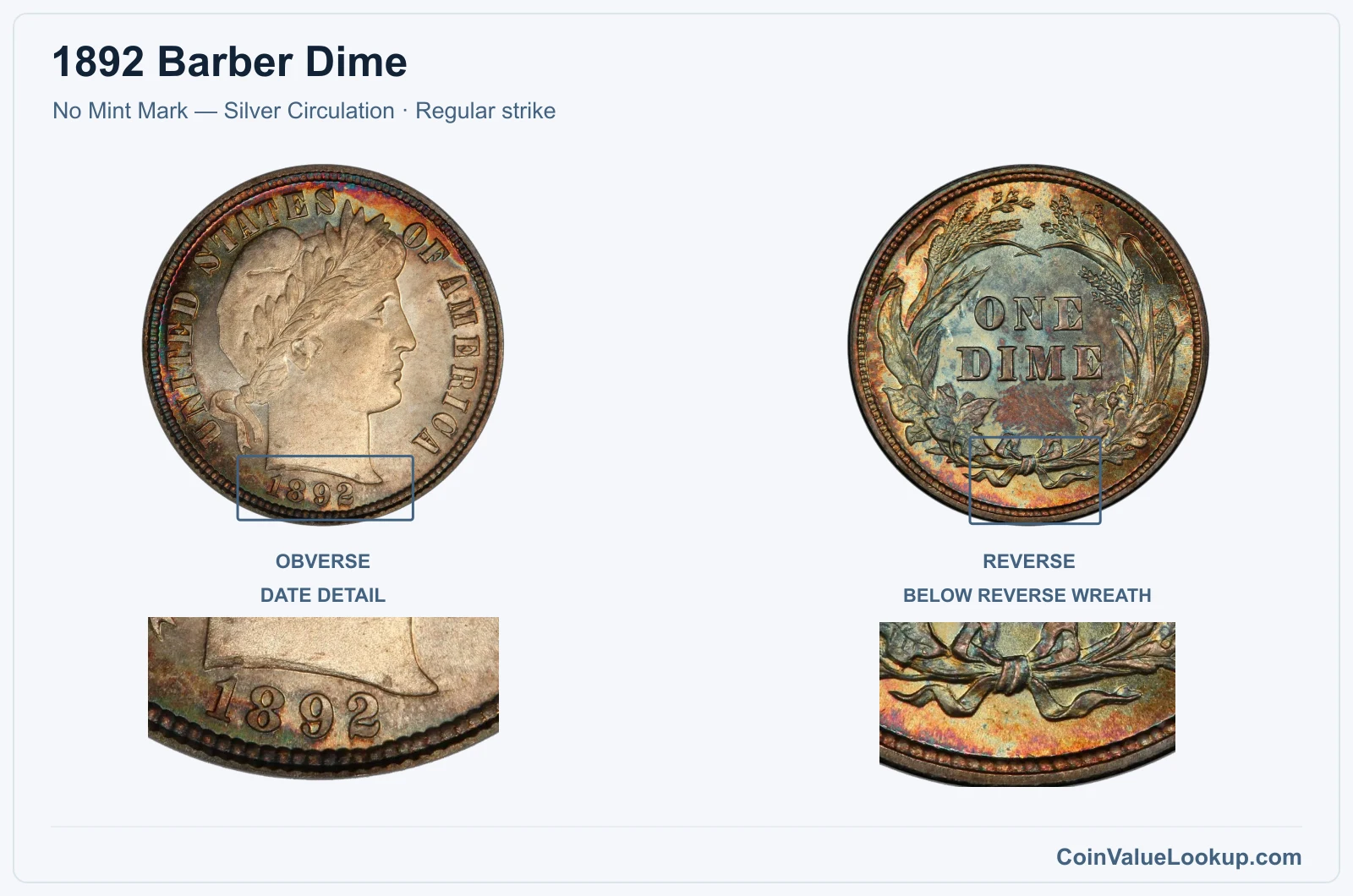
The Philadelphia issue carries no mintmark anywhere on the coin. Look below the wreath bow on the reverse and confirm the space is empty.
This is the most available 1892 Barber dime in circulated grades, with guide estimates around $14 at G4 and $229 at MS63.
Being the debut year of the design, even common Philadelphia pieces attract interest from type collectors assembling a first-year set. Still, condition matters far more than nostalgia.
A well-worn example is worth its modest guide value and not much more.
Range Grade
Price Auction Records Appraisal PO PO 1
—
Coin Identifier FR FR 2
—
Coin Identifier AG AG 3
—
Coin Identifier G G 4
—
Coin Identifier
G 6
—
Coin Identifier VG VG 8
—
Coin Identifier
VG 10
—
Coin Identifier F F 12
—
Coin Identifier
F 15
—
Coin Identifier VF VF 20
—
Coin Identifier
VF 25
—
Coin Identifier
VF 30
—
Coin Identifier
VF 35
Coin Identifier XF XF 40
—
Coin Identifier
XF 45
Coin Identifier AU AU 50
Coin Identifier
AU 53
Coin Identifier
AU 55
Coin Identifier
AU 58
Coin Identifier MS MS 60
Coin Identifier
MS 61
Coin Identifier
MS 62
Coin Identifier
MS 63
Coin Identifier
MS 64
Coin Identifier
MS 65
Coin Identifier
MS 66
Coin Identifier
MS 67
Coin Identifier
MS 68
Coin Identifier
MS 69
—
—
—
MS 70
—
—
—
1892 Barber Dime — O — Silver Circulation
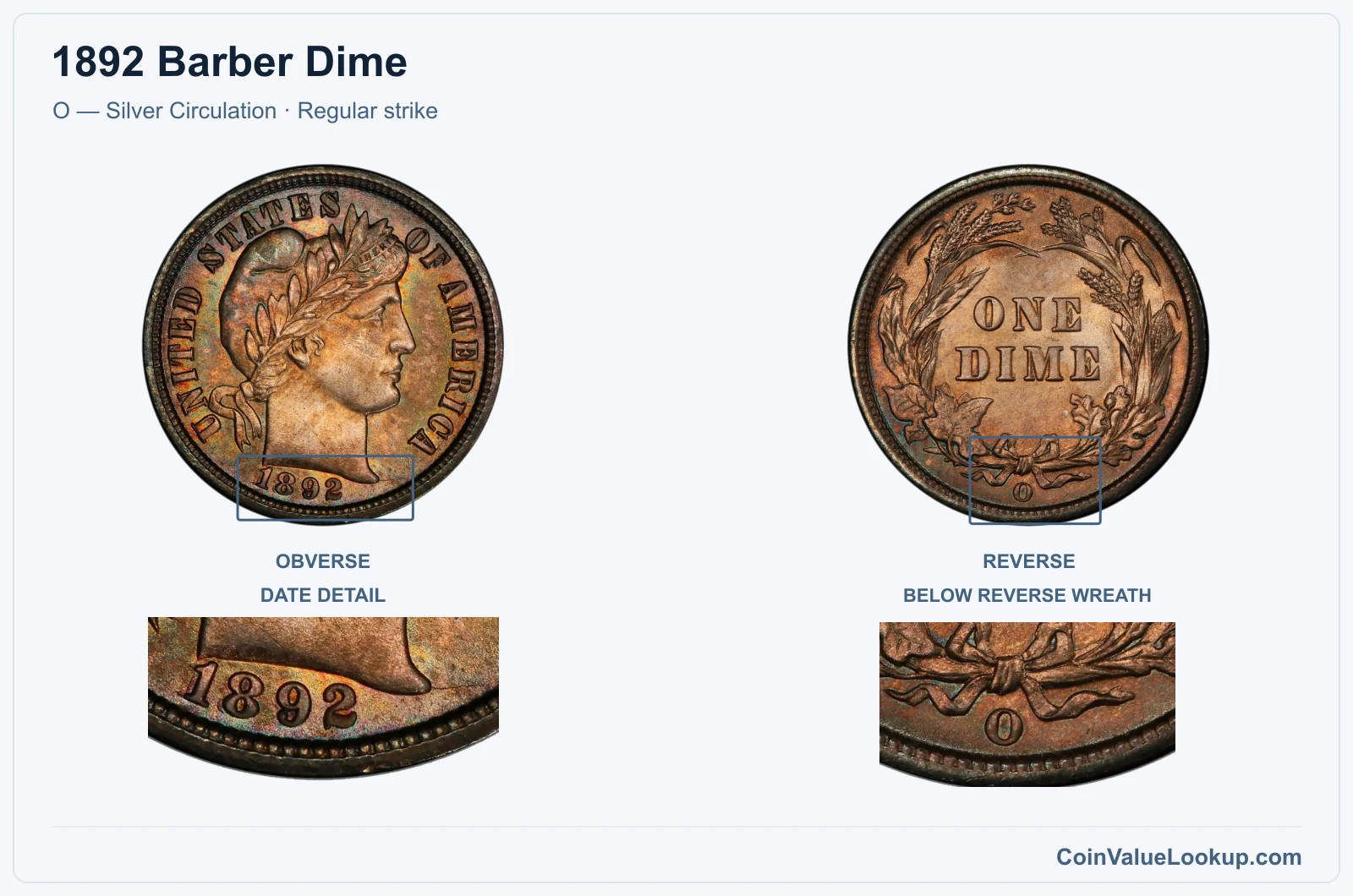
The New Orleans issue shows a small O mintmark centered below the wreath bow on the reverse. Guide estimates run about $19 at G4 and around $441 at MS63, a step above Philadelphia across the board.
One thing to watch: New Orleans Barber dimes are sometimes softly struck, which can make the headband letters look worn even on a coin that saw little circulation. Check the luster in recessed areas before assuming a weak headband means a low grade.
Original, unbroken luster plus a soft strike is a very different coin from a genuinely worn one.
Range Grade
Price Auction Records Appraisal PO PO 1
—
Coin Identifier FR FR 2
—
Coin Identifier AG AG 3
—
Coin Identifier G G 4
—
Coin Identifier
G 6
—
Coin Identifier VG VG 8
—
Coin Identifier
VG 10
—
Coin Identifier F F 12
—
Coin Identifier
F 15
—
Coin Identifier VF VF 20
Coin Identifier
VF 25
Coin Identifier
VF 30
—
Coin Identifier
VF 35
—
Coin Identifier XF XF 40
Coin Identifier
XF 45
Coin Identifier AU AU 50
Coin Identifier
AU 53
Coin Identifier
AU 55
Coin Identifier
AU 58
Coin Identifier MS MS 60
Coin Identifier
MS 61
Coin Identifier
MS 62
Coin Identifier
MS 63
Coin Identifier
MS 64
Coin Identifier
MS 65
Coin Identifier
MS 66
Coin Identifier
MS 67
Coin Identifier
MS 68
—
—
—
MS 69
—
—
—
MS 70
—
—
—
1892 Barber Dime — S — Silver Circulation
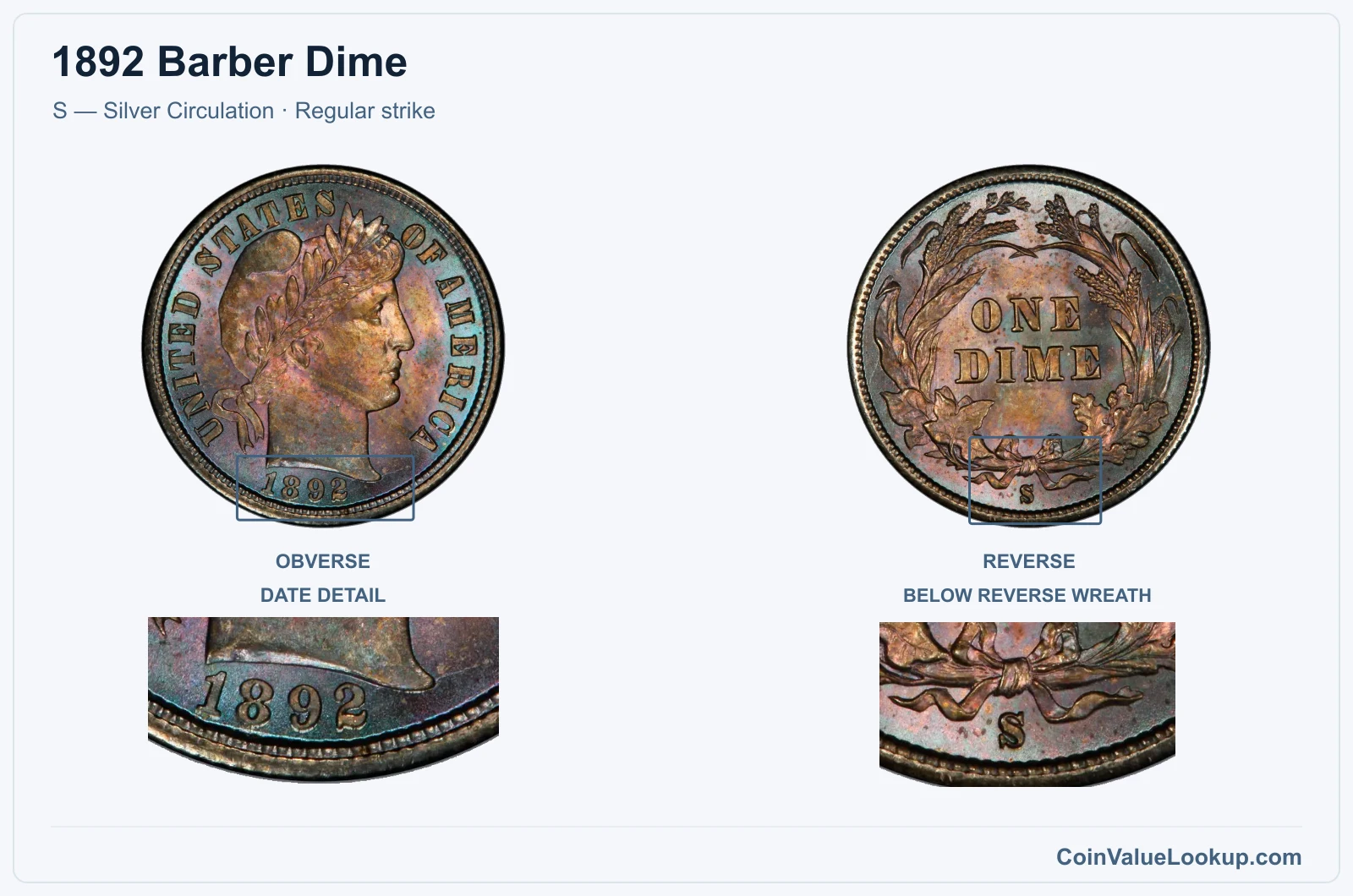
San Francisco coins carry an S mintmark below the reverse wreath bow. This is the key business strike of the year, and guide estimates reflect it: roughly $90 at G4 climbing to about $967 at MS63.
The premium exists because fewer survive in collector-grade condition, not because of any design difference. In lower grades, confirm the S mintmark with magnification since heavy wear can obscure it.
A genuine S-mint 1892 dime in any solid, problem-free grade is a coin worth confirming carefully.
Coin Value Lookup is a useful starting point if you want to compare guide values across Barber dime dates and mints before deciding whether professional grading makes sense for your coin.
Range Grade
Price Auction Records Appraisal PO PO 1
—
Coin Identifier FR FR 2
—
Coin Identifier AG AG 3
Coin Identifier G G 4
Coin Identifier
G 6
Coin Identifier VG VG 8
Coin Identifier
VG 10
Coin Identifier F F 12
Coin Identifier
F 15
Coin Identifier VF VF 20
Coin Identifier
VF 25
Coin Identifier
VF 30
Coin Identifier
VF 35
Coin Identifier XF XF 40
Coin Identifier
XF 45
Coin Identifier AU AU 50
Coin Identifier
AU 53
Coin Identifier
AU 55
Coin Identifier
AU 58
Coin Identifier MS MS 60
—
Coin Identifier
MS 61
Coin Identifier
MS 62
Coin Identifier
MS 63
Coin Identifier
MS 64
Coin Identifier
MS 65
Coin Identifier
MS 66
Coin Identifier
MS 67
—
—
—
MS 68
—
—
—
MS 69
—
—
—
MS 70
—
—
—
1892 Barber Dime — No Mint Mark — Brilliant Silver Proof
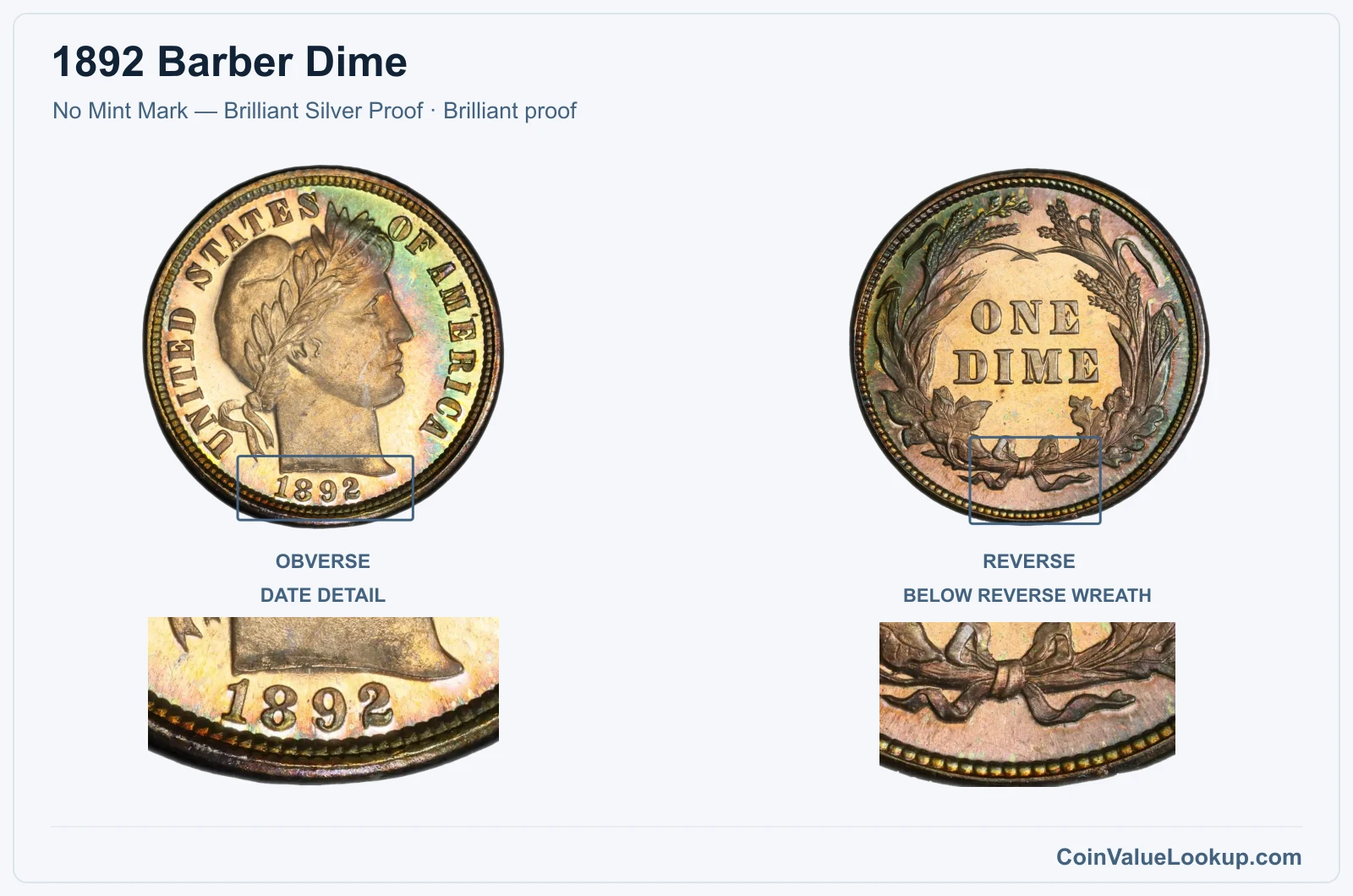
Philadelphia struck proof Barber dimes in 1892 with deeply mirrored fields and crisp, squared-off rims. These are not simply high-grade coins; proof is a specific manufacturing process using polished dies and planchets.
Guide estimates place a PR63 example around $616.
Some early Barber proofs show contrast between frosted devices and mirror fields, but do not assume every bright proof qualifies for a cameo or deep cameo designation. Those contrast levels carry different premiums and require professional attribution.
The standard PR63 guide value applies to a normal brilliant proof without special contrast.
Range Grade
Price Auction Records Appraisal PR PR 1
—
Coin Identifier
PR 2
—
Coin Identifier
PR 3
—
Coin Identifier
PR 4
—
Coin Identifier
PR 6
—
Coin Identifier
PR 8
—
Coin Identifier
PR 10
—
Coin Identifier
PR 12
—
Coin Identifier
PR 15
—
Coin Identifier
PR 20
—
Coin Identifier
PR 25
—
Coin Identifier
PR 30
—
Coin Identifier
PR 35
—
Coin Identifier
PR 40
—
Coin Identifier
PR 45
—
Coin Identifier
PR 50
—
Coin Identifier
PR 53
—
Coin Identifier
PR 55
—
Coin Identifier
PR 58
—
Coin Identifier
PR 60
Coin Identifier
PR 61
Coin Identifier
PR 62
Coin Identifier
PR 63
Coin Identifier
PR 64
Coin Identifier
PR 65
Coin Identifier
PR 66
Coin Identifier
PR 67
Coin Identifier
PR 68
Coin Identifier
PR 69
—
—
—
PR 70
—
—
—
1892 Barber Dime Error List
1. 1892 Barber Dime — Repunched Date
A repunched date on an 1892 Barber dime shows traces of an earlier impression of the date numerals slightly offset from their final position. Under magnification, look for ghostly remnants or extra serifs beside the 1, 8, 9, or 2.
These appear because the date was punched into the working die by hand, and sometimes the first strike landed slightly off.
This is different from machine doubling, which produces flat, shelf-like doubling across many design elements at once. A true repunched date affects only the date digits and shows a distinct secondary impression.
Damage from contact or corrosion can also mimic extra lines around numerals, so inspect carefully. Condition, the clarity of the extra impression, and the specific variety all influence what a repunched date adds to a coin's value.
2. 1892 Barber Dime — Clashed Dies
Clashed dies occur when the obverse and reverse dies strike each other without a planchet between them. The impact transfers a faint mirror image of the opposing design onto each die, and that ghost image then appears on subsequent coins.
On an 1892 Barber dime, look for faint outlines of the wreath in the open fields of the obverse, or traces of Liberty's profile within the wreath on the reverse. These marks align with where the opposing design would sit, which distinguishes them from random scratches or contact marks.
Do not confuse a clash with a brockage, which involves a previously struck coin acting as a die. The value of a clashed die coin depends on how bold and visible the transferred design is, along with the coin's overall condition.
3. 1892 Barber Dime — Die Break / Cud
A die break happens when a section of the die cracks or chips away, leaving a raised irregular blob on the struck coin. When that break extends to the rim, collectors call it a cud.
It looks like a featureless lump of metal attached to the edge, replacing whatever design detail was in that area.
Smaller interior die cracks show as thin raised lines across the surface. These are less dramatic but still collectible if prominent.
Do not confuse a cud with a rim dent, which is recessed damage from a hit after striking, or with corrosion buildup, which has a rough, porous texture.
The size, location, and visual impact of the break all affect value, along with the coin's grade. A large, bold cud on an otherwise attractive coin draws the most collector interest.
4. 1892 Barber Dime — Die Cap / Capped-Die Strike
A die cap forms when a struck coin sticks to one of the dies and keeps getting hit by subsequent strikes. The adhered coin gradually cups around the die like a bottle cap, and coins struck beneath it pick up a distorted, brockage-like impression.
This error has been reported specifically on the 1892-O Barber dime.
The capped coin itself shows extreme cupping with progressively mushroomed edges. A coin struck through the cap displays a softened, spread-out mirror image of the design from the stuck coin on one side, while the other side may look relatively normal.
Do not mistake a bent coin or one damaged in a vise for a die cap. Genuine caps show progressive distortion and the telltale mirrored impression.
Condition and the degree of the cap formation affect value, and professional authentication is strongly recommended for any suspected example.