1830 Capped Bust Dime Coin Value: How Much Is It Worth?
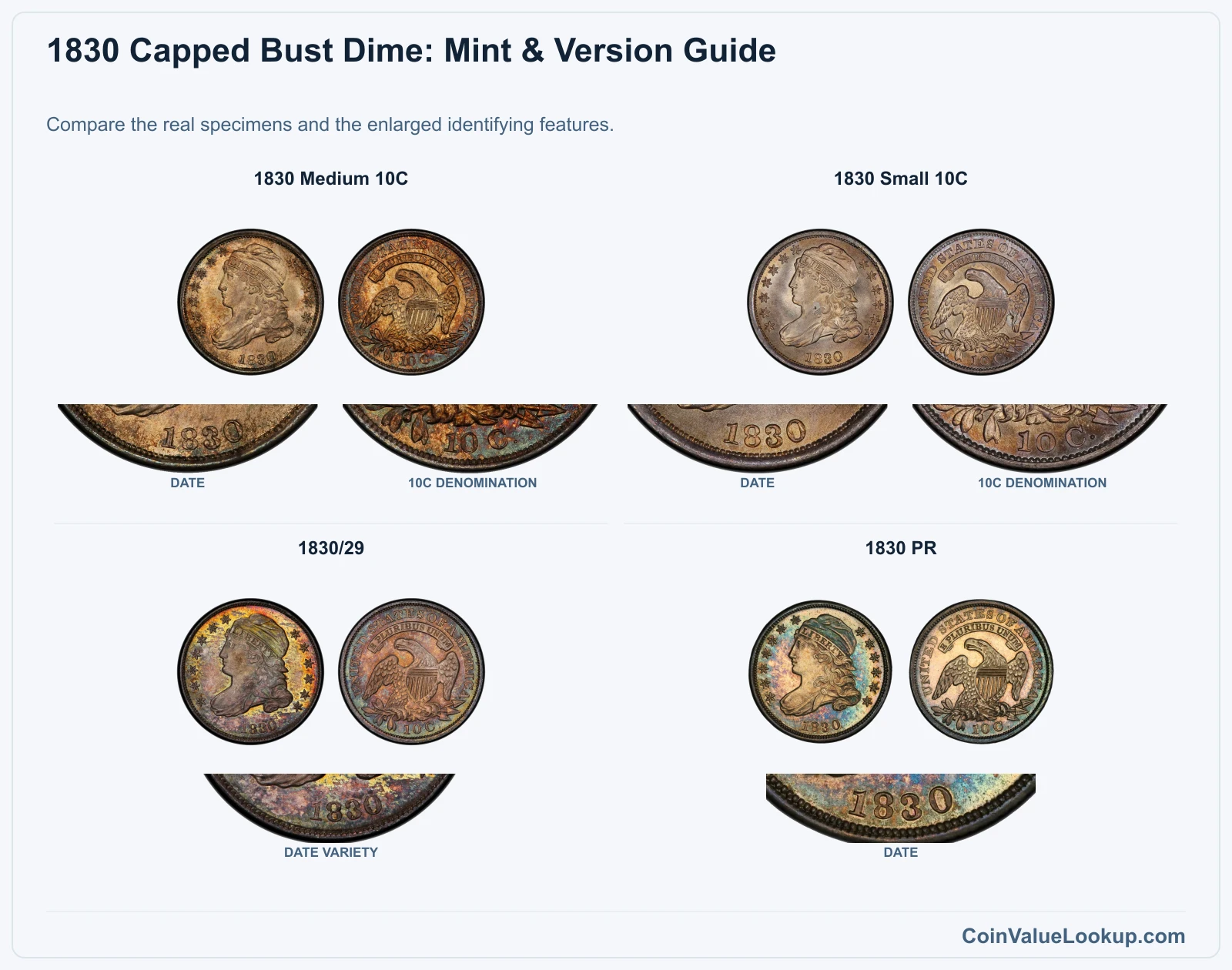
The 1830 Capped Bust Dime is a genuine piece of early American silver coinage, struck at Philadelphia when Andrew Jackson was in the White House. Guide estimates for the main branches range from about $60.00 in well-worn Good-4 condition up to $5,223.00 for a choice Mint State example of the scarcer overdate variety.
Your coin's actual worth depends on which variety it is, how much wear it shows, and whether the original surfaces are intact. Those guide anchors are not guaranteed offers — they are reference points tied to specific grades and versions.
Fast Way to Identify Your 1830 Capped Bust Dime
Snap clear, well-lit photos of both the front and back of your 1830 dime and upload them here for a preliminary identification. This step helps narrow down which variety you have — Medium 10C, Small 10C, overdate, or something else — so you can compare it against the right value range.
Sharp images of the date and the denomination text under the eagle are especially useful.
1830 Capped Bust Dime Value
Upload both sides of your 1830 Capped Bust Dime.
Front Obverse
Upload photo
Back Reverse
Upload photo
Which 1830 Capped Bust Dime Versions Are Worth Money?
- The 1830/29 overdate commands the highest guide estimates — $73.00 in G4 up to $5,223.00 in MS63 — because remnants of the earlier date make it a distinct die variety.
- The 1830 Small 10C variety guides slightly higher than the Medium 10C at upper grades, reaching $3,432.00 in MS63 versus $3,088.00.
- The 1830 Medium 10C is the most commonly encountered business-strike variety, with guides from $60.00 in G4 to $3,088.00 in MS63.
- The 1830 Proof is extremely scarce early proof production; no standard guide range applies, and each coin requires individual assessment by an authentication service.
- Cleaning, corrosion, or surface damage on any variety will reduce the coin's comparability to these guide figures.
Step 1: Identify Your 1830 Capped Bust Dime Mint Mark and Version
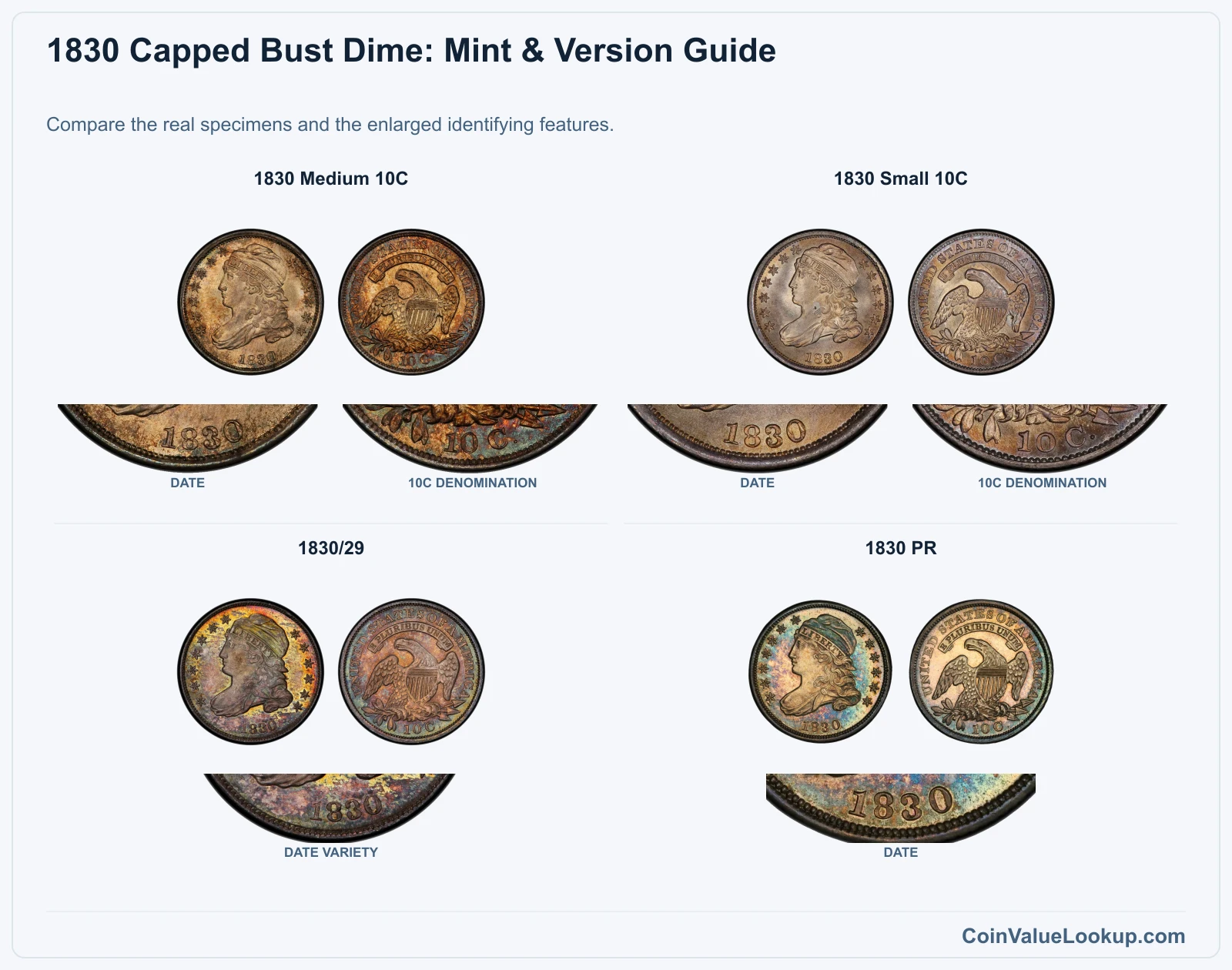
Every 1830 Capped Bust Dime was struck at Philadelphia, so there is no mintmark to look for. The coin is a silver-copper alloy, roughly 89.24% silver, in the closed-collar "small dentils" format with a reeded edge.
Four main branches exist this year: the 1830 Medium 10C, the 1830 Small 10C, the 1830/29 overdate, and the 1830 Proof. Focus first on the denomination stamp beneath the eagle on the reverse — the physical size of the "10 C." lettering is what separates the Medium and Small varieties.
You need a correctly labeled reference image at the same scale, not just magnification of your own coin in isolation.
Next, examine the date under magnification. If traces of an earlier "29" lurk beneath the "30," you have the overdate.
And if the surfaces are deeply mirrored with squared, razor-sharp rims, you might have a proof — but a shiny, well-struck business strike is not the same thing. Do not confuse a half dime (a smaller, different denomination) with this coin.
Step 2: Check Your 1830 Capped Bust Dime Grade
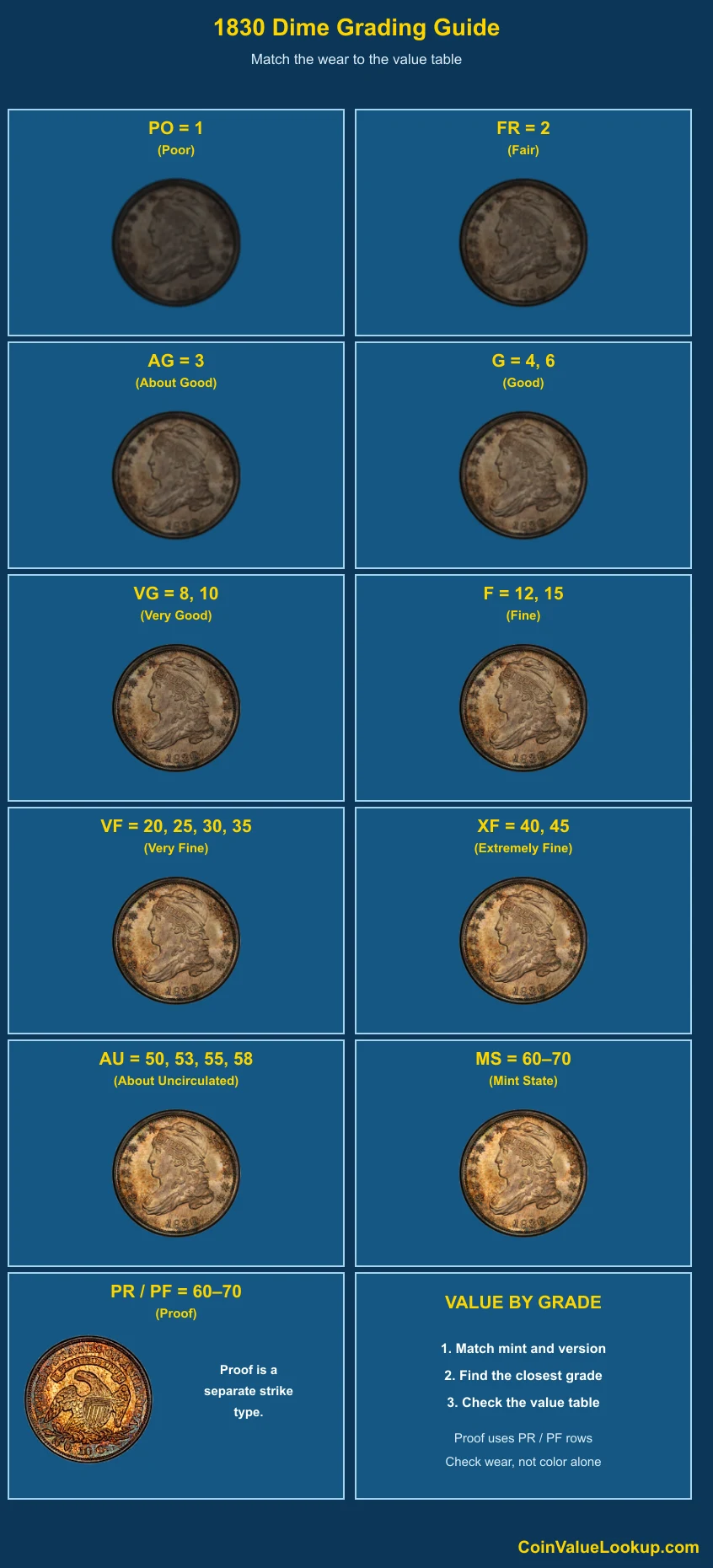
On the obverse, check Liberty's hair curls above the forehead, the smoothness of her cheek, and the folds in the cap and drapery — these are the first places to lose detail as the coin circulates. On the reverse, the eagle's breast feathers and wing tips wear down earliest.
Early 1830s dimes were struck on hand-operated presses, so even a coin with no circulation wear can show uneven or slightly weak detail in spots. That is not the same as wear.
Look at the overall luster: a coin that has been in pockets will have a different surface texture than one stored since new.
Use the comparison image of a same-type Capped Bust Dime to judge your coin's condition. Check for contact marks, scratches, and any signs of old cleaning.
A cleaned coin — even a lightly wiped one — will grade lower or trade at a discount compared to one with original, naturally toned surfaces. Brightness alone does not mean quality.
Step 3: Check 1830 Capped Bust Dime Value by Mint and Version
1830 Capped Bust Dime — Medium 10C
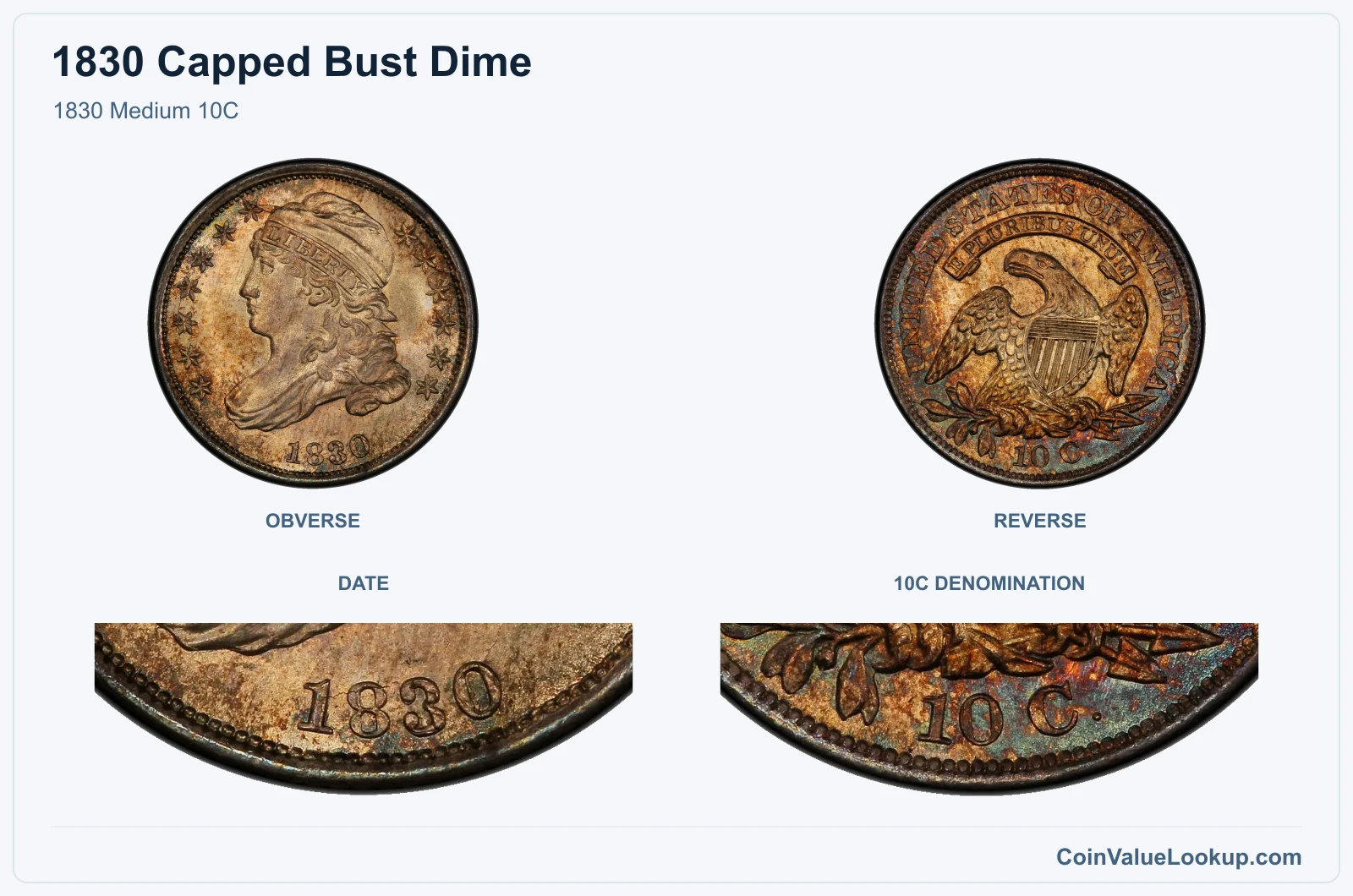
The 1830 Medium 10C is the standard Philadelphia business strike for this year. To confirm you have it, look at the reverse: the denomination "10 C." beneath the eagle is rendered in noticeably larger lettering compared to the Small 10C variety.
You need a known, correctly labeled example at the same scale for comparison — eyeballing size without a reference is unreliable.
Guide estimates place this version at about $60.00 in Good-4 and around $3,088.00 in MS63. Original surfaces matter far more than raw brightness, and any cleaning or corrosion will push value below those benchmarks.
Match the date, the closed-collar design, and the denomination size before using any price table.
Range Grade
Price Auction Records Appraisal PO PO 1
—
Coin Identifier FR FR 2
—
Coin Identifier AG AG 3
—
Coin Identifier G G 4
Coin Identifier
G 6
Coin Identifier VG VG 8
Coin Identifier
VG 10
Coin Identifier F F 12
Coin Identifier
F 15
Coin Identifier VF VF 20
Coin Identifier
VF 25
Coin Identifier
VF 30
Coin Identifier
VF 35
Coin Identifier XF XF 40
Coin Identifier
XF 45
Coin Identifier AU AU 50
Coin Identifier
AU 53
Coin Identifier
AU 55
Coin Identifier
AU 58
Coin Identifier MS MS 60
—
Coin Identifier
MS 61
Coin Identifier
MS 62
Coin Identifier
MS 63
Coin Identifier
MS 64
Coin Identifier
MS 65
Coin Identifier
MS 66
Coin Identifier
MS 67
Coin Identifier
MS 68
—
—
—
MS 69
—
—
—
MS 70
—
—
—
1830 Capped Bust Dime — Small 10C
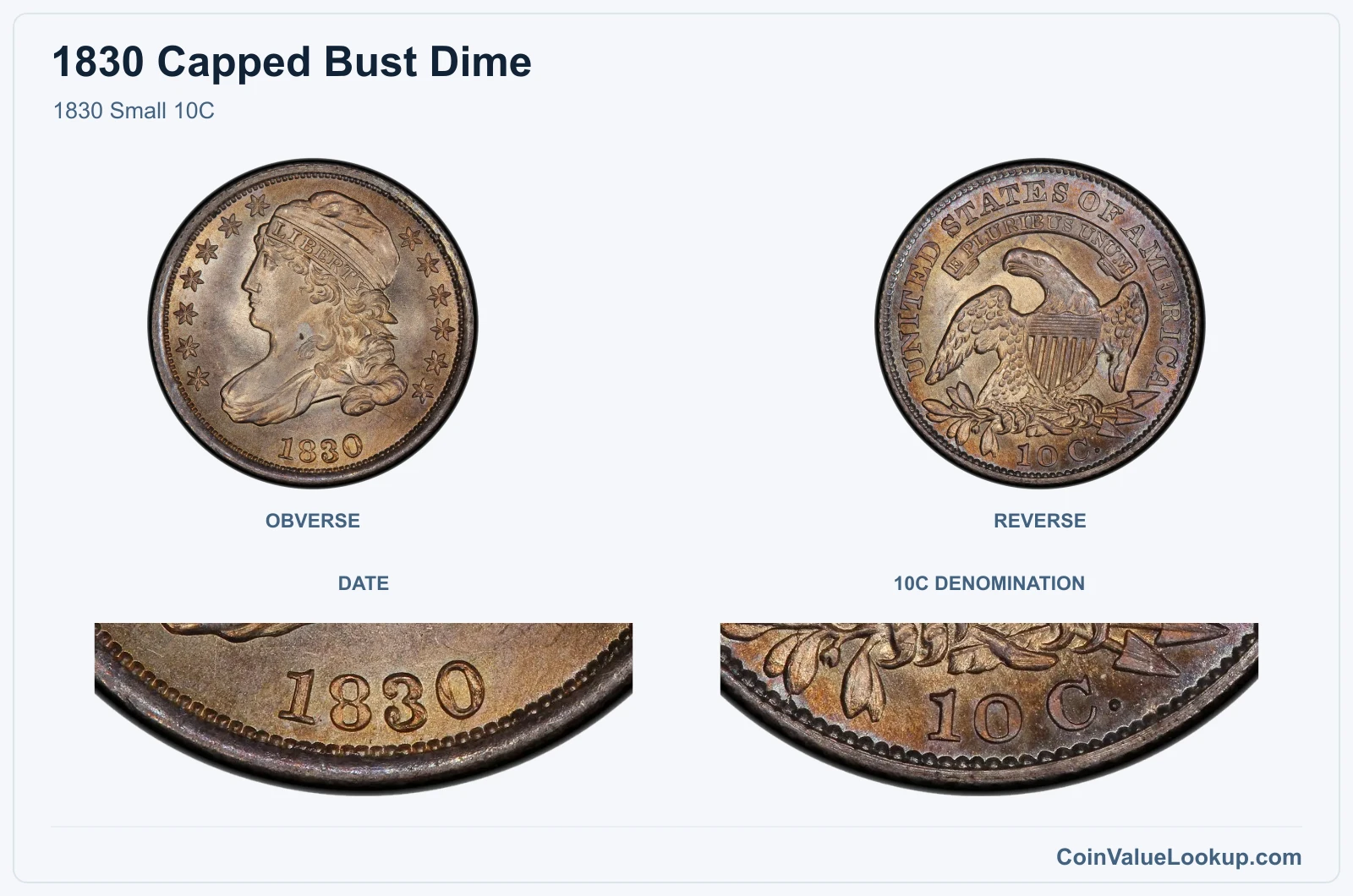
The 1830 Small 10C variety is distinguished by a physically smaller "10 C." stamped beneath the eagle on the reverse. Side-by-side comparison with a labeled Medium 10C example at equal scale is the reliable way to confirm this — magnifying only your own coin can be misleading because the size difference is relative.
Guide estimates run from about $60.00 in Good-4 to $3,432.00 in MS63, a modest premium over the Medium 10C at the upper end. As with all early silver, original toned surfaces and minimal contact marks keep the coin in line with guide figures.
Cleaned or damaged examples will trade well below.
Coin Value Lookup is a handy starting point if you want to look up guides for other dates in the Capped Bust Dime series or compare denominations from the same era.
Range Grade
Price Auction Records Appraisal PO PO 1
—
Coin Identifier FR FR 2
—
Coin Identifier AG AG 3
—
Coin Identifier G G 4
—
Coin Identifier
G 6
—
Coin Identifier VG VG 8
—
Coin Identifier
VG 10
Coin Identifier F F 12
Coin Identifier
F 15
—
Coin Identifier VF VF 20
Coin Identifier
VF 25
Coin Identifier
VF 30
Coin Identifier
VF 35
Coin Identifier XF XF 40
Coin Identifier
XF 45
—
Coin Identifier AU AU 50
Coin Identifier
AU 53
—
Coin Identifier
AU 55
Coin Identifier
AU 58
Coin Identifier MS MS 60
—
Coin Identifier
MS 61
Coin Identifier
MS 62
Coin Identifier
MS 63
Coin Identifier
MS 64
Coin Identifier
MS 65
Coin Identifier
MS 66
—
Coin Identifier
MS 67
—
Coin Identifier
MS 68
—
—
—
MS 69
—
—
—
MS 70
—
—
—
1830 Capped Bust Dime — /29
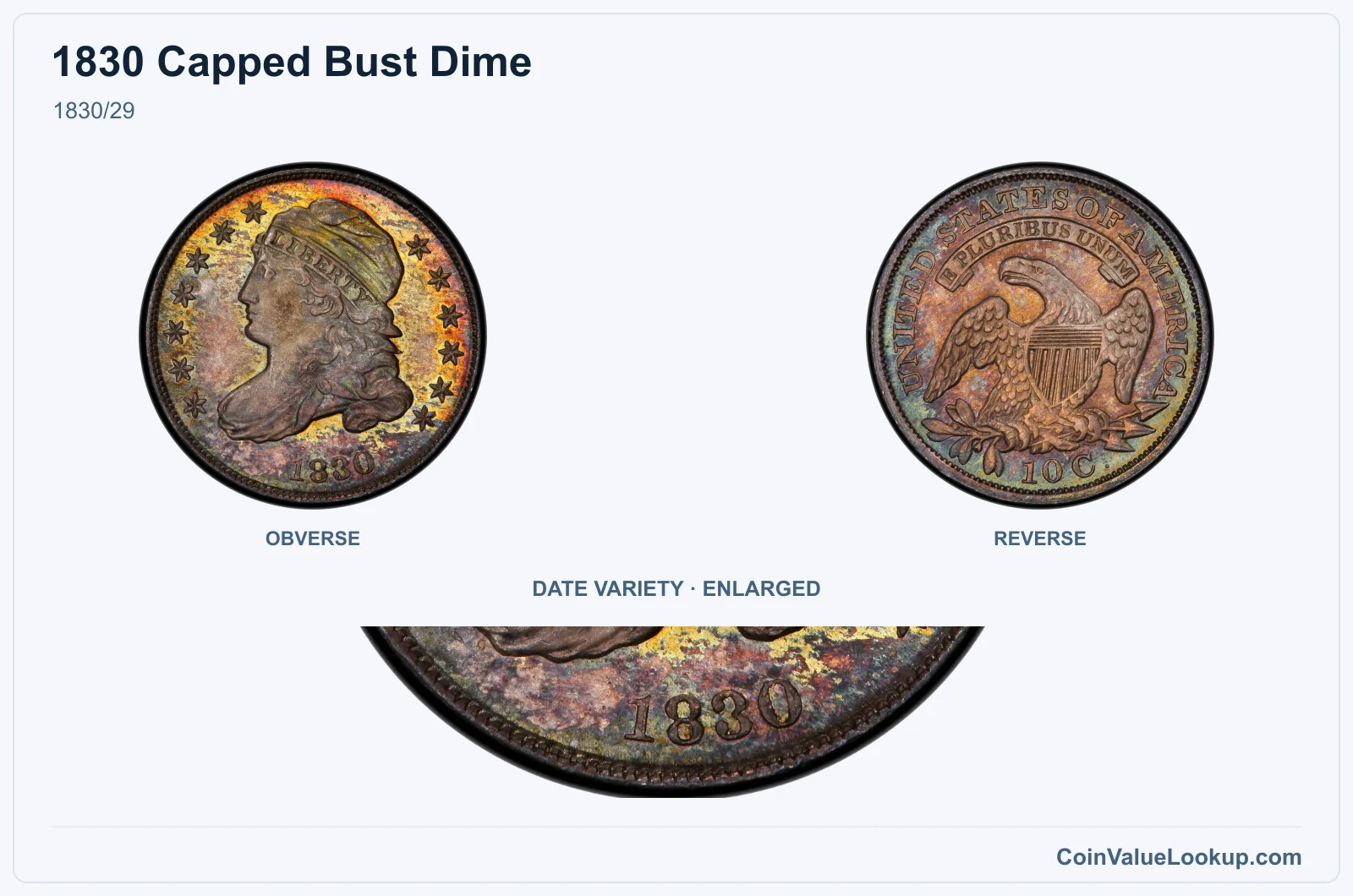
The 1830/29 overdate is the prize of the 1830 dime family. It was created when a die originally engraved with an 1829 date was re-punched with 1830 digits.
Under magnification, you can see traces of the earlier "29" peeking out beneath the final "30" — typically visible as extra curves or serifs that do not belong to the top-layer numerals.
This variety carries the highest guide estimates of the business-strike branches: roughly $73.00 in Good-4 and up to $5,223.00 in MS63. The premium exists because overdate dies are a finite, identifiable subgroup and collectors actively seek them.
As always, those figures assume original surfaces without cleaning or significant damage. Confirm the overdate under magnification before applying these numbers, because a scratched or corroded date can mimic extra lines.
Range Grade
Price Auction Records Appraisal PO PO 1
—
Coin Identifier FR FR 2
—
Coin Identifier AG AG 3
—
Coin Identifier G G 4
Coin Identifier
G 6
—
Coin Identifier VG VG 8
—
Coin Identifier
VG 10
—
Coin Identifier F F 12
Coin Identifier
F 15
—
Coin Identifier VF VF 20
—
Coin Identifier
VF 25
Coin Identifier
VF 30
Coin Identifier
VF 35
Coin Identifier XF XF 40
Coin Identifier
XF 45
Coin Identifier AU AU 50
Coin Identifier
AU 53
Coin Identifier
AU 55
Coin Identifier
AU 58
Coin Identifier MS MS 60
—
Coin Identifier
MS 61
Coin Identifier
MS 62
Coin Identifier
MS 63
Coin Identifier
MS 64
Coin Identifier
MS 65
—
Coin Identifier
MS 66
Coin Identifier
MS 67
Coin Identifier
MS 68
—
—
—
MS 69
—
—
—
MS 70
—
—
—
1830 Capped Bust Dime — PR
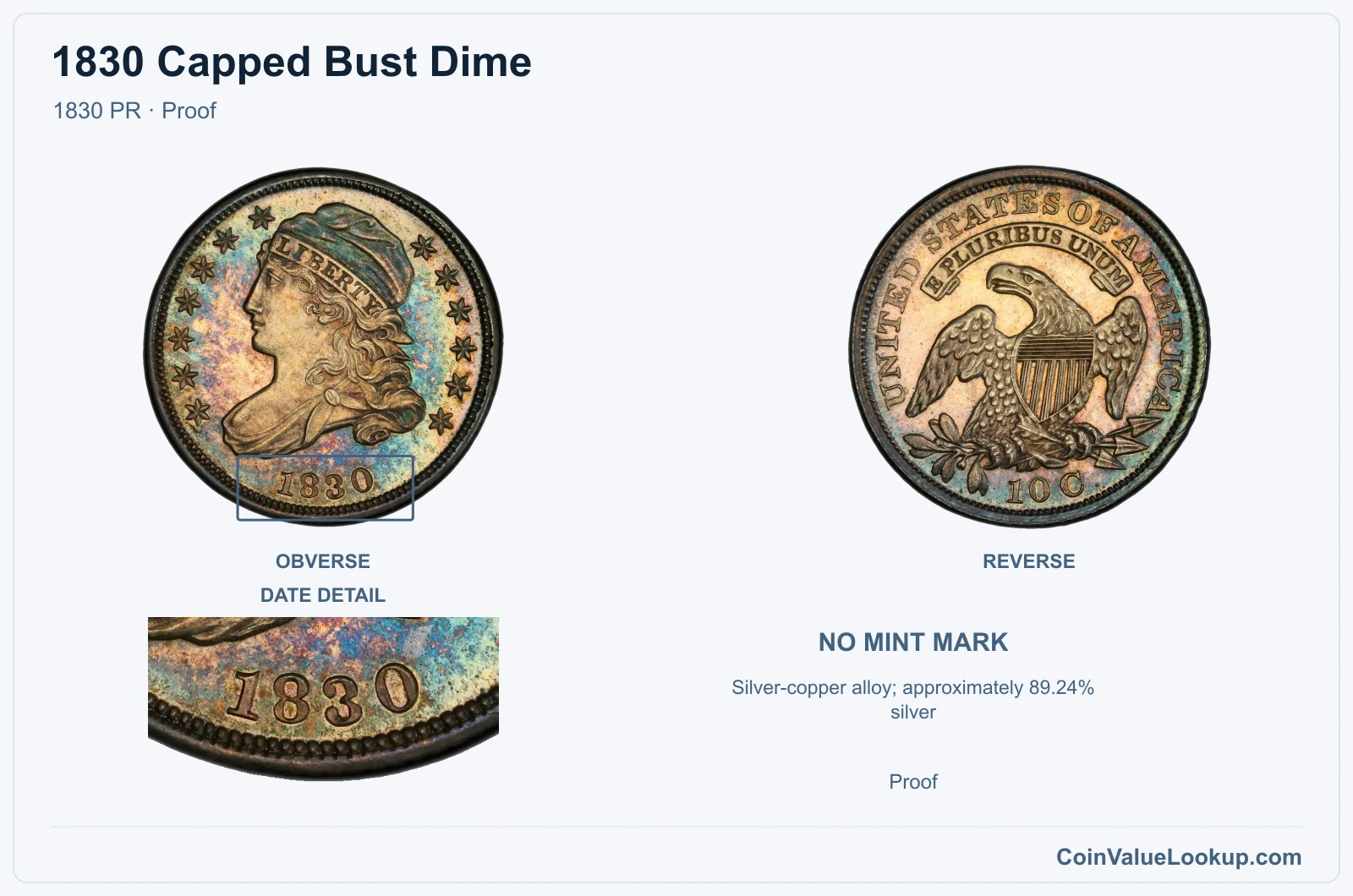
The 1830 Proof is an extremely scarce coin from the earliest era of deliberate proof manufacture at the Philadelphia Mint. Genuine proofs from this period show deeply reflective fields, sharp square-edged rims, and exceptional detail that goes beyond what even the best business strike can display.
A strongly struck or lightly circulated business strike that happens to look shiny is not a proof. Authentication by a recognized third-party grading service is essential before treating any 1830 dime as a proof.
No standard guide price range is adopted here because so few confirmed examples exist — each one must be assessed individually based on its authenticated identity and condition. If you suspect you have one, professional evaluation is the only responsible next step.
Range Grade
Price Auction Records Appraisal PR PR 1
—
Coin Identifier
PR 2
—
Coin Identifier
PR 3
—
Coin Identifier
PR 4
—
Coin Identifier
PR 6
—
Coin Identifier
PR 8
—
Coin Identifier
PR 10
—
Coin Identifier
PR 12
—
Coin Identifier
PR 15
—
Coin Identifier
PR 20
—
Coin Identifier
PR 25
—
Coin Identifier
PR 30
—
Coin Identifier
PR 35
—
Coin Identifier
PR 40
—
Coin Identifier
PR 45
—
Coin Identifier
PR 50
—
Coin Identifier
PR 53
—
Coin Identifier
PR 55
—
Coin Identifier
PR 58
—
Coin Identifier
PR 60
—
Coin Identifier
PR 61
—
Coin Identifier
PR 62
—
Coin Identifier
PR 63
Coin Identifier
PR 64
Coin Identifier
PR 65
Coin Identifier
PR 66
—
—
—
PR 67
—
—
—
PR 68
—
—
—
PR 69
—
—
—
PR 70
—
—
—
1830 Capped Bust Dime Error List
1. 1830 Capped Bust Dime — Overdate
At least eight die varieties are documented for the 1830 Capped Bust Dime, and two of them carry the 1830/29 overdate. On these coins, the Mint reused a die originally dated 1829 by punching new digits over the old ones.
The telltale sign is the surviving outline of the earlier numerals — look for extra curves or partial strokes beneath the "3" and "0" in the date area. A loupe or USB microscope makes this much easier to spot.
Not every odd-looking date is an overdate. Damage from a hit or scratch can create stray lines near the digits, and ordinary machine doubling from a slightly loose die can produce a shelf-like echo that mimics repunching.
The key difference is that a genuine overdate shows the distinct shapes of different numerals layered together, not just a shadow or flat shelf.
No specific numerical price range is adopted here for the error alone. Value depends on the visibility of the overdate, the coin's overall condition, and the integrity of its original surfaces.