1837 Capped Bust Dime Coin Value: How Much Is It Worth?
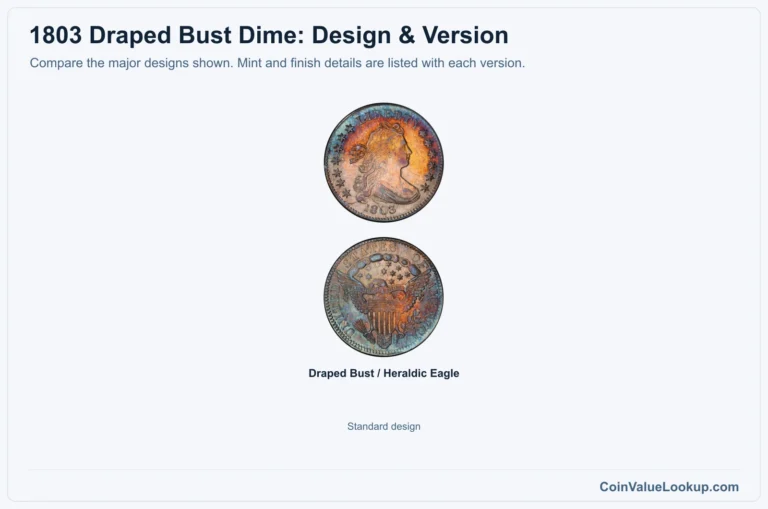
The 1837 Capped Bust Dime is a collectible early American silver dime struck at Philadelphia. Guide estimates from USA Coin Book place unseparated 1837 examples in a range of roughly $54.00 to $2,344.00 depending on grade.
Your coin's actual value hinges on which date-punch variety it is, its wear, and whether its original surfaces survive intact. Those anchors are guide figures, not guaranteed offers.
Fast Way to Identify Your 1837 Capped Bust Dime
The fastest way to start figuring out what you have is to upload clear photos of both sides of your coin. A sharp image of the front shows the date punch style, and the back confirms the design and any die anomalies.
Upload your front and back photos for a preliminary identification to help narrow down the variety and condition.
1837 Capped Bust Dime Value
Upload both sides of your 1837 Capped Bust Dime.
Front Obverse
Upload photo
Back Reverse
Upload photo
Which 1837 Capped Bust Dime Versions Are Worth Money?
- Two date-punch varieties to check: Block 8 (squared, geometric numeral) and Fancy 8 (ornate, curved numeral) — each affects collectibility.
- Condition and original surfaces drive value more than variety alone; cleaned or damaged coins fall below guide estimates regardless of date punch.
- Die cracks or die chips on some 1837 specimens can add collector interest when properly attributed.
Step 1: Identify Your 1837 Capped Bust Dime Mint Mark and Version
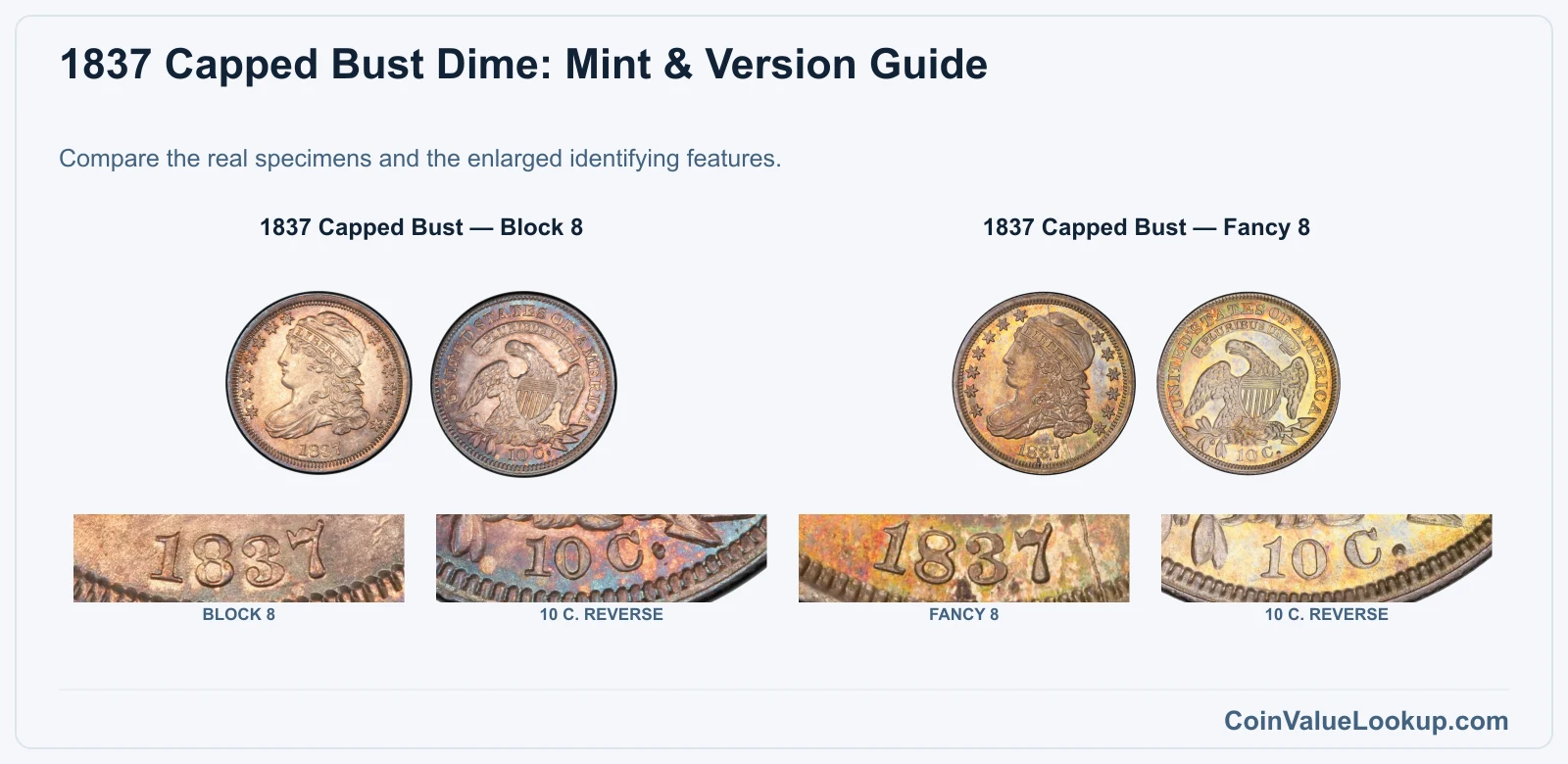
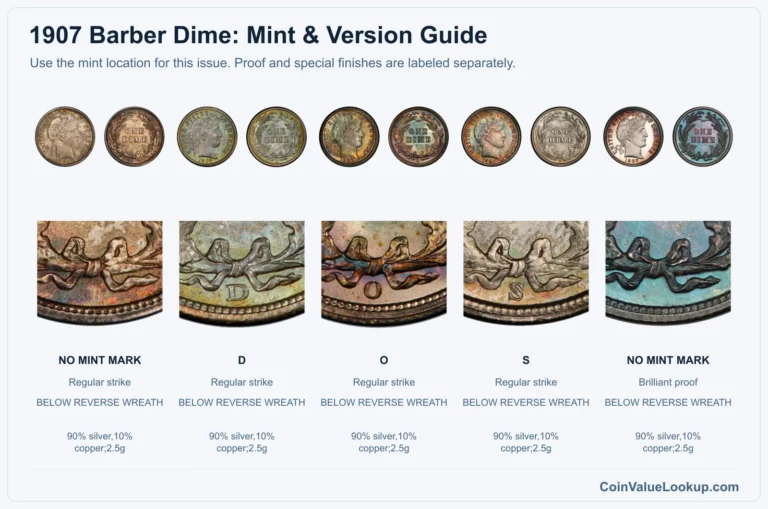
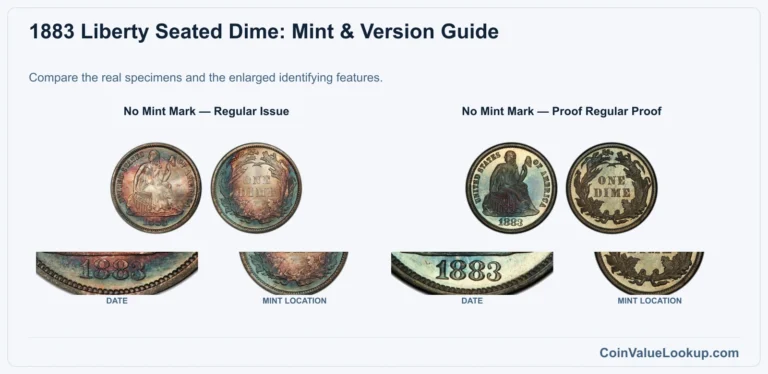
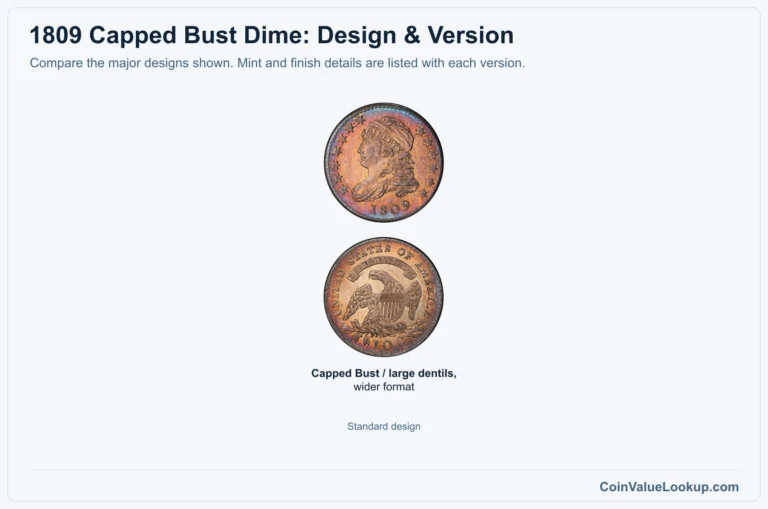
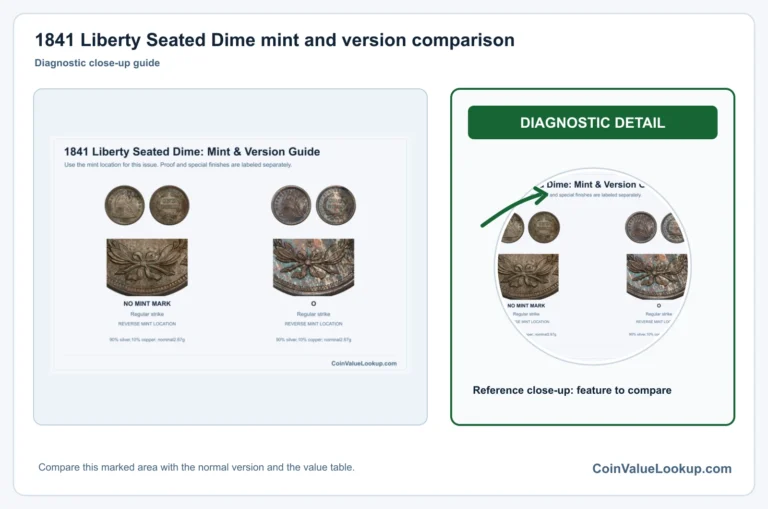
Every 1837 Capped Bust Dime was struck at Philadelphia, so there is no mintmark to hunt for. The coin is 90% silver and 10% copper, featuring the Capped Bust design with small dentils and a closed-collar format.
Two date-punch varieties exist for this year: Block 8 and Fancy 8. The difference is in the shape of the digit 8 in the date.
The Block 8 has straight, squared-off segments that give the numeral a rigid, almost geometric look. The Fancy 8 uses a more ornate, flowing punch with distinctly curved loops.
Look at the 8 under magnification and compare both loops carefully. These are intentional punch styles selected at the mint, not accidental doubling or die deterioration.
Do not confuse an 1837 Capped Bust Dime with the smaller half dime of the same year; they are entirely different denominations with different sizes and weights.
Step 2: Check Your 1837 Capped Bust Dime Grade
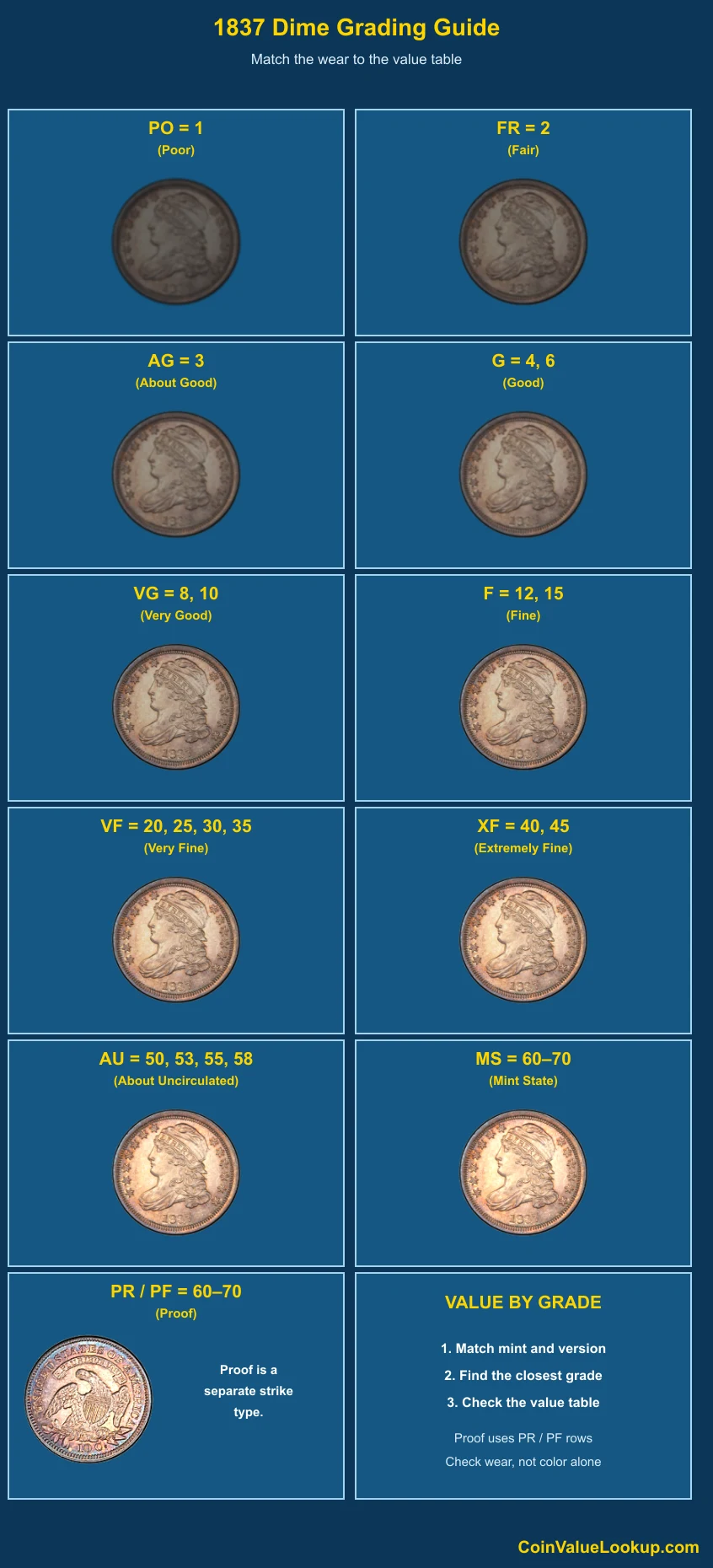
Start with Liberty's portrait on the front. The highest points that wear first are her cheek, the hair curls above the forehead, and the clasp and folds of the drapery near her shoulder.
On the reverse, check the eagle's breast feathers and the tops of the wings.
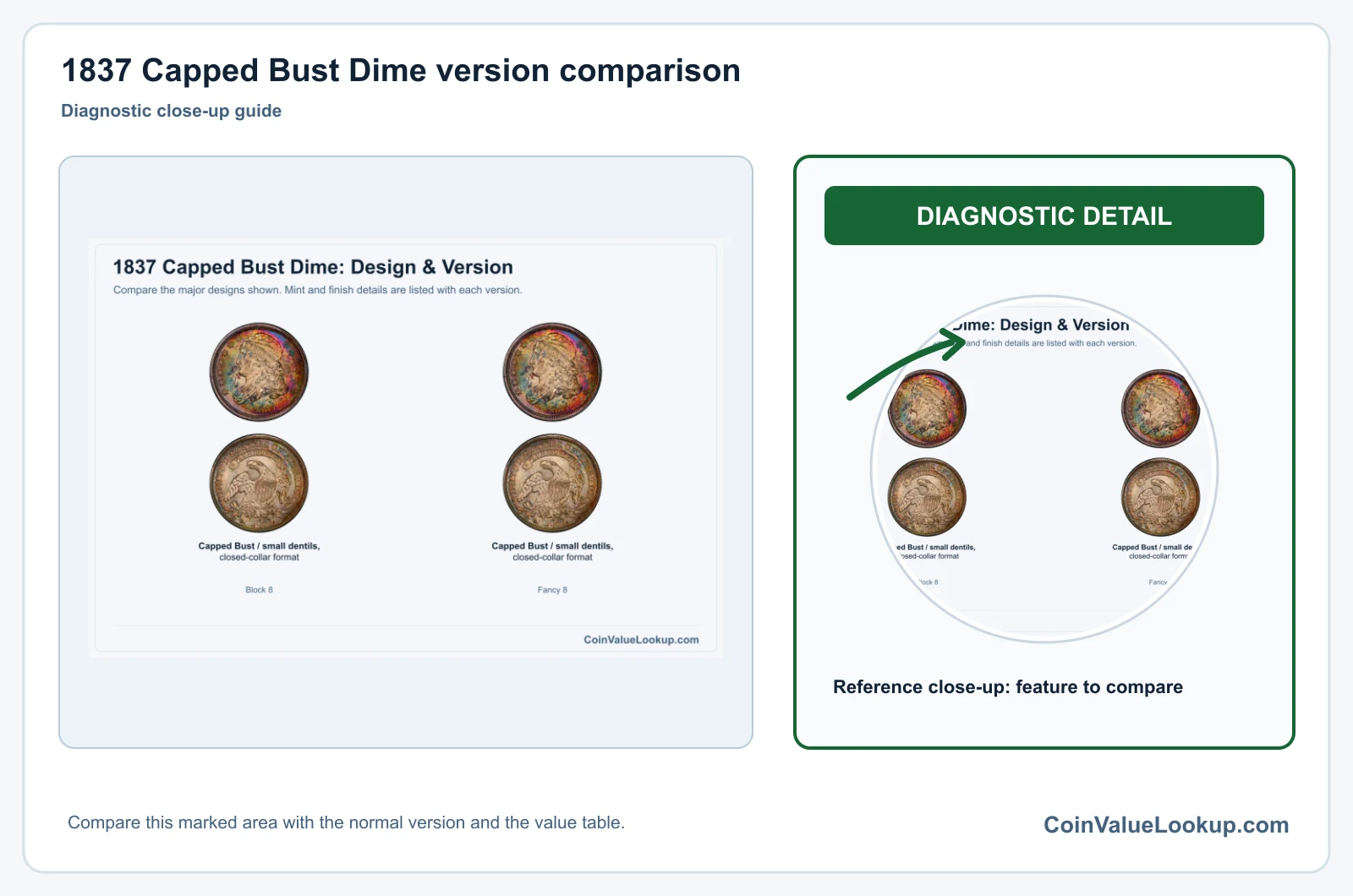
Use the comparison image to match your coin's wear pattern against known grade examples. Early 1800s coinage was struck on hand-operated presses, so even unworn pieces can show unevenly struck or slightly weak details.
That is not the same as wear.
Look for original luster in protected areas around the letters and stars. Contact marks from circulation are normal but reduce the grade.
Above all, do not clean or polish the coin. A naturally toned, undisturbed surface is far more desirable to collectors than a bright, scrubbed one.
Step 3: Check 1837 Capped Bust Dime Value by Mint and Version
1837 Capped Bust Dime — Capped Bust — Block 8
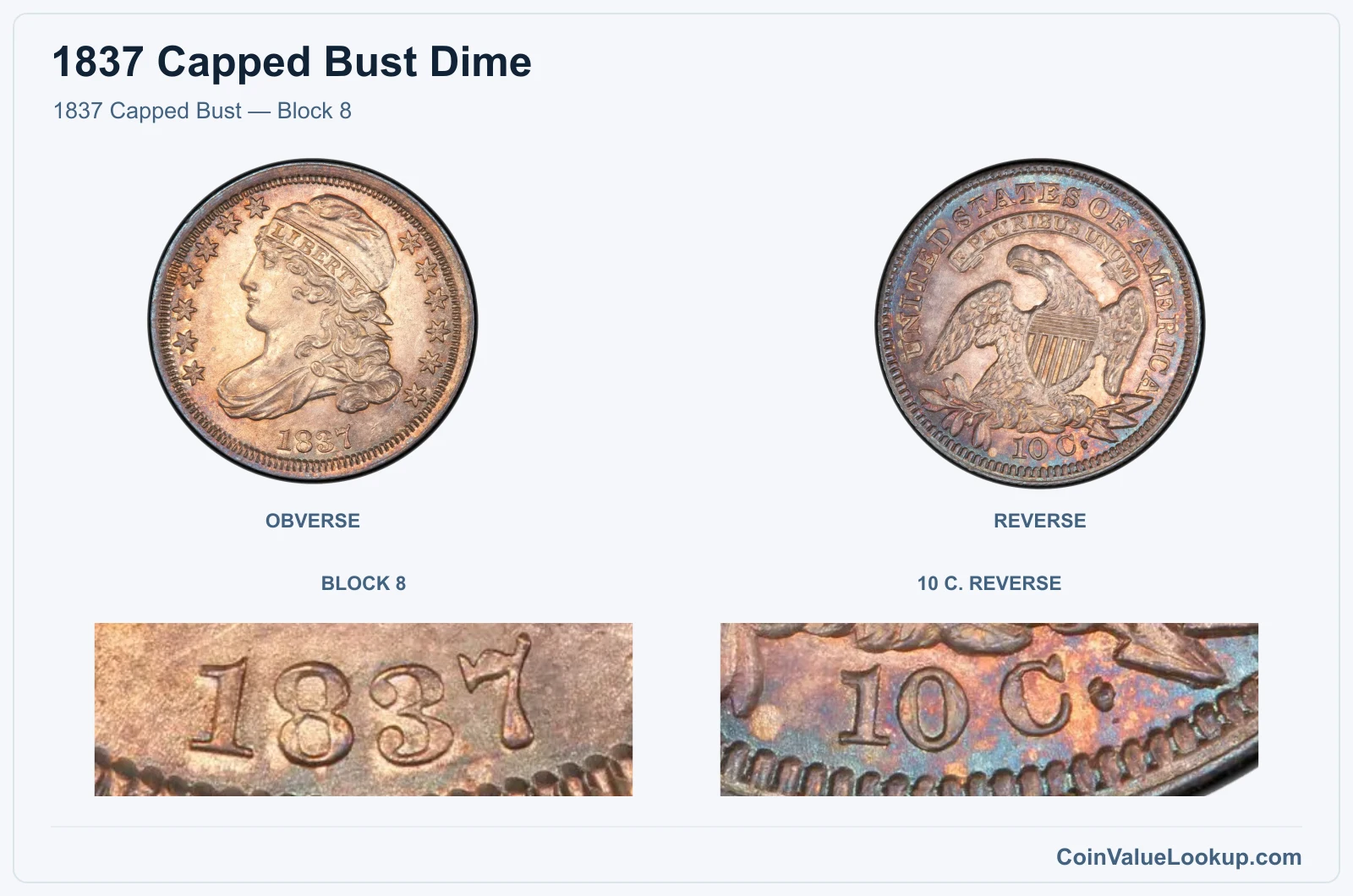
The Block 8 variety is identified by the squared, almost angular shape of the digit 8 in the date. Both the upper and lower loops look more rigid and blocky compared to the flowing Fancy 8 punch.
This is a deliberate die-punch style, not strike doubling.
No separately quoted guide price exists for the Block 8 apart from the general 1837 Capped Bust Dime anchors. Value depends on authenticated identity, the coin's actual condition, and whether it has original, uncleaned surfaces.
A professional grading service attribution helps confirm the variety and supports a stronger market position.
Coin Value Lookup is a good starting point if you want to look up guides for this and other early U.S. dime varieties before deciding on next steps.
Ordinary-issue reference: Ordinary-issue reference only: The table below shows the related standard issue (1837 Capped Bust). It does not represent the value of the specific 1837 Capped Bust — Block 8 variety or its variety premium. The year, mint, metal and strike type are matched; the specific variety is not priced by this table.
Range Grade
Price Auction Records Appraisal PO PO 1
—
Coin Identifier FR FR 2
—
Coin Identifier AG AG 3
—
Coin Identifier G G 4
—
Coin Identifier
G 6
Coin Identifier VG VG 8
—
Coin Identifier
VG 10
Coin Identifier F F 12
Coin Identifier
F 15
Coin Identifier VF VF 20
Coin Identifier
VF 25
Coin Identifier
VF 30
Coin Identifier
VF 35
Coin Identifier XF XF 40
Coin Identifier
XF 45
Coin Identifier AU AU 50
Coin Identifier
AU 53
Coin Identifier
AU 55
Coin Identifier
AU 58
Coin Identifier MS MS 60
—
Coin Identifier
MS 61
Coin Identifier
MS 62
Coin Identifier
MS 63
Coin Identifier
MS 64
Coin Identifier
MS 65
Coin Identifier
MS 66
Coin Identifier
MS 67
—
—
—
MS 68
—
—
—
MS 69
—
—
—
MS 70
—
—
—
1837 Capped Bust Dime — Capped Bust — Fancy 8
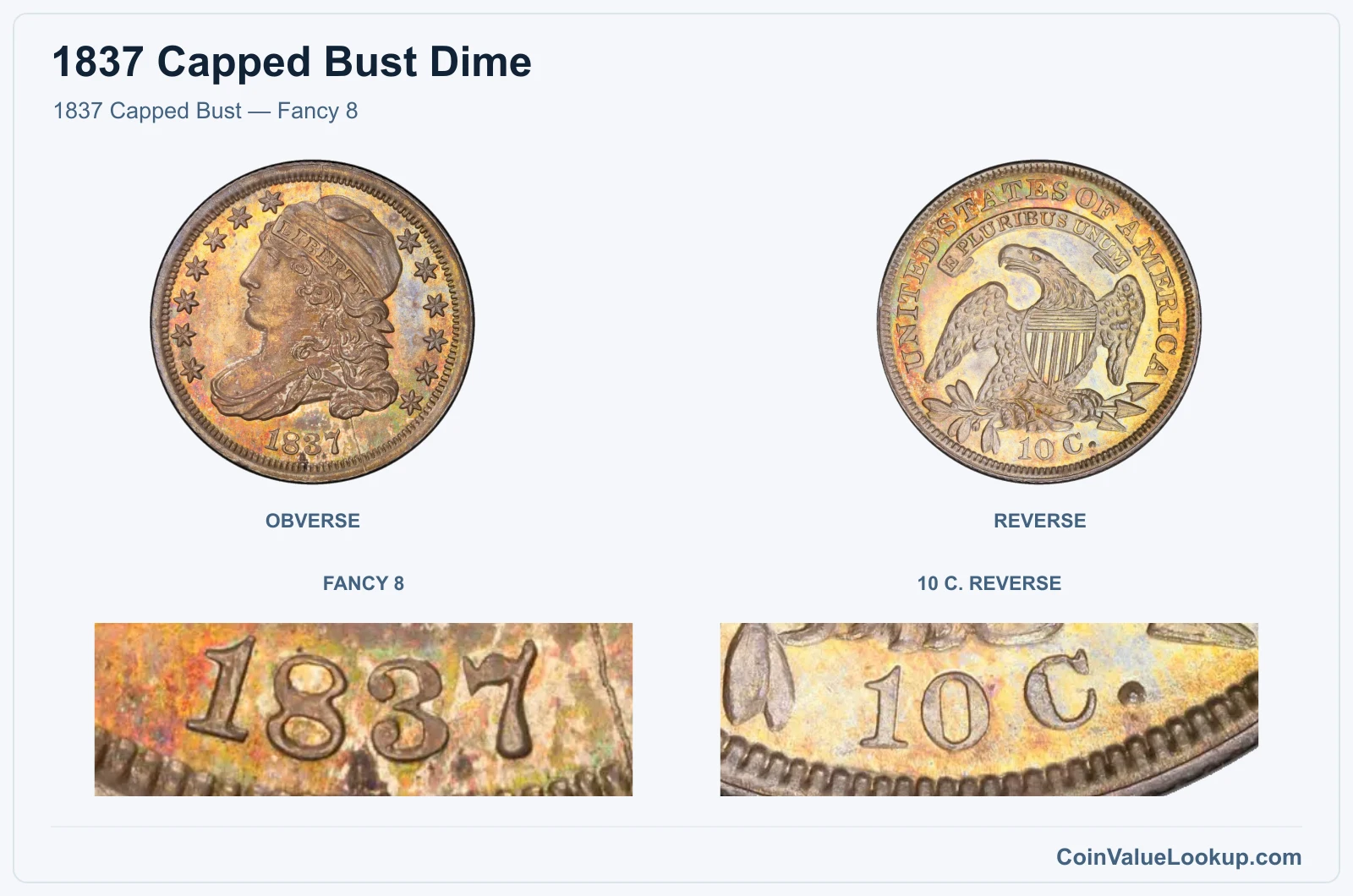
The Fancy 8 variety features a more ornate, curved digit 8 in the date. The loops are rounded and flowing, giving the numeral an almost calligraphic quality when viewed under magnification.
Set it next to a Block 8 image and the difference is obvious.
Like the Block 8, no separately quoted guide price is adopted for the Fancy 8 alone. The general 1837 Capped Bust Dime anchors of approximately $54.00 to $2,344.00 apply to the date as a whole, not to a specific punch style.
Your coin's individual value depends on its authenticated variety, grade, and the integrity of its surfaces. Scratches, cleaning, or corrosion all reduce comparability to guide figures.
Ordinary-issue reference: Ordinary-issue reference only: The table below shows the related standard issue (1837 Capped Bust). It does not represent the value of the specific 1837 Capped Bust — Fancy 8 variety or its variety premium. The year, mint, metal and strike type are matched; the specific variety is not priced by this table.
Range Grade
Price Auction Records Appraisal PO PO 1
—
Coin Identifier FR FR 2
—
Coin Identifier AG AG 3
—
Coin Identifier G G 4
—
Coin Identifier
G 6
Coin Identifier VG VG 8
—
Coin Identifier
VG 10
Coin Identifier F F 12
Coin Identifier
F 15
Coin Identifier VF VF 20
Coin Identifier
VF 25
Coin Identifier
VF 30
Coin Identifier
VF 35
Coin Identifier XF XF 40
Coin Identifier
XF 45
Coin Identifier AU AU 50
Coin Identifier
AU 53
Coin Identifier
AU 55
Coin Identifier
AU 58
Coin Identifier MS MS 60
—
Coin Identifier
MS 61
Coin Identifier
MS 62
Coin Identifier
MS 63
Coin Identifier
MS 64
Coin Identifier
MS 65
Coin Identifier
MS 66
Coin Identifier
MS 67
—
—
—
MS 68
—
—
—
MS 69
—
—
—
MS 70
—
—
—
1837 Capped Bust Dime Error List
1. 1837 Capped Bust Dime — Die Crack / Die Chip
Some 1837 Capped Bust Dimes exhibit die cracks or die chips, which are raised lines or small raised blobs on the coin's surface caused by fractures in the steel die during production. A die crack typically appears as a thin raised line running across part of the design or connecting to the rim.
A die chip is a small, isolated raised lump where a piece of the die broke away.
Not every 1837 dime has this feature. The reported variety involves a reverse die crack on a specific die pairing.
To check yours, examine the reverse under magnification for any raised, irregular lines.
Do not confuse die cracks with incuse scratches, corrosion tracks, or debris stuck to the surface. Scratches are cut into the metal, while die cracks sit above it.
No specific numerical premium is adopted here; value depends on the crack's visibility, location, and overall coin condition. Professional attribution helps confirm the feature.