1796 Draped Bust Dime Coin Value: How Much Is It Worth?
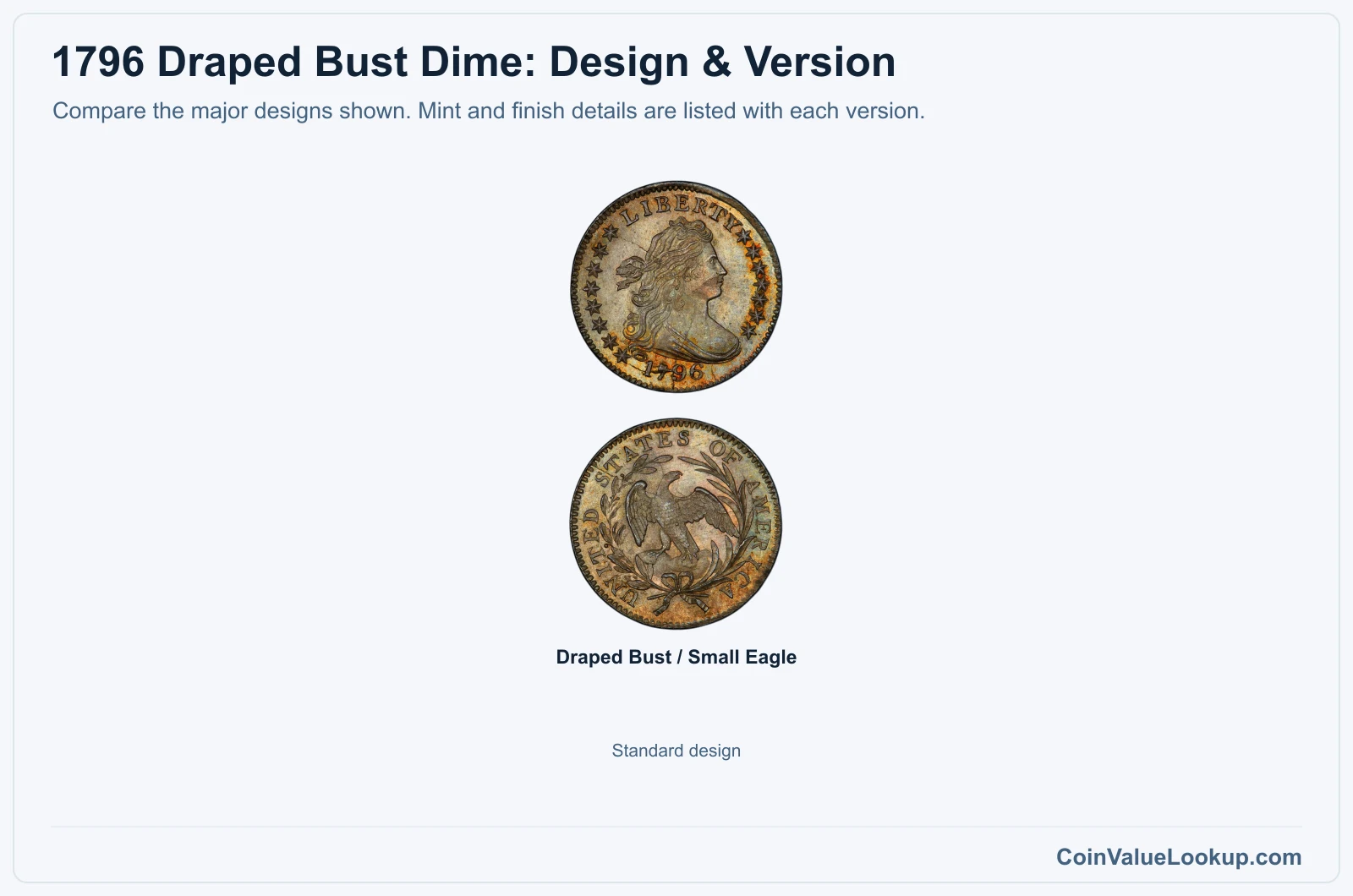
The 1796 Draped Bust Dime is one of the earliest silver dimes struck by the United States Mint. Only Philadelphia produced this coin, and surviving examples are scarce across all conditions.
USA Coin Book guide estimates range from roughly $3,431 in Good-4 condition to about $49,961 in MS63, though actual value depends on the specific coin's wear, original surfaces and any damage. Those figures are guide anchors for specific grades, not guaranteed offers for every piece.
Fast Way to Identify Your 1796 Draped Bust Dime
If you have a 1796 Draped Bust Dime — or think you do — upload clear photos of both sides. Our identifier can help with preliminary identification from your front and back images, confirming the design type and date.
This is a good first step before seeking professional grading, since the Draped Bust design appears on several denominations and sizes that are easy to confuse.
1796 Draped Bust Dime Value
Upload both sides of your 1796 Draped Bust Dime.
Front Obverse
Upload photo
Back Reverse
Upload photo
Which 1796 Draped Bust Dime Versions Are Worth Money?
- The 1796 Draped Bust Dime is the sole date branch in this series year; condition and original surfaces drive value rather than variety hunting.
- Guide estimates span from about $3,431 at Good-4 to roughly $49,961 at MS63, per USA Coin Book — higher-grade survivors are exceptionally scarce.
- Coins with intact original surfaces, no cleaning and minimal contact marks are far more desirable than bright or polished examples of the same technical grade.
- Die cracks or chips from the original striking dies may be present on some examples and are covered separately in the error section below.
Step 1: Identify Your 1796 Draped Bust Dime Mint Mark and Version
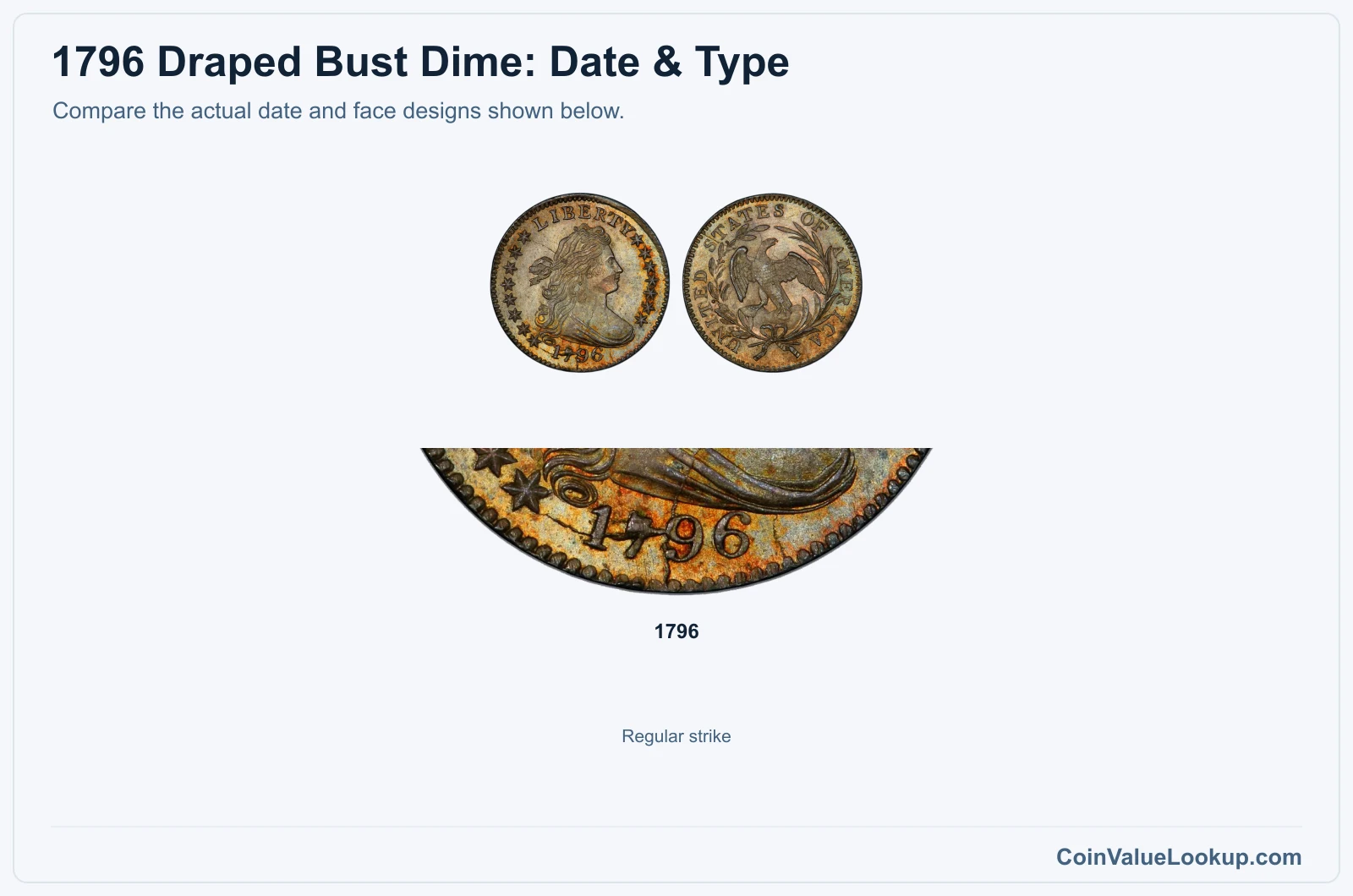
Philadelphia was the only mint operating in 1796, so there is no mintmark to look for. The coin is struck in a silver-copper alloy of approximately 89.24% silver.
The obverse shows the Draped Bust of Liberty facing right, and the reverse features a Small Eagle perched within a wreath. This same general design appears on half dimes and other denominations, so size matters.
A Draped Bust dime is roughly 19 mm; a half dime is noticeably smaller.
One quirk: no denomination is stamped on the coin. There is no "10C" or "ONE DIME" anywhere.
Confirm you have the right size before comparing values. If your coin looks similar but is smaller or larger, you may be holding a half dime or a dollar instead.
The only date branch for this denomination in 1796 is the standard issue. Match the Draped Bust obverse with the Small Eagle reverse, verify the date, and check the coin's surfaces before moving to valuation.
Step 2: Check Your 1796 Draped Bust Dime Grade
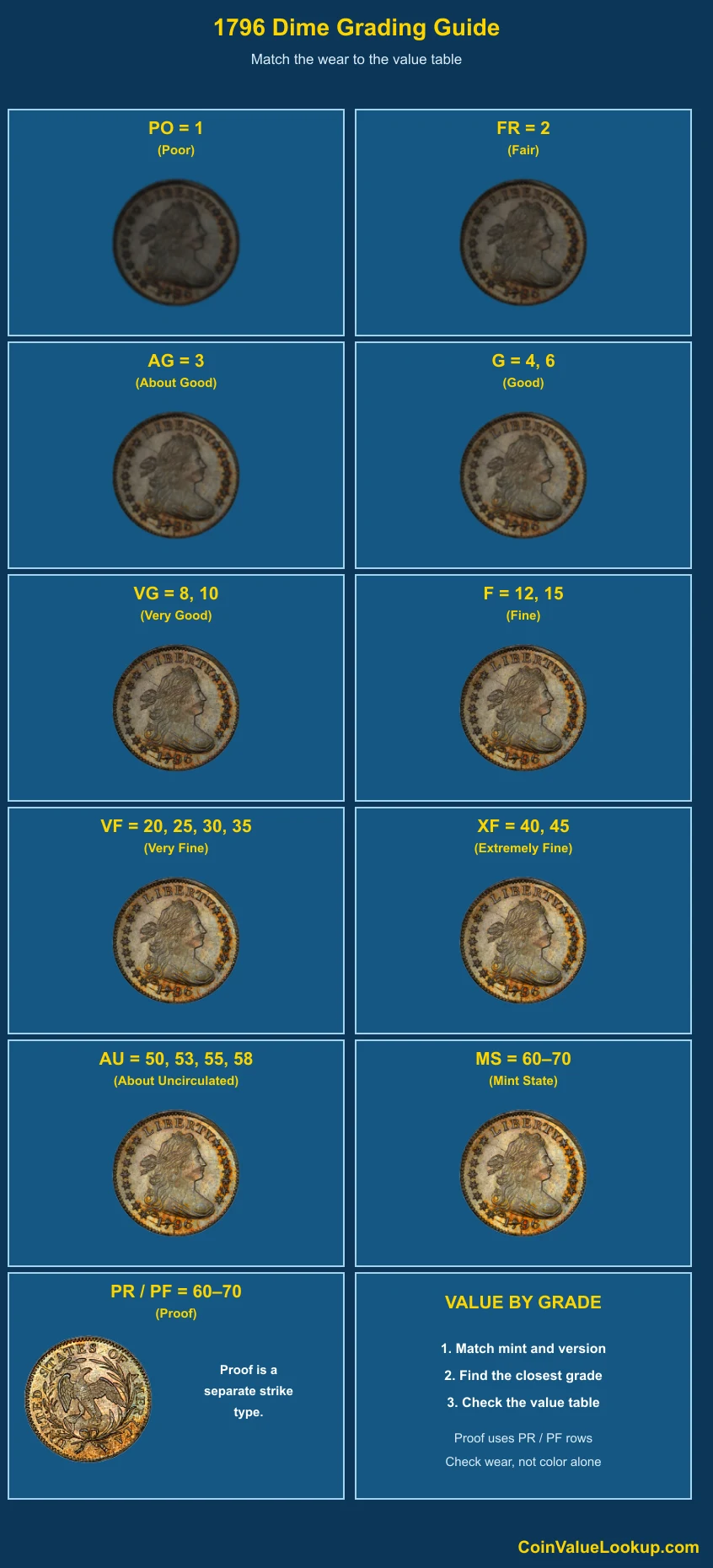
On the obverse, focus on Liberty's hair above the forehead, the cheek and the drapery near the shoulder. These are the highest points and the first to show wear.
On the reverse, check the eagle's breast feathers and wing tips.
These coins were struck on hand-operated presses, so even unworn examples can show uneven detail or weak spots from inconsistent striking pressure. That is not the same as wear.
Look for original mint luster in protected areas and assess contact marks from handling over two centuries.
The comparison image shows the progression from well-worn to mint-state examples of this type. Use it to match your coin's detail level, paying attention to whether softness is from circulation or from the strike itself.
Whatever you do, do not clean or polish the coin. Cleaning destroys original surfaces and drastically reduces a coin's desirability and value to collectors.
Step 3: Check 1796 Draped Bust Dime Value by Mint and Version
1796 Draped Bust Dime
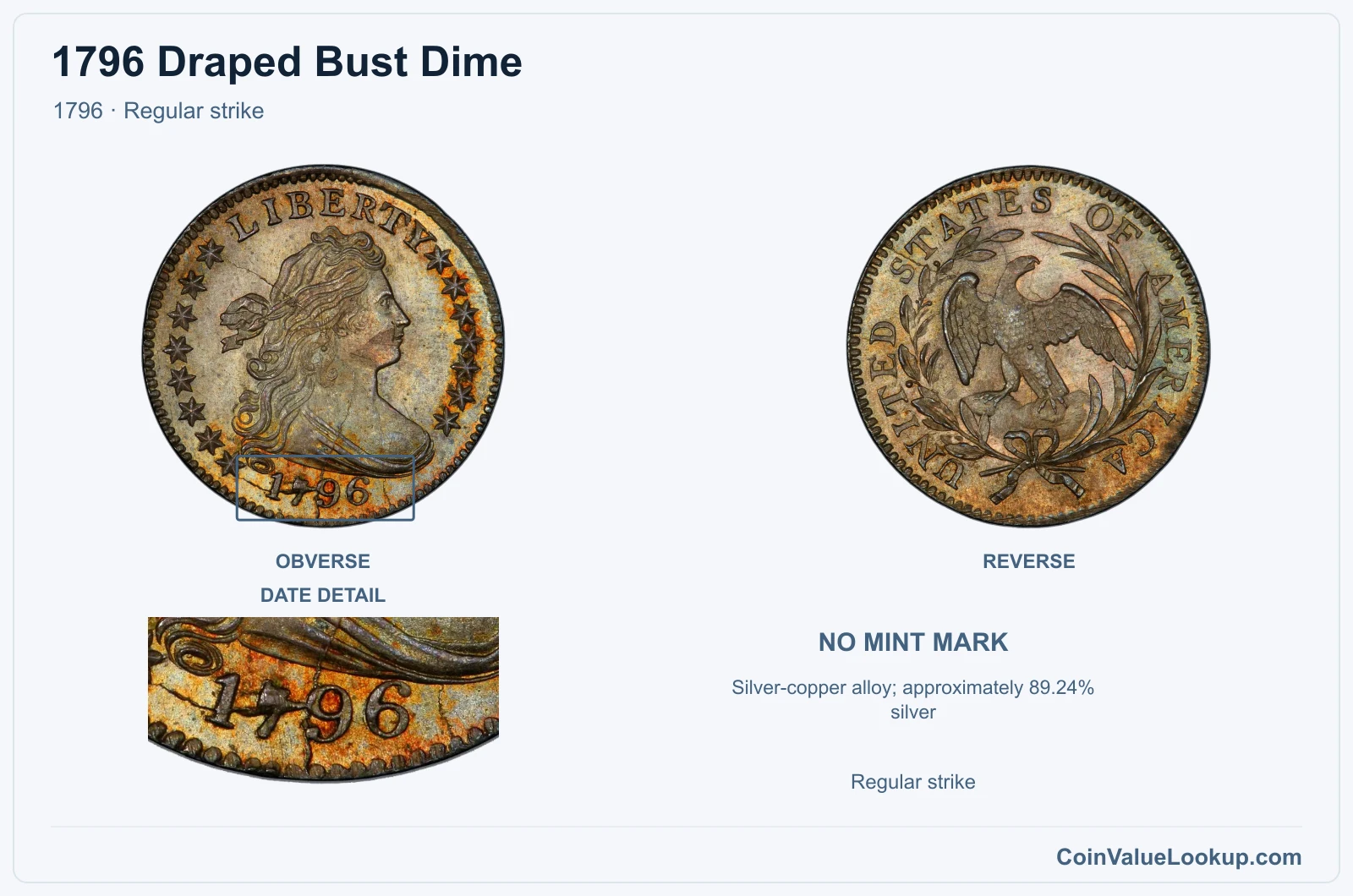
The 1796 Draped Bust Dime was struck at Philadelphia with no mintmark. It features the Draped Bust obverse paired with the Small Eagle reverse, in a silver-copper alloy of about 89.24% silver.
USA Coin Book guide estimates place a Good-4 example around $3,431 and an MS63 at roughly $49,961. These are grade-specific reference points, not blanket offers.
Original surfaces matter more than raw brightness on a coin this old. A naturally toned piece with honest wear will typically be valued higher than a cleaned example at the same apparent grade.
Confirm the date, design type and size before comparing your coin to any published guide figure.
Coin Value Lookup is a handy starting point if you want to look up guide values for other early U.S. coins alongside this one. It covers a wide range of denominations and years.
Range Grade
Price Auction Records Appraisal PO PO 1
Coin Identifier FR FR 2
Coin Identifier AG AG 3
Coin Identifier G G 4
Coin Identifier
G 6
Coin Identifier VG VG 8
Coin Identifier
VG 10
Coin Identifier F F 12
Coin Identifier
F 15
Coin Identifier VF VF 20
Coin Identifier
VF 25
Coin Identifier
VF 30
Coin Identifier
VF 35
Coin Identifier XF XF 40
Coin Identifier
XF 45
Coin Identifier AU AU 50
Coin Identifier
AU 53
Coin Identifier
AU 55
Coin Identifier
AU 58
Coin Identifier MS MS 60
—
Coin Identifier
MS 61
Coin Identifier
MS 62
Coin Identifier
MS 63
Coin Identifier
MS 64
Coin Identifier
MS 65
Coin Identifier
MS 66
Coin Identifier
MS 67
—
Coin Identifier
MS 68
—
Coin Identifier
MS 69
—
—
—
MS 70
—
—
—
1796 Draped Bust Dime Error List
1. 1796 Draped Bust Dime — Die Crack / Die Chip
Die cracks and die chips have been reported on 1796 Draped Bust Dimes. A die crack appears as a thin raised line on the coin's surface, caused by a fracture in the steel die used during striking.
A die chip looks like a small raised blob, typically where a tiny piece of the die broke away. Both are mint-made features baked into the coin during production.
To distinguish these from damage, remember: die cracks and chips are raised above the surface. Post-mint scratches are incuse, cutting into the metal.
Corrosion or foreign material sitting on the surface can also mimic a chip but will not have the same sharp, metallic appearance.
Not every 1796 dime carries this feature. No specific price range has been established here for die-crack examples, as value depends on the crack's size, location, visibility and the coin's overall condition.
A professional grading service can confirm whether a raised line is a genuine die crack.