1801 Draped Bust Dime Coin Value: How Much Is It Worth?
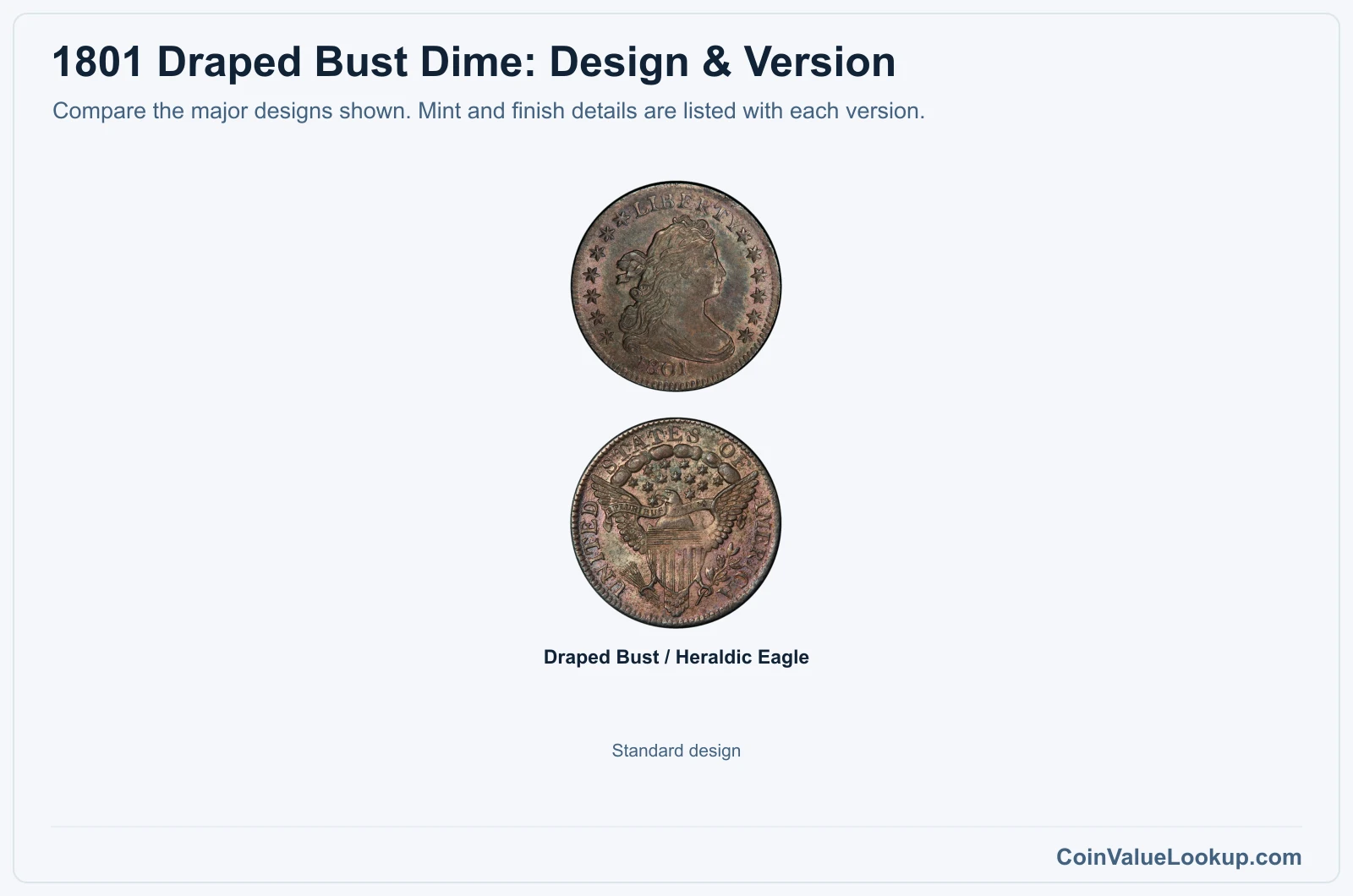
The 1801 Draped Bust Dime is one of the earliest American silver dimes, struck at Philadelphia when the nation's coinage infrastructure was still in its infancy. Guide estimates for this date range from roughly $1,394 in well-worn Good-4 condition to around $92,652 at the MS63 level, according to USA Coin Book.
Your coin's actual position in that span depends on its specific condition, surface originality and whether any die anomalies are present. These guide figures are reference anchors for particular grades, not guaranteed purchase offers.
Fast Way to Identify Your 1801 Draped Bust Dime
If you have an 1801 Draped Bust Dime and want a quick starting point, upload clear photos of both the front and back. That lets us provide a preliminary identification of your coin's design type, approximate condition and any visible features worth investigating further.
Good lighting and a steady shot go a long way.
1801 Draped Bust Dime Value
Upload both sides of your 1801 Draped Bust Dime.
Front Obverse
Upload photo
Back Reverse
Upload photo
Which 1801 Draped Bust Dime Versions Are Worth Money?
- The 1801 date is scarce in any grade; even well-worn examples carry substantial collector premiums due to the small original production for early Draped Bust dimes.
- Coins retaining original, uncleaned surfaces are far more comparable to published guide values than cleaned or damaged pieces, regardless of how much detail remains.
- Unusually well-preserved examples approaching Mint State grades are genuinely rare for this date and command dramatically higher prices when authenticated and graded by a major service.
Step 1: Identify Your 1801 Draped Bust Dime Mint Mark and Version
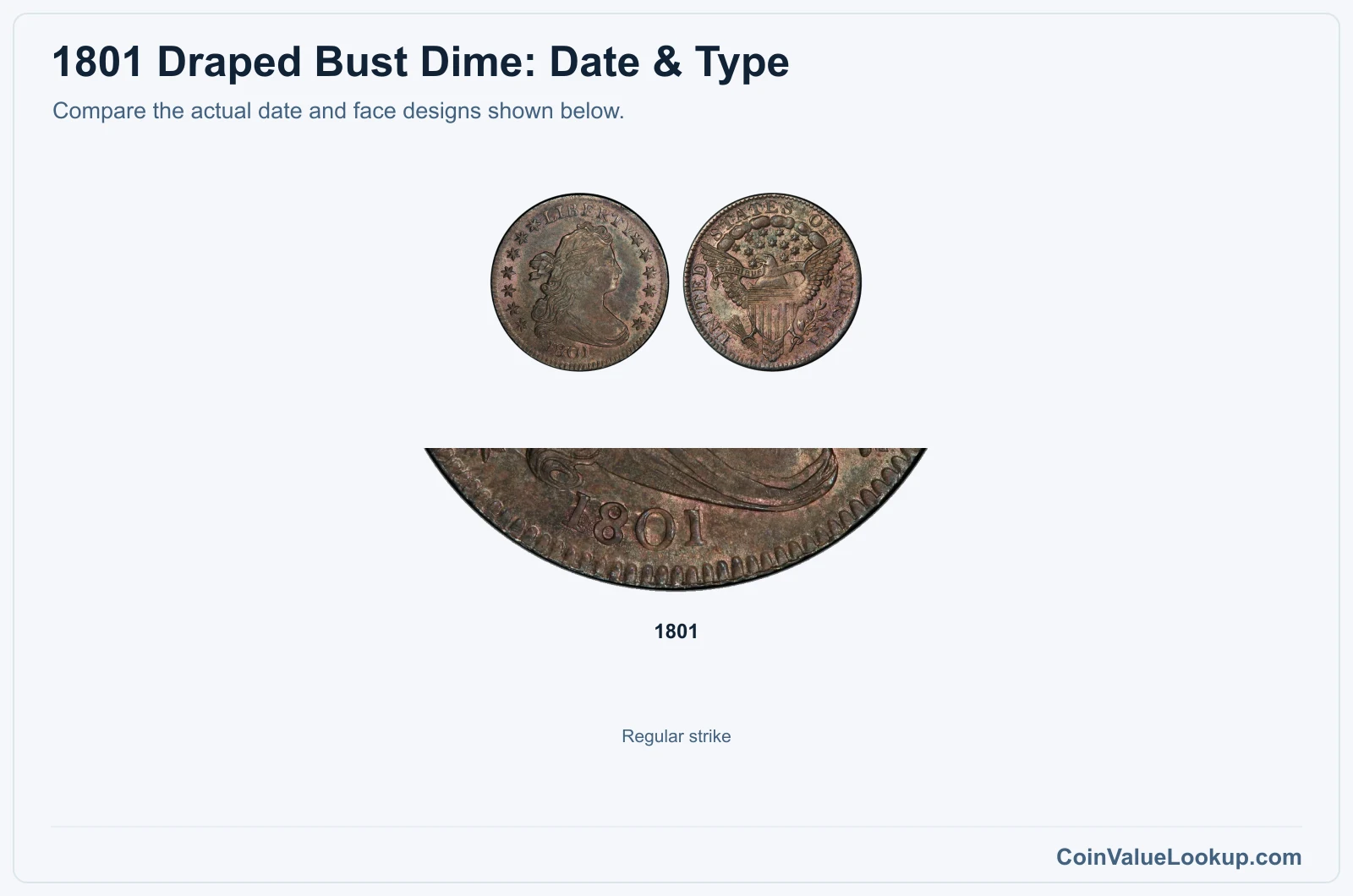
Every 1801 dime was struck at the Philadelphia Mint, so there is no mintmark to look for. The design pairs the Draped Bust portrait of Liberty on the obverse with the Heraldic Eagle on the reverse.
One thing that trips people up: Draped Bust dimes do not display a "10C" denomination anywhere on the coin. If you are not sure what you are holding, check the size.
A half dime from this era uses a very similar design but is noticeably smaller. A silver dollar also shares the Draped Bust motif but is far larger.
The composition is a silver-copper alloy, roughly 89.24% silver. Confirm you have the correct denomination and the 1801 date before comparing values, because even a one-year difference matters in early American coinage.
Step 2: Check Your 1801 Draped Bust Dime Grade
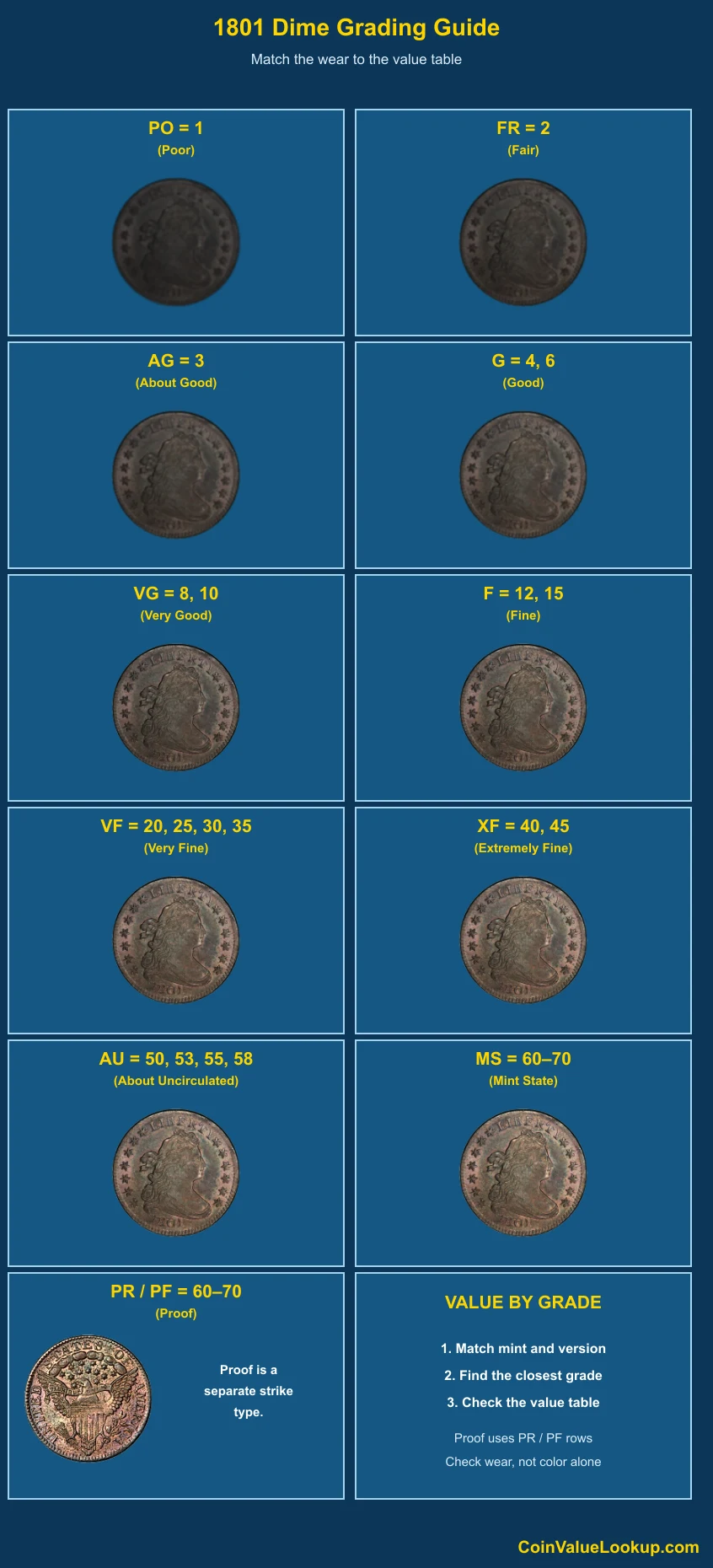
Start by examining the high points on Liberty's portrait: the hair above her forehead, the cheek and the drapery near her bust line. On the reverse, the eagle's breast feathers and wing tips show wear first.
Here is where early dimes get tricky. These coins were struck on hand-operated presses, so even a coin with no actual wear can show soft or uneven detail in spots.
That is manufacturing character, not damage. Use the comparison image to see how a worn coin differs from a weakly struck one.
Luster is your friend. A coin that has been circulated loses its original surface sheen in the high areas first.
If the entire surface is dull and flat but the details look sharp, the coin may have been cleaned, which significantly reduces its appeal and comparability to guide prices.
Do not attempt to brighten or polish the coin. Original toning, even if dark, is far more desirable to collectors than a harshly cleaned surface.
Step 3: Check 1801 Draped Bust Dime Value by Mint and Version
1801 Draped Bust Dime
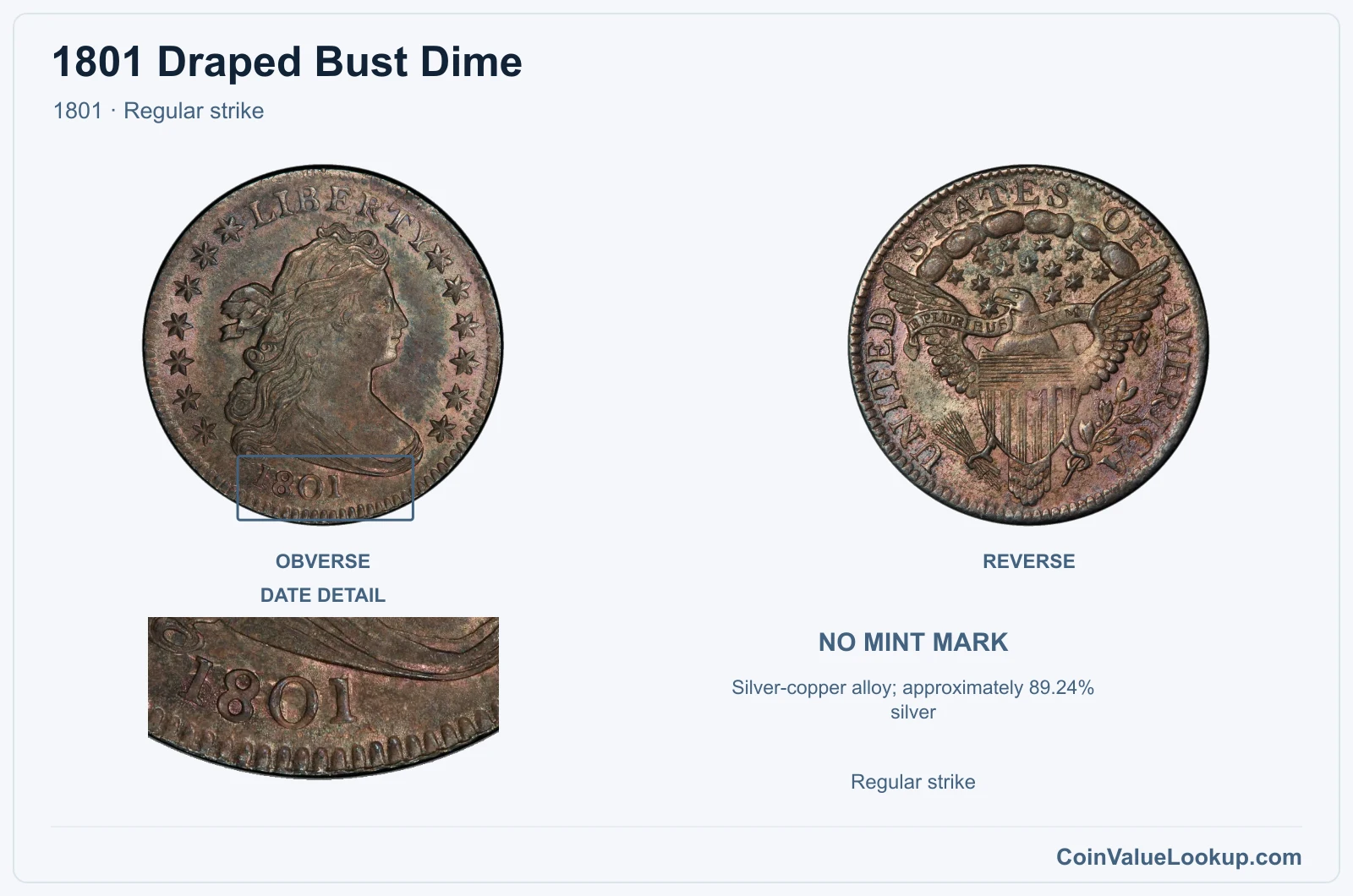
The 1801 Draped Bust Dime was produced only at Philadelphia with no mintmark. It features the Draped Bust obverse paired with the Heraldic Eagle reverse, struck in a silver-copper alloy of approximately 89.24% silver.
USA Coin Book lists guide estimates of about $1,394 at the Good-4 grade and approximately $92,652 at MS63. That is a wide gap, and most survivors fall closer to the lower end.
Original surfaces matter enormously here; a coin with honest wear and natural toning will track closer to published guides than one that has been cleaned or damaged, even if the cleaned coin shows more visible detail.
Coin Value Lookup is a handy starting point if you want to look up guides for other early American denominations alongside this one. Match the date, design type and your best grade assessment before drawing any value conclusions.
Range Grade
Price Auction Records Appraisal PO PO 1
Coin Identifier FR FR 2
Coin Identifier AG AG 3
Coin Identifier G G 4
—
Coin Identifier
G 6
Coin Identifier VG VG 8
Coin Identifier
VG 10
Coin Identifier F F 12
Coin Identifier
F 15
Coin Identifier VF VF 20
Coin Identifier
VF 25
Coin Identifier
VF 30
Coin Identifier
VF 35
—
Coin Identifier XF XF 40
Coin Identifier
XF 45
Coin Identifier AU AU 50
Coin Identifier
AU 53
—
Coin Identifier
AU 55
Coin Identifier
AU 58
Coin Identifier MS MS 60
—
Coin Identifier
MS 61
Coin Identifier
MS 62
Coin Identifier
MS 63
Coin Identifier
MS 64
—
Coin Identifier
MS 65
—
—
—
MS 66
—
—
—
MS 67
—
—
—
MS 68
—
—
—
MS 69
—
—
—
MS 70
—
—
—
1801 Draped Bust Dime Error List
1. 1801 Draped Bust Dime — Die Crack / Die Chip
Die cracks and die chips have been reported on 1801 Draped Bust Dimes. A die crack appears as a thin, raised line on the coin's surface, formed when the steel die developed a fracture during use.
A die chip shows up as a small raised blob where a piece of the die broke away, leaving a void that filled with metal during striking.
To tell these apart from damage, remember that die cracks and chips are raised above the field, while scratches and corrosion are typically incuse or pitted. Foreign material stuck to the surface can also mimic a chip, so look carefully under magnification.
A crack that extends to the rim is sometimes called a cud, which is a different category from an interior crack.
Not every 1801 dime carries these features. No specific price data was adopted for die-cracked examples, because value depends on the crack's size, location, visual prominence and the coin's overall condition.
A professional evaluation is worthwhile if the feature is dramatic.