1807 Draped Bust Dime Coin Value: How Much Is It Worth?
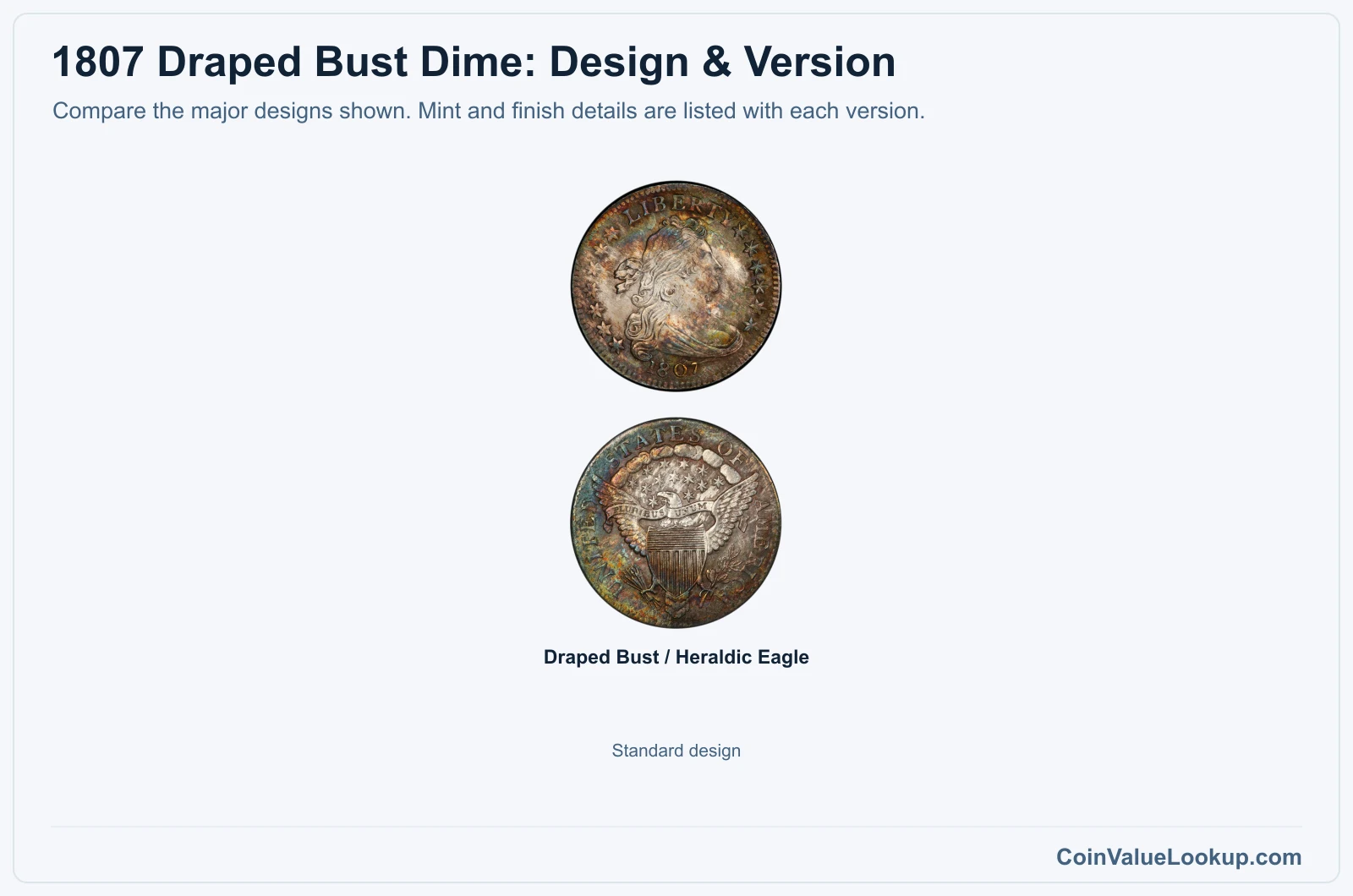
The 1807 Draped Bust Dime is one of the final issues in the early Draped Bust series, struck at Philadelphia in a silver-copper alloy of approximately 89.24% silver. Guide estimates from USA Coin Book range from $696.00 in G4 to $12,208.00 in MS63.
Your coin's actual value depends on its design match, wear, and whether it retains original surfaces — those figures are grade-specific anchors, not guaranteed offers.
Fast Way to Identify Your 1807 Draped Bust Dime
The quickest way to start is to upload clear photos of both the front and back of your coin. This gives you a preliminary identification based on the design, date and overall condition.
Snap them in natural light, avoid flash glare, and make sure the full rim is visible on each side.
1807 Draped Bust Dime Value
Upload both sides of your 1807 Draped Bust Dime.
Front Obverse
Upload photo
Back Reverse
Upload photo
Which 1807 Draped Bust Dime Versions Are Worth Money?
- The 1807 issue is the only date in this version matrix — confirm the date, Draped Bust / Heraldic Eagle design, and actual wear grade before applying any guide estimate.
- Coins with original, untouched surfaces command stronger prices than cleaned or damaged examples at the same apparent grade.
- Well-preserved examples approaching MS63 represent the high end of the guide range at $12,208.00, but even a G4 example carries a $696.00 anchor — early silver dimes hold value across the condition spectrum.
- Mint-made anomalies such as off-center strikes or clipped planchets can affect value independently; see the error section for what to look for.
Step 1: Identify Your 1807 Draped Bust Dime Mint Mark and Version
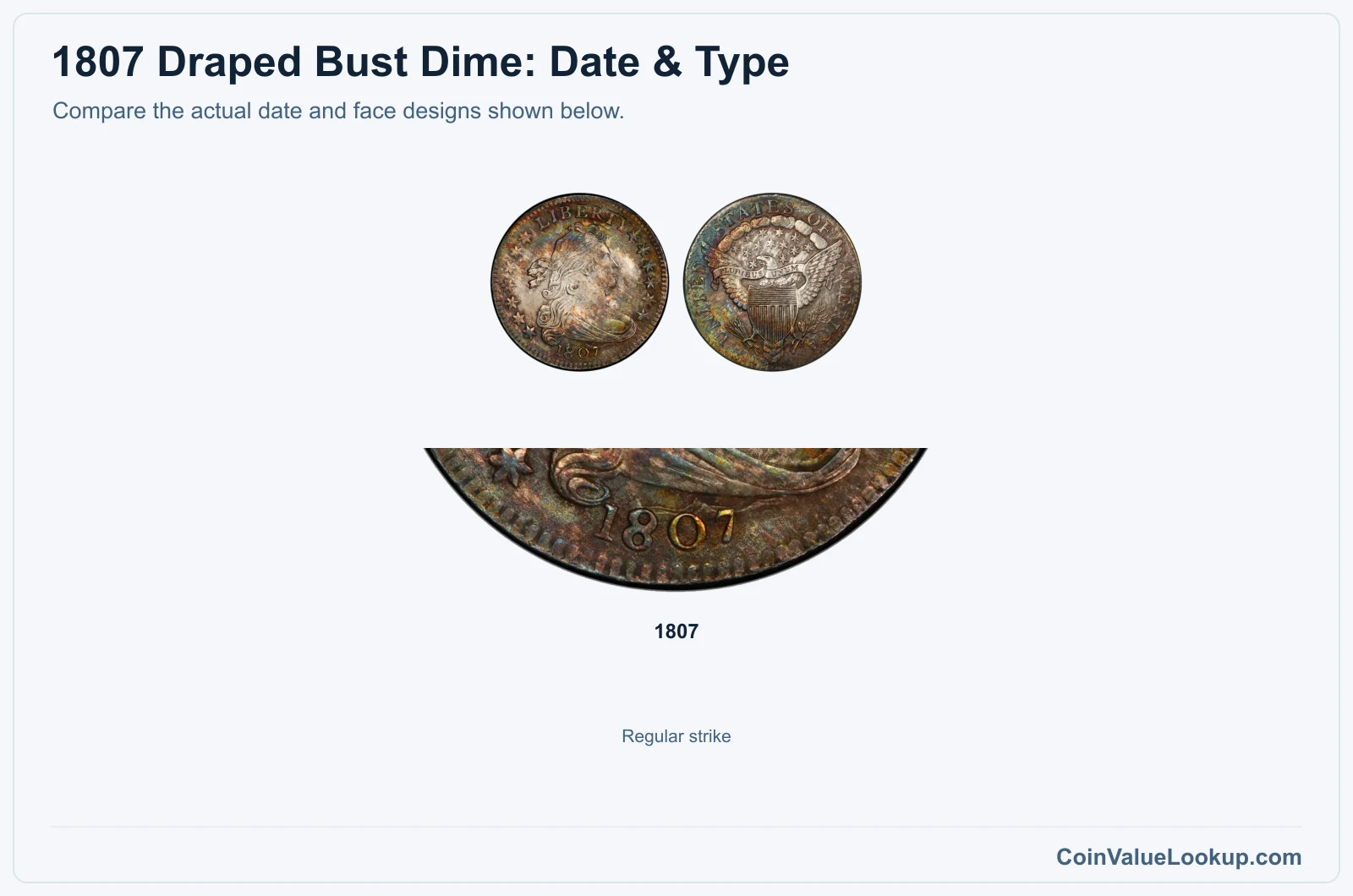
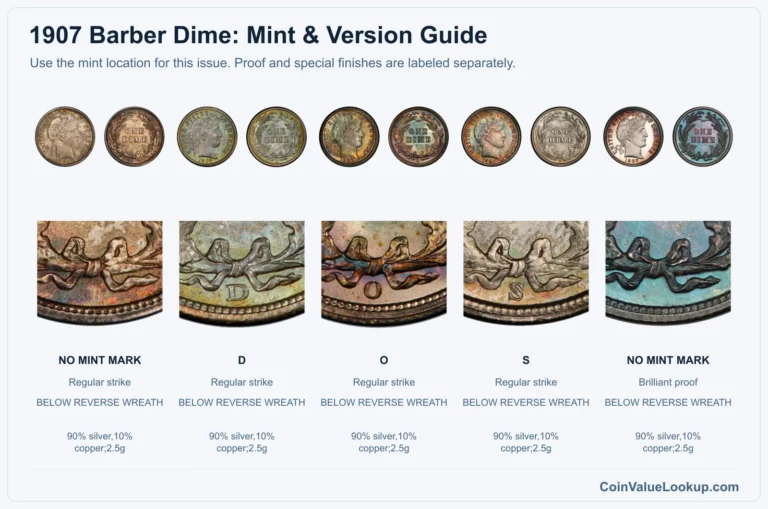
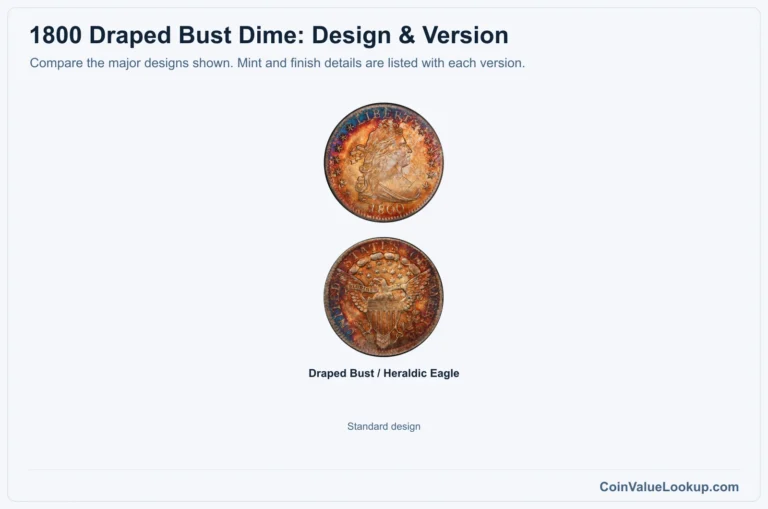
Every 1807 dime was struck at Philadelphia, so there is no mintmark to hunt for. The design pairs a Draped Bust of Liberty on the obverse with a Heraldic Eagle on the reverse.
One important detail: Draped Bust dimes do not display a "10C" denomination anywhere on the coin. If you see a similar bust design but the coin is noticeably smaller or larger, you may be looking at a half dime or a dollar instead.
Confirm both the design type and the physical size before comparing values.
The metal should have the heft and tone of old silver. The alloy is roughly 89.24% silver.
A coin that looks copper or feels unusually light deserves closer scrutiny.
Step 2: Check Your 1807 Draped Bust Dime Grade
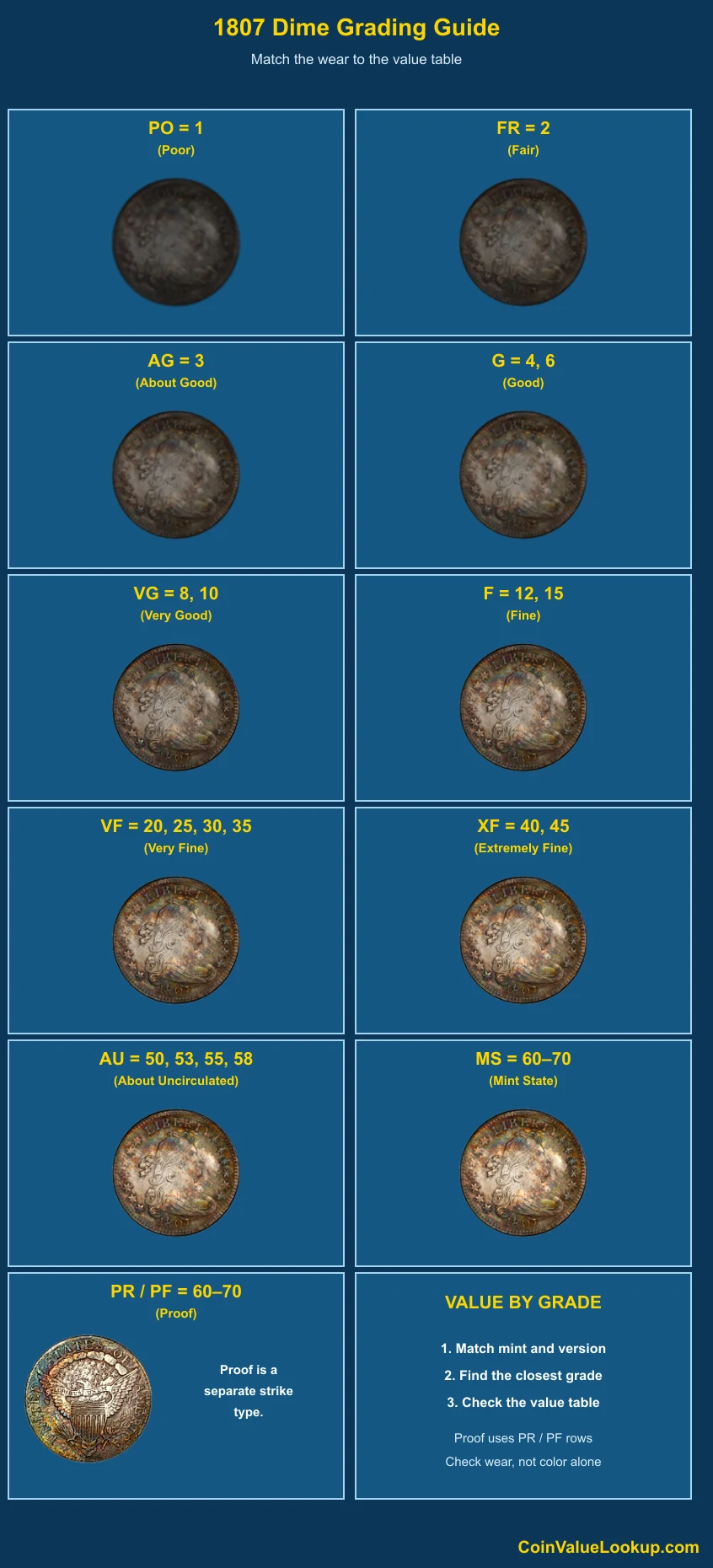
Start with Liberty's hair above the forehead and behind the ear — these fine strands wear first. On a well-circulated coin the hair merges into a flat mass, and the cheek loses its rounded contour.
Check the drapery below Liberty's bust for remaining fabric folds.
Flip to the reverse. The eagle's breast feathers and wing tips are the next wear checkpoints.
Compare your coin against the reference image to gauge where it falls.
Here is the catch with early coinage: hand-operated screw presses produced uneven strikes. A genuinely uncirculated 1807 dime can still show soft detail in localized areas.
Look at overall luster and contact marks alongside the high-point sharpness before concluding the grade.
Do not clean or polish the coin. Original toning and undisturbed surfaces add value, while a scrubbed coin loses collector appeal fast.
Step 3: Check 1807 Draped Bust Dime Value by Mint and Version
1807 Draped Bust Dime
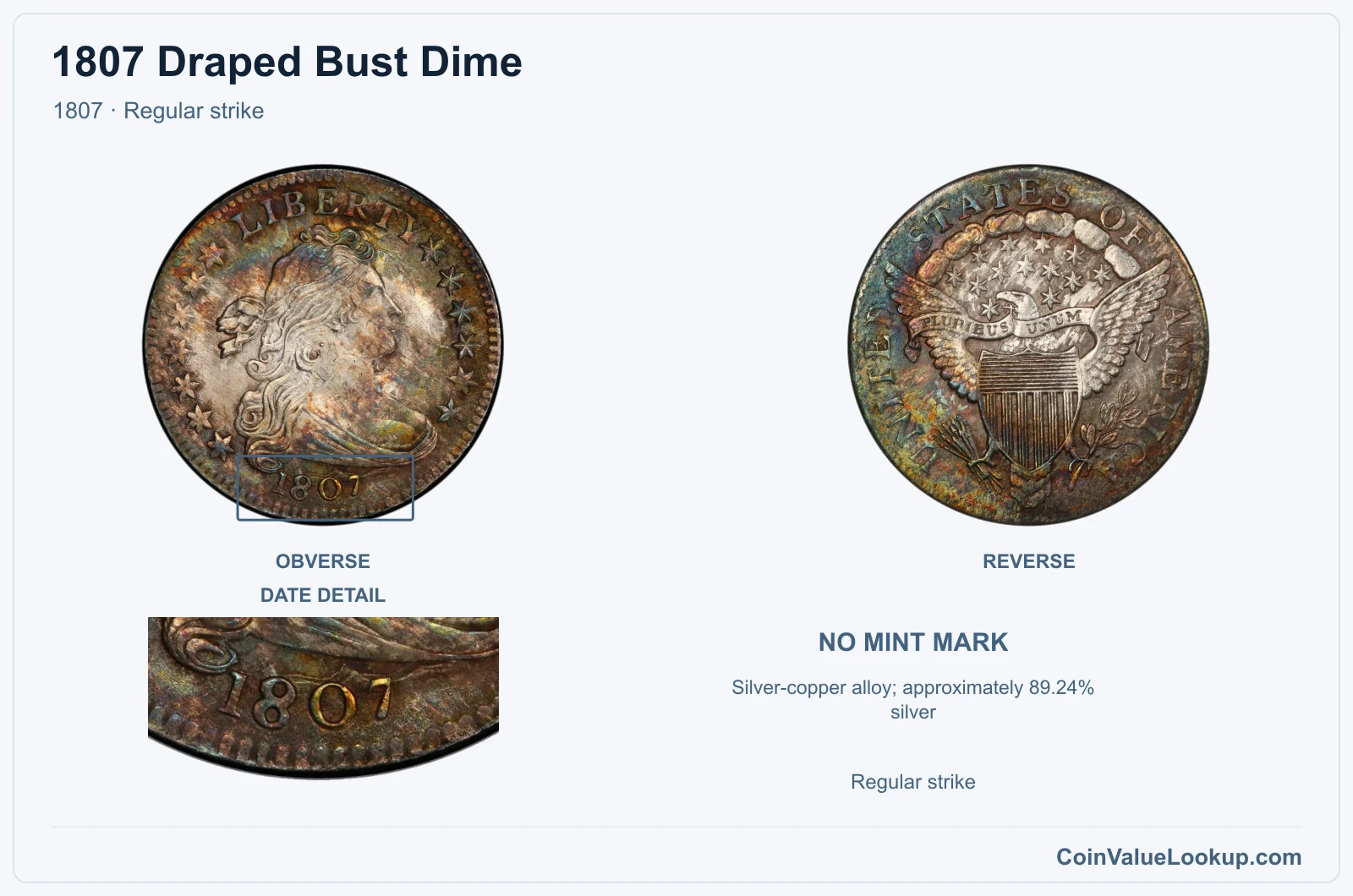
The 1807 Draped Bust Dime was struck only at Philadelphia in a silver-copper alloy. No mintmark appears on the coin.
USA Coin Book guide estimates place a G4 example at $696.00 and an MS63 at $12,208.00 — these are reference anchors, not buy-it-now prices.
Before comparing your coin to any guide figure, verify the date is clearly 1807 and the design matches Draped Bust obverse with Heraldic Eagle reverse. Original surfaces matter more than brightness.
A coin that has been cleaned, scratched or corroded will not compare well to guide estimates even if the remaining detail looks sharp.
Coin Value Lookup is a good starting point if you want to look up guides for other early dimes or different denominations in your collection.
Range Grade
Price Auction Records Appraisal PO PO 1
Coin Identifier FR FR 2
Coin Identifier AG AG 3
Coin Identifier G G 4
Coin Identifier
G 6
Coin Identifier VG VG 8
Coin Identifier
VG 10
Coin Identifier F F 12
Coin Identifier
F 15
Coin Identifier VF VF 20
Coin Identifier
VF 25
Coin Identifier
VF 30
Coin Identifier
VF 35
Coin Identifier XF XF 40
Coin Identifier
XF 45
Coin Identifier AU AU 50
Coin Identifier
AU 53
Coin Identifier
AU 55
Coin Identifier
AU 58
Coin Identifier MS MS 60
Coin Identifier
MS 61
Coin Identifier
MS 62
Coin Identifier
MS 63
Coin Identifier
MS 64
Coin Identifier
MS 65
Coin Identifier
MS 66
Coin Identifier
MS 67
—
—
—
MS 68
—
—
—
MS 69
—
—
—
MS 70
—
—
—
1807 Draped Bust Dime Error List
1. 1807 Draped Bust Dime — Off-Center Strike
An off-center strike happens when the planchet is not seated properly between the dies. The result is a displaced design with an unstruck crescent of blank metal along one side.
On an 1807 Draped Bust Dime, this is a reported error category.
The key diagnostic is that crescent of flat, featureless metal opposite the shifted design. A date that remains fully visible on an off-center coin adds to its appeal.
Look at both sides — the misalignment should be consistent front and back.
Don't confuse this with a clipped planchet, a one-sided die misalignment, or post-mint damage from being pressed or flattened after leaving the Mint. No specific price range is adopted for this error; the value depends on the degree of off-center shift, the coin's condition, and whether the date is legible.
2. 1807 Draped Bust Dime — Lamination / Split Planchet
A lamination error shows up as peeling, flaking or separating metal within the planchet itself. On an 1807 dime, this would appear as a retained flap of metal lifting away from the surface, or a visible split along the edge.
Photograph the affected area and the edge together — that combination helps distinguish a genuine lamination from surface corrosion, deliberate scraping, or a coin that was intentionally cut. Corrosion tends to pit and roughen the surface unevenly, while a lamination follows the metal's internal structure.
No numerical price range is adopted for lamination errors on this date. The value depends on the size and visibility of the defect, the coin's overall condition, and whether the error is clearly mint-made rather than environmental damage.
3. 1807 Draped Bust Dime — Broadstrike
A broadstrike occurs when the coin is struck without the retaining collar that normally confines the planchet. The result is a wider-than-normal coin with an expanded diameter and no proper reeded edge.
On an 1807 Draped Bust Dime, the entire design should still be present but spread outward.
Check the edge carefully. A genuine broadstrike will lack the normal reeding and the rim will be weak or absent.
Compare it to a regular example — the diameter difference should be obvious.
A coin that was flattened after minting or an off-center strike that lost part of the design are common lookalikes. Post-mint flattening usually shows tool marks and distorted lettering.
No specific price is adopted for this error; condition, diameter expansion, and overall eye appeal all influence what it brings.
4. 1807 Draped Bust Dime — Clipped Planchet
A clipped planchet error means a portion of the blank was missing before the coin was struck. Clips can be curved, straight, or ragged, depending on how the blank-cutting machinery overlapped or malfunctioned.
On an 1807 dime, look for a missing section along the edge where the metal simply was not there when the dies hit.
A helpful secondary diagnostic: metal flow weakness on the opposite side of the coin from the clip. The strike could not push metal evenly into that area, so you may see softness directly across from the missing portion.
Don't mistake a filed notch, an edge cut, or corrosion loss for a genuine clip. Filed areas show directional scratches; corrosion shows pitting.
No numerical price is adopted for clipped planchet errors on this date. Size and type of clip, plus the coin's overall condition, drive the value.
5. 1807 Draped Bust Dime — Wrong Planchet / Off-Metal Strike
A wrong planchet error means the 1807 dime dies struck a blank intended for a different denomination entirely. This is reported as extremely rare for this issue.
The coin would show the full Draped Bust / Heraldic Eagle design but on a planchet that does not match the normal weight, diameter, or edge characteristics of a standard dime.
To evaluate this, weigh and measure the coin carefully. Compare against known specifications for the 1807 dime.
If the diameter is off or the weight is wrong, that is the starting clue.
Lookalikes include coins that have been plated, acid-treated, corroded, or deliberately altered to appear unusual. Genuine wrong-planchet errors will show consistent design details impressed into incorrect metal.
No numerical price is adopted for this error. Professional authentication is strongly recommended if you suspect you have one.