1837 Liberty Seated Dime Coin Value: How Much Is It Worth?
The 1837 Liberty Seated Dime holds a special place as the very first year of the Seated Liberty dime series. Struck only at Philadelphia with no stars on the obverse, these coins come in Small Date and Large Date varieties.
Retail guide estimates range from about $60 at G4 to $2,501 at MS63 for business strikes, while rare Proofs command significantly higher prices.
Fast Way to Identify Your 1837 Liberty Seated Dime
Snap clear photos of both the front and back of your coin and upload them to our identifier for a preliminary look at what you have. This is not a certification or authentication service, but it can help you figure out the basic version and point you in the right direction.
Good lighting and a steady hand make all the difference.
1837 Liberty Seated Dime Value
Upload both sides of your 1837 Liberty Seated Dime.
Front Obverse
Upload photo
Back Reverse
Upload photo
Which 1837 Liberty Seated Dime Versions Are Worth Money?
- The 1837 Small Date variety lists around $65 at G4 and $2,501 at MS63 in guide estimates, making it the pricier business strike branch at the top end.
- The 1837 Large Date variety guides at roughly $60 at G4 and $2,175 at MS63, still a strong coin as the inaugural Seated dime year.
- Proofs from 1837 are genuinely rare early issues, with a guide estimate near $17,000 at PR63, and are not ordinary collector products.
- Die Crack and Clashed Dies errors are documented for this date and can add collector interest depending on visibility and condition.
Step 1: Identify Your 1837 Liberty Seated Dime Mint Mark and Version
First things first: make sure you are looking at a dime, not a half dime. The reverse should read ONE DIME inside a small wreath.
The obverse shows a seated Liberty figure with no surrounding stars, a design unique to this transitional year.
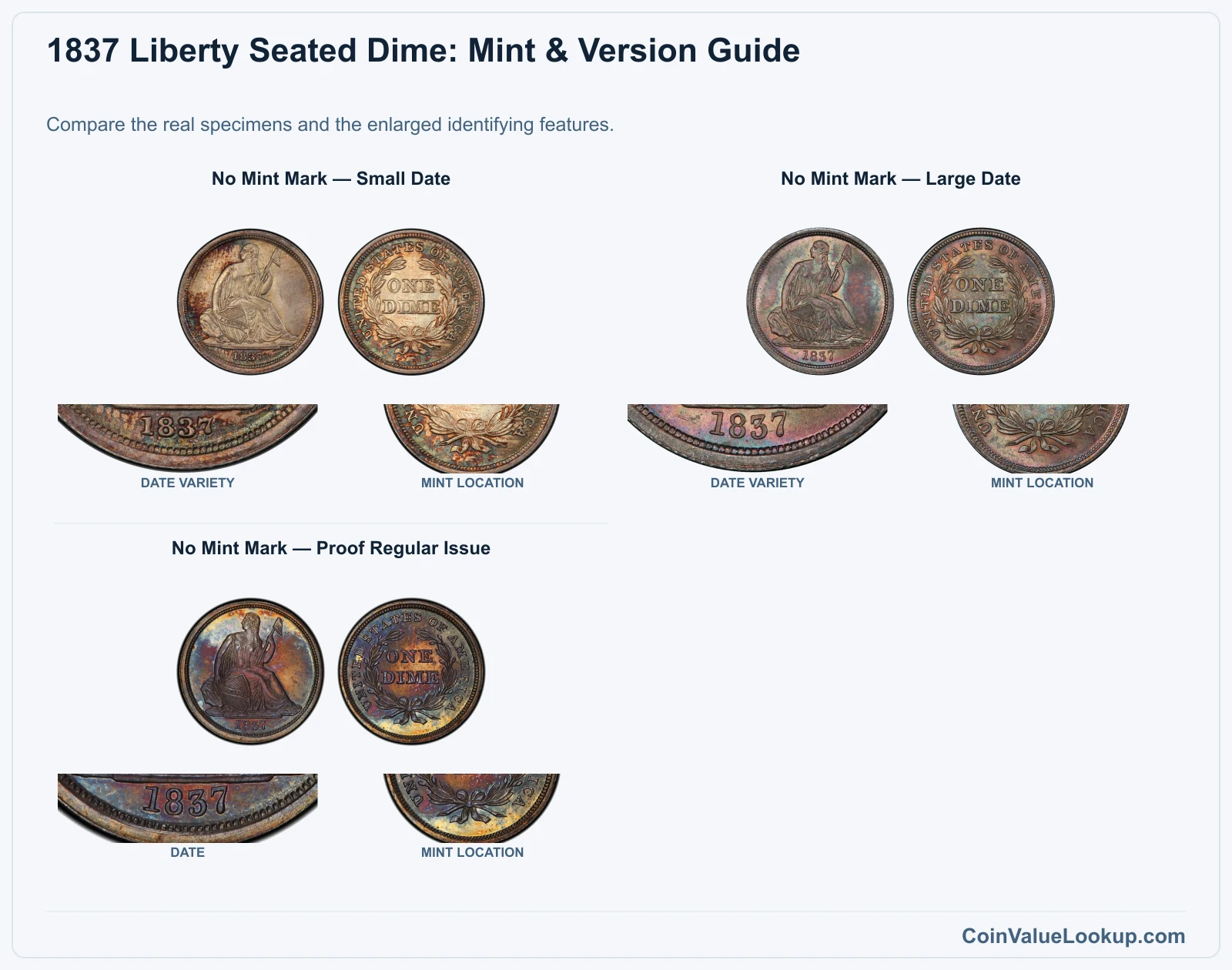
There is no mintmark on an 1837 Seated dime because Philadelphia was the only mint striking them. Look below the wreath on the reverse to confirm there is no letter present.
The coin is 90% silver and 10% copper, weighs nominally 2.67 grams, and has a reeded edge with a diameter of 17.9 mm. If the coin is noticeably lighter or the edge is smooth, something is off.
Now the important part: distinguish the Small Date from the Large Date. On the Large Date variety, the digits in 37 are taller with flatter tops.
The Small Date digits are shorter and thicker. This is a real value difference, not just a collector curiosity.
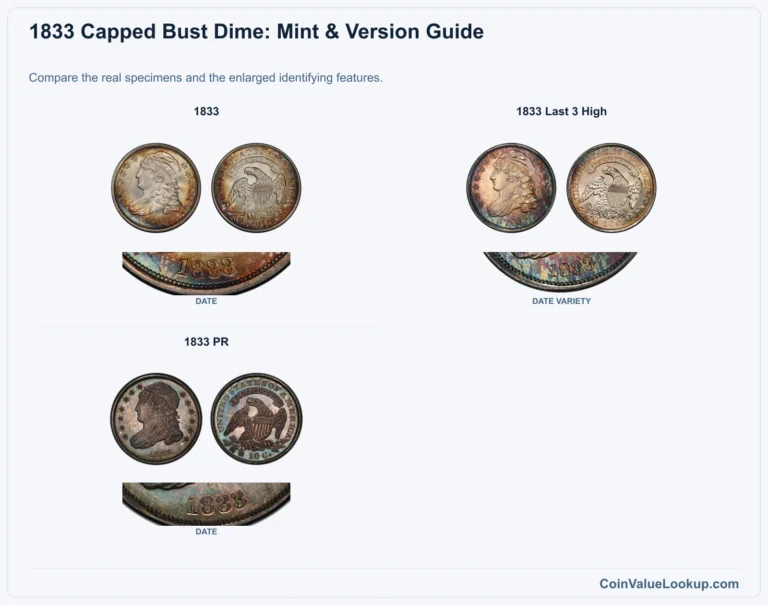
Also, 1837 Capped Bust dimes exist as a completely separate design and should not be confused with the Seated type.
Step 2: Check Your 1837 Liberty Seated Dime Grade
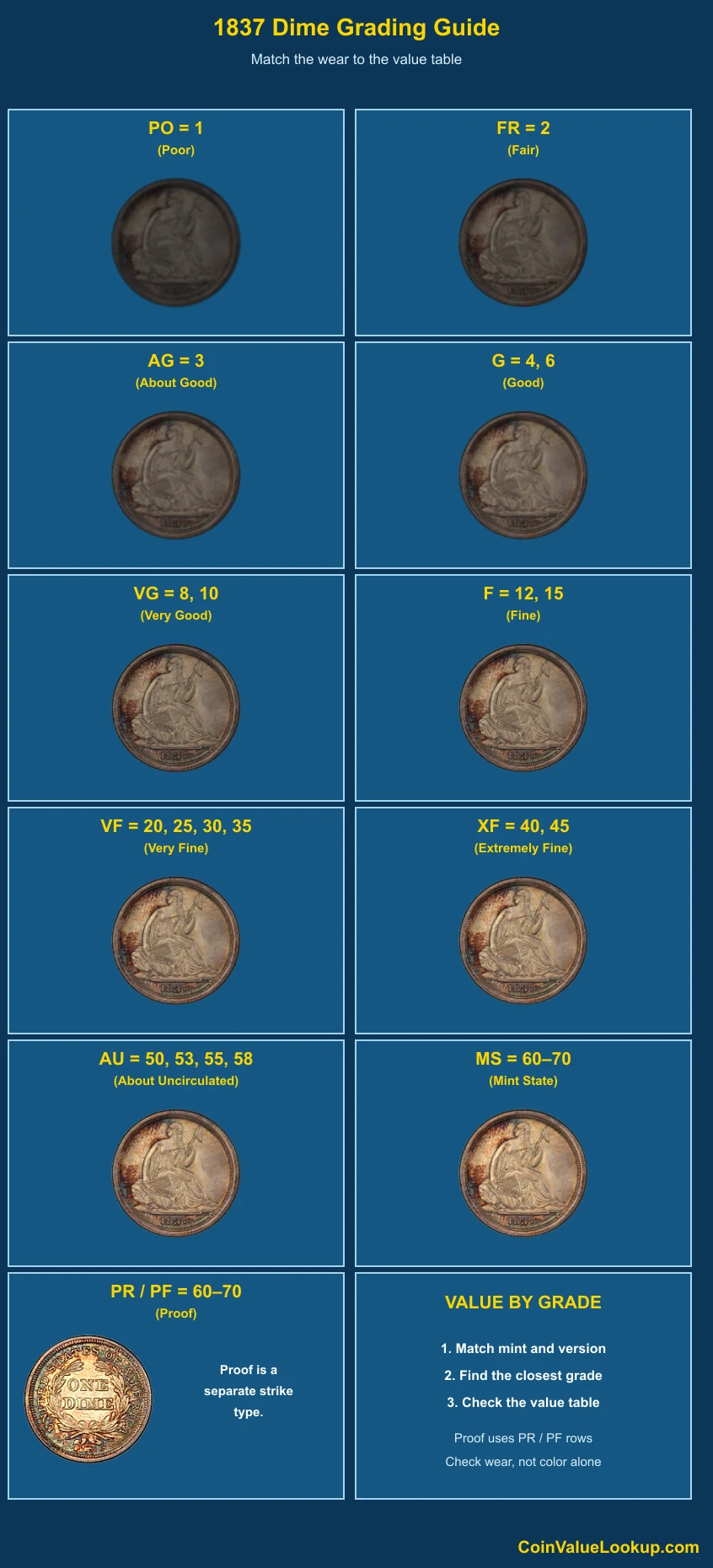
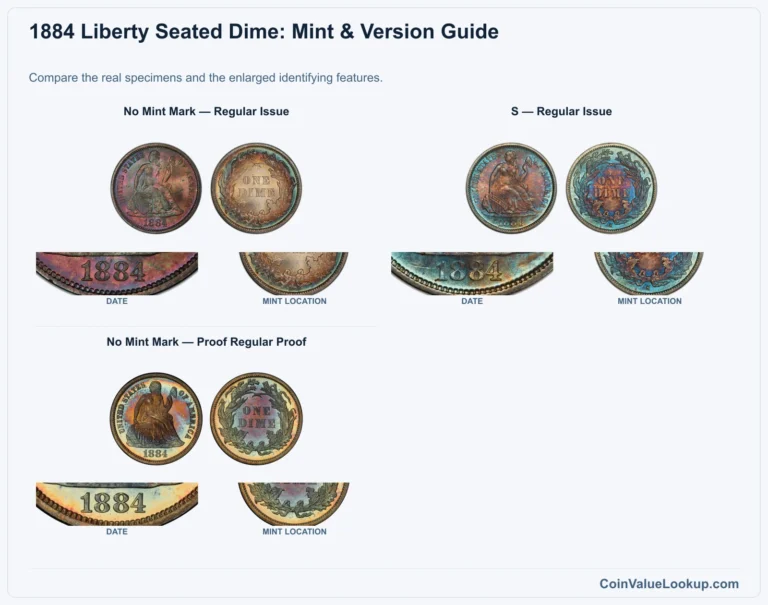
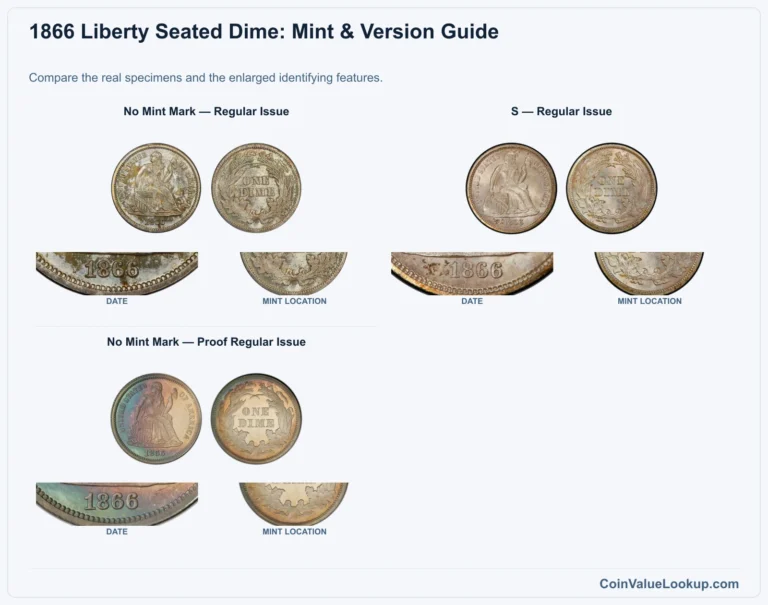
When judging condition, focus on the key areas: Liberty's head, gown folds, the shield on her arm, and her feet on the obverse, plus the wreath detail on the reverse. Compare your coin against the correct subtype in the grading image provided.
Strike weakness on early Seated dimes is common and can mimic wear. A weakly struck coin might look more worn than it actually is, so check for remaining luster in the protected areas before downgrading.
Original luster matters. A coin that has been cleaned or polished will have an unnatural shine and may show hairlines under magnification.
That is not the same as a high-grade original surface.
Proof coins are a separate category from Mint State. A polished circulation strike is not a Proof, no matter how shiny someone made it.
Proofs show mirrored fields as made, and hairlines from handling need their own assessment.
Step 3: Check 1837 Liberty Seated Dime Value by Mint and Version
1837 Liberty Seated Dime — No Mint Mark — Small Date
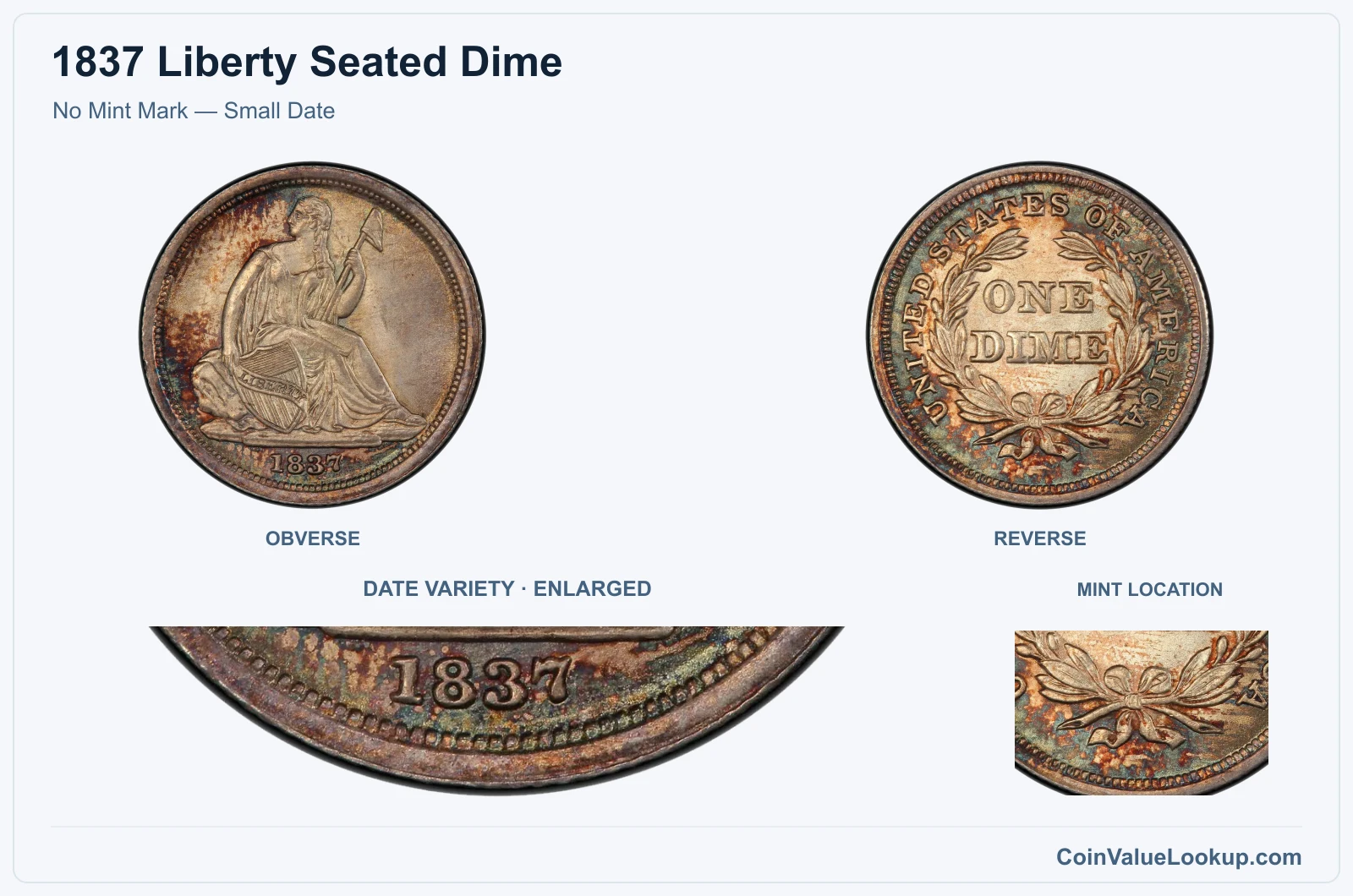
The 1837 Small Date dime was struck at Philadelphia with no mintmark. It is part of the No Stars subtype, meaning Liberty sits alone on the obverse without the ring of stars added in later years.
The reverse features ONE DIME inside a small wreath.
To identify the Small Date, look at the 37 in the date. The digits are shorter and noticeably thicker compared to the Large Date.
It is a subtle but consistent difference once you see both side by side.
Guide estimates from USA Coin Book place this version at about $65 in G4 and around $2,501 in MS63. The coin is 90% silver and 10% copper with a nominal weight of 2.67 grams.
Range Grade
Price Auction Records Appraisal PO PO 1
—
Coin Identifier FR FR 2
—
Coin Identifier AG AG 3
—
Coin Identifier G G 4
—
Coin Identifier
G 6
—
Coin Identifier VG VG 8
—
Coin Identifier
VG 10
Coin Identifier F F 12
Coin Identifier
F 15
Coin Identifier VF VF 20
Coin Identifier
VF 25
Coin Identifier
VF 30
Coin Identifier
VF 35
Coin Identifier XF XF 40
Coin Identifier
XF 45
Coin Identifier AU AU 50
Coin Identifier
AU 53
Coin Identifier
AU 55
Coin Identifier
AU 58
Coin Identifier MS MS 60
Coin Identifier
MS 61
Coin Identifier
MS 62
Coin Identifier
MS 63
Coin Identifier
MS 64
Coin Identifier
MS 65
Coin Identifier
MS 66
Coin Identifier
MS 67
—
—
—
MS 68
—
—
—
MS 69
—
—
—
MS 70
—
—
—
1837 Liberty Seated Dime — No Mint Mark — Large Date
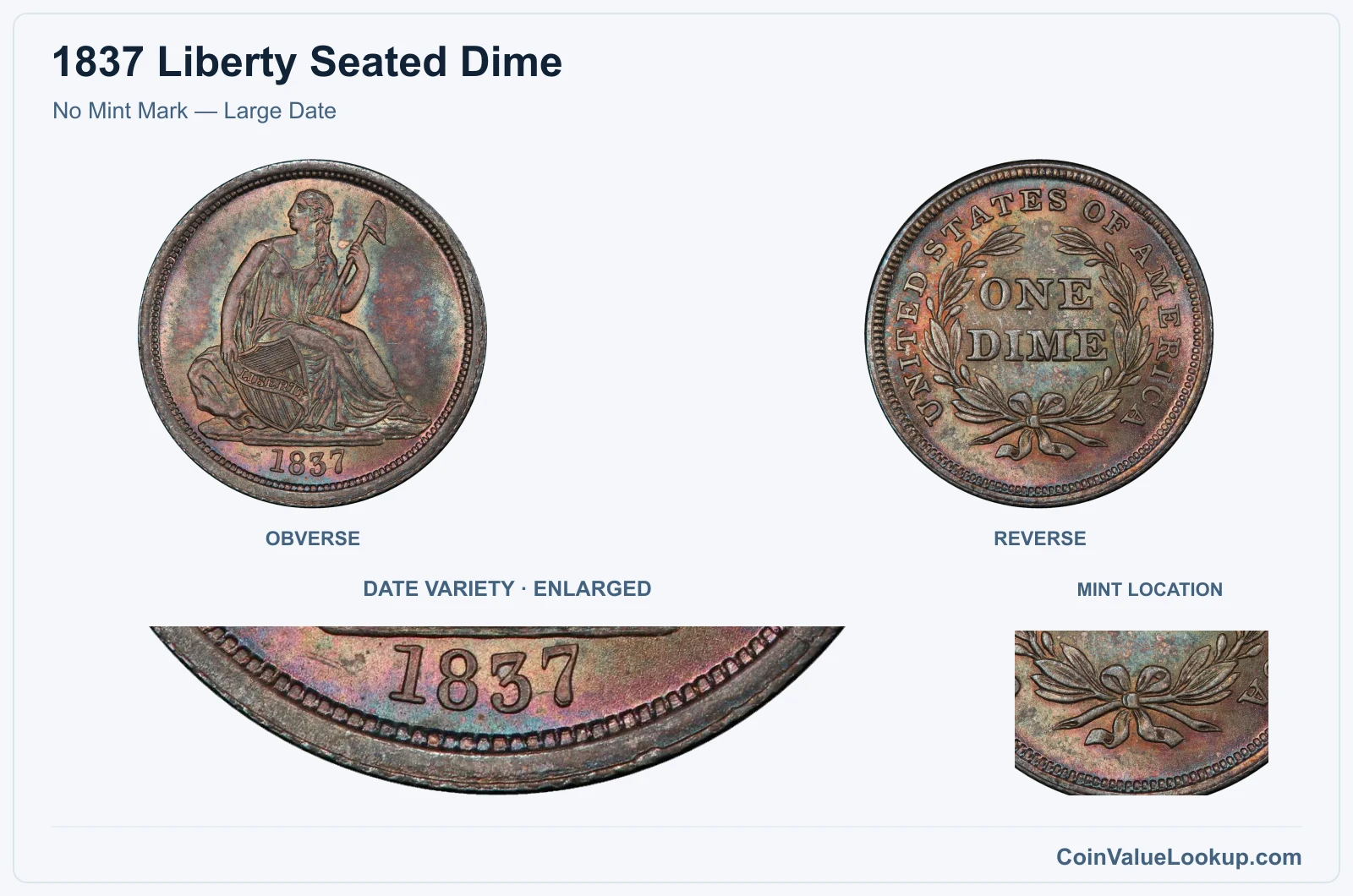
The 1837 Large Date is the other business-strike variety for this year, also from Philadelphia with no mintmark. Same No Stars obverse, same small wreath reverse.
The giveaway is in the 37: the digits stand taller and have flatter tops than on the Small Date version. Hold the coin at arm's length and the height difference in the numerals is often visible even on well-worn examples.
Coin Value Lookup is a handy starting point if you want to compare this dime against other dates and denominations in the Seated Liberty series. Guide estimates from USA Coin Book run about $60 at G4 and roughly $2,175 at MS63, making it slightly less expensive than the Small Date at the upper grades.
Range Grade
Price Auction Records Appraisal PO PO 1
Coin Identifier FR FR 2
—
Coin Identifier AG AG 3
—
Coin Identifier G G 4
—
Coin Identifier
G 6
—
Coin Identifier VG VG 8
—
Coin Identifier
VG 10
Coin Identifier F F 12
Coin Identifier
F 15
Coin Identifier VF VF 20
Coin Identifier
VF 25
Coin Identifier
VF 30
Coin Identifier
VF 35
Coin Identifier XF XF 40
Coin Identifier
XF 45
Coin Identifier AU AU 50
Coin Identifier
AU 53
Coin Identifier
AU 55
Coin Identifier
AU 58
Coin Identifier MS MS 60
Coin Identifier
MS 61
Coin Identifier
MS 62
Coin Identifier
MS 63
Coin Identifier
MS 64
Coin Identifier
MS 65
Coin Identifier
MS 66
Coin Identifier
MS 67
Coin Identifier
MS 68
—
—
—
MS 69
—
—
—
MS 70
—
—
—
1837 Liberty Seated Dime — No Mint Mark — Proof Regular Issue
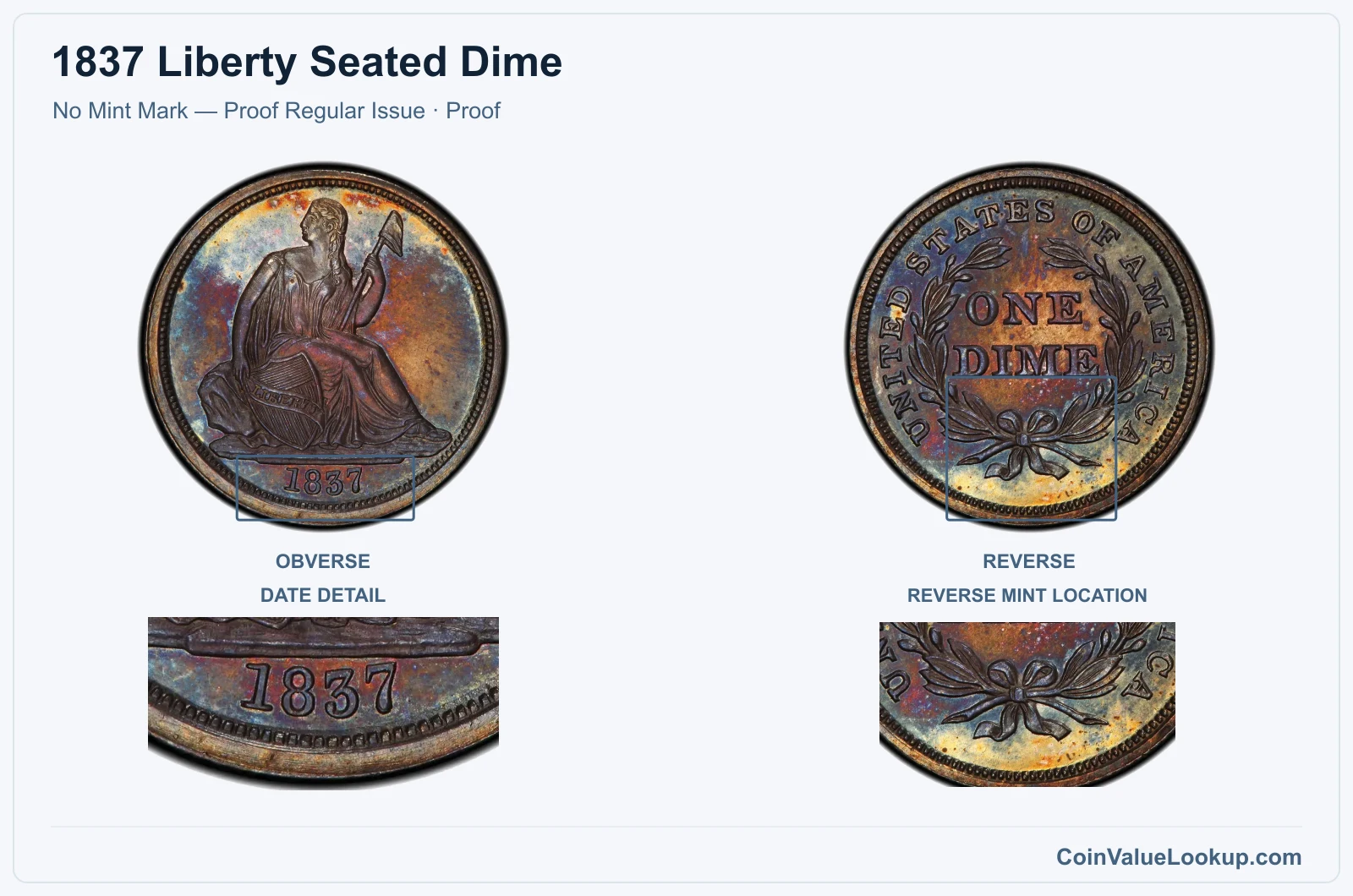
Proof 1837 Seated dimes are rare survivors from the earliest days of the series. These were not mass-produced annual collector coins like later Proofs.
Each one was individually struck with polished dies on polished planchets, producing deeply mirrored fields.
Do not confuse a cleaned or polished circulation coin with a genuine Proof. True Proofs show a specific reflective character in the fields that cleaning cannot replicate, and they require professional attribution.
Cameo contrast, where the devices appear frosty against mirrored fields, is a visual characteristic and not a separate mint issue.
A PCGS guide estimate places this version near $17,000 at PR63. That figure reflects the extreme rarity of confirmed early Proofs, not a guaranteed sale price.
Condition, provenance, and the specific surfaces all influence what any individual coin might bring.
Range Grade
Price Auction Records Appraisal PR PR 1
—
Coin Identifier
PR 2
—
Coin Identifier
PR 3
—
Coin Identifier
PR 4
—
Coin Identifier
PR 6
—
Coin Identifier
PR 8
—
Coin Identifier
PR 10
—
Coin Identifier
PR 12
—
Coin Identifier
PR 15
—
Coin Identifier
PR 20
—
Coin Identifier
PR 25
—
Coin Identifier
PR 30
—
Coin Identifier
PR 35
—
Coin Identifier
PR 40
—
Coin Identifier
PR 45
—
Coin Identifier
PR 50
—
Coin Identifier
PR 53
—
Coin Identifier
PR 55
—
Coin Identifier
PR 58
—
Coin Identifier
PR 60
—
Coin Identifier
PR 61
Coin Identifier
PR 62
Coin Identifier
PR 63
Coin Identifier
PR 64
Coin Identifier
PR 65
Coin Identifier
PR 66
Coin Identifier
PR 67
—
—
—
PR 68
—
—
—
PR 69
—
—
—
PR 70
—
—
—
1837 Liberty Seated Dime Error List
1. 1837 Liberty Seated Dime — Die Crack / Die Chip
Die cracks appear as thin raised lines on the coin's surface, caused by fractures in the steel die during striking. On an 1837 dime, look for lines that may run from the rim inward across the design or connect features.
A die chip shows up as a small raised blob, usually inside a letter or near a design element.
A crack that reaches the rim and produces a raised lump of extra metal is called a cud, which is a more dramatic form of the same problem. Interior cracks tend to be thinner and less dramatic but still collectible.
Do not confuse die cracks with incuse scratches, corrosion lines, or foreign material stuck to the surface. Scratches are recessed into the metal, while die cracks are always raised.
The value of a die crack error depends on the specific crack's size, location, and the coin's overall condition.
2. 1837 Liberty Seated Dime — Clashed Dies
Clashed dies occur when the obverse and reverse dies strike each other without a planchet between them. The impact transfers faint impressions of each die's design onto the other.
On a struck coin, this shows up as ghost-like traces of the opposite design in the fields.
On an 1837 dime, you might see faint outlines of the wreath on the obverse or traces of Liberty on the reverse, aligned with where the opposing features would contact. The transferred images follow specific positions because they result from the normal die alignment.
Do not mistake random scratches, raised lines from other causes, or brockage errors for die clashes. Clash marks follow the pattern of the opposing die and appear in predictable locations.
The premium for a clashed die coin depends on how visible the clash is, the coin's condition, and collector demand for the specific variety.