1868 Liberty Seated Dime Coin Value: How Much Is It Worth?
The 1868 Liberty Seated Dime spans a wide value range depending on mint, grade and finish. USA Coin Book guide estimates run from about $29 in Good-4 for a Philadelphia issue up to roughly $2,501 in MS63 for a San Francisco coin, with Proofs listed around $725 at PR63.
Those are retail guide anchors across different versions, not a promise for any single piece. Condition, originality and the specific version you hold determine where your coin falls.
Fast Way to Identify Your 1868 Liberty Seated Dime
The quickest way to start figuring out what you have is to upload clear photos of both sides of your coin. A front-and-back image lets us provide a preliminary identification of the mint, finish and general condition.
This is not a substitute for professional grading or authentication, but it points you in the right direction before you invest more time or money.
1868 Liberty Seated Dime Value
Upload both sides of your 1868 Liberty Seated Dime.
Front Obverse
Upload photo
Back Reverse
Upload photo
Which 1868 Liberty Seated Dime Versions Are Worth Money?
- The San Francisco (S mintmark) issue lists around $77 at G4 and $2,501 at MS63 per USA Coin Book, making it the pricier regular-issue version in higher grades.
- Philadelphia Proofs carry a guide estimate near $725 at PR63, reflecting their limited intentional production for collectors.
- A Misplaced Date variety, reported mainly on Proof-die coins, shows numeral fragments outside the normal date position — worth checking if your coin has mirror fields.
- A Doubled Die Reverse with doubling on the ribbon ends and lower wreath has been documented for 1868 Philadelphia coins.
Step 1: Identify Your 1868 Liberty Seated Dime Mint Mark and Version
First, confirm the design: a seated Liberty on the obverse with stars and the date, and ONE DIME within a wreath on the reverse. If it says HALF DIME, set it aside — different coin entirely.
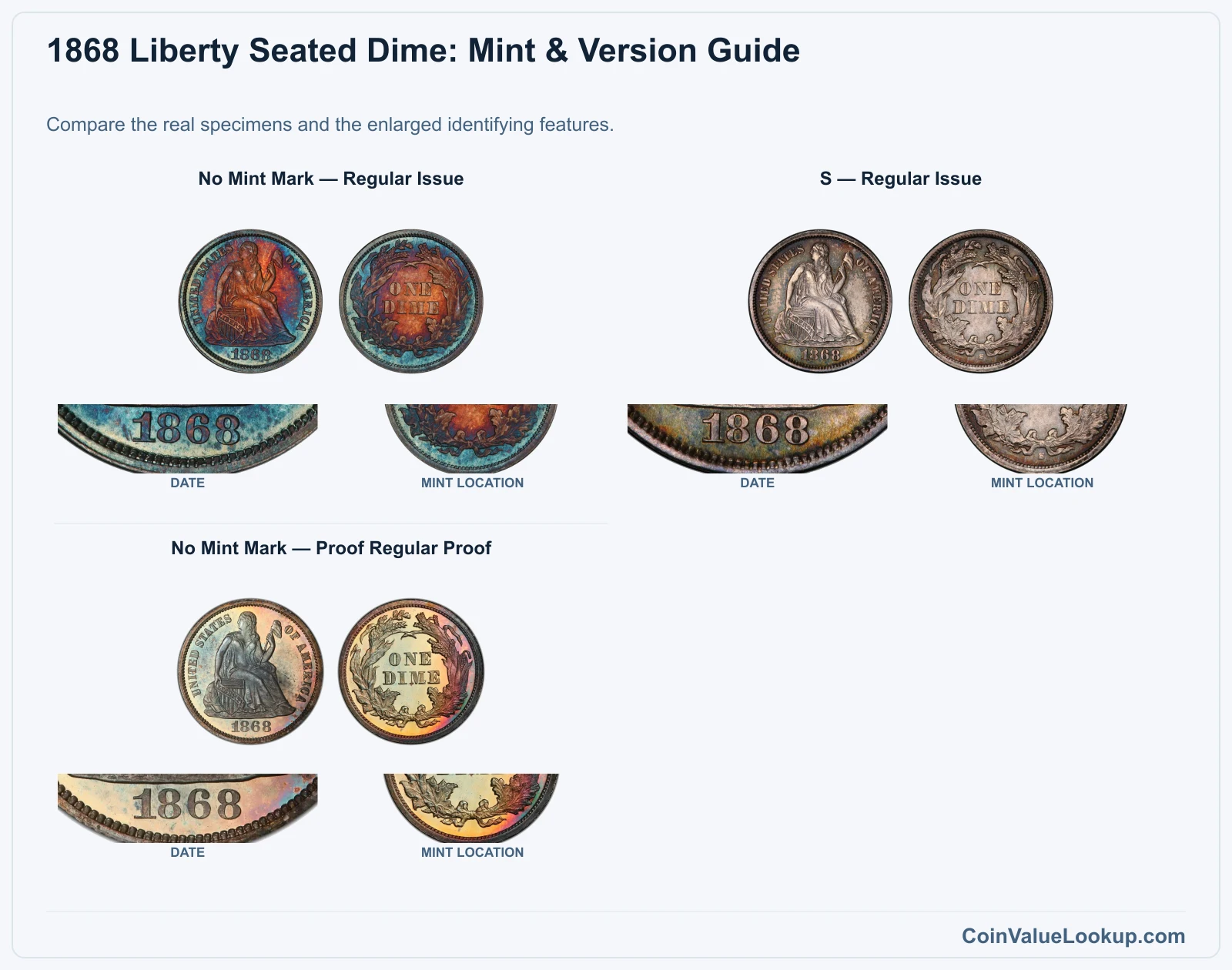
Philadelphia-struck 1868 dimes carry no mintmark. San Francisco pieces show a small "S" on the reverse within the wreath, near the bottom.
No other mint produced this date.
All regular 1868 dimes are 90% silver and 10% copper, 17.9 mm in diameter with a reeded edge, and weigh nominally 2.49 grams. If yours is noticeably lighter or has a smooth edge, something is off.
Philadelphia also struck Proof versions in 1868. A Proof is a special manufacturing finish with mirror-like fields, not simply a high-grade coin.
Polished circulated coins are not Proofs, no matter how shiny they look.
Step 2: Check Your 1868 Liberty Seated Dime Grade
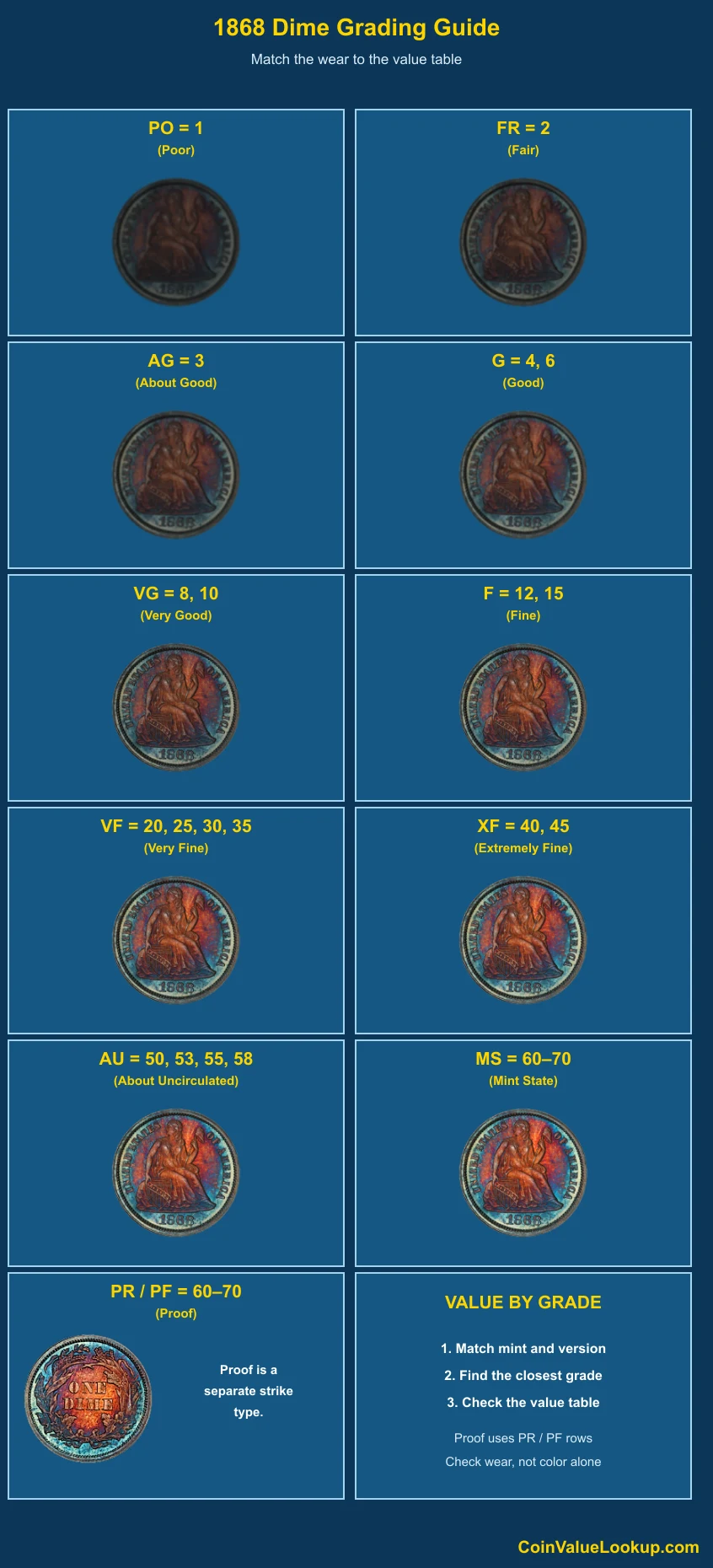
Start with the obverse. Liberty's head detail, the lines across her breast and knee, and the horizontal shield lines are the first areas to lose definition from wear.
On the reverse, check the highest wreath leaves.
Don't confuse a weak strike with actual circulation wear. Some 1868 dimes left the press with soft details, especially on the head or stars.
A weakly struck coin may still have full original luster across flat areas, while a worn coin will show friction and dullness on the high points.
Compare your coin against the grading comparison image to gauge where it fits. Look at both detail sharpness and surface quality — bag marks, scratches and cleaning all matter alongside wear.
Keep Proofs completely separate from business strikes in your assessment. Mirror fields and squared rims are hallmarks of Proof manufacture, not just careful preservation.
Step 3: Check 1868 Liberty Seated Dime Value by Mint and Version
1868 Liberty Seated Dime — No Mint Mark — Regular Issue
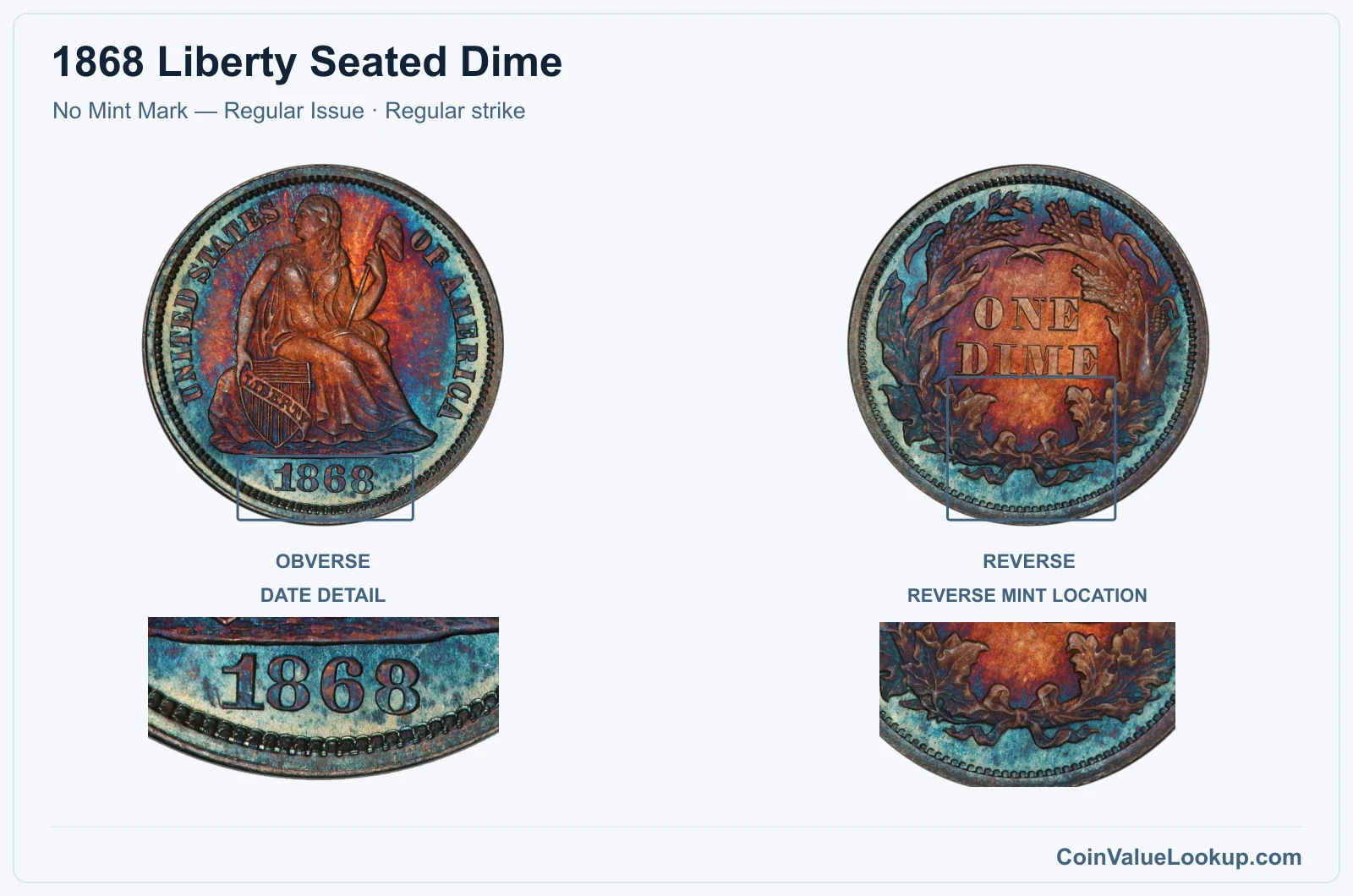
The Philadelphia regular issue is the most common 1868 dime. It carries no mintmark — the reverse wreath area below the bow should be clean of any letter.
USA Coin Book lists this version at about $29 in Good-4 and roughly $1,067 in MS63.
The design is the Legend Obverse type with UNITED STATES OF AMERICA on the obverse and an agricultural wreath on the reverse. Look for original, untampered surfaces.
A genuine uncleaned example with natural toning will generally be more desirable than one that has been harshly cleaned, even if the cleaned coin appears brighter.
Range Grade
Price Auction Records Appraisal PO PO 1
—
Coin Identifier FR FR 2
—
Coin Identifier AG AG 3
—
Coin Identifier G G 4
—
Coin Identifier
G 6
—
Coin Identifier VG VG 8
—
Coin Identifier
VG 10
—
Coin Identifier F F 12
—
Coin Identifier
F 15
—
Coin Identifier VF VF 20
—
Coin Identifier
VF 25
—
Coin Identifier
VF 30
—
Coin Identifier
VF 35
Coin Identifier XF XF 40
Coin Identifier
XF 45
Coin Identifier AU AU 50
—
Coin Identifier
AU 53
Coin Identifier
AU 55
—
Coin Identifier
AU 58
—
Coin Identifier MS MS 60
—
Coin Identifier
MS 61
—
Coin Identifier
MS 62
Coin Identifier
MS 63
Coin Identifier
MS 64
Coin Identifier
MS 65
Coin Identifier
MS 66
Coin Identifier
MS 67
—
Coin Identifier
MS 68
—
—
—
MS 69
—
—
—
MS 70
—
—
—
1868 Liberty Seated Dime — S — Regular Issue
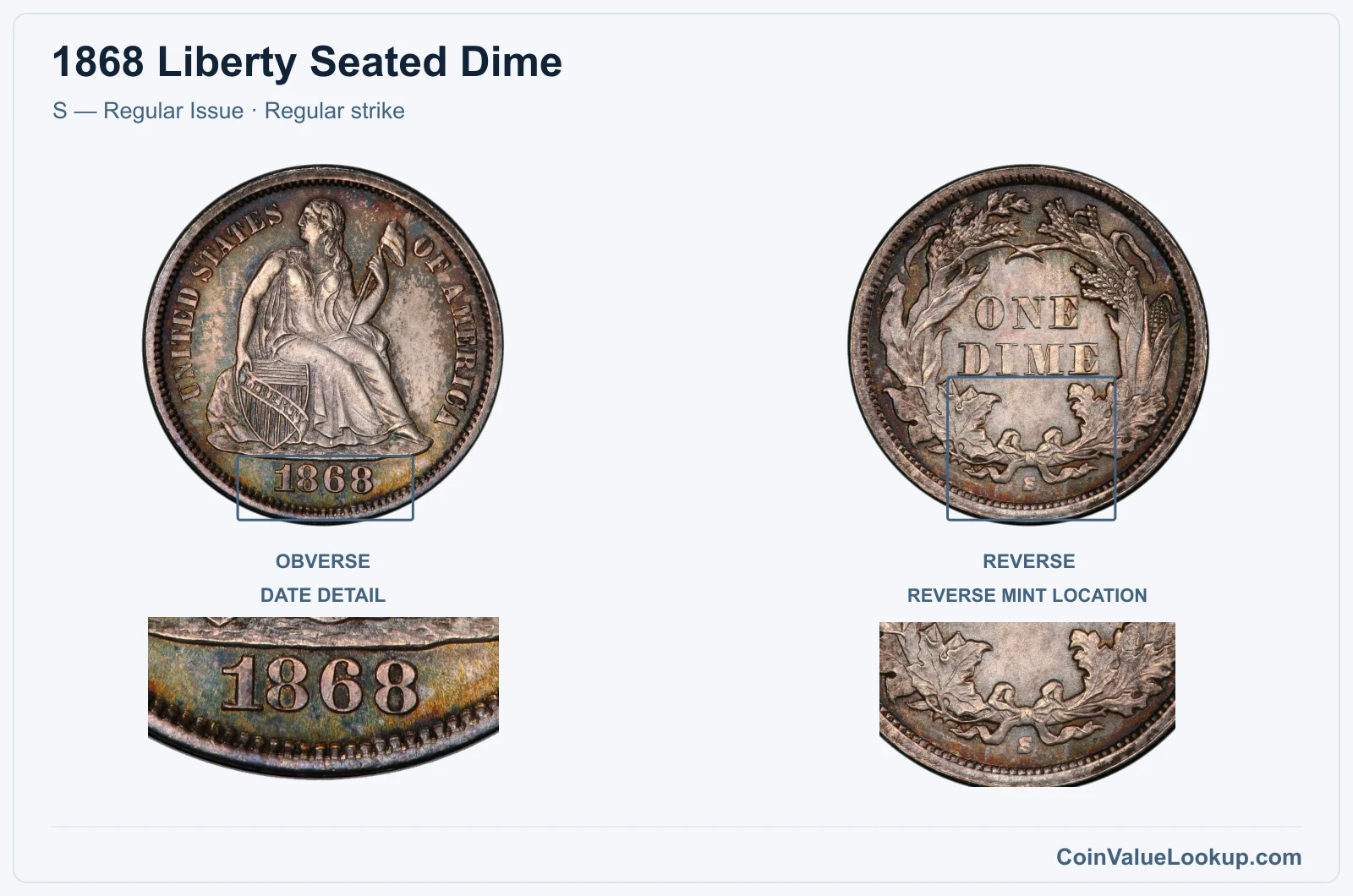
San Francisco struck 1868 dimes with a small "S" mintmark on the reverse, positioned within the wreath near its base. This issue is scarcer in better grades than its Philadelphia counterpart.
USA Coin Book guide estimates sit at about $77 in Good-4 and approximately $2,501 at MS63. That higher-grade premium reflects genuine scarcity — fewer survived in collectible condition.
The same 90% silver composition and 2.49-gram weight apply. When examining the mintmark, make sure the letter is consistent with a genuine punch; an added or altered mintmark is a red flag.
Coin Value Lookup is a handy starting point if you want to look up guides for other dates and mints in the Liberty Seated Dime series.
Range Grade
Price Auction Records Appraisal PO PO 1
—
Coin Identifier FR FR 2
—
Coin Identifier AG AG 3
—
Coin Identifier G G 4
—
Coin Identifier
G 6
—
Coin Identifier VG VG 8
Coin Identifier
VG 10
—
Coin Identifier F F 12
Coin Identifier
F 15
—
Coin Identifier VF VF 20
Coin Identifier
VF 25
Coin Identifier
VF 30
Coin Identifier
VF 35
—
Coin Identifier XF XF 40
Coin Identifier
XF 45
Coin Identifier AU AU 50
Coin Identifier
AU 53
Coin Identifier
AU 55
—
Coin Identifier
AU 58
Coin Identifier MS MS 60
—
Coin Identifier
MS 61
—
Coin Identifier
MS 62
Coin Identifier
MS 63
Coin Identifier
MS 64
Coin Identifier
MS 65
Coin Identifier
MS 66
Coin Identifier
MS 67
Coin Identifier
MS 68
—
—
—
MS 69
—
—
—
MS 70
—
—
—
1868 Liberty Seated Dime — No Mint Mark — Proof Regular Proof
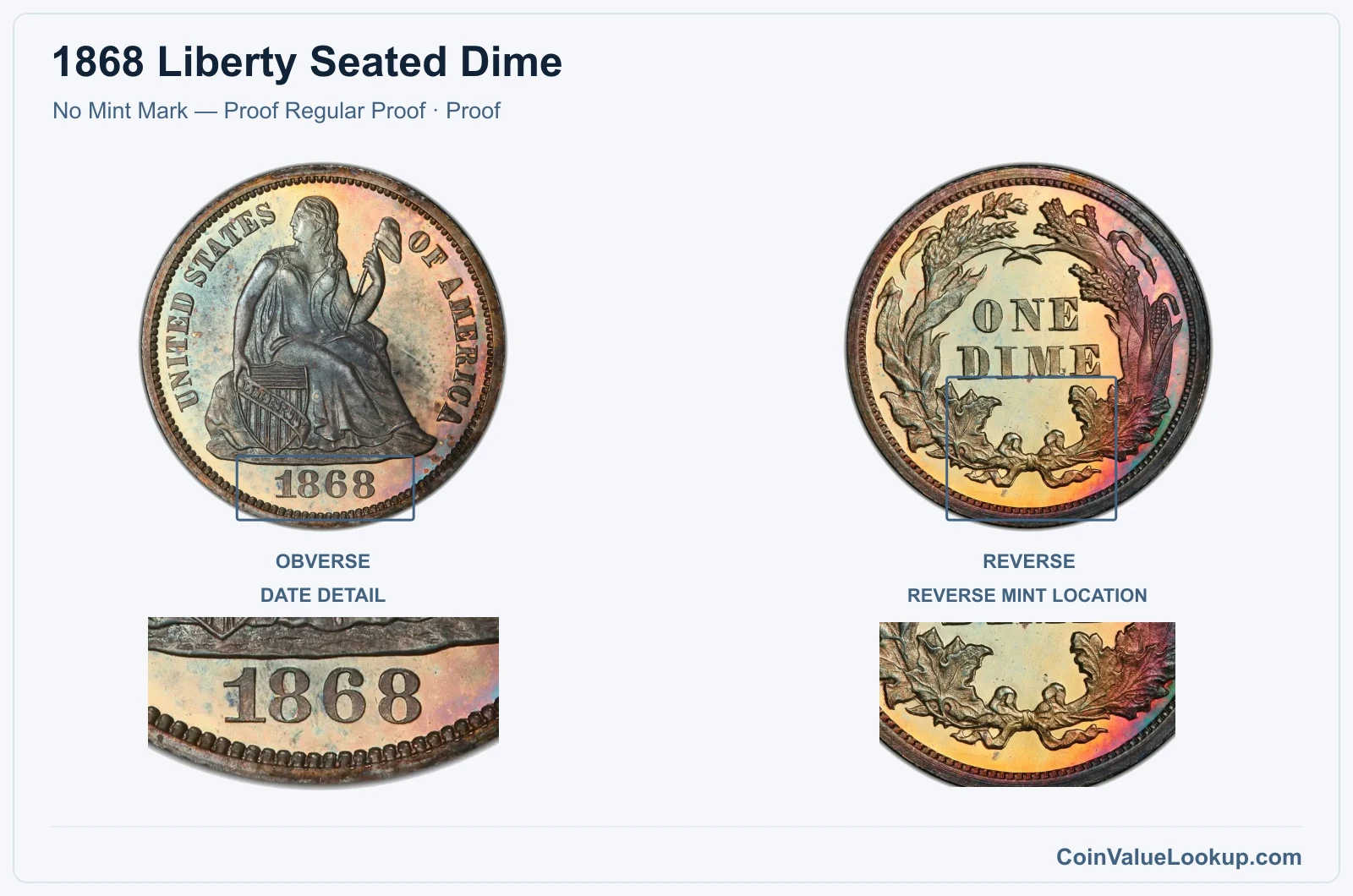
Philadelphia Proof 1868 dimes were deliberately struck for collectors using polished dies and prepared planchets. The result is mirror-like fields that reflect like glass, with the design elements standing in sharp relief against that reflective surface.
USA Coin Book lists this version at roughly $725 in PR63. Hairlines from improper storage or cleaning are common on surviving Proofs and will affect the grade and value.
A coin that merely looks shiny from polishing is not a Proof — look for the combination of squared rims, fully struck details and deeply mirrored fields.
Brilliance alone does not confirm Proof status. If you suspect yours is a Proof, professional attribution from a major grading service is the safest path.
Range Grade
Price Auction Records Appraisal PR PR 1
—
Coin Identifier
PR 2
—
Coin Identifier
PR 3
—
Coin Identifier
PR 4
—
Coin Identifier
PR 6
—
Coin Identifier
PR 8
—
Coin Identifier
PR 10
—
Coin Identifier
PR 12
—
Coin Identifier
PR 15
—
Coin Identifier
PR 20
—
Coin Identifier
PR 25
—
Coin Identifier
PR 30
—
Coin Identifier
PR 35
—
Coin Identifier
PR 40
—
Coin Identifier
PR 45
—
Coin Identifier
PR 50
—
Coin Identifier
PR 53
—
Coin Identifier
PR 55
—
Coin Identifier
PR 58
Coin Identifier
PR 60
—
Coin Identifier
PR 61
Coin Identifier
PR 62
Coin Identifier
PR 63
Coin Identifier
PR 64
Coin Identifier
PR 65
Coin Identifier
PR 66
Coin Identifier
PR 67
Coin Identifier
PR 68
—
—
—
PR 69
—
—
—
PR 70
—
—
—
1868 Liberty Seated Dime Error List
1. 1868 Liberty Seated Dime — Repunched Date
A Repunched Date on the 1868 dime shows remnants of an earlier position of one or more date numerals alongside the final placement. This happened when the date punch was applied to the die more than once in slightly different positions.
To spot it, examine each digit under magnification. Look for traces — partial outlines or shadows — of a numeral offset from the final, sharply defined digit.
The remnants may appear above, below or to one side.
Don't confuse this with machine doubling, which produces a flat, shelf-like distortion rather than distinct secondary punch impressions. Random damage or corrosion can also mimic the look.
The specific error, its visibility and the coin's overall condition all affect how much premium, if any, a given example commands.
2. 1868 Liberty Seated Dime — Misplaced Date
The Misplaced Date variety on the 1868 dime is reported mainly on Proof-die pieces, though a business-strike example has also been noted. Look at the base of the coin below the seated Liberty figure for fragments of a numeral that ended up outside the intended date position.
These stray impressions occurred when the date punch accidentally struck the die in the wrong spot before being correctly placed. The key diagnostic is matching the shape of the fragment to a recognizable digit from the date.
Straight scratches, die polish lines or random marks can look similar at first glance but won't match the contour of a specific numeral. Condition and how clearly the misplaced digit shows both play into any added value, but no reliable price range is established for this variety.
3. 1868 Liberty Seated Dime — Clashed Dies
Clashed dies on the 1868 dime — reported for Philadelphia strikes — result from the obverse and reverse dies striking each other without a planchet between them. That contact transfers faint ghost impressions of the opposite design onto each die, which then appear on subsequently struck coins.
On the obverse, you might see faint traces of the wreath pattern in the open fields. On the reverse, look for hints of Liberty's seated figure or shield outline where they don't belong.
The transferred elements will be positioned consistent with the normal die alignment.
Don't mistake random scratches, contact marks or raised lines from a damaged die for a genuine clash. True clash marks follow the geometry of the opposing design.
Value depends on the strength of the clash impression and the coin's condition.
4. 1868 Liberty Seated Dime — Doubled Die Reverse
A Doubled Die Reverse has been documented on the 1868 Philadelphia dime, showing minor doubling on the ribbon ends and lower wreath area. This is a true hub-doubling variety — the reverse die received a second impression from the hub in a slightly different position, creating separated or thickened design contours.
Compare your coin's ribbon ends and lower wreath details to a known normal example. Genuine doubling will show consistent separation or notching on affected elements.
Machine doubling is the most common lookalike and produces a flat, shelf-like distortion rather than the raised, rounded secondary contours of a doubled die. Reflections, lighting tricks and random damage can also fool you.
The value of any doubled die depends on how visible the doubling is and the coin's overall condition; no specific price data is established for this variety.