1882 Liberty Seated Dime Coin Value: How Much Is It Worth?
The 1882 Liberty Seated Dime was struck only at the Philadelphia Mint, in both business-strike and Proof formats. Retail guide estimates from USA Coin Book place the regular issue at about $22 in G4 and around $316 in MS63, while the Proof carries a guide value near $725 in PR63.
That spread reflects the wide gap between a worn survivor and a well-preserved example, so your coin's condition matters enormously.
Fast Way to Identify Your 1882 Liberty Seated Dime
The quickest way to start figuring out what you have is to upload clear photos of both the front and back of your coin. Our identifier can give you a preliminary read on the date, mint, finish and general type.
It is not a substitute for professional authentication or grading, but it points you in the right direction before you dig deeper.
1882 Liberty Seated Dime Value
Upload both sides of your 1882 Liberty Seated Dime.
Front Obverse
Upload photo
Back Reverse
Upload photo
Which 1882 Liberty Seated Dime Versions Are Worth Money?
- The regular Philadelphia business strike ranges from about $22 at G4 to $316 at MS63 per USA Coin Book, making higher-grade survivors the ones to watch.
- Proofs carry a guide value near $725 at PR63, reflecting lower original mintage and collector demand for the mirror-field finish.
- Repunched date and misplaced date varieties are documented for 1882 and can carry premiums, though value depends on condition and how visible the feature is.
- Die cracks and clashed dies are recorded on 1882 Philadelphia dimes; dramatic examples draw variety-collector interest beyond the normal issue price.
Step 1: Identify Your 1882 Liberty Seated Dime Mint Mark and Version
The 1882 dime features a seated Liberty on the obverse surrounded by stars and the legend UNITED STATES OF AMERICA, with ONE DIME inside an agricultural wreath on the reverse. This is the Legend Obverse variety used from 1860 onward, so do not confuse it with earlier types that carry the legend on the reverse.
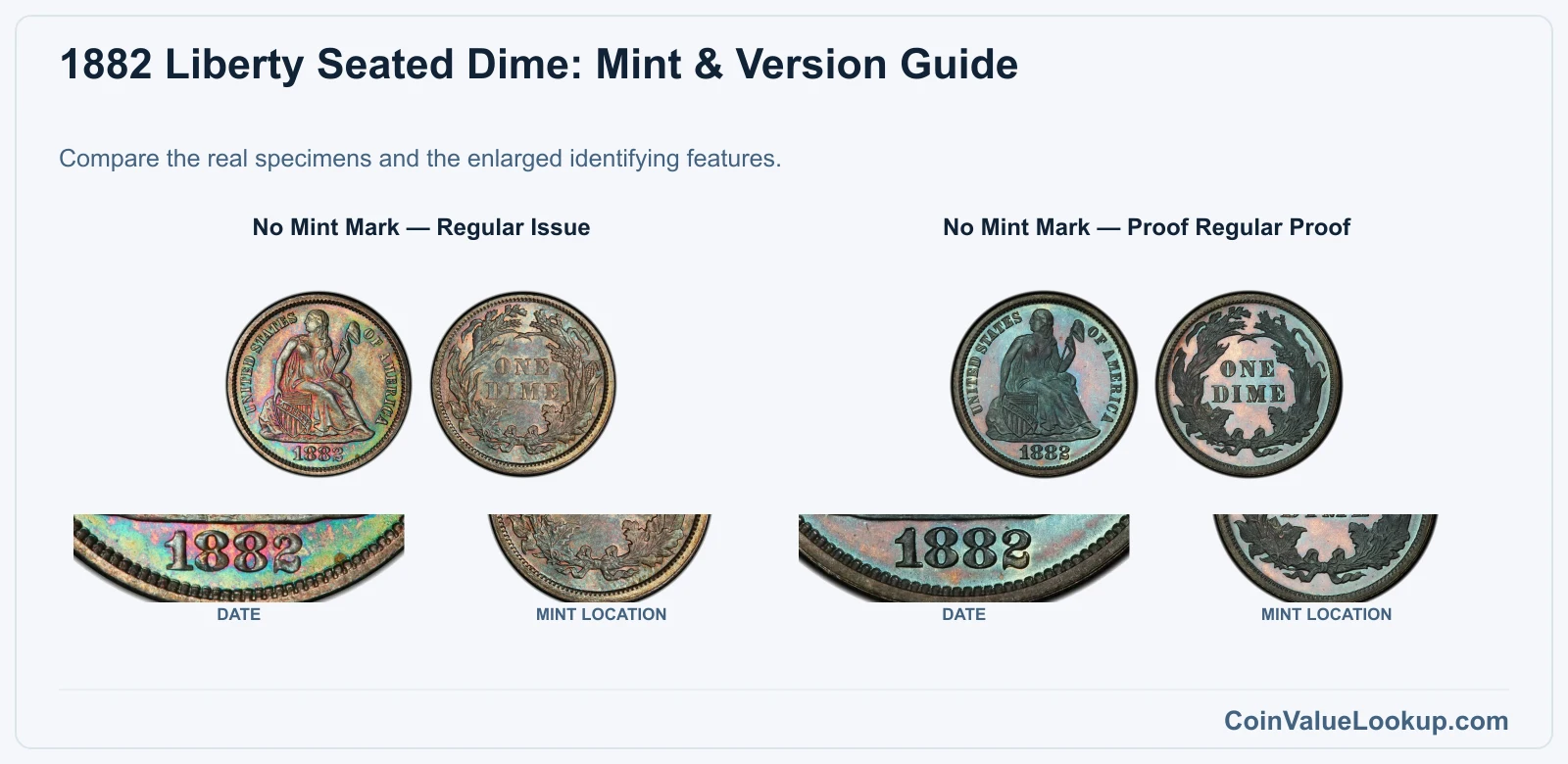
Philadelphia struck the entire 1882 run. There is no mintmark on this coin, period.
If you see a small letter below or within the wreath, you are looking at a different year or denomination.
The coin is 90% silver and 10% copper, weighs a nominal 2.50 grams and measures 17.9 mm with a reeded edge. A half dime is noticeably smaller and lighter, so size alone rules it out.
Weigh your coin if you suspect a counterfeit; significant deviation from 2.50 g is a red flag.
Beyond the normal business strike and Proof, collectors also watch for die varieties such as repunched dates and misplaced digits. These require magnification and careful comparison, but they are real features worth checking once you know what to look for.
Step 2: Check Your 1882 Liberty Seated Dime Grade
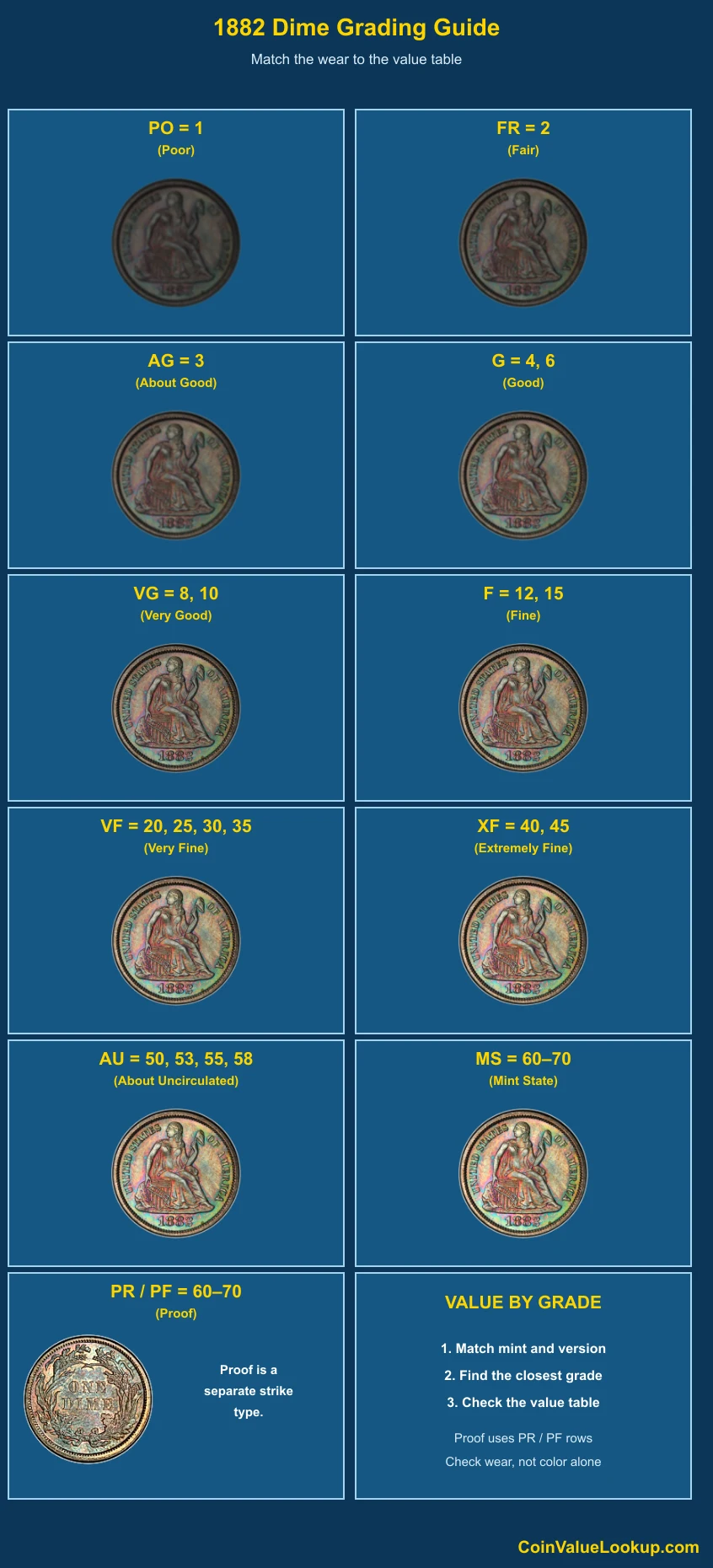
Start with Liberty's head and upper body. On a well-worn coin the hair detail above the ear disappears first, followed by the breast, knee and shield lines.
Compare both sides of your coin to the reference image to gauge how much design remains.
Luster is the other half of the story. A coin can retain sharp detail yet show dull, cleaned surfaces, which hurts its grade.
Conversely, a lightly circulated piece with original silvery luster often grades higher than you would expect from detail alone.
Weak strikes exist on this series and can mimic wear, especially on the head and wreath leaves. Look for undisturbed luster in the flat areas; if it is still there, the softness is from the strike, not from someone's pocket.
Proof coins have mirror-like fields produced by specially prepared dies and polished planchets. A shiny coin is not automatically a Proof.
Polished or whizzed business strikes lack the sharp, squared-off rims and the deep reflectivity of genuine Proofs, so keep those categories separate when grading.
Step 3: Check 1882 Liberty Seated Dime Value by Mint and Version
1882 Liberty Seated Dime — No Mint Mark — Regular Issue
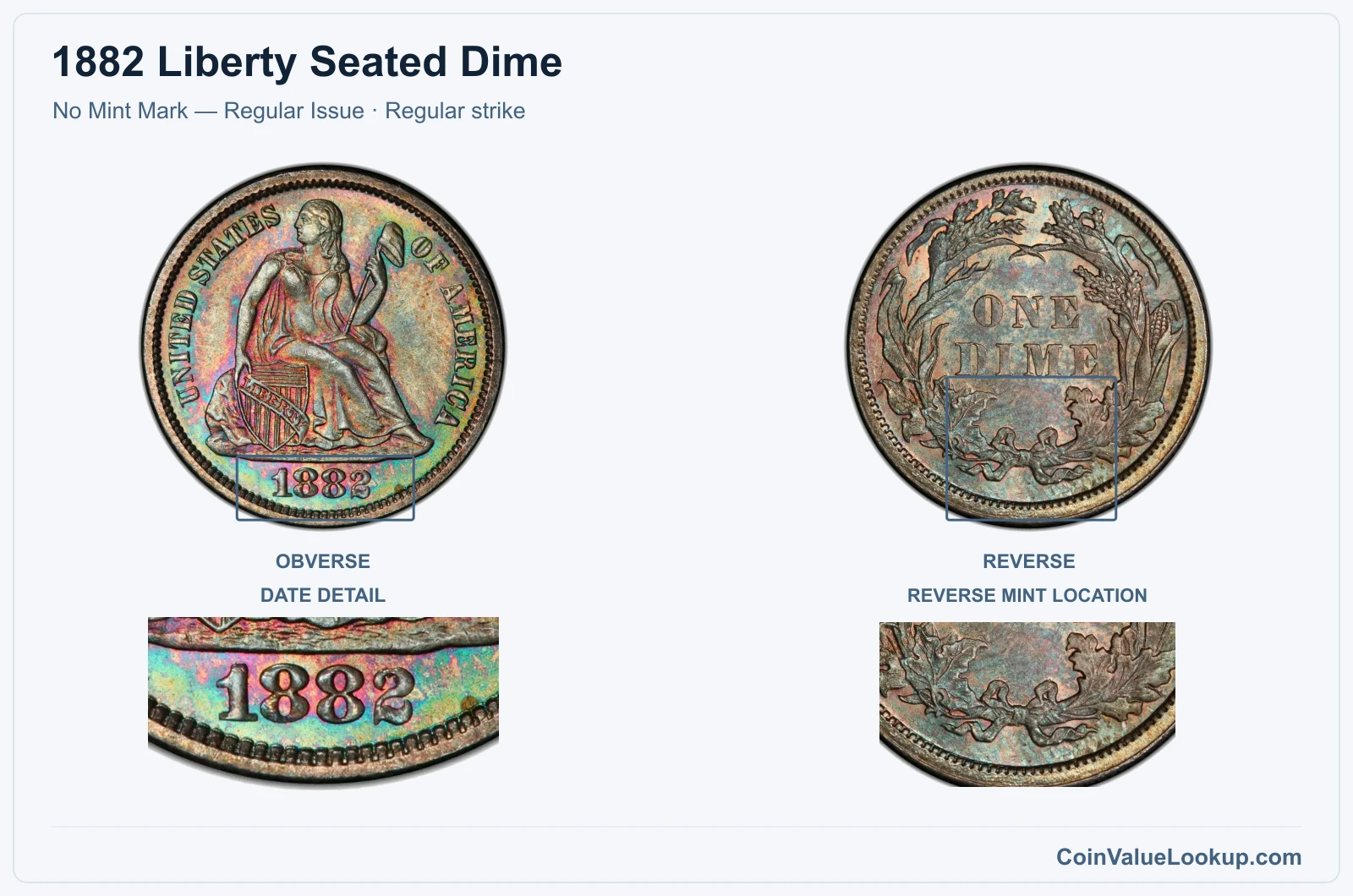
The 1882 regular-issue dime was struck at Philadelphia with no mintmark. It uses the Legend Obverse paired with the agricultural wreath reverse reading ONE DIME.
The coin is 90% silver and 10% copper, weighing 2.50 grams.
USA Coin Book lists a retail guide value of about $22 in G4 and roughly $316 in MS63. Most survivors turn up in lower circulated grades, so a piece with strong luster and minimal contact marks stands well above the crowd.
Check the date area under magnification for repunched or misplaced digits before filing it away as strictly ordinary.
Coin Value Lookup is a good starting point if you want to compare this dime against other dates and denominations in the Liberty Seated series.
Range Grade
Price Auction Records Appraisal PO PO 1
—
Coin Identifier FR FR 2
—
Coin Identifier AG AG 3
—
Coin Identifier G G 4
—
Coin Identifier
G 6
—
Coin Identifier VG VG 8
—
Coin Identifier
VG 10
—
Coin Identifier F F 12
—
Coin Identifier
F 15
—
Coin Identifier VF VF 20
—
Coin Identifier
VF 25
—
Coin Identifier
VF 30
—
Coin Identifier
VF 35
—
Coin Identifier XF XF 40
—
Coin Identifier
XF 45
Coin Identifier AU AU 50
—
Coin Identifier
AU 53
—
Coin Identifier
AU 55
Coin Identifier
AU 58
Coin Identifier MS MS 60
Coin Identifier
MS 61
Coin Identifier
MS 62
Coin Identifier
MS 63
Coin Identifier
MS 64
Coin Identifier
MS 65
Coin Identifier
MS 66
Coin Identifier
MS 67
Coin Identifier
MS 68
Coin Identifier
MS 69
—
—
—
MS 70
—
—
—
1882 Liberty Seated Dime — No Mint Mark — Proof Regular Proof
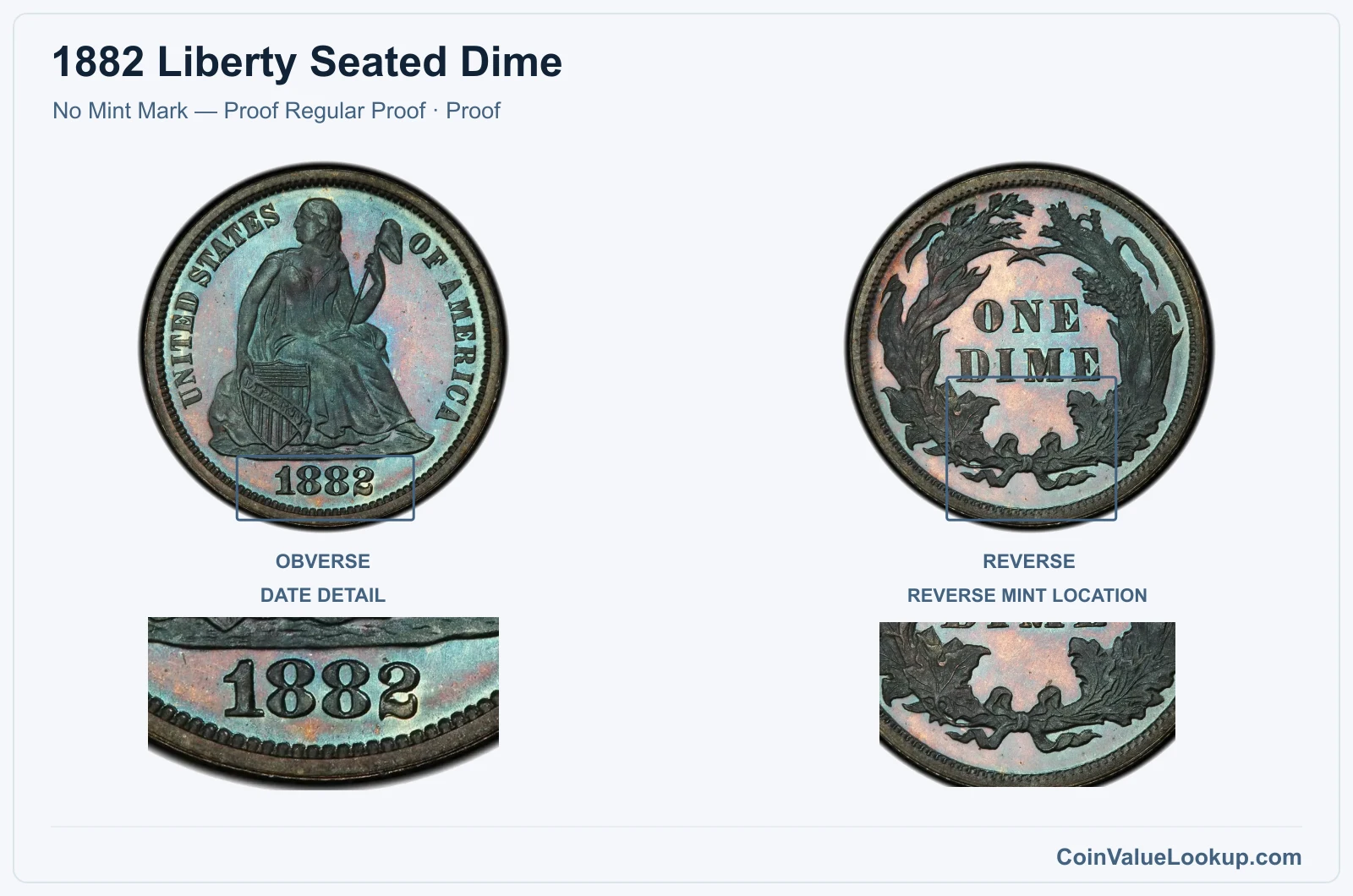
Philadelphia also produced Proof dimes in 1882 for collectors, struck from specially prepared dies on polished planchets. The fields should show deep, glassy reflectivity, and the rims are typically sharp and squared off compared to a business strike.
USA Coin Book places the PR63 guide value at approximately $725. That figure assumes original surfaces without heavy hairlines.
Hairlines from improper cleaning are common on old Proofs and can drag the grade and value down considerably.
To confirm you actually have a Proof, look for the combination of mirror fields, full design sharpness and deliberate die preparation marks. Brilliance alone is not enough.
A polished or dipped business strike can look shiny, but it will lack the squared rim profile and the distinctive field depth of a genuine Proof. When in doubt, a third-party grading service is the safest confirmation.
Range Grade
Price Auction Records Appraisal PR PR 1
—
Coin Identifier
PR 2
—
Coin Identifier
PR 3
—
Coin Identifier
PR 4
—
Coin Identifier
PR 6
—
Coin Identifier
PR 8
—
Coin Identifier
PR 10
—
Coin Identifier
PR 12
—
Coin Identifier
PR 15
—
Coin Identifier
PR 20
—
Coin Identifier
PR 25
—
Coin Identifier
PR 30
—
Coin Identifier
PR 35
—
Coin Identifier
PR 40
—
Coin Identifier
PR 45
—
Coin Identifier
PR 50
—
Coin Identifier
PR 53
—
Coin Identifier
PR 55
—
Coin Identifier
PR 58
Coin Identifier
PR 60
—
Coin Identifier
PR 61
Coin Identifier
PR 62
Coin Identifier
PR 63
Coin Identifier
PR 64
Coin Identifier
PR 65
Coin Identifier
PR 66
Coin Identifier
PR 67
Coin Identifier
PR 68
Coin Identifier
PR 69
Coin Identifier
PR 70
—
—
—
1882 Liberty Seated Dime Error List
1. 1882 Liberty Seated Dime — Repunched Date
A repunched date on the 1882 dime shows remnants of an earlier position of one or more date numerals beside or overlapping the final digits. Under magnification you will see traces of a slightly shifted numeral, usually visible as a ghost outline or a thickened edge on part of the date.
This is different from doubled-die doubling, which affects the entire design. A repunched date is strictly a date-punch positioning error, where the engraver placed the punch, struck it, then repositioned and struck again.
The leftover impression from the first hit is the diagnostic.
Do not confuse this with mechanical damage or machine doubling, which tends to produce flat, shelf-like displacement rather than a sharp secondary image. Condition of the coin and clarity of the extra impression both affect how much a collector will pay, so no single price applies across the board.
2. 1882 Liberty Seated Dime — Misplaced Date
A misplaced date variety shows part of a date digit where it does not belong, typically in the denticles or lower field near the base of the date. On the 1882 dime, look carefully in those areas for a recognizable fragment of a numeral, such as the top curve of an 8 or the serif of a 1.
The key test is shape. A genuine misplaced digit has the contour of an actual numeral, raised and consistent with the font used on the date.
Random die scratches, polishing lines and bag marks do not follow that pattern.
This variety is reported for 1882 Philadelphia dimes. Value depends on the strength and visibility of the displaced digit as well as overall coin condition, so premiums vary widely and no single figure covers every example.
3. 1882 Liberty Seated Dime — Die Crack / Die Chip
Die cracks appear as thin raised lines on the coin's surface, caused by fractures in the steel die during striking. On the 1882 Philadelphia dime, these can run across fields, through lettering or from the rim inward.
A die chip is a small raised blob where a piece of the die broke away, leaving a filled area that produces a bump on the struck coin.
If a crack extends from an interior break all the way to the rim and a chunk of the die collapses, the result is called a cud, a larger raised area at the edge. Most 1882 cracks are more modest than that.
Do not mistake incuse scratches, surface corrosion or debris stuck to the coin for a genuine die crack. Die cracks are raised and follow a consistent path across multiple specimens from the same die.
Premium depends on size, location and the coin's overall grade.
4. 1882 Liberty Seated Dime — Clashed Dies
Clashed dies occur when the obverse and reverse dies strike each other without a planchet in between. The impact transfers a mirror image of each die's design onto the opposite die, and subsequent coins struck from those dies carry faint traces of the wrong design in the fields.
On an 1882 dime, look in the open field areas for outlines that correspond to features on the opposite side, such as wreath elements appearing faintly around Liberty or seated figure outlines showing in the reverse field. The transferred images will be aligned consistently with how the dies meet.
Do not confuse clashed-die impressions with random scratches, raised lines from die polishing or a brockage, which is a different kind of error involving a previously struck coin stuck to the die. The value of a clash depends on how dramatic and visible the transferred design is, along with the coin's condition.